




Abstract
The enthusiastic embrace of virtual reality films as ‘the ultimate empathy machine’ by humanitarian organisations and technology companies can be positioned as an attempt to change attitudes towards refugees through a strategy of ‘humanisation’. This article offers a critique of humanising approaches to displacement as they manifest in the United Nations’ first-ever virtual reality film Clouds Over Sidra (2015), targeted at policy makers, donors, and the general public in the Global North. Through an experiential and textual analysis of the film, I analyse two strategies of humanisation in Clouds Over Sidra: reproduction of ‘ideal’ figures of the refugee through the depiction of daily life in Za’atari camp and overrepresentation of children, and depoliticisation of displacement via technological disembodiment in the film. The former results in a never-ending search for purity, and the latter depoliticises displacement through an erasure of differential exposure to colonial and racial regimes of im/mobility. I argue that humanising approaches based on a logic of inclusion ultimately affirm the colonial and racial hierarchy of humanity as they leave unquestioned the already colonial and racial nature of ‘the human’. This article provides an original contribution to debates about VR technology, empathy, and displacement by going beyond a generalised critique of VR films to foreground a critique of humanising approaches to displacement. I conclude by asking what it might mean to think about displacement relationally, an approach that is grounded in a politics of location and global relations of power.
Introduction
When the film begins, I am standing alone in a desert. As I look around, I notice footmarks on the ground. The narrator starts to tell me about her journey from Syria to Jordan, reminiscing about a kite that got stuck in a tree back home in Syria before she had to flee. I then enter a refugee camp. A young girl, whom I come to know as Sidra, introduces me to her daily life, providing candid and at times humorous narration to each scene. I watch her siblings playing together; children forming a human train on the way to school; Sidra’s all-girls class; a bakery where pita bread is being made in a tandoor oven; children playing outside on muddy ground; an Internet café full of boys playing computer games; a makeshift gym, boys wrestling, and girls playing football; Sidra having dinner with her family; and children running towards and encircling me. All this time I feel like a fly on a wall, as if I am not supposed to be here. I am troubled by the ease with which I enter their lives. The last scene depicts the vastness of the camp, and the film ends with Sidra’s hopeful message of return: I will not be twelve forever and I will not be in Za’atari forever. My teacher says the clouds moving over us also came here from Syria. Someday, the clouds and me are going to turn around and go back home. (Milk and Pousman, 2016)
Lasting 8 minute 45 seconds, the virtual reality (VR) film ends with a link to a website 1 showing what action the viewer can take to help refugees like Sidra.
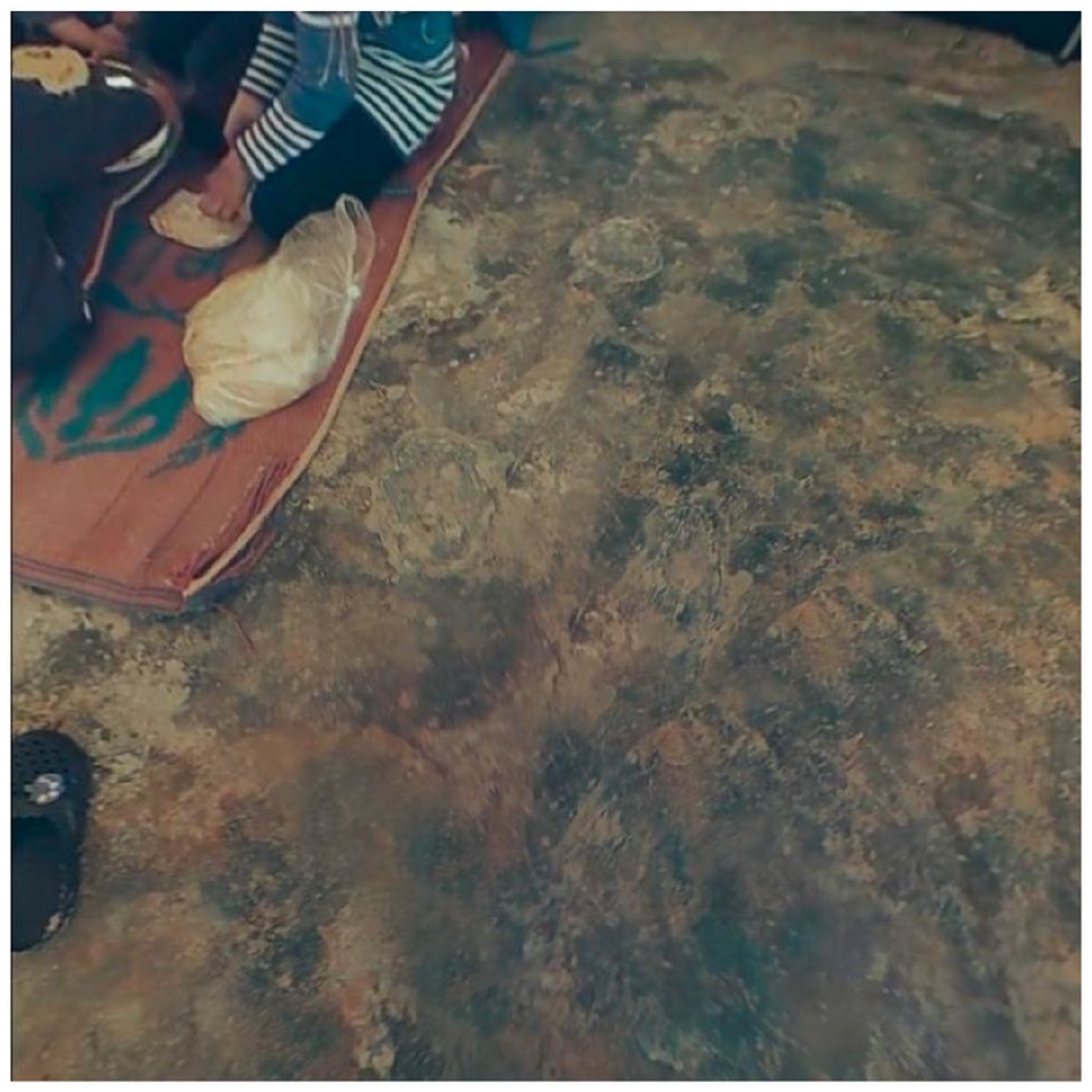
Throughout the film, I can look around to get a 360° view. Sounds of everyday life surround me: the rustling of people going about their daily lives, giggles and chatters of children, and the clanking sounds of equipment in the gym. The experience is peculiarly embodied and disembodied; I am constantly aware of the weight of the VR headset and the mild nausea, 2 and yet in the film I do not have a body when I look down. The traces of the camera are erased, giving me a ghostly presence, as if I am playing ‘the god trick of seeing everything from nowhere’ (Haraway, 1988: 581). Still, the film itself is clearly a view from somewhere – what is shown within the 360° view was chosen by specific people for particular purposes – and my physical presence was made obvious when people spoke to me and looked at me directly, either with curiosity or suspicion.
Image: Sidra speaking.
Taken on Oculus Quest 2 (Milk and Pousman, 2016).
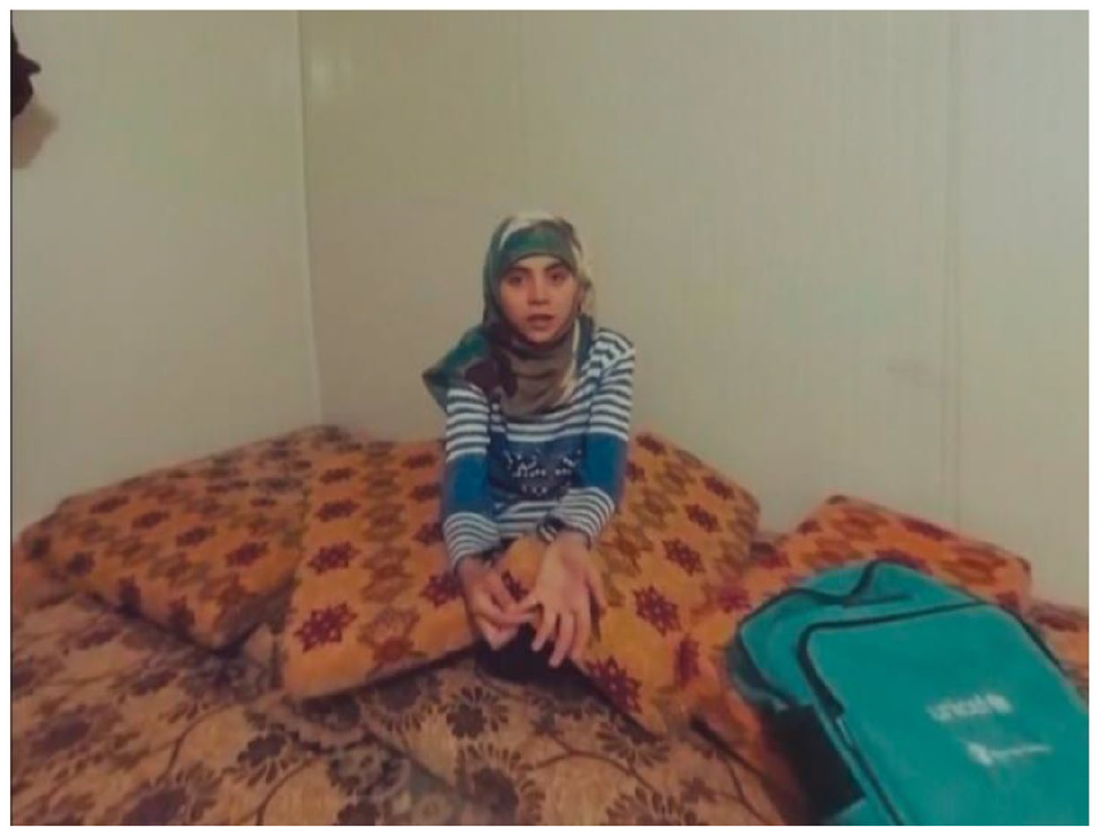
Image: I am standing beside Sidra having dinner with her family. My body is absent.
Taken on Oculus Quest 2 (Milk and Pousman, 2016).
Humanisation of refugees 3 and ‘the ultimate empathy machine’
Clouds Over Sidra is the United Nation’s (UN) first-ever VR film, released in the aftermath of the ‘Syrian refugee crisis’ in 2015. Created by the UN Sustainable Development Goals Action Campaign, VR company Vrse, UNICEF Jordan, and Samsung, it tells the story of a 12 year-old Syrian refugee, Sidra, living in Za’atari refugee camp in Jordan. The film has received much acclaim since its release at the World Economic Forum in Davos in January 2015, where participants entered Za’atari camp through VR headsets. The film targets diplomats, policymakers, and donors, and its intention is to bridge the disconnect between ‘the powerful’ and those who are forced to live the consequences of their decisions. As Gabo Arora, the director of the film, the UN’s first Creative Director, and the founder of UN Virtual Reality puts it: I think a lot of these people, even when they would go into Za’atari Camp or someplace like that, it’s with an entourage . . . I just didn’t feel like they were really, truly understanding what it’s like to walk in someone else’s shoes, and I think that all of them need to. (Bierend, 2015)
Since its release, the film has been used to target those in the Global North 4 more generally, for example in UNICEF’s street fundraising efforts (Cravinho, 2016).
The film can be situated in the wider context in which, since 2015, international and humanitarian organisations and VR companies have produced VR films to shed light on social and political issues to raise funds and awareness in the Global North. VR technology, first developed in the 1980s and 1990s, is now hailed as ‘a visceral empathy generator’ (De la Peña, 2015) and ‘the ultimate empathy machine’ (Milk, 2015). Facebook (now Meta), which acquired VR start-up Oculus VR for approximately $3 billion in 2014, has also framed the technology in this way: ‘One of the most powerful features of VR is empathy. My goal here [VR experience of hurricane-hit Puerto Rico] was to show how VR can raise awareness and help us see what’s happening in different parts of the world’ (Mark Zuckerberg quoted in Tarnoff, 2017). Such celebratory remarks about the transformative potential of VR technology are a continuation of the discourses during the 1980s and 1990s, when high expectations abounded regarding VR technology’s potential to forge connections and bridge or even eliminate difference within the virtual world; enthusiasts imagined boundless connections with anyone around the globe (Chester, 2003; Lanier, 1989).
The supposedly transformative nature of VR films in eliciting empathy is based on their ability to forge a shared humanity through the technological affordances of VR such as immersion and presence. Arora (2019) comments that, ‘Many [viewers] are often moved to feel a connection they didn’t expect with someone they thought were [sic] different from them. The shared humanity is what moves people the most’ (emphasis mine). The film cultivates empathy as viewers overcome apparent differences and recognise the shared humanity between themselves and refugees. Producer Chris Milk (2015) makes a similar remark: You feel her [Sidra’s] humanity in a deeper way. You empathise with her in a deeper way . . . [VR is] a machine, but through this machine we become more compassionate, we become more empathetic, and we become more connected. And ultimately, we become more human.
In Arora and Milk’s views, VR films cultivate the viewer’s empathy and compassion towards refugees through ‘humanisation’, that is, recognition of another as a fellow human being, via Sidra and others in the film. This shared humanity serves as the basis for empathy, which Arora summarises as ‘walking in someone else’s shoes’ (Bierend, 2015). VR technology is thus framed as a tool that makes people more compassionate and empathetic, which are posited as emotions that lead to the betterment of society.
Such ‘humanising’ strategies seek to challenge dominant representations of refugees that bolster anti-refugee sentiment and violence. Refugees from Syria, especially since the ‘European refugee crisis’ 5 in 2015, are often represented as terrorists and sexual predators by invoking entrenched Islamophobia in Europe and the normalisation of the ‘War on Terror’, both of which are entangled in modernity/coloniality (Abbas, 2019; Kapoor, 2018; Quijano, 2000). These forces produce a gendered and racialised figure of the refugee, which Clouds Over Sidra ostensibly challenges by creating a shared humanity to which the viewer and refugees both belong. It enables the viewer to imagine that ‘what happens to these unfortunate people could also occur to our kids’ (Arora and Jones, 2017).
Within this context, what is foreclosed and concealed when empathetic identification and humanisation are positioned as a strategy for changing people’s attitudes towards refugees? This article thus explores the following questions: how does Clouds Over Sidra attempt to humanise refugees? What assumptions undergird humanising approaches to displacement? What are the implications of such approaches? Although empirical studies have explored the relationship between empathy and VR technology to various outcomes, 6 they take for granted that empathy and humanisation are not only possible but good. What I am interested in, then, is ‘the dangers of a too-easy intimacy’ (Hartman, 1997: 20); the underbelly of unfettered human connection that VR is said to achieve.
This article begins by presenting the technological affordances of VR such as presence and immersion, which supposedly make it superior to other mediums. I then review some of the literature on VR films, empathy, and humanitarian communication and point out that they do not specifically address ‘humanisation’. After discussing the entanglements between the concept of ‘the human’ and modernity/coloniality and racism, I briefly outline my method. In the analysis, I focus on two strategies of humanisation in Clouds Over Sidra: the constructions of ‘ideal’ figures of the refugee (Fiddian-Qasmiyeh, 2014) through the depiction of daily life in Za’atari camp and overrepresentation of children, and depoliticisation of displacement via technological disembodiment. I conclude that humanising approaches based on a logic of inclusion ultimately affirm the colonial and racial hierarchy of humanity. There is a need to move away from strategies of humanisation and towards thinking about displacement relationally that is grounded in a politics of location.
Virtual reality: ‘felt truth’ beyond visuality
VR can be defined as a computer-generated virtual environment with which the user can interact. Key features of VR include immersion (various properties of the VR experience such as visuals, sound, compelling narrative, and haptics that create a sense of deep engagement with the virtual world) and presence (the user’s subjective sense of ‘being there’ in the virtual environment) (Bailenson, 2018; Evans, 2019). These features are said to make VR films superior in cultivating empathy, compared with other types of media like literature or television shows (Engberg and Bolter, 2020). VR experiences are therefore not only visual but visceral. The sense of presence undergirds claims about privileged access to truth. As Milk (2015) states in reference to Clouds Over Sidra: ‘It’s a machine but inside it feels like real life, it feels like truth’. The United Nations (UN, 2016), in a video promoting the idea of ‘humanitarian empathy’, also asks, ‘. . . what if you could step into the frame, and actually feel what it’s like for the individuals on the ground?’.
These claims about VR can be described as what Pedwell (2014) calls ‘felt truth’, which she uses to analyse immersion programmes for professionals in the field of international development. As an experience of immersion, VR films are based on the assumption that ‘this “emotional knowledge” is direct, natural (perhaps instinctual), and therefore more legitimate (or real) than other ways of knowing’ (Pedwell, 2014: 83). This felt truth is expected to be more effective than conventional methods of campaigning or fundraising in driving people to action (Bailenson, 2018; Milk, 2015; Milk and Arora, 2015; UN, 2016). This is why VR experiences are better understood as ‘an actual experience’ rather than a ‘media experience’ because they ‘feel real’ (Bailenson, 2018: 46). VR reduces some of the ‘imaginative work’ required when reading a book or watching a documentary, as the viewer is able to feel what it is like to be there (Bailenson, 2018: 84). Accordingly, VR is often discussed as a medium of simulation rather than representation. For some, there is no difference between ‘the virtual’ and ‘the real’ (McLuhan, 2013).
Unsettling ‘the ultimate empathy machine’
Theoretical literature remains sceptical of the seamless empathic and human connections touted by VR advocates. For example, using Chouliaraki’s (2013) work on humanitarian communication, Irom (2018) and Nash (2018) argue that VR films foreclose the possibility of the viewer reflecting on the unequal power relations in which they are implicated by collapsing the distance between self and other. For Andrejevic and Volcic (2019), it is precisely because VR advocates believe mediation and frames – what VR films supposedly eliminate – to be a barrier to empathy that VR cannot create empathy. Without distance, VR films are simply an exercise in narcissism and consumption of the other; what Nash (2018) calls ‘improper distance’. Rose (2018) further questions the assumption behind VR films, that the lack of compassion or empathy is the main issue. In this sense, VR films reproduce neoliberal trends in humanitarian communication where individual feelings, rather than structural, political change, become the site of intervention (Chouliaraki, 2013; Gruenewald and Witteborn, 2020; Nash, 2018).
Nakamura’s critique of empathy and VR technology is also insightful. Given that refugees’ voices are routinely silenced, claims to enable those, who occupy a privileged subject position, to experience displacement reinforce ‘the idea that you cannot trust marginalized [sic] people when they speak their own truth or describe their own suffering, but you have to experience it for yourself, through digital representation, to know that it is true’ (Nakamura, 2020: 53). Others also claim that VR films are more about the viewer than refugees or ‘doing good’, whether that be the production of a particular global citizen and meeting their emotional needs (Gruenewald and Witteborn, 2020), or about the viewer’s presence in the virtual world over their engagement with the issue of displacement (Nash, 2018).
While this article can be situated among such critical literature on VR technology, empathy, and humanitarian communication, most of such work subsumes particular sociopolitical issues like displacement under a general critique of VR technology and empathy. In contrast, my article positions VR films like Clouds Over Sidra as an example of a strategy of ‘humanisation’.
Critical assessment of humanising approaches, and how they manifest through technologies like VR, go beyond a general critique of VR technology. By proposing a different way of conceptualising displacement, it is my hope that this work not only contributes to theoretical debates on the limits of humanising strategies and representations of displacement and refugees but also to rethinking affective relations between people in the Global North and refugees around the world.
Genres of the human and the ‘myth of difference’
As shown in the analysis below, Clouds Over Sidra uses strategies of humanisation to cultivate empathy towards refugees. Through an analysis of the film, I argue that humanisation, defined here as recognising another person as a ‘fellow human being’ based on a logic of inclusion into a shared humanity, is always already colonial and racial. This is because of the entanglements of modernity/coloniality (Quijano, 2000) with the concept of ‘the human’ (Fanon, 2008; Mignolo, 2009; Wynter, 2003). Logics of inclusion are predicated on unequal power relations, whereby one is letting in – or ‘welcoming’, to use a language more commonly used in relation to refugees – the other.
Expanding Chimni’s (1998) idea of ‘the myth of difference’ 7 between refugees from Europe and those from the Global South, Mayblin (2017) elucidates how contemporary non-entrée refugee regimes and strategies of containment and necropolitics can be located in the idea of ‘(hu)man’ as understood through the framework of modernity/coloniality. In this framework, European capitalist expansion cannot be separated from colonial domination beginning in the 15th century, and the attendant epistemic violence and racial classifications of human beings that assign differential human worth. In this way, refugees are positioned as lagging behind in temporal and civilisational terms within the modern/colonial nation-state system, justifying their violent treatment and abandonment. Race, understood as ‘a technology for the management of human difference, the main goal of which is the production, reproduction, and maintenance of white supremacy on both a local and a planetary scale’ (Lentin, 2020: 11), is thus intimately tied to contemporary regimes of im/mobility where some people’s mobility is facilitated while others are left to drown.
It is important to examine the underlying premises and the conditions that call for humanisation, since strategies of humanisation are often unquestioningly framed as countering dehumanising narratives and depictions of refugees (Fiddian-Qasmiyeh, 2017). As Fanon (2008) pointed out in his theorisation of blackness, whiteness, and humanity, black people are made to question their status as human beings because their status as human is suspect in a world based on a colonial, racial classification of humanity – and in this context, humanisation may simply mean becoming white. Wynter (2003) expressed this with the concept of ‘genres’ of the human, whereby the supposedly universal conception of human is often an overrepresentation of a particular genre of the human, that is, white, middle/upper-class, (cis)man. Other genres of the human that do not fit into this way of being are disavowed. Coloniality is thus intrinsically bound up with modernity, which ‘assumes a linearity – that one perfects what it means to be human in a linear fashion’ (Walcott, 2021: 3; emphasis original). I am interested in how these dynamics manifest in VR films like Clouds Over Sidra, which are often said to provide better representations of refugees due to VR’s technological affordances.
Methodology
Clouds over Sidra warrants critical engagement due to the acclaim it has received, and its continued prominence in narratives about VR’s potential to change people’s attitudes towards refugees. In addition to the film being cited in UNHCR’s article titled ‘7 videos guaranteed to change the way you see refugees’ (Parater, 2015), director Arora and producer Milk have made several media appearances to discuss the transformative potential of VR. UNHCR has also exhibited the film at various places including the Sheffield International Documentary Festival (2015) where the film won the Interactive category, Refugee Week (2018) at the Victoria and Albert Museum in London, and ‘Festival of Tolerance’ (2019) in Zagreb targeted at the youth. The film is now available for anyone with a headset to watch on YouTube and Within’s app. The film’s potential is also said to lie in its ability to raise funds more successfully than conventional methods. For instance, it was shown in VR format at a humanitarian pledging conference in March 2015, where it exceeded expectations and raised $3.8 billion, and used in street fundraising campaigns in Canada (Anderson, 2015). It has been incorporated into UNICEF’s street fundraising efforts in 40 countries, with claims that VR is twice as effective in generating donations (UN Virtual Reality, n.d.).
I conducted experiential and textual analysis (watching the film, factual and reflective writing, coding, and analysis) of Clouds Over Sidra as part of a larger study of VR films on displacement and refugees. To supplement these data, I also utilised online interviews with the production team and other materials about the film.
‘Ideal’ figures of the refugee
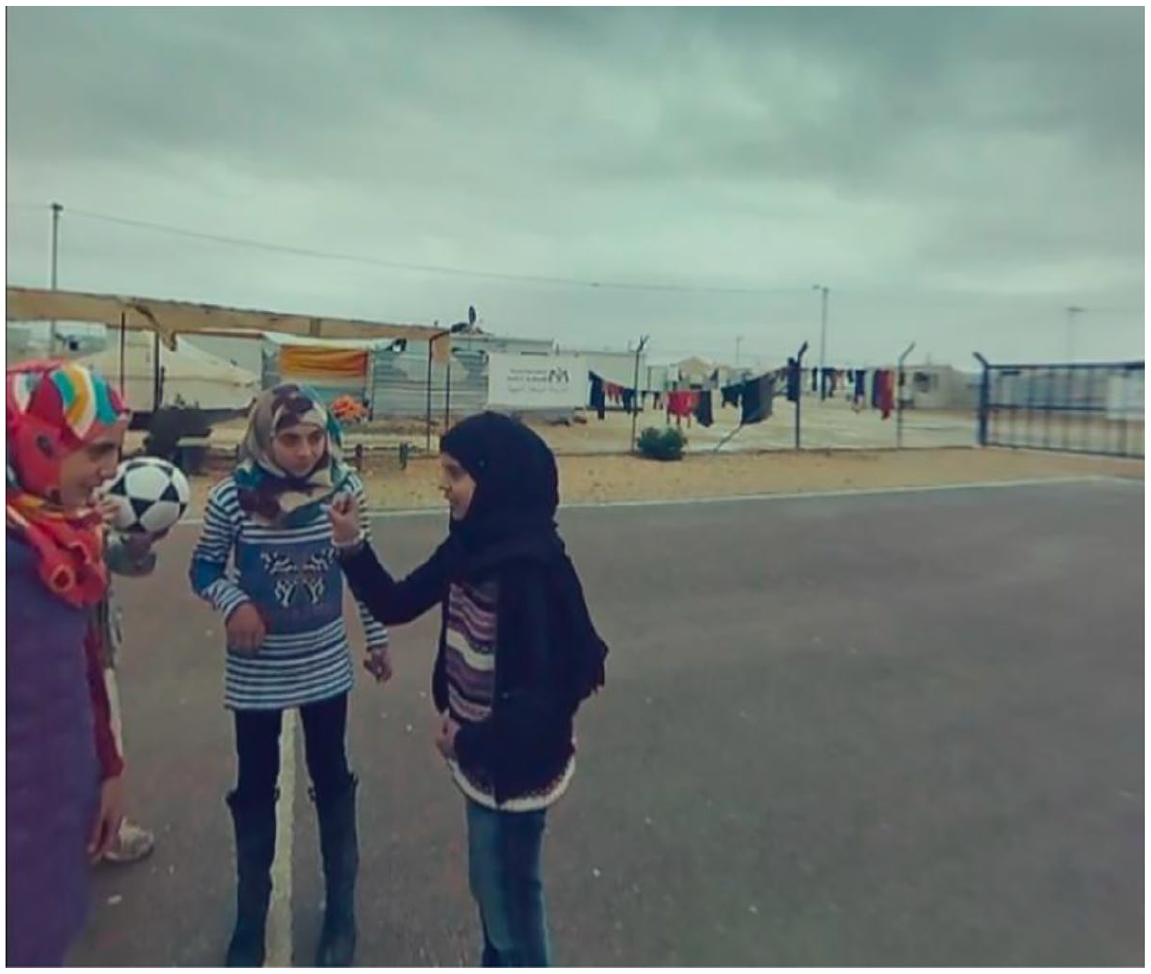
Clouds Over Sidra consists of ‘a series of ordinary moments’ (Bailenson, 2018: 77). There is no dramatic narrative arc or explicitly emotive scenes. There are fleeting moments of faint familiarity for the imagined viewer in the Global North: children going to school and playing sports while parents and teachers watch over them; glimpses of domestic life, like laundry hanging to dry; people chatting at the bakery; boys playing computer games. And yet those ordinary moments coexist alongside UNICEF and UNHCR logos on Sidra’s bag and tents, and barbed wire surrounding the school compound. The viewer is confronted with the vastness of the camp, juxtaposed with Sidra’s hopeful message of return to Syria. The film therefore attempts to create fragments of familiarity that are simultaneously disrupted by the constant reminder that this is life in a refugee camp. The creators wanted to produce ‘a situation that looks “ordinary” yet is disturbed by details that with sobriety remind us [the viewer] of tragedy’ to cultivate ‘empathy stemming from real understanding’ (Arora and Jones, 2017).
Image: Girls playing football (Sidra in the middle), and laundry hanging in the background.
Taken on Oculus Quest 2 (Milk and Pousman, 2016).
Sidra’s narration also plays a significant role in creating a sense of her daily life. For example, in a scene where men are working out in a makeshift gym in a big white tent, she comments, Many of the men say they exercise because they want to be strong for the journey home. But I think they just like how they look in the mirror. A lot of them make funny sounds when they lift the weights. (Milk and Pousman, 2016)
In the classroom where I see students enthusiastically raising their hands, Sidra describe what is really happening: ‘Our teachers sometimes pick students who do not raise their hands to answer. So everybody raises their hand, even if they do not know the answer’ (Milk and Pousman, 2016). Sidra’s witty comments give an insider view of life in the camp through her eyes, adding richness to the encounters in the film.
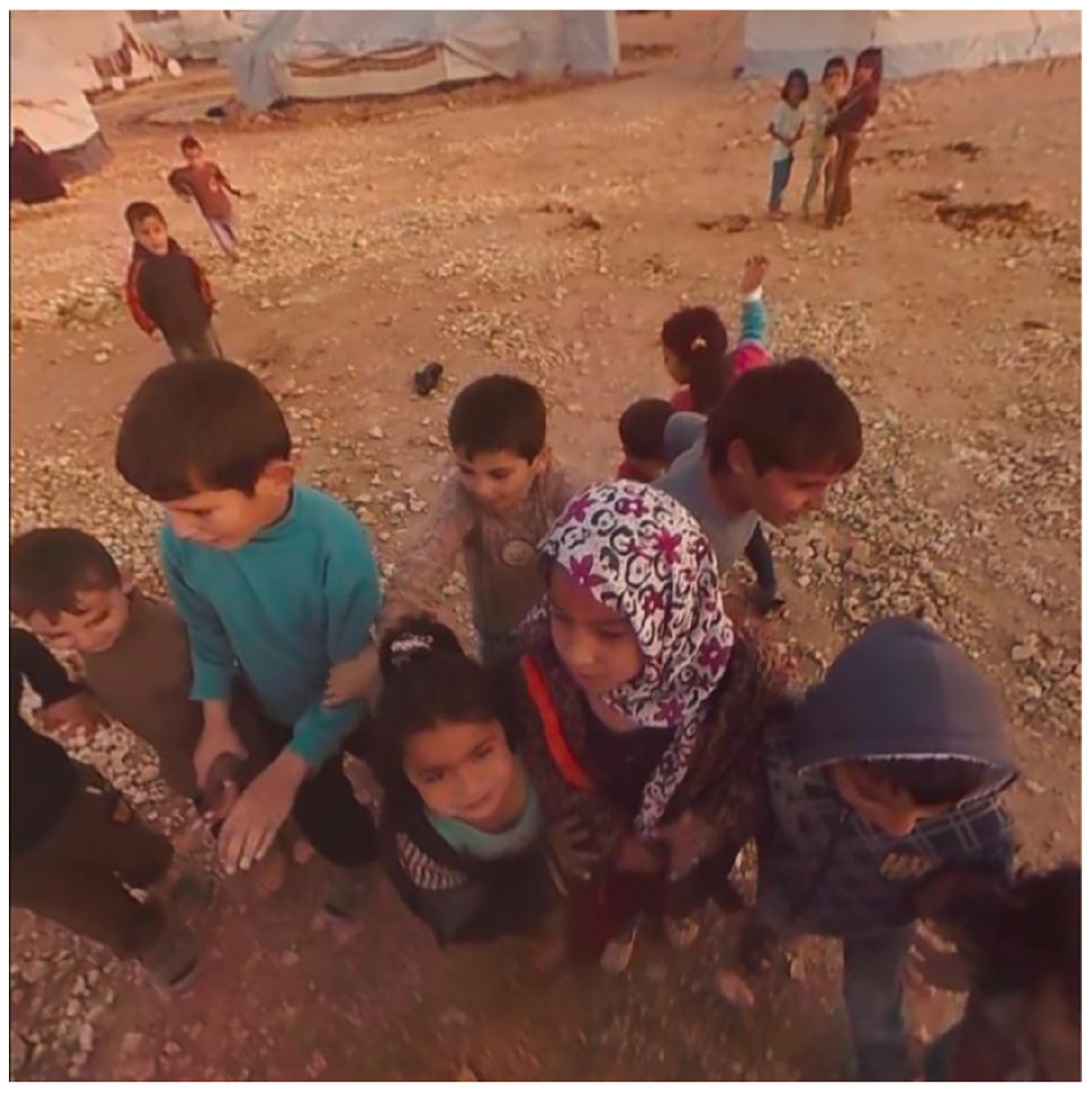
These attempts to invoke the ordinary supposedly make it easier to imagine what has happened to Sidra and other refugees could also happen to the viewer or their children. The prominence of children in the film, a common feature of the UN’s VR films (Gruenewald and Witteborn, 2020), further constructs ‘ideal’ figures of the refugee (Fiddian-Qasmiyeh, 2014). Apart from Sidra, who is present in all scenes through her narration and appearance, 11 out of the 15 scenes put children at the centre. It is telling that the scene where a group of children run towards and encircle me is a scene that Arora wanted to portray so much that he orchestrated it: Of all the scenes, I staged one. The one with the kids running at you and encircling you in slow motion? I herded about 200 kids. I was like the pied piper. We did that and made a game of running and playing for four hours. (Arora, 2015)
This gesture of children encircling the viewer is symbolic of peace and hope – what Malkki (2010) describes as ‘infantilisation of peace’. Through their association with world harmony and peace, children in the film appear as ‘educators’ of adults embroiled in the politics of war and displacement.
Image: Children running towards me and forming a circle around me.
Taken on Oculus Quest 2 (Milk and Pousman, 2016).
Appearing ‘against the background in which Syrian adults are racially and culturally marked as Arab Muslims’ (Al-Ghazzi, 2019: 3227), children’s association with innocence does a lot of work here. Children appear as embodiments of innocence who exist within an apolitical realm. As a boundary concept, innocence is a constantly expanding space of purity juxtaposed with a space of contamination (Ticktin, 2017). Ticktin (2011) analyses how innocence works through pained and suffering bodies of asylum seekers in France. While Clouds Over Sidra does not portray such bodies in any explicit way, innocence still constructs ideal figures of the refugee. Sidra, a girl refugee, and everyone who appears in the film, are simply going about their lives in Za’atari camp. There is no contextualisation of the displacement of Syrians, as I will elaborate below. The centrality of children not only depoliticises displacement, but also draws on universalising conceptions of children to purportedly enable the viewer to imagine their own children being displaced like Sidra. Innocence is also gendered and racialised; Sidra, who is wearing a hijab, represents the figure of a feminised and veiled refugee, reproducing conventional representations of refugees as vulnerable and docile victims in need of rescue (Abu- Lughod, 2002; Johnson, 2011). The film creates a space of purity devoid of politics, featuring innocent child refugees with a girl as the protagonist.
In these ways, the film constructs ideal figures of the refugee to enable humanisation and empathic identification. However, logics of inclusion are violent and leave unequal power relations in tact. Speaking of the idea of shared humanity in relation to police brutality in the United States, Hartman (2003: 189) comments that It’s as though in order to come to any recognition of common humanity, the other must be assimilated . . . utterly displaced and effaced: ‘Only if I can see myself in that position can I understand the crisis of that position’.
On the surface, refugees in Clouds Over Sidra are not utterly displaced and effaced. Sidra, a refugee, is at the centre of the film. She is presented as an individual, contrary to oft-criticised representations of refugees as an anonymous mass and speechless victims in pain (Malkki, 1996).
Nevertheless, silencing and assimilation still take place. The film was scriped by Gabo Arora and Edward Robles, and made ‘with cooperation with UNICEF staff’ (Cravinho, 2016); no mention is made of cooperation or consultation with refugees. This raises questions about silencing even as the film features Sidra, a refugee, as the protagonist. The film is a site where knowledge about refugees and displacement from the perspectives of people working for international aid organisations and technology companies are reproduced (Rajaram, 2002). The film attempts to give some individuality to the usually amorphous figure of the refugee, but in a way that is not too particular that they cannot be the object of empathic identification based on a shared humanity (Sirriyeh, 2018). Sirriyeh (2018) and El-Enany (2016) also discuss how the innocence and whiteness of Alan Kurdi, a 3-year-old Syrian Kurdish boy whose body on a beach was photographed and circulated in the media in 2015, played a role in eliciting a temporary wave of support towards refugees. Similarly in Clouds Over Sidra, an innocent and replaceable figure – ‘this child could have been mine’ – may be more likely to attract empathy, but those who do not exist in the space of innocence are seen as undeserving of support, or even life. Despite claims to represent refugees in new and even better ways using VR technology, Clouds Over Sidra thus reproduces ‘ideal’ figures of refugees through the gendered and infantalising operations of innocence.
Innocence, then, shapes the affective relations between ‘I’ and ‘refugees’, how one may feel ‘about’ refugees in the first place before they feel ‘with’ or ‘for’ them (Ahmed, 2014). Contrary to VR advocates’ claims, humanisation is not a smooth path towards a better world. Clouds Over Sidra may cultivate empathy towards a particular figure of child refugees, but this reinforces the hierarchy of humanity and deservingness as it relies on recognition by ‘the host’ (Malik, 2019), or in this case the intended viewer in the Global North.
Depoliticisation of displacement via technological disembodiment
As mentioned before, despite the intense awareness of my body due to nausea and the weight of the headset, my body disappears in the film. In my view, this erasure of the body is symptomatic of an assumption behind the film: that humanisation is made possible through an erasure of difference and power relations. The erasure of the body provides a supposedly neutral standpoint from which to enter Sidra’s world, facilitating ‘felt truth’. VR films are said to afford access to a privileged form of knowledge, derived from experiencing what it is like to live in a refugee camp rather than simply watching or reading about it.
I challenge this collapse between knowledge and experience by drawing on the insights of postcolonial and Black feminist scholars (Collins, 1991, 1999; Combahee River Collective, 1977; Mohanty, 2003). This body of work suggests that experience does not automatically engender privileged forms of knowledge or access to ‘truth’; knowledge and understanding are generated through struggle against and interpretations of one’s experience that is historically and politically embedded in the world they inhabit. Moreover, when knowledge-claims assume a neutral subject, it is usually a particular genre of the human (Wynter, 2003). The politics of location must therefore be considered when thinking about experience and knowledge.
Bearing those insights in mind, I argue that experiences of displacement cannot be divorced from who experience it, and their particular locations in the world. While campaigns about the Syrian conflict and displacement based on possibilities of shared humanity often garner attention, such as the Save The Children UK’s (2014) ‘If London Were Syria’ or the Twitter hashtag #CouldBeMyChild in response to Kurdi’s photograph, they are fundamentally based on false equivalence and historical-political amnesia. The assumption of such campaigns, including Clouds Over Sidra, that anyone can experience displacement is made possible through the erasure of historical and political conditions that create displacement (Danewid, 2017; El- Enany, 2016). What does ‘experience’ mean when it is dis-located from the embodied lives that experience displacement, and the historical and political composition of the world that facilitate some people’s mobility while letting others drown at sea?
The technological disembodiment and erasure of power relations and locations are therefore related. The erasure of my body and the particular social locations I occupy as a lived body undergird the shared humanity envisaged by the creators of Clouds Over Sidra, upon which humanisation is predicated. This is a neutral body, a view from nowhere, into which everyone and anyone can enter to experience as many events and lives as one wants. To use Mohanty’s (2003) term, a politics of transcendence undergirds the claim that anyone can ‘step into the shoes of a refugee’. This politics of transcendence activated through technological disembodiment reflects the persistent discourse of VR technology as enabling ‘bodily and subjective transcendence’ (Balsamo, 1997: 123–131; Green, 1999: 415–416) from the 1980s and 1990s when the technology was being developed.
In Clouds Over Sidra, the only slightly contextual information I receive about the displacement of Syrians is the statement at the very end that reads, ‘The world is facing the most devastating refugee crisis since WWII. As of September 2015, the Za’atari camp in Jordan harbors [sic] 80,000 Syrians escaping war and famine. . . . ’As Danewid (2017) argues in her analysis of pro-refugee activism and its assumption of ‘abstract humanity’ rather than ‘historical humanity’, this says nothing about the global and historical entanglements in which displacement and migration occur – the bombing of Syria by the United Kingdom, France, the United States, and Russia; the enduring legacies of French and British creations of borders on contemporary dynamics of the conflict in Syria; or the enduring legacies of the French mandate of Syria (1920–1946) in its political life (Fildis, 2011) and the development of the carceral system that the Assad regime wields with brutality against civilians 8 (Munif, 2020). This point can be extended to the implication 9 of people in the Global North in ‘border imperialism’ (Walia, 2013), including processes of bordering and control of mobility rooted in capitalism, colonialism, and the nation-state system, and the subsequent production of unequally mobile subjects (Anderson and Sharma, 2012). Clouds Over Sidra not only dis-locates refugees’ experiences of displacement – why people have had to flee Syria, or why some have remained in Syria 10 – but also dis-locates the imagined viewer in the Global North. Even if a viewer does take action to support refugees as prompted by the film, they remain an innocent bystander rather than already implicated in the capitalist global economy, colonial world order, and imperialist warfare (Danewid, 2017).
Displacement, then, is historically and politically embedded, and, most of all, embodied as an experience. Viewers of Clouds Over Sidra may comment that ‘[the film] made you feel like you were a refugee yourself’ (Alberghini, 2020: 13); yet, this arguably provides a false sense of intimacy, signifying instead consumption and commodification of refugees’ experience that reasserts existing structures of domination (Cañas, 2016). The empathetic relationship that the film attempts to establish between the viewer and refugees engenders a politics of transcendence rather than a politics of location, effacing how contemporary im/mobility functions along a racialised, colonial logic. Just as the film reproduces ‘ideal’ figures of the refugee, it also regurgitates ‘the extrapolation of refugee experience from individual social and historical contexts and the creation of a veneer of objectivity and dislocation’ that Rajaram (2002: 248) incisively critiqued in the early 2000s. It is, then, questionable in what ways VR films present fundamentally new and better representations of refugees.
What possibilities may be opened up when VR films engage with, rather than attempt to transcend, the embodied nature of experience and the attendant politics of location? As someone who benefits from the ability to move relatively freely around the world because of a system that privileges the mobility of some over others along a racialised and colonial logic, what might it look like to situate my body, my location, in a VR experience about displacement? Perhaps, such an experience will cease to be about displacement altogether, but more about the racialised and colonial global system of im/mobility. I suggest that a starting point is to think about displacement relationally, grounded in a politics of location. Thinking relationally about displacement may be a way in which one stands in solidarity with refugees not necessarily because they can empathise with or ‘humanise’ refugees, but because one stands against the conditions that produce displacement and a call for humanisation in the first place.
Conclusion: thinking relationally about displacement
Clouds Over Sidra attempts to raise awareness and funds through strategies of humanisation, utilising the technological affordances of VR such as immersion and presence. Through an experiential and textual analysis of the film, I argued that it attempts to humanise refugees by constructing ‘ideal’ figures of the refugee and depoliticising displacement via technological disembodiment. The film attempts to forge a shared humanity and cultivate empathy in the viewer through the portrayal of Sidra’s daily life, which seeks to highlight the quiet tragedy of displacement devoid of contextualisation. Moreover, the film overrepresents children, who embody innocence, peace, and hope. Centring figures of the refugee who are innocent, vulnerable, suffering, non-threatening, or any other new boundary concept that searches for purity, will inevitably reproduce a hierarchy of humanity (Ticktin, 2017; Wang, 2018). Displacement is further depoliticised through technological disembodiment – the erasure of the viewer’s body in the film – alluding to the assumed shared humanity that erases difference and power relations. Drawing on postcolonial and Black feminist writings on epistemology and ontology, I challenged the politics of transcendence that undergirds the construction of a shared humanity. Strategies of humanisation based on a logic of inclusion overlook the already racial and colonial nature of the human. Such humanising strategies produce a politics of transcendence, whereby displacement is divorced from global power relations and both refugees’ and the viewer’s social locations. Displacement cannot be experienced without attending to the histories people carry with them, the lives that people have led, and the circumstances that they have endured. This incommensurability is not limiting but is an inherent part of what it means to live in this world, and I believe embracing this will open up other ways of conceptualising displacement and taking action.
As a tentative way forward, I suggest that thinking about displacement relationally
11
may offer a better starting point for imagining and creating a just world for all. Thinking about displacement relationally would mean refusing to fix ‘refugeeness’. It means a shift towards the conditions that create a hierarchy of humanity and the need for ‘humanising’ in the first place, rather than introducing new ways of representing refugees who fit a particular genre of the human. This might be what Glissant (1997) called ‘the right to opacity’, a refusal to be reduced to a transparent being. Such an approach would be more conducive to realising a world based on de-colonial thinking that Mignolo (2009: 23) envisions: de-colonial thinking is not arrogating upon itself the right of having the last word about what human is, but proposing instead that there is no need for someone specific to talk about the human, because human is what we are talking about.
Thinking relationally about displacement would also be grounded in a politics of location, with an understanding of one’s historical and political connections to those who are displaced. It would centre wider structures such as capitalism, colonialism, and the nation-state system, within which the racialised poor are left to drown or detained indefinitely, while the media speaks of ‘the most powerful passport’ and the rich can buy citizenship through investments. It would no longer be about inclusion into a universalising shared humanity that is in fact a particular genre of the human. It would instead be a common project of building a world for everyone, rooted in one’s location and relationships, and by implication in the histories and structures of violence.
Footnotes
Acknowledgements
I would like to thank Kirsten McConnachie, Ben Little, Barbara Orth, and the two anonymous reviewers for their generous and constructive feedback.
Funding
The author(s) received no financial support for the research, authorship, and/or publication of this article.

Notes
Biographical note
Moe Suzuki is a PhD Candidate in Politics at the University of East Anglia. Broadly interested in the politics of ‘the human’, their thesis explores ideas about ‘humanity’ through analyses of virtual reality films on refugees and displacement by drawing on feminist, postcolonial, and decolonial theories.