




Abstract
In research on cultural taste and distinction, inconsistent and ambivalent attitudes towards hierarchy versus equality have largely been ignored. This study shows, by means of in-depth interviews with 90 Dutch people on their own and others’ cultural tastes, that both a hierarchical and an egalitarian repertoire appear in people’s narratives, and that these repertoires are often used simultaneously. People still distinguish culturally from others, but not consistently and often reluctantly, as they morally object to high–low distinctions based on aesthetic evaluations at the same time. This article analyses both repertoires and explores when and how tensions between the two come forward. We interpret these tensions on the micro level of self-presentation and habitus, and on the macro level of changing structures of inequality and meritocratic ideas.
Keywords
Introduction
Modern Western societies are characterised by a tension between normative egalitarianism and actual social inequality, as De Tocqueville (1990 (1835)) and other social theorists observed in the 19th century. In recent times, this tension may even have grown. Whereas socio-economic inequality tends to rise (see, for example, Piketty, 2014), moral norms that stress basic human equality – equal rights, non-discrimination, equality of opportunity – are perhaps stronger and more widespread than ever before. This is not only an intellectual issue; people have to cope with such contradictions in everyday life. How do they negotiate between their practices of social distinction and their morally-grounded egalitarian ideas?
In dealing with this question, this article focuses on tensions in the practices and perceptions of cultural hierarchy. As Bourdieu (1984) argued extensively, cultural taste preferences are more than just aesthetic – they indicate and express social distinctions, which affirm and reinforce class differences. Yet, the question is how strong the connections between class position, aesthetic judgements and status distinction are, and how they may change over time. The thesis of omnivorousness, developed in a critical response to Bourdieu’s theory, and supported by numerous empirical findings, contends that exclusive, highly distinctive, ‘snobbish’ preferences for high culture among high-status groups increasingly have given way to an ‘omnivorous’ taste that combines preferences for high and popular culture, indicating trends of increasing openness and tolerance, weakening distinction, blurring class boundaries and declining social and cultural hierarchies (e.g. Ollivier, 2008; Peterson, 2005; Peterson and Kern, 1996).
Other scholars have shown, however, that ‘omnivorousness’ and cultural distinction can easily go together. They point out, for example, that well-educated cultural omnivores distinguish themselves precisely by their breadth of cultural knowledge and interest (Prieur and Savage, 2013; Van Eijck, 2000); that these omnivores often are highly selective and exclusive in their specific preferences (Bennett et al., 2009; Bryson, 1996; Warde et al., 2007); that they differ from less-educated ‘univores’ in their attitudes towards popular cultural products (Holt, 1998; Jarness, 2015; Peters et al., 2018; cf. Lizardo, 2008); or that distinctive practices develop within genres that are conventionally defined as popular (Bachmayer et al., 2014; Friedman and Kuipers, 2013; Thornton, 1995). This suggests at least a partial reconfirmation of Bourdieu’s original thesis, and a continuation of cultural hierarchical practices, rather than a decline.
As we will argue in this article, unambiguous answers to the central questions in this on-going debate cannot simply be given, since the ‘reality’ that these answers should uncover is itself ambiguous. The cultural hierarchies that are the focus of study are not rock solid social facts, but rest on social definitions marred by controversy, doubts and ambivalence. More specifically, as will be pointed out, social distinctions connected with aesthetic judgements are often contradicted or downplayed on moral grounds (cf. Lamont, 1992).
This study deals with what is usually left out in the studies of cultural taste and distinction. Based on in-depth interviews with 90 respondents living in the Netherlands with various educational and social backgrounds, it explores how people define cultural hierarchies; how they position their own and others’ taste preferences in relation to perceived hierarchies; and whether, how and why they affirm or reject high–low distinctions. The interviews brought to light two types of conflicting repertoires: a hierarchical and an egalitarian one. Some respondents took only one of the stances, but most expressed both views, indicating inconsistency, ambivalence and tensions. While some students of cultural taste and distinction paid attention to such ambiguities (Jarness and Friedman, 2017), these have hardly been a topic of systematic research.
After a short account of some theoretical ideas on contradictions and some methodological considerations, we present the analysis of our findings. We first describe how people use the hierarchical and the egalitarian repertoire in defining their own and others’ cultural preferences. This is followed by an analysis of when and how individuals combine these repertoires. Finally, we interpret our findings on different levels: a micro level of both deliberate self-presentation and internalised habitus, and a macro level that explores the historical roots of the hierarchical and the egalitarian repertoire and the potentially ambiguous consequences of present-day meritocratic ideology.
Dealing with ambivalence and contradictions in cultural sociology
In general, sociologists have difficulties in recognising ambivalences and inconsistencies in the ways people express their ideas, opinions and feelings. This is most apparent in quantitative research, in which respondents fill in questionnaires with given answer alternatives. However, it also applies to much qualitative interview research, including research on cultural preferences and practices. Cultural omnivorousness is often put in perspective by developing a new typology with sharp demarcations between clusters of respondents. For instance, Holt (1998) describes two contrasting taste and consumption practices, Ollivier (2008) identifies four ideal types of ‘openness’, Atkinson (2011) compares the musical tastes and practices of the ‘dominant’ and the ‘dominated’ and Jarness (2015) distinguishes four ‘modes of consumption’; all without any apparent inconsistencies or ambivalences in respondents’ attitudes and orientations. It could be that inconsistencies and ambivalences simply did not show up in the interviews. 1 However, it is likely that such elements in respondents’ narratives were overlooked or ignored, because they did not accord with the researchers’ wish to present unambiguous results.
Not all studies neglect ambivalences and inconsistencies in people’s narratives, however. Discourse analysts studied ‘variability’ in language (Potter and Wetherell, 1987), more specifically the contradictory repertoires out of which people construct a narrative (Wetherell and Potter, 1988). Within sociology, the most prominent example is Ann Swidler’s (1986, 2001) work on switching between ‘cultural repertoires’. She demonstrated that people are often inconsistent in their conversations. They ‘make use of varied cultural resources, many of which they do not fully embrace’ (Swidler, 2001: 19). Culture in this approach is a ‘toolkit’ containing ‘diverse cultural materials’, from which people select some and neglect others, depending on the situational and symbolic context. In other words, they may switch between different cultural repertoires available to them. Holstein and Gubrium (1995) show that such contradictions can be explored excellently by means of in-depth interview research.
Furthermore, some studies on the more particular issue of present-day class relations have pointed out that definitions, perceptions and experiences of class are often ambivalent. For many people, the notion of class is embarrassing, since it is conceived as a normative category associated with inequality in human worth, which gives reasons to deny the reality of class. At the same time, class inequalities are sensed, felt and recognised in various ways, even if the term class is not used (Savage et al., 2001; Sayer, 2002, 2005; Van Eijk, 2013).
Recently, Jarness and Friedman (2017) have described contradictions in judgements on cultural taste and lifestyle among upper-class people in Norway and the United Kingdom, which are, in several respects, quite similar to our own research findings. 2 However, they interpreted these tensions differently. In the conclusion, we will explain in what ways our interpretation differs from theirs.
Data and methods
In 2009 and 2010, the first author conducted in-depth semi-structured interviews with 90 people in the Netherlands (Van den Haak, 2014). Questions were asked about their own and others’ taste in five cultural fields: music, film, television fiction, theatre and visual arts. Each interview began in an open and flexible way with questions about people’s likes and dislikes in the present and the past. Subsequently, opinions were asked about taste differences with significant others (parents, siblings, partners, friends), as well as with distant others, represented by three occupations in different class positions. The last part of the interview focused on people’s perceptions of ‘high culture’, ‘low culture’, ‘good taste’ and ‘bad taste’. In the analysis by means of Atlas.ti, particular attention was paid to ambivalences, for instance, by separately coding downplaying remarks.
Because the study was aimed at comparing groups, a quota sample was designed. The quotas consisted of three birth cohorts (before 1945, 1945–1965, 1965–1985) and three status groups, based on educational level and parents’ educational level: (1) well-educated with well-educated parents, (2) well-educated with less-educated parents and (3) less-educated with less-educated parents. 3 This resulted in 9 quotas of 10 people each, with an equal number of men and women in each quota. 4 Educational level is operationalised as ‘high’ when the respondent has a college degree, that is, at least a bachelor’s or equivalent degree at a university or professional school, and as ‘low’ when the respondent has, at most, medium vocational education. In each quota, an equal number of men and women were interviewed. The quotas were gradually filled in three stages: (1) a random sample from phone directories (N = 47); (2) random samples from purposefully selected postal codes that, according to official statistics, contain high numbers from certain age groups and/or income levels 5 (N = 28); and (3) calling upon the first author’s own diverse network to fill the last gaps (N = 15). The average response rate in the first two stages was about 25 percent.
Analysis: cultural taste and conflicting repertoires
In the interviews, the respondents expressed two types of conflicting views, or repertoires, on cultural taste differences: a hierarchical and an egalitarian repertoire. We start this section with an account of both repertoires separately, before describing when and how they are combined.
The hierarchical repertoire
Not every aesthetic judgement can automatically be interpreted as an act of social distinction (Lamont, 1992; Warde, 2011). The minimum empirical evidence for such an interpretation is that the person who gives such an assessment defines it as superior, as reflecting a better taste than other people have. More than half of the respondents in this study demonstrated this in one way or another.
The most common way for people to express distinction is by connecting their dislikes of certain cultural items to the people who do like them. Marsha,
6
a 44-year-old communication adviser, gives her opinion about Dutch language music: It doesn’t grip me, I find it gross, and er … yes, common too, often. You quickly associate it with the audience that attends these [concerts], at least I do.
Some speak about this audience by referring to its size: ‘the majority’ or ‘the masses’. More often, respondents use terms that suggest a lower class, such as ‘the common people’ or ‘the man in the street’. Others mention specific occupations, or certain neighbourhoods or regions that they associate with a working- or lower-middle-class population.
Other much used distinction markers are educational level and, related to that, intelligence. This is often connected with the alleged complexity of ‘high culture’ and with the open attitude one needs in order to appreciate alternative or innovative cultural products. Marleen (aged 67, teacher) states that some people are ‘too simple’ to understand the ‘cynical and sarcastic’ character of a certain comedy show. And Louis (aged 53, journalist) assumes ‘that in general people with brains, let’s say with an IQ over 110, are spontaneously inclined to be curious about cultural expressions’. Apparently, less intelligent people are not.
The hierarchical repertoire also comes to the fore in an opposite way: looking up to people with a ‘better’ taste, and hence looking down on one’s own taste. Looking down and looking up often occur simultaneously: many respondents position themselves at some spot in the cultural hierarchy, above and below others (cf. Ollivier, 2008). The well-educated are strongly overrepresented in both types of hierarchical practices. Hence, they show more awareness and acceptance of a cultural hierarchy and of their own place in this hierarchy than the less-educated do. Some of the less-educated respondents also look down on and/or up to others, but often only slightly, or only once in the interview.
The egalitarian repertoire
The egalitarian repertoire can be clearly recognised in many interviews as well. Egalitarianism is an, often morally grounded, rejection of hierarchy, which comes to the fore in several ways. The first is an explicitly individualist and relativist view. Cultural taste is seen as subjective and personal, not to be put into boxes, let alone vertically arranged boxes. ‘Tastes differ’, ‘to each his own’, ‘there’s no disputing about taste’ – these are the common expressions that often pop up in the interviews. About one-third of all respondents, from all educational levels, make such remarks already in the first, open, part of the interview, in reply to questions on the reasons for their likes and dislikes and, particularly, on taste differences with significant others. 7 Some express very strong dislikes about a certain taste, but explicitly add that this should not be interpreted as a social distinction. This is shown by Hans (aged 64, steel industry calibrator), when speaking about house music: ‘I call it fucking noise, but that’s my opinion, someone else likes it’. An interview question on good and bad taste triggers such responses even more frequently: the distinction between good and bad taste is often regarded as ‘individual’, ‘arbitrary’ or ‘neutral’ (cf. Warde, 2007).
Second, the most explicit anti-hierarchical remarks are made in response to questions about the meaning of the concepts ‘high culture’ and ‘low culture’. While several respondents answer these questions by giving definitions or examples, about one-third – equally distributed over educational levels – respond with outspoken resistance. They say, for example, that they do not like these ‘strange’ concepts, that you ‘just cannot use’ them or that ‘culture is culture’ without distinctions. The use of the label ‘high culture’ is called ‘arrogant’, ‘pretentious’, ‘elitist’ and ‘hot air’; the term ‘low culture’ is characterised as ‘disparaging’, ‘discriminating’ and ‘mean’. Strikingly, the most outspoken rejections are not brought forward by less-educated people, who do not want others to look down on them, but by the well-educated, even though many of them personally like items that are usually classified as high culture. Apparently, they do not wish others, in particular less-educated people, to be downgraded by using such concepts.
The third way of expressing an egalitarian view is criticising elite pretensions. While such criticisms are expressed by the different educational groups alike, the well-educated do so most explicitly. First, members of the economic elite are often accused of snobbish status display: they are suspected of visiting events such as classical concerts with the aim of meeting friends and business relations and of ‘being seen’, rather than enjoying the music. Second, members of the cultural elite are criticised for their alleged pretentiousness. They are suspected of not really liking what they say they like and of showing off with their self-proclaimed expert opinions and sophisticated speech. Third, elite groups in general are accused of claiming superiority and of explicitly looking down on others. For example, Henny (aged 53, civil servant) answers the question on the meaning of high culture by stating that artists and intellectuals ‘make it high themselves’, so that they can place themselves ‘above the rabble and the riff-raff’.
Hence, these anti-hierarchical respondents distinguish themselves from those who do distinguish. This distinction with anti-distinction can be interpreted as a moral rather than a cultural or aesthetic distinction (cf. Lamont, 1992, 2000). It is often related to a moral aversion against social hierarchy in general, conceived in terms of human worth or dignity (cf. Sayer, 2002; Van Eijk, 2013). This is particularly articulated by less-educated respondents, such as Nel (aged 32, receptionist): I don’t easily look up to someone anymore. Because: they’re all people, and one person earns more money than the other or has more responsibilities than the other, but […] as a human being he just remains a human being. So I think: we’re all the same, they have to sleep too, take a shower, eat, change clothes, so that won’t be different. No, I see through that, yes.
It is, above all, the suspected insincerity, the ‘fakeness’, of would-be cultural insiders that is condemned, particularly when they are believed to force their opinions upon others. 8 As a consequence, these anti-hierarchical critics create, paradoxically, a moral hierarchy instead, in which authenticity and sincerity are core values.
Switching between repertoires
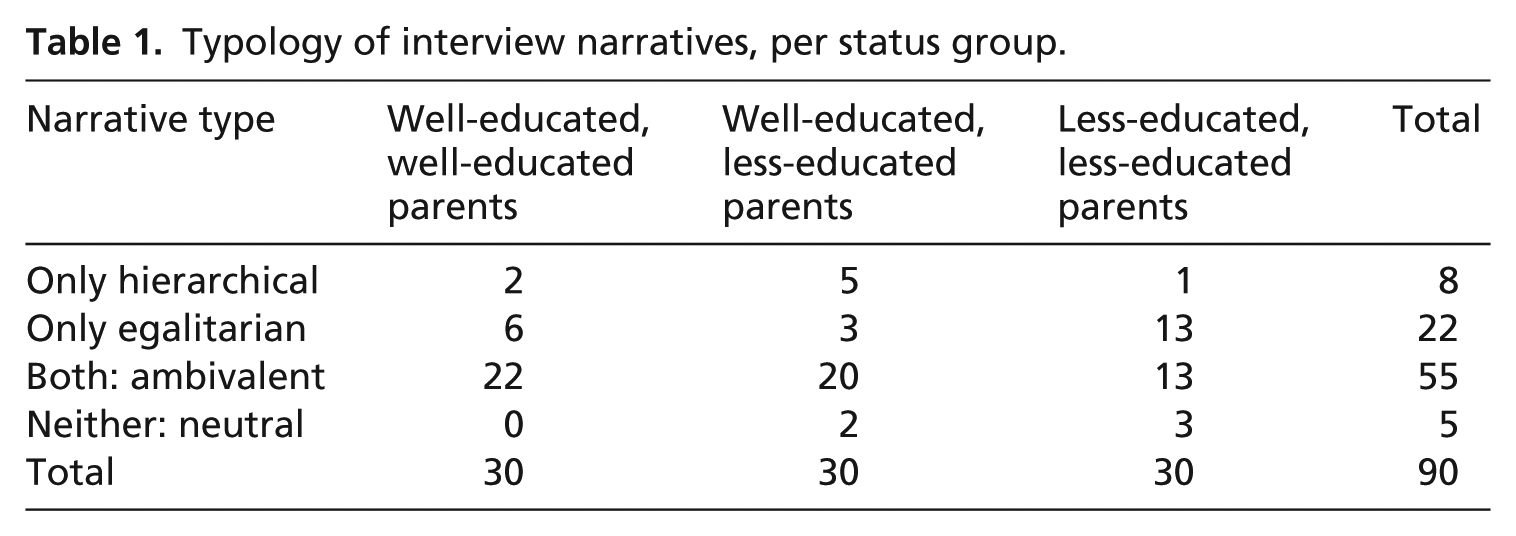
If one assumes – in line with most studies on cultural preferences – that people in general are consistent in expressing their views, one would expect them to stick to either a hierarchical or an egalitarian repertoire when speaking about cultural taste. Although a number (one-third) of respondents indeed do, there are more who switch between these two repertoires. A typology based on a thorough analysis of the interview transcripts reveals learns that only 8 out of 90 respondents use the hierarchical repertoire without ever switching to the egalitarian one. Conversely, 22 respondents use the egalitarian repertoire and ignore the hierarchical one. No fewer than 55 respondents are in some way inconsistent or ambivalent. 9 There is, in other words, a strong overlap in the use of both repertoires. Finally, there are five respondents who do not use either repertoire during the interview: they never speak in a hierarchical way, nor do they explicitly oppose this, but they only speak about their own and others’ tastes in a neutral way. 10 As Table 1 specifies, the well-educated are clearly overrepresented in the hierarchical type and the (much larger) category of the ambivalent type, whereas the less-educated make up larger proportions of the egalitarian and the neutral categories.
Typology of interview narratives, per status group.
This section presents two different ways in which inconsistencies and ambivalences come forward. The first way of switching repertoires is expressing different views in different parts of the interview (cf. Swidler, 2001; Wetherell and Potter, 1988). A good example is Koos (aged 60), an upwardly mobile construction engineer, who explicitly looks down on the tastes of his less-educated brother, an elevator mechanic. According to him, construction workers ‘can only talk about chicks and football, that’s how it works’. He also disqualifies the boisterous nouveaux riches in his village (‘not my kind of people’), who have a lot of money and drive big cars, but who like the same Dutch-language singers as his working-class brother. Later, however, he says that ‘you just cannot use’ the concept ‘low culture’, because it is based on stereotypes and prejudice. For the same reason, he finds high culture ‘a nasty expression’.
Hence, Koos is very distinctive during the more open part of the interview, when he can speak about his and others’ likes and dislikes in his own words. However, when he is confronted with questions on high and low culture and on good and bad taste in general, he realises the inegalitarian and elitist connotations of these terms. There is an apparent discrepancy between his valuations of specific taste differences on one hand, and his views on general notions of hierarchy and inequality on the other.
The second way in which people show ambivalence – not noted by Swidler (2001) – is by downplaying distinctive statements immediately after or even before making them (cf. Goffman, 1971: 108–118). Respondents say they do not mean to be ‘negative’, ‘mean’, ‘insulting’, ‘derogatory’, ‘shitty’, ‘elitist’, ‘arrogant’, ‘snobbish’ or ‘pedantic’, directly after having made clear hierarchical distinctions. They mean things ‘with all due respect’ and do, after all, not want to ‘judge’ people. They feel uncomfortable about either their status display or their explicit looking down on others, and feel the urge to correct this image. Some amend their statements in advance, by giving a ‘disclaimer’ to convey that what is about to follow should not disrupt the interlocutor’s view of the speaker (cf. Hewitt and Stokes, 1975). Helma (aged 71, housewife), for instance, answers the interview question on the typical bricklayer’s taste (see below) with: It sounds very elitist if I say so, but I think the average bricklayer, well, does not have the intellectual development to visit a concert hall […] and he doesn’t attend good films and plays, no. But of course that’s really generalising, but of course it’s the image that comes up.
Most people do not give a reason why they downplay their statements, but some do. First, some say it is hard to find the correct expression that reflects their thoughts. Peter, for instance, a 53-year-old trader of supplies, describes low culture as ‘more common’
11
and ‘more coarse’, but he continues: That’s not a value judgement, by the way. Let that be clear. You have to give it a name, and I think that’s the danger of language and giving names, that you sometimes say things with which you perhaps express yourself in a derogatory way, but that you don’t mean that way. […] And ‘common’ doesn’t really sound, er … yes, I wouldn’t know how I could say it differently. If there are different terms for it, I’d be glad to hear it!
The second reason given for such downplaying is when one realises that one does not really know the people whose taste one looks down on. This reason is often – but not only – given in reply to three interview questions on the cultural taste of people in specific occupations, such as bricklayers, with whom most respondents are not directly familiar. After answering, they suddenly realise that they use stereotypes and that reality might be different. Louis (aged 53, journalist) meanders between his presumptions about the typical bricklayer’s taste and his rejection of these presumptions: I expect of course that his preference is less sophisticated, yes, I think that he – that counts for everyone with more practical and less theoretical schooling – likes [Dutch language singer] André Hazes. Of course it sounds insipid and prejudiced, but in eighty percent of the cases it will be that way. But there are also … a bricklayer could just as well be a member of a choir, where he started to appreciate Bach. That’s possible, isn’t it? But well, most prejudices are correct. Yes.
The third, most frequent, reason for downplaying occurs when people personally know other people whose taste they are inclined to look down on. Respondents speak about uncomfortable situations in which they keep their opinions to themselves, either because they do not want to hurt others’ feelings or because they are afraid that others will find them elitist or arrogant. Marsha, who was quoted before with her dislike of Dutch-language music and ‘the audience that attends these [concerts]’, knows some childhood friends who do like this music. She does not express her dislike to them, because ‘it is their passion, and one should respect someone’s dignity’.
12
Such tensions occur both in professional contacts and in more personal relations, such as with family members. Many respondents who distinguish themselves from their family’s tastes find an explanation in their own upward mobility. They received more education than their parents did and ended up in higher occupations, sometimes also higher than their siblings and childhood friends. Trudy (aged 62, nurse), a slightly upwardly mobile woman, expresses her shame about her brother’s and sister-in-law’s bad taste, but downplays its significance: He is a very nice chap, that’s not the point, but we think: good, it’s your taste, fine, he lays a plush carpet on the table, haha, well, if it makes him happy! […] Also as regards clothing, then I think: ‘My God, do I have to walk through town next to him?’ […] The taste difference is very large, but what matters to me is: how are they themselves? I mean: when you visit them, they welcome you in the warmest way, you’re never too much, if necessary they will always help you. It’s just, yes, we have a completely different taste!
Hence, both Trudy and Marsha downplay their aesthetically based judgements by turning to a moral repertoire of dignity and being considerate to other people (cf. Lamont, 1992). Some upwardly mobile respondents sometimes feel stuck between (the tastes of) their parental milieu and their current milieu (cf. Brands, 1992; Friedman, 2012; Matthys, 2010). Yet, ambivalence towards cultural hierarchy is by no means confined to this group: upwardly mobile respondents did not show more ambivalence than the well-educated respondents with well-educated parents.
Naturally, such uneasiness is experienced in actual interactions with people with another background, as both Marsha and Trudy described, but it can also be felt when these others are absent. Patrick (aged 43, team manager) recalls a conversation he had with his girlfriend about the question of whether or not it is acceptable to look down on others’ tastes: I can say ‘Well, that’s really shit’, but I won’t say it to that person, I would say it to my girlfriend. […] But she thinks: ‘You cannot say that, because they like it’. [Then I said:] ‘Yes, but I don’t say it to them, I say it to you’. [Then she said:] ‘That isn’t nice, is it?
Apparently, Patrick has no problem with looking down on others’ bad taste, as long as he does not tell them openly. His girlfriend, however, wishes to keep her opinion to herself even when these others are not present. The reason, according to Patrick, is that she thinks twice before saying something ‘that deviates from what people expect of her’. This hesitation to speak differently from what others expect may form a first clue – however indirect – to understand why many people are struggling with distinction in an interview setting, too.
Conclusion
Three empirical main conclusions stand out. First, people often contradict cultural hierarchical distinctions, much more often than is suggested by most studies on taste differences. They do so by defining their own and others’ cultural preferences as merely personal and subjective, by explicitly rejecting concepts such as ‘high culture’, or by criticising people who do culturally distinguish. Indeed, a large majority of respondents in this study used the egalitarian repertoire in one or another version, and it was used more often than the contrasting hierarchical repertoire, in which one looks down on other people’s bad taste, or looks up to those who are seen as having a taste better than one’s own.
Second, the contradiction between the two repertoires does not only appear as disagreements between people, but also, and even more so, as intra-individual tensions and ambivalences. The majority of respondents in this study applied both repertoires. They switched from the one to the other in the course of the interview, or immediately downplayed their expressions of distinction by adding that they did not mean to look down on other people for their taste.
Third, among the majority who show ambivalence towards hierarchy, the well-educated are overrepresented. Whereas less than half of the less-educated respondents combine both repertoires (the same number of them being exclusively egalitarian), 70 percent of the well-educated do so. Contrary to what one might expect, upwardly mobile people are not overrepresented within this majority.
The ambivalence shown by the well-educated can be interpreted as a conflict between aesthetic and moral judgements, between ranking on the basis of cultural taste and moral norms that prescribe equality, openness and fairness in dealing with other people. However, aesthetics, or culture in the narrow sense, and morality are not strictly separated domains. Taste judgements are easily, almost inevitably, associated with judgements on people’s social standing or human worth. It is for this reason that people tend to be inconsistent when they speak about their own and others’ cultural taste.
We propose three different lines of explanation for the internal tensions that many people experience when speaking about their own and others’ tastes.
Conflicting self-presentations and cultural repertoires
The first explanation refers to the ways people present themselves during an interview and in other social situations. As Goffman (1959) has argued, people wish to give – whether consciously or not – a good ‘presentation of self’ in different social situations. A sociological interview is one such social situation. Self-presentation in this setting partially depends on the presumptions one has about the interviewer’s preferences and expectations (Holstein and Gubrium, 1995). This article shows that this self-presentation can shift over the course of an interview. Koos, for example, who spoke distinctively about his brother’s taste, initially presented himself towards the interviewer as a cultured person who is sure that his taste is better and more developed than that of less-educated people. When confronted with the concept ‘high culture’, later in the interview, his self-presentation changed into that of an egalitarian person, who does not look down on others for what they are or what they like.
The immediate downplaying of distinctive remarks can be explained in this line of thought, too. When people say or do something that seems to conflict with their ideal self, that might cause misunderstandings or that they think the interviewer might disapprove of, they must correct this. Therefore, they often contradict themselves and downplay certain remarks that they made ‘too quickly’. When they use a supposedly negative or derogatory term, or when they think of someone they personally know, they suddenly realise that they do not want to be perceived as elitist or as condemning other people. They feel they must correct the wrong image that the interviewer might have gotten in order to restore the balance (cf. Hewitt and Stokes, 1975).
Problems with self-presentation in other social situations are felt as well. As several respondents reported, they often hide their own taste judgements towards people whose taste they perceive as inferior, since they do not want to hurt them by claiming superiority.
The role of class habitus
One may argue that this explanation in terms of self-presentations and available cultural repertoires is too voluntaristic and cognitivist. It views human actions as conscious and flexible adaptations to changing social situations and does not probe into internalised dispositions that motivate recurrent practices (cf. Vaisey, 2009). Here, the concept of habitus, or, more specifically, class habitus (Bourdieu, 1984), becomes relevant, that is, the internalised and embodied attitudes, tastes and behavioural routines, acquired by an upbringing in a certain social class or class fraction.
In their analysis of findings on ‘contradictory’ taste and lifestyle judgements among the Norwegian and British upper-middle classes (richer in economic and cultural capital than most respondents in our own study), Jarness and Friedman (2017) give class habitus a central explanatory role. Without exception, these respondents expressed distinction from lower classes. Yet, they mostly did so after having done the opposite, by using common egalitarian phrases such as ‘each to their own’ and ‘live and let live’. Drawing on Pugh (2013), the authors note that the respondents shifted in the course of the interview from expressing themselves as an ‘honourable’ person with egalitarian views to expressing ‘visceral’ distinctive attitudes, which manifested emotional aversion to the tastes and lifestyles of lower classes. These shifts were often introduced by phrases such as ‘I’m not a snob, but … ’, compared to the downplaying remarks in our study. The same moral front was held up in everyday encounters with people from a lower-class background, who therefore tended to believe (wrongly) that members of the upper-middle class are really open and egalitarian. The authors conclude that ‘[f]lying under the moral radar of egalitarianism […] may – intentionally or otherwise – help secure the legitimacy of cultural distinction and class-cultural boundaries’ (Jarness and Friedman, 2017: 23).
Taking account of our own research findings, we have some reasons to put this interpretation into doubt. 13 While the authors state that both the distinctive ‘visceral’ and the ‘honourable’ self are part of the respondents’ upper-class habitus, they suggest that the former is much more deeply ingrained in the class habitus, whereas the latter is connected with ‘the careful monitoring of self-presentation’, which serves to ‘mask’ the distinctive class dispositions. This is sustained by their observation that respondents first made egalitarian remarks, showing openness and relativism to the interviewer, and subsequently – when they became more relaxed and informal – expressed their disgust for lower-class taste. In our study, however, the distinctive remarks often preceded the egalitarian ones. We did not find strong indications that the distinctive utterances reflected more ‘visceral’ attitudes than the egalitarian ones, let alone that the latter were merely a front to hide true class feelings. Distinctive speech could indeed be a spontaneous expression of emotional attitudes rooted in the class habitus, but it could also be a deliberate presentation of self as a cultured person, who presumes to share his or her taste preferences with the interviewer. Similarly, the downplaying of this distinction, or the anti-hierarchical speech in response to specific questions, could be a deliberate presentation of self but also the expression of a habitus of egalitarianism. These are polar possibilities. In reality, sharp distinctions between deliberate self-presentation and habitus-induced spontaneous expressions are difficult to make.
The development of (tensions between) hierarchical and egalitarian repertoires
In line with Bourdieu’s approach, Jarness and Friedman’s interpretation is essentially static: egalitarianism among the dominant classes is viewed as a ‘strategy of condescension’ that serves the continuation of class inequality. By stressing the on-going reproduction of class inequalities, Bourdieu, and those who adhere to his theories, tends to neglect or downplay important changes in structures of inequality and habitus. However, structures of inequality, class habitus and related repertoires do change over time and should be explained accordingly.
The hierarchical repertoire is inherent to social stratification as such. For ages, privileged groups have distinguished themselves from other groups in outward appearance and ways of behaving (clothing, speech, manners) to express, affirm and reproduce status inequalities. In Europe of the 19th and early 20th centuries, class differences were still highly visible and enacted in interaction rituals that expressed status inequality through gestures of deference and dominance (Collins, 2004: 268–284). Distinction on the basis of cultural taste acquired particular significance from the 16th century, when elites began to distinguish themselves with preferences for ‘refined’ art and ‘civilised’ consumption (Burke, 1978; cf. Kempers, 1992).
These hierarchical distinctions were not uncontested. While members of underprivileged groups tended to accept and affirm existing hierarchies through deferential behaviour and internalised self-definitions of inferiority, they also often felt resentment, resisted dominant definitions and counter-stigmatised powerful groups (Elias, 2008 (1976); Wertheim, 1974: 105–119). Such resistance was not confined to the underprivileged. The egalitarian repertoire – the moral imperative of basic equality of human beings – is rooted in a long Western tradition. It ranges from early Christianity, through the secular ideologies of liberalism and socialism, to present-day movements opposing ethnic, racial and sexual discrimination.
This moral tradition did not preclude huge class and status inequalities, but in the course of the 20th century, and particularly after the Second World War, manifestations of class-related status inequality did weaken. Power and status inequalities diminished with political democratisation, growing economic prosperity, decreasing income and wealth disparities and increasing social mobility. Interaction codes came to stress informality, flexibility and equality and declared open expressions of superiority and inferiority taboo (Wouters, 2007).
This did not mean that cultural distinction disappeared. The social and cultural emancipation of ‘the masses’ evoked resistance among middle and upper strata. Many condemned the upcoming commercial popular culture (‘mass culture’) as a threat to ‘real’ (high) culture (Gans, 1974). In this way, the tendency of diminishing inequalities of power, prestige and privileges may have paradoxically contributed for some time to an increasing significance of cultural taste preferences as markers of status distinction (De Swaan, 1985: 49). With on-going processes of informalisation and status levelling during the past decades, however, this kind of status distinction, too, became more difficult and embarrassing, as this study illustrates. More recently, this uneasiness might be strengthened by the fear of being accused of elitism, as a populist discourse communicates. Transformations in the domain of cultural production itself, such as the continuous expansion and partial upgrading of popular culture, have also contributed to this development. These processes have been conducive to increasing taste uncertainty, relativism and eclecticism.
The observed tensions between hierarchical distinction and its egalitarian rejection might be further explained by making a connection with a development that became particularly manifest since the 1980s: the spread and strengthening of a meritocratic-individualistic ethos throughout the Western world, related to tendencies of increasing socio-economic inequality, flexibilisation of work relations and a further expansion of formal education with its stress on ‘open’ selection. 14 This meritocratic ethos – widely accepted, particularly by the well-educated (Steijn, 2016) – comprises both the norm and the perception of equality of opportunity. It defines social inequalities as legitimate hierarchies in so far as these are perceived as based on differences in individual merits, that is, personal capacities plus personal efforts. It combines the moral imperative of basic human equality, interpreted as equality of opportunity, with the acceptance of social inequality, interpreted as the outcome of fair competition and in this way serves to legitimise existing or even growing inequalities.
In this meritocratic ideology, the significance of cultural taste differences for social hierarchy is not very clear. Unlike, for example, educational credentials or economic success, ‘good taste’ in itself cannot easily be regarded as reflecting personal merit. Yet, as this study has shown, cultural taste is often strongly associated with educational level (or intelligence, as some respondents suggest), which helps to define symbolic boundaries between the well-educated and the less-educated. However, taste differences are also associated with parental upbringing, and hence with inherited class characteristics, or status groups in the Weberian sense. As this perception does not fit the meritocratic view of society well, it may lead to uneasy feelings, and feed the inclination to deny or reject the significance of cultural taste for status distinction. This may partly explain the tensions that people experience when speaking about their own and others’ taste preferences.
People do not behave consistently according to one logic, and social processes do not unfold only in one direction. As this research – like others – shows, cultural taste differences still play a significant role in perceiving and constructing hierarchical distinctions. At the same time, these distinctions are far from self-evident; they are often criticised, contradicted, denied and met with ambivalence. The disagreements, inconsistencies and tensions that were found in this research are not anomalies; they are normal, ordinary phenomena and essential for understanding the social functioning of cultural preferences and perceptions of class differences in the present age. Such ambivalences should therefore not be ignored, but rather be recognised, meticulously studied and explained by connecting micro and macro levels.
Footnotes
Acknowledgements
The authors wish to thank Giselinde Kuipers for her co-supervision of the PhD thesis on which this article is based. They also thank the editors of this special issue and the reviewers for their useful comments on previous versions of this article.
Funding
The author(s) disclosed receipt of the following financial support for the research, authorship and/or publication of this article: The research on which this article is based was funded by NWO, the Dutch Research Council.