




Abstract
The relationship between media practices and social inequality has been studied within a range of sub-disciplines in media and communication studies and cultural sociology. In various, more or less direct, ways these studies point to the fact that habitus – the socially formed class specific relations to the social world – generates certain tastes, lifestyles, practices and preferences. When social groups form relatively distinct media practices, and distance themselves from the practices of other groups, they reproduce their social position, and ‘make’ their class. By analysing in-depth interviews with members of an emerging cultural middle-class, this study shows how class-making also manifests in the ways in which people expect that others would ‘look down’ on their media practices. By anticipating stigma from imagined others, the cultural middle-class stays in line with class-specific lifestyles and media practices, thus cementing their distinct character in the social space.
Keywords
Introduction
Research on media use and social inequality is dispersed among a range of sub-disciplines of media and communications research. For instance, the field of political communication has a history of studying gaps in terms political knowledge and engagement (e.g. Tichenor et al., 1970), and journalism studies’ recent audience turn (Costera Meijer, 2020) brought with it renewed concerns with social inequality and news consumption (Lindell, 2018). Research into media repertoires has had a strong focus on demographics such as income and educational levels (see e.g. Kim, 2016), and studies on digital divides have shown that socio-economic status matters not only at the level of access to digital media, but also for how people use and create opportunities from them (see e.g. Van Dijck, 2020). Cultural studies, in turn, was constructed with the ambition to study subaltern groups and media reception (Kim, 2004; Morley, 2005). And, the import of Bourdieu’s theoretical-methodological programme into media studies led scholars to study the correspondences between social positions and a range of media practices (Hovden and Rosenlund, 2021; Lindell, 2018).
These fields of study come together in the overarching conclusion that different social classes use media in distinct ways, which corroborates the argument that (media) practices and preferences play a key role in social reproduction and in the ‘making’ of social classes (Bourdieu, 1984; 1989). This study seeks to contribute to the understanding of the relationship between media practices, understood via Couldry (2004: 117) as ‘the open set of practices relating to, or oriented around, media’ and social class. It does so by focusing not only on how a specific region in what Bourdieu (1984) refers to as the social space – a young and emerging cultural middle class (henceforth ECMC) – relate to various media. More centrally, we focus on how the ‘making’ of a social class also takes place through the fear of not living up to class specific expectations on media practices and the subsequent internalization of stigma.
Recent studies have suggested that elite communities (Holmqvist, 2022) and those rich in cultural capital, in particular the ECMC, are more prone than other groups to be anxious about their lifestyles and media practices (Lindell, 2022). To delve deeper into this dynamic, we interviewed people belonging to the ECMC. Interviewees were students enrolled in international humanities and social science programmes at a prestigious European university, all with inherited scholastic capital and their eyes set on careers in academia or the cultural sectors of society. Interviewing the ECMC allows zooming in on instances of ‘class making’ via media practices in a group of young people in the midst of entering a segment of the social space characterized by its investments and stakes in its lifestyles and tastes. We ask the following research questions:
RQ1: What characterizes the media practices of the ECMC?
RQ2: What media practices do the ECMC classify as having low/high status?
RQ3: Which media practices of the ECMC are connected with the anticipation of stigma, and how does this ‘felt stigma’ manifest?
RQ4: What are the imagined social origins of the stigmatization of their media practices?
Class making: From homologies to anticipated stigma
Bourdieu’s Distinction has inspired many researchers to study the relationship between the structure of class relations and various cultural practices and lifestyles in modern societies. The relationship is framed as a correspondence between the social space, a multidimensional space of social positions set by individuals’ access to economic and cultural capital, and the space of lifestyles, the universe of the available cultural goods and lifestyles in a given context (Bourdieu, 1984). Contemporary studies tend to align with Bourdieu’s conclusions regarding a homologous relationship between the two spaces (e.g. Flemmen et al., 2018). This is to say that specific segments in the social space, or classes, tend to form similar lifestyles and cultural tastes, thereby reproducing their social positions, and ‘making’ their own class. The key concept explaining the linkage between the two spaces, and why it is the case that people that share objective conditions of existence also tend to share subjective orientations (such as tastes) is habitus. Habitus is the socially formed and relatively durable system of classification that shapes people’s orientations in the social world (Bourdieu, 1990a). Socialization in childhood and throughout educational trajectories and via participation in social fields creates mental maps that people pre-reflexively rely on when moving about in the social world. As such, habitus points to the fact that the ‘subject is not the instantaneous ego of a sort of singular cogito, but the individual trace of an entire collective history’ (Bourdieu, 1990b: 91).
Previous studies in the Bourdieusian tradition have tended to focus on how habitus generates practices and preferences, whether they be diets (Atkinson and Deeming, 2015), news preferences (Lindell, 2018), tastes in music (Savage and Gayo, 2011) or a wider range of lifestyles (Flemmen et al., 2018; Hjellbrekke et al., 2015; Prieur et al., 2008; Rosenlund, 2019). This has mainly been observed with geometric data analysis where certain lifestyles have been shown to cluster in specific segments of the social space, a space in which social agents are separated in terms of their volume and composition of capital. Alternatively, the coordinates of various demographic variables (such as education and income) are studied in the space of lifestyles. These studies have charted how social positions, mediated via habitus, explain how people, broadly speaking, choose to lead their lives. Recent qualitative research has supplemented the focus on statistical relations by studying how people relate to culture (De Keere et al., 2021; Jarness, 2015), and how people in different classes position themselves against the lifestyles of other classes and thereby draw symbolic boundaries across the social space (Jarness, 2017; Jarness and Flemmen, 2019; Lindell, 2020).
Previous research has thus argued that habitus generates not only certain practices and preferences, but also that it promotes certain modes of consumption and negative sentiments in regard to the practices and lifestyles affiliated with other classes. This has also been the focus in the studies on media use and social inequality (e.g. Danielsson, 2014; Robinson, 2009; Lindell and Hovden, 2018). What is oftentimes discussed, not least by Bourdieu (1984) himself, but not often studied empirically is how habitus generates a ‘sense of unworthiness’ (p. 321), and ‘anxious’ relations to one’s own lifestyle (p. 327). This suggests that the making of a class takes place not only through practices, preferences and boundary-drawing against others but also via internalized expectations and the anticipation of stigma, should such expectations not be met. This is the gap that the present study seeks to address.
A different take on class making and media practices
The people (becoming) rich in cultural capital, who have been referred to as the (intermediate) cultural fraction of the social space (Rosenlund, 2019) or the cultural middle class (Lindell, 2018), tend to be drawn to- and familiarized with canonized and institutionalized culture, enjoy a ‘taste freedom’ contrasting the working class’s ‘taste for necessity’ (Bourdieu, 1984: 374), and lead comparably ascetic, cosmopolitan and intellectually oriented lifestyles (Flemmen et al., 2018; Hjellbrekke, et al., 2015; Prieur et al., 2008). Social agents in this region of the social space have, moreover, been shown to position themselves against the economic fraction of the middle and upper classes through an ‘aversion towards “the rich”’ (Jarness, 2015: 7). In terms of media practices, this social group seems more digitally oriented and also drawn towards ‘legitimate’ media practices (such as reading classical books and national newspapers) (Hovden and Rosenlund, 2021; Purhonen et al., 2021). In qualitative research relatively well-off groups have also been shown to display creative rather than task-oriented media practices (Robinson, 2009), and holding information-rich and cosmopolitan media repertoires (Danielsson, 2014; Lindell and Danielsson, 2017).
At the same time, recent research has unearthed an anxious relation to cultural practice in the intermediate cultural fractions of society (Meng, 2020; Lindell, 2022) and in elite communities (Holmqvist, 2022). Relatedly, Bourdieu pointed to the ‘cultural goodwill’ of the petite bourgeoisie – that is, the lower middle-class acknowledging the ‘legitimate culture’ without properly knowing it. While an anxious relation to one’s lifestyle is found among the middle- and upper classes, those deprived of capital have been found to create alternative classification systems where the correct morals rather than cultural mannerisms and tastes are valued (Lamont, 1992; Lamont and Mizrachi, 2012; Skeggs, 2011). This dynamic can be explained in that social agents are invested in different fields endowed with different stakes, values and norms. The cultural middle-class is, in other words, per definition invested in having the ‘right’ taste, as they participate in social fields where their cultural tastes and practices may function as field specific capital (Lindell, 2022). Indeed, more than any segment in the social space, the culturally rich are invested in moving about in the ‘legitimate culture’ (whatever that may be in a given context) in a ‘legitimate manner’ (Bourdieu, 1984: 87). Fear of not living up to such expectations might, thus, be incorporated in the habitus as a sense of unworthiness and the anticipation of stigma.
To account for these dynamics the Bourdieusian concerns with class-making should be combined with the basic propositions in the sociology of emotions, shame and stigma – for instance Cooley’s (1902) argument that shame arises when a person views herself through the eyes of the other, and Lynd’s (1958) emphasis on shame as the reflection of a break with social norms (for instance the particular expectations, values within the cultural middle-class). This is to hypothesize that the habitus of the ECMC is configured in such a way that it not only produces certain practices and preferences, but that it also keeps agents ‘in line’ by imagining and ‘anticipating’ stigma (Bos et al., 2013; see also Lynd, 1958). The present study takes initial steps in covering these dynamics by focusing on how members of the ECMC describe their own media practices, what they classify as high/low status and how they internalize and anticipate stigma of their own media practices. This implies that we put focus not only on the relationship between the ECMC habitus and practices/preferences, but also on the emotions, unease and adjustments promoted by the habitus as it attunes to its social environment (see Bourdieu, 2000: 184).
Data and method
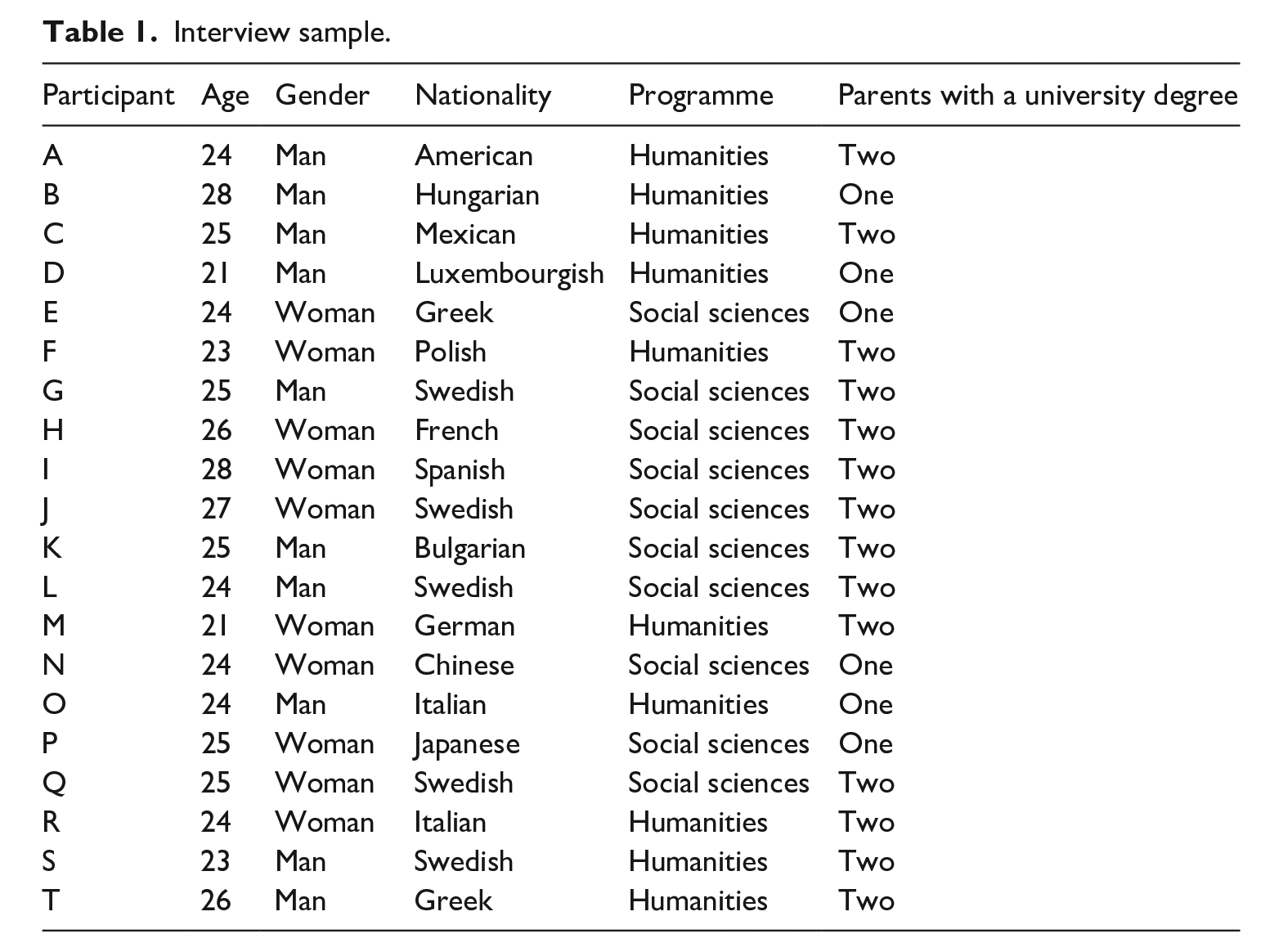
In order to study media practices and ‘class making’ in the ECMC 20 qualitative semi-structured interviews were conducted and transcribed between July and December of 2022. The ECMC is a segment in the social space whose capital portfolio is characterized by cultural rather than economic capital, which manifests not least in its origins in social milieus rich in scholastic capital. The segment belongs, in other words, to the ‘cultural fraction’ of the social space (Bourdieu, 1984; Flemmen et al., 2018). Additionally, the segment is emerging, meaning that its members are relatively young and in the process of upward mobility (or, in a sense, of reproducing their social positions) in the social space by pursuing a tertiary education in disciplines leading to future careers in cultural production, academia, publishing, media and so on. To sample this segment of the social space we recruited master’s level students at a Swedish university ‘where there is a concentration of students with vast amounts of highly recognized resources of various kind’ (Börjesson and Broady, 2016: 121). All our interviewees: (1) were young (between 21 and 28), (2) students in the humanities or the social sciences, who were (3) enrolled in advanced level studies (master’s programmes) and (4) had at least one parent holding a university degree. Thus, our 20 interviewees (10 women and 10 men) can be considered members of the ECMC on the basis of their capital composition/volume and their ongoing trajectory in the social space (undertaking advanced studies in humanities/social sciences and aspiring to enter academia or fields of cultural production). The sample is summarized in Table 1.
Interview sample.
In order to study the media practices of the ECMC (RQ1) and also to initiate the interview in a relatively undramatic manner the interviews began in an open-ended way by asking interviewees to describe a regular ‘day with the media’. This step follows the broad notion of media practices (Couldry, 2004) and previous studies on media repertoires which allows an open-ended study on the ‘specific combination[s] of contacts with different media and kinds of content’ (Hasebrink and Popp, 2006: 384) in an increasingly complex digital media landscape. We then proceeded to let respondents talk about certain media practices (such as watching a particular show on Netflix, listening to a certain type of music or reading a particular news item) that they felt proud of and/or would gladly talk about or showcase and let other people know about (RQ2). Next, we turned the question around, asking if there were any media practices that they believed that others would ‘look down on’ (RQ3). This follows the suggestions to approach self-stigma, or internalized stigma, by asking people what they think other, unknown, people would think of themselves (Bos et al., 2013; see also Link and Phelan, 2001). In order to understand from where they expect such stigma, that is, its imagined social origins (RQ4), we asked our interviewees to think of a person, or a category of people, that would ‘look down’ on their media practices.
The complexities ingrained in the task of studying habitus, and how people relate to culture – not least via the interview method – are well-documented (see e.g. Benzecry, 2018). Two key strands of thought exist here (Pugh, 2013). On the one hand there are those sceptical about the interview method since it tends to capture only ‘honourable’ accounts. What is expected to be documented by the interviewer is, in other words, only attempts by respondents to be viewed in a positive light. At the other side, there are those relying multi-levelled analysis and careful interpretation to reach beyond the honourable level (Pugh, 2013). In a sense, we promote a middle-way here, arguing that there is value in a multi-levelled analyses of the ways in which ‘the honourable’ becomes manifest. The habitus promotes not only practices and preferences, but also constant negotiations, not least in interviewees’ own accounts of their anticipation of stigma. Our study design implies that we talk about taste with a social class invested in its taste. One might thus expect that all analytical levels delineated above (description of practices, valuation of practices, anticipation of stigma on practices) are embedded in honourable accounts. While proponents of both strands mentioned above could view this as problematic, we argue that the ways in which members of the ECMC chose to talk about their own practices and how they claim to imagine others reacting to those practices are at the core of the class-making we are studying. In a sense then, our research questions and method provide ‘accounts of accounts’ (Bourdieu, 1989), and despite the different character of the research questions they come together, in the actual interview setting, in a more or less unified ‘presentation of self’ (Goffman, 1959). It should be noted, however, that in breaking with pure ‘subjectivism’ involved with exclusively studying how social agents represent the social world (‘accounts of accounts’), we anchor such representations in their social origin and the class specific habitus of a particular social group, the ECMC (Bourdieu, 1989).
The interviewees were confidential and all participants signed a consent form agreeing to be audio-recorded. The interviews were conducted in English and lasted on average for 40 minutes. Transcripts were thematically coded inductively in three rounds.
While our study design allows us to zoom in on a specific segment in the social space, and to demystify the category of ‘young people’ in relation to digital culture (as oftentimes done via notions of ‘digital natives’ and ‘Generation Z’), and to explore the relatively undisclosed dynamics in how media practices contribute to the making of a class via self-stigma, it is not without limitations. First, the material is limited in scope, meaning that we do not seek to generalize in statistical terms, but rather to advance the theoretical discussion on media practices, habitus and class-making. As such we invite future research to further explore the tendencies and dynamics uncovered in this study. Second, our sample is international, consisting of people from 14 countries. On the one hand, this allows us to account for the increasingly transnational character of the contemporary middle-class (Derné, 2005). On the other hand, it implies that we might miss out on local differences and the fact that the social space and the composition of the ECMC might look different in different countries. It should be noted, however, that the patterns analysed in the next section constitute common traits in the sample, pointing to a similar class habitus in the ECMC across gender and ethnicity dimensions. Third, we focus here on only one specific segment of the social space, the ECMC – a segment suggested by previous research to be comparably prone to anticipate stigma of their media practices (Lindell, 2022). We thus leave for future research the important task of comparing the present dynamics between different class fractions.
Results and analysis
We begin by charting the media practices of the interviewees. In a second analytical step we uncover what media practices were considered having high or low status. This leads into the third and fourth analytical steps where we analyse the media practices that the ECMC expects others to ‘look down’ on, and the imagined social origins of this internalized stigma.
The media practices of the emerging cultural middle class
We began our interviews by probing a regular ‘day with the media’ for the ECMC. The benefits of this initial step were not only methodological (in terms of starting off the interviews by talking about relatively non-controversial matters). It also allowed us to unearth potential discrepancies between what respondents said they did (what their media practices were) and what they expected others to think of this, which is covered in later sections.
At the overarching level our interviews suggest, in line with previous findings (e.g. Kim, 2016; Purhonen et al., 2021), that the media practices of the young ECMC revolves around digital, rather than analogue, media. A recurring pattern was the daily use of social media (e.g. Facebook, Instagram, WhatsApp) driven by the need to connect with friends and family, seeking entertainment or accessing personalized information/content. Another prevalent theme capturing the interviewees’ media practices was using various streaming services (e.g. Netflix, YouTube, HBO Max, Disney+, SVT, MUBI, Spotify, Podcaster) both for watching television series and films and to listen to music and podcasts corresponding to their fields of interests.
Accessing the news was also embedded in our sample’s digitalized media repertoires. Their news diets included the online editions of mainstream media such as Swedish Radio, BBC, Dagens Nyheter (a Swedish quality broadsheet), The Guardian, Aftonbladet (a tabloid paper), local radio stations from their country of origin and digital-only outlets such as social media accounts, news aggregators and apps. Other themes uncovered in the coding and categorization of their media practices was playing video games as a way to spend time with friends and reduce stress, but also to produce contents on social media, including sharing photos, initiating discussion by sharing news, promoting their university in articles and joining discussions. Taken together the media practices of the ECMC correspond to the ‘basic needs’ (Bengtsson et al., 2021) fulfilled by various media – interviewees use media to maintain social contacts, organize everyday life and relax but also to gain recognition via social media and fulfil civic desires (such as gaining knowledge and learning about current affairs).
On a broad level the set of media practices of the ECMC uncovered here (e.g. using a range of streaming services, consuming ‘quality news’ and frequent use of social media) fits with previous findings on the media practices of this class fraction (Hovden and Rosenlund, 2021; Lindell, 2018). What likely sets this group apart from other, less well-resourced, young segments in the social space is their media/cultural omnivorousness (Peterson and Kern, 1996) and the digital nature of their media practices (Purhonen et al., 2021). Our material suggests that this particular segment in the social space forms media repertoires around a range of different devices, types of contents and practices (from in-depth podcasts about history or philosophy or the consumption of quality journalism to gaming and browsing social media). This corresponds to the notion that cultural omnivorousness, that is ‘having broad tastes and straddling divides are in fact key features of what Bourdieu saw as a “taste freedom” and a “sense of distinction” typical of those rich in cultural capital’ (Flemmen et al., 2018: 129).
‘High’ and ‘low’ media practices
In a second analytical step we asked interviewees about the media practices they classified as more prestigious than others. This step in the analysis aimed to uncover an economy of practices and its hierarchies, and it allowed us to analyse the correspondences between two forms of symbolic systems formed within the ECMC – what they view as high/low status and, later, what they believed that others think (which will be covered in the next section). Two groups of media practices were endowed with ‘high’ status.
The first group of media practices held in high regard relates to news consumption. News use was described as good and productive because of the virtue of staying up-to-date with current affairs (Lindell, 2018; 2020). As discussed above, however, the interviewees were mostly accessing and consuming the news via digital media – ranging from digital versions of newspapers, smartphone applications, and in some cases from social media platforms and profiles. The interviewees, it should be stressed, were keen on emphasizing the differences between news sources, where ‘respected’ and ‘reliable’ sources were set apart from unsupervised and unchecked outlets.
The second group of practices with high status was the use of streaming services – in particular MUBI, Netflix and podcasts. MUBI is a streaming service providing theatrical and unconventional films from emerging talents in the film industry. The platform is curated every month by human beings, rather than algorithms. This, the interviewee argued, gives the service more value than other ‘mainstream’ streaming services. The reason why using Netflix was considered, by one interviewee, as more prestigious than other services was because of its popularity in her own social circles. Allegedly Netflix was held in high regard by her peers and as such formed the basis for social interaction and conversation. Other examples included listening to podcasts and audiobooks via streaming services. This was considered a high-status practice on the basis that podcasts offer the opportunity for self-development. One of the interviewees highlighted the fact that whether or not listening to podcasts is ‘high-status’ depends on the theme and content of the given podcast, but also by the fact that listening to podcasts requires more effort, intention and engagement compared to other digital media practices. Similar dynamics echoed in another respondent, who used streaming services to improve her English skills as a non-native speaker.
In line with previous research on how upper and middle classes seek to present themselves as ‘ordinary’ (Savage et al., 2001), downplaying their lifestyles and being ‘open’ to the cultural practices of other classes (Ollivier, 2008) our interviewees were less keen on outing ‘low-status’ media practices (see also Jarness and Flemmen, 2019). It was, however, possible to distinguish two different practices marked as having lower status than others. One such practice was reading the tabloid papers which, according to some interviewees, were ‘less respected’ than other news outlets (see also Lindell, 2020). The other example was spending ‘too much time’ on social media, or using social media in the ‘wrong ways’ (e.g. people who are careless in posting on social media) which interviewees associated with unproductivity and waste of time. This particular sentiment of spending ‘too much’ time on social media is perhaps the most clear-cut distinctive feature of this class segment (Fast et al., 2021). These patterns tie into previous research on how young people from culturally rich homes are careful not to waste time and to spend their spare time on constantly improving themselves in various ways (Danielsson, 2014) and the studies suggesting how being ‘busy’ is emerging as a form of cultural capital in late, neoliberal, modernity (Prieur and Savage, 2015).
Media practices and anticipated stigma
The third analytical step involved asking the interviewees what they think that others would think about their media practices, and it allowed us to tap into a relatively unexplored facet of the habitus, namely how the rules and expectations of the social world is internalized and turned into the anticipation of stigma (Lindell, 2022; Lynd, 1958). Two main forces were at play here.
The first one is the trope of unproductivity, which implies that our respondents expect that others will view some of their media practices as redundant, unnecessary and leading to procrastination of more important matters. The prime example here is using social media ‘too much’ (see also Fast et al., 2021) as it, according to the interviewees, is ‘very time-consuming and addictive’, ‘not productive’ and not leading to ‘rewards’. Several respondents expected that others would ‘look down’ on using Facebook for ‘entertainment’ such as looking for memes and funny content, and another stated that people might be surprised that he was using Facebook (‘Oh? You use Facebook’) when time could be spent on other, ‘better’, things.
I think it’s just spending a lot of time on them [social media] without any particular reason, just to kill the time [. . .] It’s not that I’m ashamed of spending time on Instagram, but the thing is, using social media a lot limits concentration to a big extent. Especially when you do it, like you know, three minutes here, ten minutes here and then you take breaks in whatever you are doing so, yeah, I think that would be it. (participant F, 23 years old)
In the same category – that is, media practices expected to be deemed as unproductive by others – we have gaming, aimlessly browsing the internet or watching videos on YouTube and reality shows. ‘Mindless scrolling’ on social media, gaming or binge-watching (‘bad’) shows are expected to bring about sentiments such as ‘why are you doing this when you could do something more productive?’ as our respondents expect others to classify these practices as ‘time-consuming and unnecessary’.
The second source of anticipated stigma of media practices concerns the trope of disengagement. This includes expectations that others will look down on media practices on the basis of what our interviewees were not doing. This primarily concerns not consuming enough news, not reading the right magazines or using social media in proper and moderate ways.
Somebody might say to me “why don’t you read the newspaper? Why don’t you watch the news?” So, I think [. . .] they would judge me for the things that I don’t do. Like “why don’t you read the newspaper? You don’t like. . .why don’t you watch. . .you don’t know what is happening in the world?” (participant E, 24 years old) So, for example I know there is this magazine that is called [magazine] and it’s considered a very good magazine. I’ve read a couple of editions or issues. It is a good magazine, but like it has some thought-provoking articles or articles that also help you look at some things from a different perspective or point out some issues you wouldn’t think about otherwise. But the thing with magazines like this, you have to put in more effort because it is, you know, slightly more demanding when it requires you to think. But this is something I could do more or I don’t know, read newspapers every now and then about some events in the world. (participant F, 23 years old)
Charting both which media practices that the ECMC hold in high (and low) regard, as well as the anticipation of stigma on the basis of how they choose to spend their time with various media provide the contours of a moral economy that the interviewees seem obliged to navigate. Research has suggested that it is the upper class and the cultural factions in the social space that are most anxious about their media practices, possibly because they have clear-cut stakes in their lifestyles (Holmqvist, 2022; Lindell, 2022). This study reveals how this plays out in everyday life. More than anything else, the ECMC balance between productivity and unproductivity and connectivity and disconnection in regards to the outside world and current affairs. It seems thus, that the accumulation of the emerging forms of cultural capital – being busy, cosmopolitan and connected to the world at large (Prieur et al., 2008; Prieur and Savage, 2015) – is what is at stake in how this group of young people manoeuvre in their mediatized everyday lives. Failing to live up to these expectations results in the anticipation of stigma from imagined others. The question that remains to be answered concerns the social origins of the imagined others that are expected to look down on and judge their media practices.
The social origins of anticipated stigma
Our interview material reveals three main social origins of the stigma that our interviewees have internalized. The first concerns the stigma expected to be cast by people in other generations. The interviewees, who are between 21 and 28 years old, viewed ‘younger generations’ as more media savvy than them, and in better positions to adjust their tastes and practices to an ever-changing media landscape. Thus, the interviewees expected younger generations to think that their media practices were ‘old-fashioned’ and that they would be grouped alongside ‘older people’. This sentiment manifests most clearly in regards to Facebook – a social media losing popularity in younger generations which is subsequently considered a platform for older people who ‘share weird stuff from time to time’: And I started to notice like my parents are the generation using it [Facebook] a lot these days and the younger generation doesn’t use it anymore like at all. [. . .] So yeah, some people maybe would look down on me for using Facebook cause they would think I’m old or something. (participant B, 28 years old)
In regards to the older generations, our interviewees expected them to think that their media practices were a ‘waste of time’. This was largely explained by the different media regimes that the two generations have grown up in. The interviewees believed that older generations ‘are not used to’ contemporary media practices since they ‘didn’t grow up’ with them. It is because of this alleged lack of knowledge that the older generations, in the eyes of our interviewees, consider the ways in which the interviewees spend their time on various media as wasteful. Older generations were believed to suggest that it would be better to ‘do something more productive like reading a book, go for a walk’: I think it is like probably the older generations because they don’t really use it that much [social media] so they live their life without using it at all. And they don’t spend time on it and I don’t know like it’s quite common to hear that “oh you are on your phone again” like “you are using your phone again” and of course, it doesn’t really matter what you are doing on the phone but if you are spending a lot of time on social media there is kinda criticism. (participant F, 23 years old)
Another example includes parents worrying about the interviewees’ failure to stay up-to-date with current affairs and checking the news and subsequently risk ending up in her ‘own bubble’. Here respondents fathomed their parents – who, it should be stressed, almost all had university degrees – stressing the importance of knowing who ‘this and this is’ and to ‘know what is happening in the world’, and they would view reality-tv as ‘trash’.
The second social origin from which the ECMC expects stigmatization of their media practices is, in accordance with the Bourdieusian (1984) narrative on the directionality of symbolic violence, the upper regions in the social space. More specifically, our interviewees express a concern that more distinguished agents in the academic field, future employers (i.e. established agents in the field of cultural production and/or academia) or people generally ‘above them’ would look down on how they choose to spend their time with various media. Like the anticipation of the stigma coming from older generations, our respondents expected these categories to look down on the unproductivity of their media practices. For instance, one interviewee – a philosophy major – seemed to experience cognitive dissonance in enjoying a popular scientific philosophy podcast that he thought his professors would regard as illegitimate.
If I would talk to somebody I respect and they tell me that what I’m listening to is you know not proper or whatever – I would feel in a sense of shame you know because you look up to this person and you expect to have open mind (participant A, 24 years old)
The imagined others at positions above our interviewees in the social space ‘want me to produce something or be effective’, and such ‘effectiveness’ was not perceived to be linked with the daily use of social media – a form of media practice that (as we have seen) is a recurring target in the ECMC’s internalized stigma. The interviews reveal an aspiration to be viewed in a positive light by agents at higher social positions which in some cases result in an adjustment of social media uses in that our interviewees enact an online identity believed to be on par with the expectations of the imagined other. This can manifest, for instance, in ‘not share[ing] that picture’ or ‘showing my intelligence’ (see also Pitcan et al., 2018).
The importance of connectivity and staying updated on world events was emphasized here as well. When mentioning how people with higher status in future workplaces and inside academia would view our interviewees’ media practices, news media came to mind. According to one interviewee’s ideas of these expectations, reading the right news outlets and magazines were ‘something essential in this world’, and if she does not immerse herself in those outlets, she’s not having the proper taste and lifestyle as she fails to be ‘an aware person’ up to date on cultural matters and world events.
The interviewees were also anticipating stigma from those above them in the social hierarchy in terms of their non-existent media practices. This includes not using social media for academic purposes (e.g. using Twitter to find and promote research). Interviewees seemed to be under the impression that if you are not publishing social media content connected with research, ‘you don’t exist’, and that this would apply both for themselves and for their seniors within academia.
Finally, other regions in the space of lifestyles (Bourdieu, 1984) constitute a third origin from which the ECMC anticipates stigma of their media practices. This is mainly, but not exclusively, a matter of anticipating stigma from people holding different political views and consuming other, partisan, news media or being active in the ‘wrong’ online forum. The Swedish interviewees, for instance, expected people who vote for the Sweden Democrats (a populist right-wing party) to look down on them for listening to Swedish Radio, a public service broadcaster often accused by far right-wing opinion-leaders for being left-leaning (see e.g. Holtz-Bacha, 2021).
Others also anticipated close friends with other views and approaches to social media to look down on how they chose to manoeuvre on social media platforms. For instance, one interviewee uses Facebook for entertainment purposes such as to look for ‘funny stuff such as pics’ thinking this was ‘really ridiculous’ while another was anxious about using Instagram in a ‘Japanese way’ by posting too much.
Interviewees also claimed to avoid conversations regarding some of the practices with low status explored above, such as gaming. For instance, one interviewee expected others to think that he was a ‘nerd’ for playing history and war games, arguing that it is easier to tell people that ‘you are interested in, like, creative photography’ than playing video games. Another example concerns major bodily investments, which in previous studies on university students has been connected other student groups (business administration and engineering students) than students in cultural studies and the humanities, who instead tend to display a relative disinterest in buying expensive clothes and physical exercise (Börjesson et al., 2016). Here one of our interviewees believed that her content on Instagram could be looked down upon because people would perceive it as ‘shallow’, projecting a ‘fake’ version of herself and her lifestyle.
[. . .] I think some people find it, like, unattractive to care. I think there is a perception that like being in the gym has to do with looking a certain way. [. . .] And then like maybe they are looking down on it because it is considered like you only care about how you look. (Participant J, 27 years old)
This constitutes a case in point on how the habitus attunes to its social environment, in this case the cultural fractions of the field of higher education wherein the interviewee occupies a position characterized by relative bodily disinterest. In this segment of the social space following Instagram accounts dedicated to physical appearance and exercising is expected to be met with aversion. This, and the other examples, show how internalized structures (the habitus) produce classificatory systems of anticipated stigma that reproduce the interviewees’ identities as members of a cultural middle class wherein, for instance, ‘too much’ bodily investment is met with scepticism.
Conclusion: Class-making beyond practices and preferences
This study has zoomed in on how a particular social class, or more specifically, a segment of the social space – the ECMC – relates to a range of media practices in acts of ‘class making’ (Bourdieu, 1984). We have shown that social reproduction takes place (1) through media practices and preferences (the ECMC taste) and (2) via adherence to class specific norms in regards to what is classified as ‘high-status’ (such as reading quality news or watching certain shows) and ‘low-status’ (such as spending ‘too much’ time on social media). In regards to these two categories, the ECMC are, in line with previous studies (e.g. Danielsson, 2014; Purhonen et al., 2021), digital cultural omnivores who value ‘productive’, ‘connective’ and ‘informative’ media practices, whilst downgrading unproductivity and wastefulness. While we have not compared this kind of media repertoire and moral sentiments with those of other classes our results align with previous research on the social space in its entirety (e.g. Lindell, 2018) and on-going discussions on how the middle-class values the importance of leading connected, productive and cosmopolitan lifestyles (e.g. Prieur and Savage, 2015).
Indeed, the main point of this study was not to compare social classes, but rather to zoom in on a class fraction particularly invested in its lifestyles, a fraction prone to anticipate stigma on the basis on their tastes and media practices (Lindell, 2022). Previous studies (Lamont, 1992: Skeggs, 2011) have shown that people deprived of capital tend to create alternative classification systems and thereby allowing themselves to ignore the doxa connected to consuming the ‘legitimate culture’ in a ‘legitimate manner’ (Bourdieu, 1984). By contrast, the cultural middle-class is heavily invested in their lifestyles, which may function as symbolic, field-specific, capital in the cultural fractions and in certain fields in the social space. This implies that their habitus, which adapts to its social environment, promotes sensitivity to the ‘rights’ and ‘wrongs’ in the realm of culture consumption and media practices. More specifically, the ECMC habitus seems to be configured to ward off ‘unproductive’ and ‘time-wasting’ practices. In order to avoid such practices and ‘maintain rank’ (Bourdieu, 1989: 17) and fit within class-specific norms they internalize and embody a stigma manifested in the expectation that others will look down on their lifestyles (Merrell Lynd, 1958).
Thus, our main contribution regarding class-making is found in how the ECMC is (3) anticipating stigma of their media practices and thereby aligning themselves with class-specific expectations on how to lead one’s life. The habitus is the past in the present, the socially formed relation to the world, and ‘the individual trace of an entire collective history’ (Bourdieu, 1990b: 91). Previous studies have been occupied with the linkage between habitus/capital/class and its manifestation in tastes, that is, practices and preferences. The habitus of students in the humanities and social science, with academic upbringings and their eyes set on careers in academia, publishing, media and cultural production summons imagined others – the (well-educated) parent, a grandparent, a teacher, a future employer, a peer, the political opponent and so on – who ‘looks down’ on one’s media practices. We have identified overlaps with what the ECMC hold in high regard (such as ‘productive’ media use) and the bases from which they imagine that others will judge them (for instance, ‘unproductive’ media use). This suggests that the various levels explored here (description of practices, valuation of practices, anticipation of stigma on practices) form a relatively unified presentation of the self. We have thus accounted for the accounts that a specific social group relies on in cementing its position in the social space.
