



Abstract
Background:
This study examines Spolsky’s tripartite family language policy framework of Bengali as a heritage language (HL) among intra-national immigrants in New York City (NYC).
Methods:
Data comprised a non-random purposive survey and semi-structured interviews. The survey data were analysed using descriptive and inferential analysis, and the interviews were analysed through reflexive thematic analysis. Recurring themes and selected excerpts were aligned with the survey results to highlight and conceptualise broader social patterns.
Results:
The findings indicate a generational shift from bilingualism to English-dominant monolingualism in Bangladeshi immigrant families. Parents ideologically preferred Bengali and supported bilingualism for cultural and intergenerational ties. However, they demonstrate a strong inclination towards English management while supplementing Bengali through home, educational and community strategies. Furthermore, children consistently preferred English across all domains of the framework. Barriers to HL maintenance included perceived limited relevance and value, constrained resources, assimilation pressure and parental insufficient awareness.
Conclusion:
This study suggests targeted support mechanisms to promote for HL maintenance in understudied NYC communities.
Keywords
Introduction
Recently, there has been an increase of interest in the family language policy (FLP) of Bangladeshi immigrations in different countries (e.g., Afreen & Norton, 2022; Al-Azami, 2005, 2014; Bhattacharya & Sinha, 2025; Bose et al., 2024; Ferro, 2025; Kolancali et al., 2024; Rasinger, 2013; Subhan, 2007). Traditionally, Bangladesh has historically experienced substantial outward migration (Bossavie, 2022; Gardner, 2009). Individuals are often motivated to migrate internationally for a higher standard of living, better education, health care and economic stability. Moreover, they want to avoid the political instability, insecurity and systemic corruption in Bangladesh (Shafiq, 2016). However, they face the dual challenge of English proficiency for social integration and mobility in New York City (NYC) while preserving their heritage language (HL) amid pressures of assimilation. In this case, parents’ FLP also often involves finding an (im)balance between learning the dominant language(s) of the host country and/or preserving the HL. Assimilation pressure is one of the main instruments of language shift / change at both micro-and macro-levels (Fishman, 1965). As multilingual families have become more predominant alongside international migration and the development of transnational identities, the role of HL maintenance has become an increasingly important area of scholarly inquiry (Blommaert, 2010; Lukose, 2007). FLP provides a framework for explaining HL use by showing how families negotiate their ideologies, management and practices under multiple pressures (A. S. Canagarajah, 2008; Curdt-Christiansen, 2009; Fogle & King, 2013; Schwartz, 2010). It also depends on socioeconomic conditions, demographic distribution, representation in the media and education and government policies (Cavallaro, 2010; Clyne, 1982, 1991; Kloss, 1966; Pauwels, 2016).
The term heritage language used in this study refers to a language that is historically and culturally associated with a particular community and transmitted across generations (Blake & Zyzik, 2003; Boon & Polinsky, 2015), often in contexts where it is no longer the dominant language of daily communication. This term is preferred over alternatives such as old language or ancient language because it emphasises sociocultural continuity, identity affiliation and intergenerational transmission rather than perceived age or historical distance. Moreover, HL is widely used in sociolinguistic and applied linguistic scholarship to describe languages maintained by minority or diasporic communities, providing conceptual precision and alignment with existing research (Boon & Polinsky, 2015; Lipińska & Seretny, 2012; Montrul, 2016; Valdés, 2000).
Bangladeshi immigrants in the US are a rapidly growing community, estimated to be around 500,000 including both documented and undocumented individuals (Akhter & Yang, 2023). The first-generation are foreign-born individuals who migrate to a host country; the second generation consists of their children who are born, raised, educated and socialised there (Salas-Wright et al., 2014; Schneider, 2016). This generational distinction is particularly relevant for FLP research, as intergenerational differences often shape divergent language ideologies, practices and management strategies within immigrant families (Wąsikiewicz-Firlej & Daly, 2023).
While NYC is a major hub for migration hosting about 93,000 of Bangladeshis as of 2019 in the state (Budiman, 2021), existing research has paid limited attention to how Bangladeshi immigrant parents and children negotiate FLP in this specific sociolinguistic context. Although a considerable amount of research has been devoted to other countries, few attempts have been made to investigate Bangladeshi immigrants in the US. This study addresses this gap by examining FLP of Bangladeshi immigrant families in NYC, with a particular focus on how parents’ and children’s language ideologies, practices and management strategies respond to social and institutional pressures. By adopting a mixed-methods approach, the study aims to contribute to FLP scholarship by providing empirically grounded insights into intergenerational language negotiation and HL maintenance in an understudied community.
The remainder of this article is organised as follows: the next section reviews relevant literature on heritage language theory, ideology, practice and mangagement, and family language policy. Furthermore, it is followed by a description of the research design and methodology. The results section then presents the integrated quantitative and qualitative findings, after which the discussion and conclusion summarise the study’s contributions, implications, limitations and directions for future research.
Family language policy
FLP has become essential for exploring how HLs are negotiated across generations in transnational immigration. One of the first introductions was outlined by Luykx (2003) to address children as both agents and objects in the language-ecology in their families. Slavkov (2017) refers to FLP as ‘. . . explicit and implicit family rules, practices and ideologies about who speaks what language to whom in a household’ (p. 380). It is also defined as ‘. . . how a family views and organizes language use’ with a focus on decisions on children’s education (Hollebeke et al., 2020, p. 1). Thus FLPs, whether explicit or implicit, provide a framework for how language is used at home (Pagé & Noels, 2024). Studies on FLP thus examine both deliberate strategies and covert ideologically driven practices shaped by politics and culture (Caldas, 2012; Curdt-Christiansen, 2012, 2018). The family is a strong ‘socialising agent’ (Fogle & King, 2013) and a core actor in the transmission of HL to the next generation (Yagmur & Bohnacker, 2022). As language socialisation begins at home (Quay & Montanari, 2016), family strongly influences children’s language preferences (De Houwer, 2007; King & Fogle, 2006; Leung & Uchikoshi, 2012; Spolsky, 2012).
At the macro level, FLP is shaped by politics, social attitudes and economic factors, which influence whether families promote multilingualism and/or monolingual norms (Curdt-Christiansen & Sun, 2022; Heller, 2003). These forces also shape the linguistic environment and influence them whether they preserve their HL(s) or use dominant ones (Curdt-Christiansen, 2013). Besides, FLP at the micro-level is shaped by parents’ beliefs, socio-cultural experiences, political and economic factors (Curdt-Christiansen, 2009; Mirvahedi, 2021; Schwartz & Verschik, 2013). Thus, families act as mediators between individual and social practices by bridging the gap between the macro and micro levels.
The family is considered central to intergenerational language transmission and can either slow or accelerate language shifts (Fishman, 1991). ‘Intra-family factors’ include family structure, parental education, acculturation and emotional cohesion (Schwartz, 2010). Furthermore, ‘external influences’ from the extended family, community and nation which may change initial language-use decisions (Wąsikiewicz-Firlej & Daly, 2023). Bilingual families live in contexts that either support both languages (additive) or marginalise the HL (subtractive). Some of them rely mainly on the dominant language, others focus on the HL and many mix both, depending on family dynamics and social pressures (Deprez, 1994; Hélot, 2007). To balance language(s), they use strategies such as the ‘one person, one language’ (OPOL) approach, the earlier and most widely studied model (Baker, 2011; Barron-Hauwaert, 2004; Lanza, 1997/2004; Schwartz, 2020; Yamamoto, 2001) or the ‘minority language at home’ (MLAH) approach, often combined with time or place-based methods (Baker, 2011). Moreover, Mirvahedi and Hosseini (2023, p. 181) introduce the notion of ‘family language policy in retrospect’ to examine the long-term outcomes of parental ideologies, practices and management in shaping children’s linguistic development, thereby bridging synchronic and diachronic perspectives. This approach critiques snapshot accounts of translingual practices that overlook parents’ histories, aspirations, affective concerns, language power relations and the long-term implications for children’s language acquisition.
Spolsky’s (2004) model frames FLP as the interaction of ideologies, practices and management, which links parental beliefs, daily routines and the wider sociocultural context (see also King et al., 2008). However, his model has attracted several criticisms (Mueller, 2023). Although Spolsky (2009) acknowledges implicit policies, his emphasis on explicit management overlooks the covert choices (King & Fogle, 2017). Postmodernist studies challenge that his framework is overly rigid for multilingual family realities and, grounded in canonical epistemologies, may marginalise Global South perspectives (Hiratsuka & Pennycook, 2020; Lomeu Gomes, 2018). Despite this, it remains influential as a ‘structural, flexible, and expandable framework’ (Schwartz & Verschik, 2013: 4) and continues to guide diverse FLP studies (Mirvahedi & Hosseini, 2023).
HL ideologies, practices and management
Language ideologies (LI) are the ‘underlying force’ (Curdt-Christiansen, 2013) which shape parents’ beliefs and decisions about language use, negotiation of social pressures and migration-related challenges (e.g., schooling and cultural adaptation) and everyday practices (Curdt-Christiansen, 2013; De Houwer, 2007; King, 2000; Spolsky, 2004; Yagmur & Bohnacker, 2022; Yamamoto, 2001). Parents’ beliefs often indicate the instrumental value of dominant language(s) for mobility while mediating tensions between HL maintenance and host-society linguistic norms (Bacallao & Smokowski, 2007; Heller, 2003). For example, in English-dominant contexts, they may prioritise English for its perceived advantages, do mixed-language practices despite ideals of pure language and expect children to maintain the HL and cultural values while succeeding in the dominant language, often creating tensions around identity and loyalty (Curdt-Christiansen, 2016; Tannenbaum & Howie, 2002; Verschik & Argus, 2023). These ideologies are not homogeneous; differences within families can lead to conflict or compromise as family members negotiate differing views on language use (Mirvahedi, 2021; Van Mensel, 2018). However, there is often a gap between parental HL and actual practices. LIs are closely intertwined with cultural and socio-political experiences. Kozminska and Hua (2020), for example, found that socio-political changes, such as Brexit, have shaped the ideologies of Polish-speaking immigrant families in the UK. Moreover, Zhu and Li (2016) examined how LI shapes immigrants’ identities and influences their sense of belonging in host culture.
Language practice (LP) refers to the actual use of language in daily family interactions, which may align with or diverge from parental ideologies and is shaped by the realities of the country (Verschik & Argus, 2023). Importantly, the long-term impact of such practices on children’s linguistic development is closely tied to emotions, an often-overlooked dimension in accounts that portray multilingual families as ‘simply translanguaging’ (Wiley & García, 2016, p. 59). In bilingual families, LPs vary, ranging from exclusive use of the dominant language or HL to mixed approaches (Deprez, 1994). Parental planning is pivotal for children’s bilingual development and minority-language maintenance (Yagmur & Bohnacker, 2022), yet it can also reconfigure family power relations as children gain proficiency in the dominant language (Lee, 1996). Nonetheless, maintaining sustainable HL practices is often difficult, as parents may switch between languages or face constraints from limited resources and external sociocultural pressures (Doyle, 2018).
Moreover, language management (LM) refers to strategies to promote specific language(s), such as fostering a supportive home environment, enrolling children in language classes and encouraging interaction with peers who share the same linguistic backgrounds (Spolsky, 2004). These efforts often involve conversational practices such as rephrasing, offering equivalents in the target language or correcting language use (Schwartz, 2020). In immigrant contexts, LM often focuses on schooling choices (e.g., monolingual or bilingual preschool) and home-based strategies, such as language rules, supplementary instruction and cultural immersion, sometimes through schools that support specific language(s) (Curdt-Christiansen, 2013, 2018; Kheirkhah, 2016; Schwartz & Moin, 2012). In interethnic or immigrant families, these strategies often adapt to conflicting linguistic and cultural norms and require constant adjustment to changing circumstances (cf. Bacallao & Smokowski, 2007; I. J. Kim, Kim, & Kelly, 2006). For example, studies on Latvian and Kazakh families (Martena, 2023; Smagulova, 2017) have identified various discourse strategies used by parents to facilitate language transfer. Misalignments among ideology, management and practice often arise in response to social attitudes, national policies and economic pressures, and they emphasise FLP as a dynamic, context-dependent process (Curdt-Christiansen, 2016; Rahmadani, 2026; Spolsky, 2004; Moustaoui Srhir & Poveda, 2022).
Parents and children agency
Agency is defined as the ‘socioculturally mediated capacity to act’ (Ahearn, 2001, p. 112). FLP explains how parents and children negotiate their language use. Parents as ‘language managers’ (Spolsky, 2004, p. 8) are central policy actors in the immigrants’ home, with the authority to influence children’s LP. Parental agency (PA) is enacted through everyday language use, feedback and management strategies that may support bilingual development and minority-language maintenance (Fogle & King, 2013; Kheirkhah, 2016; Lanza & Lomeu Gomes, 2020; Mishina-Mori, 2011; Moustaoui Srhir, 2020; Spolsky, 2004, 2012). For immigrant families, while parents often navigate the tension on cultural preservation, they allow children to acquire dominant language(s) for socioeconomic reasons (Bacallao & Smokowski, 2007). Moreover, parents may try to achieve language goals by enforcing rules for language use, such as enrolling their children in language classes or encouraging cultural immersion (cf. Curdt-Christiansen, 2016). However, external pressures (social) and internal motivations (individual) often influence PA decisions. Parents with greater educational and linguistic resources may prioritise the institutional language over HL transmission and reflect how their goals, backgrounds and resources influence families (Hollebeke et al., 2022; Ren & Hu, 2013; Schwartz & Verschik, 2013).
Besides, children may not follow their parents’ language beliefs. Their daily language choices often favour the dominant language(s), leading parents to adjust their FLP, especially when multilingual goals are not supported by consistent management (Gyogi, 2015; Lanza, 2004/1997; Luykx, 2005; Maseko, 2022; Pagé & Noels, 2024; Tang & Calafato, 2025). Child agency (CA) is further strengthened through parent–child collaboration and sibling influence and is expressed in both resistant and compliant HL practices (cf. Bridges & Hoff, 2014; Fogle & King, 2013; Little, 2023; Paradis et al., 2021; Rojas et al., 2016; Sorenson Duncan & Paradis, 2020; Tsinivits & Unsworth, 2021).
Heritage language: theory and practice
The term HL is ‘conceptually and operationally challenging’ (Blake & Zyzik, 2003, p. 523). Boon and Polinsky (2015) define it as ‘an ethnic or immigrant minority language which is the weaker of a bilingual speaker’s two languages. Heritage speakers feel a cultural or family connection to their HL, but their most proficient language is the one that is dominant in their community’ (p. 1). This term emerged in the 1990s in US and Canadian educational literature and policy to describe ‘non-mainstream languages’ spoken by communities whose ancestors predated the establishment of these nations or migrated later (Valdés, 2001; Wiley, 2014). It is also defined as ‘the language a person regards as their native, home, or ancestral language’ and closely tied to cultural and emotional attachment (Richards & Schmidt, 2013, p. 259). Later, the definition has expanded to include minority or non-social languages. HL is a contested, ideologically loaded concept that may marginalise some linguistic identities (Cummins, 2005; Verschik, 2014). They are also called minority languages spoken by ethnolinguistic communities in contexts where a dominant or official language prevails, often with limited prestige and institutional support, resulting in uneven speaker proficiency (Romanowski, 2021a). Many studies suggest alternatives such as ‘home language’ or ‘community language’ to emphasise practical and family use (Baker & Jones, 1998; Corson, 1999; Schalley & Eisenchlas, 2020; Wiley, 2001, 2005; Yeung et al., 2000).
HL usually refers to an immigrant language passed down across generations in Canada and the US (cf. Montrul, 2020; Polinsky, 2018; Rothman, 2009). In the US, schools and other institutions often encourage second-generation children to use English, which may limit their opportunities to develop the HL at home and receive little support outside the family. So, many children quickly shift to English and gradually lose proficiency in the HL (Boon & Polinsky, 2015; Brown, 2011; Lipińska & Seretny, 2012; Montrul, 2016; Valdés, 2000). Moreover, Polinsky and Scontras (2020) found that HLs are characterised by the time of acquisition, socio-political factors and the dominance of the language.These categories help explain the experience of HL speakers and the challenges associated with them. Fishman (2001, p. 81) argues that ethnolinguistic maintenance in the US is long-standing and as of identifies three types of HLs: indigenous (e.g., Native American languages, many endangered but supported by revitalisation efforts such as Navajo and Hawaiian), colonial (e.g., Dutch, German and French, maintained in enclaves such as Amish German and Louisiana French) and immigrant (associated with more recent migration, e.g., Mandarin, Korean and Hindi), with Spanish uniquely spanning both colonial and immigrant histories (McCarty, 2002).
Immigrant HLs maintenance often diverge from homeland norms under host-language influence and may develop hybrid forms shaped by both contexts (Polinsky, 2018; Scontras et al., 2015). HLs are typically used primarily in the home and linked to cultural identity, with HL speakers raised in households where a non-dominant language fosters varying degrees of bilingualism (Valdés, 2000; Van Deusen-Scholl, 2003). According to the classification of Fishman (2001, p. 81), Bengali in the US can be categorised as ‘an immigrant heritage language’. HL maintenance is especially important for immigrant families and communities because sustaining the HL supports the preservation of cultural and ethnic identity, values and traditions in many cases (Brown, 2011; Escudero et al., 2023; Shin, 2023).
Bengali as a heritage language
Efforts to maintain Bengali as a HL in NYC have emerged through public school programmes, community-led initiatives and advocacy for dual-language instruction to preserve cultural identity and bilingualism. Bengali is the third most frequently reported home language among students identified as English learners in NYC public schools (Choudhury, 2012). PS 7 Louis F. Simeone (Elmhurst, Queens) launched NYC’s first primary-level Bengali dual-language programme in 2018 (Woodward, 2018). Though HL establishment is expanding, definitional ambiguity complicates curricula, pedagogy and assessment. Bengali bilingual programmes are further constrained by shortages of certified Bengali-speaking teachers, school–family–community collaboration and community-based Bengali schools (Choudhury, 2012; Kern-Jedrychowska, 2017; Michael-Luna, 2015; cf. Wąsikiewicz-Firlej & Daly, 2023). Where available, such programmes may support biliteracy, home–school engagement and cultural continuity under assimilation pressures (Choudhury, 2012; Kern-Jedrychowska, 2017; Michael-Luna, 2015).
Moreover, studies of Bengali as a HL in different countries show diverse commitment, but (un)equal support for maintaining it. For example, in the UK, parents use languages differently depending on the activity and often lack resources and HL opportunities, which limits participation in support programmes (Kolancali et al., 2024). Longitudinal evidence also shows that children may shift quickly to English and lose active Bengali use when Bengali-speaking locations and pro-heritage attitudes are weak, even though community identity can remain strong (Al-Azami, 2014). In Canada, Bengali HL teaching is presented as transcultural work that goes beyond classroom instruction (Afreen & Norton, 2022). In Australia, digitally ‘networked’ FLP highlights how dispersed relatives and emotional ties shape maintenance (Bose et al., 2024). In Singapore, ‘Bengaliness’ is described as a negotiated identity sustained through everyday cultural practices within a managed multicultural setting (Bhattacharya & Sinha, 2025). In Venice, Italian is widely viewed as necessary but is unevenly accessible due to gender and work constraints, while Bengali remains important for transnational ties, reinforcing calls for stronger multilingual and minority-language policy (Ferro, 2025).
Research design
This study used a convergent parallel mixed-method, cross-sectional design with a survey and semi-structured interviews (Bergman, 2008; Creswell & Plano Clark, 2018; Cummings, 2017; Spradley, 1979). A convergent design was selected to allow simultaneous collection and analysis of quantitative and qualitative data, enabling comparison and triangulation of findings across methodological strands. It was theoretically guided by Spolsky’s tripartite FLP model (ideologies, practices and management) for its compatibility to examine intergenerational negotiation of both parents and children (Spolsky, 2004). Each component of the framework directly informed the formulation of the research questions, data collection instruments, analytical and interpretive procedures. Specifically, language ideologies guided questions related to beliefs and attitudes. Language practices shaped items concerning everyday language use across home, digital and social domains. Language management related to parental strategies, rules and deliberate interventions.
This framework was selected over alternative FLP or domain-based approaches because it allows for an integrated analysis of beliefs, behaviours and strategies within the same analytical model. Unlike frameworks that focus primarily on interactional practices or domain-specific language use, Spolsky’s model facilitates interpretation of how ideological commitments translate into everyday practices and management efforts, a distinction that proved critical for explaining the intergenerational discrepancies identified in the findings.
The qualitative inquiry positioned a relativist ontology (Hugly & Sayward, 1987) and an interpretivist epistemology (Sol & Heng, 2022), foregrounding participants’ subjective experiences and emphasising contextual variation in perceptions, while remaining axiologically value-laden through culturally sensitive and reflexive interpretation of narratives (Bishop & Shepherd, 2011). In contrast, the quantitative inquiry maintained an axiology of value neutrality, as the survey focused on measuring collective attitudes towards HL. Ontologically grounded in critical realism (Bhaskar, 2008) and epistemologically aligned with positivism (Adams et al., 2005), the quantitative inquiry relied on systematic observation to produce generalisable patterns and inferential insights. Guided by the research aim, this study addressed the following research questions (RQs):
The first research question examines how intergenerational divergences of parents and their children in language use across domains and deliberate efforts to regulate language choice, thereby capturing the internal dynamics of FLP. The second research question focuses on parents’ perspectives by investigating the motivations, strategies and challenges involved in transmitting Bengali as a heritage language. This question aims to uncover the affective, cultural and practical considerations shaping parental language management. Moreover, the structural and institutional constraints that limit heritage language management in an English-dominant environment. Together, these questions enable a comprehensive analysis of how family-level language decisions interact with broader social pressures to shape HL outcomes.
Methods
Participants
Participants were recruited using criterion-based sampling where demographic variation ensured sample diversity and representativeness (Bryman, 2016). Inclusion criteria required participants to be members of intra-marriage Bangladeshi immigrant families residing in NYC (Brooklyn, Bronx, Queens), with at least one child. Ethical compliance was ensured with informed consent and confidentiality (Patton, 2015).
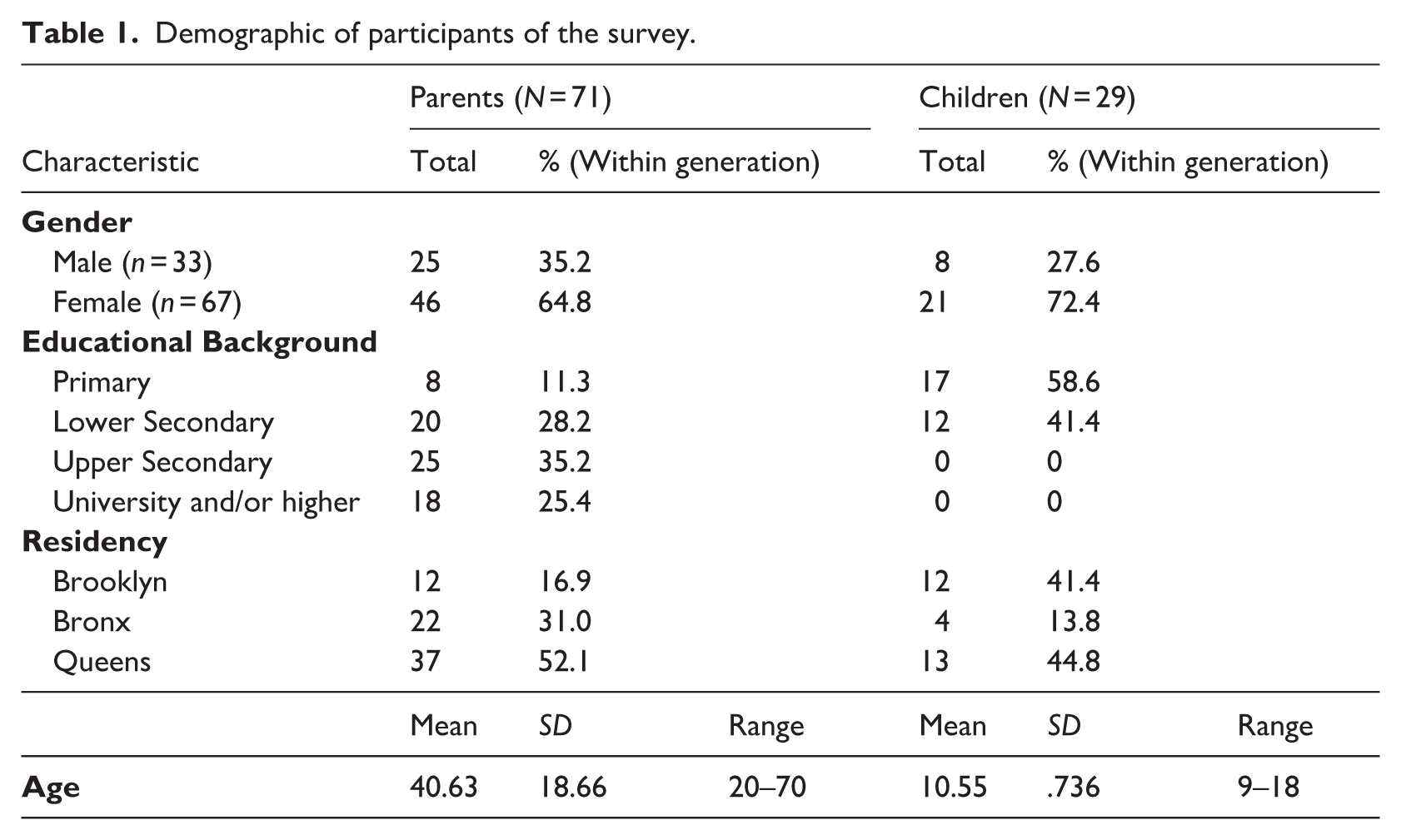
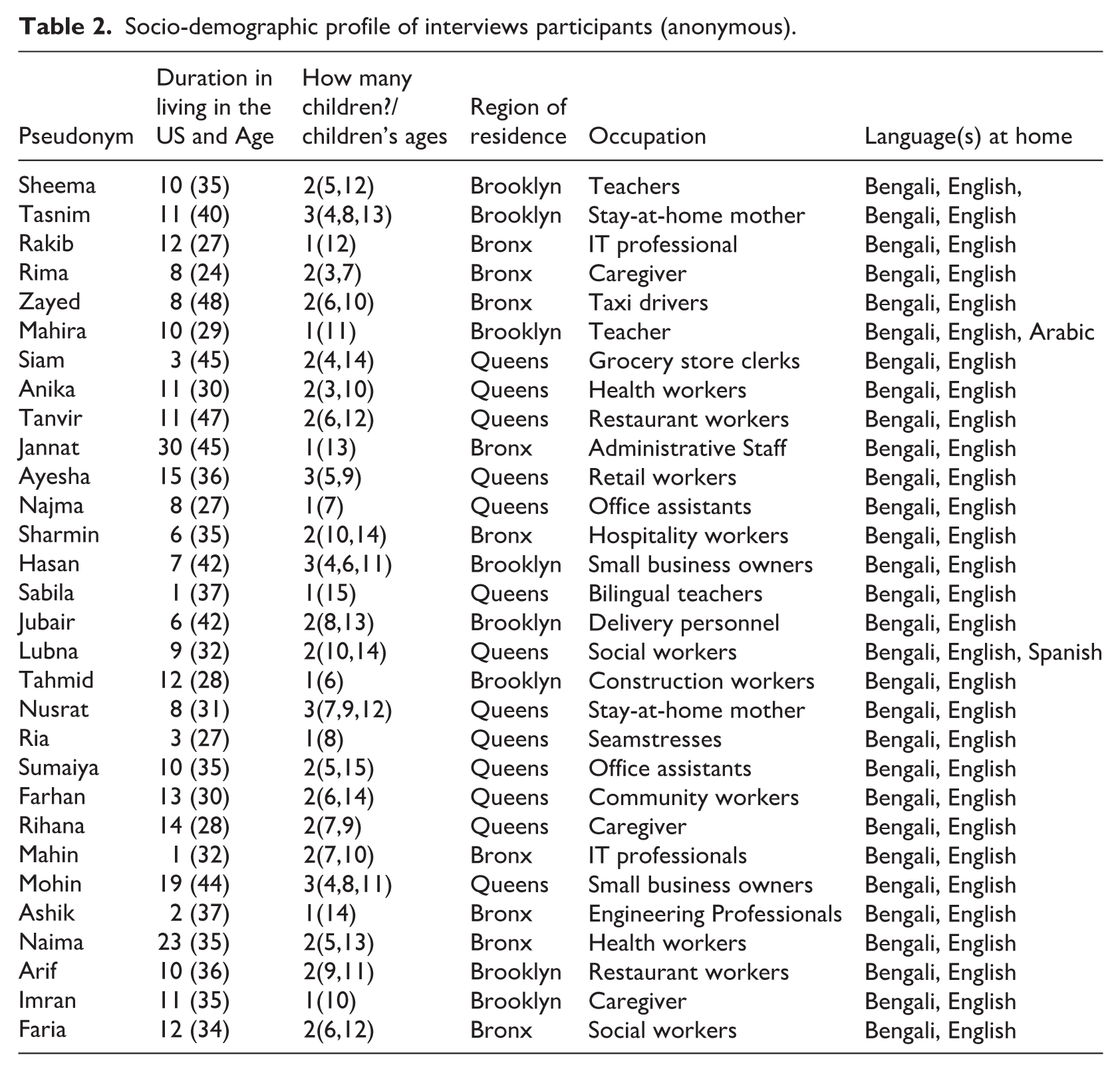
Table 1 shows a parent-dominant sample and with a female majority in both parents and children cohorts. The two groups have distinct life-stage and educational profiles, supporting a generational comparison. Participants come from multiple NYC boroughs, with parents more concentrated in Queens and children more evenly distributed across the boroughs. Table 2 provides the demographic profile of the semi-structured interviews with 30 parents (12 males; 18 females), who came from various socio-economic backgrounds. The spouses of all participants were also from Bangladeshi ethnic backgrounds. To minimise prestige bias, participation was voluntary and anonymous, and respondents were assured that there were no correct or preferred answers. Survey items were neutrally worded to reduce evaluative cues related to language practices and parental roles.
Demographic of participants of the survey.
Socio-demographic profile of interviews participants (anonymous).
Data collection and analysis
The survey questionnaire was adapted from both Bezcioğlu-Göktolga and Yagmur (2022) and Romanowski (2021a) for Bangladeshi immigrants living in NYC. These instruments were selected due to their prior validation in FLP research and conceptual alignment with Spolsky’s framework. It was provided with two sets (one for parents, one for children) in both English and Bengali which required approximately 15 minutes to answer. To reduce acquiescence bias, (5-point Likert-type scale) items were adapted from established instruments and reviewed for balanced phrasing and clarity across both language versions.
The participants were encouraged to include their families (i.e., spouse and children) to ensure a broader representation of their FLP. The survey (n = 100) was conducted using a non-random purposive sampling strategy to reflect the patterns of intra-marriage Bangladeshi families with at least one child. Moreover, interview participants (n = 30) were recruited from the pool of survey respondents using a combination of snowball and convenience sampling. While this facilitated access to a hard-to-reach immigrant population, potential sampling bias is acknowledged and addressed through methodological triangulation. To enhance transparency regarding representativeness, it is acknowledged that the use of non-random and network-based sampling may have overrepresented socially connected families, thereby limiting generalisability. Interviews were audio recorded, then transcribed using ‘intelligent transcription’ (Eftekhari, 2024) to ensure accuracy and efficiency. The transcripts were then forward translated into English.
Quantitative data were analysed using descriptive statistical procedures (means and percentages), followed by independent-samples t-tests to assess generational differences between parents and children. Qualitative data were analysed using ‘reflexive thematic analysis’ (Braun et al., 2023). The analytical process involved data familiarisation, followed by deductive coding based on the predefined FLP components. Within these deductive codes were used to accommodate emergent nuances within each FLP domain. Theme construction and review were conducted to ensure internal coherence and clear alignment with the theoretical framework.
Although reflexive thematic analysis does not prioritise statistical inter-coder reliability. The transcripts were independently and manually coded by the researcher through iterative comparison to enhance analytical rigour and conceptual consistency. Reflexive memos were maintained throughout the process to document analytical decisions, theoretical alignment and researcher positionality. Interview excerpts presented in the Results section were selected based on their representativeness, clarity and explanatory value.
Finally, although self-report measures are inherently susceptible to self-deception bias, the use of previously validated survey instruments and triangulation with qualitative interview data strengthened construct interpretation. Accordingly, findings were integrated using a mixed-methods comparison matrix (Haynes-Brown, 2024) that systematically aligned qualitative themes with quantitative patterns to enable cross-strand triangulation and interpretive convergence. Both survey and interview data were collected concurrently over three months in late 2024.
Results
Scale characteristics of the questionnaires
Table 3 shows an implementation gap in ideology, with strong endorsement of HL maintenance (M = 4.22) but in LP, near-midpoint daily use (M = 3.08) and only occasional LM for Bengali (M = 2.93) and English (M = 2.99) . Attitudes are mixed (school M = 2.89; society M = 3.48), and reliability is generally adequate (α = .71–.93) except for maintenance (α = .63) and societal attitudes (α = .67).
Scale characteristics.
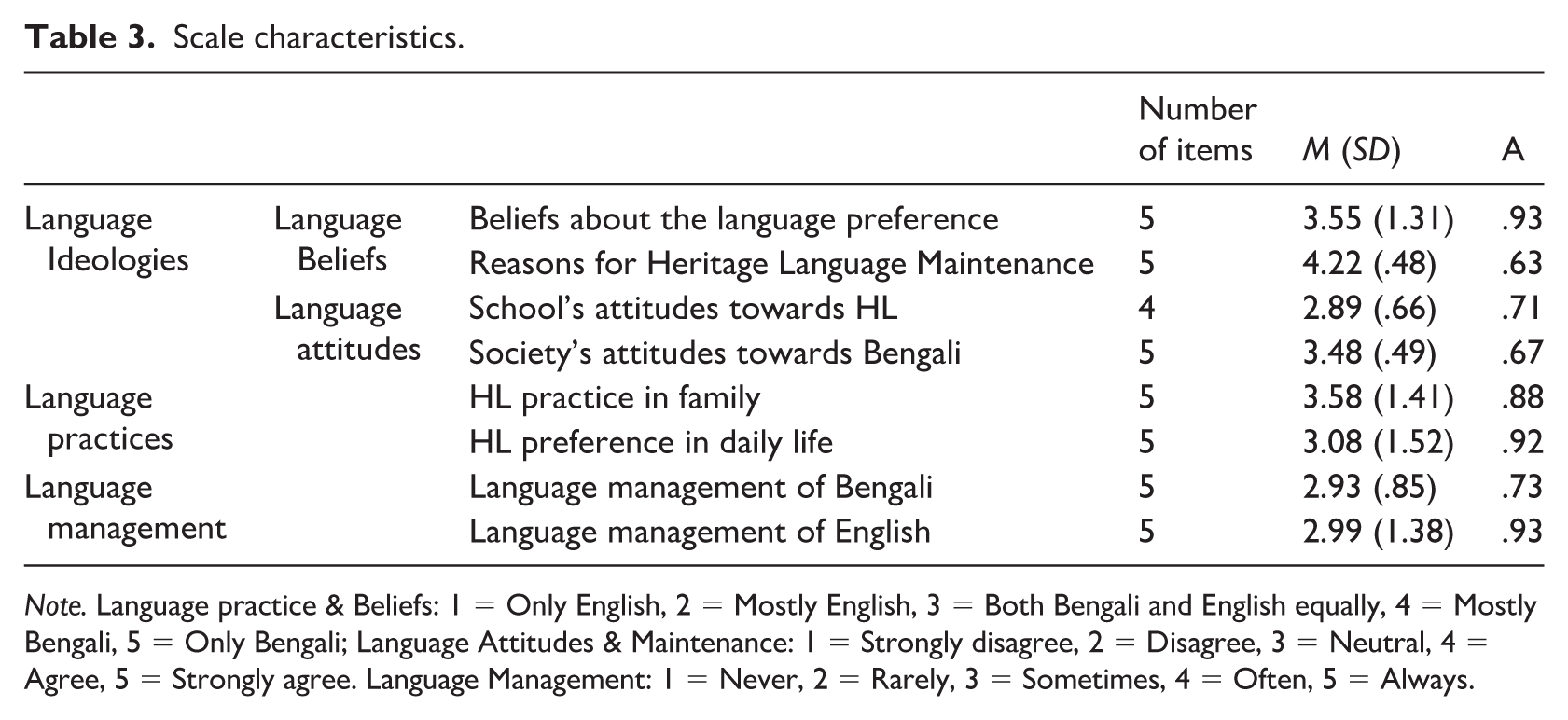
Note. Language practice & Beliefs: 1 = Only English, 2 = Mostly English, 3 = Both Bengali and English equally, 4 = Mostly Bengali, 5 = Only Bengali; Language Attitudes & Maintenance: 1 = Strongly disagree, 2 = Disagree, 3 = Neutral, 4 = Agree, 5 = Strongly agree. Language Management: 1 = Never, 2 = Rarely, 3 = Sometimes, 4 = Often, 5 = Always.
To enhance interpretive clarity, quantitative survey results are reported first to establish general patterns and group differences. Furthermore, the qualitative interview of parents used to contextualise, explain and deepen interpretation of those patterns.
Language ideology
Among Bangladeshi immigrants in NYC, LI was conceptualised as a multidimensional construct encompassing language beliefs (preferences and maintenance of Bengali at home) and language attitudes (social and institutional positionings).
Table 4 provides convergent evidence of a generational shift in HL ideology. As can be seen, parents report Bengali-oriented preferences and stronger maintenance orientations than children, with significant group differences for HL preference and maintenance (p < .001). By contrast, school and societal attitudes show no group differences (p > .05). Interview accounts align with these trends by linking HL attrition to English-dominant school/public domains and by highlighting parental enforcement as a key strategy. These findings indicating an intergenerational ideological divergence within the same families. Parents conceptualise Bengali as a symbolic resource tied to identity, heritage and transnational belonging as, Mahira highlighted that the Bengali is a vital strategy for preserving and maintaining cultural roots. However, children evaluate language primarily through everyday communicative utility within English-dominant school and peer environments.
Mixed-methods comparison matrix for HL ideologies.
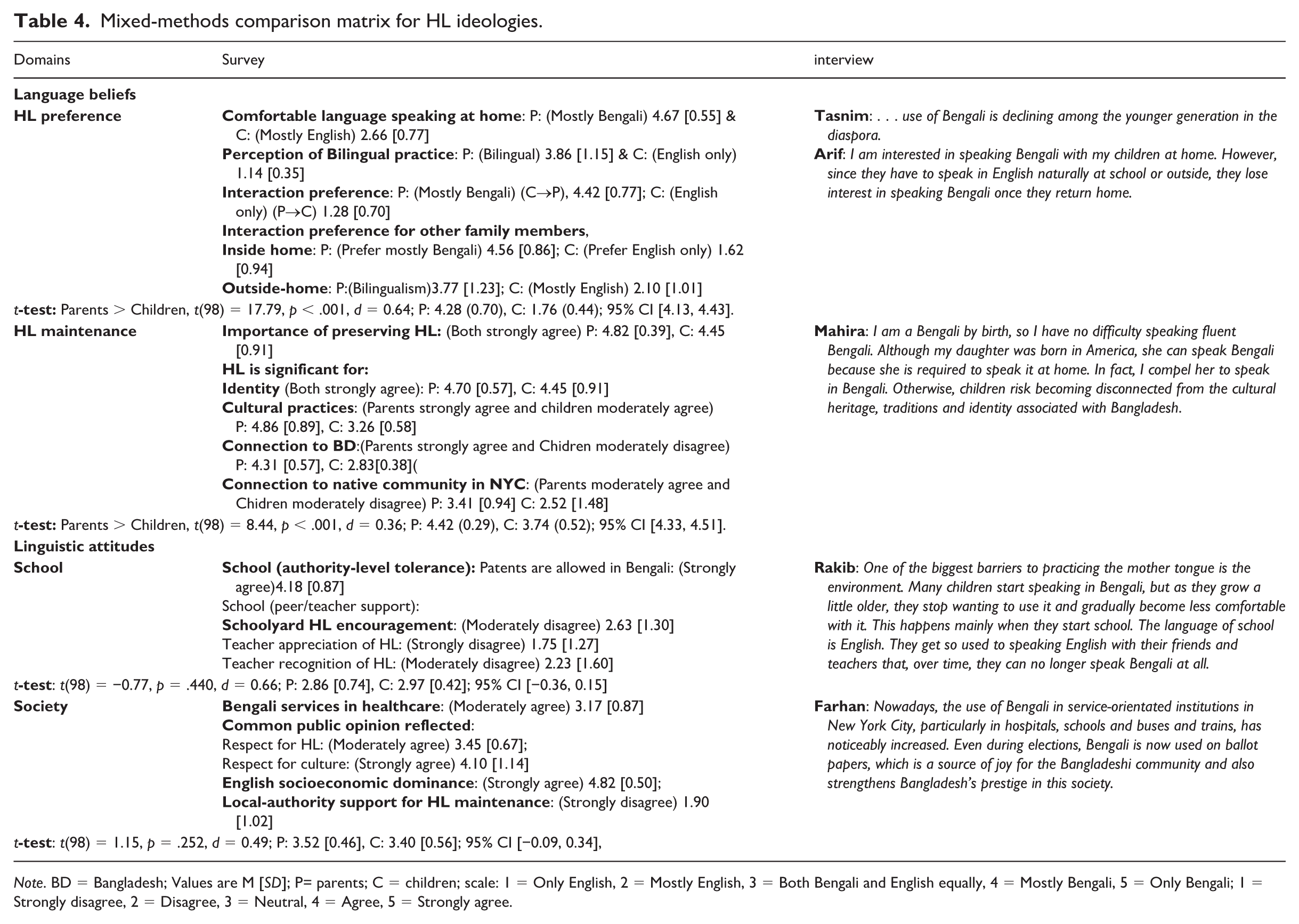
Note. BD = Bangladesh; Values are M [SD]; P= parents; C = children; scale: 1 = Only English, 2 = Mostly English, 3 = Both Bengali and English equally, 4 = Mostly Bengali, 5 = Only Bengali; 1 = Strongly disagree, 2 = Disagree, 3 = Neutral, 4 = Agree, 5 = Strongly agree.
Language practice
Table 5 shows a consistent, cross-domain generational difference in LP. As can be seen, parents largely maintain Bengali in the family and attempt to sustain bilingual interaction with their children, whereas children’s LP are English-dominant in routine home communication and wider family networks, possibly a shift from their HL towards English. For instance, Zayed’s experience demonstrates how the LP in diasporic families can change significantly over time. This can affect effective communication in HL with their parents and grandparents, thus creating intergenerational linguistic gaps in HL transmission. The same pattern exists in digital and cognitive domains, where children’s LP is overwhelmingly English-oriented. Online and peer-mediated environments reinforce English as the default language. There are very limited opportunities to use Bengali in school, friend circles and social media. It describes communicative breakdowns when parents attempt Bengali-only interaction.
Mixed-methods comparison matrix for HL Practices.
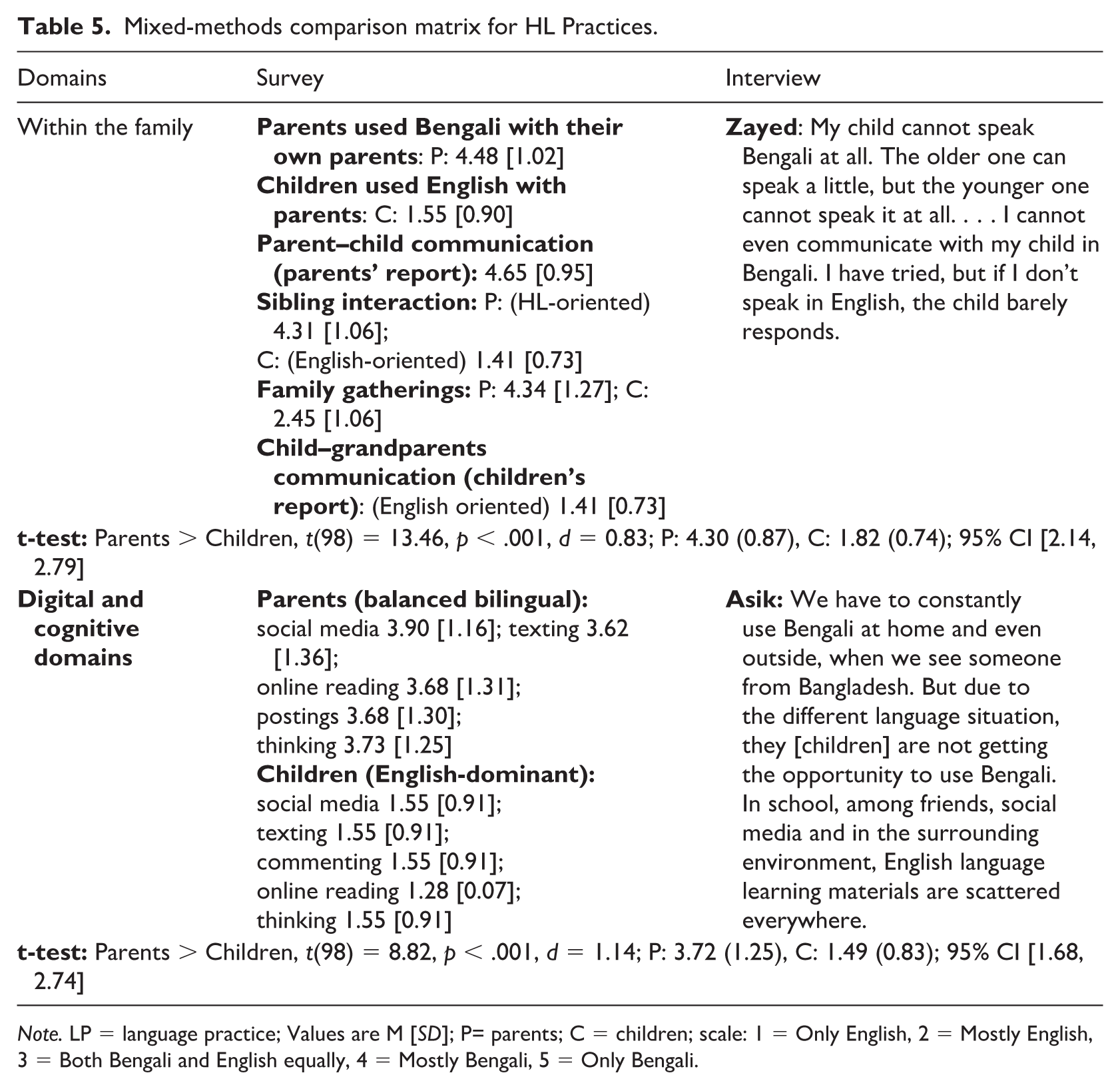
Note. LP = language practice; Values are M [SD]; P= parents; C = children; scale: 1 = Only English, 2 = Mostly English, 3 = Both Bengali and English equally, 4 = Mostly Bengali, 5 = Only Bengali.
Language management
Table 6 shows that HL management is mainly parent-driven, while English mostly is more child-driven; both contrasts are statistically significant. Interview excerpts of Hasan demonstrate that language management operates asymmetrically across generations: while parents actively invest in Bengali through structured practices and media exposure, children’s English development is reinforced both at home and institutionally through schooling. Interview data further suggest that Bengali management requires deliberate and sustained parental intervention, whereas English acquisition occurs organically through environmental exposure, reinforcing unequal effort across languages.
Mixed-methods comparison matrix for LM.
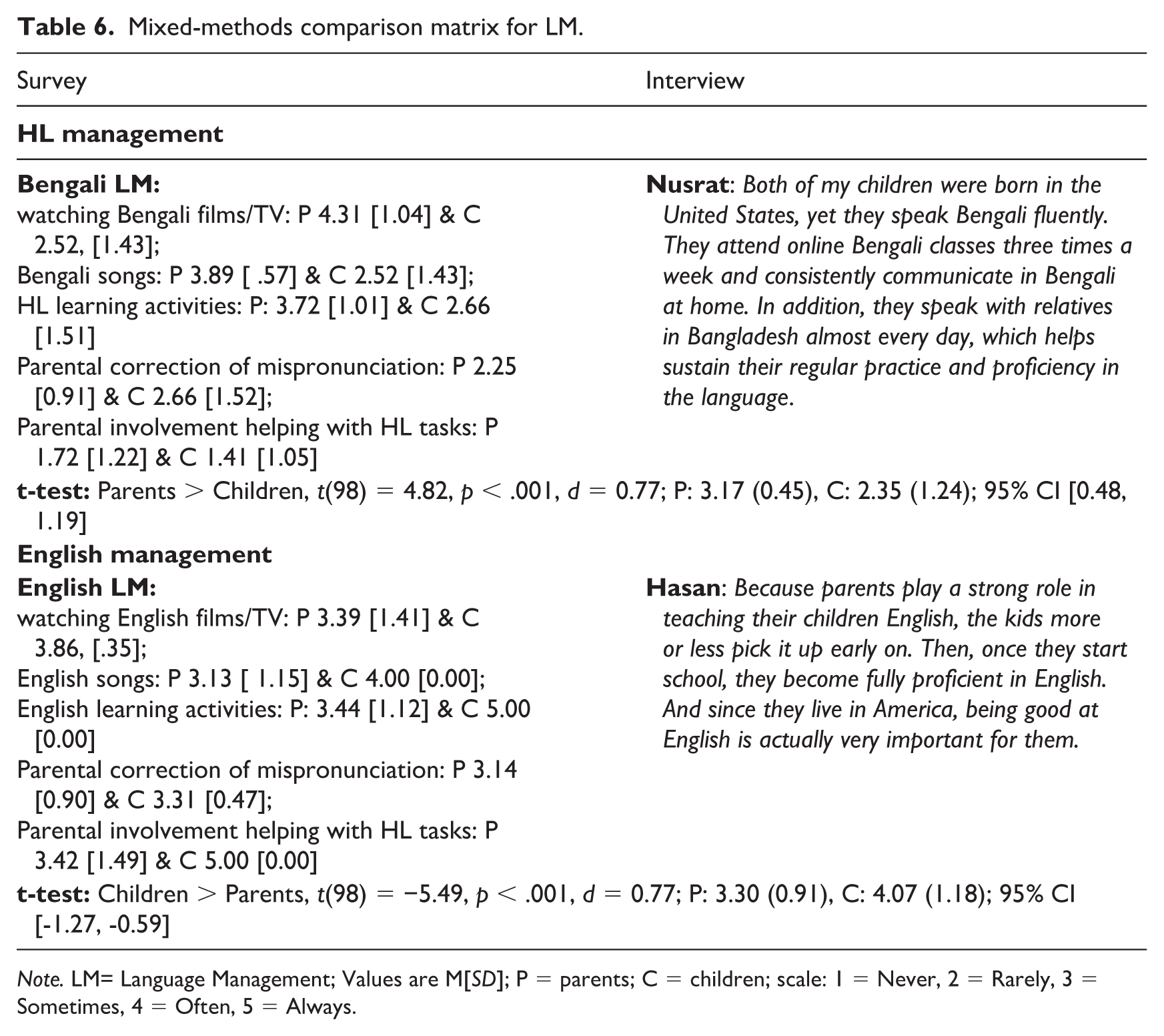
Note. LM= Language Management; Values are M[SD]; P = parents; C = children; scale: 1 = Never, 2 = Rarely, 3 = Sometimes, 4 = Often, 5 = Always.
Overall, there are substantial differences between parents’ and children’s responses because of different reasons, even within the same families. For examples, parents’ views are shaped by symbolic and affective motivations, as shown by their strong support for HL maintenance (M = 4.42) and their preference for Bengali as central to identity and cultural continuity (M = 4.28). This explains parents’ efforts to manage Bengali at home through media use and structured learning activities (M = 3.17). In contrast, children relate to language mainly through daily functional needs shaped by English-dominant schooling, peer interaction and digital environments, reflected in their strong preference for English (M = 1.76), through practice at home (M = 1.82), and cognitive and digital domains (M = 1.49). These differences lead to contrasting attitudes and practices.
Within this framework, LM functions as a mediating mechanism between ideology and practice. Parental commitment to Bengali through overt management strategies. However, children’s English language development is supported largely through covert and ambient management.
Motivations, strategies & challenges
Table 7. presents the interview findings on parents’ motivations and strategies for transmitting the HL to their children, as well as the challenges they encounter in a multicultural society where English is the dominant language.
Motivations, strategies & Challenges to HL management.
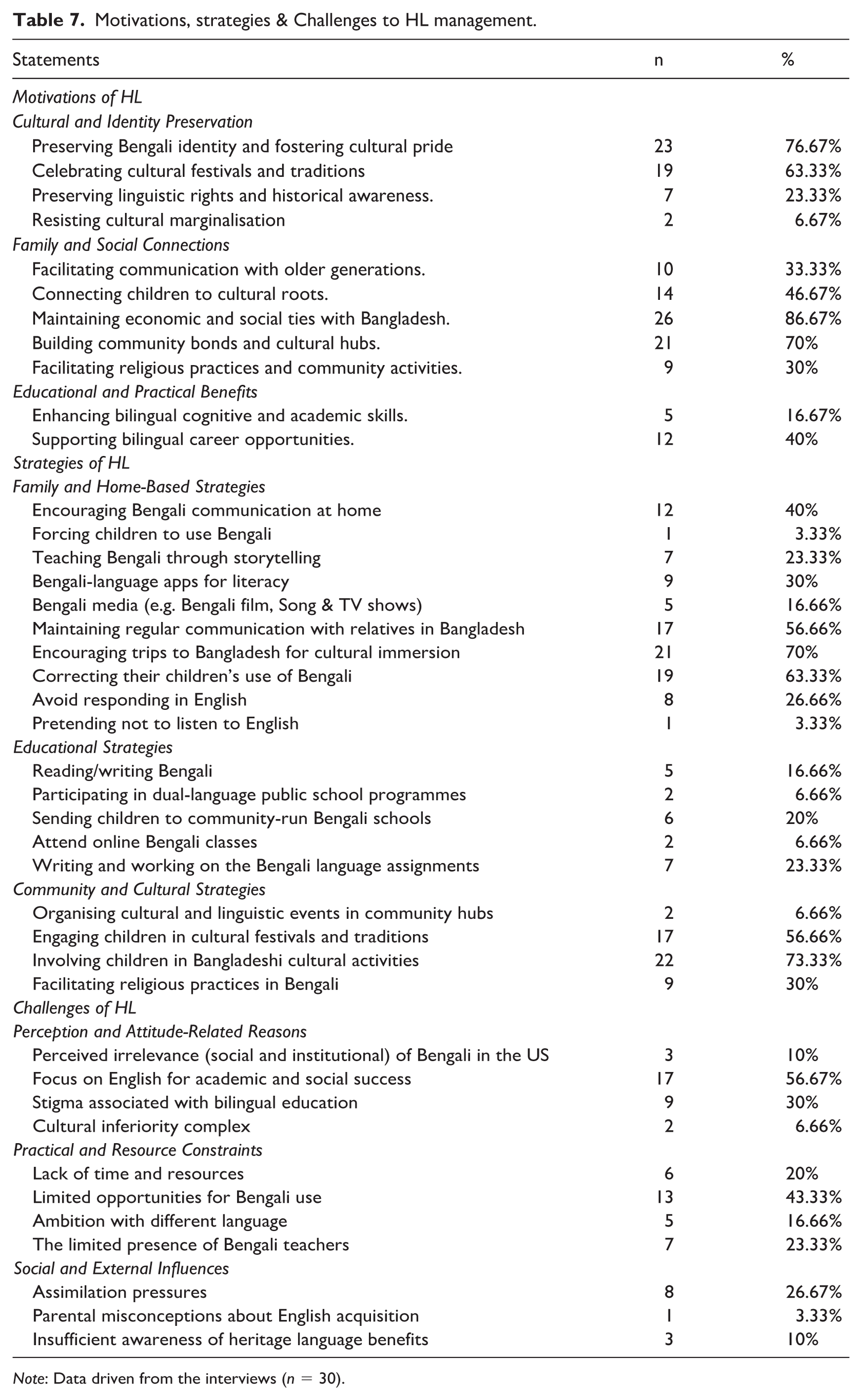
Note: Data driven from the interviews (n = 30).
As can be seen, participants’ HL motivations are guided mainly by cultural identity and social relationships, rather than academic or career-related benefits. They regard Bengali as a key to culture, resource and bond with maintaining community and a sense of belonging within the native immigrants. Moreover, they primarily depend on family-and-community based strategies. For example, they focus on increasing Bengali use at home, maintaining regular contact with relatives and involving children in cultural events that encourage Bengali use. In contrast, formal educational support is mentioned less frequently and is generally seen as an additional resource rather than the main pathway for maintenance. At the same time, English is widely seen as necessary for school success and social integration, which reduces children’s opportunities and willingness to use Bengali. Participants also report broader constraints, including stigma around bilingualism, pressures to assimilate and limited institutional resources, such as a lack of Bengali teachers and structured learning opportunities.
Discussion
Intergenerational language ideology and institutional constraints
In the USA, while first-generation immigrant parents strongly preferred and maintained Bengali at home, their second-generation immigrant children showed a strong preference for English in public and virtual spaces. Most parents are more comfortable speaking Bengali at home, although they generally practise bilingualism (Bengali and English) at home and outside. They also want their children to speak Bengali at home, as they strongly believe this will preserve their cultural identity with solidarity, pride, resistance, a legacy of resilience, social cohesion among immigrants and maintain connections with older generations (Andaleeb et al., 2022; Chatterji, 2016; Creese & Blackledge, 2011; Hajjaj, 2022).
However, positive beliefs about HL use alone are insufficient to ensure its maintenance (cf. Park & Sarker, 2007). The parents also agreed that bilingual proficiency in English and Bengali is beneficial for cognitive development and future career opportunities for their children. Both parents and children agreed that there were few or no opportunities to communicate and study in Bengali in public schools in NYC. Teachers expect from immigrant students to use only English, which make students feel linguistic inadequacy (cf. Bezcioglu-Göktolga & Yagmur, 2022). However, there is a moderately positive attitude towards Bengali in NYC (especially in certain health care and public services). Lack of sufficient institutional support and the necessity of English for jobs make Bengali less valuable. Children choose English as their first language and Spanish and/or Arabic as second languages. Generational gaps between immigrant parents and children can vary HL acquisition in Anglophone countries (Carreira & Kagan, 2011). Moreover, limited knowledge of Bengali among children may detach from their cultural heritage.
The differences between parents’ and children’s responses arise from how they experience language differently within the same families. Parents view Bengali as a symbol of identity, culture and connection to Bangladesh, which explains their strong support for heritage language maintenance and their efforts to use Bengali at home, such as requiring children to speak Bengali, using Bengali media and arranging language classes. Children, however, experience English as the main language of schools, friends and online activities, and therefore see English as more useful and natural for everyday communication, even at home. These different experiences shape attitudes and practices in clear ways. Parents see English-dominant schools and public spaces as obstacles to maintaining Bengali, while children see these spaces as central to their social lives, which leads them to prefer English in family interactions, with siblings and in digital contexts. As a result, a gap emerges between parents’ intentions and children’s actual language use, sometimes causing communication difficulties when parents insist on Bengali. Given that these differences appear within the same families, the findings show that heritage language shift is driven not by a lack of parental effort, but by children’s stronger exposure to English-dominant environments outside the home.
Language practice and management
Parents strongly prefer using Bengali exclusively with siblings and relatives in family gatherings. In contrast, most of the children, in these cases, speak in English. However, some of the children use both Bengali and English . Most grandparents cannot speak English, which creates communication barriers with their grandchildren. Moreover, most of the parents are bilingual in social media, text messaging, reading online content, commenting and posting. In contrast, most children exclusively use English in their social media, text messaging and academic work (cf. MacSwan, 2000; Porcel, 2006).
Parents use LM strategies at home, schooling and community, including using Bengali at home, engaging with media and family, participating in Bengali or dual-language programmes and literacy tasks and participating in cultural events and Bengali-mediated religious practices. Overall, they have a few structured and deliberate efforts to support Bengali (cf. Romanowski, 2021a, 2021b) Even when they value Bengali, they cannot always transmit it to children consistently. So, they often do bilingual practices with children that contribute to a gradual intergenerational decline in HL use (cf. Bayram et al., 2019). As LM is shaped by dominant-language norms (cf. Vallance, 2015), many children show limited interest in Bengali and a stronger preference for English, which further weakens parents’ efforts. Thus, Bengali has become less relevant in the US when they prioritise English for success. Moreover, parents’ strong focus on their children’s educational achievement in the interest of their career prospects was a key factor in FLP (Curdt-Christiansen, 2018; Schwartz, 2010).
LM is directly shaped by LI and enacted through everyday LP, rather than functioning as an autonomous domain. Parents’ LM decisions are ideologically motivated, particularly by strong beliefs about the HL as a core marker of cultural identity, intergenerational continuity and connection to Bangladesh, while children’s weaker alignment with these beliefs limits the effectiveness of such management. Empirically, LM appears both overt and covert: overt in explicit strategies such as mandating Bengali use at home, enrolling children in HL classes, correcting linguistic forms and regulating media exposure; and covert in parents’ implicit accommodation to English in school-related, digital and peer-oriented contexts, reflecting broader societal ideologies that prioritise English for educational and socioeconomic advancement. The relationship between LM and LI is therefore bidirectional: ideologies motivate management efforts, while persistent English-dominant practices in institutional and social domains simultaneously reshape parental management towards pragmatic bilingualism. Consequently, LM operates as a mediating and negotiated mechanism between beliefs and practices, rather than as a uniform or purely prescriptive process.
Comparative contexts
The US offers a distinct environment for Bangladeshi immigrants, though comparable patterns exist in immigrants in the UK and Canada. For example, Bangladeshi families in the UK also generally rely on generational transmission to preserve their HL. UK and US parents both may strengthen cultural and linguistic ties by taking their families on visits to Bangladesh and facilitating their children’s interactions with grandparents and extended family members (Chowdhury, 2019). Furthermore, both have also established cultural organisations and associations to preserve and celebrate their heritage which help preserve culture and provide social networks that promote the use of the HL (Ahmed, 2006; Carey & Shukur, 1985; Ghosh, 2006, 2007, 2014; Rahim, 1990, 2001; Rasinger, 2013; Subhan, 2007). As in NYC, parents in the UK and Canada also tend to use English as it is the dominant language for education and jobs, leading to the gradual loss of their HL (Al-Azami, 2005; Subhan, 2007; cf. Vallance, 2015). Supplementary Bengali schools in the UK, which help promote the HL, are often supported by local education authorities (Dixon & Wu, 2014; Johnstone, 2010).
Implications for HL support
The findings strongly indicate the need for more targeted, collaborative strategies for HL preservation in NYC, such as strengthening HL schools, promoting intergenerational language exchange and recognising the broader benefits of bilingualism (cf. Anderson et al., 2024; Bilgory-Fazakas & Armon-Lotem, 2025; Cangelosi et al., 2024; Dąbrowska, 2013; Murillo & Smith, 2011; Scontras et al., 2015; Valdés et al., 2008). Such strategies must address both practical constraints, such as limited time and resources, and shared attitudes that may undervalue or stigmatise HL use (Schecter, 2014). However, this parallel institutional support remains minimal in the US and varies considerably by region and school district. Recognising and celebrating Bengali as a HL can ensure linguistic diversity as a strength. Support from both communities and state policies is therefore key to keep Bengali across generations.
Conclusion
Ownership of HLs is relatively stronger among parents than their children because of the partial and inconsistent use of Bengali in both home and institutions. Initiatives to preserve this HL are fragmented and Bangladeshi immigrant children use HL in NYC to a very limited extent compared to many other communities. FLP plays a strong role in maintaining an HL, as it shapes the structure of children’s language development and acquisition (Cangelosi et al., 2024; King et al., 2008). The study recommends to incorporate explicit multilingual instruction in Bengali weekend schools or extracurricular programmes in Bengali (cf. Chen et al., 2018; Koda et al., 2008) and family workshops (Gasca Jiménez & Adrada-Rafael, 2021) and highlights its cultural, cognitive and social benefits (Cangelosi et al., 2024).
Community programmes should also normalise plurilingual competence and practices as a core learning goal (S. Canagarajah & Liyanage, 2012; Piccardo et al., 2019). Bengali initiatives should address linguistic power asymmetries and resist marginalisation to promote equity (cf. De Houwer, 2018). This aligns with decolonial approaches to FLP and critiques of linguistic coloniality (Léglise, 2024; Veronelli, 2015), positioning HL reclamation as a response to colonial legacies (Sarcinelli, 2018). Parents can also strengthen their children’s HL proficiency by using explicit socialisation practices and drawing on emotional aspects of family life that support language maintenance (Curdt-Christiansen & Huang, 2020; Tannenbaum, 2012).
Returning to the research questions, this study demonstrates that Bangladeshi immigrant parents and their children in NYC differ significantly in their language ideologies, practices and management. By integrating quantitative and qualitative evidence, the study highlights a persistent implementation gap within FLP. Thus, strong LI and LM efforts do not sustain HL practices across generations. This finding contributes to theories of heritage language maintenance and FLP by illustrating how structural and institutional forces mediate the relationship between ideology, practice and management in immigrant families.
This study confronted some methodological and analytical limitations due to practical reasons. First, it focused exclusively on Bangladeshi families in intra-national marriages, which may reduce its generalisability and limit transferability to across regions, economic dimensions, ethnic groups and family structures. Second, it relied on self-reported survey and interview data, which is susceptible to recall bias and perceived pressure to produce socially desirable responses. Third, the cross-sectional design only captured a single point in time, which precludes conclusions about changes over time and limits causal interpretation. Finally, this study overlooks the role of grandparents, which remains an important area for future research. Future study may address this gap by exploring how socio-economic factors influence the tripartite FLP framework in the long term.
Footnotes
Acknowledgements
The author gratefully acknowledges the guidance and constructive feedback of Prof. Piotr Romanowski [University of Warsaw, Poland], who supervised his MA dissertation. This paper is based on selected aspects of the said thesis.

Funding
The author disclosed receipt of the following financial support for the research, authorship, and/or publication of this article: The author acknowledges IDUB UW microgrants under Excellence Initiative-Research University for University of Warsaw for supporting open access publication the present work.
Declaration of conflicting interests
The author declared no potential conflicts of interest with respect to the research, authorship, and/or publication of this article.