




Abstract
Aims:
By applying the tripartite framework of family language policy, this study seeks to gain insight into heritage language maintenance of Polish families in Melbourne. To this end, an integrative investigation of family language policy encapsulating the heritage language perceptions, practices and management will be employed.
Methodology:
Based on the data collected through the online questionnaire supplemented with in-depth interviews, quantitative and qualitative analyses have been conducted to obtain a sociolinguistic picture of the convoluted dependencies.
Data and analysis:
The interviews were recorded, transcribed verbatim and coded according to the grounded theory approach. The recurrent themes were noted. The existing social patterns were conceptualised through the process of constant comparison. The excerpts selected for analysis illustrate how critical have been the informants’ beliefs and practices concerning heritage language maintenance.
Findings and conclusions:
The data analyses of the researched families disclose a wide range of practices where certain discrepancies are observed between declarations and the actual language behaviours. It also emerges that without parents’ reinforcement and establishing the heritage language as a default means of communication at home, children suffer from lower productive skills.
Originality:
This paper delves into how Polish is maintained as a heritage language by the second generation of Polish-speaking immigrants. It explores the Polish community, one of the well-established yet understudied groups that make up multicultural Australia. It unfolds an account of the dynamics of family language policy, illustrating how they are constantly negotiated, contested and formed by parents.
Significance/implications:
The findings contribute to the ongoing discussion of language policies and heritage language maintenance by demonstrating that the hardship and distress resulting from heritage language acquisition as well as language maintenance are incumbent primarily on family language policy. The researched group is an average-size immigrant community situated in the context with limited institutional support resolving down to Polish Saturday schools.
Keywords
Introduction
With almost 29% of the whole resident population born overseas in 2019, it is clear that Australia’s ongoing history of immigration is one of the defining features of its society (Romanowski, 2021). While up to 20 million people of Polish ancestry reside outside the country, over 170,000 live in Australia (Forrest & Kusek, 2016). The 2016 census revealed that the Melbourne area and the State of Victoria have the highest concentration of Poland-born people, at 32.4%. It is worth reiterating that Poland’s accession to the European Union and the improvement in living conditions in Poland have significantly reduced the levels of Polish migration to Australia in recent decades (Kinowska & Pakulski, 2018).
The Polish diaspora in Australia has already been investigated by Leuner (2007), who concentrated on Polish immigration to Melbourne in the 1980s and how the Australian immigration policy affected them. Also, Dębski (2009) researched English–Polish bilingualism of Australians in the era of globalisation and digitisation. He demonstrated the significance of electronic communications as tools impacting Polish language maintenance in the diasporic communities. Last but not least, Lipińska (2013) analysed the process of school teaching of Polish immigrant children in Australia. However, this paper will focus on immigrant parents’ family language policy (FLP) with reference to their children’s heritage language development and maintenance. It is situated in and inspired by Spolsky’s (2012) tripartite model of language policy. Consequently, this study will aim to investigate family as the critical domain, which shapes the use of language among family members and affects language maintenance or its attrition. As evident in the said researched group, heritage speakers are to some extent bilingual, and hence able to communicate in both languages (Montrul, 2008; Polinsky, 2018). Although they acquired Polish as their first language (L1) in the early years, English is now dominant due to mainstream schooling. On the other hand, it is no surprise that the insufficient heritage language use in immigrant children may result from a perceived lack of agency of their parents. Also, positive language beliefs towards a heritage language need to be translated into actual family language practices, which will later become visible in the home language management.
Heritage languages and their speakers
In comparison to first language (L1) and second language (L2) acquisition, heritage languages only recently gained currency in the field of second language acquisition (Cummins, 2005; Polinsky & Kagan, 2007). In Canada and the USA, heritage language is defined as any immigrant language spoken by immigrants and their children (Montrul, 2020), while in Australia it refers to community language (Clyne & Fernandez, 2008). Accordingly, heritage speakers are children of first- and second-generation immigrants who have some contact with their heritage language despite using the dominant language in everyday lives. These speakers can be divided into two groups: simultaneous bilinguals who have been exposed to the heritage language and the dominant language since birth; and sequential bilinguals who were born and raised in a monolingual community, and subsequently became exposed to the dominant language through schooling (Aalberse et al., 2019; Valdes, 2000). Heritage speakers maintain their heritage language in varying degrees, often exhibiting incomplete knowledge (Kondo-Brown, 2006; Montrul, 2008). Clearly, although for heritage speakers the heritage language is frequently their L1 when considering the order of acquisition, for most of them it proves to be their secondary language due to the fact that it is less prevalent in their lives and its use is being reduced across the lifespan (Polinsky, 2006).
In the context discussed above, heritage languages also constitute minority languages, because these are the languages of ethnolinguistic communities in a country, for example Polish in Australia, where another code is the official language in the society. Concurrently, minority languages frequently have lower prestige and no official status (Benmamoun et al., 2010).
Owing to the fact that some heritage speakers have limited access to education in their heritage language, or only for a short period of time, they may become partially illiterate in the language and, as a result, significantly lag behind their monolingual peers in terms of lexis and grammatical structures (Lipińska, 2013). Heritage speakers may also lack exposure to formal registers and the written language, which affects the acquisition of structures and lexical items typical of such registers (Lipińska & Seretny, 2009).
Language ideologies and attitudes in heritage language studies
Language ideologies are sets of beliefs about language possessed by individuals and communities (Baquedano-Lopez & Kattan, 2008; Silverstein, 1979). Ideologies also refer to what language is for a particular community and how its use is related to identity (Guardado, 2018). Consequently, language ideologies are connected to the processes of social interaction as well as referring to people’s understandings, beliefs and assumptions regarding the relationship between language and social life. With reference to the present paper, these ideologies may also allude to people’s opinions about the relationship between heritage language development and cultural affiliations (Fishman, 1966).
One of the foci, particularly valuable in the context of this study, pertains to ethnolinguistic groups whose language practices are affected by local and broader language ideologies (Kroskrity, 2010). Within this theme we can examine shifting ideologies towards more powerful languages, for example English, dictated by its desirability, appeal and economical advantage (Meek, 2007). Woolard and Schieffelin (1994, pp. 55–56) indicate that language ideologies play a crucial role as they ‘envision and enact links of language to group and personal identity’, making them particularly explicit in multilingual contexts (Ochs & Schieffelin, 1995). As Guardado (2018) rightly posits, the attitudes and beliefs of the community members about language are critical to their heritage language development success. They constantly evolve through interactions with both members of the minority-language community as well as those beyond. These language ideologies are subject to the broader sociopolitical forces affecting all beliefs and attitudes we possess, for example those referring to home language practices, which ultimately facilitate or hinder heritage language development. Hence, it may be concluded that language ideologies of parents and children directly impact heritage language acquisition and maintenance (Ochs & Schieffelin, 1995).
Often, families’ desires for heritage language maintenance contrast with their actual practices; hence there exists a gap between explicit discourses about language use and actual socialisation practices (Guardado, 2009, 2018). Along these lines, a mismatch between the attitudes and the behaviours of Korean parents was found by Cho (2008). In the same vein, Slavik (2001) discovered that, although most of her Maltese-Canadian parents believed in the importance of minority-language development, not many of them actually spoke it to their children. This points to a growing sense that some minority groups may actually devalue or suppress their own language at home due to the fact that it is less desired and prestigious in the community. This may be because speakers perceive themselves as English-dominant; hence they express ambivalence about their heritage languages. To make matters even worse, children especially may resent the imposition of the minority language, leading to the development of hostile ideologies about it.
Deployment of family communication patterns
Intermarried, interlingual or mixed families are defined as those in which parents have different native languages, one of which is the major language of the community (Yamamoto, 2001). Yet Guardado (2017) notes that this is not always the case for all interlingual couples, due to the fact that they may not have a native language that matches that of the community, causing numerous challenges with reference to their language planning choices and communication patterns. However, regardless of the family language constellations, interlingual couples are faced with the task of raising their offspring in two or multiple languages. While there exists a tendency to assume that children born from such families acquire the language naturally, it has been demonstrated that mere exposure to two languages does not guarantee active bilingualism. Therefore, the attitudes and language practices of parents are critical factors impacting bilingual development (De Houwer, 2007).
For the purpose of the present research, the most commonly used family communication arrangements will be discussed. Researchers have identified several patterns and analysed them in terms of their effectiveness. Although not necessarily the most successful, one of the most popular options employed in Ronjat’s pioneering diary studies in 1913 was one person–one language, abbreviated as OPOL (Baker, 2010; Billings, 1990; Döpke, 1992; Grosjean, 2010; Romanowski, 2018). As the name suggests, children are addressed in a different language by each of the parents; hence they will associate a particular language with each of the parents and will use it for communication. In addition, the language of communication between the parents is usually the societal language or the language they used when they started their relationship. As already indicated however, the strategy did not prove to be very efficient; for example, Döpke (1992) identified such factors as the quantity and quality of input and insistence on the use of the heritage language as well as parental interactional styles as negatively impacting OPOL’s success.
Another popular pattern of communication is based on dual-lingual interactions, also referred to as a ‘parallel’ mode (Gafaranga, 2010; Saville-Troike, 1987). This strategy applies to speakers who have receptive abilities in each other’s spoken languages and is frequently employed in families whose children comprehend but do not speak their parent’s language (Nakamura, 2018). Dual-lingual interactions have serious long-term implications when parents and children possess limited comprehension of their weaker languages and communication becomes more complex; for example, discussing school matters. Wong-Fillmore (2000) indicates that when there exists a lack of understanding between parent and child, dual-lingual interactions may lead to minimal communication. De Houwer (2015) also argues that such a family arrangement may often cause conflictive bilingual development, as opposed to harmonious bilingual development where the acquisition and use of two languages is expected to be a positive experience for the family.
The third type of heritage language practice entails code-switching, which refers to an alternation between languages, either within (intra-sentential switching) or between (inter-sentential switching) utterances (Myers-Scotton, 2011). The goals of practising code-switching are to compensate for lack of proficiency to continue the opening language, to stir interpersonal relations, or to signal and interpret speakers’ intentions. Heller (1995) adds that code-switching individuals draw on their linguistic resources to accomplish conversational purposes. Grosjean (2001) implies that families code-switch because they lack cognitive resources for one language and try to retrieve knowledge from another language to compensate for their deficiency. Alternatively, bilinguals may also be simply too tired to search for an exact word in one language and therefore code-switch to minimise effort. Also, Zhu Hua (2008) sees in code-switching the role of strategically promoting communication in an intergenerational immigrant family that may not be achieved otherwise, and therefore she defines it as a multifaceted sociocultural practice whereby family members secure and negotiate their positions and assign and reassign their cultural values, roles and expectations by challenging the power distance between parents and children.
Last but not least, although the so-called ‘heritage/minority language at home’ strategy does not apply to the context of the present study as in each of the families only one parent is using the heritage language, it still needs to be mentioned due to its fairly high effectiveness as well as persuasiveness in mixed families (Yamamoto, 2001). Guardado (2017) further explicates that the minority language is chosen as a means of communication in the family and both parents speak it, although for one of them it is a non-native language as he or she is a speaker of the socially dominant language. This mode of operation fostering active bilingualism has been found more effective than OPOL in some families (Billings, 1990; Shang, 1997).
Family language policy (FLP)
The historical roots of the field were formed by classic diary studies by Ronjat (1913) and Leopold (1939/1949), which provided descriptions of their own children’s bilingual development and popularised the OPOL strategy (King, 2016). De Houwer (1990), Döpke (1992) and Lanza (1997) revived interest in this vein of inquiry after a long break and forged the path to a renewed interest in child bilingualism. By referring primarily to Western middle-class bilingual families, these studies focused on language input, parental discourse strategies and their language experiences. It needs to be emphasised that FLP emanated from the coalescence of research into language policies and child language acquisition (King et al., 2008) and sought to address questions attributed to individual children’s bilingual trajectories (e.g. De Houwer, 1990; Döpke, 1992; Lanza, 1997; Okita, 2002; Takeuchi, 2006).
At this point, it is imperative to note that FLP obtained the status of a discipline in its own right thanks to the research conducted mainly by Kendall King and Lyn Fogle (Lanza & Gomes, 2020), whose work added much to our understanding of family language policymaking and child language outcomes. Emerging from Spolsky’s (2012) framework of components of the language policy model considering any speech community, FLP seeks to delineate how family members perceive their languages (language ideology), how they use them (language practices) and what endeavours they make to sustain a particular language (language management). This model also proposes a clear distinction between habitual patterns of selecting among language varieties, beliefs about language and language use and any efforts aimed at modification or influence of the practice by means of intervention, planning or management (Romanowski, 2021). Curdt-Christiansen (2014) further extended the theory of FLP by underlining the fact that each family decided on their rules and norms for speaking, acting and believing. She rightly noticed that determining what languages to practise, encourage, avoid or abandon is dictated by the values ascribed to certain languages and perceptions held towards them by respective families. That said, we can further argue that decision-making processes are largely dependent on parental beliefs and goals for their children’s linguistic development, and therefore they are impacted by parental education, their economic status and prior language-learning experience. This also aligns with King and Fogle’s (2013) perception of FLP as combining parental ideologies, decision-making and strategies related to language and literacies in the context of child language learning in the broad social and cultural context of family life. Therefore, research pertaining to how languages are managed, learnt and negotiated within families has remained the primary focus of FLP (Schwartz, 2010). King et al. (2008) accentuate that families are not isolated in a vacuum, but co-exist in a larger sociocultural context by interacting with others. Hence, their nature moves beyond home parenting and affects identity, religion and education, as well as cultural and political allegiances. Consequently, family has often been referred to as the central driving force in heritage language maintenance and loss.
This study seeks to contribute to the growing body of research devoted to FLP by focusing on Polish-Australians in Melbourne. The target is an average-size immigrant community in the context of limited institutional support, essentially consisting of Polish Saturday schools, but which is also geographically situated far from Poland, thus preventing frequent visits to the home country. Accordingly, this paper focuses on the heritage language learning in the Polish diaspora when the hardship and distress resulting from heritage language acquisition, very often incomplete, as well as language maintenance and/or attrition, are incumbent primarily on individual families’ FLP.
Research questions
By applying the framework of FLP, the main objective of this study will be to gain insight into heritage language maintenance of Polish immigrant families in Melbourne situated in the transnational context. Although the development of heritage speakers’ bilingualism seems to prevail as a theme in the FLP literature, a shift towards a more holistic approach to the bilingual experiences of transnational families was proposed not so long ago by Curdt-Christiansen (2018). In this type of approach, audits are employed alongside interviews and observations as they allow for the collection of richer data and enable the frequency and contexts of all language choices to be revealed, at the same time unfolding a more comprehensive and integrated picture of FLP. As much as such a holistic approach can provide more valuable insights into family language socialisation from the perspective of both the minority and the majority languages, due to time constraints this study employs a more traditional perspective, which concentrates on drawing causal links across ideologies, practices and outcomes (King, 2016). In addition, this paper will take on an analysis framework coalescing the procedure, which, on one hand, focuses on language ideologies, practices and management, but on the other, also considers individual experiences of transnational families. To this end, an integrative investigation of FLP encapsulating the following research questions will be undertaken:
What are the parental beliefs regarding heritage language development?
How do the parental practices support the children’s heritage language maintenance?
How do the parental language ideologies correspond with their actual language practices and management in the families?
Methodology
Research instruments
This study is part of a larger research project, which involved 124 surveyed participants and was conducted between 2014 and 2018. It commenced with an anonymous online questionnaire to investigate the existing language ideologies, practices and patterns of language management in the Polish diaspora community from Melbourne. The data gathered through the questionnaire were supplemented at a later stage with face-to-face interviews of 26 Polish parents. This phase entailed the process of contextualisation of the collected quantitative data so as to obtain a clearer picture of the researched families and their individual members (Schwartz & Verschik, 2013; Zhu Hua & Li Wei, 2016). Further, by combining various research methods, the collected data could be easily validated.
The online questionnaire was distributed through the Facebook group ‘Polonia Melbourne’ and its access was facilitated by six Polish Saturday schools located in the suburbs of Melbourne. The teachers from the Polish schools responded in a favourable manner to the request, and prompted the parents’ swift response to the online questionnaire, which was available on the internet for six weeks. It consisted of 24 items including seven general questions, a further 10 questions regarding family practices, and an additional seven questions concerning their beliefs (see Appendix 1). The semi-structured interviews carried out with the Polish-speaking parents consisted of 20 questions in total, where the first 10 questions investigated their language practices and the last 10 revealed some information pertaining to language management and ideologies (see Appendix 2). The interviews were conducted in Polish in the families’ homes although the researcher’s first contact with the parents had occurred on the school premises. The interviewees were invited to freely expand on any experiences and thoughts regarding the asked questions.
Participants
As illustrated in Table 1, 26 Polish parents agreed to participate in this research project. While the surveyed parents’ ages at the time of the project ranged from 30 to 54 years old, they had been living in Australia for 10 to 19 years. There were 20 mothers participating in the study and six fathers. Fourteen families had one child, nine families had two children, and the remaining three had three children. The children involved in this research project were all Polish heritage speakers (26 girls and 15 boys). The children’s ages spanned between 8 and 18.
Sociodemographic profile of participants.
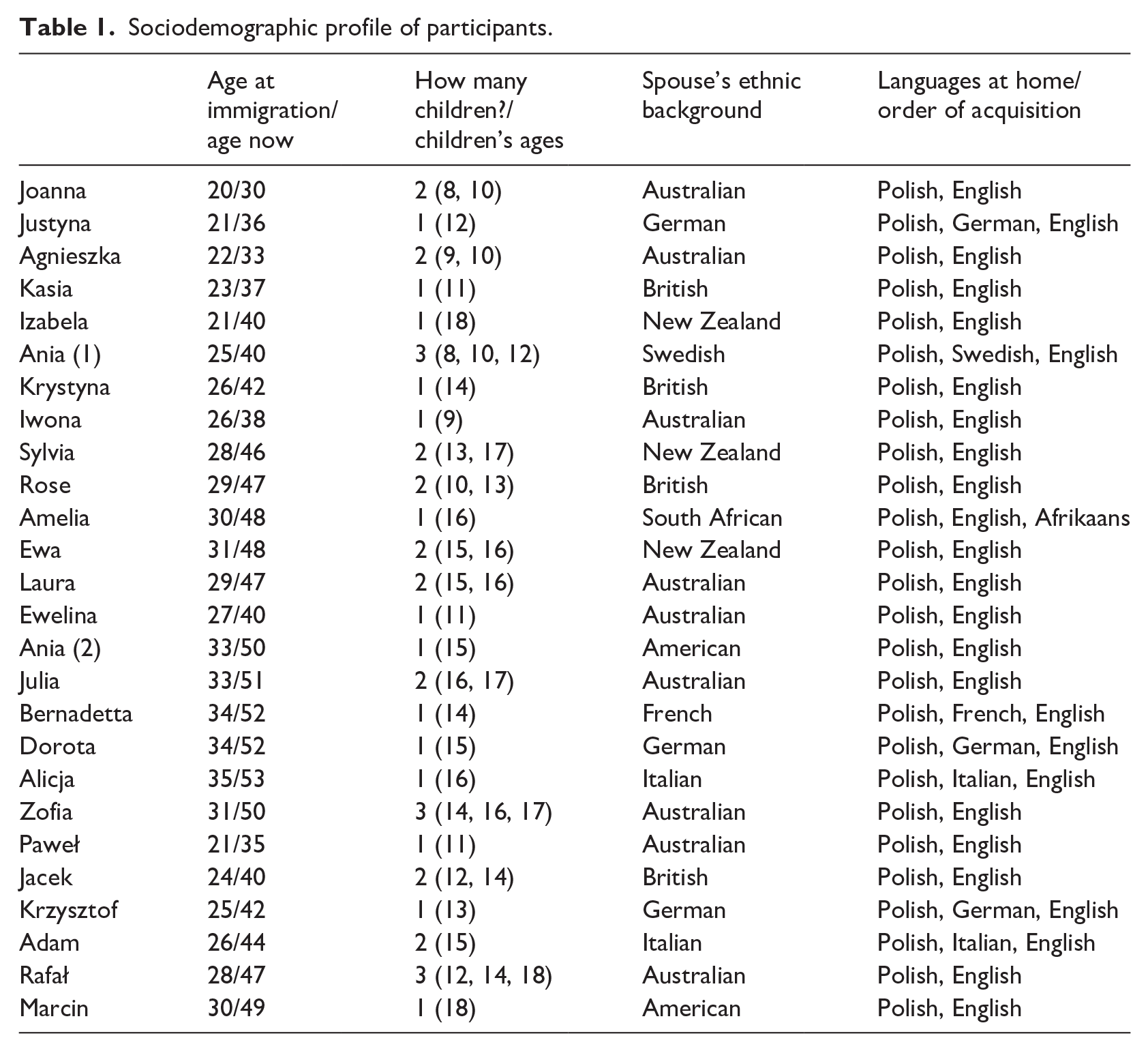
On the basis of the collected data, it can be concluded that the children were raised in exogamous families where each spouse had a distinct ethnic background and language. In all cases the Polish parents emigrated to Australia in the period between 1999 and 2008. The subjects’ parents belong to a group of immigrants who obtained their visas either through the skilled migration programme or by marrying an Australian citizen. Although all of them demonstrated a strong national identity, they also exemplified a good command of English. Members of the previous two immigration waves, whose competence in English was much lower or non-existent, showed strong pride in the heritage culture and language (Jamrozik, 1983; Smolicz et al., 1993). In addition, 20 parents of those listed had graduated from institutions of higher education either in Poland or Australia, while the remaining six had obtained certificates of secondary education. Parents who received higher education enabled better exposure to Polish for their offspring by helping them acquire more structures and vocabularies of formal registers in Polish. However, as shown in this study, the acquisition of the heritage language would not have been possible without immersing the children in the Saturday school context where such registers are frequently used. Polish Saturday schools taught them geography, history and the Polish language and literature. Clearly, all the classes were conducted entirely in Polish, which helped the children, to some extent, to learn reading and writing in their heritage language. What is more, the classes were taught by native speakers of Polish who moved to Australia themselves. All the children had travelled to Poland to visit their families and spend their holidays there. Interacting with their relatives and other speakers of Polish intensified the acquisition of Polish.
The children participating in the study acquired Polish, English and other respective languages simultaneously from birth; hence some of them were either bilingual or trilingual. According to the interviews conducted with the Polish parents, Polish prevailed in homes in the children’s early years. This is not surprising as most of the job related to upbringing is most often done by female caregivers (Okita, 2002; Banasiak & Olpińska-Szkiełko, 2019). However, English became the dominant language as soon as formal schooling started.
Data analysis
The analysis of data followed as soon as the data collection process was initiated (Charmaz, 2003). All the interactions were recorded during the interviews and transcribed. In addition, the recurrent themes were noted. The interviews were transcribed verbatim and coded according to the grounded theory approach. Its methodology was used to analyse the collected data qualitatively as it enables researchers to seek out and conceptualise covered social patterns and structures through the process of constant comparison (Heath & Cowley, 2004). The software programme NVivo 12 was applied to code and analyse the data. The main advantage of this type of software is that it allows researchers to uncover richer insights and produce clearly articulated, defensible findings, which are backed by rigorous evidence. Coding labels were created as soon as all the interview data were uploaded into the programme. As a result, an in-depth analysis was commenced. Some of the nodes that emerged from the interview data served as central themes discussed in the paper. Last but not least, pseudonyms were used in this research.
Findings
In order to discuss the obtained findings in a detailed way, Spolsky’s (2012) model of language policy was applied. The interviewees’ beliefs concerning heritage language maintenance in their families, particularly crucial for the children, as well as associated practices, are discussed in the following section. Needless to say, the parents tried to customise language use in their homes on many occasions, reducing the amount of English and sustaining the continuous use of Polish. Their home language management ranged from rigorous and restrictive OPOL strategy to dual-language interactions and flexible code-switching practices.
Heritage language ideologies
The studied parents all agreed that Polish is maintained at home as well as in the community for several reasons (see Table 2). They all considered it to be crucial to pass the heritage language onto their children. The most common reasons the interviewees stated for pursuing heritage language maintenance included language and cultural identity, communication with the extended family, and multiple advantages resulting from bilingualism.
Reasons for maintenance of Polish.
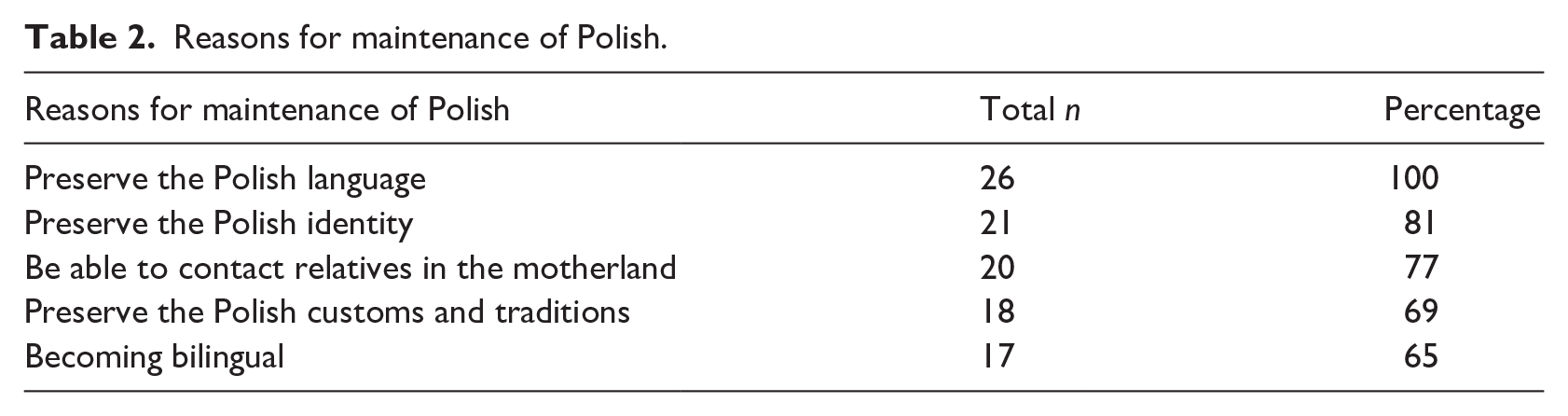
Most of the participants in this study, by identifying themselves with the Polish language and culture, related language to their ethnicity. Hence, it is not surprising that preserving the Polish identity was one of the most frequently voiced reasons for the use of Polish in the home environment. The parents believed that acquisition and maintenance of the heritage language would help their children better safeguard their identity. Fishman (2001) and Cavallaro (2005) indicated that the heritage language was a tool for parents for transmitting cultural identity to their children, especially in multilingual and multicultural contexts, where prestigious languages, for example English, dominate. The interviewees also voiced the need to sustain the mother tongue in their siblings, because language attrition might generate the loss of cultural identity, which resonates with earlier studies by Zhang and Slaughter-Defoe (2009) and Lee (2012). This is expressed in the following example: Dorota (age 52): Nie mogę pozwolić na to, aby mój jedyny syn nie wiedział czym jest polskość i nie znał języka. Uważam, że moja rola polega na tym, aby uczynić wszystko, co jest możliwe w utrzymaniu kontaktów z Polską i moją rodziną zamieszkałą tam. [I cannot let my only son not understand what Polishness is about or not know the language. I believe that my role is to do everything I can to maintain contacts with Poland and my family living there.]
In this short excerpt, Dorota emphasises her own role as a parent in sustaining the mother tongue in the home, mainly to maintain contacts with the Polish relatives. This echoes what Gharibi and Seals (2019) voiced in their analysis of the Iranian community in New Zealand. They also noted that minority language speakers should not be expected to achieve high proficiency in the heritage language as their language and cultural identity will develop through affiliation with or investment in their minority language culture.
For some parents it was imperative to consider the Polish customs and traditions as a form of identification with the motherland. They underlined the necessity to celebrate Christmas and Easter traditions, especially religious ones. Concurrently, they expressed their contentment about the fact that the children had adapted to Australian society despite being situated in a diaspora community, which is also congruent with a study conducted by Guardado (2008).
Agnieszka (age 33): Moje dzieci są dobrze zintegrowane z rzeczywistością australijską, pomimo tego, że nasz rodzina jest mieszana. Z jednej strony mają swoich przyjaciół ze szkoły, z którymi wychodzą i spędzają czas wolny. Z drugiej strony mogę zadbać o to, by kultywować polskie tradycje i obyczaje. Dzięki językowi angielskiemu i kulturze australijskiej, w której żyjemy, odnoszą sukcesy w szkole i wiem, że będzie im łatwiej w życiu dorosłym. Język polski służy do podtrzymywania więzów rodzinnych i dzięki niemu utożsamiam się z moim krajem i jego kulturą. [My children are well integrated into the Australian reality, even though our family is mixed. On the one hand, they have their friends from school with whom they go out and spend free time. On the other hand, I can cultivate Polish customs and traditions. Thanks to the English language and the Australian culture we live in, they are successful in school and I know life will be easier for them in the future. The Polish language is used to maintain family ties and thanks to it I can identify with my country and its culture.]
In this account, Agnieszka positions her children in two different worlds. Cultivating ethnic cultural practices provides a link for them to the Polish extended family and enhances inner family communication, whereas being fully immersed in their Australian life is important in terms of affinity and belonging. The ability to communicate is considered one of the key elements of heritage language maintenance (Bezcioglu-Goktolga & Yagmur, 2018; Kouritzin, 1999).
Thanks to maintaining the heritage language, the informants could develop bilingualism in their children. For many parents the ability to speak two languages can bring their offspring better career opportunities (King & Fogle, 2006). A few parents referred to the positive aspects of bilingual development, that is, better cognitive abilities or higher IQ (Bialystok, 2010; Genesee & Nicoladis, 2006; Paradowski & Michałowska, 2016). Therefore, positive perceptions of bilingualism associated with heritage language development and maintenance mostly unfolded.
Jacek (age 40): Uważam, że zalety dwujęzyczności w dzisiejszych czasach są ogromne. Po pierwsze możliwości poznawcze są lepiej rozwinięte a poza tym, dzieci dwujęzyczne mają wyższy wskaźnik inteligencji. [I believe that the advantages of bilingualism these days are enormous. First, cognitive abilities are better developed, and besides, bilingual children have a higher intelligence quotient.]
Heritage language practices
Heritage language practices of the investigated families are mainly governed by the speakers, their language preferences and the topic, as well as the context of verbal exchanges. In most of the observed conversations the parents spoke Polish to their children, sometimes code-switched; however, the children would shift to English while speaking to their siblings, in some cases even to their Polish parents. In situations when their non-Polish parent was around, they would immediately switch to English and maintain their conversation in the majority language. Clearly, they would employ dual-language interactions if both parents were involved in a conversation. Such practices seem to be consonant with what Lanza (1997) as well as Barron-Hauwaert (2004) discussed in their studies.
Declared language practices differ depending on the preferences and the involved interlocutors. The Polish parents (n = 26) unanimously reported using Polish with their children; however, the actual practice slightly diverged from the declarations. They also mentioned that their children preferred English, especially when their siblings, the other parent, other relatives or friends participated in a conversation. In a similar vein, the topic caused a change in the language use. Most parents (n = 17) affirmed that discussing homework with the children enforced the use of English. In intimate situations or contexts inducing emotions, the use of Polish in the interaction was immediately provoked. The results should not be surprising, because earlier studies by De Houwer (2007), Pavlenko (2012), Kopeliovich (2013) and Dekeyser and Agirdag (2018) confirmed that emotional language preferences of children reflect their acculturation process as well as that of their parents.
As already highlighted, three modes of communication were identified among the researched families: restrictive one person – one language (OPOL) strategy, dual-language interactions (DLI) and flexible code-switching (CS) practices (see Figure 1).
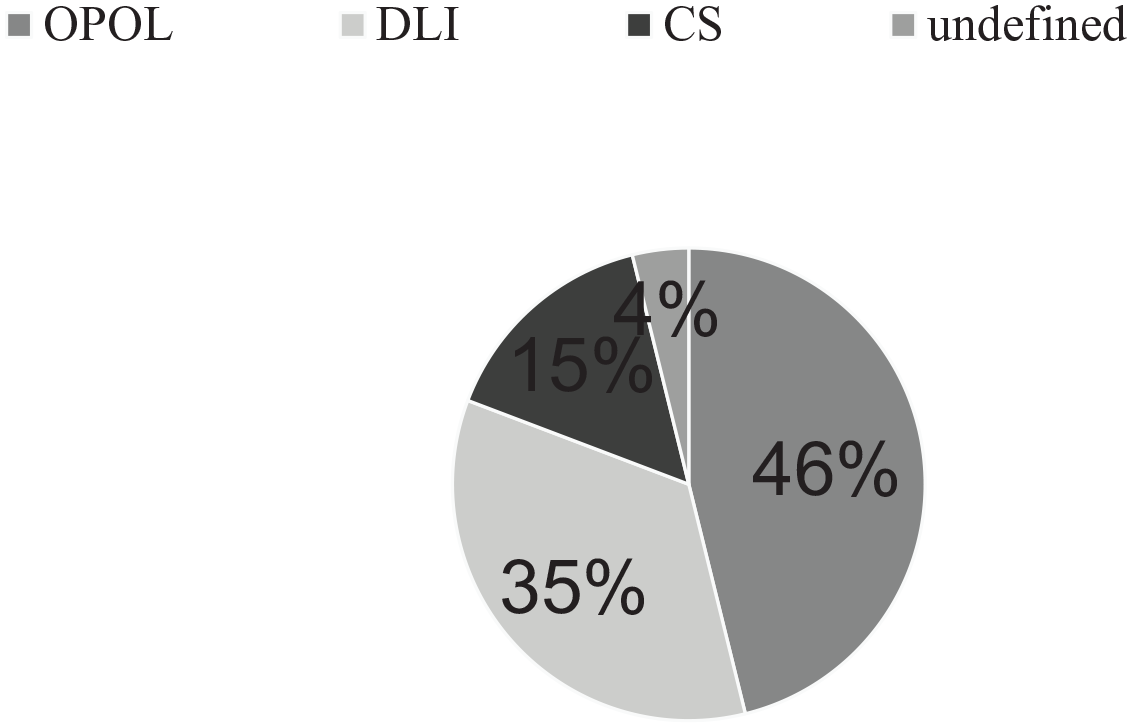
Overview of communication modes.
Given its pervasiveness, OPOL proved to be present to a great extent (n = 12) in the researched group. As assumed from the format of communication, the expectation is that each parent uses a different language to address their children (Schwartz & Verschik, 2013; Takeuchi, 2006; Yamamoto, 2001).
Marcin (age 49): Każde z nas używa swojego języka w komunikacji z synem. Luke jest do tego przyzwyczajony od dziecka. Teraz, kiedy jest już dorosły, mimo wszystko preferuje angielski. Może wynika to z tego, że byłem mało konsekwentny w użyciu polskiego i zdarzało mi się czasami zwracać do syna w obu językach? [Each of us uses their own language to communicate with our son. Luke has been used to it since birth. Now that he has grown up, he prefers English anyway. Maybe this is due to the fact that I was not very consistent in my use of Polish and that I happened to address my son in both languages from time to time?]
As much as OPOL has been regarded as a widely acclaimed strategy of raising children bilingually in interlingual families, the father does not sound very optimistic (Döpke, 1992). He attributes poor results to his lack of consistency in the actual everyday practice. Not surprisingly, researchers have reported certain incongruences related to establishing this type of communication in interlingual families (Quay, 2012; Shang, 1997; Takeuchi, 2006).
Dual-language interactions, which constitute the second communication arrangement found among the researched families, were also found to be common and widely favoured (n = 9). In this case, all family members tend to use both parental languages for home communication as much as they can (Guardado, 2017; Shang, 1997; Yamamoto, 2001).
Alicja (age 53): W naszym domu zawsze używaliśmy trzech języków: polskiego, włoskiego i angielskiego. W rezultacie nasza córka posiada ich dobrą znajomość, choć angielski dominuje. Niestety niekoniecznie lubi czytać, czy pisać po polsku. Staram się namawiać ją do oglądania ze mną TV w języku polskim ale niestety nie udaje mi się to. [We have always used three languages in our home: Polish, Italian and English. As a result, our daughter knows them well, although English is dominant. Unfortunately, she does not necessarily like to read or write in Polish. I try to persuade her to watch TV in Polish with me, but unfortunately it does not work.]
From the excerpt it looks as if the selected communication arrangement in this particular home might result in the child’s future passive bilingualism, which may even switch to monolingualism in the dominant/majority language (Billings, 1990; Gafaranga, 2010; Saville-Troike, 1987). Researchers also posit that dual-lingual conversations frequently lead to a lack of understanding between parents and their children, which then may cause minimal communication in a family, catalyzing eventually deterioration of family relations and ties (De Houwer, 2017; Nakamura, 2018; Tseng & Fuligni, 2000; Wong-Fillmore, 2000).
Last but not least, a few families (n = 4) of those surveyed reported to have internalised code-switching practices in their homes, because for families acculturated into bilingual contexts, code-switching is a form of language (Gee, 2002). In these families, code-switching functions as a communicative strategy to facilitate their communication by lowering language barriers as well as by consolidating cultural identity. As Kabuto (2010) further indicates, this format of communication is of particular importance to understanding what exactly occurs when multiple languages come into contact with one another.
Rose (age 47): Ja zawsze pozwalam dzieciom na przełączanie kodów, gdy rozmawiamy. Sama jestem językoznawcą i zdaję sobie sprawę jakie mogą być tego skutki. Niemniej jednak chcę, aby nasze dzieci nie stresowały się, gdy nie potrafią wyrazić czegoś w języku polskim. [I always let the kids code-switch when we speak. I am a linguist myself and I am aware of the consequences. Nevertheless, I do not want our children to get stressed when they cannot express something in Polish.]
This flexible approach may, on one hand, curb the development of competence in Polish as a heritage language. However, daily interactions based on code-switching still facilitate family communication by lowering language barriers and supporting the families’ well-being (De Houwer, 2015). Chung (2010) postulates that code-switching in such contexts constitutes a versatile strategy to meet the complex communicative demands between or within generations of immigrant families.
Only one family (n = 1) could not define their practices or classify them according to the list of the proposed FLPs. This might be due to their negligence or a lack of awareness of minority language maintenance. Nonetheless, it also appeared that the family members were using a combination or a hybrid of the three communication modes without realising what the possible outcomes may be.
Heritage language management
The researched families were using various strategies to encourage their children to use the heritage language. Obviously, certain differences were noticed across the families resulting from their background, education, household and employment situation, length of stay in Australia, etc. While older parents with an employee status and/or a secondary education certificate (n = 10) are more involved in heritage language development and maintenance, younger, higher-educated, self-employed parents (n = 13) proved to be less confident in management practices. Interestingly, the fathers (n = 6) engaged in the study declared more commitment and determination than their female counterparts. Similarly to Bezcioglu-Goktolga and Yagmur’s (2018) study, they all valued external support and wanted to benefit from lessons offered by Polish Saturday schools.
Most parents (77% of those interviewed) reported using Polish since their children were born. Undoubtedly, the mothers were the primary source of heritage language input (Okita, 2002). In order to stimulate their children’s use of the heritage language, eight parents (31%) confirmed they had not reacted when English was used by their offspring. These parents explained that their children had been fully aware of the reasons for such behaviour. 77% of the researched parents (n = 20) confessed to have been using only Polish before the children accessed mainstream schooling. Although many children are already grown up, the Polish parents continuously instil the values related to the minority language and culture. The parents explain this as follows: Ewa (age 48): Z moimi dziećmi wciąż oglądam filmy po polsku, czytam im książki i słucham polskiej muzyki. [With my children, I still watch Polish films, read books and listen to Polish music.] Paweł (age 35): Zawsze starałem się mówić po polsku jak najwięcej. [I have always tried to speak Polish as much as possible.] Bernadetta (age 52): Kiedy urodził się Philip, nie przestawałam mówić do niego po polsku. Tak jest i dziś. [When Philip was born, I did not stop speaking Polish to him. And I still do.]
As indicated by the first parent, there exist other means of home language management in addition to the intentional and deliberate use of the heritage language. All the parents (n = 26) unanimously stated that they were correcting their children’s use of Polish. 73% of the parents (n = 19) were or still are involved in reading books in Polish (particularly about Poland: its culture, history and geography). Less than a half (n = 12; 46%) of those interviewed reported watching Polish TV programmes and films. In addition, 10 parents (38.5%) reported teaching their offspring to read and write in Polish when they were little. Of other, less frequently applied strategies of heritage language maintenance, the parents voiced self-organised playgroups, get-togethers with other families, social networking and trips to the heritage language country. This paints a picture already familiar from studies by Guardado (2002), Szecsi and Szilagyi (2012) and Little (2020).
Finally yet importantly, many parents (n = 18; 69%) pointed out the role of discussing the significance of heritage language use and proficiency as well as the perceptions it might exert in their households. A summary of all the strategies the investigated parents referred to is presented in Figure 2.
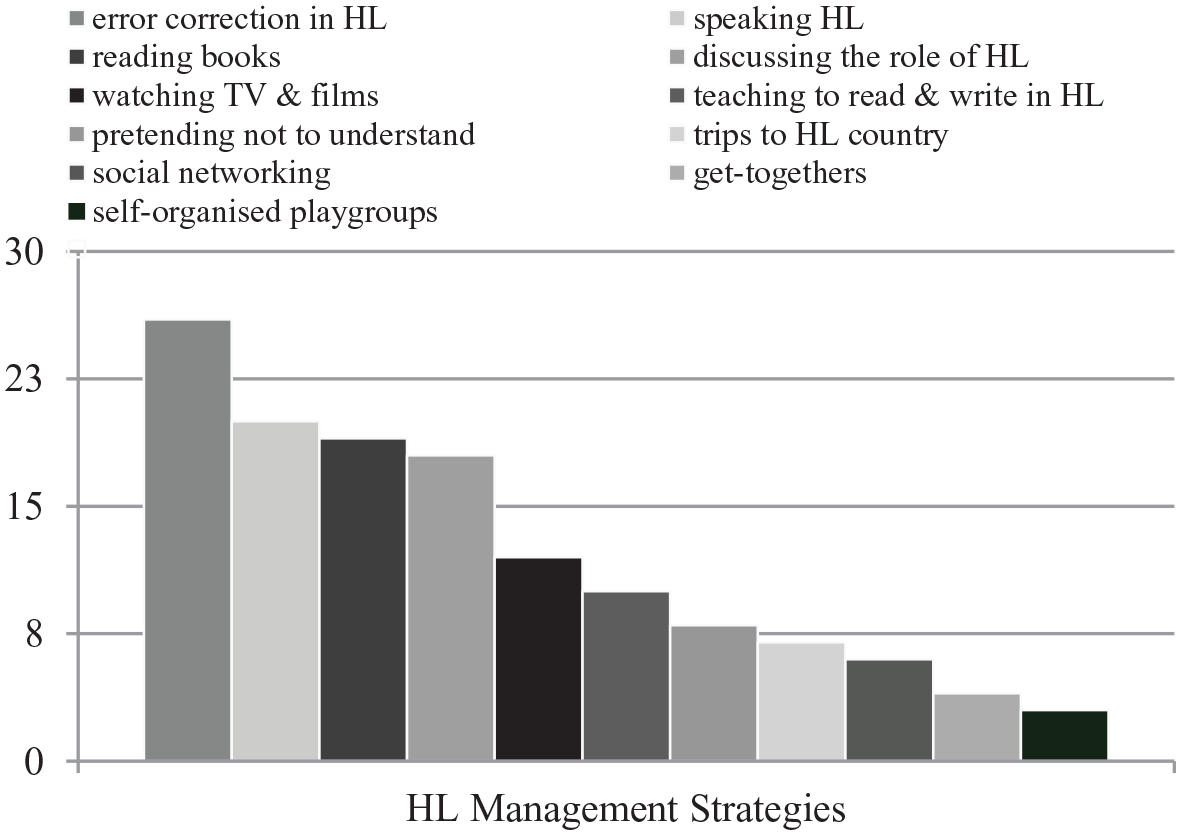
Overview of heritage language management strategies.
Discussion
This article demonstrates the results of a limited and self-selective sample; hence it does not claim to be representative of all intermarried families. As a result, based on the findings, it needs to be emphasised that the observed complexity and diversity across the researched families might, to some extent, preclude us from making accurate generalisations with regard to language policies. Nonetheless, certain similarities can be observed about the families’ ideologies, practices and management.
Firstly, all the parents expressed unambiguous beliefs that maintaining Polish was of paramount importance; however, certain discrepancies were observed between declarations and the actual practices (Gharibi & Seals, 2019; Schwartz, 2008). This happened because the researched parents did not enhance the acquisition process, and they often discontinued using Polish when their offspring embarked on speaking the societally dominant language having started formal schooling. Also, it needs to be underlined that the insufficient heritage language use in immigrant parents resulted not from a deliberate language policy but a perceived lack of agency or ability.
In spite of three divergent communication arrangements identified within the researched families, it transpires that educational achievements remain a key factor in parental decisions that determine their children’s career prospects; therefore these should be perceived as essential components shaping their FLP (Curdt-Christiansen, 2018; Schwartz, 2010). Becoming well-educated and literate in two languages is invoked as what Piller (2001) defines ‘investment’ that will yield a high return. Unquestionably, as raised by many parents, bilingualism, as a human capital, is a valuable vehicle for economic empowerment. The parents accentuate a belief in academic excellence as the only way for their children to obtain upward social mobility in Australia.
Secondly, it emerges that without parents’ reinforcement and establishing the minority language as a default means of communication at home, children will suffer from lower productive skills in the heritage language. Therefore, fostering positive beliefs towards heritage language use will never be sufficient to guarantee heritage language maintenance in children (Park & Sarkar, 2007). In addition, however much parents want their offspring to interact in Polish with other interlocutors, there will always exist pressures from the outside world. It is the contradiction and confusion that heritage speakers frequently experience concerning integration and language use that prevent them from wider language practices beyond their home and community environment (Bezcioglu-Goktolga & Yagmur, 2018). Also, drawn on her research findings, Nakamura (2018) asserts that heritage speakers may fear that their language use will oppose societal ideologies; hence they are often susceptible to feeling psychological pressures.
Thirdly, as already outlined, there are certain factors, for example interlocutors, topics for discussion, command of English and/or Polish, that affect the actual language practices. Many parents explained that although Polish was their preferred language, they would want their children to communicate in English if needed. They emphasised the fact that their children’s competence in English sometimes exceeds their own. This resonates with earlier findings that home language socialisation is a two-way process, with parents socialising children and children socialising parents (King & Fogle, 2013).
Ultimately, resorting to a holistic examination of FLP, as outlined in the introductory part of this paper, might have offered other valuable insights, for example how heritage children focus on bi-/multilingual practices rather than exclusively on those that benefit the minority language. In this sense ample data could have been obtained, for example on how intermarried families position themselves and others based on their ideologies and how they construct their bi-/multilingual identities though their linguistic repertoires consisting of not one, but many languages, etc.
Conclusion
Based on the conducted study, there are a few implications that need to be formulated. The findings contribute to the ongoing discussion of language policies and heritage language maintenance by demonstrating that the hardship and distress resulting from heritage language acquisition as well as language maintenance are incumbent primarily on families. The researched group is an example of an average-size immigrant community situated in the context with scant institutional support.
Through close turn-by-turn analyses of the collected interactional data, a certain degree of congruity pertaining to the families’ language practices, ideologies and management unfolds. A unanimous stance was expressed by the investigated parents on the prerequisite to develop and sustain the heritage language. Regrettably, some discrepancies were observed between declarations and the actual practices. Further, it transpires that children’s productive skills in the heritage language will be continually undermined without parents’ reinforcement and/or establishing Polish as the default language at home. Therefore, it is assumed that fostering positive beliefs towards heritage language use will never be sufficient to safeguard heritage language development in children.
Last but not least, some limitations need to be acknowledged with reference to the present study. Despite the observed complexity and diversity noticed among the researched families, this paper demonstrates the results of a self-selective sample; hence it does not claim to be representative of all mixed families. In addition, the strict selection criteria employed to obtain a more homogeneous group may have distorted the full insight into the convoluted dependencies existing in the Polish diaspora and its respective home language policies. As a result, a more diverse sample of parents nationality-wise would fill the research gap since the Australian multicultural make-up embraces other European as well as Asian immigrants. In addition, future research could also focus on paternal agency in heritage language maintenance because fathers are well-represented, as evidenced in the present study, yet under-researched; hence extracting gender-specific factors affecting FLP might prove worthwhile.
Footnotes
Appendix 1
Appendix 2
Declaration of conflicting interests
The author(s) declared no potential conflicts of interest with respect to the research, authorship, and/or publication of this article.
Funding
The author(s) received no financial support for the research, authorship, and/or publication of this article.
