




Abstract
Aim and objectives:
The present study investigates parental language beliefs and management among French-English bilingual families in the UK. It addresses the following two research questions. (a) What are parents’ attitudes towards translanguaging and beliefs about effective language management? (b) Do these beliefs and attitudes translate into language separation strategies versus flexible language practices?
Design/methodology:
This paper reports part of the results of a mixed-method study consisting of an online survey as well as multiple in-depth case studies. The qualitative portion of the present article focuses on two case studies including face-to-face interviews and observations in the family home.
Data and analysis:
Responses to the online questionnaire (n = 164) were analysed using descriptive statistics. Thematic analysis was used for interview data. Observations were analysed through the Family Language Policy framework and by looking at turn-taking sequences and meta-linguistic comments.
Results:
Parental ideologies appear to have evolved towards more positive attitudes towards language mixing. However, these positive attitudes towards translanguaging do not necessarily result in flexible language practices at home.
Findings/conclusions:
Language separation strategies such as one parent–one language may be adopted not as a result of ideologies, but despite parents’ beliefs about the flexible nature of bilingualism and owing to the pressure experienced by parents to develop children’s heritage language (HL) proficiency.
Originality:
The findings contradict previous studies, which reported the predominance of monoglossic language ideologies among middle-class parents. They suggest that parental language beliefs may have evolved and that a translingual ideology is making its way into multilingual families.
Significance/implications:
The study suggests that practical support in the form of additional sources of HL input, rather than theoretical guidance, would be required for parents to embrace flexible language management at home. The present study findings also highlight the dilemma parents face between prioritising their children’s bilingual development and fostering a harmonious bilingual environment for their families.
Introduction
Considering the increasing number of transnational families raising bilingual children, researchers in the emerging field of Family Language Policy (FLP) have focused on the strategies employed by parents to foster the development of their children’s bilingualism (Barron-Hauwaert, 2004; Braun & Cline, 2014; De Houwer, 2009). Parental language management is one of the three components of Spolsky’s (2004) FLP framework and consists of ‘any specific efforts to modify or influence [family language] practice by any kind of language intervention, planning or management (Spolsky, 2004: 5)’. The other two elements of FLP are language practices – that is, how family members use language in daily interactions, and language ideologies, referring to beliefs about language use and language in general.
While particular language management strategies have traditionally been advocated by some researchers (Barron-Hauwaert, 2004; De Houwer, 2009; Lanza, 2007), there is an on-going debate in FLP research on whether flexible language practices present any benefits for multilingual families or whether they are better avoided (Soler & Zabrodskaja, 2017). The present study aims at contributing to our understanding of FLP by investigating reported parental language beliefs and language strategies among French-English bilingual families in the UK. More particularly, this paper addresses the following two research questions. (a) What are parents’ attitudes towards translanguaging and beliefs about effective language management? (b) Do these beliefs and attitudes translate into language separation strategies versus flexible language practices?
This paper reports part of the results of a mixed-method study including an online survey (n = 164) and multiple case studies drawing on face-to-face interviews and observations in the family home. After a brief review of the relevant literature on FLP, the methodological approach for this research is described, followed by some of the findings from the online survey and the presentation of two case studies.
Literature review
The question underpinning the field of FLP has, for a long time, been the following: Which language practices and strategies lead bilingual families to achieve their linguistic goals and which do not? (Schwartz & Verschik, 2013). There is, therefore, a significant amount of literature focused on various parental language management and their effects on children’s heritage language (HL) proficiency. More specifically, there has been a long-running and on-going debate on whether a parent should interact with his or her bilingual child in one language only, in order to increase the amount of exposure to the minority language (Unsworth, 2016), or whether they should use the various linguistic resources available in their repertoire. The term ‘translanguaging’ is often used as an equivalent for code-mixing, which occurs when a speaker alternates between two or more language varieties in the context of a single conversation and according to grammatical and interactional rules (Li, 2018). However, the notion of translanguaging goes beyond the multilingual speaker’s practice and represents a theory of multilingualism in itself (García & Li, 2014). This study employs the term ‘translanguaging’ to refer to what has traditionally been described as code-switching and code-borrowing, with a view to espousing the more recent approach to language as a multimodal and meaning-making resource in which a speaker deploys his or her ‘full linguistic repertoire without regard for watchful adherence to the socially and politically defined boundaries of named (and usually national and state) languages’ (Otheguy et al., 2015: 281).
Earlier literature, thus, reported specific language management strategies observed among multilingual families. In her study of American-Norwegian families (2007), Lanza identifies five parental strategies: ‘minimal grasp’ – the adult states that she/he does not understand the child’s language choice; ‘expressed guess strategy’ – the adult asks a question in the other language; ‘adult repetition’ – the adult translates and repeats the child’s utterance in the other language; ‘move-on strategy’ – the adult does not intervene and lets the conversation take its course; and ‘adult code-switching’ – the adult uses both languages. Similarly, through her discourse analysis of bilingual Singaporean-Chinese families, Curdt-Christiansen (2013) described a variety of FLPs from highly controlled to unintended. She recognises three main types of parental language strategies: ‘highly organised with regular monitoring of the child’s bilingual development, unreflective parental adaptation and total laissez-faire, permitting the two-code practice in mother-child interactions’. As demonstrated by Lanza and Curdt-Christiansen’s studies, parental language management exists on a continuum based on the level of tolerance towards translanguaging. Lanza (2007) proposes that the ‘minimal grasp strategy’ is the most effective to promote children’s acquisition of the minority language. No mention is made, however, of how such a strategy could be sustained as children rapidly realise that the adult does speak the majority language. In a large-scale study (families n = 2250), De Houwer (2009) concluded that in cases where the minority language was spoken exclusively by one parent, and the majority language by the other, 73% of children had become bilingual, according to participants’ reported data. The proportion fell to 34% if the minority-language parent was using both the minority and majority languages at home. Although these seem like compelling results, it is important, in such studies, to define what constitutes bilingualism. If 73% of the children in the study were described by their parents as successful bilinguals, there was no indication of what success meant to these participants. Many other scholars (Arriagada, 2005; Dopke, 1992; Gafaranga, 2010; Takeuchi, 2008; Yates & Terraschke, 2013) have also concluded that a low tolerance to translanguaging is a necessary condition to develop children’s bilingualism. In other words, parents should create a monolingual environment in order to produce bilingualism. Based on existing literature, most of today’s FLP research is carried out on the premise that maximising the HL input through language separation strategies will favour children’s bilingual development (Smith-Christmas, 2016; Unsworth, 2013).
As a result, the one parent–one language (OPOL) strategy has become the most popular among middle-class intermarried families (Schwartz & Verschik, 2013) and consists of each parent speaking his or her native language to the child, exclusively and consistently. Much of the popularity of the OPOL can be attributed to linguistic research in the 1980s and 1990s concluding that active competence in both languages could be achieved using this strategy (Baker, 2001; Döpke, 1992, 1998); Hulk & Van der Linden, 1996; Meisel, 1990; Paradis & Genesee, 1996; Romaine, 1995). However, an important point is often overlooked when reporting these research findings, that is, the young age of participants (infancy to five years old) who have not yet entered formal education and are still exposed mainly to the languages used in the home environment. There is little evidence of the benefits of OPOL for the language development of bilingual school-age children whose exposure to the minority language(s) greatly decreases after their entry into formal schooling (Montrul, 2010; Rothman, 2009). Among the few studies dedicated to raising school-age heritage speakers, Suzanne Barron-Hauwaert’s (2004) book focuses on OPOL, which the author describes as an ‘almost mythological approach’ (2004, p. 9) to bilingual childrearing. Drawing on a questionnaire study of 93 bilingual families and a study of 10 trilingual families, the author promotes strict adherence to OPOL as a way to produce successful childhood bilingualism. However, Barron-Hauwaert’s claims are not based on any assessment of children’s proficiency levels in the minority language and do not establish any clear correlation between OPOL and language competence. Whilst OPOL studies may provide valuable sociolinguistic insight into the experiences of transnational families, there is still no solid psycholinguistic evidence of the effect of OPOL on school-age children’s bilingual development (Hamers & Blanc, 2000).
If OPOL responds to parents’ desire to maximise their offspring’s exposure to the HL, the strategy has also been the object of significant criticism. Firstly, some researchers have pointed out that the promotion of rigorous parental strategies is based on the questionable premise that family language practices are essentially a product of parental decisions (Fogle, 2012); Fogle & King, 2013). This is well reflected in Barron-Hauwaert’s (2004: 34) use of the term ‘policing’ when referring to parents’ implementation of language rules in the home. Some researchers in the field have recently been questioning the efficacy of language separation in bilingual homes given the dynamic nature of FLP, in which each family member influences code choice (Gafaranga, 2010; Little, 2017; Smith-Christmas, 2016). More specifically, research on child’s agency in FLP (Kopeliovich, 2013; Palviainen & Boyd, 2013) has highlighted the fact that parental language beliefs and language planning are not simply implemented as a ‘top-down’ policy (Fogle, 2013), as children’s language preferences and use may differ from those of their parents (Fogle, 2012; Fogle & King, 2013). Whilst the current study focuses on parents’ language ideologies and how they may impact their language practices in the home, it does not argue that parental language choices are the only factor shaping FLP.
OPOL has also been described as an unrealistic language management method, since language consistency requires significant parental efforts (Okita, 2002) and is difficult to sustain as a result (De Houwer & Bornstein, 2016; Doyle, 2013; Hamers & Blanc, 2000; Schwartz 2008; Smith-Christmas, 2016). Moin et al.’s (2013) study of Finnish-Russian mixed families demonstrated that even parents who are committed to OPOL and disapprove of translanguaging sometimes use the ‘wrong’ language. It is because there seems to generally be some ‘leakage’ (De Houwer & Bornstein, 2016: 11) even in the most committed OPOL families, that the strategy has sometimes been described as atypical of bilingual interactions (Piller, 2001).
The rigorous aspect of language separation strategies has also been put into question for its emotional impact on minority-language parents who endeavour to implement them strictly (De Houwer, 2013). More particularly, a few researchers have drawn the attention to the experiences of mothers who often bear the responsibility of transmitting the minority language, with little or no support from the wider society (Okita, 2002; Smith-Christmas, 2016; Takeuchi, 2008; Yates & Terraschke, 2013). Okita’s (2002) notable work on Japanese-English intermarried couples in the UK gives an authentic insight into the difficult and ‘invisible work’ of mothers trying to raise their children bilingually. The author highlights that the pressure some parents experience to ensure that their children reach certain language expectations is closely intertwined with the notion of good parenting (see also King & Fogle, 2006).
A language separation approach to bilingual childrearing has also been criticised for its association with a monoglossic ideology of bilingualism as ‘parallel monolingualism’ (Baker, 2003) in which the children would function as ‘two monolingual persons in one’ (Grosjean, 1989). Monoglossic ideologies of language have long dominated the field of linguistics and have led to the study of bilingualism as two whole and separate autonomous linguistic systems (García, 2009). This approach to bilingualism and the language separation strategies associated with it are in contradiction with the more contemporary idea of heteroglossia. The heteroglossic understanding of language defines bilingualism as the simultaneous use of various forms and signs ‘without diglossic functional separation’ (García, 2007). It views the bilingual speaker’s language varieties as constantly interweaving and combining in an infinite number of ways of communicating, depending on the speaker’s position (Bailey, 2007). FLPs involving consistency in language use demand that parents ‘stick to their guns’ (Smith-Christmas, 2016), which does not allow any room to adjust to the flexible nature of bilingualism (García & Li, 2014).
A few researchers in FLP have recently moved away from the traditional concern with identifying potential language management strategies leading to HL development, in order to question the very notion of successful bilingualism shaping parental language expectations (Schwartz & Verschik, 2013). Whilst fluency in more than one language is possible, most linguists concur that mastering two languages at the same level of proficiency is an almost impossible goal to achieve, thus challenging the monoglossic approach to bilingualism as a ‘native-like control of two languages’ (Bloomfield, 1933, p. 55). A few studies have proposed that successful FLP is better achieved through a more flexible approach to bilingual parenting, which would confer children the freedom to embrace and select from their entire linguistic repertoire during family interactions (Purkarthofer, 2019; Soler & Zabrodskaja, 2017). These recent studies are calling for a more nuanced definition of successful FLP, which accounts for the variety of family experiences and includes a range of factors other than children’s language output (Smith-Christmas et al., 2019); Wilson, 2019). For instance, Kopeliovich (2013) promotes a ‘Happylingual Approach’ to bilingual childrearing, by which parents move away from the pressure of linguistic purism and embrace a flexible approach to bilingual childrearing in which language mixing is perceived positively. That said, more data is needed on parents who have consciously opted for a flexible approach to bilingualism, since a significant amount of information on family translanguaging practices was obtained through studies of parents who claimed to follow a language separation strategy but did not always succeed in doing so (Doyle, 2013; Schwartz, 2008; Smith-Christmas, 2016).
Given the existing debate in the field of FLP regarding whether parents should encourage or allow flexible language practices, it is important to examine what parents themselves believe about the nature of bilingualism and the value of translanguaging. Many researchers have investigated language ideology to understand the influence of macro-political decisions on parental language beliefs regarding the status of minority and majority languages and the value of bilingual language acquisition (Baker, 2017; Curdt-Christiansen, 2009, 2016; Zhang & Slaughter-Defoe, 2009). The present study is concerned with language ideology at the micro level in terms of parental beliefs regarding language use and raising children bilingually (King & Fogle, 2006; Pérez Báez, 2013). Piller’s (2001) study of parental language planning within middle-class families concluded that the majority of participants advocated the consistent separation of languages at home in order to avoid confusing children and hindering their language development. Another popular idea among the parents in Piller’s (2001) study was that successful bilingualism consisted of native-like proficiency in both varieties (King & Fogle, 2006; Okita, 2002). The pursuit of balanced bilingualism often comes hand in hand with the idealisation of the native speaker as the only legitimate speaker (García, 2009). For instance, the three Spanish-Estonian couples in Soler and Zabrodskaja (2017) shared the belief that one could only ‘have one language, their native or mother tongue’. To these participants, parents were to use their native tongue in which they had linguistic authority and acted as a correct linguistic model to their children (Bonfiglio, 2010).
In instances where family language planning is deliberate, parents often hold beliefs about language development, which, in turn, may influence their language choices at home (Schwartz, 2008). However, research has also demonstrated that reported parental ideologies do not always inform parents’ language practices at home. Many scholars have reported incongruences between reported language beliefs and practices (Brown, 2011; Frese & Ward, 2015; Schwartz, 2008), as well as contradictory ideologies within the same family (Curdt-Christiansen, 2016). Schwartz’s (2008) quantitative analysis among 70 Russian families in Israel revealed a gap between parents’ claims that using the minority language (Russian) was paramount to HL maintenance and their use of Hebrew during interactions with their children. Curdt-Christiansen’s (2016) investigation of Singaporean families’ FLP revealed that caregivers in the same families had conflicting beliefs about which language should be spoken to the children, some favouring bilingual interactions including English and Mandarin, whereas others believed in establishing a monolingual Chinese environment in the home.
In view of the existing debate in FLP research regarding the place and value of translanguaging within multilingual families’ language policies, this paper examines what parents believe about bilingualism and language mixing and whether these beliefs bear any weight on their choice of language separation strategies versus flexible language practices with their children.
Methodology
A mixed-method approach was used in order to both identify existing parental language ideologies and gain a more in-depth understanding of the relationship between reported attitudes to translanguaging and language management choices. The first step of this study was to identify parental beliefs about bilingualism and attitudes towards translanguaging through an anonymous online survey (n =164). All respondents were parents who grew up speaking French, were involved in interlingual relationships with either a native-English speaker (n = 132) or a third-language speaker (n = 32) and were raising one or several school-aged children (5–17 years old) in the UK. In order to obtain a satisfactory rate of participation, as well as a geographically diverse population sample, the Internet survey was distributed to French-speaking parents through 22 of the 54 French supplementary schools across Britain. The survey was given in English so that non-French speakers could forward the questionnaire link to potential participants, thus maximising the response rate. Whilst it can be argued that some participants may have preferred to answer the survey in French, the nuance and quality of their responses in English indicated that this choice of language had a limited impact on the results. The families’ attendance at a supplementary school suggested that parents were interested in maintaining the minority language within the family to some degree. The survey was given in English and contained 30 items, 11 of which were quantitative questions and 19 were open ended questions. Thirteen items were designed to collect socio-demographic data about the participating parents and their families. Nine items were related to the respondents’ family language practices and involved detailing which language every family member spoke to whom, how often and in which situations. Finally, parents answered eight questions meant to identify their language beliefs. The present study focuses on participants’ responses regarding their reported beliefs about bilingualism, translanguaging and what they perceived as the ideal language management approach.
The second portion of the study consisted of six case studies aiming at contextualising the online survey findings and understanding how and why parental language beliefs do or do not shape their language management choices at home. In this paper, two case studies, drawing on face-to-face interviews with the minority-language parents at the supplementary school and observations in the family home, are presented and discussed. English and French versions of the interview questions were prepared in order to accommodate parents’ language choices. All parents chose to discuss with the researcher in French and all engaged in translanguaging on a few occasions. Observations were carried out either during a family meal or while doing homework with the children, depending on which scenario was more comfortable for all family members. Mealtime was selected as a context for the study of bilingual family interactions because it is a moment when most middle-class families gather around the dinner table and share their daily experiences (Blum-Kulka, 1997). The context of homework was proposed to participants who were reluctant to be observed during a family dinner. Many online respondents indicated that doing English schoolwork in the HL was a challenge. As with family meals, homework time can involve interesting language choices from various family members (Curdt-Christiansen, 2013), but it is a less intimate context. In all cases the observer was present in the room, with the family, at a distance, which would allow her to observe and record, while causing minimum disruption to the on-going conversations (De Houwer & Bornstein, 2016). Thematic analysis was used for both the qualitative answers in the online survey and the interview data. Observations were analysed through the three-component FLP framework as well as by looking at turn-taking sequences, meta-linguistic comments and how interlocutors responded to each other (Hutchby & Wooffitt, 2008).
Research findings
The online survey
Respondents’ socio-demographic and linguistic profile
A significant number of participants were based in or around London (29%), which was consistent with the high concentration of French nationals in this area (Office for National Statistics, 2017). The rest of the sample population was geographically dispersed. As in many sociolinguistic studies, respondents were predominantly female (86%, n = 140), reflecting the traditional role of mothers as primary caregivers (Tannen, 2003). In many cases, mothers rather than fathers tend to give up full-time employment in order to provide childcare (Lyon, 1996; Okita, 2002). This may explain why most FLP studies of linguistically exogamous couples consist of a female minority-language speaker and a male native speaker in the host country. The average age of participants was 42 years old, and the average duration of their residency in the UK was 17 years. The children’s average age was 8.2 years old. The vast majority of survey respondents were highly educated, with 82% having completed a higher education degree. A large majority of respondents reported having high proficiency in English with 37% rating their level of English as advanced and 59% reporting native-like proficiency. Whilst the target population for the survey was originally defined as French-speaking parents living in the UK, the information collected through the questionnaire suggested that many respondents were also French nationals. Therefore, the socio-demographic make-up of the participant sample in this study is representative of French citizens residing in the UK as per the Office for National Statistics’ information (2017). Fifty-four per cent of participants reported that the other parent did not speak any other languages than English, 29% stated that their spouse or partner spoke French and 19% listed a third language other than French and English.
Reported language beliefs
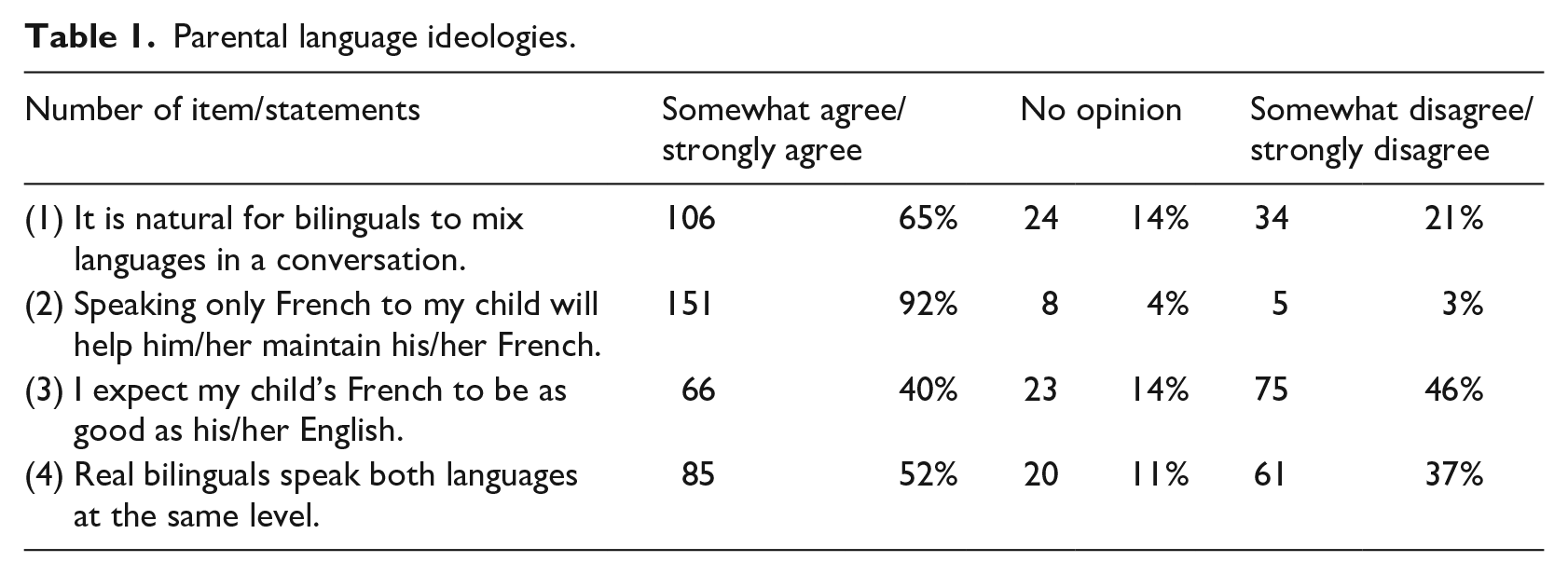
Respondents’ reported beliefs regarding translanguaging and family language management are summarised in Table 1.
Parental language ideologies.
Beliefs about translanguaging
Participants were asked to express their views on whether it was natural for bilinguals to mix languages in a conversation (Item 1 in Table 1). The term natural in this survey item was meant as both instinctive and normal. In anticipation of the possibility that respondents’ interpretation of the question might vary, they were asked to justify their answers in a comment box. The qualitative data they provided indicated that the term natural was understood as acceptable and/or beneficial. The significant majority of parents (65%, n = 106) declared that translanguaging practices were natural for bilinguals. Most of these respondents justified their answer by arguing that some concepts were better conveyed in one or the other language (33 references) and provided examples of terms that either did not translate precisely in the other language or that would require a longer phrase (for instance, ‘playdate/venir jouer à la maison’, ‘softplay/aire de jeux gonflables’, ‘pédagogie/good teaching skills’). Other parents explained that translanguaging was a natural practice due to the fact that language was closely linked to the context in which it was acquired. For instance, some participants declared that it was easier for them to describe their work or discuss politics in English, whereas they found home-related concepts easier to express in French. Other parents stated that translanguaging was a natural and positive practice because it facilitated the flow of conversation (29 references). They argued that the ability to select vocabulary in either language allowed for a faster and more fluid conversation between multilingual interlocutors. Finally, 13 references were related to the role of translanguaging in achieving richer communication and learning.
Only 21% of respondents viewed translanguaging as unnatural. Given this limited percentage and considering that some of these participants did not provide any justification for their statements, it was not possible to identify significant themes within the qualitative data. That said, two main ideas were mentioned on several occasions. Firstly, a few parents believed that languages were separated in the brain and described bilingualism as the ability to transfer or translate any given concept from one language to the other (10 references). Other respondents viewed translanguaging as the improper use of a language due to intellectual laziness (six references). These ideas seem consonant with a monoglossic understanding of multilingualism as the co-existence of separate and autonomous linguistic systems.
Language separation as a language management strategy
Although 65% of parents perceived translanguaging as natural or positive, the overwhelming majority of respondents (92%) also declared that speaking French exclusively to their offspring would be the best language management strategy for their families. Moreover, 42% of respondents reported implementing OPOL at home. Parents’ reported language beliefs about and attitudes towards translanguaging cast light on some incongruences between the two different language ideologies and between reported language beliefs and language management. These results suggest that parents who endeavour to implement a strict language separation at home may not necessarily do so on the basis of a monoglossic understanding of bilingualism. The two following case studies aim at contextualising parental language approaches in order to examine how parents reconcile their attitudes to translanguaging with their language management choices.
The case studies
Case study A: The Bertrand family
Patrick has been living in the UK for 21 years. His wife, Laura, is a native-English speaker and a full-time French teacher at a secondary school and describes her French as ‘near native-like’. They have two children: Alain, 6, and Anne, 3.5, both born in England.
Reported family language practices
Patrick was part of the 42% of respondents who reported speaking French exclusively to their children. During the interview, he declared that family conversations were ‘always in French and only in French’. Patrick describes his language use as follows: Quand je parle à Alain c’est, donc, à la maison c’est français, dans la rue, c’est français. Euh les devoirs sont en français. Le piano est en français. Quand il regarde la télé c’est en français (. . .) Dans toutes les situations où je suis là, c’est du français (. . .) Il n’y a pas un mot d’anglais.
As Patrick sums it up himself: ‘the home is French’. He explains that interactions between Laura and the children are also in French, despite Laura being a native-English speaker. However, Laura’s reported language practices indicate that she ‘occasionally’ uses English and does the children’s homework in the majority language. Outside the home, the Bertrand family’s language practices remain mostly in French. English is used only when the non-French-speaking grandparents ‘are directly involved in the conversation’, as stated by Patrick. As regards translanguaging, Patrick declares that he never mixes French and English.
Non, non, non, du tout. J’ai parfois du mal à trouver le mot en français après 20 ans ici, mais je vais faire l’effort de trouver le mot français de façon à l’utiliser. ‘Lunch bag’ c’est ‘sac pour le déjeuner’, point à la ligne. Et je fais un effort pour dire c’est ‘le sac pour le déjeuner’. Je mélange pas [= laughter].
Parental language management
As the minority-language parent, Patrick is determined to implement a strict language consistency within the family. He reports that every member of the family, including his wife, a native-English speaker, is expected to speak French in his presence. He summarises his FLP as follows: La maison est française. C’est moi qui parle français, et Laura (spouse) parle français aussi. Elle est anglaise, mais elle est prof de français. Dans toutes les situations où je suis là, c’est du français.’
In order to negotiate a monolingual context with his two children, Patrick employs various techniques. Firstly, he often uses the ‘minimal grasp’ (Lanza, 1997) method through which he pretends not to understand what has been expressed in English.
Si Alain ou Anne parlent en anglais, je dis ‘je comprends pas’. Je m’arrête là. (. . .) Du pain, du lait, à manger: ‘je comprends pas’. Je dis ‘je comprends pas’ [laughter].
Et puis quand elle (Anne) réalise que si elle veut un p’tit peu de pain avec du beurre, et que parce qu’elle le demande en anglais elle l’a toujours pas, et ben euh il faudra qu’elle parle français, et sinon elle aura faim [laughter].
Another of Patrick’s strategies to encourage his children to speak French is to ignore any comments or requests made in English. Alternatively, he expressly asks his children to switch to the HL. Patrick also reports implementing stricter methods in order to impose the use of French on his offspring. When the above-mentioned techniques fail, he ‘raises his voice’, ‘tell[s] them off’ or applies some form of punishment until the children have switched to French. The sanctions are described by Patrick as ‘not too bad’ and can consist of taking a toy away or losing their bedtime story. Lastly, warnings or threats, such as the one described below, are used to discourage the use of English among the children.
Ce matin y avait un exemple au p’tit déjeuner [pause] Alain il commence à parler en anglais. J’ai dit non, une fois, non deux fois. Y avait un anniversaire cette après-midi, j’ai dit: ‘si tu continues, y a pas d’anniversaire.’ Hop, c’est reparti en français.
Patrick’s language management involves a zero tolerance to translanguaging. Based on his approach, the family should function as a French monolingual entity within an English-speaking society. Patrick’s efforts to establish a monolingual context within the family also applies to their literacy practices. Both parents read the children bedtime stories in the minority language and French audio books ‘are played in loop in the car’.
Les livres que l’on choisit sont en français. Je lis actuellement ‘Le Petit Prince’, de St Exupéry à Alain et Anne. Anne a du mal mais Alain commence à vraiment comprendre. On l’a en version disque dans la voiture. Il tourne en boucle.
Observed language practices and management
The recorded observation took place at the Bertrands’ home, at dinner time, over the weekend. The observed exchanges were consistent with parental reports of the family language practices. Patrick and Laura did not use any English during the entire recorded conversation. Alain spoke exclusively in the HL to his mother and father, except on one occasion where he code-mixed as he could not find the French term for ‘museum’. Elements of the language management methods described by Patrick during the interview emerged during the observation. For instance, Laura and Patrick did not tolerate any code-mixing during the recorded interactions. Alain did not attempt to speak English. However, his younger sister, Anne, mixed French and English on a few occasions. Her parents’ negative response to her use of translanguaging was immediate and systematic, as shown in the two conversation samples below.
Qu’est-ce que vous avez préféré?
Le CHOCOLATE.
Comment?
Chocolate.
[sounding irritated] Comment on dit ça en français Anne? Fais un effort.
Chocolat.
Bon.
Papa, où est YOUR GLASSES?
Pardon?
Où. . .?
Où est hmm [pause] YOUR lunettes?
Où sont tes lunettes? Dans le salon.
Tu peux le dire Anne? ‘Oú. . .
Où. . . [hesitation]
[sounding irritated]. Anne, on dit ‘Où sont tes lunettes?’
In the two conversation samples above, Patrick used two techniques he described during the interview. Firstly, he pretends not to have heard or understood Anne’s utterance in English by using the word ‘pardon’. Secondly, he explicitly and firmly asks her to repeat her sentence in French. In both excerpts, above, the father’s sanctioning of his daughter’s code-mixing immediately put an end to the conversations.
Language ideologies
Beliefs about language acquisition and bilingualism
Patrick declares that consecutive bilinguals, like himself, are not ‘real’ bilinguals or, at best, they are not bilingual to the same extent as simultaneous bilinguals such as his children. The notion of nativeness, reflected in his language management approach, is central to his language ideology. Patrick believes that in order to qualify as a bilingual, his English proficiency would have to match his French, in all linguistic aspects, as described in his comment below: Moi je me sens, autant je parle bien l’anglais, autant c’est pas, ça reste pas forcément, même après 20 ans, ça reste pas forcément naturel. Si je devais, euh, 100% en français, ce sera du 100%, mais en anglais ce sera du 90%.
Patrick’s distinction between his language experience and that of his children also justifies his approach to translanguaging. As a non-bilingual, whose first language remains French, Patrick believes that translanguaging does not come naturally to him, hence his ‘orthodox’ language practices and the fact that he speaks ‘either English with the English [and] French with the French’. However, he strongly believes that for ‘real bilinguals’ like Alain and Anne, translanguaging is a natural phenomenon. He explains that ‘to them, having two languages is normal’ and that they ‘can move from one language to the other with ease’. He adds that translanguaging ‘helps [the children] with their learning’. Patrick’s positive perception of translanguaging is, therefore, in contradiction with the very language separation rules he imposes at home. While being part of the 65% of respondents who see translanguaging as natural, Patrick thinks that it should still be avoided due to the dominance of the majority language. The father believes that given children’s natural tendency to speak English, translanguaging would be a slippery slope and would further encourage the use of the majority language, at the expense of the HL. Patrick’s language management is an attempt to create ‘an automatic reflex, a mechanism, so that when they’re with dad, it’s only in French’. He reports feeling uncomfortable about ‘letting [the children] do as they wish’ (i.e. translanguage) because they have not yet acquired ‘solid foundations in French’.
Patrick’s rigorous language separation strategy comes with high expectations of his children’s bilingual development. Whilst he understands that his children’s lower level of exposure to the minority language must be taken into account, he adopts a rather mathematical approach to the problem and explains that a certain amount of input will translate into a particular level of proficiency.
C’est marrant parce que j’ai une sorte de pourcentage en fait. Euh je crois qu’ils sont exposés à 80% d’anglais et 20% de français, dans la journée. Comme à la maison ce n’est que du français, du retour de l’école a 5h jusqu’au coucher, ce n’est que du français, donc il y a au moins trois ou quatre heures de français dans la journée. Le weekend, c’est français. Donc, mais je pense qu’il y aura donc, si leur niveau est à 100% en anglais, il sera à 85 ou 90% en français.
Case study B: The Bradford family
Vanessa was born and raised in France and she has been living in the UK for 23 years. Her husband, Carl, is a British citizen of Indian descent, and does not speak any other languages than English fluently. Carl describes his French as just good enough to order food at a restaurant, or as his wife puts it: ‘tourist’s level’. Their two children, Eric, 11, and Ella, 13, were both born in England.
Reported family language practices
As a general rule, Vanessa tends to address the children in French but she also reports translanguaging often. The mother describes her interactions with the children as follows: Ben l’anglais en fait vient assez facilement quand euh, parce qu’en fait ils me repondent en anglais donc au bout d’un moment c’est ‘bon ben on va continuer en anglais’, c’est fatigant quoi. C’est souvent. Et après ils me répondent en anglais. Donc c’est vraiment un mélange quoi. Je commence en français généralement et ça finit en anglais quoi [laughter].
Vanessa also translanguages with bilingual colleagues, friends and her sister who lives in the UK. She reports inserting ‘English words into a French conversation’ frequently. In the presence of Carl, the father, all family members usually speak English because ‘he understands very little French’.
Language management
Vanessa qualifies her approach to the transmission of the minority language as ‘relaxed’. Her language management methods vary from what Lanza (1997) describes as the ‘move-on strategy’ – the adult does not intervene and lets the conversation takes its course, to ‘adult code-switching’ – the adult uses both languages. Vanessa’s language management can be described as highly tolerant towards translanguaging (Curdt-Christiansen, 2013; Lanza, 1997). She does not expressively ask Ella and Eric to use the minority language. Rather than language rules, Vanessa has established a ‘tradition’ of speaking French in the car, on the journey back from their French supplementary school.
During visits to Vanessa’s family in France, she encourages the children to speak French in presence of their grandparents. She describes her approach as follows: Ils vont dire: ‘Oh j’connais pas le mot en français’. Donc je dis ‘Ben tu construis ta phrase en français et le mot que tu comprends pas ou tu ne sais pas comment dire, tu me le dis et puis j’te le dis’.
Vanessa explains that her approach has been flexible since the children were little. When she realised that they preferred using English, she decided to adopt a ‘light’ and playful approach to avoid creating tensions.
Observed language practices and management
The observed interaction took place after school, on a weekday. Vanessa, Eric and Ella were present and discussed one of Eric’s school assessments given by his French teacher. As reported, the children spoke mostly English to their mother and between themselves. Vanessa spoke mainly French and did not translanguage. This may be due to the topic of the conversation (Eric discussing his school French assessment for feedback), as well as a conscious effort to use French on Vanessa’s part due to the presence of the researcher. Eric, on the other hand, used both French and English within the same sentence on a few occasions. His mother did not mention his use of translanguaging nor did she interrupt him to propose a French equivalent. Despite the many mistakes in Eric’s French homework, Vanessa did not interrupt to offer any corrections, unless specifically requested by the children. In the excerpt below, Eric’s grammatical errors in French are presented in italic.
Oh, would you like to listen to that paragraph EN FRANÇAIS? (. . .) C’est pour mon ASSESSMENT.
Oui, super. Vas-y.
[reading in jerky speech] ‘J’habite au X (home town), c’est en Angleterre.’
Just do the whole thing without doing [b] [b] [b] [mimicking cluttered speech].
No [interrupted by Vanessa].
Ok. Ok. Tu le dis. Répète.
[reading his work] ‘Pour commencer, X est vraiment moderne, des parts de X est vraiment moderne, et des autres parts est vieille. J’aime habiter à X parce que il y a pleins de bâtiments pour visiter, et plein de activités pour faire.’
That’s my first line. Then it says: ‘What do you like doing?’ [continuing reading] ‘L’avantage de habiter en X, comme j’ai dit d’abord, il y a pleins de activités comme aller dans le parc pour faire des promenades en barque et faire le [hesitation] et faire le equesterien? [laughter].’
[laughter] faire du cheval.
Language ideologies
Like many other participants in the online survey, Vanessa realised that keeping French in the family became more difficult upon the children’s entry to school. Although she wonders whether she should have persisted more with using only French at home, she believes that her flexible approach was a ‘necessity to avoid complications’. She found doing English homework in French particularly difficult for the children and for herself. When asked whether parents should, ideally, keep the minority and majority languages separated, Vanessa gave the following response:
Penses-tu que dans l’idéal il faudrait séparer les 2 langues?
Hmm Je préfère qu’ils parlent, même si parfois y a des mots anglais, que pas du tout en fait. Je pense que, des fois je me tais quand je les entends et ils font une erreur. Je me dis bon, on laisse parler, et puis peut-être qu’après je dis ‘tiens peut-être que ça tu aurais pu le dire comme ça’. Mais je me dis bon, tant qu’ils parlent, et qu’ils font l’effort. Pour ne pas couper l’effort.
Vanessa believes in encouraging communication and effort, sometimes at the expense of grammatical and lexical correctness. According to her, a stricter approach would defeat the very purpose of developing the acquisition and use of the minority language and would antagonise the children.
Vanessa sees translanguaging as a natural practice for bilinguals. She explains that she sometimes translanguages because ‘[her] proficiency in French has decreased, compared to [her] English proficiency’. However, she also metaphorises translanguaging as ‘the gymnastics of the mind’, which indicates that ‘[one] is really bilingual’. She distinguishes between her bilingualism and the children’s because whilst she learned English at school, Ella and Eric are learning French in a more naturalistic environment. Therefore, she believes that translanguaging may be even ‘more natural’ and ‘more intuitive’ to the children. However, the mother was also part of the 92% of online respondents who declared that speaking French only to their children was the best language management method. Vanessa justifies her answer by explaining that ‘she should avoid speaking English to [the children]’ in order to further develop their French skills. However, she explains that the stress this would involve ‘would not be good for the sanity of the family’. In other words, the mother believes that her language management method is not the most effective for HL development but that it is best for the well-being of all family members. She also declares being satisfied with her children’s French skills and that Ella and Eric’s levels of French ‘might not be excellent, (. . .) but they get by, (and) they are ahead of any other child who (. . .) learns that language in school’.
Discussion and conclusion
This study used mixed methods in order to identify parents’ language ideologies and attitudes towards translanguaging and examine whether and how they might influence their language management at home. The online survey revealed clear differences of language beliefs among the participants. The traditional monoglossic approach to bilingualism as the co-existence of two separate linguistic systems, as well as the idealisation of the native speaker (Flores & Schissel, 2014), seems well ingrained in parental language ideologies. However, while some monoglossic ideas still exist in the minds of some parents, the results also showed the strong presence of heteroglossic ideas among many respondents. These findings contradict previous studies (King & Fogle, 2006; Okita, 2002; Piller, 2001), which reported the predominance of monoglossic language ideologies among middle-class parents. This suggests that parental language beliefs may have evolved and that a translingual ideology is making its way into multilingual families. The online survey results also highlighted the co-existence of seemingly contradictory beliefs about translanguaging. The participants’ responses revealed a dissonance between a positive parental attitude towards translanguaging and the overwhelming support for a language separation strategy. The qualitative portion of this study further explored how some parents made sense of these incongruent approaches to bilingualism when electing and justifying their family language management.
The two case studies presented in this paper contextualised the reported language beliefs and management of two survey respondents who, like the majority of participants, both positively described translanguaging practices and endorsed language separation as the ideal language management method. Whilst both Patrick and Vanessa reported that they viewed bilingualism as a fluid and ever-changing phenomenon in which translanguaging played positive role, only Vanessa embraced such heteroglossic ideas and adopted flexible language practices with her children. Although she declared that she ‘should speak more French to them’, Vanessa decided to promote a ‘relaxed’ FLP in order to avoid creating tensions and to encourage communication with her offspring. However, while doing so, Vanessa recognised and accepted that her language management style might not be optimal for her children’s HL development. Patrick, on the other hand, adopted a language strategy that ran counter to his ideology of bilingualism and imposed a rigorous ban on translanguaging, implemented through more or less subtle sanctions. The father’s choice of language management seems motivated by a pragmatic consideration – that is, the need to maximise the amount of minority-language input received by the children – and despite a positive perception of translanguaging as a practice that ‘helps [the children] with their learning’.
In both cases, the parents believed that language separation was a necessary evil to ensure maximum input in the minority language given the overwhelming dominance of English in their sociolinguistic environment. That being said, the difference between these two parents’ language management decisions seemed to reflect which aspect of bilingual childrearing they chose to prioritise. Patrick appeared to put the emphasis on language proficiency and long-term expectations, including attaining near balanced bilingualism. As demonstrated in the recorded conversations at the Bertrands’ home, the father’s focus was on his children’s language development rather than on encouraging communication. Vanessa, on the other hand, reported that she believed in encouraging her children’s efforts to speak French, as well as parent–child communication, sometimes at the expense of grammatical correctness and lexical development. According to her, a stricter approach would defeat the very purpose of developing the acquisition and use of the minority language and would antagonise the children.
If both the online survey and case studies suggested that an interlingual ideology of bilingualism is reaching multilingual families, parental positive attitudes towards translanguaging do not necessarily translate into flexible practices at home. Language separation strategies such as OPOL may, in fact, be adopted despite parents’ beliefs about the flexible nature of bilingualism and owing to the pressure of being the sole source of HL input for their children. Whilst some parents may decide to adopt translanguaging as a legitimate aspect of their family language practices, they are also aware that it may not be the most effective language strategy to help develop their children’s HL. This suggest that practical support in the form of additional sources of HL input, rather than theoretical guidance, would be required for parents to embrace flexible language management at home. The present study findings also highlighted the dilemma parents face between prioritising their children’s bilingual development and fostering a harmonious bilingual environment for their families (De Houwer, 2013). Multilingual families would, therefore, benefit from further research investigating the emotional impact of parental language management choices on the experiences of parents and children.
Footnotes
Funding
The author received no financial support for the research, authorship, and/or publication of this article.
