




Abstract
Aims and objectives:
This study examines the structural and morphological features of direct object realization through various types of direct objects—noun phrases (NPs), clitic pronouns, and null objects—in child heritage speakers (HSs) of Bosnian and Serbian in contact with Norwegian. This study also focuses on the role of language-internal factors, individual language experience variables, lexical proficiency, and cross-linguistic influence in shaping direct object usage.
Methodology:
Direct objects were elicited in the discourse settings where the referring element had been mentioned in a previous context, such as in response to the question, “What is Mia doing to the monkey?” We used the Q-BEx questionnaire to capture the individual language experience factors and MAIN to measure lexical proficiency.
Data and analysis:
Participants were 32 HSs of Bosnian and Serbian descent between the ages of 5.5 and 10.4 (M = 93 months, SD = 14 months). The data analysis and visualizations were carried out in R (v4.2.2) and the packages MASS, nnet, mclogit, and ggplot2.
Findings:
Child HSs of Bosnian and Serbian were sensitive to discourse-pragmatic (information structure) constraints, showing a preference for clitics followed by null objects and NPs. The individual language experience variables significantly affected the children’s object realization preferences. We argue against morphological deficiency despite the observed increase in the rate of null objects. The potential vulnerability of the feminine clitic je is likely due to the complex morphosyntactic patterns of Bosnian and Serbian.
Originality:
This study offers new evidence on object production in lesser-studied languages through an in-depth investigation of the complex relationship between syntax, semantics, pragmatics, and morphology, including case, gender, and number.
Significance:
This study underscores the importance of considering language-internal and external factors in the bilingual acquisition of object realization.
Introduction
In this study, we examine the structural and morphological features of direct object realization in child heritage language (HL) speakers of Bosnian and Serbian in Norway. These bilingual children face the complex task of acquiring a variety of possible argument types permitted by the target languages, including noun phrases (NPs), clitics, or even null elements where the argument is omitted altogether. The language-internal variation in Bosnian and Serbian is shaped by syntactic, semantic, and discourse-pragmatic factors, alongside complex morphosyntactic features such as gender, number, and case. Our primary aim is to explore whether and how this variation is influenced in the context of HL acquisition. To ensure comparability with previous studies, we assess bilinguals’ use of direct objects in contexts where the objects are specified, given, or previously mentioned, such as in response to the question, “What is Mia doing to the monkey?” The new evidence on object production in lesser-studied languages in this study will be analyzed in relation to the following key trends observed in child bilinguals acquiring languages with pronominal clitics and null objects (Mykhaylyk & Ytterstad, 2017; Pirvulescu et al., 2014; Rinke et al., 2019; Serratrice, 2007; Shin et al., 2019, 2023; Sopata et al., 2024): (1) encoding referential expressions is regulated by accessibility and animacy; (2) an overuse of null objects or full NPs can be expected in the context of HL acquisition; (3) clitics can be vulnerable, avoided, or late acquired. Special attention in our analysis will be paid to the impact of individual language experience variables, as well as lexical proficiency and cross-linguistic influence on the developing grammars of child heritage speakers (HSs).
Direct object types in Bosnian/Serbian and Norwegian
Syntactic and discourse-pragmatic principles
Bosnian and Serbian are closely related to South Slavic languages, which are part of the Bosnian, Croatian, Montenegrin, and Serbian (BCMS) language continuum. The languages have rich inflectional morphology, a relatively free word order (though the canonical word order is SVO), and subject drop. Direct objects can be expressed as NPs, clitics, full pronouns, or null elements, depending on discourse-pragmatic (information structure) conditions. Pragmatically new, focused objects are typically NPs in the clause-final position, as in (1a). 1 When referents are specified, given, or mentioned in a previous context, direct objects are expressed as clitics, as in (1b), or they may be omitted (null), as in (1c). These contexts, which are relevant to this study, are described in detail in (3) below. Full, stressed pronouns in (1d) can only be used in special pragmatic contexts, such as contrastive focus.
(1) a. Mia kupa Mia.NOM.F.SG bathes monkey.ACC.M.SG “Mia is bathing a monkey.” b. Mia Mia.NOM.F.SG it.CL.ACC.M.SG bathes “Mia is bathing it.” c. Šta Mia radi s majmunom? – #Kupa. what Mia.NOM.F.SG does with monkey.INST.M.SG. bathes “What is Mia doing to the monkey?—(She) is bathing (it).” d. Mia kupa Mia.NOM.F.SG bathes it.ACC.M.SG. not me “Mia is bathing it, not me.”
Object clitics in Bosnian and Serbian are phonologically weak monosyllabic elements that cannot bear focus. They undergo an obligatory cliticization to the second position in the clause, after the first prosodic word or after the first syntactic/prosodic phrase. Pronominal clitics must join a syntactic constituent (stressed word or phrase) to their left, forming a single prosodic phrase (see, e.g., Bošković, 2020; Pešikan, 1958; Progovac, 1996; Radanović-Kocić, 1988). Therefore, they cannot appear in the first position as in (2a), or in the third position post-verbally, as in (2b). Post-verbal clitic placement is only allowed in structures like in (2c), where the pronominal subject is omitted. In contrast, full pronouns bear focus and thus occur post-verbally carrying contrastive focus, as in (1d).
(2) a. * it.CL.ACC.M.SG bathes “(Mia) is bathing it.” b. *Mia kupa Mia.NOM.F.SG bathes it.CL.ACC.M.SG “Mia is bathing it.” c. Kupa bathes it.CL.ACC.M.SG “(Mia) is bathing it.”
Unlike Serbian and Bosnian, Norwegian has a “fixed” SVO word order and verb-second (V2) rule. Direct objects are either NPs or full pronouns (there are no clitics). Both types occur clause-finally except for sentences with negation in which unstressed pronouns must precede the negative particle ikke (Anna elsker
The examples in (3a–f) demonstrate that, in the contexts examined in this study, Bosnian and Serbian utilize a broader range of syntactic structures and object types compared to Norwegian in (3g–l). Lexical NPs in (3a), clitics in (3b, d), and null elements in (3e) all serve as felicitous responses to questions such as “What is Mia doing to the monkey?” in Bosnian and Serbian. In these contexts, however, lexical NPs are pragmatically less appropriate than clitics or null objects, as repeating the same NP already mentioned in the question introduces lexical redundancy. Full pronouns in (3c) are ungrammatical in specified contexts. They are reserved for the cases where cliticization is not possible, for example, marked functions, such as prosodically realized contrastive focus, or the cases where there is a lack of an immediate strong element to cliticize to, such as in coordinate structures and prepositional phrases. It is important to note that while discourse-related object omissions, such as in (3e), where the subject is also omitted, are provisionally licensed in Bosnian and Serbian, omissions involving only the object, as in (3f), are ungrammatical. In Norwegian, pronominal subjects are generally overt but can be omitted in informal speech (cf. 3j).
(3) a. Ona kupa she bathes monkey.ACC.M.SG she bathes monkey.ACC.M.SG b. Ona she it bathes she it bathes c. *Ona kupa she bathes it she bathes den d. Kupa bathes it bathes it e. #Kupa. k. *Bader. bathes bathes f. *Ona kupa. l. *Hun bader. she bathes she bathes
In line with discourse-pragmatic approaches to object realization, the choice between the different expressions for direct objects in Bosnian and Serbian is conditioned by the discourse accessibility of the referent (Ariel, 1991; Grosz et al., 1995; Gundel et al., 1993; Sigurðsson, 2011, 2014). The greater the accessibility of a referent in discourse, the more reduced the form that can be used. When a referent is new or relatively inaccessible, speakers tend to employ full NPs to establish it in the discourse. Once the referent becomes more accessible, pronominal forms are typically used, while null objects are licensed when the referent is highly accessible, topical, or salient. Psycholinguistic evidence from Slavic languages supports this view (e.g., Sopata, 2016).
Semantic properties of the referents, such as animacy, are also shown to influence the choice of object expression. Investigation of adult and child speakers of Polish and Ukrainian, where object omission is a licit option similar to Bosnian and Serbian, found significant effects of animacy on object realization in the adult data: adult speakers were more likely to realize animate referents as clitics and pronouns, while inanimate referents were more often expressed as null elements (Mykhaylyk & Sopata, 2016). However, no animacy effects were found in the monolingual children’s data.
Direct object morphology
The nominal system of Bosnian and Serbian differentiates between three genders and seven cases in singular and plural, illustrated in Table 1. Lexical direct objects of masculine and feminine animate and inanimate nouns that were used in this study are marked with the endings -a, -ø and -u in the Accusative singular and the ending -e in the Accusative plural.
Bosnian and Serbian case endings for masculine, feminine, and neuter nouns.
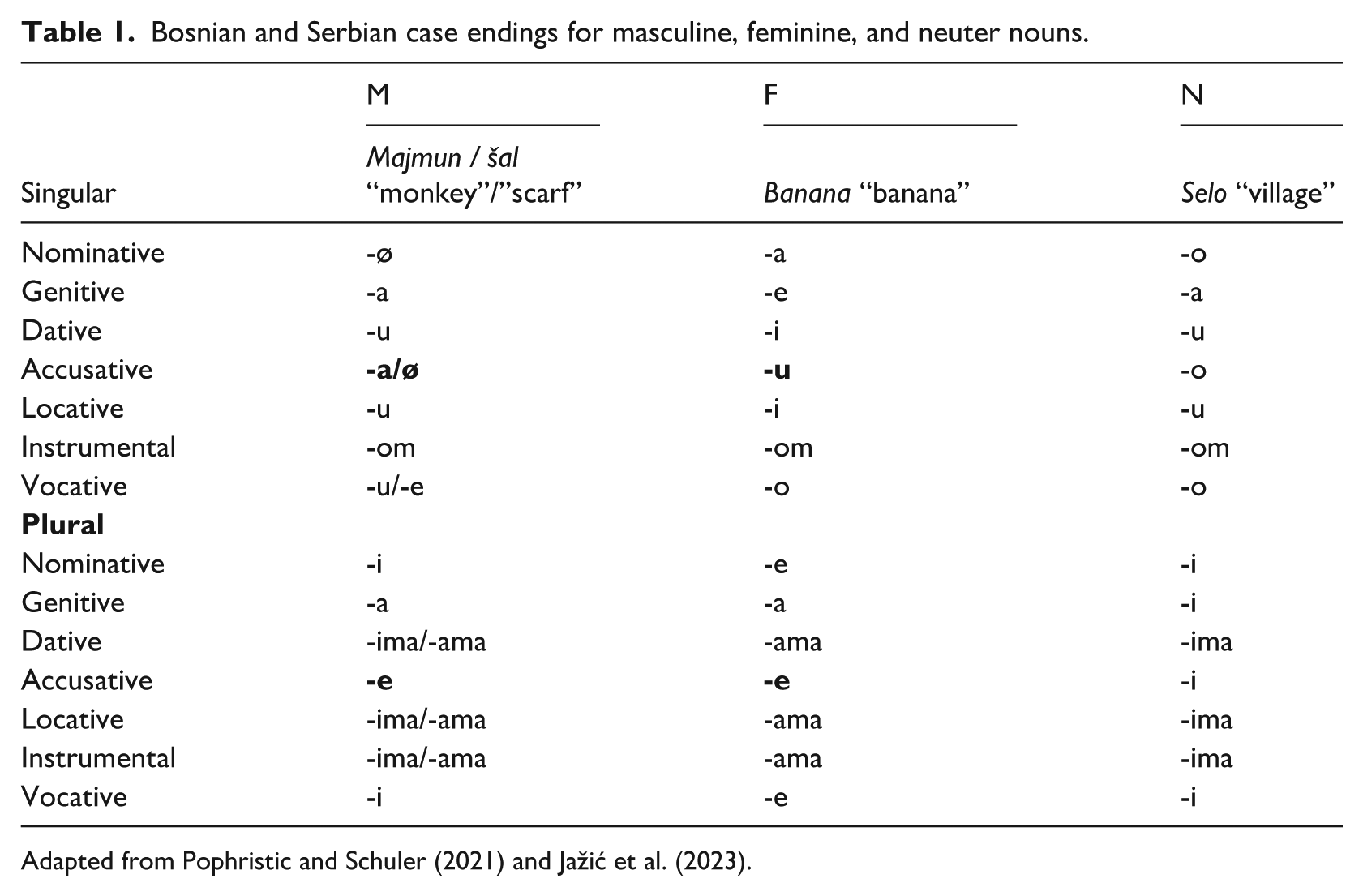
Adapted from Pophristic and Schuler (2021) and Jažić et al. (2023).
Bosnian and Serbian pronominal clitics are marked for gender (masculine, feminine, and neuter), number (singular and plural), and case (Dative, Accusative, and Genitive). Table 2 shows that the same forms are used in the Accusative and Genitive. In the third person accusative elicited in this study, only one form is used, both with animate and inanimate referents: ga for both masculine and neuter, je or ju for feminine, and ih for plural of all genders.
Bosnian and Serbian pronominal clitic forms.
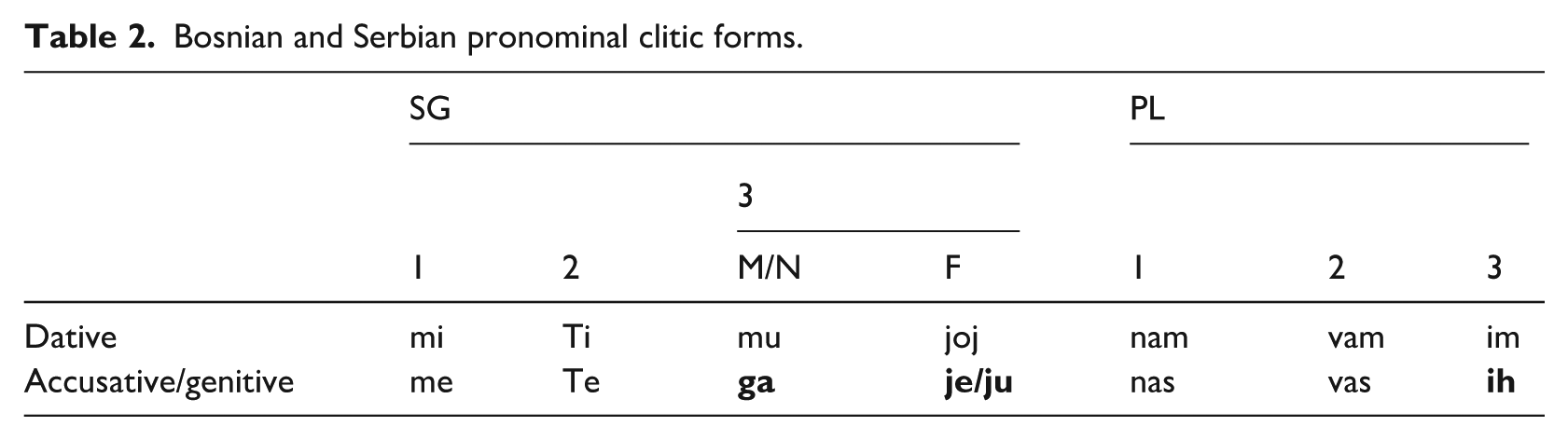
The two forms of feminine accusative clitics je and ju show patterns of subtle microvariation (Kolaković et al., 2022). In standard Serbian and Bosnian, je is considered to be a default form, which is homophonous to the verbal clitic je. The status of ju is less clear. Ju occurs in restricted contexts of suppletion, for example, in combination with a verbal clitic je, nije “is not,” or after verbs ending in -je. 2 When pronominal je occurs in clitic clusters with verbal je, in everyday colloquial language, speakers of Bosnian and Serbian can use only one je instead of two (known as haplology, e.g., Ona je kupala. instead of Ona je/ju je kupala. “She bathed her.”). These complex distributional patterns, as well as homonymy and haplology, can make it more difficult to distinguish the feminine accusative je and the verbal je in acquisition.
While Norwegian dialects traditionally have a three-gender system (masculine, feminine, and neuter), the dialect spoken in Oslo, where the participants were recruited, has only two genders, common and neuter (Busterud et al., 2025). In the Oslo dialect, singular pronouns han and hun are used with humans, both male and female referents; den is used with non-human, both animate and inanimate referents of common gender; and det is used with non-human animate and inanimate referents of neuter gender. 3 This is in contrast to Bosnian and Serbian, where ga and je/ju are used not only with human, but also with animate and inanimate referents of masculine and feminine gender.
Previous research on the acquisition of objects in child bilingualism
Previous research on child bilingualism investigated direct object realization and placement (although to a limited extent), focusing on the role of language-internal and external experience factors and cross-linguistic effects. Cross-linguistically, bilingual children are shown to modify their referring choices according to referent accessibility and in specified contexts elicited with questions like “What is Maja doing to the monkey?” Lexical NPs were the least frequent option across different HLs (e.g., Mykhaylyk & Ytterstad, 2017; Rinke et al., 2019; Shin et al., 2023; Sopata et al., 2024). However, several studies have shown that, when compared to monolinguals, bilingual children acquiring a clitic language may experience an extended null object stage and/or overuse NPs instead of clitics (Pirvulescu et al., 2014; Serratrice, 2007). Children’s direct object usage is modulated by language-internal factors, like animacy, as well as heritage language experience, lexical proficiency, and age.
Only a few studies investigated direct object realization in HSs of Slavic languages (for an overview, see Ivanova-Sullivan & Rodina, in press). Mykhaylyk and Ytterstadt (2017) report that in specified contexts, Ukrainian-English 4 to 6-year-olds showed a preference for pronominal and null direct objects but could also use lexical NPs in heritage Ukrainian. The use of pronouns increased with age, while the use of nulls decreased. While these distributional patterns in heritage Ukrainian were a close match to those of monolingual peers, Mykhaylyk and Ytterstadt (2017) observed a considerable amount of null object usage in English, the societal language, at the ages of 4 to 5, which they attributed to the cross-linguistic influence (CLI) from Ukrainian and potentially to a combination of language experience factors and limited vocabulary at early stages of development. Following Tryzna (2009), the authors also hypothesized that young children’s omission of direct objects in both English and Ukrainian could be due to a discourse-linking mechanism, such as omitting when experiencing uncertainty as to the morphophonological material needed to realize a functional element, or to the structural economy, that is, produce short utterances with only as much information as needed.
A different conclusion is reached in a series of studies with Polish-German and Portuguese-German bilinguals, where their acquisition of object realization is argued to be influenced by the properties of the target language rather than CLI from the SL, German (Rinke et al., 2019; Sopata et al., 2024). The variable use of NPs, clitics, and null objects is permitted in specified contexts in both Polish and Portuguese, and the speakers of these HLs (6–10-year-olds in Rinke et al., 2019) showed the highest preference for object clitics and the lowest preference for NPs. Despite these distribution preferences being similar to those of their monolingual peers, the rate of null objects was higher in heritage Polish and Portuguese, corresponding to an earlier acquisition stage in monolinguals and thus indicating a protracted acquisition in child bilinguals (Rinke et al., 2019). Comparison of object production by four age groups of Polish-German bilinguals in Sopata et al. (2024) confirms this protracted development in heritage Polish, which the authors associate with the shift in language input and use during school age, characterized by a steady increase in exposure and use of the SL. With regard to animacy, both studies report that bilingual children’s pronominal choice is modulated by animacy of the referents in their HL. Animate and immediately accessible referents are more often realized with clitic pronouns, while inanimate or less accessible referents are typically expressed with null objects.
At the level of morphosyntax, an interesting CLI pattern has been observed in heritage Spanish (Shin et al., 2019, 2023). The children (aged 5.3–11.9, M = 8.9) erroneously used masculine clitic lo with feminine, especially inanimate referents in their HL. This was argued to be an influence from English, where pronouns distinguish gender for animate but not inanimate singular referents. Thus, frequent activation of English it may have caused an increased activation of lo in heritage Spanish as a gender-neutral form. The influence of English on heritage Spanish is also proposed to explain a small proportion of clitic misplacement errors in an elicited imitation task where 3 to 8-year-olds used enclitics instead of proclitics (25%; Pérez-Leroux et al., 2011). Shin et al. (2023) also report that animate reference promoted clitic use, whereas inanimate reference promoted lexical NP use, and erroneous object omission was more common among children who experienced restricted input in the HL and lower levels of lexical proficiency.
Evidence from the acquisition of direct objects in BCMS varieties is limited to Serbian and Croatian monolingual children, who have been shown to possess knowledge of specificity and discourse principles that govern the form of direct objects, as well as target-like morphosyntactic knowledge (Ilić & Deen, 2004; Varlokosta et al., 2016). Serbian-speaking 5-year-olds are shown to favor pronominal clitics (77.7%), followed by null objects (6.7%) and NPs (6.3%; Varlokosta et al., 2016). Errors with gender, number, and case were rare (below 12%), and no errors were made in the placement of clitics. A similar performance is reported for Croatian 5-year-olds, yet with 1.2% of errors of misplacement. Non-target-like omission of clitics identified as a reliable early clinical marker of developmental language disorder in some languages (e.g., in child Italian and French) was not attested. Varlokosta et al. (2016) also report adult control data elicited using the same experimental procedure. For example, Croatian-speaking adults produced 90.2% clitics, 2.3% NPs, and 6.0% null objects, while Serbian-speaking adults produced 97.5% clitics, 2.5% NPs, and null objects were unattested.
While the morphosyntax of direct objects is robust in monolingual acquisition of BCMS, divergent patterns are characteristic of adult HSs. Illicit clitic omission and clitic misplacement were attested in the speech of first- and second-generation Serbian-English bilingual adults in Australia and were hypothesized to occur due to CLI from English (Dimitrijević-Savić, 2008). Most recently, adult heritage and attrited speakers of Bosnian and Serbian in Norway have been shown to have reduced sensitivity to clitic placement in the acceptability judgment and self-paced listening tasks (Tomić et al., 2025). Using the causal inference approach and Structural Equation Models, the study revealed that literacy (as reading practices), experience with Bosnian/Serbian across communicative contexts, and age of bilingualism onset determined the clitic placement violation sensitivity. Additional evidence comes from adult HSs of Bulgarian (a language where clitics are constrained by prosody similar to Bosnian and Serbian), whose reduced sensitivity to the constraints that govern clitic placement was attributed to a combination of language-internal optionality and the absence of the target structure in English, their dominant language (Ivanova-Sullivan et al., 2022).
Present study
This study focuses on the production of referential expressions and their realization through different types of direct objects—NPs, clitic pronouns, and null objects, in school-aged speakers of heritage Bosnian and Serbian in contact with Norwegian. We examine the discourse contexts where the referring element has been mentioned in a previous context (elicitation question) and address three main research questions:
Research Question 1 (RQ1): What direct object forms (NP, clitic, null) do child heritage speakers use in Bosnian/Serbian?
Research Question 2 (RQ2): How do individual background factors, lexical proficiency, and the referents’ animacy modulate direct object realization?
Research Question 3 (RQ3): Is there evidence of non-target-like performance at the syntactic and/or morphological levels?
With respect to RQ1, we predict that child HSs of Bosnian and Serbian will use a variety of direct object forms, and their preferred options will be structures with pronominal clitics (X-CL-V or V-CL). We anticipate that lexical NPs will be the least preferred option in contexts where objects are previously mentioned. The evidence from Serbian-speaking monolinguals suggests that the number of null objects, that is, structures with single verbs where both nominal arguments are omitted (V), should be rather low (6.7% in Varlokosta et al., 2016). However, as demonstrated in heritage Polish and Portuguese (Rinke et al., 2019; Sopata et al., 2024), an increased rate of null objects is not unexpected.
Furthermore (as per RQ2), we predict that these direct object preferences will be modulated by language experience and lexical proficiency. Increased Bosnian/Serbian experience and lexical proficiency should lead to increased rates of pronominal clitics. Previous research on clitic placement sensitivity in HSs of Bosnian and Serbian suggests that literacy and reading practices, in particular, as well as HL use across contexts may have the strongest impact on the pronominal clitic rates (Tomić et al., 2025). Even though direct object omission is a licit option in Bosnian and Serbian, higher proportions of null objects may occur in bilinguals with insufficient HL experience and low lexical proficiency (cf. Mykhaylyk & Ytterstad, 2017; Rinke et al., 2019; Shin et al., 2023; Sopata et al., 2024). If children are sensitive to the semantic properties of the referent, we would expect (a) a higher rate of clitic production with animate objects than with inanimate ones, and (b) that inanimate referents would promote the use of null objects (cf. Mykhaylyk & Sopata, 2016; Rinke et al., 2019; Sopata et al., 2024).
In relation to RQ3, we predict two areas to be potentially vulnerable in heritage Bosnian/Serbian: pronominal clitic placement and feminine clitic je. Due to language-internal complexity and cross-linguistic differences between Bosnian/Serbian and Norwegian, we anticipate that clitics may be misplaced and occur post-verbally in structures like *Mia/Ona kupa ga. “Mia/she is bathing him.” We also anticipate that masculine singular clitic ga can be erroneously used instead of je with feminine referents (cf. Shin et al., 2023).
Participants
Participants were 32 HSs of Bosnian and Serbian (23/32 females, 9/32 Bosnian) between the ages of 5.5 and 10.4 (M = 93 months, SD = 14 months) who completed the experimental tasks and whose parents filled the Q-BEx questionnaire (De Cat et al., 2025). Of the 32 children, 30 attended Norwegian primary schools at the time of testing. Twenty-two children were born in Norway. The remainder arrived between the ages of 1 month and 2 years of age, except for one child who arrived from Serbia at the age of 6.9. 4 The participants attended Bosnian and Serbian HL schools from which they were recruited and in which they were tested. The Bosnian-speaking children experienced more variability than the Serbian-speaking children in terms of cumulative exposure to the HL over their lifetime (as shown in Figure 1). 5 Their current exposure to the HL is also more variable (as illustrated for Community contexts and for Holidays in Figure 2).
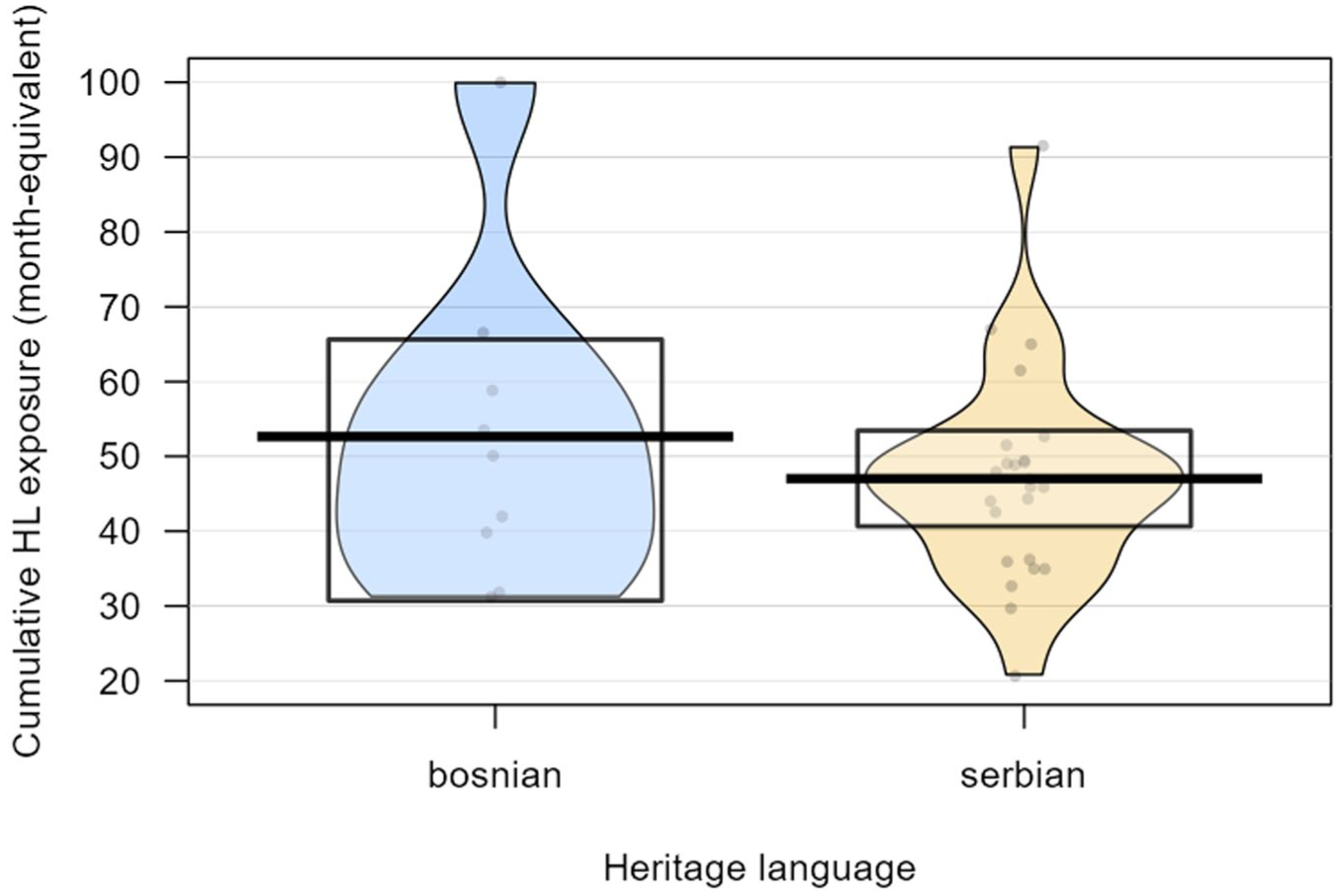
Cumulative exposure to the HL expressed in month-equivalent.
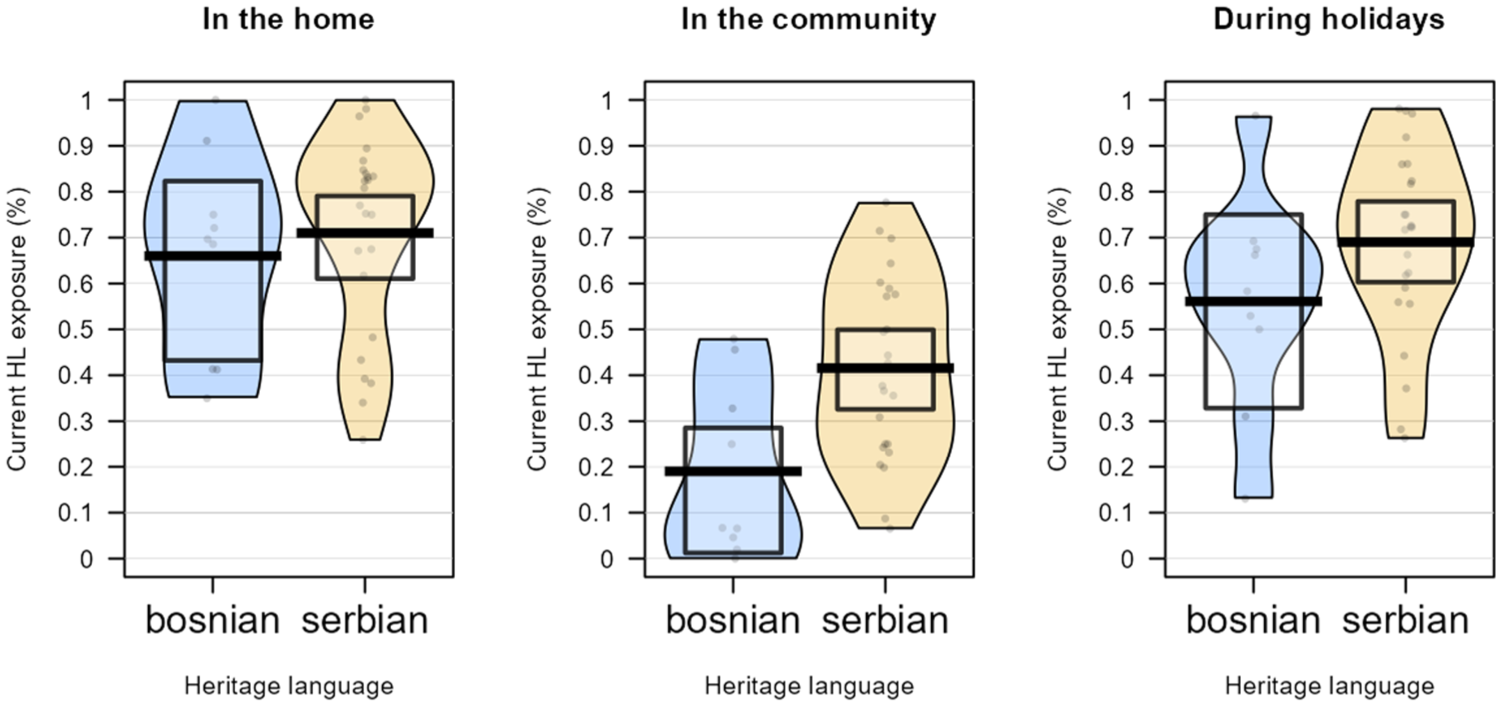
Current exposure to the HL across non-school contexts, expressed in the percentage of total exposure time (averaged over the current year).
Materials and procedure
All participants completed two tasks: oral narratives and elicited production of direct objects. Oral narratives were elicited using the Multilingual Assessment Instrument for Narratives (MAIN; Gagarina et al., 2012). All children told the same story—“Baby Birds.” Two lexical productivity measures were included in the analysis: Total Number of Words (TNW) and Number of Different Words (NDW).
The elicited production task consisted of 11 items: four with masculine referents (majmun “monkey,” pingvin “penguin,” mačor “cat,” šal “scarf”), four with feminine (supa “soup,” banana “banan,” ograda “fence,” žirafa “giraffe”), and three plural (baloni “balloons,” orasi “nuts,” ruže “roses,” occasionally realized as the collective noun cveće “flowers”). Four items featured animate referents, including two masculine and two feminine. Each item was presented with a set of color pictures created specifically for the task. The first picture provided the context in which the experimenter introduced the referent and the target verbs. For example, participants saw a picture of a monkey and heard Pogledaj tog prljavog majmuna! Ali majmuni vole da se kupaju. A ovo je Mia. Već je sipala toplu vodu u kadu. “Look at this dirty monkey. But monkeys like to be bathed. And this is Mia. She already filled the bathtub with warm water.” This preamble was followed by two new pictures showing Mia bathing and drying the monkey. The experimenter asked two elicitation questions, illustrated in (4) together with respective target responses.
(4) Elicitation question 1: Šta Mia radi s majmunom? “What is Mia doing to the monkey?” Target response 1: Mia/Ona ga kupa. Mia/She it.CL.ACC.M.SG bathes “Mia is bathing it.” Elicitation question 2: A šta Mia sad radi s majmunom? “And what is Mia doing to the monkey now?” Target response 2: Mia/Ona ga Mia/She it.CL.ACC.M.SG dries “Mia is drying it.”
Thus, each item was elicited twice with two different verbs, which were provided by the experimenter before each story. Only present tense was used in the elicitation questions, since in the past, pronominal clitics occur in clusters with verbal clitics in Bosnian and Serbian. The task was explained and practiced with several additional items during which the participants were prompted to produce structures with overt subjects to ensure pronominal clitics in the second position, that is, NP/prn-CL-V. Structures with null subjects, leading to V-CL combinations, were also anticipated; however, these would not necessarily provide insight into clitic placement. 6 Nevertheless, both overt- and null-subject structures could provide insight into the realization of direct objects (RQ1).
The participants were tested individually in a quiet room, and their answers were audio recorded. 7 The experimenters were speakers of Bosnian and Serbian who also transcribed the data. The responses were coded for:
Direct object type: clitic, lexical NP, and null object.
Clitic placement: target-like X-CL-V or V-CL as well as non-target-like X-V-CL.
Direct object gender and number: masculine (ga), feminine (je), and plural (ih).
Direct object animacy: animate or inanimate
Due to the spontaneous in-person nature of the experiment, some experimental items were occasionally referred to by experimenters with a synonym with a different gender or number than the intended one, for example, mačor “a male cat” versus mačka “a female cat.” These were coded accordingly to reflect the nouns used by experimenters.
The model selection and multinomial analyses, as well as visualizations, were carried out in R (v4.2.2, R Core Team, 2022) with the help of the packages MASS (Venables & Ripley, 2002), nnet (Venables & Ripley, 2002), mclogit (Agresti, 2002; Elff, 2022), and ggplot2 (Wickham, 2016). The data and analysis scripts can be found in the Open Science Framework repository at https://osf.io/e4mt7/.
Results
Direct object realization
The children produced 663 relevant responses, while 41 questions were either not answered or received inappropriate responses. As shown in Figure 3, direct objects (n = 663) were realized as clitics (51%, n = 339), null elements (37%, n = 245), and NPs (12%, n = 79). The majority of the children had a strong preference for either clitics or null objects. Only two participants had a preference for NPs over other forms. The examples in (5) illustrate the use of NPs, clitics, and null elements as objects.
(5) Šta sad radi majmunčić s bananom? “What is the monkey doing with the banana now?” a. jede bananu (S20, 6;10) eats banana.ACC.F.SG b. on je jede (B11, 6;4) he (monkey) it.CL.ACC.F.SG eats c. jede (S24, 8;4) eats “Now the monkey/he eats the banana/it.”
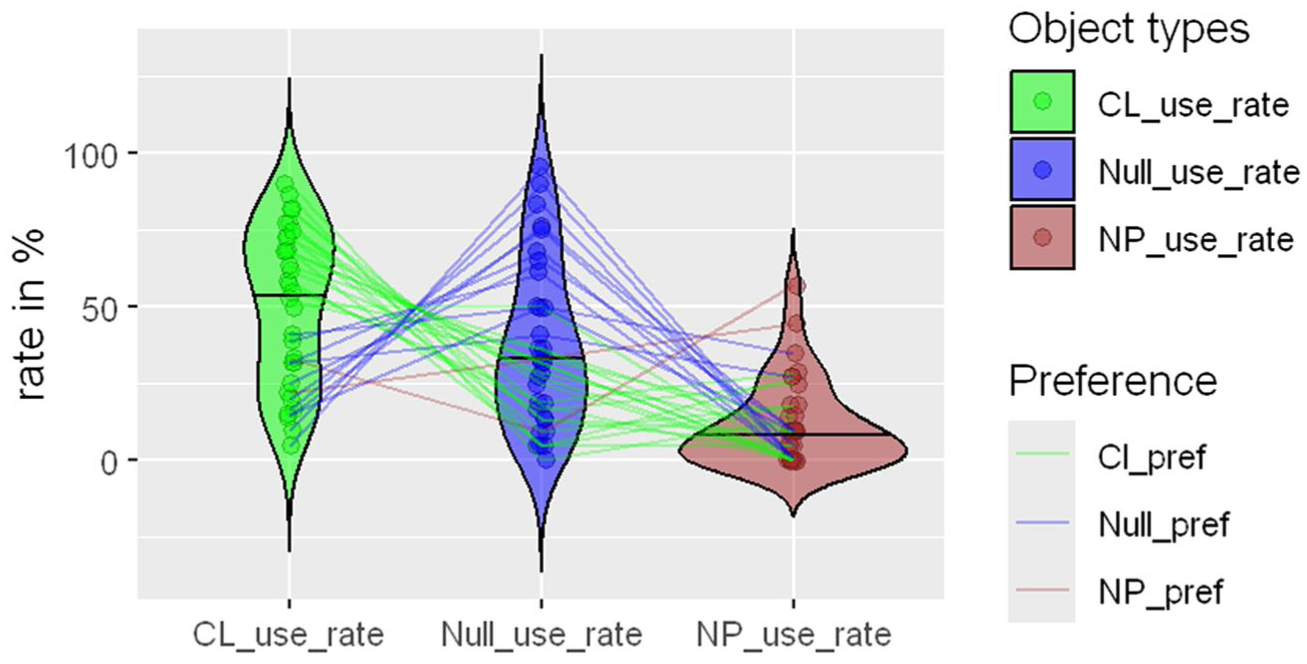
Object realization rates (CL, null, and NP) across children.
In the instances of clitic object realization, the V-CL structure was the most common with 207 occurrences (61.06%), whereas the X-CL-V structure occurred 129 times (38.05%). Despite attempts to elicit more three-element structures to explore the clitic positioning with respect to the verb, participants were sensitive to the null subject tendency in Bosnian/Serbian, preferring the V-CL structure. There were only three additional instances (0.89%) of the ungrammatical order with the clitic in the third position, X-V-CL, with two of them in the dependent complementizer clause with da complementizer, illustrated in (6).
(6) a. on mora da popravi je (ograda) (S16, 7;1) he has to fix it.CL.ACC.F.SG “He has to fix it/fence.” Target structure: On mora da je popravi. b. on grli ’e (mačka) (S17, 6;6) he hugs it.CL.ACC.F.SG “He hugs it/cat.” Target structure: On je grli. c. uzme orasi i hoće možda da baci ih tamo (S16, 7;1) (he) takes walnuts and wants maybe to throw them.CL. ACC.PL there “He takes the walnuts and maybe wants to throw them there.” Target structure: Uzme orasi i hoće možda da ih baci tamo.
Figure 4 suggests that animacy increased the probability of clitic use. Inanimate objects were numerically more often realized as empty elements or NPs rather than as clitics.
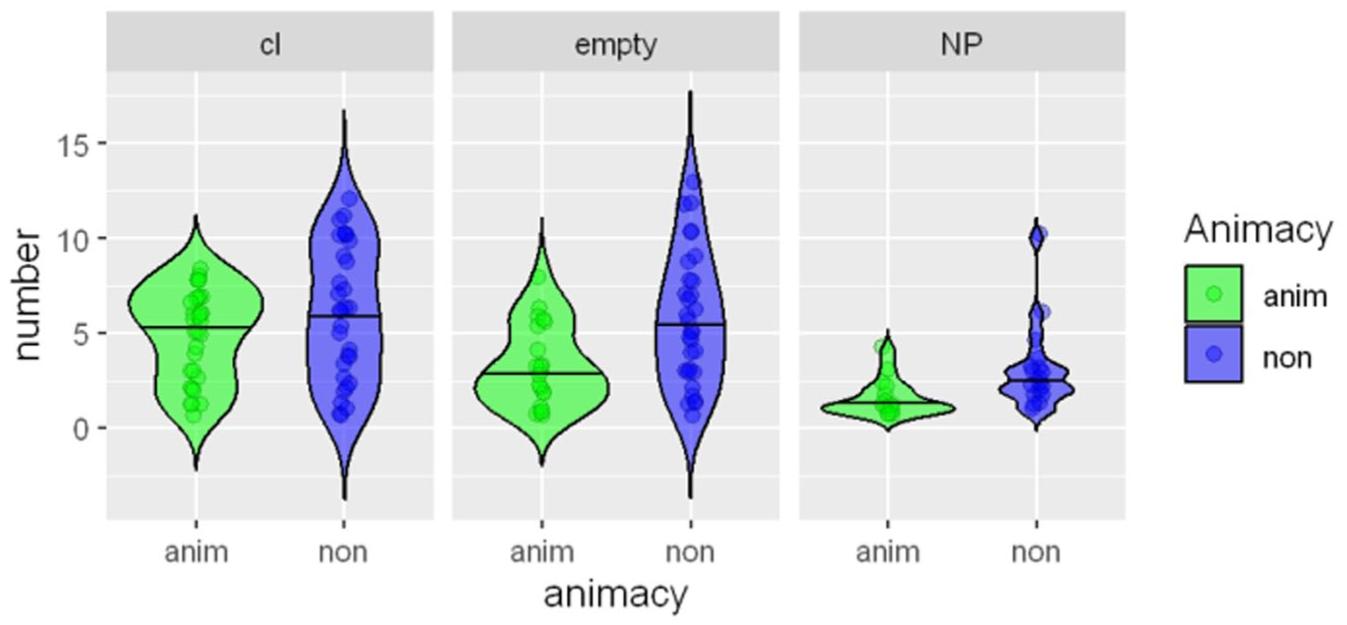
Object realization counts for animate (anim) and inanimate objects (non).
Figure 5 demonstrates that there were fewer instances of feminine gender objects realized as clitics compared to empty elements and NPs. The opposite pattern is observed for the masculine gender objects.
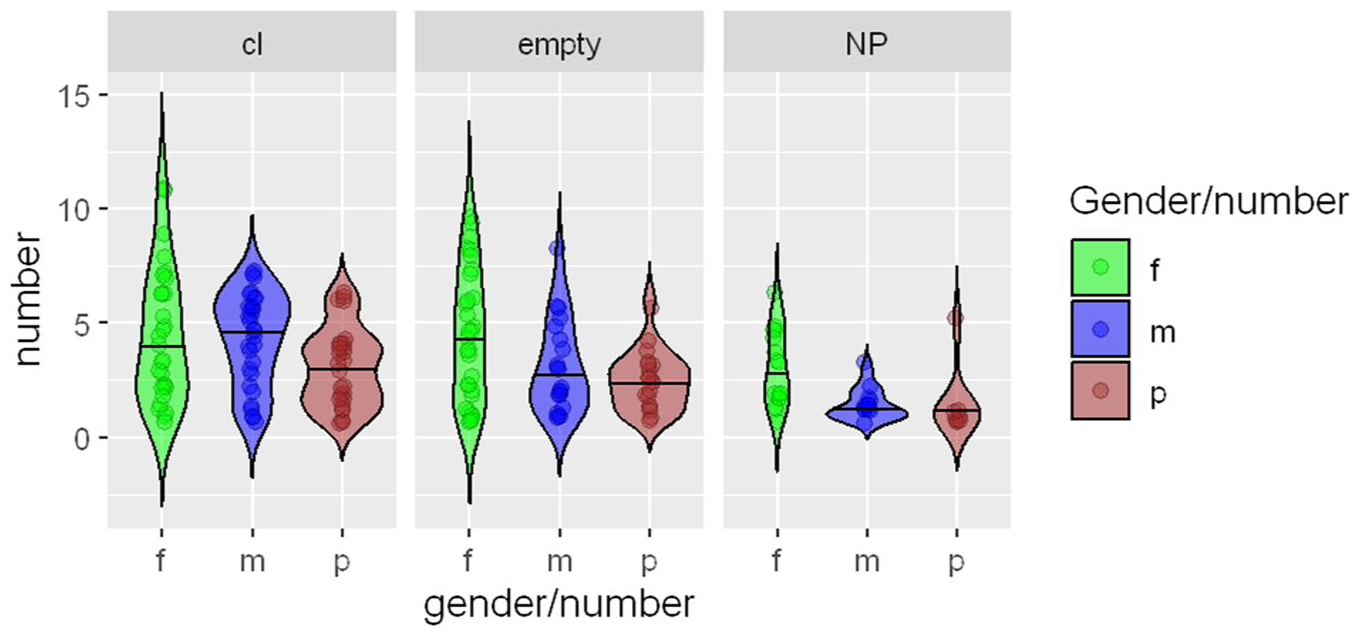
Object realization counts by gender (M, F) and number (PL).
For the analysis of linguistic factors of gender and animacy on object realization, we excluded the plural number as it did not cross with animacy (all plural nouns were inanimate). The multinomial model explored the main effects of gender, animacy, and the interaction of the two, along with a participant random intercept, 8 with the mean of means of all conditions as the baseline. The intercept inspection revealed that there was a lower probability of clitic realization than NP realization (b = −1.9049, se = 0.2795, z = −6.815, p < .001), whereas null objects and clitics probability did not significantly differ. The model identified the significant main effect of gender such that the feminine referents had a higher probability of being realized as null objects rather than clitics (b = 0.4410, se = 0.1212, z = 3.637, p < .001) and as NPs than clitics (b = 0.4645, se = 0.1897, z = 2.448, p = .0144). The main effect of animacy was also significant, such that inanimate referents had an increased probability of being realized as null objects rather than clitics (b = 0.6276, se = 0.1219, z = 5.148, p < .001). There was also a significant interaction of gender and animacy, such that inanimate feminine referents were more likely to be realized as NPs rather than clitics (b = 0.4371, se = 0.1896, z = 2.306, p = .0211).
The multinomial models exploring the effect of lexical proficiency in terms of TNW and NDW scores separately revealed that larger TNW scores led to a higher likelihood for the use of NPs versus clitics (b = 0.018, se = 0.007, z = 2.697, p = .007), but it did not affect the likelihood of null objects over clitics. NDW scores did not significantly predict object realization types.
Morphological accuracy of direct object forms: gender, number, case
Overall, 20 children made 50 (15%) gender/number errors with object clitics. The errors were sporadic for most children, but one child made eight, and two others made seven errors each. The results reveal that the feminine gender clitics were numerically most error-prone. Forty-one errors were due to the overuse of masculine ga instead of feminine je with three feminine nouns accounting for most of the mistakes: žirafa “giraffe,” banana “banan,” and ograda “fence.” Interestingly, while giraffe and banan are both cognates and common gender in Norwegian, the noun fence is neuter—gjerde. In the case of plural referents, the singular masculine ga was used five times instead of the plural ih. In addition, three errors were due to the overuse of feminine je instead of masculine ga, and one error showed an overuse of plural ih instead of feminine je.
(7) Šta sad radi majmunčić s bananom? “What is the monkey doing with the banana now?” jede ga (S10, 6;9) eats it.CL. ACC.M.SG “(The monkey) eats it.” Target structure: Jede je.
We tested the linguistic effects on clitic accuracy using a binomial logistic model with the main effects of gender (masculine, feminine), animacy (inanimate, animate), and the interaction of the two, along with a participant random intercept. The baseline comparison level was the mean of condition means. The model identified the main effect of gender, such that feminine nouns were less likely to be used correctly (b = −1.85274, se = 0.35560, z = −5.210, p < .001) compared to the baseline. There were no other significant effects. The binomial logistic models testing the effects of lexical proficiency in terms of TNW and NDW scores on clitic form accuracy (limited to masculine and feminine referents), with participant as a random intercept, did not yield any significant effects on clitic accuracy.
The children produced 79 direct object NPs. Out of these, 15 (19%) had erroneous case forms produced by 12 children. Only two of the errors involved the Instrumental case, where the form was the exact repetition of the elicitation questions. Seven errors involved using the Nominative instead of the Accusative (e.g., majmun instead of majmuna “monkey,” or supa instead of supu “soup”). Four errors involved the incorrect use of another oblique case form, such as majmun jede banane instead of majmun jede bananu “The monkey is eating the banana.” Two errors were due to the omission of case endings.
Individual experience effects on object realization
We combined data-driven analysis aspects with causal inference (Tomić et al., 2025) in the analysis of direct effects. The small sample size did not allow testing for all possible direct effects. Therefore, we used a stepwise model selection process to choose the smallest set of variables that could explain the object realization pattern, to avoid multicorrelation issues. The following potential direct causes of HL outcomes were included in the selection process: Age in months, SL exposure onset, Cumulative HL exposure, Current home exposure, Current community exposure, Current holiday exposure, Reading frequency, and Lessons frequency. All measures were z-scored before entering the models to ensure model fit.
Figures 6 and 7 illustrate the individual experience effects on object realization. The model selection process for object realization singled out the following variables as most parsimoniously explaining object realization: Age in months, Frequency of lessons in HL, Current exposure to HL in the community, Reading in HL, and Current exposure to HL during holidays. We also added SL exposure onset to the final multinomial model for object realization, as it was of special interest. The final multinomial model for individual variable effects on object realization also included participant as a random intercept. Overall, NPs were used significantly less than clitics (b = −1.889, se = 0.217, t = −8.687). Nevertheless, older age as well as increased frequency of HL lessons caused a significant increase in NP use over CL use (age effect on NP over CL use: b = 0.536, se = 0.224, t = 2.388; HL lessons frequency effect on NP over CL use: b = 0.602, se = 0.212, t = 2.837). Both HL exposure during holiday and in the community significantly decreased the use of NPs compared to CLs (holiday HL experience effect on NP vs. CL use: b = −0.461, se = 0.228, t = −2.020; community HL experience effect on NP vs. CL use: b = −0.533, se = 0.257, t = −2.072). Increased HL lessons frequency also increased the probability of null object use over clitic use (b = 0.486, se = 0.243, t = 2.003). Neither SL exposure onset nor HL reading frequency seemed to have a significant direct effect on object realization.
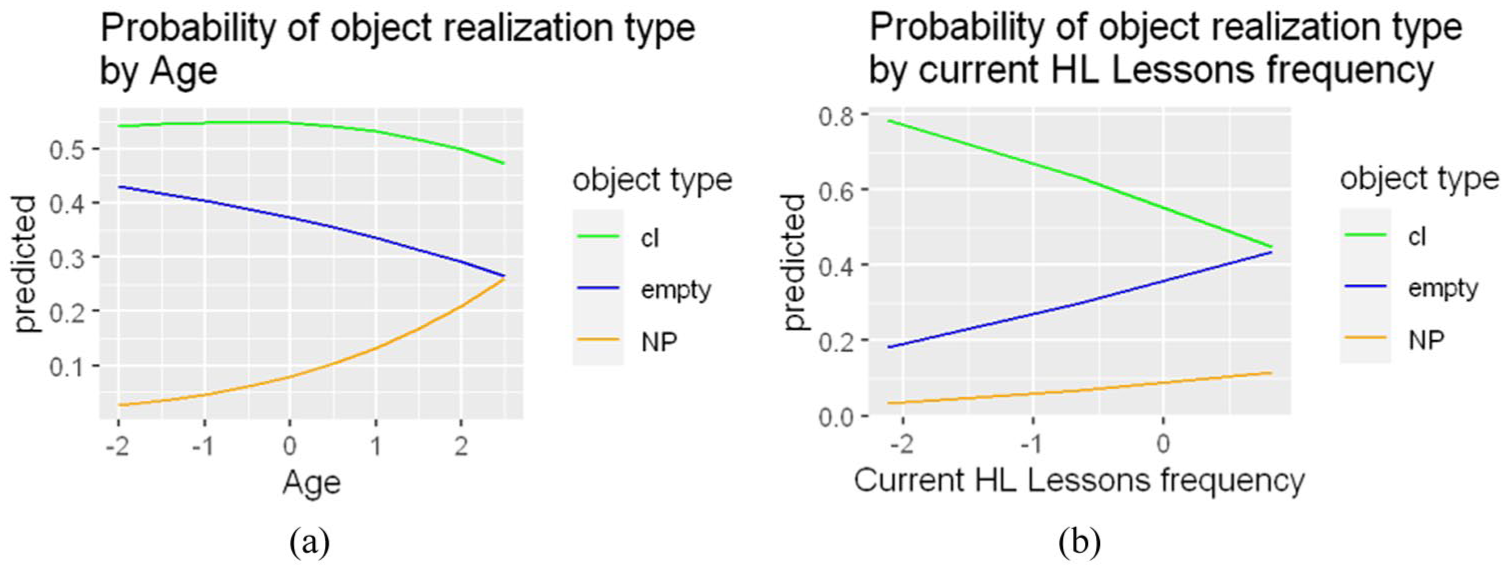
(a) Predicted probability of object realization type by age (scaled). (b) Predicted probability of object realization type by HL lessons frequency (scaled).
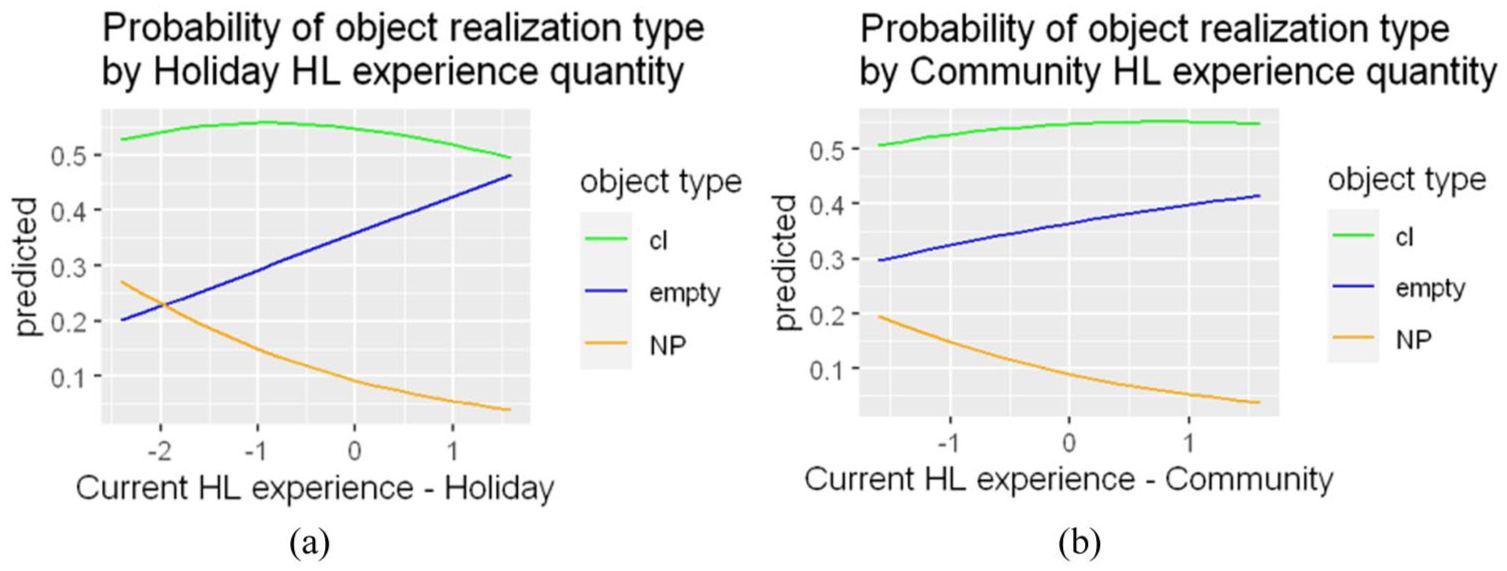
(a) Predicted probability of object realization type by holiday HL exposure quantity (scaled). (b) Predicted probability of object realization type by community HL exposure quantity (scaled).
Discussion
In this study, we used an elicited production task to investigate the structural and morphological characteristics of direct object realization in 5 to 10-year-old HL speakers of Bosnian and Serbian. The first research question focused on what direct object forms child HSs use in Bosnian and Serbian. In line with previous research (Mykhaylyk & Ytterstad, 2017; Rinke et al., 2019; Shin et al., 2023; Sopata et al., 2024; Varlokosta et al., 2016), our data show that 5 to 10-year-old bilingual children modify their referring choices according to referent accessibility and in specified contexts elicited with questions like “What is Maja doing to the monkey?” Lexical NPs were the least frequent object type. NPs are the least pragmatically felicitous since they are strong phonological and morphosyntactic elements that are not commonly used for definite reference, despite meeting the morphosyntactic requirements for a realized object in Bosnian/Serbian. Clitics were the most frequent response type, followed by null objects, both of which are syntactic options allowed in Bosnian and Serbian. Thus, the ranking of direct object instantiation observed in this study—clitics > omission > NPs—supports what has previously been found for heritage and monolingual children acquiring other languages, for example, Polish, Ukrainian, or Portuguese (Mykhaylyk & Ytterstad, 2017; Rinke et al., 2019), where pronominal clitics or pronouns and null objects are both permitted and preferred options in the specific contexts. We thus conclude that child HSs of Bosnian/Serbian are sensitive to discourse-pragmatic (information structure) constraints. Moreover, they are sensitive to the semantic feature of animacy. Consistent with previous findings (Rinke et al., 2019; Shin et al., 2023; Sopata et al., 2024), animacy significantly shapes object realization in heritage Serbian and Bosnian: animate referents tended to promote clitic use, whereas inanimate referents were more likely to be realized as null objects rather than clitics. These results reinforce the view that the animacy of the referent is an important factor in direct object realization.
In addition, the rates of various object types in our study are similar to those observed in Polish-German, Portuguese-German, and Ukrainian-English bilinguals. For instance, the rate of object clitics in our study (51%) is comparable to the rate found in Polish-speaking 6 to 10-year-olds in Germany (64.3%). Overall, the rate of null objects in heritage Bosnian and Serbian is considerably high (37%), even though the SL—Norwegian—does not have this option. On the one hand, this suggests that the children can differentiate between the object structures of the two languages. On the other hand, the high percentage of null objects may reflect uncertainty about the morphophonological material required to express a functional element, such as an object clitic (Mykhaylyk & Ytterstad, 2017; Tryzna, 2009), as well as the effects of bilingualism, which could contribute to delayed acquisition (Rinke et al., 2019; Sopata et al., 2024). Recall that null objects occurred only 6.7% of the time in Serbian-speaking monolinguals in Varlokosta et al. (2016), albeit elicited with a somewhat different methodology. In what follows, we examine the distribution of direct object types in bilinguals, considering the influence of lexical proficiency and individual background factors (RQ2), and present an argument against morphological deficiency.
The individual language experience variables significantly affected the children’s object realization preferences, with increased HL usage in various communicative contexts, such as holidays and the local community, relatively enhancing the use of clitics over NP objects. Contrary to our expectations, the increased frequency of HL lessons caused a significant increase in NP use over clitics. This finding is likely due to the focus on vocabulary learning and formal language or speech production in the classroom, which may have resulted in a pragmatic shift in object realization. 9 Consequently, the children might use NPs even for specified, given, or mentioned objects to demonstrate their lexical knowledge. This conclusion is further supported by the observed correlation between the extended vocabulary in terms of TNW produced in the narrative and the increased proportion of lexical NP objects. Another observation arises if we take into account the complex morphosyntactic properties of Bosnian and Serbian. In child heritage Spanish in the United States, higher rates of direct object lexical NPs compared to monolinguals were interpreted as CLI from English, where NP direct objects are more frequent than in Spanish and repeating lexical NPs is more common (Shin et al., 2023). However, producing NP direct objects in Serbian and Bosnian is not equivalent to repeating these elements from the elicitation question, where the objects are indirect and appear in the Instrumental case (e.g., s banan-om “with a banana”). Instead, they must be transformed into the Accusative case in the response (e.g., banan-u). The NP examples in our data included variability in the use of the accusative in NPs, with grammatical examples, but also examples with erroneous case forms, among which the overuse of Nominative was most prominent. Despite evidence of divergences in the case system, there were only two examples when the children simply repeated the Instrumental form.
Furthermore, surprising was the finding that older age promoted the use of NPs over clitics. This could be due to older age being correlated with the length of residence in the HL country, leading to potential language-internal restructuring due to decreased frequency of HL use or pressures from the SL. Nevertheless, this change is likely restricted to the pragmatics domain. Namely, the use of NPs involves complex morphosyntactic knowledge, including overt case, gender, and number marking. Participants thus mobilized substantial HL knowledge when producing NP objects rather than simply repeating NPs from the prompt.
Finally, SL exposure onset did not have a significant effect on object realization, even though its effect had the expected direction (more clitic use with later SL exposure onset). This is likely due to other factors that later exposure onset causes, such as current HL exposure during holidays and in the community, which sufficiently explained object realization.
We now turn to the effects of lexical proficiency measures, which are particularly insightful in understanding the overuse of null objects. Although the knowledge of nominal morphology cannot be traced in the case of null objects, lexical production can guide our understanding of the observed pattern. The two measures of lexical proficiency used in the present study—TNW and NDW—were previously found to be highly sensitive to language-specific features, such as morphological richness, diversity of functional words, and word segmentation principles (Hržica & Roch, 2021). These measures also appear to be important predictors of development across various linguistic domains (Rodina et al., 2023). Our analysis revealed that higher TNW scores were associated with a greater likelihood of using NPs instead of clitics, but did not affect the likelihood of null objects relative to clitics. Thus, in our data, the use of null objects was not influenced by lexical knowledge, meaning that limited vocabularies did not correlate with higher rates of omission. Therefore, the results do not directly support the idea that children omit direct objects when uncertain about the morphophonological material required to realize a functional element, such as an object clitic. Instead, the bilingual acquisition of object realization is likely to be shaped by the relevant properties of the target languages, as highlighted in Rinke et al. (2019).
Our third question focused on evidence of non-target-like performance at the syntactic and/or morphological levels. At the syntactic level, the examination of subject-initial clauses revealed that all but three structures had clitics in the target-like second position. Two instances with the ungrammatical clitic placement in the third position/post-verbally may be attributed to the increased complexity of the complementizer clauses in which the misplacement occurred. In contrast, NP objects always followed the verb. These distributions indicate that direct object placement is intact in heritage Bosnian and Serbian in this study. Yet, since the number of subject-initial contexts was not very high, additional evidence from both main and complementizer clauses would be necessary to confirm these results. The analysis of clitic gender and number reveals a small number of errors, the majority of which, however, show a tendency to misuse the masculine clitic ga with female referents requiring the feminine clitic je. A similar pattern observed in heritage Spanish in the United States was attributed to the CLI from English because the children misused the masculine clitic lo more often with inanimate than with animate feminine direct objects (Shin et al., 2023). It is the activation of the English “it” used with inanimates in English, which, according to Shin et al. (2023), triggered the activation of lo with feminine inanimate in heritage Spanish. Although the same animate–inanimate distinction does not apply in the Oslo dialect of Norwegian, the lack of feminine gender and the fact that a single pronoun den is used with both animate and inanimate referents of common gender could potentially affect the overuse of ga with feminine referents in heritage Bosnian and Serbian in Norway. However, in light of the evidence that the acquisition of gender in child heritage bilingualism is largely predicted by the structural properties of the target language (Rodina et al., 2020), it is plausible to assume that the overuse of ga is caused by masculine being the unmarked default gender in Serbian/Bosnian. Defaulting to masculine has been attested in adjective-noun agreement in heritage Serbian in contact with German (Krstić & Stanković, 2024). Ga is also a more frequent form compared to the feminine je, since it is used in reference to both masculine and neuter nouns. In addition, the feminine je may be vulnerable due to its low salience and structural ambiguity with verbal je in certain contexts (cf. the morphological properties description).
Conclusion
The results of this study show that child HSs of Bosnian and Serbian utilize a broad range of syntactic structures and object types. They modify their referring choices according to referent accessibility, resulting in the following hierarchy: clitics > omissions > NPs. Increased HL usage in various communicative contexts, such as holidays and the local community, enhances the use of clitics over NP objects. Conversely, the increased frequency of HL lessons and older age promote the use of NPs over clitics. The children can differentiate between the object structures of the heritage language in terms of both object types and sentence placement, and have knowledge of the morphological material required to express direct object NPs and pronominal clitics. Therefore, the bilingual acquisition of object realization is likely to be shaped by the relevant properties of the target languages rather than CLI from Norwegian. However, the overuse of the nominative case instead of the accusative and the substitution of the masculine clitic ga for the feminine clitic je warrant further investigation.
Footnotes
Acknowledgements
We gratefully acknowledge the reviewers and the journal editor for their insightful comments and constructive suggestions. We are also grateful to Dr. Fatih Bayram for his contribution to task development, to Ernie Roby-Tomić for his wonderful drawings, and to our assistant, Aida Hajduković Kristiansen, for her support in data collection and transcription. Special thanks go to the children and their parents, the Bosnian school Jabuka, the Serbian school in Oslo, and the Embassy of the Republic of Serbia in Oslo for their participation and cooperation.

Author contributions
The first two authors share first-author responsibilities for this article. Yulia Rodina: conceptualization; methodology; data collection; analysis and interpretation of results; writing – original draft; writing – review and editing; funding acquisition; project administration. Aleksandra Tomić: conceptualization; methodology; data collection and curation; formal analysis, visualisations; writing – original draft; writing – review and editing. Cécile De Cat: conceptualization; methodology; formal analysis; writing – original draft; writing – review and editing.
Funding
This research was supported by the AcqVA Aurora Centre (grant number 2062165).
Declaration of conflicting interests
The authors declared no potential conflicts of interest with respect to the research, authorship, and/or publication of this article.