




Abstract
Objectives:
This study investigates the influence of lexical knowledge, progressive aspect, and verb type on bilingual children’s direct object expression in Spanish.
Methodology:
Sixty-one child heritage speakers of Spanish, ages 3;3-8;8, and 10 Spanish-speaking adults in the United States completed a task designed to elicit Spanish transitive verbs and direct objects. The children’s comprehension of Spanish vocabulary was measured by a standardized test.
Data and Analysis:
The children produced 743 transitive verbs, which were coded for grammatical aspect, comparing progressive and non-progressive forms, and for whether the verbs were “mixed” (verbs that routinely occur with or without a direct object among adults) or “non-mixed” (verbs that generally occur with a direct object among adults).
Findings:
The adults rarely omitted directed objects, whereas the children frequently did. Mixed-effects logistic regression analyses demonstrate that the higher the children’s Spanish vocabulary score, the less they omitted. Furthermore, progressive verb forms and mixed verbs increased the likelihood of omission. The progressive effect is interpreted as a reflection of children’s tendency to associate atelicity with intransitivity. The mixed-verb effect is interpreted as reflecting a lack of understanding of the discourse conditions that render omission infelicitous with mixed verbs. These two verb-level effects dissipated with age, suggesting a loosening of the atelicity–intransitivity association and an increasing awareness of the discourse conditions that guide direct object expression.
Originality:
The study demonstrates that bilingual children’s omission patterns are guided by progressive aspect and verb type, thus revealing an intricate and nuanced developmental pathway.
Implications:
While previous research has shown that bilingual children omit more direct objects than monolingual children, this study reveals important systematicities in bilingual children’s omission patterns. Studying child heritage speakers’ grammars in their own right paves the way for a deeper understanding of the systematic nature of the developing heritage grammar.
Keywords
Introduction
Children’s tendency to omit direct objects with transitive verbs is a well-documented phenomenon across languages. It has been found in studies of Bulgarian, Catalan, English, French, Italian, Polish, Romanian, Russian, Spanish, and Ukrainian, although rates of omission vary across languages and dialects (Pérez-Leroux et al., 2018, pp. 74–76). While there are multiple explanations for young children’s object omissions, this study of Spanish–English bilingual children brings to the fore the role of the verb. In particular, the study examines how verb type and grammatical aspect are key to understanding bilingual children’s direct object omission with transitive verbs in Spanish, as in (1): (1) Adult: ¿Qué hace Marisol con la ventana? “What is Marisol doing with the window?” Child: Está abriendo. “She is opening.”
Bilingual children are an excellent resource for exploring children’s direct object expression and omission patterns because compared with monolingual children, they omit more objects and do so for a longer period of time (Castilla-Earls et al., 2016, 2020; Pérez-Leroux et al., 2009; Pirvulescu et al., 2014; Satterfield, 2021). Most previous research on bilingual children has focused on explaining this “bilingual effect.” Studies indicate that direct object omission in one language (e.g., Basque, Quechua) begets more direct object omission in another language (e.g., Spanish) (Larrañaga & Guijarro-Fuentes, 2012; Sánchez, 2003). By contrast, more direct object expression in one language does not beget more expression in another language. Direct object expression rates are higher in English than in French, yet English–French bilingual children omit more direct objects in French compared with monolingual French-speaking children (Pérez-Leroux et al., 2018; Pirvulescu et al., 2014). English–Spanish bilingual children omit more direct objects in Spanish compared with monolingual Spanish-speaking children, but they omit very few direct objects in English (Shin et al., in press). Bilingual children’s higher rates of omission in French and Spanish are not due to cross-linguistic influence, as English influence would manifest as increased rather than decreased object expression. Instead, restricted input resulting in slower lexical development helps explain increased omission in these cases (Pérez-Leroux et al., 2018; Pirvulescu et al., 2014). Indeed, scholars agree that learning to express direct objects is tied to lexical development. Increased vocabulary size in one language negatively correlates with direct object omission in that same language (Pérez-Leroux et al., 2012; Shin et al., 2019), and children’s direct object expression rates with individual verbs correlate with rates in their input (Ingham, 1993/1994; Pérez-Leroux et al., 2006; Theakston et al., 2001).
While it is well established that bilingual children omit more direct objects than monolingual children, much less is known about bilingual children’s omission patterns. As such, this study examines bilingual children’s linguistic systems in their own right, focusing not on how they differ from monolingual children, but instead on systematicities in their patterns. Bilingual children’s longer window of development during which object omissions occur offers ample opportunity to examine omission patterns in detail. This study highlights the importance of two verb-related factors. First, some verbs optionally occur with direct objects (henceforth “mixed verbs”), while other verbs generally occur with direct objects (henceforth “non-mixed verbs”). Previous research indicates that children attend to distributional patterns associated with individual verbs in the input (Theakston et al., 2001). If so, they should omit direct objects more often with mixed verbs than with non-mixed verbs. Furthermore, since previous research suggests that it takes time for children to learn when to express direct objects with mixed verbs (Pérez-Leroux et al., 2008), an age effect is anticipated: older children are expected to express more direct objects with mixed verbs compared with younger children.
The second verb-level factor investigated is grammatical aspect. According to Hopper and Thompson’s (1980) transitivity scale, telic events are more transitive than atelic ones and, as such, direct objects are likelier to occur with the former than with the latter. Since Spanish verb morphology encodes telicity, we should find more direct object expression with verb forms used for telic events and more direct object omission with verb forms used for atelic events. This study emphasizes the progressive, which naturally pairs with atelic events and thus is predicted to promote direct object omission. Children tend to pair telic events and perfective grammatical forms on one hand and atelic events and imperfective forms on the other. Since this pairing dissipates with age (Shirai & Andersen, 1995; Wagner, 2010, 2012), the omission of direct objects with progressive verb forms should also dissipate with age.
The observation that bilingual children omit more direct objects than monolingual children continues to be a topic of great interest (Castilla-Earls et al., 2020). This study moves beyond this observation and reveals important systematicities in bilingual children’s omission patterns. Furthermore, the study focuses on heritage speakers of Spanish, who speak Spanish at home and live in the United States, where English is the dominant language outside the home (Valdés, 2005). Uncovering the systematicities of the developing heritage grammar has important implications given the common and unfortunate misperception that heritage grammars are deficient, incomplete, or even “broken” (Otheguy, 2016; Tseng, 2021).
Children’s direct object omission
Previous research indicates that lexical, discourse, processing, and grammatical factors conspire together to provide a multifactorial explanation for children’s direct object omission. There is widespread agreement that lexical development plays an important role. Higher scores on vocabulary scores correlate with decreased object omission (Pérez-Leroux et al., 2012, 2018; Shin et al., 2019). Furthermore, lexical development explains why bilingual children omit more objects than monolingual children: Pérez-Leroux et al. (2018) argue that “the extended null object stage in bilinguals is a consequence of overall reduction in input and of the greater degree of input ambiguity and diversity” (p. 104). Indeed, reduced input implies reduced opportunities to experience a variety of direct objects. Pirvulescu et al. (2014) posit that experience with direct object pronouns in particular helps children figure out when to express direct objects in their language.
While the correlation between lexical development and direct object expression reflects an increase in language experience in general (and thus with a variety of direct object types), a related question is whether it also reflects experience with particular lexical items. Previous research suggests a tight connection between children’s and caregivers’ direct object expression with individual verbs. In Theakston et al.’s (2001) study of English-speaking mothers and children, ages 1;10.7–2;0.25, the children expressed direct objects more often and earlier with frequent verbs that occurred with direct objects in the input compared with frequent verbs that occurred without direct objects as well as with infrequent verbs in general. Furthermore, analyses of mixed verbs like “draw, eat, read,” which can occur with or without a direct object, revealed significant correlations between the mothers’ and children’s direct object expression rates (see also Valian, 1991). Similarly, Ingham (1993/1994) compared an English-speaking mother and her child, ages 1;10-1;11, and found a correlation between the mother’s and the child’s direct object expression with individual verbs. Both the mother and child produced eat, push, and see with and without direct objects, but always expressed direct objects with break, bring, cut, and do (see also Pérez-Leroux et al., 2006). These findings suggest that children track direct object occurrence with individual verbs in the input. Nevertheless, as Pérez-Leroux et al. (2018) write, “The observation that children are sensitive to lexical transitivity in the input is correct but insufficient” because children overshoot the mark and omit direct objects in contexts in which adults tend not to (p. 166). In summary, lexical development is concomitant with increased direct object expression, most likely because lexical development goes hand in hand with the opportunity to experience more examples of the positive evidence needed to figure out when to express the direct object. In addition, children appear to detect and reproduce the occurrence of direct objects with individual verbs in the input.
Other factors beyond lexical development guide children’s direct object omission patterns, too, including discourse, processing, and grammatical factors. With respect to discourse, children omit objects more often when the referent is accessible. Studies have shown that children acquiring English, Hindi, Inuktitut, Italian, Japanese, Korean, and Spanish omit more referring expressions, including direct objects, when the referent is present in the extralinguistic environment, the referent is previously mentioned in the discourse, there are no competing referents, and there is joint attention between children and their interlocutors (Allen et al., 2015).
Scholars have also highlighted the role of memory limitations. In Valian’s (1991) study of 21 English-speaking children, production of non-mixed or “pure” transitive verbs and of direct objects with mixed verbs increased with age. Valian argues that this is explained by a performance account: as children’s memory increases, they are able to produce longer utterances, which entails producing more verbs that require direct objects (non-mixed verbs) as well as more objects with those verbs that allow, but do not require, direct objects (mixed verbs). In Mateu’s (2015) study of 32 Spanish-speaking children in Los Angeles, ages 2–4 years old, weaker working memory increased the likelihood of omission. Working memory has also been found to impact direct object omission among bilingual children between the ages of 6 and 10 years old (Grüter & Crago, 2012). Nevertheless, working memory cannot explain why bilingual children omit more than monolingual children in general, as bilingual children do not have weaker working memories than monolingual children. As Pérez-Leroux et al. (2018) note, children’s direct object omissions show systematicities that require further explanation beyond memory limitations. These authors argue that all children pass through a null-object stage during which they overextend null objects beyond what is found among adults. According to their account, children emerge from the null-object stage by experiencing expressed direct objects in the input, which helps refine children’s understanding of verbal semantics and verbs’ selectional restrictions.
Indeed, the nature of the direct object referent is crucial for understanding patterns of direct object omission among adults and children alike. In Spanish, object omission with non-specific or generic referents is common across dialects (Schwenter, 2006; Vallejos et al., 2020). The relevance of referent individuation is also evident in Pérez-Leroux et al.’s (2008) study in which participants were prompted to use mixed verbs. For example, when shown an image of a girl drawing a flower and asked “What is she doing?”, French- and English-speaking adults and 2- to 5-year-old children alike commonly responded, “She’s drawing” rather than “She’s drawing a flower.” In contrast, when the context implied an individuated referent, as in “What is she doing with the flower?”, the adults generally expressed the direct object, as in “She’s drawing it,” whereas the children often omitted the object in these cases. By age 4, the children distinguished between the two context types and omitted objects with mixed verbs more often in non-individuated than in individuated contexts. Thus, as children age, they continue to omit objects in non-individuated contexts, but learn to consistently express objects in contexts in which the object is individuated.
In addition to the nature of the direct object referent, grammatical factors related to the verb may also affect children’s direct object omission. In particular, grammatical aspect is likely to be influential. According to Hopper and Thompson’s (1980) transitivity scale, telicity increases transitivity; across languages, direct objects are likelier to occur with telic events than with atelic ones. In many languages, including Spanish, grammatical aspect encodes telicity. In (2a), the perfective past tense verb comió “ate” renders the event telic, whereas in (2b) the imperfective past tense comía or the past progressive estaba comiendo “was eating” render the event atelic. The prediction that follows is that direct objects will be omitted more often in contexts like (2b) than in contexts like (2a): (2a) Gabriel comió un taco. “Gabriel ate a taco.” (2b) Gabriel comía/estaba comiendo un taco. “Gabriel was eating a taco.”
Of particular interest in this study is progressive aspect, which is compatible with atelic events. In a study of Spanish-speaking adults’ narratives, Mayberry (2011) found that the present progressive was often employed to express atelic activities like caminar en el parque “walk in the park” and much less often used for telic events like cerrar el baúl “close the trunk.” When the progressive is paired with telic events, the resulting construal is atelic. Estoy abriendo la ventana “I’m opening the window” does not entail completion of opening. In fact, the progressive appears to perform “aspectual coercion,” changing telic into atelic events (Michaelis, 2004). Furthermore, progressivity encodes ongoingness, which draws attention to the activity denoted by the verb. The progressive emphasizes the action and de-emphasizes the patient, which is the type of construal that lends itself to omission of the patient. As Goldberg (2005) writes, “omission of the patient argument is possible when the patient argument is construed to be de-emphasized in discourse vis-à-vis the action. That is, omission is possible when . . . the action is particularly emphasized” (p. 230). As such, the progressive should be especially compatible with direct object omission.
While telicity and transitivity are intertwined among adults (Hopper & Thompson, 1980), this relationship is more pronounced among children. Young children tend to interpret transitive constructions as signaling completed (telic) events and intransitive constructions as highlighting the activity rather than the completion of an event (Wagner, 2010). Furthermore, children’s language production evinces a strict pairing of telic events and perfective grammatical forms on one hand and atelic events and imperfective forms on the other (Shirai & Andersen, 1995; Wagner, 2012). Given that children associate transitivity with telicity and also associate telicity with grammatical perfectivity, it follows that they will associate transitivity with grammatical perfectivity and thus will express direct objects more often with perfective verb forms than with imperfective ones. Evidence supporting this prediction comes from Greek and Romanian children. Tsimpli and Papadopoulou (2006) found that in responses to a written sentence-completion task, 36 Greek adults and 37 Greek 10- to 11-year-olds expressed more direct objects with perfective verbs than with imperfective verbs (the adults expressed more direct objects than the children did with both verb types). Likewise, Avram et al. (2015) found that Romanian 3- and 4-year-olds expressed more direct objects with perfective verbs than with imperfective verbs. As Tsimpli and Papadopoulou (2006) write, “perfectivity is understood as involving an endpoint and the use of an overt object makes this endpoint visible” (p. 1609). Given the established relationship between telicity/grammatical aspect and transitivity and its stricter pairing among children, this study investigates the influence of grammatical aspect on Spanish-speaking children’s direct object omission. In particular, the study focuses on the progressive, which generally encodes atelic events and thus should be especially compatible with direct object omission.
To summarize, previous research has demonstrated that children’s direct object omission is related to lexical development in general as well as experience with individual verbs and verb types. Previous research also suggests the importance of grammatical aspect, given the relationship between telicity and transitivity. This study thus makes the following predictions:
Lexical development: Given the well-documented relationship between overall lexical development and direct object expression (Pérez-Leroux et al., 2012, 2018; Shin et al., 2019), it is predicted that children with higher Spanish vocabulary scores will express more direct objects.
Verb type-mixed verbs: Given that children have been shown to omit direct objects more often with verbs that also occur without direct objects in the input (Ingham, 1993/1994, Pérez-Leroux et al., 2006; Theakston et al., 2001), it is predicted that children will omit direct objects more often with mixed verbs than with non-mixed verbs. Furthermore, following findings in Pérez-Leroux et al. (2008) and Valian (1991), an age effect is predicted: older children will express direct objects with mixed verbs more often than younger children.
Grammatical aspect-progressive: Given the relationship between grammatical aspect/telicity and transitivity (Avram et al., 2015; Hopper & Thompson, 1980; Tsimpli & Papadopoulou, 2006) and that the progressive is especially compatible with atelic events (Mayberry, 2011; Michaelis, 2004), it is predicted that children will omit direct objects more often with progressive forms than with non-progressive forms. Since the association between telicity/imperfectivity and transitivity loosens with age (Wagner, 2010, 2012), it is predicted that older children will express direct objects with progressives more often than younger children.
Given that bilingual children experience a prolonged stage during which they omit objects, these children provide an excellent opportunity to investigate the impact of verb-level factors on direct object omission and whether patterns of omission change with age. Thus, this study explores the predictions described above in a study conducted with bilingual children. More specifically, the study focuses on child heritage speakers of Spanish, whose grammars are often studied to understand what structures are vulnerable to attrition or are never acquired when linguistic input is restricted (e.g., Cuza et al., 2019; Montrul, 2016; Polinsky, 2018). By contrast, this study examines these children’s grammars in their own right in an effort to understand the systematicities of the developing heritage grammar.
Methods
Participants
Children were recruited from pre-schools, after-school programs, or via snowball sampling in New Mexico. Only those who came from Spanish-speaking or Spanish-English speaking homes were included. Caregivers answered three screening questions probing concerns about their child’s speech and language. If concerns were expressed, the child was not included (n = 4).
A total of 61 children, ages 3;3–8;8, were included in the study. The majority (55) were born in the United States; one was born in Mexico, one in Honduras, and one in Chile. Place of birth was not reported for three children. With respect to parents’ country of origin, the parents of 51 children were from Mexico; the other children’s parents were from Honduras (3), New Mexico (2), Argentina (1), Chile (1), Costa Rica (1), and Cuba (1). Parents’ country of origin was not recorded for one child. Children with Mexican parents omitted direct objects more often than children with parents from other countries (20%, 11%, respectively), indicating that including the latter did not inflate omission in the data set. The study also included a control group of 10 Spanish-speaking adults currently living in New Mexico; seven were born and raised in Mexico, one in Argentina, one in Costa Rica, and one in New Mexico. The Costa Rican and Argentinian adults and four of the Mexican adults were parents of children included in the study; the others were recruited via snowball sampling.
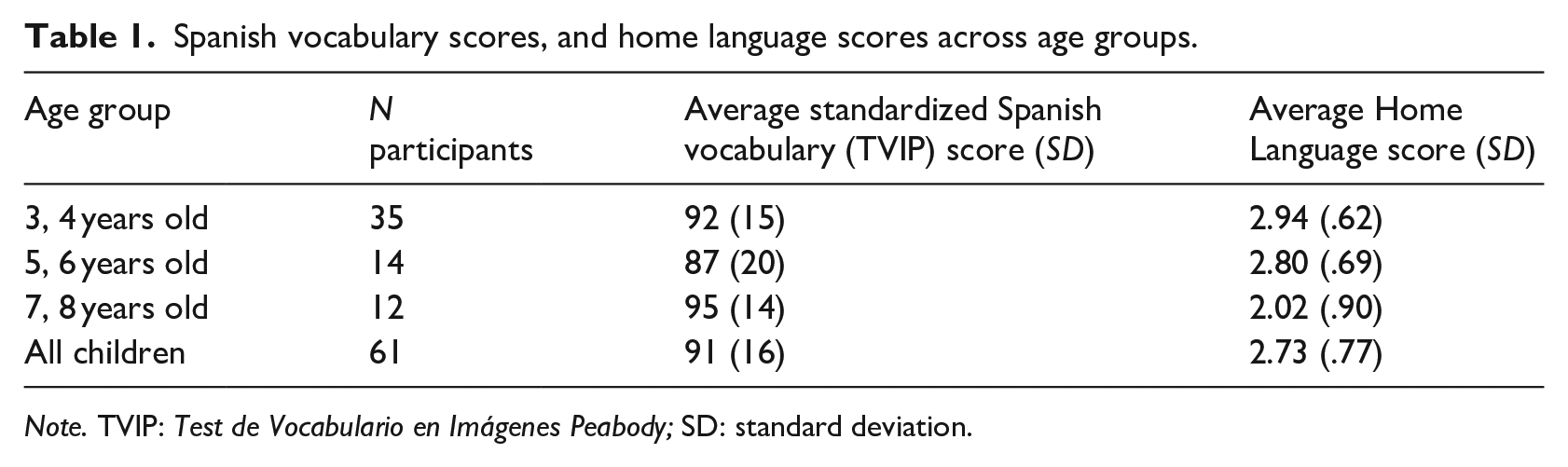
Parents completed a background questionnaire that included seven questions to gauge the amount of English and Spanish used in the home; five questions focused on the language spoken to the child (exposure) and two focused on the child’s own language use (usage). Each question was followed by five options and each option was assigned a score ranging from 0 all English, 1 more English than Spanish, 2 same amount of both languages, 3 more Spanish than English, to 4 all Spanish. The average exposure and usage scores were then calculated for each child. As exposure and usage scores were highly correlated (r = .711, p < .0001), an overall Home Language score was computed based on the average across all seven questions (see also Shin et al., 2019). Home Language score was missing for one child. For the remaining children, the average score was 2.73/4 (SD = .77), indicating that Spanish is more widely spoken than English in these children’s homes. Home Language score negatively correlated with age (R = −.44, p = .0004), indicating that the younger the children, the more Spanish used in the home.
All children completed the Test de Vocabulario en Imágenes Peabody “TVIP” (Dunn et al., 1986). The children’s raw scores correlated with age (R = .78, p < .0001). Therefore, to investigate Spanish Vocabulary score and age as separate predictors of omission patterns, analyses relied on standardized scores normed by age. The standardized mean for the TVIP is 100; scores between 85 and 115 are considered within the typical range. In this study, standardized TVIP scores do not correlate with age (R = .09, p = .47) or with Home Language scores (R = .17, p = .18).
Table 1 presents the average Spanish Vocabulary (TVIP) and Home Language scores across age groups of children.
Spanish vocabulary scores, and home language scores across age groups.
Note. TVIP: Test de Vocabulario en Imágenes Peabody; SD: standard deviation.
Materials and procedure: elicited production task
Both child and adult participants completed an elicited production task in which the experimenter tells a story about a girl named Marisol and shows the child 18 pictures. The first two pictures are presented with training questions that acquaint the child with the task, such as ¿Qué está haciendo Marisol? ¿Dónde está la ventana? “What is Marisol doing? Where is the window?” The task continues and includes 13 questions designed to elicit direct objects. For example, participants are shown the picture in Figure 1 and hear Marisol se acerca a la ventana. ¿Qué hace con la ventana? “Marisol goes to the window. What does she do with the window?” The anticipated response is la abre “She opens it.” The full set of experimental materials can be found on the author’s OSF site.
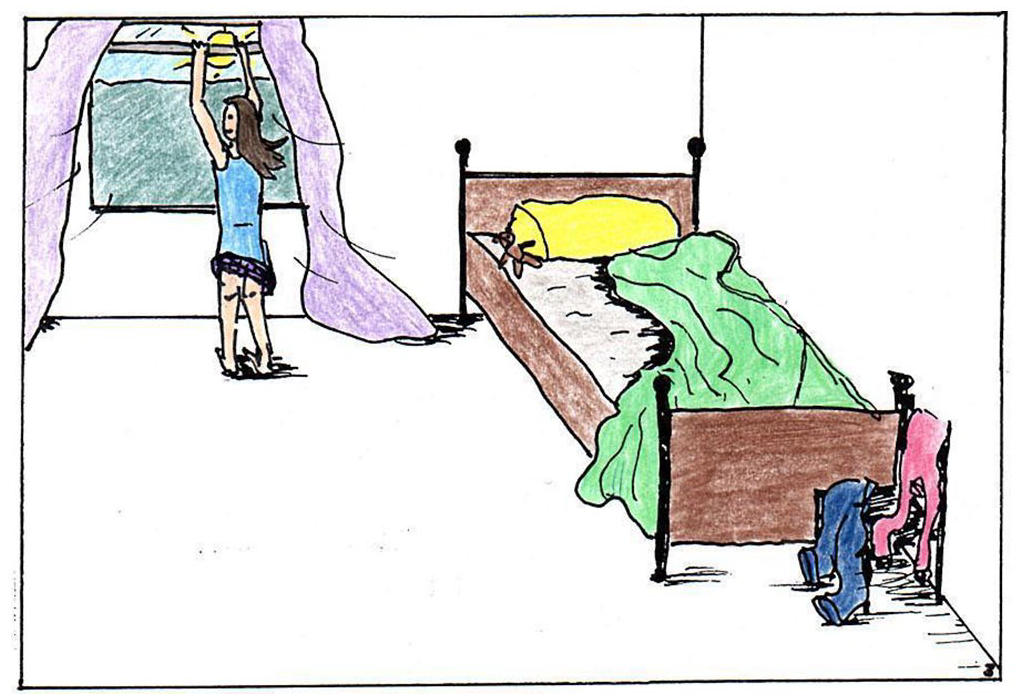
Example picture from elicited production task.
The verb hacer “do” is used in all 13 questions; hacer is in the simple present tense in seven questions, the present progressive in three questions, the periphrastic future in two questions, and the perfective past (henceforth “preterit”) in one question. The verb form in the prompt sometimes elicited the same verb form in the children’s responses. For example, of 192 responses to prompts with progressive forms, 167 responses included progressive forms, too. The simple present tense also elicited progressive forms from the children (174/373; see also Table 3 in Castilla-Earls et al., 2020), which is not surprising given that the Spanish simple present tense is often used to refer to ongoing events (Mayberry, 2011). As a result of the prompts containing progressive and simple present verb forms, almost half the children’s responses included verbs in the progressive form (352/743). While the verb forms in the prompts may explain the abundance of progressive forms in the children’s responses, the question in this study is whether children are likelier to omit direct objects when they produce progressive forms. The fact that nearly half the children’s verb forms were progressive is thus helpful for investigating this question.
All 13 prompt questions were designed to elicit reference to an individuated inanimate object presented in a prepositional phrase headed by con “with,” as in ¿Qué hace con la ventana? “What does she do with the window?” where the anticipated response, la abre “she opens it,” includes reference to the window in direct object position. In the original experiment, there was one item referring to a human direct object referent; however, since animacy significantly conditions direct object usage (Shin et al., in press), responses to this item were not included in this study.
If the participant said something that the experimenter could not hear or understand or the child produced an intransitive construction, a direct object lexical NP, or omitted the object; then the experimenter told the participant she had not heard the response and asked the question again, prompting a second response. Both first responses (when audible and comprehensible) and second responses were included in this study. There were only five tokens of second responses among adults; all five included an expressed direct object, which is in keeping with the adults’ overall pattern. Including second responses (n = 98) increased the children’s data set and also prompted a wider variety of verb forms because in some cases the experimenter reformulated the question by changing the verb from present to past tense. The decision to include second responses is supported by the fact that children’s direct object omission rates were not significantly different in first (112/645) versus second responses (22/98), χ2(1) = 1.49, p = .22. Moreover, regression analyses were repeated with first responses only and results were replicated (see Appendix A in the online supplementary materials).
Coding and analyses
All participants’ responses that contained transitive verbs were included in the study. All adult responses were included, but some child responses were excluded, such as when the verb was inaudible or there was no verb at all. Also excluded were responses with English verbs and copulas with predicate adjectives.
Each of the remaining tokens (adults: n = 143, children: n = 743) was coded for whether the direct object was expressed or omitted (dependent variable) and the following linguistic predictor variables:
Progressive (binary), which compared progressive with non-progressive verb forms. The category Progressive included constructions with auxiliary estar “to be” (está abriendo “is opening”), as well as gerunds without the auxiliary. Non-progressive forms included the simple present indicative, preterit, infinitive, present subjunctive, imperative, and periphrastic future forms. No other verb forms were produced by the children.
Mixed Verbs (binary): The categorization of verbs as mixed or non-mixed was based on the adult control group’s responses to the elicited production task. The adults omitted direct objects in seven instances, once with each of the following verbs: comer “eat,” tomar/beber “drink,” lavar, peinar/cepillar (el pelo) “wash, brush/comb (hair), and partir split.” These seven verbs were coded as mixed verbs in the children’s data. All other verbs were considered non-mixed.
Results
Table 2 presents the average direct object omission rates across age groups, first with all tokens of transitive verbs and then with mixed verbs only and with progressive verbs only.
Direct object omission across age groups.
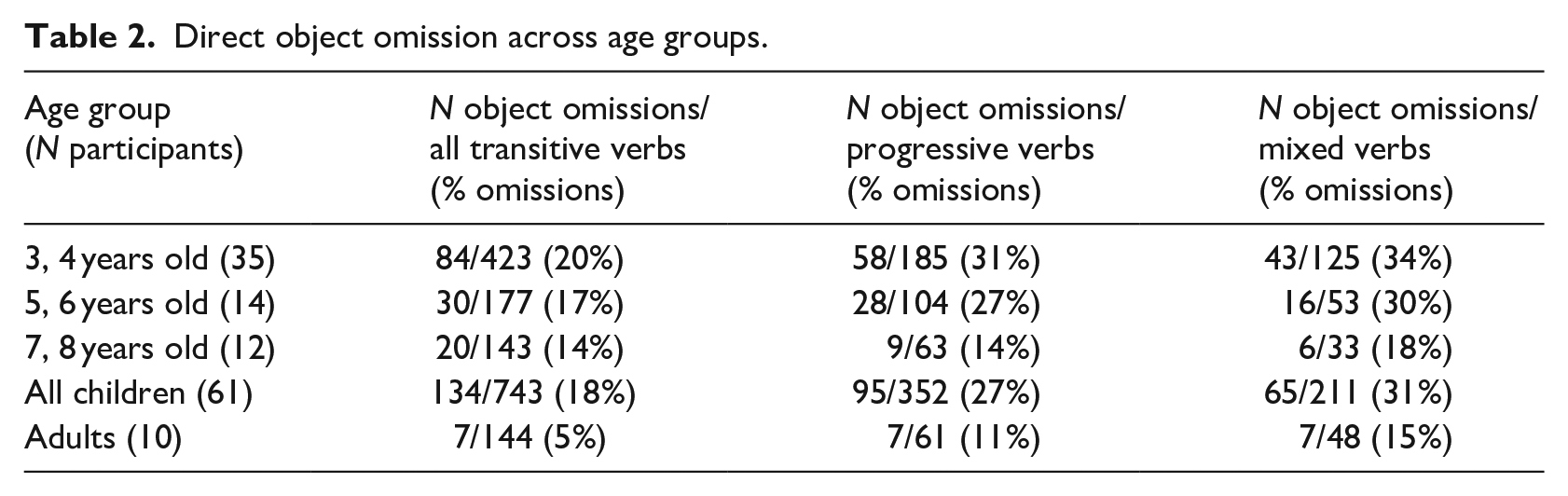
As shown in Table 2, adults expressed a total of 137 direct objects and omitted seven. The seven tokens of omission were produced by five different speakers, four of Mexican origin, and one of New Mexican origin. The seven omissions occurred with the following verbs, all in the progressive: comiendo, bebiendo, tomando, lavando, peinando, cepillando, partiendo “eating, drinking, drinking, washing, brushing, brushing, splitting.” For example, in response to ¿Qué hace María con su plato? “What does Maria do with her plate?” one adult responded Está lavando “She is washing.” However, all other adult responses to this question included a direct object, as in lo lava “she washes it” and Marisol está lavando su plato que acaba de usar “Marisol is washing her plate that she just used.” In contrast to the adults, the children expressed 609 direct objects and omitted 134. These results demonstrate that the production task elicited direct objects at a near ceiling rate from the adults and also confirm that the children omitted direct objects significantly more often than the adults, χ2(1, N = 887) = 14.69, p < .0001. Table 2 also indicates that children’s omission rates were higher with progressive and mixed verbs, but by age 7–8 years old, their rates in these contexts were similar to those of adults.
To test the predictions related to children’s direct object omission described above, a mixed-effects binary logistic regression analysis was performed using the glmer function in the lme4 package (Bates et al., 2015) in R (R Core Team, 2021). The binary dependent variable was expression versus omission of the direct object. The predictor variables were Progressive (binary), Mixed Verbs (binary), Spanish Vocabulary (continuous), Age in months (continuous), and Home Language score (continuous) as fixed effects, and Individual Child as a random intercept. The model did not converge with all predictors included. Since Age and Home Language score are correlated (R = −44, p < .001), subsequent models included either Home Language score or Age, not both. Home Language score did not significantly predict direct object omission (β = −.21, SE = .30, p = .49) and thus was excluded from further analysis. The remaining predictors were Progressive, Mixed Verbs, Spanish Vocabulary, and Age as fixed effects, and Individual Child as a random intercept.
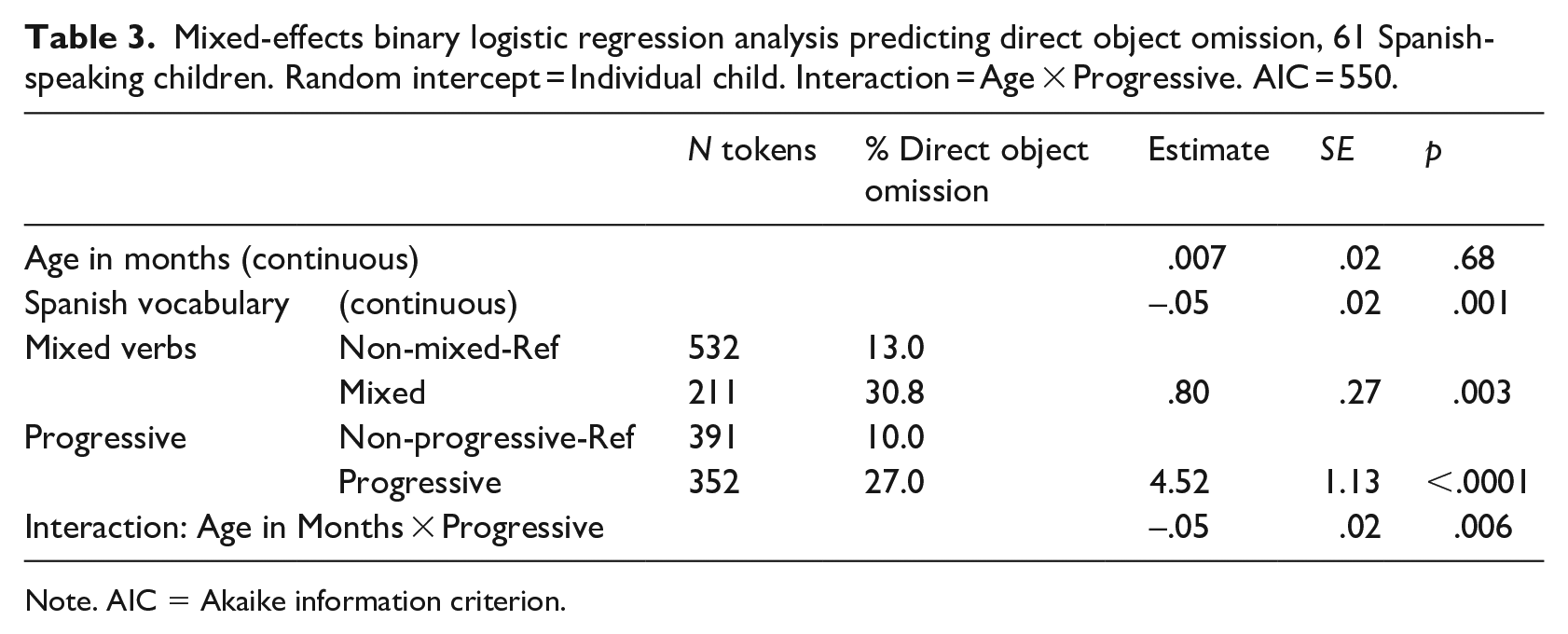
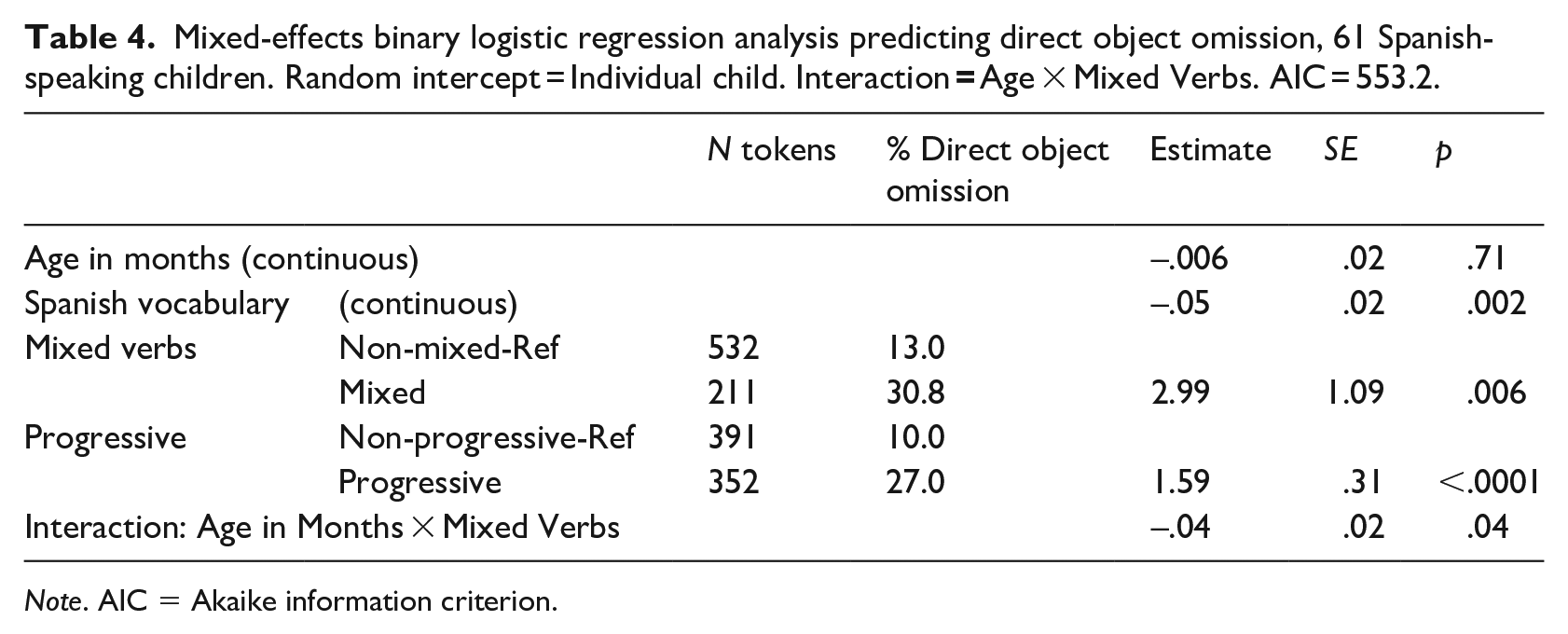
Since the impact of Progressive and Mixed Verbs is predicted to dissipate with age, two interaction terms were included in the analysis: Age by Progressive and Age by Mixed Verbs. The model did not converge with both interaction terms; thus, two analyses were run, one with Age by Progressive and the other with Age by Mixed Verbs. There were no issues of multicollinearity in either model; VIF values ranged from 1.02 to 1.33. The model including Age by Progressive (Table 3) outperformed the one including Age by Mixed verbs (Table 4) per Akaike information criterion (AIC) values. Reference levels for each categorical predictor variable are labeled “Ref.” Since the models are set to predict direct object omission, positive coefficient estimates indicate that a factor increases the likelihood of omission, whereas negative coefficient estimates indicate that a factor decreases the likelihood of omission.
Mixed-effects binary logistic regression analysis predicting direct object omission, 61 Spanish-speaking children. Random intercept = Individual child. Interaction = Age × Progressive. AIC = 550.
Note. AIC = Akaike information criterion.
Mixed-effects binary logistic regression analysis predicting direct object omission, 61 Spanish-speaking children. Random intercept = Individual child. Interaction
Note. AIC = Akaike information criterion.
The results in both Tables 3 and 4 show that the higher the Spanish Vocabulary score, the less likely the direct object is omitted. In contrast, direct object omission is more likely with Progressive and Mixed Verbs. These two contexts also interact with Age, indicating a developmental progression whereby children express more direct objects with progressives and mixed verbs as they age. The interaction between Age and Progressive is illustrated by Figure 2, which presents the probability of direct object omission by Age in months for progressive and non-progressive verb forms based on the model presented in Table 3. 1
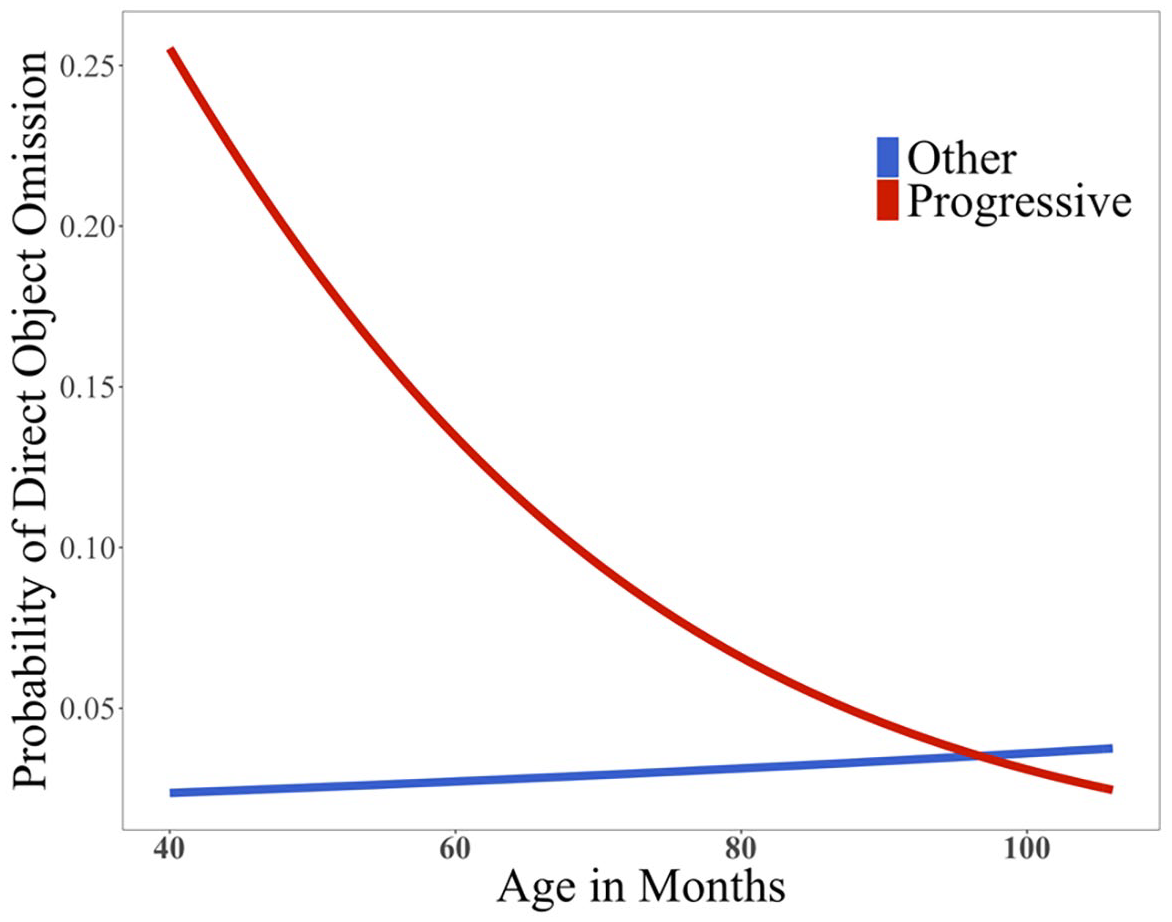
Probability of direct object omission by age in months for progressive and non-progressive verb forms.
How do we know that the relationship between direct object omission and the progressive loosens with age rather than with increased Spanish vocabulary? In contrast to the interaction between the progressive and age shown in Figure 2, increasing Spanish Vocabulary score favors decreased object omission not only with the progressive but with non-progressive verbs forms as well, as illustrated by Figure 3, which plots probability of direct object omission by Spanish Vocabulary with progressive and non-progressive forms based on the same binary logistic regression model reported in Table 3, but with one exception: the interaction term included was Spanish Vocabulary by Progressive rather than Age by Progressive.
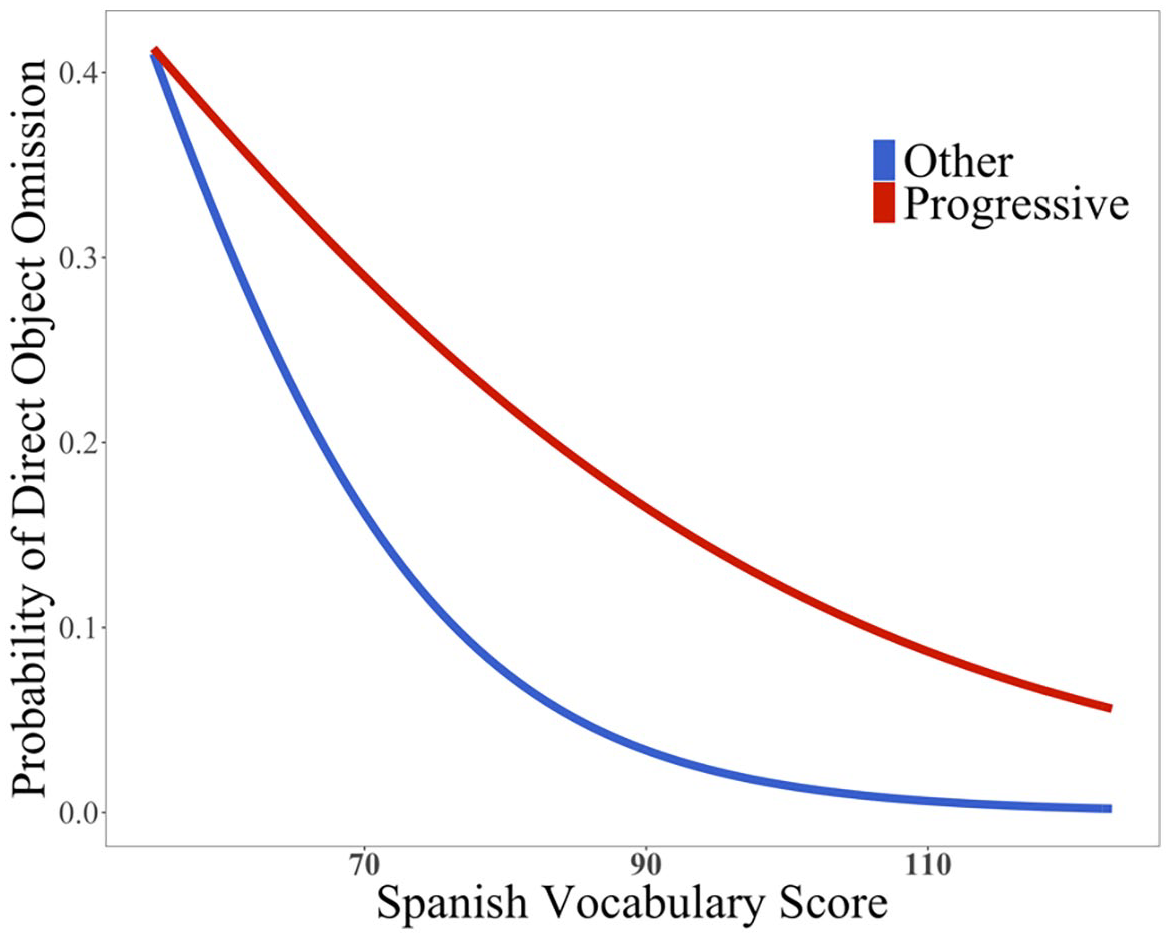
Probability of direct object omission by Spanish Vocabulary for progressive and non-progressive verb forms.
Turing to Mixed Verbs, the interaction between Age and Mixed Verbs (Table 4) shows that as children age, they express more direct objects with mixed verbs. This effect is illustrated in Figure 4. A follow-up analysis indicates that the relationship between direct object omission and mixed verbs loosens with age rather than with increased Spanish vocabulary. The same binary logistic regression model reported in Table 4 was run again, but this time the interaction term included was Spanish Vocabulary by Mixed Verbs rather than Age by Mixed Verbs. The results demonstrate that omission with both mixed and non-mixed verbs decreases with increased Spanish vocabulary scores, as illustrated in Figure 5.
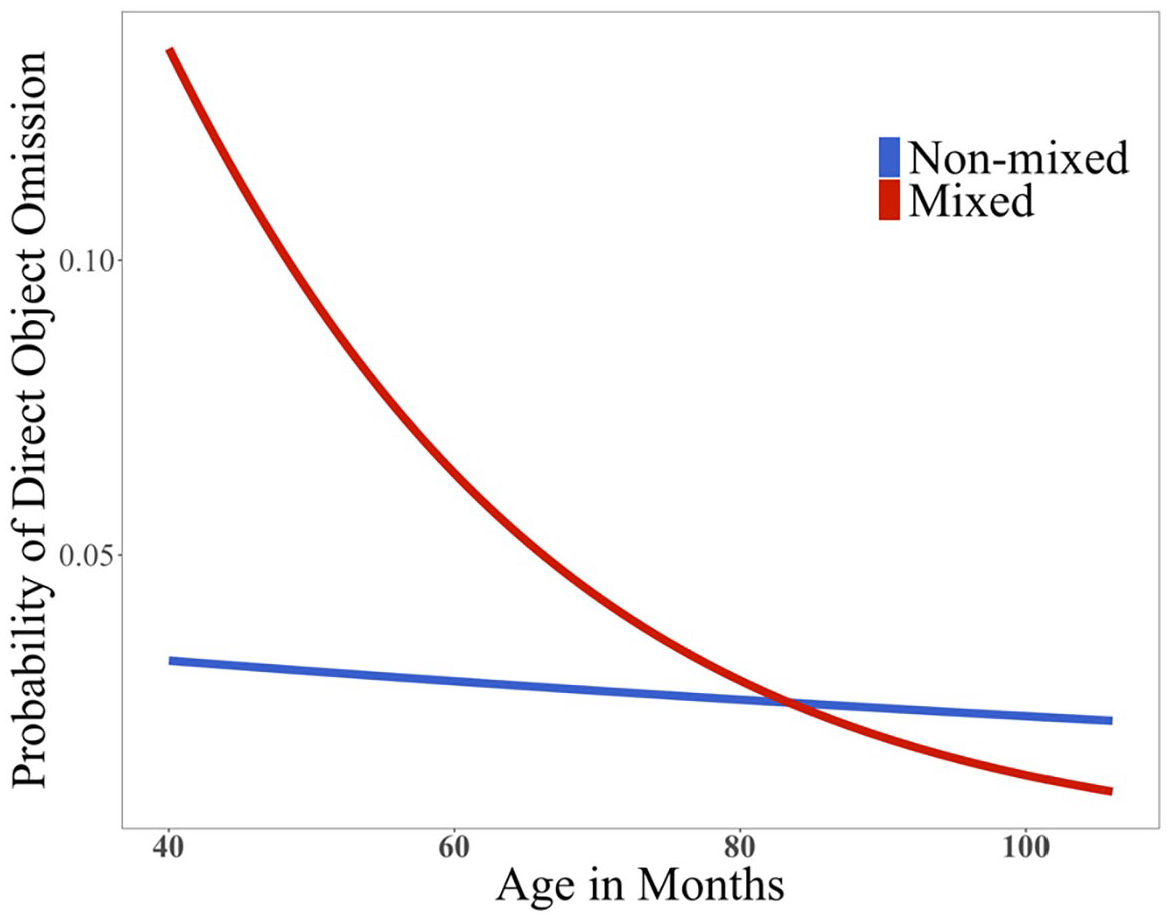
Probability of direct object omission by age in months for mixed and non-mixed verb types.
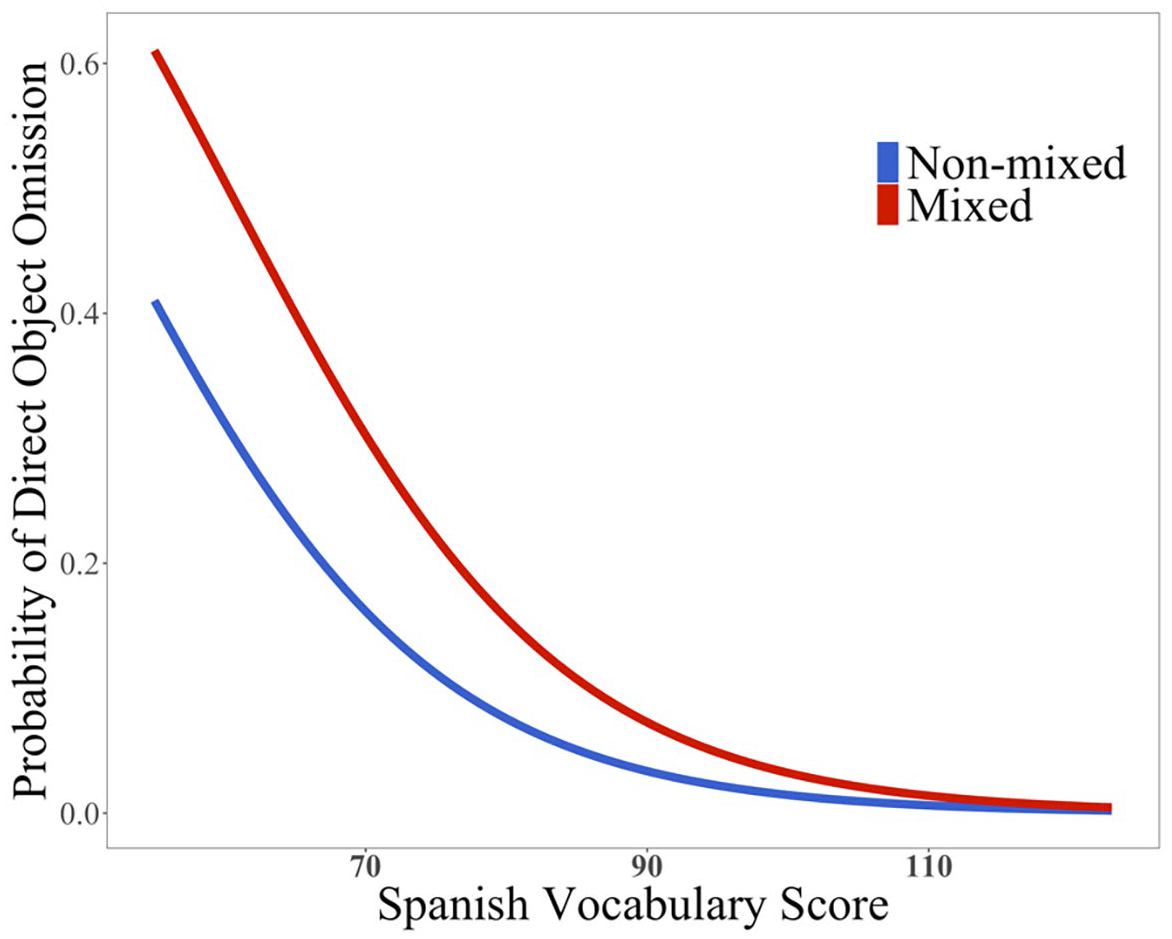
Probability of direct object omission by Spanish Vocabulary for mixed and non-mixed verb types.
Discussion
Previous research on bilingual children’s direct object omission has generally focused on comparisons with monolingual children and has confirmed a widespread “bilingual effect” whereby bilingual children omit more direct objects than monolingual children do. This study moves beyond this observation by investigating systematicities in child heritage speakers’ omission patterns. More specifically, this study investigated direct object omission in 61 three- to eight-year-old child heritage speakers’ responses to a task designed to elicit transitive constructions in Spanish. The children omitted direct objects more often than a control group of 10 Spanish-speaking adults from their same community, some of whom were caregivers of children in the study. In fact, omission was rare among the adults, thus confirming that the task promoted direct object expression.
The children’s overall omission rates ranged from 20% among the 3- to 4-year-olds to 14% among the 7- to 8-year-olds (Table 2). Some previous studies of U.S. Spanish–English bilingual children report lower rates. In Castilla-Earls et al.’s (2020) elicited production study, 6- to 7-year-olds’ omission rates were between 6% and 7%. One possible reason for this difference is that the current study only included inanimate direct object referents, whereas Castilla-Earls et al. included both inanimate and animate referents. Animacy influences the form that direct objects take in Spanish (Vallejos et al., 2020), including among child heritage speakers of Spanish (Shin et al., in press). Jacobson (2012, Table 3, lower grades) found that 7-year-old child heritage speakers of Spanish omitted only 7% of their direct objects in response to an elicited production task. Yet, half of Jacobson’s prompts elicited perfective past tense verbs, which promote direct object expression. These differences across studies underscore the importance of considering grammatical factors that promote or inhibit direct object omission. The current study highlights the role of the verb, including verb type (mixed vs. non-mixed verbs) and progressive aspect. In the discussion that follows, the results of the study are considered in light of the predictions made, starting with the impact of lexical factors on direct object expression.
Overall lexical development
Previous research has demonstrated that as children’s lexicons expand, their tendency to omit direct objects decreases (Pérez-Leroux et al., 2012; Pirvulescu et al., 2014; Shin et al., 2019). Thus, it was predicted that children with lower Spanish vocabulary scores would omit more direct objects than children with higher scores. This prediction was borne out. The significant main effect of Spanish Vocabulary demonstrates that children with higher scores omitted objects less often than children with lower scores (Table 3, Figure 2).
Does the Spanish Vocabulary effect hold across age? Follow-up analyses zeroing in on Spanish Vocabulary and Age indicate that the answer is affirmative. A mixed-effects binary logistic regression analysis was run with direct object omission versus expression as the dependent variable. Predictor variables included Progressive, Mixed Verbs, Spanish Vocabulary, and, for purposes of presentational clarity, the categorical variable Age Groups rather than Age in months. Individual Child was again included as a random intercept. No interaction term was included since the model did not converge with the interaction Spanish Vocabulary × Age groups; however, the probability of direct object omission for each age group plotted in Figure 6 illustrates that the impact of Spanish vocabulary on direct object omission (β = −.05, SE = .02, p = .0006) holds across age groups.
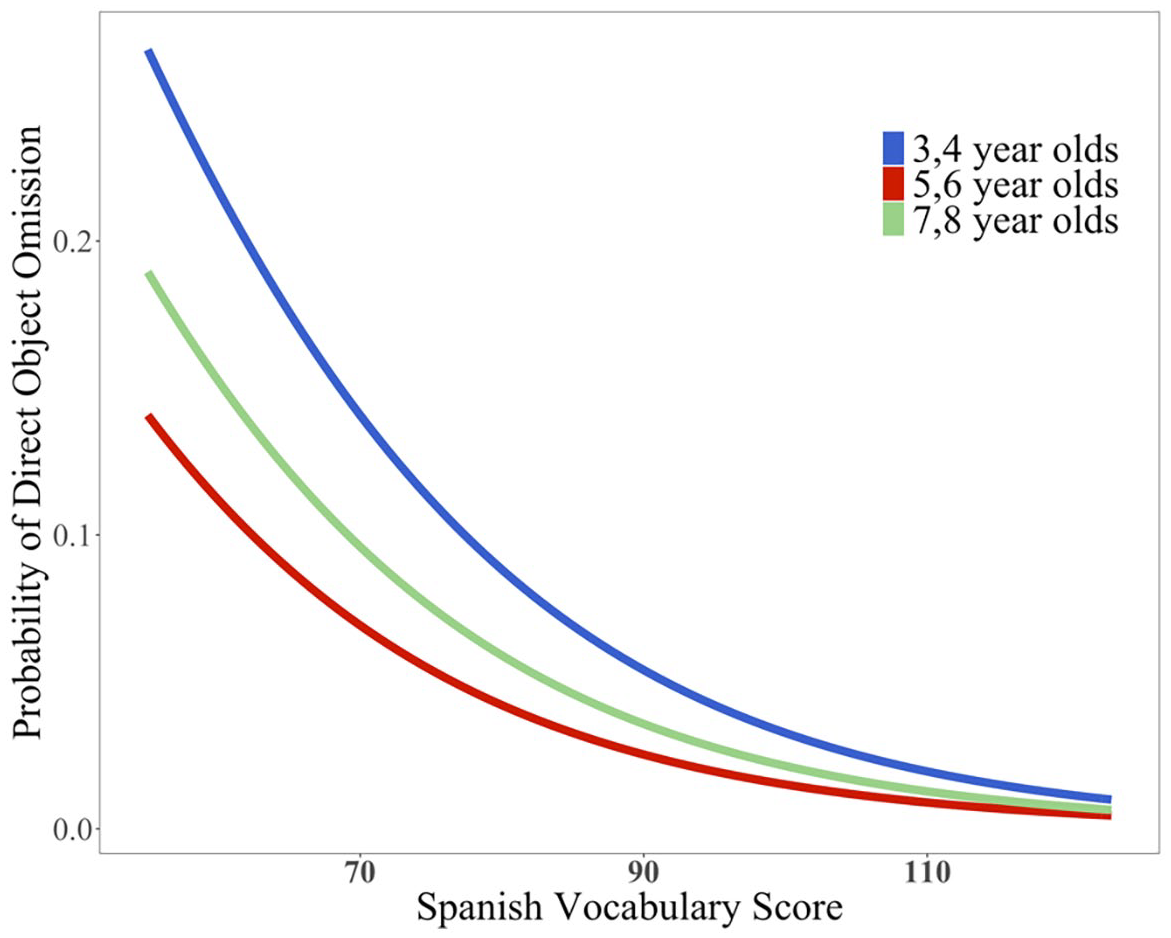
Probability of direct object omission by Spanish Vocabulary score for three age groups.
A second follow-up analysis corroborates the observation that the Spanish Vocabulary effect applies across age. A linear regression model was conducted using the lm function in the lme4 package in R. For this analysis, the data set included the average omission rate per child (n = 61) as well as the interaction Age by Spanish Vocabulary. The interaction was not significant (β = −.01, SE = .01, p = .28). These results confirm that Spanish Vocabulary significantly predicts children’s direct object omission across age in this study.
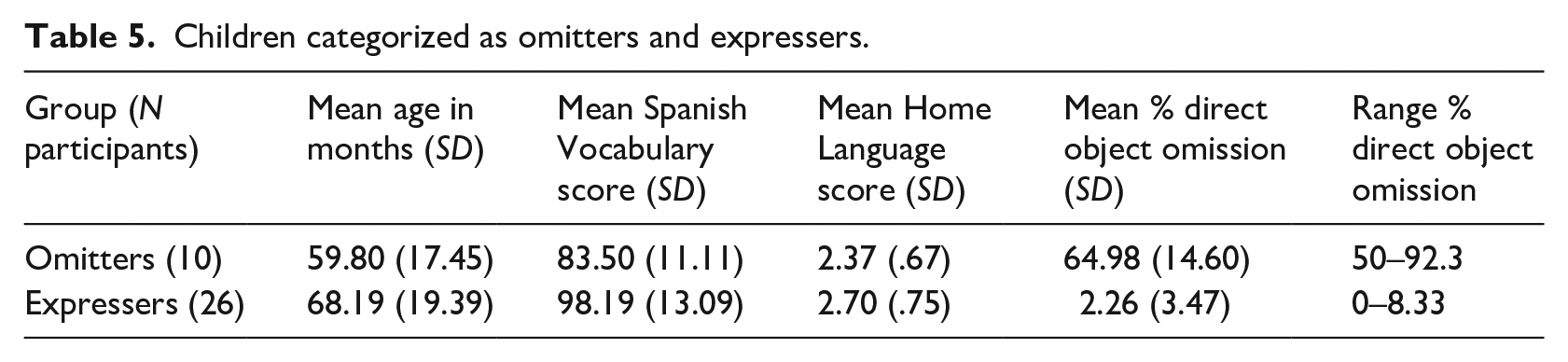
The impact of lexical development is also evident when the children are categorized into two groups: “Omitters,” who omitted at a rate of 50% or higher, and “Expressers,” who almost always expressed the direct objects (Table 5). Omitters and Expressers did not differ significantly in terms of Age (t = 1.25, p = .23) or Home Language Scores (t = 1.27, p = .22). In contrast, the Expressers had significantly higher Spanish Vocabulary scores than the Omitters (t = 3.33, p = .003), thereby bolstering the conclusion that direct object expression is intimately tied to lexical development.
Children categorized as omitters and expressers.
While an overall lexical development effect indicates that language experience matters, it does not tell us which parts of language input children attend to to figure out the distribution of direct object expression and omission in their language. Pérez-Leroux et al. (2018) and Pirvulescu et al. (2014) have argued that experience with a variety of direct object forms in the input is particularly important. Thus, the lexical development effect may reflect the impact of increased experience with expressed direct objects.
It has also been argued that lexical development explains the “bilingual effect” whereby bilingual children omit more direct objects than monolingual children. As bilingual children experience reduced input, which is concomitant with reduced opportunities to experience transitive constructions, it may take them longer to figure out the distribution of direct object expression and omission in their language (Pérez-Leroux et al., 2018; Pirvulescu et al., 2014). Although this study did not set out to investigate this bilingual effect, it is worth noting that follow-up analyses investigating the possible impact of the children’s English vocabulary scores on their direct object omission and expression in Spanish do not show any evidence of English influence (see Appendix B in the online supplemental materials). This bolsters the conclusion that the “bilingual effect,” whereby bilingual children omit more direct objects compared with monolingual children, is not related to crosslinguistic influence, but instead is related to lexical development and restricted opportunities to experience a variety of expressed direct objects in the input (Pérez-Leroux et al., 2018; Pirvulescu et al., 2014; Shin et al., in press; Shin et al., 2019).
Verb type: mixed verbs
Based on previous research demonstrating that children omit direct objects more often with verbs that also occur without direct objects in the input (Ingham, 1993/1994; Pérez-Leroux et al., 2006; Theakston et al., 2001), it was predicted that the children would omit direct objects more often with mixed verbs, which optionally occur with direct objects, than with non-mixed verbs, which almost always occur with direct objects. As predicted, direct object omission rates were higher with mixed verbs than with non-mixed verbs (31% vs. 13%, respectively; Tables 2–4). In addition, the tendency to omit direct objects with mixed verbs decreased with age. By age 7–8 years, the children’s average omission rate was on par with adults.
These findings align with Pérez-Leroux et al.’s (2008) study, in which English- and French-speaking adults and 2- to 5-year-old children were prompted to produce mixed verbs whose object referent was either non-individuated or individuated. Pérez-Leroux et al. found that the adults omitted objects in non-individuated contexts (What is she doing? “She’s drawing”), but rarely did so in individuated contexts (What is she doing with the flower? “She’s drawing it”). The youngest children in their study omitted as often in individuated contexts as in non-individuated contexts, but by age 4, the children omitted objects more often in non-individuated than in individuated contexts. These findings, coupled with the results in this study, which only included individuated contexts, suggest that it takes time for children to identify which discourse contexts render direct object expression the preferred option with mixed verbs.
Progressive aspect
Previous research has shown that children associate transitivity with telicity (Wagner, 2010) and also associate telicity with grammatical perfectivity (Shirai & Andersen, 1995; Wagner, 2012). Furthermore, there is evidence that Romanian and Greek children omit more direct objects with imperfective verb forms than with perfective ones (Avram et al., 2015; Tsimpli & Papadopoulou, 2006). The current study focused on the progressive aspect, which is particularly compatible with atelic events (Mayberry, 2011) and coerces telic into atelic events (Michaelis, 2004). It was predicted that direct objects would be omitted with progressive verb forms more so than with non-progressive forms. Results showed a significant main effect of the progressive in support of this prediction, corroborating Wagner’s (2012) observation that “children seem not to want to talk about ongoing bounded events . . . (e.g., Look mom, I’m making a sandwich!)” (p. 460).
In addition to the general trend whereby children omitted more direct objects with progressive forms, the significant interaction between Age and Progressive (Table 3, Figure 2) demonstrated that the relationship between the progressive and direct object omission was especially pronounced among younger children. What explains this developmental trajectory? One possibility is that as children age, they experience more input containing progressive verb forms with direct objects. Such an explanation, however, would also predict more progressive + direct object expression with increased lexical development. Of course, it is difficult to tease apart lexical development and age because as children age, their lexicons expand. Indeed, the children’s raw scores on the Spanish vocabulary test positively correlated with age, as mentioned earlier. Nevertheless, the results based on standardized vocabulary scores, which help assess children’s lexical development within their own age group, suggest that lexical development promotes direct object expression in general, but this lexical effect is just as pronounced for non-progressive forms as for progressive forms (Figure 3). Thus, the progressive verb–direct object omission pattern is better explained as a developmental phenomenon. Indeed, this is the prominent explanation for children’s tendency to combine telic events with perfective forms and atelic events with imperfective forms. The argument is that children’s preferred combinations are semantically simpler than the dispreferred combinations. Children opt for the simpler combinations possibly because of their limited conceptual abilities or because these preferred combinations are the ones represented in their mental grammars (Wagner, 2012). Given the association between telicity and perfectivity as well as between perfectivity and transitivity (Avram et al., 2015; Tsimpli & Papadopoulou, 2006; Wagner, 2010, 2012), it is logical that the same developmental explanation may also apply to children’s tendency to omit direct objects with progressive verb forms. This leads to a testable prediction, which is that monolingual and bilingual children should follow a similar pathway of development with respect to the progressive verb effect. In summary, while this study cannot address how children learn to increasingly express direct objects with progressives, the significant effect of age suggests a developmental explanation.
Conclusion
This study of 61 child heritage speakers’ patterns of direct object omission with Spanish transitive verbs confirms the relationship between lexical development and direct object expression. In addition, it highlights the impact of verb types and verb forms. The children omitted direct objects with mixed verbs more than with non-mixed verbs and with progressive verbs more than with non-progressive verbs. The mixed-verb effect helps confirm the importance of input patterns. Children omit direct objects with verbs that routinely appear without direct objects among adults, too. Furthermore, it takes time for children to learn the discourse conditions that promote direct object expression with mixed verbs, which explains why their omission rates with mixed verbs in this study exceed those of adults. The progressive effect appears to be related to developmental factors: with age, children loosen the association between progressivity and direct object omission, an association that is likely related to children’s general tendency to pair imperfective verb forms with atelic events and atelic events with intransitivity.
Overall, the study advances our understanding of child heritage speakers’ developing grammars and, more specifically, their acquisition of direct object expression. While previous research has shown that bilingual children omit more direct objects than monolingual children do, this study reveals a pathway of development that is shaped by input as well as developmental changes concomitant with age. By examining child heritage speakers’ grammars in their own right, the study highlights the systematicities of the developing heritage grammar, which in turn can help dispel the misperception that heritage grammars are deficient, incomplete, or “broken” (Otheguy, 2016; Tseng, 2021).
Supplemental Material
sj-docx-1-ijb-10.1177_13670069221124475 – Supplemental material for Está abriendo, la abrió: Lexical knowledge, verb type, and grammatical aspect shape child heritage speakers’ direct object omission in Spanish
Supplemental material, sj-docx-1-ijb-10.1177_13670069221124475 for Está abriendo, la abrió: Lexical knowledge, verb type, and grammatical aspect shape child heritage speakers’ direct object omission in Spanish by Naomi L. Shin in International Journal of Bilingualism
Footnotes
Acknowledgements
The author thanks the children and their families for agreeing to participate in this study. Research assistants Aja Armijo and Molly Perara-Lunde helped collect data, and Nick Sulier assisted with data coding. Nadia Neff, who was supported by ADVANCE at UNM (NSF EHR #1628471) through their Faculty Professional Development Support program, assisted with data visualization.
Declaration of conflicting interests
The author(s) declared no potential conflicts of interest with respect to the research, authorship, and/or publication of this article.
Funding
The author(s) received no financial support for the research, authorship, and/or publication of this article.

Supplemental material
Supplemental material for this article is available online.
Notes
Author biography
References
Supplementary Material
Please find the following supplemental material available below.
For Open Access articles published under a Creative Commons License, all supplemental material carries the same license as the article it is associated with.
For non-Open Access articles published, all supplemental material carries a non-exclusive license, and permission requests for re-use of supplemental material or any part of supplemental material shall be sent directly to the copyright owner as specified in the copyright notice associated with the article.
