



Abstract
Purpose:
This study examines embedded clauses with adverb/negation in heritage speakers of Norwegian in North America. We ask (a) whether the production of these structures is different from the baseline, (b) how the production is different, and (c) why it is different.
Methodology:
50 second to fifth-generation speakers from the Corpus of American Nordic Speech (CANS) are compared with a baseline consisting of 13 first-generation speakers from the same corpus and a large corpus study on verb placement in embedded clauses in European Norwegian.
Findings:
The speakers behave differently from the baseline, as they use main clause word order in embedded clauses, especially when the finite verb is an auxiliary. Furthermore, there is a correlation between main clause word order in embedded clauses and V2 violations in main clauses. We propose a combination of crosslinguistic influence, language-internal drift, differential acquisition, and activation of the heritage language as possible factors affecting the speaker’s production.
Originality:
Whereas several studies have looked at main clause word order in the same and similar populations, not as much work has been done on embedded clauses. We also combine data from the same informants from a previous study to look at correlations between the behaviour in main and embedded clauses.
Implications:
This study illustrates how heritage languages are affected by different factors across speakers; where some speakers seem to simplify the language, others have held on to fine-grained distinctions.
Introduction
From 1825 to 1925, approximately 800,000 Norwegians emigrated to North America. For generations, the descendants of these immigrants would learn Norwegian at home as their first language (L1), before acquiring English as a second language (L2) as they started school. This means that, like most heritage speakers, they would undergo a dominance shift from Norwegian to English. From the 1930s to the 2010s, various types of data have been collected from these speakers. All the later recordings and some early ones are available in the Corpus of American Nordic Speech (CANS) (Johannessen, 2015b).
In this study, we investigate verb placement in embedded clauses based on a selection of 50 speakers in CANS. These results are compared with a corpus of contemporary European Norwegian (Ringstad, 2019) and a small group of 13 first-generation immigrants (typically not regarded as heritage speakers, see, e.g., the definition in Rothman, 2009). While the main clause word order is V2 in European Norwegian, the canonical word order in embedded clauses is without verb movement, meaning that the verb stays in situ, but optional verb movement may appear in certain contexts, leading to the linear order Verb-Adverb. Our main finding is that heritage speakers are more prone to place the verb before the adverb in embedded clauses compared with European Norwegian speakers. We argue that this is caused by a combination of influence from English, reduced language usage and activation, and potential language-internal drift where optional verb movement is expanded.
Word order
Word order in Norwegian and English
Norwegian is an asymmetric V2 language (Holmberg & Platzack, 1995; Vikner, 1995; Westergaard et al., 2019), with V2 in main clauses but not in embedded structures. This means that, unlike in English, the finite verb is in second position in both non-subject-initial and subject-initial declaratives, regardless of whether it is a lexical verb (1, 3) or an auxiliary (2, 4):
(1) Non-subject-initial declarative with a lexical verb.
I går
(2) Non-subject-initial declarative with an auxiliary.
I går
Yesterday had he eaten cake ‘Yesterday
(3) Declarative with a lexical verb and adverb
Han
(4) Declarative with auxiliary and adverb
Han
Note that the auxiliary is placed before the adverb in English, which means that the two languages overlap in (4), but not in (3). 1
In embedded clauses in Norwegian, the verb generally stays in situ, creating an asymmetry between main and embedded clauses (5) and (6). English, on the contrary, is symmetric, meaning that it has the same word order in main clauses as in embedded clauses.
(5) Embedded clause with a lexical verb
Hun sa at han
(6) Embedded clause with auxiliary
Hun sa at han
She said that he never has eaten cake ‘She said that he has never eaten cake.’
However, Norwegian has optional verb movement in certain embedded clause types, such as that-clauses (7), where the finite verb may precede negation and adverbials (e.g., Bentzen, 2014a; Heycock, 2006; Julien, 2010, 2015; Ringstad, 2019; Westendorp, 2022; Wiklund et al., 2009).
(7) Verb movement in that-clause
Han sa at han
Thus, in subject-initial clauses with a clause-medial adverbial, there is a distinction between main (Verb-Adverb) and embedded clauses (Adverb-Verb) when it comes to verb placement in Norwegian, while in English, the salient distinction is between the behaviour of auxiliaries (Auxiliary-Adverb) and lexical verbs (Adverb-Verb). As a result of this, a comparison between the two languages reveals that, in main clauses, there is overlap in the placement of auxiliaries, while, in embedded clauses, there is overlap with lexical verbs.
Verb movement in embedded clauses in European Norwegian
The occurrence of verb movement in embedded structures seems to be dependent on several factors (Bentzen, 2014a; Heycock, 2006; Julien, 2010, 2015; Ringstad, 2019; Wiklund et al., 2009), for example, the semantic status of the matrix verb. Wiklund et al. show that assertive and semi-factive verbs allow verb movement (7), while factive and non-assertive verbs do not (8). These tendencies are largely confirmed by the Norwegian judgements in the Nordic Syntax Database (Bentzen, 2014a).
(8) Factive matrix verb
*Han angret på at han He regretted that he ate always much cake ‘He regretted that he always ate a lot of cake.’
Another factor found to play a role is the type of embedded clause. For example, relative clauses (9) (Ringstad, 2019), indirect wh-questions (10) (Franco, 2010), and adjunct clauses (11) (Faarlund et al., 1997) have been argued to be contexts that do not permit verb movement. This illustrates that it is not just the semantics of the matrix verb that determines whether verb movement is permitted, as most of these clauses are not selected by the matrix verb.
(9) *De som
(10) *Hun lurte på hvorfor han
She wondered on why he could not go to cinema.DEF ‘She wondered why he couldn’t go to the cinema.’
(11) *Hvis han
If he gets not job. must he move home again ‘If he doesn’t get a job, he’ll have to move home again.’
Other accounts of the use of verb movement refer to discourse properties, for example, Wiklund et al. (2009), Jensen and Christensen (2013), and Caplan and Djärv (2019), the latter arguing that verb movement is limited to structures in which the content of the clause is not familiar. To summarize, there is no consensus about which conditions allow verb movement past an adverb, but matrix verb, type of embedded clause, and discourse-related factors have been argued to play a role. Yet, despite the lack of theoretical consensus, native speakers have relatively strong intuitions about which embedded contexts licence verb movement.
Ringstad (2019) investigates the distribution of the linear order Verb-Adverb (V-Adv below) with negation in five Norwegian-spoken corpora. Overall, she finds 33% (377/1145) V-Adv in embedded clauses, varying between 21% and 43% in the different corpora. Furthermore, she finds no examples of V-Adv in relative clauses and embedded questions, which is consistent with the behaviour of adult controls in an elicited production study (Ringstad & Kush, 2021). In adjunct clauses, the picture is a bit more varied. While temporal and conditional clauses generally are not attested with the order V-Adv, other types of adjunct clauses, such as causal and consequential clauses (especially fordi ‘because’ and sånn at ‘so that’ clauses) are attested with verb movement relatively frequently (Ringstad, 2019). Westendorp (2022) investigates the material from the Nordic Word order Database (NWD Lundquist et al., 2019) and reports similar patterns as Ringstad and Kush (2021) in that-clauses, also for other adverbs than negation, namely ofte ‘often’, alltid ‘always’, and aldri ‘never’. However, in embedded questions, which is a context that only allows embedded word order (Adv-V), there is variation conditioned by the adverb: the adverb never adheres to a strict Adv-V pattern, similar to negation, always appears after the verb in approximately 5% of the elicited sentences, while often surfaces after the verb in 30% of the embedded questions. Most of this variation is due to some adverbs having a more liberal distribution compared with negation, but some of the variation could also be explained by more fine-grained dialectal variation in verb placement (see especially Bentzen, 2014b). 2
Ringstad (2019) also investigates whether auxiliaries are more likely to precede negation than thematic verbs in embedded clauses. She finds that the difference between the two is quite marginal, with auxiliaries preceding negation at 36%, lexical verbs at 33%, and the copula at 30%. This is different from the elicited production study reported by Ringstad and Kush (2021), in which there was a significantly higher proportion of V-Adv with auxiliaries among the adult controls (20% vs. 12.3%).
In this study, we use the distribution of the verb relative to the two positions in different clause types in the work of Ringstad (2019) to define which types of embedded clauses allow and which do not allow verb movement. Even though Adverb-Verb (Adv-V) is the preferred order in (almost) all clause types, clauses that allow V-Adv will be referred to as ‘+/-VM contexts’, and clauses that do not will be referred to as ‘*VM contexts’ for ease of exposition. Also, note that our study does not include instances of embedded non-subject-initial declaratives. These structures obligatorily place the finite verb in front of the subject. The focus of our study is embedded structures in which the verb either precedes or follows a clause-medial adverb or negation, that is, the type of structures often referred to as linear V2; see Table 1 for an overview.
Overview of clause types based on Ringstad (2019).
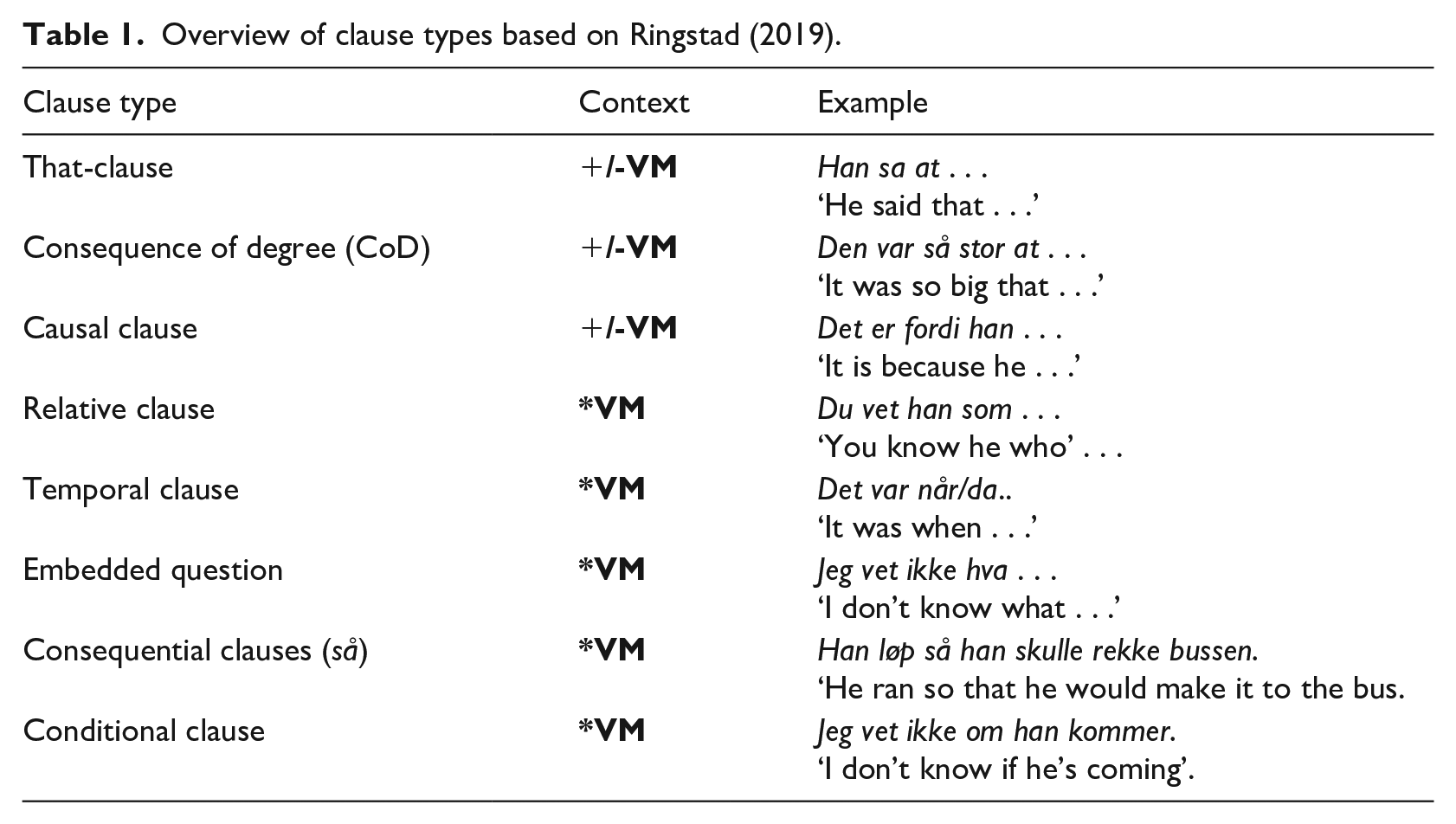
We have made some alternations to Ringstad’s categorizations in using that-clauses as one clause type and adding consequential clauses starting with så ‘so’ as a *VM clause type. Så can be both a coordinating conjunction (12) and a subordinating conjunction (13), where the different word orders (Adverb-Verb and Verb-Adverb) determine the analysis.
(12) Han hadde mat, så han
(13) Han hadde mat så han
Acquisition
Studies of the acquisition of word order in embedded clauses show that children tend to overgeneralize +VM (Ringstad & Kush, 2021; Westergaard & Bentzen, 2007). Westergaard and Bentzen (2007) investigate both embedded questions and embedded declaratives from a corpus of three Norwegian children (age 1;9-3;3) and occasional examples from somewhat older children. In embedded questions, Norwegian children produce target-consistent word order from early on (i.e., Subject-Verb), while embedded clauses containing adverbs or negation often appear with the verb preceding the adverb, both in *VM contexts (14) and in +/-VM contexts (15).
(14) Ina.26, 3;2.5 (Westergaard & Bentzen, 2007, p. 279)
Det er ho mamma som
It is she mommy who has also drawn ‘It is mommy who has also been drawing.’
(15) Henning 4;8,13 (Westergaard & Bentzen, 2007, p. 282).
Æ vet at æ
This overgeneralization of verb movement is also attested in Swedish child language (Håkansson & Dooly Collberg, 1994), where it is found that children have a stronger preference for +VM with auxiliaries than lexical verbs.
An elicited production task with 48 Norwegian-speaking children also finds overuse of verb movement with negation (Ringstad & Kush, 2021, p. 421): Young children below the age of 5 produced 20% V-Neg order in relative clauses (35/175), whereas children over the age of 6 only produced Neg-V. In complement clauses, the children used 16%–44% V-Neg, depending on the matrix verb. Like Håkansson and Dooly Collberg (1994), Ringstad and Kush (2021, pp. 421–422) observe that verb movement is more common with auxiliaries than with lexical verbs in both child (47%/36%) and adult speakers (20%/12%).
Heritage languages
Verb placement in main clauses
It is well-documented that V2 is a robust property in heritage languages (see, e.g., Hopp & Putnam, 2015; Larsson & Kinn, 2022; Schmid, 2002), and this also applies to Heritage Norwegian (Alexiadou & Lohndal, 2018; Eide & Hjelde, 2015, 2018; Johannessen, 2015a; Khayitova, 2016; Westergaard et al., 2023; Westergaard & Lohndal, 2019). Westergaard et al. (2023) investigate 50 informants from CANS and conclude that all speakers have a V2 grammar, with some examples of V2 violations (16).
(16) harmony_MN_02gk (Westergaard et al., 2023, p. 18).
Når vi kom der så
They find a negative correlation between the proportion of V2 violations and non-subject-initial declaratives. Speakers who produce more non-subject-initial declaratives (the core context for V2) produce fewer V2 violations than speakers who produce few V2 contexts. The authors suggest that a low proportion of non-subject-initial declaratives causes less activation of the Norwegian grammar (see Putnam & Sanchez, 2013), which makes it vulnerable to crosslinguistic influence (CLI) from English. Yang (2001) finds that 90% of the sentences in Penn Treebank, a corpus of modern English, have SVO. Only about 10% have either XSV or SXV (Yang, 2001, p. 242), indicating that XSV is rare in English. In contrast, Faarlund (1992, p. 91) reports that around 40% of declarative sentences in conversational Norwegian are non-subject initial. The low proportion of non-subject-initial sentences in Heritage Norwegian may be due to CLI, where the distributional pattern of English influences how frequently such structures are used, which subsequently leads to a weakening of the V2 grammar (Westergaard et al., 2023, pp. 21–22).
Verb placement in embedded clauses
Studies on embedded clauses in Heritage German (Hopp & Putnam, 2015) and heritage Scandinavian (Larsson & Johannessen, 2015a, 2015b) show that embedded verb movement is more common in the heritage language than in the European varieties. Hopp and Putnam (2015) investigate embedded clauses in Moundridge Schweitzer German with an acceptability judgement task and an elicited narrative production task. They find a preference for verbs in second position in weil-clauses (‘because’-clauses) (17), which can have both V2 and verb-final word order in European German, as well as dass-clauses (‘that’-clauses), which traditionally are *VM (18) (Hopp & Putnam 2015, p. 207).
(17) Participant 103 (Hopp & Putnam, 2015, p. 195)
. . . weil ich duh net Hochdeutsch redde.
. . .because I do/can not High.German talk ‘because I can’t speak standard German.’
(18) Participant 102 (Hopp & Putnam, 2015, p. 195)
. . . dass da Lieber Gott hot uns auch net alles genomm wie dat in Oklahoma
that the dear God has us also not everything taken like there in Oklahoma. ‘that the dear God hasn’t taken everything away from us like in Oklahoma’.
Hopp and Putnam (2015, p. 203) argue that there ‘is little to no evidence in the production data that English SVO word order has affected [Moundridge Schweitzer German]’. They suggest that the high proportion of V2 is caused by a reanalysis of the grammar, where +/-VM is expanded to dass-clauses, a development also found in European German (Freywald, 2008, p. 251). For this reason, they refer to this as typological drift, which is accelerated by the symmetry between main and embedded word order in English in combination with less activation and usage of German.
We stress that even though Norwegian and German are both asymmetric V2 languages where V2 is obligatory in main clauses but only licenced in a subset of embedded clauses (+/-VM), the languages are different in that Norwegian has canonical SVO, whereas German is SOV (verb-final). This means that, whereas the asymmetric word order in Norwegian is only observable in embedded clauses with adverbs/negation, it is salient in all embedded clauses with an argument or an adjunct in German. This makes verb movement more marked in German than in Norwegian.
Larsson and Johannessen (2015a, 2015b) consider verb placement in that-clauses (
(19) zumbrota_MN_01gk (Larsson & Johannessen, 2015b, p. 248)
det var en som arbeida med dem som
there was one who worked with them who understands not so much Norwegian ‘There was one who works with them who doesn’t understand much Norwegian’.
(20) coon_valley_WI_06gm (Larsson & Johannessen, 2015b, p. 247)
det er så lenge sia at jeg
As they find V-Neg with both auxiliaries and lexical verbs, they argue that this word order cannot be caused by CLI from English (Larsson & Johannessen, 2015b, p. 254). They attribute the high proportion of V-Neg to incomplete acquisition (Montrul, 2002, 2008), arguing that the speakers may not have acquired the word order of embedded clauses completely. As mentioned, L1 children (Ringstad & Kush, 2021; Westergaard & Bentzen, 2007) and L2 learners (Pienemann & Håkansson, 1999) go through a stage where they overgeneralize verb movement in embedded clauses.
Research questions and predictions
In our study, we explore the distribution of verb movement in Norwegian heritage language in a larger group of speakers (50) and focus on how different contexts and verb types may affect word order. We investigate three research questions:
RQ1: Do Norwegian heritage speakers produce more V-Adv than speakers of European Norwegian and first-generation speakers?
Based on the findings from Hopp and Putnam (2015) and Larsson and Johannessen (2015a, 2015b), we predict a higher proportion of V-Adv than what is found in European Norwegian and the first-generation in both +/-VM and *VM contexts.
RQ2: If the heritage speakers’ production is different from European Norwegian, how does it differ?
a) Do we find a difference between +/-VM contexts and *VM contexts (see Table 1)?
Embedded clauses with adverbs are infrequent, making them more vulnerable to change. The distinction between the contexts is fine-grained, so one possibility is that embedded verb movement has been lost across generations. Another possibility is an expansion of +/-VM contexts, making embedded clauses more like main clauses.
b) Do we find differences between verb types in the embedded clause?
The difference between Norwegian and English embedded word order (overlap with lexical verbs, but not with auxiliaries) may influence Heritage Norwegian towards a system where lexical verbs are less likely to appear before adverbs than auxiliaries.
RQ3: If the heritage speakers’ production is different, how can this be explained?
As described in section 3.2., different theories have been proposed to explain the high proportion of verb movement in heritage German (typological drift as proposed by Hopp and Putnam, 2015) and heritage Scandinavian (incomplete acquisition as proposed by Larsson and Johannessen, 2015a, 2015b). In addition, CLI may also affect language processing, as suggested by Westergaard et al. (2023) for V2 violations in main clauses.
Method
The data investigated in this study come from CANS (Johannessen, 2015b), which currently consists of almost 773,000 tokens from semi-structured interviews and conversations with 246 Norwegian heritage speakers in North America. The corpus is morphologically tagged and consists of orthographic and phonetic transcriptions and audio recordings. In this study, we consider a subset of 50 speakers, who produce a total of 277,070 tokens (the same speakers as in Westergaard et al., 2023). All speakers are second- to fourth-generation speakers of Norwegian, and the average age is 80. In addition, we have considered all the first-generation speakers (n = 13), who, together with findings from Ringstad (2019), serve as a baseline. Ideally, the baseline should reflect the input received by the 50 speakers we investigate, as this would be better suited to say something about the development across generations. However, CANS only consists of 13 first-generation Norwegian speakers, and there is no information about possible family relationship with our 50 speakers. Even though this is not ideal, we argue that the combination of Ringstad’s study and the 13 first-generation speakers provides a sufficiently adequate baseline for this specific population; see Polinsky (2018, chapter 1) for a more detailed discussion on the use of baselines in heritage studies.
The search criteria in CANS were the following: subordinating conjunctions and wh-words with ikke ‘not’ or another adverb as one of the four following words. This yielded 264 embedded clauses with negation/adverbs in clause-internal position. These were manually categorized in Excel based on the variables word order (V-Adv or Adv-V), verb type (auxiliary/main/copula verb), and clause type (+/-VM or *VM cf. Table 1).
All statistical analyses were conducted in R. The same procedure was used with the 13 first-generation speakers, but no statistical analysis was carried out, due to small numbers.
Results
Overview
We first provide the results from the 13 first-generation speakers in the CANS corpus. The numbers are presented in Table 2, with information about the two word orders in the two relevant contexts: the ones that allow +VM and the ones that do not.
Overview of word order among first generation (n = 13).

Although the number of observations is small, we can still conclude that the variation in +/-VM contexts looks very similar to the variation in the European Norwegian corpora (Ringstad, 2019): 30.8% compared with 33%. As for the *VM contexts, there are two instances of V-Adv order in the first-generation speakers. One of them appears in a relative clause:
(21) First-generation speaker relative clause gays_mills_WI_01gm når vi kom isammen # og organiserte # at det som
when we came together # and organized # that it which is now called Utica congregation ‘When we came together and organized what is now called Utica congregation.’
This speaker produces a total of five embedded clauses (two that-clauses, one temporal, and two relative clauses), and (21) is the only one with V-Adv. Note that the adverb here is nå ‘now’, and even among European Norwegian speakers, there is some variation with respect to the placement of temporal adverbs, although -VM is clearly preferred.
The second example of V-Adv in *VM context is found in a relative clause (22):
(22) First-generation speaker embedded V2 conditional clause viroqua_WI_04gm
men så spekulerte han på det og når de skulle til Amerika om han just as well travel ‘But then he considered it and when they were going to America, if he might not just as well leave.’
These examples indicate that the influence from English has affected Norwegian speakers already from the first generation of Norwegian immigrants in North America. However, there are only a few examples here, making it difficult to determine whether this is a slip of the tongue or the emergence of a pattern. It is possible that the word order patterns in (21–22) are due to CLI from English. Nevertheless, the general observation is that relative clauses and other *VM contexts largely do have Adv-V order in the first-generation speakers, just like in European Norwegian today (Ringstad, 2019; Ringstad & Kush, 2021).
An overview of the results from the 50 later-generation speakers is given in Table 3.
Overview of word order in embedded clauses (+/-VM and *VM contexts), 50 speakers in CANS.
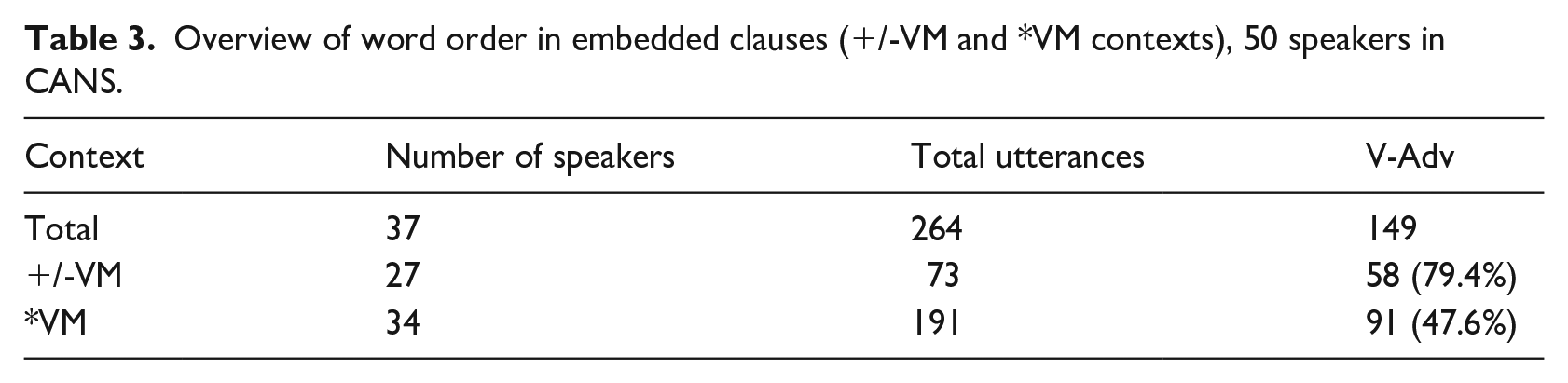
Of the 50 speakers, 37 produced one or more relevant utterances (altogether 264). The negation ikke ‘not’ is the most frequent adverb, while other adverbs make up only 22.7% (60/264). The distribution per speaker is illustrated in Figure 1, where the speakers are ordered after the total number of embedded clauses with adverbs that they produce.
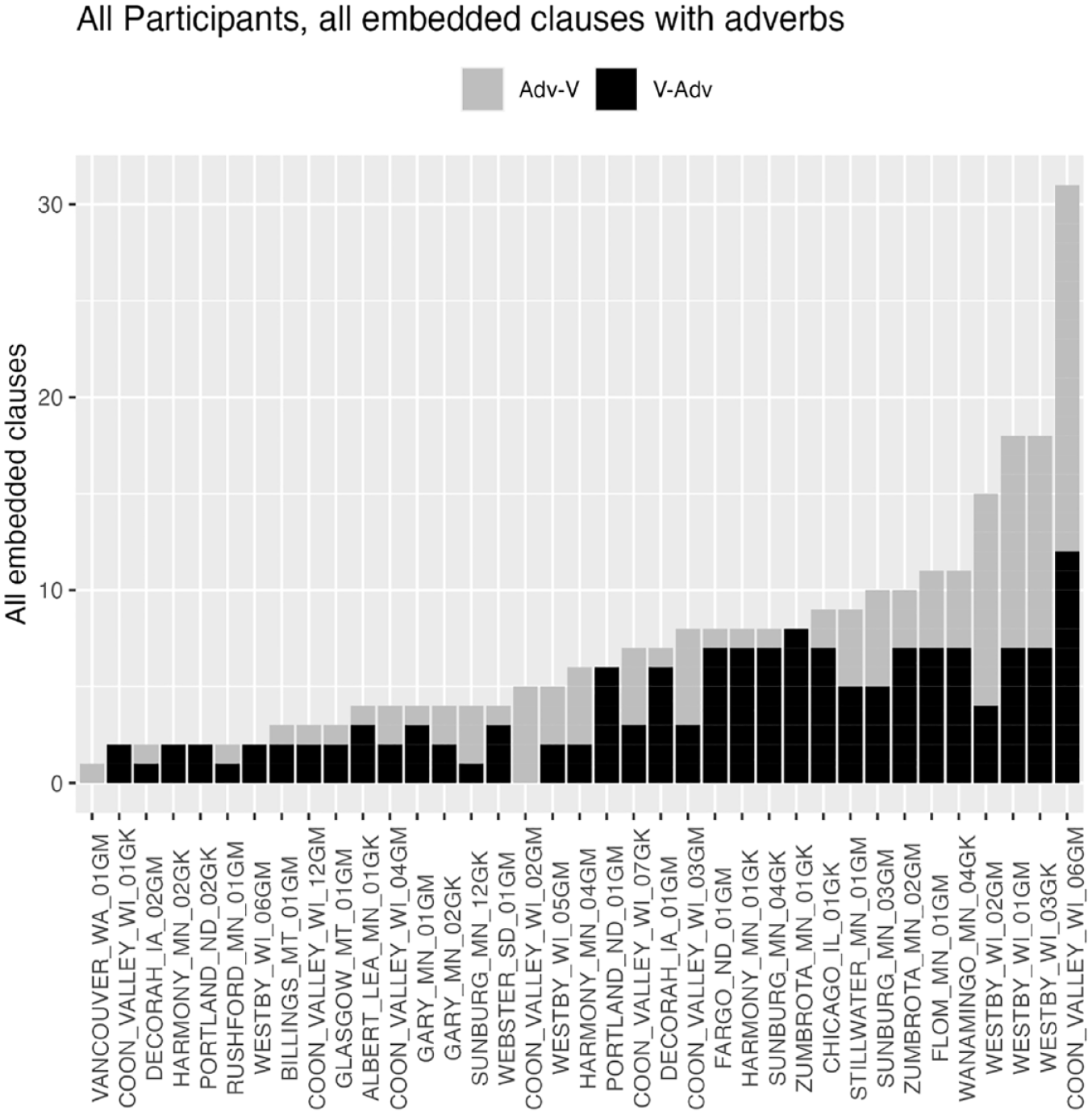
The distribution of embedded clauses per speaker.
As we can see, most speakers produce fewer than 15 relevant examples, and 16 speakers fewer than 5. The figure also illustrates that most speakers produce both V-Adv word order (black) and the canonical Adv-V word order (grey).
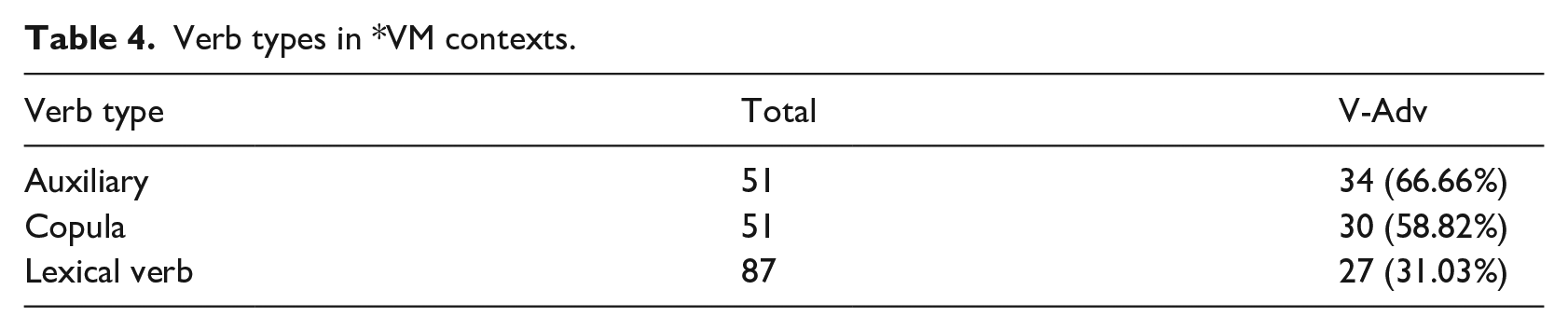
In total, 149 out of the 264 clauses exhibit V-Adv, constituting more than half of the examples (56.44%). In 74.3% (58/78) of the embedded clauses with auxiliaries, the auxiliary precedes the adverb, while 60.2% (41/68) of the embedded clauses with copula and 43.4% (50/115) clauses with lexical verbs have V-Adv order. We find no difference between negation and adverbs.
+/-VM contexts
In +/-VM contexts (i.e., contexts that allow verb movement past an adverb/negation in embedded clauses in European Norwegian, cf. Table 1), we find examples from three different clause types (altogether 72 examples), causal clauses, consequence of degree clauses, and that-clauses, where 79.4% (58/73) appear with +VM. The distributions across participants and clause types are provided in Figures 2 and 3.
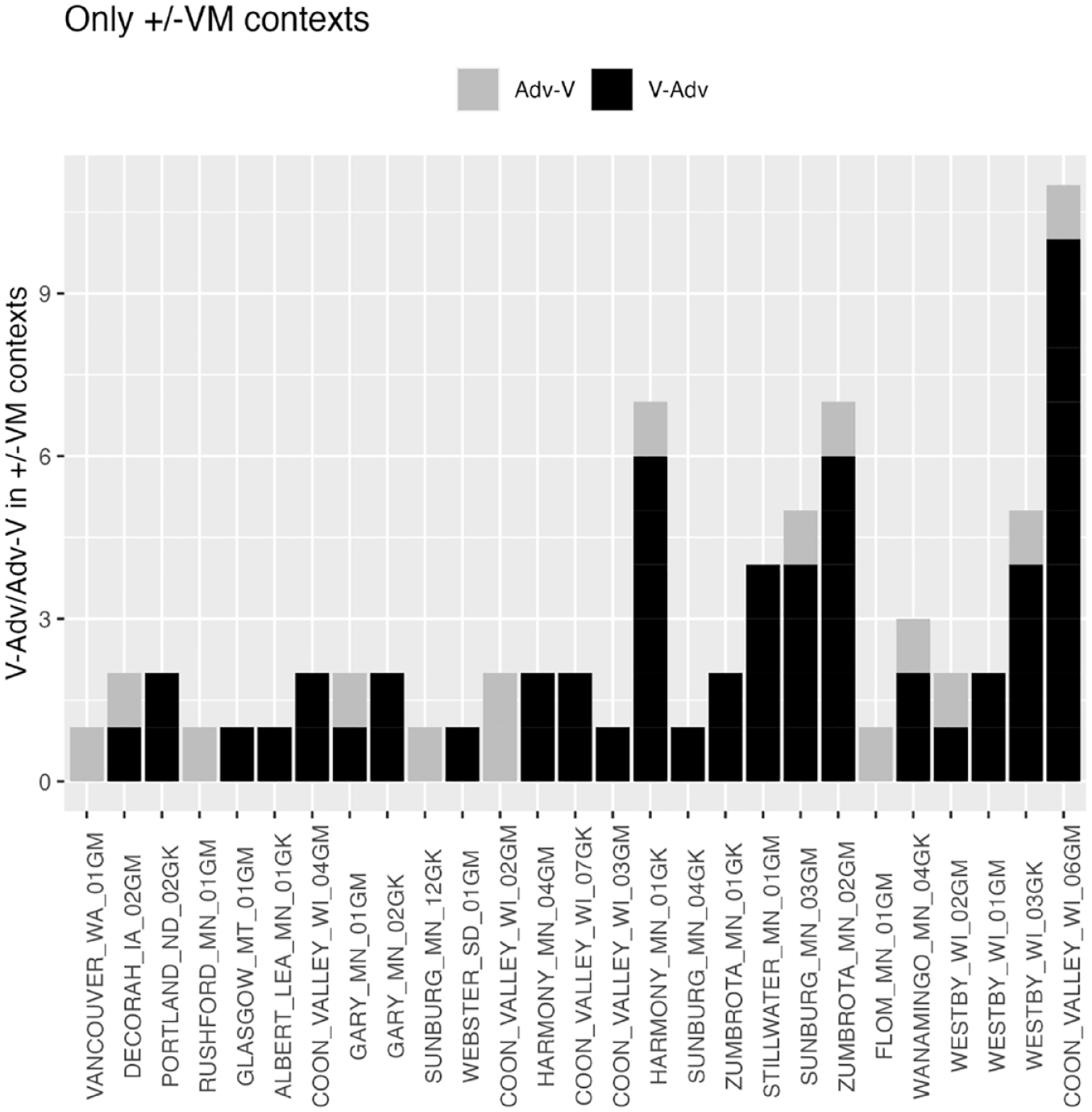
The distribution of verb placement across participants.
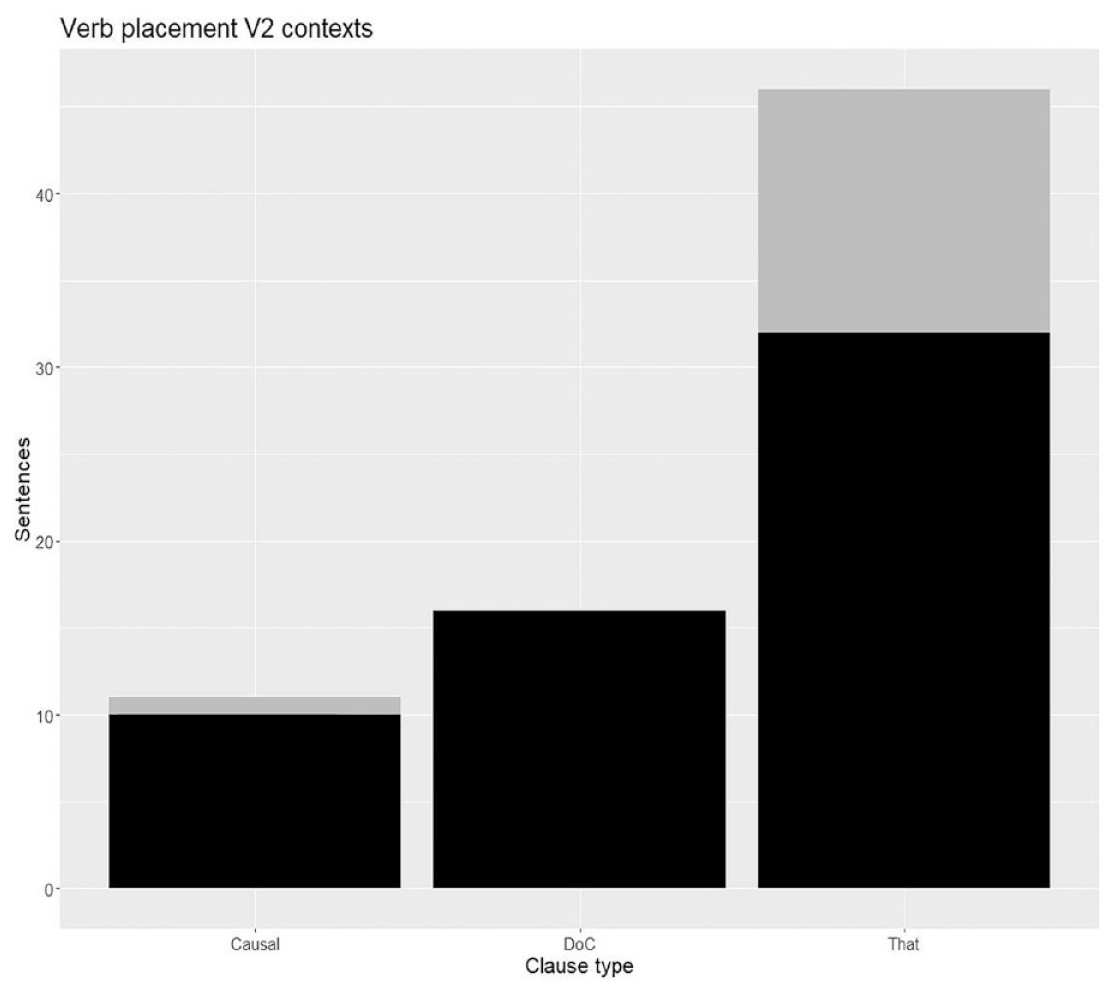
The distribution of verb placement across clause types.
Examples are provided in (23)–(25): All the 17 consequence of degree (CoD) clauses have +VM, as do 10 of 11 causal clauses and 71.1% (31/44) of that-clauses.
(23) Consequence of degree lexical verb gary_MN_01gm
men # kona mi er så # god at jeg jeg
(24) Causal clause coon_valley_WI_07gk
Nå driver de og setter en annen en ny xxx for det at de
(25) That-clause westby_WI_02gm
eh det har vært lykkelig at eh det
eh it has been happy that eh it has not taken any lives ‘It is lucky that it has not taken any lives’.
The proportion of V-Adv in these clause types is higher than in European Norwegian. Ringstad (2019) finds 50% V-Adv with negation in causal clauses, 70.72% in CoD-clauses, and only 32.33% in that-clauses. We also find more V-Adv in causal clauses and CoD-clauses than in that-clauses.
Finally, there is no difference between verb types in these contexts: V-Adv is preferred irrespective of verb type (24/27 with auxiliaries, 14/17 with copula, and 23/27 with lexical verbs).
*VM contexts
As many as 192 of the 264 embedded clauses are categorized as occurring in *VM contexts, that is, contexts where V-Adv is not acceptable in European Norwegian. These are produced by 34 speakers; 47.6% (91/191) of these appear with V-Adv order. Figure 4 illustrates the distribution across participants, and Figure 5 illustrates the distribution across clause types.
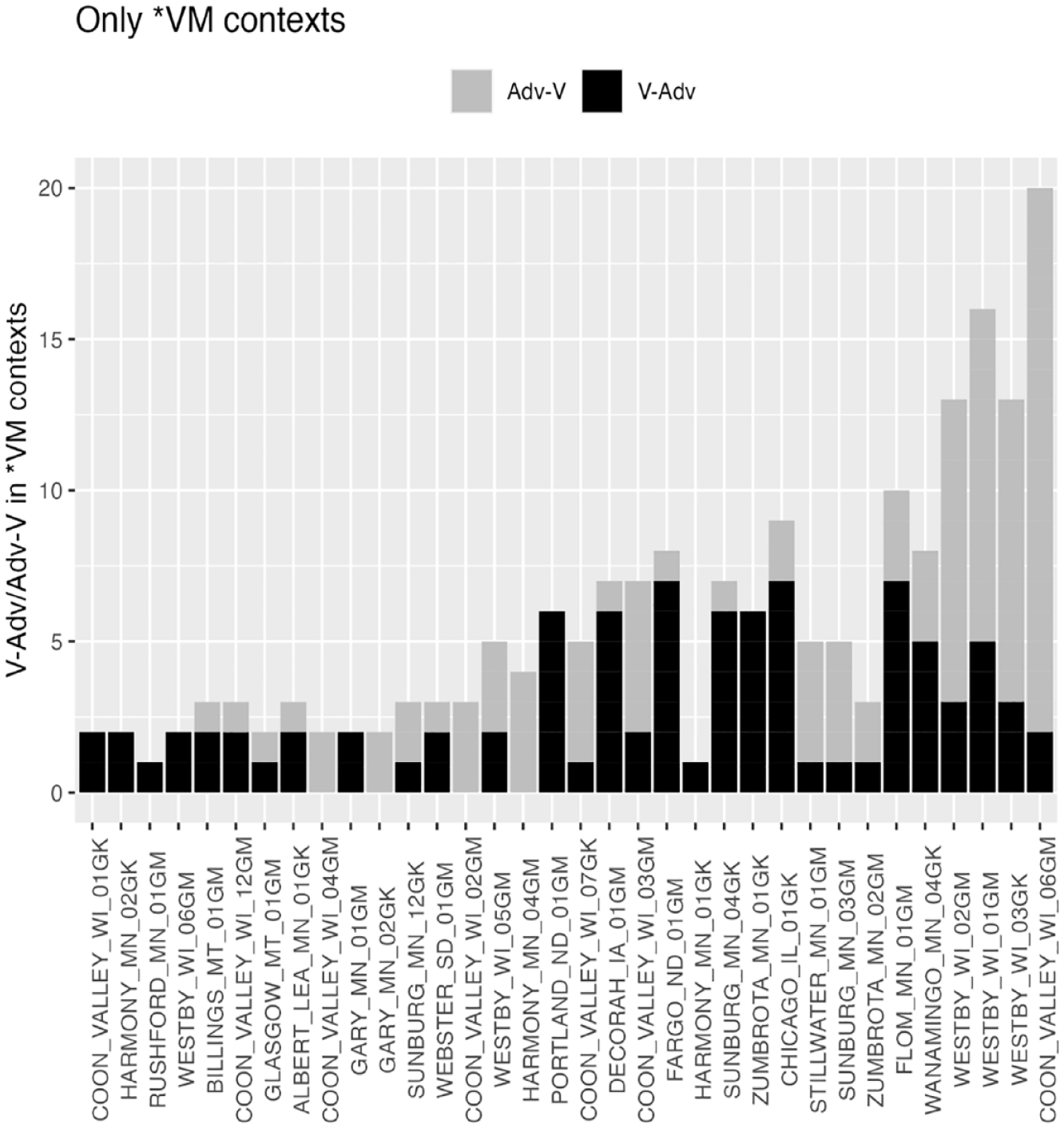
The distribution of verb movement across participants for *VM contexts.
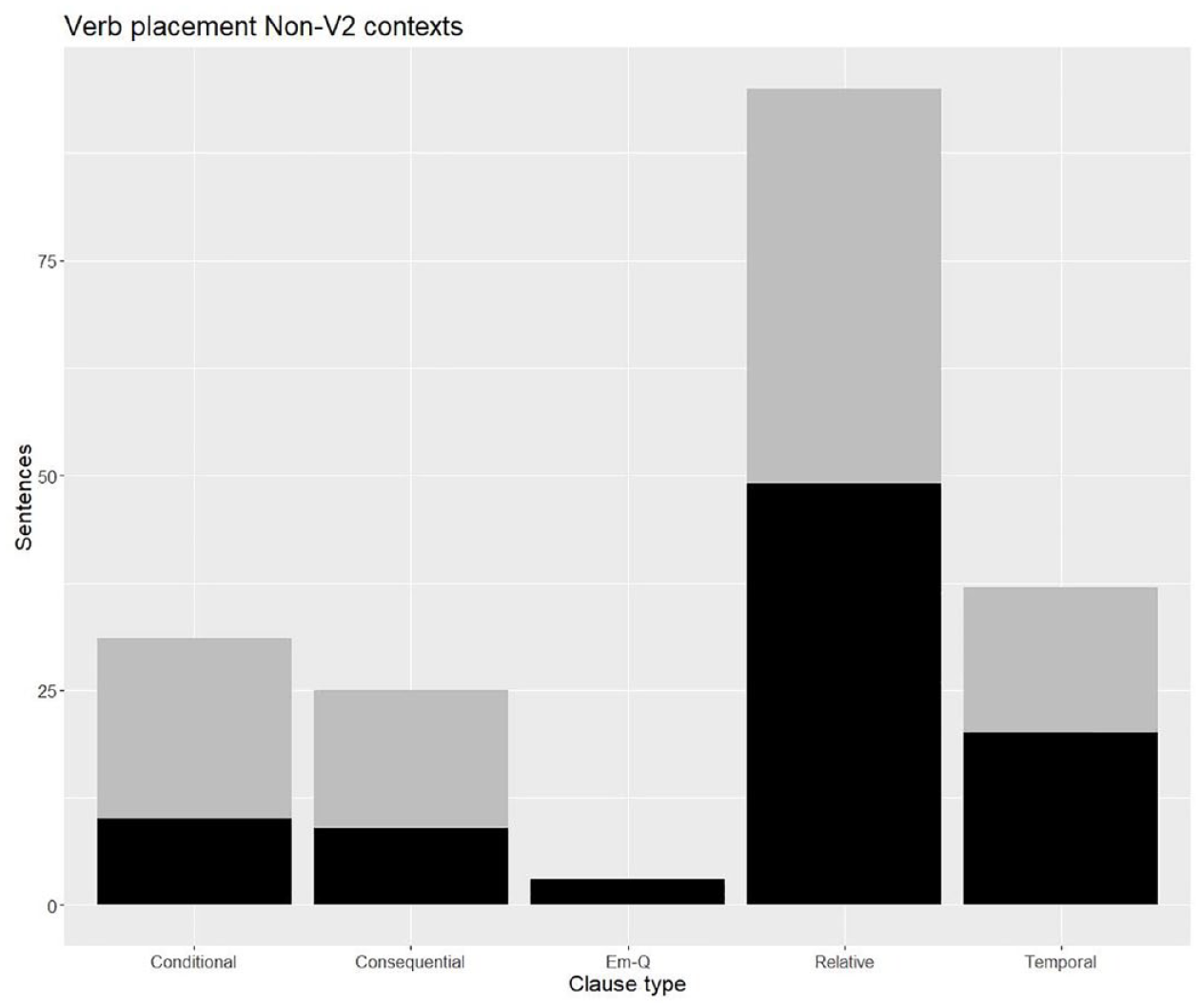
The distribution of verb movement across clauses for *VM contexts.
The V-Adv order is significantly less frequent in the *VM contexts compared with the +VM contexts (β: –1.95, SE: 0.39, p < .001, 3 c.f. Figures 2 and 4): There also seem to be fewer instances of V-Adv among the speakers who produce more embedded clauses, an observation we return to in section 5.5.
Figure 5 illustrates that the use of Adv-V (black) varies across clause types. This is very different from the distribution Ringstad reports for European Norwegian, where these clause types rarely or never have V-Adv order.
The clause type with the smallest proportion of Adv-V is conditional clauses, where 21/31 clauses have the canonical Adv-V order, see examples (26) and (27):
(26) Conditional clause (Adv-V) coon_valley_WI_04gm
vi gikk beins da (laughter) # om vi
we walked legs then # if we not walked on skis ‘We walked on our legs then if we didn’t ski.’
(27) Conditional clause (V-Adv) westby_WI_02gm
det tok lenger veit du hvis det
it took longer know you if it was not much with help ‘It took longer, you know, if there wasn’t a lot of help.’
In the consequential clauses, 16/25 examples (produced by 18 speakers) occur with the canonical Adv-V word order; see (28) and (29).
(28) Consequential clause canonical coon_valley_WI_03gm
det # kanskje sydd i fast # med tråd ## nål og tråd # så han
it # maybe sewed in # with thread ## needle and thread # so he not # unraveled seg oppatt itself up again ‘It may have been sewed together with needle and thread so that he wouldn’t unravel again.’
(29) Consequential clause V-Adv westby_WI_05gm
det ble så du
As word order may change the interpretation of these sentences, we categorized them as *VM contexts (see 2.2). The proportion of V-Adv here (36.00%) is similar to the proportion in conditional clauses (32.26%), which suggests that this categorization is correct.
We only find three examples of embedded questions. In contrast, relative clauses are the most frequent clause type in the data, with a total of 95 examples (produced by 30 speakers), approximately half of which have V-Adv 51.58% (49/95); see (30) and (31).
(30) Relative clauses with V-Adv (lexical verb) portland_ND_01gm
det var ikke noe jeg så i Norge
(31) Relative clause with V-Adv (auxiliary) chicago_IL_01gk
det er en ## norsk mat
there is one ## Norwegian food that I have never liked ‘There is one kind of Norwegian food that I have never liked.’
The last clause type is temporal clauses. There are 37 examples (produced by 20 informants), 17 following the canonical word order; see (32) and (33). In comparison, in the first generation and in Ringstad, none of the temporal clauses have V-Adv order.
(32) Temporal clause canonical (lexical verb) wanamingo_MN_04gk
men i når du
but in when you not use it for long times ‘but when you’re not using it for a long time.’
(33) Temporal clause +VM (auxiliary) chicago_IL_01gk
men når du
Table 4 illustrates a clear preference for placing auxiliaries and copula before adverbs compared with lexical verbs. This is a pattern that indicates CLI from English, where auxiliaries and copula would occur in front of the adverb. However, we did not find this pattern in +/-VM contexts (see the last paragraph in section 5.2), where verb type does not seem to affect word order. Thus, there is both a quantitative difference, in that there is more V-Adv word order in the +/-VM contexts than in the *VM contexts, and a qualitative difference, as the verb type seems to affect the word order in *VM contexts, but not in +/-VM contexts.
Verb types in *VM contexts.
Behaviour in embedded and main clauses
As was reported in the background section, the Norwegian heritage speakers in CANS have a relatively stable V2 grammar in main clauses (Westergaard et al., 2023). V2 violations in sentences that require subject-verb inversion are about 10%, and subject-initial declaratives with Adv-V are rare. Most notably, errors involving the placement of negation with respect to the finite verb are less than 1%, and this is true both for lexical verbs and copulas and auxiliaries. In other words, the heritage speakers’ verb placement patterns in the main clause are close to identical to those of the European Norwegian speakers, and crucially different from the English patterns. In contrast, the heritage speakers’ verb placement in embedded clauses clearly differs from the European Norwegian baseline and also from the pattern in the first-generation heritage speakers, although the data are limited. There are three core points of the results that need to be discussed in relation to both main clause patterns, European Norwegian and English.
The heritage speakers differ from European Norwegian speakers in two respects: (a) the proportion of V-Adv word order in +/-VM contexts is much higher in heritage Norwegian than European Norwegian, and (b) the heritage speakers have a substantial amount of V-Adv order in *VM contexts, i.e., contexts where European Norwegian speakers never produce V-Adv(relative clauses, conditional clauses, etc.).
Most of the word orders produced by heritage speakers in embedded clauses are word order patterns that are not licit in English. Out of the 264 utterances, 142 have one of the following patterns which would be illicit in English: a finite lexical verb following or preceding negation, or a copula/auxiliary following an adverb or negation.
The verb placement patterns in the heritage speakers’ embedded clauses significantly differ from their pattern in the main clauses. As mentioned above, the verbs precede negation in over 99% of the main clauses, but only in 57.6% of the embedded clauses.
At the group level, it seems accurate to claim that the 50 heritage speakers have a Norwegian-like V2-grammar: as in European Norwegian, verbs surface in the second position in main clauses, and just like in European Norwegian, the verb placement is variable in embedded clauses. Still, as discussed by Westergaard et al. (2023), the main clause production patterns differ substantially between the heritage speakers and European Norwegians, and as is clear from the results above, the embedded patterns differ between the two groups as well. In main clauses, Westergaard et al. (2023) show that heritage speakers stick to subject-initial sentences to a large degree, in contrast to European Norwegian speakers who front a non-subject in about 30% of all declaratives (see Meisezahl et al., 2023 for an overview of fronting patterns in other V2 languages). It is not clear if the reason for the low number of non-subject fronting is that the heritage speakers have not acquired the pragmatic rules and conventions that govern the choice of the clause-initial constituent in Norwegian, or if they simply are influenced by their English grammar in their production (more specifically, the English rules and conventions for topicalization). In embedded clauses, the heritage speakers master the core pattern: V-Adv is not obligatory in embedded clauses (in contrast to main clauses). However, the heritage speakers do not master the subtle pragmatic, semantic, and syntactic factors that govern the variability.
The generalizations discussed above hold at the group level, but structured individual variation explains some of the variation in verb placement. Recall that Westergaard et al. (2023) found that, in the main clauses produced by the 50 heritage speakers, there was a negative correlation between V2 violations and the production of non-subject-initial sentences (cf. section 3.1). Since we have investigated the same dataset as Westergaard et al. (2023), we can show that subject fronting also influences verb placement in *VM contexts: speakers who produce fewer non-subject-initial sentences produce more illicit embedded V-Adv orders (β = –0.102, SE = 0.034, p < .01, r2 = .14). We also find that participants that produce more V2 errors in main clauses are also more likely to produce V-Adv order in *VM contexts (β = 0.126, SE = 0.043, p < .01, r2 = .16). Following the reasoning in Westergaard et al. (2023), we assume that some speakers stick to simple, non-inverted sentences, which leads to less activation of the V2 rule, which in turn increases the likelihood for errors. We find the same pattern for the embedded clauses: speakers that produce a low number of embedded clauses in relation to the number of main clauses are more likely to produce embedded V-Adv orders in *VM contexts (β = 0.9, SE = 0.345. p < .01, r2 = .11), that is, speakers who rarely produce structures that require a specific ordering of a verb and an adverb are likely to produce non-target-consistent word orders. We illustrate the relationship between embedded clause production and likelihood of +VM order in Figure 6.
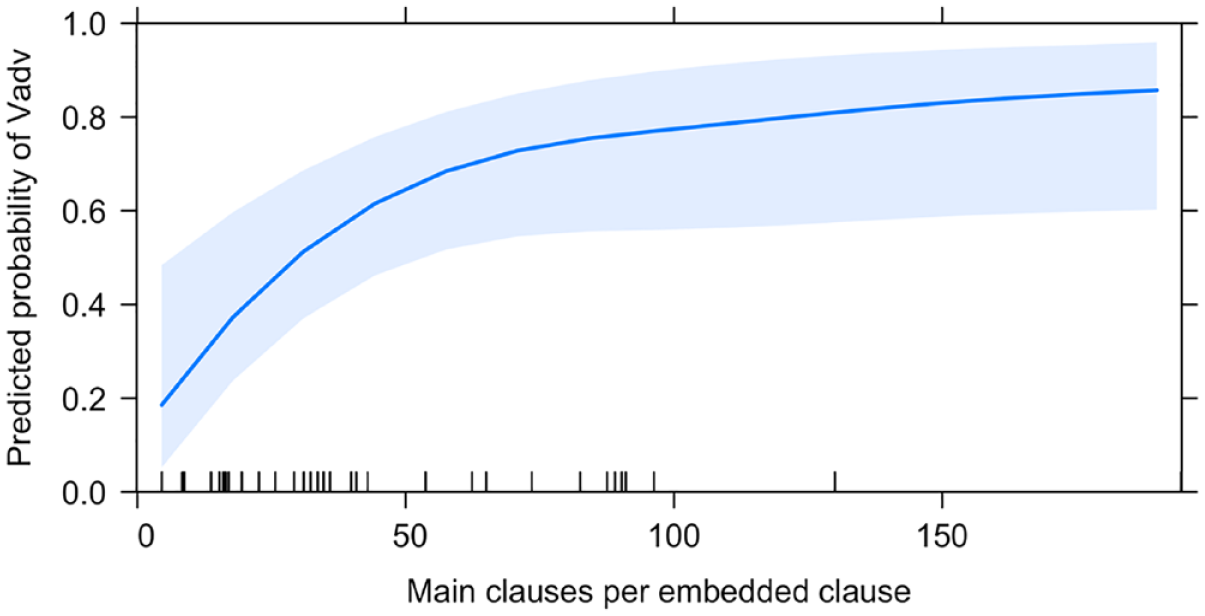
The relationship between embedded clause production and likelihood of +VM order.
In light of the variation within the group of heritage speakers in the corpus, it should be highlighted that we find speakers who perform almost target-like with respect to non-subject fronting and verb placement in main clauses, as well as verb placement in embedded clauses. However, there are very few speakers, only four in total, who stick to a strict Adv-V pattern in *VM contexts, and these speakers all produce fewer than five relevant utterances per speaker. It is thus unclear if any of the speakers fully master verb placement in embedded clauses. Yet, some speakers clearly show a sensitivity to the syntactic-pragmatic restrictions that govern verb placement in European Norwegian: there is overall more A-Adv order in +/-VM contexts compared with *VM contexts. In other words, these speakers must have a V2 grammar with almost the same fine-tunings as the European Norwegian grammar. Other speakers appear to be more sensitive to the distinction between lexical verbs and auxiliaries and copulas. It is likely that these speakers have only acquired one course-grained generalization about verb placement in Norwegian: main clauses have strict V2, and embedded clauses have variable verb placement. In this type of variable system, it is likely that the actual choice of word order is directly influenced by the word order patterns in the societal language, here English, leading to pre-adverbial auxiliaries and copulas, and post-adverbial lexical verbs. Finally, there may be speakers who have ended up with a fully symmetric V2 system, where verbs precede adverbs in all clauses. If these speakers exist at all, they are very few: only five speakers produce exclusively +VM in embedded clauses. In short, it is most plausible that most or all 50 heritage speakers have a core Norwegian V2 grammar: V2 in main clauses, V in situ in embedded clauses; they just have not fully figured out the fine-grained syntactic, semantic, and pragmatic factors that govern (a) verb placement in embedded clauses and (b) non-subject fronting in main clauses.
Individual speakers
So far, we have looked at the data at the group level, and as illustrated in Figure 1, the production per speaker varies, making it hard to see patterns within individual speakers. When we investigate individual speakers who produce eight or more examples (15 speakers), we find three speakers who behave in a way compatible with English and generally have V-Adv with auxiliaries and Adv-V with lexical verbs. All the three speakers are third- or fourth-generation immigrants. Seven of the speakers produce V-Adv orders in most sentences in both contexts, irrespective of verb type. Two of the speakers have several examples of +VM in the contexts where it is permitted, but few to none in the contexts where it is not.
Unfortunately, the metadata is limited as it is not collected in a systematic way and varies from speaker to speaker. This makes it hard to compare individual speakers. The background data available in CANS includes immigrant generation, contact with Scandinavia (Norway, in the case of these participants), language of confirmation (Norwegian or English), and whether the speakers started learning English before or after starting school. It is to be expected that the more generations away from the immigrant generation a speaker is removed, the more affected their Norwegian should be. If a heritage speaker was confirmed in Norwegian, this might suggest that they grew up in a community where the heritage language was more actively used, which could potentially make it more robust. Equivalently, it has been shown that the later the majority language is introduced, the less vulnerable the heritage language is likely to be (see, e.g., Amengual, 2019; Kim et al., 2009), even though studies of returnees suggest that more long-term stability seems to come from around the onset of puberty (Flores, 2010). However, even though these factors may affect language outcomes, they are all very coarse and imprecise measures compared with the kinds of measures that are typically used based on questionnaire data in research on heritage linguistics today (see, e.g., Anderson et al., 2018; Marian et al., 2007; Tomić et al., 2023).
The 37 speakers who produce embedded clauses are all second- to fourth-generation immigrants, but as the input situation of the participants may vary independently of this, there is no guarantee that the Norwegian of a second-generation speaker will be more robust than that of a fourth-generation one. This will depend on several other factors, such as how much and in which contexts Norwegian has been used throughout the lifetime of the speaker. For example, the participant Chicago_il_01gk is a second-generation immigrant, but the transcript of her interview reveals that she acquired Norwegian only when her Norwegian grandmother came to live with them, and several studies show that her Norwegian differs from European Norwegian when it comes to many different linguistic features, such as double definiteness, possessive word order, and V2 (see, e.g., Anderssen et al. 2018; Johannessen, 2015a). Despite this, she is one of the 15 speakers who produce the most embedded structures, with a total of nine relevant clauses. Only one of these appears in a +/-VM context; the eight remaining sentences occur in *VM contexts, and the verb precedes the adverb in seven of them. Thus, only two out of nine embedded clauses exhibit the default European Norwegian word order, Adv-V. The fact that Chicago_il_01gk did not speak Norwegian as a young child is only clear from the interview, where she says that her parents used to speak Norwegian so that she would not understand. This also illustrates quite nicely that the information provided in the metadata is not very fine-grained.
If we take number of embedded structures as a rough measure of Norwegian proficiency, where higher numbers are indicative of higher proficiency, no discernible effect of immigrant generation can be found. Of the 15 speakers who produce more than 8 embedded clauses, four are fourth generation, seven are third generation, two are second to third generation, and two are second generation. Eight of the 15 speakers often have contact with Norwegian, four have some contact, and three have little contact. Only 5 of the 37 speakers were confirmed in Norwegian, and these are all in the lower to middle range when it comes to number of embedded clauses (and not among the 15 with the highest number of embedded clauses), three producing a total of four (with one, two, and three -VM structures), one producing five (4/5 -VM), and one producing seven (4/7 -VM). When it comes to the 14 speakers who first acquired English in school, 8 are among the 15 with 8 or more embedded clauses, while 4 are among the 12 with the lowest number of embedded clauses (2, 3, 4, 4). Thus, the background factors available provide an unclear picture, even though it seems like the speakers who often have contact with Norway (8) and who acquired English after they started school (8) are quite likely to be among the ones who produce more embedded clauses.
Even though it is difficult to say much about what factors may influence the individual speaker, we want to take a closer look at three specific speakers who all represent different patterns: Coon_valley_WI_06gm, Portland_nd_01gm, and Westby_wi_01gm.
Coon_valley_WI_06gm is the informant who produces the most relevant clauses of all the informants. In general, this is a speaker who speaks a lot and follows a pattern similar to that found in European Norwegian. Notably, 17.1% of the declaratives found in the dataset are non-subject-initial, which is considerably more than what is typically found in English, but less than in Norwegian. As mentioned, a higher proportion of contexts where the two languages differ is likely to lead to more exercise for the ‘V2-muscle’. Given that Coon_Valley_WI_06gm is a third-generation immigrant, this similarity to European Norwegian is surprising, even though he reports to often be in contact with Norway and on having started learning English at school age.
When we look at Portland_ND_01gm, we find another pattern. This informant produces six embedded clauses, where all exhibit V-Adv word order. In the main clauses, we see that he uses Adv-V in 15% of all the declaratives. He also produces a lower percentage of non-subject-initial declaratives (10.7%), which is similar to the proportion found in English. This speaker seems to follow a more English pattern in his Norwegian. Interestingly, this speaker is a second-generation immigrant who often has contact with Norway, and who only started learning English when he started school. Again, this shows the limited explanatory power of the background data.
The third speaker, Westby_wi_01gm, exhibits a more varied pattern than the former two, in that he produces a high number of embedded clauses, but the word order varies and seems to be dependent on verb type, and not type of embedded clause. He produces 18 embedded clauses with the adverbial in medial position, eight of which have V-Adv. One of these involves a lexical verb, the rest are either copula or auxiliaries, that is, verb forms that precede the adverb in English. For the 10 utterances with V-Adv, 6 involve lexical verbs. However, the speaker is mostly target-like in main clauses (0.40% non-V2) and follows a European Norwegian-like pattern when it comes to the proportion of non-subject-initial declaratives (22.5%). This suggests, not surprisingly perhaps, that word order in embedded clauses is more vulnerable than in main clauses. When it comes to background data, Westby_wi_01gm is very similar to Coon Valley_wi_06gm, except that the latter started learning English when he started school.
To sum up, as this brief overview indicates, the background factors available in CANS are simply not fine-grained enough to distinguish between the speakers in a meaningful way.
Discussion
We now turn to a discussion of the research questions. For expository convenience, they are repeated here.
RQ1: Do Norwegian heritage speakers produce more embedded V-Adv orders than speakers of European Norwegian and first-generation immigrants?
As we predicted, there is a higher proportion of V-Adv in the heritage variety than in the baseline.
RQ2: If the heritage speakers’ production is different, how does it differ?
a) Do we find a difference between +/-VM and *VM contexts?
The proportion of V-Adv is much higher in +/-VM contexts (85%) than in *VM contexts (49%), but this distinction is only maintained by some of the informants.
b) Do we find a difference between verb types in the embedded clause?
We do find a difference between verb types, but only in *VM contexts, where embedded clauses with auxiliaries and copula are more likely to exhibit V-Adv word order than clauses with lexical verbs.
RQ3: If the heritage speakers’ production is different, how can this be explained?
As in Larsson and Johannessen (2015a, 2015b) and Hopp and Putnam (2015), the proportion of V-Adv is higher in Heritage Norwegian than in the baseline. How can this be explained? First, if the results from previous studies are disregarded, this development towards more embedded V-Adv order is very surprising because of the extremely low frequency of embedded clauses with an adverb or negation, and the few that are used exhibit mostly Adv-V. This observation is corroborated by the numbers reported in Ringstad (2019, p. 340), where the total corpus consists of 612,814 main clauses and 40,516 embedded clauses, and only 2,921 are embedded clauses with negation. Also, note that in the absence of negation or an adverbial, these structures are ambiguous between a verb movement (V2) analysis, in which the finite verb would occur in front of the adverbial, and an analysis without verb movement, in which it would follow. Given the low frequency of structures that can disambiguate between the two, and the fact that the vast majority of such structures have no verb movement in European Norwegian, the most likely outcome should be the loss of verb movement in embedded clauses in the heritage variety. Instead, what is observed is an increase in the least frequent word order. In the following, we discuss different potential mechanisms that might explain this surprising development and argue that several factors, such as CLI, language-internal drift, and incomplete acquisition, may play a role.
If CLI is causing the development, we would expect verb movement in examples with auxiliaries and copulas and no verb movement in examples with lexical verbs. This is due to the partial overlap between English and Norwegian embedded clauses, where (medial) adverbials precede lexical verbs (Lex) in both languages, while they precede auxiliary verbs (Aux) in Norwegian, but not in English. We do find a higher proportion of Aux-Adv than Lex-Adv in the heritage speakers, but only in *VM contexts. Indeed, there are three speakers who consistently distinguish between auxiliaries and lexical verbs and use Aux-Adv and Adv-Lex in Norwegian embedded clauses, which exactly mirrors the English word order. There are only a few sentences from each speaker, but the overall pattern is clear and suggests that English word order is indeed affecting verb placement in embedded clauses in their Norwegian. The fact that we find some examples of this in the first generation (see [26] and [31]), and these involve auxiliaries/the copula, also supports an analysis in which CLI is the driving force behind the development towards increased embedded verb movement. However, as there are only two examples, this conclusion must be drawn with some caution, but note that according to Ringstad (2019, p. 341), only 1/681 relative clauses in her corpus exhibits V-Neg, and she states that this example is likely to be a re-start. Also, it should be remembered that the most common adverb in the sample is the negation, and in English, a finite lexical verb can neither precede not follow a negation, but finiteness has to be realized on an auxiliary, copula, or dummy do.
On a more systematic level, the two languages also differ, in that Norwegian is asymmetric, since it has a different word order in main and embedded clauses (V2 vs. verb in situ), whereas English has the same word order in both main and embedded clauses (Aux-Adv/Adv-Lex). This kind of symmetry could influence the speakers in the direction of adopting a more symmetric word order system into their Norwegian production, resulting in a high proportion of V-Adv in the data. This ‘English’ pattern (V-Adv with auxiliaries, but not with lexical verbs) is found in three of the more productive speakers. However, as we only have a few sentences from each speaker, it is difficult to say how reliable this pattern is.
Recall that Hopp and Putnam (2015) observe a similar expansion of verb movement in weil-clauses (‘because’-clauses) in Moundridge Schweitzer German, as well in dass-clauses (‘that’-clauses), which are traditionally *VM in European German. They argue that this is caused by typological drift, as a similar, albeit more limited, development is taking place in European German (Freywald, 2008). As far as we know, no similar expansion is taking place in European Norwegian, but among the heritage speakers, there are those who have both kept and expanded verb movement within the contexts where it is optional in European Norwegian. This is found among a couple of the more productive speakers. However, there are also speakers who produce high proportions of V-Adv irrespective of clause types, so this may not be the explanation for all speakers.
Larsson and Johannessen (2015a, 2015b) attribute the high proportion of verb movement to incomplete acquisition. They argue that this cannot be the result of CLI from English, as they would not expect to find verb movement in embedded clauses with lexical verbs, only auxiliaries (Larsson & Johannessen, 2015a, p. 254). They also exclude language use and activation as explanations, as they do not find any indication that this is related to the high proportion of verb movement (Larsson & Johannessen, 2015a, p. 257). On one hand, our data support their conclusion: relative to the baseline, we find a high amount of verb movement with both lexical verbs and auxiliaries in all types of embedded clauses in all speakers. This suggests that the heritage speakers indeed have not acquired how to condition verb placement in embedded clauses. On the other hand, we find both an effect of the verb type and of the speakers’ production, both quantitatively (those who produce fewer embedded clauses have a higher proportion of V-Adv in *VM contexts) and qualitatively (the speakers with high proportions of V-Adv in *VM contexts also have higher proportions of V2 violations in main clauses). Based on these observations, we believe that incomplete acquisition, as described by Larsson and Johannessen (2015a, 2015b), is less likely to be the main explanation of the development found in this population. However, given that the results from the small sample of first-generation immigrants also show some indications of influence from English, it may be that the input to the second generation was slightly different than the input to the first, thus yielding differential acquisition (Kupisch & Rothman, 2018). The acquisition process may also have a different effect on the speakers. Children differentiate between lexical verbs and auxiliaries early on, but they are slower to differentiate between main and embedded clauses (as illustrated for Norwegian in Ringstad and Kush’s [2021] study). The fact that the distinction between auxiliaries and lexical verbs is more salient in English than in Norwegian may affect the acquisition process, which again may fortify the effects of CLI from English, where auxiliaries would be placed in front of the adverb.
We stress that our dataset totals 264 sentences, and these are distributed very unevenly across speakers, meaning that some of them produce many sentences, and others only one or two. This makes it difficult to consider individual patterns. Another limitation of the study is the fact that we do not have information about the input situation of the speakers, making it difficult to make a definitive conclusion about incomplete acquisition. However, our results suggest that several factors conspire to drive the development towards an increased proportion of verb movement in embedded clauses in this Heritage Norwegian variety. Importantly, the ambiguity when it comes to verb placement in embedded clauses with no clause-medial adverbial, combined with low activation of Norwegian, is likely to make these structures vulnerable to change. The results from the first-generation immigrants further tentatively suggest that some incipient changes have taken place already at this stage due to CLI from English. If this is the case, it is possible that (a) this might affect different speakers to varying degrees – explaining why there are no clear differences between generations – and (b) that the input to the next generation may offer a higher proportion of V-Adv orders. This may in turn result in differential acquisition, exacerbated by the tendency for young children to produce V-Adv in embedded clauses, especially with auxiliaries (Ringstad & Kush, 2021).
The effect of CLI is further observed in the fact that auxiliaries and the copula are considerably more likely to precede the adverbial than lexical verbs in *VM contexts (66.6% and 58.8% vs. 31%). This behaviour may in some cases be the result of a misanalysis of the grammatical system through the acquisition of differential input. This may be the case for the three speakers who consistently distinguish between auxiliaries/the copula and lexical verbs. For other speakers, it may be due to a temporary inability to inhibit English, and for such speakers, we expect to see less consistent behaviour. Unfortunately, there is too little data and too much variation in the production of individual speakers to really explore this possible distinction.
What is clear, however, is that there is also a general tendency for all verb types, and not just auxiliaries and copula, to precede adverbials in embedded clauses. This development cannot be straightforwardly accounted for by CLI from English. This is where Hopp and Putnam’s (2015) notion of typological drift becomes relevant. They describe typological drift as ‘a particular type of levelling of word order distinctions across clause types within the constraints afforded by German syntax’ (Hopp & Putnam, 2015, p. 206) and argue that it is caused by a combination of low activation of the heritage language and the fact that the majority language, English, has symmetric word order in main and embedded clauses. It is likely that a similar mechanism is at play in Heritage Norwegian, that is, that there is a general drive towards symmetry between main and embedded clauses, which is additionally boosted by the symmetry in English. We would like to refer to this phenomenon as language-internal drift, that is, a mechanism according to which there is a development towards word order symmetry between main and embedded clauses in situations with reduced input and low activation of the heritage language.
Even though several factors pull in the same direction to cause this surprising development towards more verb movement in embedded clauses in Heritage Norwegian, CLI seems to be the most important one. There are several reasons for this. First, CLI is observed (to a limited extent) already in the first generation of immigrants, specifically with auxiliaries and copula, suggesting that the observed development is instigated already at this point. Second, in Norwegian, the salient distinction when it comes to verb placement is the asymmetry between main and embedded clauses, while all verb types behave the same. In English, the salient distinction is between verb types, while main and embedded clauses behave the same. The fact that the heritage speakers both distinguish between verb types in +/-VM contexts and seem to be moving towards a general levelling of the word order distinctions between main and embedded clauses suggests that English is playing an important role in this development.
Summary
This study investigates verb placement in embedded clauses in second- to fourth-generation Norwegian immigrants in the United States. In concordance with previous studies, we find a considerably higher proportion of V-Adv word order in this population than in European Norwegian today, as well as in a small group of 13 first-generation immigrants. This behaviour is observed both in contexts that allow verb movement and in contexts where verb movement is not found in European Norwegian. However, the proportion of V-Adv is considerably higher in contexts that permit it than in contexts that do not, suggesting that a distinction is made between the two. In +/-VM contexts, we also find a much higher proportion of V-Adv structures with auxiliaries and copula, which suggests influence from English. We suggest that these results can be explained by a combination of CLI, differential acquisition, and language-internal drift, all of which are caused by lack of use of Norwegian and a correspondingly low activation of the relevant grammatical structures.
Footnotes
Declaration of conflicting interests
The author(s) declared no potential conflicts of interest with respect to the research, authorship, and/or publication of this article.
Funding
The author(s) disclosed receipt of the following financial support for the research, authorship, and/or publication of this article: The author(s) received financial support from the AcqVA Aurora Center at UiT The Arctic University of Norway for the research, authorship, and publication of this article.
