



Abstract
Aims and objectives:
This study investigates how multilingual speakers with dementia mobilise their multilingual and interactional resources when searching for words in a naming test setting, and how their word-search behaviour relates to lexical retrieval processes characteristic of multilinguals, as well as to aspects of cognitive decline.
Methodology and approach:
The study takes an interdisciplinary approach by combining conversation analysis (CA) with psycholinguistic perspectives on lexical access and neurological perspectives on cognitive decline.
Data and analysis:
Data for the study are video/audio-recordings of seven multilingual speakers with dementia carrying out a naming test in their two common languages, English and Norwegian. CA was used for analysing the data and developing a coding scheme for word-search strategies. These findings were explored with statistical analysis based on language background, test scores, word proprieties/psycholinguistic properties, and cognitive/diagnostic assessment.
Findings/conclusions:
Multilingual speakers with dementia mainly used six general word-search strategies in the Norwegian and English naming test sessions: turn-holding, semantic searches, phonetic searches, embodied demonstrations, code-switching to another language, and inviting help from the conversation partner. The participants used more search-strategies in English, although it was their stronger language. Code-switching appeared to be the most successful strategy in English and phonetic searches appeared to be the most successful strategy in Norwegian. In-depth analysis of two participants indicate a benefit of using multiple strategies, drawing on their full linguistic repertoire.
Originality:
The study adds new knowledge to the interrelated, but previously separated areas of psycholinguistic word-finding difficulties and interactional word-searching behaviour, in the context of multilingual dementia.
Implications:
The study has implications for our understanding of the relation between observable word-searching behaviour and mental processes of word finding in multilinguals with dementia. The study also contributes to our growing understanding of test situations as interaction, with implications for everyday interaction and clinical practice.
Keywords
Introduction
One of the earliest and most prominent linguistic symptoms of several types of dementia is ‘anomia’, that is, problems finding the right word (Chen et al., 2001). One response to such problems is employing various verbal and non-verbal strategies to find the missing word. Such word searches are the topic of this article. We investigate the word-search strategies used by multilingual persons with dementia, looking at how they relate to characteristics of the speakers and the words searched for. The study takes an interdisciplinary approach by combining conversation analysis (CA) with psycholinguistic perspectives on lexical access and neurological perspectives on cognitive decline. We aim not only to investigate the various word-search strategies used, but also to relate them to lexical retrieval processes characteristic of multilinguals and to aspects of cognitive decline among persons with dementia.
Word finding may be particularly difficult for this group for several reasons. First, finding the right word becomes more difficult with age (Nicholas et al., 1985) possibly reflecting a general, age-related weakening of the connections in the lexical network (Burke et al., 1991; Burke & Shafto, 2004). As multilinguals, they have larger total vocabularies than monolinguals, meaning that each word they know is used less frequently (Gollan & Silverberg, 2001) and more words need to be inhibited (Abutalebi & Green, 2007). Although multilingualism seems to delay onset of dementia symptoms, cognitive decline associated with dementia can pose additional challenges to inhibiting lexical competitors from non-target languages (Bialystok, 2021; Zacks & Hasher, 1997). How easy it is to find the right words also depends on the words themselves: Words with a strong representation and many connections are easier to find. Thus, to study word searching in relation to word-finding problems, we also need to take lexical properties into account. In this paper, we are interested in how word-finding problems manifest in test interaction, how multilinguals mobilise their cognitive and interactional resources, which word-search strategies are used, and how word-searches relate to the mental lexicon, language background, and diagnostics.
Psycholinguistics is concerned with cognitive processes involved in lexical retrieval, what we will refer to as ‘word finding’. In the conversation analytic tradition, by contrast, the focus has been on how the process of searching for a word is manifested in conversational practices of repair and turn design. The primary focus in this study is on word searches, but we relate the findings to what is known about word-finding problems associated with second language (L2) usage or dementia-related symptoms. We will therefore start by outlining characteristics of word-search sequences and word-finding problems.
Word searching and word finding
A word search is initiated when speakers display problems continuing an ongoing turn by pausing, producing hesitation markers (uh), stretching sounds, or manifesting other speech perturbations (Schegloff et al., 1977). Speakers may also perform embodied displays of trouble, such as putting up a ‘thinking face’ (Goodwin & Goodwin, 1986) or gesturing (Kendon, 2004). Finally, they may provide verbal indications of a word search by inserting parenthetical phrases such as ‘what’s it called’ or ‘how do you say it’. Such verbal prompts are sometimes recognisably self-directed, especially when speakers are searching for a word that they do not expect their interlocutors to have access to. This is realised by keeping the gaze away from the interlocutor or by speaking with low volume. By contrast, speakers may seek to recruit their interlocutors to participate in the search activity by directing their gaze at them and addressing questions to them, thereby initiating a collaborative word-search sequence (Goodwin & Goodwin, 1986).
Looking at word searches in L2 interaction more specifically, Greer (2013) and Kurhila (2006) found that L2 speakers provided verbal clues as to what they are searching for, such as giving examples, paraphrasing, explaining, or code-switching. Furthermore, speakers, both of their L1 and L2, may also provide gestural clues, such as iconic gestures illustrating the referent or deictic gestures identifying it (Greer, 2013; Hayashi, 2003; Park, 2007).
Lexical retrieval depends on word properties such as word class, frequency, age of acquisition, and imageability. Concerning word class, differences between nouns and verbs have been found across groups of children and adults with a language impairment, although findings are mixed (Kambanaros & Grohmann, 2015). As for frequency, words are harder to access the less frequent they are for both neurotypical individuals and persons with neurological conditions (Jescheniak & Levelt, 1994; Kittredge et al., 2008). As indicated above, the frequency effect may be stronger among multilinguals, as each word in a larger lexicon is retrieved less often (Gollan & Silverberg, 2001). The age of acquisition of a word, how early in life it is acquired, has been found to affect retrieval positively in a range of participant groups including older adults and different patient groups (Juhasz, 2005). Imageability, the ease by which a word evokes a mental image, also helps retrieval in populations with and without language impairments (Bird et al., 2003).
These findings align with a usage-based view, where we assume that words are stored in a rich mental network organised by perceived similarities in form, meaning and use (Bybee, 2010). The more frequently we encounter a word, the stronger its representation in the mental lexicon. Retrieval happens through spreading activation along phonological and semantic connections, meaning that we activate not only our target words, but also those connected to them (Dell, 1986). Presuming all our languages are always active, spreading activation must also take place across languages (Libben & Goral, 2015).
Word finding and word searching in dementia
All types of dementia cause memory deficits, although the manifestations vary between types. In Alzheimer’s disease (AD), a progressive decline of episodic and working memory from the beginning is common (Manchon et al., 2015), whereas persons with primary progressive aphasia (PPA) show memory deficits only at a later stage (Gorno-Tempini et al., 2011). When it comes to language, word-finding problems is a common and early symptom of both AD (Chen et al., 2001; Nicholas et al., 1996) and PPA, particularly the logopenic subtype (Gorno-Tempini et al., 2011; Kempler & Goral, 2008). However, there are differences between different types of dementia in how the problems manifest. Speakers with AD tend to provide answers semantically related to the target (Balthazar et al., 2008; Martin & Fedio, 1983; Moreaud et al., 2001), while speakers with the logopenic variant of PPA appear to struggle with access to the phonological form of the word they are aiming at (Kempler & Goral, 2008; Rogers et al., 2006).
There is limited research focusing on word search in dementia. In a cross-diagnostic study on interviews with couples living with dementia or aphasia, Samuelsson and Hydén (2017) found that people with aphasia searched for words more frequently than people with dementia, although word searches were common in both. In two case studies of a bilingual speaker with PPA (Lind et al., 2018; Svennevig & Lind, 2016; the participant is also included in this study with the pseudonym JJ), the speaker displayed different types of problems and used different remedial strategies in his L1 and L2. In his L1, the word-retrieval problems mainly concerned information-carrying, low-frequency nouns, whereas the problems were more global in his L2.
This study
Traditionally, lexical processing and retrieval has mainly been assessed with psycholinguistic measures, whereas research on word searching has mainly focused on informal talk using interactional approaches. In this paper, we combine these approaches to investigate the interface between word finding and word searching in multilingual dementia. In this endeavour, we focus on one setting: a picture-based naming test, as far as possible carried out in all actively used languages. In this paper, we will concentrate on the participants’ two common languages, English and Norwegian, asking the following research questions:
Which word-search strategies are used by multilingual individuals with dementia when faced with word-finding problems during a naming test?
Is the use of certain word-search strategies associated with successful retrieval?
Is word-search activity associated with word difficulty, as estimated by psycholinguistic properties?
How do word-search profiles relate to individual language background and clinical characteristics?
Methods
Data and participants
Primary data for this study are video/audio recordings of a naming test in Norwegian and English. Main participants are seven multilingual speakers diagnosed with dementia in conversation with five test administrators (two researchers and three research assistants). The data are combined with background information from cognitive/diagnostic assessment and language interviews. The main participants were recruited through a hospital memory clinic, home nursing care services, and nursing homes, presented in Table 1. The participants had all been examined according to a standardised research protocol including clinical interviews, cognitive tests, physical examination, blood and cerebrospinal fluid (CSF) sampling, and imaging. The information from this examination was collected from the research registry NorCog (Medbøen et al., 2022) or straight from their hospital, after consent and ethical approval from the registry and hospitals. The level of impairment was estimated based on the clinical dementia rating scale (CDR) by a certified rater with long clinical experience. All available information was used for classification, following recommendations from McKhann et al. (2011); for PPA, we further relied on Gorno-Tempini et al. (2011). Where the dementia was due to multi-etiological causes, the patient was classified as unspecified.
Background information on the seven participants.
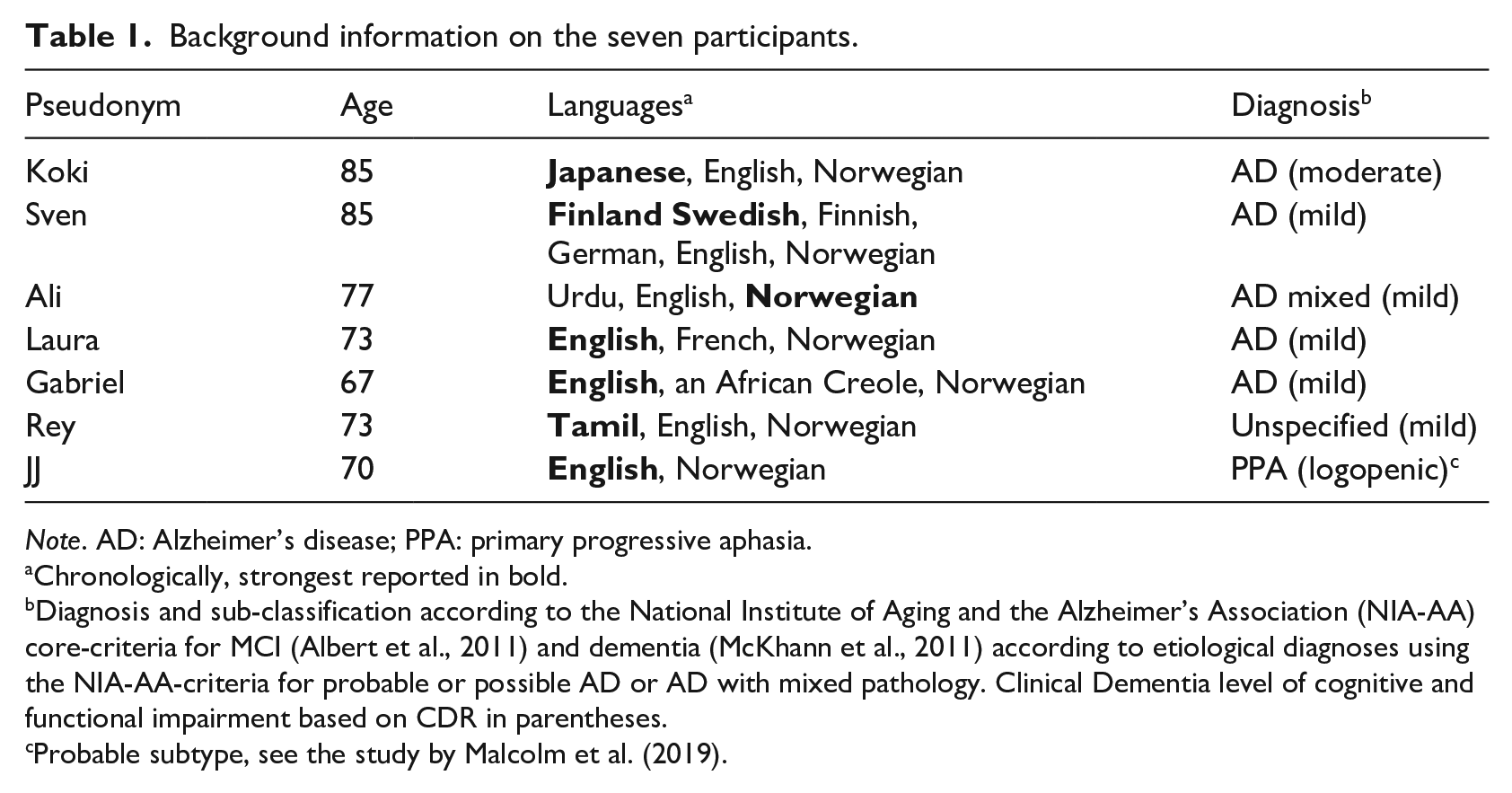
Note. AD: Alzheimer’s disease; PPA: primary progressive aphasia.
Chronologically, strongest reported in bold.
Diagnosis and sub-classification according to the National Institute of Aging and the Alzheimer’s Association (NIA-AA) core-criteria for MCI (Albert et al., 2011) and dementia (McKhann et al., 2011) according to etiological diagnoses using the NIA-AA-criteria for probable or possible AD or AD with mixed pathology. Clinical Dementia level of cognitive and functional impairment based on CDR in parentheses.
Probable subtype, see the study by Malcolm et al. (2019).
JJ and Laura grew up as monolingual speakers of English, and the rest acquired multiple languages from birth (Sven, Koki, and Gabriel) or early school years (Ali and Rey). Norwegian was an active language for all seven participants, acquired as an L2 in late teens or early 20s. Some or all have been further described in the studies by Svennevig et al. (2019) and Hansen et al. (in prep.); and JJ has also been presented in the studies by Svennevig and Lind (2016), Lind et al. (2018), and Malcolm et al. (2019). The study was approved by the Norwegian Centre for Research Data, the Regional Committee for Medical and Health Research Ethics, the data protection officer at the hospital, and endorsed by the municipality’s head of health services. Prior to data collection, participants and interlocutors received oral and written information about the study and signed a written consent. We repeated the information orally to the primary participants and obtained their oral consent before every data collection session. All participants lived at home, and data collection was carried out there, at the university, or in a day care centre.
The participants were assessed with a battery of cognitive tests, which included the Rowland Universal Dementia Assessment Scale (RUDAS; Storey et al., 2004), a general cognitive screening tool more suitable to migrant populations than the similar, more common Mini-Mental State Examination (Nielsen et al., 2018; Rowland et al., 2006). The maximum RUDAS score is 30, and the cut-off for neurotypical individuals is 23. As shown in Table 2, Rey, Ali, and Laura scored at or above this point, whereas Gabriel, Sven, Koki, and JJ scored below.
RUDAS and naming scores for the participants and the percentage of target words in the naming task that elicited a word-search sequence, by language.
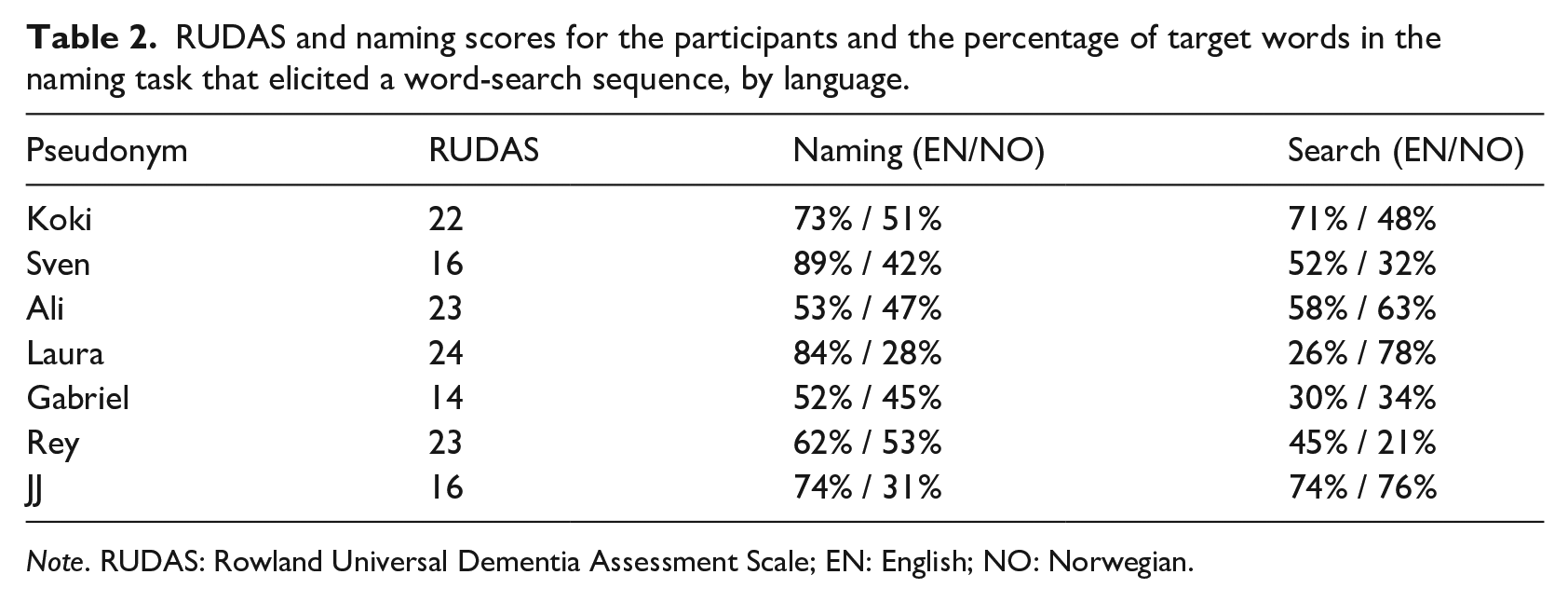
Note. RUDAS: Rowland Universal Dementia Assessment Scale; EN: English; NO: Norwegian.
All participants completed a naming test with 31 drawings depicting objects taken from the Norwegian version of Psycholinguistic Assessments of Language Processing in Aphasia (PALPA; Kay et al., 1996), and 31 drawings depicting actions taken from the Norwegian version of the Verb and Sentence Test (VAST; Bastiaanse et al., 2003, 2006). If the participant named several items in a row in a non-target language, a prompt was given to answer in the target language. The participants completed the naming test in a separate session and with a different test administrator for each of their languages. In this study, we only analyse the test sessions for English and Norwegian, since those two languages were the only ones, all participants had in common. These sessions were recorded on video, with four exceptions: Laura’s and Koki’s Norwegian sessions and both JJ’s sessions were only audio recorded. Their naming scores for English and Norwegian are given in Table 2, along with the proportion of responses involving a word-search sequence, as reported by Hansen et al. (in prep.). All responses with a word-search sequence constitute the dataset for this paper. They were analysed using CA, combined with a statistical analysis.
Conversation analysis
Building on conversation analytic research on word searching, a two-step coding process was conducted. As a first step, Hansen et al. (in prep.) coded all the participants’ naming responses in Norwegian and English as containing or not containing a word search. Word searches were identified as instances in which the participant did not produce an immediate answer to the stimuli, but initiated a word search, for instance with hesitation, filled pauses or other search markers. As a second step, which is the focus of the present study, the identified word-search sequences were transcribed and analysed in detail using CA to identify and describe the various word-search strategies used. The two-step coding scheme was inductively developed by the first author in collaboration with the second author to distinguish various types of word searches, taking a bottom-up approach (Stivers, 2015). Subsequently, all the data were coded by a research assistant, leading to several rounds of specification and re-coding. No formal inter-rater reliability measures were conducted, but all cases of doubt were discussed individually until consensus was reached. Transcripts follow the conventions developed by Jefferson (2004) (see Appendix 1). Extracts involving other languages than English are presented with the original language first, and a second line with English translation in bold. Code-switching within extracts is marked with italics and language in parenthesis.
Taking a conversation analytic perspective, the analysis involves the actions of both parties and how they coordinate their contributions in both individual and collaborative searches, although the focus of this study is on the search activities of the persons with dementia. Another analytical principle in CA is applying an emic perspective: We describe the participants’ normative orientations as manifested, rather than applying external standards of evaluation (Seedhouse, 2005). Hence, problems and solutions to word-finding problems are described based on what the participants themselves treat as satisfactory or problematic responses to the word finding.
Quantitative analysis
Quantitative analyses of the coded dataset were carried out in R version 4.2.1 (R Core Team, 2022) by means of RStudio (RStudio Team, 2022). We used the packages base and ggplot2 (Wickham, 2016) to explore and analyse the data. Heatmaps were produced to visualise individual profiles.
In successful search sequences involving multiple word-search strategies, we cannot tell which strategy led to the success – it may well be the combination. To investigate success rate, we scored all strategies used as successful or not based on the outcome of the whole sequence. Given the lack of independence between observations, we refrained from statistical tests of these data, but used Wilcoxon tests to compare the number of strategies involved in successful and unsuccessful search sequences.
The interest in connections between search activity and properties of the target words is based on psycholinguistic insights into lexical processing. In this paper, we limited our investigations of lexical effects to the Norwegian dataset, for which we had access to four factors well known to influence word activation: word class, frequency, age of acquisition, and imageability. Lexical properties were downloaded from the online database Norwegian Words (Lind et al., 2015). We hypothesised that the fewer strategies participants would employ per search sequence, the more easily retrievable the target word was predicted to be. We expected more search strategies per search sequence for nouns than for verbs, and fewer the strategies employed the higher the imageability, the higher the lemma frequency, and the lower the age of acquisition (i.e., the earlier the word is typically acquired). Here, Wilcoxon tests and Spearman’s rank correlation coefficient were used for analyses.
Results
Detailed analysis identified six broad word-search strategies used in the English and Norwegian naming test sessions. Table 3 shows an overview, together with the distribution for all participants across their common languages English and Norwegian, ordered by overall frequency in the data. We identified 812 occurrences, 442 in the English test session and 370 in the Norwegian test session. Chi-square tests uncovered one significant difference between languages: Embodied demonstration occurred significantly more often in English (χ2(1) = 14.3, p < .001).
Occurrence of each of the six word-search strategies in the dataset, by language.
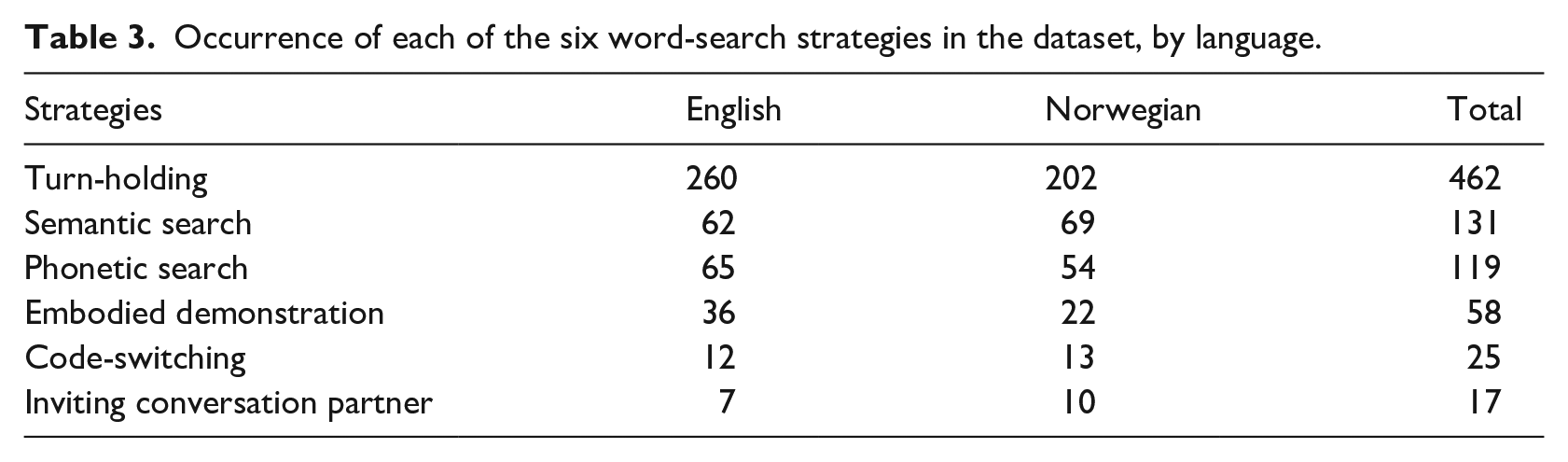
In the next section, we will illustrate each of these word-search strategies in a qualitative CA. The extracts are primarily chosen to represent clear examples of the six strategies. In addition, several examples illustrate successful search-sequences and characteristic search patterns for two of the participants discussed in detail below. We then turn to quantitative analyses to explore possible connections between the use of word-search strategies and properties of the word, as well as the success rate of using word-search strategies. Finally, we look at individual profiles, focusing on two of the participants, relating their word-search activity to diagnostic features.
Qualitative CA
Turn-holding
Turn-holding strategies include vocal search markers (e.g., sound stretches, hesitation, cut offs), embodied search markers (e.g., gaze up to the left (‘thinking face’), pauses, hand gestures, and other bodily movement signalling search activity (e.g., leaning back, closing the eyes). Also, verbal resources can contribute to holding the turn, through producing self-directed meta comments oriented to the search (e.g., ‘what’s it called again’) or through producing an account, explaining or excusing the word-finding difficulties. These strategies are often used in combination and contribute to maintaining speakership despite production problems, and are prototypical hallmarks of word searches. Turn-holding is also by far the most frequent word-search strategy found in our data (cf. Table 3).
Extract (1) illustrates how Koki (K) employs turn-holding through vocal and embodied search markers in response to the target word ‘mitten’ in a test situation with test administrator 1 (T1). Combined with an embodied demonstration, he succeeds in finding a suitable word, although in Norwegian (hanske ‘glove’).
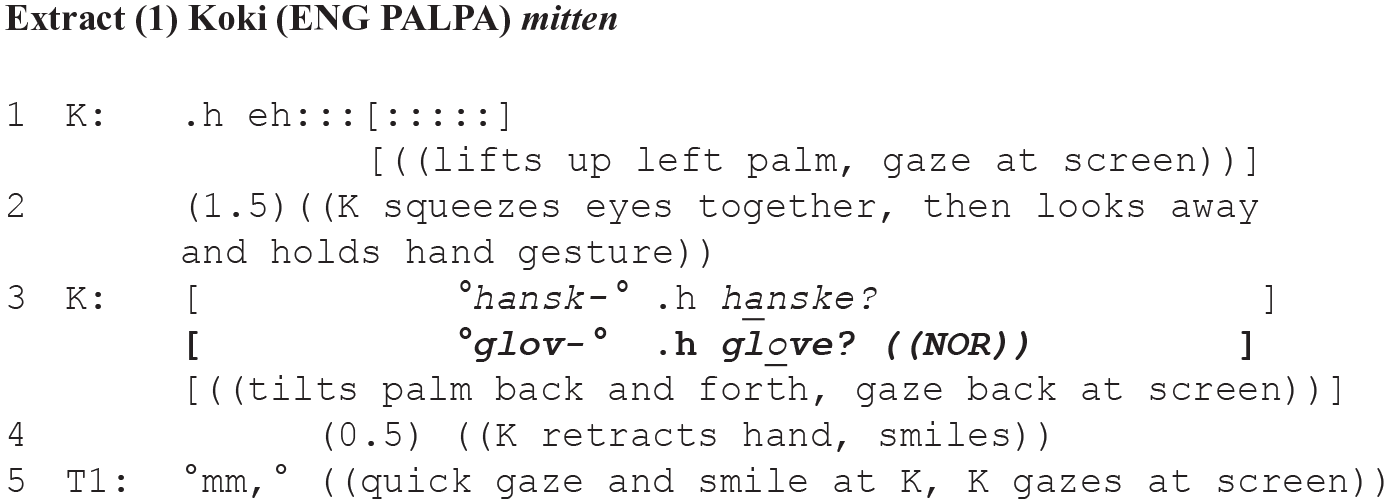
Koki launches a search with a hesitation marker (line 1), before he lifts his left palm in a hand gesture and keeps it in stroke position as part of his turn-holding for an extended period, in a ‘gesture hold’ (Sikveland & Ogden, 2012). His ongoing individual search activity is maintained by squinting his eyes and looking away, displaying embodied self-addressed search (line 2) (Goodwin & Goodwin, 1986). After these turn-holding strategies, he produces the target word in line 3. First, he produces an aborted attempt with low volume, then a full form with normal volume and ‘try-marked’ rising intonation, inviting confirmation from the interlocutor (Sacks & Schegloff, 1979). Additional examples of turn-holding can be found in other extracts below (see e.g., the beginning of Extracts (2) and (4)).
Phonetic search
A phonetic search involves producing the first sound(s) of a lexical item, typically with sound prolongation and/or re-starts.
This word-search strategy is exemplified in the following Extract (2), where the target word is halskjede or kjede ‘necklace’, a low frequency word with high age of acquisition, but also high imageability.
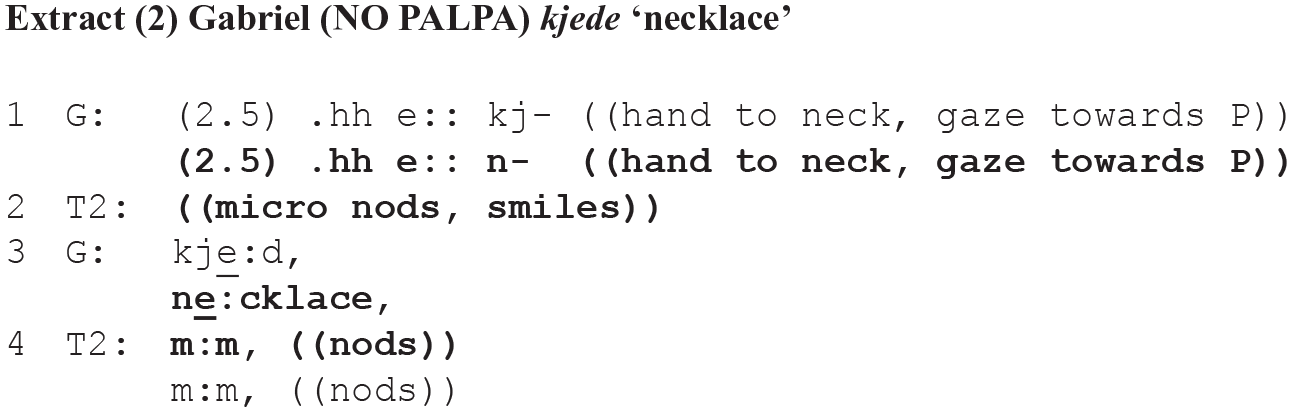
Gabriel (G) starts his search activity with a hesitation marker (e::) in line 1. Subsequently, he produces the first sound of the word (a dorsal fricative) but then cuts off the word before completion. He also gives a clue as to the content of the word searched for by moving his hand to the frontside of his neck (thus also manifesting an embodied search). After an encouraging nod and smile from the test administrator T2 (line 2) indicating that the search is still in progress, he succeeds in finding the target word (although slightly unidiomatic, without the final vowel). Another example of phonetic search can be found in Extract (6), line 11.
Semantic search
When the participants displayed problems finding a word, some would use semantic search strategies, that is, providing explanations or semantically related words, showing that they have access to the concept but are unable to find the correct lexical item.
A case in point is the following Extract (3), where the picture shows two hands braiding hair. The Norwegian target verb, flette ‘braid’, is low in both frequency and imageability, and thus we expect it to be hard to retrieve.
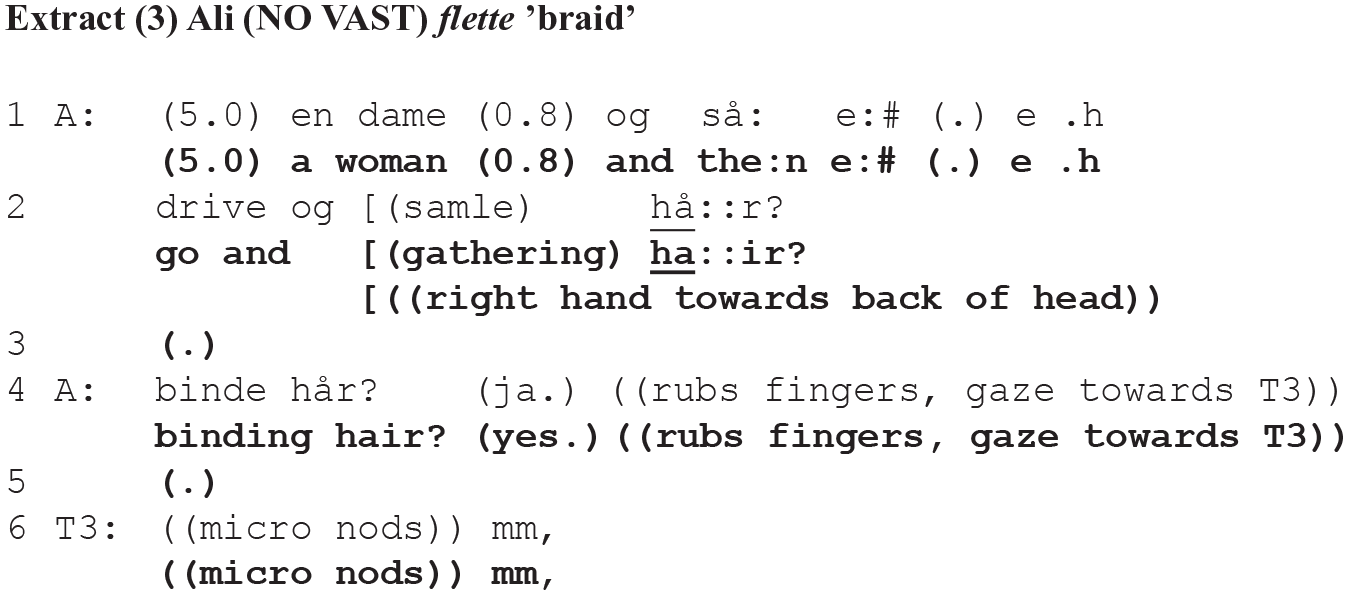
Ali’s (A) word-search is manifest by the extended initial pause of 5 seconds and the hesitations and pauses in the following utterance. Instead of providing a single word, he produces a full sentence, placing the designated action into a narrative frame. As such, he uses a circumlocution aimed at conveying the meaning but not the lexical item requested. The descriptions constitute semantically related, but more general concepts, given that braiding is a more specific type of gathering and binding. He also uses gestures (lines 2, 4), further demonstrating access to the concept involved. The candidate words are presented with rising intonation (‘gathering hair? binding hair?’), displaying uncertainty about the correctness of the suggestion. This practice of ‘try marking’ (Sacks & Schegloff, 1979) is conventionally used to seek confirmation from the interlocutor.
Embodied demonstration
Embodied demonstrations (cf. Keevallik, 2014; Kindell et al., 2013) involve the use of bodily resources during a search, that is, before producing a target word. Examples are hand gestures (e.g., drawing a figure in the air, pointing to objects or body parts) or non-lexical sounds, such as onomatopoeia (e.g., snoring sound).
Extract (4) illustrates an embodied demonstration during Ali’s (A) search for the Norwegian noun hjul ‘wheel’, which is in the mid-range in terms of both frequency and imageability. He employs as many as four different strategies in his search; turn-holding, embodied demonstration, code-switching, and invitation to conversation partner, but the focus here will be on the embodied demonstration.
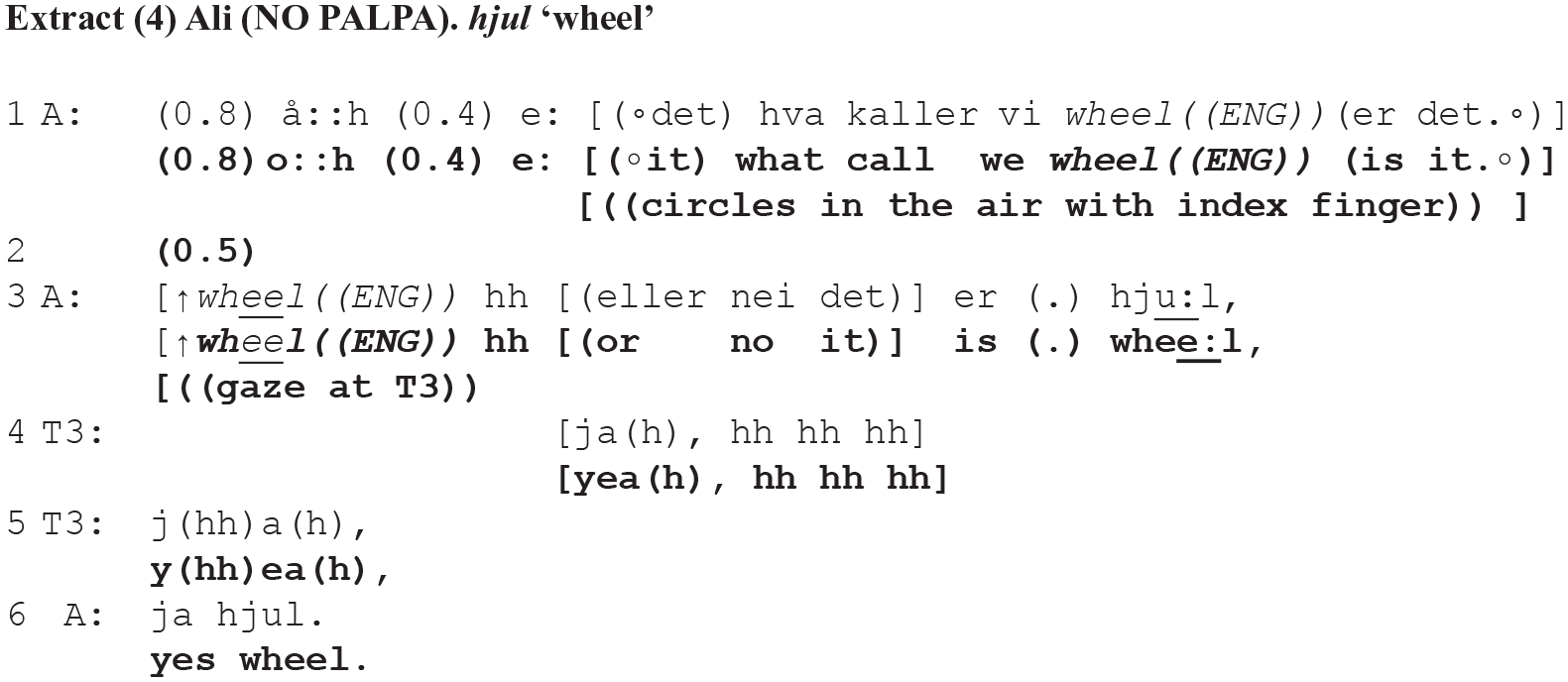
The pauses and hesitation markers in line 1 initiate a search. Ali then launches a verbal search marker, inquiring about the Norwegian equivalent of the English word (‘what do we call wheel’). The search activity so far is self-addressed in that he produces the question with soft voice and gaze down to the left. These turn-holding strategies are accompanied by an iconic gesture, in which he draws a circle in the air. The embodied demonstration is produced before a candidate word, indicating that it works as a memory prompt. After a 0.5 second pause, Ali restates the target word (↑wh
Code-switching
Code-switching as a search strategy involves producing a lexical item in a different language than the target language during a word search. That it is used as a search strategy implies that it is not presented as an answer (e.g., with final intonation and gaze to the screen or test administrator), but rather as a clue to an answer.
The search sequence in Extract (5) illustrates how Koki (K) reaches the target word whale in English after having produced the word in his L1 Japanese.
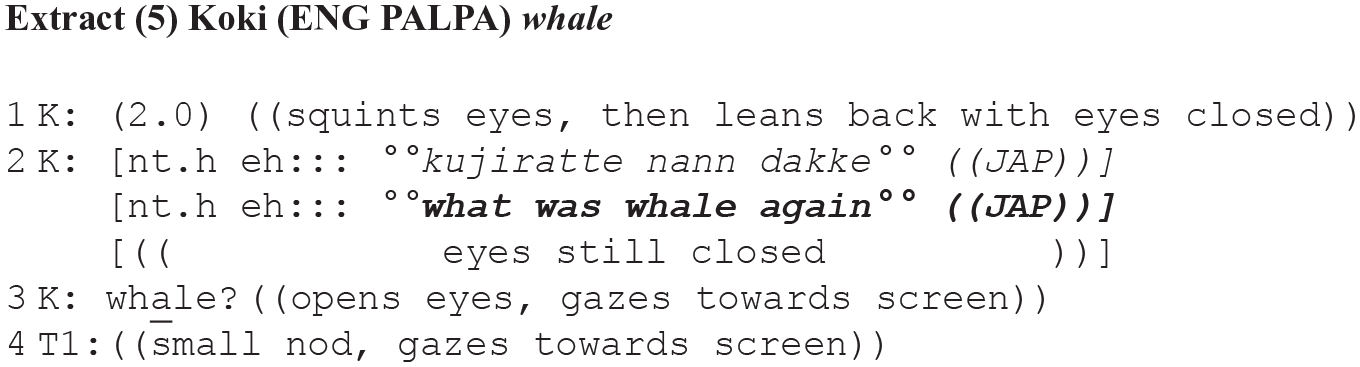
During an elongated pause and hesitation marker, Koki displays thinking by squinting his eyes before closing them completely. Holding this posture, he utters with very low voice in Japanese ‘what was whale again’. This question is a typical memory prompt question as displayed by the past tense of the verb and the addition of the adverb ‘again’. It is also recognisably self-directed in that it is uttered with low volume and closed eyes, thereby constituting yet another display of searching. The production contrasts clearly with the answer provided in line 3, where he opens his eyes and returns to his normal speech volume. The self-directed utterance thus involves code-switching to a more familiar language, in which he produces the word corresponding to the search target without any problems. The production of the word in Japanese seems to be a part of his search strategy, as the memory prompt question could have been formulated also without the full noun (as is typical in such memory prompt questions), merely as ‘what was it again’. The example thus illustrates how other languages can be a resource during word searches for retrieving the right words in the right language (see also Svennevig et al., 2019). Other examples of code-switching can be found in Extracts (1), (4), and (6).
Inviting conversation partner
We found that the participants sometimes appeal to the interlocutor for confirmation or assistance by producing candidate answers or cues with rising intonation. In addition, they sometimes produce more explicit requests for help from the conversation partner, as in the following Extract (6). The target word skjell ‘shell’ in Norwegian is a mid-frequent and highly imageable word, which implies retrieval should not be particularly hard, but the picture appears to evoke different associations for Ali (A).
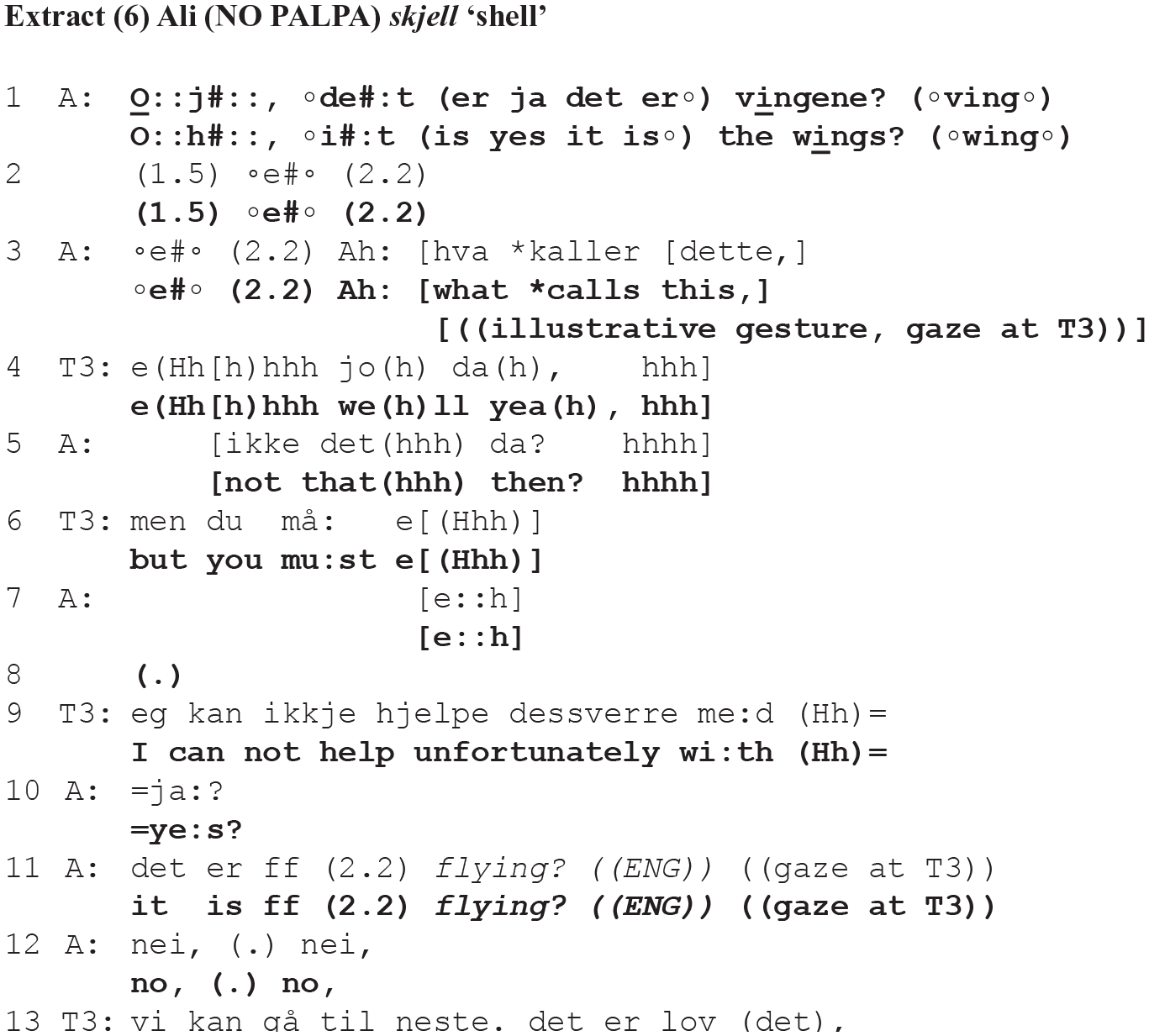
After having produced a candidate answer with rising intonation (‘vingene?’ ‘wings?’) and getting no response from the test administrator (T3), Ali continues the search by gazing at T3 asking her what ‘this’ is called, together with an illustrative gesture. T3 does not respond, but instead starts laughing, orienting both to the sensitivity of not being allowed to provide an answer, as well as mitigating the sensitivity of Ali’s incorrect answer (Lindholm, 2008; Saunders et al., 2011). Ali joins the laughter and continues to pursue a response with an understanding check (‘ikke det da?’ ‘not that then?’). By so doing, he seeks confirmation of his interpretation that the candidate answer in line 1 was wrong. T3 denies this and initiates an utterance that seems to provide some form of guidance on how to answer (or maybe how to find the correct answer). However, she aborts this mid-course and instead explicitly and metacommunicatively informs him about her restrictions on helping him. In yet another attempt to find the word, Ali uses a phonetic search (line 11) while continuing to seek confirmation from T3 with a try-marked candidate answer, produced with rising intonation and gaze at T3 (Goodwin & Goodwin, 1986; Sacks & Schegloff, 1979). After disconfirming his own guess, T3 suggests moving on. Other instances of embodied and verbal invitations to conversation partners can be seen in Extracts (1), (3), (4), and (5).
Combining multiple strategies
As demonstrated in the analysis thus far, making use of multiple strategies in the same word-search sequence is common: As many as 60% of the word-search sequences in our dataset involve more than one strategy, and 35% more than two. Extracts (1), (2), (4), and (5) are examples of successful word finding after combining multiple strategies. In the next section, we investigate associations between strategy use and success rate in the test, before turning to properties of the target words that tend to elicit searches.
Quantitative analyses
Table 4 summarises the success rate of the word-search sequences involving the identified word-search strategies. The strategies cannot be contrasted directly, as participants often used more than one strategy in each word-search sequence.
The six main strategies and the success rate of the search sequences involving them, by language.
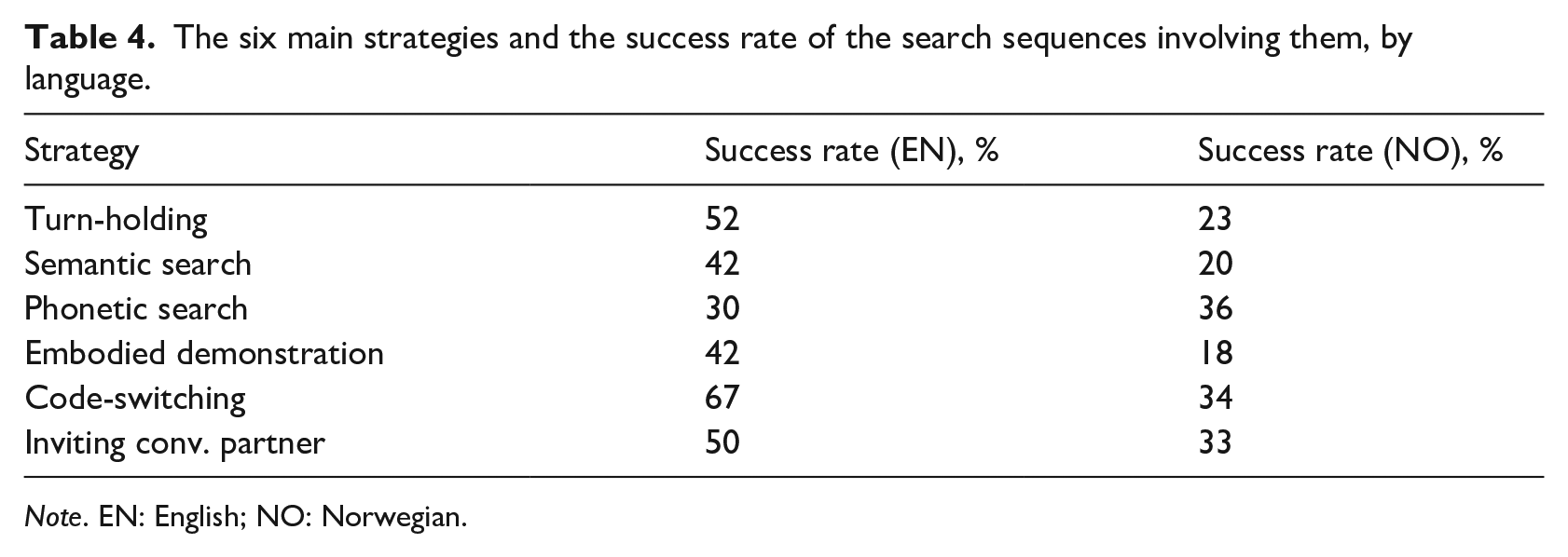
Note. EN: English; NO: Norwegian.
Turning to the number of strategies involved in each word-search sequence, the participants succeeded significantly more often when using only one strategy (50% success) than when they used more than one (32% success, χ2 = 12.45, p < .001), but there was no significant difference in success rate between two (35%) and three or more strategies (42%). While these results might be taken to indicate that word-search strategies fail to help the speaker, another possible explanation is that the words that induce word searches are the words that are harder to retrieve from the lexicon. If so, we would expect associations between the number of strategies and word properties known to predict word difficulty.
As outlined in the introduction, we focus on four such properties, in Norwegian only: word class, imageability, frequency, and age of acquisition. Statistical analyses revealed that the participants used significantly fewer word-search strategies the higher the imageability (rS = −0.61, r < .001) and the lower the age of acquisition (rS = 0.31, p = .017) of the target word. As illustrated in Figure 1, there were also significantly fewer strategies at play when the target word was a noun (Mdn = 5) than when it was a verb (Mdn =7, W = 228, p < .001). No significant correlation was found between the number of strategies and word frequency (rS = −0.05, p = .734).
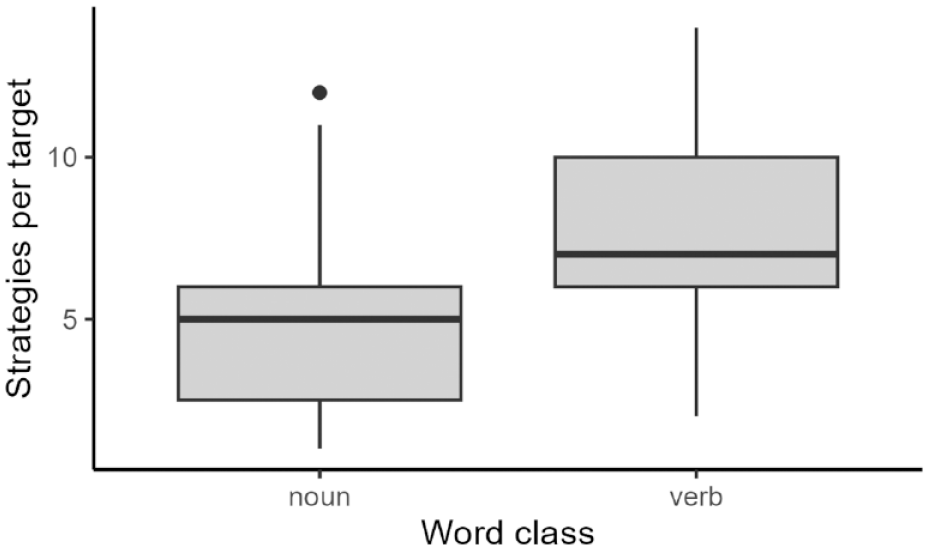
Word class differences in the number of word-search strategies used per target word, with thick lines indicating medians, box edges showing quartiles, and whiskers extending to the data point closest to 1.5× interquartile range.
Individual profiles
Turning to the individual level, the participants used a mean of two strategies per word-search sequence, spanning from Sven (1.4) to JJ (2.3). There were individual differences in the use of the six identified strategies, as illustrated by heatmaps for Norwegian and English, respectively, in Figure 2(a) and (b). Turn-holding and phonetic searches were common for all participants (comprising 45%–69%), while the use of the other strategies varied. For instance, Sven only used phonetic searches, and Gabriel differed from the others by not using code-switching as a strategy. For all seven, the pattern differed across languages. JJ and Laura (both L1 speakers of English) used code-switching only in the Norwegian session. Note that since video recordings are missing for JJ (both languages), Laura, and Koki (Norwegian), the extent of their use of embodied demonstration cannot be determined.
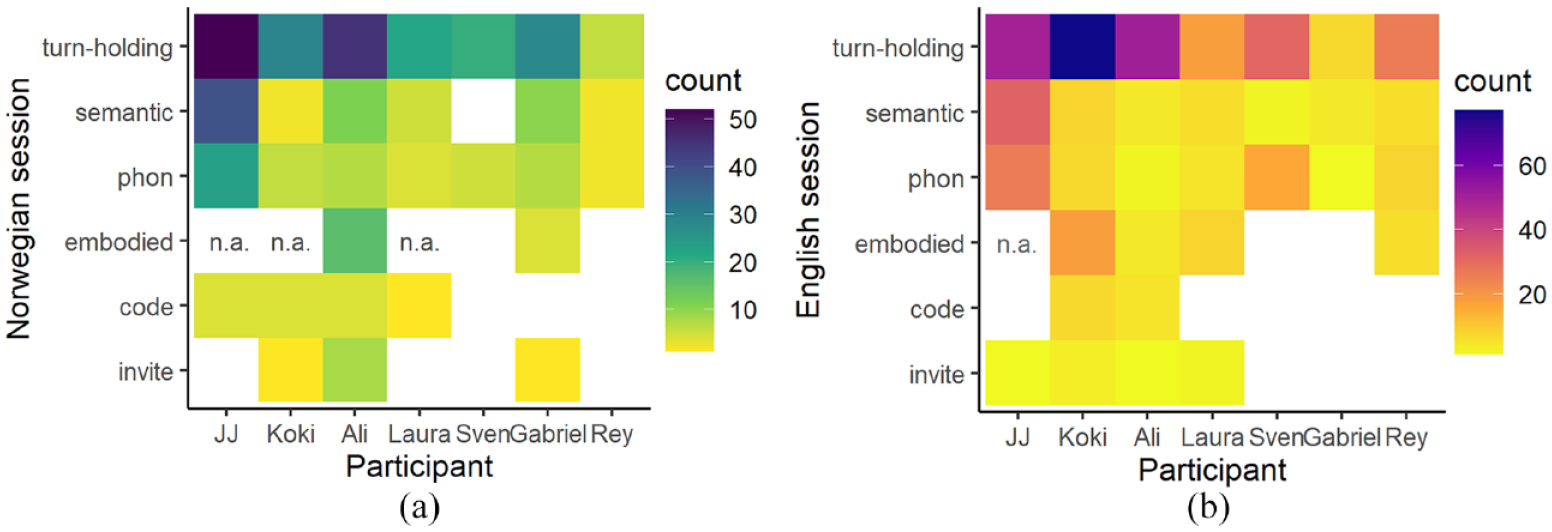
Heatmap of the participants’ use of word-search strategies in the (a) Norwegian test session and the (b) English test session; the more instances, the darker the colour (white squares indicating no cases and n.a. indicating missing data, as audio recordings cannot reveal embodied actions).
In the final part of this section, we will go further in depth into two participants (Koki and Ali). They both use all the identified word-search strategies and seem to profit from using them. As outlined above, Koki (85) and Ali (77) both have AD and score similarly on the cognitive assessment battery (see Table 2). Koki had a typical amnestic type of moderate degree, with memory problems and problems with orientation and increasing problems with the Norwegian language from 5 years before data collection. The severity of his symptoms increased gradually. Ali was reckoned to have an etiologically mixed presentation of AD, fulfilling the clinical core criteria for AD, but with evidence of other conditions influencing cognition. He was AD biomarker (amyloid PET) positive. At the time of inclusion, Ali had mild stage dementia.
Koki and Ali both moved to Norway in their 30s, and they were highly proficient in Norwegian. Both learned and used English from childhood (Koki from birth, Ali from early school years), along with a first language not shared with the majority population. Koki identified English as his stronger of the two languages, while the opposite was true for Ali.
As shown in Figure 2, Ali and Koki make use of all the six main strategies and turn-holding is the most common for both (62% for Ali and 65% for Koki). Both tend to use more than two strategies when searching (cf. Extracts 1, 3–6). The maximum number of strategies used in one and the same word-search sequence for Koki was seven (the English verb ‘sow’) and six for Ali (the English verb ‘swing’).
As shown in Table 2, Ali scores similarly in the two languages, whereas Koki scores higher in English. Notably, Koki used significantly more search strategies per sequence in English (Mdn = 2.5 M = 2.7) than in Norwegian (Mdn = 1 M = 1.5, W = 968.5, p < .001), while Ali did not differ significantly between languages (English: Mdn = 1 M = 1.9; Norwegian: Mdn = 2 M = 2.3, W = 536.5, p = .064). The difference in the amount of searching is also reflected in time used: Whereas Koki’s English test session lasted 26 minutes, Ali’s session only lasted 13 minutes. This may indicate that Koki profited from his extensive search activity in English, for example, through his use of various turn-holding strategies, buying time (cf. Figure 2(b)).
The qualitative CA also shows some differences in their individual word-search behaviours: Koki relies primarily on individual retrieval. Many of his (successful) searches are characterised by self-directed code-switching to his dominant L1 Japanese, prompting himself to find the word in the target language (see Extract 5 and Svennevig et al., 2019). Also, his turn-holding is characterised by individual, embodied search markers, such as closing his eyes, thinking face, squinting, and leaning forward scrutinising the picture, indicating to the interlocutor that an individual search is going on (Goodwin & Goodwin, 1986), in one instance for more than half a minute before uttering a single word. In the verb part, he recurrently employs a repeated frame sentence (‘a man/woman who . . . ’) which also contributes to buying time, working as a turn-holding device.
While Ali also employs individual search strategies, he seems to exploit the interlocutor more extensively, by inviting them to help, both verbally and with the use of gaze (see Extracts 3, 6, 7). In contrast to Koki, he uses code-switching to a shared language (English), thus making his ongoing retrieval accessible to the interlocutor. In combination with embodied and verbal invitations, Ali thus recurrently invites the interlocutor to contribute to the search, both by subtle and more explicit means (Hayashi, 2003). These strategies may lead to success (see Extract 4), although not necessarily (see Extract 6). Comparatively, both Koki and Ali seem to benefit from their extensive use of search strategies, although their search patterns differ. It is worth noting that Koki, being at a later stage of dementia than Ali, appears to have developed quite effective independent word-finding strategies.
Discussion
This paper combined insights and methodologies from CA and psycholinguistics to investigate and illuminate the interface between word-finding problems and word-search behaviour. Analysing the word-search behaviour of seven participants with dementia during picture naming, we found six main word-search strategies: turn-holding, semantic, phonetic, embodied searches, code-switching, and inviting the conversation partner to help. Turn-holding was by far the most common word-search strategy in both English and Norwegian, amounting to more than half of the instances. Code-switching appeared as the most successful strategy in English, as did phonetic searches in Norwegian. We found that the more word-search strategies, the lower the imageability and higher age of acquisition, and more so for verbs than nouns, indicating a relation between the amount of word-searching and word difficulty.
All participants used several word-search strategies, and 60% of the search sequences involved more than one. Turn-holding, semantic, and phonetic searches were used by all seven, while embodied search, code-switching, and inviting help were only used by some, revealing individual differences. The participants used more search-strategies in English, although it was their stronger language according to their naming scores. The participants succeeded in word searches more often when only one strategy was used. A closer inspection of two participants revealed differences in the distribution between strategies, and in which strategies they benefitted the most from the two languages.
Below we will discuss these findings in two directions: First, we explore what a combination of a psycholinguistic approach (here represented by usage-based theory) and a conversation analytic approach can tell us about the intersection between word-searching and word-finding, discussing implications for the two theoretical perspectives. Second, we present three implications for clinical practice in relation to test settings and for everyday interaction.
Theoretical implications
Looking at the overall functions of the identified search strategies from our combined psycholinguistic and conversation analytic approaches, we argue that the six strategies to varying degrees draw on cognitive and interactional resources. The search strategies may thus constitute continua ranging from less to more cognitively oriented and from less to more interactionally oriented. For example, phonetic searches may draw mainly on cognitive resources (phonetic connections in the mental lexicon, cf. Bybee (2010)), whereas inviting the conversation partner may be more interactionally oriented, by eliciting evaluative responses from the test administrators (Sikveland et al., 2021). Turn-holding constitutes a method for gaining more time (cognitively oriented] without being interrupted (interactionally oriented). Semantic searches, code-switching, and embodied demonstrations (the latter two can be viewed as subtypes of semantic searches) may be regarded as both highly cognitively oriented (manifesting online activation along semantic connection lines) and interactional, as they make available to the interlocutor, in real-time, knowledge thus far of the concept searched for (Hayashi, 2003; Klippi & Ahopalo, 2008). This model is visualised in Figure 3.
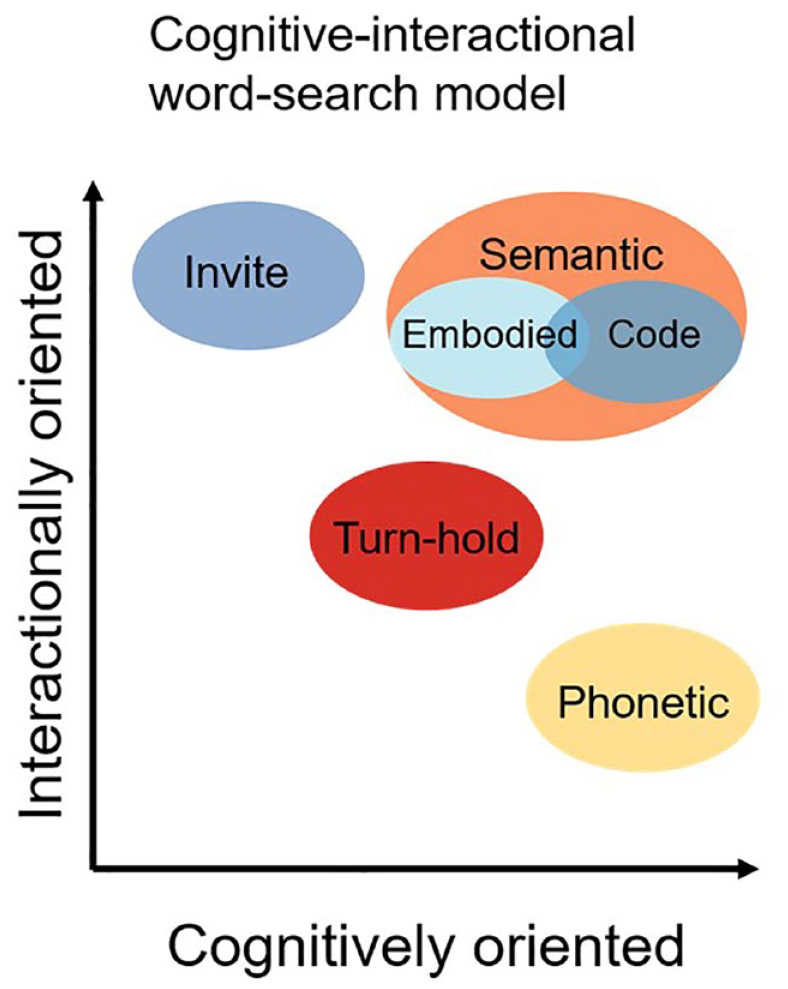
A schematic representation of the identified search strategies on a scale indicating the degree of interactional and cognitive involvement.
The parallel mental and interactional processes involved in the interface between word finding and word searching is also manifest on an individual level. Whereas Koki mainly relied on individual retrieval, enabled by effective turn-holding strategies combined with self-addressed searches and code-switching to a language not shared with the interlocutor; Ali also elicited and drew on input from the conversation partner during his word searches (cf. Extracts 1, 3–6). By focusing on the interface between (cognitive) word-finding processes and (interactional) word-searching behaviour, this paper contributes to integrating the simultaneous processes normally studied separately as either cognitive word-retrieval processes (i.e., word-finding) or as interactional search behaviour (i.e., word-searching; Landmark & Hansen, 2019).
By combining conversation analytic and psycholinguistic approaches, one can take both psycholinguistic (e.g., word properties) and interactional (e.g., word-search) aspects into account, allowing a broader scope than by using only one of the approaches. As such, this study adds new knowledge to the interrelated, but previously separated psycholinguistic and interactional strands of research on dementia in a clinical context. The study thus takes novel methodological steps, exemplifying the added value of combining theoretical perspectives that are traditionally perceived as incompatible, one dealing exclusively with observable behaviour, the other established precisely to shed light on the psychology of language.
The results corroborate a usage-based approach to the mental lexicon, language processing and language activation. Our participants tend to use multiple strategies in the same search sequence. This pattern tallies with a view where the mental lexicon contains not just a minimum of semantic and phonetic information, but rich mental representations based on the sum of our experiences with each word and the concept they refer to, be they auditory, visual, kinaesthetic, olfactory, or gustatory. If the mental lexicon is organised by perceived similarities in usage, form, and meaning (Bybee, 2010), we would expect the use of multiple word-search strategies to promote access through multiple paths. This is exactly what we find; for instance, when Ali combines code-switching, embodied demonstration, and phonetic search in Extract (4), he may be activating the target word through semantic and phonetic connection lines. It also appears that his access to the word hjul ‘wheel’ is gradual, first as a motion and a linguistic concept and gradually also in form. It may thus be more appropriate to see lexical access as a situated and gradually emerging phenomenon than as an either-or categorical property.
Our analyses indicate a connection between the difficulty of the target words and the participants’ word-search behaviour: They employed more search strategies when searching for a verb than for a noun, and more strategies if the target word had a low imageability and/or a high age of acquisition. These findings, in addition to the fact that phonetic searches were a common strategy for all participants, are indicative of problems with access to the word, in line with problems found in healthy ageing (Burke & Shafto, 2004). However, our findings do not rule out a possible deterioration of the semantic representations in our participants (Pekkala et al., 2013).
The use and success of embodied demonstrations are of particular interest: While not the most common strategy in our dataset, one out of three times when embodied demonstrations were used, the word-search sequence was successful. The success rate may be an attribute of our mental lexicon, and even cognition itself, essentially emerging from sensory–motor experiences. If so, it would not make sense to see or treat language difficulties in isolation. Former studies have shown that training active gesture use can facilitate word-retrieval among persons with aphasia (Marangolo et al., 2010; Rose et al., 2002). Our results indicate that such approaches may be beneficial also for persons with dementia.
Implications for practice
This study has implications for test interaction, everyday interaction, and clinical practice. First, it contributes to a relatively unexplored, but growing line of research; on test interaction as interaction (cf. Myrberg et al., 2020). The test setting is viewed as a relatively ‘controlled’ setting, where the test administrator is instructed to not offer any help, aiming at measuring the participants’ individual abilities (e.g., access to the mental lexicon). Our results demonstrate that the participants nevertheless invite help from their interlocutor, reflected in being one of the six identified strategies, albeit the least frequent one.
Moreover, our findings indicate that test administrators do guide the participants’ searching by offering subtle cues through various minimal or withheld responses (cf. Extracts 2, 4, 6). Thus, instructing a test administrator to not interact may be counterproductive because ‘switching off’ interaction is not possible. Instead, future test protocols should treat interaction as ever-present, and something that can be drawn on rather than stifled.
Second, a naming test is designed for charting the mental lexicon. Consequently, more interactionally oriented strategies that may help in everyday interaction, may not count towards the participants’ naming scores. For example, semantic searches, code-switching to a shared language, and embodied demonstrations may be sufficient in everyday interaction for achieving mutual understanding. However, in a test setting, such strategies only pay off when the participant arrives at the correct target word in the expected language. As such, the participants’ exploitation of their full linguistic repertoires may not be reflected by only looking at test scores. Thus, relying solely on test scores poses questions about ecological validity, and may challenge the relevance for everyday interaction and clinical practice. One possible solution is to supplement standardised testing with more interaction-based assessment (cf. Myrberg et al., 2018).
As for everyday interaction, individuals with dementia who experience word-finding difficulties may profit from using their full repertoire of linguistic, cognitive, and interactional resources, including a variety of word-search strategies. Based on this study and previous findings from aphasia research (Marangolo et al., 2010; Rose et al., 2002), we propose that future research should explore whether training people to use multiple strategies may promote word finding in dementia conditions.
Third, the study indicates that interlocutors play a crucial role in co-constructing the outcome, even in a test situation. In one search sequence, Koki holds his turn for 35 seconds without the interlocutor intervening, contributing to Koki’s successful word retrieval. In a recent review, Volkmer et al. (2020) found that interaction-based interventions, building on communication strategies persons used, and practicing these strategies with an interlocutor, improved communication outcomes for persons with PPA. These findings indicate a potential for designing intervention programmes targeting word-search strategies persons already use, as well as involving interlocutors, for instance, in line with interventions developed by Beeke et al. (2013) and Volkmer (2020).
Limitations and future directions
This paper has explored the intersection between word-finding problems and word-search behaviour in seven immigrants to Norway diagnosed with dementia. While the interdisciplinary approach has proved useful, the study comes with some limitations. First, the participant group was small and heterogeneous when it comes to medical history as well as language history. Also, the lack of video data in four of the test sessions may limit the scope of our quantitative findings about the successfulness of combining strategies as well as correlations between word factors and number of strategies employed.
Another issue of the study design is the complexity of comparing different word-search strategies, when so often more than one is at play. However, this complexity may well reflect the realities of everyday interaction. A larger dataset could, however, allow for more sophisticated statistical analyses to surpass the challenge and identify patterns regarding not only which strategies tend to be associated with successful word retrieval, but also how the different strategies interact, and whether they relate to properties of the words they are used to search for.
In this study, we limited the analyses to strategies from the main participant. Thus, we did not analyse systematically the conversation partner’s contributions. The excerpts indicate that looking more closely at their behaviour might be useful both for a better understanding of the tester’s role in test situations and for the development of guidelines for test interaction.
Conclusion
This paper has shown that multilingual speakers with dementia mainly use six general word-search strategies during a naming test session: turn-holding, semantic searches, phonetic searches, embodied demonstrations, code-switching to another language, and inviting help from the conversation partner. Code-switching appeared to be the most successful strategy in English, and phonetic searches appeared to be the most successful strategy in Norwegian. Using multiple strategies in the same word-search sequence was more common than using only one, and more so the more difficult the word, indicating that the participants activate their target words through multiple paths simultaneously, in line with a spreading activation model of the mental lexicon.
The study adds new knowledge to the interrelated, but previously separated psycholinguistic and interactional areas of word-finding difficulties and word-searching behaviour, in a clinical context of dementia. By combining these theoretical and methodological approaches from psycholinguistics and CA, the study points to several implications for test interaction, everyday interaction, and clinical practice.
Footnotes
Appendix 1
Acknowledgements
The authors are deeply indebted to the participants taking part in the study. We also want to thank Aafke Diepeveen, Maria Njølstad Vonen, Malene Bøyum and Andre Nilsson Dannevig for research assistance, and all the others who have contributed in the project as interpreters, or facilitated recruitment and data collection. We want to acknowledge the Norwegian registry of persons assessed for cognitive symptoms (NorCog) for providing access to patient data.
Declaration of conflicting interests
The author(s) declared no potential conflicts of interest with respect to the research, authorship, and/or publication of this article.
Funding
The author(s) disclosed receipt of the following financial support for the research, authorship, and/or publication of this article: This work was partly supported by the Research Council of Norway through its Centres of Excellence funding scheme (project number 223265 and project number 250093).
