



Abstract
Aims and objectives:
Prior research shows that bilingual pupils may have foreign language learning advantages over monolinguals, but evidence is controversial. Investigating English as a foreign language (EFL) in the context of the Netherlands, we hypothesized that the conflicting findings may be partly explained by differences in extramural EFL exposure. We further predicted that amount and length of EFL exposure might moderate the effects of bilingualism on EFL learning and cross-language relationships between English and the previously acquired languages.
Approach:
Twelve- to 14-year-old Turkish–Dutch bilinguals (n = 30) and Dutch monolinguals (n = 31) participated. The Peabody Picture Vocabulary Test was used to measure receptive vocabulary in English, Dutch, and Turkish. Grammatical ability was measured with a sentence repetition task. A questionnaire was used to obtain information on children’s language exposure.
Data and analysis:
Data were analyzed by means of multilevel linear regression. Amount and length of extramural exposure were used as control variables in the analyses comparing EFL skills of bilinguals and monolinguals. The role of exposure as a moderator of bilingual effects and cross-language relationships was also tested.
Findings/conclusions:
If differences in exposure were not taken into account, the bilinguals were outperformed by the monolinguals on EFL vocabulary, but not on grammar. However, the between-group difference disappeared once exposure measures were controlled for. Bilinguals with little exposure to English performed worse than monolingual peers, but at higher exposure levels, bilinguals outperformed monolinguals. In the bilingual sample, Dutch vocabulary predicted English vocabulary, but Turkish proficiency did not predict English skills.
Originality:
This is the first study to include measures of extramural exposure in investigating the effects of bilingualism on EFL learning.
Significance/implications:
This research shows that differences between monolingual and bilingual EFL learners can be either concealed or inflated if exposure is not controlled for. Furthermore, exposure moderates bilingual effects in EFL learning.
Keywords
Introduction
Bilingual development may be associated with additional benefits, including cognitive (Bialystok, 2017; Chamorro & Janke, 2022; Dolas et al., 2022) and socio-emotional advantages (Sun et al., 2021). One type of bilingual advantage may lie in foreign language (FL) learning. There is a growing body of evidence that bilinguals outperform monolinguals in learning a third language (L3), which constitutes monolinguals’ second language (L2) (e.g., Cenoz & Valencia, 1994; Hopp et al., 2019; Keshavarz & Astaneh, 2004; Mady, 2017; Maluch et al., 2016; Muñoz, 2000; Rauch et al., 2011). For example, Sanz (2000) compared L3 English skills of Catalan–Spanish bilingual students and their Spanish monolingual peers. Results indicated that bilingualism independently contributed to greater English competence in comparison with the monolinguals. Similarly, Brohy (2001) found that Romansch–German bilinguals in Switzerland outperformed their monolingual German-speaking peers on L3 French proficiency. This being said, there are also multiple studies that did not find such advantages (Edele et al., 2018; Lorenz et al., 2020; Schoonen et al., 2002; Zoutenbier & Zwitserlood, 2019) or even found that bilingual pupils were outperformed by their monolingual peers. For instance, Van Gelderen et al. (2003) compared English reading skills of Dutch monolinguals and immigrant bilinguals with various L1s and Dutch as their L2. Results showed that the Dutch monolinguals outperformed the bilinguals.
Several factors have been proposed to explain the controversial findings in the literature. For example, bilingual advantages are more likely to be found in bilinguals with higher levels of L1 and L2 proficiency (Hopp et al., 2019; Muñoz, 2000) and in bilinguals who are also biliterate (Keshavarz & Astaneh, 2004; Rauch et al., 2011). Furthermore, bilingual advantages appear more robust in younger pupils and abate with age as monolinguals develop multilingual competence through FL lessons (Hopp et al., 2019). Maluch et al. (2016) studied the effect of bilingualism on English proficiency in a large sample of bilinguals with a minority language as their L1 and German as their L2 over a period of 2 years. While the bilinguals outperformed the monolinguals in English competence in sixth grade, this effect disappeared in eighth grade.
Another variable that could explain the conflicting findings in the literature on bilingual-monolingual differences in FL performance is out-of-school exposure to a FL. To our knowledge, this variable has not been considered in previous research despite the fact that extracurricular exposure is known to be a strong predictor of FL performance (Leona et al., 2021; Lindgren & Muñoz, 2013). The present paper will address this gap.
Extramural exposure as a confound variable
Prior studies on bilingual FL learning advantages have sometimes controlled for differences in amount or length of formal instruction, for example, by matching monolinguals and bilinguals for years of English as a foreign language (EFL) lessons (Cenoz & Valencia, 1994; Keshavarz & Astaneh, 2004; Maluch et al., 2016; Rauch et al., 2011). However, length of formal instruction appears to play a relatively small part in explaining individual differences in EFL outcomes because classroom time devoted to FLs in non-immersive settings is too limited to make a difference, and children starting FL lessons at a later age easily catch up due to their more advanced cognitive and metalinguistic skills (Muñoz, 2006).
In contrast, informal exposure to English outside of the classroom, also known as extracurricular exposure or extramural English (Sundqvist, 2009), is considered to be one of the strongest predictors of EFL performance (Leona et al., 2021; Lindgren & Muñoz, 2013). Extramural English involves both incidental and intentional learning that takes place in spare time outside of school (Sundqvist, 2009; Sundqvist & Sylvén, 2016). In countries, such as Belgium (Flanders), the Netherlands, Sweden, and Iceland, children are amply exposed to English language media and often attain an A2 level (Common European Framework of Reference for Languages [CEFR]) of oral proficiency in English before the start of English classes at school, although large individual differences between children have been reported (De Wilde et al., 2020; De Wilde & Eyckmans, 2017; Lefever, 2010; Leona et al., 2021; Peters, 2018; Puimège & Peters, 2019; Sundqvist, 2009). For example, Sylvén (2022) reports that some kindergartners in Sweden receive more than 20 hours of weekly exposure to English outside of school, and others less than 3 hours. Across studies, watching English-spoken TV programs with L1 or L2 subtitles comes out as a very strong predictor of various EFL skills (Leona et al., 2021; Lindgren & Muñoz, 2013; Peters, 2018; Puimège & Peters, 2019). Using internet and social media, speaking English and playing computer games are also positively related to EFL outcomes (De Wilde et al., 2020; De Wilde & Eyckmans, 2017; Puimège & Peters, 2019; Sundqvist & Wikström, 2015; Sylvén & Sundqvist, 2012). Sundqvist’s (2009) study using detailed exposure diaries in combination with a questionnaire revealed that extramural activities that required more active use of English (e.g., reading, gaming) were more strongly associated with oral proficiency and vocabulary in English compared to more passive activities (e.g., watching movies, listening to music). Comparing the effect of length of formal instruction and out-of-school exposure to English, Peters (2018) found that the former explained 7% of variance, whereas the latter explained 13% of variance. Hence, it is crucial to control for differences in extramural exposure when studying EFL outcomes.
It is surprising that studies on L3 advantages have not taken extramural exposure into account when comparing EFL skills of bilinguals and monolinguals. To the best of our knowledge, Sanz (2000) is the only study that included measures of both formal and informal exposure. Informal exposure was operationalized as the number of different extracurricular activities undertaken in English. For example, if the participants mentioned that they listened to music in English and watched American television, they would receive a score of 2 (with a maximum of 5 points). No significant effect of exposure was found, possibly because this measure was not sensitive enough.
It appears particularly important to consider exposure when comparing monolinguals and bilinguals. Some types of multilingual families may have more exposure to English because transnational couples often use English as lingua franca, particularly in heterogeneous expat communities (Pietikäinen, 2017; Soler & Zabrodskaja, 2017). Bilingual children growing up in this context may be exposed to English more than their monolingual peers. In contrast, large and more homogeneous bilingual communities, such as the Turkish community in the Netherlands, are more likely to use the heritage language (rather than English) for communicating with family and friends (Bezcioglu-Goktolga & Yagmur, 2017; Smith-Christmas et al., 2019). Moreover, in such bilingual communities, children are less likely to be exposed to English through media because media are used to increase children’s exposure to the heritage language (Bezcioglu-Goktolga & Yagmur, 2017; Smith-Christmas et al., 2019), and they are likely to have less out-of-school exposure to English than monolinguals. The latter scenario is more relevant to our study because our bilingual participants were recruited from the Turkish community in the Netherlands. In this study, amount and length of exposure will be taken into account in the comparisons of EFL outcomes of monolinguals and bilinguals.
The role of metalinguistic awareness: extramural exposure as a moderator of group differences?
A possible source of bilingual FL learning advantages is enhanced metalinguistic awareness, i.e., the ability to view language as an object, to reflect on language structure and to see similarities and differences between languages (Dolas et al., 2022; Hofer, 2015). Bilinguals compare their languages from early on and develop insights into how languages work. Although formal language instruction, and multilingual instruction in particular, boosts the development of metalinguistic awareness (Hofer, 2015), there is evidence that bilingual children outperform their monolingual peers on metalinguistic tasks even before the onset of primary school (Foursha-Stevenson & Nicoladis, 2011). 1 Sanz (2000) proposes that metalinguistic awareness leads to more efficient input processing abilities in bilinguals, so that, the amount of exposure that becomes intake (i.e., input effectively used for acquisition) and the quality of intake may be higher in bilingual learners, which would explain bilingual advantages in FL learning.
It is, however, also possible that such advantages are not visible at lower levels of FL exposure. Enhanced metalinguistic awareness should help bilingual FL learners to trace patterns in the new language based on their previous linguistic experience and recognize similarities with the previously acquired languages. However, in order to trace patterns in the input, a significant amount of exposure is needed. Enhanced metalinguistic skills are probably of little help when a learner has barely been exposed to an L3 (Eibensteiner, 2023). Moreover, increased L3 exposure further boosts the development of metalinguistic awareness and language learning strategies, as bilingual children gradually become multilingual (Dolas et al., 2022; Kemp, 2007). Therefore, bilingual advantages in FL learning are likely to grow with increased exposure to an L3. Hence, in this study, we will explore the possibility that length and amount of L3 exposure moderate the effects of bilingualism on L3 learning.
Extramural exposure as a moderator of cross-language relationships
In addition to metalinguistic awareness, bilingual advantages in FL learning can also be explained by positive transfer from more than one language system. For instance, bilingual vocabularies are likely to contain more cognates of L3 compared to monolingual lexicons. Similarly, learning of L3 grammar can be facilitated because bilinguals use two grammar systems as a resource for positive transfer. Typological proximity between languages in the multilingual mind determines the extent of interlingual transfer. A recurrent finding in the literature is that proficiency in a school/majority language that is typologically close to English (e.g., German or Dutch) strongly predicts EFL performance, whereas proficiency in a more distant heritage language (Russian or Turkish) does not (Edele et al., 2018; Lorenz et al., 2020; Tribushinina et al., 2021).
Research on L2 acquisition indicates that cross-language interdependence can be moderated by length of L2 exposure. More specifically, L1 transfer may not be available at the outset of L2 acquisition (Blom & Paradis, 2015; Hulstijn, 1991) and L1-L2 relationships become stronger as a function of length of L2 exposure (Blom et al., 2021; Tribushinina et al., 2022). Such discontinuity has been explained by the fact that learners need a certain amount of L2 experience in order to map L2 forms to familiar categories from the L1.
Similar proposals regarding L3 learning have been made by Eibensteiner (2023) and Stadt et al. (2018). Eibensteiner (2023) investigated positive transfer from L2 English in the acquisition of L3 Spanish grammatical aspect by L1 German students. The results revealed that in perfective contexts, that are generally acquired early, positive L2 transfer was already visible in low-intermediate learners, whereas for the later acquired progressives L2 transfer was only available to upper-intermediate learners. The author suggests that at the early stages of L3 acquisition, the learners were not yet “developmentally ready” for processing the progressive construction and thus could not benefit from their L2 English knowledge of progressive aspect. Stadt et al. (2018) studied positive and negative transfer to French from L1 Dutch and L2 English in Dutch students enrolled in bilingual (Dutch-English) secondary education. The findings demonstrated that there was little L2 to L3 transfer at initial stages of L3 learning, but the amount of L2 transfer was higher in students with longer L3 exposure. One of the explanations proposed by the authors is that “students need some L3 input before the L2 can be unconsciously perceived as a possible source of transfer” (p. 240). If cross-language relationships are moderated by length and amount of L3 exposure, as suggested by Stadt et al. (2018), bilinguals may only benefit from their knowledge of the previously acquired languages, especially languages that are more distant from English, after having received sufficient exposure to L3 English.
The present study
The aim of the present study is to determine whether differences in extramural exposure to English can explain some of the controversial results regarding bilingual advantages in FL learning. To this end, we compare EFL skills in Dutch–Turkish bilinguals growing up in the Netherlands and Dutch monolinguals, while at the same time taking differences in out-of-school exposure into account. As explained above, extramural exposure can be a confound variable masking potential differences between monolinguals and bilinguals or revealing differences that are not due to bilingualism as such. At the same time, length and amount of exposure can be a moderator of bilingual effects and cross-language relationships.
The context of the Netherlands is interesting because Dutch primary schools, where children spend the first eight years of their school careers, are free to decide in which grade they introduce English lessons; the only restriction being that English lessons should be taught at least in the last two grades (age 11–12). In addition, children have ample exposure to English outside of the classroom, as all media are subtitled rather than dubbed and many parents use English for their work, which also brings English into the homes (Leona et al., 2021). Since this study was conducted in the Netherlands, the L1 of the monolinguals and the L2 of the bilinguals was Dutch. This research involved Turkish–Dutch bilinguals because they represent the largest minority group in the Netherlands (Bezcioglu-Goktolga & Yagmur, 2017).
The following research questions were addressed in this study:
Research Question 1 (RQ1). Do Turkish–Dutch bilinguals outperform Dutch monolinguals in EFL proficiency if amount of extramural exposure and length of EFL exposure are controlled for?
Hypothesis 1: Since this is the first study to control for differences in exposure in research on L3 advantages, a null hypothesis was adopted. Prior studies conducted in the Dutch context either found no differences between monolinguals and bilinguals (Schoonen et al., 2002; Zoutenbier & Zwitserlood, 2019) or found bilingual disadvantages (Van Gelderen et al., 2003). Controlling for differences in exposure may reveal bilingual advantages masked in earlier studies that did not control for exposure measures.
Research Question 2 (RQ2). Do amount and length of exposure moderate group differences in EFL skills?
Hypothesis 2: We predict that bilingual effects are stronger at higher levels of exposure to English. This hypothesis is based on prior work revealing that bilingual advantages in metalinguistic awareness increase as a function of emerging multilingualism (through L3 learning) (Dolas et al., 2022) and that L1 and L2 transfer to L3 appear more prominent at later stages of L3 acquisition (Stadt et al., 2018).
Research Question 3 (RQ3). In the bilingual sample, do amount and length of EFL exposure moderate relationships between L3 English and the previously acquired languages (Dutch and Turkish)?
Hypothesis 3: In view of the discontinuity of cross-language transfer reported in the literature (Blom et al., 2021; Blom & Paradis, 2015; Hulstijn, 1991; Stadt et al., 2018; Tribushinina et al., 2022), we predict that the relations between English and the previously acquired languages (Dutch and Turkish) will become stronger as a function of amount and length of exposure to English. Transfer from the typologically similar language (Dutch) is probably available earlier due to surface similarities (e.g., cognates) that are easily noticed even at the outset of L3 learning. Deep transfer of more abstract grammatical knowledge from Turkish would require more experience with the L3. 2 In light of this asymmetry, the present study will separately consider measures of vocabulary and grammar knowledge.
Method
Participants
The participants were 12- to 14-year-old secondary-school students, including 30 Turkish–Dutch bilinguals (mean age = 13.23 years, SD = 0.90) and 31 Dutch monolinguals (mean age = 12.90 years, SD = 0.83). The participants were recruited from seven different secondary schools located in large cities in the central and eastern parts of the Netherlands.
All bilingual participants were born in the Netherlands. Twenty participants were simultaneous bilinguals and acquired both languages from birth, and 10 participants were early sequential bilinguals with first exposure to Dutch before age 4 (mean age of acquisition of Dutch: 0.78 years, SD = 1.31). The bilinguals attended a regular Dutch school without any (literacy) instruction in Turkish.
The monolinguals were matched with the bilinguals for age, gender, educational track (pre-university track, general secondary education, or prevocational track) and grade. For age, a 70% individual match was achieved. There was no difference between the mean ages of monolinguals and bilinguals, t(53) = –0.94, p = .35. The bilingual group consisted of 18 male and 12 female participants, the monolingual group comprised 18 male and 13 female participants. Finally, we obtained an 86.9% match for educational track and a 100% match for grade.
Test instruments
In this study, proficiency was operationalized as performance on a receptive vocabulary test and a sentence repetition task (SRT). Both measures are considered reliable indicators of overall proficiency (Hulstijn, 2010; Klem et al., 2014). These measures were also chosen because they allow assessment of all languages of the multilingual participants using parallel methodology.
Peabody Picture Vocabulary Test
Three language versions of Peabody Picture Vocabulary Test (PPVT) were used: PPVT-III-TR 3 (Blom, 2019) for Turkish, PPVT-III-NL (Schlichting, 2005) for Dutch and PPVT-4, Form B (Dunn & Dunn, 2007) for English. The participants were asked to match one of four pictures with the target word uttered by the experimenter. The experimenter determined a start set, and afterwards a basal set. For Dutch, set 5 was the start set for all participants. This set became their basal set only if the participants made no more than 4 errors in that set. The English and Turkish PPVTs were conducted starting with the first set, which automatically became the basal set (cf. Sylvén, 2022). The Dutch and the English PPVTs were carried out until a ceiling set was reached, which was a set containing 8 or more errors for the English PPVT and 9 or more errors for the Dutch PPVT. Since the Turkish version contained only 12 sets (eight items per set), the entire test was administered without a ceiling set rule. A raw score was calculated separately for all PPVTs by subtracting the total of errors from the total of test items.
Sentence repetition task
SRTs are considered an appropriate instrument for measuring language proficiency at multiple levels, including lexical knowledge, segmenting and parsing spoken sentences, speech production and, particularly, grammatical ability (Klem et al., 2014; Polišenská et al., 2014). The rationale of an SRT is that the test sentences are long enough to disallow passive parroting. To repeat a stimulus sentence, participants need to process it through their grammatical systems and reconstruct using their active knowledge of the lexicon and grammar. SRTs have been shown particularly suitable for comparing language skills in typologically different languages (Polišenská et al., 2014). We used the language-specific versions of the LITMUS SRT developed within the COST Action IS0804 (Marinis & Armon-Lotem, 2015). LITMUS SRTs include a language-independent part, including complex syntactic constructions known to be difficult for children across languages and a language-specific part representing challenging syntactic structures of a particular language (Marinis & Armon-Lotem, 2015).
The task was designed as a “Treasure hunt”, consisting of 30 sentences that varied in length and grammatical complexity. Since we used this task as a measure of grammatical ability, we chose the scoring method based on grammaticality (Marinis & Armon-Lotem, 2015). Each response was awarded one point if it was grammatically correct, regardless of whether there were lexical differences with the model sentence.
Parental questionnaire
The parents filled in an adapted version of the Questionnaire for Parents of Bilingual Children (PABIQ) (Tuller, 2015), which provided information about the language and personal background of the children with respect to country of birth, age of first exposure to the languages, type and amount of exposure to the languages. From the questionnaire, we derived the following EFL exposure measures:
Amount of instruction was operationalized as the mean number of EFL instruction hours a week the child received in primary school and in secondary school.
Amount of extramural exposure was operationalized as hours of extracurricular English activities per week; these included English use at home and in other extramural contexts, such as sport clubs. This score was calculated by adding up the hours provided for each separate subquestion about different extracurricular activities in English (reading, watching, gaming, listening, and writing).
Length of instruction was calculated by subtracting the age at which the child started English lessons in primary school from the chronological age of the participant.
Length of exposure was calculated by subtracting the age at which regular exposure to English started from the chronological age of the participant. For the majority of the participants (20 monolinguals and 18 bilinguals), regular exposure to English started outside of the classroom prior to the onset of formal instruction. For 16 participants, the onset of formal instruction and extramural exposure coincided. However, all these children, except three bilinguals, had more exposure to English outside of the classroom than at school. Finally, one bilingual participant had 48 months of English lessons and only 36 months of regular exposure to English outside of the classroom, but the amount of extramural exposure by far outweighed the amount of instruction (16 vs. 1 hour a week, respectively).
Procedure
The bilingual group was tested by the second author, a Dutch–Turkish bilingual with a university degree in English. The monolingual group was tested by the third author, a Dutch L1 speaker with a university degree in English. The participants were tested individually in a quiet room at their school. Each language was tested in a separate session. An average interval between the test sessions was 3.35 (SD = 2.04) days for the monolinguals and 4.57 (SD = 3.88) days for the bilinguals. The order in which the sessions took place and the order of the tasks within a session were counterbalanced across participants. The test sessions took 15–20 minutes.
Results
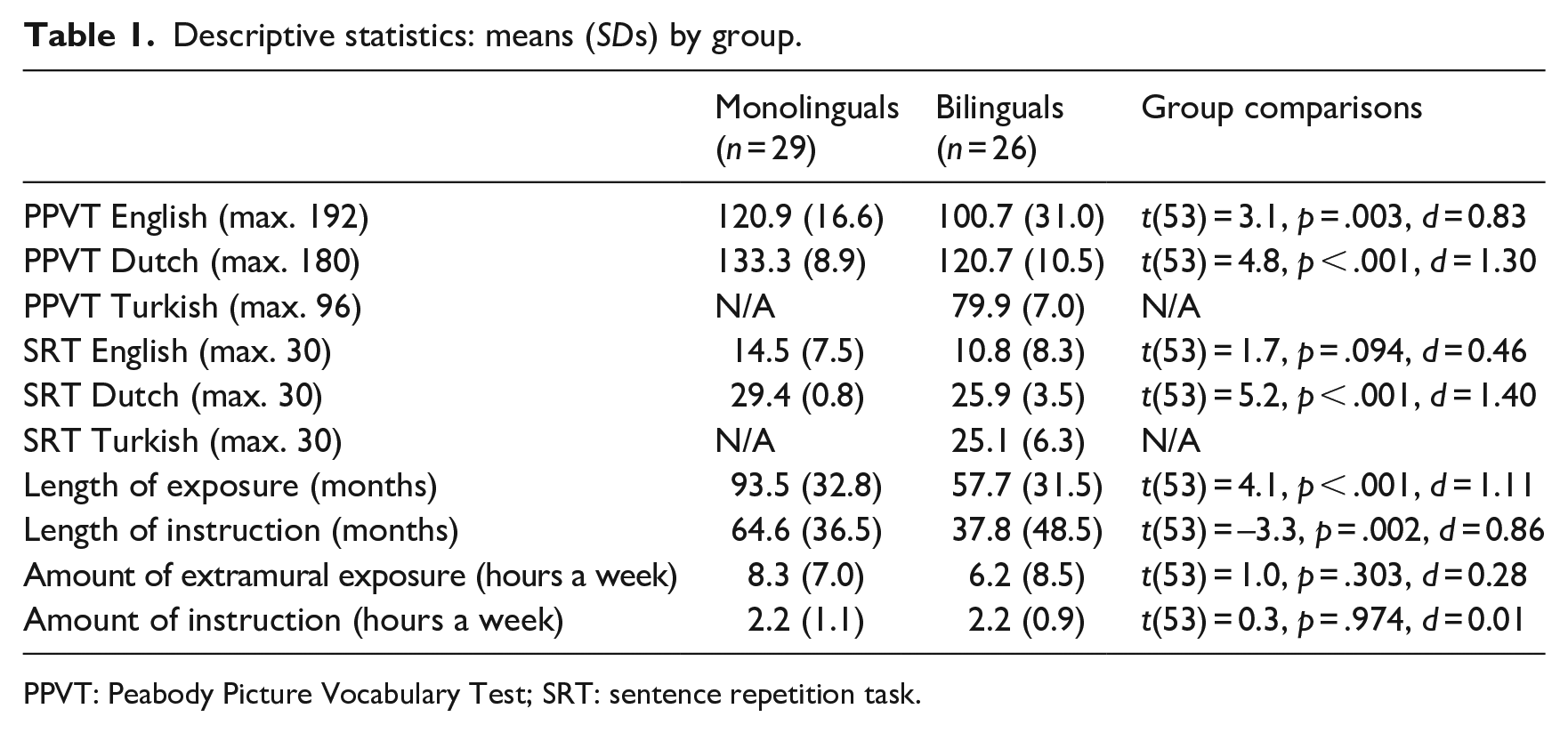
The language tests were completed by all monolinguals (n = 31) and bilinguals (n = 30). If crucial information on exposure was missing, the participants were not included in the analysis. The final dataset included 29 monolinguals and 26 bilinguals. Descriptive statistics are summarized in Table 1.
Descriptive statistics: means (SDs) by group.
PPVT: Peabody Picture Vocabulary Test; SRT: sentence repetition task.
As explained above, the scores of the three versions of PPVT are not directly comparable. However, the parallel set-up of the SRT allows us to compare the performance of the monolinguals and bilinguals in different languages. The monolingual group scored significantly higher in Dutch than in English, t(25) = –8.9, p < .001. The bilinguals showed differences in performance across the three languages, F(2, 50) = 44.6, p < .001. Post hoc Bonferroni tests revealed significant differences between Turkish and English (p < .001) and between Dutch and English (p < .001), but no significant differences between Turkish and Dutch (p = 1.0).
Table 1 further confirms that children in the Netherlands on average start being regularly exposed to English well before the onset of formal EFL instruction. On average, our participants had 76.6 months (SD = 36.6) of regular exposure to English, whereas the mean length of instruction was 51.9 months (SD = 33.6); this difference was significant, t(54) = –6.2, p < .001. The figures in the table also reveal noteworthy differences between monolinguals and bilinguals. First, the monolingual group scored higher on both Dutch tests and on the English PPVT test compared to the bilingual group. Second, monolinguals were exposed to English at an earlier age, as evidenced by the significant difference in length of exposure. Third, amount of extramural exposure to English varied, particularly in the bilingual group. This underscores the importance of taking differences in exposure into account when comparing bilinguals and monolinguals. Finally, the monolinguals had more months of formal EFL instruction, which possibly reflects differences between primary schools they had been previously enrolled in (cf. Leona et al., 2021). Hence, we will control for measures of extracurricular exposure, as well as formal EFL instruction in the group comparisons. Below, we report the results per research question.
RQ1. Do Turkish–Dutch bilinguals outperform Dutch monolinguals in EFL proficiency and if amount of extramural exposure and length of EFL exposure are controlled for?
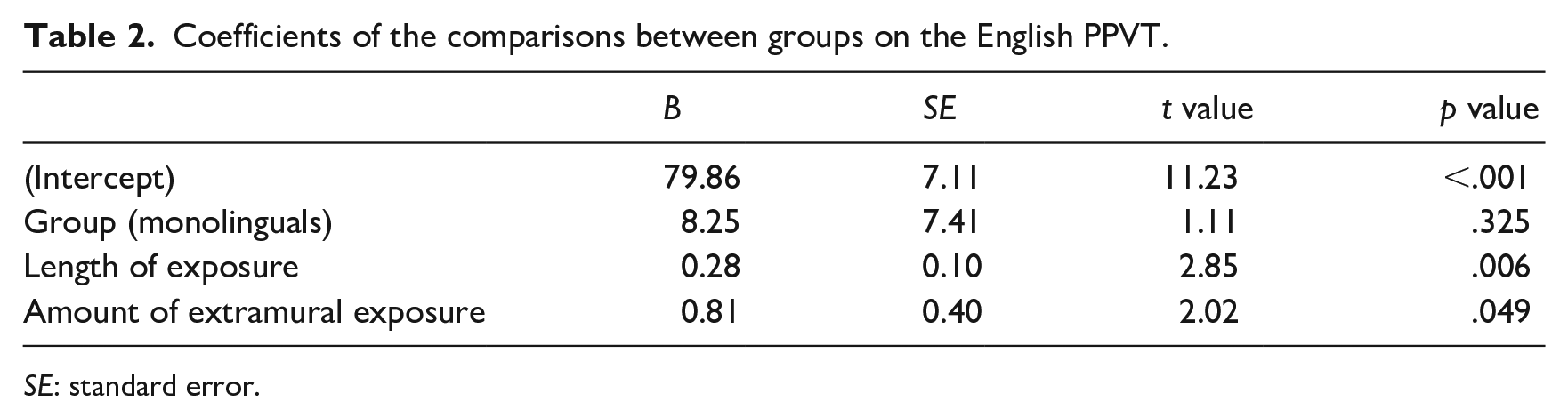
The data of the English PPVT and SRT were analyzed separately using multilevel linear regression analyses performed using the lmerTest package in R (Kuznetsova et al., 2017). For the English PPVT, we first created a model in which group was added as a fixed effect and class nested in school as a random effect (Model 1). Adding the effect of length of exposure (Model 2) significantly increased the fit to the data, χ2/(1) = 11.73, p < .001. In Model 3, amount of extramural exposure was also added to the model, which again significantly improved the model fit, χ2(1) = 2.02, p = .049. Adding length of instruction, χ2(1) = 0.01, p = .930, and amount of instruction, χ2(1) = 0.24, p = .628, did not improve the model fit. Table 2 shows the final model (Model 3). Amount and length of exposure were positively related to English receptive vocabulary. No effect of group was found after controlling for the exposure measures. This model explained 41% of the variance (R2 = .41).
Coefficients of the comparisons between groups on the English PPVT.
SE: standard error.
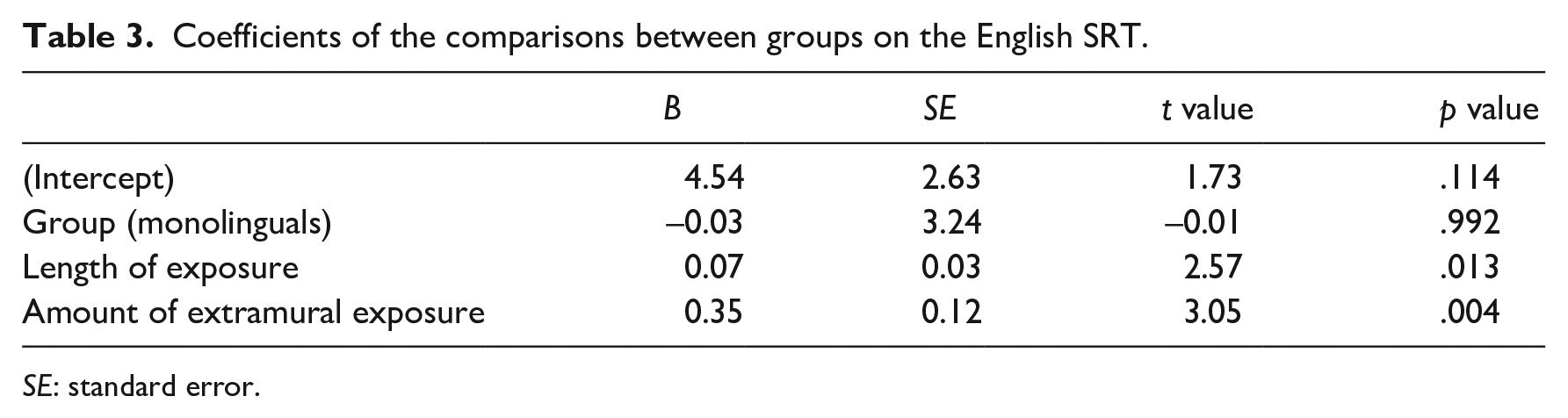
For the English SRT, we again started with a model with group as a fixed effect and class nested in school as a random effect (Model 1). After that, we added an effect of length of exposure (Model 2), which significantly improved the model fit, χ2(1) = 12.37, p < .001. In Model 3, amount of extramural exposure was also added, which again significantly improved the fit, x2(1) = 9.13, p = .003. Adding length of instruction, χ2(1) = 0.23, p = .633, and amount of instruction, χ2(1) = 0.06, p = .799, did not improve the model fit. The final model (Model 3) is presented in Table 3. Again, both length and amount of exposure positively predicted performance. The effect of group was not significant. This model explained 48% of the variance (R2 = .48).
Coefficients of the comparisons between groups on the English SRT.
SE: standard error.
To summarize, length of EFL exposure and amount of extramural exposure positively predicted performance on both tasks, whereas length and amount of formal EFL instruction did not. Without controlling for differences in extramural exposure, we found a bilingual disadvantage in the English vocabulary task. However, the difference disappeared once exposure was accounted for.
RQ2. Does amount and length of exposure moderate group differences in EFL skills?
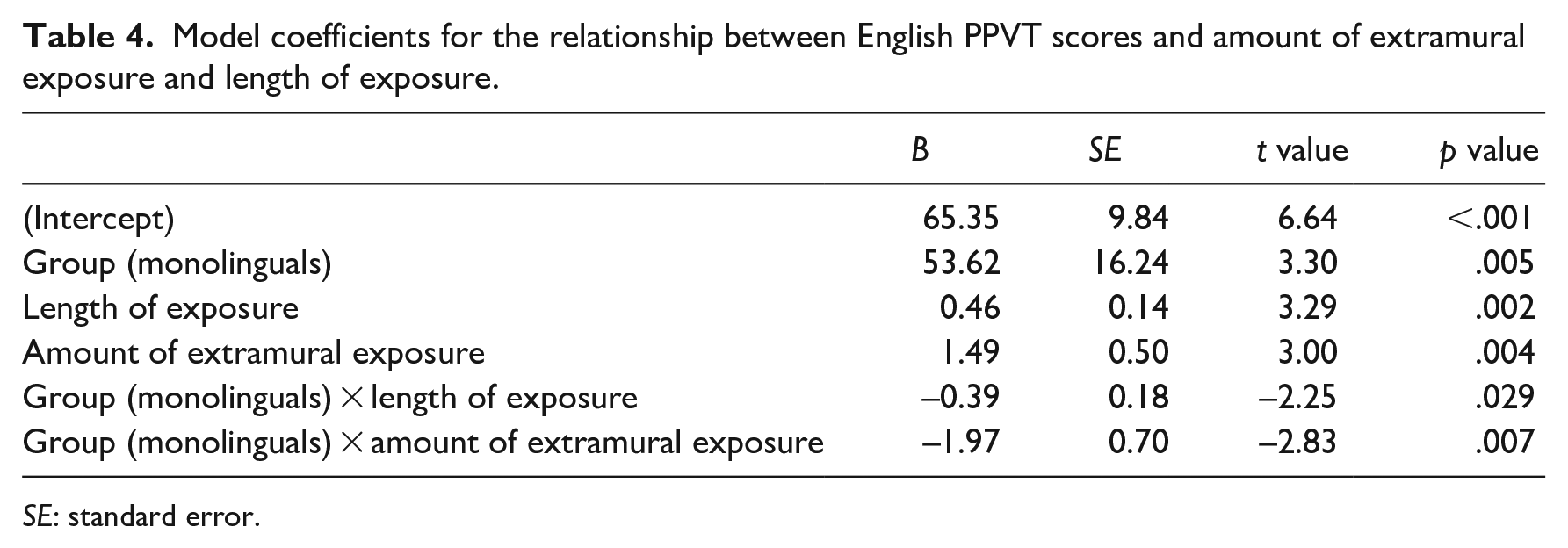
If length of exposure and amount of extramural exposure moderate the effects of bilingualism, we expect to find significant interactions between group and amount of extramural exposure and group and length of exposure. We ran two multilevel linear regression analyses (one for PPVT and one for SRT), with group × amount of extramural exposure and group × length of exposure in the fixed part of the model. Class nested in school was included as a random effect. The performance of the bilingual group was taken as the baseline. The results for PPVT are summarized in Table 4 (R2 = .61).
Model coefficients for the relationship between English PPVT scores and amount of extramural exposure and length of exposure.
SE: standard error.
The model coefficients revealed a significant effect of group at the intercept, which shows that bilinguals with low amounts of extramural exposure and fewer years of exposure to English were outperformed by monolinguals on the receptive vocabulary test. The significant interactions between group and amount/length of exposure show that the effects of exposure were significantly smaller in the monolingual group, that is, increase in amount and length of exposure was associated with larger gains in the bilingual group. This interaction is visualized in Figures 1 and 2.
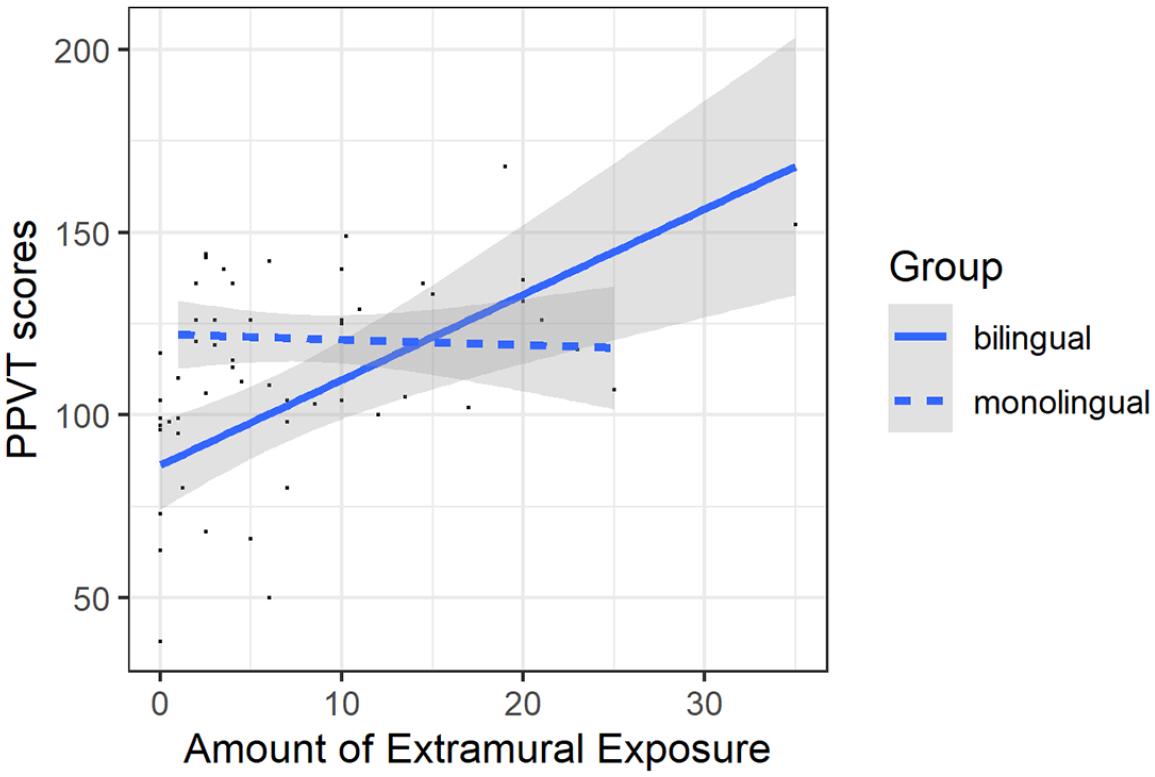
The relation between amount of extramural exposure (in hours per week) and the English PPVT scores.
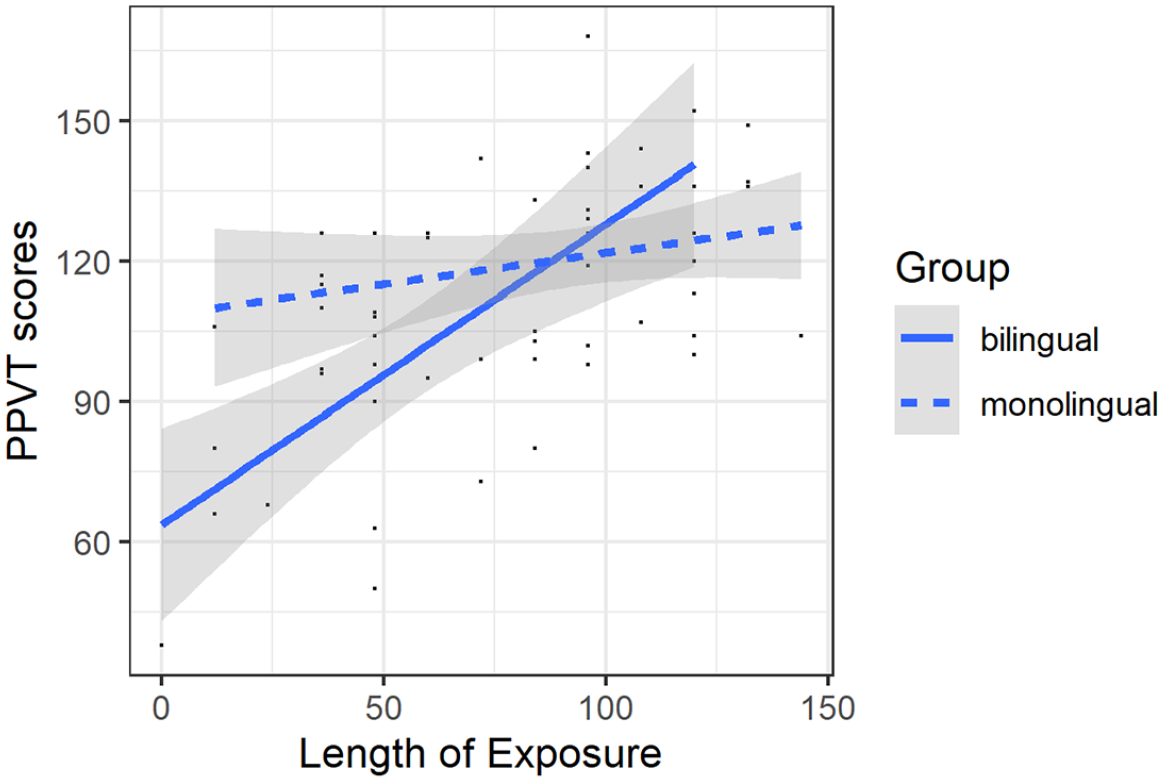
The relationship between length of exposure (in months) and the English PPVT scores.
Table 5 summarizes model coefficients for the English SRT (R2 = .54). In this model, no group differences at the intercept were found. The interaction between group and length of exposure was not significant, and the interaction between group and amount of extramural exposure approached significance. As shown in Figure 3, bilinguals with more extramural exposure to English tend to outperform monolinguals on the SRT task.
Model coefficients for the relationship between English SRT scores and amount of extramural exposure and length of exposure.
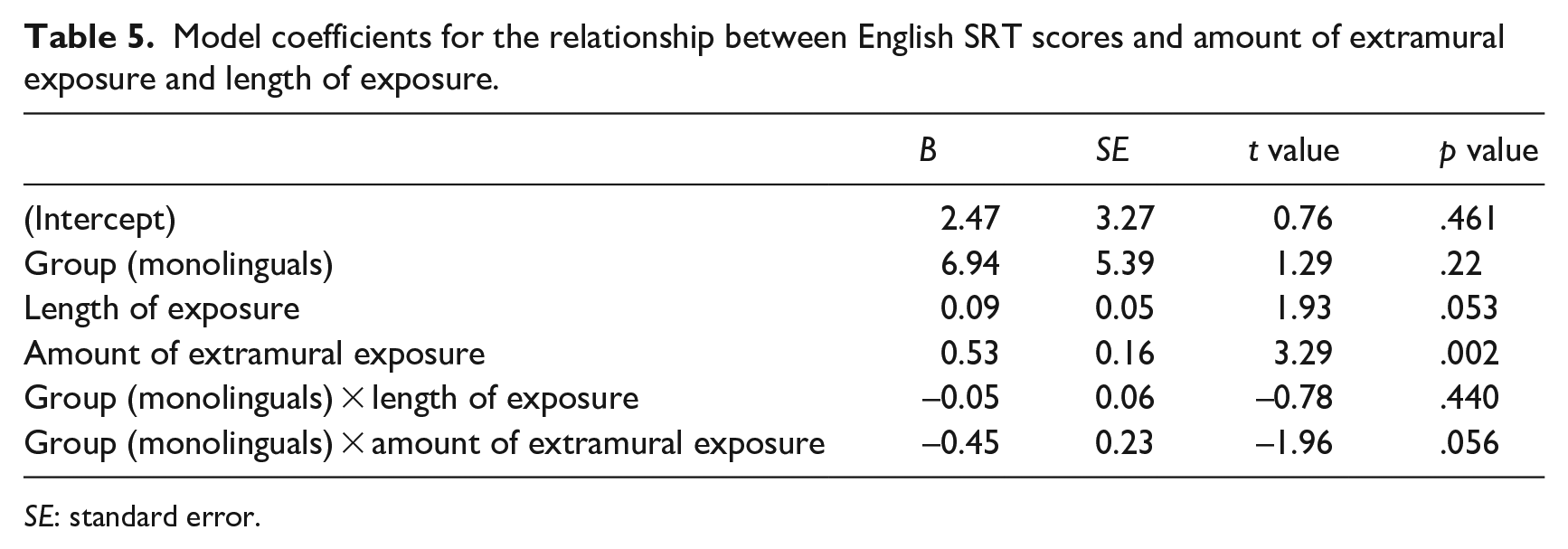
SE: standard error.
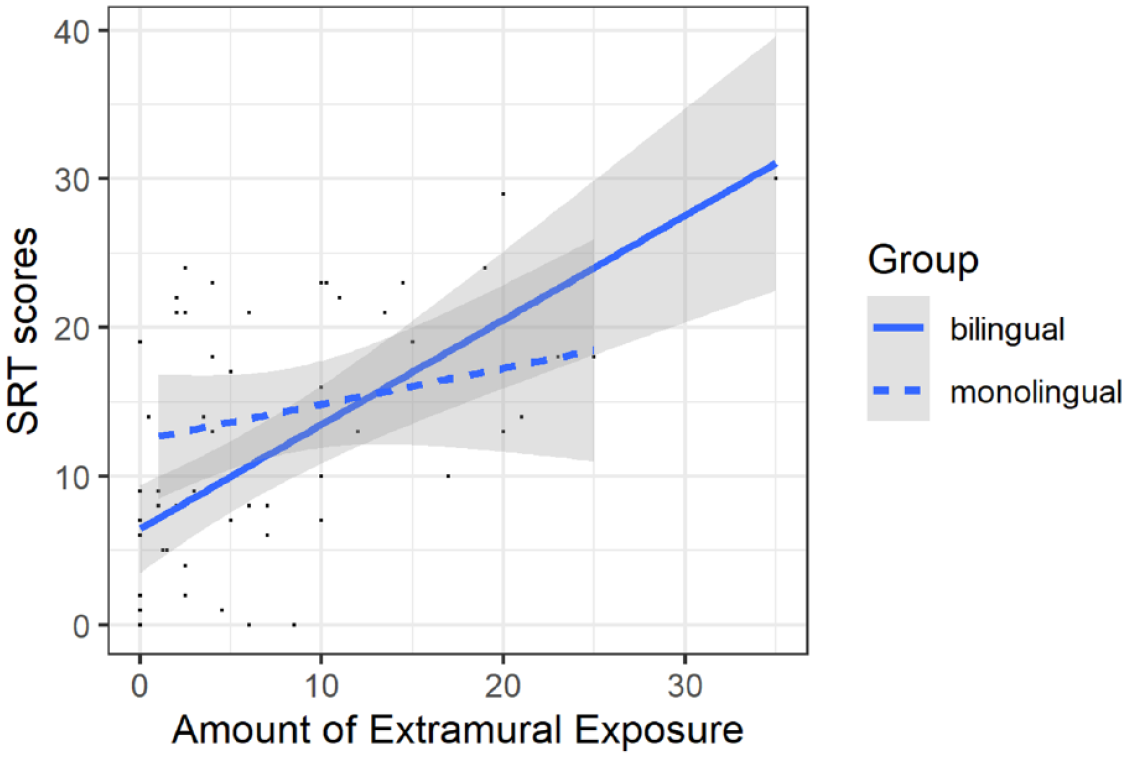
The relation between amount of extramural exposure (in hours per week) and the English SRT scores, by group.
To summarize, bilingual advantages were only visible at higher levels of exposure. However, the differential effects of length and amount of exposure in the two groups were more pronounced in the vocabulary task than in the grammar task.
RQ3: In the bilingual sample, do amount and length of EFL exposure moderate relationships between L3 English and the previously acquired languages (Dutch and Turkish)?
To address the last research question, we ran two multilevel linear regression models (one for each test) predicting the English PPVT/SRT scores from the Dutch and Turkish PPVT/SRT scores, amount of extramural exposure, length of exposure, and the interaction of the Dutch/Turkish measures and the EFL exposure measures. If, as predicted, the relationships between Dutch/Turkish and English skills become stronger as a function of exposure, we should find significant positive interactions between the language measures (Dutch/Turkish PPVT/SRT) and the two EFL exposure measures (length of exposure and amount of extramural exposure). The full models can be found in the Supplemental Materials.
Contrary to our predictions, none of the interactions were significant. The only significant effect was that of the Dutch PPVT scores positively predicting the English PPVT scores (B = 2.57, SE = 1.05, t = 2.45, p = .026): Pupils with larger vocabularies in Dutch were more likely to have larger vocabularies in English (see Figure 4). However, this relationship did not change as a function of length or amount of exposure.
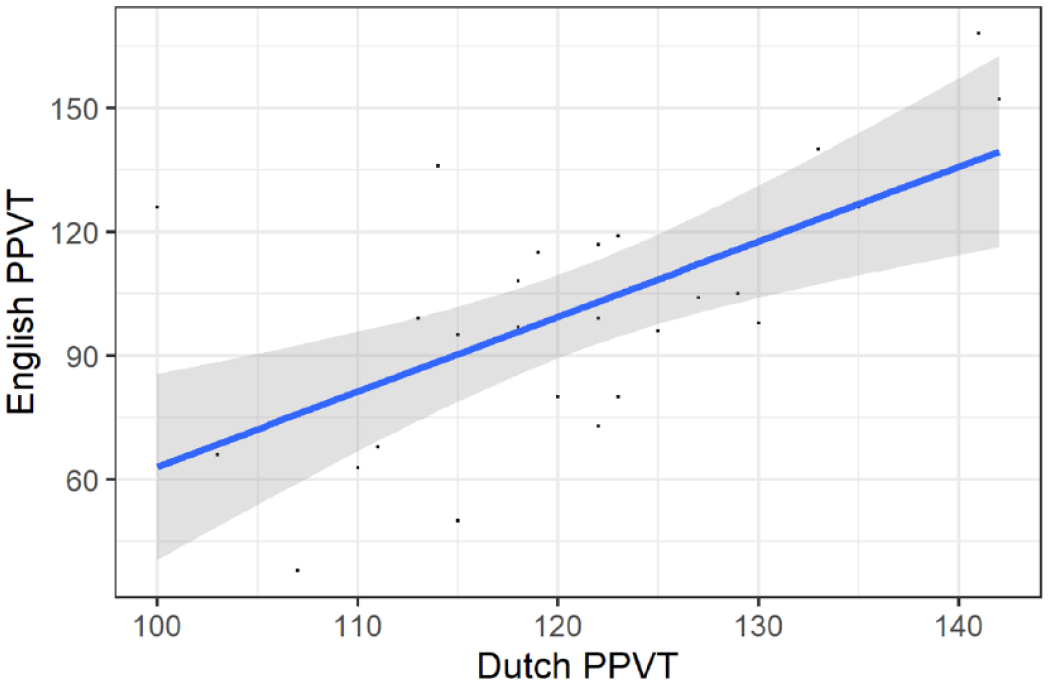
The relation between PPVT scores in Dutch and English (bilinguals only).
The Dutch SRT scores did not predict the English SRT scores. No significant relations between Turkish and English were found, which means that proficiency in the heritage language did not predict L3 skills.
Discussion
The literature on L3 advantages is highly controversial. Our study was the first to control for differences in extramural English when comparing EFL outcomes of bilingual and monolingual students. The findings confirm that length and amount of extramural exposure to English are strong predictors of English skills (De Wilde et al., 2020; Leona et al., 2021; Lindgren & Muñoz, 2013; Sundqvist, 2009; Sylvén, 2022), whereas length and amount of formal EFL instruction did not predict vocabulary and grammar outcomes (cf. Peters, 2018). Similarly, Leona et al. (2021) did not find significant differences in EFL vocabulary of Dutch primary-school children who had received several years of English lessons and their peers without prior formal instruction in English. This is possibly related to the fact that Dutch primary schools teach English implicitly, with a focus on vocabulary, conversational routines and without explicit grammar instruction (Tribushinina et al., 2023). Hence, this approach is in many respects similar to naturalistic language learning, except that classroom time devoted to English is too limited to make a difference compared to the ample exposure to English outside of the classroom.
Crucially, despite the matched-group design, the monolinguals had more years of exposure to English, both at school and outside of school. On average, the monolinguals in our sample had almost 8 years of experience with English, whereas the age-matched bilinguals had less than 5 years of EFL exposure. Hence, not taking differences in EFL exposure into account may place bilinguals at a disadvantage. Without controlling for exposure, we found that the bilingual group performed worse than monolinguals on the English vocabulary test, which is consonant with earlier findings in the Dutch context (Van Gelderen et al., 2003). After controlling for differences in amount and length of exposure, the group difference disappeared. Hence, our study suggests that the conflicting findings in the L3 literature might be (partly) due to differences in out-of-school exposure to a FL that have so far been overlooked.
Even more importantly, we found an interaction between exposure measures and bilingual status. Bilinguals with little weekly exposure to English and with fewer years of regular contact with the English language were outperformed by monolinguals with comparable amount and length of exposure. However, at higher exposure levels the pattern was reversed, with bilinguals outperforming monolinguals. The finding that increases in exposure had a stronger effect on bilinguals supports Sanz’s (2000) proposal that bilinguals may be more efficient in processing linguistic input. However, in light of the present results, it is plausible that bilinguals need to accumulate sufficient experience with the L3 before they can reap the advantages of bilingualism. Assuming that enhanced metalinguistic awareness makes bilinguals more efficient in L3 processing and intake (Sanz, 2000), increased multilingual experience (through L3 learning) is likely to further boost bilingual advantages in L3 learning as a function of developing multilingual competence. Although monolinguals also develop multilingual competence through FL lessons, there is evidence that trilinguals may experience more cognitive benefits than bilinguals (Schroeder & Marian, 2017) and that knowledge of more languages is positively related to the number of language learning strategies employed by the learners (Kemp, 2007). Increasing multilingual competence, as a function of increasing L3 exposure, may thus render bilinguals more successful in learning additional languages.
Our results revealed an asymmetry between vocabulary and grammar: The moderating effect of EFL exposure was stronger in the vocabulary domain. This result supports earlier findings by Sundqvist (2009) demonstrating that extramural English had a stronger effect on vocabulary than on oral proficiency of Swedish learners of English. This pattern might be due to the fact that vocabulary acquisition is particularly sensitive to frequency and input effects (Bialystok et al., 2010).
Our final research question addressed the role of extramural EFL exposure as a moderator of cross-language relations in the bilingual mind. No such moderation was found. Dutch receptive vocabulary predicted English vocabulary scores, but this relationship did not change as a function of exposure. In contrast to Dutch, Turkish vocabulary scores did not predict English receptive vocabulary, which is probably due to a large typological distance and a limited number of cognates in the two languages. This result seconds earlier studies conducted in the Dutch and German contexts (Edele et al., 2018; Lorenz et al., 2020; Tribushinina et al., 2021) and underscores the important role of typological proximity in cross-linguistic transfer (Rothman, 2015). Another explanation of the privileged role of Dutch and German is that these languages are also languages of instruction in Dutch/German schools, whereas Turkish is not supported in education.
Finally, contrary to our predictions, we did not find positive relations between grammar scores in English and Dutch/Turkish. This might be due to the fact that the SRT was not designed to test positive transfer between English and Turkish/Dutch and rather reflects general language proficiency. It has been suggested in the literature that bilinguals may have advantages in more specific areas of grammar through positive transfer from a language not shared with the monolingual controls (Lorenz & Siemund, 2019). For example, Westergaard et al. (2017) found that Russian monolinguals and Russian–Norwegian bilinguals outperformed Norwegian monolinguals in the placement of frequency adverbs in English. This advantage was attributed to the similarity of adverb placement in English and Russian. Another area where positive transfer from L1 and/or L2 to L3 has been reported is grammatical aspect (Eibensteiner, 2023; Toth et al., 2023). For example, Lorenz and Siemund (2019) showed that Russian–German and Turkish–German bilinguals, like Russian and Turkish monolinguals, had advantages over German monolinguals in the use of the English progressive aspect. These advantages were likely due to positive transfer from Russian and Turkish, both aspectual languages (unlike German). It is possible that tests targeting production and comprehension of the English progressive aspect could reveal advantages of Turkish–Dutch bilinguals over Dutch monolinguals because in Dutch aspect is not encoded in the grammatical system. However, it is also possible that such advantages are only available to bilinguals who are literate in the L1 (Keshavarz & Astaneh, 2004) and/or have higher levels of metalinguistic awareness in the heritage language (Rauch et al., 2011). For instance, Eibensteiner (2023) demonstrated that German students with more advanced awareness of aspectual distinctions in L2 English produced more correct aspectual forms in L3 Spanish. Since the participants in our study did not receive any formal schooling in the heritage language, their levels of metalinguistic knowledge about Turkish may not have been sufficient to benefit from positive L1 transfer in L3 learning.
This study has a number of limitations. The sample size was relatively small, which could have resulted in insufficient power, particularly in the within-group analyses yielding many non-significant relationships between L1/L2 and L3 proficiency. This study included only two measures of proficiency (receptive vocabulary task and SRT). Although these tasks are considered good predictors of overall proficiency (Hulstijn, 2010) and they allowed us to conduct parallel assessment of the three languages, other important aspects of L3 proficiency, such as reading and listening comprehension, as well as complexity, fluency and accuracy in oral and written production were not taken into account. Furthermore, vocabulary knowledge was only measured with a receptive task, leaving out productive vocabulary, as well as lexical diversity and sophistication (cf. Sundqvist & Wikström, 2015). Future research on bilingual effects in FL learning could zoom in on a variety of language skills to determine whether exposure and cross-language transfer have differential effects across different skills constituting the multi-componential construct of language proficiency.
Even though we individually matched monolinguals to bilinguals based on age, gender, school type and educational track, we did not directly control for socio-economic status (SES) indexed by family income or parental education. Therefore, we cannot rule out the possibility that the relatively high English proficiency of the monolinguals may be related to a higher SES, which might have concealed some of the positive effects of bilingualism. Furthermore, differences between bilinguals and monolinguals might be due to enhanced cognitive skills associated with bilingualism (Bialystok, 2017; Chamorro & Janke, 2022). For example, Berthele and Udry (2022) demonstrate that proficiency in L3 English could be predicted from L1 German and L2 French skills in primary-school children in Switzerland. However, once cognitive skills (nonverbal IQ, verbal working memory, visuo-spatial working memory) were accounted for, there was no evidence of an additional positive contribution from the previously acquired languages. These results are not directly comparable to our study because we focused on early bilinguals, whereas the participants in Berthele and Udry (2022) learnt L2 French as a FL at school. This being said, it is crucial to investigate the role of cognitive skills as a potential mediator of bilingual effects in FL learning in future research.
Another limitation is that the present study did not control for FL learning motivation, which can play an important role in FL outcomes (Cenoz & Valencia, 1994; Lorenz et al., 2020). L3 learners may have stronger motivation and less anxiety for language learning compared to monolinguals learning an L2 (Mady, 2017). Future research will therefore benefit from including not only exposure but also attitudes and motivation into the picture.
Conclusion
Prior research on L3 advantages has not taken extramural L3 exposure into account. The main contribution of this study is that it demonstrates that it is crucial to control for differences in extramural exposure when comparing monolinguals and heritage bilinguals on FL outcomes. Differences between groups can be either concealed or inflated if exposure is not taken into account. Bilinguals with little extramural exposure to English perform worse than monolinguals, whereas bilinguals with higher amounts of EFL exposure outperform their monolingual peers. Thus, L3 advantages are likely to appear only if bilinguals have sufficient experience with English outside of school. This finding might explain some of the controversial results in prior work: It is possible that bilingual advantages were only found in bilingual samples with sufficient L3 exposure. In the bilingual group, only Dutch vocabulary predicted EFL vocabulary, and this relationship did not change as a function of EFL exposure. No relationship between Dutch and English grammar was found, suggesting that lexical transfer is more accessible at early stages of L3 learning. Heritage language (Turkish) vocabulary and grammar skills did not predict L3 English vocabulary and grammar, confirming the role of typological proximity in cross-lingual transfer.
Supplemental Material
sj-docx-1-ijb-10.1177_13670069231224542 – Supplemental material for Revisiting bilingual foreign language learning advantages: The role of extramural exposure
Supplemental material, sj-docx-1-ijb-10.1177_13670069231224542 for Revisiting bilingual foreign language learning advantages: The role of extramural exposure by Elena Tribushinina, Betül Boz, Vera Aalbers and Elma Blom in International Journal of Bilingualism
Footnotes
Acknowledgements
The authors would like to thank all participating schools and families. They are also very grateful to the anonymous reviewers for their insightful comments and constructive criticism.
Funding
The author(s) received no financial support for the research, authorship, and/or publication of this article.

Supplemental material
Supplemental material for this article is available online.
Notes
Author biographies
References
Supplementary Material
Please find the following supplemental material available below.
For Open Access articles published under a Creative Commons License, all supplemental material carries the same license as the article it is associated with.
For non-Open Access articles published, all supplemental material carries a non-exclusive license, and permission requests for re-use of supplemental material or any part of supplemental material shall be sent directly to the copyright owner as specified in the copyright notice associated with the article.
