



Abstract
Aims and Objectives/Purpose/Research Questions:
The study investigated the relationship between the L2 grit, domain-general grit, foreign language enjoyment (FLE), multilingualism, and self-reported literacy achievement of students learning English as a foreign language (EFL) in public upper-secondary schools in Norway. Specifically, the study sought to identify predictors of students’ EFL reading and writing achievement and examine the moderating effect of multilingualism on the relationship between L2 grit, FLE, and such achievement.
Design/Methodology/Approach:
A quantitative research design was employed, and data were collected through an online questionnaire. Convenience sampling was used to recruit 181 upper-secondary school students learning EFL in southeastern Norway (one participant’s responses were discarded because they were incomplete).
Data and Analysis:
Paired and independent sample t-tests and moderated multiple regression were used to analyse the collected data.
Findings/Conclusions:
The study found that the perseverance component of L2 grit and daily language use (one of two aspects of multilingualism used in the study) positively predicted both reading and writing achievement (the consistency of interest component of L2 grit only positively predicted writing achievement). In addition, daily language use was found to negatively moderate the relationship between the perseverance component of L2 grit and reading and writing achievement, with the moderating effect dissipating as additional languages were used daily.
Originality:
The study is among the first to explore the interplay between grit and multilingualism in the Nordic region and examine the relationship between multilingualism, grit, FLE, and achievement globally.
Significance/Implications:
The study’s findings underscore the need for researchers to develop and use more comprehensive multidimensional measures of multilingualism when investigating its effects on language learning in formal contexts, design scales for grit that target specific language skills, and broaden grit-related research to cover the learning of multiple language and non-language subjects concurrently.
Introduction
Learning a foreign language successfully is a complex process that requires not just aptitude and intelligence but also a combination of positive psychological factors, for example, grit and enjoyment. Grit refers to an individual’s ‘perseverance and passion for long-term goals’ (Duckworth et al., 2007, p. 1087), representing their willingness to practice regularly, persist through challenging tasks, and seek out new learning opportunities. Grit can be domain-specific, for example, an individual’s perseverance and passion for learning a language (i.e., L2 grit; Teimouri et al., 2021), or domain-general, meaning that it is not specific to any one area or field (Feng & Papi, 2020). As a construct, grit consists of two primary factors: perseverance of effort (PoE) and consistency of interest (CoI). PoE refers to the ability to sustain effort and focus on long-term objectives despite encountering obstacles, setbacks, and failure, whereas CoI refers to the capacity to maintain an enduring interest in goals over time. Studies involving PoE and CoI as predictor variables for achievement have yielded inconsistent results, with some demonstrating that PoE has greater predictive validity (Credé et al., 2016), whereas others have reported CoI as a stronger predictor (Sudina et al., 2021). These inconsistencies notwithstanding, PoE and CoI are inherently interconnected and interdependent: an individual who displays PoE concerning their goals is likely to maintain a consistent level of interest in them (and vice versa).
Foreign language enjoyment (FLE) can be defined as the positive affective experiences that learners have when learning a language (Dewaele & MacIntyre, 2014). FLE is important for language learners because it enhances their motivation to learn and engagement in the learning process. Research suggests that both grit and FLE play a role in language learners’ achievement (Sudina et al., 2021; Teimouri et al., 2022), though these constructs, as predictor variables, have often been studied in isolation from one another and other influencing factors (e.g., anxiety). Referring to this situation, Khajavy and Aghaee (2022) note that researchers ‘should examine the role of grit when other factors are also taken into account’ to ‘understand which variables can be stronger predictors’ of outcomes (p. 2). They observe that grit statistically significantly and positively correlates with a raft of positive emotions, for example, FLE and motivation (see Credé et al., 2016; Feng & Papi, 2020; Liu & Wang, 2021; Teimouri et al., 2022). One complex factor that has not been widely explored in relation to grit is individual multilingualism, which can be defined as one’s knowledge and use of more than one language, including the acquisition of language and non-language skills that accompany this knowledge and use (Jessner, 2008). Individual multilingualism has been found to correlate with diverse cognitive, affective, and socio-cultural factors, as well as achievement (Calafato, 2023; Calafato & Simmonds, 2023; Diamond, 2010; Kroll & Dussias, 2017).
Governments globally have adopted educational policies that view individual multilingualism as a valuable resource in today’s world, crucial for employability, mobility, and social integration (Calafato, 2022a, 2022b; European Commission, 2018; European Council, 2019; Gao & Zheng, 2019; Wright & Baker, 2017). Researching language learning, then, without considering individual multilingualism as a variable, might produce incomplete findings because such research ignores both the impact of multilingualism on learning outcomes and the educational policies implemented by governments in primary, secondary, and tertiary education. Concerning grit and FLE, since multilingual individuals have already demonstrated their ability to learn multiple languages, they might persist more determinedly in the face of challenges and setbacks when learning additional languages. They may also enjoy the learning process more because they have acquired strategies and skills from their previous language-learning experiences (Jessner, 2008). This can lead to a positive feedback loop whereby their enjoyment reinforces their grit, ultimately resulting in greater achievement. In terms of research, only Wei et al. (2020) appear to have explored the relationship between multilingualism (operationalized in their study as participants’ self-reported proficiency in multiple languages) and grit, with the researchers discovering a statistically significant correlation, albeit one with a small effect size (r = .27; for interpreting effect size, see Plonsky & Oswald, 2014).
Studies involving multilingualism (mostly measured as the number of languages known, without any reference to context or frequency of use) and FLE are more numerous, though still limited (Botes et al., 2020; Dewaele et al., 2018), and have reported either a weak correlation or no link between the two. Moreover, none of the studies included achievement as a variable, meaning that we do not know if the correlations between multilingualism and FLE had a meaningful impact on learning outcomes. The study reported here aimed to contribute to the existing research on the effects of positive psychological factors on achievement by examining how the relationship between learners’ grit, FLE, and English literacy achievement (i.e., reading and writing achievement) was moderated by their multilingualism, measured as both the number of languages learned (besides one’s first language[s]) and used in daily life. The study investigated these links among students studying English as a foreign language (EFL) in public upper-secondary schools in Norway. It is pertinent to highlight here that while the study focused on the relationship between grit, FLE, multilingualism, and literacy achievement in foreign language education, its findings can contribute to the broader discourse on the multifaceted nature of multilingualism, used as an umbrella term in the study to also cover individual bilingualism (see Marshall & Moore, 2018), thereby shedding more light on the mechanisms that underpin effective language learning.
Interactions between grit, enjoyment, multilingualism, and achievement
According to self-determination theory (SDT), which is an organismic meta-theory, humans possess innate qualities of activity, intrinsic motivation, and integrative processes that contribute to healthy development and well-being. These qualities do not need to be learned; rather, individuals require certain biological and psychological ‘nutriments’ for them to function optimally (Deci & Ryan, 2012). SDT posits that there are three universal psychological needs, namely, competence, autonomy, and relatedness, which are necessary for optimal growth and functioning. Competence involves an individual’s perception of their potential to effectively undertake actions, autonomy consists of an individual’s freedom and power to make decisions without being influenced by external factors, and relatedness pertains to positive social interactions and relationships that individuals have with others. In the EFL context, learners who experience high levels of FLE in the classroom may be satisfying their need for relatedness (at least partly), which could lead to better learning outcomes. Since multilingualism contributes to a greater sense of relatedness to other cultures and communities (Kroll & Dussias, 2017; Tang & Calafato, 2022) due to its positive correlations with cultural empathy and open-mindedness (Dewaele & Van Oudenhoven, 2009), it may have a moderating effect on the relationship between FLE and achievement.
Dörnyei and Mentzelopoulos (2023), in their study of 30 exceptional multilingual language learners and their high levels of FLE, observed that learners’ ‘perceived social identities’ played a ‘decisive role in shaping the learning process’ (p. 125). Their findings suggest that the enjoyment derived from learning multiple languages creates a positive affective feedback loop for multilingual individuals (see Mitchell et al., 2020; Wang et al., 2021), boosting their FLE when learning new languages. Multilingualism might also lead to heightened feelings of competence and autonomy, manifesting in higher grit levels and, ultimately, achievement. For instance, Dörnyei and Mentzelopoulos found that, regardless of how gifted their multilingual participants were, the ability to persist, which is similar to the construct of grit (Dale et al., 2018; Duckworth et al., 2007), was a prerequisite to successful learning outcomes. Henry (2023) proposed a self-discrepancy approach to understanding these effects, theorizing that the desire to become (more) multilingual positively affected goal-seeking behaviour, leading to more time devoted to learning the target language and, ultimately, better learning outcomes. Here, it is important to reiterate that some researchers see grit as domain-general (Feng & Papi, 2020), that is, it transcends individual fields or contexts, whereas others see it as domain-specific (Teimouri et al., 2021), meaning that it is contingent upon the nature of the task or goal at hand.
Proponents of L2 grit, one representation of domain-specific grit, argue that the domain-general grit construct lacks precision because it fails to consider contextual influences. They also note that language-specific grit makes sense since other variables have domain-specific variants, too, such as motivation (e.g., L2 learning motivation) and anxiety (i.e., foreign language anxiety; Pawlak et al., 2022; Teimouri et al., 2021). Disagreements over the nature of grit notwithstanding, research indicates that both domain-general grit and L2 grit predict L2 achievement, with the effects of these constructs sometimes examined together in studies (Li & Yang, 2023).
Research questions
Considering the limited number of studies that have examined the relationship between grit and other affective factors in conjunction with multilingualism, including their ability to predict learning outcomes, this study investigated the following research questions (RQs):
What is the degree of variation between participants’ EFL and domain-general grit?
To what extent are participants’ grit and FLE related to their literacy achievement?
To what extent does participants’ multilingualism moderate the connection between their grit, FLE, and literacy achievement?
Methods
Participants
A total of 181 students from public upper-secondary schools in Norway participated in the study (94 identified as male, 83 as female, and four reported other identities). The participants were in their first (n = 160) or second year (n = 21) of upper-secondary education at the time of the study, with an average age of 16.64 (SD = 0.71). Norwegian was the most frequently reported first language (n = 148), followed by Urdu (n = 7), Arabic (n = 5), Turkish (n = 5), Kurdish (n = 4), and Somali (n = 3). The remaining first languages were Albanian (n = 1), Bosnian (n = 2), Bulgarian (n = 1), Chechen (n = 2), Chinese (n = 1), Danish (n = 2), Estonian (n = 1), Hindi (n = 2), Indonesian (n = 1), Latvian (n = 1), Persian (n = 2), Polish (n = 2), Punjabi (n = 1), Russian (n = 1), Spanish (n = 1), Swedish (n = 1), Thai (n = 1), Tigrinya (n = 1), and Vietnamese (n = 1). Among the 148 participants who reported Norwegian as their first language, 24 reported a second first language. One participant had three first languages: Norwegian, Russian, and Chechen. Eighty-five participants reported learning two additional languages, while 44 had learned only one additional language, 38 had learned three additional languages, 11 had learned four additional languages, and 3 had learned five or more additional languages. In terms of the number of languages used daily, 31 participants used only one language, 96 participants used two languages, 47 used three languages, 5 used four languages, and 2 used five languages.
Instruments
The study employed an online questionnaire, made available to the students in Norwegian to gather data (the questionnaire can be downloaded from the IRIS Database: iris-database.org). The decision to administer the questionnaire in Norwegian instead of English was motivated by a desire to ensure accurate and reliable responses from all participating students and prioritize their comfort and comprehension since students might possess varying levels of English proficiency. The questionnaire was divided into four sections. Details regarding the questionnaire’s various measures, including reliability scores, are listed in Table 1. Both Cronbach’s alpha (α) and McDonald’s omega (ω) coefficients were calculated for reliability since McDonald’s omega can be a more robust predictor than Cronbach’s alpha, especially under violations of tau-equivalence (Dunn et al., 2014).
Questionnaire overview and reliability scores.
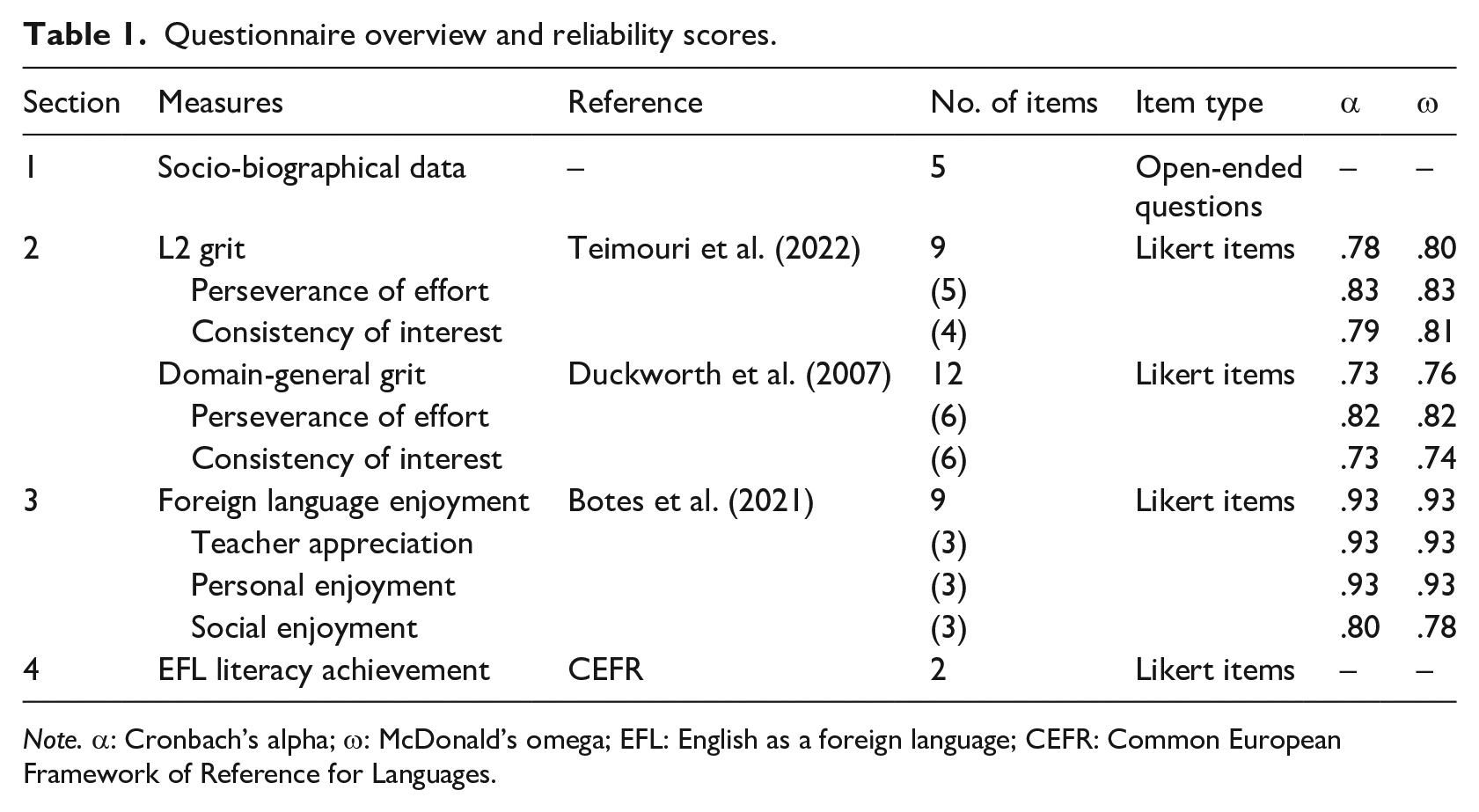
Note. α: Cronbach’s alpha; ω: McDonald’s omega; EFL: English as a foreign language; CEFR: Common European Framework of Reference for Languages.
The first section of the questionnaire gathered socio-biographical data, including participants’ first language(s), language learning history, and the number of languages used daily. The second section contained the L2 grit and domain-general grit measures by Teimouri et al. (2022) and Duckworth et al. (2007), respectively. The third section contained the FLE scale from the study by Botes et al. (2021), which consists of three factors: personal enjoyment, teacher appreciation, and social enjoyment. Personal enjoyment is the pleasure learners derive from learning and using a foreign language, while teacher appreciation relates to teachers meeting learners’ psychological needs. Social enjoyment refers to a positive, socially cohesive environment marked by peer solidarity. The fourth section collected participants’ self-reported EFL reading and writing scores using a six-point Likert-type scale where each point represented a proficiency level from the Common European Framework of Reference for Languages (CEFR) and was worded according to the reading and writing production descriptors found in the CEFR self-assessment grid for English (Council of Europe, 2012). While self-reports are primarily perception-based and thus a limitation of this study, especially due to the young age of the participants, one can refer to Li’s (2020) view that such perceptions are likely formed through a cumulative process of self-assessment informed by prior test results and performance and, therefore, could be considered dependable indicators of achievement (see also Luk & Bialystok, 2013).
Data collection procedure
The questionnaire, which took around 15 minutes to complete, was emailed as a link to seven EFL teachers across three urban high schools in southeastern Norway’s Viken County. Sampling was convenience-based due to pre-existing contacts with the teachers, and the questionnaire was administered to students during regular class hours. Answering the questionnaire in this way allowed students to seek immediate clarification on questionnaire items from their teachers, particularly if something was unclear. The seven EFL teachers, who were all native speakers of Norwegian, had already received the questionnaire several weeks prior, reviewed the Norwegian translation of the measures used therein (alongside the English version), and approved it. Back-translation was not used due to several factors. First, the translation process involved native Norwegian speakers who were also fully proficient in English, ensuring a nuanced understanding of both languages. Second, the project had been discussed with each of the seven EFL teachers beforehand in individual meetings, providing them with context and clarity regarding its objectives and how their learners’ grit and enjoyment would be investigated via the questionnaire. Third, researchers have noted that back-translation may not be necessary for quality control and can be excluded from the translation process (Fourie & Feinauer, 2005; McKenna & Doward, 2005).
Note also that the questionnaire was not piloted. The measures that were included in the questionnaire have been used in Norway and elsewhere extensively. Moreover, the seven participating teachers did not raise any concerns regarding the language or content of the questionnaire during or after the review process (e.g., when students were completing the questionnaire). Indeed, the questionnaire required little time to complete and was easy to administer. All students completed the questionnaire, except for one first-year student, whose responses were subsequently discounted during data analysis, leading to a final response rate of 99.45%.
Data analysis
The data from the questionnaire were analysed using SPSS 28. A paired sample t-test was conducted to examine the differences between participants’ L2 grit and domain-general grit, while an independent samples t-test was performed to check for differences in participants’ L2 grit and FLE based on their year of upper-secondary schooling. For the paired sample t-test, box plots and skewness and kurtosis scores (see Table 2 for the latter two) revealed that there were no outliers or deviations from normal distribution. Regarding the independent samples t-test, Levene’s test for equality of variances indicated that there was homogeneity of variance for participants’ L2 CoI (p = .494), L2 PoE (p = .530), personal enjoyment (p = .056), teacher appreciation (p = .090), and social enjoyment (p = .153) based on whether they were in their first or second year of upper-secondary school. Here, too, box plots, as well as skewness (skew) and kurtosis (kurt) scores for first-year (L2 CoI: skew = –0.64, kurt = –0.04; L2 PoE: skew = –0.25, kurt = –0.63; personal enjoyment: skew = 0.14, kurt = –0.66; teacher appreciation: skew = –0.95, kurt = –0.08; social enjoyment: skew = 0.03, kurt = –0.35) and second-year students (L2 CoI: skew = –0.13, kurt = –1.28; L2 PoE: skew = –0.84, kurt = 2.67; personal enjoyment: skew = –0.12, kurt = –0.07; teacher appreciation: skew = 0.28, kurt = –0.93; social enjoyment: skew = –0.39, kurt = 1.15) indicated that there were no outliers, and the distribution for both groups was generally normal.
Participants’ literacy achievement, grit, and foreign language enjoyment.
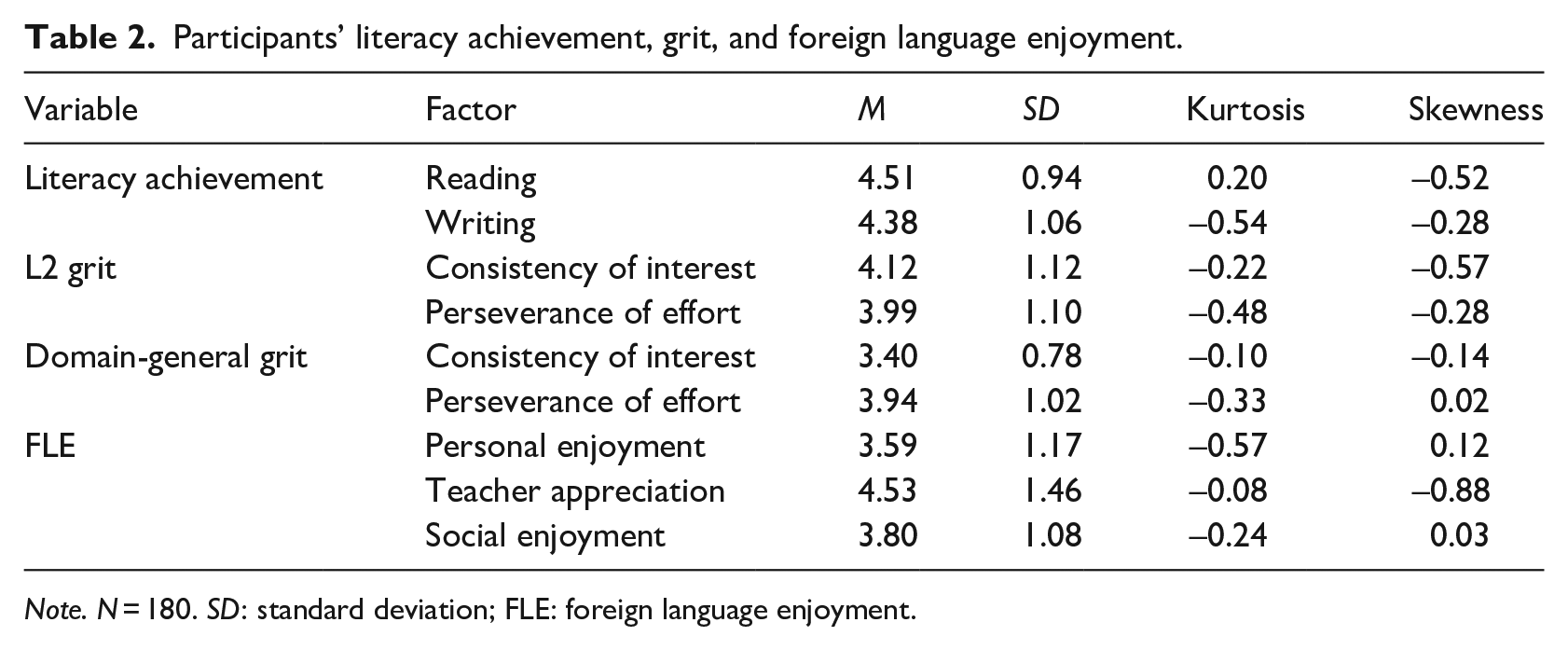
Note. N = 180. SD: standard deviation; FLE: foreign language enjoyment.
Moderated multiple regression was performed to investigate the relationship between participants’ L2 grit, domain-general grit, FLE, and literacy (i.e., reading and writing) achievement, as well as the moderating effects of multilingualism, operationalized as the number of languages learned and languages used daily, on this relationship (for multidimensional measurements of multilingualism, see Luk & Bialystok, 2013). Variation inflation factor (VIF) scores calculated for the predictor variables, with reading achievement as the outcome variable, revealed that multicollinearity was not an issue (see Table 3), while standardized residuals revealed no outliers (Stdandard (Std.) Residual Min = –2.50, Std. Residual Max = 2.75). The data were also not autocorrelated (Durbin–Watson value = 1.90). VIF scores computed for the predictor variables, with writing achievement as the outcome variable, indicated the absence of multicollinearity (see Table 5), and standardized residuals showed no outliers (Std. Residual Min = –2.72, Std. Residual Max = 2.77). Furthermore, autocorrelation was found to not be an issue (Durbin–Watson value = 1.94). The normal P–P plots of standardized residuals (for both writing and reaching achievement as the outcome variable) indicated points that were almost completely on the line, while the scatterplots of standardized residuals showed that the data met the assumptions of homoscedasticity and linearity.
Regression analysis results using reading achievement as the outcome variable.
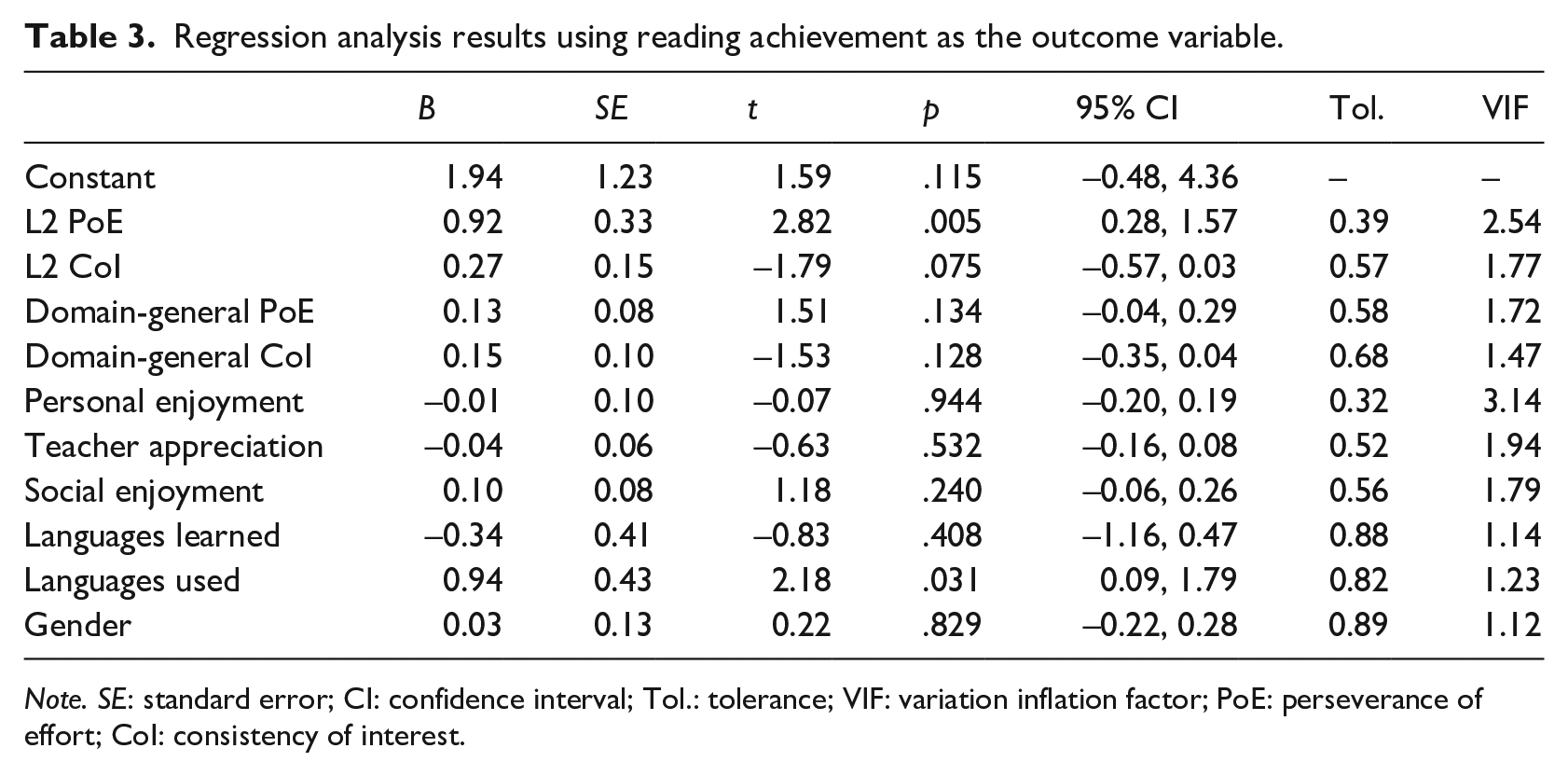
Note. SE: standard error; CI: confidence interval; Tol.: tolerance; VIF: variation inflation factor; PoE: perseverance of effort; CoI: consistency of interest.
Gender was included as a covariate in the regression because grit levels have been shown to vary between males and females (Khajavy et al., 2021) and due to evidence of females frequently outperforming males in scholastic achievement (Voyer & Voyer, 2014). An alpha level of .05 was used for all significance testing. Cohen’s d was reported for effect size and interpreted based on Plonsky and Oswald’s (2014) recommendations, with 0.40, 0.70, and 1.00 representing small, medium, and large effects, respectively.
Results
Table 2 contains descriptive statistics regarding participants’ responses to the L2 grit (Teimouri et al., 2022), domain-general grit (Duckworth et al., 2007), and FLE (Botes et al., 2020) measures, as well as their self-reported EFL literacy achievement scores. The findings indicated that participants perceived their reading and writing achievement to be at comparable levels, between B2 and C1 proficiency according to the CEFR. Furthermore, they exhibited higher levels of L2 grit compared to domain-general grit, and teacher appreciation was the strongest source of their FLE. Paired sample t-test results revealed that participants exhibited statistically significantly higher L2 CoI than domain-general CoI, with an almost medium effect size (adjusted for correlation) (t[179] = 9.63, p < .001, d = 0.63), based on the L2-domain-specific benchmarks by Plonsky and Oswald (2014), whereas their L2 PoE and domain-general PoE were quite similar (t[179] = 0.848, p = .397, d = 0.05).
Independent t-test results indicated no statistically significant differences between participants’ L2 CoI (t[179] = 0.40, p = .687, d = 0.06), L2 PoE (t[179] = –0.26, p = .797, d = 0.01), personal enjoyment (t[179] = 0.20, p = .840, d < 0.01), teacher appreciation (t[179] = 0.62, p = .538, d = 0.20), or social enjoyment (t[179] = 1.16, p = .246, d = 0.15) based on their year of upper-secondary schooling. Moderated multiple regression was conducted using participants’ self-reported EFL reading achievement scores as the outcome variable and their L2 grit, domain-general grit, FLE, and gender as predictor variables. Participants’ multilingualism, represented by languages learned in addition to their first language(s) and the languages they used in daily life, comprised the two moderator variables included in the model. The overall regression model was statistically significant (F[12, 167] = 4.00, p < .001, R2 = .22), and the coefficients for the predictors revealed that the number of languages used and L2 PoE were statistically significantly and positively correlated with reading achievement (see Table 3). Moreover, the number of languages used in daily life statistically significantly and negatively moderated the relationship between L2 PoE and reading achievement (B = –0.23, p = .029).
A test of the highest-order unconditional interaction showed a significant effect on the interaction between L2 PoE and the number of languages used daily (F[1, 167] = 4.86, p = .029, ∆R² = .02).
To further understand these interactions, the conditional effects of the focal predictor (i.e., L2 PoE) were examined at different percentiles of the moderator (i.e., languages used). The results showed that the relationship between L2 PoE and reading achievement was more negatively moderated at lower percentiles of languages used, and the effects lost significance at higher percentiles (see Table 4).
Conditional effects of L2 PoE at values of the moderator with reading achievement as the outcome variable.
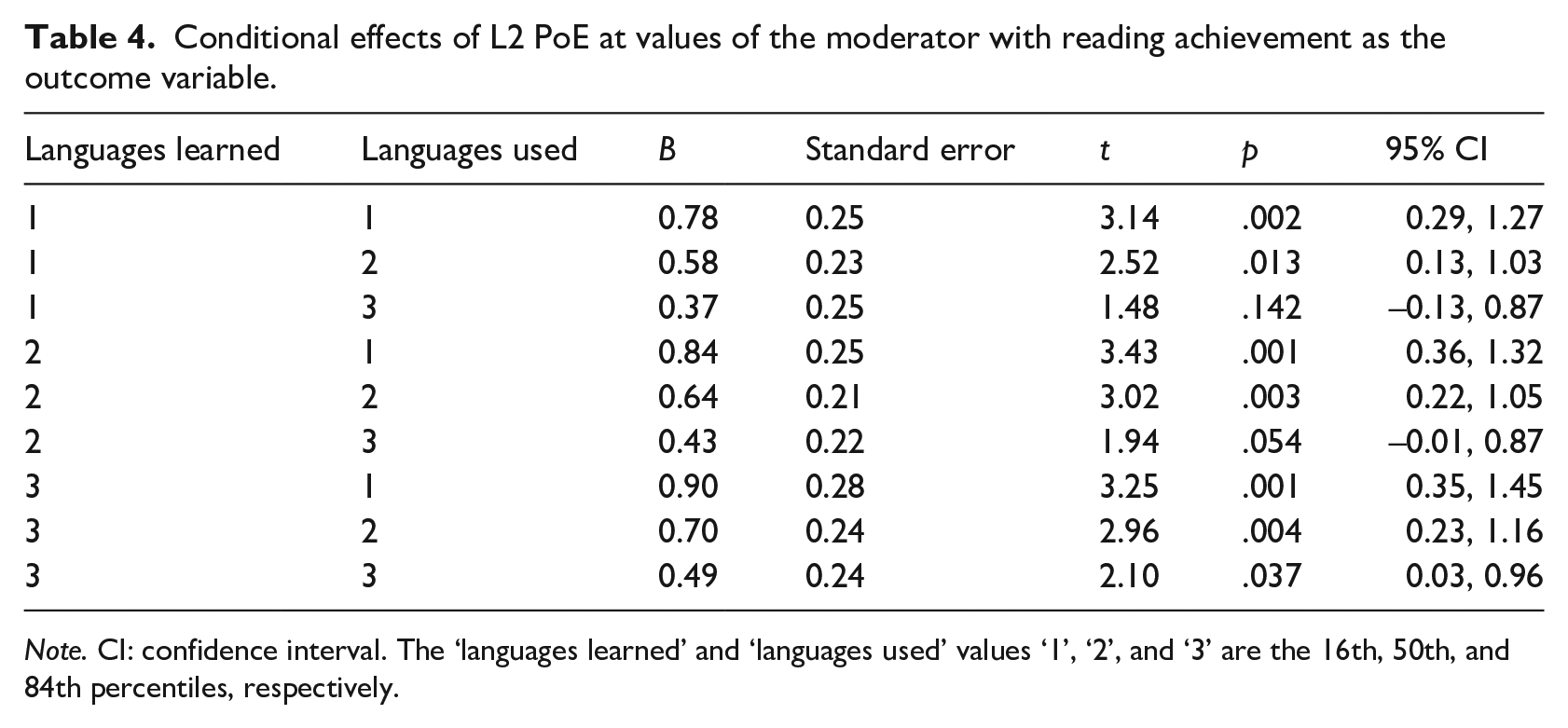
Note. CI: confidence interval. The ‘languages learned’ and ‘languages used’ values ‘1’, ‘2’, and ‘3’ are the 16th, 50th, and 84th percentiles, respectively.
A second regression was conducted using participants’ self-reported EFL writing achievement scores as the outcome variable. The results revealed that the overall model outperformed the null model (F[12, 167] = 4.13, p < .001, R2 = .23). Among the individual predictors, L2 PoE, L2 CoI, and the number of languages used were the only statistically significant (and positive) predictors of writing achievement (see Table 5). Similar to its effects on the relationship between L2 PoE and reading achievement, the number of languages used daily statistically significantly and negatively moderated the relationship between L2 PoE and writing achievement (B = –0.25, p = .040). A test of the highest-order unconditional interaction showed a significant effect on the interaction between L2 PoE and the number of languages used daily [F(1, 167) = 4.26, p = .040, ∆R² = .02].
Regression analysis results using writing achievement as the outcome variable.
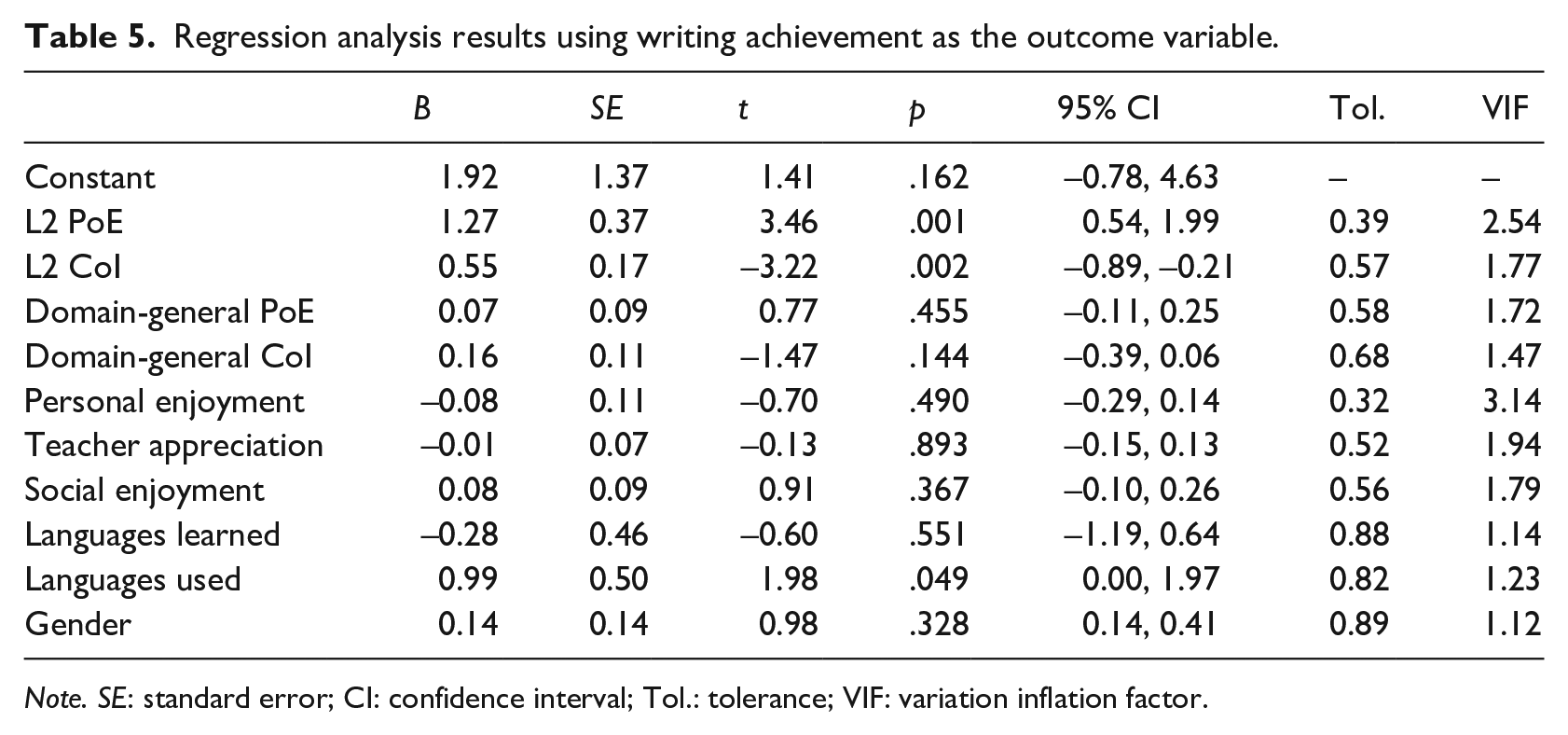
Note. SE: standard error; CI: confidence interval; Tol.: tolerance; VIF: variation inflation factor.
To further understand these interactions, the conditional effects of the focal predictor (i.e., L2 PoE) were examined at different percentiles of the moderator (i.e., languages used). The results revealed that the relationship between L2 PoE and writing achievement was more negatively moderated at lower percentiles of languages used, with the effects losing significance at higher percentiles (see Table 6).
Conditional effects of L2 PoE at values of the moderator with writing achievement as the outcome variable.
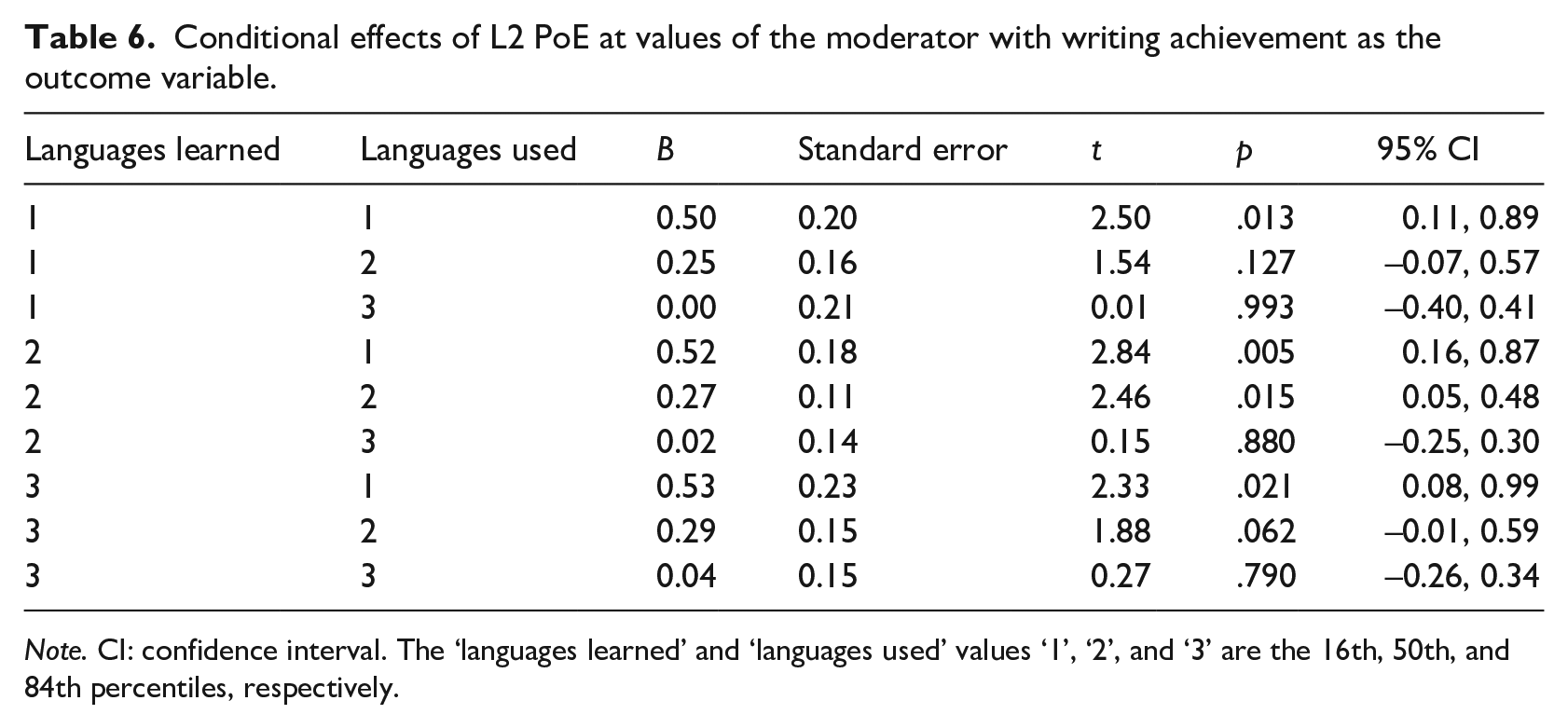
Note. CI: confidence interval. The ‘languages learned’ and ‘languages used’ values ‘1’, ‘2’, and ‘3’ are the 16th, 50th, and 84th percentiles, respectively.
Discussion
This study investigated the degree of variation between participants’ EFL and domain-general grit (RQ1), the relationship between their levels of grit, FLE, and literacy achievement (RQ2), and the extent to which their multilingualism moderated this relationship (RQ3). Concerning RQ1, the findings indicated that participants demonstrated statistically significantly higher levels of L2 CoI than domain-general CoI, with these differences, based on the effect size (d = 0.63), having a fairly moderate impact (based on the benchmarks recommended by Plonsky & Oswald, 2014). These findings are similar to those reported in the study by Teimouri et al. (2022), where differences between L2 CoI and domain-general CoI were very meaningful (i.e., they had a large effect size: d = 1.95), while the differences between L2 PoE and domain-general PoE were of little practical significance (d = 0.01). As such, it can be asserted that participants in this study reported more consistent and pronounced interest in learning English compared to their more universal levels of interest and engagement. However, they also exhibited comparable levels of perseverance for both English-related and domain-general tasks. The findings provide support for the validity of language-specific grit as a construct, at least with respect to the CoI subscale, and contribute to the argument against domain-general grit made by Pawlak et al. (2022), who remarked that its utility ‘to elucidate the intricacies’ of language acquisition ‘is at best limited’ (p. 16).
Regarding RQ2, regression results indicated that L2 PoE and the number of languages used had consistent predictive power with respect to EFL reading and writing achievement, whereas L2 CoI only statistically significantly (and positively) predicted EFL writing achievement (see Tables 3 and 5). As already mentioned, the findings regarding L2 grit are consistent with previous research that has shown it to have more predictive power concerning L2 achievement than domain-general grit. For instance, Teimouri et al. (2022) reported that the strength of correlations (r) between L2 grit and language achievement, measured through course grades, grade point average (GPA), and self-reported proficiency, was in the range of .27 and .35, whereas that between domain-general grit and language achievement was between .06 and .21. Indeed, individuals who possess high levels of language-specific grit may be better equipped to meet the demands of language learning and persist in their literacy development in the target language. In contrast, domain-general grit may be less relevant to language achievement because it does not explicitly and specifically capture the unique demands of language learning. As for L2 PoE being a more consistent predictor of literacy achievement than L2 CoI in this study, the results find some support in those reported by Zhang and Zhang (2023), who discovered that L2 PoE positively predicted both EFL argumentative and narrative writing performance, whereas L2 CoI was only predictive of EFL narrative writing performance.
Commenting on the differences between the predictive power of L2 CoI and L2 PoE in their study, Zhang and Zhang (2023) reasoned that CoI might have less of a role to play as task complexity increases. This might explain why L2 CoI predicted writing achievement but not reading achievement in this study, seeing as learners in Norway have been reported to view reading as a more difficult endeavour than writing due to it being an activity over which they feel they have less control (Aske, 2018). The findings also revealed that the number of languages used in daily life was statistically significantly and positively predictive of participants’ reading and writing achievement. This finding can be explained by the cognitive advantages of multilingualism, such as improved executive function and metalinguistic awareness (Jessner, 2008). Using multiple languages in daily life may have exposed participants to a wider range of linguistic structures, vocabulary, and cultural contexts, enriching their EFL learning experience and leading to higher reading and writing achievement. Interestingly, the study did not find a significant relationship between the number of languages learned and reading or writing achievement, perhaps because developing advanced proficiency also requires active and frequent engagement and practice (Paradis et al., 2017). Participants who reported learning multiple languages but did not use them regularly might not have attained comparable proficiency levels as those regularly utilizing their languages, limiting their ability to benefit from their multilingualism to boost their EFL literacy achievement.
The study’s finding regarding the daily use of languages negatively moderating the relationship between EFL PoE and reading and writing achievement also revealed that this negative effect was stronger when fewer languages were used daily and diminished or disappeared as more languages were used. These dynamics could be a result of the effects that accompany the use of languages in daily life. For example, research suggests that engaging with more languages regularly, whether at school or home, correlates with stronger academic achievement (Baker et al., 2012; Dolson, 1985; Soh, 1987), likely due to the increase in cognitive stimulation, including the awareness and sense of progress associated with being able to use one’s languages daily and the resultant positive impact on learners’ motivation to persevere in their learning. These dynamics have also been observed in how the number of languages used positively impacts language teachers’ pedagogical beliefs and teaching ability (Calafato, 2022a, 2022b), and accord with the contention, as already mentioned, that achieving advanced language proficiency requires active and regular engagement with the target language (Paradis et al., 2017). For multilingual individuals, not drawing on their entire linguistic repertoire with some regularity in daily life would ultimately preclude them from fully benefitting from their multilingualism (see Jessner, 2008), negatively impacting their progress and drive to persevere in target language tasks and leading to lower literacy achievement, as was observed in this study (though the effects weakened or disappeared as more languages were used).
Conclusion
This study’s findings contain several implications for language teachers, educational institutions, and researchers. First, given the strong emphasis placed by governments globally on developing the multilingual competence of students, it would be beneficial for educational institutions and teachers to more strongly encourage their students to use all their languages in daily life. Teachers could initiate discussions with their students about multilingualism, highlighting its different dimensions and placing greater emphasis on daily language use as a means of enhancing literacy development. Teachers could also pair up students with language exchange partners who have a different first language, facilitating opportunities for learners to potentially communicate with each other in multiple languages and practice their language skills. Second, the study highlights the importance of L2 grit in language learning, particularly PoE, and its consistently positive correlation with literacy achievement. To cultivate L2 grit in their students, teachers can highlight its importance through discussions and incorporating strategies such as creating a supportive community of language learners in the classroom by pairing more experienced language learners with less experienced ones. They could also ask their students to set specific goals related to their language learning, for instance, setting a goal to achieve a certain level of proficiency by a specific date or to learn a specific number of new words each week.
Recognizing that reading and writing achievement might be linked to distinct aspects of grit would also help teachers develop strategies to enhance students’ literacy skills more effectively through targeted development of one or both grit aspects. Third, with this study being based on cross-sectional data, it is hoped that future studies will investigate the interactions between grit, multilingualism, FLE, and achievement longitudinally. The study’s participant sample also consisted exclusively of schools in southeastern Norway, making the findings less generalizable to learners in other regions of the country. In addition, this study operationalized multilingualism as the number of languages learned and used daily, without examining participants’ multilingual proficiency, modes of use, or attitudes towards their own multilingualism. Future research could include these other aspects of multilingualism as predictor variables concurrently, as well as investigate grit’s impact on achievement in both language and non-language subjects at school, as moderated by students’ multilingualism. The development of grit scales for specific language skills and contexts is also needed; for instance, learners interested in playing video games in English may target a different set of language skills compared to those who are primarily interested in reading literary fiction in the language. Such scales would more accurately reflect how languages are used in and outside of educational contexts.
Footnotes
Declaration of conflicting interests
The author(s) declared no potential conflicts of interest with respect to the research, authorship, and/or publication of this article.
Funding
The author(s) received no financial support for the research, authorship, and/or publication of this article.

Availability of data and materials
The data supporting this study’s findings are available on request from the corresponding author. The data are not publicly available due to their containing information that could compromise the privacy of research participants.