




Abstract
Aims and objectives:
This study applies the notion of chronotope as an analytical tool to explore the role of globalization, immigration, and transnationalism in shaping multilingual children’s awareness and use of semiotic resources in changing social contexts.
Design/methodology/approach:
This study is a part of an ongoing collaborative autoethnography (CAE), in which the data come from the second author’s cross-cultural transnational family and are shared with the first author for a collaborative interpretation and analysis.
Data and analysis:
Data were collected through recording the observations of language practices of a nine-year-old girl in a transnational family, including her plays on her own or with her peers in and outside the home. An ethnographically grounded discourse-analytic approach was employed in analyzing the data.
Findings/conclusions:
Despite rich linguistic and cultural repertoire, the child situated English on a higher scale level in a hierarchically layered system, and she found imaginative play as a space in which she could explore not only linguistic repertoire but also certain cultural chronotopes. She also demonstrated her awareness of and skills in drawing on variation within the English language to index certain social personae.
Originality:
The originality of the study lies, first, in the uniqueness of the case being in an Indian-Iranian multilingual transnational family and, second, in the unique methodology—using chronotopes as a theoretical and analytic tool to analyze audio-recorded interactions in a multilingual child’s imaginative plays.
Significance/implications:
The study has implications for our understanding of how children pick up indexical meanings of linguistic choices and reproduce them in their imaginative worlds. It also sheds light on how language ideologies and practices reproduced by children may result in hierarchization and power difference between linguistic varieties.
Introduction
The importance of children’s imagination and play has long been established in psychology and education (Vygotsky, 1967). In anthropological and sociolinguistic scholarship, children’s imaginative play has been also found to be an integral element of how children socialize each other into linguistic and cultural norms (Goodwin & Kyratzis, 2012; Kyratzis, 2007; Schwartz & Palviainen, 2016) with implications for linguistic and cultural maintenance/change (Mirvahedi & Cavallaro, 2020; Smith-Christmas, 2020). Children have been found not only to reproduce the same action they have seen and heard adults do, but also to creatively combine and use them to construct new realities which correspond to their own needs and desires (Long et al., 2007; Vygotsky, 1967), often with an eye to “what they assume is just around the bend” (Karrebæk, 2011, p. 2913).
Through interactions during their imaginative plays, children have been also shown to recognize and produce indexical meanings; that is, they learn and use linguistic structures not only to convey content, but also to index social meanings associated with the context (Paugh, 2005). While in monolingual children, such indexical meanings may be expressed by variation within one language, multilingual children have a variety of semiotic resources at their fingertips to draw on during their plays to enact certain identities and socialize one another into multilingual practices and ideologies (Nicolopoulou, 2007; Paugh, 2019; Vardi-Rath et al., 2014). Research on Malay siblings in Singapore (Mirvahedi & Cavallaro, 2020), for example, showed how children as young as four and seven drew upon their English proficiency to enact an identity of a teacher and student during their imaginative play at home. The authors concluded that using English rather than Malay during the children’s play at home lay in the English-dominant Singaporean society and English-medium schools where students experienced teacher and student roles predominately in English.
Contributing to this line of research, this paper argues that language practices of children when they are in the play “frame” (Goffman, 1986; Mirvahedi & Cavallaro, 2020) are not random. To understand what semiotic resources, how, and why multilingual children use in their play, we show that different types of social actions and behavior, including language choice, are influenced by certain timespace configurations and spatiotemporal scales (Agha, 2011; Blommaert, 2017, 2020) children evoke and imagine themselves in during their play. Examining a unique case of an Indian-Iranian multilingual transnational nine-year-old child’s language practices during episodes of her imaginative play, we propose using chronotope as an analytical tool to address the role of globalization, immigration, and transnationalism in shaping multilingual children’s awareness and use of semiotic resources in changing social contexts.
Investigating the chronotopical organization of imaginative play as well as the overlapping nature of chronotopes, we shed light on the complexity, interaction, and mutual impact among different chronotopes, showing how they are blended in the lifeworld of an individual as young as nine years old. We show how the child creatively makes use of and tests out her resources in her linguistic and cultural repertoire to produce indexical meanings, which reflects her capacity to understand and use these semiotic forms to point to sociocultural information, such as ethnicity, class, status, gender, and geographic origins, as well as affective stances, culturally distinguishable activities, and social relationships.
In what follows, we first delineate the theoretical and analytic tool used in the paper. Then, we present the research methodology including a description of the family and the child’s life trajectory that has provided her with rich semiotic resources. In the data analysis section, three excerpts are shown to illustrate how chronotopes could be used to yield more nuanced and complex analysis of children’s linguistic practices in their imaginative play. The paper ends with some concluding remarks on transnational multilingual children’s life experiences, multilingualism, language ideologies and choice in their imaginative plays, and their implications for the child, family, and the society.
Chronotopes and scaling practices in multilingual children’s play
Introducing chronotope in literary work, Bakhtin (1981) stressed for the first time the “inseparability of space and time” in better understanding literary texts and characters, as he famously wrote, “time, as it were, thickens, takes on flesh, becomes artistically visible; likewise, space becomes charged and responsive to the movements of time, plot and history” (p. 84). While Bakhtin’s chronotope initially concerned time and space configurations in the novelistic discourse, he was quite clear that the concept could apply to “other areas of culture” as well (p. 84). Sociolinguists have since expanded and used the notion to understand how and why “[c]oncrete and socioculturally recognizable timespace configurations” (Blommaert, 2020, p. 18) are created in interaction, and what role language plays in such a process. Chronotope as an analytical tool has been proved particularly useful in examining sociolinguistics of globalization and population mobility shedding light on how technological and physical mobility empowers time and space to place conditions on people—or what Agha calls “personhood” that is “associable with a semiotic display of self ” (Agha, 2003, p. 243)—and their actions. As Blommaert and his colleagues argue, social action and interaction in chronotopes “peopled by certain social types” (Agha, 2007, p. 321) as well as any identity work is not random, but rather subject to norms and microhegemonies that lead to specific social effects (Blommaert, 2020; Blommaert & Varis, 2013). In such a spatiotemporal orientation, language practices are also considered and examined as mobile signifiers that are located in specific space and time (Canagarajah, 2017), the analysis of which shows social actors’ dynamic and hybrid utilization of semiotic resources in discursive meaning-making as well as their language ideologies (Karimzad, 2021; Karimzad & Catedral, 2018).
Such an understanding of interaction among people in different chronotopes inevitably changes the definition of context from merely as “local, stable, static, and given operational-analytical category” to something that is “continuously evolving, multiscalar, and dynamic” that involves “an IDEOLOGICAL and a MORAL a priori” (Blommaert, 2017, p. 95, emphasis in original). Similar to Blommaert et al. (2005 p. 221) who showed how situated talks in the neighborhood are “semiotically layered” and connect to different centers and their indexical orders, we also illustrate how children’s language practices in their plays are polycentric and scalar. While a child or a group of children may play in their room and their language practices take place at a micro and local context of the room, they creatively explore a variety of chronotopic situations and identities engaging in indexical re-stratification where forms of speech indexically attached to one time space configuration are re-entextualized into another giving them entirely different indexical valuations (Agha, 2003; Blommaert, 2017). This also allows them to imagine things of different orders which are hierarchically ranked and perform scale-jump from “personal and situated to impersonal and general” practices (Blommaert, 2010, p. 35). Foregrounding this notion of context as multilayered organization of the time space configurations lends itself very well to our analysis of transnational multilingual children’s imaginative play as it provides us with insights and views into their understanding of the power relations between languages in different chronotopic situations as well as their ways of constructing certain identities in the context of globalization.
Research methodology
This research is part of an ongoing collaborative autoethnography (CAE), in which more than one autoethnographer collaborates at different stages of the study (Pheko, 2018). The data come from the second author’s cross-cultural transnational family. The data are collected by the mother as a participant-researcher taking notes and recording her observations of language practices in the family including her child playing on her own or with her peers in and outside the home. After each piece of the data is collected, it is shared with the first author for a collaborative interpretation and analysis.
The analysis in this article is based on plays and interactions of the nine-year-old multilingual girl that were audio-recorded by her mother for the purpose of monitoring her language development in various contexts and her exposure to different languages. The excerpts for this study were selected from three recordings; a 15-minute recording of her play with her dolls, a 17-minute play on her mobile phone where she also explains the game to her mother, and a 15-minute play with five dolls in which she imagines herself as a mother and a ballerina who has two daughters. In all recordings including the child’s individual play, her mother interacted with her and asked questions about her play. Participant’s verbal informed consent (Roulston & Choi, 2018) was gained prior to selecting the recorded plays for the data analysis. The second author, Elena’s mother, explained to her what the research was about and sought her assent for sharing the recordings with the first author. The audio-recordings of the plays were transcribed verbatim, and then they were shared with the first author. The transcripts were collectively analyzed and interpreted by the authors to gain a meaningful understanding of the multilingual child’ language practices during her plays in certain timespace configurations. The recordings were analyzed to focus on how a child’s imagination and her language use mediate one another in such imaginative spaces. CAE empowers the researchers “to hold up mirrors to each other” in collective self-interrogation (Chang et al., 2013 p. 26). Therefore, the employment of CAE enabled us to discover potential subjectivity and avoid biases.
Participants: Elena and her family
Elena (a pseudonym) was born in a transnational family consisting of an Indian father who speaks English, Hindi, Punjabi, and Persian, which he learned during his stay in Iran for almost 20 years, and an Iranian mother who speaks Persian and English. The family has lived in different countries, ranging from Iran to Malaysia exposing Elena to different languages and cultures in addition to the home languages, that is, English, and some Hindi and Persian. Elena was born in Iran. In the first year of her life, Elena was exposed to English and Persian with the mother as her main carer who talked to her in Persian. English was also one of the home languages as it was sometimes used between parents as well as by her father when addressing her. Hindi remained to be the language used in the parties and gatherings with Indian friends. Cartoons, movies, and TV series in Persian, English, and Hindi were also among the sources of her exposure to languages at home. The family moved to Lithuania to establish a business when Elena was one. After their stay in Lithuania for 6 months and establishing their business, they decided to move to Germany since the short distance between Vilnius and Frankfurt provided them with the chance to manage the business in Lithuania and life in Germany where they could be with some close friends and relatives. Within their three-year stay in Germany and Lithuania, Elena was still at home and did not join any child care centers. She had the same exposure to Persian, English, and Hindi as she had during their residence in Iran. However, the cartoons that she watched were limited to English-speaking ones on YouTube. She was exposed to German and Lithuanian through her language contacts while she played with children at parks and neighboring buildings. At this stage of life when she was almost reaching four, Elena did not speak any of these languages except for some unclear words which only made sense to parents. In 2016, when Elena was four, the family decided to return to Iran. It was the time for Elena to join kindergarten and because of the parents’ immigration plans as well as the father’s nationality, Elena was sent to the school of embassy of India in Iran where the medium of teaching was English, and Hindi was taught from the third grade in primary school. Although the medium of teaching was English, Hindi and Punjabi were used by all the teachers who were from India. The family was in Iran for a period of 2 years and Elena was exposed to Persian through her mother, the mother’s family, programs on TV, a music class that she joined, and interactions with the children and people in the society where the official language was Persian. English was taught and used at school every day for 8 hours, and she was also willingly engaged in learning Hindi and Punjabi used by the teachers at school, Indians in the Gurdwara which is the place of worship for Indian Sikhs in Tehran, and the Indian movies and programs that the family watched. Within the 2 years of their stay in Iran, Elena used English to interact with friends and teachers at school, Persian and English in communication with her parents, and Persian with friends in the music class. In 2019, the family moved to Malaysia, and Elena joined an international school where English was the medium of teaching, and French was taught as a foreign language. In Malaysia, Elena learned French as a foreign language and some Chinese in interactions with her Chinese friends. The use of English at school and society and learning French and Chinese pushed Persian into the corner, and it was limited to the domain of home and in communication with her mother till 2021 when they came back to Iran. Although she was not confident enough to speak Persian upon their arrival to Iran, she was capable of handling her interactions with her friends and cousins in Persian after a couple of months. Yet, given that Elena’s exposure to Persian is mainly through her mother, which is always mixed with English, it is fair to say that English dominates Persian in family interactions. The language ecology of the home and the life trajectory of the family and child are presented in Figure 1.
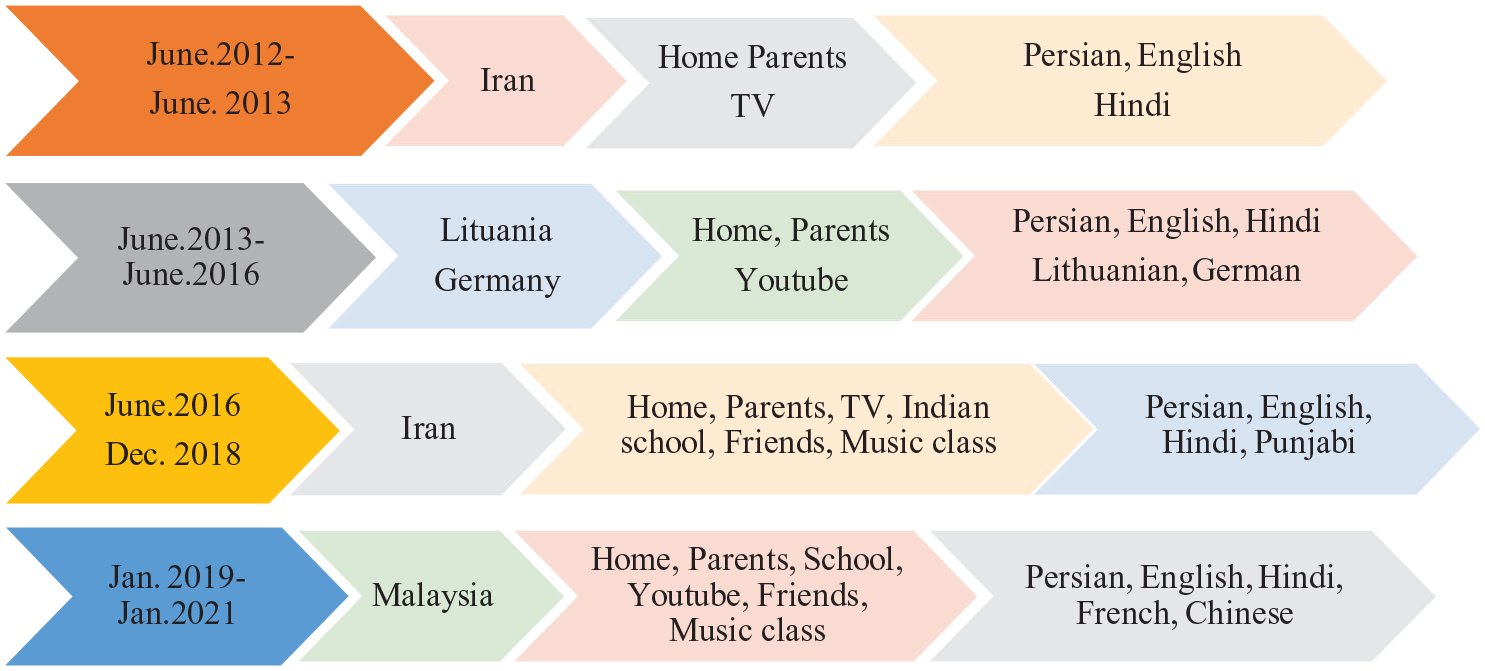
Elena’s history of exposure to particular languages until age 9.
Data analysis
We follow an ethnographically grounded discourse-analytic approach in this analysis. Ethnographically grounded discourse-analytic approaches are commonly applied in research to analyze recordings of naturally occurring events, interactions, and interviews to identify and understand how groups of people make sense of their experiences within and across settings (Wortham & Reyes, 2020). This means we have incorporated our knowledge of social, cultural, and situational contexts into the analysis of the transcriptions of interactions. The first excerpt comes from a play taking place in Elena’s room while they were in Iran and waiting for their permission to move to Australia just after the lockdown. The family was just back from their stay in Malaysia which, to a great extent, explains Elena’s insistence on speaking English. The imaginative play is carried out by Elena and some of her dolls, and the mother who interrupts and solicits some information from her about the activity she is engaged in.
Excerpt 1: a hypothetical utopian toy world
M = mother
E = Elena
Persian in italics
M: dari che bazi mikoni?
[What are you playing?]
E: If you want to speak in Persian, I cannot reply to you.
M: Oh why?
E: Because it’s a hospital in Malaysia and I don’t want to talk to you in Persian.
M: Oh, I see, I will also speak in English. Is that fine?
E: Yes
M: What game is it?
E: She has to get some person for doctor check-up
M: The duck is the doctor?
E: No, the other one. The mermaid is a doctor.
M: But why did they just go through the slide?
E: Because they didn’t want to drive the car. It’s a zip line.
M: They have to pass to the zip line to go to the doctor?
E: They have to pass the line and come here to get the tickets for check-up and then they go.
M: Why do they need to see the doctor?
E: Because they need to have a paper for Australia so they have to give it and then they’re allowed to go.
M: Oh, it’s Australian check-up for visa. Yeah. Really? If they have any diseases, they cannot enter Australia then?
E: No, they come here to make them well. They will be fine and then they will allow them to go to Australia.
E: This is the first patient.
M: What’s wrong with that patient?
E: They will just check her if she is fine, they also do the test, like what we did in Malaysia [she doesn’t remember the name]
M: Oh, that one is PCR. Wow. Do you think she’s afraid?
E: No.
E: Then she goes to bed and they put an injection so she doesn’t understand what's happening.
M: Oh good. But why in Malaysia They didn’t give us injection?
E: For toys it’s different.
M: Why?
E: Because mostly toys are scared. So, that’s why they put the injection, now she’s doing her wings
M: What’s wrong with her wings?
E: No, we have to check the germs in all of their bodies.
M: If the doctor says that she’s sick and she can’t go to Australia, then she will be unhappy and sad.
E: No, they will give her this kind of medicine and she will go.
M: No one will be rejected?
E: No.
E: They are just going to check inside the ear.
M: Okay, got it, some internal parts.
M: Why did you choose this game today?
E: Because it’s almost near to go to Australia. That’s why I like to do this.
M: You feel it’s near to go? And are you happy?
E: YES.
M: You like to go sooner? Why?
E: Because I want to go there and go to school and have some new friends. Yeah, I’m sick. And just sick to be at home. I’m tired of it.
M: Tell me about the result of PCR. Okay? If she has COVID or not.
E: No, she doesn’t have COVID.
M: Do they also receive vaccine?
E: When COVID came, the toy scientists knew that COVID will come so they made the vaccine sooner than the people so, they don’t have to put mask.
M: Why?
E: Because they know that COVID was coming.
M: How did they know?
E: Some of them know the future.
E: Oh, they put some vaccines and they can know the future, the old people, those old people know.
M: They are so intelligent you mean.
E: Okay, now the doctor needs some rest. So the doctor is now me because he she got tired. Okay.
E: Wait, wait, I have a question. Only because she’s tired. She’s leaving all the patients and she goes.
E: No, she has family and has to meet them and come back.
M: What about these patients? They have to wait here for a long time.
E: I’m also a doctor.
M: You’re also a doctor. Oh, you mean the doctor will be replaced?
E: The doctor only stays from 4 to 9 and then goes then I stay nine o’clock to 12.
M: Only two patients are left.
E: Yeah, the second doctor went for dinner also.
M: You mean the patients have to wait there? But they will be tired.
E: No, it’s dinner break.
M: But, you know, I feel pity for those patients who have to wait there, especially that one on the bed. And has to wait there.
E: You know, when doctors are in their room doing their stuff. You know, first day like put the patient somewhere and then they go and then come back their job and they come back.
M: So, you mean it is something usual?
E: YES!
The excerpt presents a telling example of how several chronotopes are evoked simultaneously, and similar to the real world, they do not exist in isolation (De Fina & Perrino, 2020). In this excerpt, there are several chronotopes including a hypothetical toy world created by the child, in which the chronotopes of hospital, migration, COVID-19, and biometrics take place. These chronotopes are not clearly separated, and different times and spaces overlap (Perrino, 2011). For instance, the chronotope of the hospital with its different layers is situated in the toy world. In such chronotopic lamination (Prior, 1998), where multiple chronotopes are layered, some chronotopes are foregrounded while others are backgrounded. However, all these chronotopes are present and influence each other and the understanding of the bigger picture of the main action being performed (Prior & Shipka, 2003). The first and most important feature of the toy world is the language, indexing Elena’s awareness and skill to evoke the communicative norms of the chronotope; although the time she is playing is the duration in which the family is in Iran, she chooses and insists to use English in her play. The immediate time space of her play is hypothetically linked to that of a hospital in Kuala Lumpur, Malaysia, where the family had biometrics for an Australian visa. Situating the play in such a chronotope leaves her no choice but using English, the normative behavior associated with the chronotope. The chronotope of the hospital is made up of three chronotopes of relatively smaller scales (i.e., yard, room, hall), and specific chronotopically situated materials (e.g., bed, medical instruments, computer, and scanner), people (e.g., patients, doctors, nurses), activities (e.g., lying on the bed, waiting in the hall), and the normative behavioral scripts associated with them (e.g., taking turns, keeping quiet). In the chronotope of her hypothetical utopian world, the choice of English reflects the fact that “language choice” rather than being an individual selection is “an outcome of the interaction of personhoods and scales that determine what collectively sanctioned patterns of language use are relevant” (Karimzad, 2020, p. 8). In our case, the chronotope of the hospital, based on Elena’s previous experience, is related to Malaysia where she and her family had to speak in English. Following the notion of scale (Blommaert, 2010), the space is stratified and power-invested. In the chronotope of the hospital, for instance, the context is layered and includes various scopes. There are different sets of norms, normative behaviors framed (Goffman, 1986) by chronotopes, such as the doctor leaving while keeping patients waiting (lines 53–64), that are indexical of the hierarchy of social structure in the hospital where doctors are in higher social position and are empowered by institutional rules to keep patients waiting. Moreover, the choice of the mermaid as the doctor (lines 9–10) and other toys such as duck, bear, and dogs as patients is the indexical image of society (Blommaert, 2010) where doctors are of higher ranks and scopes compared with patients. There is another chronotope in this play that may not be explicitly observable, and it is backgrounded: The chronotope of the theme park that was used in the beginning of the play where the patients had to pass a zip line to reach the building of the hospital. Elena had tried zip line in Malaysia when she was taken to a theme park on a field trip arranged by the school. In her explanation of her experience about the field trip she stated: the zipline was super scary. I didn’t want to try it, but my teacher said all the children have to try it. When I sat there, the guy in charge of it pushed me and I was so scared when I opened my eyes and I saw I am above the boiling lava. I will never try it again. [she emphasizes]
Bakhtin (1981) argues that chronotopes are not merely a configuration of time and space, but they are always colored by values as well as emotions. The chronotope of the theme park, which is filled with fear and anxiety because of the zip line ride, is applied at the beginning of the play where the patients enter the hospital for check-ups and treatments. The child’s creativity and imagination enable her to create a chronotope that is safe. In the imaginary chronotope of the toy world, the patients are given injections before check-ups (lines 24–28), so that they will not feel pain. Moreover, there is no COVID-19, since, in the toy world, the old citizens predicted the occurrence of the pandemic and immunized the people way in advance (lines 45–56).
Excerpt 2: mobile game: dance school
The following excerpt is taken from a conversation between Elena and her mother while she was playing on her mobile phone. Unlike the first example of the play above, Elena here used Persian (Farsi) as what has come to be known as the matrix language (Myers-Scotton, 1993) with many English words (underlined) embedded in it. The reason for this shift to Persian was the family’s stay in Iran for a while during which Elena was immersed in a Persian-speaking environment.
M = mother
E = Elena
English words underlined
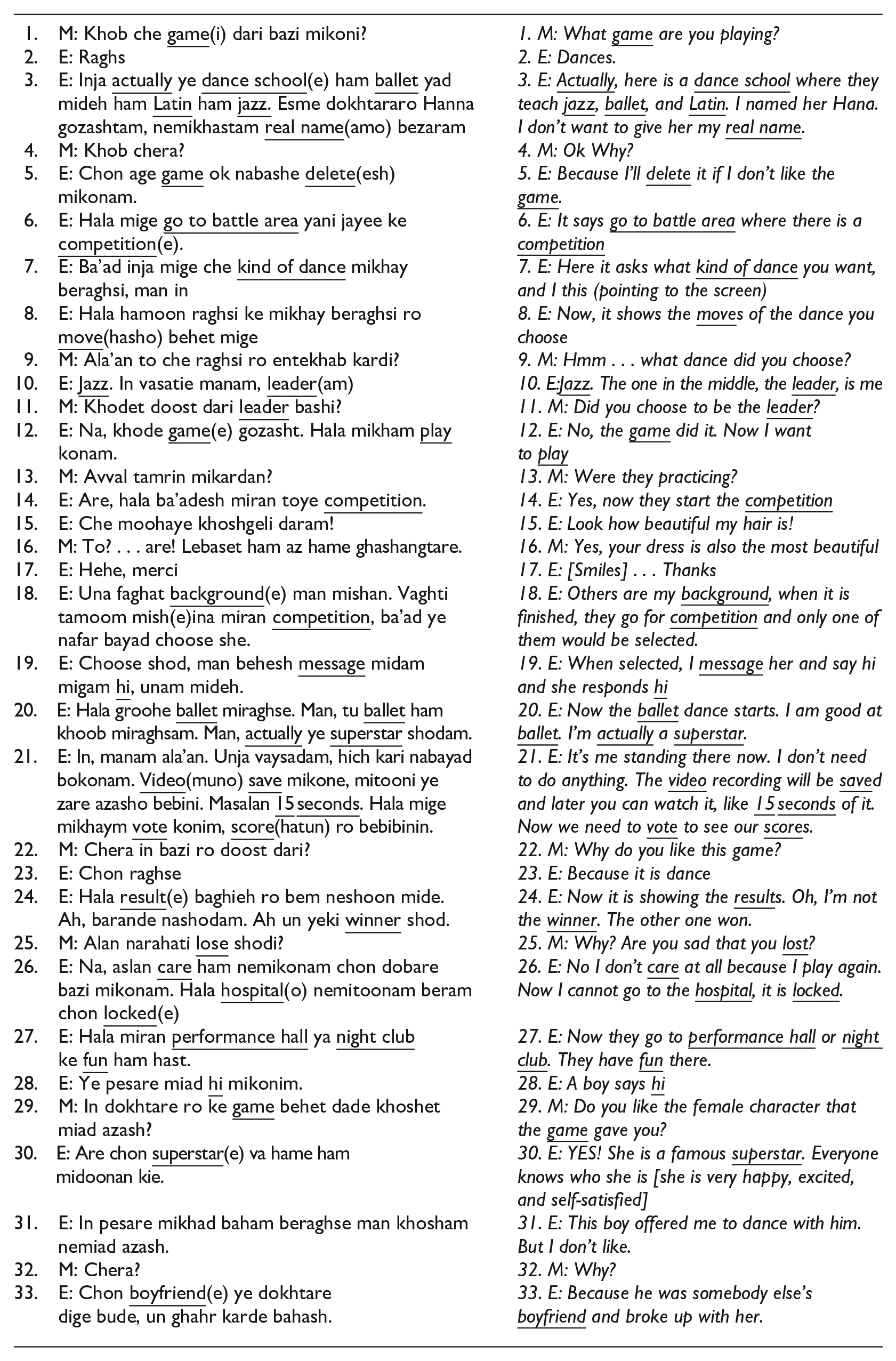
Games, as Jenkins (2004) puts it, do not simply tell stories, but they are designed worlds and sculpted spaces. Manning (2020, p. 120) argues that this approach to games as “spatial narrative affordances” allows us to analyze the game-worlds in terms of chronotopes because playing (online) games also afford “virtual space-time ‘movement’ and ‘travel’” (Lempert & Perrino, 2007, p. 207). Elena’s playing a dance game provides us with such a case. While she is in the chronotope of her home in Iran with the normative behavior, some of which are possible at home and some are not in the public sphere (e.g., dance), the chronotope of “dance school” on the phone allows Elena to choose jazz, which seems she has previously played and now knows it very well. She is so attracted by and to the game that she situates herself there and anytime her mother asks her a question, it takes a while for her to come out of the chronotopes of the game to that of the real world and reply to her mother. Although her mother asks questions in Persian and expects her to respond in Persian, as she usually does, she uses her multilingual skills such as code-switching and borrowing as she shifts between the imaginary world of the game and the real world (Cromdal & Aronsson, 2000) to respond to her mother’s questions. Absorbed by the game, she imagines herself as a “leader” in a jazz dance (lines 10–11); however, she chooses ballet, what she believes she is good at, and everyone knows her as a “superstar” (line 20). She is involved in an imaginary time space where personhood is also highlighted (Agha, 2007). The fact that everything in the game including the songs, dialogues, messages, and instructions is in English grants the language a higher position and value in the scalar hierarchies of languages around her. The chronotope of the game on her phone not only takes her to another time and space (Bakhtin, 1981), where English is the dominant language and therefore up-scaled and foregrounded (Blommaert, 2010), but also engages her in some identity work and behavior associated with that specific chronotope. The chronotope of the dance game makes it possible for her to dance with boys, and engage in such discourses as going to a night club, having a boyfriend, breaking up, and so on, that are not part of Iranian-Islamic cultural chronotopes sanctioned by the State. While her identity as a “well-known superstar” and feeling confident, happy, and satisfied (lines 30) throughout the chronotope of the dance game resonates with Bakhtin’s argument that chronotopes are colored with emotions and values (Bakhtin, 1981), the “normalcy” (Karimzad, 2020) of her behavior in the chronotope also sheds light on her linguistic and cultural ideologies (Jorgensen, 1998), on one hand, and her ability to reshuffle her social and cultural capital to construct identities, on the other (Blommaert, 2017). In other words, under the current circumstances in Iran, certain social practices such as dancing at a dance club and having a boyfriend are not sanctioned by the official State discourses on Islamic-Iranian culture. Thus, observing what Elena finds as “normal” in the game reflects not only her linguistic and cultural ideologies, practices, and identities that are in clash with the official discourses but also her dexterity in drawing on her multilingual repertoire to enact them.
Excerpt 3: being a mother and a ballerina
In another play, she takes a role of both a mother and a ballerina. In this play, there are five main characters including Elena (Pinkie Pie in the play), her friend (Anna), Pinkie Pie’s daughter (Snow White), Anna’s daughter (Hanna), and Pinkie Pie’s little daughter (Bella). There are also characters whose roles are backgrounded, but are of paramount importance in our analysis, such as the security guard of the residence. The female characters (Pinkie Pie, Anna, Snow White, Hanna) in her play are the Barbie dolls and the male character (security guard) is the policeman in her Lego set. She chooses Pinkie Pie, the blond and most beautiful one, to play as her own role. Beside the dolls, she uses some other materials in her imaginary play. For instance, a rectangle kitchen strainer as Pinkie Pie’s car, a metal ruler as the slide in the park where she takes the kids, and a small compact mirror as the check-in tag. She prepares the stuff before the play, and in the conversation with her mother, she speaks in Persian, however, she code-switches to English where she is not able to express what she means in Persian. As she steps in the play world, she starts speaking in English. She is a ballerina and she finishes her work and drives back home to take the kids to the park.
SG = Security Guard
H = Hanna
SW = Snow White
P = Pinkie Pie
A = Anna
SG: Here you go, have a nice day (she used English with a Bangladeshi accent—flash back to their residence in Malaysia where the security guards had Bangladeshi accents)
P (Elena): Please go straight ahead then turn right, go straight ahead then turn left. You have arrived at your destination (Mimics the voice just the way Waze navigation application does with an American accent)
P: Hi kids
SW: Mommy I love your costume
P: Hehe it’s for our show
P: Hanna, Anna, how is the baby?
A: She is fine, she didn’t cry
P: (she plays with a baby in the cot and uses some unknown words)
P: I want to take you to the park because you were good kids
SW: I love you mommy
P: I love you too
P: Anna, take care of the baby while we are gone. Bye.
P: Ok buckle up your seatbelts
SG: Hello there can you give me your card so I can scan? (Impersonating the guard with Nepali accent)
P: Of course, thank you (different English accent)
P: (Waze): Please go straight ahead then turn left
P: Then go left then go right then go left (she giggles and explains to her mother that she has to change her way because it is lockdown)
SW & H: When will we arrive?
P: Just wait for 20 minutes
P: We have arrived, let me just park the car
SG: Hello, you need to get the tickets to go in (accent)
P: Ok give us the ticket
SG: Here you go have a nice trip (accent)
P: Thanks
SW & H: YES [happily]
SW & H: But there is no one here only two women
SW & H: We cannot play with kids (sad)
P: You can just play on your own
H: Come on
SW & H: Is it lockdown here? Because nobody is here!
P: You go and play and I . . . oh my mom is here I will go and talk to her . . . to your grandma
SW: Wow here is the slide (she made it with a metal ruler and a small toy car)
Similar to the previous excerpts, the main chronotope of the play consists of several small laminated chronotopes, within which various social personae with their accompanying values and behavior are evoked. While she is playing, she is involved in the “scale-jumping” processes where certain resources came into play through spontaneous interactional moves, footings, and frames (Goffman, 1979, 1981, 1986), applied by characters particularly when language users with different competencies come into contact. The play consists of several pieces belonging to various timespace configurations including the times and spaces from which she speaks and the times and spaces she speaks about (Karimzad & Catedral, 2021). While she is in Iran and her play is the reproduction of the family’s lifestyle while they were in Iran, it is also combined with the events and features of their life in Malaysia. In her play, she is reproducing her mother’s role (Pinkie Pie in the play) reflecting the period in which her mother went to work in Iran and her aunt (Anna in the play) took care of her at home. At the same time, the play reflects some parts of their life in Malaysia where there were security guards in their place of residence, they used Waze application to travel around, and some roads were blocked due to COVID-19 quarantine and restrictions.
The whole play is in English. However, Elena shows awareness and control of variation within English associated with different social personae in the society. While her use of different accents, that is, “standard” American accent for impersonating Waze application, and Bangladeshi and Nepali accents for the security guards, shows her polylanguaging skills (Jørgensen, 2008), it can be also related to the normative practices (Karimzad & Catedral, 2021) based on what she has observed during their stay in Malaysia. Moreover, it reveals her language ideologies that are observable through the indexicalities created by drawing upon contextualization cues (Gumperz, 1982) such as accented speech, pointing to sociocultural information, such as ethnicity, class, gender, and geographic origins (Ochs & Schieffelin, 2008). Elena’s language choice for Pinkie Pie and Waze application, a more standard variety of English than the one security guards speak, suggests scalar hierarchies in her imaginary world (Gumperz, 1982). What is important here to note is that chronotopes are not simply a spatiotemporal background in which social activities are built. Rather, imagining herself in a specific timespace configuration places her in a position that leads to reproduction of certain language ideologies and hierarchization of linguistic resources ranging from a language to an accent.
Concluding remarks
Elena’s invocation of chronotopes and use of her semiotic resources during her plays provides us with insights into transnational multilingual children’s rich life experiences, multilingualism, language ideologies and choice in their imaginative plays, and how they are carried over to subsequent interactional contexts. Applying chronotopes to our data, we have shown that the multilingual child’s language practices are not random in her plays but they are informed by timespace configurations as well as the timespace-bound associations such as people, behaviors, moralities, and indexicalities (Blommaert, 2015). We have additionally shown that such time space configurations and associations ultimately contribute to the production and interpretation of meaning (Karimzad & Catedral, 2021).
The analysis of the three excerpts above showed that although Elena has a rich linguistic and cultural repertoire due to the transnational context of the family and the diverse life experiences (Blommaert, 2010), she situated English on a higher scale level in a hierarchically layered system (Blommaert, 2010). As the first excerpt showed, although her linguistic choices could have shifted in response to norms in the immediate chronotopic context (Blommaert & De Fina, 2017), what actually the mother thought to be the case, Elena asked her mother to speak English, otherwise they could not discuss her play world. While the play took place in Iran, a chronotope in which Persian would be expected to be used by Persians, the normative force of the chronotopes she evoked during her plays left her no choice but to use English in interaction to different social personae she imagined. Interestingly, this norm was carried over to her interaction with the mother outside the chronotopes of the play, which would be worth considering in investigation of family language policy and heritage language maintenance (see also Mirvahedi & Cavallaro, 2020).
The second excerpt shone a light on how children find imaginative play as a space in which they can explore not only linguistic repertoire but also certain cultural chronotopes that may not be readily available to them. Examining the micro-scale chronotope of the dance game in relation to the macro-scale nation-state-level cultural chronotopes showed how she engaged with such sociocultural practices as going to a night club, dancing with a boy, relations outside marriage, that is, having a boyfriend, and breaking up, the practices that are not sanctioned in an Islamic country like Iran. Of significance here is that while the matrix language in the parent–child interaction is Persian, English is used to refer to those concepts associated with non-Islamic culture. In line with Blommaert and De Fina (2017, p. 10), the analysis of the second excerpt shows how investigating the co-occurrence and intersection of macroscopic and microscopic chronotopes can help us detect social change and shed light on “various forms of cultural globalization in which local and global resources are blended in complex packages of indexically super-rich stuff.”
The final excerpt revealed further information about Elena’s English proficiency. She demonstrated her awareness of and skills in drawing on variation within the English language to index certain social personae, for example, impersonating accents associated with people, suggesting how she has picked up particular norms, codes, and expectations (Blommaert, 2010) in her past life experiences. While this might not be surprising at all, it has strong implications for our understanding of how children pick up indexical meanings of nuanced linguistic choices such as certain accents in relation to race, ethnicity, and social class, and reproduce them in their imaginative worlds. As such language ideologies and practices are reproduced by children, the rescaling of vernacular resources in the global context may not happen, leading to further hierarchization and power difference between linguistic varieties.
In sum, we have illustrated how applying chronotope as an analytic tool to children’s language practices can open an insightful venue to investigate the complex polycentricity and scalar nature of language choice, with all its sociocultural implications, in children’s imaginative plays, and in the family in general. We have accordingly illuminated two points. First, we have shown how “[t]he macro-sociological order OCCASIONS the conversational order’ (Gafaranga, 2010, p. 266, emphasis in original). Second, language choice takes place in a “layered simultaneity” in that “it occurs in a real-time, synchronic event, but it is simultaneously encapsulated in several layers of historicity, some of which are within the grasp of the participants while others remain invisible but are nevertheless present” (Blommaert, 2005, p. 130). Further research needs to be carried out to contribute to our better understanding of how young children’s practices, including language choice, are informed by various local and global factors, and what implications they have for the children, families, and the society.
Footnotes
Declaration of conflicting interests
The author(s) declared no potential conflicts of interest with respect to the research, authorship, and/or publication of this article.
Funding
The author(s) received no financial support for the research, authorship, and/or publication of this article.
