




Abstract
Aims and objectives/purpose/research questions:
This study explores the asymmetric placement of the finite verb in Korean L2 German speakers and examines the effect of sociolinguistic factors on the produced verb placement patterns.
Design/methodology/approach:
Fifty-eight participants performed a sentence completion task that elicited the preferred placement of the (finite) verb in matrix and subordinate clauses. In addition, language background interviews were conducted to better understand the sociolinguistic circumstances of the Korean immigrants.
Data and analysis:
The experimental data are analyzed using implicational scaling to identify patterns of verb placement. The effect of sociolinguistic factors was tested fitting an ordinal logistic regression model.
Findings/conclusions:
Contrary to the developmental stages of L2 German syntax found in previous research, the experimental results revealed that target-like subordinate clauses are produced more robustly than verb second (V2) constructions. It is argued that this result is better explained with difficulties producing subject-verb inversion, V2, than with facilitative L1 transfer effects from Korean, producing German subordinate clauses with V-final order. Concerning social factors, the type of occupation (coal miner or nurse) was most significant in predicting the preferred L2 verb placement pattern, followed by L2 education and age of immigration.
Originality:
This article adds to the understanding of L2 German syntax by revisiting previously identified stages of L2 German development with data that target the preferred verb placement in matrix and subordinate clauses from less-researched L1 Korean speakers. The intra-group distinction of Korean immigrants into coal miners and nurses further allows a differentiated look at the role of sociolinguistic factors.
Significance/implications:
This research is significant as it aims to draw a comprehensive picture of L2 German acquisition and usage in the context of labor migration, highlighting a less-studied group of immigrants.
Introduction: untutored L2 German development of adult immigrant workers
The increased numbers of immigrant workers in western and northern European countries, induced by the post-war economic upswing in the 1950s, made it possible for scholars to examine untutored, “naturalistic” second language (L2) development of adult learners. Seminal studies around the 1970s and 1980s aimed at capturing how untutored, adult L2 development proceeds under the given sociolinguistic circumstances of the immigrants (e.g., Clahsen et al., 1983; Klein & Perdue, 1997). Another focus area was the role of the L1 and Universal Grammar (UG) on adult L2 acquisition (e.g., Schwartz & Sprouse, 1994, 1996). Today, this generation of immigrants, which once provided the empirical data to study the developing L2, has reached retirement age and—after more than 40 years of living and working in the host country—is suited for revisiting previous findings on L2 development. This study explores the use of the asymmetric verb placement in German by L1 Korean speakers who immigrated to (West) Germany in the 1970s, a less-studied L2 German speaker group. While Korean is an OV-language where the verb is always on final position, German has V2 in main clauses and V-final in subordinate clauses which pose different acquisitional hurdles. By investigating Korean L2 German speakers’ verb placement preferences, the study adds to the understanding of L2 German syntax, by revisiting previously identified stages of L2 German development, particularly regarding V2 and subordinate OV. Furthermore, the effects of sociolinguistic circumstances on their preferred L2 structures are examined to draw a comprehensive picture of L2 German acquisition and usage in the context of labor migration.
A seminal study on the acquisition of L2 German word order is the investigation of the L2 development of Italian, Portuguese, and Spanish workers (Clahsen et al., 1983, henceforth ZISA). The study proposed six incremental developmental stages (word order rules) for the development of L2 German syntax. The most relevant finding for this study concerns the asymmetric verb placement in German. In matrix clauses, the finite verb must occur in the second position, V2, and in subordinate clauses the finite verb occurs clause-finally, V-final (OV). The ZISA study found that the rule for subject-verb inversion in matrix clauses, leading to V2, is acquired before the V-final rule in subordinate clauses. This order of acquisition has been confirmed by other studies (classroom L2: Ellis, 1989; child L2: Lightfoot, 1989; Pienemann, 1989; adult L2 German with L1 Turkish and L1 Korean: Vainikka & Young-Scholten, 1994). The authors of the ZISA study framed the development of word order rules within a psycholinguistic approach, considering speech processing constraints (but see, for example, Meisel, 2011, for a different approach). They assume that different structures, that is, word order rules, demand different levels of processing capacity, and that the information processing system is limited in capacity. As Clahsen (1984) puts it, “linguistic structures which require a high degree of processing capacity will be acquired late” (p. 221; see also Tsimpli, 2014, for interface phenomena). Referring to Levelt’s (1978) “skill theory” that appeals to the relationship between mental effort and complex operations such as language behavior, L2 acquisition, and use is understood to require a considerable amount of mental (processing) capacity due to lack of automation. Structures like V2 might demand complex speech planning and have lower levels of automation for an L2 speaker, requiring more mental effort and resulting in alternative word order patterns. This study targets the production of V2 order with the goal to inform verb placement preferences in the left periphery.
Another influential study that has investigated L2 German syntactic development comes from Schwartz and Sprouse (1994, 1996). Their analysis of the L2 German utterances of Çevdet, an L1 Turkish speaker, led to the hypothesis that the adult L1 grammar transfers completely and builds the initial state of adult L2 acquisition, and that access to UG allows for gradual restructuring of this initial state to the target-like grammar (Full Transfer/Full Access for L2, Schwartz and Sprouse, 1996; Wholesale Transfer for L3, Schwartz & Sprouse, 2021). Çevdet’s data are of interest here as both Turkish and Korean are OV-languages. The developmental order Schwartz and Sprouse found differs from the ZISA stages in that Çevdet shows acquisition of target-like subordination prior to complete mastery of target-like V2, continuing V3 until later stages. Evidence for L1 transfer on the level of subordinate clauses is inconclusive. Other studies did not find facilitative L1 transfer for subordinate clauses (L1 Turkish-L2 German: Clahsen & Muysken, 1986; L2 Dutch with L1 Turkish and L1 Moroccan Arabic: Jansen et al., 1981; L1 Korean: Lee, 2010). Thus, this study aims at eliciting subordinate clauses by L2 German speakers with L1 Korean, an OV language as Turkish, hoping to shed some light on the question of L1 transfer.
Another goal of the research on untutored L2 acquisition was to understand the role of the social circumstances under which adult immigrant workers acquire their L2. The most notable projects are the Heidelberg Pidgin German study (Klein & Dittmar, 1979) and the ZISA study (Clahsen et al., 1983). Factors such as contact with native speakers at work and at home, age, and education have been investigated. The data in Clahsen (1984) show that the only participant, who had acquired all syntactic rules, was the one who worked as a waiter, while the other two, who worked as cleaning ladies, neither acquired subject-verb inversion nor target-like subordination. This gives reason to consider the level of necessity for effective verbal communication at the workplace as an important factor for L2 acquisition, rather than just “contact with native speakers.” While previous studies on immigrant workers focused mostly on unskilled workers, Korean immigrants came as unskilled (coal miners) and skilled workers (nurses). This intra-group difference makes it possible to examine the role of communication demands related to occupation on L2 development as well as other sociolinguistic factors in a more differentiated way.
To sum up, this study expands the body of research on L2 German syntactic development of adult immigrant workers by contributing data from less-studied Korean L2 German-speaking immigrants, asking the following: (1) Do the preferred verb placements mirror the developmental sequences found in previous research? (2) Which sociolinguistic factors predict the displayed preferred syntactic patterns?
South Korean immigrants in Germany
South Korean foreign workers make up a comparatively small portion of immigrant workers in Germany. Men were mostly recruited as coal miners and women as nurses. Between 1963 and 1977, the Federal Republic of Germany recruited 18,944 immigrant workers from South Korea, 7,981 coal miners, and 10,032 nurses (Garz, 2014). German language instruction prior to departure and upon arrival was an integral part of the recruitment agreements (Pölking, 2014), however, provision of language training varied greatly (Garz, 2014). In the coal mines, physical strength was more important than language skills and German language instruction was reduced to technical vocabulary. The lack of language skills led to miscommunication at the workplace and limited the possibilities for the miners to encounter the L2 environment (Pölking, 2014). The situation was different for nurses. The Korea Overseas Development Corporation (KODCO) provided about 4 weeks of language and culture instruction prior to departure that consisted of watching movies and learning some greetings and phrases. The instruction by the KODCO was not perceived as very useful (Pölking, 2014). Upon arrival, the Deutsche Krankenhausgesellschaft (German hospital society) demanded 3–6 months of L2 instruction during work time, sponsored by the employing hospitals. All South Korean immigrant workers started working right away or as soon as the sponsored L2 instruction ended. Thus, the bulk of skill acquisition (i.e., the automization of word order rules) happened “on the fly” while working and living in the L2 environment.
Verb placement in German and L2 acquisition of German word order
Typologically, German is considered an OV language. The verb phrase (VP) is head-final, and the base position of the nonfinite verb is to the right of its nominal object (Haider, 2020). German, however, has asymmetric verb placement with V2 in matrix clauses and V-final order in subordinate clauses: see (1) from participant data (“F” indicates a female and “M” a male participant). Note that “true” V2 can only be determined in non-subject initial structures (XVS). In contrast to Korean, German is a synthetic and analytic language and has periphrastic tenses. Example (1a) shows the finite verb in V2 and the nonfinite past participle in final position, building a so-called “verbal bracket”: (1a) Am Wochenende hat die Susanne gefrühstückt. (F33) on-the weekend has the Susan eaten-breakfast “On the weekend, Susan ate breakfast.” (1b) Ich habe gesehen, dass diese Frau was unterschreiben muss. (F26) I have seen that this woman something sign-INF must “I saw that the woman had to sign something.”
Theoretical analyses accounting for V2 assume movement of the finite verb out of VP to a higher functional projection. 1 Regarding subordinate V-final, a general assumption is that complementizers occur in C, which affects verb movement. 2 Such analyses underscore the complexity that underlie the speech planning tasks for asymmetric verb placement. This complexity is reflected in the relatively late mastery of matrix V2 and subordinate V-final. The six developmental stages of the ZISA study place the acquisition of non-subject initial V2 on Stage IV and the acquisition of target-like subordination on Stage VI, see (2) taken from Clahsen and Muysken (1986, pp. 106f):
(2) Stage I: SVO(no application of German word order rule, fixed linear order)
Stage II ADV-PREP (adverbs and prepositional phrases optionally move to clause-initial position, but still SVO order)
Stage III: PARTICLE(nonfinite verb parts are moved to sentence-final position)
Stage IV: INVERSION(subject appears immediately after the verb in non-subject initial structures)
Stage V: ADV-VP(adverbs and prepositional phrases are optionally placed between the finite verb and the object)
Stage VI: V-END(finite verb on final position in subordinate clauses)
The sequence of the six stages is fixed and each lower stage constitutes a prerequisite of the next higher stage (Clahsen et al., 1983). While the sequence of the stages is claimed to be the same for all learners, the authors of the ZISA study integrate the “notion of learner’s orientation” to explain variations in L2 acquisition (Pienemann, 1989, p. 55). An individual learner may be more oriented toward communicative effectiveness than correctness, applying adverb-preposing (Stage II), leading to V3, at the cost of V2 (Stage IV). For example, Benito I. from the ZISA study continued to lack subject-verb-inversion after preceding subordinate clauses while showing evidence of acquisition of the V-END rule. Similarly, Çevdet continually produced nonpronominal V3 while his subordinate clauses were already target-like (Schwartz & Sprouse, 1994). An example for a V3 structure is (3), taken from participant data: (3) In dem Video die eine Frau hat Kaffee gekocht. (F2) in the video the one woman has coffee cooked “In the video, the woman made coffee.”
According to the ZISA study account, V2 is difficult to acquire because the sentence-internal restructuring demands higher processing capacity as it requires the separation of the tight verb-complement unit (see Clahsen et al., 1983, p. 162, for arguments from child L1 acquisition and UG). Lee (2010, 2012a, 2012b) argues that separation of the subject-verb sequence requires high processing costs, which appears plausible given that SVO is acquired first and therefore likely most automatized. Furthermore, the learner has the option of a less complex alternative by preposing (frame-setting, linking, or sentence) adverbials to a basic SVO structure without changing the order (XSVO), leading to V3, which is acquired at an earlier stage. Such an account may explain why V3 is acquired earlier than V2 (Pienemann, 1989). Similarly, Schwartz and Sprouse (1994, 1996) analyze Çevdet’s V3 structures as the result of adding an adjunct phrase to the complementizer phrase, CP, (which is generally ungrammatical in German). Seeing dominance of nonpronominal V3 until later stages, the authors suspect fossilization of V3 because no input “could force the delearning of adjunction to CP,” a strategy he has posited in early development (Schwartz and Sprouse, 1996, p. 49). In Levelt’s (1978) terms, CP-adjunction has automatized and is the less complex, less costly structure in terms of processing.
V3 structures in V2 contexts are attested in native speakers of German (e.g., Bunk, 2020; Müller, 2013; Schalowski, 2015), multi-ethnolectal Germanic varieties such as Kiezdeutsch (e.g., Freywald et al., 2015; Wiese et al., 2016), as well as heritage Germanic languages (Abraham, 2011; Alexiadou & Lohndal, 2018). Some explanations concern processing strategies. Abraham (2011) suggests for heritage Cimbrian German V3 that “processing facilitation eases the parsing of oral encoding” (p. 258). Wiese et al. (2020) argue for V3 in Kiezdeutsch as a “natural” succession of Framesetter > Topic > Verb influenced by information-structural processing constraints. V3 is seen as a hidden option within the V2 property that becomes only visible in the informal register of a multi-ethnolectal community where more linguistic options are available (Wiese & Müller, 2018). Although L1 and L2 speakers cannot be compared directly, studies like these point at a more generalizable status of V3 to which L2 data like those in this study might contribute.
Regarding subordinate clauses, Schwartz and Sprouse (1994) found target-like subordination as soon as Çevdet produced complementizers. However, the ZISA study not only found that they are acquired last, but that L1 Romance speakers first produce SVX order in subordination. This structure has also been attested in L1 Turkish speakers producing L2 German subordinate clauses (Clahsen & Muysken, 1986), and in the present study, see (4): (4) Ich habe nicht verstanden, warum ein Mann hat das jemand I have not understood why a man has that someone angerufen. (M3) called I didn’t understand why a man called someone.
A proposed explanation for this word order is overgeneralization of matrix SVX as a strategy to simplify the more complex subordinate structure with V-final order (Clahsen et al., 1983). Subordinate clauses are furthermore claimed to be processed differently than matrix clauses and acquired after all word order rules of matrix clauses are mastered (Clahsen, 1984). In standard German, embedded SVX after weil “because” is attested, too, depending on syntactic-prosodic and semantic-pragmatic conditions (see Hopp & Putnam, 2015, and references therein). Investigating heritage German, Hopp and Putnam (2015) found SVX after the complementizers weil “because” and dass “that,” while other types of complementizer maintain V-final order. They account for their result with restructuring of a syntactic-pragmatic feature that governs word order, (+/– Force), due to contact with English, providing data on a restructured word order pattern that may hint at developments in other (L1 and L2) German varieties.
Verb placement in Korean and possible L1 transfer
Korean is a strict OV-language with SOV as canonical word order, see (5) from Sohn (2001, p. 15). Although Korean allows some flexibility in word order depending on pragmatic and stylistic emphases (Lee, 2010), verb placement does not change depending on clause type as in German. As an agglutinating language, subordination in Korean is marked by a suffix on the verb, see (6). Likewise, other morphosyntactic elements such as past tense markers -(a/e)ss are suffixes on the verb stem as shown in (7). There are no periphrastic constructions in Korean. Examples (6) and (7) are adapted from Sohn (2001, p. 269f): (5) nay-ka kho-ka khu-ta. I-NOMINATIVE nose-NOMINATIVE be-big-PRESENT-DECLARATIVE “I have a big nose.” (6) pi-ka o-myeon rain-NOMINATIVE come-COMPLEMENTIZER “when it rains” (7) pi-ka o-ass-ta. rain-NOMINATIVE come-PAST-DECLARATIVE “It rained.”
Except V-final ordering, there appears to be little typological similarity between Korean and German syntax, which makes Korean a desirable testcase for the acquisition and use of German word order. Instances of L1 transfer of OV order in early developmental stages was shown in German infinitival utterances (Vainikka & Young-Scholten, 2011, p. 131), see (8), and in German nonfinite structures (Schwartz & Sprouse, 1994, p. 335), see (9): (8) Hier Jacke ausmachen. (L1 Korean) here jacket off-take*-INF “She’s taking her jacket off here.” (9) der Mann seine Frau geküsst (L1 Turkish) the manh is wife kissed “The man kissed his wife.”
Vainikka and Young-Scholten (1994, 1996) found that L1 Romance speakers from the ZISA study started out with nonfinite VO order and switched to OV order later, while Turkish and Korean L2 German speakers produced OV phrases from the beginning, in line with the canonical verb position of their L1. They did not find L1 transfer in higher developmental stages. Schwartz and Sprouse (1994), however, analyzed Çevdet’s SVX constructions as the result of verb-raising from V-to-C, where the CP layer is made available through L1 Turkish. Çevdet’s XSV (V3) constructions are analyzed as CP-adjunction, an effect of topicalization. On the next developmental level, the authors found virtually all instances of Çevdet’s subordination with a complementizer to be V-final. They explain this with the acquisition of lexical complementizers that are base-generated in (head-initial) CP and block verb movement to C—an operation they view as transferred from L1 Turkish complementizer ki “that” which has head-initial C like German (Schwartz & Sprouse, 1994, p. 323). Contrary to this finding, Clahsen and Muysken (1986, p. 109) report on preliminary data showing SVX order in subordinate clauses produced by L1 Turkish-L2 German-speaking adolescents, weakening the claim of L1 transfer. Jansen et al. (1981, p. 318f) examined asymmetric verb placement in L2 Dutch by speakers of L1 Moroccan Arabic, which has VO in verbal and V2 in nominal sentences, and L1 Turkish (OV order like Korean). They found for matrix clauses that L1 Turkish speakers produced significantly more ungrammatical V-final structures, which the authors explain with L1 transfer. With increasing proficiency, however, V-final order decreased in matrix clauses and no facilitative L1 transfer effect was found for subordinate clauses.
Study
The data reported here come from a larger study that comprised several tasks and a language background interview. This paper reports on one production task that targeted the elicitation of V2 and subordinate clauses.
Participants and sociolinguistic factors
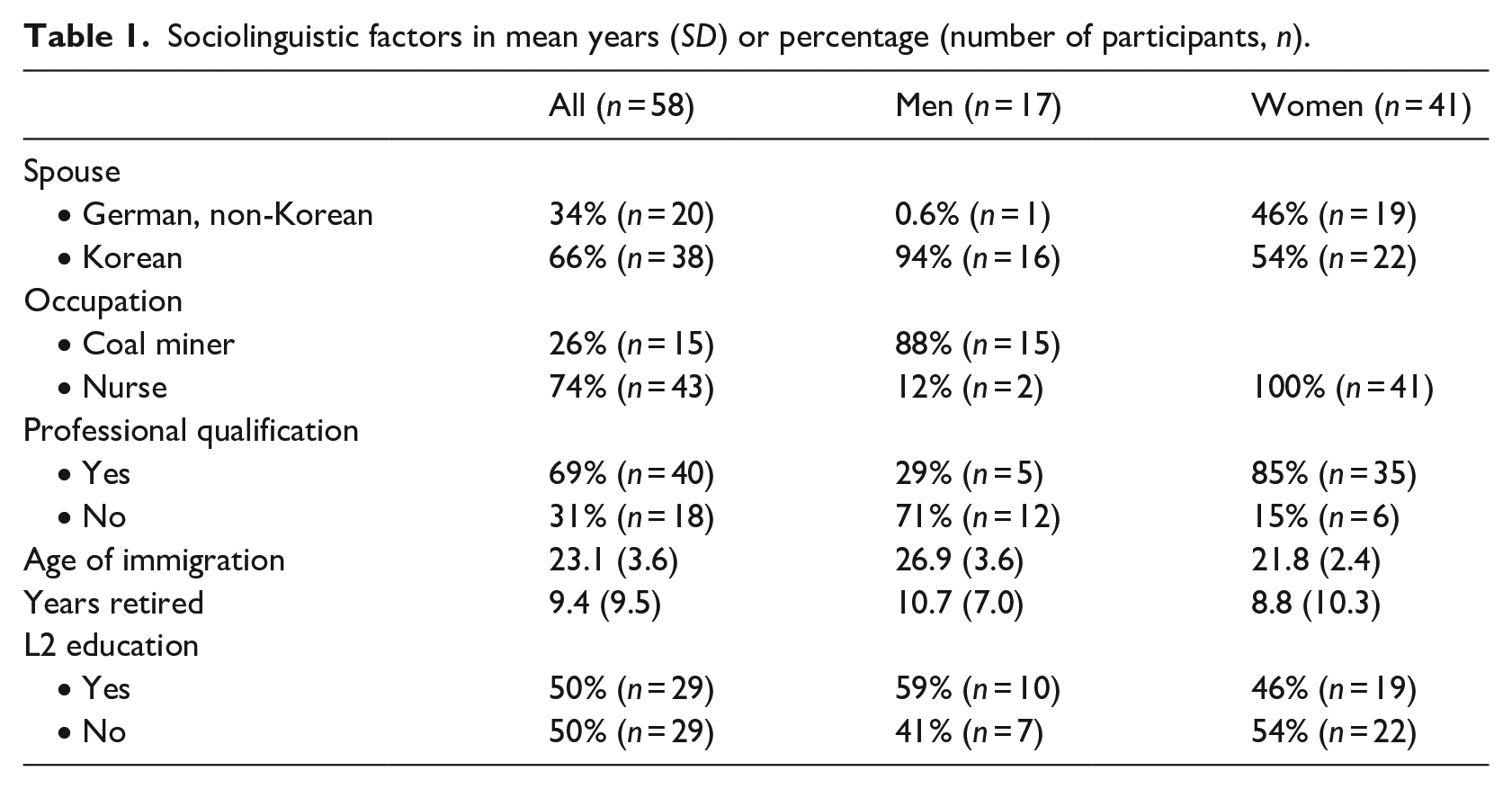
A total of 58 (17 male, 41 female) first-generation Korean immigrants in Germany participated in the study. The language background interviews were conducted as semi-structured conversations and were audio recorded. To avoid alienation, interviews were done in the participants’ preferred language, Korean or German. By the time of data collection, the average age of the participants was 68 years (SD = 4.2), for men 72.2 years (SD = 3.1) and for women 66.2 years (SD = 3.3). Length of residence was on average 45.1 years (SD = 3.1), for men 46 years (SD = 3.3) and for women 44.8 years (SD = 3.0).
Previous research (Clahsen et al., 1983; Klein & Dittmar, 1979) found several factors to influence L2 German acquisition. Most important were contact with Germans in leisure time and at the workplace, professional qualification obtained in the native country, age of immigration, and years of school education. Since all Korean participants had obtained a high school degree, school education was not included but all other factors were addressed. 3
The factor “spouse” indicates which language is spoken at home and with the extended family during leisure time. “Occupation” considers more than mere contact with Germans at the workplace, but the demand to communicate effectively in the L2, differentiating between coal miner and nurse. “Professional qualification” differed between the two occupations. All nurses came with 3 years vocational high school (n = 13), 1 year of vocational training (n = 24), 3 years of vocational training (F61), or a college degree (F29). However, professional qualification was not required for coal miners and most came as unskilled workers, but some had attended a vocational engineering high school (M3), college (M7, M36), or teacher training (M10). Regarding “age of immigration,” all participants came to Germany as young adults. Men were on average a few years older due to the 3-year mandatory military service. Following Klein and Dittmar (1979), the cut-off point for age of immigration was selected at 22 years. In addition to these factors, two more were identified as relevant for the present group, “L2 education” and “years retired.” The interviews revealed continued L2 instruction and education in the L2. Some pursued formal classroom instruction for more than a year, beyond the 3–6 months sponsored by their employer, even taking standardized German proficiency tests. Others completed vocational training in the target language to qualify for higher positions, such as head nurse or factory worker. Few others attended German universities. “Years retired” was included because participants married to a Korean spouse reported reduction of usage and exposure to L2 German after retirement. The production and preferences of L2 verb placement may have been affected by reduced L2 activation (see Putnam & Sánchez, 2013). Table 1 summarizes the sociolinguistic factors.
Sociolinguistic factors in mean years (SD) or percentage (number of participants, n).
Experiment: sentence completion task (SCT)
The goal of the SCT was to elicit the production of the asymmetric verb placement.
Materials
A total of six sentence beginnings were created to trigger matrix (SVX and XVS) and subordinate (V-final) clauses. The prompts are listed in (10). The sentence beginnings were recorded by a female native speaker of German. Matrix clause prompts were repeated eight times each, and subordinate clause prompts four times each, for a total of 32 sentence-beginning prompts. Each of the 32 prompts was randomly paired with a different 4-second short video depicting a transitive action (e.g., three women making kimchi) that were extracted from a Korean TV show: (10a) Sentence beginnings to prompt matrix clauses Die Person . . . “The person . . .” (SVX order) In dem Video . . . “In this video . . . ” (XVS order) (10b) Sentence beginnings to prompt subordinate clauses with V-final order Ich habe gesehen, dass . . . “I saw that . . . ” Ich habe nicht verstanden, warum . . . “I did not understand why . . .” Das Video hat gezeigt, wie . . . “The video showed how . . .” Das Video hat aufgehört, nachdem . . . “The video ended after . . .”
Procedure
The experiment was administered on a laptop using PsychoPy (Peirce, 2007) that presented the stimuli in randomized order to each participant. They first saw a 4-second short video and heard a sentence-beginning prompt immediately after the video ended. Once the prompt ended, a speech bubble appeared on the screen and participants were instructed to describe what they saw in the video by repeating the sentence beginning and completing the sentence in their own words. Instructions were given in Korean and German, and participants had six practice items to familiarize themselves with the task. Responses were audio recorded and coded for finite verb positions, SVX, XVS (“true V2”), V-final.
Analysis
Responses were excluded when they did not allow clear determination of the verb position, see (11), which led to exclusions of 557 responses, 30% of a total of 1,856 possible responses (32 prompts × 58 participants): (11a) Omission of XVS prompt or complementizer [In dem Video] Ein Mann hat Zeitung gelesen. (F44) [in the video] a man has newspaper read “A man read newspaper.” (11b) Chunk-like repetition In dem Video zeigt der Mann Gitarre spielt. (M16) in the video shows the man guitar plays “The video shows [that] the man plays guitar.”(?) (11c) Doubling or omission of finite verb, subject, or object Die Person hat was eingekauft hat. (M7) the person has something bought has “The person has bought something [has].” (11d) False starts Die Person … ja ich nehme an das gibt (F23) the person yes I assume-PREFIX this gives “The person . . . well I assume. . . this is(?) . . . . ”
Following the methodology of previous studies on immigrant workers (e.g., Clahsen et al., 1983; Vainikka & Young-Scholten, 1994), implicational scaling was used to analyze the verb placements and the preferred syntactic patterns that emerge from them. Implicational scaling orders data according to occurrences of the critical features under investigation to identify certain relationships between them (also “Guttman scale” in Friedmann et al., 2021). Using this method, Clahsen et al. (1983) found the six developmental stages laid out in (2). In previous studies, the notion of “acquired” was determined by robustness of production. Vainikka and Young-Scholten (1994), for instance, set a 60% production threshold to determine whether a structure has been acquired. In this study, the 60% production threshold is applied to determine preferred verb placement patterns.
Results
The analysis of the responses revealed four syntactic patterns, which are shown in Table 2. To depict the gradual emergence of the verb placement patterns, each pattern was divided into subgroups. The results show that subordinate V-final is produced more robustly than matrix V2.
Implicational scale of preferred verb placement from Sentence Completion Task.
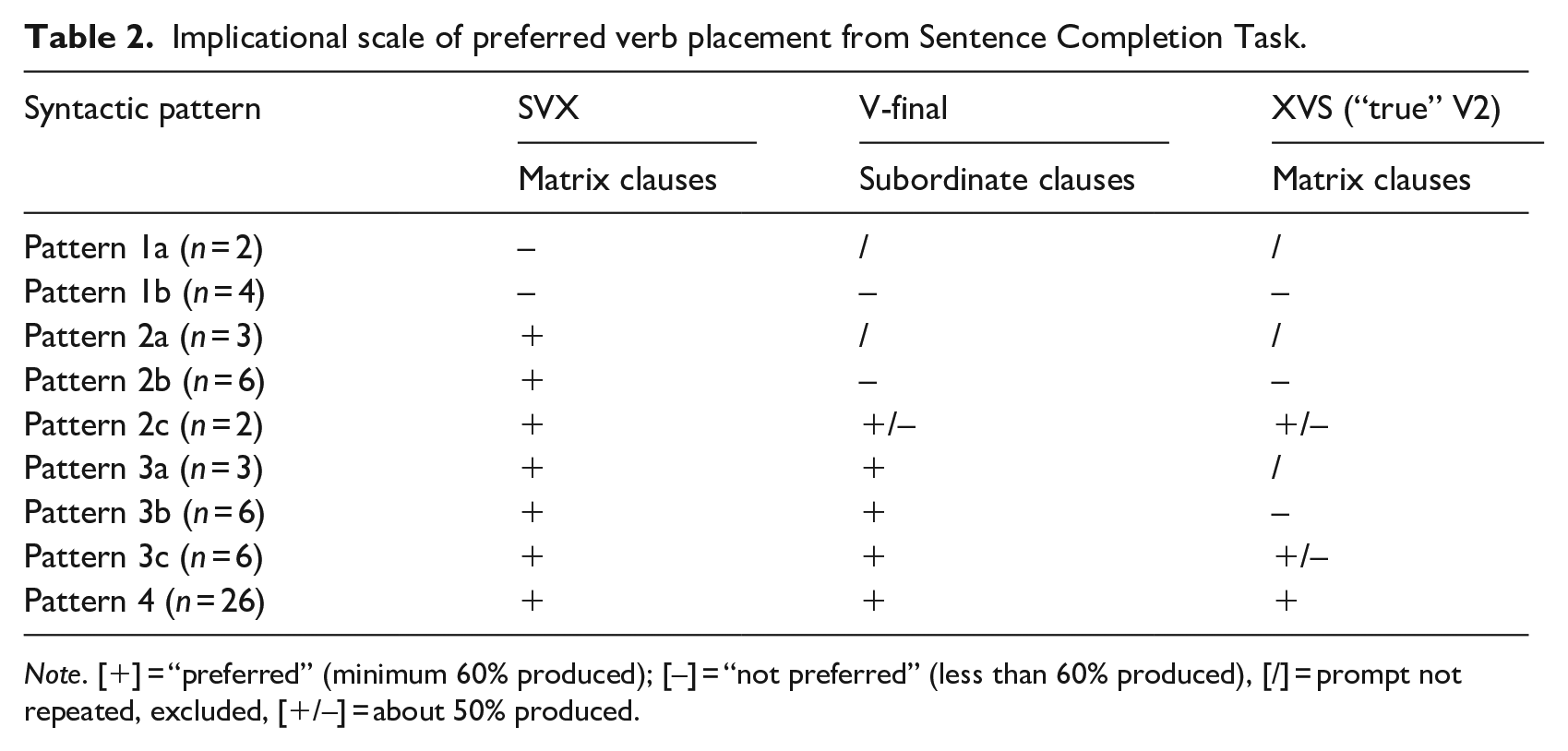
Note. [+] = “preferred” (minimum 60% produced); [–] = “not preferred” (less than 60% produced), [/] = prompt not repeated, excluded, [+/–] = about 50% produced.
The two participants in Pattern 1a (M14, M43) did not produce SVX constructions reliably and did not repeat the prompts for XVS and subordinate clauses. A closer look at all their responses, including the excluded ones, shows that both produced virtually exclusively two types of nonfinite structures, see (12), that are in line with the previous findings on L1 transfer shown in (8) and (9) above: (12a) Diese Damen Boden putzen. (M43) this lady floor clean-INF “This lady cleans the floor.” (12b) Die Person Fotoalbum gesucht. (M14) the person photo album searched “The person searched for the photo album.”
Participants in Pattern 1b occasionally produced finite verbs and repeated sentence-beginning prompts but did not produce target-like structures 60% or more. Instead, they showed high occurrence of auxiliary omission and of nonfinite verb forms.
Pattern 2 consists of participants who reliably produced SVX structures but neither XVS nor subordinate V-final. In fact, participants in Pattern 2a (M31, M36, F45) produced exclusively SVX responses and did not repeat any of the other prompts. Participants in Pattern 2b (M3, M19, F32, F58, F60) repeated all prompts but produced only SVX reliably. The most frequently produced alternative to matrix XVS (V2) and subordinate V-final was XSVX (V3) and SVX respectively, see examples in (13). Note that subordinate SVX as in (13b) contradicts findings by Schwartz and Sprouse (1994, 1996). Pattern 2c (F28, F50) shows matrix V2 and subordinate V-final about 50% of the time: (13a) In dem Video eine Frau hat in Schublade was gefunden. (M19) in the video a woman has in drawer something found “In the video, a woman found something in the drawer.” (13b) Ich habe gesehen, dass er hat sehr viel Ärger. (F28) I have seen that he has a lot trouble “I saw that he has a lot of trouble.”
Participants in Pattern 3 reliably produced SVX and subordinate V-final but struggled with V2, indicating that V2 is least automatized. For Pattern 3a (F12, F16, F44), all responses in the XVS condition had to be excluded. Participants in Pattern 3b (F2, M17, M10, F33, F48, F53) repeated the prompts but produced more V3 than V2 constructions. Participants in Pattern 3c (F9, F11, F13, F40, F53, M59) produced V2 about half the time. This pattern differs from the ZISA stages.
Finally, about half of the participants, Pattern 4, showed target-like usage of the asymmetric verb placement.
Sociolinguistic factors
To investigate the relationship between sociolinguistic factors and verb placement preferences, an ordinal logistic regression was fitted with the four syntactic patterns in Table 2 as dependent variable and the sociolinguistic factors listed in Table 1 as independent variables. The values of each of the factors were coded into binary categories: “spouse” (Non-Korean, Korean), “occupation” (coal miner, nurse), “professional qualification” (yes, no), “age of immigration” (<22 years, >22 years), “retirement” (<5 years, >5 years), “L2 education” (yes, no). The results of the ordinal logistic regression are summarized in Table 3. 4
Results of ordinal logistic regression.
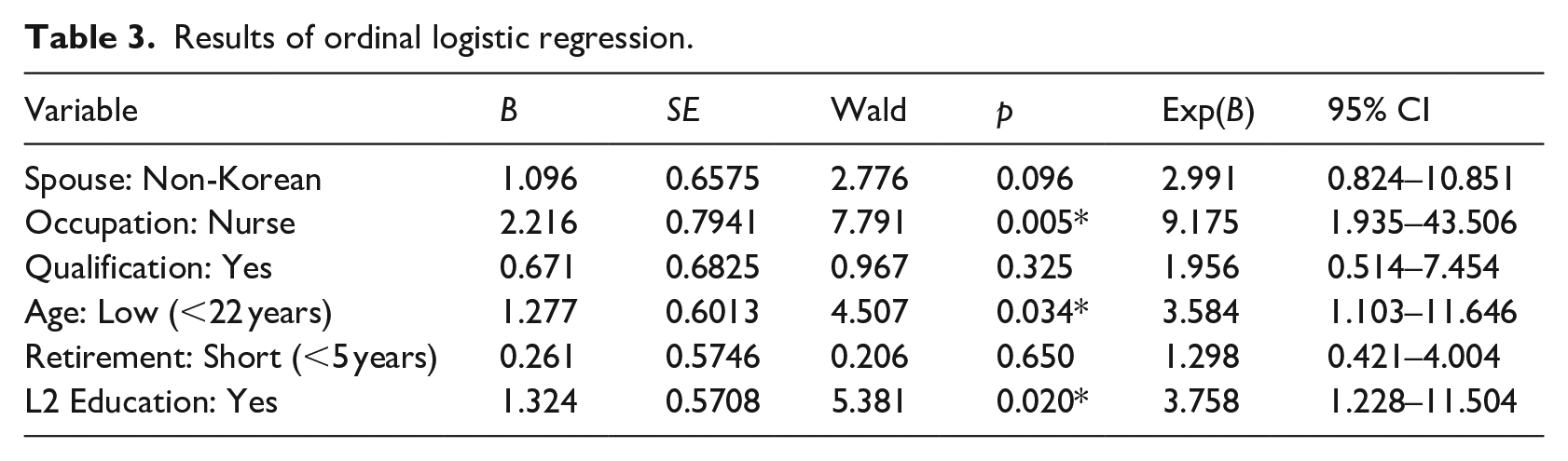
There were proportional odds, as assessed by a full-likelihood ratio test comparing the fitted model to a model with varying location parameters, χ2(12) = 11.655, p = .473. The Pearson goodness-of-fit test, χ2(72) = 78.181, p = .289, and the deviance goodness-of-fit test, χ2(72) = 64.376, p = .727, indicated that the model was a good fit to the observed data, but many cells were sparse with zero frequencies in 63.9% of cells. Thus, results must be taken with caution. However, the final model statistically significantly predicted the dependent variable over and above the intercept-only model, χ2(6) = 38.965, p < .001. Three factors showed a significant effect: “occupation,” “age of immigration,” and “L2 education.” The odds of nurses producing more target-like verb placement were 9.175, 95% CI [1.935, 43.506] times higher than that of coal miners, a statistically significant effect, χ2(1) = 7.791, p = .005. The odds of South Koreans who immigrated before the age of 22 using a more target-like syntactic pattern were 3.584, 95% CI [1.103, 11.646] times that of immigrants coming at an older age, a statistically significant effect, χ2(1) = 4.507, p = .034. Finally, the odds of immigrants having pursued extended L2 instruction or education in the L2, showing a preferred usage of more target-like verb placement was 3.758, 95% CI [1.228, 11.504] times higher than of those who did not, a statistically significant effect, χ2(1) = 5.381, p = .020. Whether someone has a non-Korean or Korean spouse, years of retirement, and the professional qualification obtained in the native country did not show a significant effect on the preferred verb placement pattern.
Discussion and conclusion
Providing data from a less-studied L2 German speaker group—South Korean immigrant workers in Germany—this study was set up to test whether the produced preferred verb placement patterns mirror the developmental sequence of L2 German syntax found in previous research. A second goal was to identify sociolinguistic factors that may contribute to the preferred syntactic patterns, attempting to draw a more comprehensive picture of L2 acquisition and use in the labor-migration context. In a nutshell, the results show that V2 appears to be most difficult to produce compared to subordinate V-final and that occupation, L2 education, and age of immigration are predicting factors which verb placement pattern one would prefer. The results, however, must be taken with caution since 30% of the experimental responses had to be excluded. Furthermore, the experimental task only included one locative prompt for XVS (V2) structures (Jackson & Ruf, 2017, found a preference for temporal over locative adverbial phrases in V2) and the statistical analysis had 63.9% zero frequency cells. With these limitations in mind, I will discuss the experimental results and the sociolinguistic factors in turn.
The first research question asking whether the verb placement preferences mirror developmental sequences found in previous studies, was not confirmed. Contrary to the ZISA stages in (2), Pattern 3 in Table 2 produced subordinate V-final more reliably than matrix V2, but contrary to Schwartz and Sprouse (1994), Korean L2 German speakers do not produce target-like subordination as soon as complementizers occur but show subordinate SVX order instead.
Instability of the V2 property, competing with V3, has been observed in L2 and L1 data. As laid out above, V2 requires sentence-internal restructuring, separating closely associated elements, the verb and its complement, which is performatively complex and demands higher mental processing capacity, unless the speech planning task for subject-verb inversion is successfully automatized (Clahsen, 1984; Levelt, 1978). To cope with the complexity, the L2 speaker may avoid or simplify the sentence-internal restructuring, producing V3 as a result of less complex operations like adverb-preposing (Clahsen et al., 1983) or CP-adjunction (Schwartz & Sprouse, 1994). V3, therefore, appears to be an effective communication strategy (see also native speaker discussion below) and may be preferable over the structurally accurate but more costly V2, depending on the learner’s orientation (Pienemann, 1989). While this view found support in individual cases, Çevdet’s nonpronominal V3 (Schwartz & Sprouse, 1994) and Benito I.’s lingering V3 after preceding subordinate clauses (Clahsen et al., 1983), the present study adds more support to the difficulty of V2 and preference for V3. Twelve participants in Pattern 3 (3b, 3c) favor V3 in the presence of V2.
In Germanic native speakers’ spoken register, V3 is not only attested but accounted for with processing constraints of various kinds. Regarding heritage Cimbrian German speakers, Abraham (2011) suggests that V3 eases parsing of oral input. Wiese et al. (2020) hypothesize that V3 follows a “natural order” that reveals an information-structural processing preference (Framesetter > Topic > Verb), an alternative within the V2 property made available through multilingual backgrounds of the Kiezdeutsch speakers (Wiese & Müller, 2018). This is based on German native speakers’ syntax being underlyingly OV, evidenced by verbal brackets, and robust V2 (e.g., Wiese et al., 2016), and theoretically modeled with extended CPs (Walkden, 2017) or as decomposed V2 rule where V can move to different loci in the extended CP, that is FinP (V3) or ForceP (V2; Hinterhölzl, 2017). While L2 speakers’ V3 in the ZISA study is understood as simplification of V2 with an underlying SVO syntax and therefore explicitly distinct from Kiezdeutsch V3 (Wiese et al., 2016), the L2 data in this study shows a different picture. Participants with Pattern 3b and 3c show evidence of underlying OV through verbal brackets and target-like subordination as observed for Kiezdeutsch speakers and V2 productions about 50% of the time in the case of Pattern 3c. Thus, the underlying grammar of these participants and their use of V3 may be more comparable to Kiezdeutsch speakers than the L2 data from the ZISA study.
The robust production of subordinate clauses with V-final by participants in Pattern 3 (3b, 3c) could be an effect of facilitative L1 transfer from Korean OV. On lower levels, the data appear to support L1 transfer, in line with Vainikka and Young-Scholten’s (1994, 1996, 2011) and Schwartz and Sprouse (1994), analyzing utterances that contain nonfinite verbs as underlying SOV grammar. M14 and M43 (Pattern 1a) exclusively produce nonfinite XV constructions comparable to those in (8) and (9). With increasing proficiency, Pattern 2, first utterances with complementizer occur, showing subordinate SVX order before target-like V-final is produced in Pattern 3. This result contrasts with Schwartz and Sprouse (1994) who found that Çevdet produced target-like subordination as soon as he used complementizers. Considering the developmental path (verb movement to the left periphery, SVO serialization, and verbal bracket), by the time subordination is produced—all morphosyntactic features unknown to the Korean grammar—Lee (2010, 2012a) argues that facilitative transfer from L1 Korean to L2 German is unlikely. This finding would be better accounted for by suggesting overgeneralization of matrix SVX order in subordinate contexts, possibly to avoid or simplify restructuring of word order to V-final (Clahsen et al., 1983; Clahsen & Muysken, 1986; Lee, 2010, 2012a).
The second research question revealed that the type of occupation, further L2 instruction and education in the L2, and the age of immigration significantly predict which verb placement pattern the Korean L2 German speaker would prefer. The factor “occupation” (coal miner, nurse) was most significant. The work environment of nurses and coal miners are in stark contrast regarding the opportunity and necessity of communicating effectively in the L2 at work. This sociolinguistic reality is reflected in the syntactic patterns in Table 2: The less complex the syntactic pattern, the higher the proportion of former coal miners, the more complex the syntactic pattern, the higher the proportion of nurses. For instance, Pattern 1 consists exclusively of former coal miners who did not pursue further L2 education and immigrated after age 22. Despite using the least complex L2 syntax, all participated actively in the German economy, doing various jobs after completing their time in the coal mines. Their social involvement, however, remains limited, spending most of their time with fellow Koreans. Pattern 4, however, consists solely of former nurses, with one exception, M37. The majority arrived in Germany at age 21 or younger and pursued L2 education. M37 came as coal miner and was (the only male participant) married to a German spouse. After completing his time in the coal mines, he did several retrainings and obtained two licenses as Meister “foreman” and reported speaking mostly German.
To conclude, this study shows that L1 Korean immigrants struggle more with matrix V2 than subordinate V-final. The results suggest that the complexity and difficulty of processing V2 is a more appropriate account than assuming facilitative L1 transfer from Korean OV to German subordinate V-final. Extended L2 instruction and education in the L2 and age of immigration have shown a significant effect on the preferred L2 verb placement pattern. But the most significant factor was occupation (coal miner, nurse) which emphasizes the importance of having the opportunity and necessity of communicating effectively at work. This shows that the demand to communicate in the L2 allows immigrants to leverage their L2 skills for social integration.
Footnotes
Acknowledgements
I am grateful to all my research participants who generously shared their time and experiences with me. This article builds on my dissertation research, and I thank my dissertation advisors for their support of my work. I would also like to express my gratitude to Nick Henry and two anonymous reviewers for their helpful comments to improve this manuscript.
Declaration of conflicting interests
The author(s) declared no potential conflicts of interest with respect to the research, authorship, and/or publication of this article.
Funding
The author(s) disclosed receipt of the following financial support for the research, authorship, and/or publication of this article: This research was partly supported by the RGSO Dissertation Support Grant, the Center for Global Studies Career Development Award, and the Institute of Arts and Humanities Graduate Student Residency at the Pennsylvania State University.
