



Abstract
Aims and Objectives:
The aim of the present study is to address the reciprocal relationship between L2 attitudes and L2 use in a bilingual setting among teenaged L2 learners.
Whereas several scholars suggested that L2 attitudes and L2 use mutually facilitate each other, empirical studies have traditionally assessed the relationship between L2 attitudes and L2 use from one direction. Design/Methodology: We propose a complex model that integrates concepts tied to the larger social context surrounding formal L2 teaching, such as attitudes towards L2 speakers and L2 use outside the school, with concepts that are more closely associated with formal L2 teaching, such as L2 motivation and L2 competence. In addition, acknowledging that peers’ opinion is a salient issue for teenagers, we also included L2 related peer norms into the model we propose. Based on earlier research we developed six hypotheses regarding the relationships between the theoretical concepts. Self-report questionnaire data were collected among students in Italian language secondary schools in South Tyrol (N = 315). The questionnaire included items from well-established and validated measurement instruments. We tested the proposed model with non-recursive path modelling.
Findings/Conclusions:
All the hypotheses were substantiated by the data. We found that both L2 attitudes and L2 related peer norms predicted L2 motivation. In addition, a significant interaction emerged between L2 attitudes and peer norms. L2 motivation predicted L2 competence which in turn predicted L2 use. Finally, the results have provided evidence of a reinforcement process, namely, that L2 use can contribute to positive intergroup attitudes.
Originality:
To the best of our knowledge, the present paper is the first that utilized non-recursive path modelling in exploring patterns of bilingualism. Significance/Implications: In bilingual settings, L2 use can promote better L2 attitudes. Positive peer norms regarding L2 can counterbalance the effect of negative attitudes on second language acquisition.
Keywords
Introduction
The underlying idea for conducting research on second language acquisition (SLA) in bilingual settings has been that the ultimate outcome of language learning is more than achieving high-level competence in the second language (L2). It has been proposed that, in bilingual settings, SLA in general, and L2 use in particular, can promote relationships between the contacting language groups. Knowing and using the language of the other language group can enhance respect towards each other’s culture, which can result in more favourable intergroup attitudes and promote better relations between the language groups (Bourhis & Maass, 2005; Byers-Heinlein et al., 2017; Lasagabaster, 2017). At the same time, since language is a salient characteristic of the other language group in bilingual contexts, it has been proposed that acquiring L2 is inevitably influenced by attitudes towards the L2-speaking community (Gardner, 2010; Gardner & Lambert, 1959; Wright & Tropp, 2005). Indeed, the field of L2 motivation research was born of the initial insight that where speakers of the contacting languages meet each other in bilingual contexts and are exposed to the other language in their social milieu, attitudes towards the L2-speaking group have an impact on the motivation to learn the L2 (MacIntyre et al., 2009). In line with this, Paladino et al. (2009) argued that SLA is also a social process in bilingual settings; therefore, attitudes towards the L2-speaking community are likely to have an impact on the development of L2 motivation, L2 competence and L2 use.
These two distinct approaches in bilingualism research are not irreconcilable but are compatible with each other. They point towards the assumption that L2 attitudes and L2 use mutually facilitate each other (Ianos et al., 2017). However, due to the overwhelmingly cross-sectional research design, empirical studies have traditionally assessed the relationship between L2 attitudes and L2 use from one direction. The impact of L2 attitudes, via L2 motivation, on L2 use has been ascertained by massive empirical research (Masgoret & Gardner, 2003), and there is a growing body of empirical research showing that L2 use can support positive attitudes towards the L2-speaking community (Forer, 2010; Lasagabaster, 2017; Vincze & Harwood, 2013; Wright & Tropp, 2005).
Merging two distinct yet compatible threads within bilingualism research, the present study addresses the mutual influence between L2 attitudes and L2 use among Italian-speaking learners of German in South Tyrol, a bilingual region in Italy where both Italian and German are official languages (Ammon, 2015; Lanthaler, 2012). The aim of this paper is to explore the complex relationship between L2 attitudes and L2 use in a bilingual setting among teenaged L2 learners. Therefore, we discuss the findings with regard to regional bilingualism.
German as a second language in South Tyrol
German speakers are a national minority in Italy, but in the province of South Tyrol they constitute a majority. Today, about 310,000 people or 70% of the population of South Tyrol are German-speaking (ASTAT, 2018). In South Tyrol, both Italian and German have official status and the same rights (Ammon, 2015; Lanthaler, 2012). German is supported by a strong formal and informal institutional network, including a provincial parliament and government, various educational and media institutions, political parties, and an own Catholic diocese (for more, see Bonell & Winkler, 2010). In order to ensure that both Italian and German speakers can use public services in their respective mother tongues, obtaining employment in public administration is also linked to the fulfilment of specific L2 requirements (cf. Baur et al., 2008). Prospective applicants must obtain the so-called Bilingualism Exam Certificate, which is designed to assess not only L2 competences but also the competence to switch between Italian and German (Abel, 2007). The bilingualism exam has four levels, corresponding to the qualifications of the applicant and the type of position applied for. Exam levels A, B, and C include both an oral and a written part, while D – aimed at unskilled workers – has only an oral part (Abel, 2007). In order to promote first language (L1) competence and L1 identity, in South Tyrol both German speakers and Italian speakers have their own school system from kindergarten to secondary school (cf. Baur et al., 2008; Voltmer, 2007). At the same time, in order to promote cooperation between the contacting language groups, from the second grade of the elementary school it is obligatory to learn Italian in the German schools, and to learn German in the Italian ones. A remarkable feature of the L2 teaching in South Tyrol is that schools can only employ a language teacher who is a native speaker of L2 (Abel, 2007).
At the same time, both representative data (ASTAT, 2015) and previous research on SLA and L2 use among the South Tyrolean population show that becoming bilingual is by no means self-evident (cf. Vettori et al., 2012). Speakers of Italian and German seem to live in two distinct social worlds (cf. Voltmer, 2007, p. 205), and therefore the language contact situation in South Tyrol has been described by some scholars as coexistence of the language groups (Forer, 2010; Gross, 2019; Wand, 2016) rather than true bilingualism, which implies authentic L2 use for personally relevant purposes (Busse, 2017; Franceschini, 2011). Communication between Italian and German speakers takes place predominantly in Italian, indicating that Italian speakers rarely use their L2 German (Abel et al., 2012; Vettori et al., 2012), and speakers of German acquire better L2 competence in their L2 Italian than Italian speakers in their L2 German (e.g. Paladino et al., 2009; Vettori et al., 2012).
There is an abundance of empirical research in South Tyrol that has investigated the various linguistic and non-linguistic outcomes of the language contact situation. Previous studies have covered topics such as the effect of bilingualism on the L1 system (Vietti, 2017); the long-term consequences of mother tongue affiliation on the maintenance of bilingualism (dal Negro, 2011); the effect of population distribution on L1 development and SLA (De Angelis, 2012); the causes of insufficient L2 skills among Italian speakers (Garotti, 2008); the role of social, educational and motivational variables in L2 competence and L2 use (Vettori et al., 2012); the relationship between bilingualism and basic human values (Gross & Dewaele, 2018); the role of direct intergroup contact in L2 attitudes (Forer, 2010); the effect of L2 media consumption on L2 attitudes (Vincze & Harwood, 2013); and the role of parental and peer norms in the perception of intergroup relations and L2 competence (Carraro et al., 2012). At the same time, as suggested by Vettori et al. (2012), learning more about the attitudinal and motivational background of SLA and L2 use by South Tyroleans is essential to developing measures that can facilitate true bilingualism, that is, where L2 learners make use of their L2 competence for real life purposes.
The present research
The present study addresses the mutual influence between L2 attitudes and L2 use among Italian-speaking learners of German in South Tyrol. We adhere to Garrett’s (2010) definition that ‘an attitude is an evaluative orientation to a social object of some sort, whether it is a language, or a new government policy, etc.’ (p. 20). In the context of the research, German is an L2 for Italian speakers who have regular contact with German speakers and considerable exposure to German outside the school context. At the same time, German is also a school subject, taught within formal education. Therefore, we propose a complex model that integrates concepts tied to the larger social context surrounding the formal teaching of German, such as attitudes towards German speakers and the use of L2 outside the school context, with concepts that are more closely associated with formal L2 teaching, such as L2 motivation and L2 competence. In addition, acknowledging that peers’ opinion is a salient issue for teenagers, we also include L2-related peer norms in the model we propose. Based on insights from previous research, we developed six hypotheses regarding the relationships between the theoretical concepts.
In bilingual settings where individuals belong to different language groups, favourable intergroup attitudes, that is, a positive psychological disposition towards the other language group may be a decisive factor in SLA (e.g. Paladino et al., 2009). Gardner (1985) suggested L2 motivation as a conceptual tool to explain why similar levels of exposure to L2 leads to vastly different outcomes among L2 learners and argued that having positive attitudes towards the L2-speaking community and having the aim to develop meaningful social relationships with L2 speakers support L2 motivation effectively. Previous research in South Tyrol that was based on representative data found a positive association between L2 attitudes and L2 motivation (Abel et al., 2012). Accordingly, we expect that Italian speakers who hold more positive attitudes towards the German-speaking minority will put more effort into acquiring German, i.e. report higher levels of L2 motivation (H1).
At the same time, the formal part of SLA takes place in the L2 class, an environment shared with same-aged peers. As same-aged peers become adolescents’ major reference group, the normative influence of the peer group grows (Csíkszentmihályi & Larson, 1984). In the context of the present study, Carraro et al. (2012) suggested that South Tyrolean students’ L2 attitudes may be shaped by the norms displayed and transmitted by peers; in addition, these authors found that peer norms played a more important role in supporting L2 skills than the positive L2 norms held by parents. Previous research has shown that peer norms predict attitudes towards school (Shin et al., 2007), the inter-ethnic attitudes of adolescents (Poteat & Spanierman, 2010), and attitudes towards L2 (Tannenbaum & Tahar, 2008). In addition, within the context of SLA, peer norms were found to predict identification with the majority language group (Clément et al., 2003); orientations in language learning (Carraro et al., 2012; MacIntyre et al., 2001); willingness to communicate in L2 (MacIntyre et al., 2001; Tannenbaum & Tahar, 2008); and L2 motivation (Tannenbaum & Tahar, 2008). Therefore, we expect that L2 related peer norms predict L2 motivation towards German (H2).
From a methodological point of view, whereas studies have traditionally addressed the direct effect of peer norms, more recent research has begun to examine their moderating role (e.g. Shin et al., 2007). There are some research findings indicating that among young people the relationship between the general outlook towards the minority language group and L2 motivation may be shaped by L2-related peer norms (e.g. Marton et al., 2014). Accordingly, our aim is to examine not only the individual effects of L2 attitudes and peer norms on L2 motivation, but also to address their combined effect. More specifically, we expect that peer norms have the capacity to moderate the effect of attitudes on L2 motivation (H3).
A massive body of research has substantiated the role of L2 motivation as an essential antecedent of L2 proficiency (Masgoret & Gardner, 2003). L2 motivation emerged as a key variable both in studies utilizing self-evaluation of L2 proficiency (e.g. Yashima, 2000) and in studies that assessed actual proficiency with language tests (e.g. Kim et al., 2018; Sparks et al., 2011). In addition, previous research conducted among Italian-speaking high school students in South Tyrol (Abel et al., 2012) has also indicated that L2 motivation contributes to L2 competence. Consequently, we expect that greater motivation to learn L2 will lead to better L2 competence (H4) which, in turn, will result in more L2 use (H5). In other words, Italian-speaking adolescents who are more motivated to acquire German language will develop better skills in German, and subsequently make use of their German skills more often in various contexts.
Our sixth hypothesis concerns reciprocity between L2 attitudes and L2 use. Several researchers have proposed that the relationship between attitudes and L2 use may be bidirectional (Bourhis et al., 2012; Trofimovich & Turuševa, 2015). Abel et al. (2012) raised the possibility that supporting authentic L2 use may facilitate the formation of positive attitudes towards the contacting language group, and scientific evidence supporting this assumption is accumulating (e.g. Forer, 2010; Ianos et al., 2017; Lasagabaster, 2005). In the South Tyrolean context, Vincze and Harwood (2013) found among Italian-speaking high school students that using L2 German for the purpose of TV consumption enhanced the participants’ attitudes towards German speakers. We argue that using L2 as the tool of communication with members of the other language group may improve the quality of intergroup contact, which may result in more positive attitudes. Accordingly, we expect that L2 use with German speakers will foster more positive attitudes towards German speakers among Italian-speaking L2 learners. In more technical terms, we expect a feedback process from L2 use to intergroup attitudes (H6). The hypotheses are summarized in Figure 1.
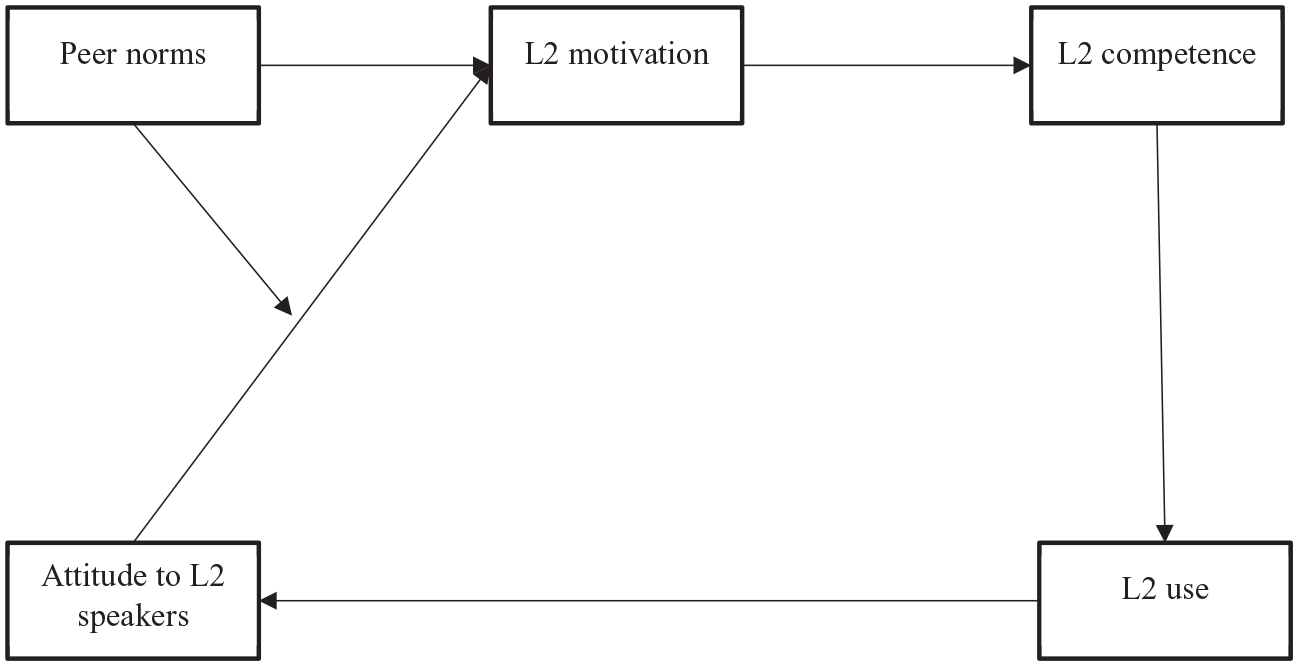
Complex model with the proposed relationships.
Method
Participants and procedure
Self-report questionnaire data were collected among Italian-speaking students at the academic high schools in Bozen/Bolzano and Brixen/Bressanone (N = 315) in May 2012. Before data collection, we obtained permission from the school directors. The questionnaires were anonymous, the respondents were blind to the purpose of the study, and participation in the research was voluntary. The paper and pencil questionnaires were filled in during class time and the process was supervised by the teachers. The questionnaire included items from Gardner’s (2010) Attitudes and Motivational Test Battery (AMTB). The English-language items were translated into Italian by an Italian-speaking social sciences graduate. 1 To ensure that the translation matched the original items, the items were then re-translated into English. The age of participants ranged from 15 to 22 years (M = 17.5 years, SD = 1.18), and 74% of respondents were female.
Measures
Attitude towards L2 speakers
Attitude towards the German speakers was measured with four 5-point items (α = 0.81) adapted from the AMTB (Gardner, 2010). The measure included items such as ‘I wish I could have many native German-speaking friends’ and ‘Native German speakers are very sociable and kind’. The anchors of the scales were strongly disagree and strongly agree, with higher scores demonstrating more positive attitudes.
Peer norms
Four 5-point items (α = 0.65), based on MacIntyre et al. (2001) measured the degree to which peers in the lives of the participants regard acquiring competence in German as important (e.g. ‘My friends think that it is beneficial if someone knows German well’ and ‘My friends think that it is useful if someone knows German well’.) Two of the items were reversed and therefore recoded prior to the summation of the variable. The anchors of the scales were strongly disagree and strongly agree, with higher values indicating more favourable peer norms towards L2 learning.
L2 motivation
L2 motivation was measured using twelve 5-point items (α = 0.91) from the AMTB (e.g. ‘I make a point of trying to understand all the German I see and hear’ and ‘I really work hard to learn German’). Following Gardner’s model, the compound variable contains the items assessing motivational intensity, desire to learn L2, and attitudes towards L2 learning (Gardner, 2010, pp. 121–124). The anchors of the scales were strongly disagree and strongly agree, with higher values indicating greater motivation.
Perceived L2 competence
Perceived L2 competence was measured using four 5-point items to assess the four skills (speaking, listening, writing, reading). Participants were asked to judge how well they could handle certain aspects of L2 (e.g. ‘Give street directions in German’ or ‘Write an email to a friend in German’). The anchors of the scales were very difficult and very easy, higher scores indicate higher perceived competence in German. The reliability of the scale was good (α = 0.82). 2
L2 use
Participants were asked what language they use in certain situations (e.g. in their circle of friends, with German speakers outside school, when using mass media). The four items ranged from 1=only Italian to 5=only German. The internal consistency of the items was acceptable (α = 0.75). Higher scores indicate more frequent use of German. 3
Analysis
We performed a correlation analysis to assess the relationships between the study variables. We tested the proposed model with non-recursive path modelling (Kline, 2013). In the model, attitudes and peer norms were entered as the independent variables predicting L2 motivation. At the same time, in order to assess whether peer norms modify the effect of attitudes on L2 motivation, peer norms were also specified as a moderator between attitudes and L2 motivation. We treated L2 competence as a mediator between L2 motivation and L2 use. Finally, in order to verify the proposed reciprocity between L2 use and L2 attitudes, we also tested for the possible feedback effect of L2 use on L2 attitudes. The analysis was performed with Mplus 7.4. (Muthén & Muthén, 1998–2015). Since the variable L2 use was considerably skewed, the model was examined using a robust maximum likelihood estimator.
Results
Descriptive statistics and results from the bivariate analyses are presented in Table 1. As can be seen, there is a significant positive correlation between all the study variables.
Means, standard deviations and correlations among the study variables.
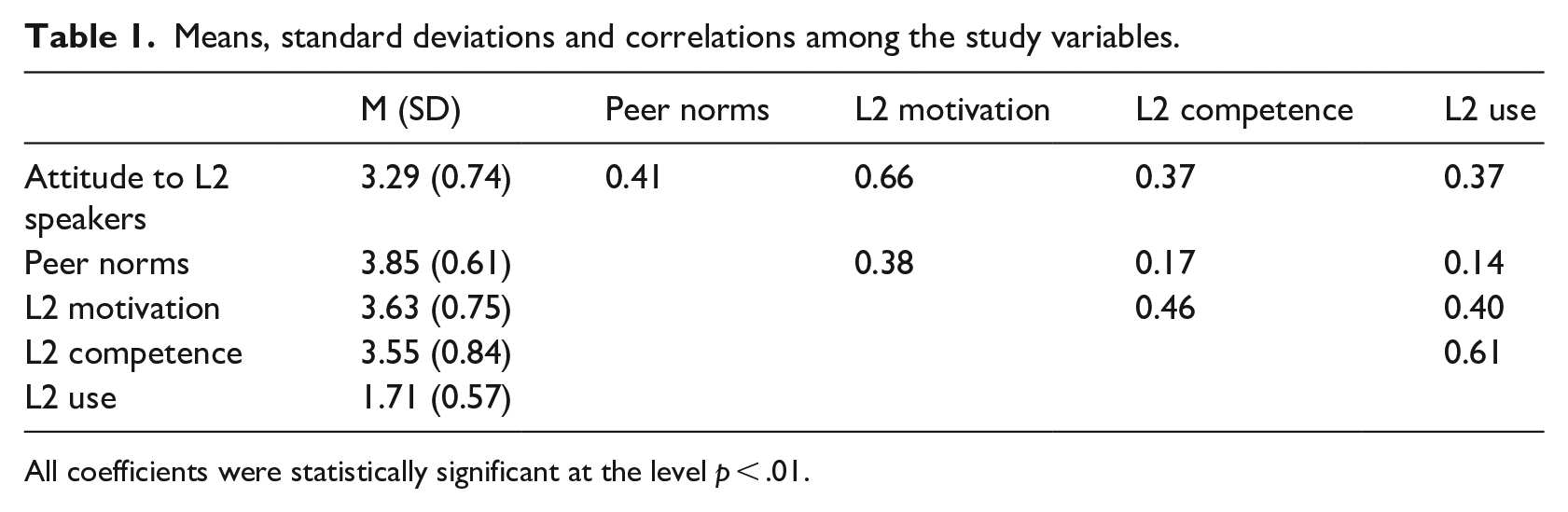
All coefficients were statistically significant at the level p < .01.
The model fits the data well, χ2(7) = 12.36, p = 0.09, RMSEA = 0.05, CFI = 0.99, SRMR = 0.05, and it explained 38% of the variance in language use, 45% of the variance in L2 motivation, 20% of the variance in L2 competence, and 10% of the variance in attitude to L2 speakers. Model coefficients are summarized in Figure 2.
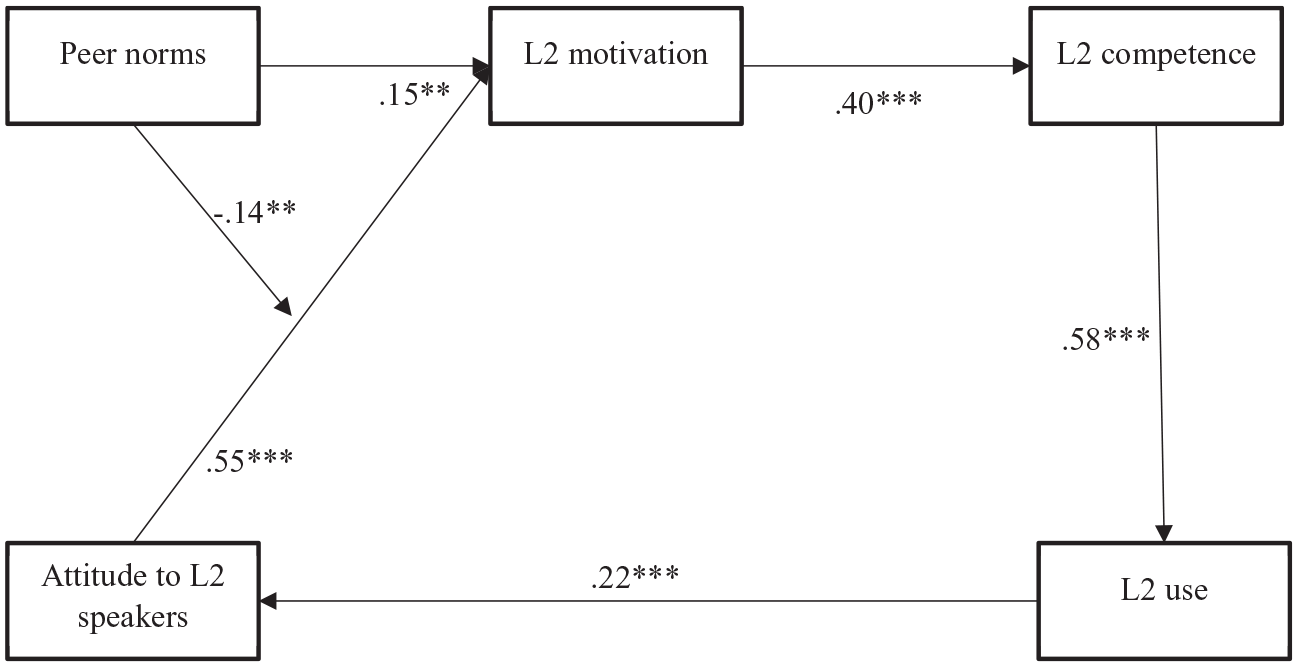
Results of the path analysis. The figure shows standardized coefficients.
Consistent with our hypotheses, both attitude towards L2 speakers and peer norms significantly predicted L2 motivation; additionally, as predicted, a significant interaction emerged between L2 attitudes and peer norms. The simple slopes are shown in Figure 3. The analysis revealed that the strength of attitude in predicting L2 motivation was systematically dependent on L2 relevant peer norms. Next, as anticipated, L2 motivation predicted L2 competence, which in turn, significantly predicted L2 use. Finally, the feedback loop from L2 use to L2 attitudes was also significant, which demonstrated that more use of L2 can enhance positive attitudes towards L2 speakers.
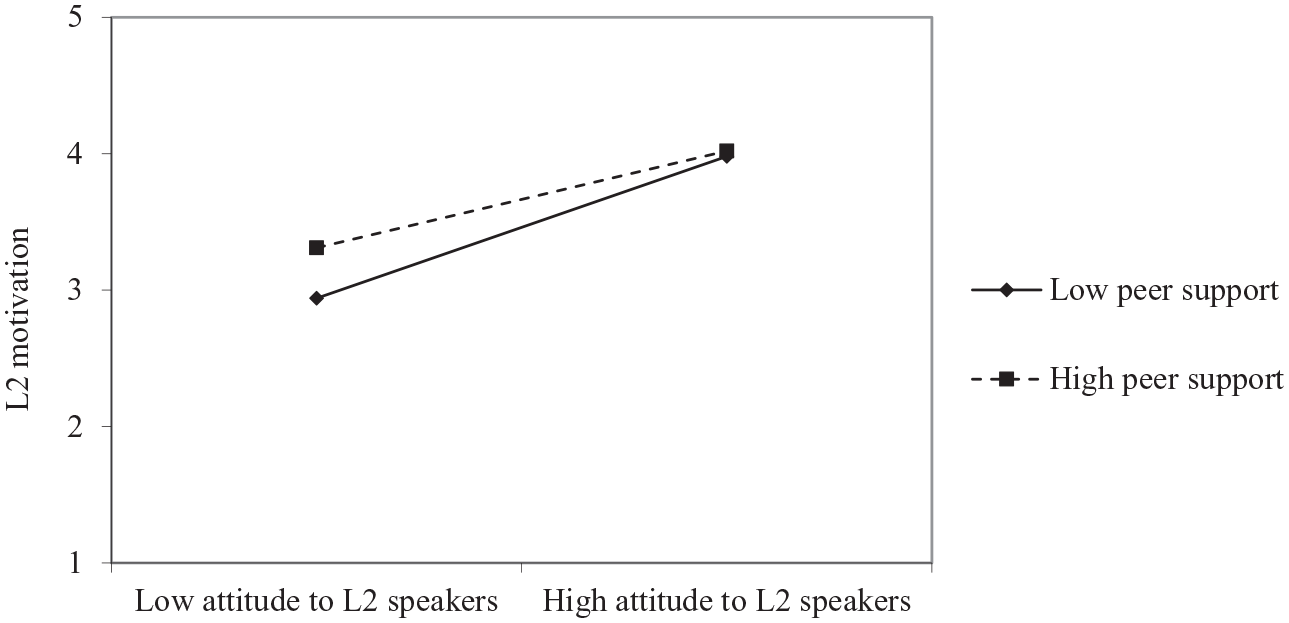
Predicted values of L2 motivation based on L2 attitudes and peer norms.
Discussion
The aim of the present research was to explore the complex relationship between L2 attitudes and L2 use in a bilingual setting among teenaged L2 learners. The results support the model we proposed and confirmed all the hypotheses we formulated regarding the relationships between the study variables. Supporting the suggestion of Paladino et al. (2009), Forer (2010), and Vettori et al. (2012), who argued that having positive attitudes towards the L2-speaking community may be facilitative of SLA, we found that L2 motivation was significantly predicted by attitudes towards German speakers (H1). This finding also corroborates earlier research results from South Tyrol that found a positive association between L2 attitudes and motivation (Abel et al., 2012).
The finding that positive peer norms regarding the value of SLA led to increased L2 motivation (H2) is line with the findings of Carraro et al. (2012) and what Tannenbaum and Tahar (2008) found among their Jewish and Arab participants. That the same pattern could be detected in the South Tyrolean and Israeli contexts suggests that in bilingual settings where there is wide social consensus regarding the importance of SLA, language teachers may capitalize on peers’ appreciation for SLA in designing the activities of the L2 class.
In addition, we found that L2 attitudes and L2-related peer norms exerted a joint effect on L2 motivation (H3). This insight is in line with what previous research found among L2 learners of Hungarian in a Slovene–Hungarian bilingual setting (Marton et al., 2014). As Figure 3 illustrates, participants who have positive attitudes towards L2 speakers make efforts to learn the L2 regardless of whether their peers approve of it or not. However, among participants with less favourable L2 attitudes, positive peer norms can make a difference in terms of work invested into learning the L2. If peers share favourable norms regarding the value of L2 skills, teenaged learners exert more effort to master the L2 even if they harbour relatively weak attitudes towards the L2 speaking group. By comparison, if L2 learners with negative attitudes towards L2 speakers perceive that their peers do not endorse good L2 skills, they tend to abandon L2 learning. Our results support the contention of Carraro et al. (2012), that SLA is not only an individual undertaking but also a social process. Based on representative data from South Tyrol, these authors were able to demonstrate that peer norms represent a significant factor among the external influences that have a bearing on SLA. Extending the understanding of this phenomenon, our study has specified how peer norms may be facilitative of L2 learning. Thus, it seems that positive L2-related peer norms have the capacity to counterbalance the effect of negative attitudes towards L2 speakers.
Also, in line with prior research results (Masgoret & Gardner, 2003), we found that L2 motivation significantly predicted L2 competence (H4), which in turn exerted a significant effect on L2 use (H5) (Marton & MacIntyre, 2020b). The latter finding echoes previous research findings, which show that experiencing engagement and competence enhances L2 use (Clément et al., 2003; Kraak & Holmqvist, 2017). At the same time, given the relatively high self-rated competence and L2 motivation, the use of German was surprisingly low among our participants. Thus, our data reflect previous research from South Tyrol describing the reluctance of Italian speakers to use their L2 (e.g. Abel et al., 2012; Vettori et al., 2012). There are at least two possible explanations for this phenomenon. On the one hand, it is possible that our participants’ language behaviour is dominated by their own language, Italian. As Abel et al. (2012) noted, the balanced official support of the languages of South Tyrol encourages the use of individuals’ first language in any contexts. On the other hand, it is also conceivable that the participants simply overrated their L2 competence, and there is a gap between their actual and self-perceived German skills (cf. Garotti, 2008). Undoubtedly, L2 learners have to acquire sufficiently high level L2 competence to use their L2 for authentic and personally relevant purposes (cf. Abel et al., 2012). Furthermore, we assessed the L2 competence variable using subjective self-assessment (cf. Liu, 2018; Sevinç & Backus, 2017; Sevinç & Dewaele, 2018), and subjective evaluation of one’s L2 competence does not necessarily reflect actual L2 competence. At the same time, we agree with MacIntyre et al. (1997) that when it comes to L2 use, subjective perceptions of one’s L2 competence can play an even more important role than actual L2 competence.
With regard to hypothesis six (H6), we found a significant feedback loop from L2 use to L2 attitudes, indicating that using L2 contributes to better L2 attitudes (H6). This finding is in line with what previous research in the South Tyrolean setting has established (e.g. Forer, 2010; Vincze & Harwood, 2013). The positive effect of L2 use on L2 attitudes is compatible with the insights of Dewaele and MacIntyre (2014), who found that authentic L2 use ranked among the most important sources of foreign language enjoyment. For most L2 learners, authentic L2 use – that is, achieving their own communicative goals by utilizing their L2 skills – can be a demanding undertaking. Accordingly, being able to cope with the challenges inherent in authentic L2 use can be a rewarding experience that affects not only confidence in the learners’ own L2 skills but also their affective disposition towards L2 speakers.
Before turning to the theoretical and practical implications of our study, we must reflect on some limitations. We collected our data among Italian speakers whereas the bilingualism of South Tyrol is, to a comparable extent, also shaped by German speakers who learn Italian as an L2. Therefore, to gain a more holistic understanding, a comparable study conducted among German-speaking participants is desirable. Second, we used a convenience sample, and our participants were students at academic high schools. Previous research in South Tyrol (Vettori et al., 2012) found that school type had a profound impact on SLA, and that students at technical high schools acquired significantly lower level competence in L2 German than students at academic high schools, which raises questions about the general ability of our findings. However, since this study focused on the interrelationship between some central variables in the process of SLA, we believe that the same tendencies are also likely to hold among L2 learners who have lower L2 competence than our participants. At the same time, our results regarding the role of peer norms are in line with findings from previous research conducted on a representative sample of the same population (Carraro et al, 2012).
We admit that the bilingual context where we conducted our study has some specific characteristics, and therefore we must reflect upon whether the results we obtained may be attributable to the context, with its specific language arrangements. Although South Tyrol is part of Italy, Italian speakers constitute the minority of the region’s population. At the same time, extensive research has substantiated both the role of positive attitudes in L2 motivation in various L2 learning contexts (Gardner, 2010), and the chain expanding from L2 motivation via L2 competence to L2 use (Boo et al., 2015). There is also evidence on the role of L2 use in developing positive attitudes towards L2 speakers from largely different L2 contexts, such as an English–Spanish contact situation in the United States (Wright & Tropp, 2005) and the Catalan–Spanish bilingual setting (Ianos et al., 2017). Therefore, we believe that the validity of our findings is not restricted by the status of L2, that is, whether German in South Tyrol plays the role of a majority or a minority language (cf. Paladino et al., 2009). At the same time, we believe that the emergence of positive peer norms regarding the value of L2 skills might be partly attributable to the context of our study. Among the study variables, peer norms had the highest mean value with the smallest standard deviation. By comparison, in bilingual regions where there is considerable status difference between the contacting languages, it is questionable whether positive norms supporting the acquisition of the minority language can emerge in the first place. It seems rather that the official status arrangements regarding the contacting languages may trickle down to peer norms (cf. Byers-Heinlein et al., 2017). Obviously, future studies from different bilingual regions adhering to different language arrangements are needed to verify how context-sensitive our results are.
As for the theoretical implications of our study, our results suggest that attitudes towards the L2 speaking group play a decisive role in bilingual contexts where SLA is also perceived as a social process (cf. Carraro et al., 2012; Paladino et al., 2009). In South Tyrol, Vettori et al. (2012) found among Italian-speaking upper secondary students that interest in the German-speaking community played a more important role in SLA than the practical benefits attached to good German skills. Results from remarkably different L2 learning contexts (McEown et al., 2014; Marton & MacIntyre, 2020b) also corroborate that interest in the L2-speaking culture can effectively support SLA, indicating the crucial importance of the attitudinal component in SLA. Our results suggest that having a general positive disposition towards L2 speakers, an interest in the culture of the L2-speaking group, and the desire to communicate with L2 speakers in their language, are central features of SLA in bilingual settings (Gardner, 2010). Thus, our results support the contention of Al-Hoorie and MacIntyre (2019) that the socio-psychological perspective on language in general and L2 motivation in particular remains a valid one that facilitates a deeper understanding of bilingualism. It seems that both the maintenance of minority languages and the peaceful relationship between linguistic minorities and majorities are dependent on attitudes (Ianos et al., 2017; Lasagabaster, 2017.)
At the same time, research results from various bilingual settings indicate that the transition from having positive L2 attitudes and fairly good L2 skills to actual L2 use is a major challenge (Lasagabaster, 2017; Marton & MacIntyre, 2020a). We agree with Busse (2017), who proposed that L2 use can best be enhanced by learning more about the L2 motivational processes at play.
We believe that the finding that L2 attitudes and L2 use mutually influence each other rests on a theoretically sound base and reflects the experience of individuals living in bilingual environments. With regard to the methodology we used in this study, non-recursive path modelling has been suggested as a suitable methodological tool in verifying theoretically justifiable reciprocal relationships on cross-sectional data (Kline, 2013, p. 43). To our best knowledge, the present paper is the first to use this methodological approach to explore patterns of bilingualism. At the same time, we acknowledge that future studies are needed to confirm the insights we have gained from the present study. Specifically, we suggest experimental or longitudinal studies to address the reciprocal relationship between L2 attitudes and L2 use. In the meantime, using one’s L2 whenever the opportunity arises seems to be a valuable individual investment in peaceful cross-linguistic relationships.
Footnotes
Declaration of conflicting interests
The author(s) declared no potential conflicts of interest with respect to the research, authorship, and/or publication of this article.
Funding
The author(s) declared the following potential conflicts of interest with respect to the research, authorship, and/or publication of this article: The work of the first author was supported by the Kone foundation.
