




Abstract
Aims and objectives:
This study examines the extent to which the acquisition of a highly advanced third language (L3) will affect previously (early) acquired languages. We directly test the main tenets of the differential stability hypothesis.
Design/method/approach:
We test 72 Catalan–Spanish bilinguals divided across four groups using two dimensions: (a) order of acquisition and (b) proficiency/exposure in L3 English. We administered two self-paced reading tasks (one in Catalan and the other in Spanish) to explore their processing of negative concord items.
Data analysis:
Using generalized linear mixed-effects models, we analysed the effect English had on the processing of negative concord items in Catalan and Spanish in three different conditions of interest.
Findings/conclusions:
The results partially confirm the tenets of the differential stability hypothesis (DSH). We show that first language (L1) and second language (L2) are differentially affected by the acquisition of an L3. We further show that there are different degrees of vulnerability for different syntactic contexts in an L2. We propose a novel effect in the study of L3 regressive effects that can complement the tenets of the DSH: the sandwich effect in L3 acquisition.
Originality:
The study provides the first empirical investigation of the tenets of the DSH.
Significance/implications:
This study offers a new effect in L3 acquisition and we put forward how we can test it and propose new directions to explore regressive transfer effects.
Keywords
Introduction
To date, there is not much work looking at modelling third language (L3) developmental trajectories (Cabrelli et al., 2020; Puig-Mayenco et al., 2020; Stadt, 2019) and L3 regressive transfer effects (e.g., Cabrelli Amaro, 2017; Cabrelli Amaro et al., 2015; Hui, 2010; Tsang, 2016). Work on first language (L1) attrition has shown that a second language (L2) can affect an L1 representation (e.g., Gürel, 2002, 2007; Gürel & Yilmaz, 2011; Hicks & Domínguez, 2020; Iverson, 2012; Miller & Rothman, 2020; Schmid, 2011; Schmid & Köpke, 2019). And so, it logically follows that an L3 may also have an effect on an L2 (and possibly an L1). As Mehotcheva and Köpke (2019) highlight, research on L2 attrition is less common and mostly limited to contexts where the L2 speakers return to their home countries or stop using the L2 (see Bardovi-Harling & Stringer, 2019; Mehotcheva & Köpke, 2019; Mehotcheva & Mytara, 2019, for up-to-date reviews). However, recent work shows that acquiring an L3 may also play an important role in triggering L2 attrition effects in general.
The present study precisely focuses on this; the role an L3 has on previously acquired systems. Due to the dearth of studies within this subfield, most empirical investigations have been exploratory in nature. Cabrelli Amaro (2017) stands out as the only study that theorizes about it with the Differential Stability Hypothesis (DSH). Building up on previous work on phonological attrition (Cabrelli Amaro, 2013; Cabrelli Amaro & Rothman, 2010), the DSH maintains that a late-acquired system is more susceptible to L3 influence than an early acquired one. As proposed by the DSH, L1 and L2 systems are differentially stable which makes the L2 more vulnerable to influence from languages acquired subsequently.
Herein, we test whether the tenets of the DSH can be extended beyond the influence of an L3 on a late-acquired system. To do so, we test four groups of highly proficient Catalan–Spanish bilinguals who differ along two dimensions: (a) whether Catalan or Spanish is their early acquired L2 and (b) whether they are beginners or advanced speakers of L3 English with at least 12 months of immersion in an English-speaking environment. We present results from a Catalan and Spanish self-paced reading (SPR) task (Just et al., 1982), where we examine the processing of negative concord items to delve into whether an early acquired L2 is also vulnerable to L3 regressive transfer effects.
Studies on regressive transfer
Cabrelli Amaro and Rothman (2010) and Cabrelli Amaro (2013) proposed the phonological permeability hypothesis (PPH), which states that a late-acquired phonological system is less stable and more susceptible to L3 influence than an early acquired one (see also, Fung & Murphy, 2016; Wrembel, 2011). In a subsequent study, Cabrelli Amaro (2017) provides partial evidence for the PPH, showing that L3 Brazilian Portuguese (BP) affects L1/L2 Spanish phonological production only. This leads her to offer a weaker version of the PPH where there is differential susceptibility between competence and performance.
Following this line work, Cabrelli Amaro et al. (2015) compare a group of advanced speakers of L3 BP with a group of beginners – both being L1-Spanish, L2-English speakers – on their knowledge of subject raising out of a Tense Phrase (TP) complement across a dative experiencer in BP and Spanish. Overall, the results show lower percentages of accuracy in L2 Spanish for the advanced BP speakers only, which is taken as evidence that BP exerted influence on L2 Spanish. To see whether the original tenets of the PPH also hold true for morphosyntax, Cabrelli Amaro (2017) compares a group of L1-Spanish, L2-English learners of L3 BP with those in Cabrelli Amaro et al. (2015). Her results show that the L1-Spanish group has higher accuracy scores than the L2-Spanish one, indicating effects of L3 BP on L2-Spanish only. In light of these results, she extends the original tenets of the PPH to morphosyntax and proposes the DSH (Cabrelli Amaro, 2017). Its main tenet is that ‘there is a maturationally conditioned fundamental difference in stability between linguistic systems that are acquired before versus after the critical period’ (Cabrelli Amaro, 2017: 178).
There are not many studies, if any, that have directly tested the predictions of the DSH due to its relative recency. Some work, however, has looked at regressive transfer effects in the domain of morphosyntax. For example, Hui (2010) examined the knowledge of subject relative clauses in L1-Cantonese, L2-English speakers with and without French as an L3. His results show that the group with L3 French performed better in the English task than the group without French. This is taken to be evidence of a positive/cumulative effect from L3 to L2 acquisition, whereby the acquisition of an L3 boosts L2 knowledge when the L3 and the L2 share the same representation. Using a similar design, Cheung et al. (2011) compare speakers of L1-Cantonese, L2-English with and without German as an L3 on their knowledge of tense and aspect. In line with Hui’s study, the results show a positive/cumulative effect from L3 German to L2 English. In another study, Tsang (2016) compared speakers of L1-Cantonese, L2-English with and without L3 French on the knowledge of number marking in the nominal domain in two different tasks: a grammaticality judgement task and a production one. His results show an effect of L3 French on L2 English on the production task only, suggesting that L3 influence plays a more important role at the production level; recall this is what Cabrelli Amaro (2017) found for phonology. In a more recent study, Ahn and Mao (2019) examine the knowledge of binding in reflexives in speakers of L1-Cantonese, L2-English with and without Korean as an L3. Their results show that the group of L3 Korean outperforms the group without Korean. Again, this is taken to be evidence that the L3 exerts positive/cumulative influence on the L2 English of these participants.
Moving away from the Cantonese–English speakers, Llinàs-Grau and Puig-Mayenco (2016) test Catalan–Spanish–English trilinguals with and without German as an additional language. Their results show a positive influence from German to English at the level of production with regard to that-deletion in specific contexts where both German and English allow it. Aysan (2012) explores the knowledge of subject pronouns by L1-Turkish, L2-English speakers with and without L3 French and L3 Italian. For this domain, French patterns like English and Italian like Turkish. Her results show that the group of L3 Italian learners performs worse in English than both the control group and the group of L3 French. These results are taken as evidence of negative influence from L3 Italian to L2 English.
All these studies show that to a certain extent an L3 can, indeed, exert influence on an L2. What all of these studies have in common, however, is that they test late-acquired systems. In the present study, we built on the existing literature by (a) testing whether a highly proficient early acquired L2 (between 3 and 6 years old) is also vulnerable to L3 influence 1 and (b) testing the L1 as well as the L2 to examine potential differential effects.
Linguistic phenomenon
Catalan and Spanish are negative concord languages; whereby two negative elements can co-occur within the same clause without triggering double negative readings. In all negative concord languages, the negative concord item needs to be licensed by sentential negation in post-verbal position (consider 1a-b and 2a-b).
(1) a. La noia no va dibuixar res. Catalan b. La chica no dibujó nada. Spanish The girl neg drew n-thing ‘The girl did not draw anything’ (2) a. *La noia va dibuixar res. Catalan b. *La chica dibujó nada. Spanish The girl drew n-thing ‘The girl drew nothing’
When the negative concord item appears in the pre-verbal position, some differences between Catalan and Spanish arise. Spanish does not allow for the co-occurrence of sentential negation with a pre-verbal negative concord item (compare 3 and 4) and Catalan allows for optionality without affecting the semantics of the utterance (consider 5). 2
(3) Nadie está escribiendo una carta Spanish Nobody is writing a letter. ‘Nobody is writing a letter.’ (4) #/*Nadie no está escribiendo una carta Spanish Nobody not is writing a letter. ‘Nobody is not writing a letter.’ (=Everybody is writing a letter) (5) Ningú (no) està escrivint una carta Catalan Nobody (not) is writing a letter. ‘Nobody is writing a letter
Negative concord items in Catalan and Spanish further differ in that they can be licensed by non-veridical operators such as conditionals, but most importantly, when they do, they get existential readings (Espinal, 2000; Vallduví, 1994) as shown in (6). Spanish, unlike Catalan, does not allow for these lexical items to be licensed by these operators (7).
(6) a. Truca’m si la noia diu res. Catalan Call me if the girl says n-thing “Call me if she says anything!” (7) *Llámame si la chica dice nada. Spanish. Call me if the girl says n-thing “Call me if she says anything!”
English has both negative quantifiers and negative polarity items. Negative quantifiers cannot co-occur within the same clausal domain with another negative element in either post-verbal or pre-verbal position (consider 8a-d).
(8) a. *The girl did not eat nothing. b. The girl ate nothing. c. Nobody is drinking coffee. d. *Nobody is not drinking coffee.
Negative polarity items need to be licensed by a negative element for them to get a negative reading (9a-b) and cannot occur preverbally (9c-d).
(9) a. Lily did not eat anything. b. *Lily ate anything. c. *Anybody is drinking coffee. d. *Anybody is not drinking coffee.
Crucially for our study, in English both negative quantifiers and negative polarity items are also licensed by non-veridical operators, giving rise to different interpretations. Negative quantifiers give rise to negative readings (10a) and negative polarity items give rise to existential readings (10b).
(10) a. Call me if Biel eats anything. b. Call me if Biel eats nothing.
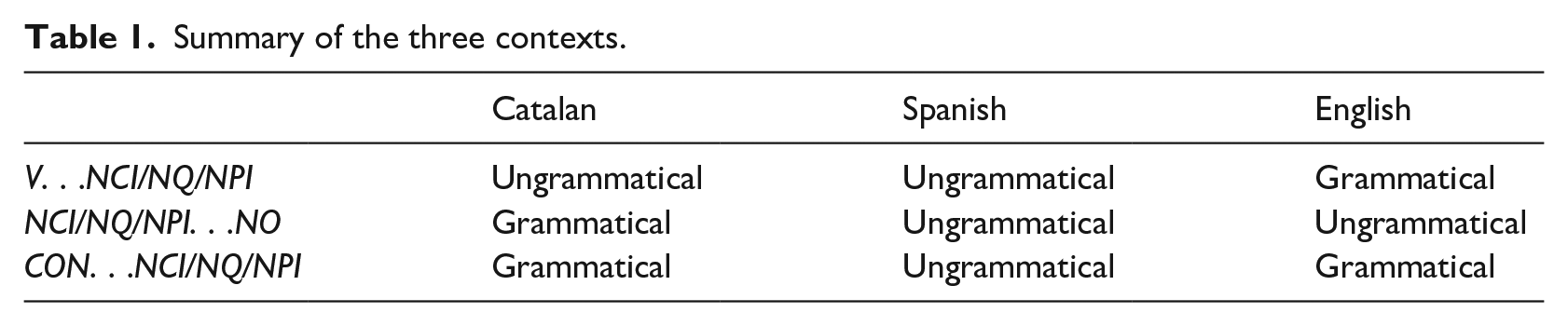
We will capitalize on these subtle, yet robust differences between Spanish, Catalan, and English to explore whether having acquired the target-like English properties has an effect on the L1 and early acquired L2 of the participants. In Table 1, we summarize how the three languages behave in the three linguistic contexts we will use in this study.
Summary of the three contexts.
Study
The aim of this study is to explore the extent to which a highly advanced L3 will have an effect on previously acquired languages. To do so, we investigate the processing of negative concord items in anti- and non-veridical contexts by Catalan–Spanish bilinguals who are highly advanced speakers of English living or having lived in an English-speaking environment for at least 12 months. We entertain the following research question and hypothesis:
RQ: Is a highly proficient early acquired L2 vulnerable to L3 influence to the same extent a late acquired L2 has been claimed to be?
Considering work on L1 attrition has shown a native language is vulnerable to attrition effects when immersed in the L2 context, we hypothesize that an early acquired L2 system will also be vulnerable to L3 influence. We, thus, predict that L3 English will have an effect on the L2 Spanish of the L1-Catalan, L2-Spanish L3-English group and on the L2-Catalan of the L1-Spanish, L2-Catalan L3-English group.
Participants
In total, 72 Catalan–Spanish bilingual speakers were included in the final analysis. The participants were grouped across two different dimensions: (a) whether Catalan or Spanish were their L1 or L2 (L1-Catalan L2-Spanish vs. L1-Spanish L2-Catalan) and (b) whether they were highly advanced speakers of English who had been living in an English-speaking environment for at least 12 months. 3 All participants acquired English in an instructed setting before moving to an English-speaking country; they did not attend additional English instruction while being immersed. The participants were grouped as follows:
Group 1 (n = 22): L1-Catalan, L2-Spanish speakers (= NO L3)
Group 2 (n = 18): L1-Spanish, L2-Catalan speakers (= NO L3)
Group 3 (n = 17): L1-Catalan, L2-Spanish → L3-English speakers (= YES L3)
Group 4 (n = 15): L1-Spanish, L2-Catalan → L3-English speakers (= YES L3)
All participants completed three background tasks, including an English proficiency test (Oxford Quick Placement Test: (Oxford University Press et al., 2001), a measure of language dominance (the Bilingual Language Profile: Birdsong et al., 2012), and a tailored background questionnaire. Table 2 contains the demographic information summarized across the four groups. 4
Demographic information about the participants of the study.
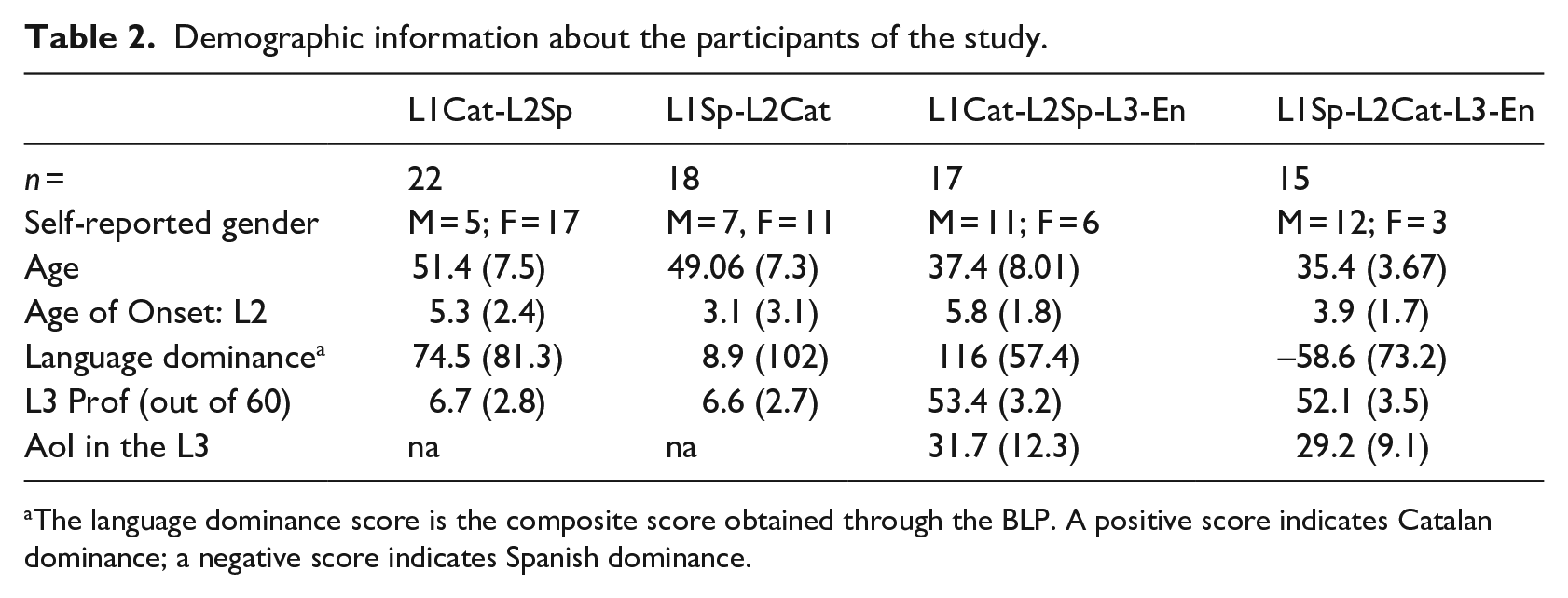
The language dominance score is the composite score obtained through the BLP. A positive score indicates Catalan dominance; a negative score indicates Spanish dominance.
SPR task
The SPR was administered in Catalan and Spanish. 5 There were three experimental contexts corresponding to the different syntactic contexts discussed above: (a) V. . .NCI, (b) NCI. . .NO, and (c) CON. . .NCI. Each context consisted of a critical and grammatical control condition. In addition, there were three distractor conditions. Each condition contained 8 experimental items (72 items in total per task). We included content questions to check for accuracy/attention on a 1:2 ratio. Tables 3 and 4 contain a summary of the conditions and exemplar items in the Catalan and Spanish tasks.
Summary of the conditions and exemplar item in the Catalan SPR task.
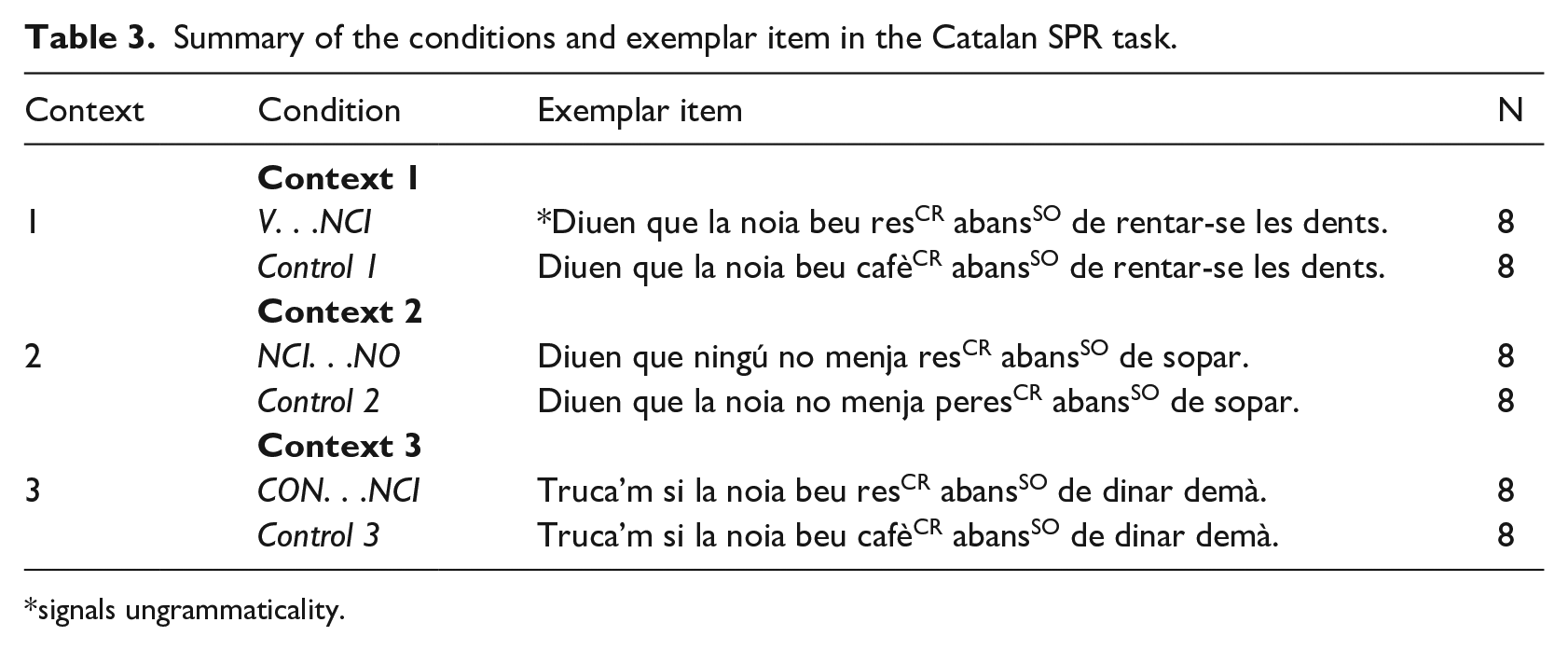
signals ungrammaticality.
Summary of the conditions and exemplar item in the Spanish SPR task.
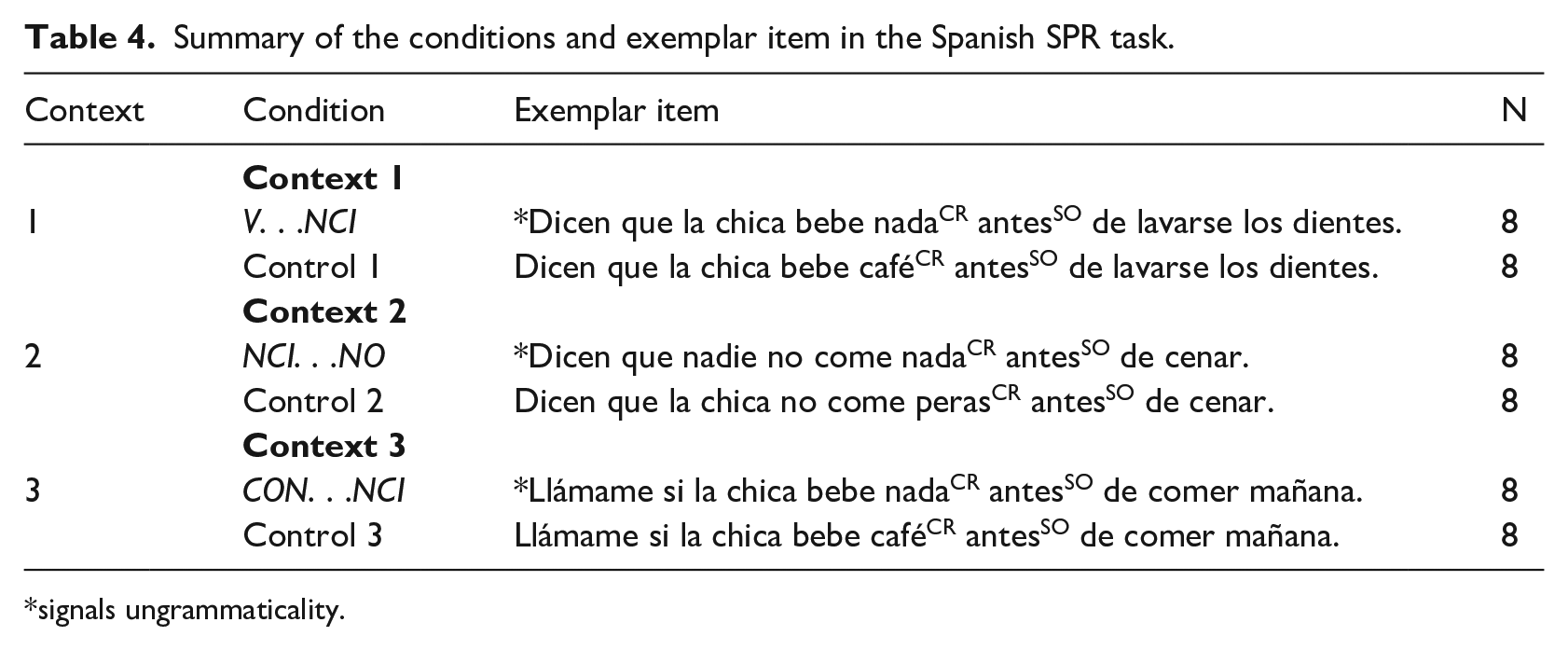
signals ungrammaticality.
Participants were instructed to read the sentences at a normal pace. The task started with six practice items, followed by the 72 target ones presented randomly to each participant.
Participants took part in three separate experimental sessions with at least 5 days in between; each session targeted the battery of tasks in a language. 6 All the tasks were delivered using IBEX FARM platform.
Results
Data analysis
We first transformed the raw reaction times to residual reaction times to neutralize possible effects of region length. 7 The two datasets were analysed using linear mixed-effects models, using the packages lme4 (Bates et al., 2015) and multcomp (Hothorn et al., 2008) for post hoc comparisons. The analysis was conducted in the R environment (R Core Team, 2019). Separate models were run for each language dataset and each paired condition. For each subset, we explored the effects and interactions of level (critical; control), Order of Acquisition (L2-Sp; L2-Cat), L3 (Beginner-L3; Advanced-L3) and region (Critical: CR; Spill-Over1: SO). Each model had the maximal random structure that converged. As per model selection, we used the recommendations by Gries (2018). First, the maximal structure for fixed-effects and a basic random structure (i.e., intercepts for items and participants) was adopted. Then, we employed backward selection, whereby we extracted the factor or interaction that accounted for the least amount of variance from the maximal model. Next, we performed a maximum likelihood ratio comparison between both models. The model offering a better fit to the data was selected to move down the process until we achieved the model offering the best fit. The final models can be found in Appendix 1.
Comprehension accuracy of the content questions was calculated to ensure that participants were reading the sentences and paying attention to the task. Three participants were not included in the final analysis because their accuracy in, at least, one of the tasks was below 80%.
V. . .NCI condition
Figure 1 shows the results in the V. . .NCI condition divided by L1 (Catalan or Spanish) and L3 (beginner ‘L3 = NO’ vs. advanced ‘L3 = YES’) in the Catalan dataset.
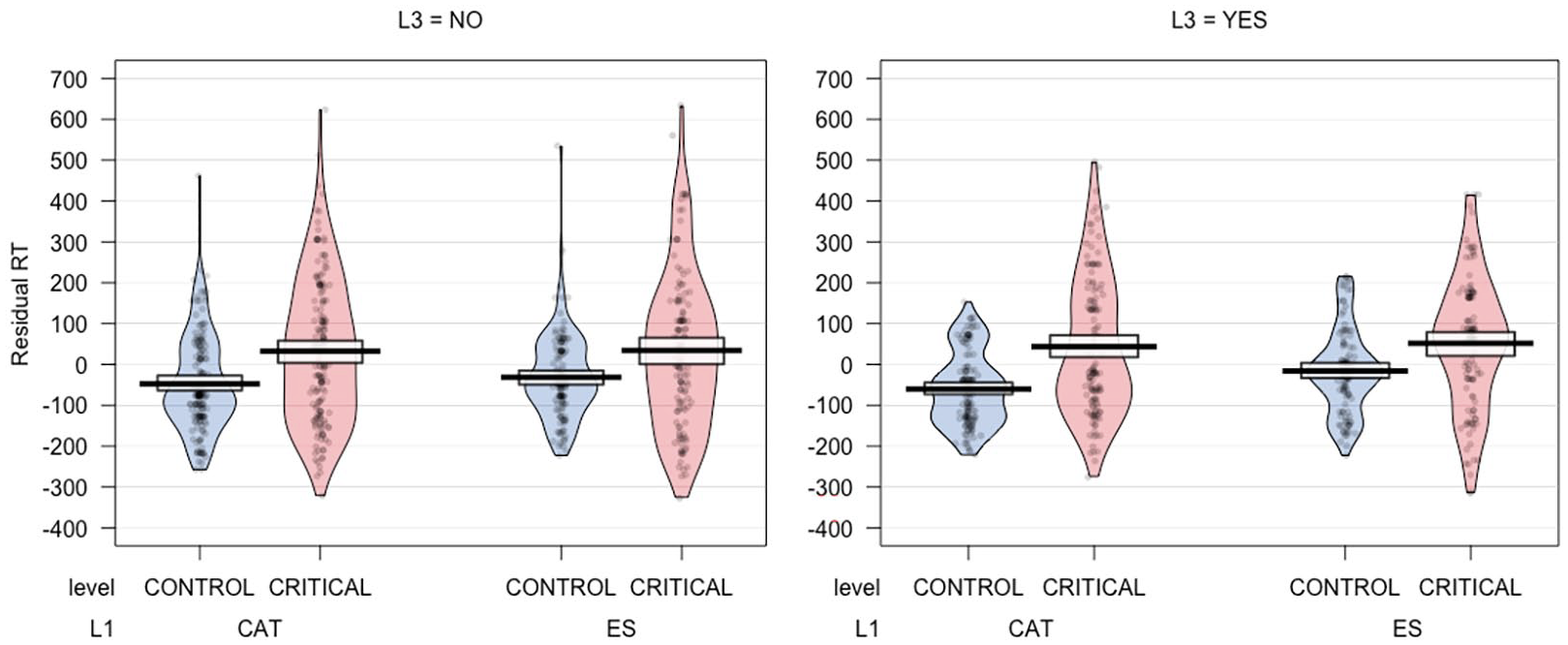
Residual RTs in the V. . .NCI condition in the Catalan dataset.
Recall that the sentences in this context are ungrammatical in Catalan but grammatical in English. Thus, we expect the control groups to show a slowing-down effect at either the CR or the SO in the critical condition. The statistical model only showed a main effect of level (β = 75.91; t = 9.49; p < .001) and a main effect of region (β = −30.42; t = −3.81; p < .001). The results suggest that all groups, irrespective of order of acquisition and presence of an L3, are significantly slower in the critical condition, specifically in the CR. This can be taken to be evidence that there is no effect from L3 English to either L1 or L2 Catalan.
Figure 2 shows the results in the V. . .NCI condition in the Spanish dataset.
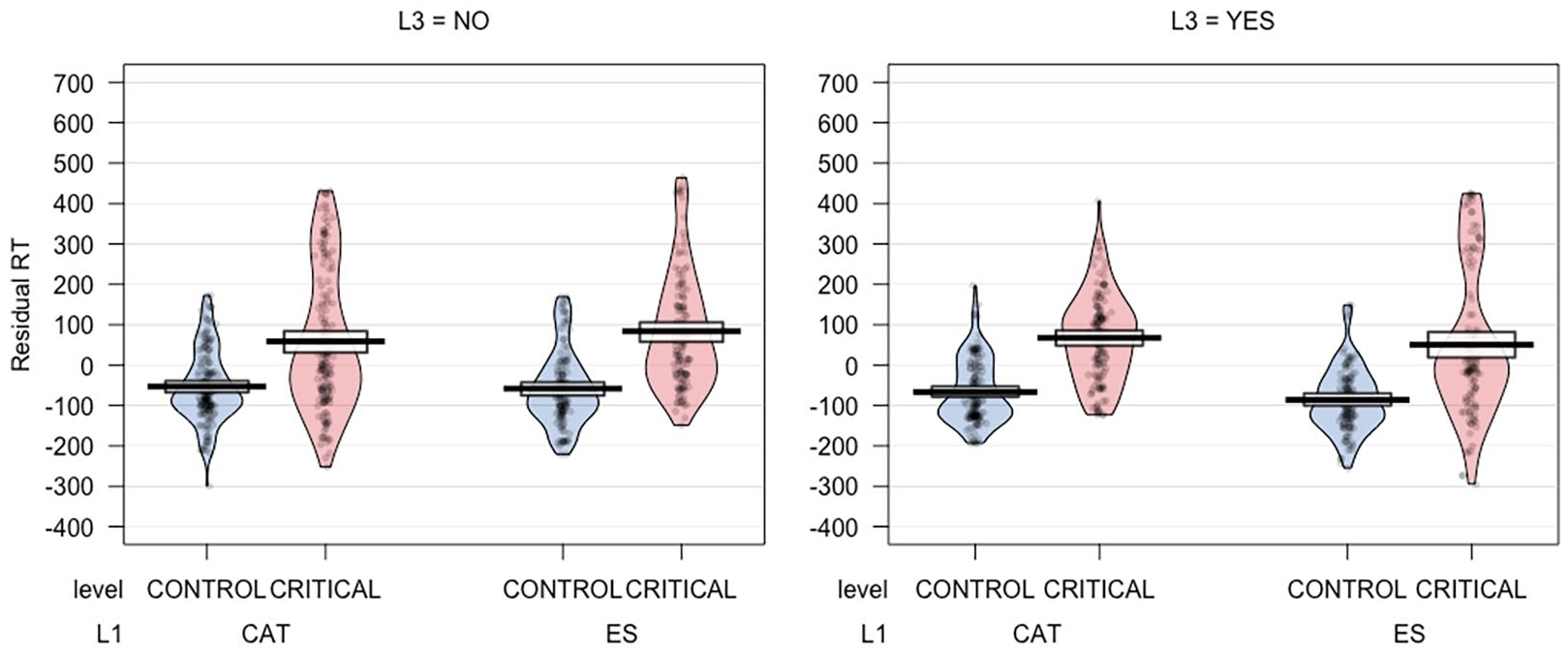
Residual RTs in the V. . .NCI condition in the Spanish dataset.
Similar to what we expected in the Catalan dataset, we predicted that participants in the control groups only would slow-down in the Critical condition. The statistical analysis revealed that there was a significant main effect of level [β = 96.03; t = −2.44; p < .001], L1 [β = −53.75; t = -2.47; p < .001], region [β = −53.55; t = 3.12; p < .001] and the following significant interactions: L1*L3 [β = 68.01; t = 2.27; p < .001], L1*region [β = 70.48; t = 3.48; p < .001 and L1*L3*region [β = −79.02; t = −2.83; p < .001]. The results overall suggest that all participants are sensitive to this morphosyntactic violation, showing no effect of L3 English either. We will further discuss the significant interactions and their meaning in the ‘Discussion’ section.
NCI. . .NO
Figure 3 shows the results in the NCI. . .NO condition divided by L1 (Catalan or Spanish) and L3 (beginner ‘L3 = NO’ vs. advanced ‘L3 = YES’) in the Catalan dataset.
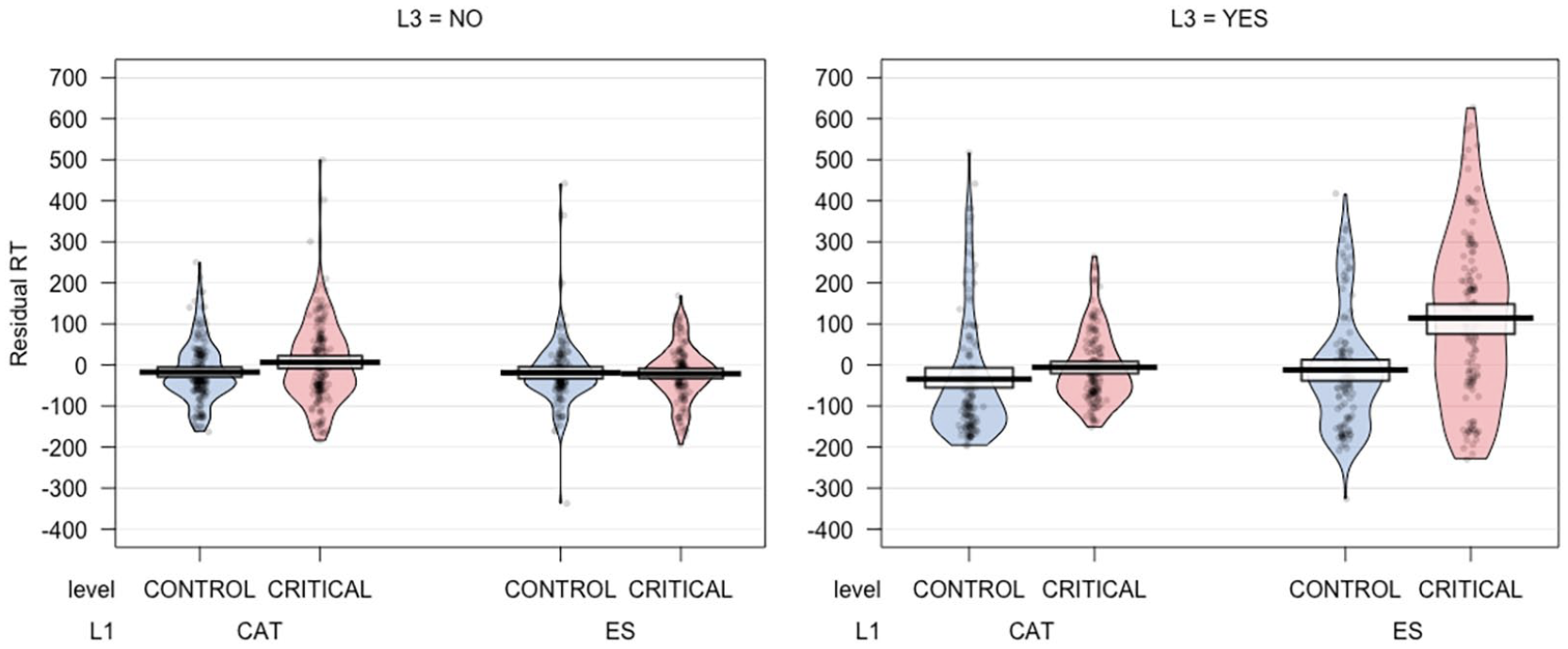
Residual RTs in the NCI. . .NO condition in the Catalan dataset.
Recall that this condition is grammatical in Catalan and thus, we expected to see no significant differences between the control and critical condition in the groups without high exposure/proficiency in L3 English. As per the groups with L3 English, we hypothesized that there would be a slowing-down effect in the critical condition of the L2 Catalan of the L1 Spanish, L2 Catalan L3 English group. The statistical analysis revealed a significant main effect of level [β = 33.81; t = 2.17; p < . 001], significant interactions of level*L1 [β = 127.90; t = 5.87; p < . 001], level*L1*region [β = −60.45; t = −2.45; p < . 001], and level*L1*L3 [β = −124.08; t = 5.02; p < . 001].
As can be visually seen in Figure 4, the L1-Spanish, L2-Catalan L3-English group is the only one that shows a significant slowing-down effect in the critical condition as opposed to the control one. This indicates an effect from English onto the L2 Catalan of this group.
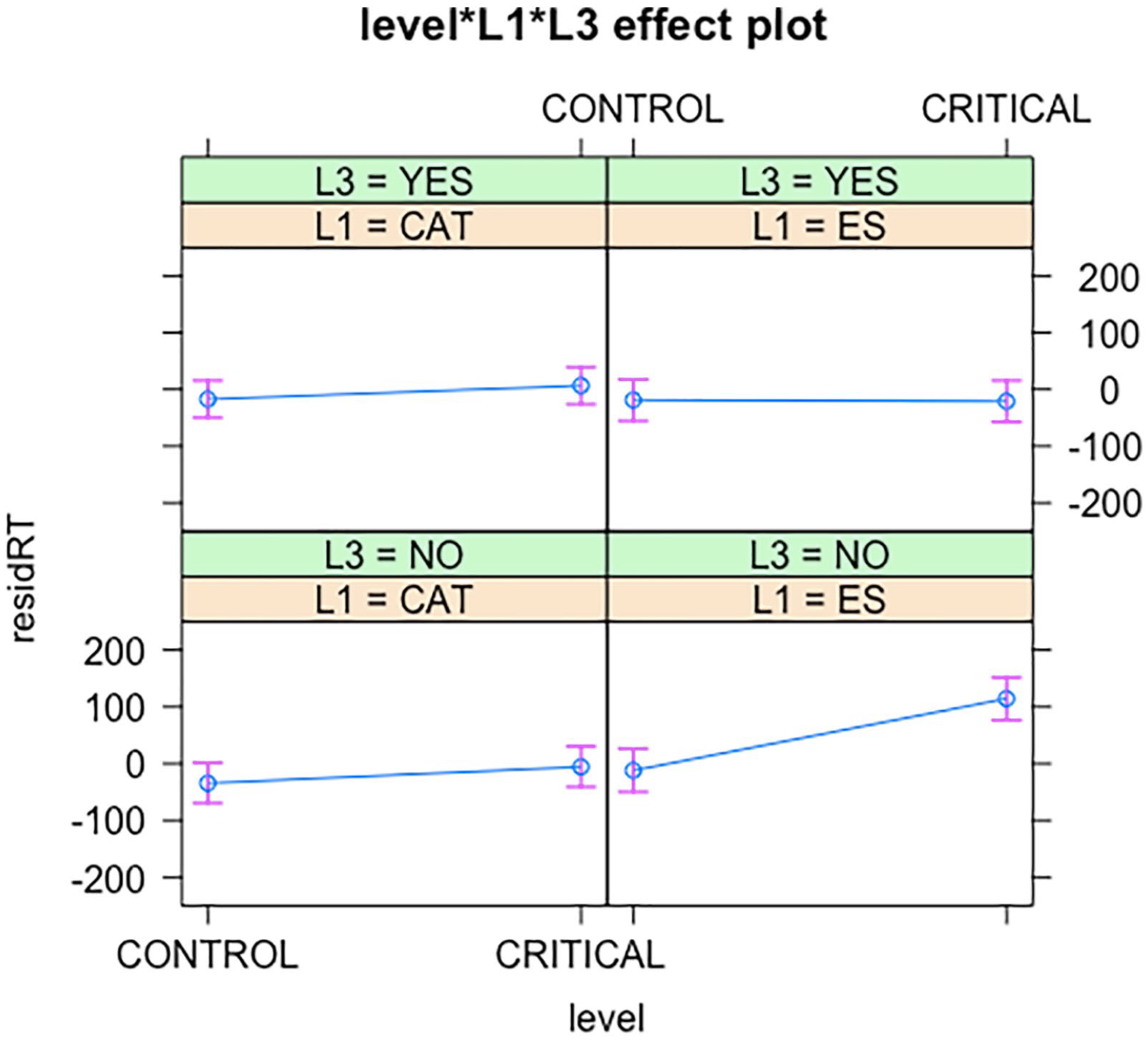
Effect plot of the Level*L1*L3 interaction for the Catalan dataset in the NCI. . .NO condition.
Post hoc comparisons showed that the only significant interactions arose when comparing the residual RTs of the critical condition for the L1-Spanish, L2-Catalan → L3-English group against everything else.
Figure 5 shows the results in the NCI. . .NO condition in the Spanish dataset.
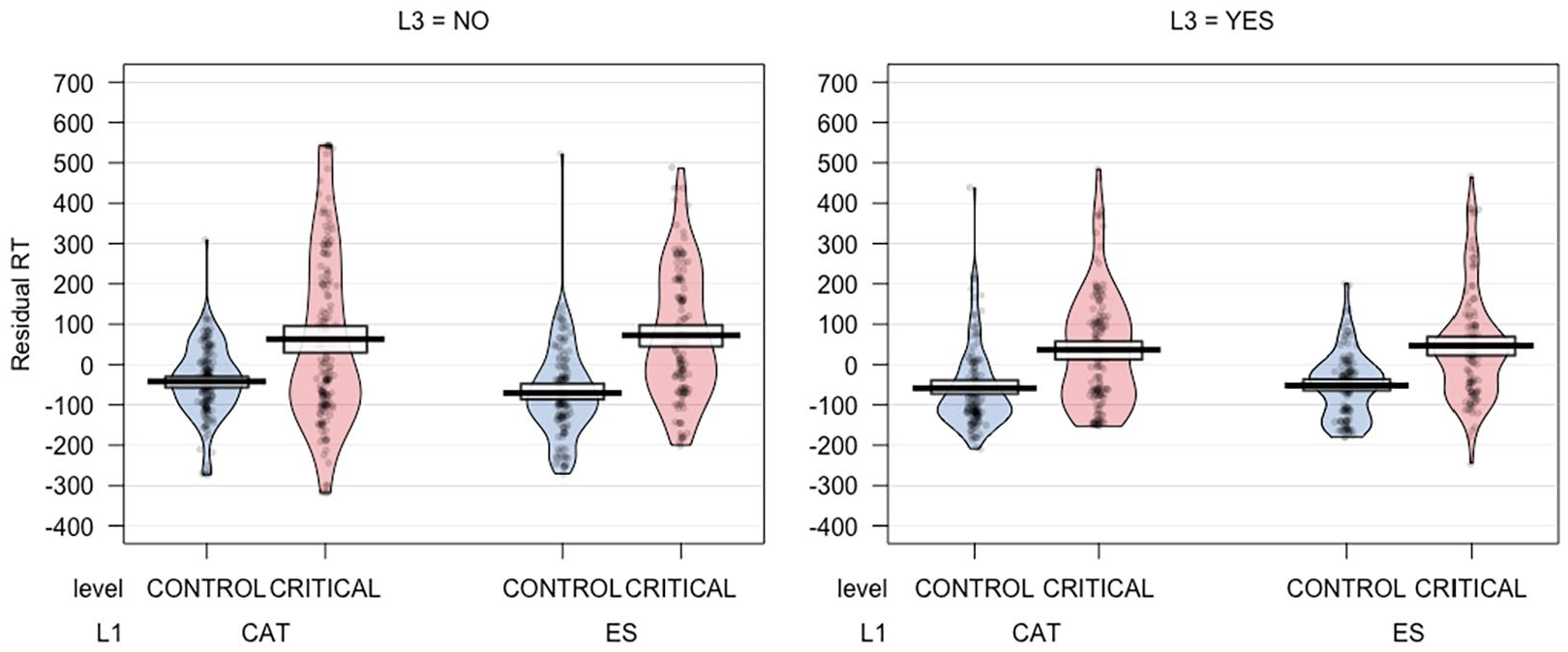
Residual RTs in the NCI. . .NO condition in the Spanish dataset.
This condition is ungrammatical in Spanish and English, and thus, we expected to see significant slowing-down effects in the critical condition as opposed to the control context for all groups. The statistical analysis confirmed that there was a significant main effect of level [β = 126.06; t = −3.42; p < .001] and a significant interaction of level*region [β = −50.89; t = −2.56; p < .001].
Conditional. . .NCI
Figure 6 shows the results in the CON. . .NCI condition divided by L1 (Catalan or Spanish) and L3 (beginner vs. advanced) in the Catalan dataset.
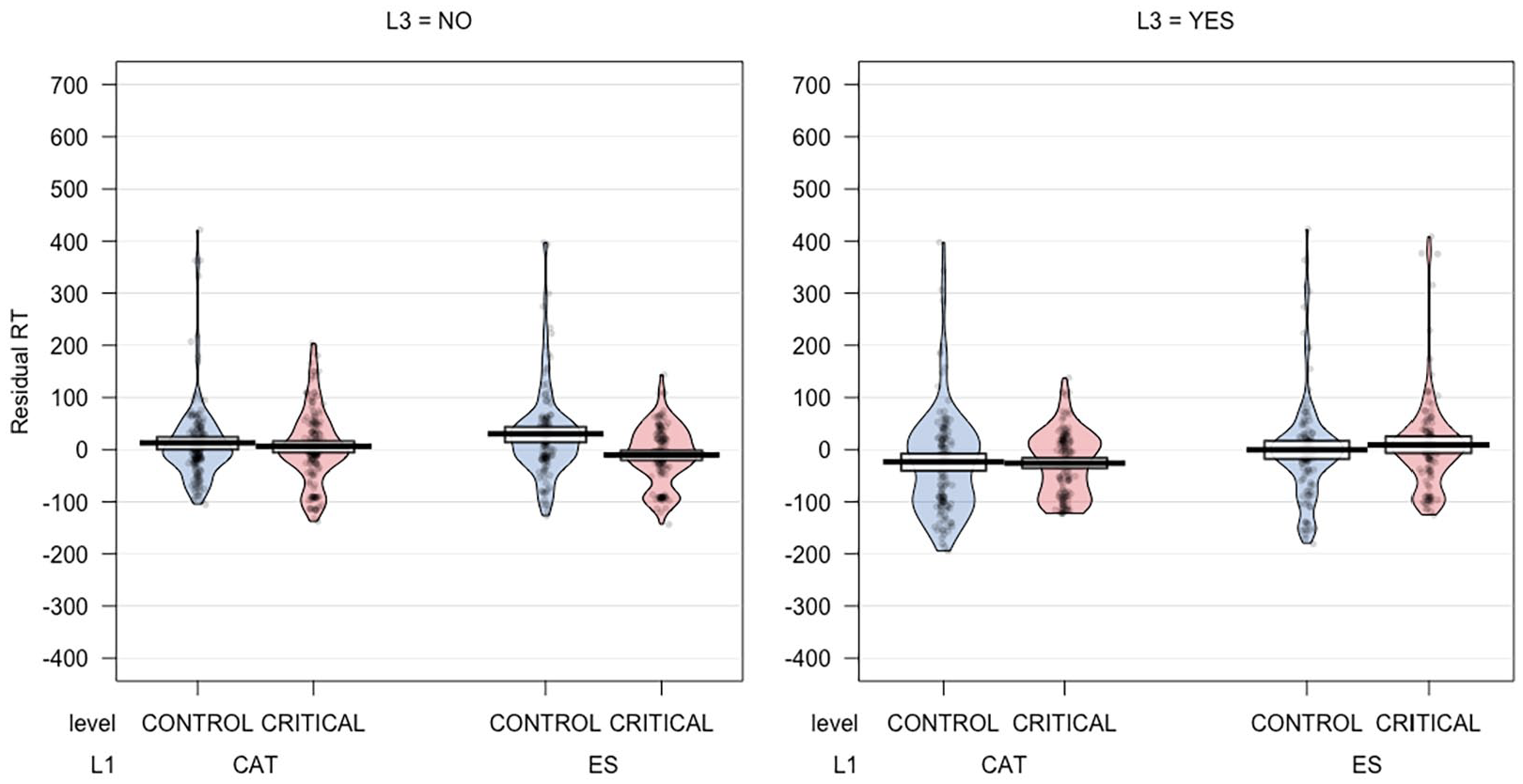
Residual RTs in the Condition. . .NCI condition in the Catalan dataset.
Recall that this condition is grammatical in both English and Catalan and ungrammatical in Spanish. We expected that none of the groups would show a slowing-down effect in either the CR or the SO of the critical condition. However, the statistical analysis revealed a main effect of L3 [β = 36.34; t = 2.79; p = .006] and a significant interaction of level*L1*L3 L1 [β = −45.54; t = −2.41; p = .015]. The results suggest that manipulation of level is not driving the significant differences found in this model. We will get back to this interaction in the ‘Discussion’ section below.
Figure 7 shows the results in the Conditional. . .NO condition divided by L1 (Catalan or Spanish) and L3 (beginner vs. advanced) in the Catalan dataset.
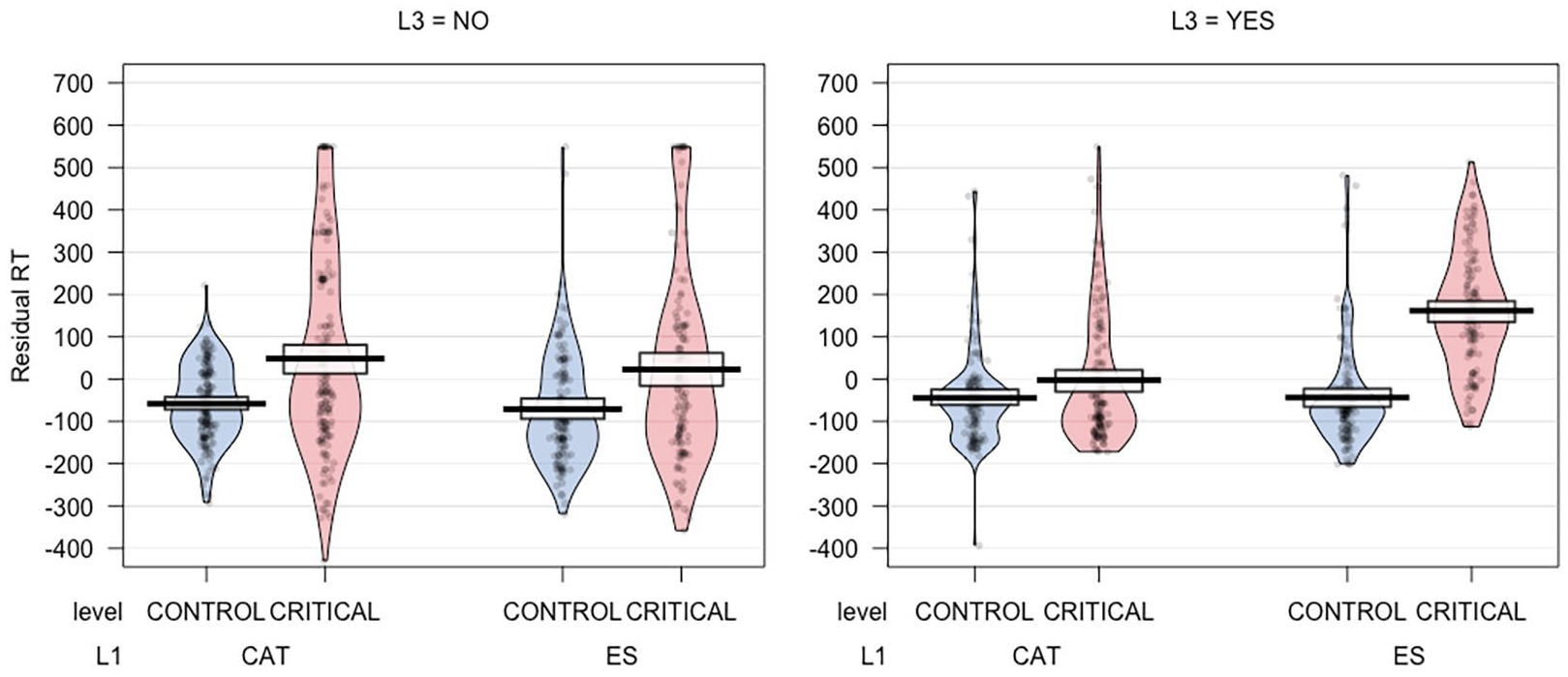
Residual RTs in the Condition. . .NCI condition in the Catalan dataset.
Considering this condition is only ungrammatical in Spanish, we predicted to find a slowing-down effect in the critical condition for the groups without L3 English. This is indeed what we found. For the two groups with L3 English, we hypothesized that we should not see a slowing-down effect in the critical condition due to influence from English. The statistical analysis revealed the following significant interactions: level*L3 [β = 96.12; t = 3.39; p < .001], level*region [β = 76.03; t = 2.61; p < .001], level*L1, and level*L1*L3 [β = 176.44; t = −5.23; p < .001]. Figure 8 shows the effect plot of the three-way significant interaction.
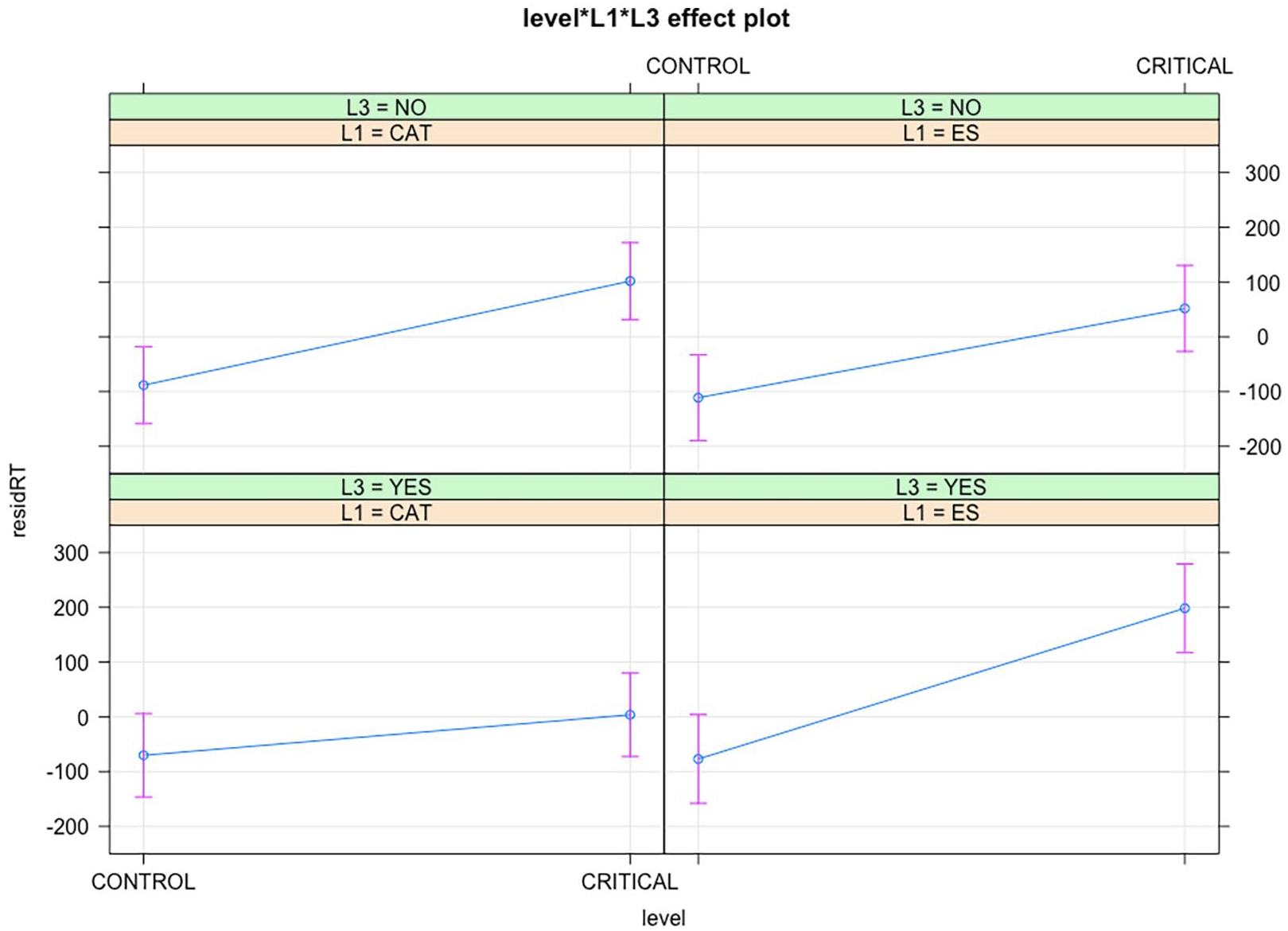
Effect plot of the three-way significant interaction (Level*L1*L3).
The L1-Catalan, L2-Spanish → L3-English group is the only one that shows no sensitivity to the morphosyntactic violation in this condition, which suggests there is an effect from English onto L2 Spanish only.
Summary across datasets and groups
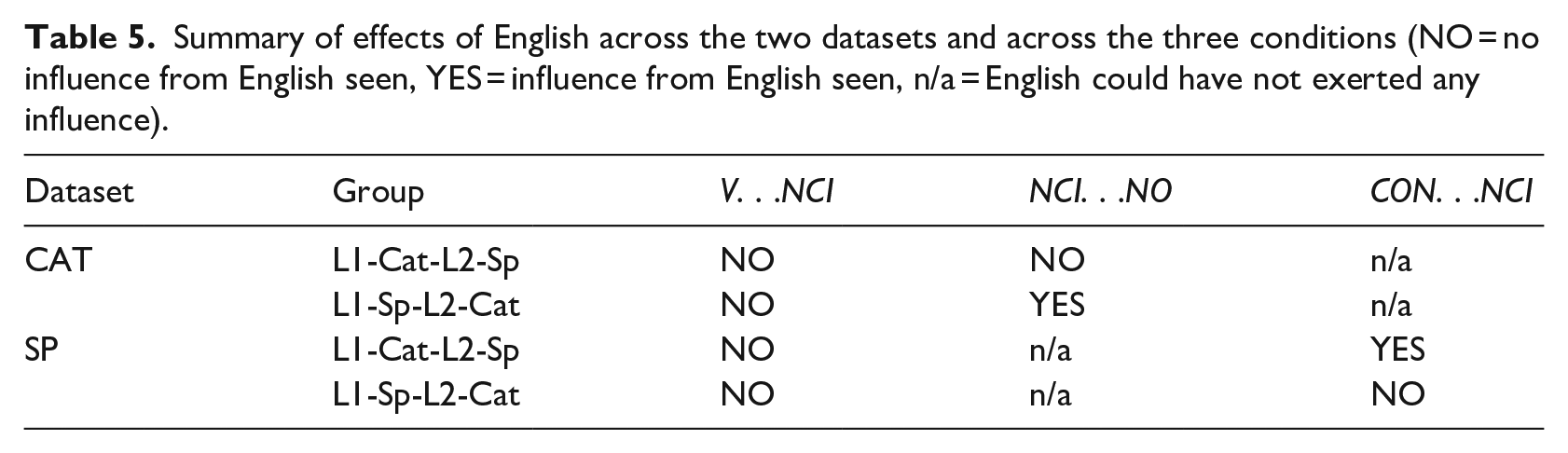
None of the groups showed regressive transfer effects from English in the V. . .NCI condition. The L2-Catalan group was the only one that showed an effect of English on their Catalan in the NCI. . .NO condition. The L2-Spanish group was the only one that showed an effect on their L2 Spanish in the CON. . .NCI condition. Neither L1 Catalan nor L1 Spanish were vulnerable to influence from English in the V. . .NCI condition. Table 5 contains a summary of the results for the two groups with L3 English in the two datasets.
Summary of effects of English across the two datasets and across the three conditions (NO = no influence from English seen, YES = influence from English seen, n/a = English could have not exerted any influence).
Discussion
The aim of the present study was to test whether the claims of the DSH also hold true for early acquired L2s. We had, thus, predicted that L3 English would exert influence on the L2s of our participants. For both groups, the predictions were only partially confirmed. They all showed a sensitivity when the negative concord item occurred post-verbally without sentential negation (V. . .NCI condition), indicating no English influence on this condition. Recall this condition is ungrammatical in both Catalan and Spanish and grammatical in English. For the L2 Catalan group, we had also predicted influence from English where the negative concord item occurred preverbal with sentential negation (NCI. . .NO condition). Recall that this condition is grammatical in Catalan and ungrammatical in both English and Spanish. Thus, if English was to exert influence, then participants should show a slowing-down effect in this condition. This is indeed what we saw, indicating that their L2 Catalan grammars do not allow the co-occurrence of pre-verbal NCIs and sentential negation. For the L2 Spanish group, we had predicted influence from English on Spanish where the negative concord items occurred in a conditional sentence (Conditional. . .NCI condition). This structure is grammatical in both English and Catalan, and ungrammatical in Spanish. Thus, we expected the L2 Spanish group with L3 English not to show the sensitivity expected in Spanish. This is what we found, indicating that their L2 Spanish grammars allow this structure.
As has been discussed above, our results partially support the predictions of the DSH. L3 English does not exert influence on the L1s (Catalan or Spanish) of the participants for any of the conditions. This suggests in line with the DSH that an L1 and L2 are differentially affected by an L3. It should not be surprising as our participants had relatively short immersion experiences as compared with the typical length of immersion found in the L1 attrition literature. 8 Whereas there is no agreement on when L1 attrition takes place, the cut-off point that has been suggested is 10 years (e.g., Schmid, 2007). Considering that immersion for our participants was shorter, it should not be surprising we did not see L3 effects on the L1s. 9 Second, our L2 data show that we can extend the tenets of the DSH to early acquired L2 systems (between 3 and 6 as reported by our participants). However, our results show that out of the three conditions under examination only two are vulnerable to regressive transfer effects at this stage. The question then is what explains the differential vulnerability of these conditions.
A first obvious question is whether we are witnessing some sort of cross-generational change that is taking place due to the language-contact situation of Catalan and Spanish (e.g., Perpiñán, 2017, 2018), especially so considering that cross-linguistic influence has been reported in contexts of societal bilingualism. Recall our participants with L3 English are slightly younger than the control participants. 10 And so, one could argue that we are witnessing language change where Catalan is losing the availability of sentential negation with pre-verbal negative concord items. This would go in line with the development of negation among natural languages. However, work on Catalan negative concord items has shown that younger populations still allow pre-verbal negative concord items to co-occur with sentential negation (e.g., Déprez et al., 2015; Prieto et al., 2013; Puig-Mayenco et al., 2018). A study worth discussing is that of Puig-Mayenco et al. (2018), where they looked at the judgements and processing of negative concord items as well as differential object marking (DOM) in two groups of Catalan–Spanish bilinguals. Their results showed that there was influence from Spanish onto the Catalan for the Spanish-dominant group and from Catalan onto the Spanish of the Catalan-dominant groups. Interestingly for us, such effects were only found on the DOM property. Both groups, irrespective of language dominance, showed target-like knowledge and processing of negative concord items in pre-verbal position. Notice that a very similar methodology to our study was used and the participants mean age was much younger than in the present groups. Thus, if what we are seeing in our study is a case of cross-generational change due to language contact, we would certainly expect to see it in the participants of Puig-Mayenco et al.’s study. It is true, however, that this remains an open empirical question.
Another possibility relates to the fact that the condition where there is influence from English to Catalan or Spanish show different degrees of optionality. In the L2 Catalan group, we saw influence where there was a preverbal negative concord item and overt sentential negation. Recall from section ‘Linguistic phenomenon’ above that this is in fact optional, whereby Catalan allows both the presence and absence of sentential negation without any implication for the semantics of the utterance (see Prieto et al., 2013; Tubau & Espinal, 2012 for some discussion on double negation in Catalan). As for the condition where we saw influence from Spanish, it has been pointed out that there is also a degree of optionality in Spanish whereby the negative concord item as well as the existential quantifier can appear in conditional structures. Notice, however, that the occurrence of the negative concord item in this context is highly restricted to contexts where it is modified by a comparative structure (Espinal, 2000). The third condition where we had predicted influence was where the negative concord item appears in post-verbal position without the occurrence of a negative marker. This condition was grammatical in English and ungrammatical in both Catalan and Spanish, so there was no optionality involved. This is the condition where our predictions were not met as no influence from L3 English to either Catalan or Spanish was observed.
There is yet a third possible explanation. The two conditions where we see influence from English onto L2 Catalan or L2 Spanish are those conditions where the L1 and L3 share the same distribution. Where the negative concord item is in preverbal position and co-occurs with sentential negation (the NCI. . .NO condition), there is influence from L3 English in the L1-Spanish, L2-Catalan group. Recall that Spanish and English work similarly in this condition. Where the negative concord item appears in a conditional structure (Conditional. . .NCI condition), there is influence from L3 English in the L1-Catalan, L2-Spanish group. Here, Catalan and English work similarly. And so, perhaps when the L1 and L3 share the same distribution, there is an enhanced effect from the L3 on the L2. A cumulative effect has already been discussed in the literature on regressive transfer (see section ‘Studies on regressive transfer’), which we come back to below.
Our dataset alone does not allow us to tease apart between the last two possibilities. Thus, by examining the available literature, we are able to provide adequate interpretation of our data and examine the possible explanations that are discussed above. Recall that in section ‘Studies on regressive transfer’ we reviewed the literature showing regressive transfer from an L3 to an L2 (see Table 6 for a summary).
Summary of the studies reviewed on L3 regressive transfer in relation to scenarios discussed herein.
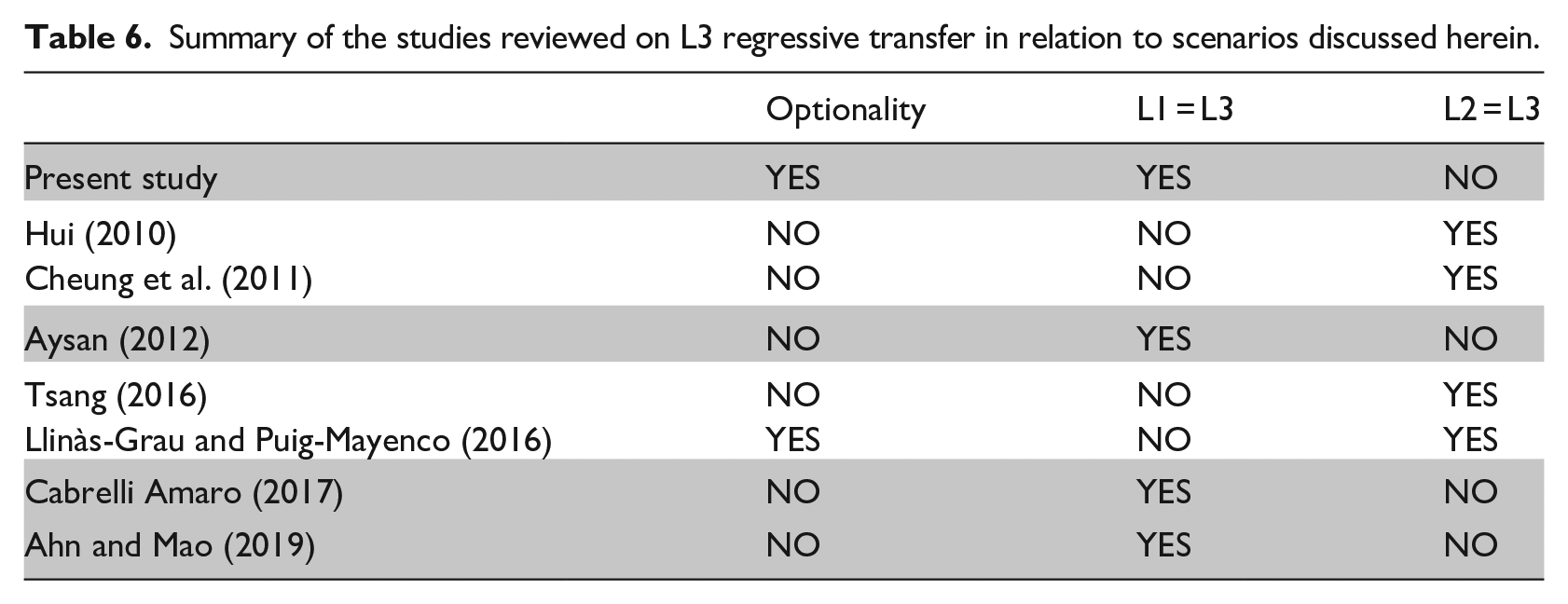
Some of these studies examine whether the L3 can have a cumulative enhancement effect on L2 acquisition. These are the studies where the property under investigation behave similarly in the L3 and L2, thus, speeding up the acquisition process (Cheung et al., 2011; Hui, 2010; Llinàs-Grau & Puig-Mayenco, 2016; Tsang, 2016). These studies do not allow us to draw conclusions for our data because (a) they did not prove for negative regressive transfer and (b) the L1 and the L3 do not share the same distribution. An initial conclusion, however, can be drawn from this cluster of studies: an L3 can have a positive/cumulative enhancement effect on an L2. The questions that follows is whether it can also have a negative effect and if so, what are the conditions that prompt such effect.
As discussed above, there are two scenarios that could potentially provide a good explanation to our results. If we look at the studies that the test negative regressive transfer effects (shaded in grey), we see that they can be explained by the fact that a regressive transfer effects are seen when the L1 and L3 share the same distribution. And so, the review of the existing literature allows us to suggest that the asymmetries in our dataset can be explained by the fact that the properties that are more vulnerable to L3 influence are those where the L1 and the L3 share the same distribution.
Conclusion
The overall results of this study support the claims of the DSH in that we show that an L2 is more susceptible to regressive transfer effects than an L1 is. We further extend this claim to an early L2, acquired in a naturalistic environment, and supported by societal bilingualism. However, the results also showed distinct levels of vulnerability for two of the conditions under investigation in our study. The review of the literature allowed us to examine our results in light of different explanations. Based on previous work, we, thus, suggest that L3 regressive transfer effects are more salient when the L1 and the L3 share the same distribution.
In light of the above, herein we propose a further effect that can complement the DSH: the Sandwich effect in L3 acquisition. We claim that (a) if proficiency/use/activation/exposure to the L3 is high, (b) if the property in the L3 is acquired in a target-like manner, and (c) if the L1 and L3 share the same morphosyntactic representation, then the vulnerability of the L2 will be enhanced and regressive transfer will be more prompt to occur. It is important to highlight that this does not mean that regressive transfer effects will ONLY occur if these conditions are met, it means that regressive transfer effects will occur gradually, but when they do, they will first be observed in the conditions/properties where the L1 and L3 share the same representation. To falsify this effect, we would want to test a group of highly advanced speaker of an L3 at several different times over the course of development in two distinct conditions: one where the L1 and L3 share the same distribution and one where the L3 does not share the distribution with either the L1 or L2. The predictions would be that we should first see influence in the property where the L1 and L3 share the same distribution. If we see influence on both properties at the same time or influence on the property where the L3 behaves differently from the L1 and L2. Then, this would be evidence against the proposed effect. More empirical research is needed for us to know whether this effect holds true, more empirical studies will say if it does.
Footnotes
Appendix 1
Declaration of conflicting interests
The author(s) declared the following potential conflicts of interest with respect to the research, authorship, and/or publication of this article: This project has been supported by different research grants at different stages: the PhD research studentship of the Language, Development and Aging Division at the University of Reading (RF: G16-142), the ESRC postdoctoral fellowship (ES/T008512/1) at the University of Southampton, the Spanish Ministerio de Economía y Competitividad (FFI2017-82547-P) and Generalitat de Catalunya (2017SGR634).
Funding
The author(s) received no financial support for the research, authorship, and/or publication of this article.

Notes
Author biography
Eloi Puig-Mayenco is Lecturer in the School of Education, Communication and Society at King’s College London, and is a member of the Centre for Language, Discourse and Communication.