




Abstract
Aims and objectives:
This article reports the ideologies on linguistic variation among a cohort of new speaker teachers (NSTs) of Irish. It investigates responses to the three main traditional dialects of Irish and a post-traditional variety common among new speakers.
Design and methodology:
An experimental design was employed. Participants responded to 15-second samples of four speakers, first on adjective items referring to speakers’ characteristics (speaker phase) and second on statements referring specifically to the type of Irish in the samples (speech phase). Background information was also gathered, for example, school type, place of origin, and type of Irish spoken.
Data and analysis:
We present the responses of a subset of 88 NSTs of Irish, focusing specifically on participants’ responses in the speech phase where they evaluated the type of Irish in the samples. Data were analysed to determine whether there were significant differences in the ratings of samples within different respondent subgroups.
Findings and conclusions:
Some significant differences were found among subgroups. Teachers working in Irish-medium schools align more closely with established native speaker language ideologies than those in English-medium institutions. Participants did not distinguish significantly between their local Gaeltacht variety and other Gaeltacht areas, but did rate all three Gaeltacht samples more positively than the new speaker variety. Finally, participants who self-identify as speakers of ‘standard’ Irish and those who describe themselves as practising a Gaeltacht variety rated the Gaeltacht samples more positively.
Originality:
While experimental investigations of linguistic ideologies are central to sociolinguistics, this article is original in its focus on the ideologies of NSTs of Irish.
Significance and implications:
This research illustrates the robustness of established ideologies in the responses of some participants but shows that others challenge these ideologies. Results speak to the complexities and contradictions of identity and speakerness among NSTs of a minority language.
Introduction
Regard for language variation has been a focus in sociolinguistics research since the early days of the field. Sociolinguists investigate subjective responses to variation with a view to establishing the social meanings associated with different linguistic features and practices (Preston, 2010), but also to establish how these meanings are used by individuals and groups to understand themselves and their relationship to their wider social world (McKenzie & Osthus, 2011). The focus of this article is on subjective responses to variation among new speaker teachers (NSTs) of the Irish language. Working within the experimental paradigm, a language ideologies perspective is adopted where ideologies are defined as sets of beliefs about language held by social actors (Milroy, 2004; Silverstein, 1979). This approach emphasises that responses to variation are layered and that they are linked to wider social processes.
In focusing on NSTs of Irish, this article, in line with the focus of this special issue, aims to make a unique contribution to wider sociolinguistic debates on identity and speakerness. It has been argued that teachers have the potential to shape the linguistic practices and ideologies of students (Ó Murchadha & Flynn, 2018a, 2018b). In addition, however, teachers are complex sociolinguistic actors in their own right. They are, for instance, shown to hold a range of (sometimes ambivalent) ideologies on linguistic variation, sometimes subscribing to dominant ideologies and other times challenging them (Ó Murchadha & Flynn, 2018a, 2018b; Sifakis & Sougari, 2005). Teachers’ ideologies on variation are arguably even more complex where they are new speakers of a minority language, as is the case with the participants in the present study. The primary aim of this article is to investigate what NSTs’ ideologies on variation in Irish reveal about their identity and speakerness.
New speaker variation
As the introduction to this special issue illustrates, the new speaker construct is a complex one. It aims to problematise the dominant sociolinguistic order that traditionally privileges so-called ‘native speakers’ and their linguistic practices (O’Rourke et al., 2015). For this article, new speakers are defined as people who use and claim ownership of a language that is not typically perceived as belonging to them (Ó Murchadha, Smith-Christmas, Hornsby & Moriarty, 2018). This includes speakers with a range of proficiencies, from emerging through to expert language users. Although small numbers of what are referred to here as new speakers do acquire native-like language proficiency, it is well documented in various contexts that new speakers typically acquire language varieties that are qualitatively different to so-called native speakers. Although the native–new speaker dichotomy is not merely a matter of linguistic classification, new speakers of, for example, Chinese (Li, 2010), English (chapters in Bayley & Preston, 1996), French (Dewaele, 2004), and Spanish (Geeslin, 2003) can be distinguished from native speakers across different areas of language. A deficit perspective has often been adopted in describing differences between the language of native and new speakers (see Cook, 1999; Ó Murchadha et al., 2018). The innovative practices of new speakers are frequently viewed as a failure to acquire native norms or as the incomplete acquisition of native norms. Within this view, the perceived failure is typically attributed to new speakers missing out on the opportunity to fully acquire native norms that, it is argued, can only take place during a proposed critical period for language acquisition (see Muñoz & Singleton, 2011, for a critical review). Much research on new speakers explicitly aims to challenge such deficit perspectives.
In the Republic of Ireland, Irish is a core subject throughout compulsory schooling, while in Northern Ireland, it is available as a subject in some secondary schools. This means that almost all students in the Republic study Irish as a subject for around 14 years, with much smaller numbers studying it as a subject in secondary schools in the North. Irish-medium (IM) education is also available at pre-school, primary, and post-primary levels in both jurisdictions. For the general population, the position of Irish in education does not normally result in high levels of proficiency in Irish and use of Irish outside education (Harris et al., 2006). For some, however, education introduces them to Irish, allows them to develop significant proficiency in the language, and they may go on to use Irish in their home, social, or professional lives. Although education can be an important juncture in the linguistic journey of new speakers, factors such as heritage connections to the heartland communities of the Gaeltacht or a personal commitment to Irish also play an important role for many, sometimes in tandem with education (e.g., Puigdevall et al., 2018).
As a result of these and other factors, there are significant numbers of new speakers of Irish located outside the traditional Irish-speaking communities (An Ghaeltacht). Census returns actually show that there are now more daily speakers of Irish located outside the Gaeltacht, in what is referred to here as the post-Gaeltacht, than there are in the Gaeltacht itself (CSO, 2017). While some of these speakers may be originally from the Gaeltacht, most are new speakers of Irish. They are bilingual in English and Irish, with some perhaps having proficiency in other languages too. Many of them live in a society that is dominated by English, but they are nonetheless ideologically committed to Irish, use it on a habitual basis, and see it as an important part of their identity. Although, traditionally, new speakers of Irish (were expected to) model their speech on the native speaker norms of a specific Gaeltacht area, there is a widespread perception that many new speakers operate independently of Gaeltacht norms (Ó hIfearnáin & Ó Murchadha, 2011). Some new speakers, in fact, explicitly reject the traditional Gaeltacht native speaker norm or implicitly reject it through their practices (Ó Murchadha & Flynn, 2018a; O’Rourke & Walsh, 2020). While much research has been carried out on the ideologies of new speakers of Irish, the Irish of new speakers has not been subject to comprehensive linguistic analysis. In the absence of such work, research on the Irish of students in Irish-immersion education is instructive in terms of the variety of Irish practised by many new speakers.
An early study on this topic relates to an Irish language initiative on Shaw’s Road in Belfast (Maguire, 1991). This initiative saw a group of families, who were not native speakers of Irish, establish an Irish-speaking housing development and an IM primary school. As part of her study, Maguire includes an analysis of the spoken Irish of the children of the Shaw’s Road primary school. She documented a wide range of innovative practices across a range of areas of language. These include innovations in the system of numbers and counting, the use of codemixing, syntactic and phonological innovations related to the influence of English, a simplification of the case system, overgeneralisation, innovative patterns of verb morphology and grammatical mutations, the use of the substantive verb instead of the copula, and the use of sentence stress in place of a traditional system of suffixation. More recent research (e.g., Henry et al., 2002; Ó Duibhir, 2018; Ó Duibhir & Garland, 2010) describes similar innovations in the spoken Irish of Irish-immersion primary school pupils. Outside the educational context, McGuigan’s (2015) study includes an analysis of morphology among new speakers of Irish in Belfast, again showing how the participants diverge from traditional Gaeltacht norms. The research on these cohorts of new speakers clearly illustrates how their Irish diverges in some important ways from the Irish of the traditional dialectal communities of the Gaeltacht. The term ‘post-Gaeltacht speech’ is used to refer to the range of distinctive practices of new speakers of Irish and is used in this article alongside ‘new speaker variety’ to refer to that range of practices.
Ideologies on linguistic variation in Irish
Although Irish remains a community language in parts of the Gaeltacht, all Irish speakers are bilingual in Irish and English. There are three main traditional Gaeltacht dialects: Munster in the south, Connacht in the west, and Ulster in the northwest. These varieties can be distinguished from one another across many areas of language, from phonology to vocabulary to morphosyntax. Previous research on Irish (Flynn, 2020; Ó Murchadha & Flynn, 2018a) demonstrates that, according to the established overt ideology, the native speaker practices of the traditional Gaeltacht communities are generally valorised, while the post-traditional practices of new speakers tend to be denigrated. Native speaker ideology is found in many sociolinguistic environments and positions native speaker norms as best language varieties and as ultimate targets for all language users. While in majority contexts, native speaker practices associated with standardness and with elite groups often have a high prestige status, in minority settings, traditional dialectal varieties are often held in high esteem. In both majority (Chan, 2017; Dalton-Puffer et al., 1997; He & Li, 2009) and minority language contexts (O’Rourke & Walsh, 2020), new speakers are themselves often shown to adopt dominant native speaker ideologies. This is also found in research with predominantly non-native (new speaker) teachers (e.g., Sifakis & Sougari, 2005). In other cases, however, new speakers are shown to contest the native speaker norm (O’Rourke & Walsh, 2020), to place value on local, non-native language varieties in terms of, for example, warmth and solidarity (McKenzie et al., 2016), or to implicitly challenge established ideologies and assumed linguistic targets by practising varieties that diverge from native speaker norms (Nance et al., 2016).
In the Irish language context, a legitimating ideology of authenticity (Woolard, 2016) is found and is rooted in the native speaker model (Ó Murchadha, 2016). Sounding natural and authentic is overtly valued. As a result, the marked linguistic practices of the traditional Gaeltacht communities are celebrated. The linguistic innovations that mark the Irish of younger speakers in the Gaeltacht and of new speakers of Irish, however, do not align with the established ideology for Irish, which valorises traditional forms. They have, therefore, been overtly denigrated, even among learners (Flynn, 2020). Despite the enduring nature of these overt ideologies on variation in Irish, they are potentially destabilised by current sociolinguistic arrangements. These include the advent and development of Irish language broadcast media and the disruption of intergenerational transmission of Irish in the home, with increased reliance on schooling for the acquisition of Irish in many cases.
The density of Irish speakers varies by Gaeltacht area, with the greatest density to be found in parts of Connemara in the Connacht Gaeltacht. Furthermore, however, there are now more habitual users of Irish reported outside the Gaeltacht (in what we call the post-Gaeltacht) than there are in the Gaeltacht itself (CSO, 2017). Physical changes, such as the development of transport and technological infrastructure, can facilitate increased virtual, geographical, and social mobility. This provides speakers of Irish with increased opportunities to engage with different forms of variation in the language. When these are placed alongside the changes in the relationship between self and society that characterise life in Western societies today, it is not difficult to see that current social dynamics have the potential to disrupt established linguistic practices and ideologies.
In such a context, we might, for example, expect Connacht Irish to be more positively received compared to Munster and Ulster Irish, given its prominent role in the broadcast media, at least historically, since the headquarters for the national Irish language radio and television stations are based there. There is also a documented trend (e.g., Flynn, 2020; Ó Murchadha & Flynn, 2018a) among new speakers to regard Ulster Irish as a variety that is very different and is difficult to comprehend. Moreover, as there are more speakers of Irish outside the Gaeltacht than in the Gaeltacht itself, we might expect some questioning of the traditional Gaeltacht dialects as a prestige norm, especially among new speakers. In this vein, Maguire’s (1991) study of the Shaw’s Road Gaeltacht in Belfast notes that parents do not widely recognise that the linguistic isolation of the local community impacts their linguistic practices. The fact that it does is not lamented by those who are aware of it, and others still assert that Belfast Irish is more correct than Ulster Gaeltacht Irish. Ó Duibhir (2018) reports that while many immersion pupils associate their ideal self with native norms, their identification with native speakers is not such that it motivates them to approximate Gaeltacht norms. Ó Duibhir and Garland (2010) likewise illustrate that immersion pupils in Northern Ireland are generally satisfied with their Irish, despite identifying ‘errors’ in their production, especially when prompted. Regan (2010) furthermore observes that second-level immersion school students openly reject traditional ideas regarding purity of language form in Irish.
Two recent volumes on new speakers (O’Rourke & Walsh, 2020) and adult learners of Irish (Flynn, 2020) have described how non-traditional users of the language relate to the Gaeltacht. In a study of new speakers of Irish, participants acknowledge the prestige of traditional Gaeltacht speech, with some subscribing to it and others actively aligning themselves with a particular Gaeltacht variety as a target (O’Rourke & Walsh, 2020). Although some new speakers target a Gaeltacht norm, others overtly question the status of Gaeltacht practices as suitable models for all. This echoes previous research on Irish and Manx (Ó Murchadha & Ó hIfearnáin, 2018), and also Scottish Gaelic (Nance et al., 2016) in which new speakers questioned the primacy of the native speaker model in those contexts. Similarly, while many adult learners of Irish uphold the traditional native speaker ideology, some report being more concerned with ‘fluency’ and ‘accuracy’ in their spoken Irish than with emulating particular native Gaeltacht norms (Flynn, 2020).
Indeed, a qualitative study with new speaker student teachers of Irish (Ó Murchadha & Flynn, 2018a, 2018b) illustrates that participants associate new speaker practices with place identities of their own and, arguably, with an authenticity of their own. In addition, participants feel that new speaker speech aligns well with the type of Irish that their students in Dublin would aspire to, that would be useful to them in the new speaker contexts that they are likely to encounter outside of school, and that would align with their students’ identities as potential new speakers (Ó Murchadha & Flynn, 2018a, 2018b). The present study builds on this previous work. In contrast to previous research, particularly a related paper that presents broader findings based on the same dataset, this article focuses specifically on aspects of the new speaker teachers’ backgrounds (where they are from, the type of Irish they have, the type of school they teach in) and whether there are significant differences in the ratings of samples within those different respondent subgroups. It thus provides a more in-depth engagement with the NSTs’ identity and speakerness.
Method
Data were gathered through an online experiment, a variant on the verbal guise technique (see for example, Garrett, 2010), which has been employed in similar research (Ó Murchadha & Flynn, 2018a, 2018b; Kristiansen, 2009). It involved participants listening to speech samples and responding to scale items, and it took around 20 minutes to complete. The stimulus voices comprised original recordings of four men describing the same picture in broadly the same terms. Samples were matched in terms of pitch (fundamental frequency in the range of 110–120 Hz), rate of speech (45–51 words), and sample length (15 seconds).
The speakers in the samples represented the traditional Gaeltacht varieties of Ulster, Connacht, and Munster and the post-traditional new speaker variety. Samples selected for inclusion in the instrument were aligned with linguistic features described in the literature, with an array of linguistic features included that linked the samples to the varieties they represented. Alignment with the varieties was confirmed by three Irish-speaking linguists and was further confirmed in a pilot.
For the Gaeltacht samples, the Ulster variety was represented by a speaker from Gaoth Dobhair. Initial stress, the default lexical stress pattern for all varieties of Irish (but see below regarding lexical stress in Munster), was evident throughout. In the words isteach (in) and díreach (straight), the final consonant is realised as a schwa. In verbal noun constructions, such as in the word caitheamh (smoking), the speaker produces a back long rounded vowel in the word-final position. The speaker furthermore realises a characteristic near-open front unrounded vowel in páipéar (paper) and in tá (is). The Connacht variety, represented by a speaker from Connemara, also exhibited initial stress; the speaker has a long closed front vowel in the word-final position for the plural fuinneoga ‘windows’ and in verbal noun constructions produces a schwa in the word-final position. The Munster variety was represented by a speaker from Corca Dhuibhne. In this sample, we find characteristic non-initial stress in certain circumstances, such as in toitín (cigarette), spéaclaí (glasses/spectacles), and cniotáil (knitting). In verbal noun constructions, the Munster sample also featured a voiced labiodental/labial fricative. There were also regional lexical differences between the samples.
Post-Gaeltacht speech was represented by a speaker from Dublin, which is in the province of Leinster. This sample is distinguishable from the Gaeltacht varieties mainly through consonant sounds, particularly where no direct correspondence exists between traditional consonant sounds in Irish and those in Irish English. Also, traditional distinctions between so-called broad and slender consonant sounds, corresponding to palatalised and unpalatalised consonants, are not evident. Instead, where there is a distinction between broad and slender consonant, or where there is no correspondence with sounds in Irish English, phonemes that are not traditionally found in Gaeltacht varieties are produced. We thus find in the sample, for instance, the use of an alveolar approximant where alveolar taps and voiced alveolo-palatal taps are found in the traditional varieties.
The samples were presented in two alternative orders to control for sequence effects. First participants listened to the four samples and quickly responded on eight 7-point adjective scale items that referred to the speakers’ characteristics. Participants were not informed at this point about the nature of the study. At the beginning of the second phase of the experiment, participants were informed that the study was about linguistic variation and the same samples were presented again. During this speech phase, participants were presented with statements regarding good, authoritative, accurate, correct, and standard Irish and with a statement about whether they liked the varieties. Participants indicated their agreement/disagreement on 7-point Likert-type items. The results from the speech phase of the experiment are the focus of this article as they provide a particular insight into the participants’ identities as NSTs of Irish.
Participants and recruitment
Irish teachers working at primary, post-primary, and higher education levels, or in adult education, were recruited. Recruitment was carried out using the snowballing technique. Recruitment materials and the experiment itself were in Irish and served a gate-keeping function for linguistic proficiency. Overall, 152 participants completed the experiment, 88 of whom were new speakers of Irish. This subset of participants was identified via responses to questionnaire items that indicated they were raised outside the Gaeltacht and acquired their Irish outside the Gaeltacht. These new speaker participants are the focus of the analysis below.
Analysis
Participants’ ratings of the speakers were converted to ranks (ordering the speakers from first to fourth on that characteristic), and a mean rank for each speaker was calculated. Data were analysed with a series of Friedman tests (the nonparametric equivalent of the repeated-measures analysis of variance [ANOVA] for ordinal dependent variables) to determine whether there were significant differences in how the speakers were ranked. In order to gain a deeper understanding of the new speaker participants’ identity and speakerness than is available in a broader analysis of these data (Ó Murchadha & Kavanagh, 2022), these tests were conducted separately for different subgroups of respondents: participants in IM and English-medium (EM) institutions; participants from Munster, Leinster, Connacht, and Ulster; and participants who describe their own Irish as standard, modelled on a Gaeltacht variety, or who described their Irish in terms of having a high level of proficiency. Where a significant main effect was found, post hoc analyses were conducted using the Wilcoxon signed-rank test for pairwise comparisons with a Bonferroni correction applied. Analyses were undertaken using SPSS version 26.
Results
Analyses of the data provide several interesting insights. The focus here is on those that demonstrate a relationship between participants’ backgrounds and their perception of the speech varieties presented. Broadly speaking, the results from the speech phase of the experiment demonstrate a trend among participants to rate the traditional Gaeltacht varieties more positively than the new speaker variety. This supports findings from previous studies using similar methods in the context of teachers and adult learners of Irish (Flynn, 2020; Ó Murchadha & Flynn, 2018a, 2018b), as well as studies in other minority language settings (e.g., Robert, 2009; Sallabank & Marquis, 2018). Nevertheless, analyses for the present research reveal some notable differences between subgroups of participants. In contrast, there was little variation among subgroups of new speakers in the speaker phase. It was thus felt that these results provided limited insight into the identity and speakerness of these participants, and a full analysis of the speaker phase by subgroup is therefore not presented here. A broader analysis of the responses of the full sample of 152 participants in the speech and speaker phases is presented in a separate paper, though without the fine-grained analysis of the new speaker subgroup that is unique to this article (Ó Murchadha & Kavanagh, 2022). To summarise the findings presented for the new speaker participants, only a few statistically significant differences were evident in the speaker phase between specific Gaeltacht varieties and the new speaker variety. These were observed on the traits of trustworthy, nice, and interesting and involved only the Connacht variety being rated significantly more positively than the post-Gaeltacht variety. In the present article, our focus is thus on the NSTs’ responses to statements about the samples in the speech phase and what they illustrate about their identity and speakerness.
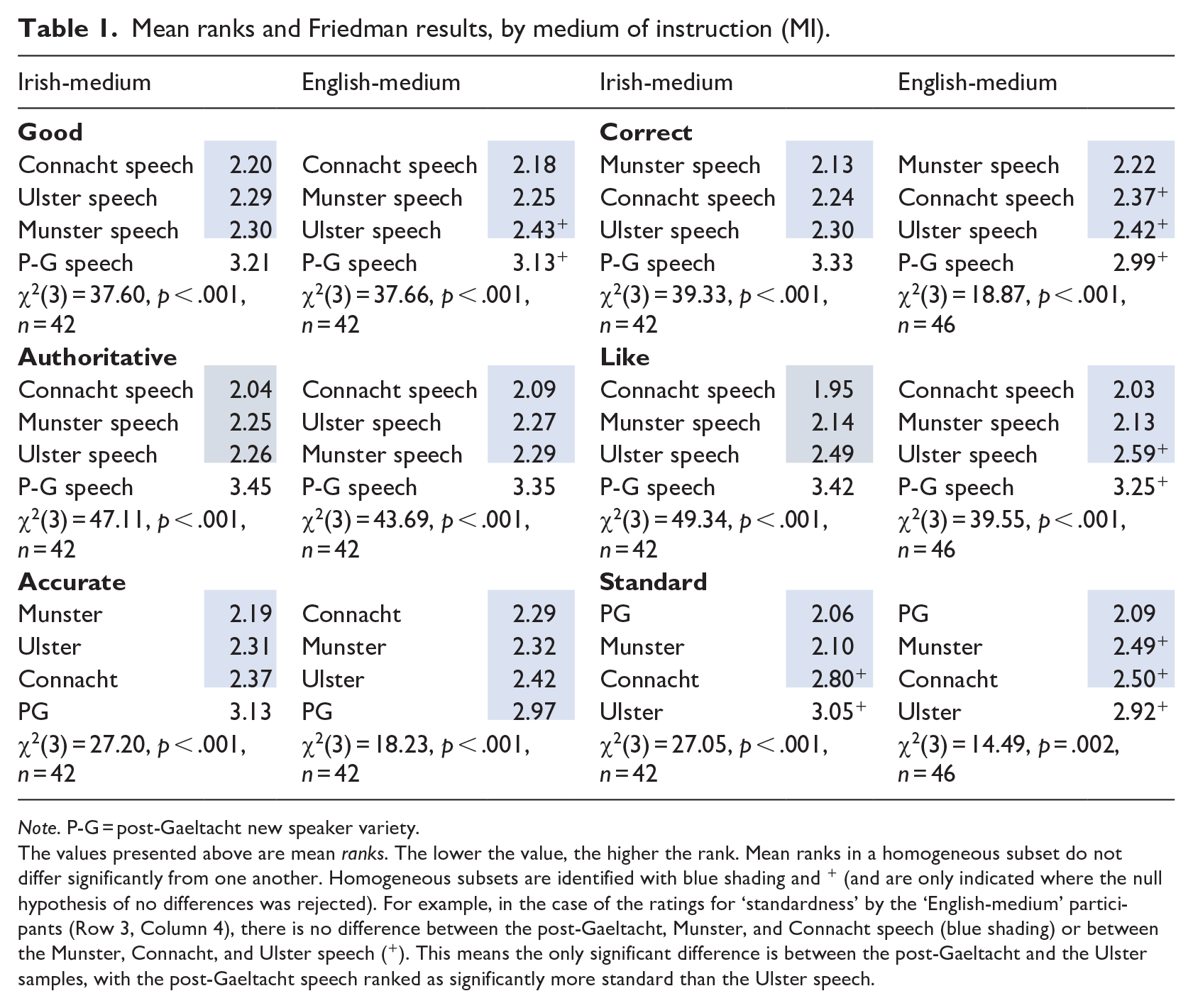
Table 1 presents participants’ responses according to whether participants teach in an IM or an EM setting. One could make two a priori predictions in relation to this analysis. On the one hand, it is plausible that participants who work in IM institutions would be more in line with the established ideology than those in EM schools, given that they deal with students and colleagues who likely already have high levels of proficiency in Irish and who may aspire to Gaeltacht norms and given that traditional ideologies on variation may often be reinforced within their schools. The same prediction would expect EM participants to be more concerned with grammatical accuracy and fluency over adherence to Gaeltacht norms because they deal with students whose Irish language proficiency may be less developed and because they may not often encounter dominant ideologies on variation in Irish within their professional settings; furthermore, there is no evidence that dominant language ideologies from English are at play. Alternatively, IM teachers could be more tolerant of non-traditional speech varieties as they are accustomed to regularly encountering students who typically demonstrate less traditional traits in their speech (e.g., Ó Duibhir, 2018), and EM teachers might be the more conservative ones as a result of a traditional curricular emphasis on Gaeltacht varieties.
Mean ranks and Friedman results, by medium of instruction (MI).
Note. P-G = post-Gaeltacht new speaker variety.
The values presented above are mean ranks. The lower the value, the higher the rank. Mean ranks in a homogeneous subset do not differ significantly from one another. Homogeneous subsets are identified with blue shading and + (and are only indicated where the null hypothesis of no differences was rejected). For example, in the case of the ratings for ‘standardness’ by the ‘English-medium’ participants (Row 3, Column 4), there is no difference between the post-Gaeltacht, Munster, and Connacht speech (blue shading) or between the Munster, Connacht, and Ulster speech (+). This means the only significant difference is between the post-Gaeltacht and the Ulster samples, with the post-Gaeltacht speech ranked as significantly more standard than the Ulster speech.
The results show that, overall, both groups are in line with traditional ideologies in many areas and are more often positive in their ratings of the traditional Gaeltacht varieties than the post-Gaeltacht new speaker variety. There are some notable differences, however. In line with the traditional ideology, IM teachers rated all three Gaeltacht varieties more positively than the post-Gaeltacht new speaker variety on all traits except for ‘standard’.
A somewhat different pattern emerges for the EM participants, however. For the traits ‘good’ and ‘like’, while the EM participants elevated the Munster and Connacht varieties above the new speaker variety, the Ulster variety is not rated significantly more positively than the new speaker variety on those traits. For ‘correct’, only the Munster variety is rated significantly more positively than the new speaker variety among EM participants. The difference between the responses of the IM and EM participants is most striking for ‘accurate’ where, although IM participants are again in line with the traditional ideology, there are no statistically significant differences between any of the varieties among the EM participants. Overall, stronger differences emerge among IM participants compared to EM participants, in that the latter appear to be more open to the post-Gaeltacht new speaker variety.
A notable exception here is for ‘authoritative’, where the EM participants are in line with the responses of the IM participants and with the traditional ideology, rating the three Gaeltacht varieties significantly more positively than the new speaker sample. This result suggests that while the new speaker variety can be considered as being on a par with at least some Gaeltacht varieties in terms of being good, accurate, correct, and liked, this is not the same as speaking an authoritative variety of Irish. It seems that ‘authority’ in Irish is still premised on Gaeltacht norms for the EM participants.
It is noteworthy that a different rating pattern is evident for the trait ‘standard’. The EM teachers perceive the new speaker sample to be significantly more standard than the Ulster sample, while the IM teachers perceive both the new speaker and the Munster samples to be significantly more standard than the Ulster sample. Irish does not have an official spoken standard, despite attempts to establish one in the 1980s. Nevertheless, post-Gaeltacht speech is associated with the written standard that was first published in 1958 and revised most recently in 2017. Although based on the traditional Gaeltacht dialects, the written standard is mostly a unitary variety comprising elements from all regional dialects. It is not the same as any of the Gaeltacht dialects and is seen as a synthetic variety. Given the prominent position of the standard in education, where it is the prescribed variety, there is a widespread view that post-Gaeltacht speech is heavily influenced by the standard. The perception of the post-Gaeltacht new speaker variety as standard is therefore not a surprising finding and has been discussed elsewhere (e.g., Flynn, 2020; Ó Murchadha, 2016).
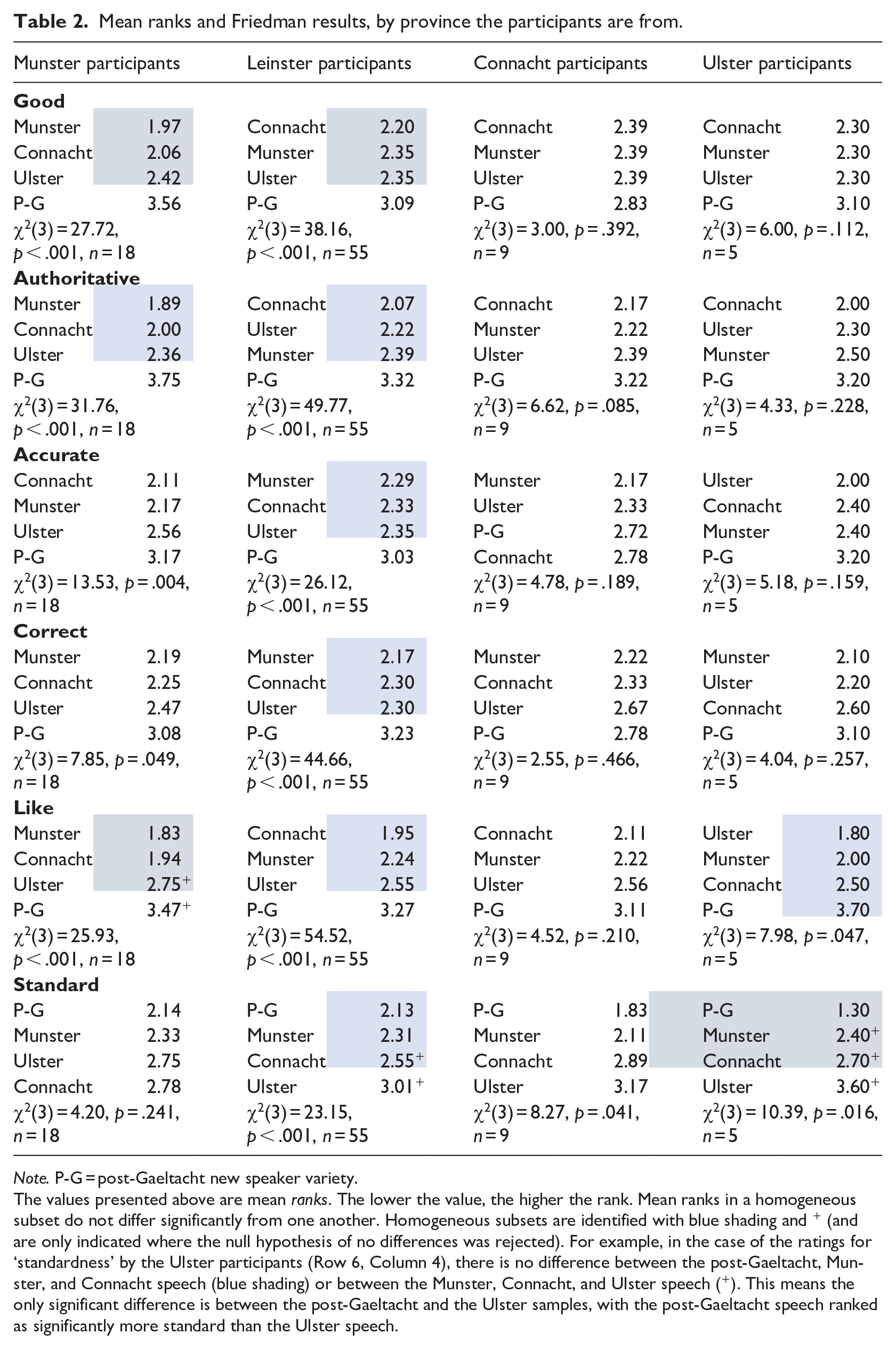
The results shown in Table 2 speak to whether the participants respond differently to the samples according to the province that they are from. Following Ó Baoill (1999), it might be expected that participants would display a degree of local loyalty and respond more positively to the Gaeltacht varieties from their own province than to varieties from other Gaeltacht areas or the post-Gaeltacht new speaker variety. Table 2 shows that participants originally from the provinces of Munster and Leinster rate the three Gaeltacht varieties statistically more positively on ‘good’ and ‘authoritative’. Furthermore, Leinster participants are significantly more positive about the Gaeltacht samples than the post-Gaeltacht new speaker variety for ‘correct’ and ‘accurate’. In the ratings for ‘like’, Munster participants are significantly more positively disposed towards the Munster and the Connacht varieties than the post-Gaeltacht sample, and Leinster participants elevate all three Gaeltacht varieties above the new speaker variety. Among Leinster participants, the post-Gaeltacht and the Munster samples are rated as significantly more standard than the Ulster sample. In contrast, there are no statistical differences among the Connacht participants for any of the traits, and the only statistically significant difference among Ulster participants is between the post-Gaeltacht new speaker variety and the Ulster variety.
Mean ranks and Friedman results, by province the participants are from.
Note. P-G = post-Gaeltacht new speaker variety.
The values presented above are mean ranks. The lower the value, the higher the rank. Mean ranks in a homogeneous subset do not differ significantly from one another. Homogeneous subsets are identified with blue shading and + (and are only indicated where the null hypothesis of no differences was rejected). For example, in the case of the ratings for ‘standardness’ by the Ulster participants (Row 6, Column 4), there is no difference between the post-Gaeltacht, Munster, and Connacht speech (blue shading) or between the Munster, Connacht, and Ulster speech (+). This means the only significant difference is between the post-Gaeltacht and the Ulster samples, with the post-Gaeltacht speech ranked as significantly more standard than the Ulster speech.
Importantly, while participants do significantly favour the traditional varieties over the new speaker variety on certain traits, participants do not differentiate between the traditional varieties themselves to a significant degree and in a systematic way. That is to say that participants from Munster, for example, do not show a clear preference for the Munster Gaeltacht variety in a way that is statistically significant. This is true for participants from all four provinces and for all traits. The participants, therefore, do not show the loyalty to their ‘home’ dialect that might be expected.
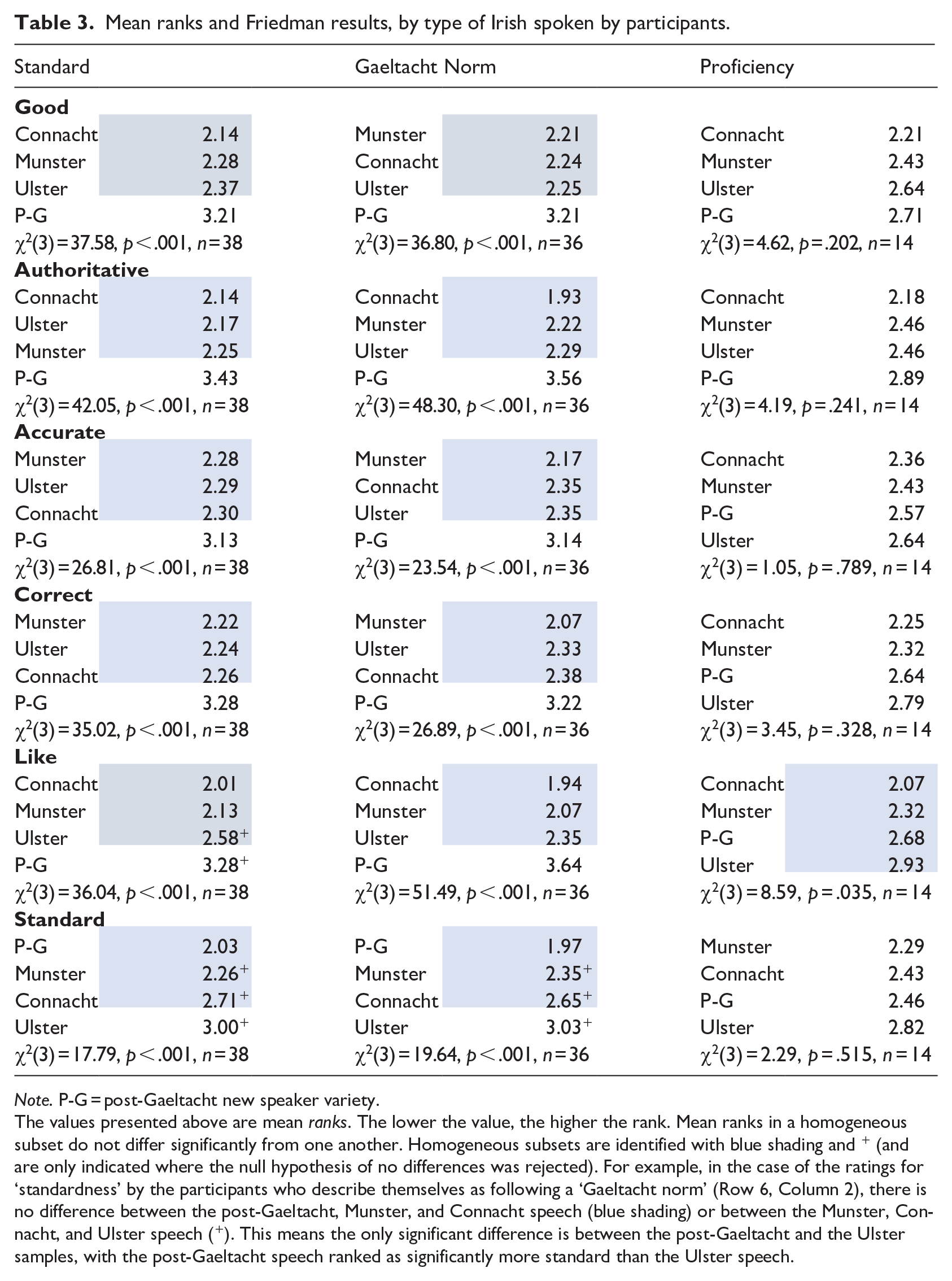
Table 3 presents participants’ responses according to the type of Irish that they identified themselves as having in a free response question. The table illustrates the extent to which participants respond differently to the samples according to the variety of Irish that they claim to speak themselves. There is evidence that at least some speakers of a non-traditional variety value these models and actively aim for them (e.g., Flynn, 2020; McKenzie, 2008). In addition, previous research with teachers of Irish (Ó Murchadha & Flynn, 2018a, 2018b) demonstrates that some NSTs see post-Gaeltacht speech as a legitimate target that is communicatively functional and identificationally meaningful. Therefore, it might be expected that participants in the present study who openly self-identify as speaking a non-Gaeltacht variety of Irish will be more positively disposed towards the post-Gaeltacht new speaker variety than those participants who report speaking Gaeltacht varieties of Irish.
Mean ranks and Friedman results, by type of Irish spoken by participants.
Note. P-G = post-Gaeltacht new speaker variety.
The values presented above are mean ranks. The lower the value, the higher the rank. Mean ranks in a homogeneous subset do not differ significantly from one another. Homogeneous subsets are identified with blue shading and + (and are only indicated where the null hypothesis of no differences was rejected). For example, in the case of the ratings for ‘standardness’ by the participants who describe themselves as following a ‘Gaeltacht norm’ (Row 6, Column 2), there is no difference between the post-Gaeltacht, Munster, and Connacht speech (blue shading) or between the Munster, Connacht, and Ulster speech (+). This means the only significant difference is between the post-Gaeltacht and the Ulster samples, with the post-Gaeltacht speech ranked as significantly more standard than the Ulster speech.
Based on their own descriptions of the Irish that they have, the participants are grouped using the labels ‘standard’, ‘Gaeltacht norm’, and ‘proficiency’, as per the columns in Table 3. ‘Standard’ includes those participants who report speaking a standard variety of Irish, but also those who say that they speak a non-native or a new speaker variety. ‘Gaeltacht’ includes those who say that their speech is aligned with any Gaeltacht norm, while the proficiency label refers to participants who describe their Irish not in terms of Gaeltacht versus non-Gaeltacht, but in terms of having high levels of proficiency, fluency, or accuracy in Irish.
As expected, the results show that participants who claim to speak a Gaeltacht variety of Irish upheld the established ideology in their ratings of the samples on all traits. They rate the three Gaeltacht varieties significantly more positively than the new speaker variety for all traits apart from standard (see above). Interestingly, however, participants grouped in the ‘standard’ category were also aligned with the established ideology in their responses in that they rated the three Gaeltacht varieties significantly more positively than the new speaker on ‘good’, ‘authoritative’, ‘accurate’, and ‘correct’. They also rated two of the Gaeltacht varieties, Munster and Connacht, significantly more positively than the new speaker sample for ‘like’. In stark contrast to the participants in the ‘Gaeltacht’ and ‘standard’ groupings, participants who describe their own Irish in terms of having high proficiency did not make a significant distinction between any of the varieties on any of the traits. While acknowledging that statistical power may be at play here, this result suggests that participants in the ‘proficiency’ subgroup are less aligned with the traditional ideology than the other two groups, and that they are more open to the post-Gaeltacht new speaker variety as a legitimate and even authoritative variety of Irish. The results presented above are discussed more fully and contextualised in the following section.
Discussion
As shown in the results presented above, there are some interesting interactions between participants’ ratings of the different speech varieties presented and aspects of their own profiles as NSTs of Irish. First, participants working in IM education are more closely aligned with established ideologies than their counterparts in English-medium institutions. While the former rate all Gaeltacht varieties significantly more positively than the new speaker variety on all scales apart from standard, the latter are more open in some instances and do not draw a systematic distinction between the Gaeltacht samples and the new speaker variety. The distinction between the two cohorts is most evident for ‘accurate’, where participants from EM backgrounds do not differentiate to a statistically significant extent between the new speaker variety and any of the Gaeltacht varieties. It is notable also, however, that the new speaker variety is on a par with one or more of the Gaeltacht samples in the responses for ‘good’, ‘correct’, and ‘like’.
Although the new speaker variety is not on a par with the Gaeltacht samples throughout, this finding is somewhat in line with one of the a priori predictions made above, that is, that IM participants would be more traditional in their ideologies than participants working in EM settings. The result can be interpreted as a function of differences in participants’ professional environments. Within this view, the tendency for EM participants to be more open to variation than their IM counterparts may be due to the fact that they are more likely to encounter schoolchildren and colleagues whose competence in Irish is more incipient or emergent, and for whom Gaeltacht norms may be seen as distant and irrelevant (Ó Murchadha & Flynn, 2018a). IM participants, however, deal with students and colleagues whose proficiency and fluency in Irish allow them to teach and learn through the medium of that language daily. In this context, teachers encounter Irish all around them, but they are likely to encounter many post-traditional types of Irish among students and colleagues, in line with what has been described in the literature (Maguire, 1991; Ó Duibhir, 2018). Regularly encountering post-traditional practices in Irish may lead to a hyperawareness among the IM teacher participants of a perceived ‘gap’ between traditional Gaeltacht speech practices and the types of Irish that are common among new speakers.
Furthermore, the difference in medium of instruction between EM and IM settings means that EM participants are unlikely to encounter ideologies of authority and authenticity in Irish to the extent that the IM participants do: in the classroom, in the corridors, in the school yard, and in the staff room. As a result, there may not be the same opportunities for the reinforcement of traditional ideologies on variation in Irish in the EM setting. Consequently, we see in the results that the EM participants present as somewhat more tolerant of variation and do not put Gaeltacht speech on a pedestal to the same extent as the IM participants. Regarding identity and speakerness, the results suggest that IM participants in this study are adherents of the established regime of language, that they have internalised that regime and are invested in it, despite their own position as new speakers of Irish. EM participants, on the other hand, do not seem to subscribe to the traditional model to the same extent and display a certain tolerance towards post-traditional speech practices in some of their responses.
Owing to the high prestige status of traditional Gaeltacht dialectal speech, it is noted that many learners and new speakers of Irish outside the Gaeltacht (are encouraged to) model their spoken Irish on the variety practised in a specific Gaeltacht area (Ó Baoill, 1999; Mac Mathúna, 2008). This tendency is attested in the literature (O’Rourke & Walsh, 2020). In the present study, it is shown that NSTs prefer these models. Ó Baoill (1999) goes further to postulate that learners of Irish are likely to display a degree of local loyalty and to orient towards the spoken norms of the Gaeltacht area(s) in their own province. However, as the results in Table 2 illustrate, this was not the case here.
Again, as in Table 1, the Gaeltacht varieties are differentiated from the new speaker variety in some instances. That Connacht and Ulster participants do not differentiate the Gaeltacht and new speaker samples goes against this trend, but this may be attributable to statistical power. Nevertheless, across the results, the sample representing participants’ local Gaeltacht variety is not distinguished from other Gaeltacht areas to a statistically significant degree. Although this result is somewhat surprising, in the case of ‘good’, ‘authoritative’, ‘accurate’, and ‘correct’ it can be explained with reference to the thoroughly pluralist, dialect ideology for Irish that has traditionally valorised Gaeltacht speech practices, mostly in equal measure (Ó Murchadha, 2016).
Nevertheless, it would not be expected for this ideology to shape responses relating to the varieties that participants like the most. To the extent that participants may orient towards the speech varieties from the Gaeltacht areas in their own province, this tendency is not strong enough for them to elevate that variety above those from other Gaeltacht areas. In this respect, the identity and speakerness of the NSTs in this study do not appear to be securely anchored in the speech practices of the Gaeltacht areas in their own province. Rather, the way that participants position themselves relative to varieties in the results above seems to be influenced by established ideologies. They are likely also shaped by participants’ journeys to new speakerness, including the influence of their own teachers and lecturers, the influence of possible family or personal connections to the Gaeltacht, their experience of speakers from different Gaeltacht areas, and their experiences as NSTs of Irish.
The results presented in Table 3 are perhaps the most insightful with respect to participants’ identity and speakerness. These results show a high degree of solidarity between participants describing themselves as speakers of standard, new speaker or non-native varieties of Irish (labelled as ‘standard’ above), and those who describe themselves as practising a Gaeltacht variety. There is a high degree of alignment between the results for these two groups, with all of the Gaeltacht varieties rated significantly more positively than the new speaker variety on all ratings apart from ‘standard’. Of course, it is not unexpected that new speakers who describe themselves as modelling their speech on a Gaeltacht norm would elevate Gaeltacht speech above new speaker speech. This result reflects these participants’ investment in and commitment to the established language ideological regime for Irish.
Somewhat surprisingly, however, participants who self-identify as speakers of ‘standard’ Irish also follow this pattern. They downgrade the variety of Irish seen as most standard while positioning themselves as speakers who fit this profile. While these NSTs do not themselves claim to practise a Gaeltacht variety of Irish, they appear to have internalised and naturalised the prestige status of Gaeltacht speech. They also appear to equate ‘standard’ with a less authentic or less prestigious variety of Irish. In rating the Gaeltacht varieties significantly more positively, the participants provide a commentary on their own Irish and suggest a certain dissatisfaction or insecurity with the variety of Irish that they practise. The result suggests that these participants see themselves as lacking the linguistic authenticity required to be considered an Irish speaker par excellence. Ultimately, the result suggests that these participants are uneasy about their own linguistic authority. As NSTs of Irish, they are committed to established ideologies and, along with participants who align with a Gaeltacht norm, they embrace the status quo as the natural order of things and use Gaeltacht language as the yardstick for what counts as best language in Irish, even though they acknowledge that this is not the type of Irish that they have.
For both the ‘Gaeltacht norms’ and the ‘standard’ participant subgroups, Gaeltacht norms loom large in their identity as NSTs of Irish. In contrast to those participants for whom the Gaeltacht is an important reference point, participants who describe themselves as having high levels of proficiency that are not associated with the Gaeltacht do not seem so preoccupied with Gaeltacht norms. It is striking that throughout all of the ratings, these participants do not differentiate between any of the samples presented to a statistically significant degree. In this sense, the participants go against the grain by not downgrading the post-Gaeltacht new speaker variety relative to any of the Gaeltacht samples. In this respect, these participants differ from their NST counterparts above who value Gaeltacht norms as a benchmark for linguistic correctness, authority, and legitimacy. These participants appear to be comfortable with a conceptualisation of linguistic correctness and authority in Irish that is not rooted in the Gaeltacht. Again, they resemble profiles of new speakers of Irish who are not concerned with Gaeltacht norms (Ó Murchadha & Flynn, 2018a; O’Rourke & Walsh, 2020). They are also in line with NSTs of Irish in previous qualitative research, who argue for the parallel correctness and legitimacy of post-Gaeltacht new speaker norms (Ó Murchadha & Flynn, 2018a, 2018b).
New speakers can represent a challenge to the sociolinguistic order (Ó Murchadha et al., 2018; McKenzie & Carrie, 2018), sometimes unsettling ideologies on what counts as best language (as also discussed earlier in this article and in the introduction to this special issue). However, the evidence presented above reveals that this is the case for only a small number of the NSTs who participated in this study. It must be acknowledged, however, that the research instruments used here do not allow participants to qualify their responses. We thus do not see the level of nuance that emerged in previous qualitative research, where many of the participants who held higher regard for the Gaeltacht varieties qualified their stance by stating that there are other legitimate targets and that approximating a Gaeltacht norm is more about decoration and not functionality, identity, and speakerness (Ó Murchadha & Flynn, 2018a, 2018b). Nonetheless, the results reported here show that: (1) NSTs of Irish teaching in EM settings tend to be slightly more open to variation than their IM counterparts; (2) that there is not a clear orientation towards the Gaeltacht variety in participants’ own province; and (3) that only participants who identity as having high levels of proficiency in Irish that is not associated with the Gaeltacht go against hierarchies of best language that are rooted in the Gaeltacht.
Conclusion
Overall, this article has emphasised that the negotiation of identity and speakerness occurs partly in relation to established ideologies on linguistic variation and that it is especially complex for NSTs in a minority language context. In such contexts, the teacher’s role can be about supporting traditional communities to maintain Irish as a vernacular language and upholding the prestige status of authentic, traditional language practices. At the same time, however, the teacher has a role in facilitating new speakers to participate in the language revitalisation enterprise and to do so on their own terms with language varieties that are meaningful to them. For some participants, their response to this dynamic is to align themselves with traditional language hierarchies, in the variety of Irish that they say they practise and/or in their ideologies. Yet, the response of others is to challenge established hierarchies, in the process arguing for the parallel correctness, legitimacy, and authority of post-traditional language practices. These stances can be explained with reference to participants’ profiles and backgrounds as NSTs of Irish. These results are to a great extent aligned with research in other minority language contexts where regard for language variation has been considered, particularly among new speakers of those languages. In many such cases, views of (new) speakers have been shown to challenge established ideologies in relation to traditional language models. This research also reveals that questions of identity and speakerness among NSTs are an area that is ripe for investigation across minority and majority sociolinguistic contexts. Engaging more thoroughly with these kinds of language users is important in establishing how new speakers of all profiles negotiate their identity and speakerness.
Footnotes
Declaration of conflicting interests
The author(s) declared no potential conflicts of interest with respect to the research, authorship, and/or publication of this article.
Funding
The author(s) disclosed receipt of the following financial support for the research, authorship, and/or publication of this article: This research was supported by funding from an Chomhairle um Oideachas Gaeltachta agus Gaelscolaíochta and the Irish Research Council’s New Foundations scheme.
Author biographies
 ). His research and teaching is focused on second language learning, language teacher training, minority language maintenance and revival, bilingualism and multilingualism.