




Abstract
Aims and Objects:
The Adaptive Control Hypothesis (ACH) proposed that different interactional contexts place different demands on cognitive processes for bilinguals. However, how cognitive control processes dynamically adapt to comprehending and producing languages in different interactional contexts is still poorly understood. This study investigated how different language interactional contexts (i.e., single-language, dual-language, and dense code-switching) modulate cognitive control in bilingual language comprehension.
Methodology:
Inhibitory control in 36 Chinese -English bilinguals was examined through flanker tasks. Participants’ language and cognitive control statuses in the three interactional contexts were manipulated through three different types of dialogue-listening. After they listened to each type of dialogue, they were instructed to complete the flanker task and answer 10 comprehension questions related to the dialogue.
Data and analysis:
Repeated-measures analysis of variance (ANOVA) compared participants’ reaction times and response accuracy in flanker tasks across the three interactional contexts. Similarly, their language comprehension performances across different interactional contexts were also compared.
Findings/conclusions:
Both the dual-language and Chinese single-language contexts showed significant facilitatory effects on participants’ inhibitory control efficiency. Furthermore, participants performed more accurately on answering comprehension questions in the Chinese single-language context, indicating the dominant language effects on modulating bilinguals’ language comprehension performance. Such effects were not found in the dense code-switching and dual-language contexts.
Originality:
This study provided empirical evidence for the facilitatory effects of dual-language contexts on cognitive control in bilingual language comprehension process, which further extends the ACH to bilingual’s cognitive process associated with language comprehension.
Significance/implications:
In general, it is an attempt to explore the associations between interactional contexts and cognitive control through bilingual language and cognitive processing manipulations.
Keywords
Introduction
When producing speech, bilinguals have to select words from the appropriate target language. Thus, they need to inhibit competing linguistic items from the non-target language, depending on the interactional context. While listening, bilinguals need to selectively comprehend meanings among competing interpretations according to the communicational goals (Price et al., 1999; Rodriguez-Fornells et al., 2006; Ye & Zhou, 2009). Such processes in bilingual communication are regarded as ‘language control’ (e.g., Jylkkä et al., 2018) and have been broadly claimed to be mediated by domain-general cognitive control, such as inhibition, attention, conflict monitoring and resolution (e.g., Green, 1998).
The hypothesis of bilingual advantages, positing that the constant managing and monitoring of more than one language in communication enhance bilinguals’ cognitive control beyond language domain, has led to heated discussions in recent decades. While some researchers argue in favour of bilingual advantages (e.g., Bialystok & Craik, 2010; Bialystok et al., 2012, 2014; Kerrigan et al., 2017; Prior & Macwhinney, 2010), other researchers are sceptical of the bilingual advantage hypothesis (e.g., Lehtonen et al., 2018; von Bastian et al., 2016). Although research has shown that bilinguals outperform monolinguals on a range of tasks beyond language domains (e.g., Bialystok, 2006), the results are difficult to replicate in many other studies (e.g., Paap & Greenberg, 2013; see van den Noort et al., 2019 for review). Such inconsistency questions the robustness of comparing bilinguals with monolingual peers and whether bilingual advantages really exist (e.g., de Bruin, 2019; Kałamała et al., 2020; Paap et al., 2015).
It is noticeable that participants included in a bilingual group in one study may not be regarded as bilinguals in another. Besides, bilingualism is not a categorical variable and what constitutes the experience of bilinguals and monolinguals has very fuzzy boundaries (Luk & Bialystok, 2013; Surrain & Luk, 2019). Individuals can develop as bilinguals in many ways based on their own experience in language use and learning, which may further have a distinct impact on both language and cognitive control (Beatty-Martínez et al., 2020; Pot et al., 2018).
In this vein, an increasing number of researchers (e.g., Beatty-Martínez & Dussias, 2017; Hartanto & Yang, 2016; Jylkkä et al., 2018; Lai & O’Brien, 2020; Soveri et al., 2011) have shifted their attention to within-group investigation to tease apart the effects of bilingualism from other confounding effects (Wu & Thierry, 2013), and explore how bilingual language experience interacts with language and cognitive control efficiency. The effects of different aspects of bilingual experience, such as L2 proficiency (e.g., Bonfieni et al., 2019; Pivneva et al., 2012; Singh & Kar, 2018), code-switching (e.g., Beatty-Martínez & Dussias, 2017; Hofweber et al., 2020a; Yim & Bialystok, 2012), and bilingual language use (e.g., Beatty-Martínez et al., 2020; Gullifer et al., 2018; Gullifer & Titone, 2020), on cognitive control have been explored in numerous relevant studies.
Noticeably, it is still unclear how different aspects of bilingual language experience modulate cognitive control. For example, the asymmetric switching costs during language switching in speech production reported in some studies (e.g., Costa & Santesteban, 2004; Filippi et al., 2014; Meuter & Allport, 1999) provided evidence for bilinguals’ active inhibition on the dominant language, and revealed the role of language proficiency in affecting inhibitory control efficiency.
However, the effect of language proficiency is quantified incompletely without referring to its interconnections with multifaceted factors in bilingual experience (de Bruin, 2019; Kałamała et al., 2021). To understand the interactions between bilingual code-switching and proficiency, and how such interactions modulate bilinguals’ inhibitory control, Kheder and Kaan (2021) explored the relationship between the bilinguals’ language experience with a measure of executive functions by using a commonly administered task in bilingual research, the Simon task. They found that bilinguals’ code-switching frequency and L2 proficiency were significant predictors of more efficient cognitive monitoring and inhibitory control. Specifically, high proficient frequent code-switchers had smaller Simon effects, showing significantly improved conflict adaption and inhibition efficiency. Their results suggested that the construct of proficiency and language use plays a significant role in cognitive control processes. Kałamała et al. (2021) further pointed out that measuring language proficiency as a uniform aspect of bilingual experience through self-reported assessment cannot fully capture the full picture of bilingual language competence; therefore, it is necessary to consider the interrelationships of more refined measures of bilingual proficiency and individual language experiences to understand how they modulate cognitive control.
Besides, other studies have provided inconsistent evidence on how bilinguals’ language switching experience interacts with their cognitive control performance (e.g., Jiao et al., 2019; Lai & O’Brien, 2020; Ooi et al., 2018; Struys et al., 2019). For instance, Ooi et al. (2018) reported that bilinguals’ intensive experience of dual-language context immersion enhanced their efficiency in suppressing nonverbal interference and conflict resolution. However, Struys et al. (2019) indicated that bilinguals’ higher levels of recent L2 exposure were associated with a more efficient switching from L1 to L2. Also, some studies (e.g., Hofweber et al., 2016; Kałamała et al., 2020) further provided different evidence on how bilingual language use patterns shape their cognitive control efficiency.
In a neuroimaging study, Kałamała et al. (2022) administered Polish-English bilinguals different language games involving natural language and collected ERP data, while they were performing inhibitory control tasks. Although the authors did not find any effects of language use patterns on inhibitory control in behavioural data, the ERP results showed different modulations of language use patterns on neural activations related to inhibitory control, providing direct evidence on the relationship between language use experience and inhibition.
In sum, a more ecologically valid manipulation and well-designed measures for bilingual habitual language use are needed to advance our knowledge of the relationship between a multilinguistic experience and cognitive skills. This study, therefore, investigated the effects of different types of interactional contexts in natural communication settings with the aim to measure how language use modulates cognitive control.
Cognitive control in bilingual language-processing
Following the inhibitory control model (ICM, Abutalebi & Green, 2007; Green, 1998), bilinguals have to inhibit their non-target language to facilitate the selection of linguistic items in the target language and ensure appropriate language use in given contexts or to specific interlocutors. Furthermore, ICM points out that as switching between languages interconnects to changes from the previous inhibitory status for a given communicative task, language switching takes time and has cognitive costs. Specifically, more cognitive demands and time are required to switch back into bilinguals’ L1 because more active lemmas in L1 were strongly inhibited before.
The claim of ICM is supported by evidence showing the association between improved cognitive control efficiency and proficient language switching performance (e.g., Declerck et al., 2017, 2021; Festman et al., 2010; Linck et al., 2012; Liu et al., 2019; Peeters & Dijkstra, 2018). For instance, Linck et al. (2012) pointed to a shared cognitive mechanism in verbal and nonverbal control through revealing that bilinguals’ smaller switching costs from weaker language to dominant language were related to their improved inhibitory control performance in a nonverbal Simon task. To understand the connection between language and cognitive control, Declerck et al. (2021) directly compared bilinguals’ ERP data in language switching and task switching. In line with the ICM, their results showed similar ERP patterns across language and nonverbal switching tasks, reflecting that language control is, to some extent, part of a domain-general cognitive control process.
When a speech listener is comprehending a sentence, meanings for each word or phrase are rapidly allocated in the syntactic unfolding order and the individual can make an early prediction of meanings at the sentence level. In some cases, such early meaning interpretations based on syntactic structure can lead to incompatible or erroneous comprehension of sentence meaning; therefore, cognitive control is hypothesised to be involved in language comprehension processes, facilitating linguistic conflict monitoring and resolution as well as revision of meaning interpretation (Novick et al., 2005; Teubner-Rhodes et al., 2016; Ye & Zhou, 2009).
Prior studies also reported the co-activation of linguistic resources from two languages during bilingual switch and non-switch speech comprehension. For example, Spivey and Marian (1999) tested Russian-English bilingual adults and English monolinguals using an auditory processing paradigm in which competing lexical items were presented. Competition from English lexical items was found in both monolingual and bilingual speakers. However, only the bilingual speakers also experienced competition from Russian, indicating cross-linguistic competition between two languages and, therefore, suggesting a parallel activation of both in speech comprehension.
Other studies (e.g., Cutler et al., 2006; Weber & Cutler, 2004) replicated Spivey and Marian’s findings even when participants processed non-native language without code-switching. Besides word comprehension, Hsu and Novick (2016) found that cross-linguistic competition occurs at sentence level. They also found that executive function plays a critical role in controlling interference from co-activated linguistic resources in sentence comprehension.
Although some studies (e.g., Bultena et al., 2015; Wang, 2015) argued that differences in cognitive control paradigms (top-down control vs bottom-up control) might be employed in code-switching production and comprehension, the involvement of cognitive control beyond language domain in bilingual language comprehension has been broadly examined and supported. Specifically, studies on both syntactic complex or ambiguous sentences (e.g., Hsu & Novick, 2016; Navarro-Torres et al., 2019; Teubner-Rhodes et al., 2019) and bilingual sentences with code-switches (e.g., Adler et al., 2020; Bosma & Pablos, 2020; Wang, 2015) indicated the role of cognitive control in facilitating successful comprehension.
The influence of individual differences like second language age of acquisition, proficiency and language usage has been also studied to investigate cross-linguistic activation and competition in language-processing (e.g., Blumenfeld & Marian, 2007, 2011; Canseco-Gonzalez et al 2010; Olson, 2017). Canseco-Gonzalez and colleagues (2010), for example, highlighted the roles of second language age of acquisition and language usage in modulating bilinguals’ language-processing. Specifically, the earlier a second language was acquired, the higher was the degree of lexical activation in this language. In addition, they found that bilinguals controlled their languages more efficiently as a function of language usage, that is, bilinguals performed significantly faster when matching the visual targets with their corresponding name presented auditorily in the monolingual mode than in the bilingual mode.
The current study further investigates the relationship between cognitive control and speech comprehension with particular focus on the bilingual participants’ language experience and how they use their languages in everyday life. We specifically address the question whether different interactional contexts interact dynamically with cognitive control in language comprehension. In this vein, this study intends to explore the bilinguals’ adaptive deployment of cognitive control in comprehending different patterns of bilingual dialogues, aiming to provide more evidence on the effects of bilingual experience-related factors and informing theory and practice.
Bilingual interactional contexts in language-processing and cognitive control
Grosjean and Miller (1994) and Grosjean (1998, 2012) argued that bilinguals can find themselves in various language modes along a monolingual-bilingual mode continuum, and their language control mechanism will change accordingly, depending on which language mode they are in.
According to Grosjean, bilinguals are in a monolingual mode when they are interacting with monolingual speakers. Therefore, they must use only one of their languages. In this mode, bilinguals have to deactivate and suppress the competition of the non-target language to produce monolingual utterances during communication. However, in the bilingual mode, bilingual speakers can use and mix both of languages to interact with other bilinguals who share the same repertoire in communications. Based on bilinguals’ interlocutors’ language use experience (e.g., frequent code-switching or not), bilinguals can also be in an intermediate mode, which is just between the two end points of the continuum. In this case, language switching frequency and the degree of language suppression in communications depend on situational factors and the language produced by their interlocutors. On this point, Green (2011) proposes that language switching in a variety of contexts can lead to different inhibitory control processes.
Wu and Thierry (2013) found that bilinguals performed with greater cognitive inhibition benefits in a mixed language context as compared with a single-language context through manipulating bilinguals’ language-processing contexts intermittently in a flanker task. It revealed the modulations of fast changing language contexts on bilinguals’ nonverbal inhibitory control performance.
The recent theoretical framework of the Adaptive Control Hypothesis (ACH, Green & Abutalebi, 2013) proposed three interactional contexts, (1) single-language, (2) dual-language and (3) dense code-switching. They suggested that language control networks will adaptively change according to the specific cognitive demands imposed in different contexts.
A single-language context indicates that two languages are used separately on two distinct occasions and no frequent code-switching between two languages is involved. For example, in a single-language context, bilinguals habitually use L2 at work and L1 at home. In the dual-language context, two languages are used on the same occasion. Bilingual speakers can switch intersententially (i.e., they can start a sentence in L1 and end it in L2).
The dense code-switching context indicates an interactional environment where more frequent and intensive switching across two languages occurs. Bilingual speakers in such a context routinely interleave their languages in the course of a single utterance or opportunistically adapt lexical items from two languages at the grammatical level. Therefore, highly intensive code-switching and lexical items from both L1 and English L2 within utterances can be observed among bilinguals’ speech in a dense code-switching context.
Noticeably, a dual-language context, as compared with the other contexts mentioned above, is hypothesised to impose the highest demands on both language and cognitive control. Specifically, bilinguals in this interactional context need to constantly detect salient cues (salient cue detection) in speech and selectively respond in the appropriate language by inhibiting the unintended one (interference control and selective response control). Besides the activation of goal maintenance, which supports bilinguals successfully using only one language consistently in communication, they need to realise efficient language switching in a dialogue relying on the activation of task engagement and disengagement processes. Therefore, the effects of a dual-language context on bilinguals’ language and cognitive control are strongly emphasised in ACH.
Supports of ACH showed positive effects of a dual-language context on facilitating bilinguals’ nonverbal cognitive shifting (Hartanto & Yang, 2016, 2020) and efficiency in interference control (Beatty-Martínez et al., 2020; Ooi et al., 2018; Pot et al., 2018). However, some studies provided inconsistent evidence to the ACH predictions. For example, besides bilinguals’ task-switching performance, Hartanto and Yang (2020) reported an association between a dense code-switching context and bilinguals’ enhanced ability in goal maintenance and interference control. In addition, Hofweber et al. (2016, 2020a) showed that bilinguals with intensive engagement in the dense code-switching contexts outperformed in high conflict monitoring required inhibitory control tasks, which also failed to fully support the facilitatory effects of dual-language contexts on bilinguals cognitive control predicted by the ACH; instead, they indicated the significant facilitatory effects of dense code-switching contexts on bilinguals’ proactive inhibitory control efficiency.
Majority of measures for bilingual language experience in prior studies were questionnaire-based, requiring bilinguals to self-report their relevant experience of language use in daily communications. A few studies provided a comprehensive characterisation of natural interactional contexts in which bilinguals habitually use their two languages, and carefully discussed its association with language proficiency and bilingual language use (Beatty-Martínez et al., 2020; Surrain & Luk, 2019). Even though increasing studies have realised the importance of characterising bilinguals’ natural language use context, it is challenging to find a more fine-scaled measure of bilinguals’ intensity of engagement in one specific interactional context. Moreover, the distinctions between the three interactional contexts addressed in the ACH might be ambiguous in a multilingual society. That is, there might be fluidity in bilinguals’ engagement in different interactional contexts as well as their selection of cognitive control strategies for language-processing throughout their long-term experience of bilingualism (Lai & O’Brien, 2020). Besides, some lab-based bilingual language-processing (e.g., exogenously cuing bilingual language switching) might not adequately reflect how bilinguals habitually perform in real-life interaction, leading to mismatched evidence with studies exploring bilingual language-processing in bilinguals’ actual communicative settings (Blanco-Elorrieta & Pylkkänen, 2017; Gardner-Chloros et al., 2013; Valdés Kroff et al., 2018). Therefore, how cognitive control in language-processing dynamically adapts to different interactional contexts still awaits further investigations. In this vein, this study induced bilinguals in three interactional contexts through different types of dialogue-listening to explore how different interactional contexts interact with their cognitive control performance.
The present study
The current study explored how bilinguals coordinate their cognitive control during language comprehension in three interactional contexts (i.e., single-language, dual-language, and dense code-switching contexts) by investigating a group of Chinese–English bilingual adults.
Two main questions were addressed in this study:
To what extent can different interactional contexts modulate inhibitory control processes in bilingual speakers?
How do different interactional contexts affect bilinguals’ speech comprehension performance?
It was predicted that participants manipulated in a dual-language context will perform better on both inhibitory control and dialogue comprehension tasks. As participants in the current study were all Chinese–English bilinguals with Chinese as their native language, it was also predicted that they will exhibit best performance in the single-language Chinese comprehension condition.
Method
The study met the requirements and gained the approval of the Ethics Committee of the Institute of Education, University College London, concerning empirical studies with human participants. Chinese–English bilinguals were recruited from university students in London. Only individuals residing in London at the time of the study and regularly using Chinese and English on daily basis were invited to join the study. The information sheet and consent form were provided to individuals who expressed an interest to this study so that they could decide whether to participate or not. No data were collected until participants signed an informed consent form. Prior to the experiment, the researcher briefly introduced participants the goals of the study and all consenting participants took part in the study as volunteers without remuneration.
Participants
Thirty-six (12 males, 24 females; age range 19–30 years) right-handed healthy Chinese–English bilinguals took part in this study. They were instructed to complete the language history and background information questionnaire (LHQ; Li et al., 2006), and a forward and backward digit span test (Hoosain, 1979) as well as Raven’s Advanced Progressive Matrices Set 1 (Raven et al., 1998) to understand their bilingual language experience and baseline cognitive skills. The LexTALE test (Lemhöfer & Broersma, 2012) was administered to objectively measure their English (L2) proficiency.
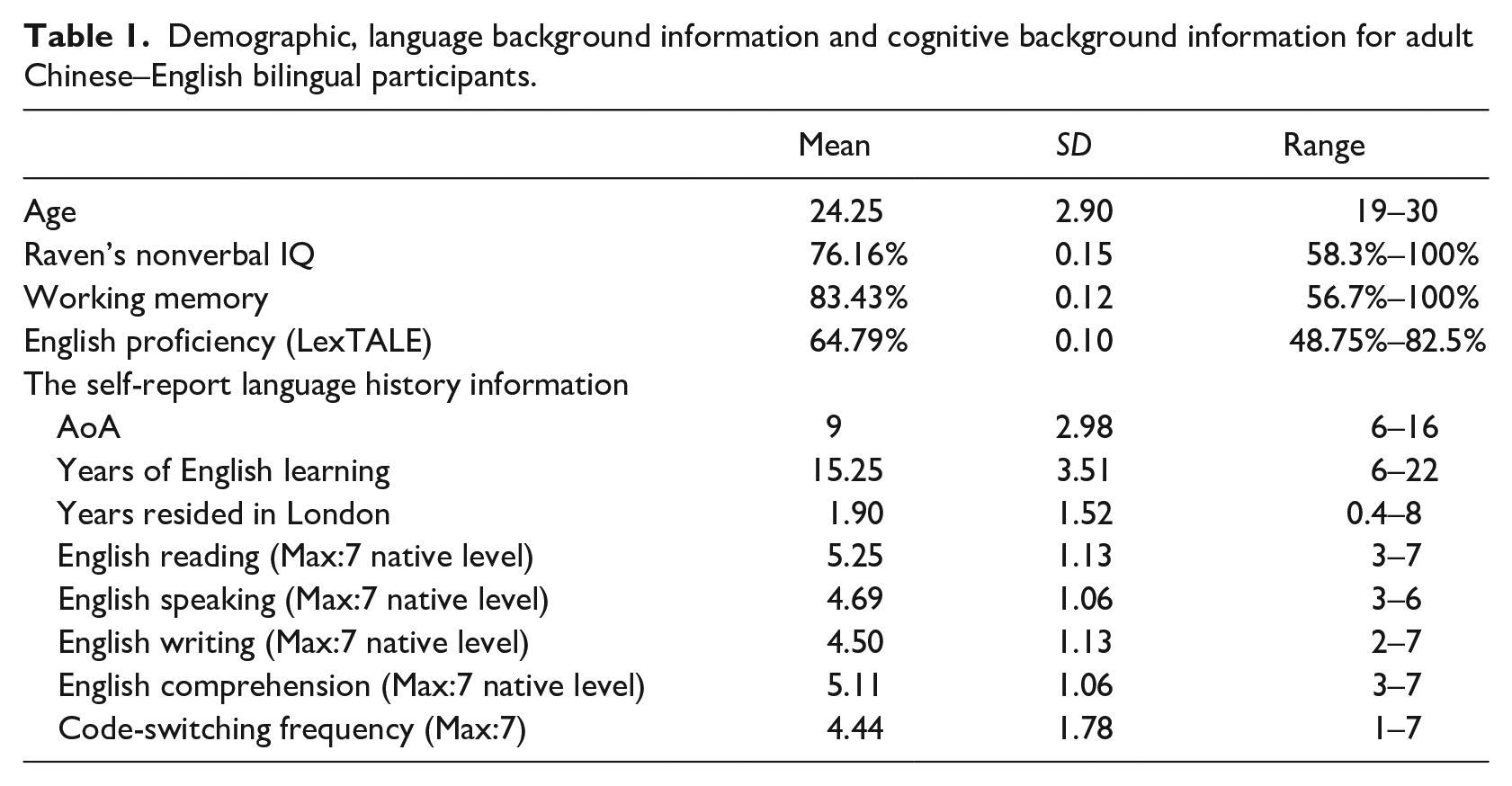
All participants are Chinese Mandarin native speakers, raised in Chinese Mandarin-speaking families. At the time of this study, participants had resided in London for 1.90 years on average. They all reported the use of both languages regularly on daily basis. They also frequently engaged in code-switching practices in daily communications (Mean code-switching frequency = 4.44), although they habitually code-switched based on sociolinguistic cues, like using English in classroom with English-speaking partners but switched to speak in Chinese at home settings or with Chinese interlocutor. Table 1 shows information on participants’ bilingual language use experience and language proficiency. Besides, they all learned English as a second language in mainstream school classroom settings after Chinese was well acquired, and reported that English and Chinese were used together as instruction languages in their English classes (average English usage: 39.43%; average Chinese usage: 60.57%), indicating that they had considerable experience of switching or translation between the two languages during English learning.
Demographic, language background information and cognitive background information for adult Chinese–English bilingual participants.
Materials, design and study procedure
Dialogue-listening materials for interactional context manipulation
Four 3-minute dialogues, in the forms of Chinese only, English only, Chinese–English dual-language, and dense code-switching, were created as listening materials to manipulate participants’ language and cognitive processing statuses in the three interactional contexts referred to in the ACH. Chinese and English word frequency in each dialogue was also calculated through the index of word frequency per million and Zipf value based on the free online linguistic corpora: SUBTLEXus corpus (Brysbaert & New, 2009) and SUBTLEXch corpus (Cai & Brysbaert, 2010). The word frequency summary in each dialogue is given in Appendix 1. The different code-switching patterns involved in bilingual dialogues were designed by adopting the classifications of code-switching proposed by Muysken (2000). In a dual-language dialogue, Chinese and English are used alternately at clause/sentence level without mixing in a single sentence. However, sentences in a dense code-switching dialogue involved the joint activation of linguistic resources from both Chinese and English at the grammatical and lexical levels. Two languages intensively switched back and forth, and their lexical items densely mixed in one sentence. A dialogue with Chinese and English intersentential switching was used for the dual-language context manipulation, while a dense code-switching dialogue was used for manipulating participants in a dense code-switching context (for examples of dialogue materials, see Appendix 2).
Ten dialogue comprehension questions were asked orally by the researcher after participants listened the dialogue and completed the flanker task. These comprehension questions were designed to compare participants’ language comprehension performance after the manipulation of the interactional contexts, that is, to explore how well they comprehend dialogues conveyed monolingually and bilingually with different code-switching involved. To keep the consistency of interactional context manipulation, the questions in each session were formed in the same linguistic structure as in the dialogue. For instance, questions in the English monolingual dialogue session were asked in English, and questions in the Chinese and English dense code-switching dialogue were asked in both languages. The questions in the dual-language context were asked in either Chinese or English; specifically, alternatively asking five questions in Chinese and five in English.
Correct answers were marked for ‘perfect match’, that is, the participants directly matched the answer with the same word presented in the dialogue. If participants used a different word/expression but indicated the same meaning with what was used in the dialogue, their answers were also marked as correct. The total number of participants’ correct answers for comprehension questions in each session were calculated and compared. Examples for dialogue comprehension questions are presented in Appendix 2.
Two native English speakers and two proficient Chinese–English bilingual speakers recorded dialogues for this study, and recordings were presented as daily conversations between a female and a male.
Flanker task
A simplified flanker task (Fan et al., 2002) with 50:50 congruent and incongruent trials was used to test participants’ inhibitory control performance. In this task, an array of five direction-pointing stimuli presented at the centre of the screen. Participants were instructed to respond as quickly and accurately to indicate the direction of the central visual stimulus (target) by pressing the corresponding key while ignoring other surrounding stimuli (flankers). When the target points left, participants have to press ‘Q’ on the keyboard, while it points right, immediate pressing of ‘P’ is required (for the stimuli used in flanker task, see Appendix 3). The task embedded in each dialogue-listening session contains 40 congruent (i.e., flankers point in the same direction as the target) and 40 incongruent (i.e., flankers point in the opposite direction to the target) trials. Each trial began with a fixation cross for 500 ms, followed by an array of visual stimuli for 1500 ms. A short practice session (four trials) was administered before the formal task to make sure participants fully understood the instructions.
Study procedure
Visual and audio stimuli in this study were presented using the E-Prime 2.0 software (Psychology Software Tools, Pittsburgh, PA). Dialogue-listening materials were recorded through Microsoft recorder and stored in mp3. format. Auditory stimuli were presented to participants through a headphone. All participants completed this study on the same equipment in a sound-proof room.
After completing the language history questionnaire and baseline cognitive skills measures, participants were instructed to perform a baseline flanker task initially. Then, they were invited to the dialogue-listening sessions, in which they had to complete a flanker task immediately after listening to a 3-minute dialogue. On completing the flanker task, they had to orally answer 10 comprehension questions related to the dialogue asked by the researcher. The four dialogue-listening sessions were counterbalanced across participants. Figure 1 is an illustration of the study procedure.
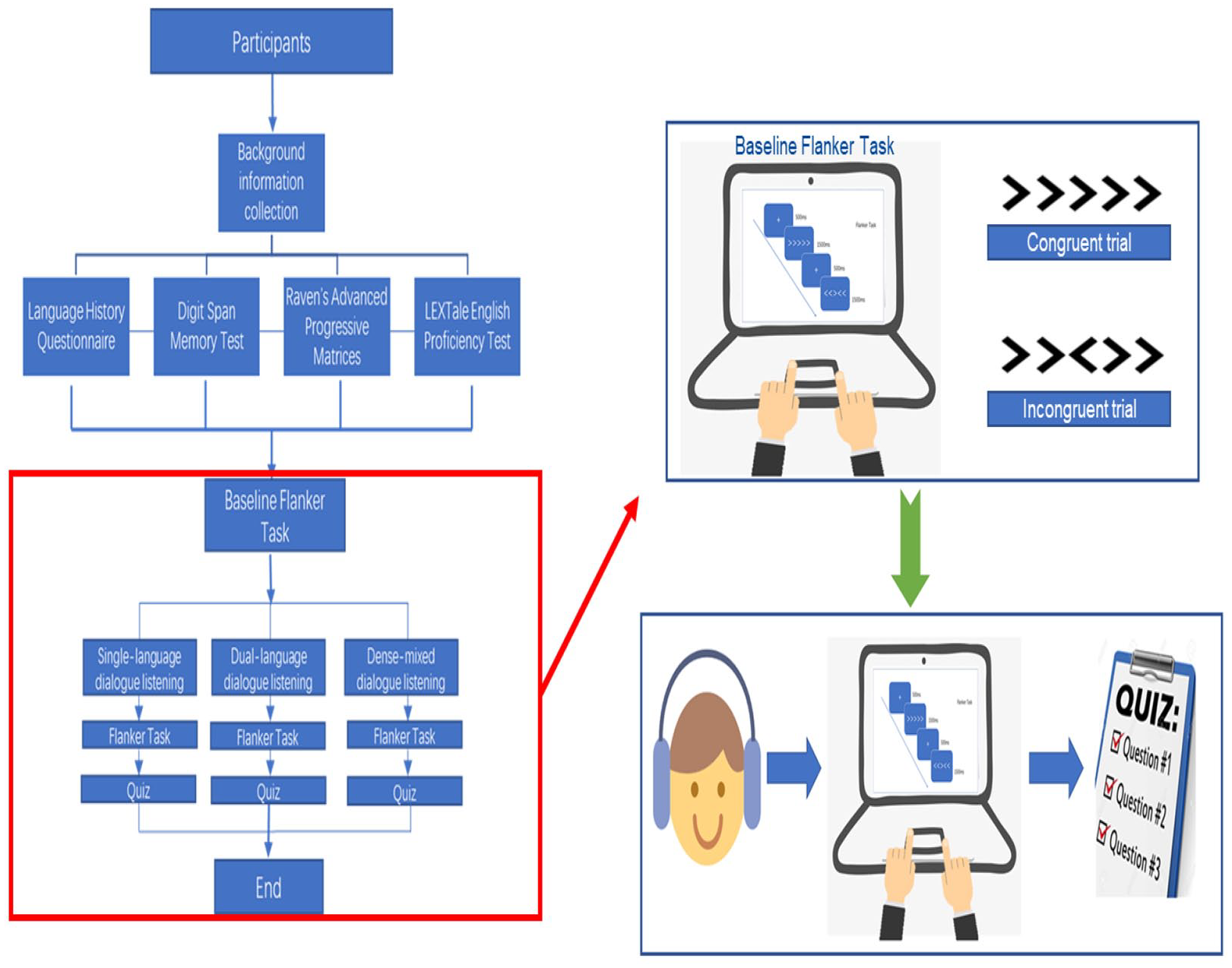
Illustration of the experimental procedure.
Results
Participants’ performance in flanker tasks and comprehension questions were presented in the following parts. Paired sample t-tests and repeated-measures ANOVA were carried out with JASP (JASP Team, 2020, version 0.14.1) to analyse the differences in participants’ performance in flanker tasks across different dialogue-listening sessions.
Results for baseline flanker task
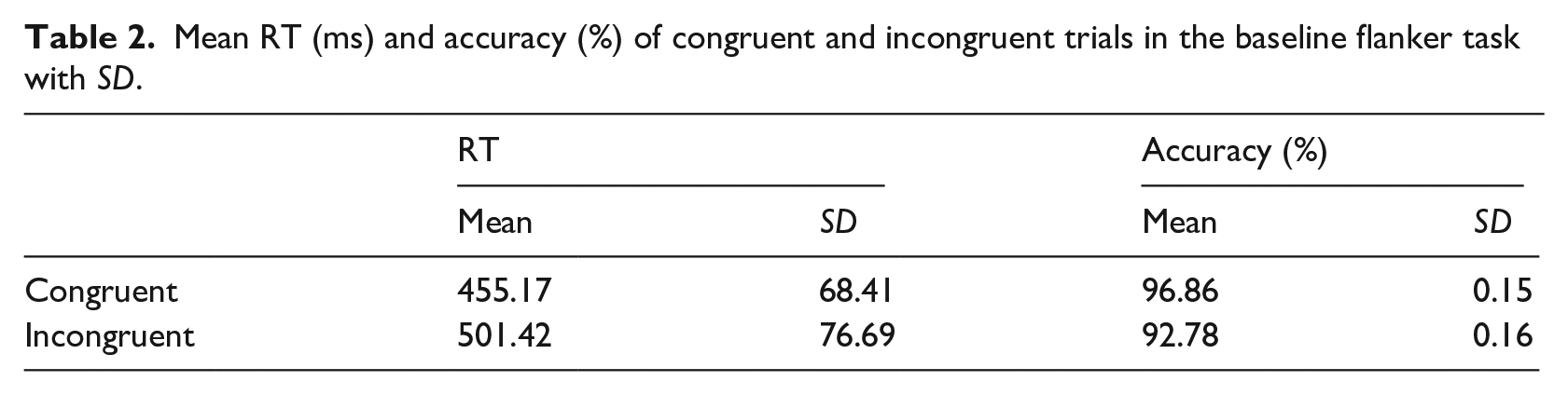
A paired-sample t-test was conducted to compare reaction time (RT) in congruent and incongruent conditions, and there was a significant difference in the RT for congruent (Mean = 455.17, SD = 68.41) and incongruent (Mean = 501.42, SD = 76.69) conditions; t(35) = −9.51, p < .001, r = −.62, Cohen’s d = −1.59, displaying a typical flanker interference effect (Eriksen & Eriksen, 1974). Besides, participants’ response accuracy for congruent trials was significantly higher than incongruent trials, t(35) = 4.65, p < .001, r = .36, Cohen’s d = 0.78. Table 2 and Figure 2 illustrate the typical flanker interference effect in participants’ baseline flanker task performance.
Mean RT (ms) and accuracy (%) of congruent and incongruent trials in the baseline flanker task with SD.
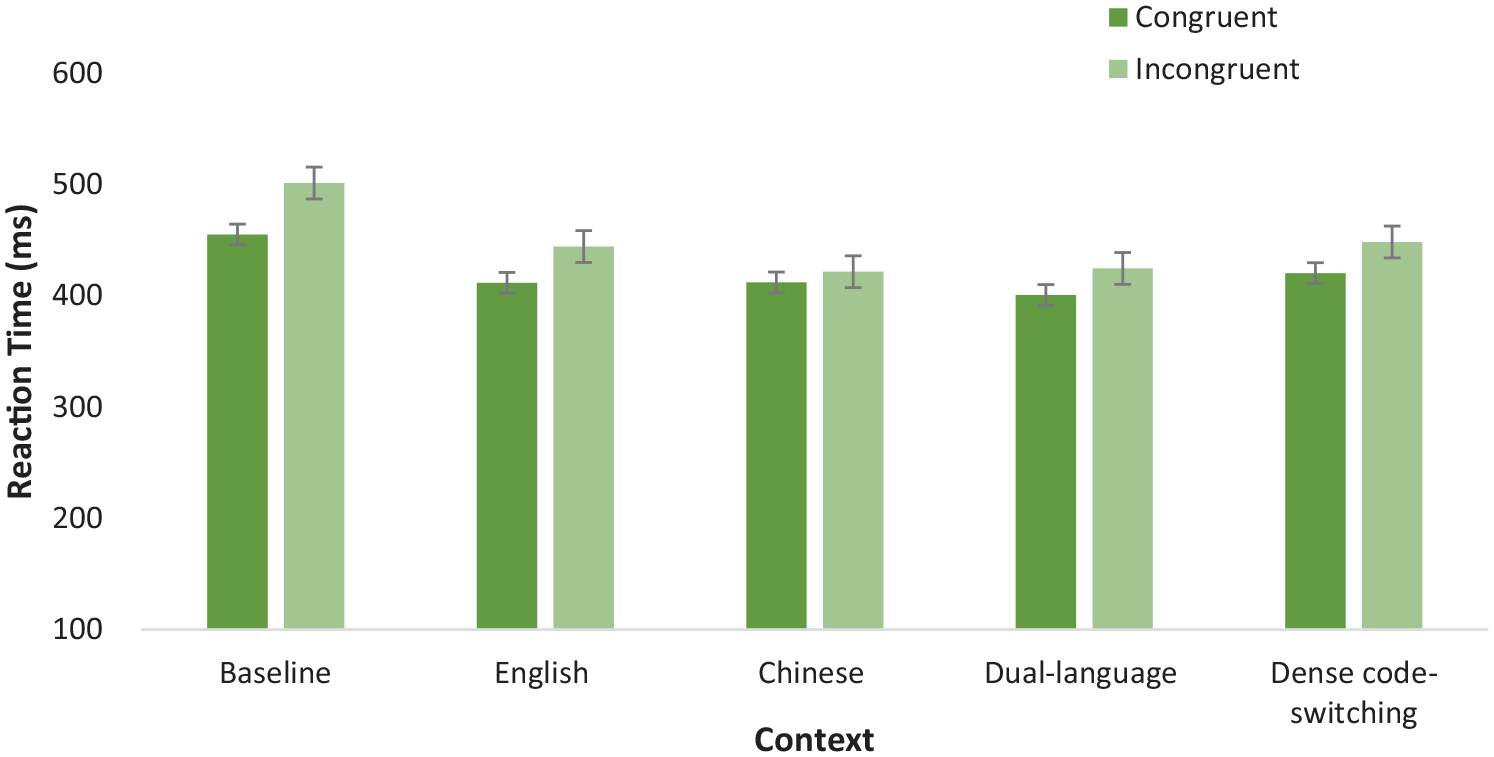
Participants’ flanker task RTs (ms) and standard errors in different language contexts.
Flanker task performance in different interactional contexts
Participants’ flanker task performance in different interactional contexts were analysed through the repeated-measures ANOVA. Table 3 shows participants’ mean RTs and response accuracy in flanker tasks after being manipulated in the single-language, English–Chinese dual-language and dense code-switching contexts.
Mean RT (ms) and accuracy (%) of congruent and incongruent trials in the flanker tasks in the three interactional contexts.
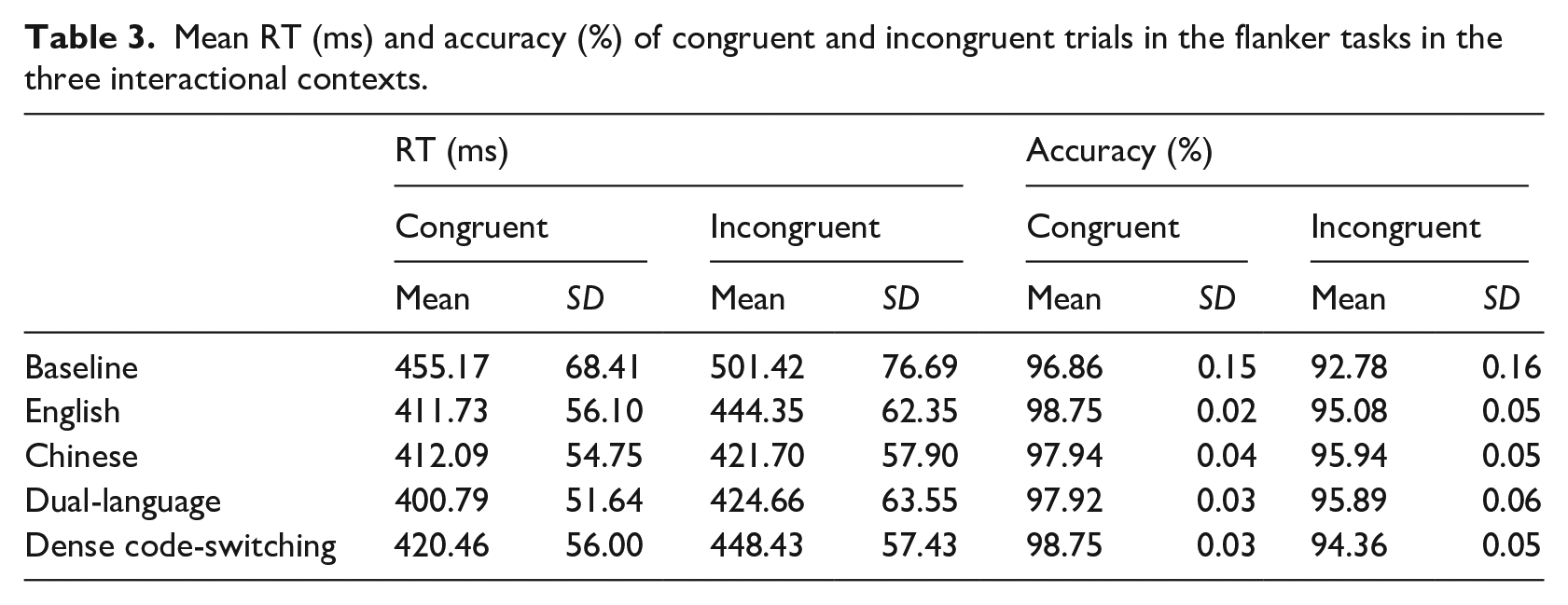
A main effect of congruency on participants’ RTs across different contexts was found, F(1, 35) = 171.79, p < .001, partial η² = .83. It indicated that participants, in general, performed longer RTs for incongruent than congruent trials (see Figure 2).
Besides, participants’ RTs varied significantly across different interactional contexts, F(1.98, 69.29) = 29.51, p < .001, partial η² = .46. Specifically, participants’ RTs for both congruent and incongruent trials in different interactional contexts, as compared with their baseline RTs, were significantly improved.
In addition, there was also an interactive effect of context × congruency on participants’ RTs, F(3.67, 128.42) = 14.80, p < .001, partial η² = .30. As for incongruent RTs, participants performed significantly faster in the Chinese single-language context than in the English single-language (t = 2.90, Cohen’s d = 0.48, p = .04) and dense code-switching contexts (t = −3.42, Cohen’s d = −0.57, p = .01). No significant differences in RTs were found between Chinese single-language and dual-language contexts.
The results further showed that participants’ incongruent RTs in the dual-language context were significantly reduced as compared with the dense code-switching context (t = −3.04, Cohen’s d = −0.51, p = .03). Similarly, RTs for congruent trials in the dual-language context were also smaller than in the dense code-switching context (t = 2.97, Cohen’s d = −0.50, p = .04).
It seemed that cognitive demands, even in language comprehension processes, also varied across different interactional contexts, leading to different degree of modulation of cognitive control. The findings revealed the facilitatory effects of interactional contexts on participants’ RTs in the flanker task, in particular, supporting the study hypothesis on the significant effects of both dominant language and dual-language contexts on domain-general inhibitory control modulation.
Response accuracy in flanker tasks across different sessions was also analysed. Although a main effect of context on participants’ response accuracy, F(1.11, 38.68) = 0.60, p = .46, partial η² = .02, was not found, the typical flanker interference effect in response accuracy was revealed. In general, participants performed more accurately for congruent than incongruent trials, F(1, 35) = 53.70, p < .001, partial η² = .61.
The analysis further revealed that participants’ response accuracy for both congruent trials, F(1.13, 39.65) = 0.45, p = .53, partial η² = .01, and incongruent trials, F(1.29, 45.28) = 1.02, p = .34, partial η²= .03, did not vary significantly across the baseline and four different language contexts. Figure 3 shows the response accuracy for flanker tasks across different contexts.
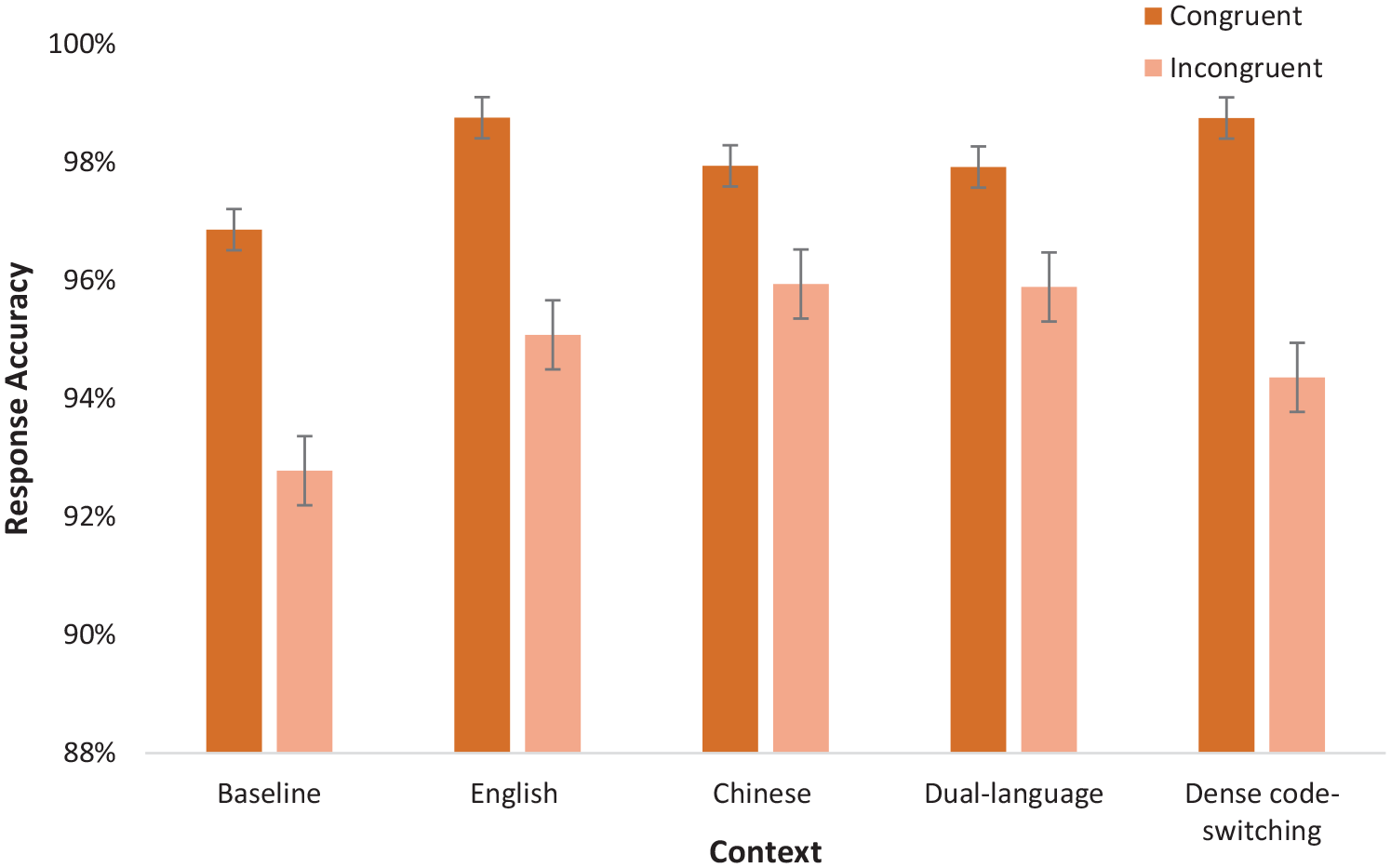
Comparisons of mean response accuracy and standard error in flanker tasks across different interactional contexts.
Language comprehension performance in different language contexts
Participants’ performance in answering comprehension questions after the flanker task in each interactional context was analysed through the one-way ANOVA. Table 4 summarises participants’ language comprehension performance in three interactional contexts.
Participants’ response accuracy in comprehension questions in different language contexts.
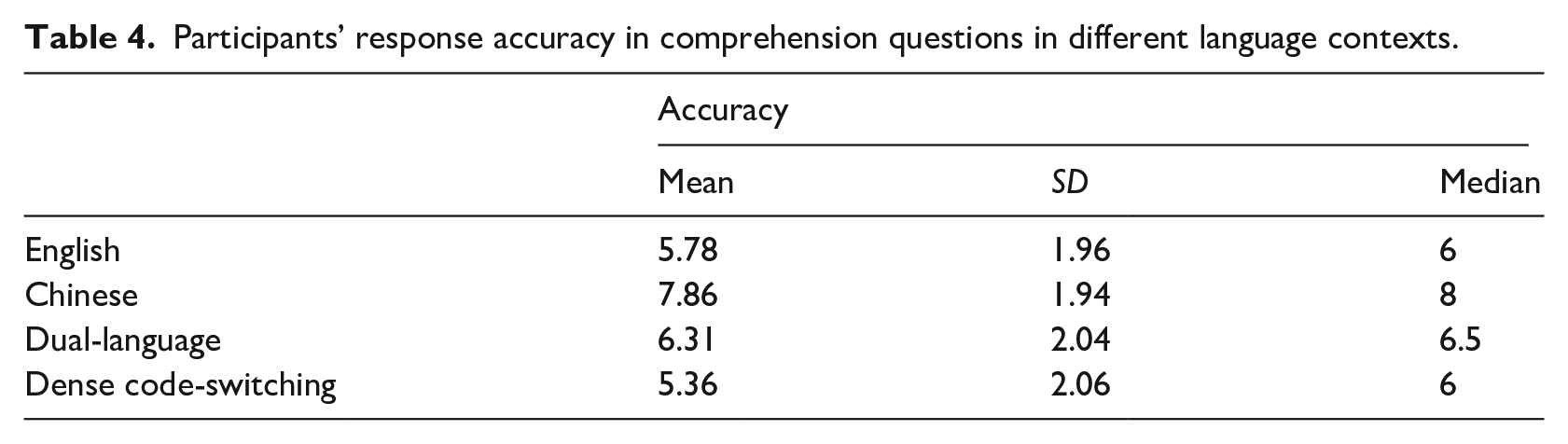
In general, participants’ response accuracy for comprehension questions was significantly different across contexts, F(3, 140) = 11.54, p < .001, partial η²= .198. Specifically, participants performed more accurately in answering comprehension questions in the Chinese single-language context as compared with the English single-language (t = 4.58, Cohen’s d = 1.15, p < .001), dual-language (t = 3.42, Cohen’s d = 0.84, p = .01) and dense code-switching (t = 5.49, Cohen’s d = 1.34, p < .001) contexts; however, no significant differences in their response accuracy across rest of the three interactional contexts. In line with the study hypothesis, bilinguals’ dominant language context significantly modulated their language comprehension performance.
Discussion and conclusion
This study examined the impacts of different interactional contexts on the cognitive control underlying bilingual language-processing. As bilingual language-processing requires efficiently managing co-activated languages while inhibiting the non-target linguistic items, resulting in modulation of bilinguals’ ability in cognitive control (Grant et al., 2015; Linck et al., 2012), the dual-language context, with greater demands on bilingual language management, was predicted to enhance bilinguals’ cognitive control efficiency. Furthermore, considering the effects of dominant language proficiency on bilingual language-processing, this study predicted that bilinguals would outperform in language comprehension in the Chinese single-language context. As expected, the results supported the connection between language-processing context and adaptive changes to cognitive control mechanisms, showing the facilitatory effects of processing languages in the dual-language on domain-general inhibitory control. Specifically, participants’ flanker task performance in the dual-language context was significantly improved. However, bilinguals in L2 single-language and dense code-switching contexts did not show significant improvement in their RTs in flanker tasks.
Bilinguals’ better performance on both RTs in congruent and incongruent trials in a dual-language context suggested that in such a context was possible to boost not only inhibition, but also cognitive monitoring. This finding is plausible, given that cognitive inhibitory process interconnects with active conflict monitoring process (Botvinick et al., 2001; Hofweber et al., 2020b); besides, it supported the prediction of ACH on the effects of dual-language contexts on bilinguals’ cognitive control performance. According to the ACH (Green & Abutalebi, 2013), bilinguals adaptively select control strategies to deal with varying cognitive demands in different interactional contexts. For instance, a dual-language context requires constant exercising of bilinguals’ cognitive control through frequent selective inhibition of non-targeted ones over co-activated languages and intensive engagement and disengagement in two languages, leading to bilinguals’ enhanced efficiency in cognitive control. The carry-over effects of the dual-language context on bilinguals’ flanker task performance provided evidence for the interaction between language-processing context and non-linguistic cognitive control (Wu & Thierry, 2013). In particular, it indicated how control strategies adapt to cognitive demands posed by different types of interactional contexts and bilingual utterances in language comprehension processes. Furthermore, it supported the greater effectiveness of nonverbal conflict monitoring and resolution attributed to language-processing in mixed language speech contexts, in which processing information conflicts boosted cognitive control to engage in similar cognitive operations (Adler et al., 2020; Botvinick et al., 1999). That is, as language comprehenders need to be prepared to deal with any code-switching, which may occur in utterances and resolve cross-linguistic conflicts efficiently, constant practice in processing languages in mixed language contexts boosted their efficiency in conflict monitoring and resolution in both verbal and nonverbal tasks.
In addition, the study showed the facilitatory effects of Chinese single-language context on bilinguals’ inhibitory control efficiency. Participants showed significantly improved RTs in incongruent trials in the Chinese single-language context, as compared with other contexts. Both this finding and results of Hofweber et al. (2020b), suggested that a single-language mode improved bilinguals’ inhibitory control. However, in contrast, L1-dominant bilinguals in their study were reported to have enhanced inhibitory control performance in the L2 single-language mode. Such contrasting results may be attributed to the bilinguals’ habitual language use patterns. As mentioned before, the majority of participants in this study were university students in London, who routinely used English as their working language in the classroom (e.g., writing assignments, reading, searching online and discussions). Although they consistently reported to use Chinese and English regularly on a daily basis, they had relatively intensive experience of language switching based on contextual cues and using their L2 in the English dominant language environment. Therefore, processing languages in the Chinese monolingual context, in fact, was a rare experience for them. Perhaps, their routinely high frequency of L2 usage and immersion increased cognitive demands on controlling linguistic interferences from L2 during L1 processing. The increased inhibition demands on L2 suppression in the L1 single-language context carried over to the participants’ performance in the immediately-following flanker task, which further facilitated their nonverbal inhibitory control performance. Therefore, these participants showed higher efficiency in inhibitory control in the Chinese single-language context due to heightened inhibition level required to control L2 interferences in the manipulated L1 single-language context.
Consistent with the study hypothesis, the study also revealed that bilinguals performed better in answering comprehension questions in the Chinese single-language context, reflecting the modulation effects of dominant language on bilinguals’ language comprehension performance. In general, these findings were in line with Bonfieni et al. (2019) that language dominance, uniting the proficiency of language and other relative bilingual experience (e.g., dominant language use context), facilitates both bilinguals’ language and cognitive control processes.
However, language dominance is a complex construct interplaying with multifaceted factors in linguistics, sociolinguistics, and psycholinguistics (Lanza, 2004; Treffers-Daller, 2019). The two dimensions, language proficiency (i.e., what bilinguals can speak and use in communications) and language use (i.e., how bilinguals habitually use their languages), are broadly measured and discussed in previous studies to quantifying bilingual participants’ language dominance status (e.g., Anthony & Blumenfeld, 2019; Luk & Bialystok, 2013; Nicoladis et al., 2018; Treffers-Daller, 2019; Treffers-Daller & Silva-Corvalán, 2016). In this current study, the participants’ proficiency and usage of their two languages are discussed as key components in the construct of language dominance.
Importantly, this study stressed the role of bilinguals’ language use patterns in shaping their domain-general cognitive control performance. As this sample of Chinese–English bilinguals had intensive immersion in L2 environment and frequent practices of English usage on daily basis, suppressing and controlling linguistic competition from L2 in the L1 single-language context were relatively challenging for them, even if Chinese was their native language. Their enhanced inhibitory control efficiency in the Chinese single-language context not only reflected the facilitatory effects of single-language contexts on cognitive control, but indicated the interplays between bilinguals’ language use patterns and the magnitude of cognitive inhibition required in their language control. Given that various factors related to bilingualism experience are mutually involved to define language dominance (e.g., Gullifer et al., 2021; Mueller Gathercole et al., 2010; Treffers-Daller & Silva-Corvalán, 2016), how to operationalise and capture the full picture of this complex construct still awaits standard and valid measures.
Furthermore, this study suggested that processing bilingual utterances involved experience-based linguistic skills; specifically, those bilinguals with intensive exposure to a code-switching environment might require less cognitive control efforts to integrate code-switching into comprehension (Adler et al., 2020; Gross et al., 2019).
Taken together, this study provided empirical evidence for the ACH (Green & Abutalebi, 2013) from the perspective of language comprehension, suggesting that single-language, dual-language, and dense code-switching contexts modulate language control processes by adaptively changing the level of inhibitory demands. Critically, it emphasised the complexity of language dominance, and highlighted the impacts of language use patterns in the construct of language dominance on bilinguals’ language and cognitive control processes. More studies focussing on bilinguals’ language use in natural communications should be carried out in future to better understand the consequences of bilingualism on domain-general cognitive control.
Footnotes
Appendix 1
SUBTLEX resources provide frequencies of words based on television and film subtitles to better approximate to everyday language exposure, and this corpus has a better language register than corpora related to written sources for psycholinguistic research. The SUBTLEXus contains 74,286 word forms with frequency values calculated from a 52 million-word corpus of subtitles from 8,388 American films and television series broadcast between 1990 and 2007 (Brysbaert & New, 2009, p. 87). The SUBTLEXch corpus is based on 6,243 different language contexts (7,148 subtitle files) from movies and television series (Cai & Brysbaert, 2010). Table 5 shows word frequency and Zipf values for Chinese and English words used in the four dialogues, which were calculated based on the aforementioned two online linguistic corpora.
Appendix 2
Appendix 3
In this study, direction-pointing stimuli involved in each flanker task constantly change across different interactional contexts to avoid participant fatigue. These direction-pointing stimuli are displayed in Figure 4.
Acknowledgements
Many thanks to all participants who took part in the study and enabled this research to be possible.
Declaration of conflicting interests
The author(s) declared no potential conflicts of interest with respect to the research, authorship, and/or publication of this article.
Funding
The author(s) received no financial support for the research, authorship, and/or publication of this article.
