




Abstract
Aims and Objectives/Purpose/Research Questions:
Recent research suggests that cognitive control plays a role in code-switching, both in bilingual adults and in bilingual children. Code-switching would only require cognitive control, however, when speakers maintain some degree of separation between their two languages, not when they completely mix the lexicons and grammars of their languages. For Frisian–Dutch bilinguals, mixing of Dutch (majority language) into Frisian (minority language) is common, but mixing of Frisian into Dutch is not. Therefore, Frisian–Dutch bilinguals need to maintain some degree of language separation when they speak Dutch, but not when they speak Frisian, predicting that code-switching from Dutch to Frisian would affect cognitive control more than vice versa.
Design/Methodology/Approach:
Frisian–Dutch bilingual children aged 5 and 6 (n = 104) completed a Flanker task. Information about frequency of code-switching from Dutch to Frisian and frequency of code-switching from Frisian to Dutch was obtained through a parental questionnaire.
Data and Analysis:
Multiple hierarchical regression analyses showed that frequency of code-switching from Dutch to Frisian significantly predicted performance on a Flanker task, but that frequency of code-switching from Frisian to Dutch did not.
Findings/Conclusions:
The results suggests that code-switching from Dutch to Frisian requires more cognitive control than code-switching from Frisian to Dutch.
Originality:
This is the first study that shows a code-switching asymmetry in the context of a minority–majority language pair.
Significance/Implications:
The study supports the hypothesis that code-switching requires more cognitive control when a bilingual speaker has to maintain some degree of language separation between her or his two languages.
Introduction
In many bilingual communities, code-switching is common practice. Broadly speaking, code-switching is the ability of a bilingual to alternate effortlessly between two languages (Bullock & Toribio, 2009). In bilingual adults, code-switching is not a lack of fluency in either language, but rather a sign of bilingual competence: balanced bilinguals switch more frequently than non-balanced bilinguals (Poplack, 1980; Yow & Li, 2015). Recent research in psycholinguistics, however, suggests that code-switching is not without cognitive effort. Several experimental studies with adults have shown that the management of two highly co-activated language systems during code-switching requires cognitive control, a cognitive function that involves the inhibition of interference from task-irrelevant cues (Adler, Valdés Kroff, & Novick, under review; Verreyt, Woumans, Vandelanotte, Szmalec, & Duyck, 2016; Wu & Thierry, 2013).
In a group of Dutch–French bilingual adults, Verreyt et al. (2016) found that the more often participants reported to engage in code-switching, the better they performed on tasks that measure cognitive control. Wu and Thierry (2013) showed that English–Welsh bilinguals performed better on a cognitive control task when they were intermittently presented with words in both English and Welsh than when they were intermittently presented with words in only Welsh or only English. In line with this, Adler and colleagues (under review) found that Spanish–English bilinguals performed better on a cognitive control task when they were intermittently presented with code-switched sentences. Furthermore, they found that detecting a code-switch in a sentence reading task assisted subsequent conflict resolution. Taken together, these studies strongly suggest that code-switching in bilingual adults involves the engagement of cognitive control mechanisms.
Code-switching in bilingual children
For bilingual children it may depend on their age how code-switching relates to bilingual competence. From a very young age, bilingual children are capable of differentiating their two languages (De Houwer, 1990; Meisel, 1990) and using them in accordance with sociolinguistic and pragmatic principles (Köppe, 1996; Lanza, 1992). Still, almost all children go through a stage in which they mix their two languages frequently (Deuchar & Quay, 2000; Köppe, 1996; Lanza, 1992; Meisel, 1994). As early mixing mainly consists of inserting elements from the dominant into the weaker language (Bernardini & Schlyter, 2004; Deuchar & Quay, 2000; Eichler, 2011; Lanza, 1992, 1997; Nicoladis & Secco, 2000; Petersen, 1988; Ribot & Hoff, 2014), this mixing is probably due to limited bilingual proficiency (Genesee, 1989; Meisel, 1994). 1
Between the ages of 2 and 3, when children acquire more lexical and grammatical knowledge, frequency of mixing decreases. With more linguistic resources at their disposal, children no longer need to borrow between languages (Genesee, 1989). Then, after the age of 3, language mixing increases again in some, but not all children (Meisel, 1994). As this mixing is voluntary and grammatically and pragmatically constrained, it is argued that children’s mixing in this stage is already very similar to code-switching in bilingual adults (Cantone, 2007; Meisel, 1994; Paradis, Nicoladis, & Genesee, 2000). Indeed, a recent study suggests that by the time bilingual children are 5 or 6 years old, their code-switching behaviour is, just like code-switching in bilingual adults, a sign of bilingual competence: the number of code-switched utterances that English–Mandarin bilingual children of this age produced was positively correlated with their lexical and grammatical knowledge (Yow, Tan, & Flynn, 2017).
If it is indeed the case that code-switching in bilingual children is similar to code-switching in bilingual adults, we would expect the psycholinguistic aspects of children’s code-switching to be adult-like as well. A recent study suggests that cognitive control also plays a role in code-switching in bilingual children (Gross & Kaushanskaya, 2015). On a picture-naming task that allowed voluntary language switching, Gross and Kaushanskaya (2015) found significant switching costs across both languages in a group of 5- to 7-year-old English–Spanish bilingual children. This means that when children were allowed to name pictures in either language, naming latencies were longer when children switched to the other language than when they stayed in the same language. Furthermore, a comparison with an English and a Spanish picture naming task that did not allow language switching showed significant mixing costs in the children’s dominant language, but no significant mixing costs in their non-dominant language. This means that for the dominant language, naming latencies were longer when children were allowed to use either language than when they were allowed to use only one language. These results suggest that voluntary language switching in bilingual children is subject to cognitive control processes that slow down lexical access and that children inhibit their dominant language to allow for switches into the non-dominant language, a mechanism that has also been found in bilingual adults (Gollan & Ferreira, 2009). Even though children’s linguistic and cognitive skills are still developing, it thus appears that code-switching in bilingual children involves the same cognitive control mechanisms as code-switching in bilingual adults.
Code-switching in different interactional contexts
As there are different types of code-switching, it could be the case that some types of code-switching require more cognitive control than others (Verreyt et al., 2016). Not only could language dominance play a role (Gollan & Ferreira, 2009; Gross & Kaushanskaya, 2015), but also the interactional context, that is, the community context of language use (Green & Wei, 2014). In order to understand why this would be the case, we need to take a closer look at the production of speech in general and the production of different types of code-switches in particular.
Speech production requires some anticipation of future content. Upcoming words and phrases are activated in parallel, but must be articulated in the correct serial order. To achieve this serial order, only items that are contextually most appropriate enter the planning layer. In the planning layer, the most active items are successively selected for production (Green & Wei, 2014). In bilinguals, phonological representations from both languages are activated and are thus competing for selection into the planning layer (e.g. Blumenfeld & Marian, 2013; Dijkstra, Miwa, Brummelhuis, Sappelli, & Baayen, 2010).
Green and Wei (2014) argue that bilingual access to the planning layer is controlled in ways that reflect the interactional context, which can be more or less tolerant with respect to code-switching. In interactional contexts where code-switching is inappropriate, there is a competitive relationship between the two languages: one language dominates to the exclusion of the other and a competitive control mode makes sure that only items from the target language enter the planning layer. The demand for cognitive control in these single-language contexts, however, is thought to be relatively low, because the degree of activation of the non-target language is lower than in code-switching contexts. In a context where code-switching is appropriate, there is a cooperative relationship between the two languages: items from both languages can enter the planning layer.
Two types of qualitatively different control modes are distinguished for contexts that involve code-switching: an open control mode, where there is no target language and items from both languages can thus freely enter the planning layer; and a coupled control mode, in which code-switches are planned in advance by changing the target language and passing control from one language schema to the other (Green & Wei, 2014). As only this second type of code-switching requires a top-down control mechanism that manages the two competing language schemas, this is the type of code-switching that is argued to practice cognitive control (Hofweber, Marinis, & Treffers-Daller, 2016). Interestingly, Green and Wei (2014) argue that for their theory on code-switching and cognitive control, it does not matter why bilingual speakers code-switch. Even when code-switching is used to fill gaps in linguistic knowledge, bilinguals are thought to practice cognitive control, because also in these cases control passes from one language schema to the other (Green & Wei, 2014).
The open control mode is argued to be used in dense code-switching contexts, where bilingual speakers completely mix the lexicons and grammars of their two languages. The coupled control mode, in contrast, is argued to be used in code-switching contexts where bilinguals still maintain some degree of separation between their two languages. This is for example the case when bilingual speakers alternate between structurally independent stretches of two languages within a conversational turn (alternational code-switching) or when they insert lexical items from one language into the grammar of the other (insertional code-switching) (Green & Wei, 2014; Hofweber et al., 2016).
One factor that has so far not been taken into account, however, is a potential asymmetry between switching from language A to language B versus switching from language B to language A. Such an asymmetry can be encountered in the context of a minority–majority language pair. A majority language is a language that is used by the majority of the inhabitants of a given country, whereas a minority language is a language that is spoken by a non-dominant group, who wish to maintain their own linguistic, and usually also cultural, identity (Hogan-Brun & Wolff, 2003).
Code-switching in a minority–majority context
In a situation with a minority and a majority language, the minority language often provides the morphosyntactic frame into which lexical elements from the majority language get inserted. In a study on code-switching within the noun phrase, for example, most determiners were found to be from the minority language (Welsh in the UK; Spanish in Miami; Papiamento in the Netherlands), whereas most inserted lexical elements were from the majority language (English in the UK; English in Miami; Dutch in the Netherlands) This shows that switches tend to be towards the language with superior social status (Parafita Couto & Gullberg, 2017). This asymmetry is also observed in the Frisian–Dutch bilingual context (Breuker, 2001), which is the focus of the current study.
Frisian is a regional minority language that is spoken in the Dutch province of Fryslân, where it has official status next to the national majority language Dutch. Outside of the Netherlands, Frisian is known as ‘West Frisian’ to avoid confusion with the Frisian languages spoken in Germany. In this article, whenever the term ‘Frisian’ is used, it refers to the West Frisian language spoken in the Netherlands. Although Frisian is predominantly used in informal domains and is much stronger in rural than in urban areas (Breuker, 2001), it still has quite a strong position in the province. In the last language survey of the province of Fryslân, more than half of the population of Fryslân reported to speak Frisian as a mother tongue (55.3%) (Provinsje Fryslân, 2015).
Frisian and Dutch are two closely related West Germanic languages and all speakers of Frisian also speak Dutch. In the literature on code-switching, the Frisian–Dutch bilingual case is mentioned as a typical example of dense code-switching (Green & Wei, 2014; Muysken, 2000). As a result of extensive language contact, interference from Dutch is visible in all subsystems of the Frisian language: in the lexicon, the morphology, the syntax and even the phonology (Breuker, 2001; De Haan, 1997). For speakers of Frisian it is common practice to incorporate Dutch elements into their Frisian and they often completely mix the lexicons and grammars of Frisian and Dutch. It must be noted, that the opposite is not true: not all speakers of Dutch also speak Frisian and when Frisian–Dutch bilinguals speak Dutch, the use of Frisian elements is limited (Breuker, 2001). Although more specific information about the frequency of different types of code-switching in the Frisian–Dutch bilingual context is not available, it can be inferred that mixing of Dutch into Frisian is common, whereas mixing of Frisian into Dutch is not. This suggests that Frisian–Dutch bilingual speakers use an open control mode when they speak Frisian and a coupled control mode when they speak Dutch, leading to the prediction that code-switching from Dutch to Frisian requires more cognitive control than code-switching from Frisian to Dutch.
In the current study, we investigated this hypothesis in a group of 5- and 6-year-old Frisian–Dutch bilingual children by examining to what extent the frequency with which these children code-switch from Dutch to Frisian and vice versa is related to cognitive control. As previous studies have shown that children’s switching behaviour may also be related to bilingual proficiency and language dominance (Gross & Kaushanskaya, 2015; Ribot & Hoff, 2014; Yow et al., 2017), we also took into account lexical and grammatical competence in both languages.
Method
Participants
For this study, data from 105 5- and 6-year-old Frisian–Dutch bilingual children were analysed. Participants were selected from 14 different schools in the countryside of the Dutch province of Fryslân. All children had at least one parent who spoke Frisian to them from birth and since Dutch is the dominant language in society and in schools, all children also learned Dutch. All children had started learning Dutch by the age of four at the latest, since this is the age when children in the Netherlands go to school. Table 1 provides an overview of the children’s age, socioeconomic status (SES), nonverbal intelligence quotient (IQ) and intensity of exposure to Frisian at home at time of testing.
Descriptive statistics of the participants (n = 105).
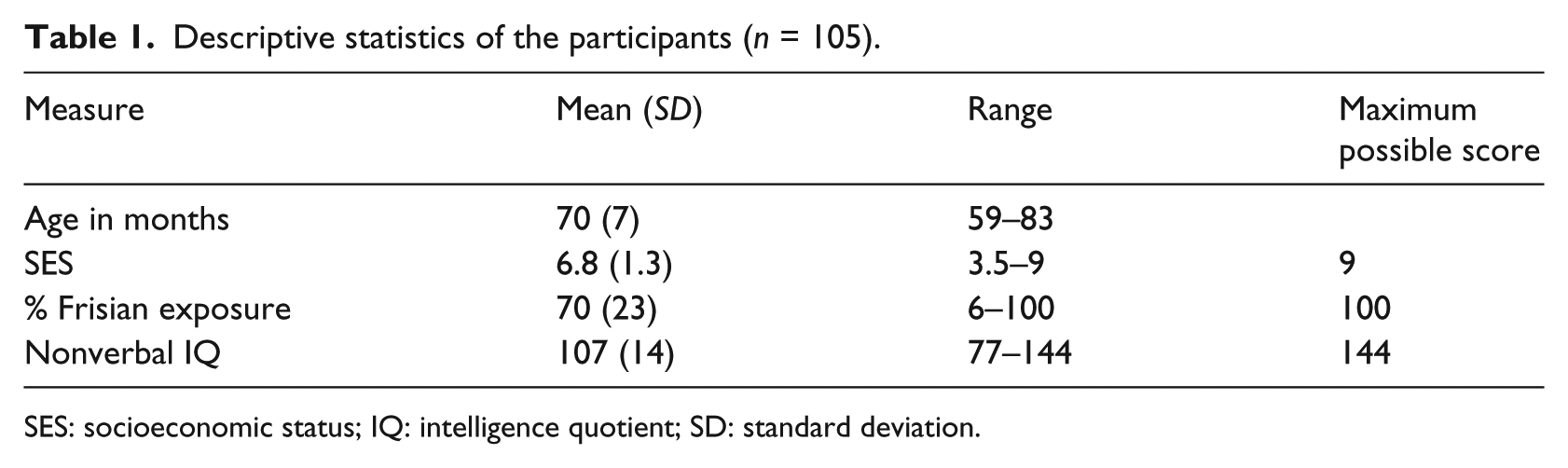
SES: socioeconomic status; IQ: intelligence quotient; SD: standard deviation.
Nonverbal IQ-scores were obtained by means of the subsets Matrices and Recognition of the Wechsler Nonverbal Scale of Ability (Wechsler & Naglieri, 2006). Information about age, SES and exposure was obtained through a parental questionnaire, based on the Questionnaire for Parents of Bilingual Children (Tuller, 2015). SES was defined as the average educational level of the parents on a 9-point scale, ranging from ‘no education’ to a ‘university degree’, thus capturing the Dutch educational system in a fine-grained manner. Intensity of exposure to Frisian at home was measured as the mean percentage of Frisian input the child received from her/his mother, father, siblings and other adults who looked after the child at least once per week. For each of these people the question had to be answered how often (s)he spoke Frisian to the child: ‘never’ (0%), ‘seldom’ (25%), ‘sometimes’ (50%), ‘usually’ (75%), and ‘always’ (100%). Intensity of exposure to Dutch at home was 100% minus intensity of exposure to Frisian at home. As age (Best, Miller, & Jones, 2009), SES (Morton & Harper, 2007) and non-verbal IQ (Arffa, 2007; but see Ardila, Pineda, & Rosselli, 2000) have been shown to be related to cognitive functioning, we included these as control variables.
Vocabulary and morphology scores in both languages were also taken into account as control variables, as previous research has shown that language proficiency may be related to both cognitive control (Bohlmann, Maier, & Palacios, 2015) and code-switching behaviour (Gross & Kaushanskaya, 2015; Yow et al., 2017). As expected, the children were quite proficient in both Dutch and Frisian, as revealed by their scores on Dutch and Frisian vocabulary (Peabody Picture Vocabulary Test-III-NL (PPVT-III-NL), Schlichting, 2005; Frisian adaptation, Bosma, Blom, Hoekstra, & Versloot, 2016) and Dutch and Frisian morphology (Taaltoets Alle Kinderen; Verhoeven & Vermeer, 2002; Frisian adaptation, Blom & Bosma, 2016), presented in Table 2. Two paired sample t-tests showed that there were no significant differences between the Dutch and Frisian vocabulary scores, t(104) = 1.26, p = 0.21, nor between the Dutch and Frisian grammar scores, t(104) = 1.63, p = 0.11, demonstrating that as a group, the children did not have a dominant language. It could, however, be the case that some children were more dominant in Frisian, whereas other children were more dominant in Dutch. This is important to take into account, because the relationship between code-switching and cognitive control may not only be influenced by the interactional context (Green & Wei, 2014), but also by individual differences in language dominance (Gross & Kaushanskaya, 2015). Therefore, we determined the dominant language of each child. First, we calculated percentage scores of the vocabulary and morphology tasks and then we created a language proficiency score for each language by averaging the vocabulary and morphology scores of each language. For children who received a higher score in Dutch than in Frisian (n = 51), Dutch was defined as the dominant language, and for children who received a higher score in Frisian than in Dutch (n = 52), Frisian was defined as the dominant language (see Gross & Kaushanskaya, 2015 for a similar definition). Two children were equally proficient in both languages. On average, the children (n = 103) obtained a 10% higher score on their dominant language (M = 68%, SD = 7%) than on their non-dominant language (M = 58%, SD = 9%). It must be noted, however, that for 35 children, the difference between their two languages was less than 5%, and that for 61 children, the difference between their two languages was less than 10%. This means that many children in our sample were relatively balanced.
Children’s performance on the language measures (n = 105).
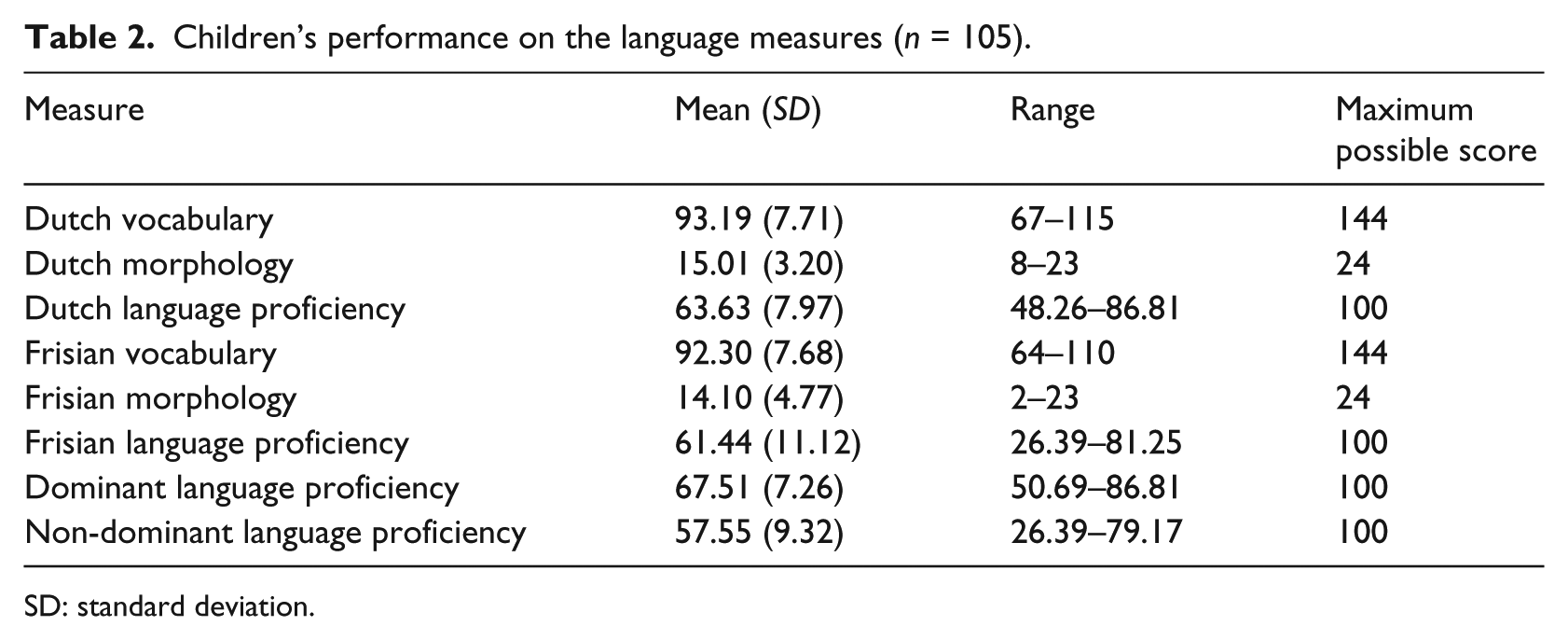
SD: standard deviation.
The children in our sample were not explicitly screened for language impairment, but there are no indications that any of them would qualify for such a diagnosis. On the Dutch morphology task, which is a standardised norm-referenced test, there were five children who got the lowest norm score (E) on a range from (A) to (E), where (E) refers to the 10th percentile, hence a score that is clinically relevant. These five children, however, all obtained higher scores on the Frisian morphology task, for which no norm scores are available, than on the Dutch morphology task, indicating that they did not have low language scores overall.
Measures
Code-switching frequency. To gain information about children’s code-switching behaviour, we added the following two questions to the parental questionnaire:
How often does it happen that your child starts a sentence in Frisian and ends it in Dutch?
How often does it happen that your child starts a sentence in Dutch and ends it in Frisian?
Possible answers were ‘never’ (0), ‘rarely’ (1), ‘sometimes’ (2), ‘usually’ (3), and ‘always’ (4). These questions are based on Byers-Heinlein’s (2013) Language Mixing Scale, which, in contrast to our study where children’s mixing behaviour was investigated, asked about the switching behaviour of the parents. We specifically chose to ask about alternational code-switching, rather than insertional code-switching, because inserting Dutch words into Frisian is so common that it may be hard to distinguish insertions from loan words and interferences.
Language proficiency. Lexical competence in Dutch was measured with the PPVT-III-NL (Schlichting, 2005), which is the Dutch version of the PPVT-III (Dunn & Dunn, 1997). Frisian receptive vocabulary was measured with an adaptation of the PPVT-III-NL, which was developed for the purpose of this project (see Bosma et al., 2016). The PPVT is a receptive vocabulary task in which children hear a stimulus word and have to choose the correct referent out of four pictures. The PPVT-III-NL consists of 17 sets of 12 items in total and the sets are ordered by difficulty. For the present study, we only used the first 12 sets, that is, the first 144 items, because these sets suffice to measure the vocabulary knowledge of 5- and 6-year-old children. We did not use basal and ceiling criteria, as we wanted to make sure that all children completed all items for both the Dutch and the Frisian version of this task.
Grammatical competence in Dutch was measured with the subtest Word Formation of the Taaltoets Alle Kinderen (‘Language assessment all children’; Verhoeven & Vermeer, 2002), which measures expressive inflectional morphology. Grammatical competence in Frisian was assessed with a comparable task that was developed for the purpose of this project (see Blom & Bosma, 2016). Both the Dutch and the Frisian version of the task contained 12 items testing noun plural formation and 12 items testing past participle formation. To elicit noun plurals, children were shown pictures of objects and prompting sentences of the following type: Dat is een X, dat zijn twee … ‘This is an X, these are two …’. To elicit past participles, children were shown pictures and prompt sentences like the following: Rosita is een bal aan het gooien. Gisteren heeft zij ook al een bal … ‘Rosita is throwing a ball. Yesterday she has also … a ball.’ Both the noun plural and the past participle part of the task contained items with different degrees of regularity.
Cognitive control. Cognitive control was measured with the Flanker task from Engel de Abreu, Cruz-Santos, Tourinho, Martin, and Bialystok (2012), who adapted the task from Rueda et al. (2004). On a laptop screen, children were shown a horizontal row of five equally spaced yellow fish. Their task was to feed the fish in the middle as fast as they could by pressing a left or a right response button that indicated the direction of this central fish. In the congruent condition (50% of trials), the flanking fish swam in the same direction as the target fish, whereas in the incongruent condition (50% of trials), the flanking fish swam in the opposite direction. The test started with eight practice trials and the real test consisted of two blocks of 20 trials in which congruent and incongruent trials were randomly presented. Each trial started with a fixation cross in the middle of the screen, which was shown for 1000 ms. Then the row of fish was presented for 5000 ms or until a response was given. Reaction times (RTs) and accuracy were recorded. The following responses were excluded from the analyses (10.43% of trials): incorrect responses (n = 394), correct responses with RTs below 200 ms (n = 3) and correct responses with RTs above three SDs of children’s individual congruent (n = 24) and incongruent means (n = 13). The measure that we calculated is the Flanker effect, which is the mean RT of the incongruent trials minus the mean RT of the congruent trials (mean RTINCONGRUENT – mean RTCONGRUENT). RTs for incongruent trials are usually slower than RTs for congruent trials, because of interference from the flanking fish. Therefore, it is thought that a smaller Flanker effect indicates a better ability of cognitive control. There was one child who only had one correct response in the incongruent condition. As the mean RT for the incongruent condition could not be calculated reliably, this child was excluded from the analysis, leaving 104 children for the current study.
Procedure
The schools distributed information folders about the research and consent forms to the parents of the 5- and 6-year-old children. Only children whose parents had signed a consent form were tested. The tasks in this study were part of a larger test battery that included tasks that were not reported on in the current study. Children were tested in a quiet room at school by the first author or a research assistant, who both had a native level command of Dutch and Frisian. The tasks were divided over two sessions of about 60 minutes each and were administered in the following order: Frisian receptive vocabulary, Frisian inflectional morphology and Flanker task in the first session; Dutch receptive vocabulary and Dutch inflectional morphology in the second session.
Results
Means and SDs for code-switching frequency and the Flanker measures are presented in Table 3. More than half of the children (n = 60) never code-switched from Frisian to Dutch, about a quarter of them (n = 27) did this rarely, and only some of them did this sometimes (n = 11) or usually (n = 6). We found more or less the same distribution for code-switching from Dutch to Frisian. More than half of the children (n = 60) never code-switched from Dutch to Frisian, about a fifth of the children did this rarely (n = 20), another fifth did it sometimes (n = 21), and only very few children did this usually (n = 3). A paired-samples t-test showed that there was no significant difference between frequency of code-switching from Frisian to Dutch and frequency of code-switching from Dutch to Frisian, t = −0.41, p = 0.68. The Flanker task produced accuracy data and response times in the congruent and incongruent condition as well as the Flanker effect. There was substantial individual variation on the Flanker task, in particular for the Flanker effect, as revealed by the large SDs. Inspection of the data indicated that this was caused by 18 children who responded relatively fast in the incongruent condition (see also Blom et al., 2017; Rouder & King, 2003). As this pertained to a clear minority of the children in the sample and as the data could not be considered outliers, we decided to include these data in our analyses.
Means and SDs for switching frequency and the Flanker effect (n = 104).
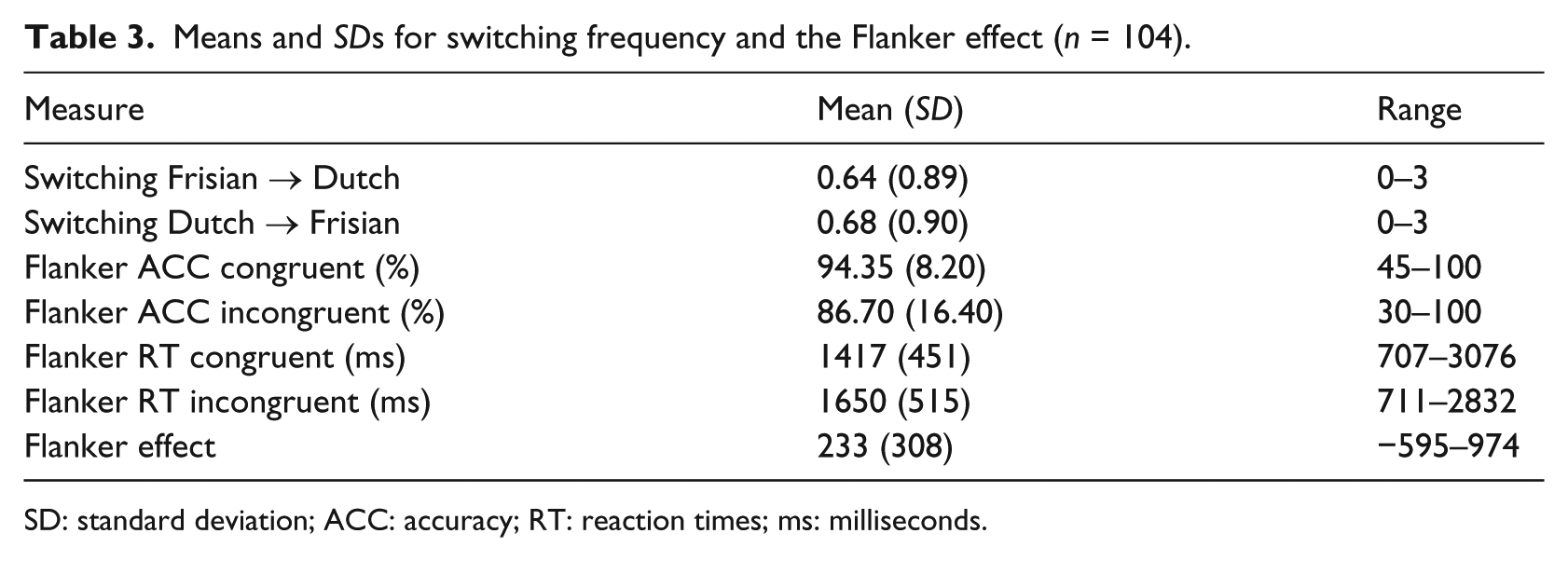
SD: standard deviation; ACC: accuracy; RT: reaction times; ms: milliseconds.
Table 4 shows the correlations among the background variables, code-switching frequency and the Flanker effect. There was a moderate positive correlation between frequency of code-switching from Frisian to Dutch and frequency of code-switching from Dutch to Frisian, r(104) = 0.43, p < 0.001, showing that children who code-switched from Frisian to Dutch were also likely to code-switch from Dutch to Frisian. Further inspection of the data revealed that a large proportion of the children (n = 44) never code-switched in either language. There was a small negative correlation between age and frequency of code-switching from Dutch to Frisian, r(104) = −0.20, p = 0.04, showing that younger children code-switched more often than older children. Furthermore, there was a small negative correlation between Frisian language proficiency and frequency of code-switching from Frisian to Dutch, r(104) = −0.19, p = 0.05, showing that children with lower skills in Frisian were more likely to code-switch to Dutch than children with higher skills in Frisian. The correlation between Dutch language proficiency and frequency of code-switching from Dutch to Frisian was close to reaching significance, r(104) = −0.18, p = 0.07. With respect to the Flanker task, there were small to moderate negative correlations between accuracy on the one hand and RTs for congruent, r(104) = −0.26, p < 0.01, and incongruent trials, r(104) = −0.29, p < 0.01, on the other hand. This shows that children who were more accurate, also had faster reaction times.
Correlations among background variables, switching frequencies and Flanker measures (n = 104).
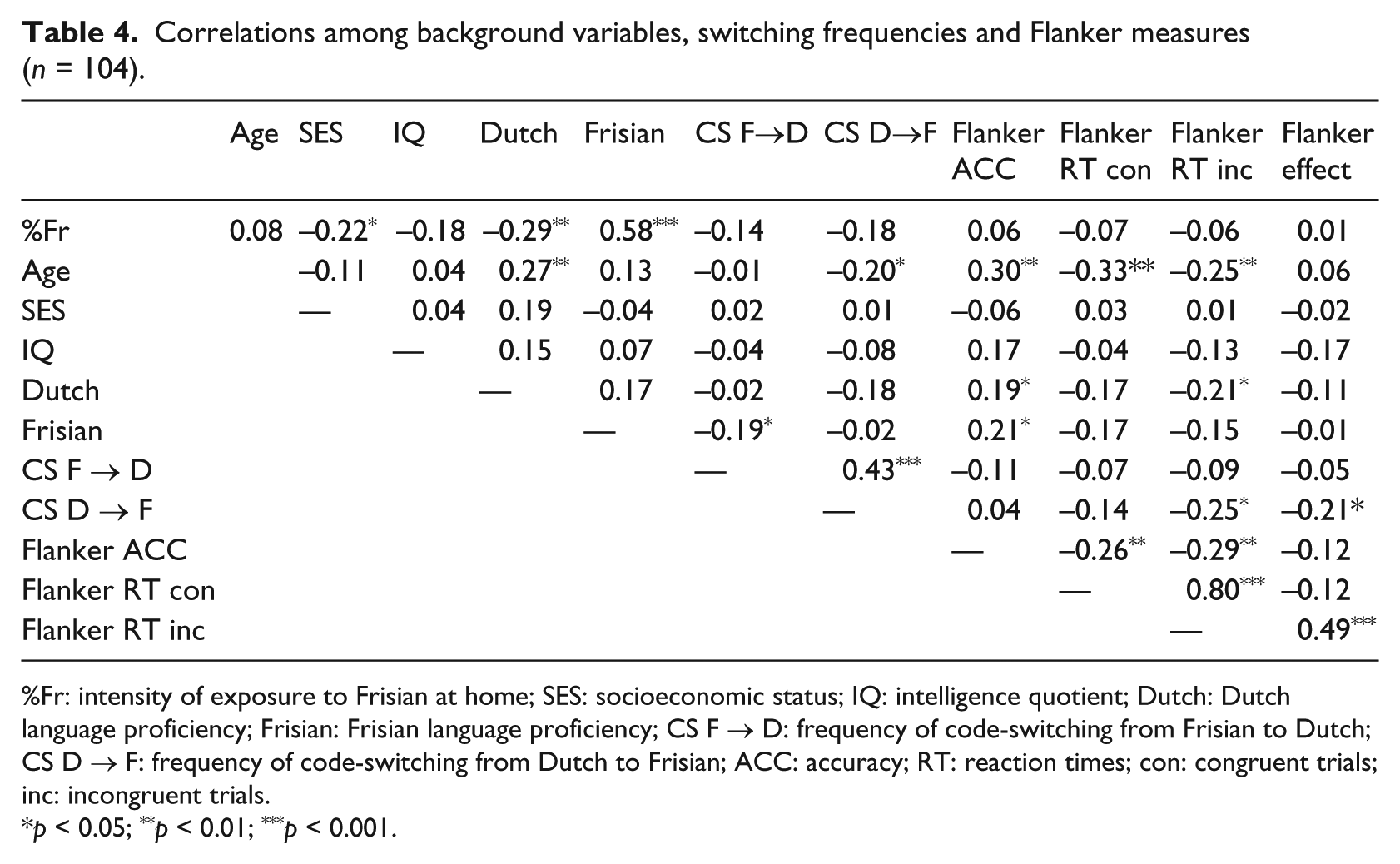
%Fr: intensity of exposure to Frisian at home; SES: socioeconomic status; IQ: intelligence quotient; Dutch: Dutch language proficiency; Frisian: Frisian language proficiency; CS F → D: frequency of code-switching from Frisian to Dutch; CS D → F: frequency of code-switching from Dutch to Frisian; ACC: accuracy; RT: reaction times; con: congruent trials; inc: incongruent trials.
p < 0.05; **p < 0.01; ***p < 0.001.
Code-switching from Dutch to Frisian versus code-switching from Frisian to Dutch
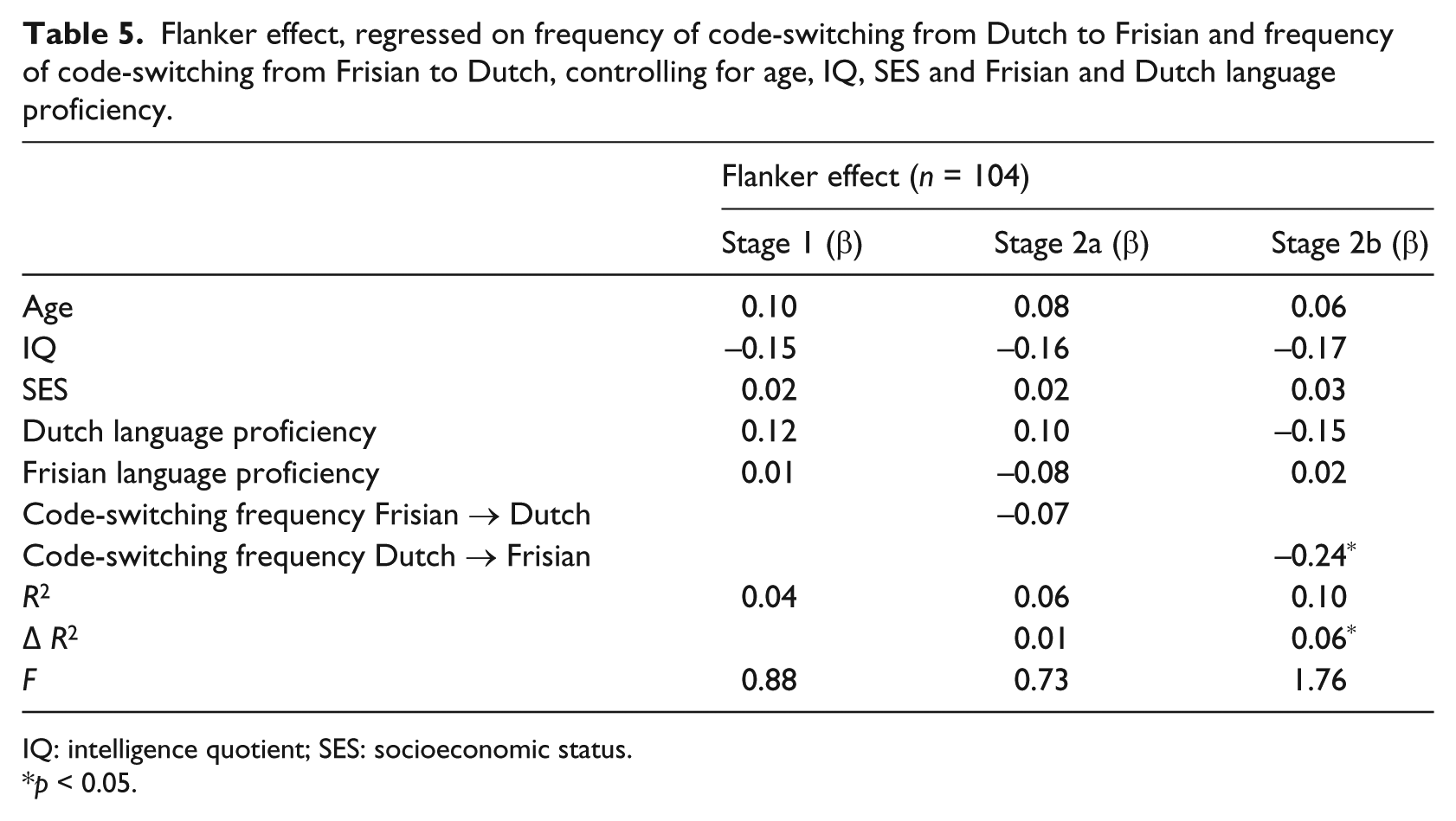
The aim of this study was to investigate the hypothesis that code-switching from Dutch to Frisian requires more cognitive control than code-switching from Frisian to Dutch. The correlational analyses showed a small negative correlation between frequency of code-switching from Dutch to Frisian and the Flanker task, r(104) = −0.21, p = 0.03, showing that children who code-switched more often from Dutch to Frisian performed better on cognitive control. There was, however, no correlation between frequency of code-switching from Frisian to Dutch and the Flanker task, r(104) = −0.05, p = 0.64. In order to investigate whether these findings would hold when controlling for age, IQ, SES and Frisian and Dutch language proficiency, a hierarchical multiple regression analysis was performed with the Flanker effect as the outcome variable. In the first stage of the model, age, IQ, SES and the language measures were included as control variables. In the second step of the model, frequency of code-switching from Frisian to Dutch (stage 2a) and frequency of code-switching from Dutch to Frisian (stage 2b) were individually added as predictors of interest. The results are shown in Table 5. Frequency of code-switching from Dutch to Frisian significantly predicted the Flanker effect, β = −0.24, p = 0.02, R2 = 0.06, but frequency of code-switching from Frisian to Dutch did not, β = −0.07, p = 0.52, R2 = 0.01.
Flanker effect, regressed on frequency of code-switching from Dutch to Frisian and frequency of code-switching from Frisian to Dutch, controlling for age, IQ, SES and Frisian and Dutch language proficiency.
IQ: intelligence quotient; SES: socioeconomic status.
p < 0.05.
It must, however, be noted that the full model was not significant, F(6,97) = 1.76, p = 0.12, R2 = 0.10, nor were any of the control variables. Although this was unexpected, it is not that uncommon. In a recent study by Thomas-Sunesson, Hakuta, and Bialystok (2018), all control variables (age, IQ, SES and English vocabulary) were also unrelated to the outcomes of the Flanker task. It must furthermore be noted that age was significantly correlated with accuracy and RTs for both congruent and incongruent trials, showing that older children were more accurate and responded faster.
Code-switching frequency and language dominance
Previous research on voluntary language switching in bilingual children suggests that the relationship between code-switching and cognitive control may also be influenced by language dominance: inhibiting the dominant language requires more effort than inhibiting the weaker language (Gross & Kaushanskaya, 2015). To exclude the possibility that the effect of code-switching from Dutch to Frisian could be attributed to children’s individual dominance profiles, we did additional analyses. As outlined in the Method section, we defined the dominant language of each individual child based on the vocabulary and morphology scores of the two languages. A paired-samples t-test showed that children code-switched significantly more often from their non-dominant to their dominant language (M = 0.75, SD = 0.93) than from their dominant to their non-dominant language (M = 0.52, SD = 0.79), t = 2.54, p = 0.01.
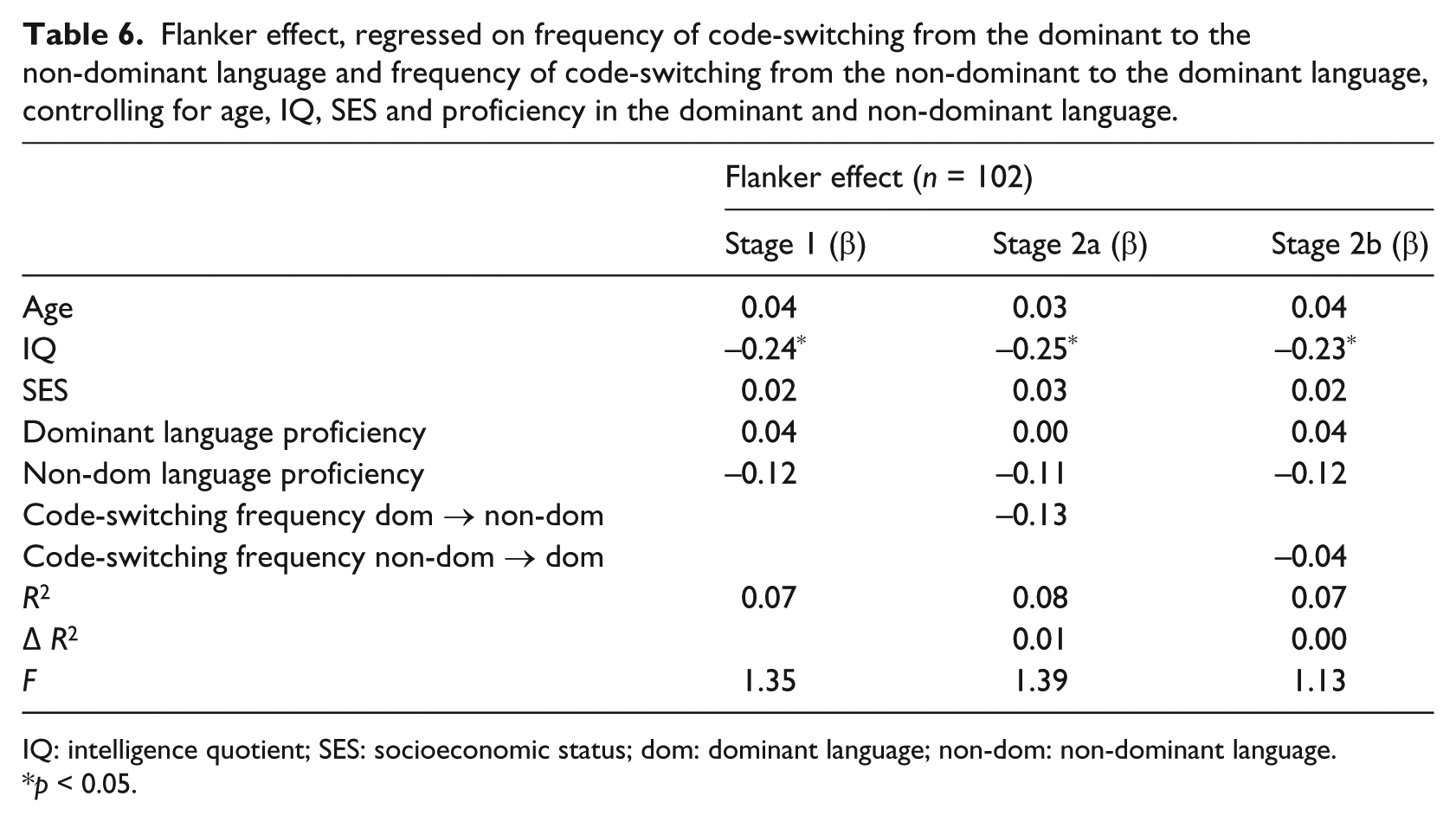
In order to test whether frequency of code-switching from the dominant to the non-dominant language or vice versa is related to performance on the Flanker task, we first conducted correlational analyses. These showed no significant relationship between the Flanker effect and frequency of code-switching from the dominant to the non-dominant language, r(102) = −0.09, p = 0.36, nor between the Flanker effect and frequency of code-switching from the non-dominant to the dominant language, r(102) = −0.06, p = 0.55. Second, as other variables could influence the relationship between the Flanker task and children’s frequency of code-switching, we conducted a hierarchical multiple regression analysis with performance on the Flanker effect as the outcome variable. In the first stage of the model, age, IQ, SES and proficiency in the dominant and non-dominant language were included as control variables. In the second step of the model, frequency of code-switching from the dominant to the non-dominant language (stage 2a) and frequency of code-switching from the non-dominant to the dominant language (stage 2b) were individually added as predictors of interest. The results are shown in Table 6. Neither of the two predictors of interest turned out to be a significant predictor of children’s performance on the Flanker task, showing that language dominance did not affect the relationship between code-switching and cognitive control.
Flanker effect, regressed on frequency of code-switching from the dominant to the non-dominant language and frequency of code-switching from the non-dominant to the dominant language, controlling for age, IQ, SES and proficiency in the dominant and non-dominant language.
IQ: intelligence quotient; SES: socioeconomic status; dom: dominant language; non-dom: non-dominant language.
p < 0.05.
Discussion
In the current study, we investigated the relationship between code-switching frequency and cognitive control in a group of 5- and 6-year-old Frisian–Dutch bilingual children. Cognitive control was measured with a Flanker task and information about code-switching behaviour was obtained through a parental questionnaire. The results showed that children who code-switched more often from Dutch to Frisian performed better on the Flanker task. There was, however, no relationship between the Flanker task and frequency of code-switching from Frisian to Dutch. As this asymmetry could not be explained in terms of language dominance, we believe that the results can be attributed to the interactional context in which Frisian–Dutch bilingual speakers use their two languages.
In the Frisian–Dutch bilingual context, mixing of Dutch (the majority language) into Frisian (the minority language) is common, but mixing of Frisian into Dutch is not (Breuker, 2001). In other words, when Frisian–Dutch bilingual speakers speak Dutch, they maintain some degree of separation between their two languages; when they speak Frisian, in contrast, they completely mix the two lexicons and grammars. This is relevant in terms of Green and Wei’s (2014) control process model of code-switching, which predicts that code-switching only requires cognitive control when bilingual speakers have to maintain some degree of separation between their two languages. This led us to hypothesise that code-switching from Dutch to Frisian requires more cognitive control than code-switching from Frisian to Dutch – an expectation that was confirmed by the results of the current study. As far as we know, this is the first study to show that code-switching from a majority to a minority language requires more cognitive control than code-switching from a minority to a majority language.
During bilingual speech production, phonological representations from both languages are activated in parallel and compete for selection into the planning layer, where the most active items are successively selected for production (e.g. Blumenfeld & Marian, 2013; Dijkstra et al., 2010). Green and Wei (2014) argue that bilingual access to the planning layer is controlled in ways that reflect the interactional context, that is, the way in which the two languages are used in the community. When code-switching is appropriate, there is a cooperative relationship between the two languages. This means that items from both languages can enter the planning layer. Two qualitatively different control modes are distinguished here: an open control mode and a coupled control mode. In the open control mode, there is no target language and items from both languages can freely enter the planning layer. We argue that this is the case when a Frisian–Dutch bilingual speaker speaks Frisian. As it is completely accepted to incorporate Dutch elements into Frisian, the bilingual does not need to control access to the planning layer. In the coupled control mode, in contrast, code-switches are planned in advance by changing the target language and passing control from one language schema to the other. We argue that this is the case when a Frisian–Dutch bilingual speaker speaks Dutch. As the use of Frisian elements should be limited when speaking Dutch, access to the planning layer needs to be controlled. When a bilingual speaker wants to code-switch from Dutch to Frisian, control has to be passed from the Dutch to the Frisian language schema. We believe that this is the reason why code-switching from Dutch to Frisian requires more cognitive control than code-switching from Frisian to Dutch.
The results of this study not only shed more light on the psycholinguistic mechanisms of code-switching in relation to the interactional context. They also provide more insight into the mechanism of code-switching in bilingual children. In line with other recent research (Gross & Kaushanskaya, 2015), the results suggest that code-switching in bilingual children involves similar control mechanisms as code-switching in bilingual adults (Adler et al., under review; Rodriguez-Fornells, Kramer, Lorenzo-Seva, Festman, & Münte, 2012; Verreyt et al., 2016; Wu & Thierry, 2013), a noteworthy observation given that children’s linguistic and cognitive skills are still developing. This finding is especially relevant in combination with two other findings from this study, namely that:
younger children code-switched more often from Dutch to Frisian than older children; and
children code-switched more often from their non-dominant to their dominant language than vice versa.
As this suggests that children sometimes code-switch as a strategy to fill gaps in linguistic knowledge, our study supports Green and Wei’s (2014) claim that code-switching can involve cognitive control, no matter the reason behind the code-switch; control passes from one language schema to the other, even when code-switching is used as a gap-filling strategy.
Given these two findings, our study provides a nuanced perspective with respect to the question of whether or not code-switching in bilingual children is a sign of bilingual competence. On the one hand, the finding that children code-switched more often from their weaker to their dominant language can be interpreted as a form of compensation for gaps in linguistic knowledge. This is in contradiction with the recent finding that code-switching frequency in 5- and 6-year-old English–Mandarin bilingual children is positively correlated with lexical and grammatical knowledge (Yow et al., 2017). On the other hand, the use of cognitive control mechanisms during code-switching shows that children are able to solve these gaps by passing control from one language to the other. It may thus depend on one’s definition of bilingual competence whether code-switching in bilingual children should be viewed as such.
There are several limitations to the current study that should be mentioned. First of all, it must be noted that many bilingual children in our sample were relatively balanced in their two languages. This may have influenced the results on the role of language dominance in the relationship between code-switching and cognitive control. For children who are relatively balanced, it is difficult, if not impossible, to define their dominant language. In the current study, however, we decided not to exclude the balanced bilinguals, as this would result in a substantial reduction of the sample, which would no longer be representative of the Frisian–Dutch bilingual context. We do, however, acknowledge that our study might therefore underestimate the effect of language dominance. Future studies should further investigate the issue of language dominance in an unbalanced minority–majority group.
Second, it must be noted that the low practice of code-switching as well as the absence of a difference between frequency of code-switching from Frisian to Dutch and frequency of code-switching from Dutch to Frisian was unexpected. Given the sociolinguistic context, we would have expected code-switching to occur more frequently, especially code-switching from Frisian to Dutch. One possibility is that speakers of Frisian actually experience Dutch alternations in their language as being Frisian rather than as code-switches to Dutch. Consequently, parents may not recognise switches from Frisian to Dutch, because these switches are so natural to them. More research needs to be done to investigate how speakers of Frisian experience the use of Dutch words and phrases in their language and how code-switches can be distinguished from loan words and interferences.
A third limitation of the current study is that the parental questionnaire that we used provided global information about children’s code-switching behaviour. We do not know the reasons why the children code-switched, such as whether their code-switching was completely voluntary or prompted by external cues like a change in interlocutor. This may be relevant to know, since recent research with bilingual adults has shown that language switching relies more heavily on cognitive control processes when the switching does not occur freely (Blanco-Elorrieta & Pylkkänen, 2017). As this finding contradicts Green and Wei’s (2014) claim that the reason behind the code-switch should not influence the relationship between code-switching and cognitive control, the issue of voluntary versus non-voluntary code-switching may be worth further investigation. In addition, research on the motivations behind code-switching may shed more light on the relationship between code-switching and bilingual language proficiency. It could be the case that community norms influence whether this relationship is either positive, as in Yow et al.’s (2017) study, or negative, as in our study. Furthermore, we encourage other researchers who work with different minority–majority language pairs to explore whether our psycholinguistic claims about code-switching in the Frisian–Dutch bilingual context can be replicated in other bilingual populations.
In sum, the current study showed a code-switching asymmetry in the context of a minority-majority language pair. The finding that only frequency of code-switching from Dutch to Frisian, but not from Frisian to Dutch, is related to cognitive control supports the hypothesis that code-switching requires more cognitive control when a bilingual speaker has to maintain some degree of language separation between his or her two languages.
Footnotes
Declaration of conflicting interests
The author(s) declared no potential conflicts of interest with respect to the research, authorship, and/or publication of this article.
Funding
The author(s) disclosed receipt of the following financial support for the research, authorship, and/or publication of this article: This work was supported by the European Union’s Seventh Framework Programme for research, technological development and demonstration under grant agreement no. 613465. The data used in this article was gathered as part of a project that was supported by the Province of Fryslân and that was conducted by the first author at the Fryske Akademy (Leeuwarden, The Netherlands) and the University of Amsterdam.
