




Abstract
Aims and objectives/purpose/research questions:
The topic of cross-linguistic influence regarding the overt or null expression of arguments has been frequently considered regarding bilinguals acquiring language pairs in which the null option is licensed by one and not both of the two languages. The goal of this study is to investigate whether simultaneous and sequential bilinguals differ from monolinguals in the case of the acquisition of Polish and German; that is, languages which both license null subjects and null objects, but in which the nature of the null arguments clearly differs. We focus on the acquisition of null arguments as silent but syntactically active bundles of features.
Design/methodology/approach:
We compare the use of null subjects and null objects by 72 bilingual and 45 monolingual children in experimental setting: acceptability judgement and sentence repetition.
Data and analysis:
The distribution of null arguments in production and judgement data of simultaneous and early sequential bilinguals was compared to the data of monolinguals.
Findings/conclusions:
The study has revealed that early sequential Polish-German bilinguals avoid null subjects in L2 German at an advanced stage of acquisition, even though null subjects are quite frequent in their L1. The slower acquisition of null subjects in early L2 German in comparison to null objects in the case of Polish-German bilinguals demonstrates that the dissimilarity between the null subjects in both languages may lead to the delay effect in the acquisition. The findings suggest that the cross-linguistic influence is due to the increased complexity inherent to the integration of syntactic and pragmatic information in case of null arguments.
Originality:
Unlike previous studies, we focus on the acquisition of null arguments in a language pair, Polish and German, in which the null option is licensed by both grammars, and in which the nature of the null arguments clearly differ.
Introduction
Two groups can be distinguished among bilinguals who acquire two languages during early childhood: simultaneous and sequential, depending on the age of onset of acquisition. The course of language development in younger children acquiring two languages simultaneously has been said to follow a similar pattern to those acquiring one language, and that of older children acquiring two languages sequentially has been said to differ from it. The borderline is set in early childhood, for example by Meisel (2011), at the age of onset (AoO) between three and four years. Cross-linguistic influence (CLI) has been said to play a more important role in the process of sequential acquisition than in simultaneous bilingual language acquisition (Meisel, 2011). Previous research has identified certain factors on which CLI depends. A phenomenon is vulnerable to CLI if it is located at an interface between syntax and pragmatics (Hulk & Müller, 2000) or between syntax and semantics (Sorace & Serratrice, 2009). Other possible factors are syntactic ambiguity (Hulk & Müller, 2000), syntactic complexity (Strik & Pérez-Leroux, 2011) and language dominance (Kupisch, 2007; Yip & Matthews, 2007). None of these factors has, however, been shown to be necessary or to be enough for CLI to occur (e.g. Kupisch, 2014).
CLI may occur in the form of a direct transfer – that is, the introduction of certain structures from one language into another (e.g. Yip & Matthews, 2000) – or in the form of an indirect impact on the rate of bilingual development in comparison to monolingual development, rendered as an acceleration or delay effect (e.g. Kupisch, 2007). The delay may manifest itself as a later emergence of a grammatical property (Kupisch, 2007) or as a later convergence on the target grammar than would be usual in monolingual acquisition (Austin, 2009). Both CLI and a reduced exposure to each language in the case of bilinguals have been offered as possible explanations for the delay effect. Cross-linguistic impact may result not only in an overuse of a structure similar in both languages but also in cross-linguistic overcorrection; that is, overuse of structures which are maximally different (e.g. Anderssen, Lundquist, & Westergaard, 2018; Kupisch, 2014).
The possibility of CLI has to be taken into account in the investigation into null arguments in simultaneous and early sequential language acquisition because they involve the syntax–pragmatics interface. Structures at the syntax–pragmatics interface are vulnerable to CLI even in the grammars of older bilingual children, once even the highest level structures are in place. At these later developmental stages CLI is said to result in pragmatically infelicitous errors and not in syntactically ungrammatical omissions (Argyri & Sorace, 2007).
Rothman (2009) claims that the reason for the vulnerability of interfaces to CLI is the inherent complexity of the phenomena at interfaces, since they require the integration of various information. In the case of the syntax–pragmatics interface, the complexity increases because the properties require the integration of the multiple types of information; that is, the syntactic with those from other cognitive systems. If the integrated information is of the same type, for example at the syntax–semantic interface, properties are acquired relatively early. The phenomena which are both syntactically and pragmatically conditioned are more complex and therefore more difficult to acquire.
Various studies have found CLI in the domain of argument realisation consisting in a higher rate of pragmatically infelicitous subjects used by bilinguals in pro drop languages (e.g. Hacohen & Schaeffer, 2004; Haznedar, 2010; Paradis & Navarro, 2003; Serratrice, Sorace & Paoli, 2004). Haznedar (2010, p. 130) reports that ‘the majority of pragmatically inappropriate subjects begin to appear following the consistent use of pronominal subjects’. Some studies based on the naturalistic production found no evidence in support of CLI in the area of null subjects (see Serratrice & Hervé, 2015, for a summary). Silva-Corvalán (2014) has shown, however, that the extent of CLI may differ considerably in time and that bilinguals may show signs of CLI after the age at which the non-pro drop language begins to dominate.
Several scholars have proposed explanations for bilinguals’ overuse of overt subjects in null-subject languages. Paradis and Navarro (2003) posited the hypothesis that the frequency of overt subject pronouns in non-null-subject language causes their overuse in null-subject language. Serratrice et al. (2004) proposed that the overt subjects in null-subject language (Italian) are marked options because they are associated with [+topic] and [+focus] discourse features. In the case of the frequent use of overt subjects as the default option in non-null-subject language (English), the marked option in null-subject language bleaches. Silva-Corvalán (2014) sees the overuse of overt subjects as a result of cross-linguistic priming.
The CLI hypothesis was formulated by Hulk and Müller (2000) and Müller and Hulk (2001) to explain the higher rate of omission of referential objects by German-French, Dutch-French and German-Italian bilinguals than by French monolinguals. The common finding of the studies on null objects in simultaneous bilingual acquisition is that bilinguals use more null objects in the language where null objects are typically not allowed (see Serratrice & Hervé, 2015, for a summary). A higher rate of object omissions has also been found by Sopata (2019) in early sequential acquisition of German which has, however, been attributed to indirect CLI consisting of a transfer of the general pragmatic context scanning strategy from L1 rather than transfer of null objects. These findings are in line with Grüter and Crago (2012), who have shown the absence of the transfer of null objects from L1 to early child L2. The higher rate of object omissions in bilingual data has also been claimed to be a result of bilingualism per se (Pérez-Leroux, Pirvulescu, & Roberge, 2008; Pirvulescu, Pérez-Leroux, Roberge, Strik, & Thomas, 2014). In cases of a structural default, the variability of the input and the reduced exposure typical for bilingual acquisition may lead to ‘longer retention of the default representation in both languages (i.e. object omission)’ (Pirvulescu et al., 2014, p. 501).
Both null subjects and null objects involve the syntax-pragmatics interface. Yet it seems that their acquisition differs in bilinguals. While most studies on null subjects report that bilingual children overuse overt subjects, tending to use them in null-subject languages inappropriately, studies on null objects show that bilinguals overuse them in languages where null objects are typically not allowed.
Crucially, the realisation of arguments concerning bilingualism has previously mostly been investigated in research in language pairs in which the null option is licensed by one of the two languages but not the other (e.g. Hulk & Müller, 2000; Müller & Hulk, 2001; Yip & Matthews, 2000) or in which neither language licenses null objects (Argyri & Sorace, 2007; Serratrice et al., 2004). The goal of this study is to investigate whether the simultaneous and sequential bilinguals differ from monolinguals in the acquisition of languages both of which license null subjects and null objects, and in which the nature of the null arguments clearly differs. While previous research has concentrated on the realisation or omission of pronominal subjects and objects, we propose to take a different path of investigation and to focus on the acquisition of null arguments as silent but syntactically active bundles of features and not just omissions of pronouns. By taking a closer look at the bundles of silent features and their differing properties in the languages in question, as well as examining the acquisition of different null forms, we will be able to draw a more detailed picture of the bilingual acquisition of null arguments.
The nature of null arguments
The use of null arguments requires a high degree of activation of the referent in the speaker’s and hearer’s mind in every natural language. The referent therefore has to be highly accessible, salient or in focus (e.g. Ariel, 1991).
Languages differ, however, in the extent to which they allow the use of null arguments under similar discourse conditions and in the syntactic nature of the null arguments. Their different syntactic nature has been clearly detailed within the framework of Generative Grammar. The main borderline consists in the distinction between null arguments conditioned by subject-verb agreement (SVA) or object verb agreement (i.e. pro drop) on the one hand and null arguments conditioned by discourse (i.e. discourse drop or topic drop) on the other (Cardinaletti & Starke, 1999; Huang, 1984; Sigurðsson, 2011, 2014). The ϕ-features, that is, the features of person, number, gender and case, are visible in the case of the null arguments of the first type because they are encoded in agreement. Due to the ϕ-agreement, the null arguments of the first type are identifiable. They are therefore not true null anaphora (see Sigurðsson, 2011). Their referent must be recovered from the context, but they enjoy similar distribution and referential properties as weak pronouns in languages such as English (Cardinaletti & Starke, 1999). Like ordinary pronouns, they are identifiable even across clause boundaries and are not restricted to the topic position (see Sigurðsson, 2011). The null arguments of the second type are ϕ-silent and have to be identified through discourse. Their distribution is more restricted (see Sigurðsson, 2011, for a detailed discussion on the syntactic difference between radically ϕ-silent and ϕ-overt arguments).
Null arguments in German and Polish
Although null subjects and null objects are possible in both German and Polish, there are differences between the two languages regarding the contexts in which null arguments may be found, and most importantly with respect to the nature of the null arguments in both languages.
German is regarded in the relevant literature as a semi pro drop language (see Grewendorf, 1989, for a relevant discussion). The referential null subjects and null objects are allowed in spoken German. They are restricted to a topic position (see example 1).
1
(1) Kommst du mit zur Schatzinsel? ‘Will you come along to Treasure Island?’ a. Ø hab ich schon gesehen. Null object have I already seen ‘I’ve already seen it.’ b. Ø hab sie schon gesehen. Null subject have it already seen ‘I’ve already seen it.’
A lexical element in the sentence initial position makes the structure with a referential null argument in German ungrammatical (see example 2): (2) *Gestern Ø hab ich schon gesehen. yesterday have I already seen ‘I have already seen this yesterday’.
Topic drop is the main mechanism underlying dropping the referential subjects and null objects in German. There has been said to be a difference in German between 3rd person null subject and null object on the one hand and 1st/2nd person null subjects on the other. Trutkowski (2016) shows that 1st and, to some extent, 2nd person null subjects in spoken German are licensed by discrete inflectional endings and their referents are not necessary recovered from the context. They cannot therefore be cases of genuine topic drop because no context is needed to identify them. While they resemble pro drop to the extent that they are ϕ-overt and conditioned by SVA, they cannot be regarded as such. They differ considerably from Romance-like null subjects because they are confined to the sentence initial position (see example 3): (3) Ø Komme etwas später. Come-1SG slightly later ‘I will come slightly later’.
German 3rd person null subjects and null objects are ϕ-silent and only possible with a salient discourse antecedent. They are also restricted to the topic position and are therefore regarded as topic drop.
Polish also allows for referential null subjects and objects. They are, however, different types of null arguments. All Polish null subjects are ϕ-overt and conditioned by SVA. They are therefore regarded as pro drop (see example 4): (4) Ø Piszesz list. Polish null subject write-2SG letter ‘You write a letter.’
The verbal paradigm in Polish encodes person and number, and the past tense even encodes gender. The rich verbal paradigm ensures that Polish null subjects are interpretable and the dependency on context or discourse to identify them is not strict. While the interpretation of all Polish null subjects is influenced by discourse, the referential choices of the speaker are shaped by a number of structural and discourse-pragmatic constraints which are much the same as in the case of weak pronouns (e.g. McShane, 2009).
The choice between referential expressions depends on the degree of accessibility of the referent (e.g. Ariel, 1991) and the referential properties of the referent (Rinke, Flores, & Sopata, 2019). In Polish, a typical null subject language, in ambiguous contexts, the null pronoun refers to an antecedent that is the topic of the main clause, whereas the overt pronoun tends to select a non-subject antecedent (McShane, 2009; Pilarski, 2013).
In contrast to null subjects, Polish null objects are not clause-internally constrained (Sopata, 2016; Ruda, 2014). The null objects are a ϕ-silent type of argument drop because there is no object verb agreement in Polish and null objects cannot therefore be identified via the agreement. They are conditioned by discourse and their reference is recoverable from the context only. The mechanism for dropping the objects in Polish is discourse drop. Null objects in Polish are not constrained to the topic position (see example 5): (5) Co zrobiłaś z ciastem? ‘What did you do with the cake?’ Ø Zjadłam Ø. Polish null object ate ‘I ate it.’
In general, null arguments in Polish are more common than in German. Polish null subjects are often produced in written and spoken language, whereas null objects are limited to the spoken language. In German null arguments are less common. German referential null subjects and null objects are both used only in spoken language. In German, they are restricted to topic positions.
Syntactically, 1st/2nd person null subjects are similar to some extent in both languages because they are unambiguously ϕ-overt and conditioned by SVA in Polish and they also seem to be ϕ-overt in German. Due to the topic position restriction in German, the German 1st/2nd person null subjects cannot be regarded as pro contrary to Polish. There is a more pronounced similarity between null objects in both languages because they are ϕ-silent and identified through discourse in each case. They differ, once again, insofar as the German null objects are confined to the topic position. Both languages clearly differ, however, in 3rd person null subjects. In Polish they are ϕ-overt arguments, instances of pro and they are licensed by agreement. Their dependency on antecedent is not strict. In German 3rd person null subjects are ϕ-silent; they are instances of topic drop; and they are strictly antecedent dependent. See the summary in Table 1.
Summary: null arguments in Polish and German.
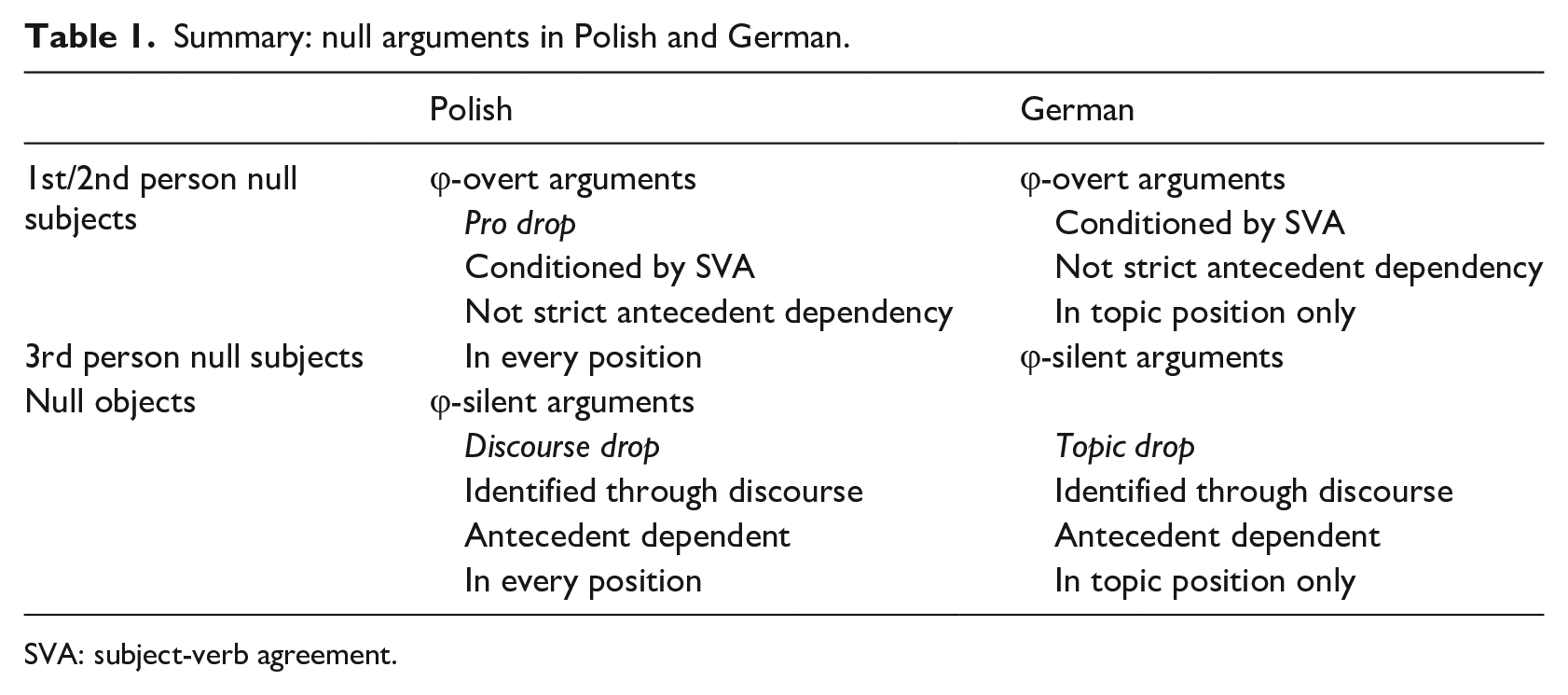
SVA: subject-verb agreement.
Null arguments in L1 acquisition: German and Polish
Studies indicate that monolingual German children acquire null arguments quite early. They use null forms in place of subjects (up to 40% of cases) in the early stage of language development, before SVA emerges. Later, subjects are realised in most cases (Clahsen, 1991; Meisel, 1994). Analysing longitudinal data of spontaneous production from two children, Hamann (1996) reports that L1 German children omit subjects and objects in pre-verbal positions, which to some extent accords with the distribution of null arguments in adult language. Ungrammatical subject and object omissions in post-verbal positions are rare, what suggests that children’s null forms at this stage of development are adult-like null arguments.
Polish monolingual children take longer to acquire the more complex system of null arguments in Polish (Smoczyńska, 1985). Few studies that have focused on the null object acquisition in L1 Polish have shown that Polish children go through a stage during which referential objects are frequently omitted (Mykhaylyk & Sopata, 2016; Sopata, 2016; Varlokosta et al., 2016). Polish children between the ages of three and five years disregard to some degree the difference between contexts in which null objects may be used, and therefore it has been argued (Sopata, 2016) that very young children do not compute the reference of the arguments in the same way adults do and assign interpretations to objects by free context scanning, bypassing the syntactic channel for discourse access (see Sigurðsson, 2011, 2014, for the discussion on the context linking mechanism).
In general, in most languages young children follow the path of acquisition of L1 through a stage during which they omit referential arguments regardless of whether their target language is a null argument language (e.g. Pérez-Leroux, Pirvulescu, & Roberge, 2017, for an overview). The null elements used by children at this stage seem to differ from adult-like null arguments, which are silent but syntactically active bundles of features in target languages (see Sigurðsson, 2011, 2014). Young children rely more on discourse licensing for the interpretation of these null elements (Roeper, 1999; Serratrice et al., 2004) and bypass the syntactic linking mechanism (see Sopata, 2016, for a detailed discussion). The full acquisition of null arguments involves the mechanism of their syntactic linking to silent phase edge features (see Sigurðsson, 2011, 2014) and their interpretation in relation to the pragmatic context (e.g. Ariel, 1991; De Cat, 2015; Serratrice & Hervé, 2015). Both are complex tasks. Only at the later stage do the null elements used by children begin to contain all the relevant features appropriately linked.
The study
Research questions
Bearing the previous discussion in mind, our main research questions are as follows:
RQ1
Do simultaneous and early sequential bilinguals differ from monolinguals in their use of 1st/2nd person null subjects?
RQ 2
Do simultaneous and early sequential bilinguals differ from monolinguals in their use of 3rd person null subjects?
RQ 3
Do simultaneous and early sequential bilinguals differ from monolinguals in their use of null objects?
Participants
Seventy-two bilingual and 45 monolingual children participated in this study. They are divided into six groups:
two groups of simultaneous Polish-German bilinguals: 12 children living in Germany and 16 children living in Poland;
two groups of early sequential bilingual children (cL2) at an advanced stage of language acquisition: 27 children from Polish families living in Germany (mean AO = 5;8) and 17 children from German families living in Poland (mean AO = 6;7);
two control groups of monolingual children: 25 German and 20 Polish.
For both groups, simultaneous and early sequential bilinguals, we will focus on the language that functions as the majority language of the environment (i.e. Polish for the children living in Poland, and German for those living in Germany). Neither L2 is used at home or only marginally so.
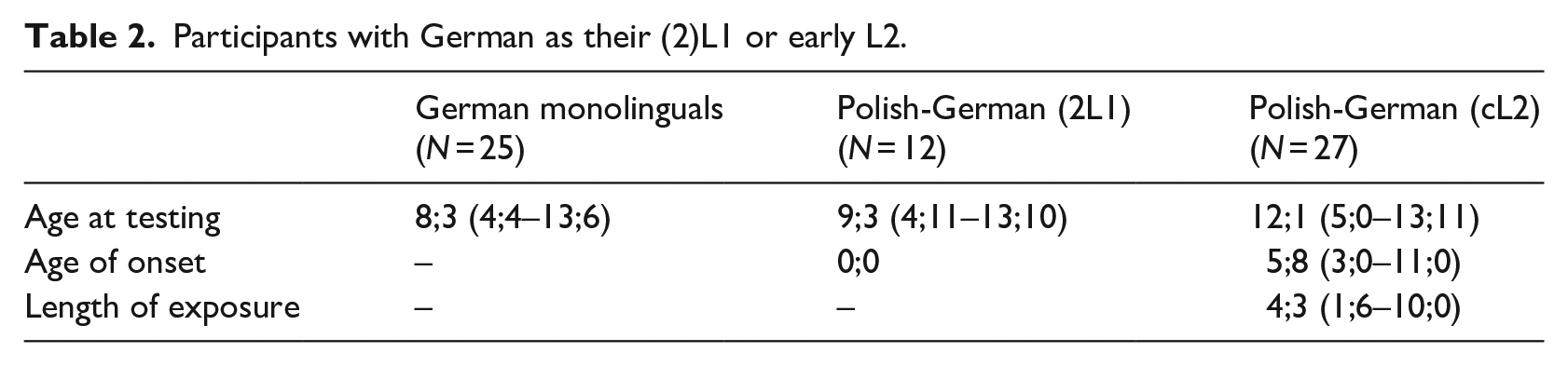
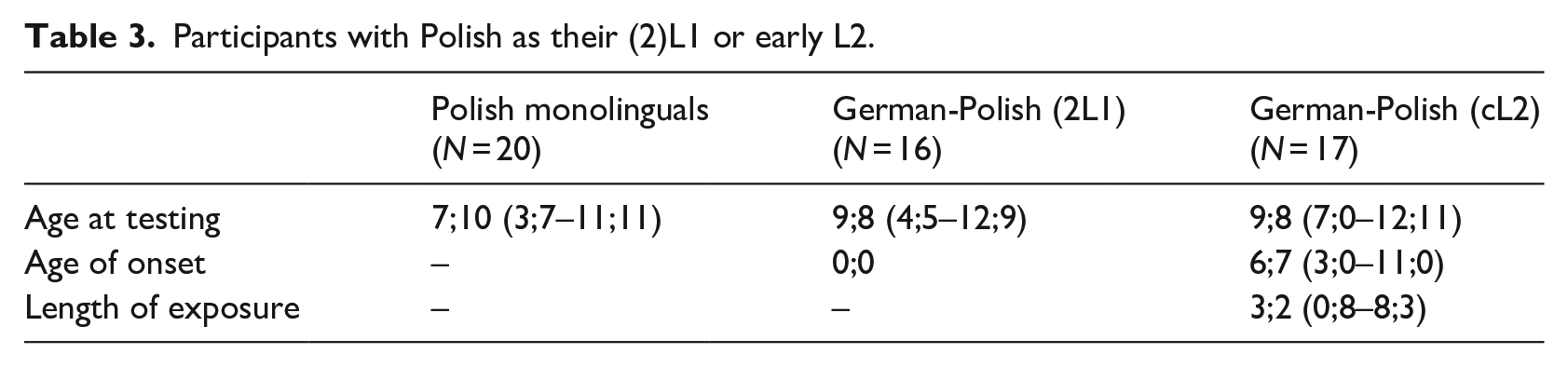
An overview of the participants is given in Tables 2 and 3.
Participants with German as their (2)L1 or early L2.
Participants with Polish as their (2)L1 or early L2.
Method
Two tasks were used in this study: an acceptability judgement task (AJT) and a sentence repetition task (SRT). Both tasks were constructed and conducted with the aid of E-Prime 2.0 Professional SP2-Software. They were created as games in order to retain the children’s attention. Children were tested individually by a native speaker either at home or at school. The procedure of the AJT and SRT was the same in Polish and in German.
In AJT, a question and a corresponding answer were presented both in written and oral form; that is, on a computer screen and through headphones. Children had then to judge whether the answer sounded ‘good’ or ‘bad’ in the target language. At the end, children were asked to correct orally those sentences which they judged to sound ‘bad’. Six target sentences contained 1st, 2nd and 3rd person null subjects in the singular in both languages which were syntactically correct and pragmatically appropriate. Cases in which children judged a sentence to sound ‘bad’ but did not correct it or corrected other features of the sentences were excluded from the analysis.
Examples of the AJT are provided in (6) and (7): (6) German, null subject 3rd SG Kennst du Fabian? Ja, klar, Ø ist mein Nachbar Know you Fabian? Yes, of course, is my neighbour ‘Do you know Fabian? Yes, of course, he is my neighbour.’ (7) Polish, null subject 1st SG Co Ø robiłeś w kuchni? Ø Ukroiłem kawałek chleba, posmarowałem go masłem i zjadłem go. What did in the kitchen? Cut off a piece of bread, smeared it with butter and ate it ‘What did you do in the kitchen? I cut off a piece of bread, buttered it and ate it.’
In the SRT procedure children were given sentences in an oral form over headphones. After the presentation they were asked first to perform a Stroop test in order to avoid passive echoing (parroting). Only after the Stroop test, did children repeat the sentence. Nineteen sentences in German and 16 sentences in Polish contained both subjects and objects which were either overt or null. All of them were syntactically correct and pragmatically appropriate. The status of overtness could have been changed in most cases without giving rise to incorrect or inappropriate arguments. The sentences that were omitted or repeated incompletely, that is, without the phenomenon under investigation, were filtered out from the analysis.
Examples of the SRT are provided in (8) and (9): (8) German, overt object Es ist windig. Hast du den Schal dabei? Den hab ich verloren. It is windy. Have you the shawl with you? It have I lost ‘It is windy. Have you got the shawl with you? I have lost it.’ (9) Polish, null subject 3rd SG Jutro do mnie przyjedzie Julia. Ø Jest smutna, bo Ø zgubiła zegarek. Tomorrow to me will come Julia. is sad because lost watch ‘Tomorrow Julia will come to me. She is sad because she lost her watch.’
In both tasks, the target sentences were mixed with other sentences that did not contain the phenomenon in question. Two randomisations were also applied to avoid order effects.
Results
The data from both tasks were binary (0 = a null argument/1 = an overt argument). For all the statistical findings in this study the chi-square test was therefore used, or, in the case of small expected frequencies, Fisher’s exact test. A post-hoc z-test was applied, where necessary.
German
Acceptability judgement task
Table 4 presents the distribution of null versus overt subjects in the children’s acceptability judgements on null subjects.
Results of the chi-square test or Fisher’s exact test (marked with *) for children’s acceptability judgements on null subjects in German.
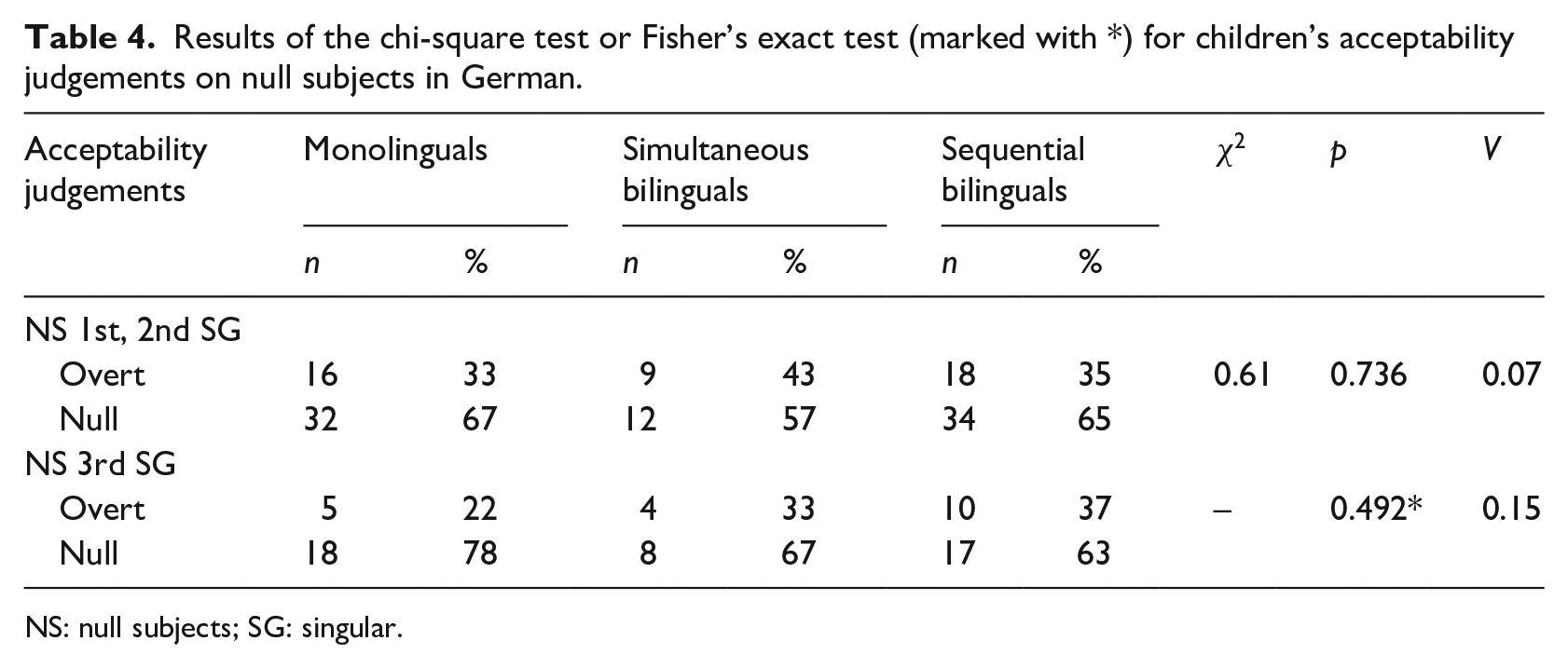
NS: null subjects; SG: singular.
Figure 1 presents the acceptance rates of null subjects (NS) in German.
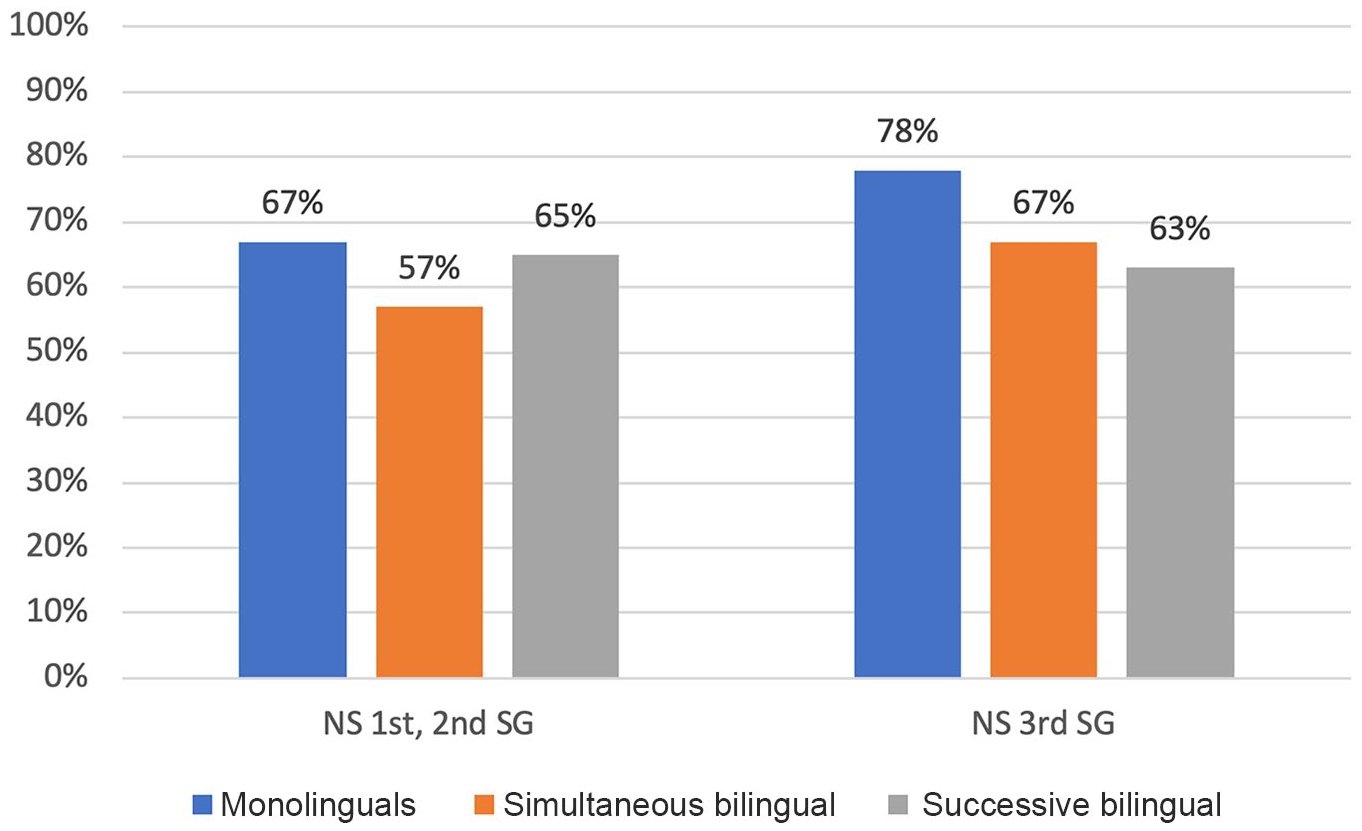
Acceptance of null subjects in German.
The results show that the simultaneous bilinguals tend to accept 1st/2nd person null subjects in 10% fewer cases than monolinguals. The sequential bilinguals also tend to accept them a little less: 2%. As far as the acceptance of 3rd person null subjects is concerned, the simultaneous bilinguals accept them 11% less, and the early sequential bilingual children 15% less than monolinguals. The differences between the groups are not significant.
Sentence repetition task
Table 5 presents the distribution of null versus overt subjects and objects in the repeated sentences after listening to a stimulus with an overt argument and with a null argument.
Results of the chi-square test or Fisher’s exact test (marked with *) for children’s sentence repetitions with overt and null arguments in the stimulus in German. Bold values indicate a significant result (p < .05).
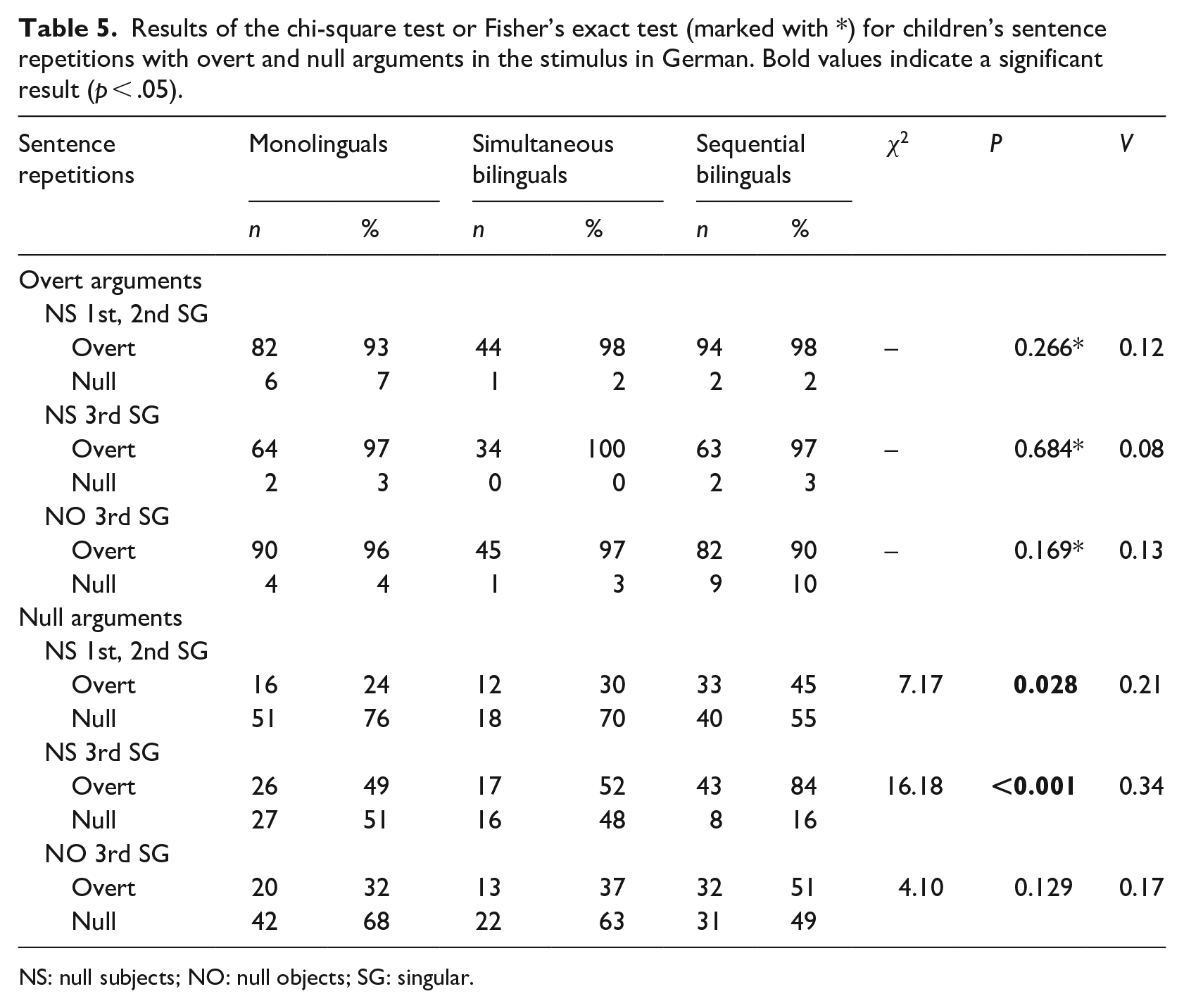
NS: null subjects; NO: null objects; SG: singular.
Figures 2 and 3 show the percentages of the use of null subjects (NS) and null objects (NO) in the sentences repeated by children. Figure 2 concerns the sentences repeated after listening to a stimulus with an overt argument and Figure 3 with a null argument.
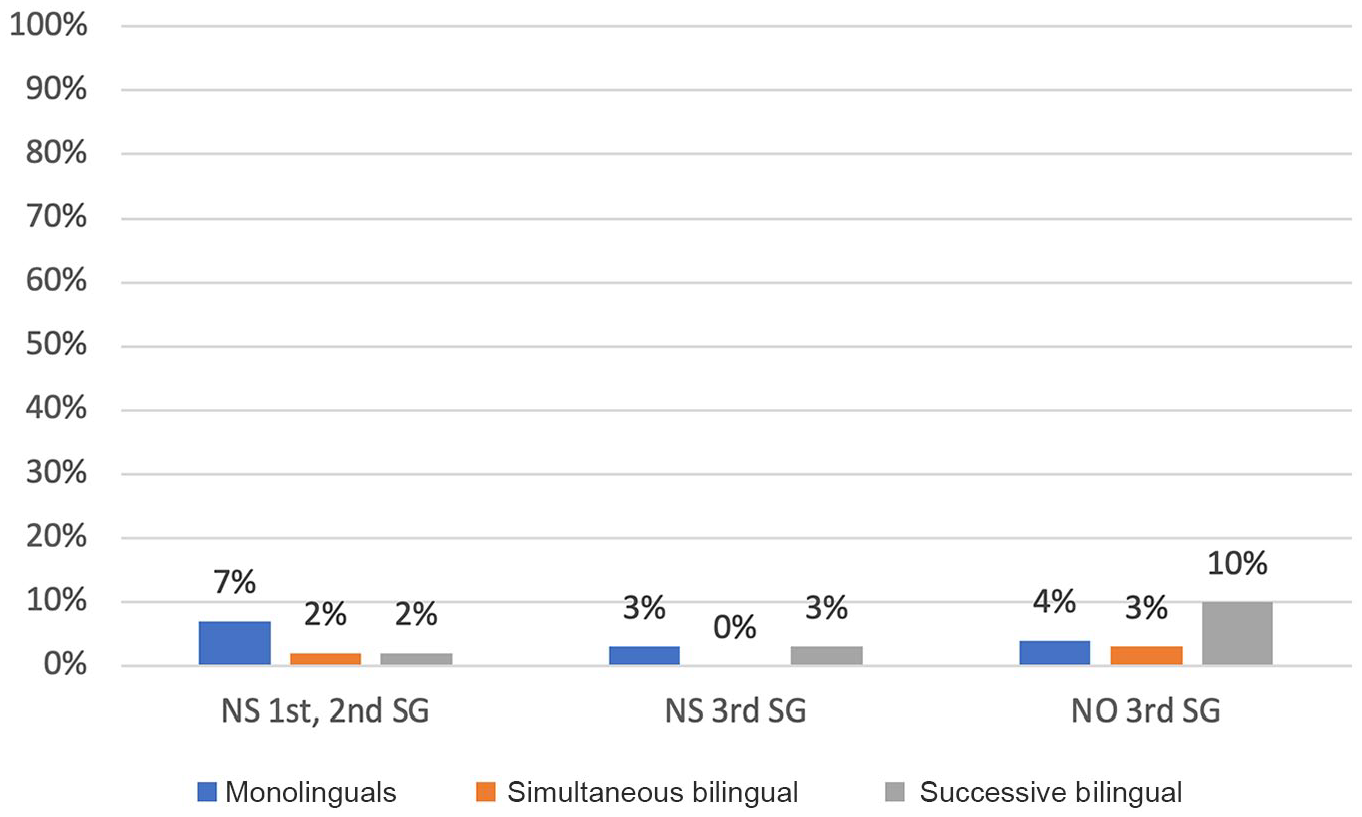
Use of null arguments in the repeated sentences with an overt argument in the stimulus in German.
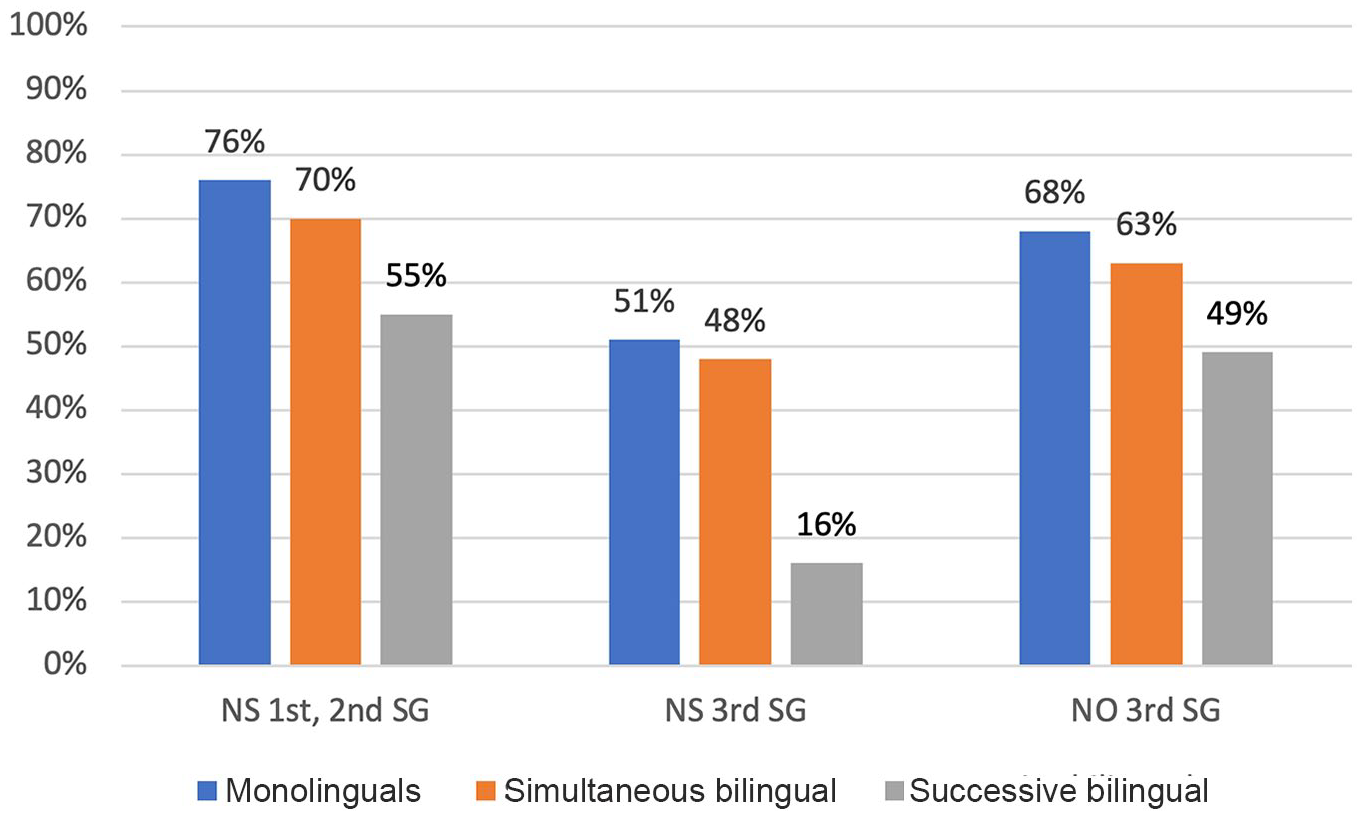
Use of null arguments in the repeated sentences with null arguments in the stimulus in German.
Figure 2 shows that children barely change the overtness status when provided with a stimulus with an overt argument. The differences are extremely small and not significant.
When provided with a stimulus sentence with a null argument, children showed far more variation in their repetitions (Figure 3). The monolinguals repeated without changing the overtness status of the null arguments in 76% of the sentences with 1st/2nd person null subjects, in 51% with 3rd person and in 68% with null objects. In other cases they inserted a pronoun in the subject or object position. The simultaneous bilinguals used 1st/2nd person null subjects 6% less, and the sequential bilinguals 21% less than monolinguals. In the case of 3rd person null subjects, the simultaneous bilinguals behaved similarly to the monolinguals. They used 3rd person null subjects only 3% less than monolinguals in SRT with a null argument in the stimulus. In contrast, the sequential bilinguals differed clearly from monolinguals insofar as they used only 16% 3rd person null subjects in this condition of SRT, 35% less than monolinguals. With reference to the null objects, the results show only small differences. The simultaneous bilinguals used 5% fewer null objects, and the early sequential bilinguals 19% fewer than monolinguals.
A post-hoc z-test reveals a significant difference between the monolinguals and the early sequential bilinguals for 1st/2nd person null subjects (p < .028), as well as for 3rd person null subjects (p < .001).
Polish
Acceptability judgement task
Table 6 presents the distribution of null versus overt 3rd person subjects in the children’s acceptability judgements. 1st/2nd person null subjects were not analysed, as all children accepted all of them.
Results of Fisher’s exact test (marked with *) for children’s acceptability judgements on 3rd person null subjects in Polish.
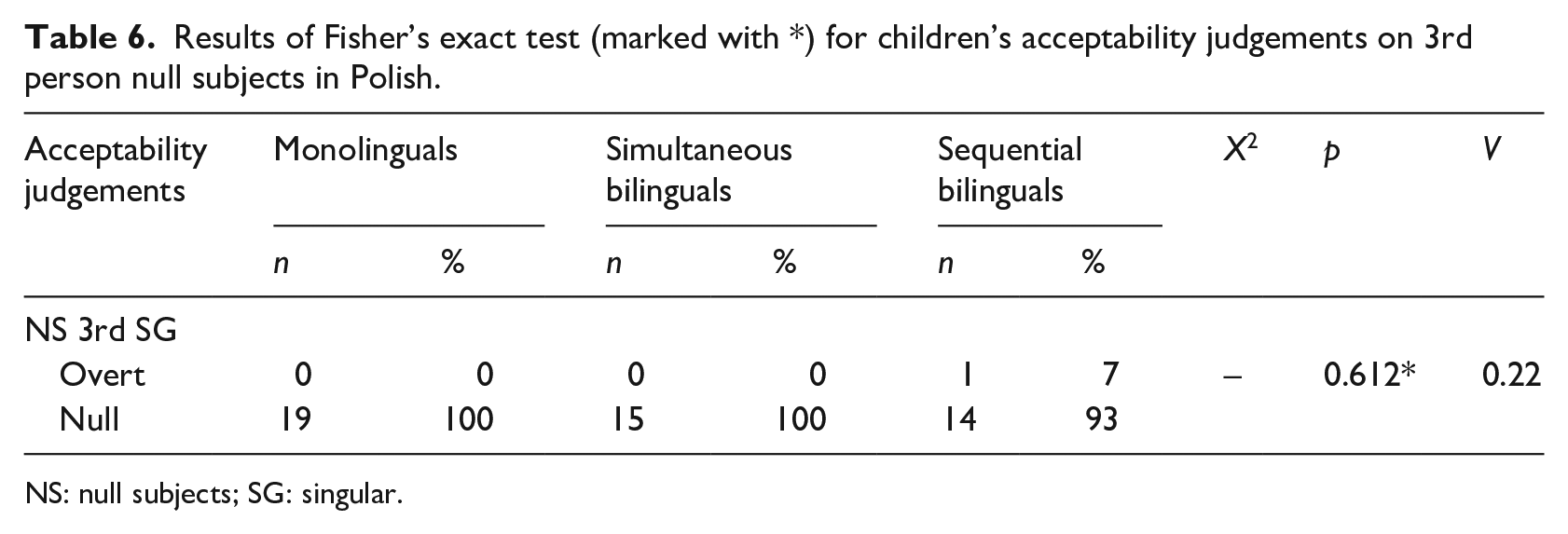
NS: null subjects; SG: singular.
Figure 4 presents the acceptance rates of null subjects in Polish.
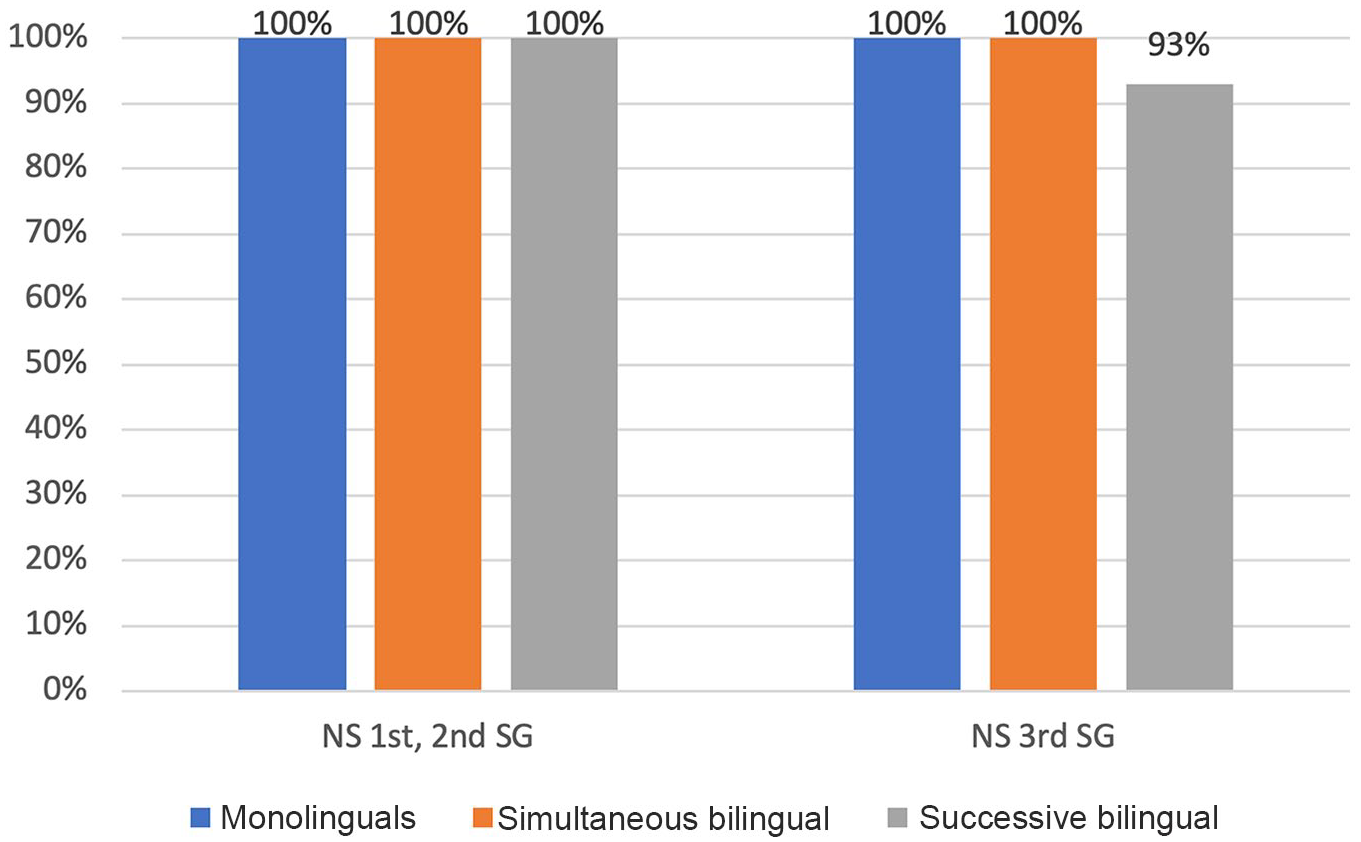
Acceptance of null subjects in Polish.
The percentage of acceptance of null subjects in Polish (Figure 4) is much higher than that given by the German data. The results show no real differences between the groups. Monolingual and simultaneous bilingual children accepted 100% of null subjects regardless of their type. Sequential bilingual children also accepted 100% of 1st/2nd person null subjects. They accepted only 7% fewer 3rd person null subjects than monolinguals, which is statistically not significant.
Sentence repetition task
Table 7 presents the distribution of null versus overt subjects and objects in the repeated sentences after listening to a stimulus with an overt argument and with a null argument.
Results of the chi-square test or Fisher’s exact test (marked with *) for children’s sentence repetitions with overt and null arguments in the stimulus in Polish.
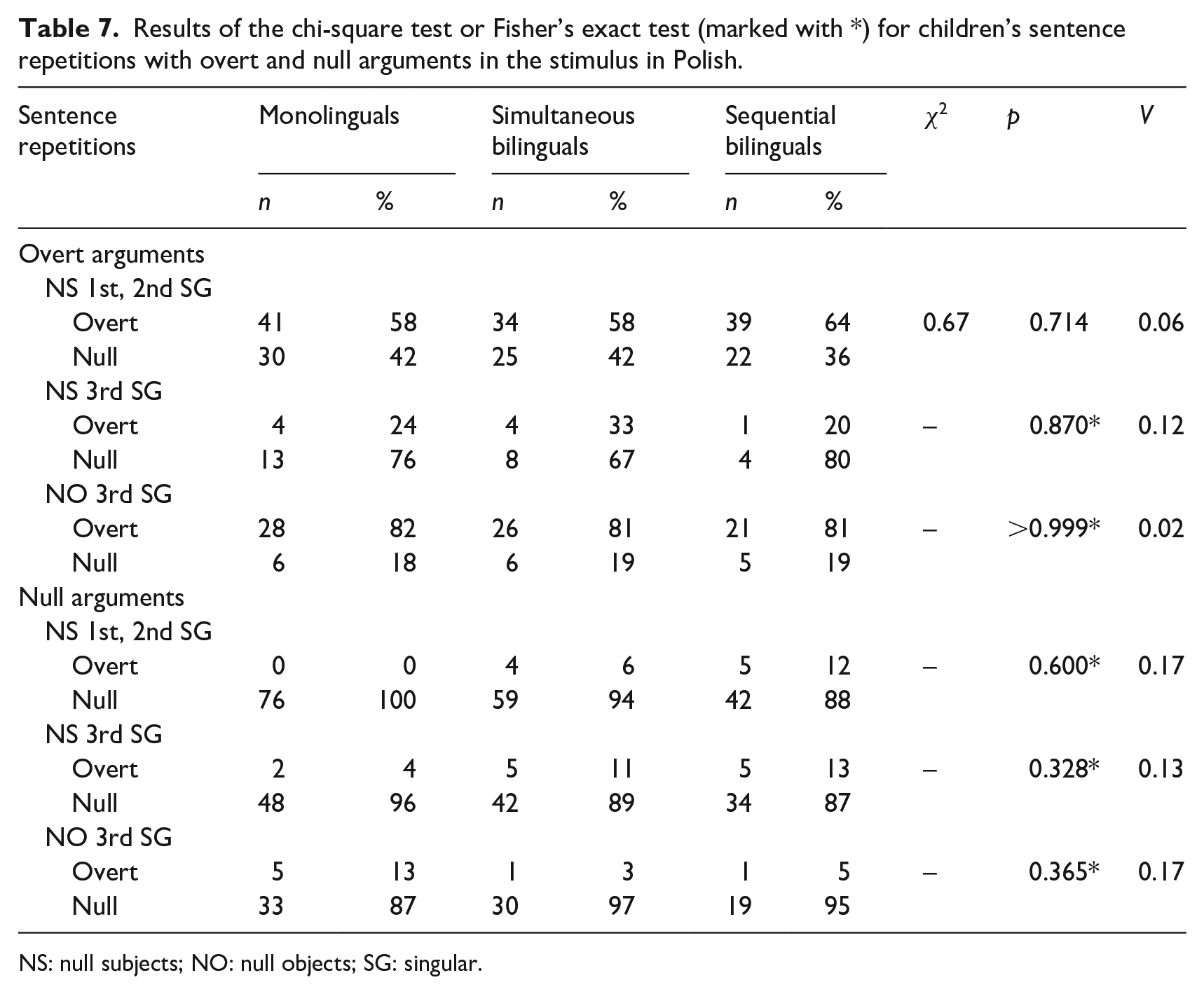
NS: null subjects; NO: null objects; SG: singular.
Figures 5 and 6 show the percentages of the use of null arguments in SRT in Polish.
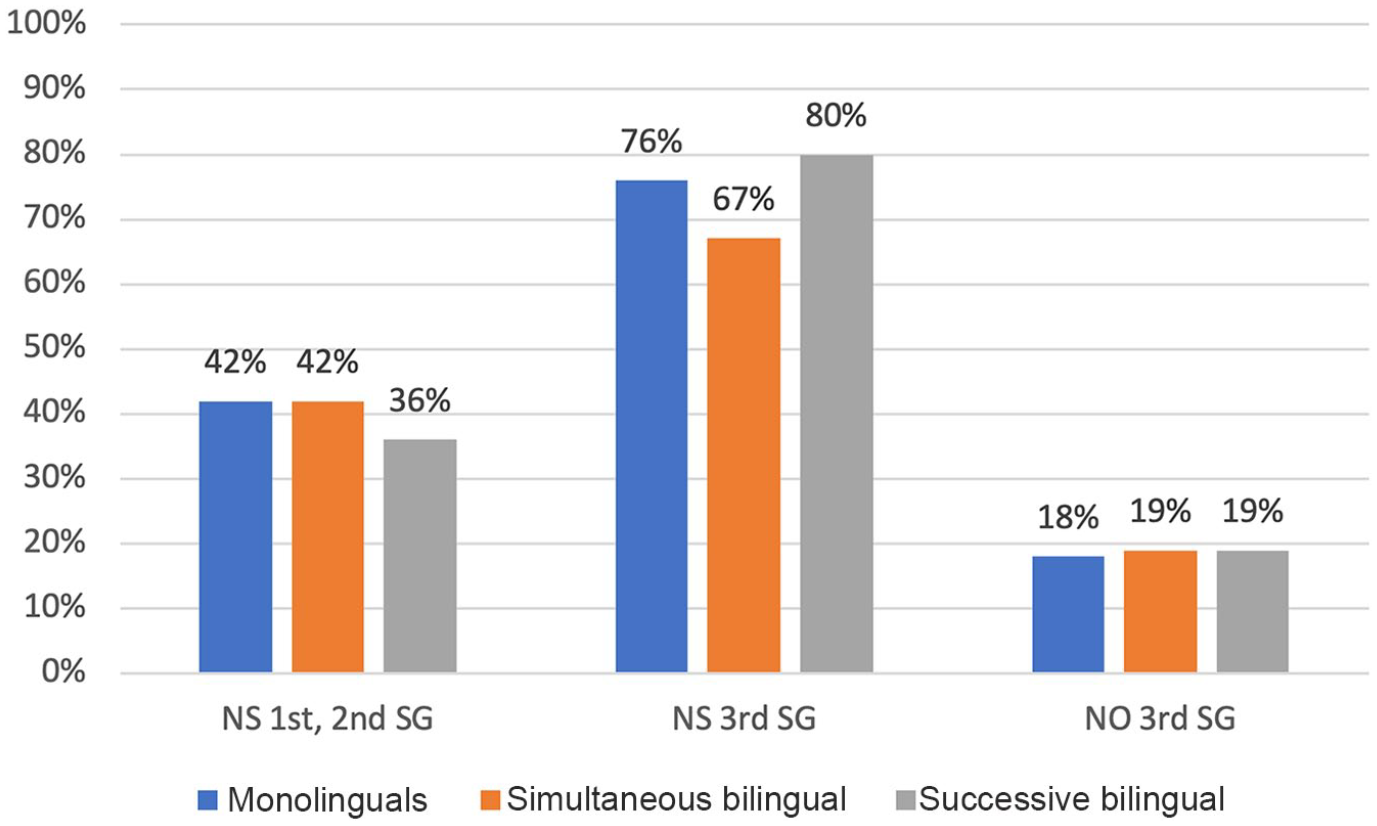
Use of null arguments in the repeated sentences with overt arguments in the stimulus in Polish.
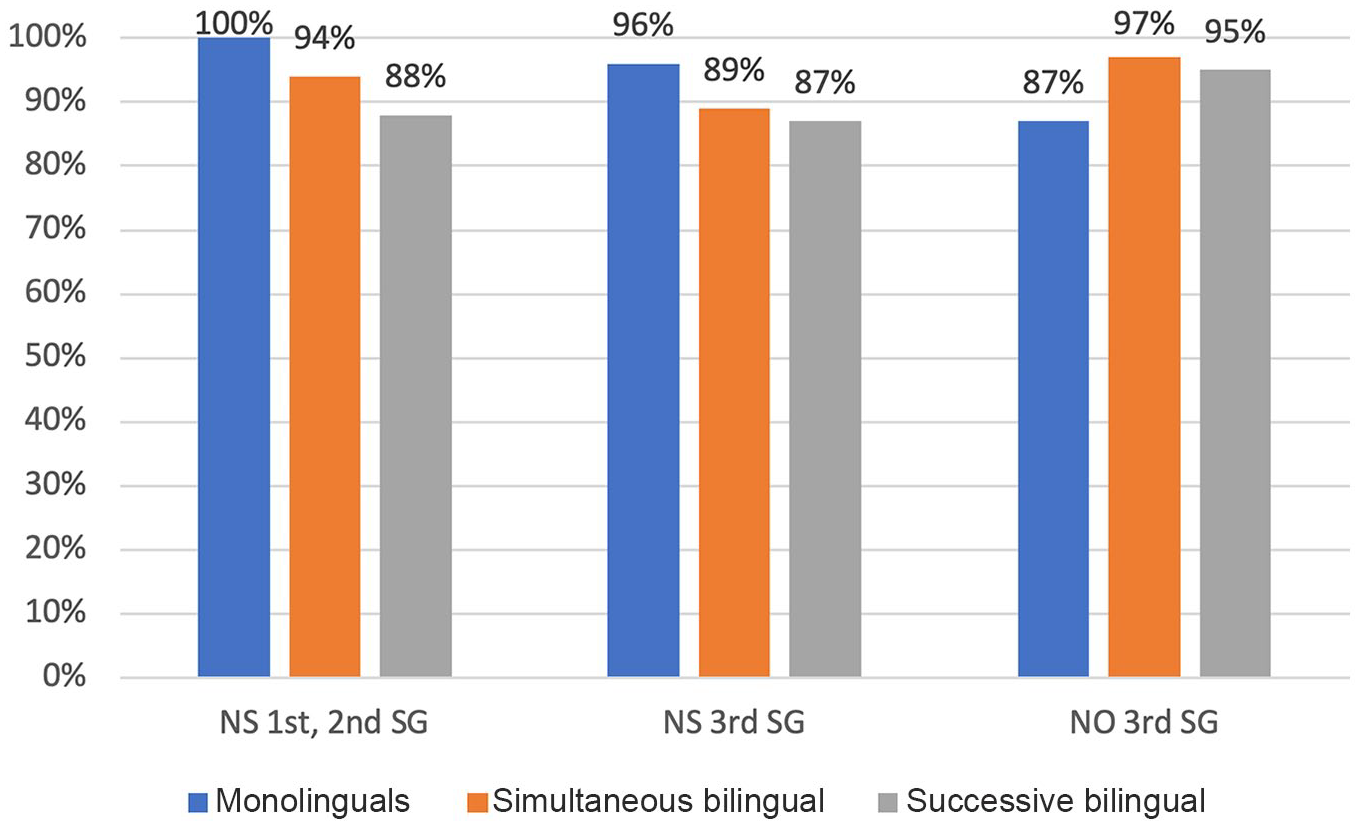
Use of null arguments in the repeated sentences with null arguments in the stimulus in Polish.
The results of the SRT in Polish (Figure 5) indicate that all children, irrespective of the group to which they belong, change the overtness status of overt arguments far more than the results shown by the SRT in German. If confronted with an overt object or 1st/2nd person overt subject in the stimulus sentence, all groups tend to drop it in the repeated sentence. The differences between the groups were extremely small and statistically not significant.
Figure 6 presents the percentage of the use of null arguments in the repeated sentences after listening to sentences with null arguments in Polish. The results indicate that all children tend to accept and repeat the sentences with null arguments without changing their overtness status. Bilingual children use null subjects a little less than monolingual children; that is, they insert more pronouns when repeating the sentences. These differences are, however, extremely small and not significant.
Discussion
The data analysis in the previous section answers the study’s three research questions.
In regard to the first research question concerning the use of 1st and 2nd person null subjects, the data show that both groups of simultaneous bilinguals behave like monolinguals. The differences in AJT and SRT were not significant either in German or in Polish. Neither did sequential bilinguals with early L2 Polish differ from Polish monolinguals. In contrast, the sequential bilinguals with early L2 German differ from German monolinguals. While they tend to accept German 1st and 2nd person null subjects in AJT to a similar extent to monolinguals, they also tend to avoid 1st and 2nd person null subjects in SRT when asked to repeat a sentence with such null subjects and insert pronouns much more frequently than German monolinguals would do.
Regarding the second research question, that relating to the use of 3rd person null subjects, the results show once again that both sets of simultaneous bilinguals behave like monolinguals. All differences between the simultaneous bilinguals and corresponding monolingual children are not significant. The behaviour of the sequential bilinguals with early L2 Polish also tends to resemble that of monolinguals. Once again, however, there is a clear difference in the use of 3rd person null subjects among the sequential bilinguals with early L2 German. Although the children accepted German 3rd person null subjects in AJT similarly to monolinguals, in SRT with the null subject in the stimulus the sequential bilinguals with early L2 German used them 35% less than monolinguals. This difference is the biggest discrepancy between the two groups in our data and it indicates a real difference in the acquisitional path for 3rd person null subjects among monolingual German children on the one hand and early sequential Polish-German bilinguals on the other.
The third question related to the use of null objects and the results show that together with the early sequential bilinguals the simultaneous bilinguals behave similarly to their corresponding monolinguals in both languages. The differences between the groups are in this respect not significant.
To sum up, several findings have emerged from this study. The results have confirmed that CLI plays a more important role in the process of sequential acquisition than in simultaneous bilingual language acquisition (e.g. Meisel, 2011). The simultaneous bilinguals at a more advanced stage of language acquisition tend not to show significant differences from their corresponding monolinguals regarding the use of null subjects and null objects. The results have also shown that the sequential bilinguals with early L2 Polish do not differ from Polish monolinguals at an advanced stage. In line with Kupisch (2014) the data thus demonstrate that the location of the phenomenon at the syntax-pragmatics interface is an insufficient factor to cause CLI.
The novel findings to have emerged from this study are that 1st/2nd and 3rd person subject pronouns may be overused at an advanced stage of language acquisition by early sequential bilinguals, even when both languages involved license null arguments. The results show that the sequential bilinguals with early L2 German tend to avoid 3rd person null subjects and to a lesser degree 1st/2nd person null subjects. This finding accords with previous studies that report on overuse of overt subjects in null-subject languages by bilinguals who are acquiring language pairs in which the null option is licensed by one and not the other of the two languages. Note, however, that the other language in the language pair in this study is Polish, which also licenses null subjects. The greater use of subject pronouns in L2 German cannot therefore be attributed to the obligatory nature of an overt pronominal subject in the other language in the pair, as postulated in previous research (e.g. Paradis & Navarro, 2003; Serratrice et al., 2004; Silva-Corvalán, 2014).
Because the overuse of subject pronouns in early L2 German cannot be an effect of exposure to a non-null-subject language (e.g. Rinke & Flores, 2018; Sorace, Serratrice, Filiaci, & Baldo, 2009, for a similar conclusion with respect to heritage speakers), we would like to propose a contrasting approach and focus on the overuse of overt subjects as a result of the delayed acquisition and therefore avoidance of null subjects. This study has shown that the tendency to avoid null subjects may persist even at later stages of sequential bilingual language acquisition. The acquisition of bundles of silent but syntactically active features in the form of null arguments not only in one but in two languages is a complex task and may lead to avoidance of them even by advanced sequential bilinguals. This study has shown that the avoidance of null arguments is more frequent if the null forms are cross-language different. The biggest discrepancy between the monolingual and bilingual children regarding the use of null arguments has been shown in regard to 3rd person null subjects. In Polish, they are ϕ-overt arguments which may appear in different sentence positions, and in German, 3rd person null subjects are ϕ-silent and restricted to the topic position.
During the sequential acquisition of L2 German the children with L1 Polish have to build up the repertoire of possible null forms in their grammars. After they have acquired the possibility of ϕ-overt 3rd person null subjects in Polish, they face the task of acquiring a ϕ-silent form in German which is confined to the topic position. Such a task is clearly complex.
In line with Rothman (2009) we argue that the phenomena at the syntax–pragmatics interface are generally of great complexity, since they require the integration of syntactic knowledge with other cognitive systems. The additional complexity is involved in the integration of syntactic and pragmatic information in cases of ϕ-silent null arguments, since the ϕ-silent null arguments provide no ϕ-features supporting the computation.
Although the acquisition of null arguments requires no learning of new overt forms, it requires the acquisition of sophisticated syntactic and pragmatic skills involving the syntactic skills of linking features to silent phase edge features (see Sigurðsson, 2011, 2014) and the skills of feature interpretation in relation to the pragmatic context (e.g. Ariel, 1991; De Cat, 2015; Serratrice & Hervé, 2015). The difficulty involved in the task of acquiring two different null forms for 3rd person subject expression leads to an avoidance of those null subjects in early L2. L1 Polish grammar with the ϕ-overt 3rd person null subjects therefore has an indirect impact on the rate of development of ϕ-silent 3rd person null subjects in early L2 German among sequential bilinguals. In line with Kupisch (2007) we consider this sort of indirect impact of one language on the rate of the acquisition of the other in bilinguals as a type of CLI.
The overuse of overt subjects in early L2 German in comparison to German monolinguals cannot be an effect of the frequency of overt subject pronouns in the bilinguals’ other language, as postulated by Paradis and Navarro (2003), since the bilinguals’ other language in this case is Polish, which is a null-subject language with frequent null subjects. The frequency of null subjects in Polish is even higher than in German, so the frequency effect would rather lead to a higher proportion of null subjects in children’s L2 German and this is not the case.
Interestingly, the sequential bilinguals with L1 German and early L2 Polish seem to find it less difficult to acquire 3rd person null subjects in Polish. Adding the possibility of ϕ-overt 3rd person null subjects to the already acquired ϕ-silent form in German appears to be a less demanding task. A possible explanation for this difference may be that the computation of ϕ-silent null arguments is arguably more complex than that of ϕ-overt null arguments because the ϕ-silent null arguments provide no ϕ-features for support. The integration of syntactic and pragmatic information in the case of ϕ-overt null arguments is rather less complex, since their ϕ-features are visible. The path which involves the acquisition of null forms that are less complex and therefore easier to compute than those already acquired seems to be less demanding.
The results lend no support to the hypothesis of markedness as proposed by Serratrice et al. (2004). The overt subjects are in German a default option and in Polish a marked option. The marked option in L2 Polish seems not to bleach in the language of sequential German/Polish bilinguals as predicted by Serratrice et al. (2004) in spite of the frequent use of overt subjects as a default option in children’s L1 German.
The study has shown that the sequential bilinguals with early L2 German also tend to avoid to a lesser degree 1st/2nd person null subjects. The avoidance of ϕ-overt null subjects among bilinguals indicates that the acquisition of partially similar cross-language null forms, i.e. 1st/2nd person null subjects, may also be delayed in bilingual acquisition. In Polish 1st/2nd person null subjects are ϕ-overt arguments which may appear in different sentence positions. While in German 1st/2nd person null subjects are also claimed to be ϕ-overt (Trutkowski, 2016), they are restricted to the topic position. They cannot be regarded as instances of pro drop and therefore they only partially resemble Polish 1st/2nd person null subjects. The acquisition of L2 German therefore requires children with L1 Polish to add to the already acquired possibility of ϕ-overt 1st/2nd person null subjects in Polish a form in German which is arguably also ϕ-overt, but which is confined to the topic position. The partially different nature of null forms makes them more vulnerable to unidirectional CLI, which results in an avoidance of 1st/2nd person null subjects by sequential bilinguals with L1 Polish and early L2 German.
The results of the present study into null objects in bilingual acquisition have shown that the simultaneous and early sequential bilinguals at an advanced stage of language acquisition do not differ significantly from monolinguals. This finding indicates that the bilinguals have at this point of acquisition converged in this area on the target grammar. The acquisition of null objects faster than that of null subjects in early L2 German shows that the difficulty of the task of acquiring null arguments in German is not the only factor influencing the rate of their acquisition in sequential bilinguals. The more rapid acquisition of null objects than null subjects in the case of Polish-German bilinguals is a result of the similarity between the null objects in both languages on the one hand and the dissimilarity between the null subjects on the other. The L1 grammar has an indirect delaying impact on the rate of acquisition of L2 null arguments that differ from the L1. At an advanced level, the CLI thus only affects null subjects and not null objects in early L2 German.
A previous study showed that younger early sequential Polish-German bilinguals (between 2;8 and 5;8) may transfer a temporary strategy of linking null elements to general pragmatic contexts from their L1 and therefore use more null objects than monolinguals even not in target-like contexts (Sopata, 2019). This indirect CLI of Polish on early L2 German in the area of null objects has been claimed to depend on the L1 acquisitional timetable and be connected with the early stage of acquisition of null elements in L1. The findings of this study confirm this hypothesis. The early sequential Polish-German bilingual children tested in this study are much older (between 5;0 and 13;11) and their acquisition of null arguments in their L1 Polish has therefore advanced beyond the stage of the general context linking (see Gielge, Brehmer, Sopata, & Długosz, in preparation, for a detailed analysis of their L1). The children indeed no longer overuse null objects in their L2 German.
To conclude, the investigation of the use of null subjects and objects by simultaneous and early sequential bilinguals in a language pair in which the null option is licensed by both grammars has shown that early sequential Polish-German bilinguals avoid null subjects in L2 German at an advanced stage of acquisition, even though null subjects are quite frequent in their L1. The slower acquisition of null subjects in early L2 German in comparison to the acquisition of null objects in the case of Polish-German bilinguals demonstrates that the dissimilarity between the null subjects in both languages may give rise to the delay effect in the acquisition.
The acquisition of null arguments, bundles of silent but syntactically active features, in two languages has been shown to be a complex task. The increased complexity inherent in the integration of syntactic and pragmatic information in the case of null arguments may cause processing difficulties in the sequential acquisition of two different null forms for subject expressions. These difficulties may lead to the avoidance of null subjects even at later stages of language development.
Footnotes
Acknowledgements
The authors are grateful to two anonymous reviewers for very useful comments and suggestions.
Authors’ note
Bernhard Brehmer is now affiliated with University of Konstanz, Germany. Raina Gielge is now affiliated with Leibniz Center for General Linguistics (ZAS), Berlin, Germany.
Declaration of conflicting interests
The author(s) declared no potential conflicts of interest with respect to the research, authorship, and/or publication of this article.
Funding
The author(s) disclosed receipt of the following financial support for the research, authorship, and/or publication of this article: This work was supported by the National Science Centre, Poland (grant number 2014/15/G/HS6/04521), and the German Research Foundation (grant number 277135691).
