




Abstract
Aims and objectives:
This study investigates the acquisition of referential expressions for direct objects by child heritage speakers of Polish living in Germany. Our main research questions are how object expression develops in bilingual children and whether their path or pace of acquisition differs from monolingual children.
Methodology:
We investigate the use of referential expressions in an elicited production task. In all, 39 Polish-German bilingual children participated in the test.
Data and analysis:
We compare the data of four age groups of bilingual children – 3- to 4-year-olds, 5- to 6-year-olds, 7- to 8-year-olds, and 9- to 10-year-olds – to each other and to monolingual children at the respective ages. For the analysis of participants’ responses, we ran a generalized linear mixed model (GLMM) with a multinominal dependent variable.
Findings:
The results show that child heritage language (HL) speakers of Polish display knowledge of semantic and pragmatic constraints of object realization from early stages on. However, from age 5 and up to age 9 to 10, they still produce high rates of inappropriate null objects and show a deceleration in the development of this knowledge, compared to monolingual children. This protracted development is attributed to reduced input in the HL, mainly due to the enrolment in the majority language school.
Originality:
This study is the first to investigate the development of referential expressions for direct objects in child heritage speakers of Polish in the age span 3 to 10 years.
Significance:
The study relates the higher rates of null objects in the bilingual production to the varying degrees of exposure to the HL during language development. Deceleration in the pace of object acquisition by the HL speakers at the age of 5 to 6 years is attributed to a prolonged stage of acquisition of integrating rules of syntactic and pragmatic knowledge.
Introduction
This study investigates the development of referential expressions for direct objects in Polish as heritage language (HL) in Germany. The adequate use of referential expressions requires the integration of syntactic, semantic, pragmatic, and discourse information. This is particularly true in a language like Polish which has not only full definite noun phrases (NPs) and (clitic and strong) object pronouns but also null objects. Consequently, acquiring the adequate choice of a referential expression in a given discourse context is a complex task in the acquisition of Polish. A comparative study of 16 clitic languages by Varlokosta et al. (2016) shows that children who acquire Polish – in contrast to children acquiring other clitic languages – still produce a high number of constructions with illicit object omissions at the age of 5 years. According to Sopata (2016), monolingual Polish children only fully master the use of null objects at school age.
As has been shown in the literature, complex linguistic structures that are acquired late by monolingual children are even more challenging for bilinguals (see Tsimpli, 2014, for a discussion). (Rinke et al., 2019) compared the production of objects by 6- to 10-year-old bilingual children (M age = 7.8) acquiring the null object languages Polish and European Portuguese (EP) as HLs and German as environmental language in Germany. The study confirmed that bilingual children in this age span still produce relatively high numbers of object omissions in inadequate pragmatic contexts and behave similar to younger monolingual children, pointing to a bilingual delay in the acquisition of object expressions. The study did not consider the developmental path that the bilingual children pursue. Do they show a slow but steady development from the beginning? Or do they initially develop like monolinguals and only later start to slow down in their development when they enter school and the input in their HL is drastically reduced? Can we provide evidence that the bilingual children develop pragmatic knowledge of the null object construction over time, although they still overuse null objects at later ages?
We take these questions as our point of departure for this study on the acquisition of null and overt direct objects by bilingual children living in Germany and acquiring Polish as their HL. We focus on their developmental path, including children with a wide range of ages, from the age of 3 to 10 years, which allows us to assess the acquisition process from early stages (3 years of age) up to an age where the property is already acquired in monolingual development (10 years of age). Furthermore, the bilingual children’s development in Polish will be compared with that of monolingual Polish children.
Direct objects in Polish and German
In Polish, direct objects can be realized as full NPs (determiners or adjectives are optional), full or clitic pronouns, and null objects. Full pronouns show characteristics typical of full NPs, while clitic pronouns have a special form, function, and distribution (see Franks & Holloway King, 2000; Rinke et al., 2019 and Sopata, 2016). In the context provided in Example 1, direct objects may be expressed in Polish by lexical NPs, clitics, and null objects: (1) Co Adam zrobił z telefonem? ‘What did Adam do with the phone?’ a. Adam/On/_ zgubił telefon. Adam/He/_ lost phone ACC ‘Adam/He lost the phone’. b. Adam/On/_ zgubił go. Adam/He/_ lost itCL ‘Adam/He lost it’. c. Zgubił _. lost ‘He lost it’.
1
Similar to other languages, the choice between the different expressions for direct objects depends in Polish on the degree of accessibility of the referent (cf. Ariel, 1985, 1991; Gundel et al., 1993; Rinke, Flores & Sopata, 2019; Sopata, 2016). The more accessible a referent is in a given discourse context, the more reduced form may be employed. Therefore, lexical NPs refer to entities which are less accessible, whereas pronouns and null arguments have to be highly accessible, salient, or in focus, since they require a high degree of activation of the referent in the speaker’s and hearer’s cognitive state (e.g., Ariel, 1991; Grosz et al., 1995).
Semantic properties of the referents, such as animacy, also influence the choice of argument expression in Polish. When an accessible referent is human or animate, the object is more often realized by a clitic pronoun than by a null object (Flores, Rinke & Sopata, 2020). However, this animacy restriction is not categorical, since null objects in Polish are not restricted to third-person referents.
The occurrence of overt and null objects is also syntactically constrained. According to Sigurðsson (2011, 2014), phases, that is, the minimal computational domains of language, are equipped with linking edge features that enable the computation of elements of a phase in relation to other phases. Referential arguments like objects are linked to the edge features in the sentence peripheral position and, in turn, related to a referent in the discursive context. Null arguments are not simply omissions but null pronouns that can be represented as bundles of active but silent features, including, for example, ϕ-features and topic features. The ϕ-features of referential null arguments are computed clause-internally and have to match the C-features in their local C-domain (Sigurðsson, 2011). This clause-internal mechanism of C/edge linking is complemented by clause-external context scanning, that is, the process of valuation of C/edge linkers in relation to prior discourse and pragmatic context. The context scanning yields reference.
Referential validation or identification of a null object in Polish is obtained by relating it to a referent that is explicitly mentioned or implicitly evoked in the prior discourse. The referent has to be immediately accessible in order to be established as a topic, one of C/edge linkers. If an NP is activated in the speaker’s and hearer’s minds, the topic feature in C/edge can be established and matched by the null object. If the NP is not immediately accessible, then the relevant topic feature in C/edge is not established. Therefore, a null object cannot be used in such contexts, because the clause-internal valuing relation is not possible.
In German, which is the majority language for the bilingual children in this study, direct objects are mainly expressed by lexical NPs or full pronouns. Definite and referential objects occur as null arguments in topic drop constructions. German topic drop cannot be easily equated with the null object construction in Polish, although the object referent in both constructions is linked to the previous discourse.
Direct objects in monolingual and HL acquisition
It has been largely shown in previous research that young children initially tend to omit objects regardless of whether the target language permits a null option or not (e.g., Clark, 1985; Costa & Lobo, 2009; Müller & Hulk, 2001; Pérez-Leroux et al., 2008). However, the intensity and duration of the object omission stage vary across languages. Children acquiring French omit objects at lower rates than children acquiring Chinese, which is a null object language, but at higher rates than those acquiring English, which only allows for non-specific null objects (Grüter, 2006). As already mentioned in the introduction, Varlokosta et al.’s (2016) study, comparing 16 different clitic languages, shows that children acquiring Polish and EP – two null object languages – show much higher rates of illicit object omissions than children acquiring other languages in their study.
Sopata (2016) confirms, on the basis of the production test replicated in this study, with 48 monolingual children aged from 3 to 6 years and 34 adults, that children acquiring Polish go through a stage in which they preferentially omit objects. The 3-year-olds in Author’s study omit 68.4% of the direct objects in contexts in which the adult’s norm prefers a lexical NP, the 4-year-olds omit 43.9% of the objects, and the 5-year-olds omit 45.5% in the same condition. Only 6-year-olds are adult-like in their realization of direct objects.
According to Schaeffer (2000), the omission of objects in monolingual acquisition can be attributed to the underdevelopment of the pragmatic component at early stages of development. Many later studies have shown, however, that children demonstrate early pragmatic knowledge in the form of sensitivity to the referents’ newness, their uniqueness status, or whether they are in the focus of joint attention (Hughes & Allen, 2015; Serratrice, 2013). Children are assumed to be sensitive to the accessibility hierarchy of referents, because it is universal across languages (Costa & Lobo, 2009). Children’s sensitivity to different discourse features and their ability to perceive differences between their own perspective and that of their addressee have been shown, however, to develop gradually (e.g., Serratrice, 2013).
Other accounts base their explanations for omissions in expressing objects in child language on the nature of clitic structures, mainly on their degree of complexity (e.g., Grüter, 2006; Grüter & Crago, 2012). According to Pérez-Leroux et al. (2017), the initial stage of object omission is not related to performance or processing limitations but corresponds to a particular syntactic representation. The authors assume that constructions with object omissions are default null cognate objects, which are universal minimal structures available in child grammar (Pérez-Leroux et al., 2008, 2017).
Based on several studies concerning the production and comprehension of object expressions in monolingual EP, Costa and Lobo (2009) and Costa et al. (2012) explain children’s object omissions with their difficulties in the assignment of the correct interpretation for the null category available in the target grammar. In a similar vein, Sopata (2016) and Flores, Rinke and Sopata (2020) argue on the basis of Polish and EP child data, respectively, that children gradually acquire the mechanism of linking the feature bundles – which are in fact null objects – to the left periphery and to the pragmatic context. At the omission stage, it has been shown that not only the rate of null elements in child language is higher than in adult language but also children’s null elements appear in contexts in which they do not correspond to adult-like bundles of silent syntactic features, which have to be linked to the left periphery in order to be interpreted (Flores, Rinke & Sopata, 2020; Sopata, 2016). The authors argue that children often omit objects, because they bypass the syntactic channel for discourse and pragmatic context and they assign interpretations to null objects by free context scanning since they have not yet fully acquired the linking mechanisms relevant for their interpretation. Adults do not use null objects in contexts with no immediately accessible NP in Polish, because the relevant topic feature in C/edge cannot be established and the clause-internal valuing relation of null arguments cannot take place when NP is not immediately accessible. Children use null objects in these contexts, however, since they ignore the necessity for the clause-internal valuing relation and assign an identity to the null objects by a direct control relation between a clause and its further context.
As for bilingual children acquiring a null object and non-null object language, previous research has observed that they may show an extended target-deviant null object stage in their non-null object language in comparison to monolinguals (e.g., Pirvulescu et al., 2014) and that they may also use pragmatically inadequate NP objects for a longer period of time than monolingual children.
There is no consensus among the researchers as to the explanation for the prolonged stage and higher number of object omissions in bilingual data. Some researchers attribute it to cross-linguistic influence. For example, Müller and Hulk (2001) argue that the higher rate of null objects produced by bilingual German-French and bilingual Dutch-French than by French monolingual children is a result of cross-linguistic influence from the Germanic languages, which show topic drop constructions. Sopata (2021) attributes the higher rates of object omissions in the early sequential acquisition of German to transfer of a generalized discourse strategy from the L1 Polish. The higher number of object omissions in bilingual data has also been claimed to be a result of bilingualism per se (Pérez-Leroux et al., 2008; Pirvulescu et al., 2014). According to this line of research, the reduced amount of language exposure, which is typical for bilingual acquisition and the variability in the input of the target grammars, may lead to a longer omission stage due to a prolonged retention of the default representation in the bilingual’s mind (Pirvulescu et al., 2014).
Similarly, (Rinke et al., 2019) argue for a temporary failure in linking the arguments appropriately with prior discourse or in correctly evaluating the activation status of the referent in the hearer’s mind as the explanation for the prolonged stage of object omissions in heritage bilingual speakers. In a study comparing the null object languages Polish and EP as HLs in Germany, they showed that bilingual children in the age of 6 to 10 years are to some extent able to distinguish between the different pragmatic conditions guiding object realization: they preferentially produce NPs in not immediately accessible contexts and clitics and null objects in immediately accessible contexts. There are no differences between the two bilingual groups. However, in comparison to age-matched monolingual children, both groups of heritage speakers show higher rates of object omissions in all contexts, which are similar to the omission rates observed in younger monolingual children. Despite a similar tendency of using more clitics in animate than in inanimate contexts, the data also show that bilingual Polish and Portuguese children produce more animate null objects than their monolingual peers. The authors speculate that this outcome is related to the reduced exposure to the respective HLs after entering school and more contact with the majority language from this moment on.
The present study
Research questions
This study builds on the study by (Rinke et al., 2019), which includes data from bilingual Polish children between the ages of 6 and 10 years. Despite revealing new insights into the acquisition of objects in HL contexts, the previous study leaves open the question whether and how the differences between monolingual and bilingual children develop over time, that is, from very early to later stages of development, and how they can be interpreted from a developmental perspective. In order to answer this question and to gain an overview over the behaviour of bilinguals in the developmental process, data from younger and older bilingual children are included in this study. Thus, the contribution of this study is to combine new data of younger child HL speakers and data from (Rinke et al., 2019) and to address the following particular research questions:
If the higher number of null objects is a result of being bilingual per se, that is, a consequence of acquiring two languages at the same time, we might constantly find higher omission rates in bilingual speakers, at later as well as at earlier stages of bilingual acquisition, and an overall slower development.
An alternative scenario would be that heritage bilingual speakers initially develop in a parallel way as monolinguals and only later decelerate in their development, in particular, when the children enter the German school and the input in their HL, Polish, drops drastically.
Yet another possibility would be that heritage bilingual children show, at the early stages of development, a more target-like performance than the monolingual children, that is, a lower rate of object omissions, demonstrating an advantage of bilingual processing. This could be due to particularly effective attentional functions, as suggested by Bialystok (2001). At later stages of development, this advantage decreases when monolinguals catch up with the bilingual children.
If the development progresses are comparable to that of monolingual children, only proceeding a little slower because of reduced input, we might expect that the bilingual children at the age of 9 to 10 may in fact have (almost?) overcome the extended null object stage.
On the other hand, it is also possible that differences in production between monolingual and bilingual populations attested at age 6 persist into adolescence (or even adulthood). If this is the case, an additional question to answer would be whether these differences are quantitative in nature or also qualitative, as argued by (Rinke et al., 2018) in their study on adult heritage speakers of EP. In contrast to monolingual speakers, bilingual speakers of EP, living in Germany, produce a relatively high number of animate null objects, which is not only a quantitative but essentially a qualitative difference between bilingual and monolingual speakers of EP. Having a closer look at the developmental process may therefore help to understand whether bilinguals have persisting problems with the integration of pragmatic and syntactic knowledge or whether they ultimately overcome the stage of free context scanning and acquire the linking mechanisms relevant for the appropriate use of referential expressions like monolinguals (Sopata, 2016).
Participants
In all, 39 Polish-German bilingual children with Polish as their HL participated in this study. They are divided into four age groups: 3- to 4-year-olds, 5- to 6-year-olds, 7- to 8-year-olds, and 9- to 10-year-olds.
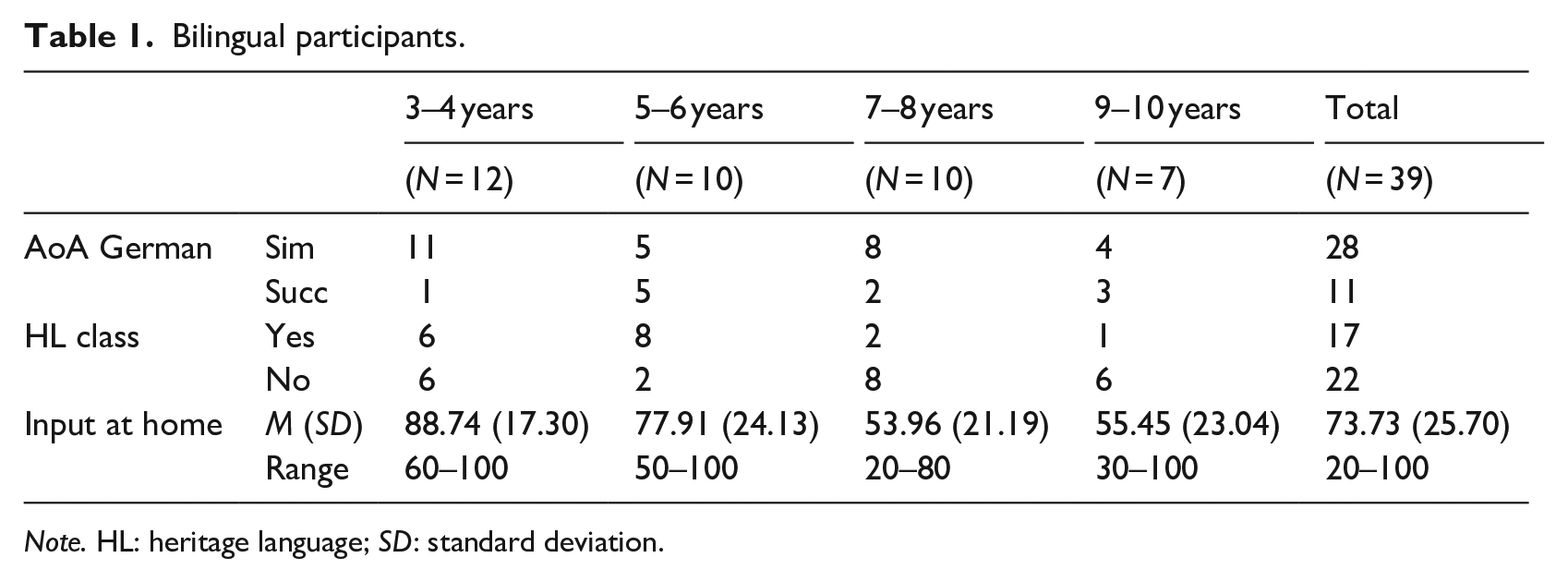
The children were tested individually in a classroom. A detailed background questionnaire focusing on sociolinguistic data was filled out by their parents. The questions concerned children’s age of onset of German as the environmental language; the languages spoken at home with both parents, siblings, and other family members and their relative frequency of use (in a scale from 1 to 5); visits to Poland; and enrolment in HL courses or a HL kindergarten. All participants are exposed to Polish since birth. An overview of the participants is given in Table 1.
Bilingual participants.
Note. HL: heritage language; SD: standard deviation.
The variable ‘input at home’ is based on the amount of Polish as HL spoken by each member of the household in interaction with the child (siblings younger than 4 years old were disregarded). The index can range up to 100% if all family members use only the HL in interaction with the child. As shown in Table 1, this index ranges from 20 to 100 (M = 73.73, standard deviation [SD] = 25.7). A closer look at this index across the four age groups shows that the quantity of Polish spoken with the children at home decreases with increasing age. While this index reaches a mean value of 88.74 (SD = 17.30) in the youngest group, it lowers to 55.45 (SD = 23.04) in the oldest age groups. Interestingly, the most salient difference lays between the 5- to 6-year-olds (77.91) and the 7- to 8-year-olds (53.96), revealing that entering the school indeed comes along with speaking the HL less frequently at home (i.e., speaking more the dominant school language). In fact, only in the school-age groups, we find children with frequency values under 50. A non-parametric Kruskal–Wallis test shows that there are indeed statistical differences between the groups’ input index (X = 17.077, p = .001). Furthermore, Mann–Whitney tests (with Bonferroni correction) confirm that the statistical difference lays between the 5- to 6-year-olds and the 7- to 8-year-olds (U = 16.000, p = .009), but there are no differences between the 3- to 4-year-olds and the 5- to 6-year-olds (U = 36.000, p = .123) and between the 7- to 8-year-olds and the 9- to 10-year-olds (U = 26.000, p = .417) regarding the amount of HL input they receive. An additional Spearman correlation confirms that there is a strong negative association between the children’s chronological age and their input index (rp = –0.580, p < .001), that is, the older the child the less input to Polish she/he has at home.
The HL data are compared to data from monolingual children collected by Sopata and reported in two earlier studies (Rinke et al., 2019 and Sopata, 2016). The monolingual participants of the studies included 48 monolingual Polish-speaking children, whose ages ranged from 3;1 to 6;11. These data were complemented by the additionally tested group of 8- to 9-year-olds, which includes six monolingual children, to ensure higher comparability of monolingual and bilingual data.
Methods
Data were obtained by using an elicited production task from Mykhaylyk and Ytterstad (2017), Rinke et al., (2019) and Sopata (2016). The experiment has been designed to elicit the production of direct objects. The participants were presented series of pictures displayed on a computer screen. Each picture sequence was introduced by a short narrative involving an agent and an animate or inanimate object. All narratives included an explicit mention of a possible discourse antecedent for the target direct object, which can be seen in the picture. A question about the depicted action followed which contained, or did not contain, an antecedent of the target direct object. In their answer, children were expected to use the direct object. Thus, all the referents have been previously mentioned and were visually present (see Hughes & Allen, 2015, for a discussion of these factors).
In order to examine children’s sensitivity to the accessibility and the animacy of the target object’s referent, we tested children’s expressions of direct objects in three conditions:
Condition 1 – NIA – in which the inanimate referent is
(1) Story: Piotruś widzi na drzewie gruszkę. Wygląda smacznie. On przynosi drabinę, aby ją zerwać.
Peter sees a pear on a tree. It looks delicious. He fetches a ladder to pick it.
Puppet: Co Piotruś zrobił?
What did Peter do?
Child’s expected answer: Zerwał gruszkę.
He picked the pear.
Condition 2 – IA-Inanimate referent – in which the
(2) Story: Braciszek Piotrusia miał ładny kubek, ale go zgubił w piaskownicy. Piotruś go umył i był bardzo szczęśliwy, że go znalazł.
Peter’s little brother had a nice sipping cup, but he lost it in a sandpit. Peter washed it and was very happy about finding it.
Puppet: Co Piotruś zrobił z kubkiem?
What did Peter do with the cup?
Child’s expected answer: Umył go/ Umył_.
He washed itCL/He washed_.
Condition 3 – IA-Animate referent – in which the
(3) Story: Łakomczuch Piotruś chciał zjeść cukierka, ale siostra także chciała tego cukierka i schwyciła go pierwsza. Piotruś był dlatego zły i ponieważ chciał odzyskać cukierka zrobił coś czego nie powinien. A jego siostra zaczęła płakać.
The lickerish Peter wanted to eat a candy but his sister also wanted this candy and grabbed it first. Therefore, Peter was angry and – because he wanted the candy back – did something that he shouldn’t have done. And his sister started to cry.
Puppet: Co Piotruś zrobił swojej siostrze?
What did Peter do to his sister?
Child’s expected answer: Uderzył ją.
He bit herCL.
Condition 1 differs from other conditions concerning the distance of the discourse referent, that is, its accessibility. As has been shown by Sopata (2016), in adult Polish, 94% of answers in this condition contain NPs as direct objects.
In Conditions 2 and 3, the referent is immediately accessible, which favours the use of a clitic pronoun or null object in Polish. Furthermore, the conditions differ with respect to animacy. Null objects are less likely to occur in animate contexts in Polish. As shown by (Rinke et al., 2019), the adults use 44% of clitic pronouns versus 25% null objects in Condition 2, and 71% of clitic pronouns versus 13% null objects in Condition 3. Null objects are in general more often used in spontaneous speech. They are rarely produced in experimental settings by adult monolingual speakers.
The task included 18 items, 6 for each condition. The children were given two prior training items. The gender/number properties of NPs were evenly distributed. The perfective aspect of the verbs used in the question prompted an answer with perfective transitive verbs, which cannot be used intransitively and can only be combined with definite and specific null objects in Polish.
Results
The data from the bilingual children acquiring Polish as HL in Germany were compared to the data from monolingual Polish children from Author’s earlier studies. A comparison between the data from both studies is possible, because the same material concerning all three conditions (NIA, IA-Inanim, and IA-Anim) has been used. The data of the monolingual preschool-age children were divided into the same age groups as the bilinguals (3- to 4-year-olds and 5- to 6-year-olds). The monolingual school-age children were included in one group only, since in the earlier studies, it has been shown that Polish L1 children behave adult-like concerning object realization from age 6 onwards (Sopata, 2016).
We will start by presenting the results condition by condition.
The first condition is the not immediately accessible (NIA) context, in which the referent is not mentioned in the question. Figure 1 presents the performance of the monolingual and Figure 2 of the bilingual children.
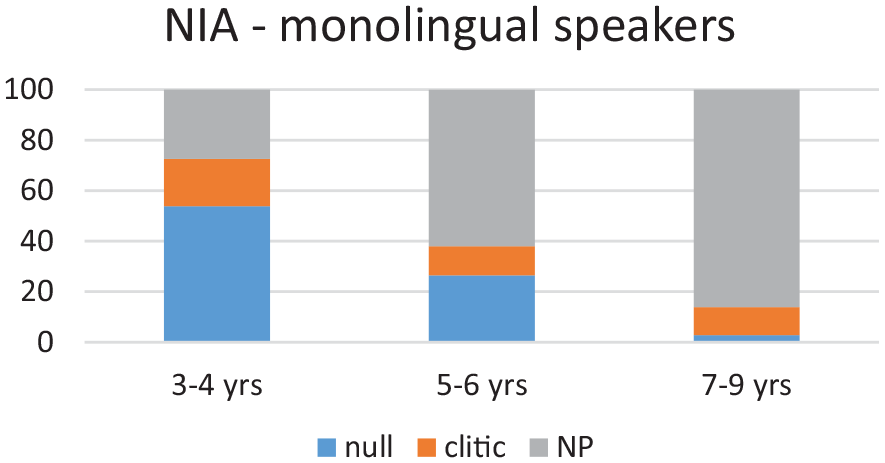
Distribution of object forms in not immediately accessible contexts (NIA) per age groups – monolingual speakers (in percentage).
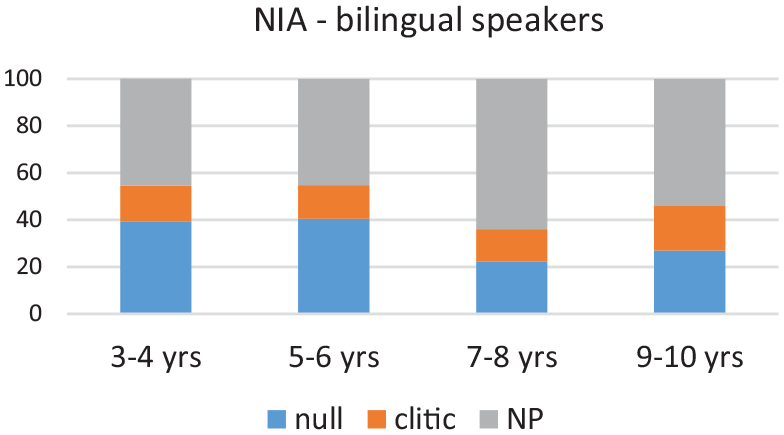
Distribution of object forms in not immediately accessible contexts (NIA) per age groups – bilingual speakers (in percentage).
Figure 1 shows pronounced differences between the monolinguals’ age groups in the NIA context. The 3- to 4-year-old monolingual Polish children produce high rates of null objects in this context (53.8%) which does not allow for object omission, confirming, thus, the (universal) tendency for children to omit objects in early stages of acquisition independently of pragmatic constraints. This tendency to omit the object decreases steadily with increasing age. It reaches 26.5% in the 5- to 6-year-old group, in parallel to the increasing use of (pragmatically appropriate) NPs. At school age (7–9 years), Polish monolingual children show residual omissions (2.8%) and high rates of NPs (86.1%). The use of clitics is similar in all age groups (between 18.8% and 11.1%).
If we now look at the bilinguals’ results, displayed in Figure 2, we see that the 3- to 4-year-old bilingual children use a similar number of null objects (39.4%) and NPs (45.5%) in the NIA context. Thus, they produce much more NPs in this context than the monolingual children, which is the target-like option in this context. However, a look at the bilingual 5- to 6-year-olds reveals that, contrary to the monolinguals, the performance of the heritage speakers in this age group is similar to the younger ones, that is, no developmental effect can be observed between 3- to 4- and 5- to 6-year-olds. Advancing to the next age group, the 7- to 8-year-old bilinguals produce lower rates of null object constructions (22.2%) and higher rates of NPs (63.9%). The rate of null objects in this age group is much higher than in the monolingual group. Furthermore, it remains similar up to the oldest bilingual group (27%). As in the monolingual group, the number of clitic pronouns remains steady across all age groups (between 13.9% and 18.9%). Overall, the results reveal that, in the NIA condition, the bilingual children start with a performance similar to that observed in monolingual children, but the development towards target-like preferential use of NPs (and avoidance of omissions) in this context is much slower and does not converge towards monolingual-like levels at age 9 to 10 years.
Now we turn to the second condition, in which the referent is immediately accessible and inanimate (IA-Inanim, see Figures 3 and 4).
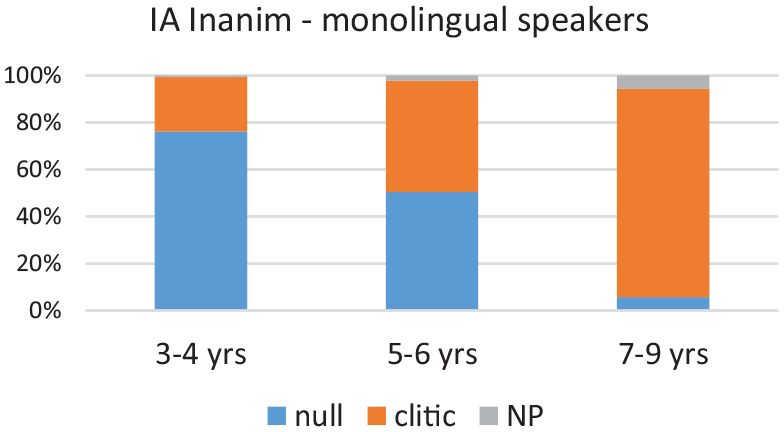
Distribution of objects in immediately accessible inanimate contexts (IA-Inanim) per age groups – monolingual speakers (in percentage).
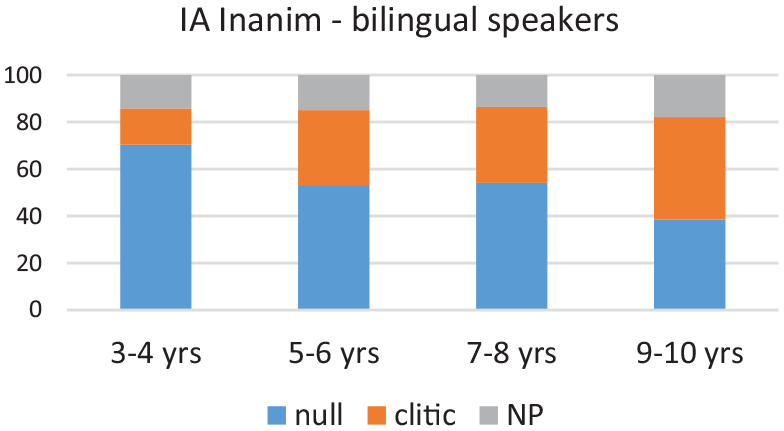
Distribution of objects in immediately accessible inanimate contexts (IA-Inanim) per age groups – bilingual speakers (in percentage).
For the monolingual children (Figure 3), the developmental process is similar to the one observed in the NIA contexts. At age 3 to 4, the monolingual children display high rates of omissions (76.1%); this percentage decreases to 50.4% in 5- to 6-year-olds and is low in the school-age children (5.7%). In parallel, the production of clitics increases steadily, reaching 88.6% in the oldest group. The use of NPs is very low in this condition across groups (0.7%–5.7%).
Again, for the heritage speakers (Figure 4), the picture is different. The 3- to 4-year-old bilingual children display similar percentages of null objects (70.4%) as the monolingual children (76.1%). However, contrary to monolinguals, they produce almost the same number of NPs (14.2%) and clitics (15.4%). Importantly, the rate of null objects decreases less steadily than in the monolingual groups. At age 5 to 6 and 7 to 8 years, the heritage speakers still produce 53.2% and 54.1% of null objects, respectively. In addition, the two age groups produce similar rates of clitics and NPs. The number of NPs remains close to the rate observed in the 3- to 4-year-old bilingual group. The oldest bilingual group (9–10 years) still produces 38.5% of null objects and 17.9% of NPs in this condition, which is very distinct from the values observed for monolingual children. Overall, also in this condition, we observe that the bilingual children start with a performance similar to that of monolingual children, but the development is slower and does not reach monolingual-like levels at ages 9 and 10.
The third test condition refers to contexts in which the referent is immediately accessible in the previous sentence and it is animate (IA-Anim, see Figure 5 for monolinguals and Figure 6 for bilingual speakers). In this context, the expected response is a clitic pronoun.
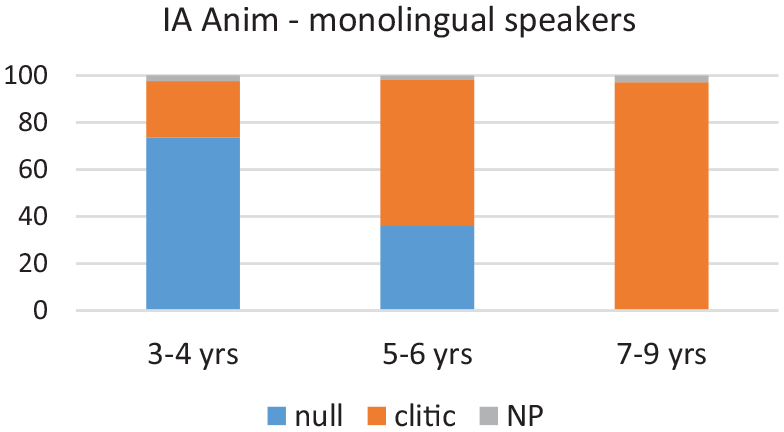
Distribution of objects in immediately accessible animate contexts (IA-Anim) per age groups – monolingual speakers (in percentage).
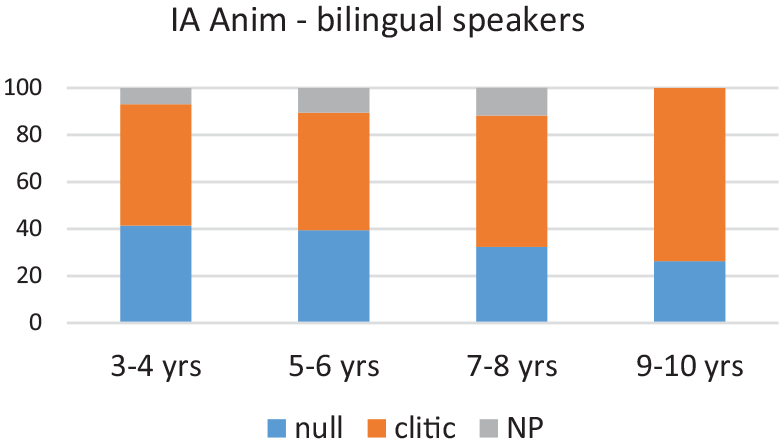
Distribution of objects in immediately accessible animate contexts (IA-Anim) per age groups – bilingual speakers (in percentage).
As can be seen in Figure 5, monolingual Polish children start by using high rates of null object constructions at early stages of development, also in contexts with previously mentioned animate objects. In the 3- to 4-year-old group, the omission rate reaches 73.6%. This number decreases considerably in the 5- to 6-year-olds (36%). For the school-age monolingual children, null objects are not an option in this context, as expected for Polish, which does not allow for animate null objects. The decreasing rate of omissions comes along with the increasing use of clitic pronouns, which are underused in the youngest group (24%) but almost exclusively employed by the oldest ones (97.2%).
In the bilingual group, the picture is again a bit different. The two pre-school-aged bilingual groups (ages 3 to 4 and 5 to 6 years) produce around 40% of null object constructions in these contexts (41.4% and 39.5%, respectively). Importantly, their rate of clitic production, the expected option, exceeds the rate of omissions (51.7% and 50%, respectively). Thus, their performance is not very distinct from that of monolingual children. The most visible differences appear at school age. Whereas the monolinguals no longer resort to omissions, this rate is still expressive in the heritage speaker groups (32.4% for 7- to 8-year-olds and 26.3% for 9- to 10-year-olds). Nevertheless, the option for the clitic pronoun continues to exceed the null object option also in the bilinguals, revealing an overall knowledge of the semantic–pragmatic constraints of the use of different types of direct objects across different age groups.
For the statistical analysis of the distribution of participants’ responses, we ran a generalized linear mixed model (GLMM) with a multinominal dependent variable, executed in SPSS 23. The participants’ ‘answer’ is the dependent variable with three values (null, clitic, and NP); null is coded as the reference value. As fixed effects, the model includes ‘condition’ (NIA, IA-Inanim, and IA-Anim) and an interaction between ‘group’ (monolingual speakers and heritage speakers) and the various age groups; ‘participants’ and ‘items’ are random effects.
The model shows a predictive effect of condition (p < .0001) and of the age group × speaker group interaction (p < .0001) (see Table 2).
Generalized linear mixed model (GLMM) results.
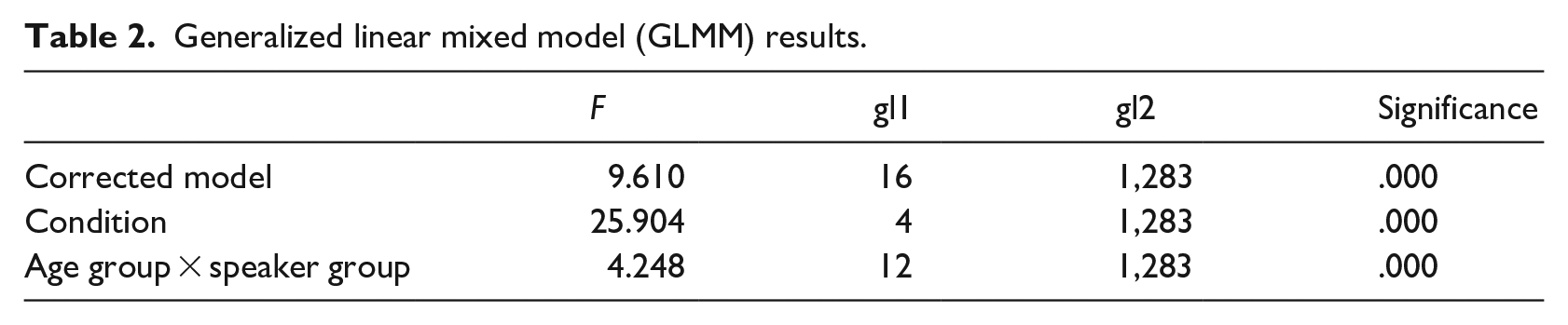
These results indicate that, as expected, globally, the participants’ use of null object constructions is significantly modulated by the test conditions. However, a closer look at the age group × speaker group interaction (see Table 3) reveals that this interaction is only significant in the monolingual group in the youngest and in the oldest group, that is, the proportion of null objects changes significantly over time (from the youngest to the oldest age group) but only in the monolingual group. In the case of the heritage speakers, there is a marginal significant effect of this interaction in the 3- to 4-year-olds (p = .51), but in the other age groups, variation in the proportion of null objects is not statistically significant.
Generalized linear mixed model (GLMM) results for the interaction ‘age group × speaker group’.
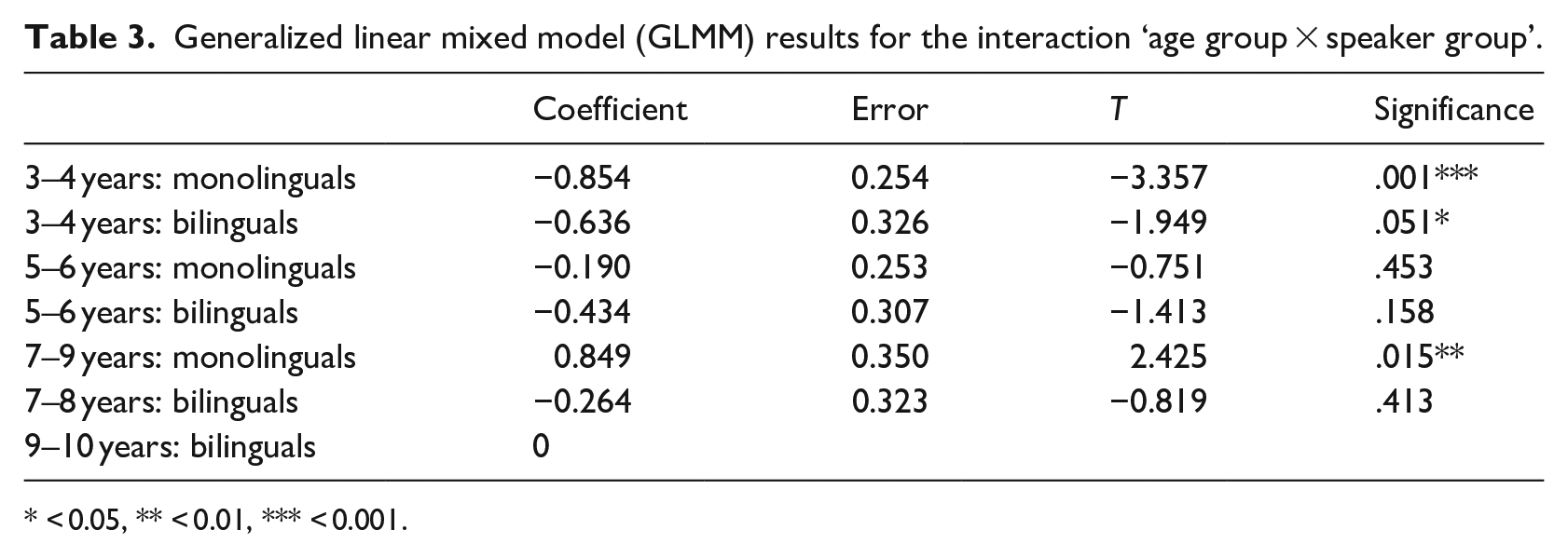
< 0.05, ** < 0.01, *** < 0.001.
Discussion
The data analysis in the previous section answers to the study’s research questions in the following way.
With regard to the first research question concerning the realization and omission of objects in younger bilingual children, the data show that the use of null objects by the youngest group of Polish-German bilingual children is not very distinct from that of the youngest monolingual children. The 3- to 4-year-old bilinguals even omit objects less frequently than monolinguals in all three conditions. However, the pictures changes if we compare the 5- to 6-year-old groups: Polish-German bilinguals omit objects more frequently than age-matched monolinguals. Globally, we can say that the bilingual children at the age of 3 to 4 and 5 to 6 omit objects in discursive inadequate contexts, similar to monolinguals. In the case of the youngest bilingual group, the percentage of null objects in inadequate contexts is smaller than in the respective monolingual group, but in the case of 5- to 6-year-old bilingual children, their percentage of null objects in inadequate contexts is higher than that in the group of monolinguals at the respective age (see Figure 1 vs Figure 2). Comparing the two younger bilingual groups with each other, we see no developmental effect in the performance in the NIA condition from 3- to 4-year-olds to 5- to 6-year-olds, contrary to monolinguals (see Figure 1 vs Figure 2).
In sum, Polish-German bilingual children do not show higher rates of object omission in Polish than monolinguals at the age of 3 to 4 years. Moreover, bilinguals’ performance at the earliest stage is even more target-like than that of monolinguals.
However, while monolingual children show a developmental effect at age 5 to 6, decreasing the use of null object constructions, this effect is not visible in the bilingual population. The bilingual children at this age use more object omissions than monolinguals, also in discursive inadequate contexts. Since omission rates in bilingual speakers are not higher than those of the monolinguals across all age groups, we argue against the hypothesis that the higher number of null objects in bilingual data is a result of being bilingual per se (Pérez-Leroux et al., 2017; Pirvulescu et al., 2014). The 3- to 4-year-old bilingual children acquire two languages at the same time like other bilingual age groups and do not have higher omission rate of objects than monolinguals at the respective age. Rather, the data show that bilingual children initially develop in a parallel way as monolinguals and show even an advantage over monolingual children. The explanation for this more target-like performance of the bilingual children may tentatively be attributed to a better control over attention, as suggested in the literature on cognitive advantages of childhood bilingualism (e.g., Bialystok, 2001). Since using null arguments requires from speakers an appropriate assessment of the degree of accessibility of the referent, an assessment of the perspective of the hearer (Theory of Mind, e.g., de Cat, 2015), and often the skill to inhibit one’s own perspective, the role of executive control is highly relevant in this process. The executive functions are also required to retrieve from memory relevant features of the referent in the case of its new mention (e.g., Torregrossa et al., 2021). Therefore, the fact that the youngest bilinguals outperform the monolinguals in the appropriate use of null objects – in a stage when they still have high amount of exposure to their HL – may be traced back to their better executive functions.
However, the development of object expression decelerates in the bilingual group during the course of acquisition. The difference in the use of object omission constructions by bilingual and monolingual children at the age of 5 to 6 years is the greatest in the NIA condition. This points to the conclusion that the development of null objects starts to decelerate at this age in the case of bilingual HL speakers. While 5- to 6-year-old monolingual children start to acquire the mechanisms of integration of syntactic and pragmatic knowledge and their use of null objects becomes more target-like at this stage, the bilingual 5- to 6-year-olds become less target-like than their monolingual peers. We attribute this development to the decreasing exposure to the HL at home. At this age, the children enter the German school and the input in Polish begins to drop. This is confirmed by the results of the non-parametric tests, which show significant differences between the bilingual age groups concerning their amount of HL input, as well as a significant negative correlation between increasing age and decreasing amount of input.
The production of the youngest bilingual group reveals an early pragmatic knowledge of object realization in the HL. In the NIA context, which requires NPs since the referent is not immediately accessible, the bilinguals even produce much more NPs than monolingual children. The comparison between the use of NPs in the NIA and the IA-Inanim conditions shows that already the youngest bilingual group differentiates between 45.5% of NPs in the NIA condition and 14.2% in the IA-Inanim condition (see Figures 2 and 4). This result corresponds to the contrast in the use of NPs observed in the group of age-matched monolinguals (27.4% in NIA condition vs 0.7% in IA condition), as shown in Figures 1 and 3. The preference for NPs in the NIA condition as compared to the IA condition when the inanimate referent is not immediately accessible can be also seen in the data of the 5- to 6-year-old bilinguals (see Figures 2 and 4). They do not differ in this respect from monolinguals. This shows that bilingual children acquiring Polish as HL differentiate between pronominal and non-pronominal contexts at a similar time and to a similar degree as monolingual children.
Furthermore, the data of the youngest group of Polish-German bilinguals demonstrate that children acquiring Polish as HL differentiate between animate and inanimate referents from very early on. Their rate of responses with clitics is higher than that with null objects in IA-Anim condition, in which the referent is animate and, therefore, the clitic is the expected option (see Figure 6). This preference stays stable also in the data of the older bilingual children at the age of 5 to 6 years. Comparing the use of clitics in the IA-Anim condition to that in the IA-Inanim condition, we also see the expected preference for clitics in the IA-Anim condition in both younger bilingual groups (see Figures 4 and 6). This behaviour corresponds to monolingual development in which the animacy effect can be clearly seen from the age of 5 to 6 years on.
The second research question related to the developmental path of object omissions from the age of 6 years on. The data of the two older bilingual groups, aged 7 to 8 and 9 to 10 years, demonstrate, globally, reduced progress towards an avoidance of object omissions in all conditions. In the NIA condition, both older bilingual age groups use a similar number of discursively inadequate null objects (22.2% and 27%, respectively, see Figure 2) in these contexts. The performance of both older bilingual groups stands, thus, in sharp contrast to that of monolingual children at this age. The 7- to 9-year-old monolinguals use only 2.8% null objects in the NIA condition.
Both older bilingual groups, 7- to 8-year-olds and 9- to 10-year-olds, produce much higher rates of null objects as compared to monolinguals in the IA-Inanim condition. However, the rate of null objects drops from 54.1% in the group of bilingual children aged 7 to 8 years to 38.5% in the oldest group of bilinguals aged 9 to 10 years (see Figure 4). Even so, the performance of the bilinguals at the age of 9 to 10 years is far apart from the monolingual rate at this age (5.7%, see Figure 3).
A clear discrepancy between 7- to 9-year-old monolinguals and the two older bilingual groups can also be observed in the IA-Anim condition. While monolinguals at this age no longer resort to object omissions in the contexts with animate referents, the two older bilingual groups do use null objects in these contexts. However, the 9- to 10-year-old bilinguals use them less often than the 7- to 8-year-old bilinguals (see Figure 6), showing a slow but steady development towards target-like frequency of null objects in contexts with animate referents.
The two older bilingual groups continue the preference for NPs in the NIA condition as compared to the IA-Inanim condition demonstrating an evident ability to differentiate between pronominal and non-pronominal contexts. The bilingual children at the age of 7 to 8 and 9 to 10 years continue also to prefer clitic pronouns over null objects in the IA-Anim condition. In the case of the oldest bilingual group, the rate of clitics amounts to 73.7% in this condition, revealing a steady development of the knowledge of semantic–pragmatic constraints.
The results of the school-aged bilingual children show a slow but steady development towards a target-like use of NPs and clitic pronouns and, thus, an advancement in the acquisition of pragmatic knowledge. However, the results of the 7- to 8- and 9- to 10-year-old bilingual children also demonstrate that the heritage speakers of Polish at this age did not overcome the extended null object stage. The differences in production of null objects between Polish monolinguals and heritage speakers of Polish may, therefore, persist into adolescence. The GLMM confirms that there is overall sensitivity to the different pragmatic–semantic contexts regarding the use of null objects, but the effect of age, from the youngest to the oldest age groups, is only significant in the monolingual population. In the bilingual population, there is only a marginal effect of age, regarding the youngest bilingual group.
The extended null object stage in the heritage speakers of Polish shows that the bilingual children persist in ignoring the necessity for the clause-internal valuing relation, that is, linking of null objects to the relevant topic feature in C/edge. At least up to the age of 10 years, heritage speakers of Polish use the identity assignment strategy to the null objects by a direct control relation between a clause and its further context without C/edge linking.
To sum up, several findings have emerged from this study. The results have confirmed that children acquiring Polish as HL show an early sensitivity to pragmatic context. They also demonstrate an early differentiation between various referential properties of referents leading to a target-like use of clitics. The largest discrepancy between bilingual and monolingual children concerns the production of null objects. Their acquisition and appropriate use is a hard task for monolinguals as has been shown in numerous studies. The acquisition of null objects by heritage speakers turns out to be even harder and is therefore delayed. The Polish-German bilingual children do not overcome the extended null object stage even at the age of 9 to 10 years. Thus, we may assume that the differences in production of null objects between monolinguals and heritage speakers of Polish may persist into adolescence or even adulthood, as demonstrated for EP by (Rinke et al., 2018).
The results have provided evidence that null forms used by young heritage speakers of Polish until the age of 9 to 10 years are unlikely to be due to limited pragmatic knowledge, because the relevant knowledge has been acquired quite early by them. Therefore, the results are in line with findings of Serratrice (2013), Hughes and Allen (2015), and others demonstrating the early acquisition of pragmatic knowledge. The overuse of null forms at later stages also cannot be explained by potential problems with the acquisition of clitics as claimed by Grüter (2006) and Grüter and Crago (2012), because the results have demonstrated that the use of clitics is mastered by heritage speakers of Polish at early stages of acquisition.
The delay effect cannot be explained by cross-linguistic influence either as proposed by Müller and Hulk (2001) for German-French and Dutch-French bilinguals. Since Polish is a null subject and null object language, the rate of null arguments in the Polish input is higher than in German, which allows only null topics. Therefore, the longer stage of object omissions in heritage Polish cannot be caused by the presence of the German grammar in the bilingual mind.
We do not assume a specific syntactic representation for null objects in child’s grammar, that is, default null cognate objects (Pérez-Leroux et al., 2008, 2017). A default null object representation extended from generic to transitive contexts, as claimed by the authors, is unlikely to be a part of children’s mental grammar of L1 Polish. Transitive and generic contexts are easily distinguished in Polish, because, in the perfective aspect, Polish transitive verbs may not be used intransitively.
In our view, the prolonged acquisition of null objects, visible in the inappropriate use of the null forms until the age of 9 to 10 years in the bilingual group, can be best explained by the complexity of the task of integrating pragmatic and syntactic knowledge during language comprehension and production (see Rothman, 2009, and Sorace, 2011). We argue that null objects are bundles of active silent features which have to be linked to silent phase edge features and related to the pragmatic context. While the youngest bilingual children seem to cope with the task even better than monolingual children at this age, probably due to better developed executive functions, the further acquisition of adult-like null objects in bilinguals falls behind. This is certainly due to the challenging task of mastering this linguistic complex structure at a stage when many bilingual children have reduced contact with their HL. Concretely, we advocate an explanation of the prolonged use of null elements in inappropriate discourse contexts in terms of a prolonged use of the strategy of free context scanning which is used by monolingual children until the age of 6. Evidently, due to input limitations, children acquiring a HL need more time to replace the strategy of free context scanning by the feature linking mechanism. Developing the process of valuation of C/edge linkers in relation to prior discourse and pragmatic context and successful referential validation and identification of a null object in Polish is a demanding acquisition task which is not triggered by identifying parametric properties as in the case of core syntactic phenomena. Crucially, children need rich and frequent input in order to fully acquire this phenomenon at the syntax–pragmatics interface. Despite a potential cognitive advantage at earlier stages of development, the bilingual children diverge from monolingual children by the of 5 to 6 years in the acquisition of null objects, since their HL input at this age, when they go to school, is usually more restricted.
Conclusion
To conclude, the paths of null object acquisition of Polish monolinguals and Polish heritage speakers start to diverge at the age of 5 to 6 years. The use of null objects by younger heritage speakers at the age of 3 to 4 years is not distinct from that of monolinguals and even more target-like. Thus, the study shows that heritage speakers develop at the earliest stage in a parallel way as monolinguals and only later decelerate in their development of null objects. The higher rate of null objects in the bilingual data is not consistent across age; therefore, the overuse of object omissions by bilingual children is not a consequence of acquiring two languages at the same time but rather of reduced input leading to a prolonged stage of acquisition of integration rules of syntactic and pragmatic knowledge. The extended null object stage may persist into adolescence.
To explore the hypothesis that better cognitive functions might be at play and explain at least part of the results, complementary tasks on executive functions are due. This line of research should be explored in future studies on object realization by heritage bilingual children.
Footnotes
Declaration of conflicting interests
The author(s) declared no potential conflicts of interest with respect to the research, authorship, and/or publication of this article.
Funding
The author(s) received no financial support for the research, authorship, and/or publication of this article.
