




Abstract
Aims and objectives/purpose/research question:
The expression of event series varies across languages in intriguing ways. One key difference is that in some linguistic systems, such as Chinese, events can be tightly sequenced using serial verb constructions (SVCs), for example, qù kāi mén ‘go open door’. Linguistic systems with this property are known as serializing, and those without it, such as English, as non-serializing. This paper explores whether second language (L2) learners with a serializing first language (L1) conceptually transfer tight L1-based event serialization patterns into their non-serializing L2, and, if L2 learners with a non-serializing L1 acquire tight SVC-modulated event serialization in the L2.
Design/methodology/approach:
To investigate this, a task was created to estimate temporal distances between events on a time axis. Participants were asked to circle two numbers on the axis (0 = far past, 9 = far future) based on their understanding of when two events expressed by two verbs in each stimulus sentence happen.
Data and analysis:
Results showed that Chinese learners of English estimated significantly shorter temporal distances between multiple events in English SVC-like sentences compared to English natives. Tighter temporal sequencing in L2 English is interpreted as L1-based conceptual transfer of event serialization patterns. In the opposite direction, English learners of Chinese marked events in Chinese SVCs as significantly further apart than did Chinese natives, also showing that their event serialization is L1-based.
Originality:
This study demonstrates for the first time crosslinguistic influence on the conceptual level in the domain of event serialization.
Significance/implications:
The reported findings inform L2 acquisition research by providing empirical support for the idea that L1-based event serialization patterns influence how L2 learners conceptualize event distances, and this holds in both directions, from a serializing to a non-serializing language as well as vice versa.
Keywords
Introduction
Substantial crosslinguistic differences in how event series are expressed arise in connection with the availability or absence of syntactic constructions that enable speakers to manipulate the ‘tightness of packaging’ of events (Bohnemeyer & Pederson, 2011, p. 47). Some languages, including Chinese, allow tighter event packaging via serial verb constructions (SVCs), defined here as “a sequence of verbs which act together as a single predicate, without any marker of coordination, subordination, or syntactic dependency of any other sort” (Aikhenvald, 2006, p. 1). Verb phrases (VPs) in SVCs “express simultaneous or immediately consecutive actions that can be conceived as one event” (Lin et al., 2012, p. 428). With respect to consecutiveness, related research shows considerable consensus that the order of verbs in SVCs follows the principle of temporal iconicity (e.g. Aikhenvald, 2006; Durie, 1997; Li, 1993; Lord, 1993; Muysken, 1988; Nishiyama, 1998), that is,. that the order of verbs in SVCs mirrors the chronological order of the (sub)events these verbs express. For instance, in the Chinese sentence wǒ qù kāi mén ‘I go open door’, the verbs are sequenced according to the temporal order of the events they represent to form a compound predicate. The events ‘go’ and ‘open door’ are tightly linked to each other and are not temporally separable (i.e. ‘I go open door’ ≠ ‘I first go and then open the door’ but instead = ‘I go to open the door’). In contrast, in many languages such as English, the grammatical expression of event series is uncommon (limited to colloquialisms such as ‘I go get a taxi’). Languages with SVCs are typologically categorized as serializing and without SVCs as non-serializing (Aikhenvald, 2006; Bisang, 2009; Haspelmath, 2016; Yin, 2007). This typological difference in the grammatical encoding of event serialization is potentially problematic for second language (L2) users because learning success in this case not only entails a new form of linguistic expression but also a new way of organizing event information, comprising either more or less tightly combined temporal units.
Previous research examined various morpho-syntactic and semantic aspects of how crosslinguistic differences between serializing and non-serializing languages influence L2 acquisition. Learners from serializing first languages (L1s) were found to transfer morpho-syntactic features of SVCs (e.g. she went home had dinner) (Helms-Park, 2004; Tang, 2018; Yang & Huang, 2009) or L1-specific uses (e.g. cook butter melt) (Helms-Park, 2001; Juffs, 1996) into their L2 English production. On their way from a non-serializing L1 to a serializing L2, corpus-based studies reported that L1 English learners often underuse Chinese SVCs (Sun, 2008; Zhou, 2009). In their investigation of SVC use in contact settings with second-generation Chinese as heritage language speakers, Aalberse and colleagues conducted a series of studies to investigate the acquisition of SVCs alongside aspect, classifiers, ditransitive constructions and motion verbs (Aalberse & Zou, 2016; Aalberse et al., 2016; Chau, 2011; Chen, 2012; Dong, 2014; Lin, 2014; Lippe, 2015; Liu, 2013; Shi, 2011). These studies converged in the observation that SVCs tended to be underemployed or misused by Chinese as heritage language speakers. Misuses and underemployment were attributed to incomplete acquisition or to influence from Dutch as the speakers’ dominant language. SVC underuse (compared to their homeland peers) was also observed among second and third generation Malay heritage language speakers in the Netherlands (Moro, 2014, 2016), and also among Javanese heritage language speakers in Suriname (Villerius, 2019). These findings indicate L1 influence at the linguistic level. However, they tell us little about the conceptual substrate that underlies L2 learners’ event serialization. That is, the mere use of such forms cannot reliably show whether, and if so, then to what extent, conceptualization of event distances in a series is influenced by the structure of the L1 or L2. This research gap invites a systematic investigation of learners’ understanding of temporal distances between individual events, which is done here to show whether typological differences in event serialization have an impact on how events series are conceptualized during sentence comprehension and interpretation.
Theoretical underpinnings
Conceptualization of serial events and the L1
Experimental studies framed within the cognitive linguistics approach have provided support for the idea that the differences between serializing and non-serializing languages are linked to different ways of viewing multiple related events (e.g. Bohnemeyer & Pederson, 2011; Defina & Majid, 2012). Defina and Majid (2012) asked 34 Avatime (a serializing language spoken in eastern Ghana, Niger–Congo language family) speakers and 33 English (non-serializing language) speakers to watch short videos with take–put-type events. The participants’ task was to indicate if the videos they watched in the test phase were the same as those shown earlier. Avatime speakers displayed significantly more false recognitions in SVC events, which was interpreted as a tendency to regard an SVC as a single conceptual event (in this case including both the ‘take’ and the ‘put’ part). In contrast, L1 English learners were found to segment the same ‘take’ and ‘put’ events as separate units. This study provided evidence for the view that event conceptualization in serializing and non-serializing language speakers differs because an SVC expresses a single conceptual event, in which sub-events are tightly linked, while the corresponding sub-events in a non-SVC language are understood as separate temporal units, between which the temporal distance is relatively longer. This study documented L1-driven variation in event conceptualization, which in turn raises the question of whether the conceptualization of temporal distances between SVC-based events transfers into a L2.
Typological differences between serializing Chinese and non-serializing English
Expression of event series in Chinese SVCs
Chinese sentence types can be divided into canonical SVCs, peripheral SVCs (pivotal sentences), and non-SVCs (verb–object sentences) (Tao, 2009). They overlap with their English counterparts in different degrees, which has direct implications for learning demands.
Canonical SVCs
Canonical SVCs are the most typical and common type in Chinese and are characterized as two or more separate events juxtaposed and compressed together in a continuum (Li & Thompson, 1981) (see example 1).
(1) Tā tuō xié zǒu jìn fang qù. He take off shoe walk enter house go V1 V2 V3 V4 ‘He took off his shoes and went into the house.’ (Ding, 1979, p. 114)
In example 1, all the verbs are bare and thus constitute a zero-marked clause 1 , within which verb constellations that express telic and/or instantaneous events are interpreted as completed.
The second SVC type of concern to the current study is peripheral SVCs. These are also known as pivotal sentences (Tao, 2009). This construction type is less transparent than canonical SVCs because “of the two predicates in a sentence, the object of the first predicate (verb) is at the same time the subject of the second one” (Li & Cheng, 2008, p. 485) (see example 2).
(2) Wǒmen qǐng tā chàng yī-zhī gē. We invite she sing one-CLF song V1 V2 ‘We invited her to sing a song (sometime in the future).’
The structural frame is that a noun ‘pivot’ connects V1 and V2 and functions as an object complement (Xing, 2004). The two verbs in example 2 represent an event continuum with two sub-events that are not tightly linked. Speakers have the possibility to express the two events in pivotal sentences as more tightly linked by adding the perfective aspectual morpheme ‘le’ after V2, as in example 3. Pivotal sentences with and without ‘le’ after V2 have different counterparts in English, which lead to varying predictions with regards to potential L1 influence on L2 conceptualization. Only pivotal sentences without ‘le’ were tested here (details in Current Study).
(3) Wǒmen qǐng tā chàng le yī-zhī gē. We invite she sing PFV one-CLF song V1 V2 ‘We invited her to sing a song (sometime in the past).’
The third type of construction that we focus on are non-SVC sentences with multiple verbs. In this sentence type, multiple verbs have no connective markers to link them, yet the verbs do not form a compound predicate. V2 functions as the object of the sentence (see example 4). Verbs that function as object in non-SVC sentences are lexical verbs that typically express mental activities and senses, beginning, continuation or ending, gain or loss, addition or reduction (Li & Cheng, 2008). Chinese verbs can function as object without any morphological changes.
(4) Wǒ dǎsuàn huí jiā. I plan go home V1 V2 ‘I plan to go home.’
Expression of events in finite and non-finite constructions in English
Multiple events expressed in a single clause in non-serializing languages such as English take the form of finite and non-finite verbs (e.g. I bought a ticket to enter the theatre). A crucial point here is that Chinese SVCs and English finite and non-finite sentences are not equivalent. For an illustration, in a sentence such as I bought a ticket to enter the theatre, the finite verb ‘bought’ conveys that the event ‘buying a ticket’ occurred in the past, but no specific temporal anchoring is provided for the nonfinite verb ‘to enter’. Egan (2008) argues that the nonfinite complement is temporally situated vis-à-vis the events expressed by the finite verb, and reports that 77.6% of ‘to infinitives’ in the British National Corpus express a forward-oriented relation with the corresponding finite verbs.
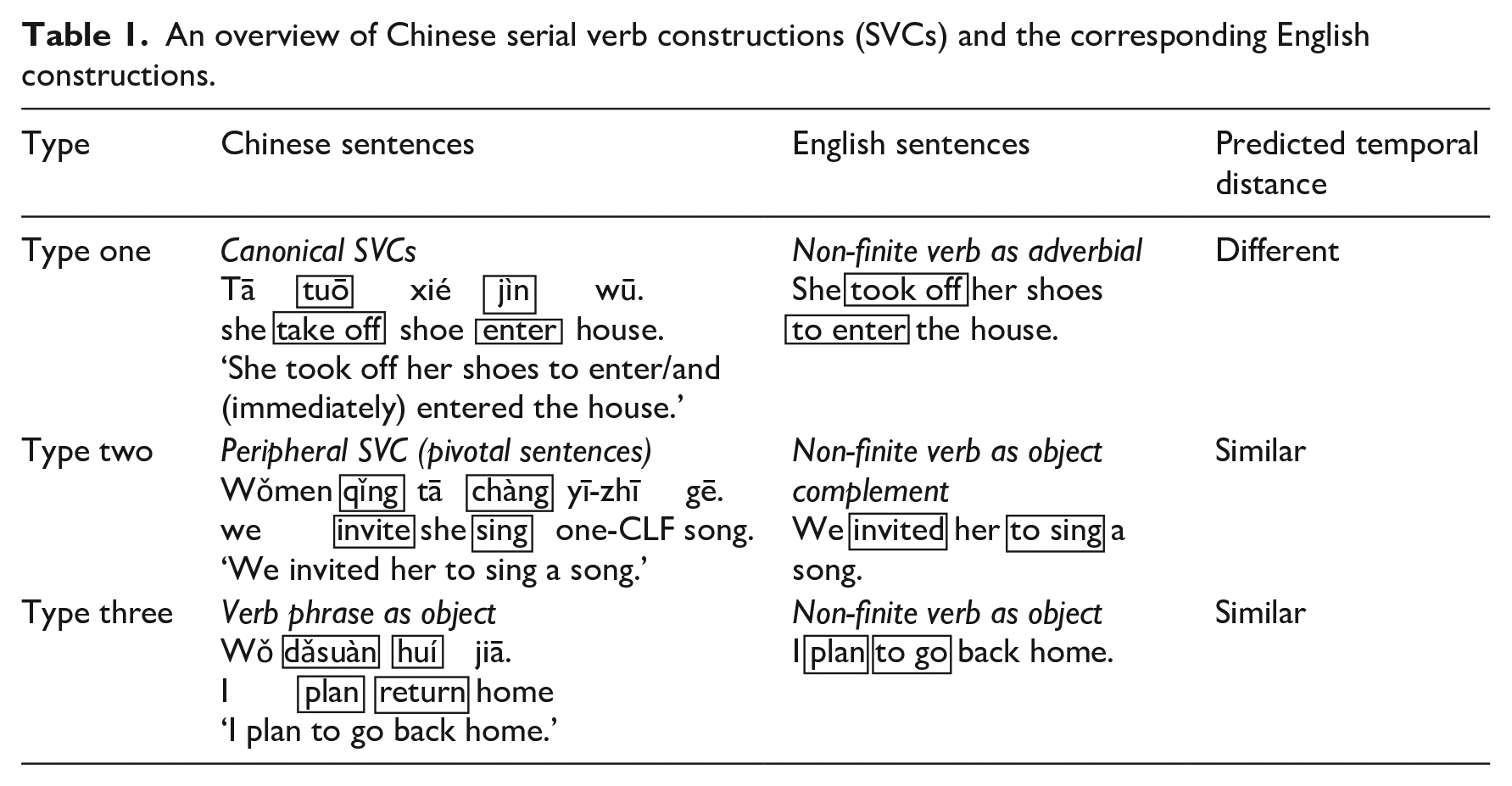
A crosslinguistic comparison (Table 1). Chinese canonical SVCs (Type one) share some similarities with the surface structure of English non-finite verbs used as purposive adverbials (e.g. ‘Peter opened the can to feed the dog’). However, while the former expresses an event continuum and grammatically pools the events closer, the latter describes subordinated events that are temporally further apart. Chinese peripheral SVCs (Type two) are similar to the structure of English non-finite verbs used as object complements (e.g. ‘Sarah asked me to forward the email’). Chinese non-SVCs with verbs as object (Type three) are viewed as a direct equivalent of English non-finite verbs as object (e.g. ‘John stopped smoking’), neither of which conveys tight event serialization (as in Table 1).
An overview of Chinese serial verb constructions (SVCs) and the corresponding English constructions.
Crosslinguistic influence on L2 event conceptualization
Conceptual non-equivalence relates to cases when a word or a grammatical expression in the L1 does not have an equivalent counterpart in the L2 (Finkbeiner et al., 2004). Theories attempting to explain what underlies concepts in the bilingual mind in cases of conceptual non-equivalence vary. Some argue that conceptualization in the L2 is L1-based as a result of crosslinguistic influence (e.g. Jarvis, 2007; Odlin, 2005). An alternative position is that L2 learners can and do shift from their L1-based conceptualization towards L2-based patterns (e.g. Athanasopoulos, 2011).
One way to account for L1-based conceptualization of events in the L2 is conceptual transfer. Jarvis’ Conceptual Transfer Hypothesis postulates that “certain instances of cross linguistic influence in a person’s use of one language originate from the conceptual knowledge and patterns of thought that the person has acquired as a speaker of another language” (Jarvis, 2007, p. 44). This definition is problematic not least because of its heavy focus on the role of the L1, without providing ground to explain how new concepts are learned in the L2. Transfer defined as concept learning is more comprehensive in this respect. Schachter views transfer as a “set of constraints that [the learner’s] previous knowledge imposes on the domains from which to select hypotheses about the new data one is attending to” (Schachter, 1983, pp. 45–46). If we focus on the constraints exercised by the L1 on the hypotheses that a learner is able to formulate about the language they are exposed to, we enable the examination of two L1–L2 configurations, both when there are and when there are no corresponding linguistic features. This is directly relevant for the present study, where the L1–L2 directions are SVC L1 to non-SVC L2 as well as non-SVC L1 to SVC L2. In the domain of event serialization, if Chinese imposes constraints on its speakers to vary tightness of event in series relatively more than English does, one would predict that for Chinese English as a foreign language (EFL)’ learners tight SVC-based event serialization patterns will be difficult to reorganize in a relatively looser, English-like way. Analogously, one would also predict that English Chinese as a foreign language (CFL)’ learners will resist restructuring their concept of loosely linked event series into more tightly linked ones. In the current study, we use ‘crosslinguistic influence on concepts’ to refer to both ‘conceptual transfer’ of SVC-based tightly linked event sequences in Chinese EFL learners and L1 constraints on English CFL learners’ conceptualization in the L2.
Numerous experimental studies have provided support for L1-based influence on conceptualization exhibited in L2 verbalization (e.g. Vanek, 2013, 2017; von Stutterheim, 2003). For instance, von Stutterheim (2003) reported that German native speakers tend to express motion events significantly more often with endpoints than English speakers, who instead tend to describe the same events as ongoing and without a mention of the endpoint. The authors relate this difference to the prominence of progressive aspect in English, which highlights ongoingness in unfolding events and defocuses their endpoints. L1 English learners of German showed an inclination to defocus endpoints in their event descriptions in German, which can be interpreted as L1-based conceptual transfer. In the opposite direction, advanced L1 German learners of English tended to refer to an endpoint when the endpoint was inferable but not reached. This lends support to crosslinguistic influence on conceptualization, showing that L2 expressions in an L2 context are built on an already existing L1-based conceptual system.
However, other research has shown that L2 conceptualization is not necessarily L1-based, and L2 learners may experience a partial or full shift towards L2-based cognitive patterns alongside learning new grammatical or lexical features (e.g. Athanasopoulos et al., 2010; Bylund & Jarvis, 2011; Park & Ziegler, 2013). For instance, Athanasopoulos et al. (2010) tested Japanese–English bilinguals’ colour similarity judgements of different shades of blue on a 10-point scale. The aim was to examine whether the ways in which Japanese–English bilinguals (mean age of onset of learning English = 12 years) conceptualize colour distinctions more like Japanese monolinguals (i.e. with greater sensitivity, based on the lexicalized mizuiro ‘light blue’ vs ao ‘dark blue’ contrast in Japanese) or like English natives (i.e. distinguishing blue and light blue stimulus pairs less well). Bilinguals’ ratings were found in-between those of the two monolingual groups, suggesting a partial shift towards the L2-based patterns. In another relevant study, Park and Ziegler (2013) tested Korean–English bilingual’s conceptualization of spatial relations. To this end, they measured the proportions of English-like conceptualizations (based on the lexicalized distinction between containment vs. support, i.e. put in vs. put on) and Korean-like conceptualizations (based on the lexicalized tight-fit vs. loose fit contrast, using kkita for tight fit). Bilinguals’ categorization significantly differed from those of both monolingual groups, displaying convergence of the L1 and L2 conceptualization patterns. As a third example of shifts away from L1-based conceptualization, Bylund and Jarvis (2011) tested Spanish–Swedish bilinguals’ motion event conceptualizations. Video retellings in L1 Spanish and L2 Swedish were used to test participants’ focus on the events’ ongoingness (based on the grammaticalized aspect in Spanish) or on the events’ endpoints (following the Swedish pattern). In both languages, bilinguals encoded endpoints significantly more often, suggesting a shift to the L2-based pattern. In sum, much of previous research shows that conceptualization patterns are not necessarily L1-based. The question that remains for empirical testing here is whether the conceptualization of a series of related events in the L2 tends to be more L1-oriented, more L2-oriented or learner-specific. To the best of our knowledge, very little research exists that has investigated potential crosslinguistic influence at the conceptual level of a non-/serializing L1 on the L2.
The present study
Research questions and hypotheses
RQ1. To what extent do Chinese SVC-based event sequencing patterns influence Chinese EFL learners’ understanding of temporal distances between multiple events in English sentences?
Hypothesis 1: If conceptualization of event series is viewed on a continuum between more L1-based to more L2-based patterns, and the L1-based patterns transfer, Chinese EFL learners are predicted to exhibit tighter event sequencing in SVC-like English sentences. More specifically, Chinese EFL learners are expected to estimate shorter time spans between events in canonical SVC-like English sentences (with non-finite verbs as adverbial) and similar time spans in non-SVC-like English sentences (with non-finite verbs as object/object complement). A significant interaction is predicted between participant group and sentence type.
RQ2. To what extent do English non-SVC-based event patterns influence English CFL learners’ understanding of temporal distances between multiple events in Chinese sentences?
Hypothesis 2: If conceptualization of event series is viewed on an L1-based to L2-based continuum and English CFL learners remain more L1-based, they are predicted to estimate longer temporal distances than Chinese natives between events in canonical SVCs, but not between events in peripheral SVCs and non-SVCs. Here too, a significant interaction is predicted between participant group and sentence type.
With the research aim to investigate time span estimates between several events expressed in L2 sentences, two temporal anchoring experiments (one in English, the other in Chinese) were designed. We adopted the method of time span estimations indicated on a temporal axis, which is an approach productively applied in previous studies to test conceptualization of time (e.g. Bylund & Athanasopoulos, 2017; Flecken & Gerwien, 2013; Klein, 1994). This paradigm is built on the idea that performance using a spatial task can accurately capture speakers’ conceptions of temporal dimensions.
Experiment 1
Experiment 1 was designed to test the extent to which Chinese EFL learners conceptually transfer the understanding of temporal distances in event series from the more tightly sequencing L1 to the more loosely sequencing L2.
Participants and procedure
73 participants, including 25 English natives (first/second-year undergraduates from University of York, UK; 18 females) and 48 Chinese EFL learners (first/second-year undergraduates recruited at China University of Petroleum, China; 32 females) took part in the experiment. 50 items of the grammar test in the Oxford Placement Test were used as a task-independent measure of L2 proficiency. Out of a 50-point maximum, the average score was 34.77 (standard deviation (SD) = 4.26), corresponding to an upper-intermediate level of English. Participants were tested by a Chinese–English bilingual experimenter in their own university, with both the instructions and the language of interaction kept identical with the target language throughout the experiment. It took 30 to 40 minutes to complete all tasks.
Prior to the experiment, all participants read and signed the consent form guaranteeing anonymity. Then, each participant completed a pen-and-paper temporal anchoring task in which they estimated time distances between event pairs. Following this, all participants filled in an information form about their general language background and L2 learning history. Participation was remunerated.
The questionnaire data showed that Chinese L2 learners of English and native English speakers were of a similar age (learners mean (M) = 19.2, range 18–21; natives M = 18.5, range 18–20). The learners had learned English for over 10 years on average and all were classroom learners.
Materials
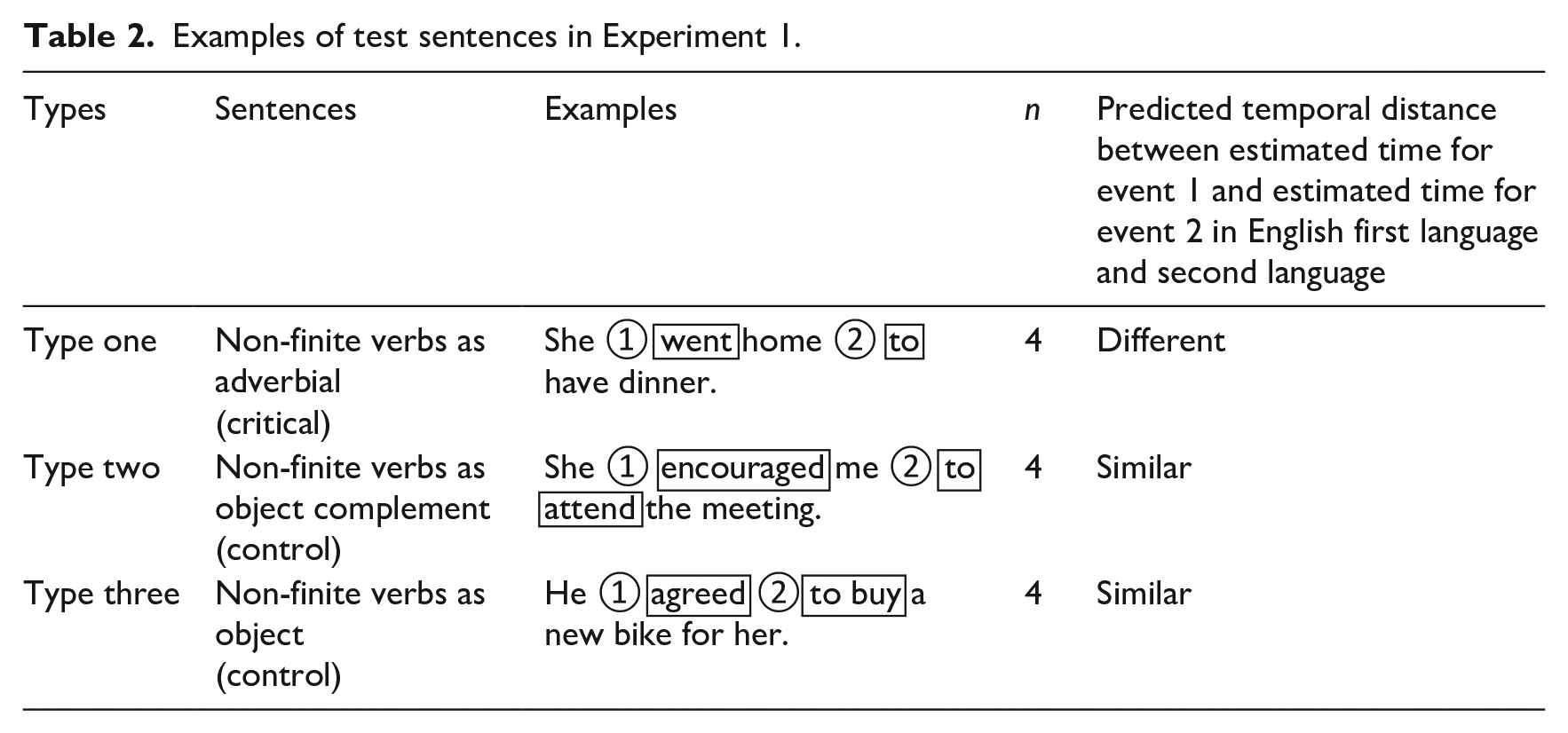
In the temporal anchoring task, there were 12 English test sentences, which included nonfinite verbs as object, object complement and adverbial (see Table 2). The task for the participants was to read the sentence carefully and mark the time of event 1 and event 2 on a time axis placed underneath each sentence. Each critical sentence included a nonfinite verb as purposive adverbial, commonly considered as the nearest equivalent in translations of Chinese canonical SVCs (e.g. Ding, 1979; Li & Cheng, 2008; Li & Thompson, 1981; Tao, 2009). Participants were asked to circle two numbers on the axis based on their understanding of when the two events represented by the two verbs in each sentence happen. They were told that 0 represents distant past and 9 the distant future (see example 5). Each test started with an example sentence with a syntactic structure different from the experimental items (see example 5). The full set of test sentences is available on the project website https://osf.io/2brs9/.
Examples of test sentences in Experiment 1.
5 She ① that I ② her a bike. Mark the time of event ① and ② on the axis.

Results
For the temporal anchoring task, means and standard deviations of the estimated time for event 1 (E1) and estimated time for event 2 (E2) and the temporal distance between them are presented in Table 3. Data from one participant in the learner group (ENL2_13) were more than four SDs away from the mean in all conditions. These extremely outlying data points were excluded from analyses.
Mean estimated time differences between event 1 (E1) and event 2 (E2) by English natives and Chinese English as a foreign language (EFL)’ learners (time distance = E2 time minus E1 time).
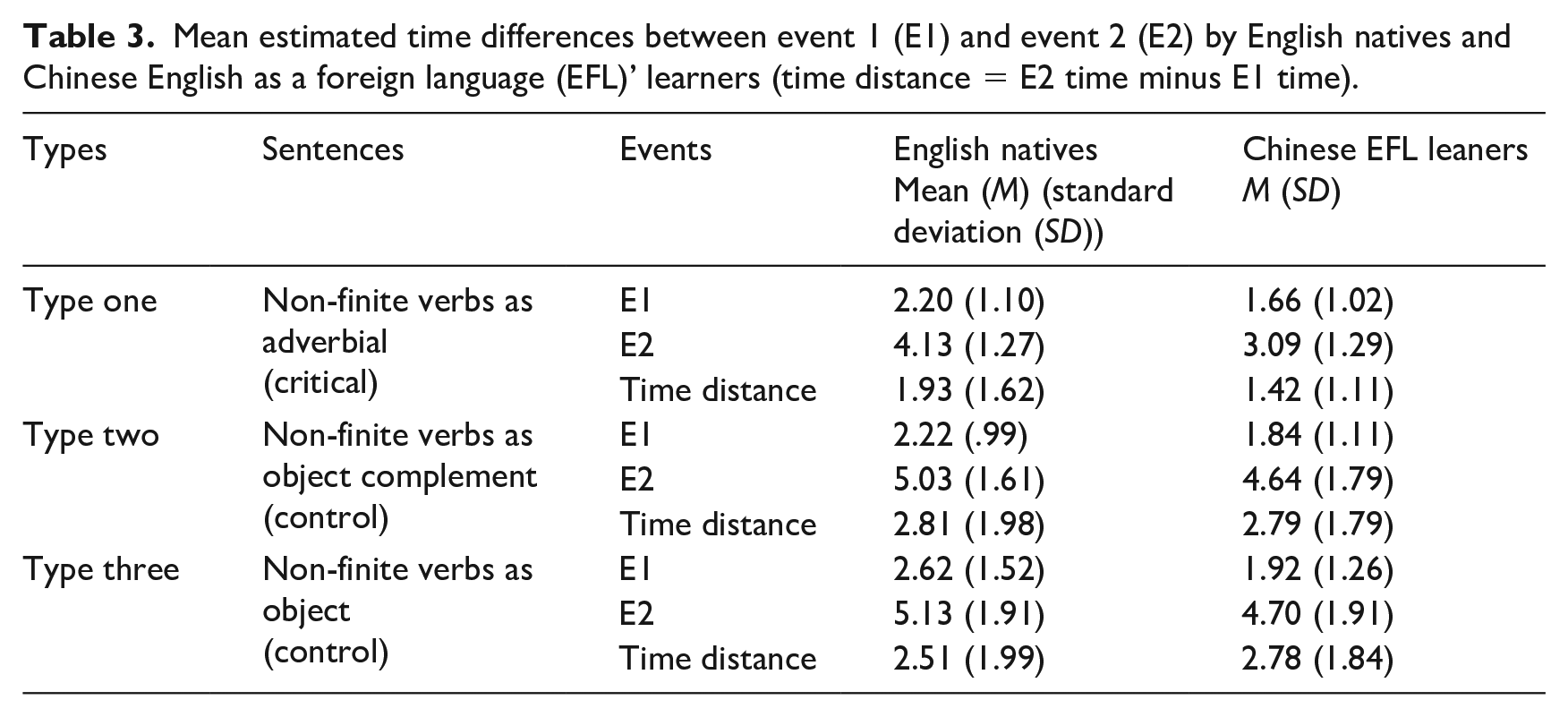
Across all sentence types, both EFL learners and English natives regarded E2 as occurring sometime after E1. As predicted, a between-group difference emerged for sentences with a non-finite verb as adverbial. The time distance between E1 and E2 marked by Chinese EFL learners (M = 1.42, SD = 1.11) was shorter than that marked by English natives (M = 1.93, SD = 1.62). This difference was not observed in the control sentences, showing variation in time estimates depending on sentence type as predicted. This variation together with the distribution of times marked for E1 and E2 are shown in Figure 1.
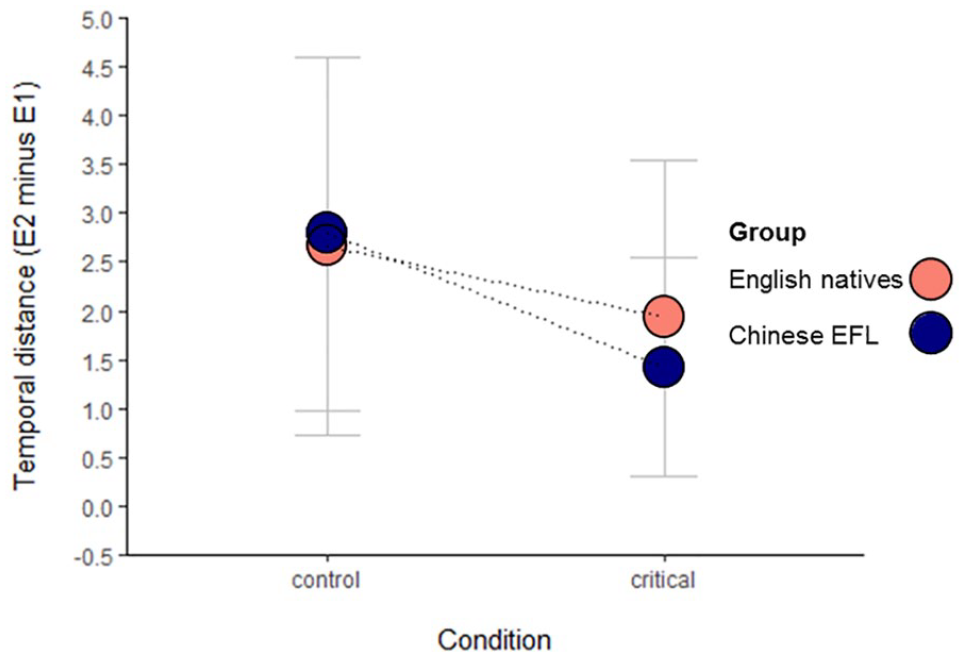
Mean temporal distances estimated between event 1 (E1) and (E2) by English natives and Chinese English as a foreign language (EFL)’ learners in critical (non-finite verb as adverbial) and control (non-finite verb as object and as object complement) conditions. The whiskers show standard deviations from the mean per group and condition.
To see if native English speakers and Chinese EFL learners statistically differed in their judgements about event time distances, we used mixed effects modelling. The lme4 package (Bates et al., 2015) was used in R (version 1.1.453, R Core Team, 2014). We specified two conditions. The experimental condition was the construction predicted to elicit tighter event linkage in Chinese L1 speakers than in L2 learners (nonfinite verbs as adverbials), and the control condition were the similar constructions predicted to show no between-group contrast in event linkage (non-finite verbs as object and as object complement). We defined group (EFL learners/natives) and condition (similar/different) as fixed factors, subject and item as random factors, and temporal distance (calculated as E2 time minus E1 time) as the outcome variable. The fixed factors were default dummy-coded. Using the formula lmer(distance~group*condition+(1|subject)+ (1|item), we found a significant difference between conditions (Intercept estimate = 2.66, β = −0.73, standard error (SE) = 0.33, t = −2.20, p = 0.046), showing that event serialization in critical sentences was significantly tighter than in the control sentences. Crucially, the model also returned a significant interaction between group and condition (β = −0.63, SE = 0.20, t = −3.24, p = 0.001). This indicates that event tightness varied between conditions in learners’ time estimates significantly more than it did in English natives’ time estimates. The full set of statistical results is available on the project website https://osf.io/w5cj2/.
Discussion
Results from Experiment 1 show that in comparison with English natives, Chinese EFL learners estimated the temporal distance between E1 and E2 significantly tighter in SVC-like non-finite verb as purposive adverbial sentences compared to non-finite verb as object/object complement sentences. Such marking of relatively small temporal distances is compatible with the view that events in canonical SVCs are temporally close to each other (Aikhenvald, 2006; Lin et al., 2012; Tao, 2009; Yin, 2007). Regarding the role of L1 in L2, the results confirm Hypothesis 1 by showing that under the influence of the canonical SVCs in Chinese, Chinese EFL learners transferred the concept of tightly-linked events into their understanding of temporal distances between events expressed in corresponding English sentences. The results in Experiment 1 provide evidence of conceptual transfer in event serialization patterns from Chinese to English.
Experiment 2
Experiment 2 was designed to test whether English CFL learners also conceptualize temporal distances in event series in an L1-based way or if they shift from their more loosely sequencing L1 to the more tightly sequencing L2 (Chinese). We used different sentence types including canonical SVCs (critical), pivotal sentences (control), and VP as object sentences (control).
Participants and procedure
52 participants, including 28 native speakers of Chinese (adult secondary school students in Shengli, China; 14 females) and 24 English CFL learners (3rd- and 4th-year undergraduate and graduate students majoring in Chinese at the universities of Oxford, Leeds, Manchester, Sheffield, and SOAS Univerity of London, UK; 10 females) participated in Experiment 2. At the time of testing, all CFL learners were at upper-intermediate/advanced level of Chinese (>1500 words) and had learned grammar, including SVCs, in a formal setting. A read-aloud test was used to check the learners’ familiarity with the words in the study. We followed Jiang (2003) and assumed that English CFL learners know the meaning of a Chinese character if they know its pronunciation (based on strong positive significant correlations reported for both phonograms, r = 0.974, and non-phonogram, r = 0.933, in Jiang, 2003). In our read-aloud task, all English CFL learners included in this study read the Chinese text in the test sentences correctly, indicating that they were highly likely to understand the words’ meanings. To control the native Chinese speakers’ language background and to make sure that Chinese was their dominant language, we enrolled adult students from secondary schools as the control group, with no study-abroad experience and no English usage on their typical day. For Chinese as L2 learners, the procedure in Experiment 2 was the same as that in Experiment 1. It took participants between 40 to 60 minutes to complete all tasks. Participants were remunerated for their time.
The English CFL learners were recruited at UK universities, had 4.24 years of Chinese learning experience on average (range 2–12) and started to learn Chinese at an average age of 17.64 years (range 12–20). All learners reported to have learnt Chinese through classroom instruction. A proficiency test with 15 items from the Hanyu Pinyin Kaoshi Chinese as L2 Proficiency Test Band 4 (intermediate) and 15 items from Band 5 (upper-intermediate) were used. Each item was worth 2 points (total = 30). The average score was 20.5 (SD = 4.90), corresponding to an upper-intermediate level of Chinese. The learners also reported learning experience of foreign languages other than Chinese. Crucially, all reported foreign languages (French, Spanish and German) are typologically close to English in terms of serialization.
Materials
There were 12 Chinese sentences in the temporal anchoring task. Their distribution across sentence types is shown in Table 4.
Examples of test sentences in Experiment 2.
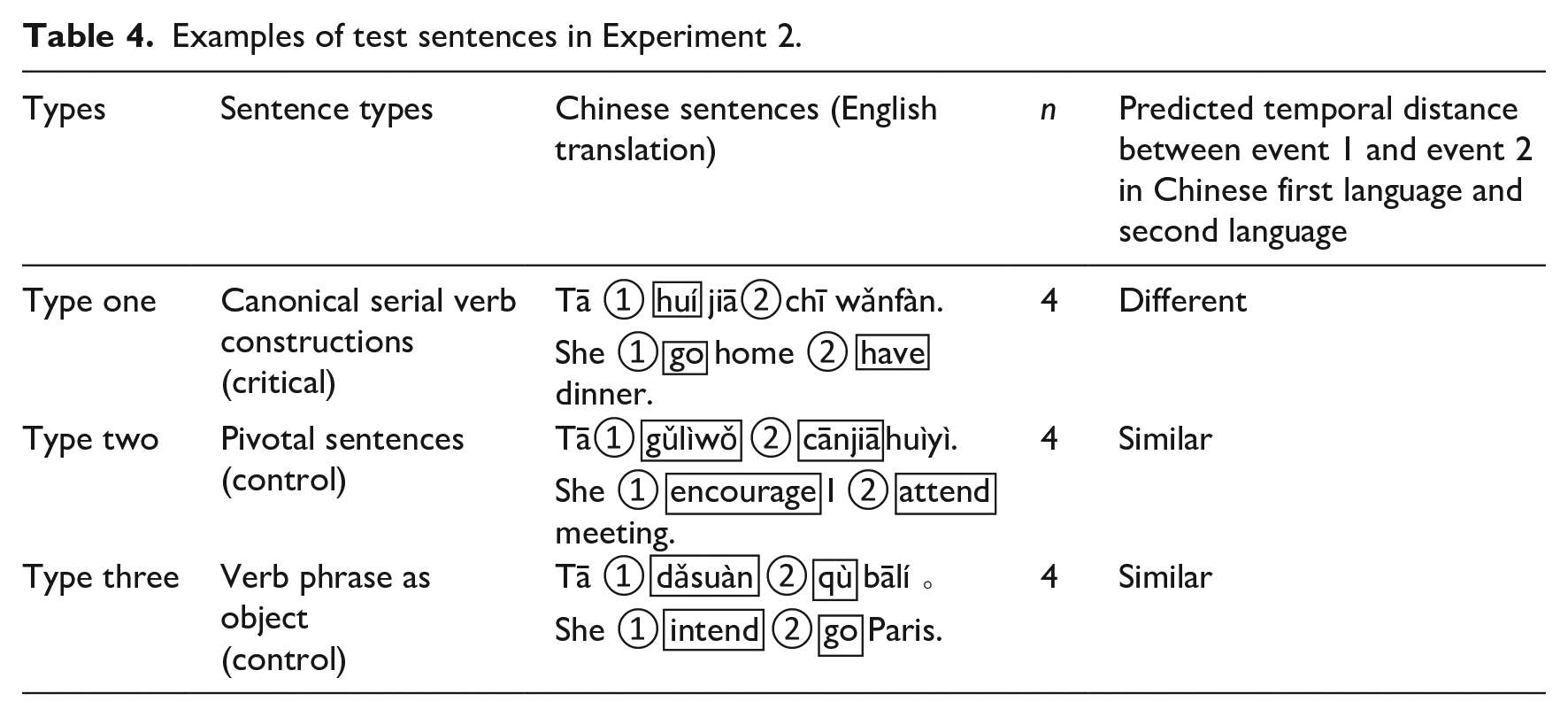
All verbs in Experiment 2 were translations of those used in Experiment 1. The translations were checked independently by two Chinese–English bilinguals. The participants’ task was identical to that in Experiment 1, that is, to circle two numbers on the time axis based on their understanding of when the two events represented by the two verbs in each sentence happen. A non-target-like example 6 was provided to illustrate event time circling on a time axis before the test. The full set of test sentences is available on the project website https://osf.io/dyc3w/.
(6) Tā ① yào ② yī-liàng chē。 She ① will ② one-CLF car ‘She said she would buy a car.’ Mark the time of event ① and ② on the axis.

Results
First, before comparing native speakers to L2 users, we tested the assumption that Chinese natives and English natives differ in the ways in which they interpret temporal distances depending on crosslinguistic differences in event serialization. We built a series of mixed effects models following the structure in Experiment 1, and found that canonical SVCs in Chinese elicited significantly tighter event packaging (M = 0.88, SD = 0.9) than similar constructions, that is, non-finite verbs as adverbial, did in English (M = 1.93, SD = 1.62), (Intercept estimate = 0.88, β = 1.04, SE = 0.21, t = 4.96, p = 0.003). We also found that Chinese native’s event time distances in critical canonical SVCs were more tightly linked than in control pivotal sentences (M = 2.19, SD = 1.65), (Intercept estimate = 0.88, β = 1.3, SE = 0.2, t = 6.52, p < 0.001) and also than in control VP as object sentences (M = 1.64, SD = 1.95), (Intercept estimate = 0.88, β = 0.75, SE = 0.2, t = 3.75, p < 0.001).
Second, we examined the means and SDs of English CFL learners’ and Chinese natives’ temporal anchoring scores (Table 5).
Mean time estimates for event 1 (E1) and event 2 (E2) by Chinese natives and English Chinese as a foreign language (CFL)’ learners (time distance = time of E2 minus time of E1).
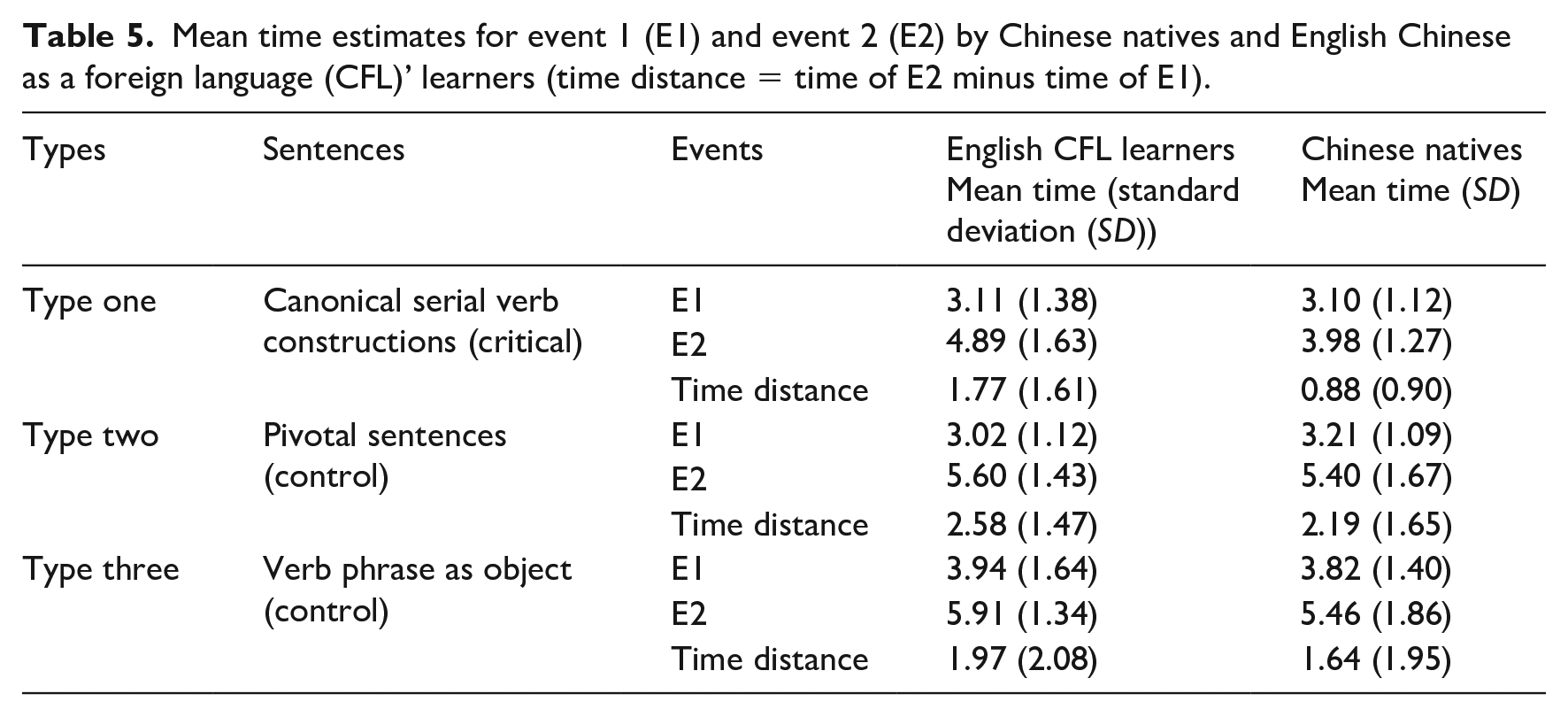
All participants marked E2 occurring after E1, and E1 at some time in the past (i.e. before ‘present’ on the time axis). As shown in Figure 2, Chinese natives marked a substantially tighter temporal distance in canonical SVCs (M = 0.88, SD = 0.90) in comparison with the control sentences (for pivotal sentences M = 2.19, SD = 1.65; for VP as object sentences M = 1.64, SD = 1.95). Unlike Chinese natives, English CFL learners estimated a comparatively longer time distance in canonical SVCs (M = 1.77, SD = 1.61). Learners’ time distance estimates in the control pivotal sentences (M = 2.58, SD = 1.47) and the control VP as object sentences (M = 1.97, SD = 2.08) were similar to those of Chinese natives.
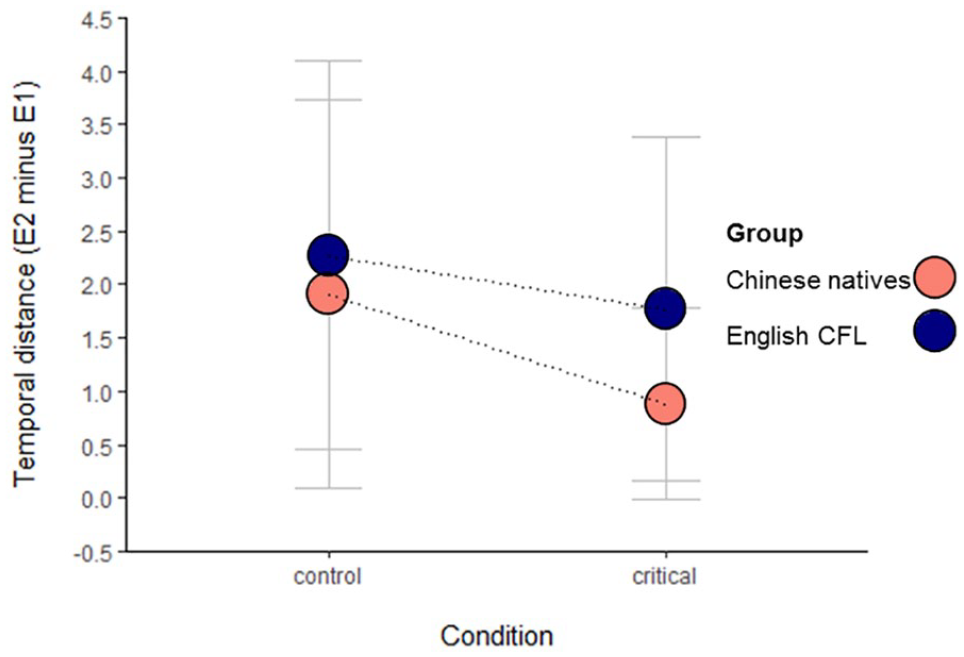
Mean temporal distances estimated between event 1 (E1) and event 2 (E2) by Chinese natives and English Cinese as a foreign language (CFL)’ learners in critical (canonical serial verb constructions) and control (verb phrase as object and pivotal sentence) conditions. The whiskers show standard deviations from the mean per group and condition.
To further explore if the between-group differences were statistically significant, we applied linear mixed effects modelling using R. As in Experiment 1, we specified and dummy-coded two conditions. The experimental condition was the construction predicted to elicit tighter event linkage in Chinese L1 speakers than in L2 learners (canonical SVCs), and the control condition were the similar constructions predicted to show no between-group contrast in event linkage (VP as object, pivotal sentences). We defined group (English CFL learners/Chinese natives) and condition (similar/different) as fixed factors, subject and item as random factors, and temporal distance (calculated as E2 time minus E1 time) as the outcome variable. Using the formula lmer(distance~group*condition+(1|subject)+(1|item), we found a significant difference between the condition (Intercept estimate = 1.91, β = −1.03, SE = 0.17, t = −5.92, p < 0.01), showing that event serialization in critical sentences was significantly tighter than in the control sentences. Crucially, the model also returned a significant interaction between group and condition (β = 0.52, SE = 0.25, t = 2.04, p = 0.042). This indicates that event tightness varied between conditions in Chinese native speakers’ time estimates significantly more than it did in English CFL learners’ time estimates.
Discussion
The results in Experiment 2 show that English CFL learners’ temporal anchoring was significantly different from that of native Chinese speakers’ in canonical SVCs. This difference in temporal distance was not observed in control sentences with verbs functioning as object or pivotal sentences, which shows that sentence type is an influential factor for conceptualizing distances between serial events. In other words, in Chinese sentences with finite and non-finite distinctions resembling those in English, English CFL learners performed similarly to the Chinese natives, while in canonical SVCs where there is no counterpart in the L1, they conceptualized serial events as loosely linked. We therefore argue that this result is consistent with Hypothesis 2 in that following the L1 pattern, English CFL learners conceptualize event distances in canonical SVCs under the influence of their L1.
General discussion
This study set out to investigate the extent to which typological differences between serializing and non-serializing languages influence conceptualization of event series in an L2. Two main findings emerged from L2 learners’ event time estimates. First, in comparison with English natives, Chinese EFL learners marked serial events as more tightly linked in sentences which are expressed as canonical SVCs in their L1. In the opposite direction, compared with Chinese natives, English CFL learners marked serial events as more loosely linked in SVCs. These findings are interpreted as variation in conceptualizing event series influenced by crosslinguistic differences in event serialization patterns. The following subsections discuss in further detail the typological differences in event serialization and their relation to what may underlie event conceptualization in bilinguals.
Language-specific event serialization in Chinese and English
The first contribution of the present study is empirical evidence showing language-specificity in event serialization between Chinese and English natives. Chinese native speakers estimated an average event distance of 0.88 in canonical SVC sentences, which is more than twice shorter than the average temporal distance of 1.93 estimated in the SVC-reminiscent non-finite verb as adverbial sentences by English native speakers. This aligns with previous research showing that native speakers of a serializing language (e.g. Avatime) conceptualize multiple events in a series (e.g. ‘take’ and ‘put’ events) more holistically, that is, as single event units, while speakers of a non-serializing language (e.g. English) conceptualize such events more as separated (Defina & Majid, 2012). Variation in event conceptualization patterns during sentence interpretation is attributed here to the typological differences in event serialization between English and Chinese. More specifically, English and Chinese native speakers’ event conceptualization differs in how tightly individual events are sequenced when these are expressed in a series, with Chinese natives conceptualizing SVC-like events as more tightly linked than English natives. It is important to emphasize that these findings and related claims pertain to the conceptualization of events in a verbal context, during sentence interpretation. Whether similar crosslinguistic differences in conceptualization also hold without an overt use of language (e.g. in a silent video segmentation task) for event series that are routinely expressed as SVCs in Chinese, remains open for future explorations.
The role of L1 in conceptualizing event series in L2
Building on the conceptualization linked to crosslinguistic differences, we explored bilinguals’ conceptualization. The tested question was whether conceptualization of a series of related events changes under the influence of the properties of the bilingual’s L2. This question is important because crosslinguistic influence at the conceptual level of a non-/serializing L1 on the L2 has not been documented in previous work. One possible outcome would have been to observe influence of L1 on L2 conceptualization (e.g. Jarvis, 2007; Odlin, 2005; Schachter, 1983). However, conceptual non-equivalence may not necessarily lead to an L1-based conceptualization, and L2 learners may shift to L2-based patterns (e.g. Athanasopoulos, 2011). Studies in a range of areas show how advanced L2 learners differ from L1 speakers, in domains including event sequencing and temporal reference (e.g. Vanek, 2013, 2017; von Stutterheim, 2003). However, this is the first study to investigate if L2 learners shift from tightly-packaged to loosely-packaged event series and vice versa.
The findings in the current two experiments show differences in how native speakers versus L2 learners conceptualize the temporal distance between events in sentences where Chinese and English have non-equivalent concepts. We argue that these differences are attributable to a routine differentiation between more tightly-linked serial events expressed by SVCs and more loosely-linked events expressed by other verb constructions in Chinese (also see Bohnemeyer & Pederson, 2011; Defina & Majid, 2012). No comparable differentiation is present in English. The influence of this crosslinguistic difference on the conceptualization of temporal distances between multiple events supports the hypothesis which predicts that L1-based conceptualization can be expected when there are crosslinguistic differences between the L1 and the L2. Some shift towards L2-based conceptualization cannot be ruled out. However, the results reported here point more strongly towards influence from the L1 (in line with von Stutterheim, 2003) rather than a shift towards the L2.
Crosslinguistic influence on conceptualizing event series
An equally intriguing question to the degree of Chinese EFL learners’ L1-based event conceptualization is whether English CFL learners also maintain their L1-based pattern or if they shift to the L2-based pattern of tighter event packaging in SVCs. The current study shows that English CFL learners marked significantly greater distances between events in canonical SVCs, unlike Chinese natives, but performed in a native-like way in control sentences where L1 and L2 formally overlap. We argue that the lack of sensitivity to different sentence types in the learner data can be assigned to the absence of a grammaticalized expression of event series in English L1. No routine distinctions between more tightly and more loosely linked events in the L1 grammar seem to guide learners’ event time estimates, which at this level of proficiency appear to be resistant to change in the learners’ L2. Resistance to change has direct implications for language production. It can serve as a potential explanation for the avoidance of using SVCs, repeatedly observed in non-serializing L1 learners of a serializing L2 (e.g. Dong, 2014; Moro, 2014, 2016; Sun, 2008; Zhou, 2009).
The L1-based conceptualization was found to be remarkably similar irrespective of the L1–L2 direction. From a non-serializing L1 to a serializing L2, learners showed a lack of sensitivity to event tightness distinctions, while from a serializing L1 to a non-serializing L2, learners transferred the concept of tightly packaged event series. The latter could potentially account for morpho-syntactic transfer reported in the language production of serializing L1 learners of a non-serializing L2 (e.g. Helms-Park, 2004; Tang, 2018; Yang & Huang, 2009).
Overall, the findings from Chinese EFL and English CFL datasets together highlight the crosslinguistic L1-to-L2 influence on the conceptualization of event series. These findings jointly support the view that L1 underlies L2 learners’ concepts when they segment and interpret the flow of event series. Crosslinguistic influence on event conceptualization patterns has been reported in earlier studies (e.g. influence of an ongoingness-focusing system on an endpoint-focusing system and vice versa (von Sutterheim, 2003)). This work brings novel support for the idea that when a language expresses a temporal concept grammatically, it sensitizes its speakers to the relevant conceptual distinctions (e.g. Bylund & Athanasopoulos, 2017). In the case of event serialization, Chinese sensitizes its speakers to make distinctions between more tightly linked events in SVCs and less tightly linked events in non-SVCs. In the other direction, English does not equip its speakers with grammatical means to vary event tightness. Both L1-based patterns were found to influence the L2, that is, not only serializing source language patterns into a non-serializing target language but also vice versa.
Limitations
We note that there are a number of limitations in the current study. For instance, we contrasted different numbers of participants in each group (28 Chinese natives, 24 English CFL learners, 25 English natives and 47 Chinese EFL learners) and although we believe this will not have affected our results, we recognize that a harmonized sample size across groups will benefit future analyses. Another limitation relates to the temporal axis in our design, specifically that 4 was arbitrarily marked as the ‘now’ in order to give participants a temporal anchor for dividing ‘near past’ from ‘near future’. We acknowledge that not having the ‘now’ as the exact middle of the time axis (4.5) may have triggered a slight bias towards the future. Potential risks to validity in this respect were minimized by presenting the same time axis to all participants. Future designs may also benefit from the inclusion of main verbs in the present as well as in the past in order to eliminate potential verb-induced temporal biases.
Conclusion
The current study investigated whether crosslinguistic differences between serializing and non-serializing languages influence how event series are conceptualized in the L2. Two temporal distance estimation experiments were used. The results from the first experiment showed that Chinese EFL learners estimated significantly shorter event distances in SVC-like English sentences than English natives. The second experiment revealed that English CFL learners estimated significantly longer event distances in SVCs than Chinese natives. The combination of these findings informs L2 acquisition research by providing empirical support for the idea that L1-based event serialization patterns influence how L2 learners conceptualize event distances, and this holds not only from a serializing to a non-serializing language but also in the opposite direction.
Research Data
chl2serialisation – Research Data for Crosslinguistic influence on English and Chinese L2 speakers’ conceptualization of event series
Research Data, chl2serialisation for Crosslinguistic influence on English and Chinese L2 speakers’ conceptualization of event series by Mengmeng Tang, Norbert Vanek and Leah Roberts in International Journal of Bilingualism
Research Data
enl2serialisation – Research Data for Crosslinguistic influence on English and Chinese L2 speakers’ conceptualization of event series
Research Data, enl2serialisation for Crosslinguistic influence on English and Chinese L2 speakers’ conceptualization of event series by Mengmeng Tang, Norbert Vanek and Leah Roberts in International Journal of Bilingualism
Footnotes
Funding
The author(s) disclosed receipt of the following financial support for the research, authorship, and/or publication of this article: This study received support from the China Ministry of Education, its Humanities and Social Sciences Youth Fund, for the project “Acquisition and processing of multi-verb constructions: A bidirectional study of English L2 and Chinese L2 learners” (project and grant number 15YJC740075), and from the Fundamental Research Funds for the Central Universities for the project “The influence of L1 finiteness on L2 acquisition” (project and grant number ZX20190052). Both grants were awarded to Mengmeng Tang.

Notes
Author biographies
References
Supplementary Material
Please find the following supplemental material available below.
For Open Access articles published under a Creative Commons License, all supplemental material carries the same license as the article it is associated with.
For non-Open Access articles published, all supplemental material carries a non-exclusive license, and permission requests for re-use of supplemental material or any part of supplemental material shall be sent directly to the copyright owner as specified in the copyright notice associated with the article.
