




Abstract
At the forefront of efforts to enhance effective communication between vulnerable persons and stakeholders within the legal system has been the introduction of the intermediary. Embedding the role of the intermediary has presented complex challenges across jurisdictions. We report on phase one of a study involving a purposive sample (n = 60) of diverse stakeholders across the Island of Ireland in which priorities for policy, research and practice were generated using a modified nominal group technique. We identified six priority areas: (i) formalising the role; (ii) building awareness and understanding; (iii) establishing mechanisms of professional development and support; (iv) undertaking service evaluation and research; (v) supporting cross-sectoral working; and (vi) ensuring equality of access to intermediaries. In the next phase of the study, priorities of individuals who have experience of using intermediary accommodations will be identified. Findings from both studies will be integrated to provide robust recommendations for policy makers to further advance the role of the intermediary in the justice system.
Keywords
Increasing recognition of the difficulties faced by minors and vulnerable adults during oral testimony in court has seen various special measures and adaptations introduced to enable such witnesses to give their ‘best evidence.’ The best evidence principle is linked to the imperative that all witnesses should be given the opportunity to participate in proceedings as fully as possible. Such special measures can include the use of screens, video-recorded evidence-in-chief and the allowance of viva voce evidence given in private or by live-link. The role of the intermediary is described as one of the most innovative of these special measures, referred to by Henderson as ‘little short of revolutionary’ (2015: 154), given their power to influence pre-trial directions and to intervene and facilitate effective communication during counsel's examination in a criminal trial.
The main function of the intermediary is to assess the vulnerable person's communication needs, to provide direct support to ensure they can understand and communicate to the best of their ability, and to negotiate adjustments with other professionals working with them to facilitate effective communication (Plotnikoff and Woolfson, 2015). The intermediary mainly assists in facilitating communication during court proceedings; however, in some jurisdictions an important aspect of the role also extends to aiding the police to communicate with the child and/or vulnerable adult in other settings such as police stations (Cooper and Mattison, 2017). Underpinning the role is the assumption that communication is a dynamic and mutual process rather than simply a transfer of knowledge from one to another. Further, communication is not viewed narrowly as a verbal process but is understood to involve multi-modal methods such as writing, drawing and a range of other augmentative and alternative communication systems such as the use of symbols and signing. Communication is also acknowledged to be influenced by context as well as the experiences, culture and emotions of the people involved. 1
The intermediary possesses specialist knowledge and skills in the assessment of the communication needs of children and vulnerable adults as well as a working knowledge of the law and procedure as it relates to their role. This skillset enables the intermediary to provide advice and recommendations appropriate to the legal context in which they operate. Although intermediaries have a working knowledge of court proceedings and court terminology, in most jurisdictions the vast majority do not possess a legal qualification. They are not legal professionals; rather, they are communication specialists. At a broader level, the role focuses on enabling the witness to understand, and have agency in, the legal process (Howard et al., 2019).
A critical operating principle underpinning the role is that the intermediary's responsibility lies with the court and not to any side of the case (Plotnikoff and Woolfson, 2015). These principles of impartiality and neutrality guide the role throughout proceedings (Ministry of Justice, 2021). Additional operating principles include the requirement for the consent of the person at every stage of the process, the avoidance of directing a person, i.e., using the least directive accommodations within the person's communication abilities, the avoidance of contaminating evidence, and transparency in every aspect of the intermediary's involvement with the person to whom accommodations are provided. Finally, the scope of the role is understood to involve the identification of accommodations rather than to have a focus on diagnosis of a disability or to raise elements of a known disability that are not connected to the person's participation in legal processes.
At the time of writing, there are a growing number of intermediary schemes around the world. 2 Significantly, however, these schemes do not adhere to a unitary model of design and, accordingly, there is variation across countries with respect to terminology, legislation, training and professional backgrounds that work in these schemes. While most schemes cover witnesses, victims and complainants, some also include vulnerable suspects and defendants (Kearns et al., 2022). Even the title of the role differs across countries. The role is referred to as witness intermediary (Australia), registered intermediary (England and Wales, Northern Ireland, Republic of Ireland), intermediary (England and Wales, Bulgaria, Kenya, Republic of Korea, Chile—intermediario), communication intermediary (Canada—Ontario), communication assistant (New Zealand), communication support specialist (Vermont, USA) and in Spain, Mexico City and Argentina, facilitador. The operating basis for the schemes also varies widely across the globe. Thus specific laws are in place in some countries that legislate for the role, while others apply general accessibility or non-discrimination acts (Kearns et al., 2022). The operation of intermediary schemes, as well as training and monitoring of the role, also vary across countries. The overwhelming majority of practising intermediaries are experienced speech and language therapists, with practitioner psychologists, occupational therapists and social workers or similar making up the rest of the group (O’Mahony et al., 2016; Plotnikoff and Woolfson, 2008). Procedural guidance manuals have been developed as a reference document for intermediaries to provide explicit guidance regarding the remit of their role in relation to the specific jurisdiction in which they practice (Australian Capital Territory (ACT) Human Rights Commission, 2020; Ministry of Justice, 2023; Plotnikoff and Woolfson, 2015).
The Pigot Report (1989): The birth of the intermediaries in England and Wales
The role of the intermediary was introduced in England and Wales via s. 29 of the Youth Justice and Criminal Evidence Act 1999 (YJCEA). The intermediary role can be traced back to the Pigot Report in 1989—a report produced by a UK governmental advisory group on video evidence which recommended ‘quite radical changes’ (Pigot Report, Great Britain Advisory Group on Video-Recorded Evidence, 1989: 2.9) to the treatment of witnesses in the criminal justice system. Section 29 of the YJCEA provides that a court may allow for a witness to be examined ‘through’ an intermediary and that the role's function is to ‘communicate (a) to the witness, questions put to the witness, and (b) to any person asking such questions, the answers given by the witness in reply to them’. In practice, intermediaries perform a communication assessment of the witness and compile a report with recommendations to help facilitate communication between criminal justice professionals and the vulnerable witness (Plotnikoff and Woolfson, 2015). Although the YJCEA is silent on the profile of the intermediary, the Ministry of Justice (MoJ) now recruits, trains and regulates a cohort of skilled communication specialists who facilitate the communication of vulnerable witnesses in court. Intermediaries who operate from the Witness Intermediary Scheme (WIS) register are known as ‘Registered Intermediaries’ (Ministry of Justice, 2023). In 2004, the WIS was piloted in six locations across England and Wales (Cooper and Mattison, 2017), and this was followed by the recommendation for the national roll-out of the scheme in 2006 (Plotnikoff and Woolfson, 2015).
In England and Wales, vulnerable accused persons fall outside the scope of the WIS. Instead, intermediaries for vulnerable defendants at court are appointed on an ad-hoc basis by judges. While there has been some formalisation of standards for intermediaries assisting defendants in England and Wales, the system has been described in the literature as two-tiered (Henderson, 2015). Requests for intermediary services for accused persons can be made via the HM Courts and Tribunals intermediary services scheme—although these are commercially provided and regulated differently to the WIS.
The ‘unitary model’: Extending intermediaries to Northern Ireland
In 2013, the Department of Justice of Northern Ireland developed a similar model for the provision of intermediaries in the criminal justice system. The ‘Registered Intermediary Scheme’ (RIS) is based on the provisions of the Criminal Evidence (Northern Ireland) Order 1999, which mirror the provisions of s.29 YJCEA. However, as noted by Cooper and Wurtzel (2014: 39), the WIS in England and Wales provided a ‘template but not a blueprint’ for Northern Ireland. Whilst eligibility to access an intermediary for defendants is the same in both jurisdictions, i.e., that an accused would otherwise be unable to ‘participate effectively’ in the proceedings as a witness (Coroners and Justice Act 2009, s.104; Criminal Evidence (NI) Order 1999, Art.21(b)(a)), one crucial distinction with the practice in England and Wales and Northern Ireland is that the RIS in Northern Ireland covers both witnesses and defendants. It was concluded by the Department of Justice (DoJ-NI) (2015: 6) that respect for the principle of equality of arms demanded nothing less. Further, intermediaries in Northern Ireland work with both witnesses and suspects at the police station, assist with the planning of interviews and attend interviews to help facilitate communication (DoJ-NI, 2015). As a result, Northern Ireland has been described in the literature as a unitary system of intermediary provision (Taggart, 2021).
Pilot steps: The introduction of intermediaries in Ireland
In mimicking policy developments both north of the border and across the Irish Sea, Ireland's statute book, for more than three decades, expressly recognised a series of testimonial accommodations—or ‘special measures’—for vulnerable witnesses that were designed and introduced to ‘temper the hostile excesses and personal trauma associated with the formalities of Ireland's adversarial trial’ (Cusack, 2020a: 281). Significantly, the intermediary special measure was positioned at the forefront of Ireland's special measures architecture from the outset, with the Minister for Justice heralding the role in July 1992 as ‘an entirely new technique in criminal procedure’ which was ‘necessary if justice is to be done in cases of child abuse’ (Seanad Éireann Debate, Government of Ireland, 1 July 1992). In endorsing the recommendations of the Law Reform Commission, the Minister declared: ‘If we do not have someone interposed between the questioner and the child in these particular cases, we are conferring a degree of immunity on child abusers’ (Seanad Éireann Debate, 1 July 1992).
Accordingly, Ireland's intermediary role came to life with the passing of the Criminal Evidence Act 1992. Under s. 14(1A) of the 1992 Act, any child victim under 18 years of age or any adult victim with a ‘mental disorder’ who is delivering, or about to deliver, testimony through a live television link, may apply for this special measure. This facility is also statutorily extended beyond victims, by virtue of s. 14(1) of the 1992 Act, to child witnesses under 18 years of age and adult witnesses referred to as having a mental disorder in cases involving alleged offences that are sexual or violent in nature. In each case a court has jurisdiction to grant an application for this special measure if it is satisfied that the intermediary facility is in the ‘interests of justice’ (Campbell et al., 2020; Cusack, 2020b).
More recently, a new eligible constituency to access the support of an intermediary was established in Irish law with the passing of the Criminal Justice (Victims of Crime) Act 2017, which created a ‘separate, discrete regime of ancillary supports for vulnerable victims (beyond the purview of the 1992 Act)’ (Cusack, 2022). Specifically, pursuant to s. 19(2)(c) of the Criminal Justice (Victims of Crime) Act 2017, the intermediary facility is now open, at the discretion of the court, to all victims who are adjudged to have a ‘specific protection need’ regardless of the nature of the offence that has allegedly been committed against them (Cusack, 2020b). Crucially, however, the legislative enthusiasm for expanding access to this special measure has been distinctly lopsided and, at the time of writing, defendants are denied any meaningful access to special measure on a statutory basis in Ireland (Delahunt, 2024: 164).
According to Cusack (2020b: 105), ‘the 1992 Act fails to provide any… guidance on the qualifications that must be possessed by an individual prior to assuming the role of an intermediary, and an Irish court is authorised by statute to appoint as an intermediary any person that it considers competent to act as such’. Once appointed, the intermediary's role is to convey questions to the witness in either the words used by the questioner or so as to convey to the witness, in a way which is appropriate to his age and mental condition, the meaning of the questions being asked (s. 14(2), Criminal Evidence Act 1992). As Delahunt (2024: 145) notes, ‘there is no provision for the answers of the witness to be translated or explained by the intermediary for the benefit of the court’. Indeed, the confinement of the office of the intermediary to a purely instrumental communicative function (in alignment with the approaches in Northern Ireland, England and Wales) was emphasised by the Court of Appeal, which recently rejected an appeal against a murder conviction on the grounds that, during the examination of a central prosecution witness with the aid of an intermediary, ‘there was no occasion when the question was actually formulated and put by the intermediary’ (DPP v O’Driscoll [2022] IECA 4).
Given the exceptionally long gestational period that accompanied the roll-out of intermediaries in Ireland (see Cusack, 2020a: 299), this confirmation of the operational limits of the office, although not entirely surprising, has been welcomed for bringing certainty and constitutional validity to the role. Indeed, as recently as 2018, Rape Crisis Network Ireland (RCNI) observed that ‘[i]n practice, an intermediary is very rarely used in Irish courts, in part because the legislation is vague about how, when and for what purpose they should be used, and there have never been any Rules of Court to address these issues’ (RCNI, 2018: 9). At a political level, the impact of this finding was considerable and within six months the Minister for Justice launched a major review of the investigation and prosecution of sexual offences in Ireland (the ‘O’Malley Report’) (Cusack, 2022: 73–74; Department of Justice, 2018b) which identified no fewer than 52 discrete policy actions which were intended to ‘improve the present [criminal justice] system’ (Department of Justice, 2020: 9). Chief amongst these actions was a recommendation that a ‘[a] cohort of appropriately qualified intermediaries who have undergone a prescribed course of training on the role of intermediaries should be recruited and placed on a register’ (Department of Justice, 2020: 108).
This recommendation ultimately found expression at a political level in April 2021 when the Department of Justice (DoJ) invited Expressions of Interest to design and deliver an accredited RI training programme. A proposal for an inter-faculty offering across the School of Law and the School of Allied Health in the University of Limerick was successful in gaining the funding award from the DoJ, to design and deliver the only higher education institution accredited intermediary qualification programme in Ireland in September 2022. As Kearns et al. (2022: 3) explain: ‘The proposal and subsequent programme that has been designed has been informed by key findings from programmes and schemes described in this article; Northern Ireland, England and Wales, and other common law jurisdictions including New Zealand.’
While the intermediary role is becoming increasingly prevalent across different justice systems, there remain valid questions about the scope of the role, its function and relative status. A recent systematic review and qualitative synthesis of the international literature which included both empirical and published reports from across the fields of health and law yielded 26 publications in total (Kearns et al., 2024). Findings from this synthesis highlight challenges in relation to the role in practice from the perspective of multiple stakeholders as well as intermediaries themselves. Whilst some stakeholders reportedly view the role as beneficial in bringing new knowledge to the justice system, others were less convinced, and strained working relationships between intermediaries and other practitioners such as police were identified (Agneswaran, 2018). In terms of the intermediaries themselves, issues of professional identity were identified related to the space in which they work, positioned as they are at the intersection of diverse fields of practice including psychology, therapy, social care and law. Findings from this study also suggest that many intermediaries view their work as pressurising, complex and poorly compensated, with most lacking job security (see also O’Mahony et al., 2016, who examined the developing role of intermediaries appointed for defendants). Misconceptions about the role amongst legal professionals and the judiciary appear to persist which impact the intermediary in fulfilling their role (Fairclough et al., 2023).
At a systems level, in some jurisdictions there appears to be an increasing demand for the work of intermediaries as awareness and appreciation of the necessity of the role increases across the court and tribunal systems, yet no initiatives appear to be in place to respond to this increasing demand (O’Mahony, 2024). Whilst training has been made available for criminal lawyers in England and Wales on effective questioning techniques with vulnerable persons, this appears to have been ineffective in reducing demand for services according to data released by the National Crime Agency's Witness Intermediary Scheme. 3 The continued expansion of the use of intermediaries with defendants in the criminal courts in addition to use in the family courts and other tribunals will continue to place demands on these limited resources.
Successful uptake of recommended accommodations in relation to communication in the justice system made by intermediaries is argued to require complex infrastructural, attitudinal and practice change (Hoyano and Rafferty, 2016; Mirfin-Veitch et al., 2014; Plotnikoff and Woolfson, 2019). Yet there appears to be a lack of robust practice survey data available about how the role is undertaken in practice, what methods of assessment and communication aids and intervention techniques are used, and how effective such methods are (Collins and Krahenbuhl, 2020; O’Mahony et al., 2012; Owen, 2016). Intermediaries come with different professional backgrounds and skillsets, and yet no data exists to inform whether this makes a difference to how the intermediary engages in the communication assessment and intervention practice in the police interview and at court. The issue of mental health and the effect of trauma is under researched in the intermediary literature both in terms of how intermediaries are utilised to assess how mental health and trauma affect communication, together with the strategies employed to minimise miscommunication, but also the impact of vicarious trauma on the intermediary (O’Mahony et al., 2018).
Much of the research related to the role of the intermediary has been conducted at a national level and often within distinct discipline areas, with limited international knowledge exchange opportunities for practitioners, researchers and policy decision makers. A coordinated, multi-sectoral strategy would enable a cohesive approach to research in this relatively unexplored practice-policy research space and would build capacity for collaborative research internationally.
Study aims and methodology
The aim of this study was to engage multiple stakeholders across policy, practice and research to generate priority actions to enhance the effectiveness of the role of the intermediary. Expert consensus is an important element of evidence-informed policy and practice and is widely employed in research in both the fields of health and law (Fink et al., 1984; McMillan et al., 2014; Vander Laenen, 2015). Methods of consensus are considered to have strong validity, particularly in contentious or inter-disciplinary spaces. It is well argued by Surowiecki (2004) that collective decisions produce better judgements than individual experts acting alone. The nominal group technique is one such evidence-based method which combines interactive individual and group phases to reach consensus. Co-production of priorities by multi-sectoral stakeholders has been shown to generate research which is more translatable to the domains of policy and practice (Denyer and Tranfield, 2006). The nominal group technique was developed by Delbecq and Van de Ven in 1971 as a means of generating potential answers to complex practice-based questions. It has previously been used to identify research priorities in other health-related areas. Despite diversity in its application, there is general consensus on four core phases: silent generation, round robin, clarification and voting (ranking/rating) (McMillan et al., 2014).
The core research team involved in the study includes five individuals, four currently working in academia and the fifth working as an intermediary in practice. The team comprises two white females and three white males. The two female researchers are qualified speech and language therapists, one with experience of working with adults with acquired communication needs, and the other with experience of working with children and young people up to the age of 18 years who have a range of neurodevelopmental disabilities. Both female researchers are qualitative researchers, currently work in academia in the field of health services research. Both lecture on a professional qualification programme for speech and language therapists. One of the female researchers acts as course director of the aforementioned qualification programme in intermediary studies. Of the male members of the team, two have legal qualifications and have worked in legal practice previously (one is a qualified solicitor, the other a qualified barrister), and both teach undergraduate and postgraduate criminal law and law of evidence in addition to undertaking research on the theme of vulnerability in the criminal process. The third male has worked in law enforcement, is a qualified forensic psychologist, and is currently practising as a forensic psychologist and as a registered intermediary.
In this paper, we report on part one of a two-phased consensus-building study in which we engaged different stakeholder groups using a modified nominal group technique to identify priorities for policy, practice and research in relation to the role of the intermediary in the Irish context.
Methods
Design
We conducted the study as part of a planned knowledge exchange hybrid event. The face-to-face meeting was held at the University of Limerick, in the Republic of Ireland and via an online platform (Microsoft Teams) in June 2023. As described above, a modified version of the nominal group technique developed by Delbecq and Van de Ven was used. This method allowed a structure and a process for getting feedback from a diverse group of people in a way that allowed everyone to have an equal say. Rather than collating data using an online survey, the method was chosen as it allowed participants, firstly to hear some important lectures about the emergence of the role and current practice, and then afforded them an opportunity to clarify and reconsider their views and/or priority areas through group discussion with other stakeholders. The benefit of this design is that participants have multiple opportunities over the course of the knowledge exchange event to review and to resubmit their priority areas for action.
Recruitment and sampling
Guided by the sampling and recruitment recommendations when employing a Nominal Group Technique set out by McMillan et al. (2014), we recruited a purposive sample of participants using a maximum variation strategy. We primarily used snowballing techniques to recruit diverse groups of participants as this approach has been shown to be effective where unique knowledge is sought from a relatively small pool of expertise (McMillan et al., 2016). Direct invitations were issued to key stakeholders via government departments, non-government organisations, charities, professional organisations and established networks. These included individuals involved in policymaking, intermediaries in practice, law enforcement including specialist interviewers, legal practitioners and researchers. We sought the views of researchers across the fields of law, health and social care, intermediary studies and forensic psychology. In addition, we promoted the knowledge exchange event extensively on social media. Recruitment extended to other countries where the role of the intermediary has been established including Northern Ireland, England and Wales, Chile, Australia, Spain and New Zealand. To source research-active professionals, manual and electronic searches of peer-reviewed papers were also reviewed and contact details of researchers currently publishing in the field of intermediary studies were identified.
Data collection and analysis
Data collection steps are presented in Figure 1.
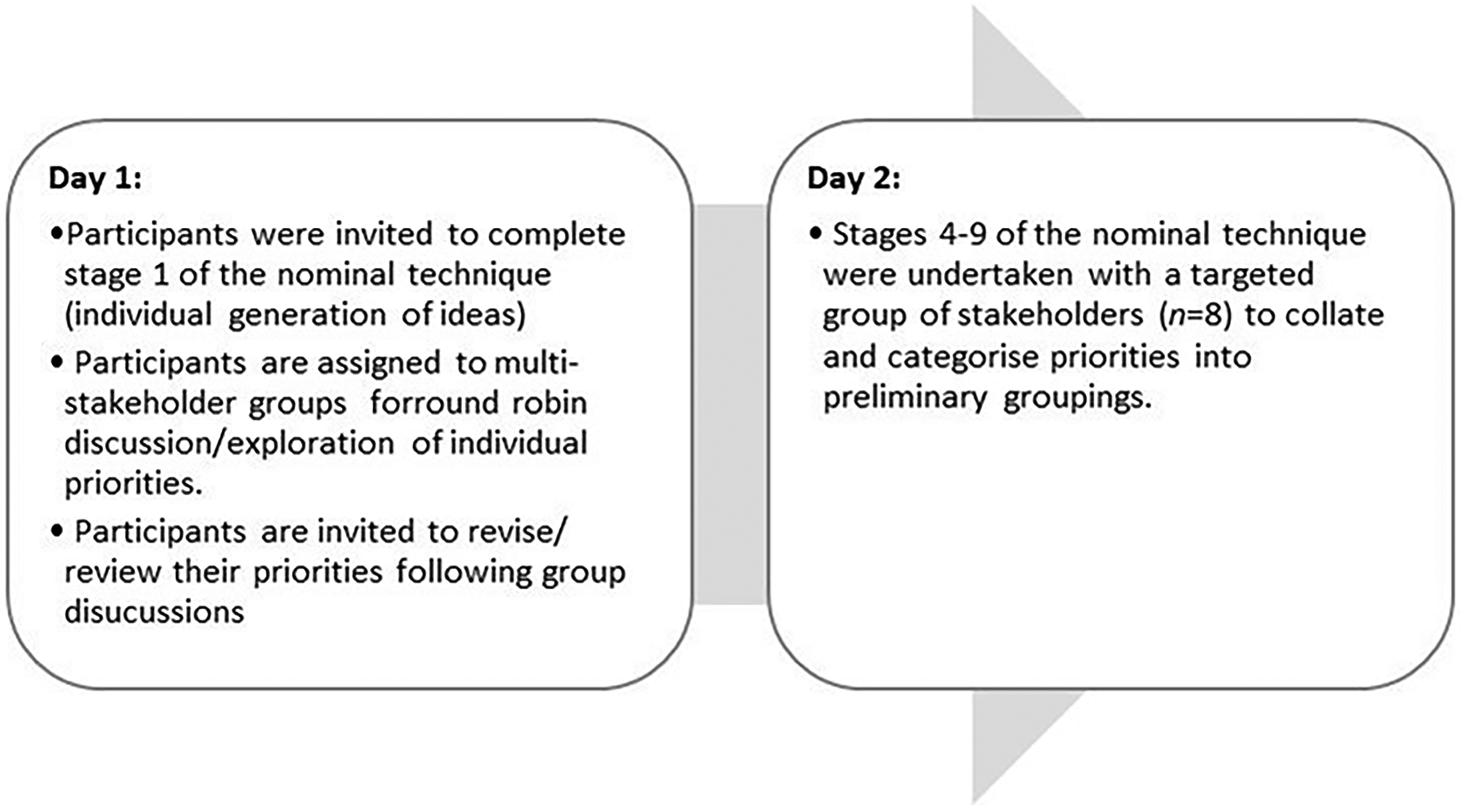
Data collection process.
Day 1
Stages 1–3 of the technique were completed by the end of the first day. These steps included: (i) silent generation of priorities where each participant wrote down their ideas independently whilst listening to and engaging with keynote and lightning talks, (ii) multi-stakeholder group discussions and (iii) revision of priorities.
Stage 1: Silent generation of priorities (individual)
Over the course of the first morning of the knowledge exchange event, participants were invited to identify priorities individually whilst listening and engaging with keynote speakers and those presenting lightning talks by inputting into an online survey platform developed on Qualtrics.
Stage 2: Round-robin discussions (group).
Following on from the afternoons talks, participants were allocated to multi-stakeholder groups (n = 8) (both in person and online) for an opportunity to discuss their priorities and to listen to the priorities of others. Each group was assigned a facilitator, who recorded all the ideas. Each idea was then discussed one at a time. This ensured that all ideas were given equal weighting and allowed for clarification to be sought where necessary. Once all the ideas had been presented, participants discussed any similarities and differences between the priorities. This process allowed participants to hear the rationale behind other perspectives and to develop their own initial ideas further in relation to these.
Stage 3: Review of priorities (individual)
Towards the end of the day, having heard all the presentations and having engaged in group discussions, participants had time to review their initial list of priorities and to refine or amend these further. This process was undertaken individually rather than to seek a group consensus for two reasons. Firstly, many of the stakeholders were not known to one another and had only a limited amount of time together to share ideas. It was felt that forcing a group consensus prematurely could result in some important ideas being lost. Secondly, some jurisdictions were more heavily represented than others and there was a concern that a voting process could risk specific individual priorities being ranked lower.
Day 2
Data submitted during the knowledge exchange event was downloaded from the online Qualtrics survey by ALG and AK. Any written submissions were added to the data set. The raw dataset was presented to a smaller group of stakeholders from academia and intermediary practice. This group included the five authors of the paper (ALG, AK, AC, JT and BOM) and three additional intermediaries in practice. The analysis group membership therefore included an equal number of practising intermediaries (n = 4), and academics (n = 4). Three of the eight group members were male, and the remaining five were female. A process of open coding was then undertaken.
Each submitted idea was read out aloud in the group and a group consensus was sought to sort these into preliminary categories. By the end of day 2, 17 categories had been generated. These were uploaded to NVIVO, a qualitative research database, to track analytical decisions by ALG and AK in a subsequent research meeting and further refined (n = 8). These eight categories and supporting data were then presented to two further experts in the field, who provided individual written feedback regarding the analysis. These comments were considered in an additional analysis meeting by ALG and AK, resulting in a final list of six categories.
Results
Participants
One hundred and twenty-two people attended Day 1 of the hybrid knowledge exchange event. Of those, 67 delegates attended the event face to face and 55 participated online. Sixty delegates (49%) participated in the study. Of the sample, over half worked in the Republic of Ireland (59%). Five participants worked in Northern Ireland (9%). Four participants worked in England and Wales, four in New Zealand and four in Chile (7%). Nineteen participants self-identified as intermediaries (31%), eleven participants self-identified as academics (18%), ten participants self-identified as speech and language therapists (16%), seven participants self-identified as legal practitioners (11%), three participants were social workers (5%), two participants were from law enforcement (3%) and one participant was an occupational therapist (1%). Seven participants ticked ‘other’ (11%). Most of these participants described their title or role as working for non-government organisations and one participant stated that they advised government departments.
Results of analysis
As described in the previous section, the dataset was analysed using open coding of the participants’ top 10 priorities. In Figure 2, an overview of the final six categories, and the number of supporting open codes are presented in order of frequency of reference across the dataset.
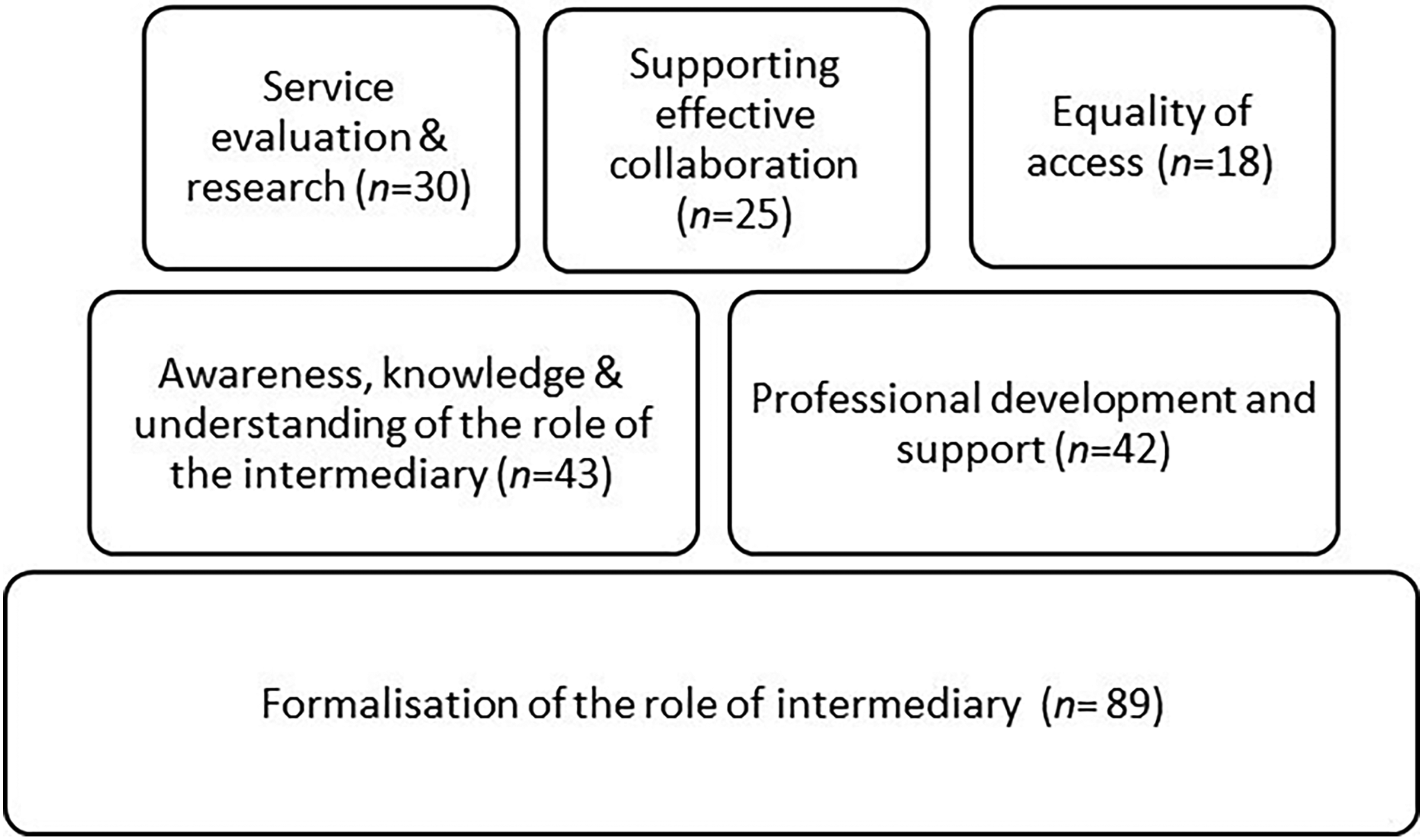
Categories and number of supporting codes.
Category 1: Formalisation of the role of intermediary
This most heavily coded category included two key ideas: formalisation of processes and procedures and formalisation of the employment status of the intermediary. In terms of processes, participants identified three key elements; the need for agreed professional guidelines, the need to formalise processes of referral to and allocation of intermediaries and the need for governance processes in relation to the role. The rationale for these priorities related to the need to ensure early, timely and fair access to the intermediary and to ensure skills of the intermediary are carefully matched with the case: Systems in place for assigning (the) intermediary to (the) case which reflects some degree of skills match to needs as well as geographical considerations (Legal practitioner, Republic of Ireland)
Category 2: Awareness, knowledge and understanding about the role of intermediary
The second most heavily coded category related to the need to focus on ways of ensuring that there is an awareness of the role, and that the role is fully understood. This issue was referred to in the context of reference to perceived negative attitudes towards the role by certain professional groups: Stakeholder awareness/training regarding role and scope of Intermediary practice—aiming to address attitudinal barriers (Legal Practitioner, Government Department) Training for legal practitioners around the role of the intermediary. Intermediaries feel excluded at times from the legal process when in fact they are neutral and there to assist in an unbiased way. Intermediaries have expressed dissatisfaction at how they have been examined by legal practitioners and treated rudely at times (Intermediary, New Zealand)
Stakeholders specifically mentioned the importance of the support of the judge in being able to work effectively, and the need to ensure that members of the judiciary fully understand the role: Some judges are still not grasping the importance/nature of their role in facilitating vulnerable persons in giving evidence and more training/education should be given to Judges/Court Staff/Legal practitioners so that we are all comfortable in the use of intermediaries going forward (Director, Accompaniment Service for Children, Republic of Ireland)
The need for promotional activities amongst the public such as publicity and media campaigns was also discussed.
Category 3: Professional development and support
This category was almost as heavily coded as category 2. Participants cited the need for a range of professional supports for intermediaries if a workforce is to be sustained. Access to supervision and counselling was identified as important to protect intermediaries from suffering from vicarious trauma, given the nature of the cases they work with: Provision of supervision/counselling to avoid vicarious trauma—the nature of the cases is extremely harrowing and to deal with these horrific situations without support is not sustainable (Intermediary, England and Wales) Support needs to be set up at all levels, formally, proper reflective supervision (and funded) for intermediaries, also opportunities so they can co-work and have others to bounce ideas off, read their reports to offer a friendly critical approach… (Speech and Language Therapist & Intermediary student, Republic of Ireland)
Access to legal advice to protect intermediaries around challenges in practice was also referenced: Legal advice—here in England, the MoJ (Ministry of Justice) doesn’t have a formal system for intermediaries accessing legal advice. I have been an intermediary here for 8 years and thankfully only twice have I been issued with a witness summons and compelled to attend court and be cross examined about my assessment/interaction with a witness before interview, it was a terribly stressful experience and although in both cases I felt I held my own in the witness box I think there are questions that were put to me that were outside my remit so legal advice would have been helpful (Intermediary, England & Wales)
Category 4: Service evaluation & research
Many of the participants included the need to ensure intermediary services had mechanisms of feedback and quality assurance to protect those who are allocated this accommodation. Pilot schemes where intermediaries are introduced should be properly planned and evaluated using robust methods in order enhance the effectiveness of the schemes in a timely manner: A pilot has a beginning and end, a pilot needs to be evaluated quickly so that it can be rolled out across the CJS (Criminal Justice System), and evaluation needs to be done systematically, not just piecemeal, using proper models and frameworks (Employee, Non-Government Organisation) Discourse analysis (fine grained studies using ethnographic methods) around the role in action (Academic, Republic of Ireland)
An agreed set of core outcome measures was also identified as an important research focus to be able to ensure that when evaluating the effectiveness of the role, relevant and meaningful criteria are used: Developing core outcome sets for measuring success of role otherwise how will we know what to evaluate the work of the intermediary in a meaningful way going beyond numbers of referrals etc
(Intermediary & Researcher, Northern Ireland)
Category 5: Supporting effective collaboration
This category relates to the need for efforts to support effective partnerships if the role of the intermediary is going to be maximised. The importance of building and maintaining inclusive networks including all of the key stakeholders in order to support the intermediary's work was highlighted.
It was acknowledged that the role of the intermediary can be a lonely one: Ensure the community is tight knit/supportive. The intermediary role can be a very lonely one. Ensuring a relationship of mutual trust/support between the intermediaries themselves and others in the system included the Department/provider is essential (Legal practitioner, Northern Ireland) Joint training/networking—judges and barristers can be a bit snooty/snotty! If there’s more joint training between intermediaries, barristers, and judges then this helps to break down the barriers (Intermediary, England & Wales)
Specific mention of the importance of an effective working relationship with the police in the Irish context was also noted given their role in specialist interviewing: Getting the Guards on board is essential. At the end of the day, we cannot work effectively in gathering best evidence, if those with speech and language needs are not identified from the start of the process. There is very little awareness of speech and language needs amongst the general public and amongst public servants, especially when there is no obvious physical disability going with it. The Guards (police) could have a crucial role in the identification of communication needs from the outset (Social Worker, Ireland)
Category 6: Equality of access
This category relates to concerns about access to the intermediary. Participants were of the view that the role should be extended to all vulnerable individuals whether complainant, witness, or defendants: Ireland has a chance to support victims and defendants appropriately, we need to be on the right side of history (Intermediary & Speech and Language Therapist, Republic of Ireland) Current lack of access for defendants is a serious article 6 fair trial rights issues. Harder to extend to defendants the longer you leave it—it needs be sorted asap, sort it soon (Legal Practitioner, Northern Ireland)
Participants also wanted the individual with speech language and communication needs to have access to an intermediary at all stages of the criminal justice process, not just in court: Push to ensure ALL participants can access an intermediary… not just at the evidence phase (Intermediary, New Zealand)
Participants identified the need to strengthen legislation to enable equal access: Establish a firmer statutory basis for intermediaries covering their remit at pretrial and their accessibility to defendants (Academic, Republic of Ireland)
Discussion
Many countries, including Ireland, have identified the need for accommodations to facilitate the participation of individuals with speech, language and communication needs when engaged in the legal process. At the forefront of these efforts has been the introduction of a new role; the intermediary. By facilitating effective communication between vulnerable persons and stakeholders within the legal system, intermediaries play a pivotal role in ensuring their participation. However, embedding the role of the intermediary in legal systems is recognised as challenging and there are significant knowledge gaps in relation to the role itself. Co-production of research priorities by multi-sectoral stakeholders has been shown to generate actionable knowledge which is more translatable to the domains of policy and practice. The aim of the present study was to engage multiple stakeholders to identify priorities to advance the role of the Intermediary in the legal system.
A modified nominal group technique was employed. A purposive sample of stakeholders using a maximum variation strategy was recruited at a hybrid knowledge exchange event held over 2 days in June 2023 (n = 60). Phases of data collection included silent generation of ideas, and round-robin group discussions to identify any areas of agreement or disagreement, provide further details and rationale for priorities, and for the group to generate new ideas. Participants were invited to review and resubmit their top 10 priorities individually rather than force a group consensus. Qualitative content analysis was undertaken inductively on the second day by generating open codes and then categories were developed.
Approximately 200 priorities were collected in Day 1. These were categorised into 17 priority areas in Day 2. Two further analysis meetings were held to refine the categories resulting in eight priority areas. Preliminary data analysis was member-checked and categories were further refined, resulting in six final key priority areas. These included the need to: (i) formalise the role of intermediary; (ii) enhance awareness, knowledge and understanding of the role of intermediary; (iii) establish mechanisms of professional development and support for the intermediary in practice; (iv) undertake service evaluation and research in relation to service delivery; (v) support effective cross-sectoral working relationships; and (vi) ensure equality of access to the intermediary special measure.
As a new actor to the professionalised world of criminal justice, it is perhaps unsurprising that the status of the intermediary emerges as a key issue in the data. The findings focusing on ‘formalisation of the role’, ‘awareness, knowledge and understanding about the role’ and ‘professional development and support’ all relate in different ways to the intermediary's relative occupational status. In the same vein, the priority category of ‘service evaluation’ speaks to issues of quality assurance and standards which are often associated with professionals and professional work. As the first qualification of its kind anywhere in the world, the development of the ‘Professional Diploma in Intermediary Studies’ is significant in terms of presentation of the intermediary role as a criminal justice professional. Following on from that, the recently devised ‘Guidance Document’ (Courts Service, 2024) relating to the intermediary role contains several references to expected professional standards and professional duties.
The ‘complex social world’ (Rock, 1993: 2) of the criminal court is often depicted as a closed community in which the ‘court workgroup’ operates together to process criminal cases (Eisenstein and Jacob, 1977). Its core members, the judge and both prosecution and defence lawyers, share strong organisational ties as well as educational and professional qualifications (Wandall, 2008). Whether the intermediary role ought to be considered a ‘professional’ within this environment has been an issue of contention since the role was first created in England and Wales. Although Plotnikoff and Woolfson (2015: 281) note that intermediaries ‘have emerged as a new professional identity’, the Parliamentary debates preceding the introduction of the intermediary special measure reveal that no identifiable category of individuals or particular profession from which the intermediary was expected to be drawn. Nonetheless, the Ministry of Justice (MoJ, 2023) in England and Wales and the Department of Justice (DoJ-NI, 2015) in Northern Ireland use the terms 'professional’ and ‘professionalism’ when describing the organisation of intermediaries and the standards expected of their work.
In other jurisdictions, the question of professional status has been integral to the success of the intermediary role and the schemes operationalising it. For example, in South Australia the failure of the ‘Communication Partner’ scheme has largely been attributed to the ‘volunteer element of the model’ which was adopted (Hoff et al., 2022: 975). A level of distrust emerged as many stakeholders ‘had expected a paid professional model as operated in other jurisdictions and believed the choice of volunteers reflected a lack of government commitment to the change’ (Hoff et al.,2022: 982). In Chile, the intermediary role has mostly been carried out by judges, a development that has emerged at least partially because of the status of the judiciary and the trust they engender as professionals (Ulloa et al., 2022). The decision to establish the intermediary qualification in Ireland as a ‘Professional Diploma’ is not only relatively novel but could be crucial in terms of securing the role's legitimacy and professional standing.
Based on experiences in other jurisdictions, the professional status of the intermediary role in Ireland will depend significantly on the acceptance of the role among other justice professionals and the legitimacy which intermediaries as a cohort are able to cultivate. As Taggart (2023: 494) has noted, intermediaries navigate boundaries which ‘act to mediate inter-professional interaction’ and delineate the scope and content of the role. Central to this is dealing with resistance from other actors, which invariably comes in different forms. Early evaluations of the pilot scheme in England and Wales revealed resistance from several judges and lawyers to the intermediary's presence (Plotnikoff and Woolfson, 2008). It seems clear from subsequent research that much of this resistance was grounded in a lack of understanding of the intermediary role and its function (Plotnikoff and Woolson, 2019). As acceptance of the role among criminal justice professionals has grown, the role's status as a criminal justice ‘professional’ has been helped by its specific inclusion in official rules and guidance such as the Criminal Procedure Rules (CPR) in England and Wales. For example, the content of the intermediary's court report is now prescribed (CPR, rule 18.28) and the requirement that the court must ‘invite representations’ (CPR, rule 3.9(3)(a)) from the intermediary at a ground rules hearing. These developments reflect a recognition of the intermediary role as integrated into the day-to-day practice of criminal courts.
Although only one factor among many which will determine the success of the intermediary scheme in Ireland, it is crucial that those executing the role are viewed as professionals in communication assistance. As Taggart (2022) argues, intermediaries often tread a thin line between gaining acceptance of their work and seeing their role vulnerable to encroachment. Ensuring that other justice professionals understand that the role is a neutral facilitator of communication and does not pertain to either side of a case is fundamental. Finally, securing support from the judiciary will be focal to the role's future, as experience elsewhere reveals that the scope of the intermediary role is largely determined by judges who approve its appointment in a given case (Taggart, 2021). In that regard, judicial approval of intermediary assistance is a key factor to ensuring intermediary reports and recommendations are taken seriously and, crucially, followed by lawyers.
The final two priorities identified amongst stakeholders relate to the importance of establishing and supporting effective collaborative relationships around the intermediary, and equality of access to this special measure. Regarding the former, there is a growing body of evidence in the field of implementation science of the importance of partnerships and connections across stakeholder groups in supporting the normalisation of innovations, in this instance the work of the intermediary, within complex systems (Damschroder et al., 2009; Damschroder et al., 2022; May and Finch, 2009). Much work has been done in relation to the science of engagement that has enabled conceptual clarity regarding such networks (Carrozza, 2015; Goodman and Sanders Thompson, 2017). Partnerships within such networks need to go beyond consultative to shared decision-making such that all stakeholders including service users, caregivers and families, and advocacy groups that traditionally have limited power are given shared decision-making authority with powerful stakeholders (in this instance members of the judiciary, legal practitioners, government departments, researchers in academia) are enabled to collaboratively manage the design, evaluation and implementation of projects (Goodman and Sanders Thompson, 2017). Whilst it is long acknowledged that stakeholders provide essential contextual knowledge that is critical to effective action planning in relation to driving the implementation of change, it is also suggested that until stakeholders see an advantage to the innovation, in this instance the intermediary scheme, they are unlikely to engage in such networking activities (Greenhalgh et al., 2004; May and Finch, 2009). In this instance, the need for public awareness and understanding of the role of the intermediary is essential. Such diverse networks are also difficult to sustain once established, as they include stakeholders from a range of sectors and the responsibility of maintaining network activities does not sit within one particular organisation (Babiak and Thibault, 2009; Bryson et al., 2015). In relation to intermediary schemes, tertiary organisations appear to have played, and continue to play, an integral part in fulfilling this role in other jurisdictions and may be required in the Irish context as the intermediary scheme gets underway.
Perhaps, unsurprisingly, given the lopsided statutory footing upon which access to an intermediary in Ireland is currently grounded, equity of access to this special measure was the final priority identified by the stakeholders. In raising this issue, the stakeholder respondents effectively echoed a concern voiced initially by Cusack (2017: 445–446) with regard to the structural vulnerability of defendants in Ireland whereby a patent dissymmetry in communicative power has been created, and sustained, by national legislation: As it stands under Irish law at present, vulnerable defendants have no special protections equivalent to those afforded to other witnesses. Given that the guilt of the accused has yet to be established at the time of the trial, this inequality of provision would appear to be an explicit infringement of the common law principle of equality of arms. frequent breaks, either scheduled or on request; the provision of extra time to assimilate information and respond to questions put; the facility to have complex propositions or technical matters explained in simpler language, or broken down; and the provision of an overnight transcript service, at least in respect of critical parts of the evidence, so that the person with the difficulty could review again the evidence given both after hours and at his or her own pace, and with the benefit of explanation from his advisers (to instance but some possibilities), might not be considered (para. 59).
In criticising the trial judge's inappropriate decision to consider the availability of practical arrangements to support the defendant at trial during a preliminary fitness hearing, Edwards J observed that while ‘there is a possibility that the stress of a trial could create information processing difficulties for the respondent, and/or difficulties in speed of recall from memory, a fair trial may still be possible with the provision of assistance to, or reasonable accommodations of, the accused’ (para 59). To ensure that the challenges faced by the respondent, as well as the range of possible support measures available to him in court, were properly considered by the trial judge, Edwards J concluded that it ‘would be wise to schedule a pre-trial direction hearing’. According to Edwards J: the only limitation that should be put on such [support measures] is that they should be reasonably practical; they should be confined to what is strictly necessary, and they should not confer such an unfair advantage on the beneficiary as to render an unfairness to the other side, in this instance the prosecution. We would add that the fact that accommodations might prolong a trial, perhaps significantly, should not be a reason in itself to discount their suitability or practicality (para. 56).
While episodes of judicial activism of this nature are welcome in serving to align Irish criminal procedure with international standards (T v UK (1999) ECHR 170; R (on the application of C) v Sevenoaks Youth Court [2010] 1 All ER 735), the extension of the intermediary special measure to vulnerable defendants in Ireland is, as yet, illusory. In providing, then, an ‘unruly template for securing equal access to justice’ for vulnerable defendants (Cusack, 2017: 437), the current practice of extending special measures to defendants at the unfettered discretion of the judiciary—as the stakeholder group identified—is no substitute for the consistent due process guarantee that would be yielded to these individuals by the enshrinement of a universal statutory right for all vulnerable individuals to access an intermediary in the interests of justice. Further, the act of providing a statutory right to defendants to access an intermediary communication assessment would still offer no guarantee as to the extent, if any, that the judge appoints the intermediary at court, for example, for the defendant's oral evidence only, or to be present throughout the trial to enable the defendant's full and effective participation.
Strengths and limitations
The methodological strengths and limitations of consensus study designs are thoroughly discussed elsewhere and will not be extrapolated here. For example, there is considerable debate concerning the definition of an ‘expert’, the notion of subjectivity in relation to the knowledge that is generated via consensus methods and how quality is ensured such that the findings stand up to scrutiny (Bourrée et al., 2008; Fink et al., 1984; Jones and Hunter, 1995). We take the view that our chosen methodology, informed by two frameworks in relation to the generation of knowledge for complex societal challenges—post-normal science, as elaborated by Funtowicz and Ravetz (Funtowicz and Ravetz, 1993; Funtowicz and Ravetz, 1994a; Funtowicz and Ravetz, 1994b), and the notion of co-production developed by Jasanoff (Jasanoff, 1996; Jasanoff, 2004)—has produced robust, relevant and actionable knowledge for policy and practice.
Whilst we incorporated steps during the analysis stages to enhance the trustworthiness, transparency and the credibility of the findings, we acknowledge that no study is without limitations. One critical element of a quality consensus design is the use of an explicit sampling strategy, and the inclusiveness of the recruited sample. Whilst we were successful in recruiting a diverse range of stakeholders including legal practitioners, intermediaries, representatives from government departments and NGOs using a strategy of maximum variation, we acknowledge that our sample did not include the views and opinions of those who have direct experience of accessing the use of an intermediary. This is of particular concern because the views of vulnerable persons and their families do not appear to be represented in many published studies elsewhere. Indeed, a recent systematic review which involved a comprehensive systematic search of the international literature of papers which focused on perspectives of the role of the intermediary only resulted in the inclusion of three papers that incorporated the views of individuals and their families who had experience of using intermediaries (Kearns et al., 2024). The next phase of this study is planned to ensure the experiences and priorities of those individuals who have expertise in the use of intermediaries are documented. The findings from both studies can then be integrated to ensure priorities for action around the role reflect these unrepresented views.
Conclusions
A modified normative group study was undertaken, involving a diverse range of stakeholders, to establish priorities to advance the establishment of the role of the intermediary. Six priorities were identified. These priorities raise questions in relation to the professionalisation of the role and highlight the need for collective multi-level cross-sectoral action at a policy level. Equality of access to an intermediary was noted to be a central concern of the stakeholders who participated in this study. The need to continue to expand the evidence base to guide intermediary practice was also identified. A further study is planned to explore the priorities of individuals who have experience of using intermediaries to ensure their views are represented in further advancing the role.
Footnotes
Acknowledgements
We are grateful to all participants who consented to be part of the study. We would also like to thank Dorothy Clarke, Joanne Morrison, Catherine O Neill, Fiona Simpson and Sally Kedge who helped with analysis of data. We would also like to thank Rachel Murphy, research assistant in the project, who helped organise the knowledge exchange event, and the collection of data.
Consent to participate
Participants provided written consent prior to taking part in the study.
Consent for publication
Participants provided written consent for their anonymised data to be published prior to taking part in the study.
Declaration of conflicting interests
The authors declared no potential conflicts of interest with respect to the research, authorship, and/or publication of this article.
Data availability
Consent was not provided to share data in a public data repository. However, anonymised data can be provided on request.
Ethical considerations
The study received ethics approval from the University of Limerick Education and Health Sciences Research Ethics Committee (Ref: 2021_07_02_EHS).
Funding
The authors disclosed receipt of the following financial support for the research, authorship, and/or publication of this article: This work was supported by seedfunding from the Faculty of Education and Health Sciences, University of Limerick, Ireland.
