



Abstract
Communication plays a key role in a witness's ability to give evidence and participate in the court process. Adults with intellectual disabilities (ID) can be negatively impacted by communication difficulties such as: limitations in recall abilities; suggestibility to leading questions; difficult question styles used by advocates; and unfamiliar language used within the court setting. Most research carried out on communication challenges for adults with ID, when giving evidence, has involved participants in psychology-based experimental methodology. In this study 19 court reports assessing actual witnesses (complainants and defendants) with ID, written by Registered Intermediaries in Northern Ireland, were analysed. A wide range of communication difficulties were identified for the adult witnesses. Difficulties resulting from communication used by their communication partner (typically the advocate in a court setting) were also described. A rich model of the challenges for both partners, in giving evidence and in cross-examination, is presented, extending previous research. This study highlights the need for research within UK courts to assess: how witnesses with ID are being questioned; the effectiveness of changes made to the court process to enhance communication; the impact of the court process and environment on communication and alternative question styles for advocates to use.
Keywords
Introduction
Communication, ID and court
Giving evidence in court can undoubtedly be a challenging and stressful experience for any witness. Communication plays a key role in the giving of evidence and in cross-examination. The witness needs to be able to give verbal information explaining their version of events, to fully understand and respond to questions, and to withstand the complexities of communication within cross-examination. Research suggests that the current process of cross-examination within an adversarial system can negatively impact on eyewitness testimony (Kebbell and Johnson, 2000; Valentine and Maras, 2011; Wheatcroft et al., 2004).
During a cross-examination exchange, verbal communication is usually between two people, an advocate and a witness. This two-way form of communication is often referred to as interpersonal communication (Berger, 2014), which requires some form of mutual interaction between the persons involved (Burleson, 2010; Griffiths and Smith, 2017). The process of an effective communication exchange can be complex and is impacted by the communication skills of each communication partner involved, such as: cognitive (Cogher, 2010; Wyer and Gruenfeld, 1995); language (Chomsky, 2011); social (Burleson, 2010); and pragmatic skills to understand the more subtle meanings conveyed in a message (Abbeduto and Hesketh, 1997; Hronis et al., 2017). Bar training in the UK would suggest that advocates are being trained to question witnesses in a style that can be easily understood and processed by the witness. In a section under useful tips, guidance from City University London's Bar Manual on Advocacy is for advocates to avoid long, complicated sentences and tag questions. Rather, when cross-examining, they are told to ‘Formulate your questions so that they contain one fact at a time. Use short questions. Do not recite facts at length and then ask the witness “Is that right?” Be clear and concise.’ (McPeake, 2018: 173). Bar training in Northern Ireland also teaches advocates to use simple language, a slow pace of questioning and emphasises the importance of listeners being able to ‘decode’ the information given (IPLS Queens University, 2019).
Adults with intellectual disabilities (ID) can experience a vast range of communication difficulties relating to their ability to focus and attend during a communicative exchange as well as with their receptive (inputting and processing information) and expressive language (Belva et al., 2012; Cogher, 2010; Hronis et al., 2017; Kelly, 2000). In addition, they can face challenges with the social skills required for effective communication exchanges and understanding the underlying meaning of language used (pragmatic skills) (Abbeduto and Hesketh, 1997; Martin et al., 2017). Research on adults with ID within the UK criminal justice system is limited, particularly within the court setting. This is perhaps because of an historical attitude that those with ID give inaccurate testimonies and are therefore not viable witnesses (Bowden et al., 2014; Harris and Grace, 1999). Research, however, has demonstrated that this is not true, rather people with ID are able to give accurate evidence under certain conditions (Bettenay et al., 2015; Ericson et al., 1994; Gudjonsson et al., 2000; Henry and Gudjonsson, 1999; Michel et al., 2000). However, the presence of an ID can result in significant communication challenges for a witness when giving evidence in court that can impact on their testimony (Bowles and Sharman, 2014; Gudjonsson and Joyce, 2011). A recent systematic review informs of five key communication challenges for witnesses with ID:
More limited information is provided in free recall. Witnesses may be suggestible to changing their mind in response to leading questions and potentially to negative feedback from the questioner. Statements, tag questions and questions requiring a yes/no answer are more likely to lead to inaccuracies. Witnesses can find it difficult to understand court language. Memory limitations, suggestibility and the likelihood of acquiescence are linked to lower IQ (Morrison et al., 2019).
However, much of the existing research on communication challenges for people with ID, when giving evidence in court, has been mainly lab-based research using methods from experimental psychology focusing on specific areas of communication challenges such as suggestibility (Cardone and Dent, 1996; Gudjonsson and Henry, 2003; Henry and Gudjonsson, 2003; Milne et al., 2002; White and Willner, 2005), acquiescence and confabulation (Clare and Gudjonsson, 1993; Gudjonsson and Clare, 1995) as well as the cognitive impairments of individuals, such as in memory (Collins and Henry, 2016; Perlman et al., 1994) and IQ level (Bettenay et al., 2014; Brown et al., 2012; Gudjonsson and Clare, 1995). There is less research involving actual witnesses or court cases (Ericson and Perlman, 2001; Gudjonsson et al., 2000; Kebbell et al., 2004). We therefore do not know of the impact on communication of the court process itself and other potential impacting factors such as: social factors; non-verbal behaviours of the questioner; non-linguistic aspects such as the pace of questioning and tone of voice. In addition, the court environment and delays on the day of court may impact. Witnesses with an intellectual disability are considered ‘vulnerable’ by the criminal justice system in England, Wales and Northern Ireland (Youth Justice and Criminal Evidence Act 1999, Criminal Evidence (NI) Order 1999). The introduction of a range of special measures in 1999
1
for vulnerable witnesses (including the provision of Registered Intermediaries) has resulted, amongst other changes, in recordings of the police interviews for complainants and witnesses being used as evidence-in-chief. This means that complainants and witnesses do not have to give an account of their version of events in open court and their participation in the hearing is for cross-examination and re-examination. Vulnerable defendants, however, still have to give their account in person in court, prior to cross-examination.
Research from Scotland, examining 56 trial transcripts of child complainants aged 5–17 years old (2009–2011), found that defence advocates asked more complex questions of child witnesses than prosecutors (Andrews and Lamb, 2017). Indeed, there have been a number of cases in the English Court of Appeal that have challenged how advocates question vulnerable child witnesses. Doak and Jackson (2019) state that five clear principles of changes in cross-examination have occurred in recent years:
Age appropriate language should be used. Questions should be untagged and avoid use of suggestion. Advocates should exercise extreme caution when attempting to challenge testimony. There is a need for ‘reasonable adjustments’ to be made. There is not a right to ‘put one's case’.
For adults, on the other hand, Kebbell et al.’s (2004) research, comparing court transcripts of trials for witnesses with and without ID, found questioning of the witnesses to be almost identical, though their research was carried out on cases from 1994–1999, prior to the introduction of special measures. Researchers in New Zealand compared 21 court transcripts of sexual assault hearings from the 1950s with 21 more recent cases (1996–2011). Findings showed that overall advocates asked more questions in the recent cases but the format of cross-examination had remained the same, with the emphasis still on leading questions (Westera et al., 2017). Similar more recent research could not be found for England, Wales or Northern Ireland.
Registered intermediary service
The service of a Registered Intermediary (RI) is a special measure available to vulnerable witnesses. In England and Wales this service is limited to complainants and witnesses, although in some cases non-registered intermediaries can be requested for vulnerable defendants and granted at the discretion of the Judge.2,3 In Northern Ireland RIs are also available to vulnerable suspects and defendants. In Northern Ireland, when a case is going to trial in the magistrates or crown courts, the services of RIs are requested by the Public Prosecution Service (PPS) for vulnerable witnesses and complainants, and by solicitors for vulnerable defendants. The contents of the RI court report is then addressed during a Ground Rules Hearing when the Judge decides on what recommendations should be accepted and implemented during the case hearing (see Cooper et al., 2015).
In order to address the general lack of research into communication challenges for actual witnesses this study has examined court reports written for adult witnesses by RIs in Northern Ireland. RIs conduct these assessments in order to try to predict the communication difficulties in examination/cross-examination. These reports are based on information gained from the individuals and relevant others, during a communication assessment.
As research already shows that children in general can be subject to communication challenges during cross-examination (Zajac and Hayne, 2003, 2006), this current study focuses on challenges identified for adults with ID, to ascertain the specific communication challenges relating to the presence of an ID. Thus the aim of this qualitative study is to identify the communication challenges identified by RIs in Northern Ireland for adult witnesses with ID in court.
Material and methods
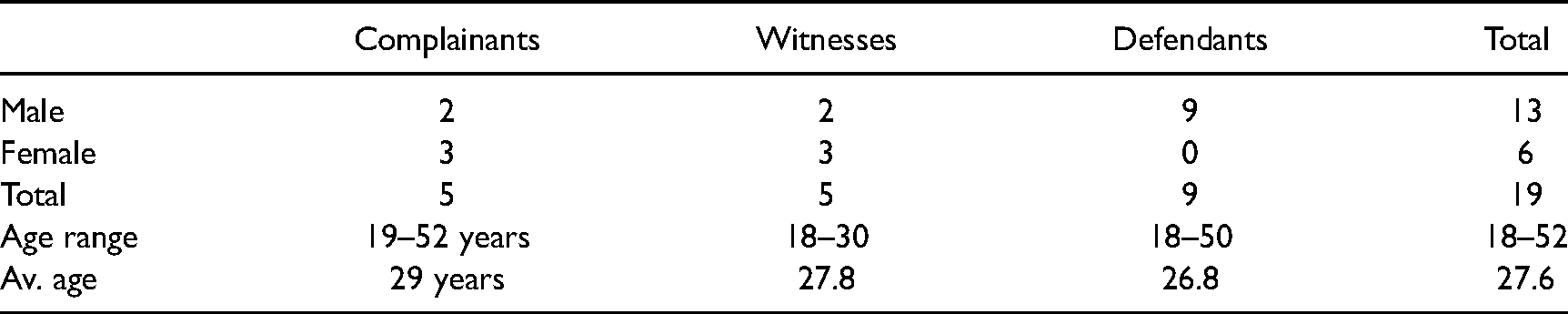
This study was made possible through the permission and support of the Department of Justice Complainants and Witnesses branch, which manages the registered intermediary (RI) service in Northern Ireland, known as the Intermediaries Services Secretariat (ISS). The last 25 relevant RI court reports received by the ISS up to May 2018 were requested (this date cut-off was used because following May 2018 reports were sent directly by the RI to the end user). In total 19 reports were received for complainants, witnesses and defendants. 4 The reports were from 12 different authors, four of whom provided two reports and one author provided four. Table 1 shows the breakdown of age and type of witness. Co-occurring conditions were recorded for some participants: mental health difficulties (7), Attention Deficit Hyperactivity Disorder (ADHD) (3), autism (3), epilepsy (1), dyspraxia (1), and hearing loss (1). This paper uses the generic term of ‘witnesses’ as an inclusive term for complainants, witnesses and defendants.
Witness details.
All reports were anonymised prior to the researchers receiving them. Ethics approval was granted by the appropriate university ethics committee.
Process of analysis
Communication theories and existing literature on communication difficulties for adults with ID provided a structure for analysing information, which is based around attention and focus, receptive language and expressive language. A similar structure is also used within the RI court reports and provided a suitable framework for this research. Consequently, Framework Analysis (Matthews et al., 2019) was chosen for this study as it uses a structure of predefined ideas or themes through which to analyse research while still allowing new and unexpected material to emerge.
All information was charted onto a framework matrix Excel spreadsheet. Each communication challenge recorded in the reports was given a code and the exact wording that related to a code was recorded on the spreadsheet. Each code was then written on a separate sticky note and arranged into sections of potential themes that could be seen from a visual analysis. Each code was taken separately and the phrases from each report, as recorded in the framework matrix, summarised and listed under each code. Key points from these phrases were also written. Spider diagrams were drawn of the codes and the key points extracted from the phrases in the charting stage. These were visually examined for potential themes.
Results
Two main themes emerged: communication difficulties relating to the witness/complainant/defendant and communication difficulties relating to the presentation of information through their communication partner. As the reports are written with the assumption that the communication partner in any examination/cross-examination communicative exchange will be an advocate, these themes are recorded as:
advocate communication difficulties witness communication difficulties.
The two main themes and eight sub-themes are recorded and presented in Figure 1. For some sub-themes further detailed points are also recorded in Figure 1 and highlighted in bold below.
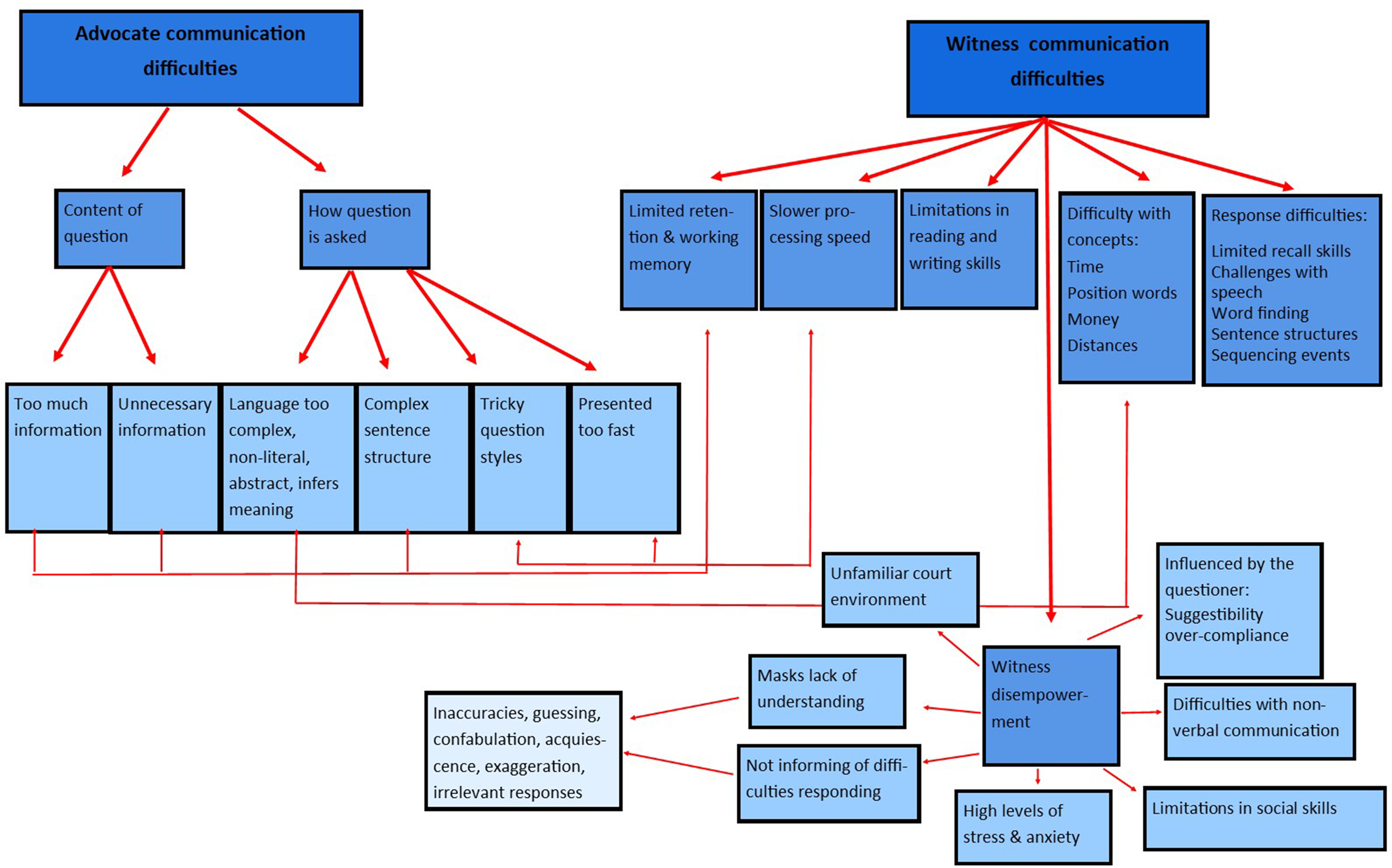
Main themes and sub-themes of communication challenges.
Theme 1: advocate communication difficulties
These are difficulties highlighted within the court reports that relate to the way in which the advocate communicates with the witness. There were two subthemes:
Content of question How a question is asked.
Subtheme 1: content of question
Too much information given in the question from the advocate to the witness and unnecessary information can be difficult for the witness to retain, particularly if presented in long sentences or paragraph form.
She is unable to fully process complex, lengthy spoken questions or short paragraphs accurately. (R20)
There is a risk that the witness will not understand the question, they may only ‘hear’ part of the question, can be ‘overloaded’ with information, and will not be able to fully process the information. This could then lead to inaccurate and/or incomplete responses.
…he would quickly get lost, unable to retain what had been said and confused as to how he should respond. (R18)
Sub theme 2: How the question is asked
The court reports identified challenges with:
the language used by the advocate sentence structure style of questions pace of questioning.
Language used by advocates may be too complex, non-literal, abstract and infer meaning. These language types can result in confusion, limited or no understanding of the question asked.
A complex question could result in a ‘jumbled’ response. (R3)
Complex language is referred to as language that is too difficult to understand; legalistic language such as the word ‘allegation’; and vocabulary that the witness is unfamiliar with.
Some reports give examples of non-literal language which are idioms, such as ‘being tied up’ (R20) and common everyday expressions such as ‘We’ll not be too long’ (R18).
Abstract language uses words that relate to ideas, qualities or emotions rather than physical things. Examples of difficulties with abstract language are not generally given in the reports; however, one report refers to concepts around time, feelings, emotions and use of money as being abstract ideas such as: how much time has passed; how one felt in the past about a particular event; or how much an item would cost (R14).
Other types of language that can cause difficulties are highlighted as: sayings; sarcasm; humour; figures of speech; and absurdities.
Challenges understanding inferred meaning are also commented on and this relates to: knowing people's motives; to draw conclusions from what is said; to make predictions; to problem solve; to assume the role of another; to make generalisations; to imagine a scenario; or to ‘read the words and behaviours of the people around him.’ (R18)
The court reports informed that advocates asking questions using a complex sentence structure cause challenges for communication. Examples of complex sentence structures are given as: paragraphs; instructions in several parts; multi-element questions; sentences with embedded clauses such as ‘the girl chases the dog that is jumping.’ (R1); and questions that contain more than one or two key points.
Has much more difficulty processing questions containing multiple parts. (R10)
Questions asked, or information presented in a complex sentence structure can make it more difficult for the witness to retain the information that is being presented, to process the information and to respond fully and accurately. In simple terms, a complex sentence structure causes confusion.
…he would quickly get lost; unable to retain what had been said and confused as to how he should respond. (R17)
It is found to be so problematic that most of the RIs recommended to only ask questions that contain one key point.
A variety of tricky question styles are mentioned in the reports as causing difficulties for communication with each style in only a small number of reports, indicating the individualistic nature of communication difficulties. These are:
statements used as questions negatives, e.g., ‘Don't you know what she said?’ tag questions, e.g., ‘Sure you know you saw that, don't you’ questions asking ‘why’ and ‘how’ repeated questions.
Some of these question styles can cause the witness to not recognise the phrase used as being a question, impair ability to understand the meaning, lead to processing difficulties, and result in limited and inaccurate responses.
He will be unsure whether he agrees or disagrees with this type of question (negative) and will simply pick a response. (R4)
…may be at risk of confabulation and providing inaccurate evidence if the same or similar questions are put to him over and over. (R15)
Some reports commented that the witness was more likely to follow and understand questions when they were asked at a slower than usual pace. If information is presented too fast, this can lead to an inability to follow the questions, difficulties processing the information, confusion and difficulties responding to the questions.
X indicated that he could not follow questions if they were too quick…and struggled if questions were asked at a fast pace. (R13)
Asking questions at a slow pace to allow the witness time to process information was the most common recommendation made by the RIs, included in 16 of the reports. Some reports gave specific instructions to help advocates, such as counting to six after asking each question.
Summary of theme
The way in which the advocate asks questions can impact on the ability of the witness with ID to understand and respond to questions. Too much information and unnecessary information; complex, non-literal and abstract language; complex sentence structures; and a fast pace of questioning can negatively impact on the witnesses’ ability to follow questioning, understand, retain and process the information given, leading to confusion and inaccurate responses. Specific question styles can also negatively impact understanding and responses given: statements, negatives, tags, repeated, ‘why’ and ‘how’ questions.
Theme 2: Witness communication difficulties
These are factors highlighted in the reports that related to difficulties the witnesses had in receiving and responding to questions from the communication partner. There were six sub-themes:
Limited retention and working memory Slower processing speed Limitations in reading and writing skills Witness disempowerment Difficulties with specific concepts Response difficulties.
Sub-theme 1: Limited retention of information and working memory
The witnesses in the reports had difficulty with storing and retaining information provided in questions. Low working memory was recorded as difficulties with repeating words and sentences.
When asked to repeat sentences of increasing length, she could not repeat more than 5 words at a time highlighting a difficulty with her retention of information. (R2)
Difficulties retaining information and working memory are further impacted by how the information is presented in questions, with a number of key influencing factors mentioned: long sentences; a large amount of information given; and the length of time questioning continues for.
As the test progressed, it became evident that her retention of the question became increasingly diminished. (R6).
Tiredness and difficulties focusing on the questions can limit the ability to retrieve the information required and accurately respond to the questions. A wide variety of descriptions were used to express difficulties with attention ranging from mild inattention to struggling to focus, such as: not keeping to topic; disengaged; distracted; poor listener; difficulty sustaining attention; agitation; confused; zoning out; and getting lost.
…at times disengaged from the task at hand. (R6)
Frequently I could see that Mr X was losing concentration, getting agitated and was not fully listening. (R17)
Sub-theme 2: Slower processing skills
Slower processing skills indicated that more time was required to listen to verbal information, read written information, gather meaning from what was heard or read, and to respond. Processing skills of the witnesses were described as: slightly reduced; slow; in low average range; or very weak.
Auditory processing time appeared to be slightly reduced…..appeared to process a little slower than anticipated. (R2)
He has very weak processing skills. There is a delay in his response time. (R4)
Time is also a factor in that the reports highlighted the need for more time in order for the witnesses to process information in questions.
Questions asked at a rapid pace, one after another without sufficient time for the witness with ID to process the information within the questions could impact on how much of the information the witness understands and therefore negatively impact the amount of information in the response, and the accuracy of the response.
Sub-theme 3: Limitations in reading and writing skills
Limited abilities in reading and writing are factored in the majority of the reports. This ranges from general difficulties with reading and writing to more specific information given: slow to read; unable to read or write; significant difficulty; limited ability.
He needs to read material several times to make sure he has understood it correctly. He also has difficulties tracking his place in text when he is reading. (R15)
She was unable to write the date (today) or her date of birth. (R8)
A number of papers stressed that although the witness demonstrated the ability to read a small amount of information, the challenge was in them being able to process and understand what they had read: He was slow to read a short, single sentence, he could not retain the written sentence and found it difficult to find the answers in a basic newspaper article. (R5) …whilst (she) successfully read the abstract aloud, during reading tasks, she displayed difficulties interpreting what she had read and drawing inferences from read text. (R20)
Sub-theme 4: Witness disempowerment
A number of specific communication challenges recorded in the reports collectively result in a sub-theme of witness disempowerment when participating in proceedings of examination and cross-examination:
Influenced by the questioner Non-verbal communication difficulties Limitations in social skills High levels of stress and anxiety Not informing of response difficulties Masking lack of understanding Court environment difficulties
When attempting to respond to questions the witnesses could be influenced by the questioner. The most common influence recorded in the reports was a suggestion of the answer sought being placed into the question; a leading question. This is more likely if the witness is confused with what is being asked, is not focusing well on the questioning, feels pressurised to give a response, or if specific question styles are used; with tag style questions and statements highlighted as being problematic. One report also recorded the use of an affirmative tone in questioning as increasing the risk of suggestibility.
Will readily agree with incorrect information when an affirmative tone or tag is used. (R10)
Some reports highlighted the risk of witnesses giving a response because they are eager to please the questioner, resulting in over-compliance.
…particularly if these questions are asked in a suggestible manner. He may also be at risk of being more suggestible to leading questions following negative feedback from the questioner…..and he may feel pressurised to give an answer. (R15)
…and appeared eager to please throughout. He often looked to the RI for reassurance and asked ‘Is that right’ (R12)
This may also result in the witness not correcting the questioner when the questioner has misunderstood or is in error.
An over-compliant individual….reluctant to correct inaccuracies. If asked to repeat his answer he will think the first answer was incorrect and try another one, in an attempt to please. (R4)
Some witnesses in the RI assessments demonstrated difficulties with non-verbal communication. Fidgeting, moving about in the chair, easily distracted and ‘drifting off’ were physical signs mentioned in the reports that indicated the witness was struggling to focus. Some physical manifestations of inner anxiety and stress were also highlighted: reduced eye contact; panic attacks; impulsive and agitated behaviour; and being physically sick. Challenges were also recorded in that the witnesses had difficulty being able to use non-verbal behaviour accurately, so that their body language is not an accurate indicator of what they actually want to say. This was recorded as their response to questions such as nodding in agreement or a fixed smile, and not indicating or saying when they did not understand the question.
X was showing all the non-verbal signs of following what the RI was saying, nodding in agreement and no signs of confusion. (R4)
His constant ‘fixed’ smile can be deceptive, suggesting he remains fully engaged. In reality, by this stage, he has little idea of what is going on around him. (R18)
Difficulties maintaining eye contact was also commonly mentioned in the reports. It is reported that the witnesses frequently avoided or ‘dropped’ eye contact. Eye contact is further reduced when the witness loses focus or feels stressed.
X's eye contact is limited and this will decrease when he becomes stressed. (R15)
It is noted that using eye contact is not a natural skill, but one that can be learned; however, the witness with ID still struggled to maintain when stressed or losing focus.
He has learnt the rules, but still tends to drop his head when (he) becomes more anxious. (R4)
X has good eye contact when he is reminded and encouraged but when he was losing interest, his eyes were focused elsewhere. (R13)
The witnesses also had difficulty being able to follow and understand the non-verbal behaviour of others. A number of reports highlighted their difficulties in understanding inferences. Although this mainly refers to inferences within language it may also be true for non-verbal language used by the advocates as one report emphasises the ‘…challenge of trying to “read” the words and behaviours of the people around him……he does not accurately read the many non-verbal cues which adults frequently use’ (R18).
Limitations in social skills were highlighted in the reports; self-reported by the witnesses and observed by the RIs in assessment. A number of reports highlighted new situations and new people as being challenging for the witnesses and reducing their communication skills.
Can withdraw when around unfamiliar adults and waits to be spoken to. (R2)
Finds it more difficult communicating with strangers and doesn't like being ‘put on the spot’. (R3)
The RI comments in the reports showed that social skills required in situations that are different or unfamiliar to the adults with ID can be confusing, hard to understand and follow, impacting on self-confidence and the ability to speak out.
X seemed self-conscious and embarrassed at times during the assessment. He made comments like ‘Now I look stupid’, ‘Now I look like a dork’. (R7)
High levels of stress and anxiety were common factors in the reports. Some witnesses reported high levels of anxiety, experienced on a day to day basis, for which medication is required.
…affected over the years by…anxiety levels…It may be the case that his high levels of anxiety are directly affecting his cognitive function. (R5)
The reports recorded that high levels of anxiety could have negative impacts on the witnesses’ abilities to focus, concentrate and respond effectively to questions asked.
Can become agitated and impulsive if anxiety levels are heightened. (R3)
When I pointed out to him that I noticed him tapping his feet and looking away from me when he wasn't properly listening he said he always did this when he became agitated and at such times he simply wanted to go off and do something less stressful. (R17)
When asked open questions X provided answers around how he was feeling, his anxiety and the impact of what is happening in his life, and he struggled to provide the factual information that the question required. (R16)
Two reports commented on the witnesses’ difficulty in processing emotions and stress and the subsequent potential consequences.
…he seemed entirely dissociated from any feelings or emotions….these build up within him to a point when they ‘explode’ in an outburst of confused feelings.. (R18)
His mother tells me he is not good at talking about how he is feeling and therefore on occasions when she does not act quickly he can express his frustration and anxiety in a verbal outburst. (R19)
Others commented on feelings of anxiety around the court process.
…poor sleep and stress which she attributes to events surrounding the imminent trial. (R20)
Some key points can be drawn from the reports to show the witnesses with ID may not inform (the court) of difficulties responding to a question. It is explained that the witness may have struggled to respond to a question because: they simply don't know the answer and cannot remember the details; they have not understood the question but do not want to say so; they did not hear fully; or they need the question repeated but do not ask.
X is at risk of giving an answer even when he has not fully understood the question. This was also raised by Y in his report. (R1)
Some witnesses masked a lack of understanding.
The defendant may come across that he has understood, but in fact, if probed, it becomes evident that the person has not understood what has been put to them. (R5)
A few reasons are suggested as to why the witnesses did not inform the questioner and simply masked their confusion. Firstly, they may not recognise their lack of understanding.
X has limited insight into his own communication difficulties and does not always recognise that he has misunderstood what has been said to him. (R12)
Secondly, they may be embarrassed about highlighting limitations.
His natural instinct is not to say ‘I don't understand’ due to embarrassment. (R3)
Thirdly, they may experience difficulties with expressing emotions and feelings.
He will not verbalise this confusion. Instead he will internalise. (R4)
A lack of informing the court of any difficulties may lead the witness to provide an inaccurate answer by guessing or confabulating answers, acquiescence, exaggeration, or providing information irrelevant to the question.
At times he tended to guess the answer. (R5)
He therefore confabulated what he thought was likely to have been what happened, rather than what he actually remembered in the story…may be at risk of confabulation and providing inaccurate evidence if the same or similar questions are put to him over and over. (R15)
He said ‘I know all about the engines’, then when asked to name one part of an engine he said ‘I don't know parts’. (R7)
The court environment was another component of witness disempowerment. Many of the reports recorded anxiety from the witnesses around the court proceedings. The reports explained this may be due to the change of daily routine required in order to attend court, fears of not being able to understand and answer properly, and a general feeling of being under pressure.
Concerned he will ‘freeze’ when asked questions. (R3)
In the courtroom setting anxiety will be heightened and she may feel under pressure when giving evidence. This will have a negative impact on her ability to communicate in a clear and coherent manner. (R6)
Noise and distractors within the environment may impact on the witness’ ability to focus and the anxiety levels of the witness may be exacerbated by the court process. Other court factors highlighted included: delays on the day; fear of seeing the defendant; fear of the questioning process; and a previous negative experience impacting stress levels.
X is sensitive to noise and if there is a lot of background noise, his mind will focus on this instead. (R15)
Fear of the trial process and of defendant. Worries about being put on the spot and not being able to answer questions. (R2)
He has a tendency to disengage, especially if other conversations or distractions are taking place around him (R18)
It is recommended that the witness is given time to adjust to the environment and that there is no delay when evidence giving takes place.
Sub-theme 5: Difficulties understanding specific concepts
Understanding and giving concepts of time were recorded as challenging. This was related to being able to state ‘when’ an event happened, i.e. the time of day, day of the week, month of year and seasons, or being able to recall ‘how long’ an event lasted for.
Was unable to accurately recall how long he had attended college or worked as a… (R1)
When asked during assessment ‘Are there 10 h in a day?’ he responded ‘yes’. (R15)
X demonstrated some confusion regarding times of the day. (R7)
Some reports also highlight that the witness has difficulty giving an accurate estimate of distance, understanding concepts of money, accuracy for position words, such as between, under and beside.
Sub-theme 6: Response difficulties
Difficulties in responding to questions included difficulties with:
recall speech word finding sentence structures sequencing events.
Two main points emerge regarding the witnesses’ limited recall skills in response to questions: the amount of information is limited and questioning is required in order to elicit further and more detailed information. In the reports, responses were described as: basic; incomplete; short; lacking in detail; lacking in context; and never expanding an answer.
Her description of objects and events lack detail and salient facts. (R11)
May require follow up questions during cross-examination as on her first attempt she may only provide minimal detail. Once she was probed she could express more detail. She required probing questions to elicit additional and finer details. (R2)
Challenges with speech were commonly highlighted in the reports. These was recorded as: soft speech of low volume; lack of clarity; mumbling; a stammer; little expression; muffled speech; slurring; rapid speech; and pronunciation difficulties. The severity of the speech difficulties ranged from a mild stammer to being largely unintelligible.
She converses fluently at conversational level although at times her speech intelligibility is reduced. Speech was at times unclear and not fully intelligible at conversational level. She adopted a fast speech rate which at times reduced the clarity of her speech. (R20)
Difficulty with word finding – locating the right words to use and putting these words into a sentence format are also recorded as specific communication difficulties for the witnesses.
One witness was able to describe the word but could not find and use the actual word sought for. Another witness displayed an overuse of non-specific terms such as ‘it’ and ‘that’ and used words that sounded like the original one he could not retrieve. Pressure of time is also highlighted as a factor that reduces word finding ability.
Some word finding difficulties. Some difficulty accessing target words. He was able to either describe the word he couldn't retrieve or change it to another word. When under time pressure X's ability to recall words significantly deteriorated. (R10)
In addition to finding words, structuring them into sentences was a further challenge. Sentence structure difficulties recorded ranged from one or two words at a time being used to short, blunt sentences and developmentally immature sentence structure and grammar. A few reports also stated that a more limited vocabulary was available to the witnesses such as simple words of high frequency. Having fewer words available to choose from, undoubtedly further challenges the possibility of finding the right word to use.
He mostly gave one to two words at a time rather than speaking in sentences, and he began to answer with difficulty. (R5)
Many of the witnesses displayed difficulties in sequencing events. For some, they demonstrated the ability to sequence a basic event only, others had difficulties with loosing ‘train of thought’; disjointed narrative; and a more generalist rather than specific sequencing given.
Could sequence a basic event in a simple and correct order, however this required effort (R6)
She was unable to order 2 or 3 part picture based stories. Her narrative can be disorganised/disjointed at times…she may talk about something that happened, then later talk about the same event but in a different order. (R8)
One report commented that difficulties with sequencing are apparent even if the event was recent.
He also struggled to explain the sequence of events, such as what he had done the previous day. (R17)
An interesting matter is highlighted around the assessing of sequencing in one of the reports when the witness was asked to sequence his daily routine and needed regular ‘What next?’ prompts, he explained that he did not have any structure to his day, which made sequencing more difficult. It is unsurprising therefore that asking questions in chronological order and signposting topics when questioning are recommendations made in many of the reports.
Summary of theme
The adult witnesses with ID exhibited a number of difficulties that impacted on communication. These were: limited retention and working memory; slower processing of information; difficulties with reading and writing; difficulties with time and other concepts; and response difficulties. A range of factors are highlighted that result in overall disempowerment of the witness: being over-compliant and suggestible; not informing of response difficulties; inaccurate use and understanding of non-verbal communication; high levels of stress and anxiety; limited social skills and pressure of the court environment.
Discussion
The purpose of this study was to research communication challenges as assessed by registered intermediaries (RIs) for adults with ID when questioned in court. Nineteen court reports written by RIs in Northern Ireland were examined. Findings of this research are in line with current literature which highlights communication difficulties for adults with ID including: difficulties in receiving, processing and retaining information; limitations in recall and expressive language skills; limitations in being able to focus during communicative exchanges; and challenges with social and pragmatic skills for effective communication (Abbeduto and Hesketh, 1997; Bartlett and Bunning, 1997; Belva et al., 2012; Blackwell et al., 1989; Cascella, 2004; Cogher, 2010; Henry and MacLean, 2002; Hronis et al., 2017; Kelly, 2000). Findings of this research also complement existing research regarding difficulties with witness suggestibility to leading questions (Bettenay et al., 2014; Cardone and Dent, 1996; Clare and Gudjonsson, 1993; Gudjonsson and Henry, 2003; Milne et al., 2002; White and Willner, 2005), limited recall skills (Bettenay et al., 2014; Brown et al., 2012; Henry and Gudjonsson, 2003) and difficulties understanding court-related language (Ericson and Perlman, 2001). However, the information provided in this study differs from existing research in the points of focus. Research presented in a systematic review on communication challenges for adult and child witnesses with ID focused mainly on experimental methodologies to ascertain the presence of specific communication challenges: mainly suggestibility, acquiescence, confabulation, recall ability and accuracy (Morrison et al., 2019). This current study records general findings of communication difficulties for individual adult witnesses with ID, resulting in a much wider range of communication challenges recorded.
A key point of difference in focus is that existing literature often records IQ levels of the participants and uses IQ as a point of comparison, whereas the level of IQ of the witnesses was not mentioned in any of the RI's court reports. The findings are also perhaps influenced by the role of the RI which is to assess the more functional abilities of the witnesses to: indicate whether the witness has the ability to communicate to give evidence; whether the use of the intermediary is likely to improve communication; advise the advocates; and make recommendations to the court to enable best communication. The role is not to give any opinion on the accuracy of the witness’ testimony of events (as stated in section two of the reports).
As well as highlighting communication challenges relating to the ID of the witness, the court reports also allowed for significant emphasis on the communication challenges within the court setting to be placed on the communication partner: the advocate. This echoes research evidencing that difficulties with communication should not be solely placed with the individual with ID, but can be outcomes from the interactional process itself and the failure of the communication partner to bring balance to the communicative equation by responding appropriately to the language and skills of the individual with ID (Bunning, 2018; Light, 1989).
Within the court reports, the RIs’ main recommendations were to ask short, one-subject questions, in chronological order using simple language and at a slow pace. Also, to avoid tags, statements, negative questions and non-literal language. Due to limited research carried out in UK courts it is not known if adult witnesses with ID are being questioned in a manner contrary to RI recommendations. Bar training would suggest that advocates are being trained to question witnesses in a style that can be easily understood and processed by the witness (IPLS Queens University, 2019; McPeake, 2018); however, these reports do suggest a mismatch of communication between the advocate and the witness. The question arises therefore as to why RIs feel the need to assess and make these very specific recommendations in their reports. Training of advocates in the UK continues to follow the Hampel method of roleplaying and assessment by the trainer, an experienced advocate. 5 Perhaps the voice of long-standing advocates during training and subsequent pupillage of trainee barristers has the strongest influence in the language and question styles used in cross-examinations. Recent research involving observations of 339 hearings suggests that the court language, concepts and structures result in the silencing of witnesses and rather than being the focus they are moved into the periphery of proceedings (Jacobson, 2020). There is further training recommended in England and Wales for questioning vulnerable witnesses. The Advocacy and Vulnerability training provided by Inns of Court College of Advocacy (ICCA) claims that over 3000 advocates have undergone the training, which emphasises 20 key principles of questioning. 6 Included in these principles are some of the challenges highlighted in this research, to avoid tag and statement question styles, as well as repetitive and leading questions, and consider avoiding ‘why’ and ‘how’ questions (The Inns of Court College of Advocacy, 2018). Similar training is not yet available in Northern Ireland. However, until research is carried out within the UK courts, we will not know the extent to which this training is put into practice nor the extent of mismatch of communication between advocates and adult witnesses with ID.
Implications for practice
The findings of this research into court reports written by registered intermediaries for adult witnesses with ID raise a number of points relevant for practice.
Firstly, the range of communication challenges identified in the 19 court reports highlights the complexity and individualistic nature of communication with adults with ID. It reinforces the need for the specialist service of RIs to advise and support effective communication with witnesses with ID at an individual level for all witnesses, including defendants. However, there are a number of recommendations that are commonly made by the RIs for questioning the witnesses that could potentially become part of general practice. These are mainly using short, one-topic questions, with simple language, at a slow pace, in chronological order and allowing for regular breaks in questioning. These recommendations could become part of an accepted format within the courts for examination and cross-examination of adult witnesses with ID. This would then allow the RIs to have even more time during assessment for communication challenges specific to the witness. They could also become part of any existing advocacy training and be encouraged into the culture of cross-examination. There is also an argument that these recommendations would be advantageous to promote effective communication with any witness, regardless of level of vulnerability. The stress and anxiety of being cross-examined in court has potential to reduce the communication skills of many witnesses (Fielding, 2013).
Secondly, this research has also highlighted the existence of other difficulties beyond those related to cognitive impairment of an ID. High levels of anxiety and stress, tiredness and difficulties maintaining focus are common factors that need to be taken into consideration by the courts. Evidence shows a higher rate of poor mental health among adults with ID (Cooper et al. 2007; Hughes-McCormack et al., 2017), which would only be exacerbated by a looming court case. Some of the communication difficulties experienced by the witnesses may be impacted by their mental health difficulties and/or trauma experienced resulting in a ‘zoning out’, dissociation and difficulties concentrating on questioning (O’Mahony et al., 2020). Complainants potentially not only have to live with the repercussions of the alleged crime but then have to perhaps relive it all over again years later during a court case. Defendants potentially have to deal with years of accusations and the prospect of punishment. The impact of this stress and anxiety could be reduced by cases involving these vulnerable adults being fast tracked into court. Pre-recorded cross-examinations that can be carried out at an earlier date are now available in England and Wales for vulnerable witnesses, 7 but not defendants, and have not yet been implemented in Northern Ireland. Other measures on the day of the hearing could also be put in place, such as recommending that witnesses with ID attend court just prior to when they are due to give evidence rather than first thing in the morning. This would require prioritising the needs of these witnesses and perhaps arranging proceedings around these needs. More recently, in response to Covid-19 restrictions, virtual trials have been considered. Recent pilot studies 8 suggest that virtual trials can reduce the stress of the court environment, make it easier to pick up on non-verbal communication as faces are more visible, and increase participation as all participants are seen on the same level rather than the defendant being at the margins of the courtroom. However, challenges were found with a high dependency on access and effective use of the technology. In addition, the involvement of vulnerable witnesses or intermediaries were not included in the pilots. Further research involving witnesses with communication difficulties is required. The authors are not aware of virtual RI assessments in England and Wales and in Northern Ireland RI assessments continued to be carried out in person during the pandemic.
Thirdly, this research raises questions regarding the needs of defendants with ID and their abilities to be able to focus during the entire proceedings. If a defendant, for example, is likely to struggle to understand complex language, long complex sentence structures and non-literal language verbalised at a fast pace, it is not unreasonable to ask how they could be expected to understand and follow what is being said during the testimonies of the complainant and other witnesses, arguments made by counsel, points raised to the judge and jury, and therefore effectively participate in their own hearing. A defendant's right to effective participation in their own hearing is enshrined in legislation through Article 6 of the European Convention on Human Rights (ECHR). However, the lack of clarity for application of this legislation has been brought into question, highlighting a need for further explanation and definition in court practice (Owusu-Bempah, 2018). Owusu-Bempah describes the European Court's description of effective participation in SC versus UK as ‘the most comprehensive statement of effective participation that has been provided by the Courts’ (Owusu-Bempah, 2018: 325). The European Court stated that defendants should ‘be able to understand the general thrust of what is said in court. The defendant should be able to follow what is said by the prosecution witnesses and, if represented, to explain to his own lawyers his version of events, point out any statements with which he disagrees and make them aware of any facts which should be put forward in his defence’ (Owusu-Bempah, 2018: 324). According to this statement, it would appear that factors required for effective participation overlap with capabilities required of a vulnerable defendant to be declared fit to plead. The most widely used version of the Pritchard test of fitness to plead requires the defendant to be able to: understand the charge; decide on how to plead; challenge jurors; instruct solicitors; follow proceedings; and give evidence in his or her own defence (Bevan, 2017). Brown (2019) suggests a more modern approach to fitness to plead would be to focus on better supporting decision making and participation at trial. It may be then that for some defendants with ID a different approach to communication, which addresses the communication challenges of the advocate and the defendant, could result in them being fit to plead and effectively participating in their trial.
Finally, this research highlights the importance of the skills of the advocate when questioning an adult with ID. The variety of communication challenges addressed in the reports demonstrates the complexity of this role. Not only does an advocate have to ask questions in the best interests of his/her client's case by extracting alternative evidence and casting doubt on the witness's version of events, they have to perhaps change their entire style, manner and medium of questioning for a witness with ID. This raises a number of issues. Is this placing very high expectations onto advocates and putting them into an unfair position and are they then best placed to cross-examine witnesses with ID? Or does the overall style of communication of advocates when questioning witnesses need to be examined for promoting effective communicative exchanges? Or perhaps the issue is with the actual process of cross-examination and the adversarial system itself so that the question needs to be asked if it is the best method of effective communication with witnesses with ID to elicit full and accurate accounts of an alleged event? Since the commencement of the RI service within UK courts no research has been carried out as to how adult witnesses with ID are being questioned, therefore we do not know how well advocates are managing to follow the communication recommendations made by RIs and how effective the role of the RI actually is in promoting best communication with vulnerable witnesses.
Limitations of this research
This is a qualitative study of communication challenges for adults with ID as recorded in 19 court reports written by RIs in Northern Ireland to inform the courts as to how best to communicate with the vulnerable witnesses. Due to the small number of reports examined this research can only inform on the challenges for these witnesses and what could potentially be challenges for other witnesses with ID. Information on the impact of the court process and environment on communication is limited as the RI assessments were carried out in a neutral, more relaxed environment than a court room. Moreover, the RIs are experienced in communicating with adults with ID and in building rapport, they cannot fully assess the impact of the stressful and emotional experience of going to court, entering a court room, giving evidence and being cross-examined by an advocate on potentially very personal matters. In addition, this research does not provide any information on the format of the RI assessment and any differences in these between RIs. We do not know if a challenge is not mentioned in a report because it was not present or because it was not assessed.
Conclusion
Challenges with communication in court during examination, cross-examination and re-examination of a vulnerable adult witness with ID are significant, complex and varied. Research into the 19 RI court reports showed these challenges lie within the individual difficulties for the witnesses and challenges for the advocate, as the communication partner. For the witness these can be limitations of cognitive skills that lead to limited retention of information, lower working memory, slower processing, limitations in reading and writing and difficulties in responding. They can also include factors that lead to the disempowerment of the witness: over-compliance; suggestibility; difficulties with non-verbal behaviours; limited social skills; high levels of stress and anxiety; being in an unfamiliar environment and factors relating to court proceedings; masking and not informing the communication partner of difficulties understanding and responding. However, witnesses are also impacted by the communication challenges of the advocate: giving too much and unnecessary information; using complex, non-literal and abstract language; using complex sentence structures; tricky question styles; and a fast pace of questioning. This research highlights the need for research within UK courts on how adults with ID are being questioned and the effectiveness of changes being made to the court process to enhance communication. Research is also required into the impact of the court process and environment on the communication skills of adults with ID. In addition, although the RI court reports provide information on question styles that can cause communication challenges for the adult witness with ID, they suggest limited alternative question styles that could be used by advocates. There is also very limited information on alternative question styles in existing research. There is therefore a need for further research to identify alternative questions styles that could be used when questioning adult witnesses with ID in court.
Footnotes
Acknowledgements
Intermediaries Services Secretariat, Department of Justice, Northern Ireland. Registered Intermediaries in Northern Ireland.
Declaration of conflicting interests
The first author is a practising registered intermediary in Northern Ireland.
Funding
This study is part of a Phd and was supported by funding from a Vice-Chancellor's Scholarship, University of Kent.
