




Abstract
Intermediaries were first introduced by the Youth Justice and Criminal Evidence Act (1999) to facilitate communication between individuals with communication needs and the criminal justice system. Yet, despite increased academic attention into this new criminal justice actor, the content of the role remains unclear. Findings from 31 interviews with intermediaries in England and Wales and Northern Ireland as well as judges in Northern Ireland indicate that two distinct systems of intermediaries have emerged between the jurisdictions. The picture is complicated by an inequality in intermediary provision between witnesses and defendants. In England and Wales, the statutory intermediary scheme covers only witnesses whereas the ‘unitary’ system in Northern Ireland covers both witnesses and defendants. Drawing on the data collected, this article highlights key themes which underpin differences in intermediary practice and suggests that lessons can be learned in how we conceptualise the role and its work.
Introduction
Described as ‘little short of revolutionary’ (Henderson, 2015: 155), the intermediary role has become an integral part of the criminal justice system (Plotnikoff and Woolfson, 2015: 14). As one of the special measures contained within the Youth Justice and Criminal Evidence Act 1999 (YJCEA), the intermediary has effected a ‘culture change’ (Cooper and Norton, 2017: 364) in the treatment of vulnerable witnesses. The role exists to facilitate communication between individuals with communication needs and the criminal justice system. 1 Yet, differences in how the role has been conceptualised have been largely overlooked. For example, in the case of R v Grant Murray a divide between intermediary and judicial conceptualisation of the role was apparent. It was contended that an intermediary assisting a defendant had been ‘undermined and undervalued’ and treated as an ‘enemy of the court’ at trial. 2 The Court of Appeal recognised that while intermediaries ‘provide a very useful service to the court’ they are ‘not to dictate to anyone what is to happen’ and are appointed to provide assistance ‘as directed by the judge’. 3 The intermediary’s relative status within the criminal trial has also raised questions. In both R v Boxer 4 and R v Beards and Beards, 5 intermediaries were allowed to provide expert evidence on the communication needs of vulnerable individuals. As is noted by the Advocate’s Gateway and the Criminal Practice Directions 2015, this is contrary to good practice if the intermediary is at the same time acting in his/her intermediary role. 6 It is recognised that intermediaries cannot operate effectively without the confidence of other criminal justice actors which requires a degree of consensus as to the role’s status and function (Plotnikoff and Woolfson, 2019: 17).
This article focuses on two similar intermediary schemes which operate in Northern Ireland and England and Wales. It reflects on the conclusion reached by Cooper and Wurtzel (2014: 60) that Northern Ireland could benefit from the ‘springboard’ of the intermediary experience in England and Wales which was established ten years prior. By focusing on intermediary practice in both jurisdictions, this article seizes the opportunity to examine the intermediary’s work by looking at key themes that colour, shape and ultimately complicate this new role within the criminal justice system. It presents the findings of an empirical, socio-legal enquiry based on 31 interviews with practising intermediaries in England and Wales and Northern Ireland as well as members of the judiciary of Northern Ireland. While research into intermediaries is increasing, this project is the first to explore understandings and perspectives of practitioners in seeking to understand the role’s content. The findings, which relate to the role’s neutrality, duration of appointment and cohesion/identity, support the conclusion that commonly recognised features of ‘intermediary work’ obscure more nuanced differences in how the role is executed. Crucially, how intermediaries are organised and overseen significantly impacts how the role is conceptualised by those who perform it. This should cause us to reflect on where this new role fits into the wider setting of the criminal justice system. By clarifying the role of the intermediary, this piece contributes towards a better understanding of the social relationships in which it engages and lays a foundation for further empirical work to be carried out. It is concluded that the ‘unitary’ system of intermediaries in Northern Ireland, which sees provision of intermediaries to both witnesses and defendants, could bring many benefits if implemented in England and Wales.
Background
The Witness Intermediary Scheme (WIS) was first piloted by the Home Office in England and Wales in 2004 and implemented the intermediary special measure contained in s. 29 of the Youth Justice and Criminal Evidence Act 1999 (YJCEA). Section 29 outlines the intermediary’s function: (2) The function of an intermediary is to communicate— (a) to the witness, questions put to the witness, and (b) to any person asking such questions, the answers given by the witness in reply to them, and to explain such questions or answers so far as necessary to enable them to be understood by the witness or person in question.
The Department of Justice (DOJ) Northern Ireland gave a commitment in its Victim and Witness Strategic Action Plan 2010–11 to develop a model for the provision of what it termed ‘intermediaries’ for vulnerable complainants and witnesses in the criminal justice system. This was based on the provisions of the Criminal Evidence (Northern Ireland) Order 1999, 11 which mirror the provisions of s. 29 YJCEA. Intermediaries, the DOJ envisaged, would be ‘professionals with specialist skills in communication’ recruited from fields such as ‘speech and language therapy and social work’ (DOJ, 2015: 5). The function of these specialists would be to ‘facilitate communication during the police investigation and at trial between a person with significant communication deficits and others in the criminal justice process’ (DOJ, 2015: 5). The vast majority of those on the register are speech and language therapists with a number hailing from a social work background (email from DOJ to author, 21 August 2020). After consultation with the Office of the Lord Chief Justice, it was decided that all vulnerable individuals—including defendants—would be eligible for intermediary assistance. The DOJ concluded that respect for the principle of ‘equality of arms’ demanded nothing less (DOJ, 2015: 5). In other words, what Henderson (2015: 167) has termed the ‘two tier’ intermediary provision in England and Wales does not exist in Northern Ireland. The Registered Intermediary Scheme (RIS) was subsequently established to allow end users i.e. police, prosecutors and defence solicitors to access the services of a ‘registered intermediary’. Intermediaries can attend both witnesses and suspects at the police station, assist with the planning of interviews and indeed attend interviews to help facilitate communication. 12 At court, their involvement is restricted to the period of oral testimony and they are not supposed to provide support throughout the whole duration of a trial (DOJ, 2015: 6). After an initial Pilot in May 2013, the scheme was extended and now operates in respect of criminal cases being heard in all Crown, magistrates’ and youth courts. Intermediaries in Northern Ireland are appointed on an ‘evidence only’ basis i.e. they are appointed to assist during the period of testimony only (DOJ, 2015: 6). 13 The court can, however, appoint a ‘court defendant supporter’, who typically also works as an appropriate adult, to provide emotional and general support to the defendant for the periods when an intermediary is not present (DOJ, 2015: 21).
A core tenet of the intermediary role is impartiality. Both the MOJ (2019: 35) and DOJ (2019: 14) outline that registered intermediaries owe their duty not to the defence or prosecution, but rather to the court and the criminal justice system. 14 The Equal Treatment Benchbook also describes intermediaries as ‘impartial, neutral officers of the court’ (Judicial College, 2018: 58). While intermediaries for defendants and witnesses are organised differently in England and Wales, the Criminal Practice Directions outline that both roles are underpinned by a narrow focus on facilitating communication between the vulnerable individual and other criminal justice actors. 15 Intermediaries carrying out both roles in England and Wales are also expected to ‘ensure they act impartially’. 16 In Northern Ireland, the decision to limit intermediary involvement to oral evidence only was premised on the fear that the role’s impartiality and objectivity may be compromised if the intermediary is present throughout court proceedings (DOJ, 2015: 6). Importantly, the intermediary is not to be viewed as a ‘supporter’ of the vulnerable individual, to ensure the role’s neutrality is maintained (MOJ, 2019: 13). Indeed, witness supporters and appropriate adults for defendants exist to provide, inter alia, the type of emotional support which falls outside the scope of the intermediary role (Jessiman and Cameron, 2017).
Intermediaries are receiving increasing academic attention as the role becomes more established within the criminal justice system. Plotnikoff and Woolfson’s (2015) book entitled Intermediaries in the Criminal Justice System narrates the emergence of the role and documents some of the earliest experiences of those working at the coalface. Cooper has also written extensively about the use of intermediaries in England and Wales and Northern Ireland and similar schemes internationally with a number of other authors (see Cooper and Allely, 2017; Cooper and Mattison, 2017; Cooper and Norton, 2017; Cooper and Wurtzel, 2013, 2014; Cooper et al., 2015). These publications provide insights which are crucial to understanding how the role operates, from the police station to the courtroom, and how it has become integrated into the criminal justice process. O’Mahony et al.’s (2016) research is also important in understanding the sorts of practical challenges encountered by intermediaries in their work and how the role could be better utilised. The operation of the ‘two tier’ intermediary system in England and Wales has been the subject of more recent academic critique with Hoyano and Rafferty (2017: 97) lamenting the ‘inequality of arms’ between witnesses and defendants in terms of intermediary access. This followed the Law Commission’s (2016) conclusion a year earlier that statutory entitlement to intermediaries should be extended to defendants to ensure the right to a fair trial is upheld.
There has, however, been a paucity of research into the scope and content of the intermediary role. Birch (2000: 249) considered that flesh would have to be put on the ‘bare bones’ of s. 29 YJCEA due to the legislation providing only a ‘briefest description of the intermediary’s function’. While the literature has contributed to a better understanding of intermediary provision and the role’s relative status in the criminal justice system, there has been no research examining how the role is performed and what implications this may have. No research to date has compared the roles of intermediaries working with witnesses on one hand and defendants on the other. Indeed, a lot of the research which has touched on the use of intermediaries has done so as part of a wider focus on witnesses policy and practice and has not considered the use of defendant intermediaries at all (for example, see Plotnikoff and Woolfson, 2019; Victims’ Commissioner, 2018). Consequently, this article seizes the opportunity to conduct a comparative analysis. As the RIS in Northern Ireland was being launched, Cooper and Wurtzel (2014: 39) noted that the WIS in England and Wales ‘provided a template but not a blueprint’ for intermediary provision across the Irish Sea. The authors were confident that the DOJ was well placed to learn from the experiences in England and Wales including how intermediaries are trained, regulated and supported. This article examines the contrast between the ‘unitary’ system of intermediary provision in Northern Ireland and the ‘two tier’ provision in England & Wales.
Methods
Participants
This article presents findings from 31 in-depth, semi-structured interviews with intermediaries and judges. All intermediaries had experience of working with both (i) witnesses and complainants and (ii) suspects/defendants. It was important that all interviewees could speak to their experiences of working with both categories of vulnerable individual. Of the 27 intermediaries interviewed, 20 were based in England and Wales and seven in Northern Ireland.
I accessed my sample in several ways. Interviewees responded to a request sent on my behalf by ‘Intermediaries for Justice’, a registered charity promoting and supporting the work of intermediaries. Further requests were sent via the ‘Registered Intermediaries Online’ portal which is operated by the NCA and is an information sharing platform for those who work in a registered capacity. In Northern Ireland, interviews were arranged in collaboration with the Intermediaries Schemes Secretariat (ISS) who disseminated information to all registered intermediaries on my behalf. In Northern Ireland, four judges were interviewed (two District Judges who sit in the magistrates’ court and two Crown Court judges) through the Lord Chief Justice’s Office. These judges were selected based on their experiences of working with intermediaries in the criminal justice system.
In terms of the representativeness of the sample, over one third of the total intermediary cohort in Northern Ireland were interviewed (DOJ, 2016: 11). In England and Wales, it is more difficult to ascertain precise numbers, since I sought to interview intermediaries who had worked in both a registered and a non-registered capacity. It is difficult to be sure how many practising intermediaries fall into this particular category. When interviews commenced in November 2018, there were 115 intermediaries on the MOJ register actively taking cases (email correspondence from Intermediaries for Justice to author, April 26 2018). Based on anecdotal evidence from the field, it is estimated that less than half of those intermediaries would be in a position to comment on working in a registered and non-registered capacity. Therefore, one can say with reasonable confidence that the 20 interviews conducted amounted to a significant percentage of the target population. Interviews in England and Wales were conducted in almost every main regional area. The interviewees had a mixture of experience with some working in the role for over 11 years and others qualifying less than a year prior to interview. One feature of the intermediary population is that the majority come from a speech and language therapy background. While taking account of this, intermediaries from other backgrounds such as social work, nursing and psychiatry were included to get as broad a view of experiences as possible. Of the 27 intermediaries interviewed, 15 came from a speech and language therapy background, three from social work, three from nursing, two from occupational therapy, two from psychology, one from teaching and one worked with deaf people as a Sign Language interpreter.
Although effort was made, therefore, to make the sample as representative as possible, the findings from this research cannot be generalised to the entire intermediary population. Rather, the data collected aims to provide a ‘snapshot’ of practitioner experiences (Garland and McEwan, 2012: 239). Yet, using a grounded theoretical approach, this is not viewed as a weakness but reflects how an inductive research strategy does not aim to achieve generalisable results (Charmaz, 2006).
Data collection
The interviews were conducted between December 2018 and July 2019 and lasted for an average of 90 minutes. The use of semi-structured interviews allowed for an open-ended and emergent approach which suited my choice of grounded theory methodology (Charmaz, 2006: 28). Prior to commencing interviews, I created an interview guide containing themes which emerged from my early doctoral research including relevant case-law and literature. 17 I was keen to ask participants as many questions on the interview guide as possible, but was also careful to allow time for exploration of issues which they considered relevant. I structured the interviews in a straightforward manner, beginning with questions about interviewees’ initial involvement in a case through to the point when their involvement ends. While each interview followed this structure, I remained reflexive to allow for ongoing modification of questions and the emergence of theoretical ‘hunches’ (Bluff, 2005). For example, I did not begin interviews with any focus on the issue of ‘neutrality’, however when this began to emerge as a prevailing theme, I adapted my interview questions and my interview guide began to evolve accordingly.
The interviews were digitally recorded, and I transcribed them myself. During transcription, I removed any references to specific courts or police stations, colleagues, and names of clients or witnesses in order to keep the identities of the respondents, and those involved in their cases, confidential. All interviewees were provided with an information sheet prior to interview and signed a consent form agreeing to their participation in the research. I anonymised each interviewee and have used the prefix ‘NI-’ to identify interviewees in Northern Ireland and ‘E&W-’ for those based in England and Wales. I used ‘CCJ-’ to denote Crown Court judges and ‘MCJ-’ to denote judges in the magistrates’ court.
Data analysis
I organised and coded the interview data by identifying 12 initial codes which were generated inductively by sticking ‘closely to the data’ (Charmaz, 2006: 47). The coding process was the ‘pivotal link’ (Charmaz, 2006: 46) between my interview data and the generation of theoretical concepts to explain the data. I was able to distil these initial 12 codes into four core codes (impartiality, professionalism, participation and communication) aided by a process of ‘memoing’ which helped me to compare categories, sub-categories as well as identifying beliefs and assumptions in the data (Charmaz, 2006: 81). This process involved rereading all codes and combining those which were similar and discarding those which were not related to the research questions. I also consulted my field notes and post-interview reflections in refining these codes. The three themes which are the focus of the present article thread throughout these core codes and were chosen based on their relevance to the interjurisdictional comparison between England and Wales and Northern Ireland.
Ethical approval was obtained from the London School of Economics.
Findings
My findings centre largely on the contrast between the ‘unitary’ system of intermediary provision in Northern Ireland and the ‘two tier’ provision in England and Wales. While Northern Ireland’s system is modelled on the WIS, it is argued that the DOJ has carved out its own unique intermediary scheme both organisationally and culturally. This includes how intermediaries conceptualise their role and its scope, but also how they are perceived and treated by other criminal justice actors. When analysing the interview data, the potential for a comparison between the jurisdictions became apparent. This comparative angle using three prevailing themes: (i) impartiality, (ii) duration of appointment and (iii) cohesion and identity is now explored.
Impartiality
As officers of the court, intermediaries aim to assist all parties in communicating with the vulnerable individual, and vice versa (Plotnikoff and Woolfson, 2015: 223). The role focuses on communication and those who carry it out are not expert witnesses, do not give evidence nor do they appear or act for either side in a criminal case (DOJ, 2019: 16; MOJ, 2019: 35). As such, intermediaries are expected to work in an unbiased, impartial and objective way at all times.
Intermediaries in Northern Ireland were clear in interview that the role operates independently of any ‘side’ in the criminal process. A strong attachment to ideals of impartiality and objectivity was apparent from all Northern Irish RI interviewees. NI-2’s comments exemplify this position: I am not beholden to anyone. I am an independent provider of a service and I work to my standard…I am not working for a lawyer, I am not working for the police. I consider myself to be an officer of the court and, as such, an officer of the criminal justice system. I think it’s very important to make it clear that either verbally or non-verbally I am neutral here. I’m not on anybody’s side…In terms of neutrality, I think that our non-verbal language can speak as loud as things that we do say. …I try and sit in the middle of the court because of my impartiality. Sometimes it’s in the back, sometimes I am in the press area and sometimes I am in the witness box. It really varies…Defence can sometimes see us as being there to protect that witness and that’s not what we are there for. When you can kind of work through that, it is much better. Even when we train police officers, we will tell them that we are neutral and we are officers of the court. We will say to them that part of our role is to build rapport, but as soon as we come into court we have to break that and step away and be on our own.
…so they may contradict themselves or say something that doesn’t quite make sense and I’ll be wanting to ask something just so they understand what they are telling me. I will say to the officer afterwards. So, if someone is describing something that happened at night and then they might say ‘he had sunglasses on’ I will think ‘why has he got sunglasses on at night?’
But you might say to the officer afterwards?
Afterwards yeh, but not on camera and not with the witness there. But that’s me asking it kind of as [name] and not as the intermediary
In a similar vein, E&W-13, sought to justify discussion of the evidence in a case with an interviewing police officer. Intermediaries in both jurisdictions accepted that having some basic knowledge about the nature of the case is important for the facilitation of communication. For example, if the allegations relate to familial sexual abuse, the intermediary should avoid asking about certain family members during an assessment. E&W-13 explained how she forces herself to view the emerging evidential picture in a case like a juror at trial. She staunchly defended the position that intermediaries ought to be more ‘assertive’ with police officers in terms of how interview questions are formulated: …in the interview the intermediary is not just the intermediary but is also potentially looking it at like a juror would. Because it’s the first time you have heard their account and if my brain is going ‘well, what about this?’ and if I am doing that then a jury member is likely to do that. So, in the breaks I go with the officer…and I would say ‘Don’t know about you, but there’s just one thing that’s rattling in my mind’ because I don’t know the rest of the evidence but I am thinking ‘If I am thinking it, a jury member might be thinking it’. if that situation you just described brought to the attention of the LCJ of Northern Ireland I would think he would either close down the service or would have a very, very hard look before allowing intermediaries to become involved. We are making an oath in court about communication, and that’s it. We are not advising on the quality of evidence or discrepancies or anything else. That is totally contrary to the role that we have. A defendant would not have to be in a trial for the whole trial if it wasn’t that they needed to actively participate. If they’re going to actively participate then they need things simplified. It’s not just a question that needs being simplified, it’s everything… What I really care about is their sentence. I really worry about vulnerable people who have done something wrong and then people don’t take into account their vulnerability. That is what bothers me…I want them to be treated fairly. When I find out there’s no presentencing report, when I find out that people take them straight to the cells, and they have no time to say goodbye to their wife of 60 years who’s dying of cancer, that’s when I get upset. Yeh, [the roles] are quite different. Well, I would say the role is similar but the way that it is perceived is so different, the way that you have to present the role has to be different if that makes sense?…there’s a lot more resistance for intermediaries for defendants than for witnesses…a lot more, so I think you have to be a lot more persuasive as a non-registered intermediary… …everybody is clear they are professional experts who are providing an independent role within the trial…I haven’t noticed any difference and I have seen some intermediaries who have worked in both roles. I haven’t discerned any difference. [MCJ-2] We were told right from the beginning, I think it was the Lord Chief Justice who said this service will be available for witnesses and has to be for defendants too. From the get-go, I haven’t known anything else.
Duration of appointment
Intermediaries can be matched with witnesses throughout the duration of a criminal case, but as discussed earlier (see Table 1), the position for defendants varies and is entirely dependent on the direction of the judge. The legal position in both jurisdictions concerning duration of intermediary appointment for defendants differs significantly. Article 21BA of the Criminal Evidence (Northern Ireland) Order 1999 provides for intermediary assistance during the period of oral examination. In England and Wales, the use of the court’s inherent jurisdiction has seen intermediaries often assisting defendants throughout the whole trial (Cooper and Wurtzel, 2014: 55). The relevant Practice Directions in Northern Ireland state that the intermediary role is restricted to the period of oral testimony 20 while in England and Wales the Practice Directions provides that a court may exercise its powers to appoint a defendant intermediary for the whole trial. 21 The Criminal Procedure Rules in England and Wales outline the powers of the court to appoint a defendant intermediary as well as the factors the court must consider when determining the duration of appointment. 22 This section considers intermediary views on when it is appropriate/necessary for intermediaries to be appointed to assist defendants and the implications of the duration of appointment.
Intermediary provision in Northern Ireland and England and Wales compared.
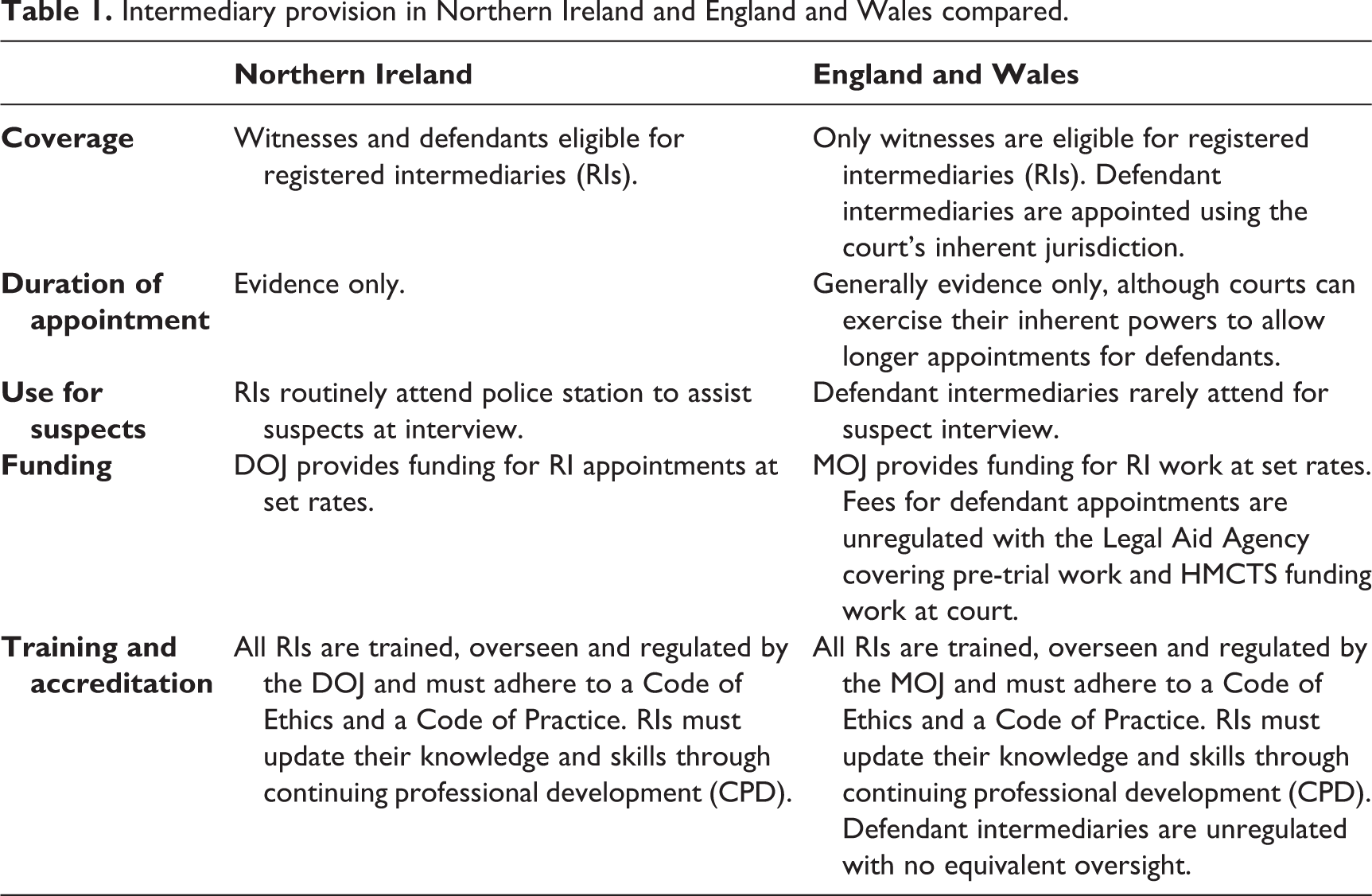
A contentious issue surrounding defendant intermediary practice is whether the role is (or should be) restricted to assisting the accused during oral testimony. In other words, do defendant intermediaries have a role to play in the dock, in legal consultations and by being present throughout the trial to ensure the defendant can effectively participate? My interviews revealed that the duration of intermediary appointment differed significantly between Northern Ireland and England and Wales. Although suspects are entitled to the assistance of an intermediary at the police station in Northern Ireland,
23
defendants in England and Wales were much more likely to have the benefit of intermediary assistance beyond the witness box. The practice of ‘evidence only’ appointments was accepted by all intermediary interviewees in Northern Ireland with the majority being in favour of the policy: We are not paid for sit for two weeks and quite frankly I am not of the view that it is the best use of our time to be there all of that time because at each point along the way the solicitor is able to update his client as to what’s happening…paying me to sit in a witness box day after day after day is highly questionable. [NI-2] The defendant isn’t required to understand everything that is going on, I wouldn’t understand because a lot of it is ‘legalese’ and that is ok because I don’t need to understand. There’s going to be a lot of legal argument going on that nobody understands except for barristers and the judge…[NI-6] The judge was thanking me for monitoring his mental health even though it’s not part of the RI role, although it can be for defendants…You have to be very much more aware of your role with a defendant and be very clear if you are stepping outside your role which you do have to do. With mental health, I am the only one in the court who has a clue about mental health and if I see signs that they are deteriorating I am the only one that will spot that. You notice little signs. That is outside of the intermediary role, because in that situation [with a prosecution witness] the intermediary would ignore all of that as long as they are communicating. With a defendant I am not going to do that. In the ideal world, they should have us with them from suspect interview, any interactions with their solicitors right through the trial because not only will they have difficulty understanding the language of what is going on, but the glass panel, everyone has their back to you, you can’t even hear what they are saying never mind understanding, I think they have a right to understand what is happening, what is being said about them, what all the legal jargon is in the way any of us would. I do feel that there is a problem there, with someone who would have significant difficulties understanding their plea or the different aspects of the legal arguments, what have you, how their case has been put forward. Certainly, there’s no doubt about that I do see there may be a role for more consultations…in terms of the themes or the aspects that are very integral to that person’s case. I can see the arguments both ways. I can see the benefits for the legal team so they are assured that their advices are understood. The difficulty there is if that is happening in the consultation then the RI is moving into a new context, a new world. They are becoming part of the defence team. I am relying on the RI to be a truly independent and objective voice, and so I have some concerns about how that role could extend or how the edges start to blur. [CCJ-1]
Cohesion and identity
Populated by individuals from a range of professional backgrounds, there is a question of whether intermediaries constitute a distinct professional group. The terms ‘professional’ and ‘professionalism’ are used by both the DOJ (2015: 5) and MOJ (2019: 6) when describing the organisation of intermediaries and the standards expected of their work. Further, the penultimate chapter of Plotnikoff and Woolfson’s (2015: 281) book on intermediaries is entitled ‘A new profession’, with the opening line noting that intermediaries ‘have emerged as a new professional identity’. 27 For present purposes, we may examine to what extent intermediaries feel part of a cohesive occupational group and how this impacts the content and performance of the role.
Intermediaries in Northern Ireland were generally very positive about the role’s organisation, training opportunities and support given by the DOJ. Indeed, many of these intermediaries had attended training events and conferences in England and Wales and had concluded that intermediary organisation in Northern Ireland was in many ways superior. NI-2 explained: I think it is much different here because we are a smaller place. If I get an awkward case this evening, there’s 3 or 4 people I would ring up and say: ‘What do I do here, or what am I missing here?’. We meet as a full group, but we meet in small cells now just to keep in touch and that’s an important thing to do but I think the size of this place dictates that you’re not really on your own. …we have quarterly meetings…for support, sharing of knowledge and learning. Information is fed to me and I will feed it to the group, but the main aim is to support one another. We have a WhatsApp group set up. You can sort of be a lone worker, probably not as much here because geographically we are a lot smaller and we are all friends on Facebook and stuff like that…We talk about experiences at court, what we’re writing in our reports. All of our experiences are very similar, there is nothing I haven’t heard before. We are all in the same boat definitely. Nothing is funded and there is very little structure…The MOJ don’t provide any kind of support or emotional support. I kind of think at some stage someone is going to have some really bad traumatic reaction as an intermediary and then what’s going to happen? I don’t think it’s clear at the minute what being a ‘member’ is. You can be a member and not turn up to meetings. [E&W-8] …if we equally had more cohesion within the intermediary world, if we had one profession and everyone was meeting the standards, and we had peer review and we could see each other working and people were meeting the standard…However, with the level of unregulation as it is, the fear is that new intermediaries are coming onboard and haven’t had that rigour if they are not getting supervised and monitored and checked, how are they going to work up to that standard?…but now there is a disparate view and people working with defendants and other organisations, each of the other organisations have their own styles and templates of reports…it’s very tricky and I do worry about the skill level being diluted and the credibility could be challenged… I don’t really know because I have never seen any assessments or how they do their assessments and I don’t know how they would do it.
Discussion
On the face of it, the function of both registered and non-registered intermediaries in England and Wales is the same: to facilitate communication between vulnerable individuals and the criminal justice system. 29 This narrative suggests that the only material difference between the two roles is that the former role works with witnesses and complainants while the latter is appointed for defendants. The data collected as part of this research paints a much more complex picture. It reveals how the intermediary schemes in Northern Ireland and England and Wales operate differently in several key areas and, as a result, the parameters and content of the roles in both jurisdictions diverge. The unitary system of intermediaries in Northern Ireland has engendered a role which is viewed by practitioners as a stand-alone, independent communication professional. Importantly, this perspective does not appear to change whether the vulnerable individual being assisted is a defendant or a witness. In England and Wales, such uniformity is not so apparent. The distinction between ‘registered’ and ‘non-registered’ intermediaries has led to the conceptualisation of what can be termed ‘witness work’ and ‘defendant work’ and my interview data suggests intermediaries often view the two as qualitatively different. This echoes Plotnikoff and Woolfson’s (2015: 275) view that intermediaries for defendants ‘require a broader and more in-depth understanding of the legal process and terminology’. This is grounded in the belief that a defendant should not merely be physically present at his trial but should understand the case made against him and the nature of proceedings (Blackstock: 2015).
Reflecting on the role’s impartiality, intermediaries in Northern Ireland, like their counterparts in England and Wales, are cognisant of the emerging evidential picture in a case, yet generally avoid venturing into complicated ethical territory which may compromise their position. They saw their impartiality as absolute, and not as something that could be reassessed based on the demands of a case. Intermediaries in England and Wales, however, were much more willing to view impartiality as malleable, open to negotiation and reconceptualisation. While accepting the dangers of straying into complicated ethical territory, these intermediaries justified their actions as being instrumental to the ‘facilitation of communication’. 30 In terms of witness work, some intermediaries in England and Wales struggle to maintain the boundaries of their impartiality and become closely aligned with police, particularly in and around the ABE interview. In cases where the intermediary is appointed in the very early stages of an investigation, the need to facilitate communication can extend far beyond the witness box to, inter alia,: planning the interview with police; monitoring the individual during interview; attending court familiarisation visits with the individual and monitoring them at court prior to testimony. These interactions with vulnerable individuals and other criminal justice actors all create opportunities for the limits of the intermediary’s impartiality to be tested. This was exemplified by the actions of E&W-2 and E&W-13 who identified inconsistencies in a witness’ story during ABE and flagged this with the interviewing officer off camera. This is at odds with the Registered Intermediary Code of Practice (MOJ, 2019: 7) which sets out that intermediaries ‘must not enter into discussion, give advice, or express opinions concerning the evidence that the witness is to present or any aspect of the case’. Similarly, E&W-6 considered that professional boundaries can ‘become blurred’ by such off-camera discussions with police.
The above examples may be viewed as intermediaries aligning themselves with the police and positioning themselves as assisting a legitimate ‘moral mandate’ (Van Maanen, 2978: 227). The contrast between the closed off, more intimate setting of the interview suite and the open, public setting of the criminal court also influences the conceptualisation and performance of impartiality. When ‘backstage’ the intermediary seems more willing to risk their impartiality in the way E&W-2 and E&W-13 explained than in the ‘front’, public stage of the criminal courtroom (Goffman, 1959: 114). The concentration and effort required to be seen as impartial by the judge, lawyers and general audience contrasts sharply with the ‘off camera’ moments when an intermediary may, for example, raise evidential issues with the interviewing officer. We may view these incidents as deviations from the ‘official stance’ of neutrality as ‘the impression fostered by the presentation is knowingly contradicted as a matter of course’ (Goffman, 1959: 112). The emotional energy expended by intermediaries in such cases is evidenced by the fact that several remarked in interview that they no longer accept defendant cases due to the nature of allegations involved. When working with defendants, intermediaries in England and Wales also encountered challenges and at times seemed to assume something of a supportive role e.g. reassuring family, demonstrating sympathy and providing therapeutic advice. This reveals a clear tension between what Plotnikoff and Woolfson (2015: 275) describe as the strong desire to fight ‘the defendant’s corner’ and the need to remain emotionally detached and impartial.
The normative basis of the intermediary role’s impartiality should perhaps be questioned. The ‘silencing’ of emotions in the criminal justice system and the need to reflect on how emotional regimes of justice professionals affect their work is receiving increased academic attention (Crawley, 2004; Karstedt et al., 2011; Bergman Blix and Wettergren, 2018). Just as Colley and Guéry (2015: 121) conclude in their study of public service interpreters, it is perhaps fatuous to view the intermediary as ‘hermetically sealed off’ from the highly emotionally charged realities of intermediary work. In this sense, the role can often assume a ‘leaky’ character whereby attempts to adhere to impartiality are compromised (Colley and Guery, 2015: 121). It may be argued that latitude should be afforded to intermediaries to ‘actively manage’ the communication process by recognising that facilitation of communication encompasses much more than the exchange of questions and answers (Mickkelson, 1998: 43). It was clear from my interviews that intermediaries are also concerned with the physical environment of the interview suite, whether the vulnerable witness is hungry, how the vulnerable defendant will access the dock if they are disabled and a myriad of other factors associated with the particular case. O’Mahony et al. (2016) previously found that defendant intermediaries struggle with conflicts between their health and care professional backgrounds and the impartiality required of the role. 31 My interview data echoes this finding, but the analysis can be taken one step further. Not only do many intermediaries in England and Wales struggle with competing occupational demands, but they reconceptualise the notion of impartiality in the face of such tension. This reflects a duality in the role’s content which seems inextricably linked to the professional backgrounds of those performing it. In Northern Ireland, the professional backgrounds of intermediaries are broadly the same as those in England and Wales, i.e. the majority being speech and language therapists. It is hard to avoid the conclusion that the absence of this role duality is attributable to the unitary model of intermediary provision.
The interview data reveals that defendants in England and Wales were much more likely to have the benefit of intermediary assistance beyond courtroom testimony than those in Northern Ireland. This finding was not entirely unexpected. In establishing the scheme, the DOJ in Northern Ireland outlined that intermediaries would assist vulnerable defendants for the duration of their testimony only. It is, however, surprising that despite this restrictive approach, the DOJ permits intermediaries to be requested for suspect interviews at the police station. My interviews reveal that this occurs routinely whereas in England and Wales intermediaries are rarely requested at such an early stage. Of course, in England and Wales, defendant intermediaries fall outside the WIS and thus no formalised policy exists. However, the Criminal Practice Directions outline how intermediary appointments for testimony will be ‘rare, but for the entire trial extremely rare’. 32 This ‘rationing’ of defendant intermediaries raises access to justice issues and is perverse considering the uncomfortable reality that defendants are often the most vulnerable individuals within a trial (Hoyano and Rafferty, 2017). It is based, at least in part, on a view that any assistance a defendant may need throughout the trial is ‘readily achievable by an adult with experience of life and the cast of mind apt to facilitate comprehension by a worried individual on trial’. 33 In the case of R v Rashid, the Court of Appeal noted that defendants also enjoy the benefit of ‘professionally competent’ legal representatives who also contribute towards ensuring effective participation. 34
The consensus among intermediary interviewees in England and Wales that their services should be more widely available has the support of the Law Commission of England and Wales (2016: para 2.62), which concluded that intermediary assistance should be provided ‘both for the giving of evidence and as much of the wider trial proceedings as is necessary for the defendant to have a fair trial’. This recommendation leaves open the possibility that defendants with particularly significant needs will enjoy intermediary assistance throughout the trial while others may only require assistance for the period of testimony. Interviewees in both jurisdictions said they would welcome such a development which E&W-15, an intermediary in England and Wales, described as a ‘middle-ground…based on the individual needs of the person’. Yet such a position is currently only achievable in England and Wales where the duration of a defendant intermediary is entirely dependent on the direction of the judge. The blanket rule of ‘evidence only’ appointments in Northern Ireland prevents a more flexible appointment which would take into account the vulnerable defendant’s particular communication needs.
In terms of ensuring the defendant’s fair trial rights, it is important to reflect on the differences in duration of intermediary appointment between the jurisdictions. The availability of intermediaries for defendants is premised on the right of effective participation in criminal proceedings pursuant to Article 6 of the ECHR. 35 The scope of this right is, however, uncertain and raises issues in relation to the intermediary and the extent of their involvement in proceedings (Owusu-Bempah, 2018). The ability of judges to make ‘full trial’ intermediary appointments in England and Wales suggests that the right to effective participation is, at least in theory, better protected than in Northern Ireland. This is because a defendant who is unable to follow proceedings may have an intermediary present in the dock to at least understand ‘the thrust of what is said in court’. 36 Backen (2017: 71) goes further and suggests that effective participation involves a defendant ‘understanding the evidence against him, talking productively with his counsel in conferences outside the court and being able to read the documents set out for the jury’. It is, however, doubtful that the right is understood so broadly, especially as courts have emphasised the importance of legal representatives in ensuring the defendant can follow and understand proceedings. 37 There is an apparent distinction in the case law on this issue. In SC v UK, the court noted that the defendant need not understand every point of law or evidential detail given the right to legal advice. On the other hand, in cases where the defendant is unable to hear or be present, the courts have found participation by proxy to be sufficient so long as they can instruct and adequately communicate with their legal representatives. 38 Owusu-Bempah (2018: 13) questions whether such ‘effective participation by proxy’ is possible if the defendant is legally represented but cannot communicate their wishes and instructions to their lawyer. In the recent case of TI v Bromley Youth Court, the High Court recognised the highly individualised nature of the right to effective participation and held that a defendant who was able to give basic instructions to his solicitor was not necessarily able to ‘engage satisfactorily in the trial process’. 39 In such cases, the intermediary’s assistance may prove vital especially when the defendant requires special assistance to regulate their mental state, relieve stress and facilitate concentration (Law Commission, 2016: para 2.51). It seems logical that this should extend to attendance at consultations to ensure the defendant understands the evidence against them and can appreciate the significance of their plea.
But are intermediaries routinely involved to such an extent in England and Wales? In 2014, Cooper suggested (2014: 12) that the vast majority of intermediary appointments go beyond the period of oral evidence, but it appears that this has changed. My interview data suggests that, since Rashid, the frequency of ‘full trial’ appointments is decreasing. The main providers of defendant intermediary services, Communicourt and Triangle, decline instructions for evidence only appointments, yet all intermediary interviewees had experience of such limited involvement. 40 While in Northern Ireland full trial intermediary appointments are not ordinarily permitted, the existence of the court defendant supporter scheme at least allows a vulnerable defendant to have someone present with them throughout proceedings. As outlined in my findings, intermediaries routinely recommend this measure and view it as complimentary to their own role. It was clear that intermediaries in Northern Ireland view the court defendant supporter as being able to provide the kind of support and reassurance which would be incompatible with the impartial nature of the intermediary role. Being present for the period of testimony allows the intermediary to avoid waiting around court with the defendant, reassuring family members and generally risking their impartiality being questioned. In the absence of a role akin to the court defendant supporter, intermediaries in England and Wales like E&W-13 are prepared to fill the breach to ensure defendants are monitored, emotionally managed and also able to understand and follow proceedings. Nonetheless, it must be questioned whether such a supporter (who is often a family member or a carer) will have the necessary skills to ensure the defendant can engage and follow proceedings. The Law Commission (2016: para. 2.63) concluded that individuals with ‘really significant communication or participation difficulties’ would often require the specialist assistance of an intermediary throughout the full trial to ensure a fair trial. With neither jurisdiction presently offering defendants a statutory entitlement to full trial intermediary assistance, it is not obvious that the right to effective participation is better protected in one or the other.
The third and final theme relates to intermediary cohesion and identity and the interview data raises important issues relating to intermediary organisation more generally. It seems clear that the organisation of the RI scheme in Northern Ireland brings many benefits, not least a consistency in practice. In this respect, ‘going second’ (after England and Wales) has proved advantageous for the DOJ (Cooper and Wurtzel, 2014). The size of the jurisdiction and relatively small number of intermediaries means that maintaining standards and developing a strong support network is more straightforward. But should it serve as a model of best practice? One Northern Irish intermediary, NI-6, suggested that she and her colleagues had perhaps not ‘had enough time to drift because we are homogenous under the umbrella of the DOJ’. However, it is doubtful that the distinction between ‘witness work’ and ‘defendant work’ that has emerged in England and Wales could exist within a unitary system so centrally managed by the DOJ. Several intermediaries in England and Wales spoke in interview of a preference for assisting either witnesses or defendants and this is perhaps part of the problem. Conversely, a unitary system whereby intermediaries are equally likely to be matched with a witness or a suspect/defendant appears more conducive to the principle of impartiality.
If intermediaries trained, registered and regulated by the MOJ are reporting to be suffering from a lack of identity and peer support, what then of non-registered intermediaries, i.e. those who work with vulnerable defendants in England and Wales? The reality is that we know little about this group of intermediaries. The majority of court appointed intermediaries for defendants appear to come from the two leading commercial providers of defendant intermediaries, Triangle and Communicourt. But it seems doubtful that defendant intermediaries should be considered a cohesive occupational group particularly since courts may appoint anyone whether qualified professionally or not (Plotnikoff and Woolfson, 2015: 248). For example, in the recent case of R (On the Application Of) v Hampshire Constabulary & Ors, 41 a teacher of a vulnerable child complainant was appointed to act in the capacity of an ‘unregistered intermediary’ despite having no formal training for the role. Based on the methods chosen for this research it was not possible to examine the role of those who exclusively carry out defendant work. 42
The organisation of intermediaries is perhaps the most obvious, visible area of difference between Northern Ireland and England and Wales. But these operational differences have engendered distinct work cultures, support networks and general levels of cohesiveness in how intermediaries approach their work. This finding alone should pique interest in a comparison of intermediaries on both sides of the Irish Sea.
Conclusion
Shortly after the DOJ launched its intermediary pilot project in 2013, Cooper and Wurtzel (2014) considered how lessons could be learned from ten years of intermediary provision in England and Wales. While the authors recognised the distinctiveness of the DOJ scheme, they did not anticipate how the unitary system of intermediaries could influence the scope and content of the intermediary role itself. This paper begins to explore the differences that have emerged in the role by reflecting on the experiences of some of those at the coalface of the intermediary’s work in both jurisdictions. It concludes that significant differences exist between Northern Ireland and England and Wales in terms of the intermediary’s relative standing in the criminal justice system and how its practitioners experience the role and its demands. Examination of the themes of (i) impartiality, (ii) duration of appointment and (iii) cohesion and identity reveals that despite intermediaries in both jurisdictions sharing a ‘common purpose’ (Cooper and Wurtzel, 2014: 39), there has been a divergence in practice that should be recognised and examined further.
Beyond the academic interest, there is another important reason for highlighting the differences between intermediary provision in Northern Ireland and England and Wales. The ‘bifurcated’ or ‘two tier’ system in England and Wales has been recognised as ‘complex and problematic’ and there have been calls for defendants to have equal access to registered intermediaries. For example, Cooper and Wurtzel (2014) declared themselves to be ‘in search’ of an intermediary scheme for vulnerable defendants in England and Wales, while the Law Commission (2016: para 2.62) concluded that it is ‘essential for a defendant to have a statutory entitlement to the assistance of an intermediary’. As there is currently no qualification requirement for defendant intermediaries, no professional conduct regulation, nor any continuing professional development monitoring or supervision, there are serious concerns over quality assurance compared to the WIS (Law Commission, 2016: para 1.29). Calls for a formalised defendant intermediary scheme have real merit and this paper provides impetus for the extension of registered intermediaries to defendants in England and Wales. Just as the DOJ in Northern Ireland based its own intermediary model on the experiences of England and Wales, lessons can now be learned from the other direction. It is time for the MOJ to look seriously at how a unitary provision of intermediaries could operate in practice and how it could ameliorate some of the issues associated with the two-tier system in England and Wales.
Footnotes
Declaration of conflicting interests
The author(s) declared no potential conflicts of interest with respect to the research, authorship, and/or publication of this article.
Funding
The author(s) received no financial support for the research, authorship, and/or publication of this article.
