




Abstract
This article discusses the findings of a study in which 160 volunteer members of the public observed one of four mini rape trial reconstructions and were asked to deliberate as a group towards a verdict. In a context in which research into the substantive content of the deliberations of real jurors is prohibited by the Contempt of Court Act 1981, these discussions were analysed to assess whether, and in what ways, perceptions of adult rape testimony are influenced by different modes of presentation. While lawyers and other observers have speculated about the possible undue effects of alternative trial arrangements on juror perceptions and the evaluation of evidence in rape trials, the issue has received scant empirical attention. In an effort to bridge this knowledge gap, this study investigated the influence upon mock jurors of three special measures currently made available in England and Wales to adult sexual offence complainants by the Youth Justice and Criminal Evidence Act 1999, namely (1) live-links; (2) video-recorded evidence-in-chief followed by live-link cross-examination and (3) protective screens. Following a careful and contextual exploration of the content of the mock juries’ deliberations, the researchers conclude that there was no clear or consistent impact as a result of these divergent presentation modes, suggesting that concerns over the use of special measures by adult rape complainants (at least in terms of juror influence) may be overstated.
In England and Wales, in accordance with the adversarial principle of orality, witnesses in criminal proceedings are generally required to give evidence ‘live’ in open court. It is, nevertheless, now widely accepted that this obligation can place onerous demands on witnesses and is a source of considerable stress for many, and militates against receipt of the best evidence potentially available in some cases (see Ellison, 2001; Spencer and Flin, 1993). For rape complainants, the process of testifying can be a particularly harrowing ordeal, given the intimate nature of the offence and the consequent need to recount explicit sexual details in a public arena in the presence of an alleged assailant. Indeed, in a context in which there is long-standing and ongoing concern about the levels of reporting of, and successful prosecution in, rape cases (HMCPSI/HMIC, 2007; Stern, 2010), some rape complainants have described their experiences in court as being tantamount to a ‘second assault’ (Lees, 1996; Victim Support, 1996).
The special measures provisions of the Youth Justice and Criminal Evidence Act 1999 were introduced to ameliorate some of the difficulties associated with giving oral evidence by granting ‘vulnerable’ and ‘intimidated’ witnesses (including adult sexual offence complainants) the use of alternative trial arrangements, in situations where courts are satisfied that this will maximise the quality of a witness’s testimony. Previously reserved for child witnesses, there are a wide variety of modifying measures that can be invoked to insulate witnesses from recognised court-related stressors. These range from the removal of wigs and gowns by legal counsel and judges to the erection of temporary screens around the witness box to shield witnesses from the potentially intimidating gaze of the defendant, or the use of live-links to allow a witness to give evidence from a room remote from the main courtroom in a comparatively informal, relaxed environment (whilst remaining visible and audible to those in court). Special measures can also be used, in appropriate cases, to mitigate the known deleterious effects of lengthy trial delays on the ability of witnesses to provide effective and reliable testimony in criminal proceedings, for example, through the admission of video-recordings of pre-trial witness interviews in place of evidence-in-chief at trial.
Previous research has identified a generally high level of appreciation of the protection afforded by these alternative trial arrangements amongst victims and witnesses. Hamlyn et al. (2004), for example, found that vast proportions of witnesses (including sexual offence complainants) who had used special measures found them helpful. Indeed, one third of those surveyed indicated that special measures had enabled them to give evidence that they would not otherwise have been willing or able to give, with this figure rising to 44% for sexual offence complainants (Burton et al., 2007; Hamlyn et al., 2004). At the same time, however, substantial concerns have been raised regarding the potential undue influence of special measures on the proof process and on juror decision-making. Particularly in relation to the types of special measure that are the focus of the present study – namely, screens, live-links and pre-recorded interviews – critics have worried that their use by adult sexual offence complainants may unfairly prejudice the defence or imbue a complainant’s testimony with an undeserved level of credibility (Burton et al., 2006; Payne, 2009a). Meanwhile, others have feared that the absence of the complainant in the courtroom, and the mediating effect of the live-link, may create a distance between her 1 and the jury, which will make it less likely that her account will incite sympathy and/or be believed (Council of HM Circuit Judges, 2006; Hamlyn et al., 2004; Payne, 2009b). Concerns have also been expressed regarding the extent to which the use of video-recorded police statements as evidence-in-chief places sexual offence complainants at a disadvantage, since officers are engaged at that stage in an investigatory process, receiving and pursuing fresh information as the account unfolds. This means that these accounts lack the kind of logical, sequential narrative that can be imposed by advocates who take the complainant through her testimony in the courtroom (Davis et al., 1999; Tinsley and McDonald, 2011; Wade et al, 1998; Welbourne, 2002). It was in the light of these latter concerns, and evidence suggesting that many video-recorded statements are of poor visual quality and exhibit inadequate police interviewing techniques, that Baroness Stern concluded in her recent investigation of rape prosecutions in England and Wales that their use was posing problems for the smooth running of trials and needed to be further reviewed (Stern, 2010; see also HMCPSI/HMIC, 2007).
The potential impact of special protective measures on juror decision-making is clearly, therefore, both a significant consideration in terms of ensuring justice in individual cases and a source of substantial debate amongst commentators and practitioners. Despite this, at least in the context of cases involving adult rape complainants, it has received scant empirical investigation to date (compare Taylor and Joudo, 2005 – discussed below). The bulk of pre-existing research has focused instead on adult perceptions of children’s testimony when alternative trial arrangements are employed – and it has produced inconsistent findings. Some studies have found that children who give evidence via a live-link are viewed less positively (in terms of honesty, accuracy and believability) by observers than children who give evidence in court, with an appreciable impact on conviction rates in some instances (Eaton et al., 2001). Meanwhile, other studies have reported no effect for the modality of testimony (Davies, 1999; Ross et al., 1994) or, alternatively, report a negative effect on child witness credibility perception but no overall impact on propensity to return a guilty verdict (Goodman et al., 1998; Orcutt et al., 2001; compare Swim et al., 1993). Moreover, research examining the impact of video-recorded evidence on the reception of children’s testimony has yielded similarly conflicting results. Although the majority of such studies have reported a preference on the part of mock jurors for live, face-to-face evidence (Goodman et al., 2006; Landstrom et al., 2007), early evaluation of the use of video-recorded evidence in England and Wales suggested no impact on conviction rates compared with the previous system (Davis et al., 1999; Wilson and Davies, 1999).
One notable exception to this tendency to focus upon the impact of special measures in the context of child complainants is Taylor and Joudo’s Australian study (Taylor and Joudo, 2005), which uncovered no systematic differences in pre-deliberation perceptions or propensity for jury verdict when an adult rape complainant gave evidence face-to-face, via a live-link or by way of video evidence. Though clearly relevant to the present research, this study does not dispose of questions regarding the influence of (adult complainant) special measures on rape jury deliberation in England and Wales. For one thing, the ‘video evidence’ used was simply a recording of the complainant’s live courtroom testimony, rather than a pre-recorded police interview. Moreover, that ‘video evidence’ included both the complainant’s examination-in-chief and her cross-examination, which sits at odds with current practice in England and Wales where adult rape complainants are required to undergo ‘live’ or ‘live-linked’ cross-examination even when video-recorded evidence-in-chief (in the form of the pre-recorded police interview) is admitted. In these key respects, then, the methodology used in the Taylor and Joudo study prevents the comparison of mock jurors’ perception and evaluation of the types of testimony with which they would be confronted in rape trials in this jurisdiction.
Against this backdrop, it is perhaps unsurprising that, in 2007, the Crown Prosecution Service (CPS) identified a specific need for jury research in England and Wales in order to examine the impact of video evidence in rape cases (Office for Criminal Justice Reform, 2007: 30) and that, in 2009, Victims’ Champion, Sara Payne, echoed the call for research to ‘determine the extent to which the use of special measures influence juries in their views’ (2009a: 48). The present research study set out to begin to bridge this significant knowledge gap, in the hopes of ensuring more informed policy and practitioner decision-making regarding the use of special measures. More specifically, it seeks to examine two key research questions. First, in what ways, if at all, are jurors’ perceptions of rape testimony influenced by the mode in which the complainant’s evidence in an adult rape case is presented; and second, to the extent that jurors’ perceptions are influenced by this, in what ways, if at all, does this appear to affect their evaluation of the trial evidence and, therefore, their ultimate conclusions about guilt or innocence? Over the course of the following sections, we will discuss our findings and consider whether the concerns that have been raised regarding the influence upon jurors of special measures – whether acting to the benefit of complainant or defendant – are merited and reflect on the ramifications of this for future policy and practice in this area. Before doing so, however, in the following section, we outline and defend the methodology relied upon.
Entering the Jury Room
In England and Wales, prohibitions under the Contempt of Court Act 1981, which prevent research into the substantive content of jury deliberations, render what goes on within the jury room the subject of uncertainty. This extends, amongst other things, to the impact of special measures on juror perceptions, prompting the competing perspectives on their risks and repercussions discussed above. In an effort to glimpse behind the veil of secrecy that surrounds real jury deliberations, the authors undertook a simulation study in which a series of four mini rape trials were scripted and reconstructed in real time in front of an audience of mock jurors, with key roles being played by professional actors and experienced barristers.
The basic trial scenario involved a complainant and defendant who had been in an 8-month relationship, which ended approximately 2 months before the alleged offence took place. The defendant called at the complainant’s home (which he had previously shared with her) to collect some of his possessions. He and the complainant enjoyed a glass of wine and some coffee as they chatted. A few hours later, as the defendant made to leave, the two kissed in the sitting room. It was the Crown’s case that the defendant then tried to initiate sexual intercourse with the complainant, touching her on the breast and thigh, and that the complainant made it clear that she did not consent to this touching by telling the defendant to stop and pushing away his hands. The Crown alleged that the defendant ignored these protestations and went on to rape the complainant. When the defendant was questioned by the police, he admitted that he had had sexual intercourse with the complainant, but maintained that all contact was consensual, and this was the approach taken by the defence. A forensic examiner provided testimony, which confirmed that the complainant had suffered bruises and scratches of a sort that were consistent with the application of considerable force, but that – as was not uncommon – she had sustained no internal bruising. He advised that while intercourse had occurred between the parties, the evidence available following his examination of the complainant was neither consistent nor inconsistent with rape.
This scenario was not based directly on any one rape case transcript but was instead drafted in close consultation with an invited expert panel of criminal justice and victim support practitioners so as to include a number of elements that research and experience have both identified as being common to many contested rape cases. Thus, for example, the complainant knew the defendant prior to the incident, the alleged attack took place in a private place without witnesses, the complainant showed no signs of internal trauma, some level of alcohol was consumed by both parties prior to the alleged assault, some level of force was allegedly used against the complainant, although without the use of a weapon, and the defendant maintained that the complainant had consented to the intercourse. At the same time, the scenario was also designed to ensure an appropriate degree of ambiguity such that jurors could feasibly be swayed one way or the other in their verdict decisions. Thus, for example, jurors were offered some potentially corroborating evidence in the form of bruising to the complainant’s body but this was limited in scale and severity to provide an opening for competing explanations, such as inadvertent force during consensual intercourse, willing engagement in ‘kinky’ sex or the incurring of bruising through an unrelated activity.
To isolate the variables under review across the four trial scenarios, the key facts and role-playing personnel remained constant while independent procedural variables relating to the mode of evidence presentation were manipulated. In the first trial, the complainant gave evidence by means of a live television (TV) link, appearing in court on a 50-inch plasma screen (head and upper body). In the second, the complainant gave her evidence in the courtroom from behind an opaque partition, which shielded her from the defendant but allowed her to be observed by the judge, legal representatives and the jury. In the third trial, a video-recording of the complainant’s pre-trial interview with the police replaced her examination-in-chief, and cross-examination was conducted via a live TV link with the complainant once again appearing in court on a 50–inch plasma screen. The researchers recorded this video at a police interview suite, using the same equipment that would be used in a real case, with questions being asked by an experienced rape investigator (sound quality and picture resolution were comparable for the live-link and video conditions). This interview covered the same substantive points as the examination-in-chief, but, in an effort to replicate the less structured way in which the account would be likely to unfold at this early stage, additional repetition and delays were included and some of the narration was adjusted to render it less logically sequential. In the process of this scripting, the authors observed a number of training videos of police officers conducting such interviews with mock complainants, in order to incorporate what were identified to us as examples of good practice, in conjunction with the Achieving Best Evidence guidelines (Ministry of Justice, 2011). This means that the videotaped interview used did not replicate some of the poorer interviewing practices, which have been identified as concerns within previous research (HMCPSI/HMIC, 2007). Although, as will be discussed below, this has to be borne in mind when transferring our findings to the real courtroom, presenting the video evidence in its better form was necessary in this study in order to more effectively isolate the influence of mode of testimony delivery. In each of these three trials, as required by the Youth Justice and Criminal Evidence Act 1999, the judge directed the jury that it was now commonplace for special measures to be utilised in rape cases and that jurors should not allow their use to prejudice them against the defendant. In the remaining fourth trial, the complainant testified from the witness box without the use of special measures.
Notwithstanding the steps taken in this study to minimise variance in the performers’ delivery of the scripted lines across the four trial conditions – including the recruitment of professional actors and the scheduling of a rehearsal in which the importance of maintaining a constant delivery was emphasised – the use of real-time re-enactments inevitably opens up the possibility that it is a variation in performance, rather than the presence or absence of differing special measures, that influences jurors’ evaluations. Other studies (Ross et al., 1994; Swim et al., 1993) have sought to eliminate this potential risk by the use of video-recorded trial simulations, within which the material relating to the manipulated variable (in the present case, the mode of the complainant’s evidence delivery) alone is adjusted – although these studies do not explain the precise mechanics of this process, it is presumably carried out through an editing of the master version. While this does ensure a greater level of control over performance variability, it presents its own difficulties, perhaps the most significant of which for current purposes is that it entails the use of video-recorded trial simulations in the context of a study designed precisely to evaluate the potentially mediating and distancing effect of the use of TV-linked or video-recorded testimony vis-à-vis testimony delivered ‘live and in the flesh’ within the courtroom. The use of a video-recorded trial simulation, in other words, means that it is not possible to assess the effect on juror decision-making of the witness’s physical presence in the courtroom – only the impact of jurors knowing that the witness testified outside of the courtroom and away from the defendant can be investigated in these circumstances (Eaton et al., 2001). Inviting subjects to watch a video-recorded trial also represents a substantial departure from what actual jurors experience. For these reasons, the researchers took the view that this was not a viable method for the present study and, having observed the re-enactments, are confident that any such performance variance across our four divergent trial conditions was, at most, minimal.
Each trial reconstruction lasted approximately 75 min. While this entailed that the sheer volume (though not necessarily substantive content) of evidence presented to jurors was streamlined and the usual periods of delay and disruption that typify court proceedings were absent, careful advice provided by experts in the scripting process was relied upon to maximise realism within these constraints. Each trial was observed simultaneously by between 38 and 42 participants, who – after receiving judicial instructions crafted from the latest Judicial Studies Board Guidance – were streamed into five different juries (with an average of eight members) and asked to undertake verdict deliberations. These deliberations lasted up to 90 min, although after 75 min participants were advised that a majority verdict would be acceptable. Again, while these restrictions on time and jury size were necessary to ensure the practicality of the study, and may have had an impact on verdict outcome, the discussions undertaken by our jurors still give a significant and valuable insight into the key concerns and priorities informing their deliberations. Moreover, there is ample evidence that ‘real’ jurors may not have needed much longer to reach a verdict (Zander and Henderson, 1993; and see also Kalven and Zeisel, 1966) and the exact significance of group size in jury simulations is contested (Kerr and MacCoun, 1985; Mills, 1973; Saks and Marti, 1997; Zeisel and Diamond, 1974), with some research suggesting that groups of eight may be optimal in terms of maximising a range of substantive contributions (Latane et al., 1979).
Participants were self-selecting members of the public recruited on the basis of jury service eligibility by a market research company and taking part in the study in exchange for a fee. That this may have influenced the composition of who participated in the study, and thus the views expressed, cannot be ruled out – particularly in a context in which some previous research has indicated that people who volunteer to take part in experimental studies display a particular disposition towards community activities and so on that may influence their thinking, or a particular sensitivity to, or concern about, the specific subject matter (Braunack-Mayer, 2002). At the same time, however, it should be noted that our jurors were asked in advance of participation if sexual assault was an issue of particular concern to them and the vast majority answered negatively. Moreover, leaving aside the potential difficulties with assuming that a person’s dispositions are linear and predictable, rather than permanently in flux in relation to divergent contexts and circumstances, the fact that jurors participated in this study in exchange for a fee (albeit not a particularly large one) may mitigate against concerns about dispositional bias. Furthermore, given the reality that participants cannot be compelled to take part in jury research with the same force with which they can be compelled to take part in jury duty, and the low positive response rate associated with more random methods of recruitment, which suggests an inevitable element of self-selection, this form of recruitment was the most pragmatic option, and a significant improvement on many previous simulations which have relied on student volunteers (Ross et al., 1994; Landstrom et al., 2007; Swim et al., 1993).
Given the random membership of real juries, and the existence of previous research which suggests that individual juror characteristics are rarely determinative of verdict (Bonazzoli, 1998; Ellsworth, 1993; Hepburn, 1980), no steps were taken to engineer demographic representation across socio-economic or racial groups (although such information was matched to anonymised juror numbers for analysis). In regard to gender, however, a broadly even distribution of men and women within each jury was ensured, reflecting (some) previous research on rape deliberation, which indicates that gender is one juror characteristic that – particularly when mediated through attitudinal lenses of rape myth acceptance and self-defensive commitment to belief in a just world – may interact meaningfully with case-specific aspects (Foley and Pigott, 2000; Kleinke and Mayer, 1990; Ugwuebu, 1979).
The deliberations undertaken by different juries were video- and audio-recorded and subsequently transcribed. The researchers independently observed the video-recorded deliberations a number of times, and transcripts were coded jointly – first on an open and grounded basis in order to generate a list of core nodes, and then more thematically in light of the study’s aims and objectives. When it came to assessing the impact of mode of evidence delivery on jurors' perceptions, we adopted a contextual, qualitative approach, analysing and comparing the coded deliberations of the juries across the four conditions to establish if there were any shifts in the tone and content of discussions, whilst also noting any references to the complainant’s use of special measures, whether positive, negative or neutral. Other simulation researchers have, by contrast, followed a statistical approach, relying exclusively on data gleaned from questionnaires to compare individual mock juror ratings of complainant credibility, juror empathy for the complainant versus empathy for the accused and personal beliefs about the guilt or innocence of the accused pre- and post-deliberation (Taylor and Joudo, 2005). Although providing some valuable insights, we have argued elsewhere that sole reliance on the questionnaire method is problematic (Ellison and Munro, 2010). It does not allow jurors to provide justifications or explanations for their judgments, nor does it allow for the examination of the emergence and resolution of disputes in social interaction. Moreover, the singling out of specific factors in isolation within questionnaires can distort respondents’ more holistic approach to the subject matter, as evidenced within the deliberations, and presents the risk that participants will select their answers based either on what they consider to be the most socially acceptable option or what they anticipate to be the desired option by researchers. For these reasons, we rely primarily on the deliberations themselves to gauge juror evaluations and influences. Such an approach allows a systematic examination of the nature and substance of jurors’ comments, the interrelation of presentation mode and other case-specific aspects, together with the dynamics of juror communication. However, it is not without its own limitations. In particular, in the context of the present study, the influence of presentation mode on mock jurors may be subconscious or mock jurors may have views relating to the use of special measures that they elect not to share in group discussions. As a result, although mindful of the risks associated with too much reliance upon them and the fact that the sample involved in this study was small by the standards of quantitative research, we also issued participants with brief pre- and post-deliberation questionnaires designed to offer another avenue for probing the influence of special measures in relation to assessments of credibility, empathy and fairness. The findings of these questionnaires were then triangulated with the contextual deliberation coding, in order to provide an additional, ancillary device for data collection and analysis.
The Impact or Otherwise of Special Measures on Verdicts
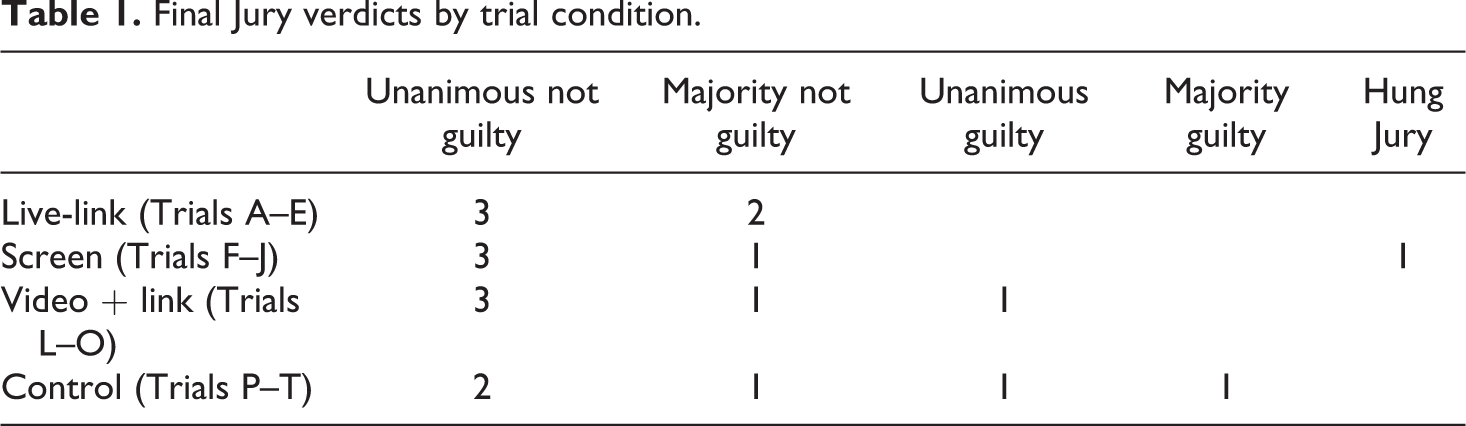
Whilst, in designing this study, we were interested in the ways in which the use of special measures may, or may not, impact on the approach taken by jurors to the evidence, to assessments of credibility and thus, ultimately also to verdict preference, it is important to bear in mind that there are a wide range of factors that can frame individual and collective verdict decisions, which may have nothing at all to do with the use of special measures. For this reason, while verdict outcome may appear to offer an immediate and simple measure of influence, it would be unwise to rely too heavily upon it as the only, or even most important, index. The fact that, in the present study, there was a mix of different verdicts across juries who observed exactly the same trial reconstruction (as detailed in Table 1) testifies to this need for caution. To the extent that verdict outcome does act as an indicator, however, our findings failed to establish any clear or consistent pattern in relation to responses to the trial stimuli.
As is illustrated in Table 1, overall, the vast majority of verdicts were either unanimous or majority not guilty (11 juries and 5 juries, respectively). There was only one jury who was unable to reach a majority verdict (of six to two) by the end of their 90 min of deliberation, and the remaining three juries reached guilty verdicts (in two cases, unanimously, and in the remaining case, by a majority decision). There was some variation across the different trial conditions. Thus, while the live-link condition yielded three unanimous not guilty and two majority not guilty verdicts, the screen condition generated three unanimous not guilty verdicts, one majority not guilty and one hung jury, the video and live-link condition provoked three unanimous not guilty verdicts, one majority not guilty verdict and one unanimous guilty verdict, and the control condition involving no special measures led to two unanimous not guilty verdicts, one majority not guilty, one majority guilty and one unanimous guilty verdict. Of the three guilty verdicts returned, therefore, one occurred in the video plus link condition and the other two occurred in the control condition.
Final Jury verdicts by trial condition.
On first sight, this might suggest that there is something significantly different about the control condition, such that jurors are more likely to find the complainant credible and/or attribute blame to the defendant where the complainant testifies without special measures in open court. That hypothesis would also appear to be supported by the fact that, as illustrated in Figure 1, at the level of individual post-deliberation verdict preferences, there were more guilty votes cast in the control condition (37%; n = 15 of 40) than in any of the other conditions (screen 12%, n = 5 of 43; link = 8%, n = 3 of 39; video plus link 21%, n = 8 of 38).
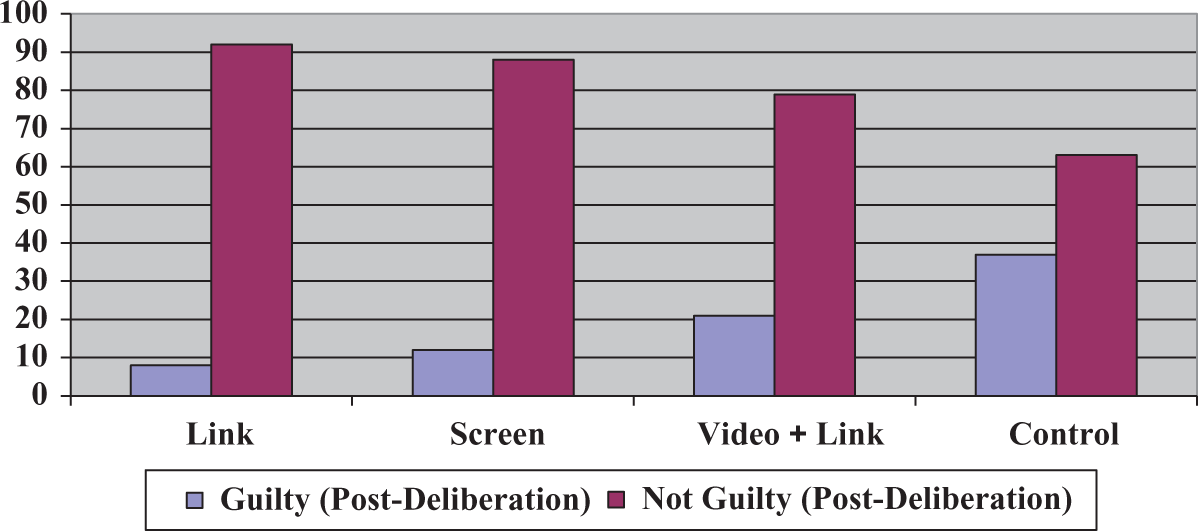
Individual verdicts (post-deliberation) by trial condition.
A closer inspection of the deliberations and questionnaire data, however, suggests that this difference may in fact have little to do with the means of testimony delivery. As noted above, a guilty vote, at individual or collective level, is potentially underpinned by a multitude of factors, which may or may not relate to presentation format. In the present study, looking at the substance of the jury deliberations, it seems that these verdict differences correlate far more strongly to the fact that individuals in the groups deliberating on the control trial (particularly in juries P and Q, which returned guilty verdicts) were more inclined from the outset to accept that victims of sexual violence do not always engage in physical resistance and to see the complainant’s injuries as providing sufficient corroboration for the alleged assault.
In line with reported findings from a previous study conducted by the authors, many other jurors in the present study held firm to a (unfounded) belief that the ‘normal’ response to sexual assault would be to fight back physically and with such force that the genuine victim would have suffered substantial bodily injury (including internal trauma) and/or inflicted significant defensive injuries on her attacker (Ellison and Munro, 2009a, 2009b). Not guilty votes and verdicts were, in turn, frequently justified with reference to the absence of evidence of more serious or extensive injuries to corroborate the complainant’s account.
The return of not guilty verdicts by a majority of juries was additionally associated with a tendency on the part of many jurors to perceive substantial scope for sexual miscommunication in interactions between the sexes and – as reported elsewhere – to place the onus on women to not only police their behaviour and so avoid giving misleading ‘signals’ to would-be sexual partners but to also communicate non-consent unequivocally and forcefully (Ellison and Munro, 2009c, 2010). Noting the complainant’s initial readiness to kiss her ex-partner, a significant number of jurors across the trial conditions specifically worried that the defendant in this case may have harboured a (reasonable) belief in consent notwithstanding the complainant’s attempts to register her disinterest by telling him to stop and trying to push him away and were opposed to finding the defendant liable for rape on this basis. To quote one juror, she only actually said that she said no once didn’t she, and she pushed him away once. If this happened, then wouldn’t you have said no or whatever more than once. And if she’s only said no once and pushed him away once and he’s gone, “What?” and then thought … then continued, maybe he misread that … in the heat of the moment and she said, “No, no,” and pushed him away a bit … She didn’t say she’d continued to push him away or continued to say no or screamed, which would have given him a really clear signal. Was it clear enough? Was her signal to him clear enough?
Meanwhile, another juror explained his not guilty vote more succinctly by simply saying, ‘I just think that he thought that she had consented to sex and if she’d said “no, no” she’s not put up enough fight’.
In contrast, the minority of jurors who voted for a guilty verdict at the close of deliberations (19%; n = 31 of 160), a significant proportion of whom had observed the control condition trial, were more likely to emphasise the importance of the evidence of bruising to the complainant’s wrist and chest and were generally open to the possibility that a woman might offer little by way of physical resistance during sexual assault for a range of reasons including shock and fear of further violence. As one male juror in Jury Q (control group) put it ‘and she did say she were in shock so and I don’t think you can condemn somebody by saying why didn’t they fight’, prompting another member of the group to observe in agreement that ‘some people’s defence mechanism is to freeze’. Jurors in this cohort were also more likely to insist that a woman need only utter the word ‘no’ to communicate sexual refusal to a male suitor – ‘you could be stood there with your trousers down and she could be laying there with nothing on and then she could go, “No,” and that’s it. And anything after that is rape’ proclaimed one juror, for example – and, more generally, to espouse a view of sexual communication in which men bore equal responsibility for avoiding misunderstandings. Thus, in Jury Q, for instance, when discussing whether there was any reasonable basis for the defendant’s professed belief in consent, several jurors ruled this out on the ground that the defendant could reasonably have been expected to have ‘stopped to make sure that it was consented sex’ after kissing the complainant by asking her directly ‘are you sure you want to do this?’ and went on to explain their guilty verdict partly on this basis. While such views were raised by some participants in other juries, they tended most often to be undermined by other, more vocal jurors’ insistence that resistance was to be expected, that the defendant’s belief in consent in the absence of this resistance was understandable and that, therefore, one could not be sure enough of his guilt to convict. By contrast, in Juries P and Q, the more strident members of the group began with this viewpoint and were able to maintain it strongly in the face of initial challenge, creating swings of opinion in their favour. Thus, for example, it is notable that, while Jury P ultimately returned a majority guilty verdict (6:2), for much of the deliberation, the voting preferences were finely balanced at 4:4, until those arguing for conviction secured a persuasive victory.
As noted above, it is possible that participants were influenced subconsciously by the mode of delivery such that it impacted on these jurors’ beliefs regarding resistance and/or scope for sexual miscommunication by, for example, heightening/diminishing sympathy for the complainant (or the defendant). It is difficult, however, to discern a logical connecting point between these different factors that would explain why they should be correlated in such an apparently strong and linear way. Indeed, a more compelling explanation, based on a contextual analysis of the deliberation content, suggests that the voting preferences of our jurors had more to do with their prior expectations regarding ‘appropriate’ responses to rape and ‘normal’ socio-sexual behaviour. This conclusion is supported, moreover, by the fact that the post-deliberation verdicts of our jurors fail to support a clear and consistent preference for in-court testimony over video-mediated evidence. Whilst, as noted above, the highest number of individual post-deliberation guilty votes was recorded in the control condition (37%; n = 15 of 40) and the lowest in the link trial (8%; n = 3 of 39), a higher percentage of guilty votes was cast in the video plus link condition (21%; n = 8 of 38) where the complainant was absent than in the screen condition (12%; n = 5 of 43) where the complainant was physically present giving live evidence, albeit shielded from the defendant. Cumulatively, then, this presents a rather mixed picture regarding the impact of presentation mode on verdict.
Tracking the Influence of Variables in the Deliberations
While we would thus urge considerable caution in simply reading off from the verdict outcomes across these different juries in order to extrapolate claims regarding the influence of the variables used in this study, this in itself does not exhaust the ways in which influence might be evidenced. The differing modes of delivering testimony could have had a number of effects on the ways in which jurors approached their task and on their assessments of the parties’ credibility, notwithstanding the fact that other substantive trial factors, approaches to the standard of proof, or group discussion dynamics may have intervened in order to prevent this translating in any predictable or linear way into specific verdict outcomes.
As noted above, previous literature in this area has hypothesised that there may be several ways in which the use of special measures could influence jurors. More specifically, it has been suggested that their use may reduce the emotional impact of the complainant’s testimony or alter jurors’ assessments of the credibility of such testimony – whether to the benefit or detriment of the complainant. It has also been argued that, as a matter of equality of arms within the trial environment, it is simply unfair to afford this opportunity to the complainant but not to the defendant. In the following sections, we explore each of these themes in turn to examine how they did, or did not, emerge within the present study.
Reducing the Emotional Impact of Testimony
One concern associated with the use of live-links and video-recorded evidence is that the ‘vividness’ of video-mediated testimony may be diminished relative to in-court testimony. It has been suggested that the emotional impact of testimony may be reduced or flattened when a witness appears on a screen, translating into a predicted loss of empathy and sympathy on the part of jurors when video-mediated evidence is presented (Hall, 2009; Payne, 2009b). During the course of deliberations in the present study, there were some comments from our mock jurors, which supported this concern, at least in so far as it speaks to the risk of creating a distancing or artificial effect. One female juror in Jury K, for example, commenting on the use of the live-link remarked that ‘to me, the video-link took away that reality. And I’m not saying it’s right to bring a rape victim into a court … where they wouldn’t be able to give their evidence properly, but it just lacks a little bit of reality for me’. Similarly, another female juror in a different jury described the complainant’s testimony via the live-link as looking ‘a bit fake’, whilst another agreed that the complainant’s appearance on the screen had ‘made [her evidence] look less real’ and maintained that the defendant’s presence in the courtroom had, by contrast, generated a greater level of connection.
For other participants, it was the fact that the use of the live-link had prevented them from being able to observe the complainant’s demeanour in the physical presence of the accused that was a source of specific concern. In Jury K, for example, one female juror remarked: ‘I think it would have helped if she’d gone to court rather than do the video-link, to see what the interaction was between them’ – a statement that prompted agreement from another female in the group. Meanwhile, other jurors referred explicitly to a perceived loss of emotional intensity when the complainant was viewed on a screen. One striking example of this emerged in Jury E, where one female juror was vociferous in expressing her dislike of the live-link. She asserted that the complainant would have ‘come across a lot better’ and her testimony would have had more of an emotional impact had she appeared in court. As she put it, ‘if you saw her face to face crying you’d think, “Oh my god,” and you’d get more upset’. Expressing a slightly different, although related, concern, moreover, another female in the same group complained that it had been impossible to assess the complainant’s ‘true emotions’ during her testimony due to her physical absence from the courtroom.
While there was thus some evidence in the deliberations to support these concerns regarding detachment and reduced emotional impact as a result of the mediating effect of the live-link or recorded testimony, it is important to stress that the expression of such reservations was confined to a small minority of jurors. Across all the deliberations, there were only a handful of exchanges that specifically raised concerns of this sort and it is not clear that these concerns had any real bearing on such jurors’ approach to other aspects of the deliberation, or indeed to their verdict. In Jury A, for example, one female juror expressed the view that she had been immediately swayed by the use of the live-link, suggesting that the complainant was obviously so upset that she could not face seeing the defendant. Despite asserting this view, in the final verdict poll, this juror supported the unanimous not guilty verdict that was ultimately reached by her jury, largely on the basis that she felt that there was insufficient evidence to be sure of the defendant’s guilt, particularly in light of arguments raised by peers regarding the potential for sexual miscommunication.
The majority of participants made no reference to the live-link or to the use of video-recorded evidence during the course of deliberations. Moreover, when asked in questionnaires at the end of their deliberations to reflect on specific questions about the complainants’ emotional state, there was no clear evidence to suggest that the mode of delivery had an impact. As illustrated in Figure 2, when asked whether they considered that the complainant was distressed whilst giving her testimony, the highest positive response was generated in the control condition where no special measures were used (87%; n = 35 of 40), but rates remained comparatively high in the other trial conditions (82%; n = 32 of 39 with the live-link, 65%; n = 28 of 43 with the screen and 66%; n = 25 of 38 with video testimony followed by the live-link).
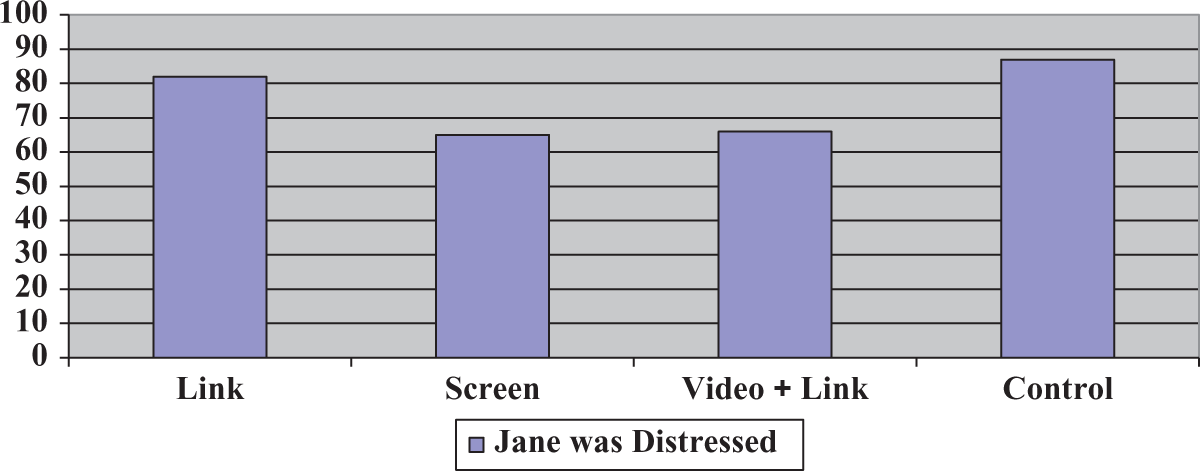
Jane was distressed by trial condition.
Importantly, this suggests that the use of special measures did not preclude jurors from appreciating the emotional difficulties that the complainant was experiencing at the time of recounting her testimony. Certainly, these responses furnish no clear or consistent evidence of reduced emotional impact when video-mediated testimony was presented relative to evidence delivered ‘live and in the flesh’, a point made clear when we combine responses to reflect the in court/out of court split in our trial conditions. Indeed, as illustrated in Figure 3, when responses for the screen and control conditions are combined, the positive response rate reaches 76% (n = 63 of 83), while the combined response rate for the live-link and video evidence plus live-link trials is only marginally lower at 74% (n = 57 of 77).
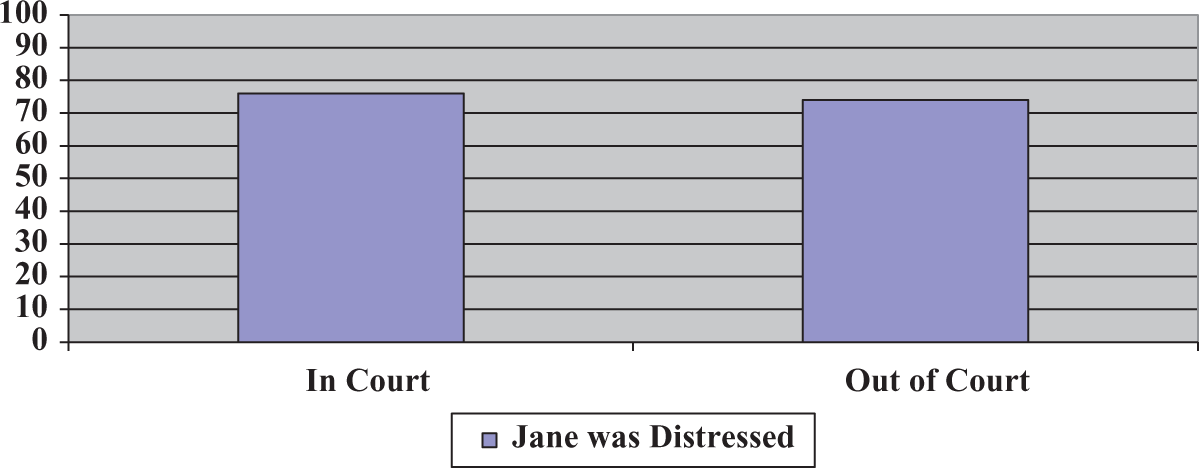
Jane was distressed by in court/out of court.
Impacting Upon Assessments of Credibility
Related at least in part to the concerns outlined in the previous section regarding the impact of special measures, particularly live-links, in reducing the emotional impact of testimony, further concerns have been expressed regarding the potential impact on jurors’ assessments of the complainant’s credibility. Some commentators have suggested that video transmission or the use of other forms of special measures may imbue witness testimony with undeserved credibility, whilst others have argued, to the contrary, that the removal of a witness from the courtroom may somehow undermine her perceived reliability or trustworthiness in the eyes of jurors (Leader, 2010; Wolfensohn, 2010). In the present study, therefore, we looked carefully at the deliberations across the different trials for any evidence that presentation mode had affected jurors’ evaluation of the credibility of the complainant’s testimony.
Once again, however, we found very little evidence in support of either of these opposed perspectives, with the overall sense being that the mode of delivery of the complainant’s testimony had minimal impact. This is not to say that there were not occasional jurors who expressed views that could be seen to support these concerns, but the direction of those comments – which were themselves much in the minority – was variable, suggesting that the special measures could work in favour of the complainant as much as they could work against her. In Jury A, for example, a female juror professed that the video-link had immediately inclined her towards believing the complainant. As she put it, ‘she’s giving evidence from a separate room, which, when she first came in, that’s swayed me straightaway because I thought, “Bless her”. She can’t even face him’. Similarly, another observed that, contrary to concerns about a dulling of emotional impact as a result of the use of special measures, ‘because the emotion of her not being there, the video-link played a part in making me feel then maybe she is telling the truth’. At the same time, however, it was noted in this jury that the opposite conclusion could just as easily be drawn, since it was equally likely that the complainant was lying and had elected to give evidence via the live-link in this instance, for fear of otherwise ‘slipping up’ in the defendant’s presence. Similarly, in Jury D, when a male juror confided that he had been affected by seeing the complainant ‘distraught on the screen’, another juror immediately retorted that women can easily get themselves into a distressed state, implying that the complainant could simply be a good actress, and resisting any temptation to afford her additional credibility on account of her performance via the live-link. Meanwhile, in Jury K, a female juror queried why the complainant had opted out of appearing in court, which prompted a fellow juror to question whether her testimony would have been more convincing if it had been given in the courtroom. In response to this, however, another juror observed that this was simply an option open to the complainant, implying that it would not be appropriate for the jurors as a group to place too much weight upon its usage, and the discussion shifted to another topic, without the issue of the live-link being raised again.
In the specific context of a rape scenario, where this study, along with a considerable body of previous research, indicates that a particular significance will be attached by jurors to the question of whether the complainant could, or should, have engaged in physical resistance in order to try to prevent the defendant’s attack, it might have been thought that the absence of the complainant from the courtroom in the live-link and recorded evidence conditions could play a key role by rendering it more difficult for jurors to assess her size and strength relative to the defendant. Certainly, there was some support for this in the deliberations. Thus, for example, in Jury A, a male juror remarked, You didn’t get any sense of her physicality. When he came in, he was quite a big fellow. When … he walked in and walked out you thought, “Yeah,” you know, you could see how … if she was quite petite, she’d have no chance getting him off, whereas if she was 5′ 10′′, she might have had more of a chance’.
Meanwhile, in Jury K, a female juror commented: our argument is that she didn’t put up … enough of a fight isn’t it really? … But we couldn’t see them side by side so you can’t say “Well look at the size of him, he could have easily pinned her down and she wouldn’t have been able to move or do anything to him.”
Similarly, another juror observed that ‘that’s one of the disadvantages with … I think with having a video-link, is that you can’t get a presence of somebody can you?’ – a suggestion that was then supported by one of his peers who agreed that ‘you can’t see whether he would be able to physically overpower her.’ To the extent that such comments may translate into an inability to properly assess the complainant’s account of having been overpowered where she does not physically appear in the courtroom, they may, therefore, pose the threat of supporting more negative credibility assessments.
At the same time, however, it is important to note that these comments were rare in the overall context of the deliberations, only being raised in a small number of juries, and barely being dwelt upon for long. This is not to suggest that the level of the complainant’s resistance was not a significant concern for many jurors – to the contrary, as already noted, in many cases it provided a key factor in framing determinations of guilt or innocence. But in many cases what appeared to happen was that the jurors moved relatively quickly from an exploration of the ability of this particular complainant to resist this particular defendant (in relation to which the lack of appearance within the courtroom was deemed to be potentially problematic) to a more abstract engagement with the levels of physical resistance that one would expect from a hypothetical rape victim. Such discussion was often markedly detached from the reality of the situation with which the jurors were presented, creating an opportunity for participants to invoke extremely demanding expectations in relation to the levels of resistance to be exhibited. These were bolstered and justified by frequent insistences on the part of female jurors that, no matter what the size differential to the assailant, they were confident that they – as well as the hypothetical non-consenting woman – would find a way in which to exercise high levels of resistance and exert some injuries upon the attacker.
On the basis of the deliberations, then, whilst there was some evidence that the absence of the complainant from the courtroom may influence the assessments of credibility undertaken by a small minority of jurors, there was limited evidence that it had any major impact. Moreover, where it did appear to have some influence, there was no clear evidence that it functioned in a predictable or systematic way – for some jurors, it promoted a more sympathetic hearing, whilst for others, it provoked initial scepticism, and for others it presented a hindrance to being able to assess the evidence before them, albeit not necessarily in a way that detained them for long. These findings are supported, moreover, by the responses provided in the pre-deliberation questionnaire where jurors were specifically asked whether they gave credence to the complainant’s claim that sexual intercourse took place without her consent, and there was no clear correlation to the existence of differing modes of evidence delivery. Here, as illustrated in Figure 4, 41% (n = 16 of 39) of jurors in the live-link condition indicated that they believed the complainant when she said that she had not consented to sexual intercourse with the defendant on the night in question, compared to 37% (n = 15 of 40) of jurors in the control condition, 37% (n = 14 of 38) in the video evidence plus live-link condition and 32% (n = 14 of 43) in the screen condition.
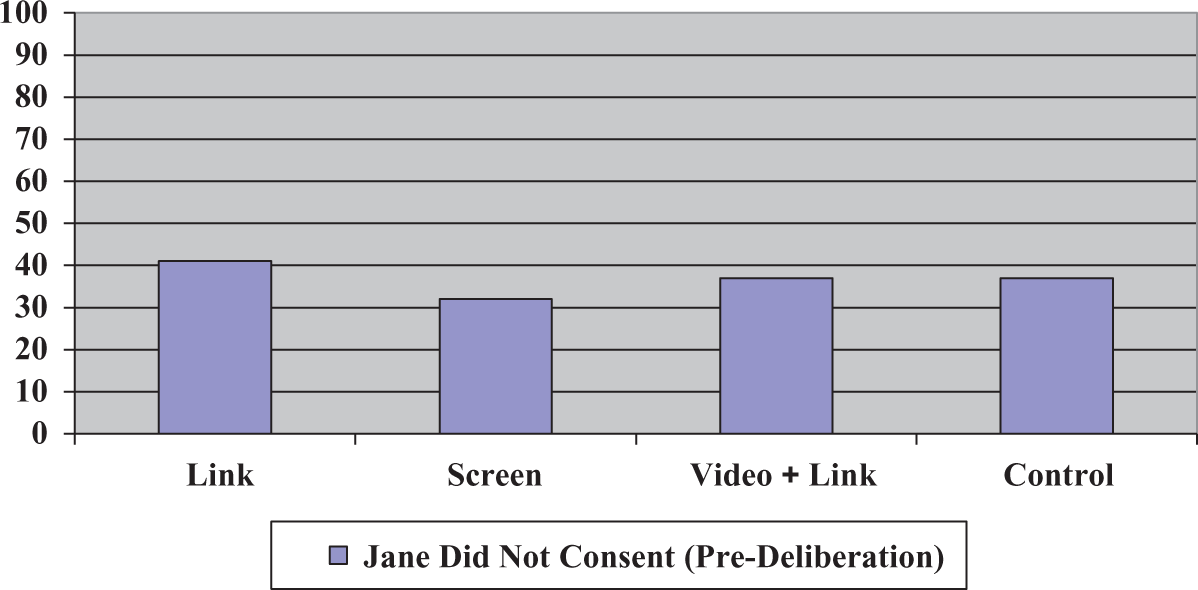
Jane did not consent (pre-deliberation) by trial condition.
When these responses are configured to reflect the in or out of court split, moreover, we still find no clear evidence of a link between juror perceptions of the complainant’s veracity on the issue of consent and presentation mode. As illustrated in Figure 5, while 35% (n = 29 of 83) of jurors indicated belief in the complainant’s account when she testified in court, the positive response rate rose only slightly to 39% (n = 30 of 77) for the out of court trial conditions.
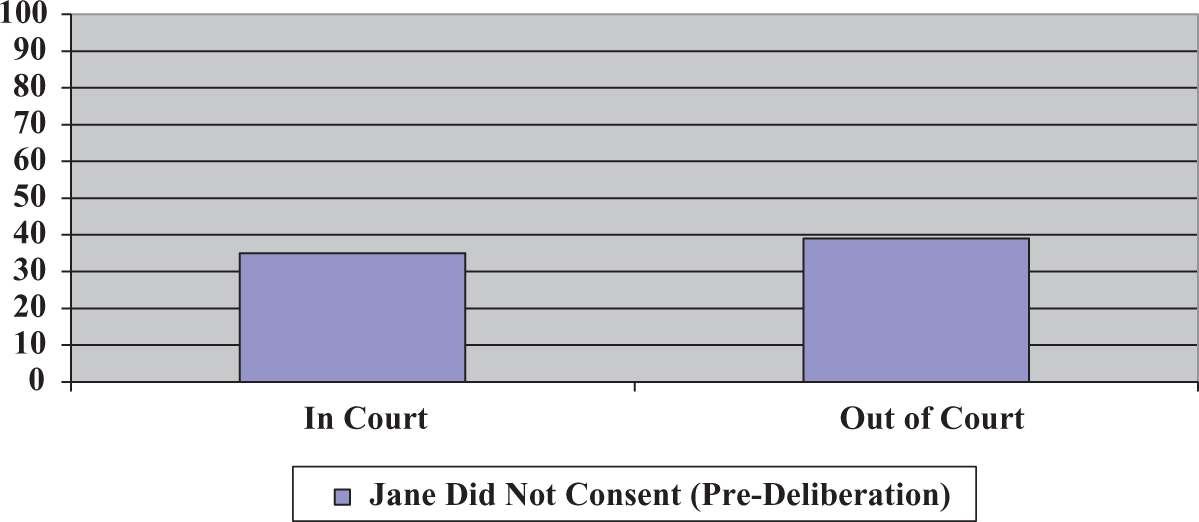
Jane did not consent (pre-deliberation) by in court/out of court.
By the time of the post-deliberation questionnaires, when participants were again asked to reflect on their views regarding the complainant’s credibility, it is true that there appears to have been somewhat of a shift in perspectives across the different conditions. Thus, as is illustrated in Figure 6, participants in the control condition were now most convinced of the complainant’s veracity (40% n = 16 of 40, compared to 33% n = 13 of 39 with the live-link, 24% n = 9 of 38 with video-recorded evidence plus the live-link and 16% n = 7 of 43 with the screen).
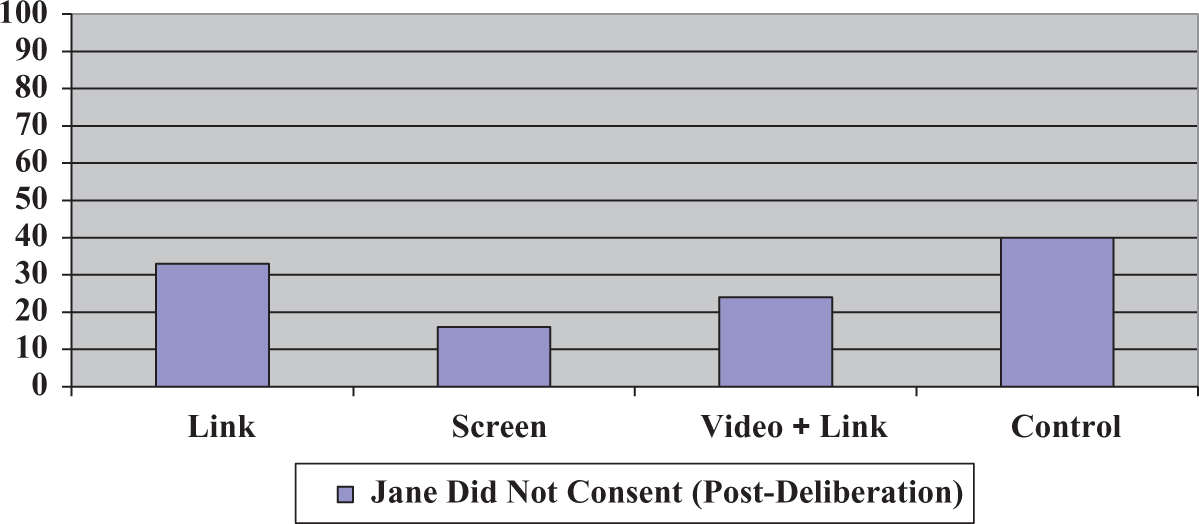
Jane did not consent (post-deliberation) by trial condition.
Although, on the surface, this shift might be thought to suggest a negative correlation between the use of special measures and perceived credibility, a deeper and contextual analysis of the content of the deliberations suggests that these credibility assessments – as with verdict differences across the four conditions (discussed above) – correlate more strongly with jurors’ expectations about injury and resistance than the means by which testimony was presented. Thus, in the live-link, screen and video plus link conditions, where belief in the complainant’s perceived veracity dropped post-deliberation, a key factor influencing this swing appeared to have been the frequently forceful assertions of peers that a genuine victim of rape would have fought back more aggressively than the complainant, sustaining (and inflicting) thereby a higher level of bodily injury. Indeed, during the course of group discussion, jurors frequently openly declared that their initial inclination to accept the complainant’s version of events had shifted towards disbelief precisely because the complainant, in their (revised) view, ‘didn’t put up enough of a fight’ (Jury K). By contrast, in the control condition, where we observed two jury deliberations (P and Q) which culminated in majority and unanimous guilty verdicts respectively, it was apparent that this line of argument failed to gain the same amount of ground and the shift of opinion over the course of the deliberations had in fact favoured the complainant’s version of events. In these two juries (as discussed above), mock jurors proved much more willing to accept the possibility that a woman might not fight back during an assault for fear of further violence or simply because she was ‘in shock’. To this extent, we believe that – reflecting the methodological concerns outlined above – simply reading off from these post-deliberation questionnaires in isolation would be misleading, suggesting a rather different journey through the deliberative process than our more detailed analysis of the discussions indicates was in fact undertaken by many of our participants.
Of course, when considering the transferability of these findings to real life trials, one would also have to take account of the effects of the use of special measures on the ability of sexual offence complainants to provide detailed, coherent and ultimately persuasive testimony. In our study – in order to isolate and thereby better evaluate the effects of presentation mode – testimony content was held constant in the live-link, screen and control conditions, whilst jurors in the video plus link condition heard the complainant give essentially the same account with some added repetition and non-sequential (re)ordering to reflect the less structured way in which narratives commonly emerge in video interviews. In actual trials, a key potential benefit of utilising screens and video technology is that they offer protection from court-related stressors and thereby help complainants to give better quality evidence. Indeed, Hamlyn et al. (2004: 81) found that witnesses using special measures were less likely than those not using them to report anxiety and more likely to say that they had been able to give their evidence completely accurately. Video interviews also have the advantage of preserving a witness’s account made more contemporaneous to the time of the events in question rather than at trial, ‘reducing the effects of forgetting and the susceptibility of memory recall to distortion from other sources’ (Westera et al., 2011a: 919; for more reviews see Westera et al., 2011b). If these potential benefits are realised in practice, and protective measures do indeed improve the completeness and overall forensic quality of complainant testimony, then one might reasonably anticipate an appreciable and positive association between the use of special in rape trials and perceived complainant credibility. Further research is needed to explore these possible, positive impacts; within the confines of our study, though, it was clear that, substantive quality of the testimony being equal, there was no compelling evidence of a reliable influence on mock juror assessments of credibility by virtue of the use of special measures.
Fairness for/to the defendant
A final, key source of concern raised by commentators relates to in-principle objections to the lack of fairness to the defendant that can be associated with the complainant’s use of special measures. Although the courts have failed to countenance such concerns as constituting a threat to the defendant’s right to a fair trial under Article 6 of the European Convention on Human Rights (in the context of England and Wales, see R v Camberwell Green Youth Court [2005] UKHL 4), the worry here is that, notwithstanding countermanding judicial direction, the use of special measures may prejudice the defence either by suggesting to the jury that the witness cannot face being in the same room as, and needs to be protected from, the defendant, or more generally by creating an imbalance in the procedures by which competing accounts are provided. In the context of a rape trial where, so often, determinations of guilt or innocence come down to an assessment of one person’s word against another, these concerns may be particularly acute. Again, in the present study, we examined our deliberations to evaluate the basis for such concerns. And once again, as will be discussed in this section, while we found occasional support for these concerns, on the whole, there was little evidence to suggest that this was a major factor in framing the approach taken to the deliberative task by the majority of our juror participants.
As already outlined, there were comments made during the deliberations which suggested that some jurors interpreted the complainant’s absence from the courtroom as confirmation of her distress/trauma, reflecting what they saw as an understandable reluctance to be in the physical presence of the man who had raped her. Such sentiments were voiced very occasionally, however, and in each instance, they prompted others within the group either to suggest an alternative reason for the complainant’s absence – specifically, the possibility that she had fabricated the claim and did not want to look the man that she was falsely accusing in the eye – or to insist – in line with the judicial direction issued – that no significance should be attached to alternative trial arrangements since they simply reflected common courtroom practice. While the deliberations thus yielded little compelling support for concerns that the use of special measures gives rise to an implication of guilt in the minds of jurors, which places defendants at an automatic disadvantage, we were also keen in this study to examine whether jurors themselves perceived any risk of unfairness as being attached to the use of screens, live-links and video-recorded evidence in rape trials; and so we examined the deliberations for any comments that tended either towards or against this view.
Having done so, we found that the risk that the use of special measures may be adversely prejudicial to the defendant was only explicitly raised by jurors in three trials – all of which involved the use of a live-link. In Jury A, for example, one juror suggested that the fact that the complainant was able to use this facility ‘put him (the defendant) immediately at a disadvantage’, particularly in a context in which he was not able to avail himself of the same medium. Importantly, though, this argument was immediately challenged by another juror who, reminding his peers of the judge’s direction in relation to the use of the live-link, insisted that this isn’t ‘to have any bearing … when you’re making your decision.’ Similarly, in Jury D, one male juror noted that, while he understood ‘why they do it, because it must be terribly traumatic for someone who has been raped to have to stand up in court’, he nonetheless felt that ‘how the trial was organised, whereby she’s on a monitor, is unfair to the defendant’. Once again, though, when this position was raised, it was immediately countered by another juror who, though not relying directly on the direction from the judge, maintained that there was nothing of significance in the use of the live-link since ‘that’s how they do it’ in many rape cases. These examples illustrate that, while there were some jurors who took the view that this mode of evidence delivery was unfair to defendants, the fact that it was not something remarkable and not to be afforded weight in the decision-making process was also strongly emphasised. Moreover, to the extent that some jurors expressed concern that the use of such measures could generate prejudice, it was evident that – in line with the observations above in regard to credibility – there was no clear consensus as to how such prejudice would, or should, play out in rape cases. This was clearly exemplified in the following exchange, which took place during discussions in Jury C:
Are we meant to be talking about the fact that it was on video?
Well, no, I don’t think we necessarily have to.
But in a normal court situation, does that sometimes influence the jury?
Sometimes people are prejudiced in rape cases …
What does it make them think?
That she won’t come in
That she’s intimidated by his presence.
That she can’t face him.
So she isn’t intimidated by him
Because she’s lying or because of what he actually did, that’s the truth
Some people automatically go, if they’re giving evidence on a video-link in a case like this, ‘It’s because she can’t face him because she knows she’s lying’. And some people will go, ‘She can’t face him because quite reasonably it’s …’ [participants talking over each other].
These findings are supported, moreover, by findings from jurors’ post-deliberation questionnaires, in which they were asked to consider – across the different trial variables – whether they felt that the trial had been fair, and whether the way in which the trial had been conducted had disadvantaged the defendant. Across the four trial conditions, a majority of participants answered affirmatively when asked if the trial they had observed had been fair and negatively when asked if the defendant had been disadvantaged by the way in which the trial had been conducted. Moreover, when jurors did register concerns regarding the fairness of a trial, no clear pattern emerged from the responses to suggest a direct association with presentation mode. As illustrated in Figure 7, participants in the control condition, where no special measures were used, were in fact most likely to answer negatively when asked if the trial was fair (20% n = 8 of 40), closely followed by jurors who had observed the other three conditions – 16% (n = 7 of 43) with the screen, 16% (n = 6 of 38) with the video-recorded testimony followed by live-link and 15% (n = 6 of 39) with the live-link.
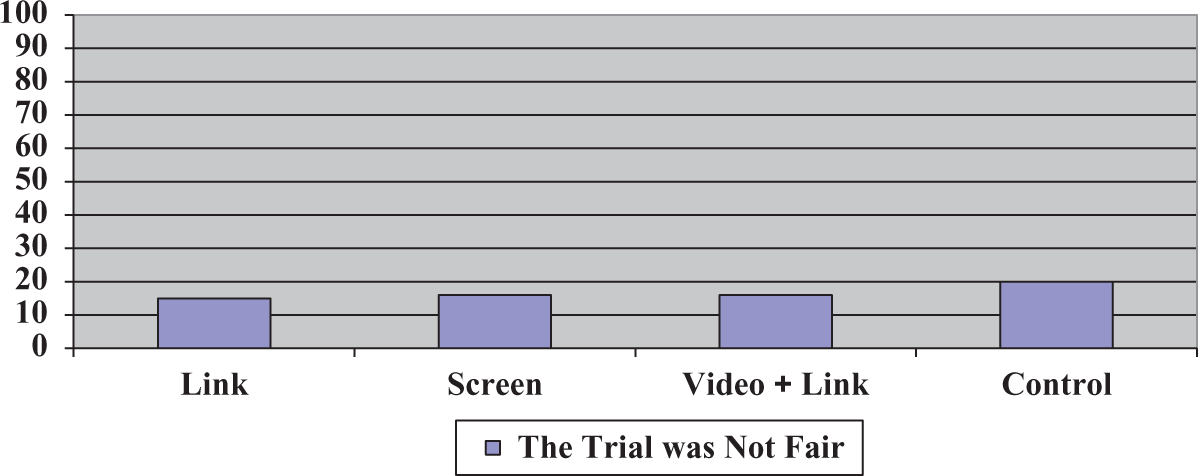
The trial was not fair by trial condition.
Looking at the written comments by which participants supplemented their responses on the issue of fairness in the post-deliberation questionnaires, it was apparent, moreover, that the primary source of consternation for this minority of jurors was the sufficiency – or rather the perceived insufficiency – of evidence adduced in the trial rather than the complainant’s use of special measures. Several jurors complained that they had not been presented with ‘enough evidence’ in court while one lamented the particular absence of ‘character witness testimony’ and another the comparatively ‘weak’ performance of the defendant’s barrister. Only one participant in this study explained a negative assessment on fairness by reference to the mode of delivery – in this instance, referring to the use of the live-link and stating that the trial ‘was biased in favour of the victim by allowing her to “hide” behind a TV screen.’
In sum, then, and in line with previous research on child witnesses conducted in other jurisdictions, our findings suggest that mode of presentation did not substantially impact negatively or differentially on juror perceptions of trial fairness (Cashmore and Trimboli, 2006; O’Grady, 1996). While some jurors did feel that the use of the live-link facility in particular was unfair to the defendant, they were significantly in the minority. The overall direction of participants’ responses – coupled with the minimal attention jurors paid to special measures over the course of their deliberations – suggests that the vast majority understood the reasons why these measures were used to present the complainant’s evidence and perceived them to be fair to both the complainant and the defendant. The confidence thereby placed by jurors in the fairness of such measures was supported, moreover, in the context of the present study, since, as we have outlined, we were unable to identify any clear or consistent evidence of a detrimental impact on either party as a consequence of using divergent presentation modes.
Concluding Thoughts
The study discussed in this article provides, we believe, important (and to date, crucially lacking) insights into the ways in which the use of special measures may, or may not, impact upon juror deliberation. That said, there are, of course, a number of limitations to this study, which have to be borne in mind – and there is little doubt that there is still a need for further research on several of the issues that it addresses. Aside from the methodological limits associated with mock trial research (i.e. the constraints of time and verisimilitude associated with the experimental context and the fact that participants know that, ultimately, their verdicts do not have ‘real’ consequences), we also had to keep certain factors constant across the trial conditions in order to isolate effectively the mode of delivery variable. As noted above, this included the content of the complainant’s testimony, notwithstanding the fact that there is reason to suspect that – in the ‘real world’ – it may have varied in substantive quality across presentation modes. Moreover, it also included the level of visible emotional distress that the complainant exhibited whilst giving her testimony. It is possible that complainants who use special measures may appear less distraught compared to those who give evidence in the courtroom without such measures, or that a complainant may be more distraught in giving a police interview in the immediate aftermath of the alleged attack than she will be some months later when the case comes to trial. Our previous research has confirmed that the emotional demeanour of the complainant can influence jurors’ perceptions of credibility, as well as their levels of sympathy, and so this may have had an impact on the present findings (Ellison and Munro, 2009a, 2009b; see also Klippenstine and Schuller, 2012). At the same time, of course, the diversity of emotional reactions that survivors of sexual assault will exhibit, in different contexts and at different times – ranging from tearfulness and anger to calm detachment – renders this one amongst many compounding variables that can influence the ways in which jurors approach their deliberations. Inevitably, such variables have to be factored in when evaluating our findings, but their relationship to the mode of evidence delivery in the context of special measures can only be explored through further research.
Beyond this, it is also important to bear in mind that, in the trials where the live-link was involved, we used a large, 50-inch plasma screen, which means that the image of the complainant was clearly visible to all our jurors. This is not always the case in real courtrooms where smaller screens may be used, or screens may be located at a distance that impairs jurors’ visibility, and this, in turn, may adversely impact jurors’ assessments of the complainant’s testimony in ways that were not evidenced in the present study. Likewise, in the video evidence condition, as noted above, we scripted the police interview based on a model of good practice. This means that the adverse impact of its use upon jurors’ deliberations may have been less pronounced than could be the case in the kinds of cases about which Baroness Stern and others have raised concerns, in which interviews lack clarity or are unduly repetitive, and the video tapes are poorly edited so as to be either overlong or disjointed. Again, while we believe that our choice to adopt this model for the scripting and delivery of the video evidence was appropriate, given the aims and limits of our study, research on the divergent impact of better and poorer quality interviews and videos may be useful.
Finally, it is important to bear in mind that the findings in this study – which suggest a limited and by no means coherent influence upon juror deliberations as a result of the use of special measures – arise specifically in the context of adult (female) complainants in rape cases. Although providing insights of potential relevance to other contexts, it would be dangerous to uncritically extrapolate from this specific scenario to make broader claims regarding the impact of special measures in other cases, or in relation to their use by other complainants. As far as child complainants are concerned, there are, no doubt, a range of other factors and expectations that might influence jurors in different ways. Moreover, it may be that, in the specific context of rape cases, the preoccupation which jurors appeared to exhibit with resistance and sexual miscommunication as key considerations sidelined the influence of mode of evidence delivery in ways that may not hold in relation to other cases. Certainly, there is some previous research that suggests a more favourable assessment by third-party observers of adult testimony delivered in court, compared to video-mediated evidence, when involving a case about a staged car accident (Landstrom et al., 2005) or an unspecified ‘domestic incident’ (Fullwood et al., 2008). Importantly, however, in these studies, observers viewed an interview with the witness rather than a simulated trial, and participants were not asked to deliberate towards group verdicts following the observation, which, we would argue, limits the scope of their findings and ensures the need for additional research.
With these reservations and qualifications always in mind, we submit that the findings of this study do make an important contribution to bridging our current knowledge gap in relation to the impact of special measures upon jurors in rape cases. Though the specific factual scenario upon which our jurors deliberated involved an alleged attack between ex-partners, there are reasons to expect that our findings need not be rigidly restricted to similar fact patterns, given the body of previous work, which suggests the dominance of similar preoccupations with resistance and sexual miscommunication in acquaintance rape scenarios and the reality that, together, partner, ex-partner and acquaintance rapes make up the significant share of contested allegations. To the extent that our findings indicate that there is no predictable or consistent influence associated with divergent modes of testimony delivery in adult rape cases, they should go some way towards assuaging the concerns of critics and – in a context in which previous research has strongly indicated that their use is welcomed by vulnerable witnesses themselves – they should give advocates greater confidence in encouraging complainants of sexual offences to make use of protective special measures.
Footnotes
Acknowledgement
The authors are indebted to the Project's Advisory Group and to all who participated in the trial reconstructions. With the usual caveats, thanks are also due to Peter Traynor for his assistance with the questionnaire data and to Amanda Burton and Jackie Kerr for helpful comments on a previous draft.
Funding
This research was conducted with funding from the Economic and Social Research Council (Grant Reference RES-000-22-4277).