




Abstract
According to the age-old proverb from Plato’s Republic: necessity is the mother of invention, the main motivation for creating new discoveries is the need for them. However, as well as the necessity factor, we argue that a very important aspect that influences invention and creativity is the empathy factor. This mixed methods research investigated the impact of empathy instruction on the social and emotional skills of creativity in the UK Design and Technology (D&T) classroom. Pupils in year 9 (aged 13 to 14 years) from two schools were assessed for their creativity levels using the Torrance Test of Creative Thinking (TTCT) both at the start and at the end of the academic school year. In the intervening period, whereas the control school continued as normal with its usual D&T lessons, the intervention school’s D&T lessons were replaced by a creativity tuition kit called Designing Our Tomorrow (DOT), which involves instruction in empathising. Pupils from year 7 (aged 11 to 12 years) in a third school were given the DOT task alone and interviewed about their experiences of it. Results showed that unlike the control school, whose emotional and cognitive creative scores in fact decreased over time, the intervention school increased in its levels of emotional and cognitive creativity, as measured by the TTCT. These quantitative as well as the subsequent qualitative interview findings and pupils’ portfolios suggest that creativity can be taught and particularly via instruction that advocates the importance of empathising with the subject matter. The findings are discussed in relation to the need for a holistic approach to teaching, where social, emotional and cognitive dimensions of teaching and learning are needed to complete and enhance the learning experience for the D&T classroom and beyond.
Keywords
There can be no knowledge without emotion. We may be aware of a truth, yet until we have felt its force, it is not ours. To the cognition of the brain must be added the experience of the soul.
Introduction
The dual nature of empathy
A government paper (POSTnote, 2018) for which the first author was consulted, addressed the importance of non-academic skills, such as social and emotional skills, being encouraged in school in order to increase academic performance and productivity, in order to create and prepare more rounded individuals who are more able and adept to navigate the workplace. Thinking about the potential of social and emotional skills for education is not new. Back in 1933, John Dewey wrote of the necessity to address students’ social and emotional skills in education: . . .There is no education when ideas and knowledge are not translated into emotion, interest, and volition (Dewey, 1933, p. 189). Such approaches have been propelled to the forefront of education and in so doing, have been recognised as being beneficial for children’s professional aspirations, as the more accurate understanding of emotion is believed to lead to better problem solving and, along with cultural and social intelligence, has been associated with positive and balanced work attitudes (Crowne, 2009). Adding the emotion to the cognition leads to a more holistic view of teaching, learning, the pupil and the school (Arghode et al, 2013; Baird et al., 2007; Demetriou & Wilson, 2009; Demetriou et al., 2009). The social and emotional skill of empathy is no exception, as evinced through its myriad contemporary definitions which include the ability to feel, share, imagine, project, identify, understand or experience another’s perspective through their feelings, thoughts and actions. Definitions fluctuate between an empathy where there is an understanding of the other person’s perspective, to an empathy where there are similar feelings experienced.
Typically, empathy is viewed as having two guises: emotional/affective; and cognitive/perspective-taking (Demetriou, 2018). The emotional/affective/feeling/vicarious form of empathy is where we can literally live the other’s experience. The other form of empathy is a perspective-taking/cognitive form that involves an appreciation of the other’s situation without necessarily becoming emotionally involved. From emotionally experiencing almost firsthand, to the socially-skilled understanding of the situation – either way triggers an empathy that can add appreciation, understanding and emotion of a situation that can in turn lead to action to ameliorate the situation. With its dual nature encompassing both emotional and cognitive components, empathy can command emotional, social and academic success, adding essential social and emotional components to learning that arguably complete learning and the learner’s path to be a holistic individual. Arguably also, it is in lessons such as Design and Technology (D&T) which are typically offered in the UK secondary school curriculum from the age of 11 to 12 years that social and emotional skills of empathy can ignite and infuse the creative process to make the product real, usable and meaningful to the user.
During the second year of life, along with the differentiation of self-other and development of perspective-taking and emotion regulation, there is a shift from self-concern to an ability to project towards the other, and in turn to provide a resolution (Demetriou & Hay, 2004; Knafo et al., 2008; Svetlova et al., 2010). Feshbach (1989) claimed that ‘The child who experiences empathically shared distress is motivated to reduce these painful distress feelings. One method for reducing empathically induced distress is to alleviate the distress of the other child through an altruistic, helpful response. Consequently, while the empathic child may find other ways of reducing empathic distress, such as avoidance and denial, one would still expect to find a positive relationship between empathy and prosocial behaviour’ (p.105). Importantly, recent research in genetics and neuroscience respectively has shown that the relatively small amount of hard-wired empathy that does exist early on, tends to recede by adulthood. To illustrate, Warrier et al. (2018) conducted the largest genetic study of empathy using information from more than 46,000 23andMe customers and the Empathy Quotient questionnaire. This research revealed that only 10% of our empathy is genetic, with therefore up to 90% of our empathy derived from social factors such as upbringing and environment. Neuroscience research has also found clues to the development of empathy. For example, Fraser et al.’s (2020) study of 5 to 9-year-old white non-Hispanic children measured the degree of empathy via their Mu suppression levels using an electroencephalogram (EEG) as they viewed scenarios depicting social injustices towards White and Black children. Compared with previous studies of adults, the children did not display racial bias in response to social victimisation. Such studies have implications for the development of biases and point further to the role of socialisation.
Empathy for creativity
Creativity and empathy possess similar traits where one is needed for the other to flourish. Such traits include unusual perceptual and personal openness, resistance to closure, non-judgmentality, egoless state of flexible ego-control, low defensiveness, and a desire to work beyond the boundaries of self. Words and phrases describing attributes of creativity such as ‘permeable boundaries’ (Carl Rogers), ‘bold and free perspicuity’ (Abraham Maslow), and ‘sensitivity’ (J.P. Guilford and E.P. Torrance), also resonate for empathy.
To an extent, the Design and Technology curriculum in the UK reflects policymakers’ emphasis of the importance of considering users’ perspectives and needs when designing and making products (Nicholl et al., 2012). At Key Stage 3 (pupils aged 11 to 14 years in years 7, 8 and 9) in particular, pupils should combine practical and technological skills with creative thinking to design and make products and systems that meet human needs (QCA, 2007, p. 51). However, more often than not, the creative classroom requires the learner to design and create a specific object to fulfill a certain function given a limited amount of time and lack of context. As a consequence, the design process is stunted with little thought given to the context for which the object is being designed. There is perhaps critical thinking taking place, but little empathy within that critical thinking, so that the thinking is judgmental and egocentric, leading the designer to misjudge with empathic inaccuracy and limited perspective-taking (Nickerson, 1999). The result is a design that has omitted to take account of the users or stakeholders of the object. As well as the nature of the tasks, the importance also lies in the nature of the instruction and focusing on the context of the design so that the product user is understood, socially, emotionally as well as logistically, during the design process. A study with 11 to 16 year olds showed the importance of not fixating on the product, but rather the user: ‘If I was going to design a chair, the last thing I would look at is a chair’ (McLellan & Nicholl, 2011). When designers are given the task of designing an object, a stumbling block is to be fixated on the product. In such cases, the designer’s approach is introspected and convergent, rather than outrospected and divergent. Creativity that reflects divergent rather than convergent thinking (Guilford, 1967) is an asset, both for the individual and society at large. The importance of creativity to industry cannot be overestimated and reviews have addressed how best to exploit the nation’s creative skills (e.g. Cox, 2005). As with many subject matters, the roots of creativity and the mindset for the creative process are those established early on in school through subjects such as Design and Technology and STEM. For example, keeping an open mind, reducing fixation and being resistant to premature closure for the sake of completing a task are often seen as beneficial to the creative process (Crilly, 2015; Howard et al., 2013). However, often the prescriptive nature and time constraints within these subjects means that rather than flourishing, there is design fixation where the creative process and potential are inhibited (Jansson & Smith, 1991). The premise of this paper is that empathy and creativity should go hand in hand through taking the perspective of and employing emotion in order to immerse oneself in the subject matter. Arguably, embedding empathy within this creativity process is the formula to fostering creativity and producing successful design outcomes.
Enhancing empathy for creativity
Research has shown that certain contexts can moreover enhance empathy, such as the power of engaging with literary fiction on the reader’s emotional skills of empathy, mentalising and theory of mind by Kidd & Castano (2013, 2017) who claimed that the more subtle stories and characters of literary fiction, rather than those of popular fiction, are particularly powerful in enhancing readers’ abilities to understand others’ mental states. The UK organisation known as EmpathyLab has used 11 pioneer primary schools to show the impact of integrating the values and learning materials that reflect empathy, specifically through reading, on the ethos, teaching and learning of the pupils and teachers (2018). In the primary school design classroom, the human-centred design approach was used to encourage 9 to 12 year olds to design a ‘movement-garden’ for both the elderly and children (Klapwijk & van Doorn, 2015). Further design research in primary school with 7 to 11 year-olds by Voigt et al. (2019) looked at enhancing children’s agency for design when considering the role of empathy alongside creativity and self-efficacy. Empathy here was the extent to which children identified with the social challenges of creating a ‘smart home’, and empathy was enhanced by connecting with the problem on a personal level. Haag & Marsden (2019) found that establishing whether a persona was similar or dissimilar to the designers played an important role and lead to empathy gaps regarding dissimilar users who were older or less technically inclined. Such studies have shown the importance of context as identified in very young children and have raised awareness for the mechanisms of empathy that should be incorporated into design and technology education. Increasingly, research is recognising the importance of factoring in an interpretative emotional empathic component in order to counter design challenges and also when considering motivational aspects behind the design thinking process (e.g. Mattelmaki et al., 2013). Cultural differences between primary school children’s empathic traits have also been identified. For example, Woo et al. (2017) researched the effects of empathy on group creativity and found higher levels of cognitive empathy among Korean pupils versus US and Dutch pupils, and vice versa for emotional empathy, and in so-doing, advocated the need for a balance of both forms of empathy for effective group creativity outcomes.
In design education, empathy is being recognised as essential for human- or user-centred design and deemed important to avoid egocentric approaches to design when relating to others who are dissimilar to the designer. The case study of Hill (1998) reflects the degree to which the user is included in the design processes. The study involved a secondary school pupil whose task was to design a table for people at a retirement home. After visiting the retirement home several times, the student decided to make a table from concrete and steel; and after numerous sketches and drawings and the production of a small-scale model out of wood, she visited the residents again only to find that the residents rejected her design because it would tear and hurt their skin. As part of the D&T curriculum, teachers should ensure to integrate the direct interaction of pupils and users throughout the process, so that no communication is lost along the way and to prevent students designing solutions before they fully understand the situation from the user-perspective. In order to address the user perspective, contextual user research and context-mapping have been developed to conduct contextual research with users where the users are the experts, thereby developing empathy with users from the outset (Visser et al., 2005).
The present paper raises the awareness for the mechanisms of the two dimensional nature of empathy encompassing thoughts and feelings within creativity instruction in the secondary school design and technology classroom. Rather than thinking and feeling
Methodology
We collected data from pupils in three schools. One school was given the Torrance Test of Creative Thinking (TTCT); the second school was given the TTCT as well as the DOT; and the third school was only given the DOT. We worked with year nine pupils (end of Key Stage 3, aged 13 to 14 years) in two large inner London academies with a diverse range of SES and ethnicity. Using a well-established psychometric test of creativity, the TTCT, creativity levels were assessed at two time points at each end of the academic year. The first assessment of the TTCT was given to both schools in October/November and was re-administered in May/June of the same academic year. In the interim between the two TTCT assessments, whereas the control school (C-school) continued with their curriculum-prescribed D&T lessons, the intervention school (I-school) was given a task called Designing Our Tomorrow (DOT) during their D&T lessons throughout the year. The pupils in the I-school were also interviewed about their experiences with the DOT and how it compared with their usual D&T lessons. The total number of pupils was 64, with 28 pupils in the C-school and 36 pupils in the I-school, giving a total number of responses pre- and post-testing of 56 and 72 respectively, and overall total across the two schools of 128 responses. The DOT alone was then administered to a third school, which was a selective, ethnically diverse girls’ school in London, and these year 7 pupils (aged 11 to 12 years) were interviewed about their creative learning experiences.
Designing our tomorrow (DOT)
Designing Our Tomorrow (DOT) was an Engineering and Physical Sciences Research Council (EPSRC) funded project created by Cambridge colleagues (Hosking et al., 2009) which aimed to bring authentic engineering design practices into the D&T classroom. DOT challenges students to solve real-world problems following an iterative process of designing, using a variety of authentic design thinking tools. The challenge we report on here is the early diagnosis and treatment of asthma for children aged 6 and under. With 5.4 million people in the UK with the condition, the National Health Service spends about £1 billion on treatment, and yet 1,484 people died from asthma in 2017, many of whom are young children (Asthma UK, 2018). Complex problems like these require creative solutions and this is where design comes in (Christiaans, 2002). DOT takes problems like these and transforms them into everyday D&T classroom tasks that affords students autonomy (Nicholl et al., in preparation) and arguably, according to the present paper – empathy.
In the current treatment of asthma, young children, or more accurately, their parents/guardians are given the asthma equipment (see Figure 1 for the design brief given to the young designers) by their doctor and told to feedback any critical incidents over an agreed timeframe (normally 2 weeks). As part of developing this challenge we sought the advice of medical experts, including the lead consultant for the NHS on the treatment of asthma as well as asthma nurses. Consulting the experts identified several problems with current practice that makes this a life-threatening condition. Firstly, young patients (and their parents/carers) do not use the equipment such as the spacer in the correct way. Also, there is no place to log any incidents (for example where and when an attack took place). This is key, as different triggers can affect people to varying degrees and it is important that triggers are identified for each patient. Early compliance to taking the inhalers is crucial if the young person is to alleviate the symptoms or reduce the chances of an attack happening in the first place. As attacks can be traumatic for all stakeholders (for example, the young child, parents/grandparents and health care staff), it is important to make the treatment of asthma a positive experience. Also, there is a need to ‘store’ the equipment in one convenient ‘package’ so the various stakeholders have the equipment ‘to hand’ in case of an attack. These problems require a creative solution and this is the real-world problem we set the young designers.
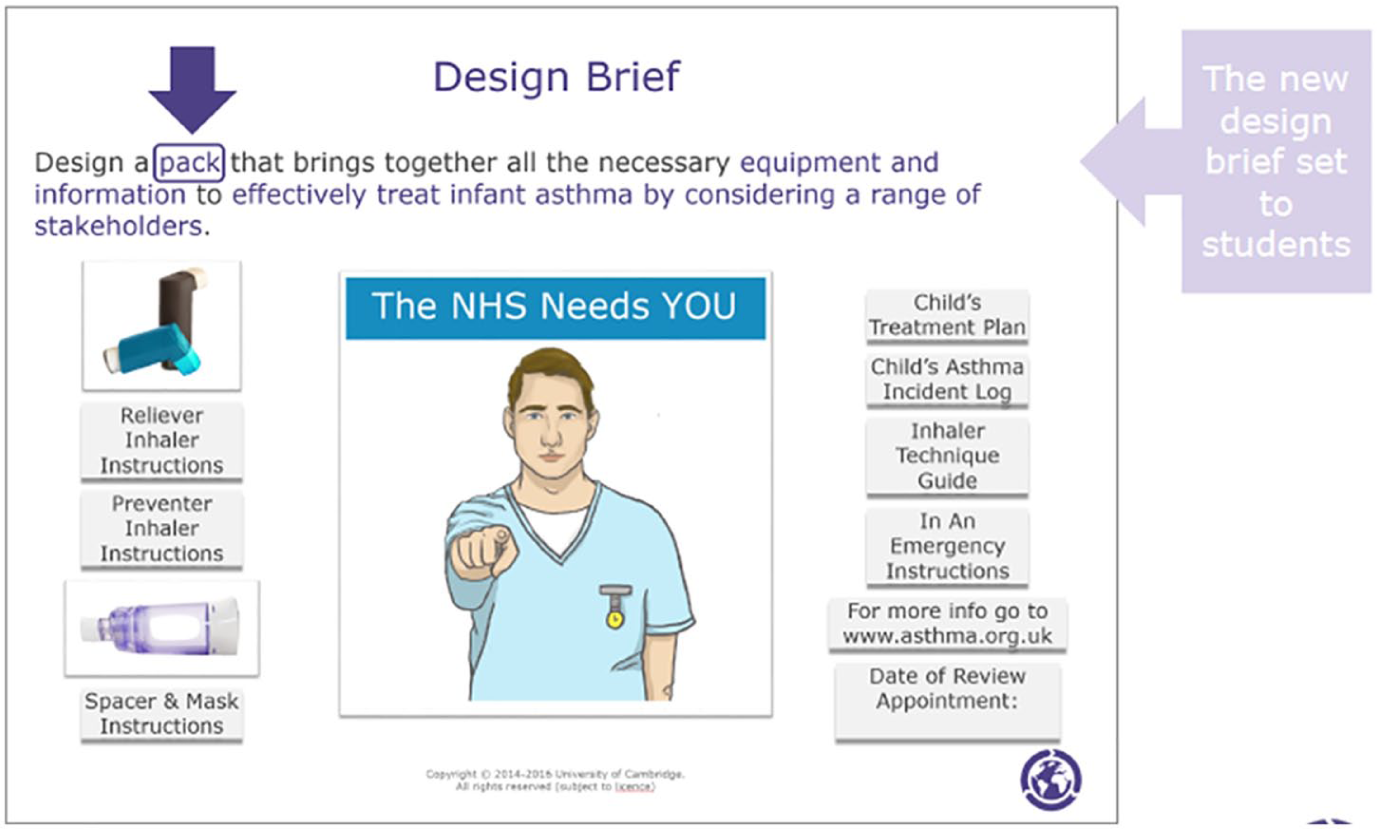
The asthma design brief given to pupils showing asthma equipment and other requirements.
Reported here is how the DOT initiative is beginning to research the way education might transform students’ experiences in D&T by relaying the importance of empathy as part of a creative climate. For example, as part of the empathy tuition procedure, pupils are shown posters that guide them towards creating their designs. One of these portfolios advocates the importance of not being judgmental of their own or others’ designs in order to keep an open mind. There is evidence that affective or emotional scaffolding ‘engages students’ imagination – using metaphor, visual representations, or narratives of content – in an effort to foster a particular emotional response to academic subject matter’ and this has received little attention in educational research (Rosiek & Baghetto, 2009, p. 181). Such interactions and exchanges depend on the degree of support one social partner offers the other and this can range from ‘using prompts and encouragement’, to modelling a task to an expert offering directions with ‘explicit and specific instructions’ (Moscolo, 2005, p. 190); as well as noting that social, cognitive and emotional support are not dichotomous but mutually interdependent (Rosiek & Baghetto, 2009).
Torrance test of creative thinking (TTCT)
The aim was to see if the use of the aforementioned DOT procedure would have an impact on the creativity levels, and in particular the creative empathic abilities, of the I-school according to the assessment criteria of the TTCT. The TTCT, originally created by Ellis Paul Torrance (1966) consists of a number of creative figural and verbal criteria, and a battery of measures requires subjects to respond to figural (drawing) and verbal (written) stimuli that can be reliably measured for their creative strengths. The figural categories consist of a main set of creative responses (fluency, originality, elaboration, abstractness of title, resistance to premature closure). There is also an additional checklist of creative strengths (emotional expressiveness, storytelling articulateness, movement or action, expressiveness of titles, synthesis of incomplete figures, synthesis of lines or circles, unusual visualisation, internal visualisation, extending or breaking boundaries, humour, richness of imagery, colourfulness of imagery, fantasy). As well as investigating each creative strength individually, the scores for this latter creative strengths section were aggregated to form a total score of creative strengths. A total figural score was created by adding together the five main figural components and all the creative strengths. The main verbal categories consist of fluency, originality and flexibility; and a total verbal score was created by aggregating the three verbal categories. Moreover, a total creative score was made by merging all the scores across figural and verbal categories. Despite being a well-established measure of creativity, inter-rater reliability was performed for the TTCT. This was based on sample of 40 tests (approximately one third of the total responses). Using Cohen’s Kappa for the categorical data from the verbal tasks, the reliability score was 0.86 (excellent); and Intra-class Correlation Coefficient for the continuous data of the figural tasks, the reliability score was 0.70 (good).
Findings
This section is in two parts. Firstly, presented are the quantitative findings from the two schools: the intervention school (I-school), which was given the DOT measure, and the control school (C-school), which was not. Secondly, presented are the qualitative findings from the interviews conducted with the two schools that were given the DOT procedure: the intervention school and the girls’ school.
Data analyses
Overall creativity
The data were analysed quantitatively using SPSS employing ANOVAs when looking for effects, including interaction effects, of time, school and gender. The results reported here are those that were significant or approaching significance (where significance is represented as p < = .054). Significant differences over time and between the two schools were particularly evident in the figural assessments rather than the verbal assessments, where the latter produced very few significant differences between sessions, schools, gender. Results also show that whereas the C-school scored more highly in its creativity at the start of the academic year (time 1), by the end of the academic year (time 2), the I-school’s creative scores were greater. Overall, the I-school achieved a significantly greater total creative score than the C-school (p = .049); and there is a school by time interaction effect for total figural score showing that whereas the C-school scores were greater at time 1, the I-school’s scores were greater at time 2 (p = .042). Overall also, the I-school achieved a greater total verbal score (p = .002). At time 1, the C-school scored more highly in its creative strengths than the I-school (p = .018); and although not significant the I-school’s creative strengths were greater at time 2. A finding that approaches significance shows a school by time interaction for creative strengths, whereby whereas the C-school outscores the I-school at time 1, the reverse situation is apparent at time 2 (p = .078). So that, despite not being significant, the increase in levels of total creative strengths for the I-school at time 2 suggest an increasing awareness of such traits as: emotional expressiveness, storytelling articulateness, movement or action, expressiveness of titles, synthesis of incomplete figures, synthesis of lines or circles, unusual visualisation, internal visualisation, extending or breaking boundaries, humour, richness of imagery, colourfulness of imagery, fantasy.
DOT and empathy
In order to ascertain whether the DOT procedure influenced the I-school pupils’ empathic creativity, certain creative traits within the TTCT were selected. Two measures that reflected an emotional/affective response most closely going by the definitions as outlined by Torrance were in the creative strengths checklist: emotional expressiveness and expressiveness of titles. Likewise, two cognitive perspective-taking measures were identified within the TTCT: resistance to premature closure measurement within the main TTCT categories; and unusual visualisation within the checklist of creative strengths. The analysis focused on the four emotional and cognitive measures individually using the same analyses respectively for these four variables and then followed by total emotion and cognition scores respectively for each of the two categories, looking for significant interaction effects with gender, school and time. Before that, a total empathy score was created from the emotional and perspective-taking aspects of the TTCT. Post creativity scores contained a significantly greater amount of overall empathy than the pre scores (p = .036). Although the effects of school and gender were not significant, it is worth noting the trends. Namely, when comparing the intervention versus control schools, overall empathy levels at both time points were greater in the intervention school, but the discrepancy in empathy between the intervention and control schools was greater at time 2. Also, although girls scored greater overall empathy at both time points, the increased empathy for both boys and girls at time 2 shows a smaller difference between their scores. These overall findings led us to investigate the specific components of empathy and any influence that the DOT has on them.
The influence of DOT on emotional aspects of the TTCT
This section focuses on the two aspects of the TTCT figural components: emotional expressiveness and expressiveness of titles (both within the creative strengths group), which were thought to reflect the most emotional, affective responses, as per their definitions which were used to detect them for scoring purposes (Torrance, 2008, pp. 15, 21).
Emotional expressiveness (EE)
At time 1 the C-school scored more highly than the I-school on emotional expressiveness (p = .014). And at time 1, girls across both schools showed greater emotional expression than boys (p = .047). By time 2 a gender by school significant effect showed that, whereas in the C-school there was greater emotion shown by girls, in the I-school, greater emotional expressiveness was evident in boys (p = .028). Such pre-post effects of the overall trend of boys at time 2 and in the I-school increasing in their emotional expression elicit the question of whether the DOT is having a greater effect on raising the emotional awareness of boys in particular? Despite only approaching significance, an interaction effect showed that there was a greater amount of emotional expressiveness for the I-school at time 2, where the C-school had greater levels at time 1 (p = .061). This pattern suggests that although not significant, whereas emotion was scored more highly for girls in the C-school at time 1, by time 2, it was the boys in the I-school who were achieving greater emotional expressiveness scores.
Expressiveness of titles (ET)
An interaction effect of school by time showed that the I-school displayed more expressiveness in its titles than the C-school for the TTCT at time 2 (p = .039). Individual analyses at each time point revealed a significant result at time 2, with the I school scoring more highly than the C-school in its expressiveness of titles (p = .025).
And a gender effect approaching significance showed that boys were more likely than girls overall to exhibit expressiveness in the titles (p = .098).
Total emotion: emotional expressiveness and expressiveness of titles
When the two emotionally-related variables were merged to form a total emotion score, two significant findings emerged. Namely, a gender effect showed that boys exhibited more emotion in their Torrance assessments through EE and ET than girls did (p = .053). Also, a school by time interaction revealed that whereas the control school (C-school) showed greater total emotion at time 1, by time 2, the intervention school (I-school) was exhibiting greater total emotion (p = .024). Looking at each time point individually, at time 1 girls scored greater total emotion than boys (p = .046); and at time 2, although only approaching significance, the I-school pupils showed greater emotion than the C-school pupils (p = .077). Overall, it appears that by time 2, the boys in the I-school are performing with greater emotional expression.
The influence of DOT on perspective-taking aspects of the TTCT
This section focuses on the two aspects of the TTCT figural components: resistance to premature closure (within the main figural group), and unusual visualisation (within the creative strengths group), which were thought to reflect cognitive perspective-taking responses, as per their definitions which were used to detect them for scoring purposes (Torrance, 2008, pp. 15, 25).
Resistance to premature closure (RPC)
The levels of RPC increased significantly across the two sessions (p = .024). The I-school in particular scored more highly than the C-school overall on RPC (p = .043). And by time 2 in particular, a significant result showed the I-school scored more highly than the C-school on RPC (p = .054). A result that approaches significance for RPC is a school by gender effect showing girls in the I-school to have scored greater RPC than boys (p = .076).
Unusual visualisation (UV)
This category of creativity emerged with a significant finding of the C-school employing greater unusual visualisation skills compared with the I-school overall (p = .001). However, a significant interaction of time effect showed that whereas the C-school was significantly greater than the I-school at time 1, by time 2, the I-school had superseded the C-school in its ability to visualise drawings in an unusual way (p = .001). Also, an approaching significant gender by time interaction effect showed that whereas boys employed greater unusual visualisation at time 1, girls showed more of this at time 2 (p = .062). So, in keeping with the other cognitive construct of resistance to premature closure, when girls in particular are afforded the opportunity to be creative using perspective-taking approaches, their creativity is enhanced.
Total cognition: resistance to premature closure and unusual visualisation
A school by time interaction effect showed that whereas the C-school achieved greater total cognition scores at time 1, the I-school’s scores were greater at time 2 (p = .010). Also, and although only approaching significance but nevertheless alluding to a potentially interesting issue, is the finding of a school by gender interaction where boys showed more total cognition in the C-school, and girls showing greater perspective-taking in the I-school (p = .081). Similar to the ‘total emotion’ scores above where empathy intervention seems to be encouraging boys’ emotional empathy; here, the ‘total cognition’ scores suggest that girls are responding to the cognitive empathy tuition (although both these findings only approach significance and should therefore be treated with caution).
Interviews and portfolios
The quantitative findings for the emotional (emotional expressiveness and expressiveness of titles) and cognitive (resistance to premature closure and unusual visualisation) constructs imply that the DOT intervention with its purpose of relaying empathy, is having an impact on the degree of emotion and cognition as measured by the TTCT. In addition to this, the DOT is seemingly having an impact on both girls and boys in different ways. For the girls, the implication is that their perspective-taking abilities are enhanced when afforded the time to explore a subject in greater depth; whereas the impact on boys stems from the opportunity to work with emotion, something that boys in particular may be typically discouraged from doing, feel embarrassed, or that it is not their domain.
In order to explore further the effect of DOT, the year 9 pupils (aged 13 to 14 years) from the I-school were also interviewed about their experiences of it and its impact on their creativity and design outcomes. Year 7 (aged 11 to 12 years) pupils in a third school, which was an all-girls’ school, were given the DOT challenge alone, and they too were interviewed about their experiences of it. The pupils from these two schools also produced annotated portfolio presentations of their ideas based on the design cycle of explore, create, evaluate. Where explore involved immersing themselves in the asthma problem and including the use of role-play; create involved the designing stage with numerous iterations; and evaluate included peer assessment for meeting the needs of the different stakeholders. It was clear from the portfolios created by the pupils that the empathy they felt for the task in hand helped them to guide and formulate their designs. The portfolios featured designs that were not only practical to use but were also child-friendly, fun and decorative, with stickers and handles and incorporating pets or superhero characters. The excerpts taken directly from the portfolios reflect the feeling, thoughtful, inspired and analytical nature of the design process. The agenda for the DOT task sparked an interest in the pupils in both the intervention school and the girls’ school, as reflected in the interviews with the pupils and teachers and through the pupils’ portfolios.
When interviewed about the DOT, the pupils’ words contained an emotional charge as well as a social perspective-taking angle in their efforts to understand the others’ circumstances – as reflected in the I-school’s increase in both their cognitive and emotional scores across time. Hence, there are affective and perspective-taking responses which then led to effective means of resolving the task in hand, and which included a winning design that was deemed suitable for use in the NHS. Certainly, pupils spoke of the importance of having an understanding of the condition in order to help effectively, and many of the responses entail this more perspective-taking empathy of ‘stepping into the other person’s shoes’. The more emotionally affective empathic responses were from those pupils who had asthma themselves or knew someone with the condition, such as a friend or family member; but also from those pupils who, in order to resolve the predicament of a young child taking an inhaler when required, drew on their experiences from their own childhoods to remember what was important or appealing to them as a child. What typically ensued from both types of empathy was the effective means of resolving the issue and making a difference to the lives of young children and their stakeholders. What follows are direct quotations from both the interviews and the portfolios by the I-school and the girls’ school that reflect the emotional/affective and cognitive/perspective-taking elements of empathy in their discourse based on their experiences of DOT, and typically followed by the effective means by which they resolved the problem.
From affective responses of empathic concern to cognitive responses of empathic perspective-taking
Pupils spoke with an affect-laden language of empathy. Here pupils relayed affect through the use of ‘feeling’ words and where they expressed their own feelings as well as the feelings of the child and stakeholders. Moreover, they used more affective language that has a more internalised tone where they are reflecting on the emotions and situation of the sufferer and stakeholders. Typically, they did this most effectively when they themselves could relate to the situation first hand or by drawing directly on their own childhood experiences. And similar to the perspective-taking responses, which were often followed with effective means of resolving the asthma predicament, the affective responses also led to constructive resolutions. Indeed, nothing quite compares when experiencing first hand a situation in order to fully empathise with the situation oneself, as recounted by a year 9 boy whose use of the word ‘suffer’ pervades his response:
Since I already have asthma myself. . .it felt kind of natural to see someone who has asthma. . .who is suffering. . . I felt like it was quite good since I really suffer from asthma. I feel like I needed to make something better, not just for myself, but for other people that suffer the same as me.
For the less acclimatised pupils, some spoke in somewhat anxious emotional tones, as did one boy in the I-school who commented that the experience with the asthma task was:
. . . really unique and it really got us out of our comfort zone.
Such comments like these from boys echo the approaching significance from the quantitative findings of the DOT having an impact on boys’ emotional empathy as measured by the TTCT.
During our interviews with the pupils from the girls’ school who completed the DOT task, these comments resonated, emphasising the impact of learning creatively when employing empathy and taking on the responsibility of real-life and potentially life-threatening issues. However, when shown the video of the young child resisting the inhaler and in distress, pupils expressed emotion and determination to resolve the issue:
I was a bit upset after seeing the child having to go through this, and so I wanted to make sure that he wouldn’t be scared of the inhaler and the asthma. And also the parent was going through a lot of stress having to care for the child, so I wanted to make sure that the strategy and the why the design would work would improve the feelings of the child and the parents so they. . ..wouldn’t be scared of having to use the inhaler every day.
. . . the emotion that this kid is having . . . and you’re thinking, oh my God, people are actually getting hurt by just taking their medicine. . .. you might think that this is pretty horrifying that kids won’t take their medicine and essentially might even die.
Some pupils expressed their surprise that they should be afforded the important mission of helping other children, but felt that being children also and therefore ‘in the same boat’, they would have greater empathic appreciation for the task in hand. And once the enormity of the situation was appreciated, the pupils would engage emotionally with the situation, often empathising with the situation, as one boy explained:
At first I was a bit surprised that we were set it as children, because I thought adults would be the ones. Then . . .I thought it was good idea because usually people say children . . . can understand may be how children feel. . . .I think by the end of the project I thought I could feel for the people with asthma because I can understand that if I was a child taking inhalers I would be scared too. . . . it helped me learn that there are other things out there that you can actually do.
Others said:
You have to take into consideration a lot more of the feelings - how it will affect everyone.
You can get like a kind of like a sense of how the parents and the children are feeling. . .Like step into their shoes.
From an emotional language to one of understanding: the language of affect was accompanied by a more emotionally-detached analytical perspective-taking language of empathy. Often, pupils expressed their bewilderment at the enormity of the situation and the task ahead of them, although, as stated by this year 7 girl, they soon began to relate to this very real issue:
It kind of helped me understand how difficult the situation was, because I didn’t realise how serious it was before then, and so after that I realised how important the packaging and how the things were designed needed to be for the children to take the medicine.
A year 9 boy emphasises the importance of understanding not only the child’s needs, but a perspective-taking and reassurance for the various stakeholders when considering their designs:
It showed how not only is the person having asthma affected, it’s the people around them, like their parents, brothers, sisters, you know. And it showed how each one’s needs, need to be met and just. . . yeah, think about them as well.
Thinking about the capabilities and interests of the young asthmatic children, many of the pupils’ designs took this into consideration. A portfolio by a year 9 girl read:
I called my product ‘Cloudy Air’ because I thought it was a good name for a box for little children. I tried it with my little brother of two years old to say the name and he said it correctly, and I thought if an infant gets an attack they will be able to say the name to help them. . .they can take the treatment in a happy way.
A year 7 girl thought back to her own childhood and reflected on a child-friendly design:
When I was a child I liked kaleidoscopes and I thought that. . ..because it spins you will get distracted and the medicine will also come out. . ..
The relatability and first hand experience of the situation clearly helped some pupils to have a more immediate appreciation of the problem, as in the case of these year 7 girls:
. . .the fact that I get this problem and I am asthmatic, I understand a bit. (girl year 7)
I thought of my design because I wanted the pack to be fun for little girls and boys so I immediately thought of animals. Something that really helped me with my design was that my sister has asthma and she described her needs to me. I based my designs on comfort.
Again, all the perspective-taking comments by the aforementioned girls echo the approaching significant findings of an increase in the TTCT scores of perspective-taking – something that perhaps girls improve on when given the time to reflect.
Perhaps more challenging for others who didn’t have direct experience of the condition themselves, it was nevertheless an enjoyable and thought-provoking challenge when thinking about others’ perspectives. Despite pupils struggling to understand the situation, feeling they were at a disadvantage as they had no direct experience of the condition, the training and tuition using the DOT and learning about the condition helped them to contextualise the issue and empower them to reach a solution:
It’s the fact that this was a real problem . . . and there’s young people affected by this . . . it makes us think more about it. Let’s say you had a sister or a brother, like someone in that position, I would like to do something like this so we can help them.
The urgency of the task inspired the pupils to work constructively towards a solution. But also as effective in bringing the message home to the pupils was being able to re-enact the problem through role-play, which helped pupils empathise with the problem and the perspective of all concerned. Role-play arguably enhances empathy directly as one is able to literally take the perspective of the other person; and was an important aspect of the DOT procedure. As a result, pupils would often talk about the importance of stepping in to the shoes of the main protagonists involved in the asthma care and taking their perspective:
I think it really helped us because as acting as an asthma nurse you kind of step into their shoes and see what it would have been like to explain to the parent of the child who’s really in need. So I think that helped us have another better understanding of how to make our project better.
That was good because that again helped you see it from the other side. . . friends help you see it from another point of view.
Described here is a direct link from perspective-taking to an understanding of the situation, and the consequence of being able to help constructively:
It was really important . . . stepping in someone else’s shoes . . . you understood how the parent feels, how the child feels and what you can do to help them. And it helps you to generate ideas. . . . because you sort of understand what the child feels and then you sort of knew what their needs are.
The winning design and its empathy content
Of all the designs that were created by the pupils across the two schools, one design was selected by a team of engineers, designers and doctors that they felt would work for use for the NHS. What is striking about the creator of this winning design are the words she used when she described the process that led to her final idea. Of note is the emphasis for the design to be child-friendly in a variety of ways, including familiarity, storytelling, security, comfort, but also practicality and the importance of addressing the child’s developmental level. What was particularly salient in her responses is the enormous amount of affect and perspective-taking that she employed when looking through the eyes of the child but also all the significant others and stakeholders involved, and immersing herself fully in the gravity of the situation when considering the effectiveness and attractiveness of her final design. Her use of emotive language as well as a cognitive appreciation of the issues, motivated her to create a design that was judged to be a viable solution to this very serious problem. Her portfolio (Figure 2) and the words that follow speak for themselves.
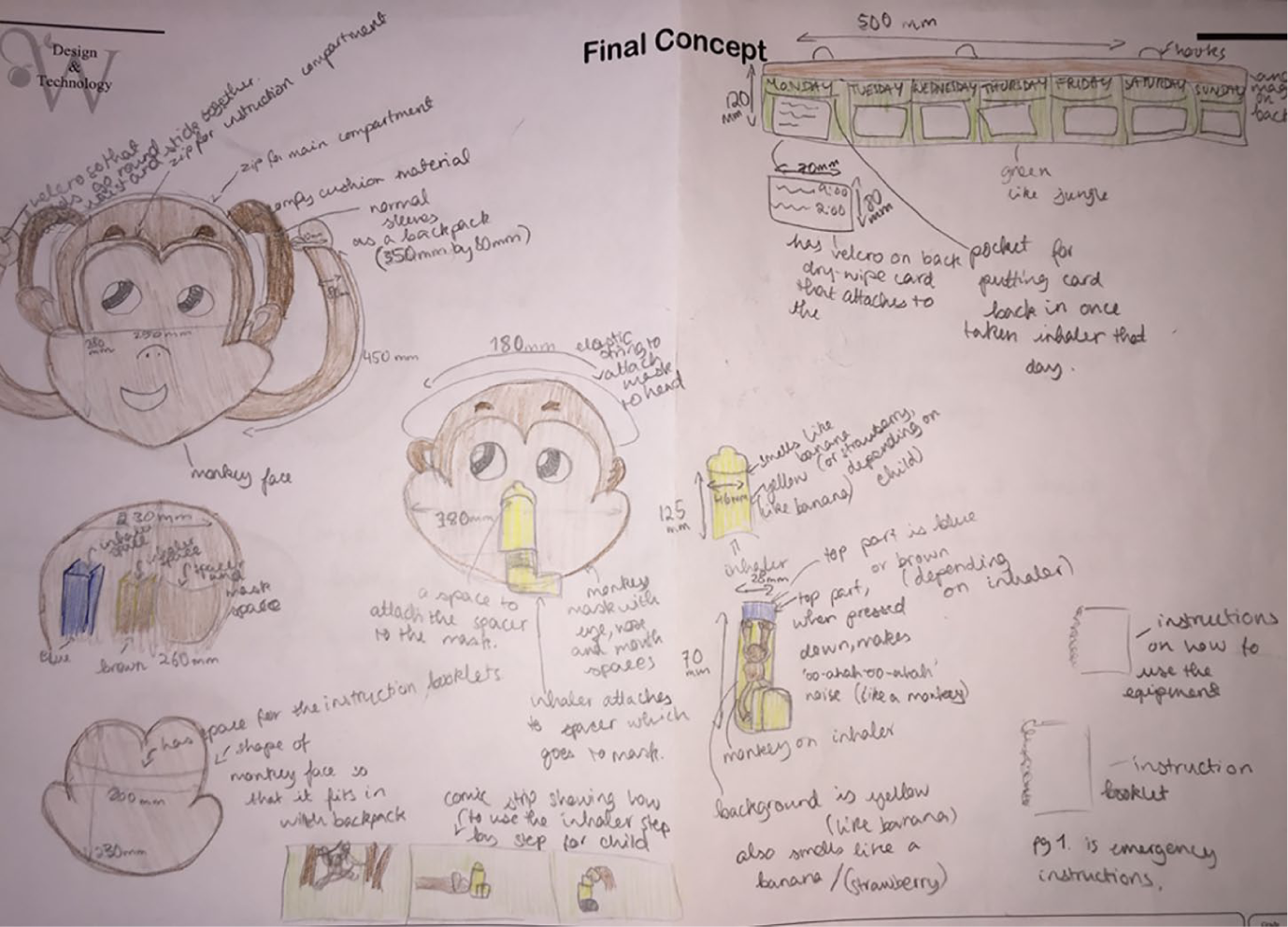
The portfolio of the winning design.
So I think the monkey is very appealing to the child, he feels comfort because it’s an animal he knows, it’s something he can hug, it’s soft, something he can use when he’s scared. And the inhaler is yellow and it’s designed to smell like a banana, or whatever the child prefers so that the smell doesn’t affect how he’s trying to breathe in the medicine, and it’s all disguised to look like monkeys or bananas on trees or something to do with the monkey theme so that it’s not something that looks terrifying to the child.
. . .animals seemed like an idea that could work with children, like most children are fine with animals, and also a monkey, it’s not a scary animal, it’s happy, it’s cheeky, it’s what children like and I had an animal toy when I was younger with the arms that you put together with the Velcro that I’d tie around my waist. . ..it’s really important that the child isn’t worried or anxious during an asthma attack because that can make it worse.
I was happy that I was going to benefit all the stakeholders and especially the child because their feelings and how they feel about the asthma it would depend on how this was designed.
You felt sympathy for the parents and the stakeholders who had to deal with asthma as a condition. . .I wanted to help the way they feel about it – their reactions. . ..
You see for yourself, unless you see something for yourself, you might not believe it. . .And so you want to erase those feelings of sacredness, worry. . ..because it’s so frustrating having to go through that everyday. So it showed me. . ..I understood how they were feeling and I just wanted to improve the way they were feeling.
Discussion
Empathy can be defined as the power of understanding and imaginatively entering into another person’s feelings. It thereby entails both a cognitive and emotional experience of how that person feels first-hand, whilst also taking the perspective of another’s situation. Bringing to bear these skills in the D&T classroom ensures that there is affective as well as effective learning; critical emotion as well as critical thinking; so that we are able to rein in our thoughts, become more critical of the other’s situation and don’t overimpute thoughts or make assumptions that are not relevant to their situation (Nickerson, 1999).
Our research questioned whether social and emotional aspects of empathy can be taught using a new empathy instruction kit, and whether any empathy taught through this procedure can be detected using an established measure of creativity as well as through pupils’ verbal feedback. Both the quantitative data as measured by the Torrance Test of Creative Thinking and the qualitative data as reflected in the words of the pupils reveal an impact of the DOT task on pupils’ emotional and cognitive empathic creativity. Such findings suggest that empathy with its emotional and cognitive components can be taught via such instruction that moves away from judgmental and egocentric thought, so that instead the designer is thinking the other’s thoughts and feeling the other’s feelings. Moreover, girls and boys are able to benefit differently in ways where ordinarily in the classroom, they were previously not able or encouraged. Typically, studies have shown that girls respond more vicariously than boys (Eisenberg & Lennon, 1983; Hoffman, 1977, Strayer, 1993; Zahn-Waxler et al., 1992). By adolescence, the trend continues with longitudinal studies showing that from 13 to 18 years of age, girls’ emotional concern remain stable, whereas that of boys decreases (Van der Graaff et al., 2013). When instructed using empathy-eliciting packs such as the DOT, it seems that boys are afforded the opportunity and remit to use affect, at the same time as enhancing girls’ perspective-taking empathy. The present research demonstrated this through gender differences that became apparent only at time 2 after the DOT intervention. Clearly, Torrance himself advocated the use of emotion and cognition as part of the creative process, hence the incorporation of such criteria as emotional expressiveness and expressiveness of titles; and also resistance to premature closure and unusual visualisation. Moreover, it seems that these criteria are measurable pre and post DOT intervention and there is evidence via the TTCT of an increase in the emotional and cognitive empathy gains needed to procure and promote creativity.
Both the quantitative and qualitative outcomes of this research showed the importance of social and emotional skills for creativity in the classroom, and specifically the impact of the DOT for teaching the emotional and social skills of empathy. The data showed that when considering a solution to the asthma problem in young children, pupils were able to relate more effectively to the problem through empathising with it and reach effective and constructive solutions. Of course, the very nature of the design task that related to the problem of asthma for young children and their families inevitably brings out an emotional side due to its emotional content. Indeed, the quantitative analyses showed a significant increase in both emotional and cognitive creativity for the intervention school which used the DOT, compared with the control school which did not, as measured by the Torrance Test of Creative Thinking. Qualitative findings through interviews also implicated the effectiveness of the DOT instruction for eliciting empathy. Pupils spoke of the importance of solving a task that had urgency, familiarity and empathy with their own urgency, familiarity and empathy. Such affective and cognitive engagement enhanced empathy, and pupils would talk animatedly about their designs and the reasons behind them. The findings reveal that in order to have an effective learning environment and outcomes, we need an affective agenda for teaching and learning where the task has meaning and purpose and the pupils are empowered to solve it and are given a social and emotional licence to do so.
Without emotion and cognition via empathy instruction, the present findings suggest a missing link in creativity. The emotion and cognition-related elements of the TTCT achieved greater scores for the intervention school, which employed the DOT procedure. The whole endeavour, and not just within the Design and Technology lesson, but across all learning, is about teaching and learning using a holistic approach so that we encourage emotionally intelligent learners (Baird et al., 2007; Woo et al., 2017). Moreover, research in neuroscience and genetics is showing that, what does exist of our empathy early on (Warrier et al., 2018), can be lost as we get older (Fraser et al., 2020). It is therefore important that we harness the empathic energy that we are born with and have a predisposition to. As Maria Montessori said in her book The Absorbent Mind (1949): ‘The essential thing is for the task to arouse such an interest that it engages the child’s whole personality’ (Montessori, 1949, p. 206). When given the opportunity to use and talk about emotions and see other people’s perspectives, the creative process becomes more complete. Learners should be encouraged to include the user-perspective at all key stages, from the early stages of the design process and continue during designing, making and testing. Teachers should provide pupils with opportunities to develop their own hands-on experiences with products so that they can understand and communicate their own wishes and needs whilst also becoming aware of the experiences of other people. Through selecting design projects closely related to the pupils’ own local contexts (Klapwijk & van Doorn, 2015; Nicholl et al., 2012; Visser et al., 2005; Voigt et al., 2019), such approaches propel an emotional and cognitive engagement for creative challenges. Moreover, this research reveals the importance of the use of emotional and cognitive empathy, as well as continual iterative ideation through resistance to premature closure for the advancement of creative ideas. Such findings reveal the importance of providing an emotionally intelligent, instructive climate through which learners can empathise with the task in hand. And when the task in hand carries with it relevance and significance to real life issues, together, these factors are a winning combination for fostering creative individuals and experiences.
Studies have shown that identification with the person, object or concept enhances empathy (e.g. Demetriou & Hay, 2004; EmpathyLab, 2018; Haag & Marsden, 2019; Voigt et al., 2019). An empathy instruction kit such as the DOT might begin with identifying with the situation by more cognitively taking the perspective of the asthma sufferer before becoming emotionally engaged; or vice versa, so that an initial emotional engagement informs perspective-taking and thereafter to a resolution to the problem. To feel is to understand; to understand is to feel: whichever way empathy works – nevertheless it works. Creativity is an emotional process in its own right, is enhanced by emotions and indeed uses emotions in order to result in original, insightful and useful ideas. When pupils are afforded this emotional license for their creative endeavours and are confident of their ability to relax control and whereby a fusion occurs between self and non-self, they are able to add it to the cognitive, learning processes thereby giving a more wholesome, panoptic experience. Such exploration and immersion through perceptual openness, role-taking and flexible ego-control characteristic of empathy correlate and lead to creativity and thence to constructive evaluative reflection: explore, create, evaluate. Empathy and open-mindedness in the real world: all these form the vital ingredients for the creative process to thrive and for encouraging the designers of tomorrow.
It was refreshing for the first author to be consulted by a government office about the importance of non-academic skills in the classroom – not least because the curriculum has become even more exam-based with less opportunity for creative coursework. What are students being taught and evaluated on in preparation for their futures and interactions nationally and worldwide? The danger is that the lack of imagination in government about the curriculum will lead to a lack of imagination and creativity in our learners. Whilst good exam grades do matter, in order for society to thrive, creative, communicative and empathic individuals also matter. And, as a postscript, we’d like to point out that at the time of writing, the pandemic that has swept the world has resulted in huge deficits in school-based learning with a loss of social, emotional and cognitive connectedness for pupils. It has been a time when we have had to reinvent ourselves in so many ways. Even more reason to educate and equip with empathy – the mother of invention, connection and expression.