



Abstract
Service organizations, particularly in the hospitality sector, are constantly under pressure to meet the ever-increasing and ever-changing expectations of the customers, in an innovative manner; making employee creativity a mainstream demand. Researchers and practitioners are pondering ways to frame employee creativity in the hospitality industry. This study aims to empirically investigate the role of positive affect in framing employee creativity in the hospitality industry. The broaden-and-build theory was employed to explain the framework under study, examining relations between affective, cognitive, psychological, and social factors that may shape employee creativity in the hospitality industry. Data was collected from 391 employees, working in hotels and restaurants in Pakistan, on a structured survey, by using a purposive sampling approach. The PLS-SEM approach was considered for data analysis. The findings show a positive relationship between positive affect and perspective-taking. The previously understudied relationship between perspective-taking and thriving at work was found significant. The relationship of perspective-taking with structural and relational social capital was also found significant. Supporting prior research, our results show that thriving at work and relational social capital lead to employee creativity. Interestingly, the relationship between structural social capital and employee creativity was insignificant. This study provides valuable insights for practitioners and hospitality managers to shape employee creativity by considering positive affect as a stimulator.
Plain Language Summary
The hospitality industry is under great pressure to remain innovative in order to meet the constantly changing expectations of customers. This makes employee creativity a mainstream demand in the hospitality industry. Hence, hospitality managers and researchers are looking for ways to enhance employee creativity. Accordingly, this study, based on the broaden-and-build theory, attempts to investigate the role of positive affect in stimulating employee creativity in the hospitality industry. 391 employees working in hotels and restaurants participated in this study through a survey questionnaire. The findings show that when employees feel happy, their thinking becomes flexible which allows them to learn, feel alive, connect more with people, and build trustworthy relationships. These are all desirable outcomes, especially in the hospitality industry. Results show that other than social connections, the remaining generated resources helped to achieve the much sought-after employee creativity. Thus, as a practical strategy, hotel industry managers may encourage such a working environment and measures that make employees feel happy in order to stimulate their creativity.
Introduction
Employee creativity is the generation of novel and useful ideas by employees (Amabile & Pratt, 2016; Jain & Jain, 2017). Employee creativity has gained considerable recognition as being a vital competency that can help firms to become responsive and adaptive toward change, efficiently exploit opportunities, grow, and achieve competitive advantage (Ouakouak & Ouedraogo, 2017; Stojcic et al., 2018). Creative employees are vital for service firms, particularly in the hospitality industry, due to the requirement of constantly being innovative in meeting and exceeding the ever-changing customer expectations (Peters & Kallmuenzer, 2018). This makes employee creativity a critical mainstream demand in the hospitality industry (Bavik & Kuo, 2022). However, as the hospitality industry started receiving attention in the creativity literature only two decades ago, research investigating employee creativity determinants is limited in this domain (Nasifoglu Elidemir et al., 2020). Organizations are looking for factors, and the interplay among these factors that may propel employee creativity (Inam et al., 2021; Ucar et al., 2021). Thus, understanding the framing of employee creativity is crucial. Accordingly, this study aims to investigate the interaction between affective, cognitive, psychological, and social factors that may shape employee creativity in the hospitality industry.
Creativity does not occur in isolation and its development comprises domain-relevant knowledge/skills, motivation, and the supporting environment (Amabile et al., 1996). Although employee creativity is a behavior that can be guided by cognitive and affective factors, careful literature reviews, including a meta-analytical study (Gong et al., 2018; Hughes et al., 2018; Jain & Jain, 2017) suggest that research has mostly focused on cognitive and motivational aspects factors, ignoring the rest of the creativity development process. This has led to ambiguity regarding the pathway through which employee creativity gets framed. The literature is scant on affective factors. Hence, researchers and practitioners, particularly in the hospitality industry, need to ponder on ways employee creativity can be framed in the hospitality industry (Nasifoglu Elidemir et al., 2020), by considering positive affect as a stimulator. In this study, positive affect refers to experiencing positive emotions by the employees in the hospitality sector; and employee creativity is operationalized as the creative performance of hospitality employees in terms of new and useful ideas regarding products, processes, and procedures. Accordingly, drawing upon the broaden-and-build theory of positive emotions (Fredrickson, 2004), this study aims to explain the trail through which positive affect transmits the impact on employee creativity in the hospitality industry.
Broaden-and-Build theory (B&B) (Fredrickson, 2004) advocates the occurrence of an upward spiral of subjective well-being, by an individual, upon experiencing positive emotions; which broadens their thinking tendencies, allowing them to build enduring personal resources (physical, social, intellectual, and psychological). As positive affect makes people feel safe, signaling a non-threatening environment, they bring cognitive flexibility in people by encouraging them to discover and accept new information. This results in building stable and useful personal skills and resources. Lastly, these resources lead to personal growth and good functioning. Accordingly, in this study, perspective-taking is the broadening process; thriving at work and social capital are the build-up of resources, which then, may, later translate into employee creativity. Figure 1 shows the theoretical model of hypothesized relations.

Research framework.
With much focus on experimental psychology, organizations-related research on perspective-taking has been infrequent (Curry et al., 2020). Perspective-taking is an active cognitive ability to become aware of others’ preferences, values, emotions, or needs (Ganegoda & Bordia, 2019). In this study, perspective-taking refers to the mental ability to be able to view and understand the preferences, values, intentions, and thoughts of others in the employees of the hospitality industry. Creativity requires being attentive and perspective-taking provides that cognitive flexibility of seeing from alternative viewpoints; enabling connecting unrelated ideas, to create different novel solutions to a problem, and may result in creativity (Hui et al., 2022). Accordingly, B&B theory (Fredrickson, 2004) suggests that positive emotions broaden the traditional ways of thinking, making one more open to understanding others’ points of view; thus, encouraging exploration and integration of information in new ways and leading toward creative outcomes (Fredrickson & Branigan, 2005). Accordingly, in this study, perspective-taking represents the broadening hypothesis of the B&B theory.
The building hypothesis of B&B theory focuses on the generation of personal resources facilitated by cognitive flexibility experienced due to positive affect. In a constantly evolving competitive service economy, thriving employees are a crucial psychological resource that enables desirable performance outcomes to gain a competitive advantage (Y. Liu et al., 2020; Zhai et al., 2020). Thriving at work represents the simultaneous presence of learning and vitality which are two constructs of the personal growth process (C. L. Porath et al., 2022). Vitality and learning not only determine performance and employees’ well-being (Pfeffer, 2010), but also help to achieve organizational competitiveness (Abid & Ahmed, 2016); and thriving at work represents the simultaneous presence of both (Kleine et al., 2019). In this study, thriving at work refers to the combined presence of vitality and learning of the employees in the hospitality industry. Organizations keenly seek thriving employees as they are desirably productive and aid in achieving competitive advantage, making them a crucial resource (Y. Liu et al., 2020, Zhai et al., 2020). Hence, it becomes critical to explore factors that can facilitate thriving at work. Accordingly, in this study thriving at work is considered a psychological resource that may be generated by the broadening process of perspective-taking.
Similarly, while examining employee creativity, it is important to consider the workplace social environment as empirical evidence suggests that creativity gets influenced by the interaction and communication processes between people (Hennessey, 2017). Consequently, the value embedded in such relationships is being considered as social capital, at multiple levels for example structural and relational (Muhammad & e Rana, 2020; Muhammad et al., 2017). Literature highlights the need to study social capital dimensions’ impact on employee creativity, rather than as a single construct (Bhatti et al., 2020; Jain & Jain, 2017; Oussi & Chtourou, 2020); particularly in the hospitality industry. Consideration of the individual effect of relational and structural social capital is still understudied (Muhammad et al., 2017).
Tsai and Ghoshal (1998) examined the association between social capital dimensions and identified that the structural dimension is manifested by social interaction, trust is manifested by the relational dimension, and the cognitive dimension is manifested by shared goals. They further added that among these manifestations, trust (relational) and social interaction (structural) were linked, more significantly, with innovation. This was also supported by other studies (C. H. Liu, 2013; Zhu et al., 2018). Accordingly, to consider the broader perspective of social capital, this study examines the individual effect of relational social capital and structural social capital on employee creativity. In this study, structural social capital refers to the networks ties, and relationships through which employees in the hospitality sector can access people and resources; while relational social capital refers to high-quality relationships or social bonds among employees in the hospitality sector. Additionally, consistent with the B&B theory, the literature suggests that happy people become more social, develop networks, and have higher-quality social relationships (Diener & Seligman, 2002; Satici et al., 2016). These relationships, in the shape of structural and relational social capital, (Nahapiet & Ghoshal, 1998), represent employee social resources. Accordingly, this study considered the dimensions of structural social capital and relational social capital as the social resources in the broaden-and-build framework.
This study is important for several reasons. First, this study provides new insights and contributions into the management literature by exploring the understudied relationship between perspective-taking and thriving at work and examining the individual effect of relational and structural social capital on employee creativity. This makes this study original. Second, this study contributes to the limited literature investigating employee creativity determinants in the hospitality industry (Nasifoglu Elidemir et al., 2020) by investigating the relationship between positive affect, perspective-taking, thriving at work, social capital, and employee creativity. In doing so, this study contributes to the limited affective studies in employee creativity literature (Gong et al., 2018; Hughes et al., 2018; Richardson et al., 2017); by presenting a unique framework, containing fairly innovative conceptualizations regarding employee creativity determinants, in the hospitality industry; by considering positive affect as a stimulator. Such a consideration will help hospitality managers to broaden the canvas of strategy formulation of employee creativity. Hence, this study provides useful insights for hospitality managers, operating in forever-changing working conditions, looking for factors that may boost employee creativity (Inam et al., 2021; Ucar et al., 2021). Lastly, being conducted in Pakistan, this study, based on the broaden-and-build theory, examines positive affect as a channel to frame employee creativity in an Eastern/Asian cultural context, which is a significant topic. Much of the existing literature on employee creativity is in the Western cultural context. Commonly, eastern cultures are synonymous with Asian countries; particularly those having collectivist cultures (Shao et al., 2019). Asian countries are considered to be creatively challenged (Morris & Leung, 2010). In various studies Easterners (e.g., Goncalo & Staw, 2006; Kim, 2005; Rudowicz & Ng, 2003), on creative tests or measures, westerners have scored higher in comparison. High power distance prevails in Asian countries, where worker control is strict, making them less creative in comparison to the West (Barkema et al., 2015). Empirical evidence suggests that at the country level, high power distance hinders creativity(Xie & Paik, 2019). Accordingly, eastern cultures managers might be unaware of how to stimulate employee creativity. Hence, this study considers the hospitality industry of an Asian country, Pakistan, to support hospitality industry practitioners for strategy formulation on stimulating employee creativity.
Next, the literature review and hypotheses development are discussed, then, the research design, results, discussion, implications, and conclusions are discussed. Finally, limitations and future research recommendations are made.
Literature Review and Hypotheses Development
Well-Being
Well-being is the reaction to the experiences that an individual either went through or would have liked to go through (Smith & Diekmann, 2017). Hence, experiences at work influence employee well-being which then in turn impact work behaviors (Sonnentag, 2015). Being a complex multifaceted phenomenon, well-being covers a range of psychological concepts categorized into two distinct perspectives, which the mainstream research (Feller et al., 2018; Park et al., 2023; Rahmani et al., 2018) defines as a hedonic view and a eudaimonic view. The hedonic view (also known as subjective well-being) focuses on happiness/pleasure/enjoyment/fun, and its central modules include positive affect, low negative affect, and high life satisfaction (Diener, 2000; Ryan & Deci, 2001). The eudaimonic view of well-being focuses on personal growth/self-actualization, human development, authenticity/autonomy, and finding meaning in life (Huta, 2016). Research indicates a deficiency of new theoretical and empirical designs that include both these perspectives of well-being (Smith & Diekmann, 2017). Accordingly, in this study, drawing upon B&B theory, we propose a unique framework containing the hedonic component of positive affect triggering the cognitive broadening process of perspective-taking which will build resources of eudaimonic nature, namely, thriving at work and social capital. These resources then will lead to employee creativity.
Positive Affect and Employee Creativity
Positive affect as an antecedent of employee creativity is well-established with literature suggesting that people tend to be more creative when experiencing positive emotions, producing new and useful ideas (Diener et al., 2020; García-Buades et al., 2020; Langley, 2018; Mohezar et al., 2021; Yuan, 2015). Further, B&B theory (Fredrickson, 2004) proposes that when an individual experiences positive emotions, for example, joy, it helps in the long-term optimal functioning development by pushing the limits to be creative; while being content leads to new ways of thinking. As thinking widens, it helps individuals to develop psychologically and gather more resources. For example, when enjoyment is experienced at work, individuals get motivated to push their limits, and enhanced creativity is experienced (Fredrickson & Cohn, 2008; Fredrickson et al., 2008). Empirical evidence supports the broaden-and-build theory positing that positive affect leads to creative performance (Binyamin & Brender-Ilan, 2018; Lin et al., 2016; Peñalver et al., 2019). In other words, people who experience positive affect can tap into creative behaviors. Thus,
H1: Positive affect has a positive influence on employee creativity.
Positive Affect and Perspective-Taking
Experimental findings (see Isen, 2000) have repetitively established that positive affect makes people open-minded, enabling them to think unusually and flexibly. The broadening hypothesis of B&B theory (Fredrickson, 2004) also advocates that feeling good makes people secure and safe, expanding their scope of attention and thinking. This theory argues that positive emotions broaden the thought-action repertoire of an individual, bringing flexibility to the thinking process (Fredrickson, 2001). Based on this, we build the following argument. When positive affect is experienced, the attention and cognition scope enlarges, leading to cognitive flexibility (Gip et al., 2022; Kühnel et al., 2022). This cognitive flexibility enables fast switching between multiple information, which promotes unusual perspectives (Y. Wang, Chen, & Yue, 2017; J. Wang, Zhang, & Jia, 2017). Perspective-taking, is a cognitive broadening process, enabling awareness of others’ preferences, values, or needs (Ganegoda & Bordia, 2019; H. Zhou et al., 2017). Increased perspective-taking is displayed by people feeling positive emotions (Nelson, 2009; Waugh & Fredrickson, 2006). A recent meta-analysis study (Acar et al., 2021) suggests that individuals experiencing positive affect are enabled to derive more connections between different variables, thus often recognizing problems and integrating multiple information. Thus, positive affect may enable perspective-taking by bringing flexibility to the thinking process of an individual which allows them to consider multiple alternatives of thoughts and actions. Thus:
H2: Positive affect has a positive influence on perspective-taking.
Perspective-Taking and Thriving at Work
In this regard, recent careful literature reviews and meta-analytical studies (Abid & Contreras, 2022; Goh et al., 2022; Kleine et al., 2019; D. Liu et al., 2021; Shahid et al., 2020), examining antecedents and consequences of thriving at work, suggest that perspective-taking association with thriving at work is an underexplored area. The linkage between perspective-taking and thriving at work can be justified with the help of B&B theory (Fredrickson, 2004). This theory states that broadened momentary thoughts can build resources. According to Fredrickson and Branigan (2005), flexibility in thinking styles makes individuals more receptive to multiple information; pushing them toward self-development by exploring new knowledge and intellect to shape learning. Hence, perspective-taking promotes learning. In addition, perspective-taking improves communication by reducing dissimilarity perceptions (Zappala, 2014), and stimulating feelings of aliveness and vitality (Carmeli & Spreitzer, 2009, Quinn, 2017) to shape vitality. Hence, perspective-taking promotes vitality. Learning and vitality, simultaneously, represent thriving at work (Kleine et al., 2019). Hence, based on the above argument, perspective-taking may lead to thriving at work. Thus:
H3: Perspective-taking has a positive influence on thriving at work.
Perspective-Taking and Structural Social Capital
Structual social capital is embedded in network ties or social connections between individuals (Nahapiet & Ghoshal, 1998), and thus is a personal social resource. The concept of perspective-taking developed in the 20th century as a necessary navigation tool for social interactions to understand diverse points of view (Calvard, 2010). Being critical to social functioning, perspective-taking plays a central role in generating social bonds by bringing psychological and cognitive closeness with others (Galinsky et al., 2005; Ku et al., 2015; Todd & Burgmer, 2013). This is because perspective-taking, being an effortful and broadening cognitive process, pursues diverse multiple perspectives by successfully reducing attribution error bias and stereotypes, enabling individuals to accurately imagine and adapt to others’ way of thinking to understand their needs, likings, beliefs, and principles feeling related to a particular situation (Hooper et al., 2015; Perry-Smith & Mannucci, 2017; H. Zhou et al., 2017). Studies investigating the perspective-taking impact on interpersonal interactions suggest that it improves interpersonal relations, promotes social bonds, and expedites social coordination by facilitating social understanding (Davis, 2018; Galinsky et al., 2008). All these studies indicate that perspective-taking facilitates building network ties and thus leads to structural social capital.
Further, according to B&B theory (Fredrickson, 2004), as positive emotions broaden cognitive style, making it more flexible, it may help them to be more open to socializing and build stronger connections socially (Ganegoda & Bordia, 2019). This theory argues that the expansion of thoughts and inventory actions can lead to the development of social resources as positive emotions encourage individuals to mingle or socialize with their environments (Fredrickson, 2001). Positive emotions widen the perceptual access of individuals, increasing their social connections (Fredrickson, 2013; Mauss et al., 2011). As perspective-taking enables understanding and approaching others, social resources are acquired, establishing social bonds (Gable & Reis, 2010; Yu et al., 2021). Thus:
H4: Perspective-taking has a positive influence on structural social capital.
Perspective-Taking and Relational Social Capital
Relational social capital represents a high quality of relationships characterized by trust (Nahapiet & Ghoshal, 1998). Perspective-taking tends to be a prerequisite for effective interpersonal relations (Jeon, 2020). This is because it develops trust (Lewicki & Brinsfield, 2017; Williams, 2007, 2012), and, thus, may lead to improved quality of social interactions. Perspective-taking is a social skill involving engaging with others’ viewpoints which helps in creating and maintaining high-quality social relationships (Segrin, 2019; Taylor & Edwards, 2021). Perspective-taking is an expected quality for rewarding and smooth interpersonal relationships as it enables one to anticipate others’ behaviors (Davis, 1983; Schutte et al., 2001). Perspective-taking also increases the similarity between individuals by enhancing the positive perceptions of each other and although people might belong to diverse social groups, they began to realize similarities; thus, reducing prejudices, stereotyping, and negative perceptions of others (Berndsen & McGarty, 2012). Perspective-taking leads to building positive relationships by increasing the perception of similarity which facilitates understanding with each other, fortifying social bonds, and producing compassion (Galinsky et al., 2008). As people imagine others’ points of view and try to understand the different perspectives, cognitive gaps resolve. Perspective-taking fosters mutual understanding, shared identity, building trust, and stronger social bonds. Thus,
H5: Perspective-taking has a positive relationship with relational social capital
Thriving at Work and Employee Creativity
Employee creativity is a well-established critical benefit of thriving at work (Zhang et al., 2022). Thriving at work represents the presence of both vitality (feeling alive and energized) and learning (acquiring and applying newly attained knowledge and capabilities) fostering performance outcomes (see Kleine et al., 2019). While learning helps to develop new skills and knowledge, making employees more confident and initiative takers; vitality promotes physical and mental energy; helping in the exploration of new processes at work and problem-solving that may lead to employee creativity (Yang et al., 2021). Once, individuals become thrilled about work activities and show interest are likely to exhibit creativity, by taking risks (T. Wang et al., 2022). Thus, based on these arguments it can be hypothesized that:
H6: Thriving at work has a positive influence on employee creativity.
Social Capital and Employee Creativity
Literature advocates that social capital fosters employee creativity (Bjørnskov & Méon, 2015; Han et al., 2014; Ivančič et al., 2014; C. H. Liu, 2013; Sözbilir, 2018). Yet, very few organizational studies have examined the link between social connections and employee creativity (McKay et al., 2017). There is an argument that since the social interaction process among people plays an important role in creativity, rich network ties may enable new ways to solve emerged problems and, thus, may contribute to creativity (C. H. Liu, 2013; Sözbilir, 2018). Social interaction allows the building of network ties which facilitates the exchange of knowledge and resources that may help to acquire new and creative ideas (Y. Y. Chen et al., 2011). Being surrounded by large network ties can enable an individual to access the external pool of knowledge, guidance, and social support; which in turn may facilitate the generation of new and useful ideas (Baer et al., 2015) for creativity. Thus:
H7: Structural social capital has a positive influence on employee creativity.
Further, being inherently impulsive and risky endeavors, employee creativity gets encouraged once there exists high trust in the relationships at work (Y. Chen et al., 2021; Chow, 2018). Strong social bonds and cooperation may lead to creativity (Ku et al., 2015). C. H. Liu (2013) argues that employees having high-quality relationships among colleagues can facilitate creativity. Strong relationships reduce uncertainty concerns and encourage risk-taking, exploring novel ideas and information sharing along with increasing an employee’s willingness to take creative risks without any apprehensions (Shen et al., 2018). The high-quality relationship facilitates knowledge sharing, decreases goal conflicts, and increases mutual expectations which allow individuals to focus more on creativity-related activities and outcomes. Further, trust shows the strength of interpersonal relationships. This strength in relationships may act as a social lubricant, connecting people and making them more willing to act innovatively; thus, facilitating employee creativity. Thus:
H8: Relational social capital has a positive influence on employee creativity.
Methodology
Research Design
Relationships amongst constructs were deduced employing a positivistic approach. For data collection, a survey strategy was used in a two-time lag approach.
Sample and Data Collection Procedure
Consistent with previous literature on the hospitality industry (Sarwar & Muhammad, 2020a, 2020b), data was collected from hotels and restaurants. Respondents participated in surveys during regular working hours. Prior participation consent from the HR manager was taken. To avoid the risk of common method bias (CMB) multiple techniques can be employed (Tehseen et al., 2017). On the suggestion of Podsakoff et al. (2012), data was collected from two sources (supervisors and their subordinates) to avoid the possibility of CMB. Additionally, data were collected in a two-time lag approach to eliminate the possibility of common method bias which may occur during cross-sectional data collection (Palmatier, 2016; Podsakoff et al., 2003). Accordingly, two separate questionnaires were designed, where, employee creativity was included in the supervisor survey; and positive affect, perspective taking, thriving at work, structural social capital, and relational social capital were part of the subordinate survey.
For sample size, a G*Power calculator was employed which has gained importance in recent literature (Muhammad & e Rana, 2020; Sarwar & Muhammad, 2020b). The minimum required sample size was 190. Research supports a sample size of 200 to be rational (Comrey & Lee, 2013). However, a sample size of more than 190 (n = 391) was collected, using a purposive sampling technique. This technique was employed because subordinate participants had two eligibility criteria to meet: Subordinate participants had two eligibility criteria to meet: first, that their work required creative tasks (e.g., supervisors, floor managers, chefs, and sous chefs, receptionists), and second, they had been under the supervision of their direct supervisor for a minimum of 6 months for their creativity to be gauged properly. Proper coding was done to later match the responses of employees and supervisors. Responses were kept confidential by the researchers by not sharing the collected data of supervisors and subordinates with each other. Data were collected in a two-time lag approach, with 4 weeks interval in between. At T1, 500 questionnaires were circulated amongst the supervisors to measure employee creativity and subordinates to measure structural social capital and relational social capital. From the 410 surveys returned, 404 qualified for further use. At T2, subordinates were handed out the survey to measure positive affect, perspective-taking, and thriving at work. At the end of T2, out of 404, 391 complete surveys were obtained and 13 were discarded due to incomplete information. Thus, the useable response rate was 78.2%.
Participants’ demographics are shown in Table 1. Of the 391 employees who participated in complete surveys, 85.9% were male and 14.1% were female. Recent studies report male domination in Pakistan’s hospitality industry (Sarwar & Muhammad, 2020a, 2020b). Moreover, 40.9% were 30 years of age and below and 48.1% had a bachelor’s degree. Furthermore, 47.8% had worked for 1 to 5 years under their immediate supervisor.
Demographic Characteristics.

Measures
For the operationalization of the constructs, well-established and validated measures were adopted from the existing literature. We measured employee creativity (supervisor rated) using 13 items adopted from (J. Zhou & George, 2001) and measured on a five-point scale ranging (from 1 = not at all characteristic, 5 = very characteristic). An item example is “The employee is a good source of creative ideas.” We adopted the 10 items positive affect scale by Watson et al. (1988), measured on a 5-point scale (1 = very slightly or not at all, 5 = extremely). An item example is “Indicate the extent you have felt this way over the past week excited.” 7 items of perspective-taking were adopted from Davis (1983) and measured on a five-point scale (1 = does not describe me well, 5 = describes me well). An item example is “I believe that there are two sides to every question and try to look at them both.” 10 items thriving at work measure was adopted by (C. Porath et al., 2012). All items were measured on a 5-point Likert scale (1= strongly disagree, 5 = strongly agree). An item example is “I have energy and spirit.” Social Capital dimensions of structural and relational were measured on a 5 items scale adopted by C. H. Liu (2013). First, relational social capital was measured using three items. An item example is “In this relationship, neither side takes advantage of the other colleagues even if the opportunity arises.” Second, structural social capital was measured using two items. An item example is “The colleague has ‘opened the doors’ of other colleagues for me.” All items were measured on a five-point Likert scale (1 = strongly disagree, 5 = strongly agree).
Method of Data Analysis
For data analysis, partial least structural equation modeling (PLS-SEM) was used. No missing values or outliers existed in the data. PLS-SEM assesses the model in two stages. In stage one, the measurement model was assessed to examine the reliability and validity of the scales. In stage two, the structural model was evaluated to test the hypotheses.
Results
Measurement Model
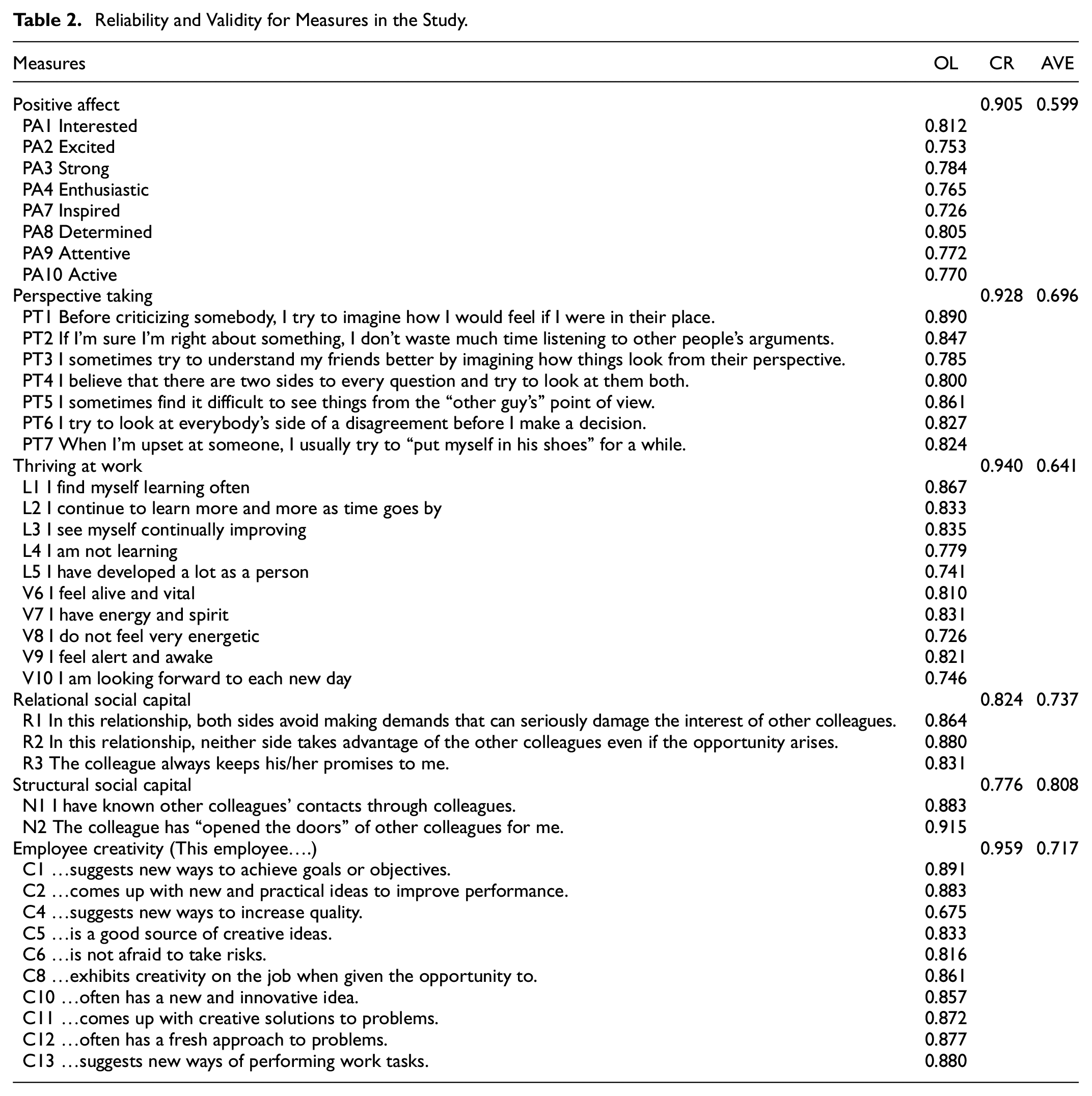
The measurement model assessed the scales for reliability and validity. Individual indicators’ reliability was assessed through outer loadings (OL). Outer loadings of a minimum of 0.7 are considered satisfactory (J. F. Hair, Risher, et al., 2019). All the items which were having loading < 0.65 were deleted. Thus, two positive affect (PA5, PA6) items and two employee creativity (C3, C7, C9) items were discarded. The measurement model was then reassessed and, as depicted in Table 2, all values of CR, CA, and OL were well above the required threshold values. To evaluate internal consistency, both composite reliability (CR) and Cronbach alpha (CA) were assessed. The required threshold for composite reliabilities should be a minimum of 0.70 (J. Hair, Page, & Brunsveld, 2019). In this study, all constructs reported above 0.80 composite reliability values. Construct validity comprises convergent validity and discriminant validity. The average variance extracted (AVE) was examined to evaluate the convergent validity (Muhammad & e Rana, 2020). As shown in Table 2, all constructs’ AVE was greater than 0.50.
Reliability and Validity for Measures in the Study.
For discriminant validity, the recent approach of heterotrait–monotrait ratio (HTMT) was employed. Table 3 shows that all constructs exhibited discriminant validity by scoring values below 0.90 in the criterion of heterotrait–monotrait ratio (HTMT) (Henseler et al., 2016). Hence, the discriminant validity was found satisfactory. Thus, the constructs values of reliability, validity, and discriminant validity appeared satisfactory. Next, the structural model was examined.
Discriminant Validity of Measurement Model- Heterotrait-monotrait Ratio (HTMT).
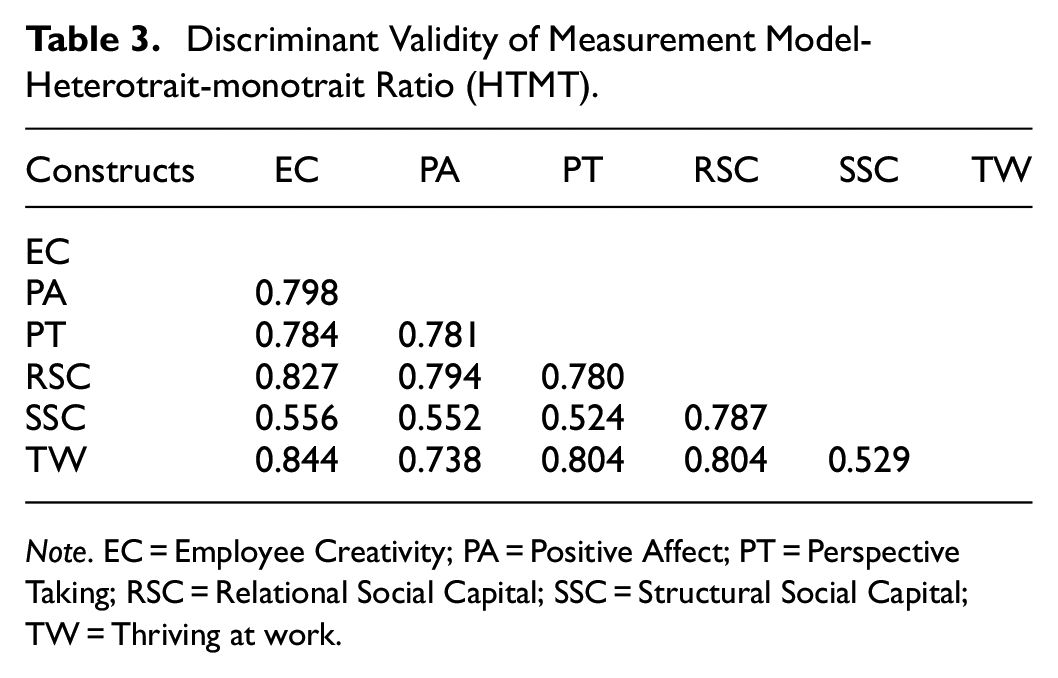
Note. EC = Employee Creativity; PA = Positive Affect; PT = Perspective Taking; RSC = Relational Social Capital; SSC = Structural Social Capital; TW = Thriving at work.
Structural Model
For the structural model, the general guidelines by Ringle et al. (2020) and J. F. Hair, Risher, et al. (2019) were followed. R2 (coefficient of determination), Q2 (predicted relevance), and t-values were assessed; while for hypotheses testing, the bootstrapping procedure was employed (Muhammad & e Rana, 2020; Sarwar & Muhammad, 2020a). Positive affect impact on employee creativity (H1) was supported (β = .288, p < .001). Positive affect impact on perspective taking (H2) was supported (β = .716, p < .001). Similarly, perspective-taking impact on thriving at work (H3) (β = .750, p < .001), on structural social capital (H4) (β = .443, p < .001), and relational social capital (H5) (β = .682, p < .001) were also supported. Thriving at work impact on employee creativity (H6) (β = .455, p < .001) and relational social capital impact on employee creativity (H8) (β = 0.206, p < .001) were supported. However, structural social capital impact on employee creativity (H7) (β = .012, p = .739) was not supported. Table 4 represents the outcomes.
Results of Structural Model Analysis (Hypotheses Testing).

Note. EC = Employee Creativity; PA = Positive Affect; PT = Perspective Taking; RSC = Relational Social Capital; SSC = Structural Social Capital; TW = Thriving at work.
p < .05. **p < .01. ***p < .001.
Cohen (1988) categorized R2 values of .02, .13, and .26 as being weak, moderate, and substantial, respectively. Accordingly, R2 values for employee creativity (.737), perspective taking (.513), thriving at work (.563), and relational social capital (.465) were substantial; and moderate for the structural social capital (.196). In PLS-SEM, the blindfolding procedure provides Q2 values which (if > 0) advocate good predictive relevance (Hair et al., 2014). The current study model (Figure 1) depicted sufficient predictive relevance as Q2 values ranged from 0.156 to 0.523. Figure 2 shows the confirmation of the proposed relationships.
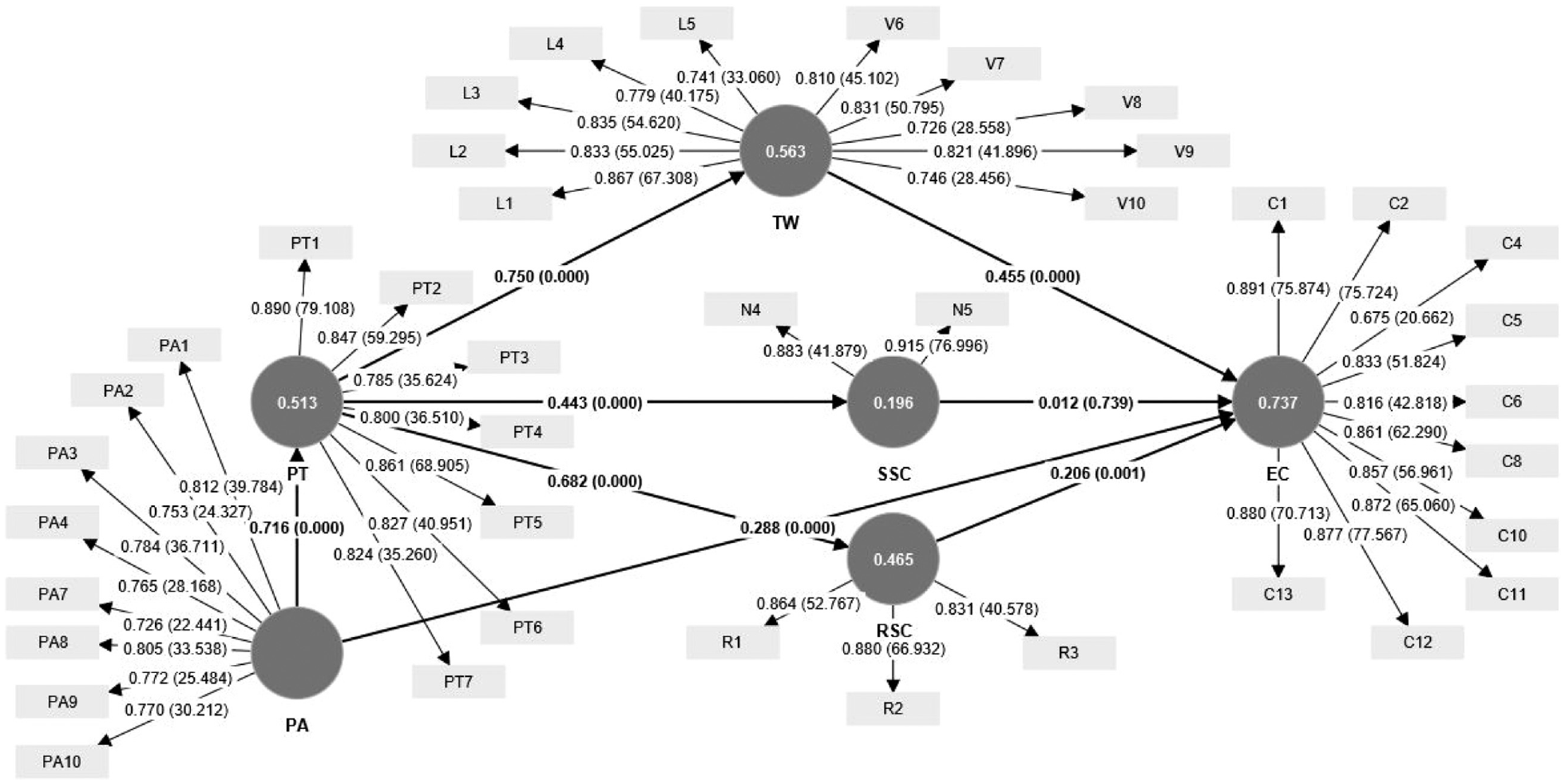
The structural model.
Discussion
Based on the broaden-and-build theory, the present study aimed to explain a unique pathway of positive affect expanding the perspective resulting in building personal resources of thriving at work and relational social capital, which was yet to be considered in the hospitality industry. In doing so, this study makes novel contributions to the management literature since some of the linkages were understudied and such an interplay among the constructs has not been empirically examined before. Thus, being an original, this study not only contributes to the literature but also facilitates students and researchers to further enhance the research in the area of employee creativity. Further, for the hospitality industry practitioners and managers, this study explains a new channel for stimulating employee creativity.
Results show that, consistent with previous literature (Diener et al., 2020; Ivcevic et al., 2021), and B&B theory (Fredrickson, 2004), a positive relationship of positive affect with employee creativity was supported (H1). Hence, creative behaviors emerge upon experiencing positive affect. Accordingly, this study adds to the literature advocating that positive emotions matter in real-life working environments, especially in the hospitality industry, where frequent and prolonged interactions between employees-employees and employees-customers are a daily feature. Further, in line with B&B theory (Fredrickson & Branigan, 2005), the impact of positive affect on perspective-taking (H2) was also supported. As employees experienced positive affect, their thinking became flexible, encouraging new ways of integrating information, resulting in better perceiving of others’ opinions, feelings, and needs. Hence, these might be the reasons that positive affect in hotel employees positively influences perspective-taking.
The relationship of perspective-taking with thriving at work (H3) was supported. Since, thriving at work is characterized jointly by learning and vitality (Kleine et al., 2019); thus, the results suggest that perspective-taking stimulates both vitality and learning, creating an overall accelerative drive, leading to thriving at work. This was an underexplored relationship in the literature. This finding can be justified by B&B theory (Fredrickson, 2004) which advocates the building up of personal resources when momentary thoughts are broadened. This theory states that individuals propel toward learning when cognitive flexibility is experienced (Fredrickson & Branigan, 2005). In addition, as perspective-taking reduces perceptions of dissimilarity, individuals experience vitality and a sense of being alive (Carmeli & Spreitzer, 2009). Accordingly, as thriving represents a joint presence of learning and vitality, hotel employees experienced it as their cognitive abilities broadened. The effect of perspective-taking on relational social capital (H4) and structural social capital (H5) was also supported. These findings align with the literature arguing that perspective-taking is a prerequisite for successful social bonds and cooperative behaviors (Davis, 2018; Galinsky et al., 2005; Hooper et al., 2015; Parker & Axtell, 2001; H. Zhou et al., 2017). Moreover, B&B theory (Fredrickson, 2001) also advocates that cognitive flexibility develops social resources.
Thriving at work relationship with employee creativity was supported (H6). This finding is consistent with scholars who have previously highlighted the generative nature of thriving playing a critical role in producing creative ideas (Yang et al., 2021). Relational social capital relationship with employee creativity was supported. This finding aligns with literature suggesting that in the Asian context, social ties are of great importance, and maintaining good relationships with colleagues matters the most, especially, for creativity (Huang & Liu, 2015). Contrary to the literature, the linkage between structural social capital and employee creativity was not supported. One reason might be high job insecurity in Asian countries where employees who fear their job loss are avoidant to actively participating in sharing their new ideas and are more inclined toward knowledge hiding (Sarwar et al., 2020). A recent systematic review (Abdullah et al., 2022) has also suggested that currently high unemployment rates have afflicted the Asian region. Particularly, the hospitality sector in Pakistan, like other South Asian countries, suffers from job insecurity as the majority of the employees are on contract-based employment (Mirza, 2020). In recent times, due to the pandemic, the hospitality industry in Pakistan has suffered immensely, negatively affecting revenues and increasing employability fears among employees (Javed, 2020). Hence, while employees become comfortable and socialize with others, yet to outperform others due to high competition and the threat of unemployment, they might not intentionally share novel ideas. Such findings have theoretical and practical implications.
Theoretical Contribution
Several theoretical contributions are offered by this study. First, the present study expands the literature that lacked studies involving affective factors’ impact on employee creativity, as highlighted by many recent researchers (Gong et al., 2018; Hughes et al., 2018; Richardson et al., 2017). Second, recent literature (Cai et al., 2020; Gupta & Bajaj, 2017; Hughes et al., 2018; Jain & Jain, 2017; Lee et al., 2020; van Knippenberg & Hirst, 2020) highlights ambiguity regarding the process and the interaction between different factors through which employee creativity gets influenced. This study provides a more broadened view of employee creativity by examining both affective and cognitive factors transferring impact on employee creativity. Third, the current study makes a novel contribution by exploring, based on the arguments of B&B theory, the pathway of transferring positive affect on employee creativity via perspective-taking, thriving at work, and relational social capital, which was yet to be considered in the hospitality industry. Fourth, by examining the social capital dimensions’ impact on employee creativity, this study adds to the scant literature available in this domain; particularly in the food service industry. Researchers have highlighted the lack of knowledge on understanding social capital dimensions’ impact on employee creativity (Bhatti et al., 2020; Oussi & Chtourou, 2020). Finally, this study considered the hospitality industry which remained ignored in creativity literature (Nasifoglu Elidemir et al., 2020).
Practical Implications
The current study offers several recommendations for practitioners to frame employee creativity. In the hospitality industry, employee happiness is crucial, especially for those who due to their work role are routinely involved in creative tasks. Thus, hotel industry managers may design such HR practices that enhance positive emotions amongst their employees to stimulate employee creativity. The hotel managers can design such work activities (e.g., involving fun, play, and humor) which provoke positive emotions, such as making employees interested, excited, enthusiastic, alert, inspired, more attentive, and active. Results show that perspective-taking was triggered in employees experiencing positive emotions which resulted in the building up of personal resources which enabled them to learn new things, feel energetic, build social bonds, and maintain high-quality relationships. All these are critically desirable outcomes for hotel employees who face intensified competition at the workplace and for such employees. Accordingly, hotel managers need to arrange such measures that induce positive affect, for example, the hotel management may create fun at work, counseling, psychological sessions, or training that may facilitate positive moods among the employees. Furthermore, while ensuring the recruitment of a diverse workforce, hotel managers may encourage brainstorming sessions and workforce training to promote perspective-taking which can facilitate vitality, learning, and building social connections; thus, leading to employee creativity.
Limitations and Future Research Recommendations
This study also acknowledges some limitations. First, this study took into account the factors of positive affect, perspective-taking, thriving at work, and the social capital dimension that facilitates employee creativity. Future research may consider other, underexplored, factors like fun at work, ebullient supervision, and nature connectedness impact on employee creativity. Secondly, since the scope of this study focused on investigating some understudied direct linkages, we recommend testing mediation in future studies to explore the underlying mechanisms. For example, the mediating role of perspective-taking between positive affect and thriving at work, the mediating role of thriving at work between perspective-taking and employee creativity, and social capital dimensions as a mediator between perspective-taking and employee creativity may be investigated. Thirdly, although, worldwide, persistent gender inequality prevails in the hospitality industry, it is overly dominated by males (Fairclough, 2018); yet both small and large firms in this sector seem to be reluctant to address the issue (Morgan & Pritchard, 2019). Future researchers may consider investigating why this gender disparity exists. Moreover, positive emotions and perspective-taking also have a dark side. It would be interesting to investigate if there are certain situations in which positive emotions lead to detrimental perspective-taking and how would that influence employee creativity. Lastly, as the present research was tested in Pakistan (Asian context), future research endeavors may be undertaken in a different context for comparison purposes. In sum, this study stimulates the literature on employee creativity. Further research may strengthen the literature in this area.
Conclusion
In the context of broaden-and-build theory, this study established a research model to explain the pathway which positive affect follows to broaden the cognitive processing of perspective taking that further results in the building of personal resources in the shape of thriving at work, relational social capital, and structural social capital. These resources then stimulated employee creativity. These findings suggest that when employees experience positive emotions, their perspective-taking ability activates, enabling them to understand alternative points of view and integrate multiple pieces of information in new ways. This results in them thriving at work by learning and developing as a person, feeling energetic, alive, and full of spirit. Thus, employees’ psychological and intellectual resources develop, enabling them to exhibit creative behaviors. Also, their ability to employ perspective-taking resulted in creating social links and trustworthy relationships, with later increasing creative behaviors. These results stress that, as a practical strategy, hotel industry practitioners may encourage positive working environments which make employees feel interested, active, alert, enthusiastic, attentive, inspired, and determined. When employees feel happy, they may be better able to perceive alternative perspectives and understand the needs, feelings, and opinions of others. It will develop their learning and knowledge-acquiring abilities, making them enthusiastic and energetic, thus increasing their creative behaviors. Also, happy employees may connect more socially and build high-quality relationships. Lastly, the study findings concluded that to increase creative behavior, good quality relationships (characterized by high trust) matter to increase creative behaviors. This study’s findings offer an in-depth understanding of positive affect as a channel to increase employee creativity through broadening the perspective-taking and building personal resources of thriving at work and relational social capital.
Footnotes
Acknowledgements
Not applicable.
Declaration of Conflicting Interests
The author(s) declared no potential conflicts of interest with respect to the research, authorship, and/or publication of this article.
Funding
The author(s) received no financial support for the research, authorship, and/or publication of this article.
Ethical Approval
Not applicable.

Data Availability Statement
Data sharing not applicable to this article as no datasets were generated or analyzed during the current study.