




Abstract
While public and academic discussions on pornography’s effects are often plagued by moralistic claims, research on the self-perceived preferences and effects of pornography has been growing in recent years. Yet, we still do not know enough about the role pornography plays in the lives of regular viewers, particularly LGBTQ+ individuals. In this study, we examine the perceptions and views of 87 regular pornography viewers who identified as non-heterosexual, non-cis-gendered, or both (these 87 were part of a larger sample of 302 regular pornography viewers). Our study joins a growing body of work that explores the views, experiences, and preferences of individuals who consume pornography. We found that pornography played a crucial role for LGBTQ+ individuals, helping them to form their gender and sexual identities, serving as a practical guide for the technical aspects of engaging in non-heterosexual sex, and normalizing non-heterosexual orientations, acts, and identities.
Introduction
Much of the academic research on pornography has focused on the potential effects (particularly the negative effects) of watching pornography, including addiction, misogyny, male aggression towards women, and a decreased likelihood of intervening as bystanders in harmful sexual situations (e.g., Foubert et al., 2011; Hald, 2011; Hald Malamuth and Yuen, 2010; Brownmiller 1975; Dines et al. 1998; Malamuth 1981; Shor 2019; Shor and Seida 2019, 2021). McCormack and Wignall (2017) have termed this line of research “the negative effects paradigm.” Other scholars, however, have taken a more nuanced approach, noting pornography’s potential benefits (Attwood et al., 2021; Duggan et al. 1993; McKee 2015; Williams 1989) and the importance of exploring viewers’ experiences with pornographic materials (McKee 2007; Shor 2022).
In the current study, we focus on viewers’ experiences, particularly those of sexual and gender minorities, seeking to move beyond the traditional “tired binary” (Juffer 1998), in which watching porn is seen as either good (empowering) or bad (reinforcing sexual violence). Instead, we follow literature that emphasizes the dynamic relationship between media and its consumers (Brown 2000; Slater 2007; Steele and Brown 1995; Taylor 2022), highlighting the reciprocal and bidirectional nature of media use and effects. This approach treats viewers as active consumers of media with diverse and constantly changing needs, interests, and histories (Steele and Brown 1995). It recognizes the dynamic and complex process of consuming pornography, shaped by both social contexts and personal histories, and pays greater attention to the dynamic interactions of spectatorial processes (Leap 2011; Ryberg 2015) It also recognizes that audiences may engage with porn in a range of complex, nuanced, critical, and contradictory ways (Mowlabocus and Wood 2015). Finally, advocates of this approach claim that pornography viewing has the potential to offer lessons about sex, bodies, and how bodies have sex, while also shaping our knowledge of gender and its performances (Scarcelli, 2015).
To examine the role of online pornography in shaping sexual identities, experiences, and norms, we conducted 302 in-depth interviews with regular pornography viewers (those watching at least once a month). In these interviews, we sought to understand how regular pornography viewers experience online pornography and how they perceive its effects on their sexual views and their sex lives. We asked interviewees to share with us how they assess the effects of pornography on their sexual education, sexual identity, and sexual experiences and views.
In this study, we focus on a sub-sample of these 302 interviews, namely 87 interviews with individuals who identified as non-heterosexual, non-cis-gendered, or both (henceforth LGBTQ+). Our analysis provides support for the idea that pornography, and in particular non-heterosexual pornography, can help LGBTQ+ individuals gain confidence in their sexual identities and normalize non-heterosexual practices, as well as teach them about the more technical aspects of non-heterosexual intercourse and relationships (e.g., Arrington-Sanders et al., 2015; Kubicek et al., 2010). More surprisingly, we found evidence that LGBTQ+ individuals, while recognizing the limitations of mainstream porn, nonetheless also found ways to use it in their sexual self-realization.
Literature review
LGBTQ+ individuals and pornography
Anti-pornography feminists have argued that pornography reproduces and eroticizes misogyny and violence against women and is therefore indefensible (Dines et al., 1998; MacKinnon and Dworkin 1988). More recently, scholars conducting qualitative and mixed-methods studies have offered a more nuanced view of viewers’ engagements with pornography, in particular as it relates to younger audiences. Studies rooted in ‘media practices models’, for example, underline the connections between adolescent identities and subsequent interactions with media (Escobar-Chaves et al., 2005). These studies found that pornography is a valuable source of sex education and knowledge acquisition for young people (Hare et al., 2014; Attwood et al., 2021; Miller et al., 2018), particularly, for LGBTQ+ young people who are traditionally under-served in mainstream educational spaces (Arrington-Sanders et al., 2015; Kubicek et al., 2010). Recent sociological research on pornography has further found pornography to be a source of leisure, entertainment and play for young people (McKee, 2014); a space where viewers can explore their fantasies and desires (Attwood et al., 2021). These studies demonstrate the heterogeneity and variability in viewers’ experiences with pornography.
Studies have found that for sexually diverse and queer young people, pornography offers a source of community, information, education, and fantasy that are often unavailable in homes or schools (Albury 2014). According to Epps et al. (2023), relationships and Sex Education (RSE) initiatives in schools are predominantly heterosexual, leading LGBTQ+ young people to report feeling excluded and different. This lack of visibility can lead to further disengagement in sex-education classrooms, contributing to poor sexual health literacy, greater risk of abusive relationships, and higher rates of sexually transmitted infections among LGBTQ+ persons. Hobaica and Kwon (2017) further question whether discussions of homosexuality in school sex education classes might only create a base from which homophobic abuse could occur, including name-calling and physical bullying.
Given these realities, LGBTQ+ individuals tend to turn primarily to online resources, a practice which might come with its pitfalls. For example, a study by Robinson et al. (2014) found that participants who only accessed online RSE information felt more isolated than participants who received a combination of online and face-to-face education, highlighting the importance of classroom-based RSE, which provides the opportunity for dialogue and exchange of experiences. Still, scholars have suggested that pornography may offer LGBTQ+ youth sexual scripts that provide an alternative to the heteronormative scripts routinely found in mainstream media (Bőthe et al., 2019; Hare et al., 2014; Mustanski et al., 2011; Nelson et al., 2014). It is therefore not surprising that LGBTQ+ youth are more likely to first consume pornography at an earlier age than heterosexual youth (Bőthe et al., 2019). Atwood (2002) argues that Queer pornography serves as a site of self-making and a source for collective identification and exploration. She therefore suggests that we need to understand queer pornography as a representation and practice on its own terms. According to Attwood, while queer pornography might be defined against the mainstream, it also plays a unique role in queer people’s everyday lives.
Notwithstanding its potential for self-discovery, education, and information, mainstream pornography remains primarily heterosexual, often fetishizing or ridiculing sexual minorities (Attwood 2002; Attwood and Smith, 2014a; Harvey 2020; Williams, 1989; Smith, 2018). Despite a growing supply of queer-produced pornography, the majority of mainstream pornography still portrays women as objects of desire, adhering to heteronormative discourses of sex roles (Ciclitira 2004; Marques 2014). Mainstream videos that do include representations of LGBTQ+ individuals and their sexuality often fetishize and exploit sexual minorities.
For example, many mainstream videos that feature two women (often tagged as “lesbian porn”) were for years clearly aimed at satisfying a male heterosexual gaze, rather than the needs and desires of lesbian viewers (Harvey 2020). Research has documented common inaccuracies and exaggerations in the depictions of how women have sex with one another and what they do during these interactions in mainstream “lesbian” pornography. Such inaccuracies, exaggerations, and stereotypical depictions include the common use of long nails and exaggerated moans, as well as excessive depictions of aggressive acts and genital-centric penetration by penis-simulating objects (Meehan 2021; San Filippo 2021; Seida and Shor 2021; Vincent 2016; Morrison and Tallack, 2005. Of note, no pornographic representations can truly encompass “reality” (Byron et al., 2021) and “being ‘misrepresented’ is actually a quality of being represented in the media at all” (McKee, 2005: p. 12). However, these exaggerated depictions suggest that “lesbian” pornography are mostly not addressing lesbian audiences.
While mainstream pornography’s representations of queer sexuality remain problematic, a burgeoning industry of professionals and studios has been working to produce more ethical and realistic queer pornographies outside the confines of the mainstream heterosexual, cisgendered industry. Over the last decade, the pornographic landscape has been quickly shifting and evolving to include a wider variety of non-androcentric pornography, also resulting in a growing body of research on sexual minorities and pornography (Seida and Shor 2021; Taormino et al., 2013). These efforts (e.g., Erika Lust, and the CrashPad Series) hold a commitment to performer safety and well-being, as well as empowering, educating, and fostering communication about lesbian sexualities (Packard and Schraibman, 1993). They also offer a wider representation of sexualities, ethnicities, ages, and body sizes. For some, lesbian porn can potentially help liberate all women from androcentric models of sexuality (Morrison and Tallack, 2005). However, others have noted that even in these alternative non-mainstream forms of pornography, representations of queer femmes and femme on femme practices (rather than butch/femme dyads) remain uncommon (Mondin 2017; Shoemaker 2007).
Another major downfall of these efforts to enhance non-mainstream queer pornography is that in most cases it is not readily accessible to viewers. According to Macleod (2018), this is in part a result of the industry’s prioritization of male audiences, though it may also be related to the larger market share of heterosexual audiences more generally.
Former research on pornography consumption among LGBTQ+ individuals
Most of the research informing our understanding of pornography consumption among sexual minorities has been conducted during the last 5 years. This research reveals a nuanced relationship and a wide variety of views and experiences. On the one hand, sexual minority viewers mostly recognize the problems, imprecisions, and misrepresentations in non-heterosexual pornography and are disturbed by these issues. On the other hand, many of them still identify some positive aspects in both mainstream and non-mainstream pornography and speak about the merits and value of pornographic content.
The more critical views of pornography were described, for example in research by Chadwick et al. (2018), who interviewed women with various sexual orientations. They found that for most queer women, the heterosexual nature of mainstream pornography made its content unappealing, particularly because they felt that queer identities were misrepresented, presumably to appeal to male viewers. Tillman and Wells (2022), who conducted interviews with 20 feminist pornography viewers, found that such sensitivity to poor representation was particularly common among women of color and members of the LGBTQ community.
Harvey (2020), who conducted focus groups with LGBTQ+ students (ages 18-25) in Northern England, also found that participants often lamented the heteronormative nature of mainstream pornography. Nevertheless, they still saw the utility of pornography in exploring and normalizing non-heterosexual encounters. Research by Sill (2022), also based on focus groups, similarly found that pornography served as a source of sexual education for sexual and gender minorities, particularly given the heterosexual focus of traditional sex education courses. The authors also found that participants learned by trial and error, given that pornography remains a source of unrealistic sexual expectations.
Below we describe how we expand on these recent research efforts and identify the unique contributions of the current study.
Methods
Sampling strategy and recruitment
We expand on the recent research efforts described above in several important ways. First, we conducted a large study including more than 300 interviews with regular porn viewers, a much larger sample than previous studies. This larger sample enabled us to include interviewees representing a significantly wider geographical distribution and cultural diversity (interviewees grew up in 55 different countries, including many developing nations) and compare the experiences and views of individuals with diverging sexual identities, including both cis-gender heterosexual individuals and gender and sexual minorities, which are the focus of the current study. Second, while many recent studies with pornography viewers have focused on either women or men (e.g., Ashton et al. 2019; Attwood et al. 2021; Daskalopoilou and Zanette, 2020; Tillman and Wells 2022), we were able to sample an equal number of men and women interviewees, as well as several non-binary individuals. Comparing women’s and men’s views is particularly important given common claims suggesting that these views vary significantly. Furthermore, we can observe differences within and between queer populations and their experiences with mainstream pornography.
We conducted in-depth, qualitative interviews using a non-probability sample of regular pornography viewers. To ascertain their eligibility, participants were screened using the following criteria: (1) being over 18, and (2) having watched pornography at least once a month in the last 6 months. While non-probability sampling limits generalizability, it provides rich descriptive data. This method is useful for research that explains complex events and processes, such as pornography consumption (Tansey 2009). Given the nuances individual viewers bring to the table, qualitative interviewing therefore allows us to glean important views and trends.
To reach our sample, we used a mix of voluntary and purposive sampling. Interviewees had to be 18 years or older and had to have watched pornography online at least once per month in the last year. We primarily used Craigslist, Kijiji, and Facebook groups, seeking to reach a diverse sample. On Facebook, we targeted various student groups and a page for recent French immigrants to Quebec. In addition, we advertised in various physical spaces in the city of Montreal, including coffee shops and universities. The majority (93%) of our sample reported encountering the study information online, mainly through Facebook groups. To bolster participation rates and in an attempt to reach more diverse audiences, we offered each interviewee 20 dollars as compensation for their time. We then used a theoretically based purposive sampling strategy to increase variability in our sample, so that we could explore the relationship between preferences and various salient demographic factors, including gender, age, nationality, and sexual orientation.
Descriptive statistics of study participants.
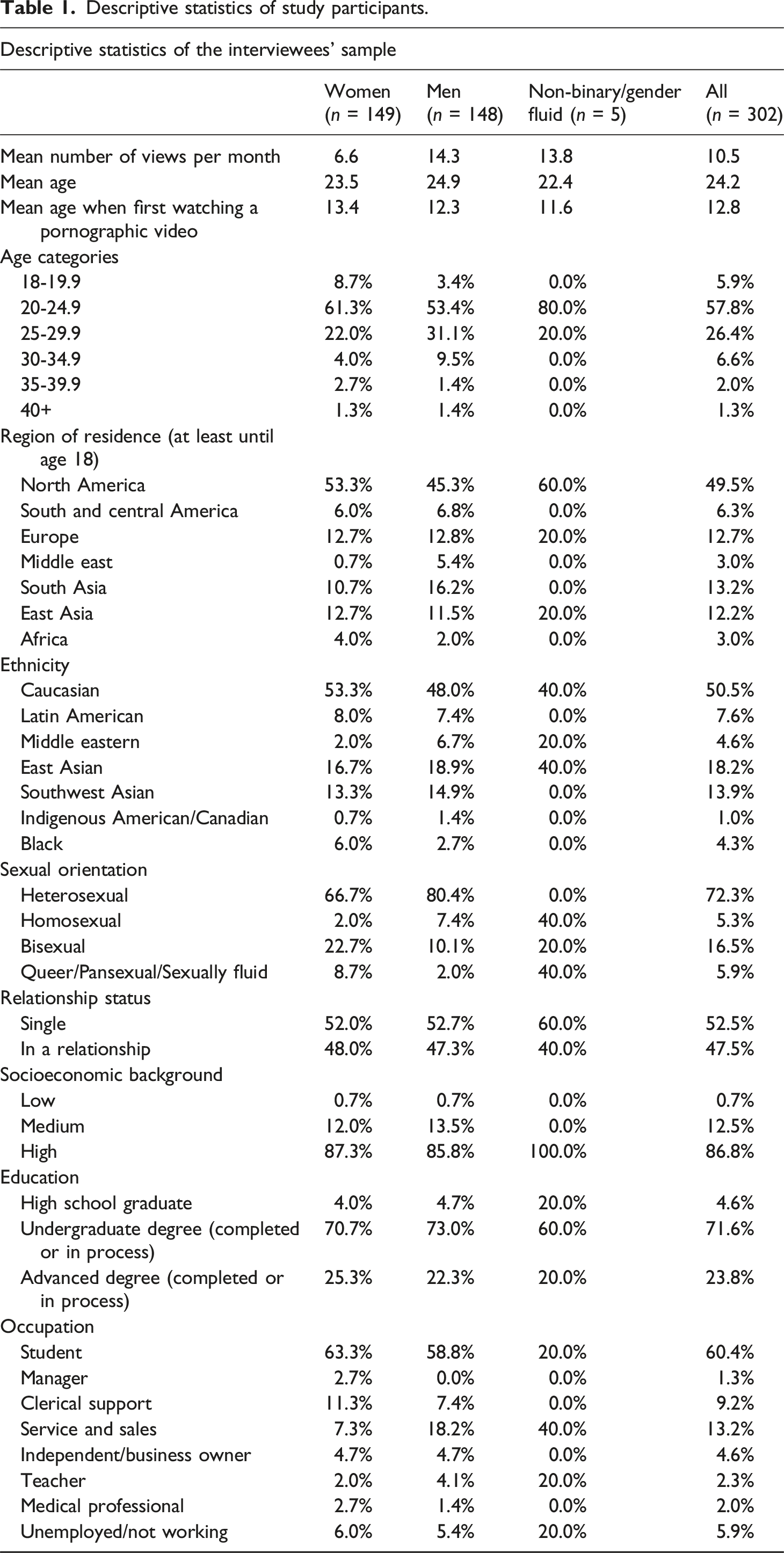
The interviewee list also includes a relatively high share of younger people. Nearly two-thirds of them were 25 or younger (the average age of the sample was just slightly over 24). Finally, students (about 60% of all interviewees), and individuals from relatively affluent socioeconomic backgrounds (86.8%) were also over-represented in the sample. Nevertheless, we were able to reach a diverse group of interviewees, and most importantly, as shown in Table 1, capture some of the most theoretically relevant features and characteristics that could influence viewers’ preferences. These include gender (an equal distribution of men and women, ethnicity (about half of the interviewees identified as visible minorities when using North American standards), sexual orientation (nearly 30% sexual minorities), and relationship status (the sample is almost evenly distributed between those who are in a steady relationship and those who are not).
Procedure, coding, and analysis
Following approval from a university research ethics board, all interviews were conducted in either French or English, two languages that are spoken by nearly one quarter of the world’s population and are official languages in nearly half of the world’s nations. The interviews were conducted by two well-trained graduate students in their twenties, a fact that helped in establishing rapport and a sense of comfort during interviews, as most interviewees were also in their twenties. One of the interviewers was a woman and the other a man, and both conducted interviews with both women and men. Of note, we could not observe any noticeable differences between interviews conducted by the two interviewers, suggesting that their gender did not significantly affect the interviewees’ responses or their comfort in sharing intimate preferences and experiences. During the study, both interviewers met repeatedly with the project leader, an experienced researcher in qualitative research and the study of pornography.
Social desirability and acquiescence bias are always a possibility when conducting survey research and interviews, especially when speaking about such sensitive issues, which often receive social censorship. In an attempt to reduce this bias, interviewers and interviewees were encouraged to avoid revealing their real names and any specific identifying details. Reducing bias is important when we are dealing with populations with marginalized sexualities, individuals from more conservative backgrounds and when speaking about generally taboo topics such as pornography.
All interviews were conducted via Skype audio (without video), to increase interviewees’ sense of confidentiality and encourage them to speak candidly about their preferences, experiences, and views. Indeed, most of the interviewees appeared to be open about their preferences and views, even when these did not seem to conform with social conventions, and they were willing to share them without noticeable reservations.
Interviews lasted between 30 and 120 min. We asked participants questions, while also allowing them to speak more broadly about experiences with sexuality (e.g., how did you learn about sex?) and preferences related to pornography (e.g., do you prefer amateur or professional pornography?). The interviews were recorded (with the consent of the interviewees) and subsequently transcribed, coded, and analyzed using an open coding strategy, which is useful in gaining a rich understanding of under-researched phenomena (Hsieh and Shannon, 2005). We therefore derived the codes directly from the text, identifying preliminary themes. Upon second examination, we revised the coding scheme by renaming, re-categorizing, and combining certain themes. We then used this coding scheme to carefully code each of the 302 interviews, revising the coding scheme as we continued in the research process.
Results
The experiences of sexual and gender minorities
We focus in this study on a subsample of our interviewees, those who do not identify as cisgender and/or heterosexual, although we also report some findings from cisgender heterosexual participants for context. Our sample included 87 non-heterosexual participants and five of them also identified as gender non-binary/gender fluid. These participants constitute more than one quarter of all interviewees in our study. Non-heterosexual interviewees tended to rely heavily on pornography as a space for both education and exploration. Most of them therefore positively viewed pornography and spoke about some of its merits. More specifically, we found three primary overlapping themes related to how LGBTQ+ viewers engage with and make sense of mainstream pornography: (1) the use of pornography in helping individuals discover their sexuality and gender; (2) pornography as a practical guide to queer sex; and (3) pornography as a way to see oneself onscreen and normalize queer identities, desires, and practices.
Forming sexual and gender identities
Pornography helped non-cis gendered and non-heterosexual respondents explore and formulate their gender and sexual identities in safe and private ways. For example, Lena (21), a bisexual student from Canada, told us: “I wasn’t sure I was bi until I really started watching more lesbian porn or bisexual porn. It’s been [a] big aspect of solidifying my sexuality, especially when I was younger.” Like Lena, the majority of our gender and/or sexual minority interviewees felt that given the heterosexual nature of most mainstream films, television shows, and sexual education programs, pornography provided them with the ability to explore and better understand their sexual and gender identities. Daniel (22), a bisexual student from Canada, credited pornographic videos with allowing him to discover his sexual desires: The demographic that I’m even having sex with, if I had never seen any trans porn, I wouldn’t know I was into this demographic of people. Having sex with those kinds of people is directly caused by seeing that I’m interested in them through porn.
Beatrice (26), a pansexual Canadian student explained that “It was thanks to porn that I realized I wasn’t hetero. That’s all I remember”. Erin (28), a queer unemployed woman from the United States, also felt that pornography helped them discover their queerness and more broadly the human body: “Watching queer porn helped me figure out that I was queer. I think that it has educated [me and] … helped me explore [the] human body more.” Similarly, Elijah (22), a gay Asian-Canadian student, told us: “As I was watching more and more gay porn, it was kind of starting to solidify my sexual orientation and helped me come to terms with it.”
While most LGBTQ+ interviewees had an overall positive experience with pornography and found it helpful in exploring and forming their gender and sexual identities, some had more conflicted feelings about it. Danica (20), a sexually fluid Canadian student told us that she needed to reach greater emotional maturity and sexual openness before she could use pornography to explore her sexuality more productively: I mean, when I first started, I watched it when I was younger, like 14, and I still had weird guilty feelings about sexuality that weren’t resolved. So, I stopped watching for a while, and then started watching again when was like 18. And then I became more comfortable with sexuality and exploring my sexuality.
For some interviewees, the conflicted emotions were largely tied to conservative upbringings in countries (e.g., Kenya, Pakistan, or Saudi Arabia) or environments (e.g., rural religious communities) that limit and restrict not only gender and sexual diversity but also sexual openness more generally. Ellen (24), a lesbian Korean who works in biotech, shared complicated feelings about pornography, which were largely affected by her conservative upbringing in a gender unequal and sexually restrictive country, while she was trying to grapple with her sexuality: The first time I watched it, I didn’t watch it. In Korea, it’s very restricted. So, for me, it was very forbidden, which is why I was so curious. So, first time I didn’t watch the video; it was accidental, and I went to images and saw a woman wearing revealing clothes. At the time, I didn’t know my sexual orientation either… For me, it’s interesting. When I first saw a picture of a woman, that’s when I started doubting my sexual orientation. I was asking why I was attracted to naked women. In [the] beginning, I just saw hetero couples, and realized I was just looking at [the] woman. Then I got curious and tried other types, like gay and lesbian porn. I was exploring it, [and] it confirmed it for me. It helped me discover my orientation.
Much like Danica, Ellen was at first somewhat deterred by pornography and found it hard to watch. Yet, she also found pornographic images fascinating and curious, driving her to start to question her sexuality and want to explore further. Similarly, Ender (22), a non-binary Turkish student raised in Saudi Arabia, told us that pornographic videos first led them to confusion and feelings of doubt: Porn is blunt and I grew up in a conservative country, so my sex ed was anatomy and that’s it. I had way more LGBTQ+ friendly education through porn. […] When I was younger, it [porn] made it [gender and sexual confusion] worse. I hadn’t accepted my identity [and] I struggled with that. I watched hetero porn, so I struggled with that a lot. I hadn’t masturbated myself because of my confusion. It’s just been recently that I’ve been able to masturbate. Porn helps me and teaches me a lot.
Both Ellen and Ender experienced porn as an iterative process of coming to terms with their gender and sexual orientations and identities. While it first produced feelings of guilt, shame, and confusion, it later on helped them come to terms with their orientations and identities and they continue to explore these orientations and identities through pornography. Similarly, Andrea (25), a bisexual IT professional from Venezuela said: “I guess it made me think about what I’d like in these situations, also made me pretty aware of where I fall on [the] spectrum of sexuality.”
Interestingly, several interviewees who identified as heterosexual also felt that pornography was key in solidifying their sexual identity. George (26), an Asian American student told us that watching heterosexual and lesbian porn made him certain of his heterosexuality: “Porn can help you realize what you’re into, sexually, like homo vs hetero. I’m totally hetero, but also watch lesbian porn. It helps you discover what you like.”
Pornography as a practical guide to queer sex
Young cis and heterosexual adolescents are exposed to an abundance of representations of heterosexual love, intimacy, and sex through various traditional media, including books, newspapers, poems, billboards, movies, and television shows. These media provide them with multiple means for learning about some of the technicalities of sex (though many scholars have criticized the veracity and authenticity of such representations). In addition, sex education classes in schools, sex education books and videos, and conversations with peers also provide some guidance on the technical aspects of heterosexual intercourse (Litsou et al., 2021), although these are also often lacking in scope and authenticity and tend to focus on potential harms and how to avoid them (Goldstein 2020).
Flawed as these representations of heterosexual sex may be, they are still significantly more available than representations of non-heterosexual sexuality, given the heteronormative tilt of most traditional media and sexual education programs. The mechanical and technical aspects of heterosexual sex cannot be applied to queer sex and sex education initiatives, even progressive and well-meaning ones that are more tolerant of sexual diversity, never really provide practical guidance for sexual minorities. Thus, nearly all of our gay, lesbian, bisexual, and gender fluid interviewees reported that porn had been their primary source of sexual education and information. Close to 90% of our non-heterosexual respondents said that they had learned directly from pornography, although only 57% of them said that pornography had benefited their sexual lives.
For example, Silas (23), a gay student from Kenya, told us that porn was how he learned about the mechanics of gay sex: “I think it [pornographic videos] is how I learned [about] gay sex and everything. It’s where I learned about everything I know.” Julian (20), a queer Canadian trans man who works at a call center, believed that porn has helped them understand trans sex: “Since I’m trans, it’s [trans porn videos] more informative [than cis pornography].” Jace (25), a pansexual agender interviewee said: I learned a lot from porn, like giving oral, rim jobs (didn’t know what it was before porn), [and] hand jobs. Porn is good education for acts. Sex ed wasn’t good when I was there [in school]. You don’t learn about acts, so porn is good. Well, it’s allowed [me] to explore things in bedroom. It’s been good in [a] way that I have [a] variety of things I can try, and that I’ve tried. I do think that for some people it can allow them to explore themselves before meeting other people. It’s allowed me to see what else I can do.
Alejandro (24), a bisexual Mexican student also felt that pornography helped him learn basic non-heterosexual practices: “I would say it has, especially in gay porn. Nobody teaches that in real life”. Some of our female lesbian and bisexual interviewees also shared this sentiment. Aisha (18), a bisexual Pakistani student, told us that “porn [in general] really helped me and taught me what to do because I had no idea. But lesbian porn showed me the little things.” Kaylie (21), a queer student from the United States, similarly told us: “I guess it’s [lesbian porn] helpful for navigating a lot of queer sex. You can find out more, get inspiration, [and it] helps with creativity.” Aisha (18), a bisexual Pakistani student told us that porn helped navigate non-heterosexual sex: I had never had sex with a woman, so me watching lesbian porn sort of showed me that. So especially lesbian porn helped me for sure and seeing by example…Same thing for gay porn. A young gay man would watch gay porn to know what to expect and see how it works for gay people.
Despite these largely positive educational experiences, some interviewees, particularly women, found most mainstream non-heterosexual pornography unhelpful. Several queer and lesbian female respondents expressed disappointment with most mainstream “lesbian” porn available online. When asked whether pornography had been beneficial in their sexual lives, only 50% of lesbian respondents said that they found it beneficial, compared with 76% of our heterosexual respondents. Ellen, (24), a lesbian Korean woman told us that “it [lesbian porn] didn’t do anything; it was just not for me. I tried some techniques, but it wasn’t realistic; didn’t work. it’s unrealistic for lesbians; it’s just for show”. Jessica (22), a lesbian student from Canada, echoed this sentiment: “I realized lesbian porn wasn’t for me… When I first was coming out, I was told it [lesbian porn] wasn’t actually for lesbians. Lesbian porn seems to just be selling to guys.”
Both Ellen and Jessica’s experiences with “lesbian” porn showcase a broader problem within the Sapphic sphere of the pornographic industry. Mainstream videos showing sexual interactions between two women, which are often labelled “lesbian,” are often produced by heterosexual producers, catering to the male gaze rather than for lesbian and bisexual women. They therefore reflect heterosexual male fantasies about female sexuality and performativity and offer little utility for sexual minorities in terms of the real-world acts habitually practiced by these sexual minorities (Corsianos 2007).
Gaining visibility and normalizing non-heterosexual practices
Pornography includes a variety of sexual experiences and interactions, which has the potential to give legitimacy and visibility to various desires, orientations, and identities through the experience of watching. The ability to see oneself in pornography and more broadly, normalizing non-heterosexual non-cis-gendered experiences, was brought up by both non-heterosexual and heterosexual respondents in our study. Julian (20), a queer transsexual Canadian who works in a call center, explained his experience of watching gay pornography: “I sleep with men mostly, so it makes it arousing and easy to watch. I can see myself.” The role of porn in normalizing queer sex was also mentioned by Cindy (26), a bisexual Chinese student: [When watching non-heterosexual pornography] I found out that way more variations were possible, and I felt better about myself. I used to just watch like hetero porn. But then [I] discovered way more options are available. I discovered trans porn, anime, etc.… it helped me know what I like and what limits I have. I became more tolerant probably and [realized] that there is more than one type of sexuality.
Steve (20), a bisexual student agreed with this sentiment: “So, it [non-heterosexual pornography] shows how varied people are with porn. It has made me more open to what people like/desire.” Shawn (34), a bisexual graduate student raised in Canada, similarly said: “You see more creative ways to experience pleasure. Most hetero porn follows a formula. Non-hetero porn is much more unstructured.” Anne (22), a bisexual Korean student, explained her experiences with the variety of pornography and how even just being exposed to the variety can subsequently normalize diverse sexual needs: I saw [a] wide range of things [in pornography], like from tons of categories [such as] gay [and] bondage. [At first,] I thought it was weird. It looked like [a] show. I didn’t think anyone actually did that stuff. And most of it wasn’t exciting. It was more seeing the interactions that was interesting. [It’s] eye-opening to see all the interests, things, positions. It’s learning; it’s not a bad teacher. It’s hard; no one tells you. You can find anything you’re into. Any video up there has been viewed by a lot of people. anything goes. It normalizes a lot of behaviours.
Even some heterosexual respondents appreciated pornography exposing them to a variety of ways to be sexual and normalizing different kinds of sexuality. Ivan (22), a heterosexual Russian student told us that “they [non-heterosexual pornographic videos] helped me and showed me things I wouldn’t have thought of or known.”
Conclusion and discussion
We found ample support for recent research claims regarding the distinct utility of mainstream pornography for non-cis and/or non-heterosexual persons, joining other recent studies which revealed similar themes (Goldstein 2020; Harvey 2020; Sill 2022). Specifically, our queer respondents found pornography helpful in three interrelated ways: it helped them gain confidence and knowledge in their sexual and gender identities, it provided practical information on the technical aspects of queer sex, and it helped normalize and legitimize queer sexualities.
Recent efforts in the United States and in other countries to limit access to sexual education, particularly regarding sexual diversity, suggest that individuals, particularly those who are not cisgender or heterosexual, may increasingly turn to pornography as a primary source of sexual education and representation. Pornography provides a space for discovery, sexual experimentation and empowerment, entertainment, and learning.
Our findings confirm that pornography consumption, despite frequent misrepresentations and distortions, indeed plays a crucial role in fulfilling these functions, particularly for sexual minorities. Our findings regarding the role of pornographic literacy echo a recent call by scholars to move beyond literacy as a top-down process (Harvey 2020), acknowledging that viewers can be literate in the fundamentals of pornography (consent, safety, realism), while remaining able to learn, explore, and mimic what they see on screen. Specifically, for many non-heterosexual and non-gender conforming individuals, mainstream pornography, even if it is unrealistic, sterile, or misleading, is often one of the only easily and widely accessible resources for sexual identity formation, sexual education, sexual gratification, and the normalization of non-heterosexual practices.
Most of our participants noted a propensity to learn positions and oral sex techniques and to replicate fantasies(or safely explore said fantasy), while reporting that they could still differentiate porn and real sex. As Tillman and Wells (2022) note, viewers can take inspiration from pornography, even while recognizing it as a realm of fantasy that often produces conflicting feelings, discomfort, and moral ambiguity. We found that learning from pornography was especially impactful for participants who identified as gender and/or sexual minorities, given the scarcity of other educational resources about non-heterosexual relationships and sexuality in both mainstream media and formal educational programs in schools. In particular, sexual-minority interviewees mentioned the ability to learn about the technical aspects of non-heterosexual sex, which are completely absent from any other form of media, as well as even the most liberal and well-meaning education initiatives and guidebooks.
These findings are in line with previous work by Arrington-Sanders et al. (2015), who found that gay men find pornography to be a useful tool for self-exploration. We also found support for the duality reported in former studies of sexual minority pornography viewers (Harvey 2020; Sill, 2022), who expressed some unease with mainstream pornography, while at the same time finding some utility in it as a source of sexual education for sexual and gender minorities. Our findings echo these former research efforts, showing that pornography can serve a beneficial educational role not only for gay men but also for queer (lesbian, bi-sexual, sexually fluid) women. Despite many of the queer women in our study noting that mainstream “lesbian” pornography was unrealistic and clearly marketed towards heterosexual men rather than members of the sapphic community, many of them were still able to find merit in this type of pornography.
Our study included only a small number of transgender interviewees (4). Still, it provides preliminary evidence that trans pornography may be somewhat beneficial for this group, particularly for learning about the logistics of trans sex and for normalizing trans sexuality. Further research that specifically targets gender non-binary and transgender individuals would be important in further elucidating their experiences with pornography and their views regarding its utility, as well as its problematic aspects.
More generally, the nuances we uncover in this study among sexual and gender minorities are important given the common propensity to treat all gender and sexual minorities as monolithic entities and ignore essential differences among them. While the overall queer community cannot be generalized in these matters, we can draw some conclusions about each particular sexual minority. The comparison of gay, lesbian, bisexual, and sexually fluid individuals allows us to detect both similarities and important differences in their experiences with pornography and in their views on how accurately it represents their sexuality. Epps et al. (2023) have recently noted the need to thoughtfully incorporate information and resources to same-sex individuals and to diverse sexual relationships, in order to avoid further ostracizing and fetishizing those whose practices fall outside heterosexual norms.
Queer porn can challenge normative pornography especially in areas such as consent and authentic sexual experiences. Whether this resonates more with queer viewers is an avenue of future study as it whether it has a discernable learning effect on queer audiences. The diverse representations within Queer porn may be an avenue of future research analyzing the links between the showcasing of or the lack of diverse body types, sexual identities and sexual acts within queer porn and viewers own understandings of porn.
“Queer, feminist and lesbian pornography, as increasingly more accessible public fantasies, may also form part of the material taken up in the ongoing, interactive processes of sexual structuring. Watching and participating in queer, feminist and lesbian porn film culture may become part of shaping and reshaping embodied subjectivities – if not yet in a predetermined or consciously controlled way.” (Ryberg 2015) Though we were able to capture the role that pornography had on our queer viewers, a more in depth look at how viewers express how their viewership impacted their identity, and their own sexual practices may be interesting. We showed through our empirical data that queer viewers come to learn and perhaps adopt practices seen in porn and may in fact also adopt the subjectivities of a queer individual through this process of learning. This is especially the case for porn viewers whose first experiences with queer sex came from pornography, helping engage in sexual situations without having had firsthand experiences. The extent to which these experiences are generalizable is yet unknown, but it stands that many individuals, especially in more repressive or less open societies first encounters with their desired sexual practices are experienced through porn viewing. In the future, researchers would do well to conduct a multi-country survey of porn viewership with a focus on the LBGTQ + community to determine what affect contextual factors (both location and current politics) as well as biographical (ethnicity, religious background) has on one’s first experiences with queer sexuality. Qualitative work should continue to explore the complex and multifaceted relationship between porn viewership and one’s sexuality, both of which are complex and ever changing. Importantly, given the personal nature of individuals sexualities, especially those with a queer identity, it is important to acknowledge how these are in continual flux, and the “learning” process is complex and continuously changing, shaped and re-shaped by several factors, one of which is, and we would argue, an important one, is porn viewership. Given the medians increasing popularity and ubiquitousness, we expect more individuals to come to “see themselves” and learn from pornography in the next few decades.
Another important component is queer sexualities increasing presence on more pornographic and non-pornographic medians, social media, movies, etc.; How these medians effect learning is another important avenue of research, as is the balance between messages received through these different medians, and how queer viewers come to balance them and how these come to form into their own subjectivities. Furthermore, the increasing presence of these realities on the screen may help challenge the heteronormative discourses that queer individuals have to balance and draw reference from for their own understandings of their own sexualities.
Our study has several notable strengths. We were able to interview a substantial number of men and women from a variety of countries and include a diverse set of sexual orientations and conduct an in-depth investigation into viewers’ emotions and ambiguities related to the pornographic content they consume. However, it is also important not to overgeneralize the findings of this study, given that viewers from higher socioeconomic backgrounds and affluent countries were overrepresented. Future studies may try to further diversity samples and target pornography viewers from more diverse socio-demographic backgrounds. Additionally, interviewees, particularly those from developing countries, may not represent the wider viewership in their country, as they were mostly relatively well-educated, and all spoke English or French. Future research should look to include more diverse socioeconomic and linguistic backgrounds. Future research should also engage with the ways that debates surrounding pornography education intersect with other prominent debates surrounding young people’s sexual practices and knowledge (Albury 2014).
We believe that the findings of our study could contribute to expanding discussions on improving sex education and to the creation of stronger, more grounded, and respectful porn literacy programs. Future research could continue to advance policy initiative designed to improve sex education and make it a safer environment for sexually marginalized individuals by including them in the research and policy decisions.
Footnotes
Declaration of conflicting interests
The author(s) declared no potential conflicts of interest with respect to the research, authorship, and/or publication of this article.
Funding
The author(s) received no financial support for the research, authorship, and/or publication of this article.
