




Abstract
In this article, we explore young New Zealanders’ use of sexual scripts in talk about Internet pornography (IP) to perform ‘smart’ sexual selves. Using sexual scripting theory, as developed by feminist discursive psychologists, our analysis of interview data generated with 10 youth (aged 16–18 years) highlights two commonly constructed sexual identities across youth talk; (i) the proficient Internet pornography user, and (ii) the astute Internet pornography viewer. The way these young people talk about portrayals of sexuality and gender in IP – and their ability to discern its artifice – suggests they are savvy consumers who are capable of using IP as a cultural resource (e.g. for learning, entertainment) while at the same time acknowledging it as a flawed representation of sex and sexuality. We discuss the implications of our findings for strengths-based sexuality education that supports sexual agency, proposing a justice-orientated approach grounded in the notion of ethical sexual citizenship.
Ongoing, anxious, public debates about young people’s online sexual practices and the dangers posed by Internet pornography (IP) have proliferated with the rise of the Internet (Naezer and Ringrose, 2018). The concern in essence is that young people will imitate what they see in IP, leading to problems ranging from unrealistic expectations of their own or others’ sexual performance to the re-enactment of sexualised violence (Chmielewski et al., 2017; Naezer and Ringrose, 2018). This fear is certainly not novel. It echoes older, ongoing discussions about the harmful effects of media on young people, which has generated a plethora of media impact research in the last three decades (Taylor, 2020).
Underlying this fear is a broader anxiety about the changing nature of contemporary childhood in western societies and the problematisation of youth sexuality in which youth are imagined as simultaneously at risk and a risk to themselves or others (Chmielewski et al., 2017). Against the deep-rooted view of childhood as a phase of sexual innocence and the insistent denial of young sexualities, children are seen as growing up too soon, their childhoods destroyed by sexual knowledge (Ngabaza and Shefer, 2022). Blame for these outcomes is laid on external forces, separate from and beyond young people’s own desires and choices, such as ‘exposure’ to highly accessible IP (Bragg and Buckingham, 2009).
These fearful, harm-orientated discussions are supported by a powerful developmental discourse, which dominates western understandings of youth sexuality (Ngabaza and Shefer, 2022). According to this discourse, by virtue of their development, young people are unable to negotiate sexual content because they are, in the first instance, asexual or sexually innocent and, in the second, inevitably lack the capacity to view media critically in order to resist its negative influences (Bragg and Buckingham, 2009). Based upon this view of an inherent inability to discern reality from fantasy and their consequent propensity to be deceived by unrealistic and/or harmful representations of sex, bodies and gendered relations, young people are commonly seen as vulnerable, at-risk viewers of IP, requiring adult intervention and protection from themselves (Tsaliki and Chronaki, 2020). Furthermore, their views on the subject are also routinely discredited and overridden by those of adults, who often fail to recognise that young people hold valid knowledge on this topic (Jarkovská and Lamb, 2018).
The concerns about youth engagement with IP have driven much of the research in this area, which joins the plethora of media effects research concerned with identifying harmful consequences of ‘exposure’ on young people (see Owens et al., 2012 for a good overview). However, there is a small body of interdisciplinary qualitative research emerging, taking a broader socio-political perspective on the topic. The findings from this scholarship contradict the commonly held view of young people as hapless and helpless victims of IP who will inevitably develop unrealistic expectations of partners or engage in harmful behaviour (e.g. Attwood et al., 2021; Byron et al., 2020; Mulholland, 2015; Spišák, 2020).
For example, findings from qualitative studies in Sweden (Löfgren-Mårtenson and Månsson, 2010) and the Netherlands (Doornwaard et al., 2017) indicate young people’s ability to think critically about pornography. Young participants in these critical qualitative studies articulated complex and nuanced understandings of IP: reporting, for instance, that they find IP intriguing and arousing, but that they also hold concerns about the way it represents ‘unhealthy’ ‘unrealistic’ gender relations and objectifies women. These findings are supported by studies in other European countries and the USA, which show that rather than unquestioningly accepting IP’s ‘messages’, young people engage critically with content (Mulholland, 2015; Spišák, 2017).
This critical research also indicates that youth actively use IP to help make sense of their sexual embodiment, sexual interactions and gender identities (Coy and Horvath, 2018). As such, IP provides a repository of information and ideas about gender and sexuality that young people can draw on in constructing their own sexual identities. These can disrupt or support existing dominant, socially acceptable constructions of gender and sexuality, potentially offering alternative understandings as to what it means to ‘do’ gender, be sexual or experience pleasure (Garland-Levett and Allen, 2018; Van Damme, 2010). Of course, this meaning-making is enacted in a specific, ‘pornified’ cultural context, where youth regularly encounter IP alongside ideas about whether it is ‘acceptable’ to view IP to be a ‘good’ or ‘healthy’ sexual citizen in a society that constructs pornography as inherently harmful to youth (Healy-Cullen et al., 2022; Aggleton et al., 2018; Mulholland, 2015). Young people have to make sense of these diverse representations alongside an array of (potentially contradictory) discourses about sex, gender and sexuality that they encounter in other media and as part of their daily lives (Aggleton et al., 2018; Goldstein, 2018; Van Damme, 2010). Thus, IP can be understood as part of the wider discursive landscape in which young people’s sexual identity construction occurs.
Our discursive research draws on this understanding of sexual identity construction as an active process informed by broader sociocultural understandings (or scripts) about sexuality and gender. Drawing on feminist scripting theory (explained further below), we analysed young New Zealanders’ accounts of youth engagement with IP and in this paper focus on their sexual identity construction as viewers/consumers of pornography. We sought to explore how they re/negotiate broader socially available meanings about IP, account for their own or others’ use of pornography, and construct socially desirable, resistant sexual identities as discerning and smart sexual agents. Our findings add to the critical literature, offering a more nuanced, complex picture of the place IP holds in the lives of these young people. Our findings have implications for pedagogical strategies responding to youth engagement with pornography, which we end by discussing, pointing to the value of a critical, justice-orientated approach.
Details of the study
The data upon which this article is based were generated as part of a larger mixed-methods project exploring students’, caregivers’ and educators’ understandings of youth engagement with IP and their views on educational responses to this issue. Ethical approved was provided by Massey University ethics committee. In accordance with ethical protocol (e.g. informed consent, confidentiality, cultural safety of Māori participants (indigenous people of New Zealand), etc.), interviews were conducted by the first author between August and November 2019 with 16–18-year-old students from nine participating schools across the North Island of New Zealand. The schools ranged in type (co-ed/single sex, religious/secular, public/private) and location (rural or urban, lower- or higher-income) thereby providing a relatively diverse range of views among participants.
Participants
Youth participant demographics.
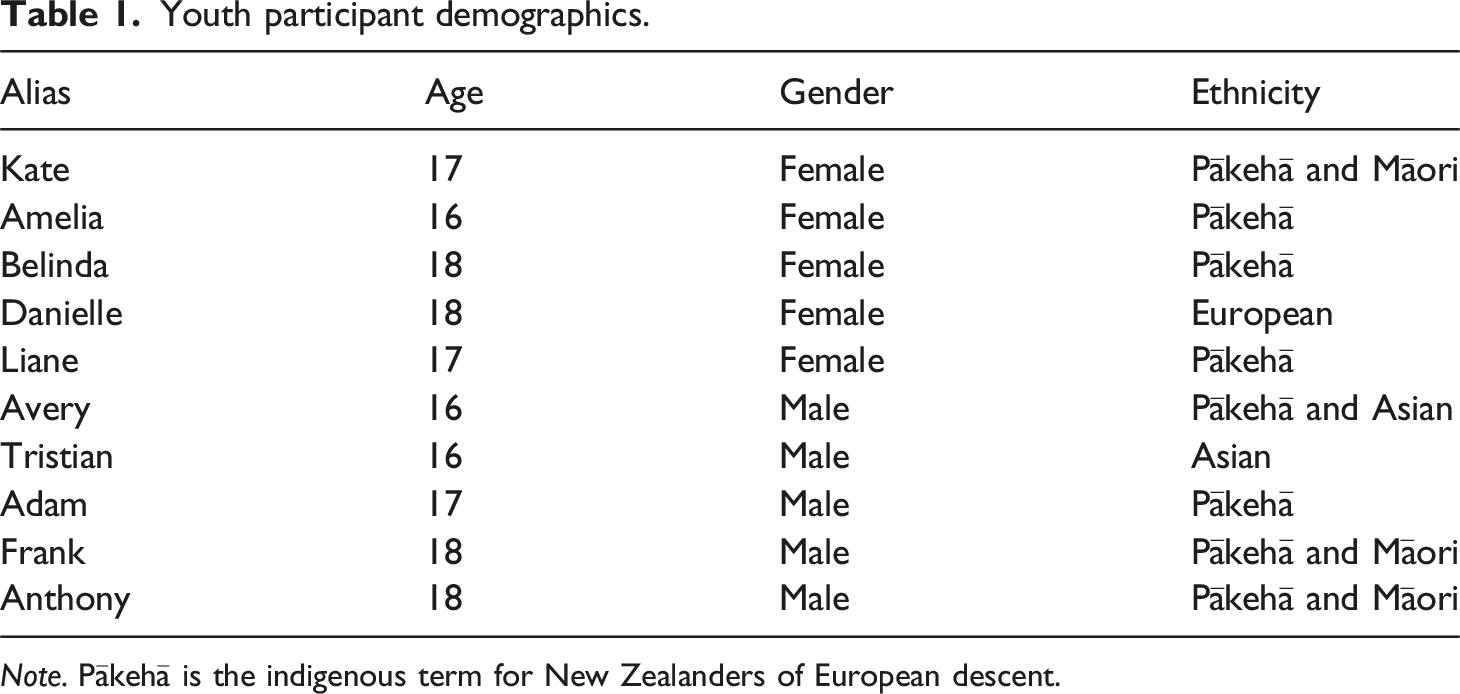
Note. Pākehā is the indigenous term for New Zealanders of European descent.
Data collection
The first author contacted interested students with information about the interviews and to answer any questions. She conducted in-person interviews at a time and location (mostly at schools) convenient to participants. Interviews lasted between 40 and 90 min and centred around participants’ views of IP, appropriate responses to youth engagement with it, and understandings of the ways that gender is performed in pornography, including gendered relations between actors, bodily styling and appearances, sexual practices, and so on. Participants were not asked about their own practices or experiences with IP, which could also have legal and ethical implications vis-à-vis underage participants (for findings about the young people’s own practices, see Healy-Cullen et al., 2021).
Data collection was designed to be responsive to the sensitive nature of the topic, which could be difficult to talk about if participants felt shy, embarrassed, or as though they could get into trouble for their disclosures. Apart from reassuring participants this was not the case, the interview guides were designed to avoid discussion of personal experiences and rather elicit understandings of the topic more generally. We used three elicitation strategies to help with this and to generate discussion. First, at the start of each interview, there was an explicit discussion about how IP/pornography is defined, and the participants’ own understandings of what IP might constitute. Second, findings from the survey component of this mixed-method study were presented to each participant to provide their perspectives on (Healy-Cullen et al., 2021). Third, a story completion exercise about a young person’s first-time viewing IP. Participants were provided with a story stem, and then proceeded to describe how they might complete the story. This technique provided a non-threatening way for participants to share their views about a sensitive topic and for us to explore ‘how particular objects are socially constructed, and the sociocultural discourses available to participants to make sense of a particular scenario’ (Clarke et al., 2019: p. 6).
Analysis method
We carried out a critical, deductive thematic analysis following Braun and Clarke’s (2019) iterative phases. After coding and classifying the data according to themes, we interpreted the resulting thematic structures using sexual scripting theory as developed by feminist discursive scholars (Beres, 2013; Frith and Kitzinger, 2001). From this perspective, sexual scripts are ‘culturally familiar, established ways of speaking about sex within a particular context’ (Morison et al., 2021) or shared cultural resources delineated by prevailing cultural norms, values and expectations regarding sexuality (Jackson and Scott, 2010). These scripts act as discursive resources for sexual identity construction (similar to interpretative repertoires in discursive psychology) as they make various positions (e.g. slut, pervert) available to speakers, and in taking up, resisting or conferring these positions, people render themselves socially recognisable (Morison and Macleod, 2015; Nentwich and Morison, 2018). In this way, speakers construct culturally intelligible and acceptable sexual identities.
Sexual scripts delineate and circumscribe what is sayable and doable regarding sexuality in a specific place and time. Yet, it is possible to improvise upon an existing script, albeit within the realms of cultural intelligibility (i.e. deviations must remain understandable in that context) (Morison and Macleod, 2015). Resistance to dominant ideals is therefore possible and sexual scripts also enable contestation and, in turn, various sexual possibilities (Jackson et al., 2010). Thus, sexual scripts are, from a feminist discursive psychology perspective, connected to the re/production of and resistance to cultural norms and broader power relations (Beres, 2013). This theoretical lens allowed us to examine how participants re/negotiate broader socially available meanings about IP in the process of constructing sexual identities (Spišák, 2017, 2020).
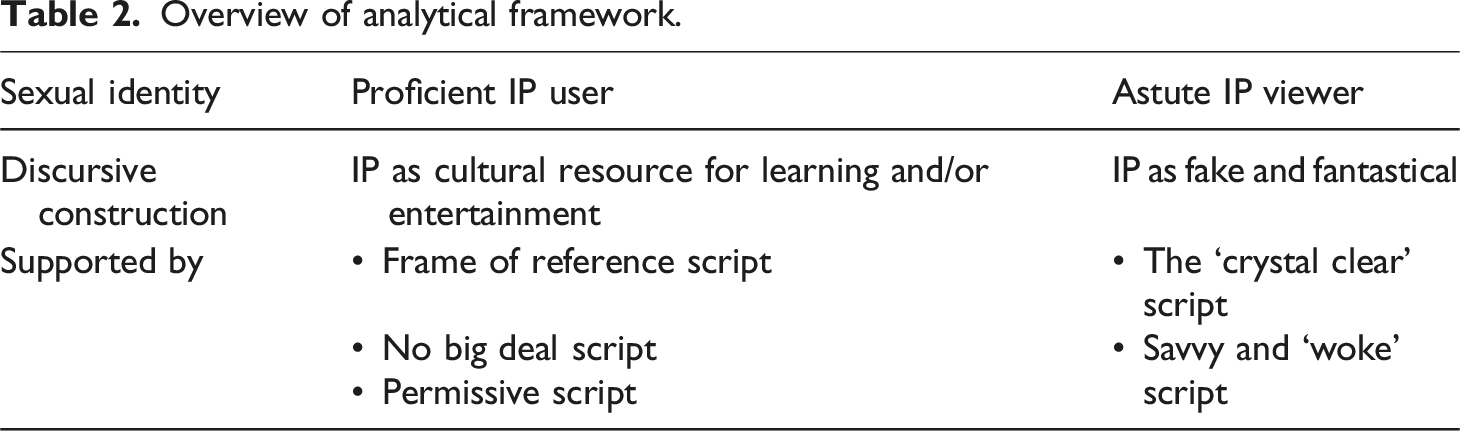
Accordingly, our analysis identifies patterns of meaning-making in talk about youth engagement with IP based on commonly used sexual scripts, which support one another in interweaving ways, and associated sexual identities (Nentwich and Morison, 2018). This involved searching for regularity and repetition that conveys a common way of understanding across interviews and within each transcript. The scripts we identified were supported by one another (e.g. as we demonstrate below, the main frame of reference script was supported by the permissive script). In the analysis that follows, we show how these scripts were commonly used by participants to construct IP in distinct ways (e.g. as a cultural resource for learning and entertainment) and work by participants to perform particular positive sexual identities (e.g. the savvy IP viewer).
Analysis and discussion
Overview of analytical framework.
The proficient internet pornography user
Overall, like their peers in other countries, participants routinised the visibility of porn (Mulholland, 2015), seeing it as an unavoidable reality embedded in their day-to-day life that acts ‘as an unavoidable cultural reference point for considering sexuality’ (Gurevich et al., 2017: 558). Accordingly, they depicted IP as performing a legitimate function in their lives as (a) a frame of reference for learning about sex, and (b) a means of entertainment.
Internet pornography as a frame of reference for ‘how to do it’
The
Extract 1
Extract 2
Here, Adam and Amelia describe IP viewing as ‘the only way’ to learn ‘what happens’ during sex and ‘how to actually do it’. The claim in extract 2 that viewing IP is the only effective means available for young people to learn about sex in a meaningful way not only justifies youth engagement with IP, but also highlights a paucity of satisfactory sources of information about sex. This resonates with research in which young people declaim their current modes of sexuality education as unsatisfactory (Allen, 2005; Jearey-Graham and Macleod, 2015), including how sex education that caregivers and educators deliver to young people is often not explicit regarding what sex will actually be like (Allen, 2008).
The frame of reference was supported by a no big deal script to construct and justify youth IP viewing as a trivial or mundane issue. This is especially evident in Adam’s nonchalant tone (‘sure’) and portrayal of youth IP viewing as ‘normal’. Similarly, Amelia’s laughter suggests not only the obviousness of youth using IP to ‘learn how to’ have sex but also that this is not a serious matter. Adam also constructs IP as a source of information about normative sexual practice which includes female sexual desire (‘what I want and what women want’; extract 1). The ‘learner’ position made available in the frame of reference means that participants can position themselves as keen sexual subjects who want, even need, to be good sexual partners, which invokes the broader neoliberal valuing of sexual prowess (Gill, 2017; Gurevich et al., 2017). In this way, the frame of reference script is supported by a contemporary sexual script, the permissive script. This script has been described by feminist researchers as built upon the more recent cultural legitimation of women’s sexual pleasure in heterosex and the perceived importance of both heterosexual women and men sexually pleasing a partner (Hollway, 1984).
In particular, female participants drew on the frame of reference and permissive scripts to construct IP as a resource to learn about how to perform sex in ways that please male partners and learn expected roles and practices. This ‘learner’ role motivated by ‘curiosity’ (Kate), and aligned with dominant constructions of femininity, offers a way to justify viewing IP in a culturally intelligible manner that adheres to feminine respectability. Aligning with other research, this allows young women to evade the stigmatised identity of being ‘like a whore or [pause] dirty’ (Liane), which some participants discussed as being associated with young women who admit to watching pornography (Goldstein, 2021).
Internet pornography as simply a means of entertainment
In addition to being a tool for learning about sex, IP was also commonly constructed as a cultural resource in the sense that it offered a means of entertainment, as in other research in which IP is described by young participants as being used for leisure and pleasure (Goldstein, 2021; Löfgren-Mårtenson and Månsson, 2010; Mulholland, 2015). As Danielle explained, she enjoys engaging with IP actors as ‘social media people’:
Extract 3
In this extract, Danielle displays her familiarity with contemporary culture in which ‘porn stars’ are cast as celebrities and a source of entertainment, positioning parents as uninformed about popular culture. Like other participants, she constructs IP as one form of ‘reality’ entertainment in the way participants nonchalantly referred to IP as a normalised part of their wider media landscape and fundamentally about entertainment. This aligns with research findings showing that online spaces are central to young people’s social interactions and that IP is normalised within these broader online social interactions as part of a pornified entertainment culture (Attwood et al., 2018).
This depiction is bolstered by the no big deal script, which is evident as Danielle explains that there is ‘no deeper meaning’ to youth viewing IP. Her claim is reinforced by drawing on her personal experience as she recounts how she ‘didn’t really think about it [IP] very deeply’. Similarly, Tristian explained, ‘I don’t think it’s there for people to actually make sense of. I think it’s for people to like have a fantasy’. Danielle and Tristian position themselves as aware that porn is simply about entertainment and fantasising. Danielle positions parents, rather than young people, as lacking insight into the nature of IP as part of the entertainment ‘industry’ and possibly as naïve, dismissing the dominant construction of youth as credulous and inevitably harmed by IP. She does not outright contradict parents but suggests that she does not need to be ‘knowledgeable’ or instructed by adults about IP (‘taught’) in order to be ‘safe’ as she was able to simply set IP aside (‘just leave it’) when she felt she needed to. IP is rendered something she can use for her purposes and set aside at will. Indeed, supported by the no big deal script, some male participants cited a generation gap, and stated that they had joked about adults taking the issue too seriously. This talk aligns with Allen’s (2006) research in New Zealand which shows the ways young men joke about sex/pornography are a form of resistance to adult authority. Accordingly, critical reflection on hidden meanings or messages – as supposed by many adults as necessary – is deemed misguided.
Thus far we have focused on how participants commonly constructed IP as a practical tool or resource that they were able to adeptly use in accordance with their needs, thus constructing a sexual identity of
The astute internet pornography viewer
IP was frequently denounced as fake and fantastical through the ‘crystal clear’ script. This script is like the critical feminist orientation identified in Goldstein’s (2021) Canadian study, which demonstrated how viewers ‘keeps critiques of porn’s representations and industry practices at the forefront’ (p. 9). This script coheres with the savvy and ‘woke’ script we identified in our data, whereby participants positioned themselves as insiders ‘in the know’; attuned to the social justice implications and gendered politics associated with IP. Although participants did not explicitly refer to themselves as ‘woke’, or ‘savvy’, they demonstrated their awareness of identity and respectability politics, and gendered positioning was not uncritically accepted. For example, as Tristian explained, lesbian IP is ‘geared towards males who want females even though they might say its lesbian porn’ (Tristian). Additionally, several participants spoke critically about the gendered associations of viewing IP, that is to say, as normal for men and indicative of healthy masculinity but aberrant and distasteful for women and indexing spoiled femininity. Particularly, Adam attributed this to ‘sexism’ and Avery, Amelia and Liane denounced it as a ‘double standard’. Furthermore, several participants, especially young women, commented on and questioned the centring of male pleasure in IP and female pleasure as secondary (Ashton et al., 2020):
Extract 4
Extract 5
Here, we see how participants demonstrate their understanding of IP as not only misrepresentative, but as perpetuating negative stereotypes. Avery and Liane position men as holding power over women who are expected to be ‘submissive’ (extract 5) and ‘get nothing’ (extract 4). In this vein, Liane demonstrates an awareness and further, she critiques the fact that most IP is made ‘to benefit the male’, and therefore portrays women as submissive. She suggests that while boys are ‘duped’ (‘they think every woman is submissive’) she herself is not submissive and is also resistant the dominant heterosexual script and gendered double standard whereby women are considered less interested in sex than men (Kim et al., 2007). Thus the ‘astute’ position made available in the ‘crystal clear’ script intersects with the savvy and ‘woke’ script, as both Avery and Liane bring attention to their personal respectability politics (‘that’s no way to have a marriage’) and shrewd personal experiences of navigating IP (‘in my experience’).
Thus, although young people may access IP as a means of ascertaining what it looks like in ‘real life’, the
Extract 6
Extract 7
Here, the
Extract 8
Extract 9
Here, Liane and Tristian discursively reckon with the gendered expectations that surround IP viewing in terms of heteronormative practices. They position themselves as astute to the artifice of IP and appraise representations of queer sex as ‘just not at all accurate’ (extract 8) and ‘sanitised and fake’ (extract 9). They also position themselves as able to judiciously problematise unhelpful misrepresentations, citing that it is ‘crystal clear’ that they are ‘not really good’ (extract 9) and can ‘twist public perception’ (extract 9). The ‘crystal clear’ script was therefore supported by a savvy and ‘woke’ script so that the astute position allows participants to evade the ‘innocent child’ identity, which some participants discussed as being associated with the naivety of ‘other’ less astute pornography viewers who are not savvy enough to know what is ‘accurate’ (Liane) or ‘good’ (Tristian).
It is also evident how Liane and Tristian resisted the common construction of youth as naïve and easily taken in by what they see in IP and other media. The speakers position themselves as not needing to learn ‘how it is’ (extract 9) from IP, but rather as knowledgeable about what sex is ‘actually’ like and how it is ‘actually’ done. Speaking about IP in a knowledgeable manner, referring to the intentions of different genres, and criticising representations of sex/uality suggests that it is the construction of ‘normal’ sexual practice that can have implications for some youth, as illustrated in Liane’s further reflections on ‘scissoring’ (extract 8); ‘And it’s like the first thing I think of is like that weird scissoring situation and it’s like I know that’s not the way to do it. But why am I thinking it?’.
As other research points out, this suggests that participants, rather than uncritically using IP as a sex guide, are actively negotiating and challenging what they view in IP and relating it to their own lives in a way that adults do not frequently recognise (Spišák, 2020). These participants were therefore navigating the conundrum of how to engage with IP as a pleasurable and entertaining means of sexual exploration, as discussed in other research, (Attwood et al., 2018; McKee, 2012), when it is so often spoken about within a harms and risk discourse (Löfgren-Mårtenson and Månsson, 2010; Spišák, 2020).
Conclusion
In the analysis above, we demonstrate how participants deployed two primary resistant sexual identities – the
Supporting emerging international evidence, these findings point to complexity, agency and nuance in participants’ understandings of IP. Participants presented themselves as cognisant and critical of the ostensive harms, discerning of the artificiality of IP, and able to critically reflect on and reflexively navigate the IP landscape. In line with previous literature, these youth demonstrate how young people’s meaning-making is more nuanced and complex than is often presented and can occur for some youth in a critical manner (McKee, 2010; Spišák, 2017). This resonates with Attwood et al.’s (2018) observation that ‘young people negotiate pornography in complex ways, demonstrating an ability to parody it while watching for a range of purposes including sexual satisfaction’ (p. 4), and challenges the construction of youth as a monolithic category of passive, uncritical IP viewers.
Our findings support several other studies in a range of contexts reporting that youth commonly distinguish between sexual representations in IP versus real-life practices. For instance, in a recent Finnish study the young women participating commonly characterised ‘sexual practices seen in pornography … as commercial, promiscuous and fake forms of sexuality’ (Spišák, 2020). Such talk resists and challenges sexual scripts that construct youth as vulnerable dupes, unable to distinguish between fantasy and reality. Our research findings represent more empowering self-positioning among these youth, similar to that of the young New Zealanders in Allen’s (2006) study, who positioned themselves as sexually knowing subjects. Positioning ‘young people as positively and legitimately sexual’, Allen (2006: 402) argues, is potentially more productive ‘than a subject positioning that is negatively construed’, as in mainstream discussion of youth IP engagement. Not only are empowering identities more aligned with these youth’s preferred self-positioning, but adults’ acceptance of young people as ‘smart’ sexual subjects potentially allows for more purposeful and productive conversations about sex and sexuality than risk and harm focused responses (Jearey-Graham and Macleod, 2015; Naezer and Ringrose, 2018).
Implications for pedagogical strategies
Our findings resonate with and contribute to work that is focused on generating constructive ways to support youth’s sexual socialisation in a western, postfeminist, digitalised culture that renders IP simultaneously ‘sexy’ and illicit (Goldstein, 2020; Spišák, 2020). Moving past the overwhelming focus on potential negative effects of IP viewing, critical scholars suggest that research should shift focus to identifying pedagogical strategies to support youth agency (Jearey-Graham and Macleod, 2017). Policy agendas that consider how best to support youth must recognise the sexual agency expressed by these youth and take them seriously (Scarcelli, 2015). Pedagogical initiatives may indeed be useful and have some positive outcomes if approached in ways that consider these dominant scripts and the current ways youth make sense of representations of sex and gender in IP (Goldstein, 2020).
For example, strategies that adopt a critical framework of ethical sexual citizenship – a justice-orientated approach to sexuality education – rather than top-down didactic ‘porn literacy’ interventions, might prove more relevant and meaningful to youth (See Healy-Cullen and Morison, in press, for a critique of porn literacy programmes, and also Byron et al., 2020; Carmody and Ovenden, 2013; Macleod and Vincent, 2014). As our findings suggest, some young people may perform a sexual self that is different from what most adults imagine when they worry about young people’s IP viewing. Our findings suggest that educational discussions about IP would be best situated among broader learnings about how a young person can explore IP as a new cultural reality, in a way that makes sense to their personal lived experiences and respects their orientation to IP as critical viewers.
What is often missing from the fearful discourse regarding youth encounters with IP is the recognition that some youth can, as we have demonstrated, actively negotiate with IP, rather than passively subsuming its messages and blindly imitating what they see (Jackson and Scott, 2007; Scarcelli, 2015; Spišák, 2016). This finding is important when we consider the issue of ‘disconnect’ between young people and adults (Jearey-Graham and Macleod, 2015b), and highlights the need to (i) listen to young people, and (ii) adopt sexuality education strategies that do so too. If the voices of these young people are to be taken seriously, young people must be recognised as active cultural consumers and legitimate sexual citizens with the potential to discern and navigate the IP landscape. Our findings indicate that a deficit understanding of ‘childhood innocence’ that renders youth as passive and naïve – and is so regularly relied on in talking about youth engagement with IP – needs to be challenged and renegotiated if we are to support youth in navigating IP in a way that is meaningful and relevant for them.
Footnotes
Acknowledgements
We would like to express particular thanks to the schools and participants who took part in this research.
Declaration of conflicting interests
The author(s) declared no potential conflicts of interest with respect to the research, authorship, and/or publication of this article.
Funding
The author(s) disclosed receipt of the following financial support for the research, authorship, and/or publication of this article: This work was supported by the Massey University Doctoral Scholarship for full-time study towards a PhD degree at Massey University.
Data availability statement
Data available on request from the authors.
