




Abstract
In June 2023, Bangkô collective and Tambay Times Kids mobilized Filipino cis-heterosexual women and LGBTQ+ individuals to converse in a gathering which they called Butiki/Baboy: A Pride Conversation Series. Butiki/Baboy (literally Lizard/Pig) references a Filipino nursery song that goes “girl, boy, bakla, tomboy, butiki, baboy,” where butiki and baboy pertain to the made-inhuman others—those who are gender nonconforming and do not fit “Westernised” beauty standards. Conceived to discuss mundane queer topics that are the excess of relevant subjects highlighted during Pride Month, the 2023 iterations of Butiki/Baboy held at multiple sites around Los Baños, Laguna in the Philippines included sessions that revolved around narratives of queer intimacies of community development workers, queerbaiting on social media, radical joys in the mundanity of unfinished projects, and messy ecologies formed in the wilderness. This essay is interested in unpacking and understanding how queer joy emanates from this gathering of cisheterosexual women and LGBTQ+ individuals who are primarily cultural and creative workers, artists, and community development workers. It asks how queer joy, through Butiki/Baboy, affords moments of commoning. Taking the cue from José Esteban Muñoz who explains that the multifarious yet shared experience of suffering and hriving forms brown commons, I argue that Butiki/Baboy facilitated a space for engendering queer joy—that thing that is being banished from queer communities by an interlocking web of powers that tags queer bodies as unworthy and inhuman.
In June 2023, Bangkô collective and Tambay Times Kids mobilized Filipino cis-heterosexual women and LGBTQ + folx to converse in a gathering which they called Butiki/Baboy: A Pride Conversation Series. Butiki/Baboy (literally Lizard/Pig) references a Filipino nursery song that goes “girl, boy, bakla, tomboy, butiki, baboy,” 1 where butiki and baboy pertain to the made-inhuman others—those who are gender non-conforming and do not fit “Westernised” beauty standards. 2 Conceived to discuss mundane queer topics that are the excess of relevant subjects typically highlighted during Pride Month, the 2023 iteration of Butiki/Baboy held at multiple sites around Los Baños, Laguna in the Philippines included sessions that revolved around narratives of queer intimacies among community development workers, queerbaiting on social media, radical joys in the mundanity of unfinished projects, and messy ecologies formed in the wilderness. In its essence, Butiki/Baboy is stripped from grand narratives of rights and recognition, which are nonetheless equivocally important, to emphasize the everyday becoming and banal activities of LGBTQ + folx, 3 how they move, navigate, and resist amidst oppressive regimes, and how they insist on their presence through joy and being.
This essay is interested in unpacking and understanding how queer joy emanates from this gathering of cis-heterosexual women and LGBTQ + folx who are primarily cultural and creative workers, artists, and community development workers. It asks how queer joy, through Butiki/Baboy, affords moments of commoning. Taking the cue from José Esteban Muñoz (2020), who asserts that brown commons are forged through knowing, encountering, and collectively moving through the multifarious yet shared experience of suffering and thriving among differently-placed minoritarian folx, I argue that Butiki/Baboy facilitated a space for engendering queer joy — that thing that is being banished from queer (of color) communities by an interlocking web of powers that tags queer bodies as unworthy and inhuman. In what follows, I will contextualize queer joy and brownness in the Philippines before laying out the multiple ways queer joy manifests in Butiki/Baboy. I point to how queer joy exposes the cracks in a Catholic-dominated, and cis-heteronormative Philippine society, where classed LGBTQ + folx also navigate global neoliberal capitalist regimes. The essay focuses on two sessions: “Unfinished Projects: From the Boring Lives of Gays, the Radical Joys of Kabaklaan” and “Messy Ecologies: Sisterhood Networks Formed in the Wilderness.” “Unfinished Projects” tackles how LGBTQ + folx manage to exercise joy amidst the necessity of capitalist productivity for survival. Meanwhile, “Messy Ecologies” asks what it means to touch and form alliances with other othered bodies in troubling times. I draw my analysis from the multiple stories shared in the two sessions mentioned above and conclude that LGBTQ + folx inhabit queer joy when they allow their bodies to be oriented towards other bodies. They mobilize queer joy to move collectively with their forged brown commons and to live in worlds they demand, albeit in fleeting moments.
Locating queer joy and brownness in the Philippines
The first two sessions of Butiki/Baboy transpired the morning after the police violently manhandled and unjustly detained Filipino trans celebrity Awra Briguela, who allegedly punched a cis-heterosexual man for protecting her female friends from sexual harassment (Rappler, 2023a). Awra joined the long list of LGBTQ + folx in the Philippines who experienced police brutality and gender-based violence; most go unreported. To this day, the Filipino LGBTQ + community continue to demand a national anti-discrimination law that would protect the community from hate crimes, discrimination, and violence (for a full context on the struggle for an anti-discrimination law that would protect the LGBTQ + community of the Philippines, see Abad, 2019). Despite the increasing presence of LGBTQ + folx and narratives in mainstream media, the Philippine nation-state’s predominantly Catholic public remains tone-deaf in human rights issues that impact its sexual minorities (Baron, 2022; De Leon and Jintalan, 2018; Garcia, 2014). Cracking down on gendered expressions and performance practices (case in point, drag) that are rendered offensive to Catholicism and other Christian religions are more often objects of national concern rather than affording LGBTQ + folx with basic human rights (See Rappler, 2023b; Rappler, 2024). Amidst this violence and an oppressive regime that favors cis-heteropatriarchy, cis-heterosexual women and LGBTQ + folx gathered in Butiki/Baboy, co-creating a space that is, as I will illustrate, imbued with stories of joy, hope and possibilities. This essay is interested in how the brownness of Filipino LGBTQ + folx manifests their ability to perform queer joy and emanate hope through being with. Before illustrating so, allow me first to articulate my deployment of queer joy and brownness within the Philippine context.
Although brownness is first conceived via the colonial lens as a racial category, Christopher Patterson (2023) posits that this historical colonial genealogy of the term is imperative in understanding how brownness is embodied and sensed. This suggests that Filipino LGBTQ + bodies can be understood as, in Patterson’s terms, the transpacific brown who had been made brown through colonial violence enforcing cis-heterosexism to uphold cis-heteropatriarchal ideals and capitalist exploitation (See also Lugones, 2016; Tadiar, 2015). While acknowledging the connection between colonial violence and brownness, there is a crucial understanding of brownness and its relation to affect that further shapes my thinking. In The Sense of Brown (2020), José Esteban Muñoz asserts that one embodies brownness via their agency to reclaim their brownness, manifested in how one navigates life and survives despite their everyday struggles and vulnerability to violence. In Muñoz’s conception, brownness emanates as a feeling that manifests through “the commonality of their (referring to those who have been made brown) ability to flourish under duress and pressure” (Muñoz, 2020: 2). It is an affective experience emerging and articulated via the body-made-brown. This sense of being-in-common should not however be foreclosed as a flattening of difference into commonality, rather, being brown acknowledges the irreducibility of differences and incommensurability of experiences of violence and oppression. In the gathering of LGBTQ + folx in Butiki/Baboy, I trace how their brownness is forged in each other’s relations to illegitimacy and everyday institutional violence, how they touch one another in navigating oppressive systems, and how their being-together-in-difference opens passages to queer worldmaking.
I conceive queer joy as parallel to the affective experience of brownness outlined above. Queer joy is a relational affect that is also shaped by the ability of queer (of color) communities to thrive amidst an interlocking web of oppressive power structures. Sara Ahmed (2004) reminds us that queer feelings emerge from contact; taking up space begins through opening bodies, whereby enjoyment and belonging are central. As a modality of performing queer relationality, queer joy becomes more than happiness as it becomes a way to insist on liveability or to collectively survive queer struggle (McGlynn et al., 2020). It is disruptive of capitalist domains and cis-heteronormative regimes as it enacts a “possibility for other ways of inhabiting bodies” (Ahmed, 2004: 162). Alongside its capacity to disrupt, queer joy, for people of color and folx who live in the so-called “Global South”, gains saliency in its capacity to be a tactic of survival and resistance against their marginalization. The works of queer of color scholars such as Amber Musser (2018), Christopher Persaud and Ashon Crawley (2022), and Michael Tristano Jr. (2022) emphasize the political potentiality of queer of color joy amidst power (infra-)structures that operate towards the abjection of people of color. Queer of color joy emerges from being transformed by one’s relations with others (Musser, 2018; Persaud and Crawley, 2022). Queer of color joy is disruptive to (white) liberal institutions because it demonstrates the “capacity for breathing, being, and becoming that is really, really tender and loving and kind” (Persaud and Crawley, 2022: 3) which contradicts how queer of color folx are conventionally painted in liberal narratives as engulfed with traumas. Most importantly, queer of color joy serves as a powerful tool in collectively living through, with, and against state violence and oppression, and “is vital for creating better and more sustainable worlds” (Tristano 2022: 279). This queer relationality embedded in understanding queer and racialized joy informs my understanding of queer joy in the Philippine context.
Filipino brown LGBTQ + bodies have been understood in scholarship to inhabit queer joy via their multiple articulations of biyuti (the vernacular of beauty) and manifold performances of kabaklaan—the performative construct of being bakla—which extends but is not limited to cross-dressing, extravagant flamboyancy, and displaying humor. The bakla is a local gender in the Tagalog region of the Philippines that is often conflated with effeminacy, homosexuality, and transfemininity. It is important to clarify here that kabaklaan is not a performance of identity; rather, as Robert Diaz (2018) suggests, it “exceeds these identitarian constructs” (404). Diaz adds that kabaklaan is a form of “asserting a distinctly queer sensibility about the travails of everyday life” (404). It can manifest in poking fun at the exigencies of life that sexual and classed minoritarian bodies navigate. In kabaklaan context, biyuti also becomes a performative way of negotiating one’s position within regimes of discipline and oppression (Garcia, 2000). Oscar Serquiña (2016) finds this in the drag practice of queer Filipino diasporic subjects as performed in a musical, Care Divas, wherein crossdressing offers them joy “to lessen (their) personal shame” and to reveal themselves in a corporeal form that “may hopefully earn (them) respect and admiration” (220). This deployment of kabaklaan via biyuti to embody queer joy is also found in the practices of pageantry, albeit there is a possibility of the brutality of the surrounds, in the form of homophobia, misogyny, and military intervention, to seep in (David and Cruz, 2018; Lopez, 2023). Martin Manalansan (2006) nonetheless finds kabaklaan within the repertoire of performative tactics that Filipino queer subjects deploy to find joy amidst the travails of everyday life.
I extend this discussion of kabaklaan as a performative strategy to insist on and inhabit queer joy beyond the trope of biyuti. Taking the cue from earlier mentioned discourses on queer joy as erupting from the moment of opening up oneself to others, I posit that queer joy may manifest in the myriad ways kabaklaan sutures relations between differently placed Filipino cis-heterosexual women and LGBTQ + bodies. Queer joy via kabaklaan may gesture a modality of queer relationality within the Philippine context. At once, it emerges from the body upon sharing out and laying bare oneself to others, not only in laughter but more so in tears from flaying individual wounds. This brings me to my thinking that brown commons are forged in these moments of queer joy from being attuned to brownness and being alongside brown kins.
Lauren Berlant (2022: 85) asserts that “a commons … begins with being with” (each other). Berlant configures the practices of commoning as a mode of undoing normative infrastructures through emplacing affective relations of care as central to the commons. These normative infrastructures are those that disable the conditions of minoritarian subjects to flourish. I suggest that this is what is produced via the modes of queer joy as withness and opening up. Muñoz (2020) posits that brown commons are a movement that flows through the moment of contact with brownness and entangling with brown kin. Furthermore, Muñoz describes the brown commons as a kind of “collectivity with and through the incommensurable” (7). The incommensurability of brown commons is important here to avoid misreading the brown commons as simply the commoning of brown folx, or the coming together of brown folx. Contrary to this unitary stance, Muñoz (2020) argues for the brown commons as a being-together-in-difference. Drawing from their previous work, being-in-difference, in the case of “queer of color” for instance, manifests “as sharing (out) of a nonequivalent, incommensurable, and incalculable sense of queerness” (Muñoz 2013: 154). This implies that collectivity is formed not through the commonality of being sexual minoritarian subjects but rather in the relationality of each other’s racialized and sexualized lived experiences. Muñoz (2020: 37) instantiates this in the case of brown feelings or feeling brown whereby “feeling like a problem” becomes a “mode of minoritarian recognition”. In this case, the collective identity of a brown commons is forged through sharing similar affect of feeling like a problem. Following this assertion on brown commoning as an act of sharing (out), the act of brown commoning I examine in Butiki/Baboy demands us to ask: What does it mean to feel together in difference and build coalition through shared feelings and encounters in moments of urgency?
In addition to the above-posed question, I also maintain an attunement to the material realities and oppressive power structures that shape the acts of brown commoning I found myself in. To queer the commons is to assert that the operation of exclusion via respectability is not separated from struggles against material dispossession (Özban and Savci, 2018). In doing so, this essay heeds the call of Nadja Millner-Larsen and Gavin Butt (2018) to be attuned to signals of communing and enact “a search for alternative models of organizing life beyond those produced by the state and the market” (411). Queer joy is disruptive because it disrupts normative institutions, but it is more so eruptive, for it is attuned to when and where it is needed. The following sections unpack the modalities in which queer joy is performed in Butiki/Baboy and what role they play in the forging of brown commons.
Storying encounters with queer joy
Butiki/Baboy hosted a congregation of cis-heterosexual women and LGBTQ + folx from Laguna, Cavite, Metro Manila, and elsewhere. Its June 2023 iteration served as the grand finale for the month-long celebration of Pride. As mentioned earlier, it also became a space for processing the violence that Awra Briguela experienced only a few hours before the gathering unfolded. Although Butiki/Baboy hosted artists and cultural workers in its first iteration, it expanded its doors to community and social development workers for this iteration. Nonetheless, it remains committed to reinvigorating the mundane in Pride conversations, to relocate the possibility of radical hope outside legal recognition and within queer collective infrastructures. The event was a live podcast recording with a host per session from Bangkô Collective or Tambay Times Kids. Paula and Isma hosted the two sessions I focus on here. Each session had a distinguished panel of speakers (some were invited, and some were tapped from the audience on the session itself) who shared their stories and responded to prompts. They were namely Daryl (a freelance writer), Nikki (a tattoo artist), Alex (a visual artist and writer), Mawel (a copywriter at an ad agency), Ligaya (a theatre-maker and teacher), and Serena (an actress, performance artist, and cultural and community worker). 4 Attendees of the events can interject at any moment or during the designated open conversation at the end.
The analysis of Butiki/Baboy presented here examines the narratives the event speakers shared during the conversation series. Additionally, I will also include the sentiments shared by other attendees. At times, I will also narrate some personal accounts of the event to explore the congregation as a performance of queer joy/and brownness via kabaklaan. I call upon what D. Soyini Madison (2006) calls “dialogic performative” to “clear more space for Others to enter and ride” (321). To do so, I bring these conversations from two sessions, and my reflections and ethnographic accounts in dialogue with each other to further pay attention to the relational modes of queer joy I encountered in Butiki/Baboy. Here, stripped off from figurations as over-the-top, kabaklaan is read as a performance of withness. Reading the event as a performance is crucial here to the argument of attunement to the worldmaking possibilities of the gathering and the role queer joy takes in the practice of brown commoning. Lawrence La Fountain-Stokes (2021), in his work with translocas of Puerto Rico, mentions how the trans and drag performers find joy in each other’s company despite being the object of hatred. In her work on Black queer nightlife in Chicago, Kemi Adeyemi (2022) asserts that Black joy brings Black queer women together “in their shared desires to feel good on the dance floor” (63) despite the real and lived threats of violence. This work extends the works of these above-mentioned queer of color scholars in understanding the radical potentialities of racialized queer joy in our communities, and in this instance, within the Philippine context. Minoritarian performance, after all, whether staged, artistic, cultural, or mundane, is a critical practice necessary for survival (Chambers-Letson and Son, 2013; Muñoz, 1999). I find that queer joy manifests in Butiki/Baboy threefold: as a way of sensing frequencies or finding one another in random spaces, as a form of communing through the queered Filipino act of saluhan, and as a collective refusal to rely on normative institutions, albeit in glimpses.
Queer joy as sensing frequencies
“We share the same frequency,” Daryl declares in the middle of the conversation around exchange and encounters with other queer creative workers. This response could perhaps also answer the prompt of the “Unfinished Projects” session: “What do queers, trans, and non-binary folx do in their free time?” As if locating a radio station where one finds refuge, LGBTQ + folx find the frequency they share in their free time. This describes the general sentiment shared by the people who gathered in the space of Butiki/Baboy, primarily brought about by their situation of gendered labor precarity as LGBTQ + folx and as freelance creative and cultural workers navigating the violence of neoliberal and global capitalism via the gig economy (See McRobbie, 2010; Soriano and Cabañes, 2019; Tadiar, 2013). Sensing each other’s frequencies enabled people to find a community where they could spend time that they, as Daryl mentions, have set aside. This is particularly salient for them since they dedicate most of their time to productive labor in order to sustain their everyday financial needs. Extending the conversation of finding frequencies in the succeeding session, “Messy Ecologies,” Serena asserts that in whichever practice and event she holds, she believes that the “right people will come.” Similarly, Butiki/Baboy, for Serena, was a gathering of the right people who came because LGBTQ + folx found their ways.
The sensing of frequency that both Alex and Serena relate to is akin to Sara Ahmed’s (2006) notion of queer orientations. For Ahmed, to be oriented is a question “not only about how we ‘find our way’ but how we come to ‘feel at home’” (7). It attends to how people considered “out of place” become directed towards a dwelling they inhabit together. One other instance of this is through LGBTQ+-oriented social media apps and how sociotechnical infrastructures enable LGBTQ + folx to rehearse survival through digitally found and formed sociality amidst the regime of brutality in their surroundings (Atienza, 2023; Ong, 2017). Here, frequency is deployed as that queer vibration that radiates from someone or a (social) space and is transmitted to other LGBTQ + folx. Sensing of frequencies is an act of attuning oneself to where one may seek refuge from the violence of the everyday. In finding each other and co-creating a social space through that queer frequency, connections, friendships, and solidarity are forged. In the case of Butiki/Baboy, the queer frequency radiates from the social space co-constructed by those who gathered therein, allowing them to leave lives usually spent on capitalist productivity. In finding this frequency, they have attuned themselves to a found community.
Mawel and Ligaya further shed light on the joy one finds in sensing queer frequencies. Mawel, in escaping abusive encounters in their hometown of Bataan, shares that nightclubs like Sadomasodisco and The Elephant Party, where techno-music is celebrated and kabaklaan erupts, enabled him to sense a community of LGBTQ + folx who also find refuge in techno-music. Here, Mawel narrates what I called elsewhere as “choreographies of queer sociality” (Ramirez, 2021: 145) within nightclub spaces, where one finds a community through the flows of bodies and conversations in intimate spaces. Meanwhile, Ligaya’s experience illuminates the joy of being a frequency that others found. In a performance of Brujas (that was toured across Metro Manila), a play by Carlo Paulo Pacolor, Ligaya unintentionally broke the seriousness of a scene. This made Carlo interested in them, and they began a friendship that has lasted since. In this case, Ligaya’s intervention in the serious scene by cackling is an act of kabaklaan particularly when thinking of literal kabaklaan as that “over-the-top out-of-place loudness” that bakla folx usually enact. Kabaklaan too can be that queer frequency that one is attuned to, or that queer frequency that sutures relations amongst LGBTQ + folx. In Mawel’s story, they highlighted that one travels to spaces where kabaklaan thrives to encounter shared frequencies. In Ligaya’s story, they highlighted that finding frequencies and being a found frequency, especially when one has recently moved to another city, requires scouring spaces to find kin, and oftentimes, revealing one’s own kabaklaan along the way.
The intentions to sense queer frequencies as the stories shared illuminate implies what Elizabeth Povinelli (2006) suggests—that intimacy is a tactic to respond to the urgency of a moment. Sensing frequencies serves as a way to sense where kabaklaan may reside to encounter queer joy in the fulfilment of a longing for intimacy. Sensing frequencies become a mode of queer relationality—contacting brownness to feel at home with brown kins as a tactic of navigating the everyday. Put differently, queer joy here manifests in stories of experiencing withness, performed in the collective moving and navigating to find brown kins despite the pervasive precarity in the everyday. More importantly, the gathering of LGBTQ + folx who have somehow found each other’s frequency in Butiki/Baboy materializes this performance of withness. As Serena asserts, they have all found their way. Queer joy can be found in sensing others’ brownness, and in coming together, they reclaim their free time from the free market.
Queer joy as saluhan/communing
Queer joy does not end in sensing frequencies of kabaklaan but instead continues in the act of communing that follows after one finds other kin. Butiki/Baboy queers the Filipino practice of saluhan to insist on the capacity of queer bodies to gather. Saluhan, from the root word salu, means to share something (usually, to consume food together). I use queer here as a verb that implies to disrupt and dismantle, and in dismantling, they also create (See Martin Manalansan’s interview in Salazar, 2012). This suggests that the gathering of cis-heterosexual women and LGBTQ + folx in Butiki/Baboy disrupts the normative system of gathering and creates a space of communion for queer bodies. Within the Filipino context where LGBTQ + folx are seen as “salot ng lipunan” (“ills of society”), their gathering via saluhan disrupts such queerphobic narrative, for they display themselves as political subjects enacting a communion. This is particularly important especially when gathering alone is an always already manifestation of an anomaly to cis-heteropatriarchal systems. In gathering for themselves without the need to dress up in glamorous ensembles, they also disrupt the earlier mentioned function of biyuti/beauty, which is to earn the respect and recognition of a cis-heteronormative society. Saluhan becomes a form of insisting on one’s presence via making kin with other brown bodies, where the object of saluhan is their brownness. Here, I read saluhan in the gathering of cis-heterosexual women and LGBTQ + folx in Butiki/Baboy, and in the stories they shared where saluhan also manifests.
In “Unfinished Projects,” the object of saluhan is the struggles of queer artists. Daryl and Alex both point to the limitations of queer art expositions and exhibitions. Daryl mentions that queer art expositions are missing exchange and conversation between artists. For him, art expositions operate only for the market, especially for artists to sell their work, network, and find clients who might commission them. Daryl longs for a saluhan where they can share their lived experience to build communities of practice. Meanwhile, Alex complains about the scarcity of lesbian visibility in so-called “queer” exhibitions, leaving them to feel tokenized in some art spaces whenever they are invited. The failure of so-called queer exhibitions to showcase the diversity of LGBTQ + art and experiences in the Philippines accounts for the lack of saluhan in such spaces. These frustrations of Daryl and Alex gesture the sense of lack they feel when saluhan is not centered in their encounters.
Responding to Daryl’s and Alex’s frustrations, Nikki narrates the joy they find in being able to grieve trauma with someone. Nikki bonds with their clients over stories as part of their practice as a tattoo artist at Tusok Studios, a queer tattoo space. These engagements generate queer joy for Nikki, especially when their clients affirm that they feel a sense of safety with them. Narrating a parallel experience, Alex shared the time when they bonded over personal traumas with strangers at a music festival, leaving them with a feeling of joy. These stories elucidate that queer joy emanates from the act of saluhan particularly in the group’s communing over stories of frustration and in sharing moments where they felt a sense of safety in being with other LGBTQ + folx. In revealing their brownness to each other, they become affectively oriented towards each other. This eventually results in feeling queer joy through a general sense of ease from the burden and pain they carry.
Similar conversations persist in “Messy Ecologies,” further elucidating how saluhan establishes a space for queer joy through the performance of withness. The performance of withness entails sharing, listening to each other, and opening oneself to vulnerability while attuning oneself to the vulnerability of others. During this session, panellists and participants connected deeply over tears and anger, but more importantly, found a sense of safety in shouldering painful feelings together. In an ice-breaker conversation where all panellists and participants had to name why Butiki/Baboy makes them feel at home, some of the responses people gave were: it made them feel like themself, they feel embraced by the formed community, they can share to the table, and they feel seen and also see others. Ruminating from these responses, Serena asserts that Butiki/Baboy facilitated a space for “redistributing power” because no one owns the space, each body within the formed brown “we” share an equal chance to pass the microphone with others. The image below (see Figure 1) further depicts the performance of withness via the practice of saluhan. In the image, what appears plainly in the eye of a viewer are bodies of cis-heterosexual women and LGBTQ + folx seen gathering around a long table. However, from the experience of the people gathering there, this image manifests the moment of saluhan—cis-heterosexual women and LGBTQ + folx coming together in their found frequency to share (out) their vulnerabilities, carry the pain of others alongside them, and commune over tears, anger, and more so, in laughter. Saluhan, in fostering the sharing of a repertoire of narratives of joy amidst violence, transformed this long table into a site where brown commoning transpired. The group of cis-heterosexual women and LGBTQ + folx in Butiki/Baboy during the final live podcast recording session, “Unfinished Projects.” Much like the session’s title, the podcast is also another unfinished project (pun intended).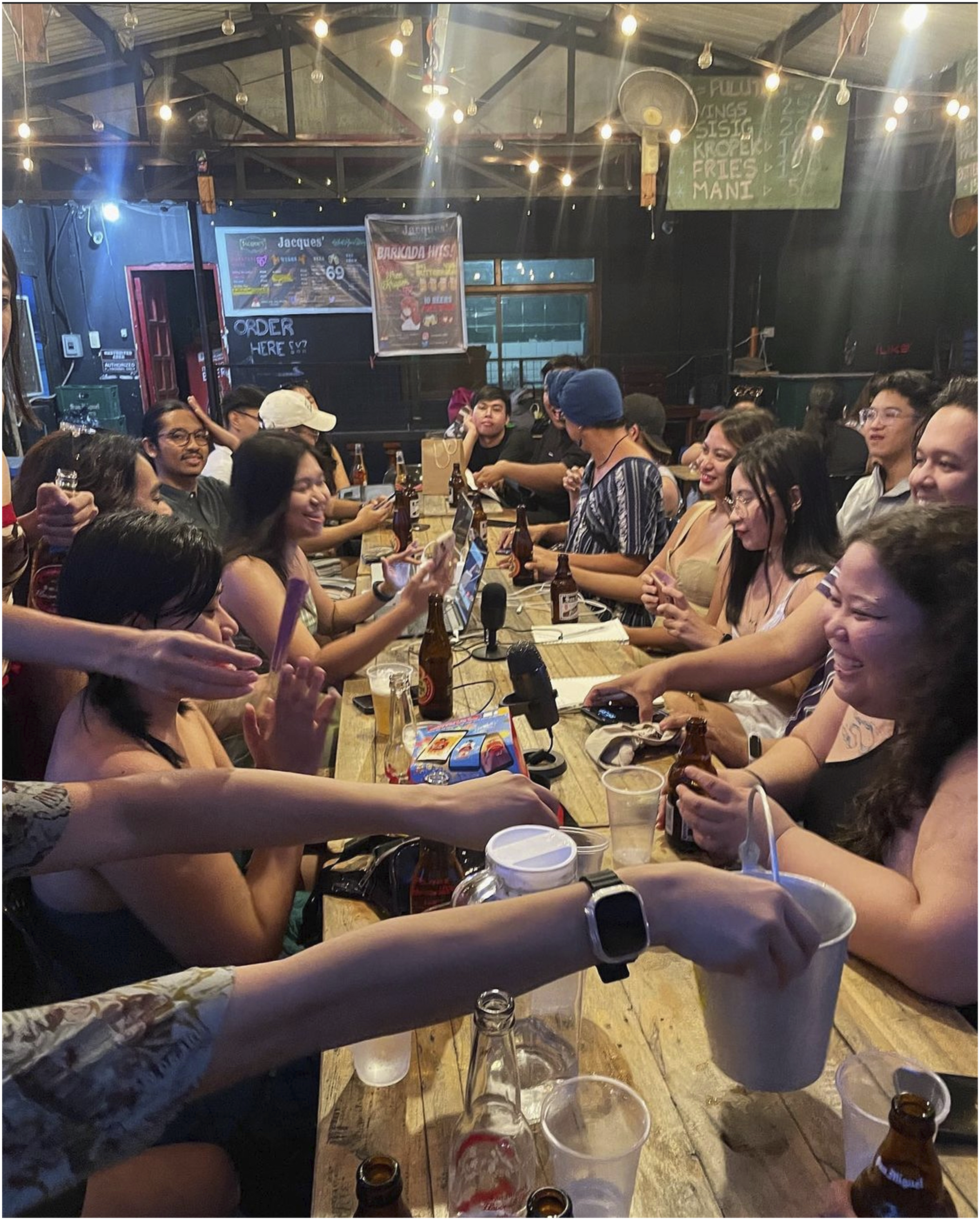
Queer joy as collective refusal
I participated in Butiki/Baboy to spend time with new-found friends. Instead, I met a wider community of queer, trans, and non-binary folx, who, in coming together, have built a brown collective imbued with the joy from togetherness amidst the violence that had just unfolded the night before the event (Awra Briguela’s unjust arrest), the shared experience of violence everyone had shared and received, and the embrace of each other’s brownness. Alongside this performance of withness, Butiki/Baboy most importantly manifested the manifold ways cis-heterosexual women and LGBTQ + folx enact a collective refusal to perform the normative scripts that have placed their location within Philippine society and a global neoliberal capitalist regime. This is the third appearance of queer joy I found.
The queer artists of Butiki/Baboy feel that they are expected to capitalize on their “queerness” to gain a position within the art scene. This manifests in the imposition of labels in their artist profiles, for instance, to say that “A is a non-binary multimedia artist.” The panellists of “Unfinished Projects” often find joy in the refusal to capitalize on their queer identity to validate their art and artistry regardless of their gender and sexuality. Daryl stresses that labels only work for the logic of the market. What they point to is not a refusal of the label queer but a refusal to subscribe to the capitalist-co-opted logic of inclusion. Rahul Rao (2020) notes that within contemporary global relations, inclusivity operates as a form of homocapitalism wherein inclusivity stands in as the “folding into capitalism of some queers and the disavowal of others” (164). This suggests that inclusion under the realm of capital implies expending one’s productivity for profit, even as it appears to be the commodification of one’s identity. The refusal Daryl describes here is also akin to Black queer women’s practice of slowness that Kemi Adeyemi (2022) elucidates in her work on Chicago’s queer nightlife scene. For Adeyemi, slowness serves as a tactic of refusal that enables Black queer women to navigate the gentrification of Chicago. Amidst the fast-paced living and rapid labor that neoliberal regimes impose upon bodies, Black queer women deploy slowness to negotiate their right to the city and perform “strategies of endurance and subsistence” (61). For Daryl, as a body comprising the mass of bodies that are rendered by the neoliberal capitalist regime as always already disposable, their refusal to capitalize the label “queer” is to insist on their life and presence as simply a body that enjoys creating. Daryl more so signals a hope for a queer futurity where art’s currency will no longer be trapped in economic capital terms but will be repatriated to the social and the communal.
Meanwhile, the “Messy Ecologies” panellists and participants air a collective sentiment of distrust in legal institutions. During this session, many shared experiences of sexual violence and the failure of legal institutions to attend to cases and afford justice. For them, sharing is a moment of refusal to let institutions hold control of the decision to concretize that the moment of violence may not have happened. Sharing stories of violence amongst brown kin materializes their narratives into reality, especially when their brown kin affirm, respect, and afford dignity to their narratives. Here, the sense of collective refusal brings forth joy in the shared practice of political assertion. As Audra Simpson (2014) articulates, there is joy in the reveal of one’s sovereign self against higher authorities who attempt to discursively contain one’s being and narratives. Queer joy emanates in the refusal to enable state-sponsored invisibilization of narratives of violence. Queer joy, too, springs from asserting sovereign authority over one’s body in the sense that one is being heard, one relates to others’ narratives and one’s narrative of violence is affirmed as lived and valid.
Lastly, Butiki/Baboy manifests a collective refusal in and of itself. As the event was held in multiple sites across Laguna—the Makiling Botanical Gardens, two cafes, and a pub—Butiki/Baboy demonstrates the queer refusal to be set in place. Such refusal further elucidates that queer joy is eruptive. Queer joy emerges in places where it is needed most when the exigency of the present requires an urgent response. As in the opening of the final session, Jesa from Bangkô Collective shares the political possibilities that an eruptive queer joy enacts—it not only makes visible the cracks, but queers, trans, and non-binary folx create the ruptures themselves that will allow them to let their queerness flow, resisting the imposed stability. In her words: “As in a road made of concrete, there is violence imposed in burying the natural and the organic that arises from the ground ... What we need instead is to operate from a frame of chaos, of messiness, of having to rely on the weeds that grow out of the road solid concrete, to locate our lives in a space where we allow ourselves to just be free”.
Coda: From queer joy to brown commoning
In this essay, I demonstrated the possibilities of approaching, knowing, and sensing queer joy. Queer joy is not merely the touches of laughter LGBTQ + folx share nor the humorizing of the violence of their surroundings. Queer joy is the embrace of the mundane and the banal encounters of relationality as found in the practices outlined here: in sensing frequencies, practicing saluhan or acts of communing, and in the collective refusal of disposability, invisibilization, and emplacement. Butiki/Baboy highlighted these manifestations of queer joy. Filipino brown queer bodies collectively insist on their kabaklaan-as-withness to inhabit queer joy. This serves as their urgent response to a life subsumed under global neoliberal capitalist regimes and a Catholic-dominated cis-heteropatriarchal society. Queer joy, as the speakers and attendees of Butiki/Baboy demonstrate, moves beyond the singular self but emanates from the relationality of one body to another. This relationality of queer joy allows for moments of brown commoning.
After partying alongside and touching each other’s brownness, the formed “we” in the frequency of Butiki/Baboy returns to their lives, keeping the moment of saluhan and carrying the practice of refusal. I remember sharing my sentiments with everyone as the final session ended. I noted, “Brownness is our flesh. It is the feeling of alterity that makes us feel a sense of displacement, but this feeling is shared in the brown commons Butiki/Baboy had formed”. Carlo from Tambay Times responded, “This is our tactic in forming collectives. We build something, then we disperse. And, when the moment needs us to gather, we gather. Our togetherness, like us, is also fluid”. Butiki/Baboy ended with dispersal but it nonetheless served as a site for cis-heterosexual women and LGBTQ + folx to rehearse ways of relating to one another and in opening themselves to others, they learn to find joy in insisting on one’s safety with each other.
Footnotes
Declaration of conflicting interests
The author(s) declared no potential conflicts of interest with respect to the research, authorship, and/or publication of this article.
Funding
The author(s) received no financial support for the research, authorship, and/or publication of this article.
