




Abstract
Pandemic restrictions shuttered educational, community and support spaces for queer youth. Despite the pervasive despair, many young, queer people found joy and opportunities for connection, empowerment and intimacy during this period. Through a qualitative thematic analysis of self-reported data from 270 young queer people in Toronto (82), Melbourne (90), and New York (98), this paper explores how queer joy is complicated by less positive and complex emotions such as fear and stress and is found in unexpected places such as school, friends/peers, sex/dating and coming out. We propose a definition of queer joy that attends to the myriad of complex and conflicting emotions that make joy possible. Queering understandings of joy allows educators and influential adults in young people’s lives to support queer youth in accessing joy.
Introduction
As COVID-19 lockdown measures came into effect in March 2020, many young people experienced mental health challenges related to school disruptions and social isolation (Zolopa et al., 2022). The pandemic exacerbated existing mental health inequities for queer youth (Ormiston and Williams, 2022). Shuttered community and support services further limited health promoting possibilities (Ormiston and Williams, 2022). Despite pervasive despair and loneliness, many young people also found joy and opportunities for connection, empowerment and intimacy during this period as our research shows. This paper explores the affective toll of COVID-19 on 270 young queer people’s joy in three global cities. Through a qualitative thematic analysis of timeline data gathered from genderqueer and sexually diverse young women and non-binary youth, we ask: How/where have these youth experienced joy during a time characterized by uncertainty? How do these experiences challenge our understanding of joy? What are the generative implications of reconceptualizing joy as complicated and shifting? We explore the complexity of queer joy in the face of normative explanations that reduce joy to the opposite of pain and propose a working definition of queer joy that disrupts this binary and makes space for the ways in which queer joy is entangled in complex, emotional experiences where joy and pain sit alongside one another.
Literature review
Despite being considered one of the most basic positive emotions, joy has been empirically and theoretically underexamined. Articulations of queer joy are especially neglected within both sociology and psychology (Shuster and Westbrook, 2022). Much of sociological research has, in fact, failed to explore queer and trans joy as previous scholarship has focused on exploring queer and trans people through deficit frameworks that depict them “as suffering negative life experiences” (Shuster and Westbrook, 2022: p. 2). When joy is explored, it is broadly understood to refer to the expression or performance of happiness and pleasure and is typically construed as the opposite of pain, marginalization and misery (Ahmed, 2004; Johnson, 2020). Queer scholars have rejected these narratives as it overlooks the possibilities of queer and trans joy, as well as more complicated or nuanced experiences that may also include emotions such as pain, loss and failure (Shuster and Westbrook, 2022). The erasure of queer joy produces what Shuster and Westbrook (2022) call a ‘joy deficit:’ wherein sociologists have little to no understanding of “the joyful aspects of being a member of a marginalized group” (Shuster and Westbrook, 2022: p. 2). To combat this, the growing body of literature on queer joy disrupts cisgender, heteronormative narratives of intimacy and pleasure that centre around monolithic experiences and sources of pure joy (Duran and Coloma, 2023; Lu and Steele, 2019; Morris et al., 2022; Murphy, 2022).
Queer scholars have theorized that queer enjoyment challenges and resists heteronormative modalities of pleasure (Ahmed, 2004; Brewer, 2021). Borrowing from Ahmed’s (2004) conception of queer loss as generative, Morris et al. (2022) define queer joy as a complex, multilayered experience in which both loss and failure play generative rather than antagonistic roles in the cultivation of joy. In their theorization, grief and loss, for instance, become integral, affective sensibilities that espouse queer joy (Dilley, 1999; see also Halberstam, 2011 on queer failure). Morris et al. (2022) further argue that queer joy “almost always involved stories of heartache,” especially in the context of finding love and affirmation within chosen families in the absence of validation from normative families (p. 939). Although this finding demonstrates that queer folks are not immune from harmful realities, this understanding of queer joy challenges dominant tropes that portray queer folks as victims of institutional and social trauma, incapable of finding joy and love. Queering our understanding of joy as the anti-antipode of pain and heartache (Duran and Coloma, 2023; Morris et al., 2022; Murphy, 2022) thus allows queer communities to reflect on the joyful similarities of sometimes painful shared experience.
Sunden’s (2021) work in particular suggests that “collective joy and pleasure can be a radical act and an antidote to both individualist isolation and public feelings of fear, anxiety, and sadness” (cf. Segal, 2018 cited in Sunden, 2021: p. 291). For many queer and trans people, the freedom to explore and reclaim identity has been met with resistance. Heterosexism often intersects with other forms of exclusion and matrices of oppression such as anti-black racism and anti-queer and trans violence, creating unique vulnerabilities for racialized community members who sit along the intersections of more than one identity (Mitchell, 2022). Black queer joy thereby functions as a form of resistance against both white queer ontologies and Black heteronormativity which erase Black queerness (Lu and Steele, 2019; Mitchell, 2022; Oliver, 2022). Scholars of colour have further theorized that Black queer joy serves as both a “contemplative practice in self-love and acceptance” (Oliver, 2022: p. 122) and radical celebration of the existence of a Black queer community that rejects being “damned to the closet” (Mitchell, 2022). As the Black activist Brittney Packnett has argued, joy is resistance to anti-black oppression (cited in Lu and Steele, 2019: p. 823). Exploring what brings joy for racialized folks is therefore vital for refusing the coloniality of cisheteropatriarchy and meaningfully engaging with equitable futures (Clark, 2016; Lu and Steele, 2019; Soares, 2023). In examining how diverse and overlapping forms of joy co-exist and were experienced by a diverse group of young queer people over the course of the pandemic, this paper provides a working definition of queer joy that resists normative explanations, contributes to the underdeveloped body of literature on queer joy and explores where and how queer youth experienced joy during COVID.
Methods
Participants & procedures
This research stems from data obtained by our multi-method, multi-disciplinary, and multi-site research team (4theRecord), which examined how COVID-19 redefined risk for young, racialized and/or LGBTQ + women and nonbinary youth aged 16–21 years old in New York City, Toronto, and Melbourne (Flicker et al., 2023). These three cities were selected for their similar sociopolitical contexts as Western, liberal, English-speaking democracies. Between February 2022 and July 2022, 321 eligible participants were invited to complete a digital map (i.e timeline) on a self-administered secure online app designed by our research team. Participants were asked to chronologically outline non/sexual experiences and key events in their lives during COVID. The timelines were pre-populated with prompts surrounding major public holidays and COVID-related events specific to the participant’s city and participants were further prompted to generate their own entries (e.g., moves, first jobs), upload images/posts/videos marking memorable occasions, share their sexual/romantic experiences. Participants were also asked to annotate and reflect on their experiences, what it meant to them, the outcomes of these events and self-report the emotions associated with their experiences using positive, ambivalent and/or negative phrases, adapted from Fredrickson’s (2013) Modified Differential Emotions Scale.
Though 321 participants completed the timelines within the larger study, given this paper’s unique focus on queer joy we used SPSS to limit our sample to include only timeline entries from sexually diverse and/or gender-queer youth who self-reported joyful emotions. After excluding entries from non-sexually diverse and/or gender-queer youth and entries that did not self-report joy, our final sample contains 1126 timeline entries tagged with an emotion of “joy” from a combined total of 270 participants in Toronto (n = 82), Melbourne (n = 90) and NYC (n = 98). On average, participants self-generated about 14 entries each.
Participants were diverse in terms of age, gender, race and sexuality. Of the 270 participants in our sample, 150 (56%) self-identified as people of colour, and 120 (44%) self-identified as white. More specifically, 55 (20%) participants identified as East and/or Southeast Asian & Pacific Islander, 21 (8%) identified as South Asian, 6 (2%) identified as Southwest Asian and/or North African, 13 (5%) identified as Latinx, 26 (10%) identified as Black, 26 (10%) identified as multiracial or racially mixed, and 3 (1%) identified as people of colour more generally. 178 participants (66%) were legally considered an adult (18+) in their country, while 92 (34%) were legally considered minors (16-17). 156 participants (58%) identified as woman/female, 4 participants (1%) identified as trans woman/transfeminine, 5 participants (2%) identified as trans man/transmasculine, 99 participants (37%) identified as nonbinary, and 6 participants (2%) identified as questioning/unsure of their gender identity. 136 (50%) participants sexually identified as plurisexual (i.e bi/pan/omnisexual, fluid, unlabelled gender), 49 participants (18%) identified as queer more broadly, 60 participants (22%) identified as lesbian/gay, 1 (0.03%) participant identified straight, 22 participants (8%) identified asexual/aromantic and 2 participants (0.07%) identified as questioning whether they are queer.
Measures
Each timeline entry was inductively coded according to its content using the following framework: school, peers/friends, family, money/work, substance use, mental health, physical health, COVID, sex/dating, identity, conflict/oppression, and travel/moving. Entries were multiply tagged for each relevant code. Descriptive summary statistics were generated to count the number of positive, negative and ambivalent emotions tagged to each entry by race, gender and sexuality categories. We counted per entry rather than by person to capture the vast array of self-reported emotions and collapsed each positive, negative and ambivalent emotions into their respective categories to explore the co-occurrence of other emotions more generally. We then generated descriptive statistics to count the frequency of other emotions that sat alongside joy and the domains of life characterized by joy. Next, we conducted a qualitative inductive analysis to provide deeper insights into the complexities and possibilities of queer joy. Lastly, we grouped timeline entries by domain and summarized the patterns through sub-coding (i.e. coming out, graduation) and present relevant examples. We approach this analysis from a feminist, anti-racist, de-colonial and intersectional lens by centering our participants’ voices. By situating their lived experiences in relation to their complex and multi-hyphenated identities, we attend to the various social structures and power dynamics that shape the ways our participants exercise their agency (Clark, 2016) and access joy.
Findings
How joy sits alongside other emotions & demographic categories
Joy by emotion.
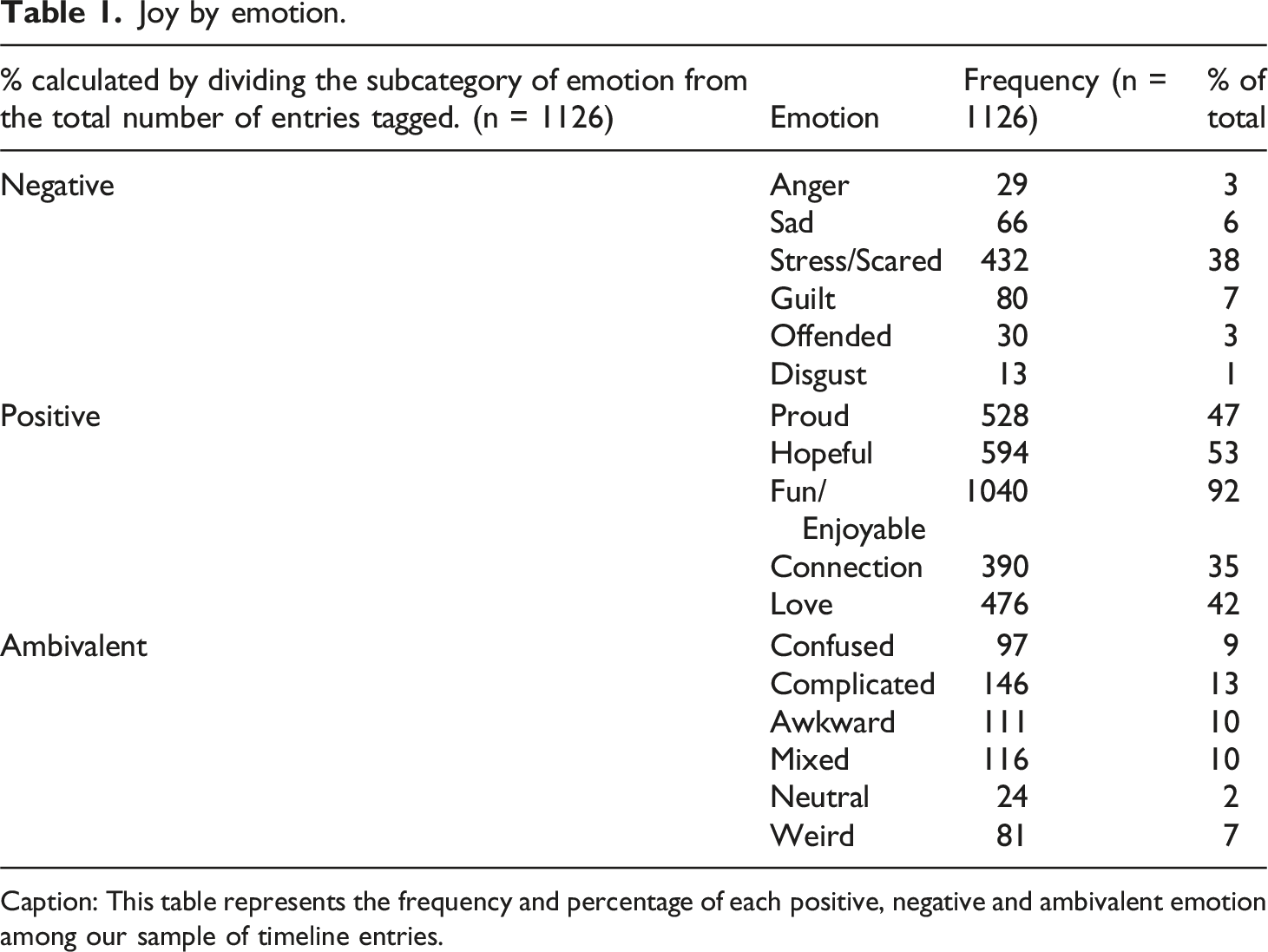
Caption: This table represents the frequency and percentage of each positive, negative and ambivalent emotion among our sample of timeline entries.
Positive, negative and ambivalent co-emotions by race, gender & sexuality.
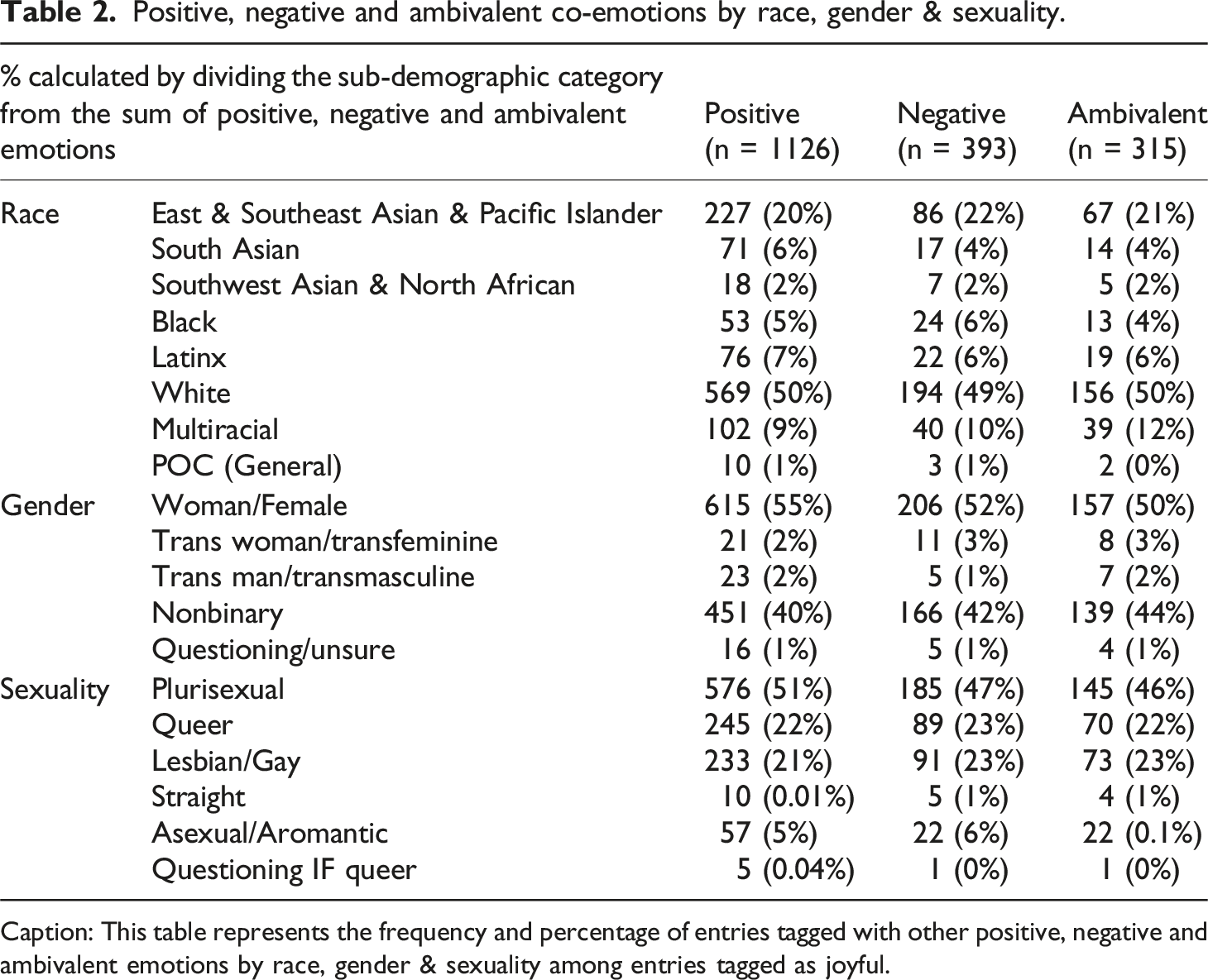
Caption: This table represents the frequency and percentage of entries tagged with other positive, negative and ambivalent emotions by race, gender & sexuality among entries tagged as joyful.
Places where joy is experienced by queer youth
Queer youth’s experiences of joy during the pandemic illustrate how experiences of anxiety and disconnection are simultaneously experienced alongside enjoyment and connection (Sunden, 2021). During the COVID-19 pandemic, many young people experienced heightened levels of loneliness and depression (Ormiston and Williams, 2022). Though the pandemic stripped many youths of the pleasures and opportunities that come with being young (e.g., in-person schooling, celebratory milestones and extracurricular events), our findings demonstrate that queer youth nevertheless found joy in sex/dating, school, with friends/peers and in stories of coming out.
Sex/dating
Participants predominantly reported feeling joy within experiences of sex/dating (43%) (See Table 3). For many participants, stories surrounding sex/dating typically included: asking out long-time crushes, leaving or building new relationships, sexting and experimenting sexually (i.e. threesomes, masturbation, not using protection), as well as pursuing partners. The pandemic provided queer youth an opportunity to reflect on their existing relationships during quarantine and forge new ones. Ellis, Esilda and Tai’s experiences, for instance, are emblematic of the kind of joy that springs from exploring love and romance within dating. For instance, Ellis, a white 21-year-old genderfluid pansexual young person from Melbourne shared how dating supportive partners allowed them to accept their trans identity and transition safely: I got with my partner at the time, and he welcomed me into a safe environment in which I could be myself and help take care of others. I got together with a lovely fellow (I thought) at the time, it helped us survive the majority of 2020. He helped me accept myself as a trans person and slowly begin my social transition in private, I basically lived with his family on the weekends (Entry #678). Joy by thematic domain. Caption: This table represents a breakdown of the frequency and percentage of entries tagged as joyful by thematic domain.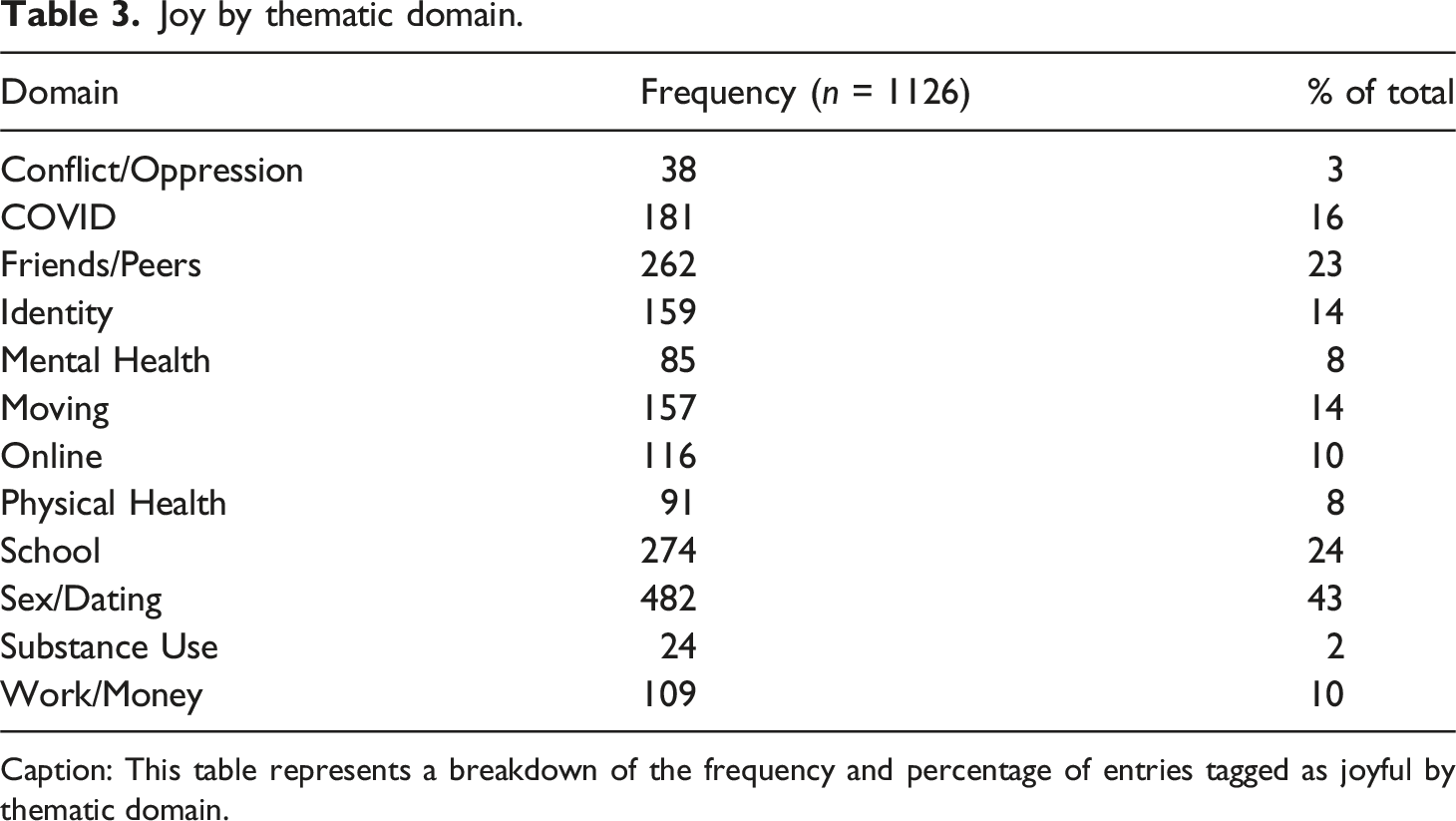
Ellis’ experience illustrates the importance of self-acceptance and support for trans identifying people, who are at greater risk of rejection than cisgender youth (Ormiston and Williams, 2022). For trans youth, finding love in close friends is often both a joyful and scary experience, as Esilda, a 20-year-old lesbian South-Asian young woman from Toronto, shared: “Falling in love with your best friend is messy and nerve-wracking, but this felt right to me at the time. We had an awkward text exchange and, within the week, we had kissed and had sex before we both left for university for the first time. It was puppy love and magical but scary” (Entry #431). Though feeling nervous about “messing up” a good friendship complicates the joyful aspect of pursuing romance with current friends, Esilda does not discount the joy of this experience; rather, the experience is joyful because of it. Similarly, Tai, a 20-year-old non-binary Asian young person from New York, wrote about the joys of finding connection, despite concerns about dating outside one’s comfort zone: I was talking with a guy who I really liked for the past several months, and he finally asked meout… I video called him for the first time and he asked me…to be his girlfriend. I was really excited and nervous because I was still thinking about whether or not to date, but he made me so happy that I told him yes...I was his first and he was mine. We were really nervous about what would happen because we never met in person yet because of COVID, but we were really excited to see each other and spend more time together. I was nervous to tell my family too, but he made me feel comfortable and accepted (Entry #526).
Throughout stories of sex/dating, queer youth reported feeling joyful, happy and/or glad to find love and develop deep connection during the pandemic. This not only allowed queer youth to feel comfortable developing intimacy with friends and partners, but it also fostered feelings of self-acceptance for those feeling stressed or scared about experimenting with new possibilities.
School
Queer youth also experienced joy in less expected places, such as school (24%). For many young queer people, schools are not always safe and affirming spaces (Gill and McQuillan, 2022; Ormiston and Williams, 2022; Russell, 2005). Sometimes, schools are sites of harm for youth who face victimization from their peers due to their gender and/or sexual identity (Gill and McQuillan, 2022). As one 16-year-old genderfluid participant from Melbourne noted, to feel safer, they “moved to an art school with a high queer population” (Entry #826). Research has also shown that queer youth searching for safety and affirmation have frequently turned to online spaces to form communities of support and belonging (Fish et al., 2022; Lucrero, 2017; Salerno et al., 2020). Despite this, queer youth also reported lamenting school closures and virtual learning, which furthered feelings of isolation and limited their ability to develop the intimacy of in-person connections with friends and partners (Anderson and Knee, 2021; Fish et al., 2022). The joy felt from returning to in-person classes after lengthy lockdowns is best represented in entries from youth such as Maybelle, an 18-year-old bisexual East Asian young woman from Toronto: “When I returned back to in-person learning, I was reunited with so many of my friends. However, this time I was more confident in my sexuality and now realize that many of my other friends are queer, so we get to have fun and make our best gay jokes” (Entry #244). For queer youth like Maybelle, the pandemic ushered in a renewed sense of the importance of physical queer spaces such as school, which serve as sites for queer friendships to flourish and provides a safer alternative for experimenting with identity compared to their non-affirming home (Fish et al., 2022; Salerno et al., 2020). For Black, queer students, however, predominantly white institutions can serve as structuralizing forces that foster hegemonic whiteness, individualism, exclusion and devalue Blackness (Tichavakunda, 2002: p. 429). Finding community in supportive friendships within schools is thus especially important for youth like Laila, an 18-year-old Black, lesbian young person from New York: Making friends in college was something I was especially worried about, given that I attend a PWI [predominantly white institution]...I wanted actual friends who valued me as a person and treated me like a good friend. Thankfully, I became friends with some people in my dorm hall. These are the greatest friends I can possibly think of, and I can’t put into words how happy I am to have a friend group like this...I can’t imagine my first year of college without them (Entry #153).
Friendships that value and respect black, queer personhood resist whiteness, homophobia and normative understandings of joy which seek to undermine the value of community and threaten the “possibility of being Black in an anti-Black world” (Tichavakunda, 2002: p. 429).
Friends/peers
Participants also reported feeling joy with friends/peers (23%). For many who were questioning their gender or sexuality, the experience of coming out was mixed. Coming out can be an unsafe experience, as family rejection can result in homelessness and abuse; queer youth may also experience bullying and harassment from those they consider friends (Salerno et al., 2020). In our sample, many participants described coming out as a positive experience that was made better by supportive and encouraging friends/peers. Young people like Sutton and Jillian for instance, are among those who reported that their friends/peers not only supported their identity but helped them regain confidence and self-acceptance. Sutton, a 17-year-old, white, nonbinary, lesbian/gay, young person from Toronto expressed feeling especially “lucky” to be supported by close friends who respected and used their pronouns correctly: I came to the realization that I didn’t identify as a girl. I came out to my close friends and then a bit later my family and they started using my pronouns (they/them). They were really supportive. I’m very lucky, and it was overall really affirming to be called by my correct pronouns. My depression got a bit better which was really interesting because I didn’t realize my dysphoria was contributing to it so much (Entry #808).
Like other queer young people, Sutton credits this experience with reducing their gender dysphoria and contributing to their overall well-being. Jillian, a 17-year-old white queer trans woman from Melbourne similarly describes the experience of coming out as empowering and joyful: “[I] came out as trans to real life friends for the first time. First to my would-be girlfriend and our mutual friend the next day. In the coming months, also to other girls in their friend group and a few trans people at school. It was empowering and thrilling to be able to feel like myself in real life with my friends” (Entry #315). Though these experiences outwardly resist the hegemonic experience of coming out as a negative experience, even when queer youth’s experiences of joy were complicated by unsupportive family members, joy was still possible.
Stories of coming out
Research shows that 67% percent of queer youth did not live with supportive family members during the pandemic (Ormiston and Williams, 2022; Salerno et al., 2020). For some of our participants like Kimberly, an 18-year-old white pansexual woman from Toronto, the joys of coming out were thus complicated by painful rejection from unsupportive family and friends: “I finally came out to my friends and partner as pansexual, unfortunately I cannot come out to my family” (Entry #249). Lennox, a 21-year-old white, agender, plurisexual, young person from Melbourne similarly shared: I no longer wanted to be known by my old name, but I knew it would come with backlash and hostility from all areas of my life, ... I got my name changed, and everyone who couldn’t respect that is no longer a part of my life (Entry #49).
Though these findings speak to the extensive literature detailing challenges that queer youth face with unsupportive family and friends, these examples also counteract deficit narratives that strip queer youth of their agency and capacity to experience joy (Russell, 2005; Shuster and Westbrook, 2022). Both Lennox and Kimberly describe limiting their interactions with unsupportive friends and family to protect their joy and make joy possible, illustrating that queer youth’s resilience overcomes the limits placed on their capacity to access joy.
Limitations of the study
This analysis relies on self-reported data collected from young, racialized, sexually diverse and/or gender expansive youth during an inherently stressful and uncertain time. As a result, some participants may have overreported, while many others skipped questions and sections, resulting in the underrepresentation of certain emotions over others. We suspect the latter may be due to fatigue around self-reporting complex emotions (Patel et al., 2020; see also Ashley, 2020). Thus, care must be taken not to generalize findings. Future research should consider further exploring these insights through linear mixed modelling which might further account for in-person differences and assess the statistical significance of variations in joy by social location.
Conclusion
This analysis describes how queer youth participants experienced joy alongside a vast array of other positive, negative and ambivalent emotions during a time of heightened anxiety and uncertainty. Like other queer studies (i.e. Morris et al., 2022; Brewer, 2021) that work to destabilize binaries, this paper too “queers” normative explanations of joy as a purely positive experience and finds that queer youth experienced joy in many unexpected and complicated ways. For many queer youth in our sample, school (particularly college and university) provided an opportunity to develop supportive relationships among peers. Friends/peers also played an important role in queer youth’s coming out journeys that helped reaffirm their gender or sexuality. We advocate for a definition of queer joy that encompasses the complexity of ambivalence that runs through our participants’ timeline entries around school, friends/peers, sex/dating and coming out. Understanding joy as both complicated and shifting allows us to help young people access and express joy during times of uncertainty. Moreover, our analysis illustrates that the importance of establishing queer spaces and communities within and outside schools cannot be understated (Anderson and Knee, 2021; Duran and Coloma, 2023; Morris et al., 2022). Not only would establishing systems of support for queer youth empower healthy relationships, but it may also foster better mental health outcomes for queer youth who lack other positive support systems, and further spark joy.
Footnotes
Author contributions
CMA participated in data collection, analysis, and manuscript preparation; SF participated in study design, analysis, and manuscript preparation. All authors read and approved the final manuscript.
Acknowledgements
This work was supported by the Government of Canada’s New Frontiers in Research Fund (NFRF), [NFRFE-2020-01107]. We would also like to thank members of the 4theRecord research team, without whom this work would not have been possible: Alanna Goldstein, Amanda C. Galusha, Angela D. Norwood, Anjalee Srinivasan, Ryn Van Leeuwen, Caitlin Arizala, Ciann L. Wilson, Deana Leahy, Emily Sutton, Helen Yaqing Han, Janelle Athansius, Jen Gilbert, Jessica Fields, Jessica J. Mencia, Joy Kirsten Tolledo, Jules Ferguson, Julia Chapman, Kethmi C. Egodage, Kezia Arinka, Laina Y. Bay-Cheng, Nadha Hassen, Nadia Bevan, Reece Rabanal, Seventy F. Hall, Vaish Puvipalan, and Zarin Parisa Tasnim.
Declaration of conflicting interests
The author(s) declared no potential conflicts of interest with respect to the research, authorship, and/or publication of this article.
Funding
The author(s) disclosed receipt of the following financial support for the research, authorship, and/or publication of this article: This work was supported by the Government of Canada’s New Frontiers in Research Fund; NFRFE-2020-01107.
