




Abstract
This article provides a genealogical analysis of the Philippine category “transpinay,” a compound word combining “trans” and “pinay.” It traces the coining of the term by trans activists in the first decade of the 21st century and examines the ways in which the term gained its currency by drawing out distinctions between gender and sexuality categories. The article investigates what the category includes and what the category excludes, and examines disputes over the term’s categorical boundaries. Overall, the article aims not to determine what the term transpinay is, but rather investigates what the term does and how it came to be.
On 6 November 2010, twenty-one beauty contestants took to the stage of an upscale hotel ballroom in Cebu City, Philippines, where they participated in the competition, “Queen: A Pageant of Alternatives.” 1 Organizers described the event as one for “ladies who are gentleman and gentleman who are ladies,” and in doing so distinguished it from beauty competitions for women assigned female at birth as well as “Miss Gay” competitions across the Philippines (Johnson, 1997). While there was no explicit reference to the term transgender in the event title, some participants drew upon global transgender discourses in their candidate introductions and in their question-and-answer responses. In fact, there were numerous terms used, among them: transgender woman, gay, homosexual, ladyboy, and transpinay. For some observers, the confluence of terms coexisting in this space might seem imprecise or “messy,” to borrow from anthropologist Manalansan (2014). However, the pageant’s categorical messiness is a productive starting point for examining how categories of sex, gender, and sexuality function in the contemporary Philippines and globally.
These untidy categorical orderings appeared once again when the host asked the final Top Ten contestant about her experiences as a call center employee in the midst of the global outsourcing boom in the Philippines. After stating that outsourcing had “changed the way the game is played,” the host asked how this new industry had changed her life. The contestant offered this response: Thank you for that wonderful question. What I can say is that it has changed in a good way for me, because nowadays homosexuals or transpinays are being allowed in the corporate world. Now for many years, transpinays has been marginalized or has been stereotyped as something that is different, something that is taboo to the common norms and practices of society, wherein being a transpinay is very difficult, wherein one must be emotionally strong.
Then, after praising her employer for its inclusive workplace, the contestant continued, “It is not a matter of our gender, our sexual preferences, or our social stature, but rather our capabilities to do our work.” I have long lingered on this contestant’s response, in part because of her use of homosexual and transpinay in the same sentence. And the invocation of the term transpinay is itself remarkable, not only due to its recent coinage just two years earlier in 2008 in Metro Manila but also because it had circulated across the Philippine archipelago to places like Cebu through social media, the pageant circuit, and activist networks.
During my fieldwork, I learned that transpinay is a term for transgender women in the Philippines and its diasporic communities. It combines the prefix “trans” with the root word “pinay,” which refers to Filipina girls and women. While the hybrid term is now circulating widely in contemporary media and in LGBT activist circles, it is important to stress that the transpinay has not always existed. 2 Instead, the transpinay identity, as distinct from categories like gay or bakla, emerged only recently and coalesced at a particular historical moment. Indeed, the term’s emergence in the first decade of the twenty-first century occurred in relation to mainstreaming of global gay and transgender movements, and through this process produced tensions between some of the movements’ foundational terms. At the same time, transpinay reflects a crystallization of shared efforts to be recognized, valued, and counted according to self-defined terms that name individual and collective existences in a globalized world.
Overall, this essay examines the emergence of term transpinay and its categorical boundaries. By seeking to better understand transpinay first and foremost as a discursive category, insights are gained into how some gender diverse people in the Philippines have sought to untangle meaning in their social lives. In the first section, I introduce the scholarly contexts that inform this study and comment on some questions that arose from my fieldwork. In the second section, I explore the historical emergence of the term transpinay and examine what it is imagined to include. In the third section, I trace boundary work around the category and examine what transpinay is meant to exclude. In the final section, I assess some disputes over its categorical edges. Together, this material demonstrates how varied social actors attempt to clarify, and in some cases “mess up,” the boundaries of terms and identities. I conclude by considering the potential of allowing these concepts to remain entangled and the possibility that transpinay transforms as it circulates globally.
Background and research context
This essay is influenced by a vibrant body of gender and sexuality scholarship, particularly in a Philippine and Southeast Asian context. There exists a rich literature documenting the pluralism of gender and sexuality in Southeast Asia and the historical transformation of identity categories over time (Blackwood, 2005, 2008; Jackson, 1997; Peletz, 2006; Sinnott, 2004). In Thailand, for example, Käng (2014), Jackson (1997), and Sinnot (2002) examine lines of distinction between various gender and sexual categories like kathoey and gay as well as the historical emergence of categories like toms and dees, terms used by masculine women and their feminine partners, respectively, for self-reference and self-identification. In an Indonesian context, Blackwood (2010), Boellstorff (2005, 2007), and Hegarty (2017a) track lesbi, gay, and waria categories and their definitions as well as situational uses of the terms in everyday life. Furthermore, in West Sumatra Indonesia, Blackwood (2008, 2010) examines how tombois, lesbian men, and masculine female subjects complicate the fixity of identities within Western LGBT discourses. These literatures document both the coupling and decoupling of gender and sexuality across different time periods and geographies, including in relation to specific institutional contexts and to formations of national identities. This is particularly significant in relation to HIV programs where the specificity of categories matters greatly for HIV prevention and outreach efforts (Boellstorff, 2011; Bumanglag, 2018; Cortes, 2013; Hegarty, 2017b, 2018; Käng, 2019).
In the Philippines and its diaspora, numerous scholars have examined the porous relationships between sex, gender, and sexuality categories (Alegre, 2018; Cannell, 1999; Diaz, 2015; Inton, 2015, 2018, 2020; Johnson, 1997; Tan, 1995). For example, Manalansan explores the messy borders between bakla and gay as “permeable boundaries of two coexisting yet oftentimes incommensurable cultural ideologies of gender and sexuality” (2003: 21). For Manalansan, the Tagalog word bakla is an “enduring social category for Filipinos” and a potentially derogatory term that “conflates the categories of effeminacy, transvestism, and homosexuality and can mean one or all of these in different contexts” (2003: 24–25). Bakla is frequently used “to refer to biological males who exhibit, or are suspected of exhibiting, sexual and gender nonnormative behavior” and the “meanings coalesce on the epicene and gender-variant quality of the bakla” (Manalansan, 2015: 113.) The bakla/homosexual dynamic is also examined by Garcia in a sweeping study of patterns of gender and male homosexuality in the urban Philippines since the 1960s. Garcia draws attention to “points of nonequivalence” (2009: xxi) and reiterates that “bakla and homosexual are terms belonging to two different knowledge systems, and therefore can only be irrevocably different from one another” (2009: xxii). Similarly, Fajardo has examined transpacific flows of terms and identities through a “crosscurrents” analytical framework, which I draw upon here because it offers a transpacific analytic that allows one to follow “connections and cultural flows between the Philippines and regional, and diasporic, geographies” (2008: 407, 2011).
In this essay, I build on Manalansan’s observation of the “dissonance” that transgender “creates vis-à-vis the bakla” (2003: 24) and foreground this dissonance by examining collective efforts to clarify categorical boundaries. I argue that one result of these collective struggles is the emergence of the transpinay. By tracking the rise and circulation of the term, this article builds upon queer and trans scholarship in the Philippines and its diaspora by exploring contingent and sometimes porous borders between bakla, gay, and trans.
This theoretical exploration of the transpinay category arises out of a larger empirical project. For the past decade, beginning with fieldwork in 2009, I have explored the experiences of nonnormative gender and sexual subjects in the Philippines, especially those who have carved out new lives and livelihoods in the context of globalized workplaces (David, 2015a, 2015b, 2016). My ethnographic work thus far has focused primarily on understanding the daily experiences of transgender laborers and the material conditions of their work lives. Now, I shift focus to terms that were circulating more broadly in the ethnographic context in which my research took place.
Throughout my fieldwork, I became aware of how my interlocutors, like the pageant contestants in the opening vignette, used a number of terms to refer to nonnormative identities, among them gay, transgender, transsexual, she-male, ladyboy, homosexual, bakla, bayot, and transpinay. I also observed my informants try to clarify terminological boundaries and to discipline others’ uses of the terms. One interviewee, Rose, recalled hesitating to participate in an interview with me over concerns that she did not “qualify.” I asked her to explain and she replied, “I am not a transgender. I’m just a gay. I really thought it’s those operated [on] or those gays who undergo operations or surgery. I really thought that those are transgender.” Rose continued by mentioning another participant named Janine, a transgender-identified person who I had interviewed earlier: “So I asked Janine, ‘I think I’m not qualified [to be interviewed]. I’m not a transgender.’ And then Janine almost threw at me his cell phone. He said, ‘Hey, you’re a transgender.’” The identity inflicted on Rose by Janine, who self-identified as a transgender woman, left Rose perplexed about terms related to sex, gender, and sexuality that were previously more easily contained in her conceptualization of being “just a gay.” Rose continued, “What do you call those gays who undergo surgery? Are they still transgender? I honestly don’t know. I’m quite confused about that.”
Through all this, I became interested in categorical sorting and what this reveals about the social organization of gender and sexuality. Drawing upon Valentine’s (2007) genealogical method used to investigate the category transgender in a U.S. context, I proceed by posing a series of questions: (1) What does transpinay include in its definitional center? (2) What does transpinay exclude? (3) How are boundaries of inclusion/exclusion contested and what operations does naming of transpinay ultimately perform? By engaging these questions, I approach transpinay, not to figure out what a term actually “is,” but rather to see what a term “does” or might do (Keegan, 2020).
To be clear, this project is not an effort to arrive at a stable definition of transpinay; instead it serves as a rumination on the analytic distinctions produced through performative acts of naming and being named. I understand this approach risks creating frustrations for those trying to locate watertight definitions because it is often through leveraging the term’s fixity that one can transform it into social currency in the “brokerage” of LGBT rights and recognition (Thoreson, 2012). Nevertheless, it is my hope that readers will see promise and political utility of conceptualizing these terms as still under construction.
The performative debut of transpinay identity
“Transpinay” is a fairly new identity category, coined in 2008 by a small group of urban transgender Filipinas. The term was self-consciously created by members of the Society of Transsexual Women of the Philippines, also known as STRAP, a group founded in Metro Manila in 2002 by four Filipina trans women (Sasot, 2011). Like many identity-based organizations, STRAP functions both as a support group and as an activist organization. The group states that its goals are “to raise public awareness on issues of gender identity and expression” and “to promote compassionate understanding of transsexualism” (Sasot, 2011: n.p.).
The term “transpinay” was developed by STRAP members in an effort to construct a local term for trans women in the Philippines and to set it apart from gay and bakla. The group defines transpinay as a “female human being of Philippine descent who was given a male sex assignment at birth” (Sasot, 2011). Through a formal vote among its membership, STRAP selected transpinay from a number of other possibilities, including transbabae (babae is another Filipino term for woman) and transfilipina (Sasot, 2011). The deliberation is noteworthy, for it reveals these categories are far from natural, timeless, or essential, but rather historical products of social actors engaged in constructions of meaning for personal and collective futures.
Marking a new chapter in the transgender movement in the Philippines, the term “transpinay” was publicly unveiled on 6 December 2008 at the annual Manila Pride March held near Remedios Circle in the Malate neighborhood (Sasot, 2011), a space that has been described as a gay urban community in the global South (Collins, 2016). Like a ritual debut ceremony, a coming-of-age occasion marking a Filipina women’s celebratory life transition from adolescence into adulthood, transpinay had its collective appearance on the public stage of LGBT politics. It was at this launch of the transpinay that seven STRAP members joined the march in nationalized attire by dressing in ternos, a Filipiniana dress with butterfly sleeves, while riding horse-drawn carriages known as kalesas. They gathered behind a bright pink banner that displayed the words, “Transpinay: The Other Filipina.”
According to one of STRAP’s founders (Sasot, 2015: 20), members debated the use of the word “other” and were convinced by another prominent group leader that “other” did not denote anything negative, suggesting that some members considered the word to have potentially unfavorable connotations. Group members ultimately decided that “the word ‘other’ boldly announces that we are also Filipinas: We are the other women in Philippines society who aren’t recognized as women but are now seeking dignity to be recognized as such” (Sasot, 2015: 20). This public recognition, as social and political subjects worthy of dignity, first required being named and rendered legible. To paraphrase Foucault, the transpinay was “put into discourse” (1990: 11).
The debut of transpinay was accompanied by a lengthy explanation explaining the newly coined term’s significance. In a formal statement prepared by STRAP, the group was “standing up not with pride but with courage to name an identity for ourselves.” They collectively described transpinay as “an identity that rings politeness,” one with “dignity,” one that would “initiate an enlightening public conversation,” and “one that would forge a sense of community” (Sasot, 2015: 20). It is worth noting that the social construction of transpinay is meant to align with a politics of courtesy, civility, and respect. This articulation of a group-based politics is similar to what Diaz, who writes about Filipinos in a Canadian context, describes as an assimilatory “ruse of respectability” in which “staid markers of respectability and economic value” are “recirculated and revalorized within the community” (2018: 117). These discourses of dignity and politeness are characteristic of an emerging liberal trans political strategy that value respectability and productivity as measures of inclusion.
Analytically, the STRAP statement shows how transpinay conceptualizes gender and sexuality as separate realms of existence. To see this ideological investment in categorical distinctions, it is worth examining what transpinay is meant to include within its heuristic boundaries. Centering gender as an analytical focus, the term is meant to emphasize womanhood, femininity, and femaleness and also an alignment with burgeoning global transgender movements (Cruz et al., 2015). As such, the gendered term crosscuts sexuality categories and includes numerous sexual orientations by emphasizing that a “transpinay can be heterosexual, lesbian, bisexual, or even asexual” (Alegre, 2018: 864). The transpinay category is also meant to include a wide range of bodies and forms of embodiment that are not reduced solely to genitals or surgical status. A transpinay may be pre-op, post-op, or non-op: “All the same,” the group contends, “no matter what their genital surgery status is, they are all females. A transpinay is not a boy/man wanting to be a ‘real’ girl/woman—she is already one” (Sasot, 2011).
Reflecting on the origins of STRAP and the term transpinay, Dee Mendoza, former president of the organization, offered this explanation in a 2009 interview with Outrage Magazine. Mendoza said, “We felt the need to create a group for transpinays because there wasn’t any at that time (it was established). The existing GLBTQIA organizations at that time did not have any idea what transgenderism was all about, (and even those) who claimed to be inclusive of transgenders did not have any clue at all. Simply, no one had heard of the word transgender” (quoted in Tan, 2009). Mendoza’s interview explained the restrictive taxonomies that existed at the time of STRAP’s emergence: “In our culture, we only have lalaki (man), babae (woman), gay (bakla), and lesbian (tomboy). All those who were assigned male at birth and chose to love a man and/or choose to identify as a woman were collectively known as the bakla. The concept of gender identity, which transgenderism is all about, was unheard of in our society” (quoted in Tan, 2009).
The parenthetical references are much more than just translations from Filipino to English (“lalaki [man], babae [woman]”) and English to Filipino (“gay [bakla], and lesbian [tomboy]”). The parenthetical references also index a specific relationship between gender and sexuality categories, where gay and lesbian are sometimes viewed as interchangeable with bakla and tomboy, respectively, and distinct social types set apart from man and woman. These conceptualizations of gay (bakla) and lesbian (tomboy) suggest that there is a conflation of sexual nonnormativity with gender variance. It points to common understandings in the Philippines that gay (bakla) is deeply connected to femininity while lesbian (tomboy) is fused with masculinity. This four-part typology appears in the childhood taunt, “girl, boy, bakla, tomboy,” which also became the title of a 2013 film starring Vice Ganda, a popular bakla celebrity who portrayed all four figures in the film. Mendoza uses this statement about a restrictive taxonomy of identities to show definitional limits and to argue that transpinay exceeds previously available categories, thus needing to be named.
The categorical exclusions of transpinay
The transpinay category also relies on differentiation. It is also worth examining the question: what does transpinay exclude? First, transpinay is a gendered category. Because its focus is on femininity and transgender womanhood, the term does not intend to refer to transgender men. This gendered boundary created conditions for the emergence just a few years later of an analogous category “transpinoy” by newly formed groups like Association of Transgender Men of the Philippines (also known as TransMan Pilipinas) and Pinoy FTM, a spinoff of FTM International (David, 2015). In this context there was a parallel sorting out of lesbian, tomboy, and transpinoy categories, both in demographic and health research, as well as in everyday life (Cruz et al., 2015; Cruz and Sasot, 2011; Evangelista, 2020; Jumaquio-Ardales et al., 2017; UNDP, 2014). Indeed, in a 2014 UNDP country report on LGBT issues in the Philippines, one focused in part on HIV as the “primary [health] challenge that confronts gay men, other MSM, and transgender women,” transpinay and transpinoy appear among lists of preferred terms by respondents, not just from Metro Manila but also from the Visayas region (UNDP, 2014: 9)
Second, differentiations are made from previously available categories in the Philippines, such as gay, bakla, bayot, or becky (a slang term for gay men, also spelled beki, see David and Cruz, 2018). These terms are each given meaning in relation to male bodies and embodiment. Similarly, STRAP’s statement distinguishes transpinay from “cross-dresser” and “ladyboy,” both of which suggest that maleness is still a defining feature despite expressions of gender variance and feminine dress.
The tensions can be seen in placards held up by STRAP members at the 2011 Metro Manila Pride march, as portrayed in an image by a Getty photographer (Figure 1). In the foreground, one participant holds a sign reading, “We R Not Bakla, We R TransPinay.” In the background another person holds a sign, “Not Becky, We are TRANS PINAY.” These speech acts of identification (“We are…”) and counteridentification (“We are not…”) bring to light the categorical relations of inclusion and exclusion that the term is meant to perform. Participants parade in the streets during the 2011 LGBT Pride March on December 3, 2011 in Manila, Philippines. (Photo by Dondi Tawatao/Getty Images).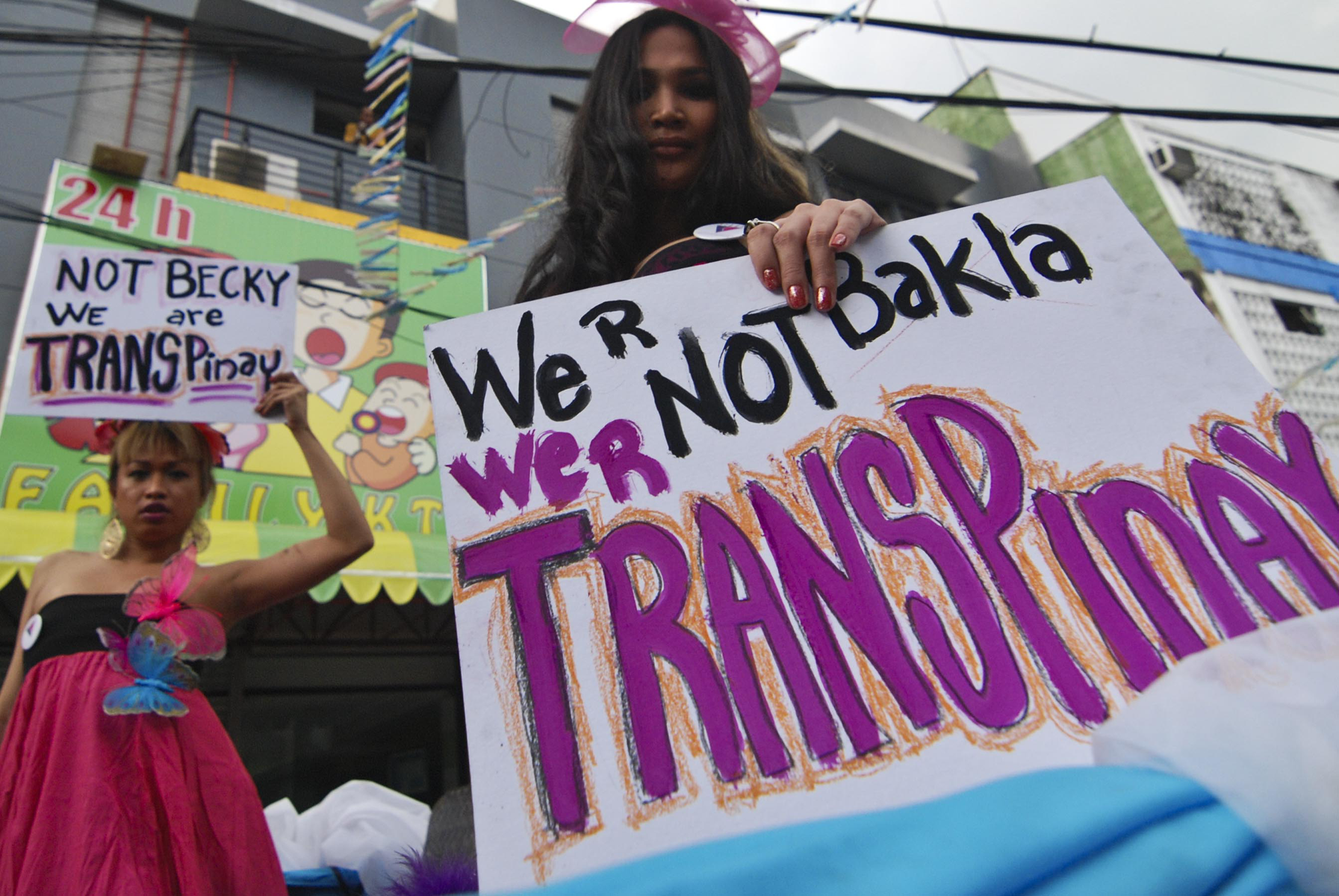
Whereas bakla and beki/becky contain what might viewed as a conflation of gender and sexuality, the announcement that transpinay is not bakla or beki/becky helps to produce rather than just describe the categorical distinction between gender identity and sexual orientation. Put simply, the emergence and uptake of transpinay has helped to institutionalize a further separation of gender and sexuality in the Philippines, a process similar to how globalized gay men in the Philippines, in their embrace of masculinity, distanced themselves from the effeminate bakla (Benedicto, 2014; Manalansan, 2003). This discussion also resembles processes that Halberstam has described as “subtle discursive shifts which have made transgenderism in the United States and Europe into simultaneously a mark of the historically specific definitional cleaving of homosexuality from gender variance” (2012: 344).
The separation of gay and bakla from transgender, as a disentanglement of gender and sexuality, can be attributed to two broad shifts in LGBT politics in the Philippines in recent years: on the one hand, the rise of a gay male globality, and on the other, the rise of a trans globality, both of which position themselves in relation to the bakla figure. One shift involves the rise of global gay subjects, which Benedicto argues has led to an ongoing disappearance of the bakla (2014). In his study gay globality in urban Manila, Benedicto writes about “the classed and feminized figure of the bakla—a local sexual formation often read as a conflation of homosexuality, transvestism, and lower class status—as an outsider within, a specter linked to the past…” (2014: 11). Benedicto then describes how the “bright lights scene,” or the spaces of gay globality characterized by incorporation into politics, consumer markets, and mainstream gay media representations, tries to “exorcise” the figure of the bakla, but that the bakla figure “keeps returning, not because it still exists as a tradition, but because the scene requires it, keeps it as a mirror that holds up an image of what gay life ‘was,’ what it might still be, and what it might become again if the scene stumbles on the march toward ‘modernity’ and fails to plug those lines of flight that steer it ‘backwards’” (2014: 11).
A second transformation in the ordering of gender and sexuality comes from groups like STRAP and other emergent transgender-focused groups like T.A.O. (Transpinay of Antipolo Organizations) that seek to carve out spaces and discourses that center trans feminine experiences. 3 Like the rise of a gay globality described by Benedicto, much of this centering of a trans globality requires differentiation from the bakla. One issue that emerges from these legibility efforts, especially recognition on the grounds that transpinays are polite, dignified, and respectable, is the distancing from those who might be deemed unrespectable and deserving of society’s maltreatment, that is, the figure of the bakla. Here, there is a potential repudiation and disavowal of the bakla. For example, take the case of the so-called bastusing bakla, described by Michael David de la Cruz Tan in Outrage Magazine. Tan recounts an interaction with a transpinay acquaintance who allegedly said, “bakla ka na nga, maging kagalang-galang ka naman. Ibukod ang mga bastusing bakla (you’re already gay, at least be respectable. Segregate those who deserve mockery).” Tan continues, “And so there’s that segregation of the ‘bastusing bakla’ versus the ‘kagalang-galang na bakla’—that is, the disrespectable gays, or those who ‘deserve’ to be mocked versus the supposedly respectable gays” (Tan, 2012, translation in original). Revealed is a construction of a line of respectability that potentially divides those who are deemed worthy of rights and protection, and those who are not.
Whereas the previous demarcations draw boundaries within the Philippine context to distinguish between gay, bakla, and trans, there is one additional performative function of transpinay. Set against a global backdrop of global transgender movements, the pinay in transpinay functions not only to emphasize gender but also to articulate racial, ethnic, and national difference that sets it apart from a universalized global transgender subject that is implicitly conceptualized as white and Western. In this way, transpinay also functions as a critique of the logics of coloniality. By combining trans and pinay, there is approximation to a global trans subject without equivalence.
At this point, it should be clear that an immense amount of thought went into the term’s construction and that categorical lines are not just reflective but also productive of distinctions. That is, these inclusions and exclusions do not simply name an already constituted identity––they play a key role in shaping these analytic categories in the first place. Through their naming, labeling, sorting, and deployment, categories like transpinay are more than just descriptive and become “productive of the very phenomena they seem to describe” (Valentine, 2007: 30).
Disputes over categorical boundaries
This discussion of the emergence of transpinay has thus far relied on written accounts penned by those in early leadership positions within the STRAP organization. As such, the historical record tends to highlight narratives of collective agency and transpinay solidarity, especially around issues of naming, self-determination, and categorical boundaries. But these narratives might cover over internal debate and disagreement over particular terms and their varied usages in everyday life. While the emergence of new terms such as transpinay can be a collective source of empowerment and solidarity, these terms can also be used to discipline subjects and to erase those who embrace bakla subjectivities.
Disputes over categorical edges can be seen through the eyes of some participants who have reported on their observations of competing uses of language. For example, in 2011, the same year that STRAP members held up these protest signs in metro Manila, Mikee Nuñez Inton attended her first STRAP meeting. Inton, an activist and an academic who writes about the bakla in contemporary queer cinema, recounts discussions taking place at the time she joined the organization. Inton describes how the group’s Chairperson had instituted an outright ban of the use of the word bakla, recalling that it was forbidden to even utter the word because of its history as a derogatory slur. Inton recalls the injunction that “No STRAP member would refer to herself, or to other members of the sisterhood, as bakla” (Inton, 2017: 8). The rationale offered, according to Inton, was that the term was “too loaded with negative connotations.” Yet, Inton felt differently about the word, especially in the context of its use among close friends. She wrote, “My cisgender gay friends and I used the world to refer to each other all the time, as did many of my cisgender female friends; it was like a term of endearment, a mark of close friendship” (Inton, 2017: 8).
Disputes over the word bakla, as a term of endearment or a term that should be disappeared, are not unlike clashes over language that have taken place in other contexts (Halberstam, 2018). In addition to in-group/out group considerations of the use or nonuse of bakla, discussions can also be situated in relation to class status and education. In this sense, Inton remarks on how transpinay did more than avoid the pejorative character what might be considered an older term. She writes, “The coining of the term transpinay was an effort to indigenize the trans identity, but it also become very much a function of class and access to education—transpinay could be used as a marker for exclusion in activism, rather than inclusion” (2017: 9). At this point, Robert Diaz’s work on kabaklaan is particularly instructive to class dimensions of bakla, queer, and trans. Diaz builds on Benedicto’s theorizations on how elite gay men in Manila, with their congregation in high end gay bars and spaces, use the bakla as a foil against which to construct an aspirational gay globality. Through an analysis of campy performances of Vice Ganda, a bakla television and film star mentioned above, Diaz argues that “kabaklaan and gay globality constitute each other” (2015: 740) and that it is kabaklaan’s hypervisibility rather than disappearance that “becomes the condition for the possibility for a reiteration of aspirations toward gay globality.” (2015: 741).
In my reading of Inton’s statement, there is a similar co-constitution of transpinay and bakla, wherein the figure of the bakla becomes the condition for a new aspirational trans globality, one that is imagined by some as progressing in time away from the past. As such, prohibitions against uttering the term bakla become illustrative of power hierarchies that place transpinay on a future-oriented trajectory toward enlightenment, modernity, self-realization, and global aspiration. Inton’s naming of this hierarchy questions ideas that this collective movement is somehow a natural progression away from the past and instead reveals class and educational dimensions that assign value to literacy in ever changing trans vocabularies.
Inton offers a second example of clashes over words and terminology. A few years later in 2013, when an (unnamed) European researcher presented ethnographic research at University of the Philippines and referred to interlocutors using terms such as bakla and bayot, Inton recalls a STRAP leader questioning why the scholar “insisted on using negative language” rather than “transpinay.” Inton said that this researcher responded with an explanation that it would be “inappropriate” to use transpinay in place of bakla or bayot “because they did not use this to describe themselves” (Inton, 2017: 9).
The competing stakes of language use in each situation can be informed by a consideration of Valentine’s ethnography of the category transgender in a U.S. context (2007). Valentine (2007: 243) wrote that the task at hand was not to figure out if someone “really” belonged in a particular identity category, but instead “to investigate the history and set of power relations whereby such disputes arise and such definitions are required of people––and what effects those requirements have.” Inton’s documentation of efforts to discipline use of particular language, including by members within the group and those outside of it, offers important insights. The clashes show that terms are not static and continue to be negotiated within particular social contexts by actors seeking to stabilize meaning for social and political ends.
This circles back to questions about the vexed relationship between trans, gay, and bakla. In a CNN Philippines roundtable discussion about the “Trans Filipina Experience,” Rain Cortes responded to a question about whether or not it is offensive to be called bakla. She said: I think there’s a big divide on that. [For some transgender women,] it doesn’t matter if they are still being called bakla or gay because that’s the culture that [we have] here in the Philippines. Even I before, when I didn't know what the word transgender was, I knew that I was very feminine, I was very female, but being called as a bakla was okay at the time. Until eventually, I learned about being transgender. So I think it depends on the person. It depends on the transgender person if she feels okay still being called bakla (quoted in Casal, 2018).
This statement is an illustration of those reflecting on a past in which the word “transgender” was not yet known. Thus Cortez, tasked with the question of locating the place of bakla now that transgender is in circulation, arrives at yet another possible conclusion. Rather than a wholesale embrace of bakla identity or an outright prohibition of the word, Cortez offers individualized solutions, suggesting that it depends on how a person feels about the term. All this amounts to a contemporary context where multiple terms are circulating in complex and often contradictory ways, requiring social actors to make sense of their past though language available today. More generally, some might try to sort out categories and firmly draw lines demarcating boundaries. Others embrace ambiguity. Some try to prohibit use of certain terms and others try to dictate who other people really are. And those like Cortez leave it up individuals to decide for themselves. My position is not to determine who is right or who is wrong, but instead to acknowledge that these dynamics are produced through individual and collective attempts to name and be named.
Conclusions
As argued in this essay, the figure of the transpinay has not always existed; it needed to be invented. The transpinay emerged at a particular moment in history as a result of social actors trying to name an existence not captured in existing social categories. This examination of the emergence of transpinay shows that the terms under discussion do not simply correspond to self-evident identities, but instead act as performatives that bring into being the very categorical distinctions they seek to describe. That is, the emergence and uptake of transpinay over the past decade further entrench categorical distinctions between gender and sexuality, especially through repudiations of bakla, a category that some have sought to make recede or disappear. Yet, in some important ways, following Diaz’s work, bakla remains a condition that enables other categories to appear. By making these distinctions, clarifying boundaries, and inhabiting the category transpinay, there are individual and collective efforts to create new, modern, aspirational, and globalized subjectivities that are positioned both in relation to the past as well as in relation to an imagined future.
The future of the transpinay remains expansive. This raises intriguing questions about how transpinay can potentially transform through its use and circulation. For example, there has been a wide uptake of the term on social media, with #transpinay appearing in over 54,000 Instagram posts at time of this writing. Additional online searches reveal a wide range of subjects from varying social backgrounds adopting the term, embracing it as a form of self-expression that renders oneself visible as part of a collective. 4 In addition, efforts are underway to assemble a plurality of voices in the anthology Trans Pilipinas: An Anthology of Trans and Gender Diverse People (Alegre et al., forthcoming). These developments suggest a democratizing process that expands the term’s social and political potential beyond the activist spaces from which it first emerged. Just as terms have circulated globally, so too have many of the social actors the terms describe. For example, numerous Philippine activists and scholars have now taken up residence across the globe to carve out lives and livelihoods in diverse locations worldwide. Similarly, new scholarship is putting transpinay in conversation with hemispheric trans discourses, especially in South–South dialogs that decenter epistemologies of the global North (Silva and Jacobo, 2020). In these ways, transpinay is not, and perhaps never was, place bound. In these dislocated geopolitical encounters, it could be observed that transpinay is thoroughly decolonial, diasporic, and transnational.
I conclude by returning to the activist signs put on public display in Manila that declared that transpinay is not bakla, and to Inton’s reflections on the terms. Rather than contrasting gay and bakla with transpinay in such a way that treats the latter as a somehow more enlightened marker of modern subjectivity, what if these categories under construction could be valued for, in the words of Sedgwick (1993: 6), “remaining at loose ends with one another.” Rather than repudiating bakla, Inton offers us a queer embrace and “reclamation of bakla” (Inton, 2015: 6), such that bakla and transpinay could coexist. 5
There now exist queer, trans, and bakla scholars in the Philippines and beyond who offer something similar, with an energetic commitment to a nuanced both/and conceptualization in which categories do not necessarily need to be at odds with one another. Inton, in the same CNN Philippines roundtable quoted above, adds this both/and perspective: “If you’re identifying as trans, that’s fine. If you’re also identifying as bakla, that’s also fine. And there’s also space to identify as both. I identify as both. I’m trans and I’m also bakla.” Rather than banning the term bakla, erasing it from existence through acts of disavowal and repudiation, Inton offers a simple declaration that is worth considering: “Let the bakla prevail!”
Taken together, the preceding discussion of the emergence and institutionalization of transpinay reflects on the ways in which categorical sorting of terms and vocabularies index shifting ideas about the relationship between gender and sexuality. Moreover, this sorting has implications not just for understandings of LGBT identities and communities but also the analytic terms for fields of study, such as feminist studies, queer studies, and trans studies. As Valentine (2002) argues, “‘transgender’ presents a deeper disruption in that this category and the varied experiences of cross gender expressions, practices, and identities gathered under this term present a challenge to a set of theoretical relations upon which gay and lesbian anthropology (and gay and lesbian scholarship more generally) is based: the necessary theoretical (and political) separation of sexuality and gender” (223).
While this essay derives from a Philippine context, the analysis has broader implications for a wide range of scholars whose work engages with emergent political identities across the globe. Rather than treating these identity terms as stable entities, this genealogical analysis has offered a case study of the historical emergence of a specific term. It complicates a set of identity categories by focusing not just on what they are, but instead on how they came to be. By engaging in such a project, insights are gained into how social actors collectively imagine what gender and sexual terms could or should be. As such, struggles over the term transpinay reveal collective efforts to carve out paths toward self-determination.
Footnotes
Acknowledgements
I would like to thank the special issue editors Michelle H.S. Ho and Evelyn Blackwood as well as the anonymous reviewers for their feedback. My thinking has also been shaped by conversations with Brenda Alegre, Joy Cruz, and Jaya Jacobo, and to each of them I extend my sincere appreciation. An earlier version of this article was presented at the 2018 American Anthropological Association's annual meeting as part of the Queer Asia: Ethnographies of Change in a Transnational World session, co-sponsored by the Association for Queer Anthropology and the Society for East Asian Anthropology.
Declaration of conflicting interests
The author(s) declared no potential conflicts of interest with respect to the research, authorship, and/or publication of this article.
Funding
The author(s) disclosed receipt of the following financial support for the research, authorship, and/or publication of this article: Fulbright Association (Grant: Fulbright U.S. Scholar Program to the Philippines).
