




Abstract
Despite growing debate about the role of monuments in diverse societies, there has been insufficient attention to contestations that have emerged involving ‘gay’ or ‘queer’ monuments. This article examines the politics of inclusion and exclusion that can stem from the social practices that evolve around these monuments, particularly as the imperatives and priorities of LGBTQ (lesbian, gay, bisexual, transgender and queer) activism evolve while monuments, created in a particular historical and geographical context, are in some sense ‘set in stone’. Drawing on an intensive, mixed-methods case study of the Homomonument in Amsterdam, the article develops a grounded critique of processes of inclusion and exclusion specifically in relation to Black, bisexual and transgender people. With a focus on dance parties organised at the Homomonument, the article calls for more research that analyses monuments as sites of practice.
Introduction
There has been considerable recent debate regarding the role that fixed public monuments play in increasingly diverse societies (e.g. Orangias et al., 2018; Stevens and Franck, 2015; Zebracki and Leitner, 2021). These debates, unfolding in a range of contexts internationally, typically involve contestations over the interpretation of history and the nature of collective memory, raising questions about whose images and narratives are invoked, preserved and/or mythologised by particular monuments (e.g. Dunn, 2017; Ferentinos, 2014). Which lives and experiences do monuments memorialise and what power relations are involved in these choices? In what ways do particular monuments engender political responses, whether from those seeking to defend their legitimacy, challenge their interpretation, re-envision their use or have them removed? And how do those in charge of particular monumental spaces respond to critiques of the sites that they manage?
These are in many respects long-standing concerns for scholars of monuments and public art. However, they have not yet been given sufficient attention in relation to the growing number of so-called ‘queer monuments’, a term used in the ground-breaking work of Orangias et al. (2018: 705) to encompass ‘heritage sites that honour gender and sexual minorities’ (see also Zebracki and Leitner, 2021). In this article, we provide new insights into how queer monuments serve as contested sites of social practice. We provide these insights at a time when there is mounting critique of static notions of gay identity and the marginalisation of transgender people within movements labelled as LGBTQ 1 (lesbian, gay, bisexual, transgender and/or queer or questioning) (e.g. Ghaziani et al., 2016), and the perceived whiteness of LGBTQ organising and politics (e.g. Hinkson, 2021; Ward, 2008b), amongst other issues.
The article focuses specifically on present-day social practices that take place around a public monument – the Homomonument (1987) in Amsterdam, the Netherlands (Figure 1) – which was originally conceived as a ‘gay’ monument. By examining how these practices enact forms of sexual and gender inclusion and exclusion in the public space of a monument, the article provides a novel contribution at the crossroads of sexualities and socially-engaged public-art scholarship. Specifically, the article probes into the experiences of how sexual/gender minorities can not only feel excluded from hegemonic heteronormativity but also, often, from spaces of homonormativity (e.g. Stryker, 2010). The study critically situates these experiences within specific repertoires of social practice that are connected with periodic dance parties organised onsite. Dance parties along with their associated organisational practices, seen as social spaces, constitute a unique lens for critically examining inclusivity. This focus taps into a particular epistemological niche and marks an underexplored area of concern in the Dutch empirical context, too. Impressions of the Homomonument (1987), Westermarkt, Amsterdam. Photos taken by Martin Zebracki around Pride Amsterdam 2018.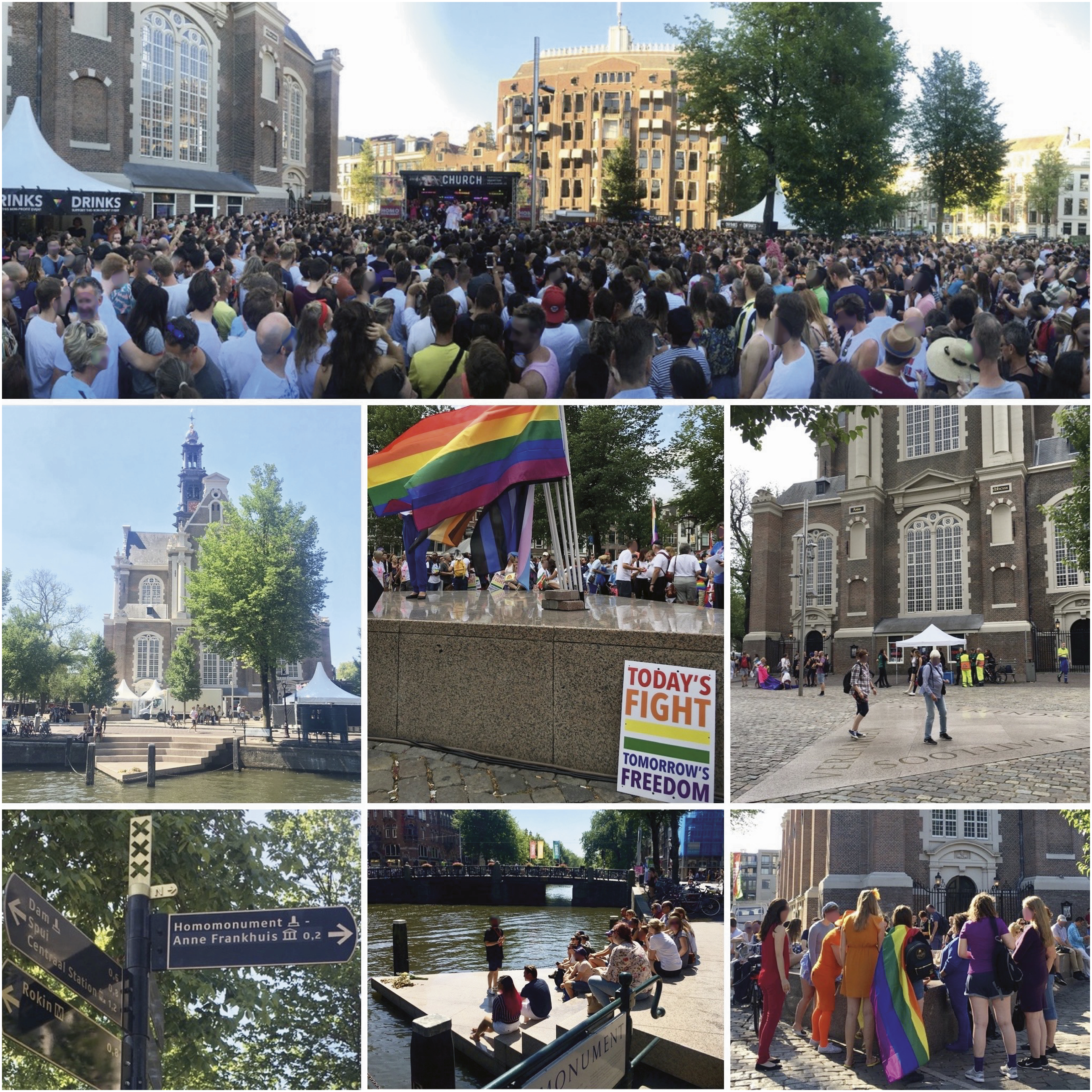
The research pursued a qualitative mixed-methods study that allows us to trace how a complex politics of inclusion/exclusion has developed in relation to the Homomonument within the context of the evolving emphases and imperatives of Dutch and wider, international LGBTQ politics. We begin the article by contextualising the Homomonument case historically and geographically. Next, we critically situate the politics of LGBTQ inclusivity within relevant multidisciplinary bodies of scholarship and with specific regard to social settings of the Homomonument in the Dutch urban capital. Following an elaboration of our methodological approach, we provide an analysis deploying vignettes to elucidate how a complex amalgamation of inclusive and exclusive practices are both manifested and resisted at the Homomonument. In conclusion, we offer pathways for future queer inquiry into monuments dedicated to, or inflected by, the lives of sexual and gender minorities.
Homomonument in historical and geographical perspective
The Homomonument, designed by Karin Daan, was inaugurated in Amsterdam’s city centre square Westermarkt on 5 September 1987. It is widely considered to be the world’s first publicly commissioned, permanent public monument that is specifically dedicated to the lives of gay men and lesbian women. Amongst the monuments that followed suit – see Orangias et al. (2018) for a comprehensive catalogue – is the Gay Liberation Monument, a well-known heritage LGBTQ landmark put on public display in New York City’s Greenwich Village in 1992 (see Summers, 2003), 5 years after Homomonument’s installation. Both the Homomonument and Gay Liberation Monument can be considered monumental exemplars of a modern, international gay and lesbian liberation movement – which should not be construed as a static, singular, temporally linear or socio-spatially coherent process (Ghaziani et al., 2016). This movement is popularly perceived as having started with the Stonewall riots at the Stonewall Inn in Greenwich Village in 1969 – commemorated with the Gay Liberation Monument in the adjacent Christopher Park. Over the last three decades, such ‘gay’ monuments have been gradually integrating other sexual/gender minorities within the LGBTQ population, including bisexual and transgender people, as part of wider, ‘group-differentiated’ commemoration efforts (Ferentinos, 2014).
The provenance of the Homomonument goes back to 1979. A then local gay activist of the Pacifist Socialist Party, Bob van Schijndel, professed an inability to understand why homosexual people were neglected during the annual WWII Remembrance Day, whilst noting that Jewish and Romani war victims were already honoured with dedicated monuments. Under Schijndel’s leadership, the Homomonument Foundation was established in 1979, precisely 100 months before the monument’s inauguration. The public debate was set with the Foundation’s mission statement that evolved to approach the Homomonument as ‘a living monument, a source of inspiration for all LGBT people; […] a call for vigilance against current and future oppression of homosexual and lesbian people both nationally and internationally’ (Stichting Homomonument, n.d.a, translated from the Dutch).
The annual Remembrance Day of homosexual WWII victims at the Homomonument since its existence in 1987 is, therefore, one of the key commemorative events (Schlagdenhauffen, 2011). The Homomonument, as such, has become partly etched in public memory through the combined image of a war and ‘gay’ monument (Bartels, 2003; Ducaat, 2014). Notwithstanding, the social uses of this monument have expanded its scope far beyond the onsite annual Remembrance Day through celebratory components, such as the dance parties in question (see Bartels, 2003; Zebracki, 2017, 2021), as we will further discuss below.
Homomonument Foundation’s initial aim of the inclusion of gay and lesbian people received wide support in Amsterdam. Its right of existence was sanctioned by the local city council that allocated the central city square Westermarkt for the monument. To buttress this goal, the competitively commissioned designer, Karin Daan, took on the task of creating a monument that was more than just a reference to the past, but rather something that would reveal an inclusive aspiration for the future. A subsequent large crowdfunding campaign, supported by local authorities that doubled the collected money, made the monument financially viable (Stichting Homomonument, n.d.b).
The Homomonument’s design consists of a combination of three pink triangles, each 10 m long, together forming a large fourth triangle. Referencing the past, present and future, this triangular structure of the Homomonument ‘presents a spatial commemorative constellation’ (Zebracki, 2017: 346). Based on artist’s data provided by the former Dutch Foundation Art and Public Space (and currently available in Daan, 2020), Zebracki (2017: 346) relayed that ‘the “sunken” triangle points to the National WWII Monument on Dam Square’, ‘the left elevated triangle (used as event podium and seating furniture) points to the former location of COC, the Dutch (and world’s oldest continuing) LGBT organisation’, and ‘the right triangle at street level points to the Anne Frank House’. This symbolic design, as Binnie (1995: 175) observed, has for many ‘an immense symbolic meaning as a place of tranquillity, of rest, of freedom’.
The use of Rosa Porino granite for these triangles abandoned the original plan to use pink marble, as the latter material would not withstand local weather conditions (Stichting Homomonument, n.d.b). The triangle is a symbolic reference to the pink triangle insignia used in Nazi concentration camps to mark inmates as homosexuals, and the wider persecution of homosexual people by the Nazis. Since the 1970s, this emblem, although intended as a shame badge, transformed into a symbol of queer pride targeted against wider systems of sexual oppression, involving other sexual/gender minorities (Heger, 1980). For many, the term ‘queer’ has carried this meaning to this day (Browne and Nash, 2010; Queer Nation, 1990; Zebracki, 2020).
Indeed, gay and lesbian life of Amsterdam in the 1970s and ‘80s largely understood the pink triangle as a symbol of pride, or strength, rather than one of victimhood. This meaning was also projected onto the Homomonument. At that time, according to Binnie (1995: 175), this monument also came ‘to represent a site of memory and mourning for those we have lost to AIDS’ – see HIV/AIDS activism in Castiglia and Reed (2011) and Stockdill (2003). Learning from what happened in NYC, where many locals initially did not welcome the Gay Liberation Monument, the Homomonument’s founders contended that this should become a ‘living monument’ – not some ‘misery on a pedestal’ (Koenders, 1987: 29).
The Homomonument lived up to this epithet of a ‘living monument’. It quickly generated both public acclaim and controversy when activists tried to adorn the granite triangles with pink paint shortly after the monument’s installation. They found this material not to be pink enough seeing the specific link with Nazi history (Stichting Homomonument, n.d.b). Nevertheless, as Coenraadts (2017) argued, for many, the Homomonument is the most important LGBTQ place in Amsterdam today. Also, Binnie’s (1995: 175) observation that the Homomonument ‘has become a site of pilgrimage for lesbian and gay visitors from across the world’ is perhaps no less valid today.
Composition of qualitative purposive sample of research participants.
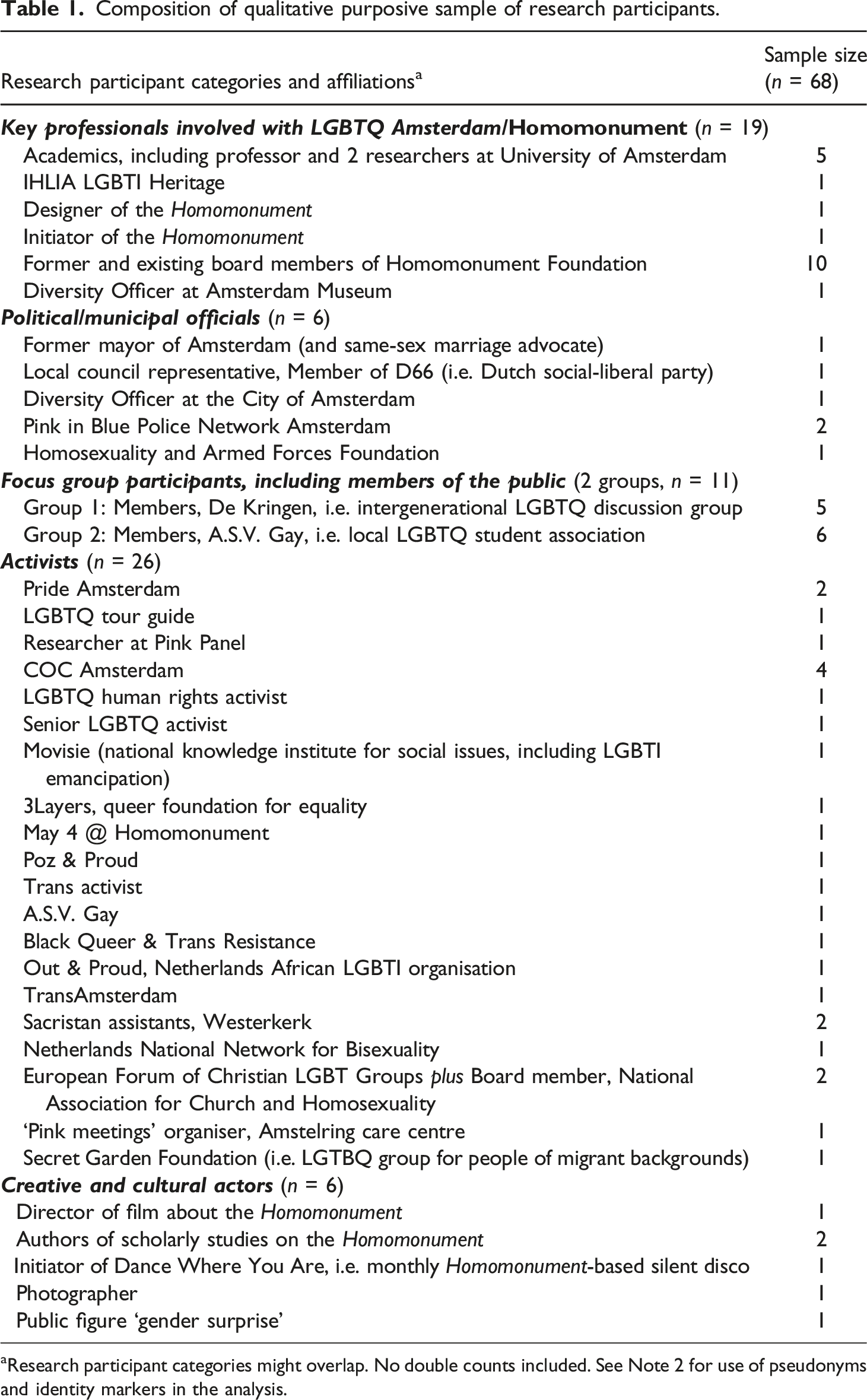
aResearch participant categories might overlap. No double counts included. See Note 2 for use of pseudonyms and identity markers in the analysis.
Summary typology of key recurrent LGBTQ-related events and associated practices, including dance parties on the site of the Homomonument. The in situ parties on King’s Day, National Liberation Day and Pride Amsterdam are (co-)organised by Homomonument Foundation. See also Note 3 on notable onsite ad hoc grassroots demonstrations and commemorations in the recent past. This table reflects the situation until the end of data collection in summer 2019 (i.e. prior to the outbreak of the COVID-19 pandemic in early 2020). ‘Amsterdam’s world-famous Homomonument is not just a memorial; it’s also a fabulous place to party’ (Amsterdam 4th and 5th May Committee, 2019).
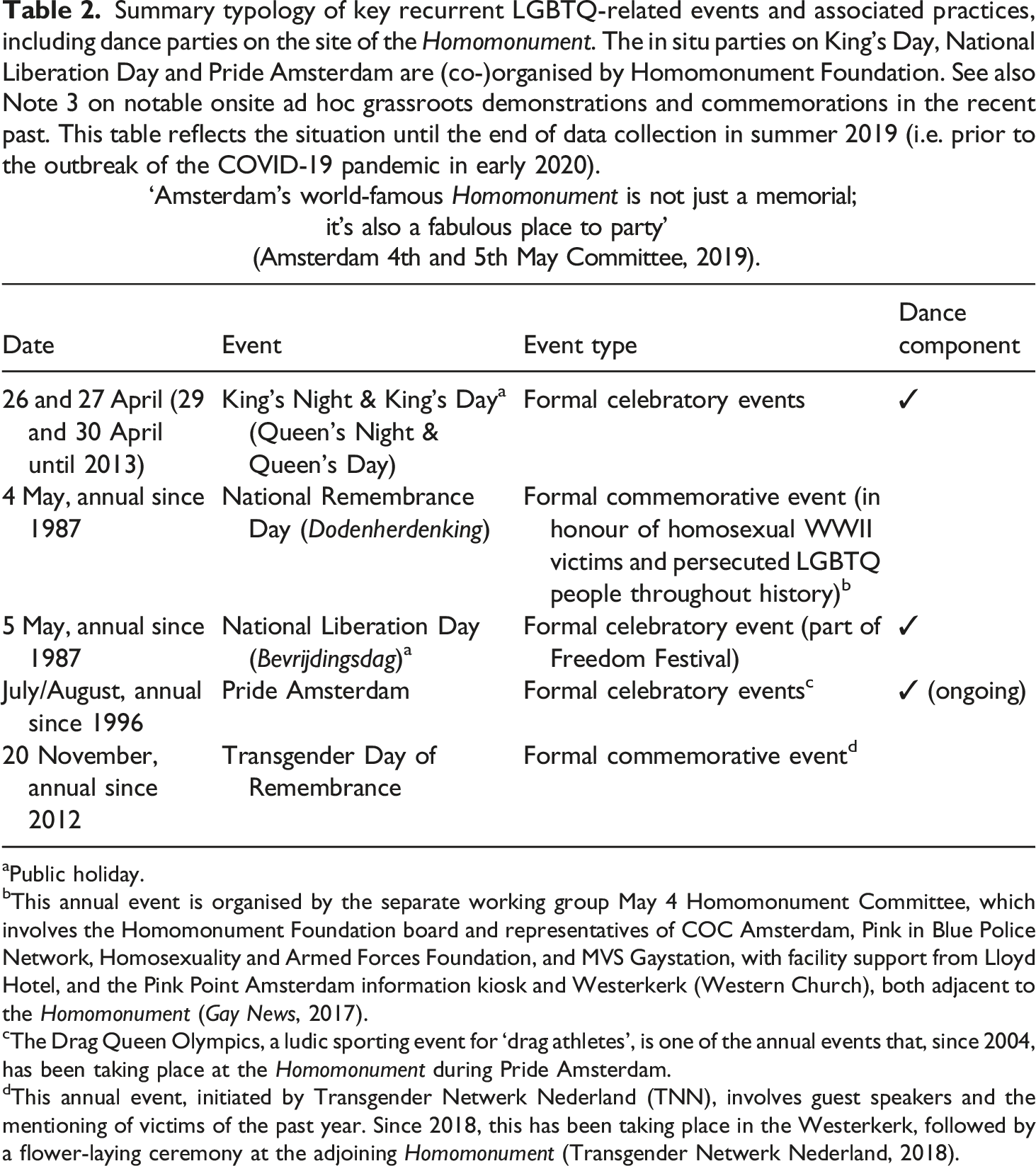
aPublic holiday.
bThis annual event is organised by the separate working group May 4 Homomonument Committee, which involves the Homomonument Foundation board and representatives of COC Amsterdam, Pink in Blue Police Network, Homosexuality and Armed Forces Foundation, and MVS Gaystation, with facility support from Lloyd Hotel, and the Pink Point Amsterdam information kiosk and Westerkerk (Western Church), both adjacent to the Homomonument (Gay News, 2017).
cThe Drag Queen Olympics, a ludic sporting event for ‘drag athletes’, is one of the annual events that, since 2004, has been taking place at the Homomonument during Pride Amsterdam.
dThis annual event, initiated by Transgender Netwerk Nederland (TNN), involves guest speakers and the mentioning of victims of the past year. Since 2018, this has been taking place in the Westerkerk, followed by a flower-laying ceremony at the adjoining Homomonument (Transgender Netwerk Nederland, 2018).
Below we provide a deeper discussion of the politics of inclusion and exclusion that emerge around the social and spatial contexts and uses of LGBTQ-related monuments. We advocate intersectionality (after Crenshaw, 1991) as an epistemological method for ‘queering’ monuments and identifying similarities and ‘otherness’ across social difference, including gender, sexuality and race/ethnicity, specifically within contexts of evolving LGBTQ politics (e.g. Oram, 2011) and queer memory and monumentality (e.g. Dunn, 2017; Zebracki and Leitner, 2021). In particular, we attend to systematic issues of exclusion and marginalisation, as well as resistances thereto.
Monuments and the politics of LGBTQ inclusion in context
Since the 1969 Stonewall riots, activists have significantly shifted the parameters of social, cultural, political and economic inclusion for sexual/gender minorities, with issues of commemoration serving as one key focus of activism. Interest in LGBTQ memory and spaces (e.g. Dunn, 2017; Oswin, 2008; Zebracki 2018), including monuments (e.g. Ferentinos, 2014; Orangias et al., 2018; Zebracki and Leitner, 2021), has developed in parallel with a much broader ‘memory boom’ in many Western cultural contexts (e.g. Stevens and Franck 2015; Stevens and Sumartojo, 2015). A long-standing concern for some commentators relates to language and identity, specifically that sites claimed as ‘gay’ or ‘lesbian’ (or their equivalents in other languages) do not necessarily translate into ‘queer’ spaces that establish scope for transgression, dissidence, resistance or progression (Oswin, 2008).
A key change to memorialisation has been the widening inclusion of minorities that do not embrace ‘gay’ or ‘lesbian’ labels, such as bisexual, transgender and queer people, where specific language uses have been pivotal (Zebracki and Milani, 2017). To varying degrees, formerly gay and lesbian (and then bisexual) activist groups have incorporated transgender issues in their remits (Minter, 2000; Stone, 2009). Consequently, these groups have provided a more inclusive purview in their organisational names, mission statements, working areas, public engagement, magazines, events, and so on to attract new, and wider, audiences (Valentine, 2007).
Geographies of ‘LGBTQ’ organising: What’s in a name?
The ‘LGBTQ’ acronym, encompassing the historically more recent term ‘transgender’, has been ‘successful’ in becoming institutionalised, as Valentine (2007: 34) critically remarked. The use of identity-based language/terms as part of politics that draw sexual/gender minorities into societal mainstream culture might be indicative of ‘strategic essentialism’ (Spivak, 1993). Pande (2007: NP) rendered the latter as an advocacy trick, ‘provisionally accepting essentialist foundations for identity categories as a strategy for collective representation in order to pursue chosen political ends’. This is compatible with Duberman’s (2018) idea of ‘normative inclusion’ that questions the degree to which the ‘gay’ movement has ‘failed’ in this regard.
Terminological revaluations have manifested in a number of name changes of Western organisations working with/around sexual and gender minorities (e.g. Devor and Matte, 2006; Ring, 2016), providing important context for situating the Homomonument. Van der Ros and Motmans (2015) argued that some gay and lesbian organisations – feeling that political and legislative successes had paradoxically decreased their relevance – took up transgender issues in part to reclaim their social and political relevance (and secure continued funding).
As noted above, the oldest existing LGBTQ organisation and advocacy group in the world, founded in 1946, is the COC, a Dutch initialism for Cultuur en Ontspanningscentrum (‘Centre for Culture and Leisure’). In some ways, this name conceals the organisation’s specific fight for gay and lesbian emancipation. In 1964, the name evolved into Nederlandse Vereniging voor Homofielen COC (‘Dutch Association for Homophiles COC’), which thus provided a gay emphasis. COC’s further broadening scope was reflected into its 1971 name change into Nederlandse Vereniging voor Integratie van Homoseksualiteit COC (‘Dutch Association for Integration of Homosexuality COC’) (Hekma and Duyvendank, 2011a). Since 2017, the organisation has been working under its legal name Federatie COC Nederland (‘Federation COC Netherlands’), shortened COC Nederland (COC Nederland, 2017).
COC’s focus on the integration of homosexuality into a dominant (and sometimes hostile) heteronormative society has evolved over time. Since the 2000s, COC started emphasising the acceptance of any ‘non-heterosexual’ relationship or union, and, in 2012, formally committed to fight any form of gender-based discrimination (Bakker, 2018; COC, 2019a). Davidson (2020) argued how this indicated COC’s move towards public policy goals alongside efforts to produce legal and cultural change. The latter saliently illustrates the politics of inclusion within a current ‘post-gay’ sensibility that rejects an emphasis on singular identity strategies (Ghaziani, 2011).
The term ‘queer’, either in addition to or as a variant of the word LGBTQ, has gained a foothold in such ostensibly post-gay era (Ghaziani, 2011; see also Callis, 2014; Giffney, 2009). ‘Queer’ has operated in complex ways: as an identity descriptor, or critical alternative to LGBT (note without Q), but also as a profound disposition challenging the use of identity categories altogether (Zebracki, 2020). Hence, there lurks a paradox in incorporating an anti-essentialist term such as ‘queer’ into a list that is so strongly based on identity markers.
Relatedly, some organisations discarded identity terms, notably LGBTQ. For example, similar to the umbrella organisation COC Netherlands, the local branch COC Amsterdam revised its mission statement without referring to any specific identity categorisations (such as lesbian, gay, bisexual, transgender or, for that matter, queer). Instead, this branch opted for a more general way of referring to people of all sexual orientations, gender identities and expressions, and sex characteristics, that is, SOGIESC (COC Amsterdam, 2017).
Similar to how existing organisations adapted to expanding gay and lesbian activism, we identify a widening politics of inclusion and exclusion that revolves around our case on monuments for sexual/gender minorities. More than a decade after the inaugurations of the Homomonument and Gay Liberation Monument, new monuments were created. Most of them were no longer aimed exclusively at gay men and lesbian women but at all sexual and gender identities. Key examples include the 2005 Sexual Diversity Monument in Montevideo in Uruguay and the 2006 Walk of Sexual Diversity in Rosario, Argentina (see Orangias et al., 2018). Similarly, the Homomonument Foundation adjusted its mission statement to communicate the message that the Homomonument should serve as inspiration source for the entire ‘LGBTQI+ (lesbian, gay, bisexual, transgender, queer and intersexual) community’ (Berends, 2018).
Aligned with strategic essentialism (Spivak, 1993), some sexuality scholars (e.g. Alexander and Yescavage, 2003; Murib, 2014; Stone, 2009) expressed critique of gay and lesbian organisations’ efforts to deliberately add letters (i.e. T, Q, I, etc.) to the LGB acronym. They criticised how transgender people and other sexual/gender minorities became submerged into a sexual politics based on a monolithic understanding of ‘the LGBTQ community’. These scholars flagged the use of this term as tokenistic (see also Duberman, 2018); that is, a superficial statement that merely enacts a commitment to inclusivity and diversity towards the outside world. Valentine (2007) suggested that such ‘letter adding’ could be understood within wider contexts of neoliberal commodification and commercialisation of ‘diversity’. This would promote a ‘rainbow economy’ in disguise (Valentine, 2007) and an instrumentalisation, or misappropriation, of diversity culture (Ward, 2008a). Also, social and economic male dominance (Knopp, 1990) has traditionally seen its footprint in a prevalent pink, that is, gay economy, or even a ‘global homocapitalism’ (Rahul, 2015).
Here, we are cautious in adopting the notion of ‘global’. It might produce a new reductive ‘global norm’ of practices that would detract from the distinct fracturedness and complexity of such practices in their social and geographical contexts. The same caveat holds, after Schotten (2016), for using homonationalism as a one-size-fits-all critique of ‘global’ politics and international relations (Puar, 2007), as it assumes homogenous rights and practice frameworks in neoliberal discourse. As Schotten (2016: 358) argued, ‘reshuffling of definitional elements results in homonationalism becoming a shorthand moniker for a particular form of gay identity politics wherein linear, stable, universalizable gay identity forms the primary basis of one’s political commitments’. We, therefore, advocate for nuanced insights into the social and spatial complexity, or ‘messiness’ of LGBTQ politics and practices, ranging between local, national and international levels.
Furthermore, in the 1990s, transgender activists were generally smaller in numbers and lacked the organisational structures – compared to established gay and lesbian organisations and lobby groups – to allow themselves a strong political voice and enhance their visibility in public memory/commemoration. From transgender activists’ perspectives, it was strategically important to align with these organisations to share the fight against heteronormative discrimination, prejudice and social injustice. In so doing, they became part of the same, already established, institutions, networks and gendered structures (Murib, 2014; Stryker, 2010).
Nonetheless, transgender, lesbian, LGBTQ bicultural and people of colour (POC) and queer activists (e.g. Whitfield et al., 2014) have been running the risk of becoming marginalised through joining gay-dominated movements and their cisnormative, white (and hegemonic masculine) environments (Eguchi, 2009; Furman et al., 2018; Stone, 2009; Ward, 2008b). Accordingly, such LGBTQ environments, as indicated above, are often governed by cis gay male priorities. These priorities are not necessarily congruent with evolving priorities of other minorities or marginalised interests within LGBTQ spaces, particularly those of transgender people, as discussed.
Furthermore, lesbian activism has led to separatist branches within both women’s and LGBTQ movements (Van Dyke and Cress, 2006). This has channelled academic interest and spatial practices that have pushed beyond concerns with heteronormative and cis gay male priorities in different social and geographical contexts, such as lesbian placemaking in NYC (Gieseking, 2020; see also Browne, 2020), lesbian women in occupational segregation in the US (Tilcsik et al., 2015) and compulsory marriage in queer public culture in India (Dave, 2012).
Visibility and recognition
Issues around visibility and recognition are particularly intensifying in debates about how to commemorate, and establish space for, sexual and gender minorities (Castiglia and Reed, 2011; Gieseking, 2016; Gorman-Murray and Nash, 2016). These debates render queer politics of inclusion as an activist commitment to creating (more) public visibility of such minorities as key pathway to heighten their recognition including formal rights – though such processes do not follow uniform patterns (Dunn, 2017; Mekler, 2018; Zebracki, 2020). Material monuments, and events such as Pride parades (in a sense performed, ephemeral monuments), can act as important vehicles to lend visibility to – or otherwise efface – minority interest within a sexual or gender minority (Zebracki and Leitner, 2021). Therefore, a cautious approach is warranted to engaging sexual/gender minorities through material heritage (i.e. monuments) and processes of commemoration, given the risks of tokenism, commodification and misrecognition.
The particular invisibility and misrecognition of transgender people in the Dutch context is not unique, given how transgender issues have played a marginal role, or have been underplayed, in gay and lesbian movements elsewhere (Davidson, 2015; Pearce et al., 2019). Minter (2000) strikingly captured ‘trans erasure’ in gay rights movements ensuing from the Stonewall riots. Trans people played a crucial part in this watershed, largely deemed the birth of a modern ‘gay’ movement. Minter (2000: 595) argued how the gay community often claims transgender people as their ‘ancestors’, yet stridently denies them as contemporary kin.
Similar exclusionist practice and discourse reveal in everyday ‘blatant racism’ (Jones, 2016) and intersectional disenfranchisements (across dynamic patterns of class, age and gender, amongst others). This happens in contexts such as urban planning and public services (e.g. Doan, 2015), LGBTQ mobilities and neighbourhood transition (e.g. Gorman-Murray and Nash, 2016) and LGBTQ organising and activism (e.g. Ward, 2008a), where LGBTQ POC in particular face adverse impacts (Irazábal and Huerta, 2016). Moreover, for the Dutch context, Boston and Duyvendak (2015) argued that the putative Dutch ‘gay tolerance’ is so closely tied to (naïve) imaginations of secularism in the minds of people, that being religious and being gay-tolerant – and especially being a gay Muslim in a migrant context (see also El-Tayeb, 2012) – allegedly denotes a contradiction in terms.
We find it important to stress here that social identities should not be regarded as monolithic categories. Rather, critical social scholarship (e.g. Battle and Barnes, 2006; Collins, 2019; Crenshaw, 1991) has construed identities as being persistently, and uniquely, moulded through historical and geographical idiosyncrasies, social fluidities and power hierarchies – which trouble and reject static, uniform or ‘straightjacketing’ identity conceptions. Similarly, Nash (2011) conveyed the nuance that intersectionality, as an idea and practice, should not be interchanged with Black feminism, as it, as ‘a historically contingent concept’ (445), is precisely ‘a product of [B]lack feminism – rather than a synonym for [B]lack feminism’ (445).
Experiences of exclusion ‘from within’ LGBTQ communities have also translated to commemorative contexts, including monuments for sexual/gender minorities. For example, Wilke (2013) critiqued patriarchal dominance in the Berlin-based Memorial to Homosexuals Persecuted under Nazism (opened in 2008). Lesbian people were deemed as absent interlocutors and excluded from leading positions in the commissioning and design process of this memorial. Regarding the Homomonument, Zebracki’s (2017) exploration indicated a gay male bias: ‘the labels of “homo”/“gay” preclude sexual identity markers other than “(male) homosexuals” in the monument’s naming and Amsterdam’s “Gay Capital” strategy’ (352). Again, this can potentially produce the monolithic understandings of ‘one’ sexual/gender minority.
A further example is provided by two queer activists, a white and Latina immigrant, who in 2015 blackfaced two standing male figures part of the Gay Liberation Monument in NYC, casting criticism of white cis dominance in the commemorative context of the Stonewall riots. The placard the activists attached to the sculpture read: ‘Black + Latina trans women led the riots – Stop the whitewashing’. In an interview with Autostraddle (2015), the activists recounted that ‘we painted them because Marsha P. Johnson, Sylvia Rivera, Miss Major, Storme DeLarverie and all the other Black and Brown people who led the [queer liberation] movement deserve credit for their courage and strength. What we did was rectification, not vandalism’. While George Segal’s oeuvre, including the Gay Liberation Monument, is known for the use of white castings (Summers, 2003), this should not refrain from ‘re-reading’, or queering, the ways in which sexual/gender minorities are (not) represented in such public art (Zebracki, 2019).
The ‘LGBT’ label (without ‘Q’) became common policy jargon in the Netherlands. Nevertheless, social and racial differences among sexual/gender minorities have been de-emphasised and internal diversity has not been much implemented in practice (Boston and Duyvendak, 2015). So, this is not at all the picture of an inclusive spectacle associated with the rainbow (Valentine, 2007). As Boston and Duyvendak (2015: 142) claimed, ‘equality, rather than the celebration of difference, became the main goal’.
The normalisation of homosexuality in the Netherlands, according to Duyvendak (1996), translated into a certain de-politicisation of a ‘gay’ identity. This had been reflected in state responses and public sentiments, inhibiting the development of pronounced ‘queer’ activism. For instance, gay communities played a vital part in managing the devastating HIV/AIDS crisis in the Netherlands in the 1990s (Mepschen et al., 2010). Yet, this did not lay the groundwork for the development of a Dutch queer politics (Duyvendak, 1996), in contrast to the US context (Castiglia and Reed, 2011).
Wide Dutch social and political acceptance of homosexuality resulted in the world’s first same-sex/‘gay’ marriage in 2001. This led many to believe that gay and lesbian emancipation and recognition were completed (Hekma, 2002, 2004), implicating what Hekma and Duyvendak (2011b: 629) described as the ‘Dutch ambivalence’ towards LGBTQ emancipation. These scholars argued how ‘they’, that is, gay people, have prided themselves on what they have achieved; however, they have largely, and conveniently, looked away from struggles and systemic oppression of other sexual/gender minorities, so the critique went. The question that, in our case, emerges is how the Homomonument – through the lens of dance parties as situated social practice – adapts to a dynamic queer community within the context of the Dutch urban capital.
Methodology
This intensive case study on the Homomonument primarily draws from observations and in-depth interviews conducted between 2018 and 2019 (following an institutionally approved ethical protocol ensuring confidentiality and the research participants’ anonymity). These methods enabled us to immerse ourselves in the everyday uses and key actors’ experiences of the Homomonument and its site. The first and second authors are Dutch natives familiar with the local and national LGBTQ contexts. This background facilitated participant observation and purposeful snowball sampling of key actors (n = 68) in LGBTQ organising and cultural life with particular regard to the Homomonument (Table 1).
As conveyed above, the annually organised parties on the site of the Homomonument provided a context for engaging issues around the politics of inclusion and exclusion. Janssens conducted participant observation in numerous key events in the first three quarters of 2018, including Remembrance and Liberation Day (4 and 5 May, respectively), and Pride Amsterdam (28 July–5 Aug 2018), in which Zebracki jointly participated. Beyond formally organised events, grassroots initiatives including LGBTQ gatherings and ad hoc initiatives were attended, too. Moreover, Janssens volunteered at Homomonument Foundation, providing opportunities to experience first-hand uses and ‘vernacularities’ regarding the Homomonument from the inside out.
Ongoing thick description (Banks, 2001), drawing on first-hand observations and the above conceptual background, together informed the interview process. The first and second authors conducted in-depth interviews with actors (listed in Table 1) who were key to gaining an in-depth understanding of the topic. A semi-structured interview format was adopted, a method that allows the introduction of aspects perceived as cognitively and emotionally relevant to respondents (Bryman, 2012). The below synthesis of prompts is indicative of the types of questions asked during interviews: Personal connection: What is your relation to the Homomonument and to what extent is it important to you? Can you describe what you did during your last visit or at an event here? Has your idea of this monument changed over time? Locational meaning: To what extent is the Homomonument important to the city? What place associations conjure up when you think of this monument? How would you like to see it improved? Social issues: For whom is the Homomonument? And for whom not? Can you describe any recent conflicts concerning this monument? What role has it played in local LGBTQ life?
The interviews were predominantly conducted in Dutch, transcribed verbatim (the majority in Dutch and translated where appropriate) 2 and then discursively analysed for emerging themes regarding key concepts as discussed previously. This process involved manual thematic coding, aided by computer-assisted qualitative data analysis software (i.e. NVivo). The interview analysis pursued the tenet of reflexivity, rather than representativeness, to provide a fair reflection of how perspectives related to each other within the research community (see Bryman, 2012).
This study carried the limitation that we had to primarily rely on participants’ self-reports, that is their lived experiences as they were relayed to us (i.e. representations). We nonetheless reflected on these relayed experiences with reference to our own lived observation-based data. The discursive analysis of the interview and observational data was further triangulated (Flick, 2004) with textual analysis of archival documents, mainly retrieved from the Amsterdam-based international IHLIA LGBTI Heritage archive. We have also collected first-hand materials from individuals who were at one point involved with the Homomonument, including meeting minutes, media coverage and photographs. Moreover, photo elicitation (Rose, 2012) supported lively engagements with the topic in interview settings, which were usually conducted remotely from the monument’s site at venues preferred by the study participants.
Qualitative sample and reflections
At this stage, we want to provide a critical reflection on the composition of the interviewees (n = 68) as presented in Table 1. Whilst acknowledging that participant categories might overlap, our research community covered (a) key actors involved with LGBTQ contexts of Amsterdam and the Homomonument across professional and organisational capacities (n = 19); (b) political/municipal actors (n = 6); (c) LGBTQ activists (n = 26); (d) creative and cultural actors (n = 6); and (e) two local focus groups: one with an intergenerational LGBTQ discussion group (n = 5) and one with an LGBTQ student association (n = 6), both of which included members of the public. Participants, amongst others, ranged from original to newer Homomonument Foundation board members, with ages ranging from people in their twenties to their sixties (a third of all informants were in their forties), and from visitors to the Homomonument to those without any disclosed affinity with it (and, for some reason or another, do not purposively visit it).
Our shared positionalities have guided the ‘queer’ study approach and facilitated the sampling of study participants, including hard-to-access LGBTQ populations. We attempted to cover the full spectrum of the LGBTQ ‘rainbow’ (Valentine, 2007). Notwithstanding, a level of self-selection was involved, as those who were less interested in the monument were potentially less willing to participate in a formal interview. In that regard, it was perhaps not entirely unexpected that, based on self-completed demographic charts, the vast majority (n = 52) of the research community identified themselves as gay (either men or women) and eight participants as straight. More than half of the participants described themselves as cis man (n = 37), three as trans man and three as non-binary. The interviewed, self-identified straight people included professionals working on themes such as gender equality and representatives of organisations surrounding the Homomonument. Four people considered themselves as bisexual and four as queer.
The above is, evidently, a somewhat rough classification. Some informants would resist being pigeonholed into any identity category, especially those with a disclosed queer disposition. The latter issue bespeaks methodological challenges encountered in queer methods and social science research more widely: basically, who and where are LGBTQ people and how can they be identified or ‘mapped’? (Compton et al., 2018; Ghaziani and Brim, 2019). That said, it was important to understand to what extent our sample provided a fair reflection of the LGBTQ population (whilst remaining aware of its incoherence) and that it not merely involved those already holding privileged positions. Despite our recruitment efforts, interviews with trans women were, unfortunately, not secured. They appeared to occupy leading positions in local transgender organisations at the time of research. Although several trans women expressed interested in this study, they could not procure time to participate due to campaigning and other activist commitments (see Lombardi 2018 on trans-inclusivity in social research).
Furthermore, we have navigated the role of whiteness in examining the politics of inclusion and exclusion as well as our white positionalities in the research process (including recruitment, interaction with participants and data interpretation). This asks for vigilance (Applebaum, 2013) and stepping out of the comfort zone, thereby taking a proactive stance and being cognisant of vulnerabilities in the pursuit of building critical, non-hierarchical collaborative knowledge (Haig-Brown, 2001; Roegman, 2018).
Access to informants beyond this study’s identified overly white actor network was challenging. We actively approached POC (a 10th of the sample) and people with a migrant background (a little over a 10th of the sample is born outside of the Netherlands to non-Dutch parents). Moreover, we purposefully included people from various religious backgrounds, such as Islam, Judaism and Christianity. Given the small numbers in the sample, the imparted experiences and opinions of the minority study participants cannot be simply extrapolated to the entire population of interest.
Difficult-to-reach LGBTQ populations do provide a much-needed voice in scholarship wherein they are still often silenced (Compton et al., 2018). We would, nevertheless, like to be upfront about this study’s limitation of how the (albeit heterogenous) qualitative sample consists of many people in privileged positions, straddling high-profile figures and professionals in local policy, creative sectors, community organising and activism. They displayed the time, energy, resources and abilities to participate and appeared to hold the cultural capital to engage with the study topic – either assenting to or critical of the Homomonument as a politicised social space. Consequently, their voices/language on the pages of the analysis echo this.
Vignette I: A ‘living monument’
This section demonstrates how the Homomonument derives its meaning, and social significance, in Amsterdam’s LGBTQ population as a ‘living monument’, most notably as a place to party but also as a gathering place at other key moments. Below, we seek to deepen the understanding of the Homomonument as a socially produced space, stretching beyond strictly commemorative uses, symbology and verbiage associated with traditional monuments (Ferentinos, 2014; Stevens and Franck, 2015; Zebracki and Leitner, 2021).
One of the key informants is local cultural entrepreneur Avery (cis man, 50–59 years, homosexual). Over the last decades, he has been profoundly involved with Amsterdam’s LGBTQ life, especially through his roles as former Homomonument Foundation board member, manager of an important LGBTQ night-time venue and performer at major events, including parties on the site of the monument, still to date. Avery stressed parties as crucial context for understanding the Homomonument within Amsterdam’s social LGBTQ fabric. As noted earlier, parties are regularly organised on the monument’s site and particularly well-attended on national commemorative dates and holidays (Table 2). Avery emphasised the monument’s design features that would facilitate large gatherings and provide a public home space for the LGBTQ population: The most special part of the Homomonument is the fact that it occupies the entire square. You actually have an entire square where you can organise festivals, and not, like in many places, just a small thing on a wall or something. (Avery)
These words resonate with scholarly engagements with social affordances of materiality, that is, public artwork (e.g. Massey and Rose, 2003; Stevens and Franck, 2015; Zebracki, 2012, 2020). Features, such as size, locality, tactile properties, and temporality versus permanence of the object, set a ‘range of registers’ for possibilities for, but also limitations to, social engagement (Massey and Rose, 2003).
From the outset, the organisation of the parties has been a central element of how the Homomonument is ‘lived’. Yet, key informants, such as Avery, argued that the organisation considered it a challenge to entice gay and lesbian people, the initially targeted audience in the 1980s and ‘90s. Given the monument’s physical distance from other important gay venues, such as bars and clubs, the monument was not directly on their ‘itinerary’, as local expert Hekma (1992: 94) noted. Moreover, in a city without a distinct ‘gaybourhood’ (see Ghaziani, 2014), Blake (local cis man, 60–69 years, homosexual), an influencer and former Pride Amsterdam board member, observed that there was no evident place for gay and lesbian people to party during national holidays.
Contrary to many other queer monuments (see Orangias et al., 2018), the Homomonument, although a combined war and ‘gay’ monument as indicated before, does not exclusively function to commemorate a sole ‘gay’ event/epoch (notably the persecution of homosexual people during WWII and sexual and gender minorities in the world ever since). Also, it was not situated in a locale that held particular meaning for the urban gay and lesbian community. For the Homomonument to indeed become a ‘gay monument’, and ‘gay space’ by extension, it had to claim its place in the city (see Bartels, 2003; Hernández, 2010; Zebracki, 2021). That said, this would not guarantee that it would turn into a ‘queer’ space, as in a transgressive or progressive vein (see Oswin, 2008; Zebracki, 2017).
Blake anecdotally conveyed that a reporter for the local gay radio station understood the Homomonument as a key marker from its early days. In a joint effort to raise awareness of this monument and attract a wider radio audience, this reporter pulled a 300-m-long cable across the canals. This cable followed the trees from the radio studio all the way through to the Homomonument to deliver a live report on the festivities at this monument on the then Queen’s Day in April (renamed King’s Day since 2014), one of the important Dutch national holidays. This reporter and others organised an annual party at the Homomonument on this anniversary onward. This later expanded to a series of what have become equally popular parties at this monument on Liberation Day in May and Gay Pride in August, redubbed Pride Amsterdam from 2017 to emphasise wider sexual/gender diversity and inclusivity (see Table 2).
Over the years, the parties at the Homomonument became a focal point for particularly local gay and lesbian people. Our sample of interviewees widely suggested that the monument’s site became a (or the) place for finding other gay and lesbian people beyond their personal networks. The parties at the Homomonument started providing a new social arrangement, and spatial rhythm, to gay and lesbian life in Amsterdam. Such parties, thereby, transcended private gay and lesbian bar/club life into the public realm, as explained by Cameron (local cis woman, 30–39 years, homosexual), a current Homomonument Foundation board member and volunteer at Homomonument-based parties: I definitely think that if you look at the parties in Amsterdam, it’s fair to say that the Homomonument is the place where everyone comes together and where everyone is visible. In the city, people are much more scattered over particular places. This [monument] is really special. (Cameron).
Although we challenge the general assumption of inclusivity in the following vignette, this informant indicated how the Homomonument has established itself, especially around the yearly parties, as an important place to hang out among local gay and lesbian people. Also, the monument has become a site of choice for grassroots gatherings and activism. For example, the day after the mass shooting at Orlando’s LGBTQ nightclub Pulse in Florida, US, 12 June 2016, a spontaneous solidarity gathering and vigil was organised at the Homomonument as tribute to the victims. ‘Nobody needs explanation’, Blake pointed out, as people naturally think of this monument as the place to gather, he asserted. Dakota (local cis woman, 60–69 years, homosexual), a senior LGBTQ activist since the Homomonument’s introduction to Amsterdam, was unambiguous about this point: I think that whenever something needs to be done from within the LGBT community – whether it’s ad hoc, a call for action, or something that takes a bit longer to organise – and it has to take place somewhere, they’ll choose the Homomonument. (Dakota)
More than three decades after the Homomonument’s incarnation, interviewees’ narratives largely endorsed secondary perspectives conveying that this monument has positioned itself on the mental map of the ‘non-heterosexual other’ (e.g. Coenraadts, 2017; Zebracki, 2017, 2021). In 2018, as a formal acknowledgement of the Homomonument’s value for sexual/gender minorities, the City of Amsterdam listed it as protected heritage site. This has contributed to its self-proclaimed denomination/image as an ‘LGBTI-friendly city’ (Gemeente Amsterdam, 2018). Nevertheless, in the next vignette, we critically engage with the extent to which the social reproduction of the Homomonument, seen through the lens of the annual parties, lives up to the inclusivity that such designation might lead us to believe.
Vignette II: Inclusive versus exclusive encounters
‘An eighteen-year-old girl next to a sixty-year-old leather man’
Along with the local gay liberation movement, evolving into LGBTQ activism as we know it today, the Homomonument and its site segued from a gay and lesbian space into an LGBTQ, or, for some (depending on perspective), queer space. This section examines how concerted efforts of the Homomonument Foundation and allies – whom we found particularly active in the local, left-wing activist scene – to diversify their onsite parties have produced experiences of an inclusive space (whilst having some clear limitations, too).
Well before the emergence of transgender activism (not to be confused with transgender activists, who existed well before the ‘90s), the monument’s initiators appeared to be sensitive to gendered power imbalances in the gay and lesbian community. They insisted that the founding board consisted of at least as many (cis) women as men (Koenders, 1987: 30). At the monument’s inauguration, the city’s then main theatre hall’s director extended a warm welcome to ‘all the ladies and gentlemen, boys and girls, men and women, and everything in between’ (de Volkskrant, 1987). Karin Daan, the Homomonument’s designer, envisioned it as a place for everyone: We are here, undeniably, strong and beautiful, but not elitist and not on a pedestal, integrated into the colourful fullness that we call society. It is our proud sign, our monument, with which we can identify, where we remember and protest, where we can meet and come together, but it also means an invitation to everyone: all of Amsterdam can own it. (Daan, 1989: 199–200)
Cameron, the aforementioned informant, involved as a volunteer in the organisation of the parties, explained that ‘the goal of the Homomonument [i.e. parties] is to make sure that nobody will ever be excluded’. She argued that this should be the case regardless of sexuality or gender alone, but also age, ethnicity and class including ‘people who don’t have so much money to spend’ – thus resonating with a spirit of diversity. Cameron conveyed that, when she started volunteering, she realised that the parties attracted an audience in a relatively older age range, where she put a caveat: That’s a good thing, that they [i.e. older people] are still coming to our parties, but if it remains like this, it will fade away. [We] brainstormed about it: how can we get younger people to come to the Homomonument, while at the same time not putting off the older generation? And so we did in a very pragmatic way: by altering the programming of the parties … The gay community also thinks in categories, and this is something that disappears completely at the Homomonument. Here you’ll see an eighteen-year-old girl next to a sixty-year-old leather man, and they walk hand in hand. Everything is coming together, and that’s really special: everyone can feel at home here. (Cameron)
On that note, Eden (cis woman), member of the Homomonument Foundation, added: We [now] have young people behind the bars, but also, you know, we ask the people on stage to play the music of yesterday, with a beat of today. You know, it shouldn’t go too loud. It has to be accessible to everyone. (Eden)
This informant intimated a desired intergenerational, and, in a broader sense, diverse place of encounter. Eden explained how the organisation has been proactively inviting a varied body of performers at the parties. Thereby, it has tried to facilitate wider and deeper interactions amongst different groups, and subcultures, within the LGBTQ population. Dakota, the aforementioned LGBTQ activist and visitor to the Homomonument of the first hour (who vividly remembers its inauguration, but who has not taken part in organisational activities around it), acknowledged this view: ‘I think that people are being involved in many different ways ... How exactly, I don’t know, but I do see [now] that there’s a bunch of different people’ (Dakota).
The latter was also echoed by Finley-Grey (trans man, heterosexual), a municipal diversity officer and involved in the organisation of the yearly Transgender Day of Remembrance. Finley-Grey argued how this commemorative event was moved from another main city square, Leidseplein (one of Amsterdam’s busiest squares), to the Homomonument at Westermarkt. This was precisely because the organisation contemplated the parties, growing in attendance, as successful in engaging a diverse mix of people across the LGBTQ population. Finley-Grey also suggested how this site, as a pre-empted ‘gay’ space, played a role in this: ‘when the discussion on the alphabet soup started, we realised that we’ve more in common with the gay community than with the people at Leidseplein’.
Avery, the aforementioned key entrepreneur, indicated experimental room for pushing the boundaries of sexual/gender norms (and what is considered acceptable) as an important dimension of the parties at the Homomonument. In Avery’s view, therefore, the Homomonument can be viewed as a transgressive, or ‘queer’, space (see Hernández, 2010; Zebracki, 2017). A local public figure in his sixties, Hayden, self-identified as queer and non-binary (using his/him pronouns), argued how his participation in parties at the Homomonument fostered him to come to grips with his ‘queer’ identity, chiefly through fashion and performance. Hayden recalled how, for the first time in his life, he felt completely free and safe and how dancing on the Homomonument helped him to lower his guard and be comfortable to express himself as he desires: as a ‘gender surprise’.
Transgression (see Oswin, 2008) is an elastic term and should be put in temporal perspective, as Avery signalled with an arresting example. In the ‘90s, he argued, it was already challenging to organise a modest sexual diversity information stand at one of the annual parties to visibilise marginalised minorities within the LGBTQ population. In more recent history, sexual preferences generally hidden from public view, were more prominently put on display. This was strikingly the case in 2004 when the Amsterdam Gay Pride organisers created a tent, or makeshift darkroom, right behind the Homomonument during the Pride event, where people could engage in sexual activities (Figure 2). In this sense, a ‘gay’ space was ‘queerly’ transgressed into a sex zone. Avery, who called it a ‘black lounge’, submitted: ‘it didn’t really work out quite well, but it was great fun!’ Darkroom installation at the Homomonument, Amsterdam Gay Pride 2004. Photo courtesy of research participant (Avery).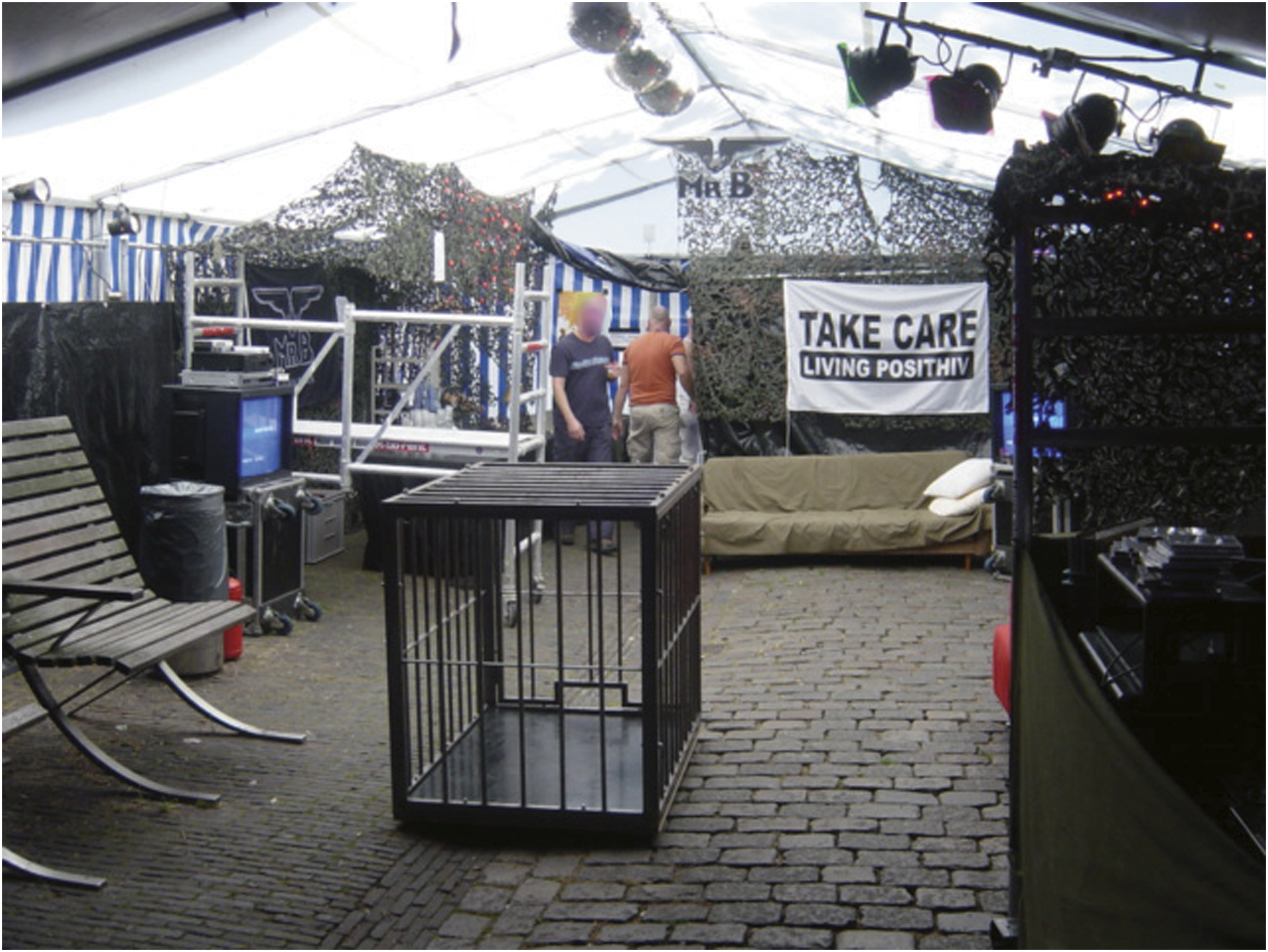
‘Not my style’
The key figures running the parties at the Homomonument engaged in a discourse of inclusivity that emphasised their continuous endeavours to make the monument into an inclusive space and experience. However, in this section, we explore some of the disjunctures between discourse and everyday practice that have become evident when speaking to a wider range of Amsterdam’s LGBTQ population. We reveal how certain groups, in particular Black, trans and bisexual people, often feel excluded from contexts of such parties. Above all, this happens through apparently innocent, albeit significant, decision-making processes, such as choices for music and catering including food and drinks. These reportedly reflect certain socially conditioned norms and dominant (white) positionalities within the organisational context.
Indigo, a local self-identified Black queer woman (20–29 years), questioned an oft-heard claim of the Homomonument as a place for everyone. When she is told by white gay and lesbian people that the annual Pride does not have to do with racism, that this topic is out of place and not ‘their problem’, she feels especially excluded: If I, as a Black woman, am not included in certain things, how can the monument be for everyone? I think that the idea is that it’s for everyone, but I don’t think that everyone feels it’s for everyone. (Indigo, emphasis in speech)
This respondent illustrates what Duberman (2018) called a ‘normative inclusion’ of ‘everyone’. Indigo explained that too much stress is laid on the emancipation of cis white gay men (and, to a lesser extent, lesbian people) or cis white people more generally. The organisation, according to her, fails to see an intrinsic connection with racism and other forms of exclusion (see Battle and Barnes, 2006; Crenshaw, 1991). She contended: The Homomonument means a lot to the gay emancipation movement in the Netherlands, but if you ask me, a Caribbean woman, how I see myself, and how I position myself within this gay emancipation: I don’t see myself represented in this struggle, in this history. (Indigo)
Such feeling of exclusion amongst POC has given force to processes of self-exclusion (see Duberman, 2018). The latter manifested when Indigo and others, after a violent attack of a Black gay man in Amsterdam in 2018, organised a joint commemorative march and protest in this city, which deliberately avoided the Homomonument: We did think about the Homomonument, it crossed our minds, but all of us, together, felt that we had no connection to the monument at all. Unanimously we said: we just have nothing to do with that monument. (Indigo)
This experience is significant, because the Homomonument, as discussed above, is often construed as the obvious place to protest and mourn collectively, such as what happened after the aforementioned Orlando nightclub shooting. Beyond some ad hoc protests
3
, Indigo moreover did not express a sense of belonging at parties in situ: The Homomonument – [it’s] not really my thing. You know, the music, it’s very much trance and house, and that’s not my style of music. That’s one of the reasons that I don’t go there. I like urban, hip-hop, Caribbean music … There’s not much for me there. And apart from the music, it’s also a particular community … It’s a specific group of gay people, mostly white. That’s not necessarily a problem, but white people like to listen to dance, trance and more. I don’t like dance and trance, so only for that reason alone I don’t feel at home. Regarding the group that rules there, I think, well, I don’t really feel at home also. (Indigo)
Although matters such as the choice of music might seem trivial, they can, at least for our research participants, be significant in terms of participation and creating a sense of an inclusive atmosphere. Jules, a local self-identified Black gay woman with Caribbean roots (30–39 years), revealed a similar experience. Not only the choice of music but also the type of drinks provided at those parties, especially beer, feels exclusionist as they are reflecting a white, ‘Dutch taste’ in her perception. In Jules’ view, Dutch Caribbeans would rather prefer ‘hip-hop music and rum’ (a rhetoric carrying the risk of essentialism though).
Another empirical thread is the issue of male (socio-economic) dominance, an ongoing scholarly area of concern (e.g. Knopp, 1990; Zebracki, 2018). Such dominance has been reportedly working through in the context of parties and within LGBTQ organising and community development more widely. Kamari, a Caribbean-Dutch Black woman (40–49 years, homosexual), similarly observed that the parties on the Homomonument primarily cater to younger, white, gay men and that they hold privileged roles in the organisational settings of the parties, too. It is important to note here that the board of the organisation that underpins the parties at the Homomonument – who are undoubtedly enthusiastic, hard-working volunteers – was entirely made up of white, cisgender people at the time of study.
Kamari indicated that such a form of institutionalised privilege reinforces greater white (gay) male visibility at the cost of displaying a much richer diversity of the LGBTQ population. She emphasised how ‘lesbians and other minorities feel less safe in this public space’. In a similar vein, Lennox, a self-identified white bisexual man in his thirties who participates in the Netherlands Network of Bisexuality, expressed an experience of profound exclusion and a shared disconnection with the dominant LGBTQ, or in a stricter sense, gay community. The appropriation of a monument that centres on such exclusive identity markers, that is, non-straight but gay, is, according to him, less attractive to many bisexual people. Therefore, similar to Indigo’s story concerning POC, Lennox imparted that the Network for Bisexuality would not consider the Homomonument a designated place for organising any of their events.
Milan, a white gay man involved in the organisation of the yearly parties, acknowledged that when they seek helpers to work behind the bars, they primarily attract white young cis men and women. On the other hand, he explained that they have a hard time finding enough volunteers in the first place, so they are ‘just happy’ with anyone who can help out: It could be more mixed, more diverse, I think … like more colour. At the moment, it’s not really representative [of the LGBTQ population]. But I’m not going to put a lot of effort in that … I did write to Trans United, but I didn’t hear back from them. (Milan)
Noel, a local white, non-binary activist in their fifties revealed an ambiguous contrast in this respect. They contemplated the Homomonument (i.e. its material design) as a ‘queer intervention in normality’, challenging the lack of inclusivity, and therefore the ‘queerness’, of the parties organised: They [i.e. the parties] don’t put down an explicit ‘queer’ thing. They are [i.e. the monument is], in essence, queer – like, the marble is queer – but the parties are absolutely not. … Well, I think the parties are pretty bad … they’re quite conservative. (Noel)
That said, Oakley, a white woman (40–49 years, homosexual) who works at an LGBTQ-related knowledge institute, expressed scope for potential change in this regard: People of colour, or the more kind of queer people, start getting involved with the events … I think that the organisation could perhaps be a bit more proactive in reaching out and, next, being prepared to organise the parties in a different way, under other conditions, and with different people on stage. (Oakley)
Concurrently, Oakley argued that this should be a two-way movement: ‘you could shout on the sidelines: “it should all be different”. But you can also say: “well, perhaps I should become a board member, or perhaps I should sign up as a volunteer”’. Jules reverberated similar sentiments from her positionality, acknowledging that she had not directly spoken out about her concerns to the organisation: I’m not sure if they are open enough, if they really make an effort to include other groups, but by the same token, I wonder: did we speak up? … I’ve actually never considered sending them a letter saying: ‘well, I miss this or that’. (Jules)
According to Kamari, the Homomonument, in its primary social uses, should be more diverse, more than just about the yearly parties, music and dancing. She, therefore, advocated a stronger role for the commemoration and involvement of diverse minority groups (and the structural challenges they face on an everyday basis): It should be more in balance, and that will also keep it alive … For certain people within the LGBT community, the parties are just that: parties. They could also take place somewhere else … You’ve got the monument, and it’s very special that we have such a place, so how can we add a deeper layer? Please let the parties continue, but also make it a more significant place. (Kamari)
What’s in a name? ‘A dynamic monument’
In this final empirical section, we reflect on the issue of language in relation to the Homomonument, and specifically how its name is implicated in how the monument is perceived as an inclusive as opposed to an exclusive space. Upon its conception in the ‘70s, Homomonument was a seemingly obvious name for a commemorative art piece designated for gay and lesbian people. In contrast to English, where the word ‘homo’ is still often considered as a deeply pejorative way to refer to someone who is ‘gay’ (GLAAD, 2019), this word is (still) very common in Dutch. Phoenix, a white trans man (50–59 years, heterosexual) with an intimate knowledge of the local LGBTQ scene, explained that when the monument was proposed, the word ‘homo’ even sounded petty bourgeois. As a statement, he imparted that activist groups would explicitly refer to themselves as potten en flikkers (Dutch for dykes and faggots), which has a more radical connotation.
Various respondents informed that there had never been any genuine discussion in Amsterdam about changing the monument’s name, because many people – in particular people identified as white, cisgender gay or lesbian – do not regard it as a descriptive name. As Quin, a white gay man (40–49 years) who is active in Christian LGBTQ organisations, conveyed: ‘I think it’s accepted as a proper noun. I’ve never heard people say: “it should be called LGBT Monument”, so people accept it as a given name’
4
. This view resonates with Robin, another white gay man in his fifties who is a local activist and an editor for a journal dedicated to HIV-positive men: I hope that they will not change the name to ‘LGBT Monument’, because it really just is ‘Homomonument’ … Nowadays, it [i.e. the monument] is also used for intersex or trans people, or people who aren’t gay. (Robin)
Phoenix considered it an activist imperative not to pursue a more generic name like ‘monument for sexual diversity’ – a name favoured by some other informants, including Kamari referenced above. Considering that ‘homo’ is yet still the most widely, inconsiderately used swear word in Dutch schools (van der Hulst, 2014), this would make the name even stronger as a kind of badge of resistance. The monument’s designer is aware that times have changed and that the name, for some, has become outdated: ‘it can’t just be called “homo” anymore, we’re supposed to say “L-G-B-T-I”, but that doesn’t sound nice’. However, the designer informed us: ‘this also covers everything: we all know what it’s about, and we all know that it includes everything’ (emphasis in speech).
However, others, especially non-white and non-cisgender people amongst our sample, including Kamari and Phoenix, observed a general reluctance to change the monument’s name as an unwillingness to be truly inclusive. According to Kamari, Homomonument refers to gay and lesbian people only. Phoenix, who used to attend the activities at the Homomonument as a lesbian person before his transition, says that he does not relate to the word ‘queer’ – nor does he feel comfortable with the word ‘homo’: ‘I still like women, so I’m a heterosexual trans man’. If the monument is conceived of as a living monument, like the organisation behind it claims, it should also adapt to new situations: You just notice that many people don’t feel represented. It remains one-dimensional, while it could, or should, be much more dynamic. That’s the beauty of it: it should be a dynamic monument. (Phoenix, emphasis in speech)
Conclusion: A gay monument in queer times
Drawing on a unique qualitative dataset, this article has provided an empirically-grounded critique of the politics of inclusion and exclusion at Amsterdam’s Homomonument, one of the world’s best-known ‘queer’ landmarks. Our study has particularly stressed the importance of moving beyond a discussion of iconography and aesthetics towards a mode of analysis that considers monuments as evolving sites around which diverse forms of practice coalesce. This form of analysis allows us to both more clearly see how exclusions can be enacted in relation to monuments, but also to glimpse opportunities for change.
The article has contributed an understanding of how queer monuments (Orangias et al., 2018; Zebracki and Leitner, 2021), and queer monumentality (Dunn, 2017), are enacted through the practices that come together around them. This case study has particularly focused on the politics of – and, accordingly, participants’ political language regarding – the inclusive potentials and limitations of the Homomonument. This case has been seen through the unique lens of dance parties as situated social practice, and their associated organisational practices. The analysis of insiders’, and bottom-up, perspectives on the Homomonument calls attention to the prospects for, and challenges to, expanding inclusive experience. The organisation behind the key parties has been aiming for the monument to be a space inclusive of all. Through their programming, the parties have attracted a crowd that, to some degree, is multigenerational, that is, blended younger and older audiences. In some ways, people across different social backgrounds and cultures do mix at the Homomonument in the common perception of the organisation concerned. As the analysis has shown, for some more marginalised groups within the LGBTQ population, the Homomonument is the only place where they feel completely safe.
At the same time, others reportedly felt excluded from the Homomonument in the organisational context of the parties. We have demonstrated how some POC felt excluded through everyday decision-making, such as choice of music and catering provisions including food and drinks at the parties. Moreover, our analysis has demonstrated how trans and bisexual people noticed how the monument-based events are still substantially focused on gay men and lesbian women, failing to recognise their privileged positions within wider LGBTQ communities (see Cohen, 1997). Furthermore, the resistance of primarily white cis men and women to changing the name ‘Homomonument’ is perceived by some as reinforcing patterns of exclusion. Queer-positioned people in our sample recognised in this resistance an effort by privileged groups within the LGBTQ population to maintain the status quo, while the society around Homomonument has changed significantly since its inauguration.
The study’s qualitative sample mainly consisted of professionals, policymakers and activists, where POC and people with a migrant background were particularly difficult to access. This brought to light that, to some degree, there was some talk about certain minorities rather than with them – at levels of both social practice and the research process/interaction on its own. Hence, the exclusionary social reality that was the subject of critique has somewhat manifested itself, too, as a critique of our research reality. We simultaneously render this ascertainment as a limitation and lesson of the study data.
Our analysis of inclusive LGBTQ spaces that several key informants have challenged is precisely at the heart of wider academic debates on ‘queering’ normative geographies (e.g. Browne and Nash, 2010; Oram, 2011; Zebracki 2020). As Oswin (2008: 91) put it, such debates challenge ‘equations of queer space with gay and lesbian (and much less frequently bisexual, transsexual and transgendered) space and the maintenance of a heterosexual/homosexual binary upon which such problematic notions of queer space rely’.
At the time of fieldwork, the entire organisation behind the Homomonument was composed of white cis men and women, who had typically drawn from their (i.e. like-looking/-minded) networks when organising events. A prevailing discourse has been constructed that the Homomonument is for everyone, that the parties are welcoming to ‘the LGBTQ community’ in full and that the word ‘homo’ in the monument’s name also applies to bisexual, transgender and queer people. This form of discourse shows evidence of what Baumann and Gingrich (2004: 25) called a ‘grammar of encompassment’. Translated to the Homomonument as a socially, and discursively, practised place, this implies a process of drawing in and incorporating ‘others’ (transgender and bisexual people and POC) as part of the self (LGBTQ community). This might thereby effectively appropriate and subjectify the ‘other’. The ostensibly inclusive formulation that the Homomonument is for everyone and that its name refers to the entire LGBTQ community enacts, following Valentine (2007: 176), its own form of exclusion (see also ‘normative inclusion’ in Duberman, 2018).
Orangias et al. (2018) argued that ‘queer monuments combat systemic transphobia, biphobia, and homophobia in public space to enliven the margins’ (2018: 710). There is little doubt that these monuments have played an important role in LGBTQ liberation movements. However, there is also a need for research to recognise: (a) the limits to these monuments’ inclusivity both in terms of representation and practice; and (b) the challenges that monuments ‘set in stone’ can pose as the emphases and imperatives of LGBTQ activism continue to evolve. In Amsterdam, the Homomonument, despite concerted grassroots efforts, continues to be understood by many segments of the LGBTQ population as a place to party for an emphasised gay and lesbian community. As such, there is a risk of ‘romanticising’ monuments as queer spaces when, both in representation and practice, they can become implicated in enactments of various forms of normativity and exclusion.
This study has recognised the nuanced differences between monuments in a material sense (the ‘brick’) and the actual practices on them – as well as the discourses that are socially constructed around them. Bricks do not have sentiments, they do not commemorate and they also do not include. We therefore call for further research that focuses less on the symbolic qualities of monuments and more on how they are practised socially. Our research calls for comparative inquiry into the complex relationship between the material affordances of monuments and forms of social engagement with such affordances. By approaching LGBTQ monuments as socially practised places, research might provide critical insights into specific inclusions and exclusions that this relationship entails. Such an approach might add to the study on how (more) inclusive sexual and gender visibility, recognition and participation can be understood, and is set in motion, under geographically differentiated conditions.
Footnotes
Acknowledgements
We would like to thank the research participants for their invaluable time and insights. Moreover, we are grateful to the anonymous reviewers and editor Travis S. K. Kong for their helpful comments on an earlier version of this article. Thanks also go to Megan Waugh for help in constructing  . Any errors remain our own.
Declaration of conflicting interests
The author(s) declared no potential conflicts of interest with respect to the research, authorship, and/or publication of this article.
Funding
The author(s) disclosed receipt of the following financial support for the research, authorship, and/or publication of this article: This study is part of the project Queer Memorials: International Comparative Perspectives on Sexual Diversity and Social Inclusivity (QMem) , supported by funding from the Arts and Humanities Research Council (AHRC) under Grant AH/P014976/1.