




Abstract
Despite International efforts by NGOs and social movements to protect lesbian, gay, bisexual, transgender, queer, and intersex (LGBTQI) people in Africa, they still face injustices, stigma, and discrimination. This study uses an assemblage approach to analyze narratives collected through interviews with LGBTQI individuals in Nairobi, Kenya about the daily strategies they use to navigate the tensions between their need for livelihood security, personal safety, and their gender and sexual identity. The study employs the analysis of daily experiences to discuss how contexts and preferences interact with internal sexual identities and choices for external expressions of sexual identities.
Keywords
Introduction
Lesbian, gay, bisexual, transgender, queer, and intersex people, rights and discrimination in Kenya
In Kenya and other sub-Saharan countries, gender and sexual minorities are often viewed as social deviants (Mucherah et al., 2016). Kenya is among 76 nations that criminalize private consensual same-sex relationships, risking arrest, prosecution, and imprisonment. Derived from British colonial law, the Kenyan Penal Code forbids sexual acts “against the order of nature” (sections 162) with a 14-year prison term (section 163), and 5 years for “gross indecency” between males (section 165). While Kenya recognized intersex individuals as a third gender category in 2022 (Kisika, 2022), legal gender recognition remains challenging for transgender individuals. Changing names and gender markers in identity documents is possible but often difficult and costly (Human Rights, 2018). The effects of these difficulties are exacerbated when identity documents must be presented, increasing the risk of revealing a misalignment between registered gender and gender expression (Human Rights, 2018), exposing individuals to the risk of harassment and arrest, and impeding their inclusion in society (Thirikwa, 2018). These laws also foment threats and abuse against actual and perceived LGBTQI individuals, as the state offers little protection against violence and discrimination (Finerty, 2012). Although primarily targeting same-sex relations, these laws harm other gender minorities as well (Thirikwa, 2018) and lead to organized violence in crime-ridden urban areas beyond police control (Thirikwa, 2018).
Over the last decade, East Africa has witnessed increased moral panic over LGBTQI rights (Mutua-Mambo, 2020). Western conservative Christian groups support the backlash against LGBTQI rights in African countries, while many Africans perceive homosexuality as un-African and a Western imposition (Mutua-Mambo, 2020). LGBTQI rights are often portrayed as conflicting with traditional African values (Mutua-Mambo, 2020); however, homophobic attitudes and laws against same-sex sexual acts have colonial origins dating back to the 19th century (Thirikwa, 2018). Western calls for tolerance have sparked a parallel movement against LGBTQI rights in Africa (Mutua-Mambo, 2020; Pindi, 2020).
Kenya has a long history of state-sponsored discrimination against LGBTQI people (GALCK, 2016). Religious institutions significantly influence public discourses on sexuality and same-sex relations (Jäckle and Wenzelburger, 2015). Religious and political leaders in Kenya coordinate attacks on LGBTQI communities, resulting in violence against gender and sexual minorities (HRW, 2015). Kenyan churches often use homophobic rhetoric in sermons to gain popularity with congregations. The Kenyan Human Rights Commission reports that LGBTQI individuals face harassment from state officials, physical violence, death threats, social stigma, and false arrests due to their sexual orientation or identity (Finerty, 2012). There are also cases of “corrective” rape of lesbian women (GALCK, 2016), and a study by the Kenyan Human Rights Commission found that 89% of respondents who “came out” or “were outed,” were disowned, subjected to psychological therapy, expelled from schools, or dismissed from jobs (Finerty, 2012).
The marginalization of LGBTQI people results from multiple factors. A study in three Kenyan cities revealed that 30% were evicted by family upon revealing their sexual orientation, and 60% relocated after neighbors discovered their sexual identity (Baraza, 2016). Research suggests that LGBTQI individuals experiencing violence are prone to mental health challenges, particularly when lacking emotional support (Jauregui et al., 2021). Members of the LGBTQI community often avoid critical health services due to the criminalization laws (Harper et al., 2021), adversely impacting public health, especially HIV/AIDS prevention and treatment (Shangani et al., 2022). Fear of discrimination from health workers deters many LGBTQI individuals from seeking essential medical care (KHRC, 2011). The absence of protection against gender and sexuality-based discrimination and violence is increasingly recognized as a global public health threat (Müller et al., 2021).
Uncovering lesbian, gay, bisexual, transgender, queer, and intersex individual’s choices in a Kenyan context
LGBTQI identity categories have played a vital role in highlighting sexuality issues on national and international policy agendas (Segal, 2008). However, they have also faced criticism as Western constructs of sexual identity, not necessarily applicable to all settings and cultures (Ahmed, 2017). Conversely, research indicates that multicultural, multifaith LGBTQI individuals are increasingly interested in uncovering their histories and heritages as part of global decolonization practices (Pallotta-Chiarolli, 2016). For them, cultivating a compound identity and a sense of belonging is tied to understanding historical, pre-colonial, religious, and cultural biographies (Pallotta-Chiarolli, 2016).
The social dynamics of gender and sexual minorities in Kenya are complex (Mutua-Mambo, 2020). For instance, the Kiswahili term “shoga,” refers to gay or homosexual individuals and is commonly used to describe same-sex relationships (Onyango-Ouma et al., 2009). Some individuals self-identify as “shoga,” while others find it offensive, and yet others use it derogatorily (Beyrer et al., 2013). To understand these dynamics, it is essential to explore the historical and contemporary experiences of LGBTQI community members (Mutua-Mambo, 2020). Sexual identities are intertwined with contextual factors such as race, socioeconomic status, and other social situations (Pindi, 2020). In the past decade, there has been increased scholarly interest in LGBTQI African migrants, primarily focused on how governments and NGOs fail to provide safety and legal protection from discrimination and harassment (Marnell, 2023). Simultaneously, LGBTQI individuals in sub-Saharan African urban areas rely on informal economic networks to survive, often running parallel to macro-level legal and political strategies to improve their lives (Tucker and Hassan, 2020). Understanding how these informal spaces influence LGBTQI individuals’ livelihoods and opportunities is crucial. Instead of collapsing urban locations into binary categories such as public/private, safe/dangerous, or progressive/conservative, researchers could focus on the nuanced “different shades of queer visibility,” to grasp how LGBTQI individuals navigate safety and well-being in diverse spaces (Marnell, 2023).
Crenshaw (1989) proposed an intersectional framework to study how various social characteristics interact in daily life, leading to vulnerabilities in certain situations. Three insights enhance the understanding of marginalization in daily life: (a) individuals belong to multiple social groups, (b) memberships in social groups are not fixed and may change over time and in different places, and (c) different social positions regulate access to different forms of power (McCormick-Huhn et al., 2019). To improve the daily life of gender and sexual minorities in Kenya, we must explore how oppression is rooted in economic, cultural, social, and political structures (Pindi, 2020). Moreover, these analyses should be grounded in an African and Kenyan context, acknowledging diverse daily experiences (Pindi, 2020). Local NGOs are working to establish informal networks for documenting LGBTQI people’s experiences, raising awareness of the need for organization, representation, and participation in public debates to affect change (KHRC, 2011). Kenyan human rights advocates, such as the National Gay and Lesbian Human Rights Commission, are actively engaged in pursuing legal reforms concerning the right to legal gender recognition for trans and intersex individuals. However, additional research is required to support ongoing advocacy for greater LGBTQI community inclusion in Kenyan society (GALCK, 2016).
This paper aims to analyze how LGBTQI individuals in Nairobi, Kenya, navigate the intersection of their sexual identity with their need for safety and security. To achieve this objective, we combine qualitative data with an assemblage theory-based analysis to address the following questions: • What comprises the “lived experience” of LGBTQI individuals in Nairobi? (encompassing the various forces influencing their narratives, livelihoods, and well-being, including environmental, embodied, and external factors). • How is “lived experience” felt within a body, between bodies and across different spaces? • Within the context of assemblage analysis, how does “lived experience” territorialize and de-territorialize sexual identity?
An analysis grounded in assemblage theory enhances our understanding of LGBTQI individuals’ experiences in Nairobi by revealing how various assemblages, including spatial, societal, cultural, and emotional elements, interact to shape daily life for LGBTQI individuals. This perspective allows us to appreciate the complexity of their experiences, the tensions between feelings of othering and belonging, and the role of fear and resistance within Nairobi’s LGBTQI community assemblages.
Assemblages, sexuality, and lived experiences
An assemblage approach, anchored in Deleuze et al.’s work (1987), aims to elucidate social complexity by emphasizing multiplicity, fluidity, and change, thus avoiding essentialism (De Landa, 2006: 26). In this perspective, entities are assemblages of non-fixed, historically contingent, heterogeneous components that occupy a spectrum between material and expressive (De Landa, 2006: 12). These entities can be observed at various scales, from individuals to communities and cities, each composed of non-stable and non-fixed heterogeneous components that form a relationship of exteriority. As such, “assemblages emerge from the interaction between their parts, but once an assemblage is in place, it starts acting as a source of limitations and opportunities for its components” (De Landa, 2006: 21). These processes of components detaching from assemblages, and (re)attaching to others are referred to as territorialization/de-territorialization processes, fundamentally altering and reconstituting organizational contexts.
Drawing on the work of Linstead and Pullen (2006), Fox and Alldred (2013), and Braidotti (2011), we explore the concept of sexuality-assemblage, examining the linkages between the concepts of “multiplicity,” “becoming,” and “rhizomatic.” Our primary analytical lens focuses on gender as “simultaneous intensive multiplicity” (Linstead and Pullen, 2006: 1289) which is a term describing the “different processes at work within an apparently integral body” that leave an immediate and lasting mark and lead to a “complex of often contradictory feelings” (Linstead and Pullen, 2006: 1289). As such, “becoming” is not viewed here as a linear process of change towards an end state (Linstead and Pullen, 2006: 1289), but as “encounters that engage the subject at the limits of the corporeal and conceptual logics already formed and so bring on the destabilization of conscious awareness that forces the subject to a genuinely creative response” (Lorraine, 1999: 182). Thus, becoming represents a context-specific change that defines individuality of a “day, a season, a year, a life” (Deleuze et al., 1987: 262).
To understand the relationship between “becoming” and “multiplicity,” we employ the metaphor of a rhizome. Unlike the linear root system of a tree, a rhizome, as defined in botany, connects any point to any other point (Deleuze et al., 1987: 21). In an assemblage analysis, Deleuze et al. (1987: 7-13) use the rhizome metaphor to understand connectivity, heterogeneity, multiplicity, and fluidity within environments, signifying multiple entry points and analytical possibilities (Deleuze et al., 1987: 7-13).
The concept of sexuality-assemblage, as described by Fox and Alldred (2013) emerges as a concept that ascends from a critique of social science approaches that essentialize sexuality, sometimes strategically, to promote emancipation and equal rights. Fox and Alldred (2013: 771-772) argue that these essentializing accounts, useful as they are, de-emphasize the interactions of relations that “produce specific capacities for action and desire.” Rather than using sexual differences to emphasize oppression, discrimination, and exploitation (Käll, 2006), sexual assemblages build on the concept of nomadism (Braidotti, 2011) to express the multiple configurations, experiences, contexts, and meaning of sexual differences as they intersect with other axes (Braidotti, 2011; Fox and Alldred, 2013; Käll, 2006). Nomadism expresses how people navigate freedom and necessity differently across different contexts to express themselves in the world (Braidotti, 2002). We employ this concept to analyze the differences between LGBTQI individuals and others, among LGBTQI individuals themselves, and within LGBTQI individuals as they negotiate their daily lives in Nairobi, within assemblages that include their sexuality, religion, the city, employment, cultural norms, institutions, behaviors, etc.
For Deleuze and Guattari, “all social production emerges rationally as entities affect each other, and form the consequent capacities and desires deriving from these relationships” (Fox and Alldred, 2013: 772). Through this lens, the focus on sexuality shifts away from individual bodies towards an “affective flow within assemblages of bodies, things, ideas, and social institutions which produces sexual capacities in bodies” (Fox and Alldred, 2013: 769). “Affect” is viewed as a relational processual force replacing the notion of human agency (Fox and Alldred, 2013: 772) influencing the flow of capacities across elements like human bodies, objects, ideas, and scripts (Sanders and Lyons, 2022). A sexuality assemblage becomes an organization of affective flows shaping societal codes, customs, and individual conduct in relation to sexuality (Alldred and Fox, 2015; Linstead and Pullen, 2006). It is the assembled relationality between bodies, things, and social formation analyzed through the affective flows that “forces shifting bodies and other relations from one mode to another” (Alldred and Fox, 2015: 908).
These affective flows that organize relationality are referred to as processes of territorialization, which, within a rhizomatic model that allows for multiplicity, implies that processes of de-territorialization probably occur elsewhere in the environment (Deleuze et al., 1987). The capacity to affect and be affected results in fluid processes of becoming linked to the multiplicity of available repertoires. Sexuality assemblages enable the examination of affective flow as it “bridges ‘macro’ and ‘micro’, private and public, intimacy and polity.” Such an analysis helps us understand the diversity of individual sexual capacities produced in bodies and the “forces that may highly territorialize sexuality into very limited manifestations” (Fox and Alldred, 2013: 766). Instead of focusing on the constraints imposed by social institutions on individual behaviors as suggested by Anthropocentric sociology, the sexuality-assemblage approach proposes an Anti-humanistic sociology perspective, focusing on the “territorialization of nomadic sexuality by molar cultural relations” (Fox and Alldred, 2013: 777).
Methodology
Research design and participant selection
The study followed a qualitative design to explore the lived experiences of LGBTQI people as they negotiate their daily experiences balancing their sexual identity against security and safety in Nairobi, Kenya. The intention was to uncover social patterns and their meanings (Lune and Berg, 2017), but also contextualize events illuminating the range of relations comprising assemblages and affective flows (Fox and Alldred, 2013).
Conducted in Nairobi, the capital city, which boasts a relatively prominent LGBTQI community with visible advocacy groups, the study recruited its participants exclusively from this community through an NGO dedicated to advancing sexual health rights. Participants were deliberately selected to represent a spectrum of LGBTQI identities, ensuring diversity of experiences and preventing overrepresentation or exclusion of any specific subgroup within the LGBTQI community.
All participants in this research did so anonymously and were informed not to use their real identities. Consent forms with information about the study were shared in advance. All participants read the consent forms before interviews and agreed to participate in this research. Participants were selected according to the following criteria: • Aged 18 and above • Voluntary and informed willingness to participate • Self-identification as LGBTQI community members
Data collection methods
Pseudonyms, sexual, and gender identity of participants.
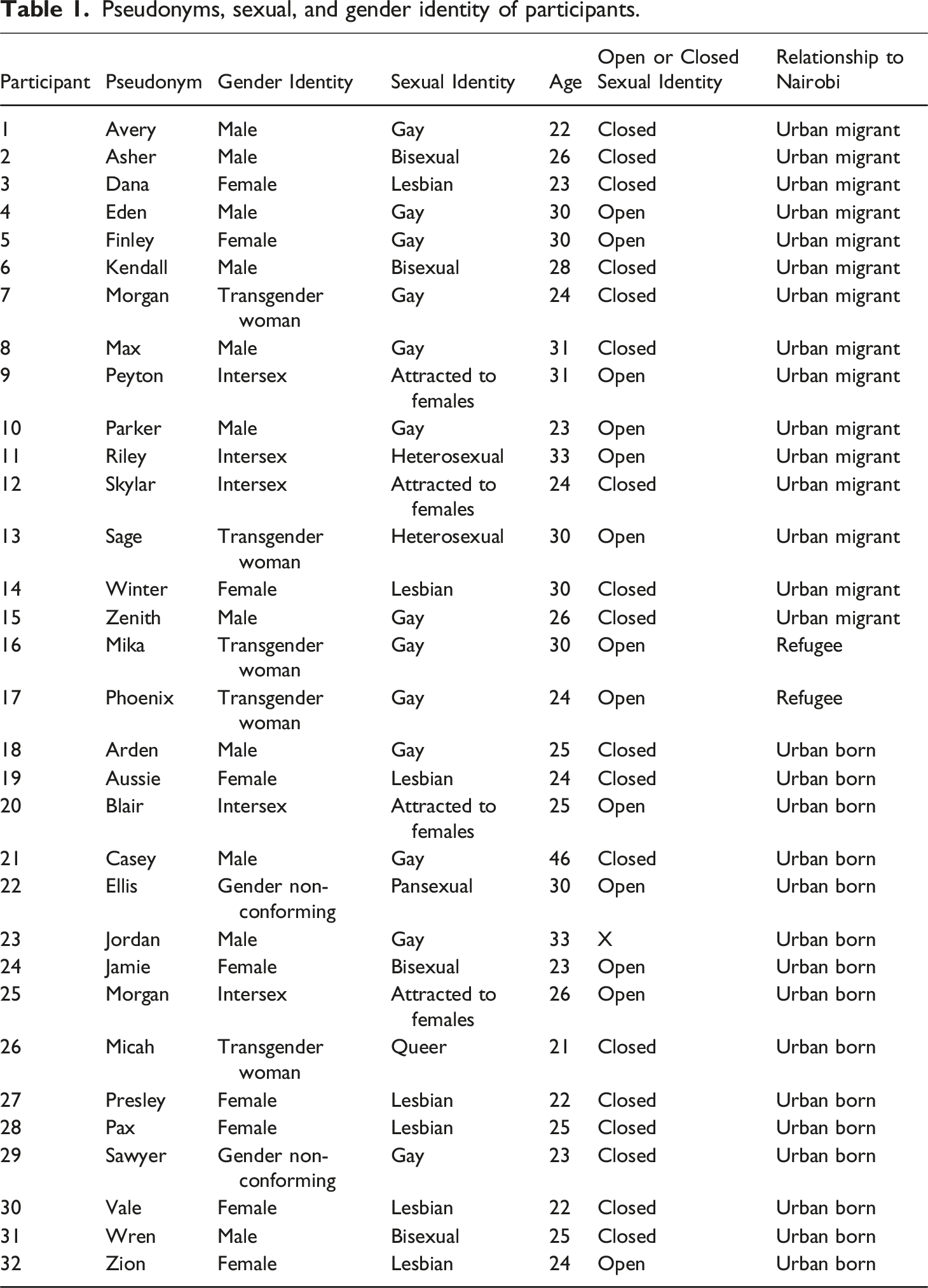
Data was collected through online semi-structured interviews and online focus group discussions (FGD). The interviews (32) and FGD (2) provided comprehensive insights into various social phenomena, including topics such as sexual identity, gender identity, professional, and social experiences in Nairobi, and linkages between daily experiences and sexual identity. The goal was to flesh out the significant relationships assembled around sexual identities, behavior, the environment, contexts, and the capacities and strategies to negotiate varied daily experiences. Due to the COVID-19 pandemic, interviews were conducted online.
Analysis process
To conduct a meaningful assemblage-based analysis, we not only identified emerging narrative categories but also explored their entanglement and impact on the strategies used by LGBTQI individuals in their diverse daily contexts through a thematic approach (Braun and Clarke, 2006).
Initially, we identified and examined three entangled spectrums derived from interviews, serving as analytical tools to understand the complex factors influencing LGBTQI individuals in Nairobi: (1) Othering and Belonging Spectrum: Encompassing experiences ranging from societal marginalization to acceptance and belonging among LGBTQI individuals. (2) Visibility and Invisibility Spectrum: Examining strategies employed by LGBTQI individuals to manage their societal visibility, including choices regarding openness about their sexual identity or concealment. (3) Fear and Defiance Spectrum: Exploring the emotions and strategies adopted by LGBTQI individuals in response to societal pressures, spanning from fear and concealment to active defiance.
Subsequently, we connected the daily strategies employed by LGBTQI individuals within these spectrums to adapt to contextual assemblages, reflecting the diverse circumstances and environments encountered in Nairobi. This analytical approach (Alldred and Fox, 2019) provides a comprehensive understanding of the multifaceted experiences of LGBTQI individuals in Nairobi, shedding light on the dynamics of othering, fear, visibility, and belonging within their lived realities.
Findings
In this section, we present data collected from interviews, using the term “spectrum” to denote positions between extremities. These spectrums, interlinked and influenced by contextual assemblages, encompass the interplay of sexual identities, territorialization, and de-territorialization processes. The spectrums range from othering to acceptance, fear to defiance, and strategic invisibility to hypervisibility.
Daily experience within and between spectrums
Daily experiences in Nairobi, like many global cities, serve as a nexus of culture, identity, and politics (Nyairo, 2015). For the LGBTQI community, Nairobi offers both safety and the opportunity to express individual sexual identities in particular spaces (Ombagi, 2019). Outside safe spaces, LGBTQI community members confront overt discrimination and marginalization due to entrenched cultural, religious, and political biases that criminalize LGBTQI sexual behavior (Ganesh et al., 2016). The narratives of respondents illuminate the complex negotiation of safety and risk tied to gender and sexual identity in Nairobi.
Varied experiences in Nairobi between safe and unsafe spaces
Different spaces within Nairobi, such as residential areas, suburbs, social clubs, low-income areas, public spaces, and private spaces offer varied experiences for LGBTQI individuals. Over half of the participants mentioned a relative sense of freedom, using words like “here in Nairobi I can be free,” “it’s normal here,” “there is a little freedom here,” “it’s better than…,” etc. Out of 32 participants, 19 mentioned that compared to other places, some spaces in Nairobi allowed them to feel more comfortable with their sexual identity, even though the city is far from being safe for the community.
In general, suburban areas, especially middle class, or upper-class income areas, were viewed as spaces where “no one will tamper with your lifestyle” (“Kendall,” 28 y/o Bisexual). At the same time, Nairobi harbors significant dangers for LGBTQI individuals. In low-income, densely populated areas with low education levels and limited privacy due to closely packed buildings, LGBTQI individuals faced reduced tolerance. These areas allowed little space for diverse views on sexuality or religion, as reported by most participants.
The city’s spatial assemblage significantly influences LGBTQI individuals’ sense of freedom and acceptance. Despite difficulties, certain spaces in Nairobi allow LGBTQI individuals to express their sexual identities and find comfort. This perspective highlights the city’s complexity and its varying degrees of freedom.
Othering and belonging
Safety and danger in Nairobi are closely entangled with expressions of othering and belonging. Othering involves a specific form of rejection that aims to “marginalize, dehumanize, delegitimize, humiliate, and often punish” individuals within the LGBTQI community (Coates, 2022: 94). In this context, “othering” refers to a sentiment expressed in the narratives provided by LGBTQI respondents. We use “othering” as a concept that pertains to how individuals construct their self-identity in relation to others (Johnson et al., 2004).
Participants described feelings of being othered by society through the public discourse about sexuality: “The general public tends to view LGBTQI people like outcasts, people without morals and good habits…” (“Jordan,” 33 y/o Gay). Public discourses characterize LGBTQI individuals’ behavior as a negative “other,” something different or unconventional within Kenyan society. These narratives permeate all public and private settings in Nairobi, including homes, streets, interactions with private and public services, as well as workplace environments. Some participants described how they have been othered by their families facing “stigma and discrimination and rejection from family and siblings once they know your identity as LGBTQI” (“Sawyer” 23 y/o Gender non-conforming). A transgender participant explained: ‘We are even discriminated or abused or even killed by our own parents because of our sexuality so how do you expect a person you don’t know (to treat you), he is not your family he is not your friend to give you a job… no one loves gay people! No one!’ (‘Phoenix’, 24 y/o Transgender).
Participants noted that being othered as LGBTQI individuals in Nairobi contributed to subsequent stereotypes about them, rejection, violent public and private attacks, prejudice, and slurs about their sexuality. However, the extent of othering varied based on the context, with participants acknowledging that not everyone treated them equally: ‘Once someone comes to know you are gay, people differ in how they understand you, as others may find it’s different and nasty treating you like an outcast, while some may be open-minded’ (‘Sawyer’ 23 y/o Gender non-conforming).
Economic capital and tolerance
Some respondents offered nuances to their experiences, explaining that economic capital could sometimes alter the impact of othering: “Your sexuality never becomes a burden when you have money” (“Sage,” 30 y/o Transgender). Some argue that economic capital increases society’s tolerance and acceptance of LGBTQI individuals. Money can help push societal boundaries and garner tolerance: “If you go to a shop with a dress and a beard and you have money, people accept that money” (“Phoenix,” 24 y/o Transgender). This also extended to family dynamics, with participants finding greater tolerance for their sexual identity when financially capable of supporting themselves and others: ‘The relationship with my family right now, what brings us together is when I have money, so if I don’t have cash, we don’t know each other’ (‘Peyton’, 31 y/o Intersex)
Similarly, some individuals exhibit tolerance towards LGBTQI individuals in high-income environments.
Rural versus urban differences
Some urban migrants observed that the experience of othering can differ in rural areas compared to Nairobi. One participant shared her experience of her sexuality becoming public knowledge while attending high school in her rural community. Consequently, she became the subject of local gossip. However, she did not encounter lasting direct harassment, stigma, discrimination, or exclusion and felt her sexual identity was accepted. She attributed this acceptance to the strong community bonds in small rural areas. She believed that in Nairobi, those who condemn her sexual identity would never accept her. In Nairobi, othering is typically expressed by individuals unfamiliar with her personally: ‘Nairobi is urban, it’s not rural. Like some villages to some extent there is some acceptance…because there is a togetherness as a community. When you have togetherness, you feel like you are not the only person who is different from others…’ (‘Sage’ 30 y/o Transgender)
Another urban migrant explained how being othered influenced decisions regarding the concealment of biological body appearances and clothing choices, depending on the physical spaces they navigated throughout the day. Participants observed that in their rural home communities, specific appearances and behaviors would not necessarily link them to an LGBTQI identity, as people there often “do not know and understand why a girl is dressing like a boy and will not discriminate” (“Dana,” 23 years/o Lesbian). Five out of ten urban migrants raised these observations about rural/urban differences, highlighting the contextual diversity in experiences of marginalization.
The role of tradition and culture
Most participants often face portrayals that label them as “devious,” “sinners,” “immoral,” “devil worshippers,” and “perverts” in connection with religious beliefs. Religion, for the majority, played a significant role in the process of othering, as “people are taught to view people from this LGBTQI community as sinners” (“Zion,” 24 years/o Lesbian). Participants believed that religion contributed to perpetuating stereotypes, framing them as a threat to the sanctity of religion, society, and social-religious norms. This religious-based othering led to adverse consequences in terms of employment, workplace relationships, social circles, and family dynamics: ‘People will tell you if you are gay, if you are lesbian, if you are transgender, those are the cursed people in the bible, you know spiritual believers and you know most of the kind of things in Kenya they are so religious directed…so that’s why you see sometimes LGBTQI people who don’t have work, face a lot of stigmas…’ (‘Sage’ 24 y/o Transgender)
Several participants expressed that homosexuality is often seen as a violation of cultural and traditional beliefs, characterized as a curse, taboo, and un-African behavior. Cultural and traditional norms play a pivotal role in shaping societal expectations: ‘People believe that a woman must be married to a man, those cultural and religious beliefs are the ones making us and taking us back.’ (‘Pax’ 25 y/o Lesbian)
Most participants noted that various cultural and traditional beliefs in Nairobi’s diverse population influenced how LGBTQI people were perceived. Despite this diversity, the prevailing sentiment across most cultures and traditions is negative, constraining LGBTQI individuals.
Belonging and strategies of visibility
To contrast othering, we employ the concept of “belonging” as its antonym, denoting a sense of self-identification within specific contexts, as articulated by the respondents. Belonging includes both self-identification and recognition by others (Yuval-Davis, 2006) and has been widely used to elucidate the impact of individuals’ membership or lack thereof in social groups and their position within those groups (Yuval-Davis, 2006). We use the notion of belonging to delineate narratives where respondents employ it as a self-identification marker based on their sexual identity. Additionally, respondents employ explicit strategies to conceal their sexual identity to belong to other groups, typically for social and livelihood security. Visibility strategies represent their approach to negotiating safety and danger in various spaces, intertwined with the dynamics of othering and belonging. Given that LGBTQI individuals face marginalization related to their sexual identity, they are uniquely poised to articulate their individual experiences within their lived realities. Their narratives unveil how cultural, religious, and political structures engender conflicts with their sexual identity, prompting strategies of invisibility in certain contexts and an acute awareness of hypervisibility in others. We link these narratives to the deliberate strategies employed by LGBTQI individuals to navigate their reality. These categories also resonate with research on intersectionality, exploring individual experiences of invisibility and hypervisibility stemming from individuals belonging to multiple marginalized groups (e.g., gender, race, sexual orientation) in various life situations (e.g., Jackson et al., 2022; Purdie-Vaughns and Eibach, 2008).
Visibility and invisibility strategies
Of 32 participants, 13 indicated varying degrees of openness about their sexual identity. They selectively disclosed it in specific spaces and to chosen individuals. For most who remained closed about their sexual identity, societal othering was the primary reason for making conscious choices to be invisible, “to hide their identity to find a job” (“Vale,” 22 years/o Lesbian), and “being discreet” (“Jordan,” 33 years/o Gay) to avoid discrimination and loss of opportunities: ‘I decided to just live a relaxed life just alone. If you are an LGBTQI you should just be quiet and relaxed about your identity don’t go out telling everyone about yourself that you want people to know what you are.’ (‘Wren’ 25 y/o Bisexual)
Several participants employ strategic concealment of their sexual identity from co-workers and employers, with no intention of disclosure. They erected invisible barriers between themselves and colleagues, keeping their true sexual identity hidden. Some regarded it as a personal matter separate from work, while others feared it would jeopardize job security and personal safety. Additionally, many actively concealed aspects of their sexual identity through outward appearances and behavior, leveraging societal gender norms to blend in and avoid detection by colleagues, family, neighbors, and society. These strategies varied across different spaces and contexts: ‘Every day you go to work maybe you are working nine hours and…you must act straight until you get back to your place where you can be safe, and that place is inside your apartment, even on the balcony you are not that safe.’ (‘Morgan’ 24 y/o Transgender)
Some use social media strategically to portray themselves as non-LGBTQI individuals, concurrently maintaining fake social media accounts to express their true sexual identity: ‘Even if they have social media, they will have pseudo-accounts with pictures of celebrities and not themselves so they can hide their identity, so people may not realize it’s them’ (‘Jordan’ 33 y/o Gay).
One respondent stages fake dates with women to give the impression of not belonging to the LGBTQI community. Participants noted that various factors such as biological bodies, physical appearances, attire, jewelry, behavior, modes of talking, walking style, presentation, and personal documentation, heightened their visibility in an environment where they were already subjected to othering: ‘Your dressing, how you portray, maybe your dressing some will judge you about your sexuality. So even dress code…makes someone to judge you…that’s how I take it’ (‘Jordan’ 33 y/o Gay)
Challenges of hypervisibility
When a lesbian woman adopts a masculine appearance or when a gay or bisexual man adopts a feminine style of dress, they become hypervisible and may encounter discrimination, judgmental attitudes, and potential violence: ‘This guy is so feminine even the walking style, dressing code, that guy cannot work in any environment except one that accepts him which is the community.’ (‘Kendall’ 28 y/o Bisexual)
When physical appearances or biological bodies deviate from public expectations based on the gender binary, LGBTQI individuals, particularly transgender and intersex groups within the community, become exceptionally susceptible to adverse attention due to their heightened visibility: ‘When you go to the supermarket. When you go get checked by the security…so me I feel like I am a man, I go to the male security check and they tell me to go to the female side. Then when I go they ask me again to go back. So you see you eventually, I just have to leave and go to shop elsewhere’ (‘Skylar’ 24 y/o Intersex).
An intersex participant recalled having to undress in front of a hospital medical board to access a routine medical report required by potential employer who wanted proof of gender. They also face difficult scrutiny when it comes to their biological bodies and appearances: ‘I cannot pass a place that has a lot of people, because you will usually hear them ask each other “Is that a man or a woman, how does he look”. So you see, you find that at the end of the day you are the one feeling bad’ (‘Skylar’ 24 y/o Intersex).
Transgender, intersex, and gender non-conforming individuals face challenges obtaining personal documents needed for employment and accessing services such as banking, education, medical and rental agreements. Often, the gender markers on official documents do not match their sexual identity and physical appearance. A transgender woman noted that being “employed before, and then after the transition…became hard as the documents say one thing and the person in front of you is different” (“Morgan,” 24 y/o Transgender). Some participants described experiencing violence being “beaten, undressed, and even arrested by police” (“Peyton” 31 y/o Intersex). To introduce modifications to documents to match their sexual identity, they require: ‘…to have a huge amount of money…lawyer who needs money, and (face a) lack of understanding when…(going to)…offices and…sent…back and forth to get you tired’ (‘Sage’ 30 y/o Transgender).
This statement emphasizes that specific factors, such as financial disparities and institutional ignorance, can significantly increase the visibility of LGBTQI individuals in society. This increased visibility frequently results in vulnerability, subjecting them to discrimination and added stress. The combination of financial difficulties, seeking aid, and dealing with bureaucratic systems magnifies the difficulties experienced by LGBTQI individuals, impacting their overall well-being and equitable treatment within society. This process renders LGBTQI people hypervisible and, consequently, more vulnerable.
Some LGBTQI people withdraw from public spaces to remain invisible. Aware of dangers, they conceal their sexual identity or hide aspects of their life that could identify them as members of the LGBTQI community. While some choose to be invisible, hiding their authentic selves to belong, make friends and find jobs, they grapple with internal conflict: ‘I’ll wear jeans, so I’ll force myself to be a man, though it’s not me. Because at the end of the day I need some income, so I’ll force myself, but I’m hurting my soul.’ (‘Mika’, 30 y/o Transgender)
Fear and resistance
Most participants expressed a dominant emotion of fear that guides their behavior. This fear pertains to various aspects, including the fear of physical attacks, being in specific spaces, exposure of their sexual identity, societal judgment, parental and co-worker scrutiny, the fear of othering, and the fear of hypervisibility. Personal safety is the foremost concern, shaped by their own experiences and knowledge of others in the LGBTQI community facing violent attacks, public insults, and harassment.
In some low-income areas, participants felt monitored by others in their own private spaces. Living in low-income areas with partners became a source of anxiety when neighbors began to pry and ask questions, especially in shared bathroom situations where privacy was scarce.
Only seven participants disclosed their sexual identity to their employers or co-workers, with five of them working for LGBTQI community organizations. Most participants in this study harbored fears of being othered at work or losing their jobs if their sexual identity became known. Some experienced anxiety at their workplaces, especially after hearing homophobic comments from colleagues and employers: ‘…they were talking about how homosexuals are like, the topic was how he cannot stand a sibling neither a family member nor friend who is a homosexual because of his belief and how he sees those people, he thinks there is some kind of demon that has possessed them, I was thinking why should I work here’ (‘Sawyer’, 23 y/o Gender nonconforming).
Fear significantly influenced strategic decisions regarding employment, prompting some to leave their previous jobs. In various work environments, fear of LGBTQI individuals is present, with some people believing that being gay is contagious.
Instances of active defiance as a strategy to counter othering were scarce. Fear overwhelmingly dominated the daily experiences of LGBTQI individuals, and this fear was well-founded, as open displays of their sexual identities are often met with violent and sometimes fatal reactions. One respondent, who was strategically open about their sexual identity, actively engaged in efforts to communicate and educate about the LGBTQI community through an organization. Their openness served as a response to othering, aiming to identify safe spaces for LGBTQI people as a means of emancipation from fear.
“Once we identify these areas with LGBTQI persons, one we start with the chief then we go to the police to create awareness about LGBTQI persons, then from there people are free to move and life continues” (“Riley” 32 y/o Intersex).
Another respondent, who also advocates for LGBTQI community rights openly through an organization said: ‘I feel I still have my power, I still have my voice, I still exist like other people because I don’t face stigma and discrimination at my workplace…unless it's outside the workspaces’ (‘Sage’ 30 y/o Transgender).
In summary, the diverse daily experiences of LGBTQI individuals in Nairobi collectively reveal certain common themes. The data presented here, focusing on three interconnected spectrums, highlights the multifaceted nature of these experiences among respondents and within each individual’s daily life. It underscores the shared aspects of lived experiences, especially concerning how respondents perceive these experiences within themselves throughout their day and adapt to various circumstances related to their sexual identity.
Discussion
Assemblage theory offers a valuable framework for understanding the dynamics shaping the experiences of LGBTQI individuals in Nairobi’s urban environment. It incorporates various elements, such as individuals, spaces, cultures, and social norms.
The concept of entangled spectrums reveals the fluidity inherent in LGBTQI experiences within Nairobi. It emphasizes the complex nature of LGBTQI life in the city and highlights that LGBTQI individuals in Nairobi do not occupy fixed positions within these spectrums. Instead, their positioning evolves as they navigate different contexts and assemblages, addressing a knowledge gap in understanding LGBTQI people’s navigation of formal and informal urban spaces in Africa (Marnell, 2023).
Territorialization and de-territorialization processes within these spectrums reflect the ongoing negotiation of space and identity by LGBTQI individuals. Specific spaces in Nairobi offer varying degrees of freedom and acceptance for LGBTQI individuals. Suburban areas, predominantly middle- and upper-class neighborhoods, are often perceived as safer spaces for expressing sexual identities, while low-income areas are associated with less tolerance and heightened discrimination.
The spatial assemblage of Nairobi significantly influences the sense of freedom and acceptance experienced by LGBTQI individuals. Despite challenges, certain city spaces enable them to be more authentic and comfortable with their sexual identities, highlighting the complex relationship between the urban environment and LGBTQI experiences.
The responses illuminate the dialectical relationship between othering and belonging within the LGBTQI community. Othering includes processes that marginalize and delegitimize LGBTQI individuals in Nairobi, evident in public and private discourses. Economic capital also plays a role in altering experiences of othering, as participants noted increased tolerance and acceptance when they possess financial resources. This highlights the complex interplay between socioeconomic factors and LGBTQI experiences.
The distinction between rural and urban contexts emerged as significant for some participants, acknowledging the limited documentation of African LGBTQI individuals in rural spaces (Arcus Foundation, 2019). Interestingly, the study found that rural areas, characterized by close-knit communities and stronger social bonds, were perceived as more accepting of LGBTQI individuals. This stresses the importance of community and social connections in influencing LGBTQI experiences.
Religion and cultural norms were identified as major contributors to othering in Nairobi. Participants highlighted how religious beliefs perpetuated stereotypes and stigmatized LGBTQI individuals. Cultural and traditional expectations, particularly regarding gender roles and norms, further reinforced the othering of LGBTQI individuals.
In contrast to othering, belonging represents a feeling of self-identification within certain contexts, encompassing self-identification and strategies individuals employ to conceal their sexual identities to fit into other social groups. The study highlights how LGBTQI individuals in Nairobi navigate the tension between authenticity and societal expectations. Visibility strategies play a crucial role in safety and danger management. Some participants openly express their sexual identities, while others actively conceal them to avoid discrimination and harm. Invisibility is often driven by fear and the need for personal safety and livelihood security, particularly affecting transgender, intersex, and gender non-conforming individuals.
Fear emerges as a dominant emotion guiding the decisions of LGBTQI individuals in Nairobi. Participants shared stories of violence and harassment experienced by themselves or others within the LGBTQI community, emphasizing fear as a significant motivator for concealing sexual identities.
While fear permeates the daily lives of LGBTQI individuals, some choose resistance and defiance, engaging in advocacy and education efforts to challenge societal norms and promote LGBTQI rights. Openness about their sexual identities becomes a means to respond to othering and create safer spaces, though these acts of defiance are not without risks, as participants acknowledge potential dangers.
For all respondents, the tension between othering and the need to belong leads to strategic behavioral adjustment informing their decision-making. In the generally intolerant Kenyan context toward LGBTQI sexual identities, othering is experienced even when sexual identities are intentionally concealed, as well as when individuals attempt to conceal their orientation while actively belonging to an LGBTQI community identity. While concealing sexual identities may ensure physical safety, it does not compensate for the inability to express one’s true sexual identity. Fear is a principal motivator for concealing sexual identities, driven by the fear of potential violent physical and verbal abuse, as well as concerns about basic livelihood needs and social interactions if one’s sexual identity is revealed.
LGBTQI individuals in Nairobi encounter various contexts related to livelihood, daily needs, socialization, and the need to express their sexual identity. Unfortunately, most of these contexts lead to de-territorialization processes concerning LGBTQI individuals’ sexual identity in present-day Nairobi. This means that LGBTQI respondents often feel compelled to compromise their true selves for survival. While fear is the primary factor influencing decision-making, re-territorialization of sexual identity occurs only in safe spaces for most individuals. A minority, driven by defiance toward prevailing anti-LGBTQI community discourses in Kenya, keeps their sexual identity visible most of the time, albeit at the cost of facing danger and lacking safety.
Concluding remarks
This study highlights the complexity of LGBTQI experiences in Nairobi as shaped by various assemblages, including spatial, cultural, economic, and social factors. Assemblage theory offers a valuable framework for understanding how these elements intersect and influence the lives of LGBTQI individuals in the city. We highlight the constant negotiation of identity, visibility, and belonging in response to the challenges posed by othering and fear.
Unsurprisingly, this study indicates that LGBTQI people in Nairobi are subjected to stigma, harassment, violence, and discrimination. Focusing on their daily lived experiences as recounted through their narratives, we shed some light on the strategies they employ in various situations to negotiate the tensions they face between their sexual identity and the implications of projecting it outwards.
An assemblage approach to the analysis of the lived experience of LGBTQI people in Nairobi reveals how individuals express themselves in various situations through positioning between othering, belonging, security, fear, invisibility, and hypervisibility to ensure their survival in social contexts. Their strategies are a complex set of situational interpretations, based on experience, and wishes to preserve various aspects of human security, while keeping their sexual identity concealed. These experiences shed light on how social hierarchies of gender and sexuality render some more vulnerable than others (Mutua-Mambo, 2020). The analysis of such hierarchies through an assemblage approach emphasizes how individuals are members of several social groups simultaneously, and that such memberships are not fixed across time and place (McCormick-Huhn et al., 2019). Through adaptive strategies, LGBTQI people in Nairobi undergo processes of territorialization and deterritorialization that enable them to experience degrees of control over contexts, often on the account of their true sexual identity which is intentionally suppressed to be able to achieve livelihood and physical security, social integration, and control over where and how to express their LGBTQI community identity in a society that mostly rejects the legitimacy of their gender expression and sexuality.
Ultimately, this study contributes to a deeper understanding of LGBTQI experiences in Nairobi and provides insights that can inform policies and interventions aimed at improving the lives of LGBTQI individuals in urban environments characterized by complex assemblages of identity, space, and culture.
Footnotes
Declaration of conflicting interests
The author(s) declared no potential conflicts of interest with respect to the research, authorship, and/or publication of this article.
Funding
The author(s) received no financial support for the research, authorship, and/or publication of this article.
