




Abstract
This article draws on the findings of qualitative research on the ways in which the domestication of sexual objects, such as vibrators, is central to relationships amongst (non)household members and social interaction within the home. Interviews with a purposive sample of 32 female participants were subjected to interpretative phenomenological analysis. In analyzing experiences and complex senses of belonging, the paper identified different circumstances and issues of public presentation and private realization that lie behind the meaning and use of vibrators. I suggest that objects, such as vibrators, come to be experienced as offering emotional, spatial, relational, and moral structures of both social integration and social distancing. All objects, even sex toys, contain culture, and by examining the domestication of such objects we can enrich knowledge of the affordances that constitute the materiality of sex.
The first vibrators, slightly more than hundred years ago, were not meant to be used for enjoyment. They were initially used for medical purposes, representing a simple physical item used to treat a variety of sexual and nonsexual disorders in both men and women. In time, however, vibrators gained first admittance into public society and markets as Trojan horses—metaphorically speaking—with their physical presence as domestic mechanical massagers, but their sexual potentialities strategically concealed. Arguably, the vibrator became a more overt sexual object from the beginning of the 1960s when pioneers in feminist movements shaped their meaning in public as well as in private, followed by discourses of sexual politics and a rise in (sexual) consumer materialism (Lieberman, 2017; Mayr, 2020b).
Presently, the vibrator is often regarded as a “toy”; a sexual plaything that has become statistically common in modern Western societies and evidently spans the globe (Döring and Poeschl, 2019; Herbenick et al., 2010; Richters et al., 2014; Walther and Schouten, 2016; Wood, 2019). In so far as vibrators are now actively ushered into people’s sex lives, the story of these devices proceeds along a way of obstacles in its historical transition from a medical tool to an “extra”, a bonus to our sex lives, and to quote one interviewee of this study, that probably most of us were “[…] actually not aware of it before, but it gives you something special”.
The historical trajectory (Appadurai, 1986) of vibrators sensitizes this article to the complex processes of domestication that lie behind the incorporation of goods into our daily lives. Following Appadurai (1986: 5), “it is only through the analysis of these trajectories that we can interpret the human transactions and calculations that enliven things”. This article, however, expands on this conceptualizing: I argue that commodities, such as vibrators, were or are not simply transformed into personal possessions, but that these objects must be “domesticated” as they move into and within different social systems of households. This article, thus, pursues Juffer’s idea of domestication in relation to the ways in which a vibrator, much like pornography, is “integrated into the routines of everyday life” (Juffer, 1998: 233).
Derived originally from anthropology (Douglas and Isherwood, 1996) and consumption studies (McCracken, 1988; Miller, 2001), the term domestication can be used metaphorically for incorporating or “taming” an object into social structures of human communities into which it has to fit. “Domestication” of pornography, for instance, has adapted sexually explicit material to objects of exchange, purchase and ownership (Juffer, 1998). In “At Home With Pornography”, Juffer showed the varying degrees of commercialization and political transformations to which porn and erotica found their place in women’s everyday lives. Gamson (1990) likewise explored the ways of “framing” condoms and reported on how social and political actions helped safe forms of contraception to become embedded in romantic relationships and domesticity. The “biography” of vibrators (Kopytoff, 1986: 66) may reflect quite similar processes of domestication. In fact, historically we can witness a metamorphosis: from a vibrator’s initial function as a simple device for medical purposes, through its penetration into markets, consumer households, and politics, to the point where this item became a part of people’s sex lives.
I move the vibrant discussion of object domestication onwards, from considering economic, technical and social transformations, to specifying the domestication of vibrators in a manner which represents values, meanings and norms laid out by the users’ own households. Utilizing theories of object domestication (Juffer, 1998; Silverstone et al., 1994), I ask how spatial, temporal, and interactional elements constitute the role and meaning of vibrators within the homes of their users. On the basis of interview data from a sample of 32 participants, I will provide an original approach to explore the ways in which sexual objects allow users to construct, maintain, constrain or dismantle their (sexual) relationships.
Research on the significance and integration of sex toys in people’s (sex) lives is not new (see, for instance, Lieberman, 2017; Waskul and Anklan, 2019; Wood, 2019). Wood (2019), for instance, focused her attention the everyday use of sex toys, such as vibrators. Her analysis examined how discourses about using vibrators alone or with someone else are mediated by developing a sexual self in which women deliberately “make time” for themselves and their partners (Wood, 2019: 142).
If recent examples of post-feminist self-development (Evans and Riley, 2015; Walther and Schouten, 2016; Wood, 2019) stand as emblematic of the role of contemporary vibrators, this begs a question as to how this may be related to other aspects of object meaning. Waskul and Anklan (2019) offer a very clear answer to that question. Sex toys, such as vibrators, may have a (self-)transforming potential that has become central to the way women perceive having power of their own bodies. A vibrator, however, does not merely symbolize (post-)feminist ideals about liberation and equity, but rather acts as a primary means of achieving identity in a (sexual) consumer culture that is driven by ideologies of choice and personal fulfilment.
Certainly, these specific processes of vibrator incorporation into to the users’ (sex) lives may have quite similar manifestations. But there is a difference if we study incorporation processes of vibrators on the level of identity work and meaning ascriptions that go into making the users, or if we study the users’ domestic intimacies into which the vibrator has to fit. I therefore, seek to broaden sociological understandings of object relations by demonstrating the empirical gains that result from placing emphasis on the sociality of objects (Appadurai, 1986; Dant, 1999), such as sex toys, within the home.
Studying the domestication of vibrators: Data collection and analysis
Drawing on the tradition of phenomenology, this study focuses on the “toy stories” of female participants. I emphasize women’s experiences of living with vibrators in the social world of their homes, including themselves and others. Here, vibrators refer to all types of an electric-powered sexual device which pulsates, vibrates, throbs, or sucks. A purposive sample was designed to include women who had purchased a vibrator at least once in an adult shop or from another sales channel, such as online retail or an in-home sex toy party. Participants were recruited through the author’s social and professional network, snowballing, social media, and through flyers in public spaces (e.g. sex shops, women's institutes, women’s associations, health sector-associated groups).
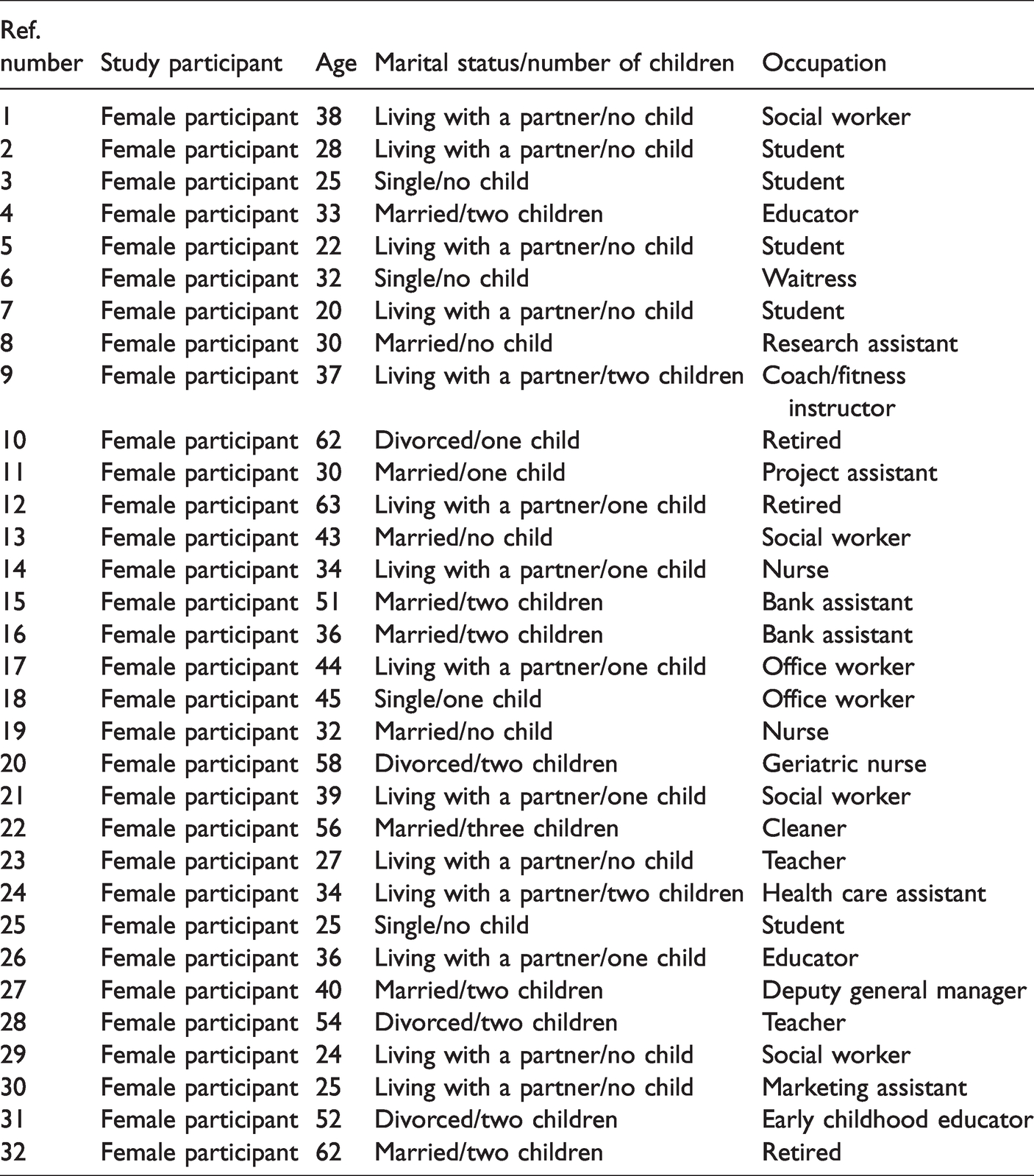
Interviews were conducted with 32 German-speaking, heterosexual women between the ages of 20 and 65 and living in Austria. Twenty-four women were in committed relationships (married or living with a partner) and eight stated they were either single, divorced, or separated. Nineteen women had one or more children, and 15 living with dependent children. Occupations were predominantly professional including several women involved in teaching, banking, sales, tourism, administration, and caring. Only three women were retired. More detailed information on sample characteristics is shown in Table 1.
Profile of interviewed participants.
All interviews lasted from 35 min to 60 minutes, and with the permission of the participants, the author audio-recorded, transcribed and analyzed data from the interviews. I particularly intended to choose a quiet and comfortable location where conversations could not be overheard to protect the privacy of the respondents. To ensure good conditions for a friendly discussion, the interviews were conducted at the participants’ homes, at the university, or in a few cases, in a public park.
The interviews began with an open question, such as, “Please remember your recent purchase of a vibrator. Could you describe the buying situation?” After establishing initial rapport, the author put the emphasis on the consumption site prior to asking first about the domestication and intimate meanings of the sex toy. General questions asked for the nature of the overall decision and purchase process, patterns of couple communication and influence behavior. Specific questions concerning the domestication of the vibrator asked for appropriation and use of vibrators and reflected on the role and position these sexual devices play and take up in the participants’ (sex) lives.
Interpretative phenomenological analysis was used in order to obtain access to the women’s experiences of living with vibrators (Smith et al., 2009). Each transcript was read several times to gain an overall impression of the data, searching for themes in the first instance. Connections across themes that emerged were identified and ordered into a set of master themes before approaching to the next transcript. Once each transcript was analyzed, patterns across the participants’ accounts were created and links between themes that captured shared experiences of the participants were formed into general themes. These general themes aided interpretation, including both the participants’ “lived experience” stories in their own words and interpretative commentary of the researcher.
Each female participant received a copy of the transcript to establish clarity and realize resonance through member checking. Additionally, a research colleague was asked to work independently on the same data set and then judge whether the themes are reasonable and consistent. This procedure allowed to enhance rigor in the research, provided more certainty, and thereby positively affected the validity and credibility of the study.
The domestication of vibrators
The following section presents the emergent themes and experiences that revolved around object domestication. The findings illustrate how vibrators are introduced into the spaces within the participants’ homes and are bestowed with particular senses of belonging. As such, the themes provided a point of reference for further discussion of key concepts pertaining to human–object relations.
Introducing vibrators in the home
It is through their appropriation that vibrators cross the threshold between the site of consumption (retail store, online, in-home sex toy party) and the user’s home. This transaction involves the passage of a vibrator from commodity-object to an object of personal property (Kopytoff, 1986). That is, the sex toy might have been bought in a shop or online, but once acquired it is given a meaning peculiar to itself. We will see that the ways in which these sexual devices are introduced into the home are somewhat secondary to the ways of how they become meaningful. It was mostly through their packaging that these toys for adults were transferred into the private life.
A 36-year-old woman, for instance, chose to disguise the order as an ink cartridge so that her mother-in-law would not know about her buying a sexual device for “it’s something private”. P: We [the woman and her husband] usually order our stuff from a seller located in Germany and sent it to my mother-in-law who lives there. And because she takes the delivery of us, we always disguise the name of the sender as a seller of ink cartridge. I: Why did you disguise the delivery? P: Because I don’t want my mother-in-law to know about the things we order. I: Why? P: Because it’s something private to us. It belongs to my husband and me. […] I don’t want anyone to know, because I don’t want to start talking about private matter. You could choose the name of the sender. We chose a seller of ink cartridges. It was just a giggle. It was just silly. But when it arrived, I told my husband: “Look, our printer has finally got a new ink cartridge.” And he replied: “It’s about time. I can hardly wait to try it out.” This was hilarious. Nobody noticed that we actually meant the arrival of our new sex toy.
Seemingly, the appropriation of vibrators can give rise to issues concerning the control of personal information about “private matter”. Both cases show how the appropriation of a sexual object can ally the couple to each other and distinguish them from others (Silverstone et al., 1994). That is, both couples strengthen the boundaries to others in such a way that only both, the women and their husbands, know about the true nature of their mail order. Whereas the 34-year-old participant used humor to openly joke about finally getting an “ink cartridge”, the 36-year-old participant decided deliberately to conceal the vibrator as an ink cartridge. It is the packaging that conceals the purchase and thus makes it easier for the participants to maintain privacy and to speak openly about the vibrator without actually referencing it.
Sometimes it can even take a while before people decide to actually use a sex toy. After buying a vibrator, it may change from a commodity-object to personal property, but this transition does not immediately make the sex toy an integral part of one’s (sex) life. To illustrate this interim disposal of objects, the vibrator of a 44-year-old woman, for instance, spent some time unused before she and her husband “suddenly thought about using it for such things can revive and offer sexual variation”. Although sex toys can spice up a couple’s sex life, some participants “didn’t need” a vibrator when being in a relationship. If I had a boyfriend, I wouldn’t buy any further products. At the time when I was in a relationship, I didn’t look at those that I already had at home because I didn’t need them. (participant, age 32) If I have a partner, I don’t need sex toys anymore. For me, sex has a lot to do with emotions and feeling a man’s body. If I can experience this, I don’t want to share my partner with a sex toy, but rather prefer my partner. (participant, age 54)
At home with vibrators: Belonging the object
Central to the spatial, temporal, and interactional domestication of vibrators were women’s perceptions of belonging —the experienced significance of certain objects to certain contexts. As such, the data suggests four object relationalities that define the sex toy’s place and routinization within the home: (1) practical belonging; having easy and quick access to the object. (2) Emotional belonging; attaching a sense of distinctiveness to the object. (3) Moral belonging; establishing/maintaining interaction order with the object within the home. (4) Discursive belonging; how one presents the object to nonhousehold members.
At the most basic level, practical belonging is a pragmatic matter of simply assuring the vibrator is on hand, literally and metaphorically, when desired. For one 40-year-old woman in this study, it was just practical to store her vibrator in the bedside cabinet, “where it belongs”. Additionally, she regarded the bedroom not only as the most suitable location to store the object but also because that space is a “safe haven” where she could enjoy being intimate with her husband: I: May I ask: where do you store your vibrator? P: Certainly. It is stored in the bedside cabinet, where it belongs. I: Why does it belong in there? P: Because everything has its place. Just like dishes belong in the kitchen, sex toys belong in the bedroom. It’s our [hers and her husband’s] safe haven where we can love each other without being seen or disturbed by our children.
Similarly, other women described what they practically, emotionally and morally referred to as the “common place” or the “private domain” of a vibrator, “where nobody should see it” and “won’t find it”: It [the vibrator] is in my closet. In a satin bag in the bedroom. I keep it in the bedroom next to my underwear and that’s where it has its common place. […] It’s beneath my underwear, so that my daughters won’t find it, if they are looking for something. […] I certainly do not store it in the kitchen, because it doesn’t belong there. (participant, age 54) I keep my personal stuff [my vibrator] in my bedside table where nobody should see it. It’s a matter of privacy. […] It’s my private domain. (participant, age 45)
Many women in this study drew parallels between the room where they usually masturbate or have sex and the place where they keep a vibrator. For that reasons, vibrators did not always strictly belong to the domain of the bedroom. As one respondent (age 39) mentioned: P: We usually had it in the living room until my niece started to visit us. Her mother asked us to put it away because it shouldn’t fall into the hands of a child. Now we store our things in the bedroom, charged and ready to use (laughs). I: May I ask you why you stored it in the living room? P: Because we mainly had sex in the living room. But now we have changed the location. (laughs) And my niece is not allowed to go into our bedroom.
One respondent (age 34) explained this in detail, making explicit the sense of moral belonging involved in concealing sex toys, because “you aren’t used to seeing things like a sex toy” within the home. Instead of considering moral belonging in rational terms (as principles of right or wrong), the participants presented moral values that arose from the interaction between the object and others within the home. This interaction mobilized a distinct set of engagements with vibrators in relation to how the women showed respect and concern for other (non-)household members. I: Where do you store your vibrator? P: Just like other things have their place, so, too, does the vibrator. I usually put it in the bedside table or in the bathroom cabinet. I: Why do you put it in there? P: Well, you can't leave such things just lying around the house. I mean, I’m a mother of two and my boys had better not see it. Besides, you can’t just do it. What impression would it make if someone visits you and sees those things lying around. It would be rather odd, wouldn’t it? Imagine how embarrassed you would be if you tripped over a sex toy. I: What makes it so special? Would there be any difference from leaving, let’s say, a lipstick lying around? P: Of course, this would make a difference. There is nothing wrong with seeing a lipstick. But you aren’t used to seeing things like a sex toy. That’s just the way it is. It’s not common, it’s not normal. No one does it. I keep it in my bedside table so that younger family members won’t see it. It shouldn’t fall into the hands of my son. It wouldn’t make sense for a six-year-old child to come into contact with such things. And generally speaking, it’s not my nature to put such things on display. I like showing any kind of decoration to my visitors, but definitely not a vibrator! (participant, age 44) For me, it’s not ok when my son would see it all the time. I mean, my sexuality lives within this thing. Imagine, I would usually keep it in the bathroom where my son comes in and sees it all the times, but suddenly it’s not there and then it goes like this: ahh mummy needs it today. I wouldn’t want to have this kind of situation. (participant, age 52) It clearly depends on the person who visits us. If my mother-in-law comes for a visit, it should definitely not be lying around. Why? Because it’s my mother-in-law (laughs)! I can’t imagine how embarrassing that would be if she found out our sexual secrets. Perhaps she will assume that her son can’t get round to satisfying me. (participant, age 36)
This process of domestication, Douglas and Isherwood (1996) would suggest, reflects the vital role objects play in confining relationships to the user, to close intimates, and to others. A deliberate placement of vibrators can help to establish and retain patterns of spatial differentiations (private, shared, adult, child, visitors). This, in turn, can provide the basis for setting spatial boundaries that separate domains of sexual intimacy from other living spaces within the home.
Complex senses of belonging obviously condition the physical display of vibrators. However, it is not just the spatial arrangement of objects the participants choose (not) to present a sex toy, but also the way they talk about it—their sense of discursive belonging. According to Silverstone et al. (1994), an object’s display can be understood as its currency. In this sense, domestic objects are of no public interest unless they are displayed symbolically as well as materially to others. Having said this, a vibrator may seem a very good example of an object for its user not only to spatially hide or exhibit it, but also to discursively engage with it.
For example, one participant (age 45) perceived a sex toy as “something that you just should not talk about”. She particularly mentioned that she does not “want to be exposed in public” because what she is doing at home “[is] nobody else’s business”. A 30-year-old respondent equally viewed her vibrator as an inherently private object, revealing a sense of emotional belonging. For her, a sex toy “is something private and personal. Not everyone needs to know it; it’s none of their business, it’s strictly off the record”. Therefore, she did not display or talk about her vibrator. In addition to that, she reported some anxiety about what her friends would think of her if they discover her vibrator. Although she could not control the way the vibrator is perceived by others, she realized that some of her friends may perceive it with suspicion and may “think badly” of her: Among friends it wouldn’t be a problem to talk about it or to show it. But, it depends. Indeed, some friends would have a bit of a problem with such things. For them, it would be extremely embarrassing to see a sex toy in general. Imagine, what would they think of me if they discover my vibrator? They or even other people might think badly of me, for it is still a taboo in public. Well, and because of them being still a problem in public, it’s very difficult to stand for using one. (participant, age 30) I certainly won’t tell my boss or my colleagues about my vibrator. […] I think it’s inappropriate to discuss this at work. And besides, it totally matters how close you are to a person and I don’t feel being close to my colleagues. (participant, age 32) We get on well with one another, but I’m not so close to my co-workers. So, I don’t feel I have to share such private things with them. It’s none of their business. Perhaps I tell a good friend, but it’s a quite unusual subject to talk about. (participant, age 36) I certainly don’t tell everybody about it, except my friends. It’s something that you use in private within the home, and well, yes, it’s something private that should stay inside these four walls. (participant, age 20) I tell my friends about it but I certainly not talk about it with my family. I’d rather have my parents think I’m a good, nice daughter. You just don’t talk about such things with your parents (participant, age 25).
The secret of possessing a vibrator can even strengthen an intimate relationship among those who share it. A 34-year-old mother, for instance, felt “closer to [her] friends than ever before”, after her friends recommended her trying a vibrator: Since we’re all mothers, we share the rough and the smooth. Well, after pregnancy, childbirth and confinement, I have experienced difficulties in achieving an orgasm through penetration. We openly discuss our sexual problems, and, once my friends recommended me trying a vibrator, I started using one. Granted, I had some doubts about using this thing at first. Luckily, I had and still have my friends because they have completely changed my mind about it! Now I feel closer to my friends than ever before because together we share a little secret – our clue to pleasure [laughs]. (participant, age 34) You usually look for someone who shares similar interests with you. Well, I can certainly tell you and know that some of my friends buy and use such things. (participant, age 33) You’re not alone. Well, sure you know that so many people buy such things, but if these people are your friends, it makes it even better. Since I know that some of my friends buy it as well and see it as normal, it makes it easier for me to buy one and use it. (participant, age 34) For instance, a good friend of mine doesn’t like to talk about such things, or about sex in general. She is kind of prude, so I don’t want to embarrass her. (participant, age 27) Imagine, if I start to talk about such things all of a sudden, it will probably be awkward. For instance, if I want to tell my colleague about how great it feels, I have to know whether she is interested in talking about such things anyway. (participant, age 34) If someone wants to visit me, I certainly hide it. For me it’s not that of a problem, but I don’t want to embarrass someone else. (participant, age 22) You can’t start talking about a vibrator just like that. They'd think I was crazy. That’s something that you can’t just talk with everyone, because not everyone would enjoy talking about such things. (participant, age 63)
Living with vibrators: Tensions between private and public
After “domesticating” an object, a process of continuous negotiation and transformation of meaning of the object may occur depending on the display and acceptance of its meaning outside the home (Silverstone et al., 1994). For some women, the domestication of their vibrator did not gain its full significance with a complex sense of belonging but also with the awareness that owning and using a sex toy is not “naughty and abnormal” behavior. The basis for this, evidently, was the way women dealt with their possession privately and publicly. As a few participants stated: The more you shroud it [the vibrator] in secrecy and the more you keep the thing taboo, the more interesting it gets. If we keep on considering it naughty and abnormal, we continue to make it special, whether positively or negatively. But I totally believe it just has to do with our mindset and the way we deal with it. I see it and treat it as something completely normal. I even talk openly about it. By doing so, I’ve never experienced someone who acted dismissively or felt embarrassed. They know that I stand by my possessions. (participant, age 43) You don’t have to tell it or completely expose yourself in public. However, if someone accidently gets to know it or whatever, it should be something normal; it shouldn’t be something special anymore. (participant, age 20) I think it won’t be so special anymore if everybody starts to talk about it. But it has to be secretive, to a certain degree, in order to remain something special. If everyone is talking about it every day, it will lose its special status, won’t it? (participant, age 34)
The continually reproduced ways of living with a vibrator suggest that what is absent from the traditional domain of the ordinary (Certeau, 1984) is as important as what is present. This is particularly true when we ask ourselves whether there is anything “special” about a vibrator—that is when we understand this sexual device to be hidden, to be not generally talked about in public or among certain audiences or to be mostly kept in the bedroom. In such cases, we can say that what we choose or feel forced to conceal will imbue objects, such as sex toys, most with value.
Conclusion
Given the diversity of domesticating vibrators discussed in this research, the identified object relations build a phenomenological structure filled with the lived experiences of people. These dynamics exist within two dimensions of vibrator ownership and use in which the participants in this study necessarily had to negotiate: public representation and private realization. Both dimensions can be either individual or collective, considering not only procedural codes of conduct or complex senses of belonging; these two dimensions are, instead, crafted and sustained through careful thought and actions that are oriented towards the self, the other, and the vibrator which is often stuck in the middle.
Each strategy of domestication can be understood as a purposive and meaningful arrangement of practical, emotional, moral, and discursive senses of belonging, all of which have dynamic qualities of their own. For example, the ‘de-commodification’ of vibrators into domestic objects (Kopytoff, 1986) required negotiating and integrating an array of compatible material and ideological constituents. Protection and maintenance of the privacy of household members were also important, but so was an emotional attachment of value to the object.
In summary, a number of points can be drawn out of the emerged object-related elements in the domestication of sex toys. First, the vibrators appeared to be bound to and confined within disciplinary practices (Foucault, 1977) that were produced by the “panopticon” of sexuality (Foucault, 1988) and conveyed a sense of normative obligation to keep the possession of a vibrator secret and, accordingly, to conceal the object. This desire to conceal a vibrator, whether chosen or forced, was essential for the women in this study to maintaining interaction order and their self-presentation (Goffman, 1959, 1986), particularly to limiting access to personal information or, in this sense, possession. Such efforts in keeping order are relatively straightforward in the home in which social structures are concentric. In other words, “[t]he more one person involves himself with another on an emotional basis the more both will need private facilities to conceal nasty habits and self-defaming information from each other” (Schwartz, 1968: 744). Thus, the concealment of sexual objects, such as vibrators, was more than simply limiting access to the self; it involved efforts to implement privacy preferences and to ensure that every (non-)member in the household complies with the privacy norms because a sex toy is “none of their business”.
Second, the discrete and delicate handling of vibrators illustrated that it is not satisfactory enough to position the domestication of these devices as a matter of heteronormative figuring of the erotic (McAlister, 2011). To the contrary, the elements of public presentation and private realization were more about collective action, strengthening ties and drawing boundaries between the self, the intimate (sexual partners, close friends) and the other (family members, friends, visitors). Although the ability to manage both elements was necessary for interaction and the maintenance of social order within the household, the senses of belonging pertaining to vibrators shaped and were shaped by the intimacy of relationships and group cohesion. We saw, for instance, mothers who used their vibrators (their “little secret” to sexual pleasure) as social currency, thus strengthening group ties. We also saw a couple that managed the arrival of their sex toy through its framing as an ink cartridge, or other couples that deliberately used vibrators as gate openers to the realms of the extraordinary (Jackson and Scott, 2004). This, in turn, reveals how a material culture of sex can be entangled in the “social fabric of everyday life” (Riggins, 1994: 1) and how people embrace the practical, emotive, moral and discursive properties of their sexual items (McCracken, 1988).
Third, the collective trajectory of masturbating or having sex with or without vibrators is thus the sum total of the many different ways in which people integrate discourses on spatial arrangements, domestic values, and public presentation. Most importantly, the elements of vibrator domestication may reveal why males and females do not integrate vibrators into their sex lives. Such an analysis can question an oversimplified view that there are various barriers to sex toy use and if such constraints were to be removed within the home, current nonusers would be willing to buy and use a vibrator. In fact, the narratives show how and why vibrators do have a place in women’s sex lives, but, as some interview statements demonstrated, not necessarily a central one.
Taken together, a vibrator is not only about self-stimulation, partner-stimulation, sharing, keeping, and discovering. The “de-commodification”, the spatial routinization, the emotional attachment, and the maintenance of domestic intimacy are about claiming complex norms of “social distance” (Elias, 1997; Simmel, 1950). Some participants felt that keeping their sex toys secret will infuse them with a sense of the special or offer them a feeling of having the object “near and far at the same time” (Simmel, 1950: 407). Social distance here is of a physical moral nature as the sexual object moves spatially or discursively in and out of being kept in their domestic place. These rules gave the women’s vibrators a specific space and meaning within their homes and distanced the devices from the stresses and strains of constant social interaction. Similarly, the analysis here has drawn attention to the social context of vibrators through reference to discussions of carving out spaces for emotional release and intimacy, whether experienced alone or with someone else.
This article has uncovered a way of experiencing material culture within the home based around the narratives formulated by women in their use of vibrators in everyday, domestic life. It sensitizes research to numerous dimensions of sexual consumption and complements a variety of analysis in human–object relations. While the results may not be unique in providing insights into people’s experiences with (not) using objects, such as sex toys, examining a vibrator’s role in the domestication approach drew more attention to how these particular experiences were lived. The domestication of sexual objects evinces how complex senses of belonging are materialized through the practices people (not) do with their possessions.
Since the empirical analysis is culturally and geographically limited to a confined participant sample, it is possible that some of the findings are not generalizable to other cultures and nations. Future research in more diverse populations and cultures may advance this study. The findings are also difficult to generalize to other sexual identities and orientations. Homosexual users of vibrators, for instance, may manage the domestication of sex toys differently, compared with heterosexual users.
The article revealed the nature of what males and females “do” with their sex toys beyond their obvious intended use, how their use was located in people’s routines, how they talked about, and why they were (not) presented to others. Certainly, not all objects will generate such senses of belonging, nor are these senses merely limited to sexual objects, such as vibrators. However, once central to forms of domestication, objects may at least acquire meaning and form a part in the possessor’s social/domestic interaction, even when they are kept secret.
Footnotes
Acknowledgements
I would like to thank Dennis Waskul for his generous help with earlier drafts and his ideas. A very special thanks also to the 32 participants who shared their intimate toy stories. I also wish to acknowledge the suggestions of the anonymous reviewers.
Declaration of conflicting interests
The author(s) declared no potential conflicts of interest with respect to the research, authorship, and/or publication of this article.
Funding
The author(s) received no financial support for the research, authorship, and/or publication of this article.
