




Abstract
While most research on digital sex toys to date has focussed on their affordances and marketing, or issues of data governance and privacy, research on user experience is limited. This article centres the accounts of 11 interviewees who used digital sex devices within mostly heterosexual relations, and often for remote partnered sex. We demonstrate how digital sex toys offer creative potential and possibilities for sexual pleasure and connection, and explore to what extent this challenges normative gendered dynamics and expectations of heterosex. We conclude that digital sex devices operate as allies with which users navigate and continually re-make heterosexual sex.
Introduction
Digital connectivity is increasingly a feature of sex toys and related products (Power et al., 2022). Digital sex devices – also called wireless, smart or networked sex toys, or teledildonics – are most commonly dildoes, vibrators for vulvas, anal toys or ‘sleeves’ for penises that are controlled using a remote control or phone app via WiFi or Bluetooth, or through built-in movement sensing detectors. These are sometimes sold as a pair of devices (a dildo and a sleeve) for heterosexual couples (Faustino, 2017) and marketed to people seeking variety in their sex lives, or those who are in long-distance relationships. There are also devices with a range of other affordances, including the capacity to synchronise with music and customise vibration patterns. The use of these devices and technologies is often collectively termed ‘techsex’. The digital sex device industry focuses on women as both consumers and designers/entrepreneurs (Ronen, 2021), and devices are increasingly marketed as wellness products as companies seek to focus on putative health effects (Jammot, 2020). The capacity of some digital sex devices to log and track sexual responses (Flore and Pienaar, 2020) also positions them in the consumer market for self-tracking products, which are promoted as improving wellbeing via self-monitoring of health status or behaviours (Lupton, 2015).
To date, most research on digital sex toys analyses their design and marketing (Burgess et al., 2022; Flore and Pienaar, 2020; Faustino, 2017) or draws on interviews with designers, producers or sales staff from techsex companies (Ronen, 2021; Wilson-Barnao and Collie, 2018). Some literature discusses the affordances of digital sex devices in relation to data-tracking and the features that allow users to track, quantify and graph orgasms, or to program, save and repeat settings (Burgess et al., 2022; Kaisar, 2021; Lupton, 2015). Other work focuses on issues of privacy and consent (Sundén, 2020) and the risk of exploitation and abuse via digital sex devices (Sparrow and Karas, 2020). There is a dearth of research on the experiences and perceptions of users of digital sex toys, although some recent work has examined users of digital sex devices as part of a broader study of techsex including dating apps, sexual image-sharing, and online porn consumption (Gesselman et al., 2023), and offered insights into issues of data governance from stakeholders representing ‘LGBTQ+, disability, HIV positive, sex work and data activist communities’ who were prospective techsex entrepreneurs (Stardust et al., 2023).
This article centres the accounts of techsex users, using interviews with 11 cisgender participants with a range of sexual identities, who used digital sex toys mostly in heterosexual relations. Drawing on feminist critiques of heterosex norms, we examine how digital devices offer creative potential and possibilities for sexual pleasure and experiences, and explore to what extent they destabilise normative expectations of heterosex. We begin by tracing the history of vibrators within the women’s movement as aligned with women’s sexual pleasure and liberation, and the positioning of sex toys as a means for women to access pleasure beyond normative heterosexuality. We then turn to feminist critiques of normative heterosex expectations and research on experiences of sex toy use within heterosexual relations. Finally, we look specifically at recent research on digital sex devices and how these differ from traditional sex toys.
Feminism and sexual pleasure
Feminist research has critiqued the ‘coital imperative’ and ‘orgasmic imperative’ in normative heterosexual relations, challenging the belief that penile-vaginal intercourse is the most authentic form of sex, and that orgasm is the ultimate goal (Potts, 2002). Twentieth-century sexology brought attention to female masturbation (Kinsey et al., 1953), while Masters and Johnson’s research on the physiology of sexual response (1966) revealed that women’s orgasms were more frequent and intense during masturbation than penile-vaginal sex (Lieberman, 2017). These findings were reinforced by firsthand accounts in publications like the Hite Report, which held political significance for second-wave feminists in understanding women’s sexual pleasure and orgasm (Hite, 1977; Mottier, 1997).
In this context, vibrators gained significance as symbols of feminist resistance to patriarchy, especially among heterosexual women (Lieberman, 2017). Although vibrators had existed prior to this moment, the emergence of grassroots feminist sex toy stores in the 1970s, alongside women’s consciousness-raising groups and sexuality-focused conferences (Comella, 2017), saw vibrators ‘transformed into feminist devices’ (Lieberman, 2017: 97). Vibrator use allowed women to explore their own bodies and sexualities, and aligned with feminist critique of the sexism of the sexual revolution of the late 1960s and its emphasis on partnered sex (Lieberman, 2017). Feminist activist Betty Dodson promoted masturbation and orgasm as forces for empowerment, liberation and self-understanding (Comella, 2017). Within these sex-positive feminist circles, masturbation was also thought to improve the quality of partnered sex by promoting better understanding of a woman’s own body and sexual communication (Comella, 2017). Indeed, women’s first experiences of masturbation and vibrator use at the time enabled them to question other aspects of their lives such as their sexuality, restrictive gender expectations and relationships (Lieberman, 2017).
However, the role of sexual pleasure in women’s liberation was a contentious issue, with some feminists advocating masturbation but remaining suspicious of sex toys (Lieberman, 2017). The phallic shape of dildoes were especially divisive, as Koedt’s 1968 essay ‘The Myth of the Vaginal Orgasm’ prompted the view that dildoes aligned with patriarchal ideas about sex, while others saw them as subversive for the same reason (Lieberman, 2017). At the same time, vibrators were implicated in the maintenance of heterosexual norms. Popular sex manuals such as The Joy of Sex (1972) emphasised that vibrators were masturbation aides for women to train themselves to orgasm in partnered sex, and were not a substitute for heterosexual sex (Lieberman, 2017). Later critique came from feminists who saw the new emphasis on female pleasure as aligned with a female ‘orgasmic imperative’, which represented women’s orgasms in contradictory terms, as both natural (with inorgasmic women pathologised as dysfunctional), yet complex and difficult to elicit (Frith, 2013).
Changing attitudes toward technology and female sexuality have led to widespread adoption of vibrators and sex toys. In a representative US study, Herbenick et al. (2010) found that vibrator usage was common among women, with around 50% of heterosexual, 70% of lesbian, and 79% of bisexual women having used one. In Australia, Richters et al. (2014) reported that 15% of men and 21% of women had used a sex toy, with women more likely than men to use them alone. Recent research on women’s use of sex toys aligns with feminist discourse on vibrators from the 1970s, emphasising empowering experiences and the subversion of heterosexual norms (Comella, 2017; Lieberman, 2017). For example, Waskul and Anklun (2020) found that sex toys helped women understand their bodies and sexual response, and for heterosexual women to experience pleasure independently of men.
At the same time, the cultural shift toward postfeminism in the 2000s saw feminism both ‘taken into account’ and ‘repudiated’ (McRobbie, 2009, cited in Gill, 2017: 607), with an emphasis on women’s ‘individualism, choice and agency’ (Gill 2017: 607) foregrounded, especially in relation to bodily practices. In this context, women’s sexual pleasure was positioned at once as a symbol of feminist power and at the same time, as ‘fashionable, safe, aesthetically pleasing and feminine’ (Attwood, 2003: 393, cited in Wilner and Huff, 2017: 263), rendering it as another arena of women’s lives to be continually surveilled, managed and improved (Gill, 2017). This combination of empowerment with an exhortation to self-improvement for women, made this a crucial time for the increasingly mainstream marketing of the vibrator and other sex toys. Accordingly, research on vibrators has often been divided on the issue of their role in the context of postfeminist culture: to what extent vibrator usage constitutes a form of female empowerment, or whether it achieves little in addressing structural inequalities impacting on women’s access to sexual pleasure, instead transforming women’s sexuality into a mode of consumption (Waskul and Anklan, 2020).
The digital era has intensified the positioning of sex toys as a women’s market, with high-profile female tech entrepreneurs and women targeted as consumers. Gendered marketing of digital sex devices emphasises empowerment and wellness, incorporating features like orgasm tracking and visualisation, reminiscent of sexology’s focus on quantification (Burgess et al., 2022). Hendl and Jansky (2022) argue that this emphasis on self-optimisation through data tracking dismisses women's embodied experiences as unreliable, reducing them to quantified body data. The industry’s promotion of ‘sexual self-optimization and performance improvement’ has also been criticised for reinforcing the orgasmic imperative (Döring, 2021: 3). At the same time, the shift of sex toys from porn and sex shops to mainstream, feminised retail markets like beauty and wellness has increased accessibility and reduced sexual stigma for women (Burgess et al., 2022).
Heterosex norms and sex toy use
The celebration of female sexuality through sex toys coexists with shame and mixed feelings among heterosexual women. Fahs and Swank (2013) discovered that sexual orientation influenced these attitudes, as queer women embraced vibrators as enjoyable and routine, while heterosexual women were conflicted in their vibrator usage. They viewed vibrator use for clitoral stimulation as shameful, feeling abnormal for preferring it over penetration (Fahs and Swank, 2013). Even women who considered vibrator ownership ‘normal’, reported feelings of shame and secrecy (Waskul and Anklun, 2020). Heterosexual women also hid their sex toys from male partners, who they feared would feel threatened (Fahs and Swank, 2013). This concern is supported by research on heterosexual male partners’ views on vibrators (Salisbury and Fisher, 2014).
Despite societal norms that label sex toys as shameful or threatening to men, they have gained acceptance within heterosexual relationships. Reece et al. (2010: 403) found that 43.8% of US heterosexual men surveyed had used a vibrator at some point in their lives. Vibrator use among heterosexual men commonly occurs to stimulate their female partners during heterosexual encounters (Mayr, 2021; Watson et al., 2016). Waskul and Anklun (2020) surveyed women and found that the majority had used a vibrator with their partners, often receiving positive and supportive responses. In a study involving the use of a WeVibe, a C-shaped vibrator worn by women during intercourse, men reported increased intimacy and connection, sometimes attributing it to the ability to orgasm simultaneously with their partner (Watson et al., 2016). Some men expressed a desire to be more involved in their female partners’ vibrator use, framing it as a way to alleviate the pressure to perform sexually and ensure their partners’ pleasure (Watson et al., 2016). This research highlights how sex toys have been embraced as tools to enhance men’s participation in their female partners’ orgasmic experiences.
Heterosexual discourses of masculinity position female orgasm as an ‘exchange for [men’s] hard work in prioritising female pleasure’ resulting in ‘the reward of more frequent sex’ (Porter et al., 2017: 745). Frith (2013) described female orgasm as a task requiring men’s labour, where sex aims to achieve desired outcomes, specifically orgasms. Salisbury and Fisher (2014) supported this view, noting that men found female orgasm highly fulfilling and offering a sense of ‘accomplishment’. In this context, sex toys have often been seen as a means to address the ‘orgasm gap’ in heterosexual relationships. However, critics argue that the concept of the ‘orgasm gap’ reinforces male orgasm and coitus as the norm, treating women’s bodies and sexual response as a problem to be addressed by fitting into the ‘timeline’ of coitus (Frith, 2013; Porter et al., 2017). The ‘ethic of reciprocity’ is a key cultural script in heterosex that equates equitable sex with both partners experiencing orgasm (Frith, 2013: 502). In practice, this often entails stimulating women before coitus, seen as the ultimate measure of successful sex (Braun et al., 2003; Porter et al., 2017). The discourse of reciprocity maintains an andocentric understanding of heterosex, where female orgasm justifies coitus, the supposed ‘real’ sex (Braun et al., 2003). For example, Backstrom et al. (2012) found that women in heterosexual relationships reported less interest in receiving oral sex compared with women in queer relationships, in part because of an expectation of reciprocity. In this way, the ‘ethic of reciprocity… works unevenly to open up different entitlements and obligations for men and women in heterosex’ (Frith, 2013: 502). Further, Fahs (2014: 976) found that women cared about having orgasms more to please male partners than for their own sake. The alignment of female orgasm with a male partners’ skills has resulted in women faking orgasm, being coerced into unwanted sex, or feeling hesitant to communicate sexual feedback to protect a male partner’s ego or feelings (Backstrom et al., 2012; Braun et al., 2003; Fahs, 2014; Frith, 2013).
Despite the heteronormative expectations discussed, we aim to challenge the conflation of heterosexuality with heteronormativity, recognising that heterosexuality is not a fixed or unified concept and that its meanings vary over time and contexts (Fischer, 2013). We draw on the concept of ‘heterodoxy’ (Beasley et al., 2015) to consider how our participants negotiate heterosex with digital devices. Distinct from the notion of ‘queering’ sex, this framework offers space to consider how heterosex as a practice can ‘provide opportunities for pleasure and possibilities for change’ (Beasley et al., 2015: 690). Here, ‘innovative’ heterosex practices are apprehended as a form of ‘straying from’ norms and thus constitute a site of political potential (Beasley et al., 2015: 688).
While some research has critiqued certain heterosexual couple’s toys for reinforcing the coital imperative, techsex devices also present opportunities for new sexual experiences (Faustino, 2017). This is exemplified by the availability of non-phallic vulva toys and wearable technologies that focus on sensation across the body rather than solely genital stimulation (Nixon, 2018). Techsex has the potential to enhance intimacy in heterosex (Watson et al., 2016), challenge gender norms, and move away from a solely coitus-centered approach (Döring, 2021). Given the outlined tensions, this paper explores what techsex toys offer in terms of relational dynamics and sensation, and how our participants made sense of these experiences in relation to gendered and heteronormative expectations of heterosex.
Methods
This study conducted 11 in-depth interviews in mid-2021 with adults experienced in using digitally connected sex toys. Recruitment involved advertising on social media and relevant networks, with interested individuals contacting the research team. Initially, Facebook ads promoting the study were rejected or removed due to references to sex products. To address this, we modified the wording to terms like ‘intimacy’, which compromised the advertisement’s clarity and purpose. Consequently, recruitment proceeded through mailing lists (internal and external), social media pages, sex toy retailer websites like Nikki Darling, and media outlets like Futureofsex.net. Additionally, we shared promotional material with previous study participants, encouraging them to spread the word or participate. Potential participants accessed a webpage with study details and consent documents, including a demographic survey for registration and eligibility confirmation. Eligible individuals received an email with the consent form, participant information statement, and an interview scheduling option.
Interviews were conducted by one member of the research team (AJ) via phone or Zoom, depending on the participant’s preference, and were audio-recorded. Participants were reimbursed for their contributions with a AU$50 gift voucher. Interviews were semi-structured and explored: participants’ use of digital sex devices and the context in which they were used; the devices’ perceived benefits and risks; and knowledge of the law and data security relating to digital sex products. Throughout the interviews, participants were informed that they should be guided by their own degree of comfort in discussing topics and could raise additional topics which they considered relevant to the theme of the interview.
As this was an exploratory study, we used an inductive method for analysing the data. While we draw on feminist theories regarding heterosex norms, our aim was to take participants’ experiences at their own value, acknowledging that their accounts engaged with popular feminist and postfeminist ideas. Recorded interviews were transcribed verbatim, and transcripts were analysed using a thematic approach (Braun and Clarke, 2006). The data was segmented and analysed using NVivo software, and top-level codes were derived from the key themes of the interview questions, such as data usage, language preferences, legal perceptions and social perceptions. Sub-level codes were derived from themes identified in participant data, such as perceptions of stigma, men and sex toy use, preferences for better legal protections, and understandings of data as already widely collected and provided. Ethics approval for this project was granted by La Trobe University Human Research Ethics Committee (HEC20492).
Participants
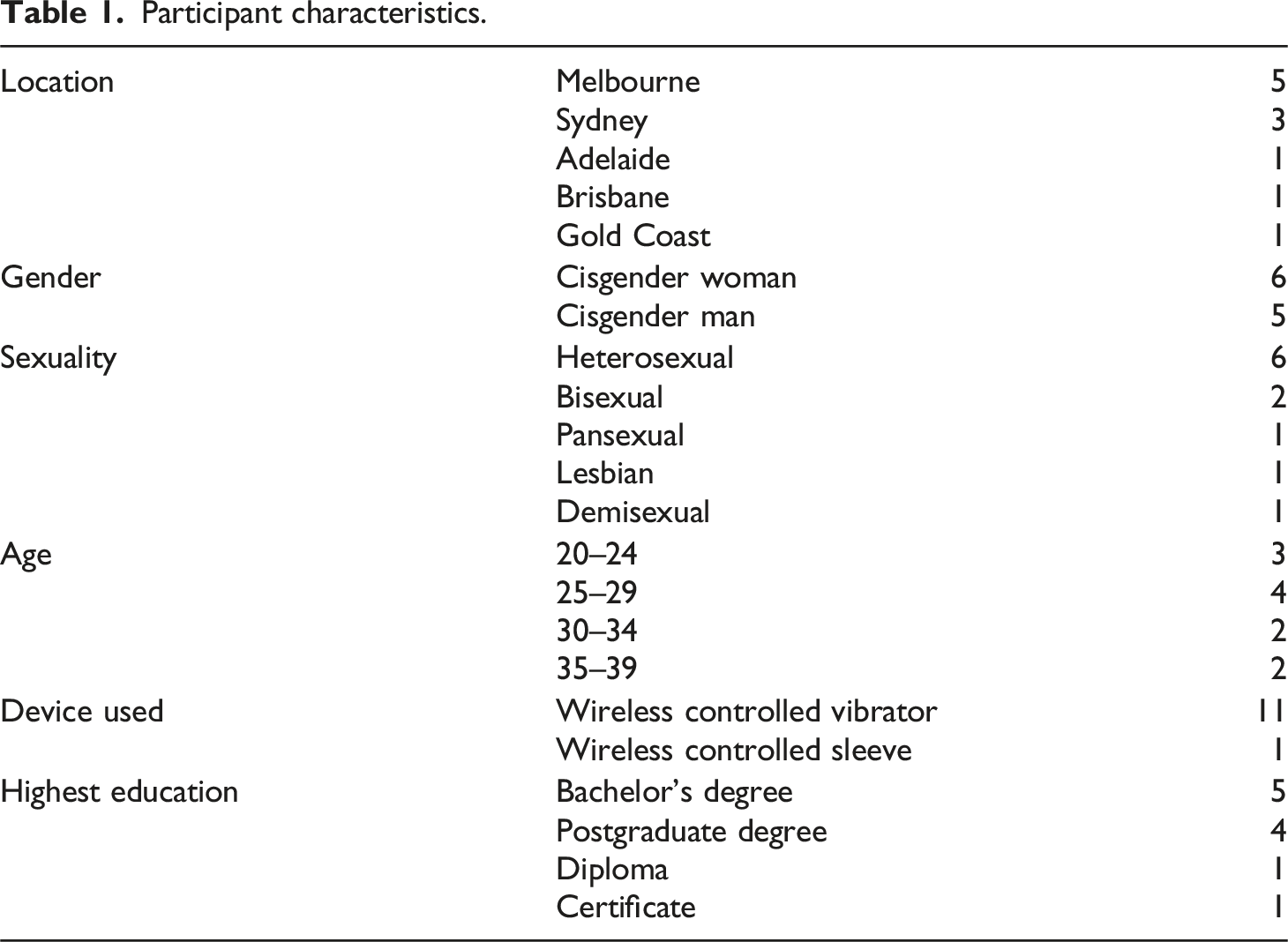
This paper draws on interviews with 11 users of digital sex devices, six of whom were cisgender women, and five cisgender men, spanning the ages of 22–38. The study was open to people of all genders, however, we did not receive any expressions of interest to participate from transgender or non-binary people. All participants had experience using wirelessly controlled vibrators, and one also had experience with a wirelessly controlled sleeve (see Table 1).
Findings
Ten of the 11 interviewees discussed using digital sex toys in heterosexual relations, with the female partner most commonly using a vibrator that was controlled by the male partner via a remote device or app, using either Bluetooth or WiFi. Several participants also spoke about using digital devices such as the WeVibe, which was worn by a female partner during intercourse and provided sensation to both partners. Additionally, two women discussed using remote devices on their own, and one male participant had used a sleeve toy on his own.
The capacity for couples to share sexual experiences whilst apart is a key affordance of digital sex devices that distinguishes them from regular sex toys. The majority of our participants had purchased remote devices because of long-distance relationships, living separately, or contexts where one partner travelled regularly for work. Many participants discussed the way digital sex toy use helped them to retain intimacy and feel connected when apart. Beth (27, heterosexual) described using toys remotely as: …very, very, very intense, like, and probably the only thing that kept the relationship temporarily alive. And it almost becomes this high school sort of thing. I remember, like, being prepared to sacrifice sleep over it, because [of] being on different time zones… I was so buzzed and wired by, you know, the experience.
Participants initially saw digital sex devices as a means to introduce excitement into their sexual relationships. The novelty of smart sex toys was often mentioned, and the participants had their most enjoyable experiences during the early stages of use. Some bought these toys with the intention of using them in public, although this idea was rarely put into practice beyond the initial phase of novelty. Beth expressed her interest in being ‘playful on a night out,’ wearing a device in public while her partner controlled it to heighten the experience. However, most participants ultimately limited their use of smart sex toys to private settings, whether it be in long-distance relationships or with both partners at home, after experimenting with public use only a few times and encountering mixed results. A couple of participants found the vibrations too intense for discreet public use, and others faced the challenge of finding suitable public contexts where they felt comfortable using these devices.
Home usage of digital sex devices was sometimes discussed as a means of maintaining connection when one or both partners was too tired for sex. Sometimes, this was framed in gendered terms, as a way for male partners to fulfill their ‘duty’ or ‘responsibility’ even when fatigued. Elsewhere, it was discussed as relieving the pressure of setting aside dedicated time for sexual interactions, and encouraging playfulness. For example, Matthew (30, demisexual) noted that using the devices at home enabled him and his partner to become more playful and more flexible with their time. Ben (25, heterosexual) noted that these devices helped to facilitate conversations with his partner about sex generally and explore using non-digital sex toys together.
Although much of the extant literature focuses on data issues pertaining to digital sex toys and their technological affordances (Flore and Pienaar, 2020; Wilson-Barnao and Collie, 2018), most of our participants did not use these extra features, for example, programming settings or visualising orgasms graphically. Two male participants were resistant to data tracking, with one expressing concern about the ‘metrics of performance’, which he viewed as ‘unhealthy’. However, most male participants understood the use of devices in terms of optimisation and enhancement, and the ‘orgasm gap’ was central to this understanding.
In the sections that follow, we analyse the accounts of women and men participants separately because their responses were highly gendered. At the same time, we explore how they framed digital sex toy use as both upholding and destabilising norms in the practice of heterosex.
Women and digital sex toys: New possibilities for pleasure and self-exploration
All female participants had used digital sex devices with male partners controlling the settings via the app or remote, except for one woman who used a device remotely with a female partner. Female participants spoke about the benefits of smart sex toys for self-exploration and getting to know their own body’s sexual responses in partnered sex, and two women had also used them for masturbation.
Control was a key theme in many women’s accounts of their experiences using digital devices. Olivia (22, heterosexual) spoke about the benefits of using smart sex toys for masturbation, describing them as ‘educational toys to teach you how to feel good about yourself… I felt like they [remote-controlled devices, compared to regular sex toys] had more power, because I could control it properly, better’. She added: I’ve learnt more about my body, like what feels good, what doesn’t feel good, what can I take, what’s too much for me, what’s not doing it for me… I’ve actually managed to have an orgasm.
Emma (35, heterosexual) spoke about the indirect control she felt as a wearer of a device her partner controlled via an app. She noted that ‘even though you’re not controlling it, you are in a sense that if you’re not enjoying it you can just pull it out’, indicating that the toys allowed her to give control to a partner in a way that felt safe.
Indeed, most female participants spoke about the pleasure of relinquishing control to a partner who was using the app or remote. Kate (28, heterosexual) said she likes it when a partner controls her device as this tests her limits, enabling her to learn more about her body’s capacity for pleasure: I think the best thing is just having that extra person there and they somewhat encourage you to try different things, or it just keeps the whole session going for longer, so that’s probably the best thing for me… It’s sort of pushed me to try new things. Yeah, having someone else in control and not being able to, um, you know, really do any — like not being able to stop when I somewhat get a little bit uncomfortable has actually made me discover that my body can actually — my body actually enjoys certain other things that I wasn’t really comfortable with before.
She added, ‘I like the fact that I can’t really predict what happens at all’. Similarly, Emma enjoyed the lack of predictability when her partner controlled the device: ‘There’s that element of surprise, that you don’t know when and where, you know, so that’s kind of exciting as well’. In these accounts, techsex toys provided a liminal space of both private self-exploration and partnered intimacy, in which women were able to play with loss of control.
Women reported that using digital sex toys in remote partnered sex helped them discover more about their bodies, enabling them to prioritise sensation over bodily appearance or orgasmic performance. Beth (27, heterosexual) highlighted the freedom to focus on her sensory experience without distractions, noting the ‘fantasy-land’ element of her enjoyment of techsex ‘because your imagination – and particularly for women I think – controls your sexual experience, and definitely your orgasm’. This emphasis on attaining pleasure without self-monitoring was aligned for some women with a sense of control. Emma spoke about remote partnered sex toy use as a break from the preparation and effort she associated with typical partnered sex: The sense of control that you get, the enjoyment, the pleasure—you don’t have to be taking off your clothes, you don’t have to actually have sex to get pleasure or enjoyment … you don’t even need to shave your legs if you didn’t want to … [the] convenience of being able to, kind of, I guess, what you’d call ‘get off’, in terms of pleasure, without the effort that regular sex takes.
Here, Emma pointed to normative gendered expectations of women’s appearance. In this comment, the idea of ‘getting off’ without these gendered bodily norms is aligned as much with pleasure as with control over the terms of engagement.
In these examples, both having and relinquishing control were discussed in terms of liberation from heterosex expectations. Control over the device allowed for self-exploration in solo contexts and also made it easier to change one’s mind during partnered sex. At the same time, the remote aspect of the devices and the way they facilitated partnered sex in private and in solo spaces allowed women to hand over control safely and explore their bodies’ capacities for pleasure.
This freedom from gendered expectations was especially apparent in the strong preference several women expressed for using devices remotely without video and, in some cases, audio elements. Emma spoke about not having to feel physically self-conscious when using toys remotely: ‘I prefer to be more private and spontaneous. I wouldn’t want to be watched, you know, facial expressions aren’t always that flattering’. Similarly, Beth said: For me, I think the experience is better without video or like trying to position yourself, like you know, trying to look cute or trying to, you know, sexting and video calls… it’s so weird, it’s not sexy at all. But if you focus strictly on an app and, you know, really like, lie down in your bed or whatever and, like, you’re on the phone or something, it becomes all about sounds and feels and you’re just using those two senses, nothing else, you’re not feeling self-conscious about… ‘oh my God, is my phone on the right angle? Am I pulling a gross face?’, awkwardly dropping the phone, glitches, anything like that. And by using just those two senses you can have a really intense experience.
Using devices without video helped some women to feel less self-conscious and able to focus on their own pleasure in partnered sex. In this way, the remote aspect enabled women to play with experiences of loss of control, while maintaining a space that encompassed private, solo sexual experiences and shared intimacy.
For some women, digital sex toys used remotely also provided relief from heterosex reciprocity expectations and the coital imperative (Braun et al., 2003; Potts, 2002). Emma said that using digital sex devices decentred male orgasm or mutual orgasm in sex, and relieved the pressure on women to ‘put out’: I think also power in the sense that you’re not obliged like normal sex to both reach a climax. Like when you have regular sex, you’re kind of obliged to make your partner, you know, ejaculate or whatever – whereas these things you don’t. It’s kind of like a one-way street.
In the above accounts, women were relieved of some heteronormative expectations in relation to bodily appearance, reciprocity, the coital imperative and orgasmic performance. Using digital sex toys remotely assisted women to feel less self-conscious and more in control, or to relinquish control in a way that enabled them to test their limits and feel safe in their exploration of new sensations. In this way, digital devices offered female participants opportunities for creative new sexual experiences and highlighted some of the heterosex norms that may have impacted their previous sexual encounters.
Men and digital sex toys: From threat to ‘enhancement’
Male participants in our study discussed their experiences of remotely controlling sex devices worn by their female partners, whether they were physically apart or together. Some men also mentioned using a WeVibe during partnered intercourse. Andrew (38, pansexual) was the only male who had tried smart sex toys designed for male bodies, specifically a digital sleeve device, and his partner had also used non-digital toys on him. Andrew recognised that both men and women worry they are ‘taking too long’ to orgasm, and he saw the use of sex toys as a way to enhance sexual pleasure for everyone. James, a 25-year-old heterosexual participant, had experimented with cock rings, noting their primary focus on vulva stimulation. He expressed his reluctance to use a Fleshlight (sleeve device), and noted the dearth of good digital devices for penises, particularly for use in public settings. Several men also commented on the comparatively inferior design of sex toys available for men compared to those for women.
James reflected on his previous assumptions about sex toys, recalling that when he was younger and a girlfriend offered to use her sex toy on him, he had responded, ‘Like, I’m not gay, sort of thing – like, that sort of real immature look at it’. This was also discussed in relation to vibrators for women. For example, several male participants commented on having felt threatened at a younger age by female partners using sex toys. This has been documented in previous studies where some women reported that their male partners viewed vibrators as a replacement for themselves (Fahs and Swank, 2013; Waskul and Anklun, 2020). Matthew (30, demisexual) said: I used to be – not intimidated per se – but I felt like, like, I know what I’m doing. But, then you have this inanimate object that does the job a thousand times better, and I felt a little bit, what’s the right word? Not intimidated … threatened, I guess, threatened by the performance of these machines. But, you know, it took me a little while to get used to… [his partner at the time] feeling amazing. And I was like, oh okay, maybe this isn’t too bad, you know, like, why am I jealous of a stupid machine? … Now I’m actually super cool with it; I actually like playing with them.
Male participants in our study often viewed orgasm as a challenge for women in partnered sex, and they saw the use of digital sex toys as a means to take responsibility for their partners’ pleasure. Andrew, for instance, mentioned the notion of closing the orgasm gap, stating that men don’t require sex toys in partnered sex to the same extent as women. Similarly, Matthew observed that the digital sex toy industry focuses on women’s pleasure due to their historical struggles with orgasm and dissatisfaction in partnered sex. He remarked that while it takes time to truly understand a partner’s body, using these devices can help them attain ‘the pleasure they deserve’. Matthew also noted that many of his male friends lacked interest in using sex toys, which he attributed to ‘toxic masculinity’ (see Waling, 2019). In these accounts, male participants demonstrated awareness of popular feminist critiques of heteronormative ideas about sex, suggesting that they viewed digital toys as aids in redressing an imbalance in heterosex.
Similarly, James recalled that ‘back in the day, like, if we’re using sex devices, then that’s going to be a bad reflection on my performance, not being able to do it’. However, he now understood toys as an enhancement in partnered sex. Andrew echoed the idea of enhancement to describe his own re-thinking on sex toys: A lot of men are threatened by the idea of, you know, using toys during play … Like, for me, I know that I can’t compete with something that is designed in a very specific shape that also vibrates, because my anatomy doesn’t do that, you know. Trying to compare myself to that, there’s no point. And so, for us, when we do use toys, it’s because we want to enhance the experience that we already have.
This reframing of digital sex toys as enhancements was viewed as important to being a good partner and offered a way for men to be more involved in a female partner’s experience. For example, Andrew saw smart sex toys as useful for assuaging men’s discomfort with their female partners’ masturbation: [Digital sex toys are] a big way of normalising, because I know a lot of men especially have that sort of insecurity about, you know, if my female partner is masturbating, then I’m not doing enough or I’m not good enough. Whereas I think at least with sex tech … it’s a cool way, I think, to involve a male partner in female pleasure.
Some male participants drew on the language of optimisation and ‘success’ to describe their use of digital devices in partnered sex. James viewed his partner’s sexual pleasure in terms of responsibility and achievement, saying that seeing her tired out after sex feels good because ‘I’ve also done my job in getting her like that’. Toys were regarded as tools to assist with this: As a guy, you always want to — there is that sort of accomplishment with getting a woman there yourself. And I’ve never sort of looked at that any differently because I’ve always looked at toys as being like, again, like a benefit as opposed to it’s the only way you can do it. And if it is the only way you can do it then, you know, get them in because, you know, you can have pride, or you can be an absolute idiot.
Here, James framed the ideal sex toy use as a benefit rather than something that was required for every sexual encounter. James expressed this further in an account of social progress: Like, a while back it was spoken about, you know, females didn’t enjoy sex and, you know, females had to go to another place to orgasm, et cetera. Whereas I feel like the discussion now is much more about how, you know, you are synced as a couple and, you know, work together to achieve satisfaction.
In this picture of male inclusion in female pleasure, the heterosexual couple is foregrounded in language that echoes the digital intimacy facilitated by smart sex toys: they are ‘synced as a couple’. Reflecting on an earlier phase of postfeminist sex toy marketing, which foregrounded the idea that ‘females had to go to another place to orgasm’, James’s comment suggests that contemporary digital sex toys operate as allies that help to bridge the gap between the empowered female consumer and a male partner. Key to this partnership is a mutual commitment to optimisation — that is, the sexual reciprocity and frequency that James noted: ‘It’s a real part of why we’re a successful couple, is that we’re very healthy in that way’.
In these accounts, men had become more comfortable with the use of toys in partnered sex over time, and the capacity for digital devices to enable experimentation and playfulness (including mutual pleasure, as with the WeVibe) made them more appealing. Participants noted the shift in the marketing of toys, from empowering women to optimising coupled sex. These accounts were underpinned by the idea of the orgasm gap and a gendered understanding of men’s responsibility for women’s orgasms, to ensure their mutual ‘success’.
Discussion and conclusion
Digital sex devices have built on the cultural heritage of vibrators and other sex toys, expanding the possibilities of these devices by enabling, among other affordances, remote use between partners, and enhancing shared sensations during coitus. The historical tensions surrounding vibrators, as both tools of resistance to patriarchal norms (Comella, 2017) and as aids to prepare women for heterosex (Lieberman, 2017), are echoed in the gendered differences in how men and women discussed their use of digital sex toys in our study. While both men and women reflected on their practices in relation to heteronormative expectations, women highlighted the potential of techsex to create new opportunities for self-exploration, connection, control and pleasure, free from self-consciousness or pressure. On the other hand, male participants viewed digital sex devices as technological enhancements to assist them in fulfilling their responsibility for female pleasure and orgasm, with the aim of optimising the experience of heterosex for both partners.
Women participants spoke of how digital sex toys assisted them to focus on their own sensory experiences via remote partnered sex, thus allowing them to experience privacy and partnered intimacy at the same time. For some women, the combination of their limits being tested and expanded by a partner, while also being able to opt out, gave them a greater sense of control. In this way, digital sex devices helped women both to feel in control and to relinquish control to a partner safely. This balance of remaining open to possibility while maintaining a sense of physical and emotional safety has also been discussed in relation to other forms of techsex (Pym et al., 2021; Scheim et al., 2019).
Women in our study expressed a preference for using wireless toys remotely, without a visual component. This allowed them to experience relief from self-surveillance and the freedom to disengage from monitoring their appearance and facial expressions. Fahs (2014) discovered that women’s best orgasmic experiences were characterised by a sense of being fully present in their bodies and sensations, which enabled them to let go of worries and self-consciousness relating to their bodily appearance. Our study revealed that digital devices provided women with this attunement to sensation and liberation from self-consciousness, offering them a means to access sexual pleasure without being constrained by gendered expectations related to appearance, grooming, or the pressure to look appealing during orgasm. Additionally, women reported experiencing relief from expectations of reciprocity, coitus, and the emphasis on female orgasm as an outcome of male partners’ ‘sexpertise’ (Porter et al., 2017).
Male participants aimed to challenge heteronormative expectations by prioritising women’s pleasure and closing the orgasm gap. Some recognised their own sexual responses as uncomplicated and believed that sex toys could level the playing field for their female partners. Their views aligned with the ‘male sex drive discourse’ (Hollway, 1989, cited in Porter et al., 2017: 740), portraying men’s desires as straightforward and biologically driven, while women’s bodies and desires were seen as complex (Burgess et al., 2022; Frith, 2013; Porter et al., 2017). This myth influenced their belief that understanding women’s sexual needs required maturity and moving past feelings of threat. Some men spoke about overcoming their pride by reframing vibrators as enhancements – a way to ensure they were able to ‘do their job’.
Male participants typically assumed control over the devices worn by their female partners, reinforcing the notion of men as the possessors of sexual skills bestowed upon women. This trope favours male egos over women’s knowledge and experience of their own bodies, reaffirming the orgasmic imperative and positioning female orgasm as a ‘masculinity achievement’ for men (Chadwick and Van Anders, 2017). Analyses of men’s sex advice in publications like Men’s Health have critiqued the portrayal of men as active agents and sexual experts, with ‘no mention of the possibility of women teaching men about their bodies and orgasms’ (Porter et al., 2017: 745). In this way, heterosexual masculinity allows men to embrace feminist ideals of women’s rights to autonomy and pleasure while upholding heteronormative expectations (Porter et al., 2017). Indeed, heterosexual men are exhorted to ‘“have their cake and eat it” by passing off their desire to affirm sexual prowess as an act of care and equality’ (Porter et al., 2017: 748). Nascent heterosex expectations regarding reciprocity and delaying male orgasm may therefore constitute ‘superficial renovations that ultimately re-install conventional masculine sexual privilege’ (Duncan and Dowsett, 2010). At the same time, our male participants' accounts suggest that the use of techsex toys troubles the idea of men as inherently sexually proficient, indicating instead the supporting role played by such devices.
The emphasis on female pleasure in men’s accounts also reflects the marginalisation of sex toys for male bodies in the contemporary market (Ronen, 2021). In this study, men’s experiences with devices were primarily limited to controlling their partners’ toys. Only one participant had used toys for male bodies with their partner, and several commented on the scarcity of well-designed sex devices for men. There was no mention of anal sex toys; research on heterosexual cisgender men’s use of sex toys or their openness to anal stimulation is scarce (Pitagora, 2019). While taboos surrounding anal pleasure for heterosexual men may be shifting (Branfman et al., 2018; Wignall et al., 2020), research still shows that toys for female bodies are more commonly used in heterosexual partnered sex, including couple’s toys used during coitus (Watson et al., 2016). Indeed, the relative lack of focus on men’s bodies in the marketing of these devices may render them less threatening to heteromasculinity, and thus more readily incorporated into the narrative of the ‘synced’ heterosexual couple bridging the orgasm gap.
This article has focused on binary gender relations in our participants’ accounts to explore how heterosex dynamics and practices are being shaped in both new and familiar ways. People of many sexualities, including our sexually diverse participants, engage in ‘hetero’ sex, and we have approached these accounts with an eye to ‘heterodox possibilities for pleasure and change’ (Beasley et al., 2015: 681), alongside the reiteration of heterosex norms and expectations. Cultural shifts in sexuality – including market innovations such as techsex toys – destabilise, reframe and generate change in both the discourse and practice of heterosex. Further, as Burgess and colleagues remind us, regardless of the binary coding of devices’ marketing or design, ‘sextech technologies themselves do not pre-determine the kinds of bodies or relationships they mediate’ (2022: 66). Rather, techsex devices can be viewed as allies in the ongoing re-creation of sex, including heterosex.
Participant characteristics.
Footnotes
Declaration of conflicting interests
The author(s) declared no potential conflicts of interest with respect to the research, authorship, and/or publication of this article.
Funding
The author(s) disclosed receipt of the following financial support for the research, authorship, and/or publication of this article: This work was supported by Australian Research Council; DP190102027.
