




Abstract
Interactive sex toys shape how we understand sexual intimacies and pleasures on an individual and societal scale. Yet analytical and critical research on actual devices is scant. To help address this, we conducted an in-depth Feminist Content Analysis of interactive products offered by one Dutch manufacturer, including text and video material that discusses and presents those products. Applying the theoretical lens of technosexual scripts, we show how one of the largest industry stakeholders engages in promising a utopian sex-future, while upholding and re-inscribing normative scripts for how sexual encounters with others and oneself can be technologically mediated. Our analysis illustrates the far-reaching consequences of skewed (and unkept) promises of safety, health and optimization, which implicates technologists as well as marketing strategists.
Introduction
(Content note for this paper: discussions of sex and genitalia, explicit language, objectification, power dynamics, questionable consent, mentions of rape, sexual philias and racism.) Remote-controllable, insertable artifacts paired with virtual reality (VR) technologies promise novel, immersive ways for sexual stimulation. How we individually and collectively conceptualize physical intimacies with ourselves and/or others, shapes these devices as much as they shape our understandings in return (Su et al., 2019). To conduct a deep dive into how technological design and surrounding discourses in Western societies lead to inclusion/exclusion, we investigate the technosexual scripts at play in the design of interactive sex toys, i.e., teledildonics.
Initially developed by Theodor Nelson in 1974 to refer to electronic dildos (Henry, 2016), the concept of remote physical stimulation at a spatial distance was popularized in the 1990s by the writer and critic Howard Rheingold under the term ‘teledildonics.’ Teledildonics operate by transmitting tactile data via vibrational patterns triggered by, for example, a slider bar in a remote interface or another teledildonic device. When combined with VR glasses, this interactive sexual experience can be extended to (social) VR platforms or to VR pornography, thereby extending our sexual interactions to new persons, things and spaces, while simultaneously drawing elements from the virtual realm into our physical world. In this way, teledildonics hold the potential for novel sexual intimacies (Liberati, 2017, 2020).
We conducted a Feminist Content Analysis (Leavy, 2000) of marketing materials and artifacts associated with one Dutch sex toy company, KIIROO – one of the leading players in the industry (Faustino, 2018). Consequently, we specifically zone in on a crucial step of teledildonics development, namely the promotion and marketing by the company.
We explore the Cyber Toy Stories 1 told by KIIROO as an amalgamation of their products, public engagement, connected software and marketing materials. In doing so, our research provides an interrogation as to how this specific sex toy company scripts teledildonic sex toys and what they consider to be a successful artifact. Closely focusing on such a constrained context offers insight into how the larger fields around technologies facilitating sexual interactive intimacies operate, how they are shaped by them and shape them in return.
Background: Teledildonics and digital sexual intimacies
As we approach the design and marketing of interactive intimacies through the lens of critical analysis, our work sits at the intersection of Human-Computer Interaction (HCI), Critical Interaction Design and Science and Technology Studies (STS).
Specifically, STS understands teledildonics as more than mere material artifacts. Theoretical explorations of the implications this novel form of sexual interaction might effectuate conceptualize teledildonics as hybrid actors (Duller and Rodriguez-Amat, 2019). Comprising and connecting technological components, human body parts, data infrastructures, information flows, phantasies, sexual practices, socio-cultural understandings and histories of sexuality, teledildonics are considered socio-technical assemblages along with their specific affordances that mediate and are mediated by their components (Duller and Rodriguez-Amat, 2019; Flore and Pienaar, 2020). Such novel intimate constellations create new ways of being in touch (Liberati, 2017, 2018, 2020).
While studies on sex technologies in general suggest opportunities for personal empowerment, pleasure, and well-being (Döring, 2000; Döring and Pöschl, 2018; Eaglin and Bardzell, 2011; Kannabiran et al., 2018; Schulte et al., 2020), closer investigations of teledildonics and their capabilities, in particular, point to liberatory potentials, like experimentations with identities, bodies and genders supported by (VR-)chat user-account modulation (Liberati, 2017) or shared orgasmic moments during teledildonics-facilitated erotic webcam performances (Martins, 2019).
However, the design and functionality of sex technologies tend to simultaneously contain both limiting and normative elements (Barwulor et al., 2021; Döring, 2000; Döring and Pöschl, 2018; Kannabiran et al., 2020; Passmore et al., 2020). Remote-controllable sex toys, according to Rossolatos (2017), promote secrecy and isolation regimes, reducing sexuality to mere simulatory games rather than redefining sexual interactions. Similarly, Evans (2020) suggests that, contrary to the anticipated embodied empathy revolution, teledildonics-enhanced VR pornography risks reinforcing and solidifying hegemonic masculinity and the male gaze even further. A closer case study of three teledildonics companies conducted by Faustino (2018) concludes that, despite efforts at separating sex and reproduction, the products still reinforce the coital imperative (Jackson, 1984), a dominant script that, paradoxically, renders the hetero-normative reproductive model as the essential form of sexual interaction, dismissing the multiplicity of sensual and sexual expressions. Conceptualizing teledildonics as sexuotechnical-assemblages, Flore and Pienaar (2020) observe how the datafication of sexual interactions via products of two teledildonics companies contributes to the healthicisation and commodification of sex, intimacy and pleasure. As Wilson-Barnao and Collie (2018) argue, the droning intimacy characterized by surveillance and regulation techniques like real-time data collection or trackability is even marketed as improving and customizing a given device. In exchange for potentially higher-quality satisfaction, efficiency, and sexual health, customers agree to the commodification of their bodies and intimacies. However, any leakage in such datafied sexual assemblage risks carrying what appears private and intimate into unknown and even unknowable territories, bearing unprecedented implications to users’ safety and privacy (Galaitsi et al., 2019; Ley and Rambukkana, 2021).
When examining how technologies and sexualities shape and attune to each other within these assemblages, a crucial point of inquiry lies in the product’s design as well as their marketing. Bardzell and Bardzell’s (2011a) interviews with sex toy designers illustrate the compassion and enthusiasm high-end designers bring to designing for intimacy. However, their work focuses on the practices involved in designing such devices and is less interested in how the resulting artifacts operate within the larger context of the associated industries. Regarding additional relevant factors to consider in a critical analysis, Wilner and Huff (2017) illustrate the cultural shaping inherent not just in the design of sex toys but also in their marketing.
While the above works illustrate different alleyways into studying teledildonics-facilitated sexual intimacies and interactions, what is missing is a case study that combines the previously separated points of inquiry in its analytic approach. Such a critical analysis needs to include not just the artifacts themselves but also the surrounding materials and cultural contexts to allow a holistic understanding of how these elements shape, influence, and materialize the (use of) teledildonic devices. Drawing on Flore and Pienaar (2020) who employ such an ecological lens, we aim to extend and refine prior insights by taking a close and detailed investigation into the associated practices of one producer of modern teledildonics.
Theoretical lens: Scripting technological intimacies
The theoretical lens affording such a holistic analysis of technological, social, cultural and rhetorical elements is the framework of technosexual scripts, which was conceptualized by Waidzunas and Epstein (2015) and synthesizes sexual script theory, technological scripts and materialization.
Calling for a closer and contextual study of sexuality, Simon and Gagnon’s (1984, 1986, 2003) sexual script theory posits sexual behaviors and actions as socially scripted. Individuals’ sense-making of a specific sexual language, setting, situation, act, or response is determined by the scripts they have obtained and embodied through living and engaging within their social environment. Sexual scripts operate on three layers: cultural scenarios, interpersonal scripts, and intrapsychic scripts. Cultural scenarios reflect conventions and expected roles and actions; interpersonal scripts bring in adaptation tools to guide individuals through various situations and social encounters. Within this framework there is room for internal experiences – the intrapsychic scripts, a person’s private world of desires and fantasies. However, as much as intrapsychic scripts give freedom and agency to contemplate sexual desires and actions, they are limited by the various examples and possibilities exhibited within a larger society.
While sexual script theory describes the social dimensions of scripting, technological scripts, coined by Akrich (1992) and Latour (1992), capture the ways designers inscribe their visions, assumptions, and predictions of potential users and their socio-political surroundings into a technology’s materiality. Based on postulated actors with specific traits, motives and preferences, technological scripts prescribe ways and contexts these actors can interact with the artifact. By pre-defining norms, measuring users’ behaviors, and punishing them for failing to submit to a script (e.g., excluding them from using the technology), technological scripts shape users’ (framework of) actions, consequently carrying moralizing character. Notably (albeit this is beyond the scope of this analysis), inherent in any interaction with technological devices is a continuous negotiation and de-scription of technologies by its users (Akrich, 1992).
However, the discursive pre-configuration of a technology does not shape its design unilaterally. Matter and meaning are in a constant conjoined state of mutual re-configuration giving rise to material enactments of the world, defining its boundaries and properties (Barad, 2007; Murphy, 2006). Thus, technosexual scripts “orchestrate arrangements of bodies, apparatuses, self-understandings, and cultural beliefs, [and] articulate the relations among parts of the assemblage” (Waidzunas and Epstein, 2015: 190) within a technologically mediated sexual setting. In such a technosexual assemblage, sexual intimacy materializes (Barad, 2007; Murphy, 2006), i.e. it becomes a perceptible material reality for those tangled up in this assemblage (Waidzunas and Epstein, 2015). Analyzing the technosexual scripts inherent in the marketing and design of one specific teledildonics company, we trace the realities materialized and rendered (im)possible within this setting.
Methodology
Research outline
We took an interest in how one specific company performs its role in this industry and the larger societies in which it operates. Our analysis was guided by the following questions: (1) How does a sex toy company script teledildonic sex toys? (2) What is a successful teledildonic sex toy from an industry’s stakeholder perspective and how does their conceptualization relate to overall dominant sexual scripts in Western societies? (3) What are the materialized purposes of teledildonics and which contexts and discourses are notoriously absent?
Steps involved in feminist content analysis adopted from Leavy and Harris (2019).

In line with the literature presented above, we expected to find a discourse dominated by cis 2 -heteronormative scripts that were particularly oriented towards a cis-male audience. While these expectations were reflected by our results, our inquiry documented further aspects of inscribed norms and standards in teledildonics and introduced interwoven nuances to consider more in-depth.
Corpus assembly
We chose to focus on a single Dutch company, KIIROO, to drill deep into how one of the biggest players in the teledildonics industry conceptualizes and markets digitally mediated intimacies. While the company is based in Europe, their marketing is targeted towards an international audience. KIIROO offers several products suited for remote control, virtual pairing and the ability to connect to VR porn applications and movies. They are the largest company based in the EU and “the most active and prominent in social media, frequently refreshing and updating the content displayed in the website, including many articles on teledildonics” (Faustino, 2018: 247). Because of this additional visibility and the large volume of material for analysis, KIIROO is uniquely suited to be the focus of our analytical case study. 3
To ensure a diverse range of material, we initially conducted a (1) document analysis of the KIIROO product websites and posts published on their blog; (2) a video analysis of commercials, public talks, and interviews with product developers and management available on KIIROO’s YouTube channels; and (3) explored select teledildonic devices along their materiality and functionality, including test runs in VR porn. 4
In refining the body of data, we chose to focus on materials that discuss the interactivity and actual use of the artifacts (but ensured that those materials touched on a range of different topics, including (sexual) health, long-distance relationships, porn etc.) to potentially study differing materializations. After our initial selection process, in December 2019, we expanded the corpus in September 2020 to account for the potential discursive changes introduced by the COVID-19 pandemic, particularly regarding isolation and quarantine. For the videos, we focused on commercials as well as talks and interviews where the company’s official viewpoints concerning their products would be expressed. We excluded material that did not directly discuss the use and interaction with teledildonics (e.g., erotic short stories published on the company’s blog). The final corpus encompassed material published between 2014 and 2021. Further details about the material we analyzed, including links to the content, are available in the Appendix.
Despite using them as sources in our inquiry, we did not conduct an extensive analysis of VR porn sites. Instead, we chose to focus on the overall experience of watching VR porn in conjunction with KIIROO’s products whenever possible. In many cases, however, this was impossible with the devices we had chosen for exploration because the VR porn on offer was predominantly intended for strokers and penile masturbators. For our technical platform, we chose the Oculus Quest VR setup. In all cases, we engaged with content that was accessible to us through free trial accounts, which meant that we had to exclude Pornhub because Pornhub did not offer free access to their VR content at the time of the study. All chosen platforms indicated that they cooperate with KIIROO.
Analysis
Our final material consisted of 13 blog posts, four commercials (video), nine product pages, three talks, five artifacts, and four virtual porn platforms (both together and individually) to establish familiarity with the range of content. We transcribed all non-textual material. In shared meetings with all authors, we recorded our initial thoughts on the material in short memos before systematically engaging with it in depth.
Our coding procedure was informed by the theory of technosexual scripts (discussed above) while still remaining flexible for open codes (Boyatzis, 1998); hence, we used deductive and inductive coding jointly. Further, our coding process was not aimed at creating coherence among the authors but rather was used as a basis for conversation and shared interpretative meaning-making, which is common practice in qualitative thematic research from a constructivist epistemological standpoint (Braun and Clarke, 2019). From these codes, we constructed messy and ordered situational maps accompanied by memos (Clarke, 2005).
Using our situational maps, we collectively organized individual codes and aimed to identify overarching themes. After several iterations, we were confident that our individual assessments converged into a specific set of themes, and we discussed the narratives that these themes would provide us. To better facilitate the iterative rearrangement of situational maps in our individual and shared coding sessions, we refrained from using coding software and instead used Post-It notes and highlighters to physically code printed texts.
Positionality statement
The authors of this work draw from a range of different lived experiences. All of them currently reside in Central Europe, though one of the authors lived in the Middle East until 2016. All authors position their gender outside the traditional Western notion of a binary. Two of them are White, one is Persian. Our scholarly background combines STS, Gender Studies, Interaction Design, Computer Science and Astronomy, with a strong commitment to queer-feminist and situational epistemologies (Haraway, 2001; Horkheimer, 1972) and Feminist HCI (Bardzell, 2010; Bardzell and Bardzell, 2011b; Rode, 2011). We collaborated on this work because of our shared interest in diversified approaches to interaction design specifically, and critical perspectives on the normative tendencies of computing artifacts generally.
Results
As our results illustrate, beyond calling on the external authority of ‘science’ to establish trust in their products, KIIROO’s artifacts and the associated communications are inscribed in norms on technologically mediated sex while re-inscribing and solidifying said norms. This paints a technosexual utopia full of promises oriented towards potential without the material means to support these.
A technosexual utopia just out of reach
KIIROO’s marketing combines alluring promises of a future just around the corner to draw in potential customers, but also aims to establish trust by drawing on the rhetoric of science without necessarily providing the required proof to back up such claims.
Establishing trust in technological sex futures
KIIROO markets their company and their products as part of a utopian sex future, one that is just around the corner, but which is never really quite there (similar to other techno-scientific endeavors like pharmacogenomics (Williams-Jones and Corrigan, 2003) or genetic research (Evans et al., 2009)). One blog post states, “the future of it all is a bright one. Companies like KIIROO are pushing the boundaries and redefining what sex toys can actually do” (B2: ‘The Future of Teledildonics'). However, what they actually do remains within a fairly constrained opportunity space. Regardless, the artifacts are positioned as bridging a present that is currently found wanting and a future full of desirable interactive sexual intimacies (see also, inner part of the circle in Figure 1). Schematic of the implied argument indicated as a direct relationship between futurism via technology to improve sex framed as factual to establish trust.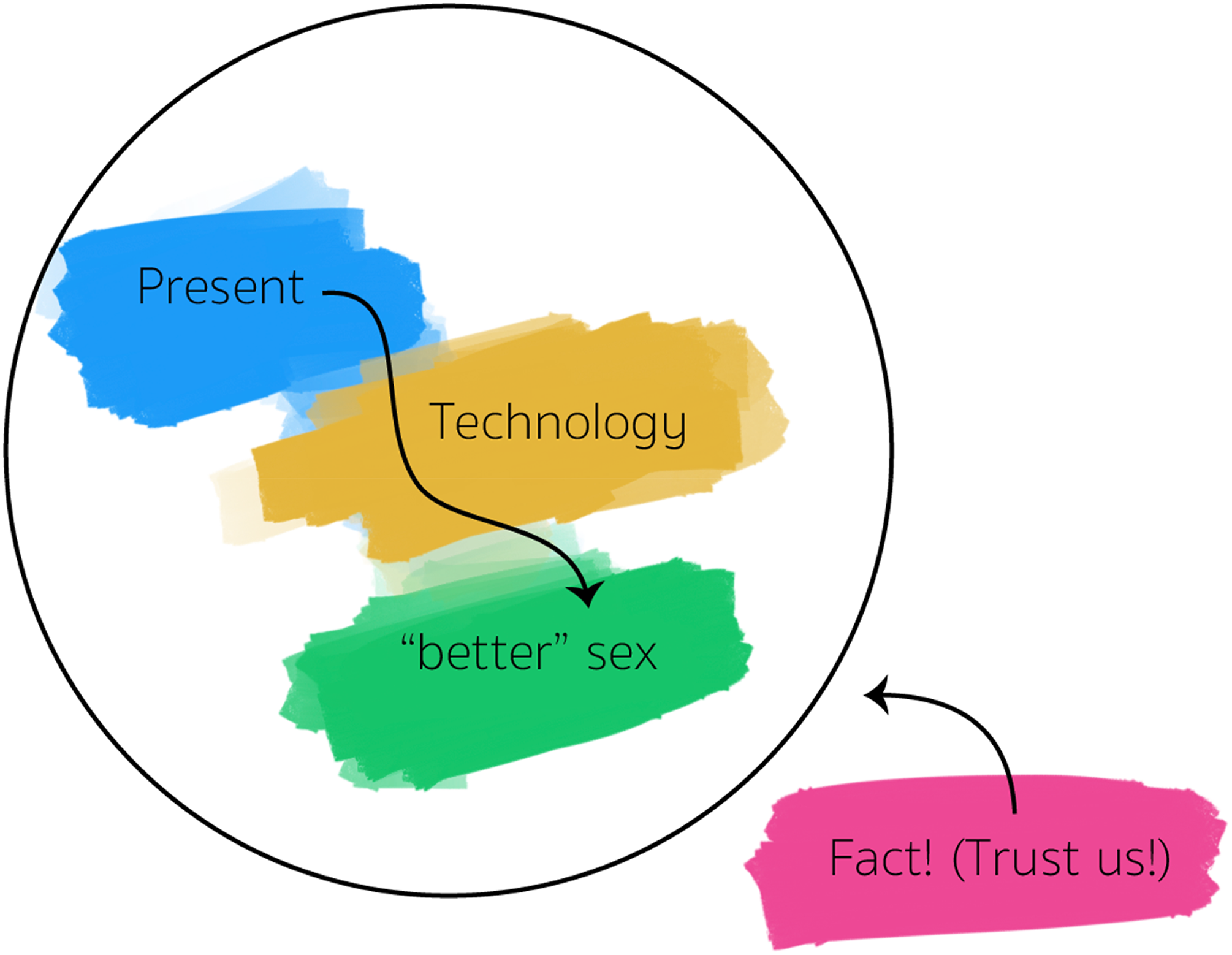
Specifically, KIIROO aims to entice their readers' current imaginaries and to encourage them to formulate alternative ones, albeit avoiding ones that might be too specific. They state that “with the development of VR, the potential for enjoying sex online started to become even more limitless” (B3: ‘The Virtual Sex Industry’). While there is a certain business strategy behind not being too concrete with how these potentials might actualize with the use of teledildonics to avoid liability issues, this move opens KIIROO up to address potentially any kind of desired sexual futures their customers might have, without alluding to how they would be informed by such desires.
In promising a future of ‘better’ sex by means of their products, KIIROO needs to establish a, preferably external, authority that builds the foundation of their customers’ trust. Here, the company draws on either a ‘long-standing’ history of teledildonics based on a mix of references to science fiction, ‘tech pioneers’ and ‘The Science Behind Pleasure’ (B2). However, ‘science’ is used more as a rhetorical token than referenced in detail beyond a single, convenient study supporting a specific argument. The overall argument, as schematically depicted in Figure 1, serves to support potential customers by convincing them that their choice to engage with the technological devices KIIROO produces is scientifically backed.
Technology as neutral good
Interactive sex toys and sexual VR experiences are largely referred to as neutral tools for pleasurable interactions. As KIIROO’s co-founder states: “I think we made a huge step forward giving people the tools they need to be intimate […] in a world which is changing fast” (T1: min 9:15, emphasis by the authors). Here, the company adopts the perspective of a provider of necessary goods, with the framing of tools (instead of e.g., toys) implying an implausible neutrality of technological artifacts (Whelchel, 1986) they create and distancing themselves from the sexual interactions they support, potentially and precisely because a large market for those products lies in remote sex work (Barwulor et al., 2021). This forms one of the strategies that allows the company to claim innocence in reference to dominant popular rhetorics of technology as a solutionist approach to any kind of dissatisfaction with the current status quo (Morozov, 2013).
However, these technologies are not only conceptualized as neutral but are simultaneously presented as a global and local good (i.e., as useful to a general audience as well as to individual readers). As an example of a global good, a Senior Content Producer at KIIROO, states that “a lot of psychiatrists and psychologists are interested in creating a system that will help people get over their phobia or help people to adjust in a social situation” (T2: min 6:15). Bringing in this rhetorical paradox of conceptualizing the technological artifacts as both neutral and virtuous, allows KIIROO to deflect responsibility for less positive experiences and consequences. To position VR as a solutionist technology improving other people’s (sex) lives, KIIROO uses the ‘violent language of the helping professions’ (Edelman, 1974) by implying good intent without including any studies or accounts of people targeted by this product, essentially not accounting for or even acknowledging potential harms.
“Not only can you use VR to intensify your solo sex, but it can also help couples who are looking to spice up their sex lives” (B9: sect. 2). This statement further presents sex facilitated through VR as both intensified and capable of introducing variation into the presumed undesirable trope of ‘dull’ intimacy, especially that of longer-term couples. In other publications, however, the company assures their audience that “nothing can truly replicate the experience of skin-on-skin contact” (B4: ‘Taking the First Step’). Through this indefinite ambivalence about the role of technology, KIIROO creates plausible deniability around their statements without taking a clear position as to the role their products might play in people’s sex lives.
Scripting norms of technologically mediated sex
If taking KIIROO’s promises at face value, their audience appears to be diversely spread over various target groups. However, as argued in the following section, this promise does not extend beyond the surface level.
Hegemony of sex
Praising VR (and particularly VR porn) as an innovative enterprise that is both creative and financially advantageous, KIIROO encourages tech-savvy early adopters to ‘get out there’ (T2) and seize one of the copious opportunities to enter the business. Readers of KIIROO’s blog posts (e.g., B12) are addressed as experienced sex-tech experts who ought to teach their (conversely portrayed as unknowledgeable and naive) partner the most basic information about sexual interactions and consent. While not made explicit, such a framing connotes a strongly gendered interpersonal dynamic that is further corroborated by the company’s appeal to the male gaze: Sexualized and objectifying depictions of women playing to male-coded spectators (Mulvey, 1975) – posing in lingerie, or illustrated as mythical creatures – are sprinkled across the entire website. This goes as far as visual instructions on vaginal-toy-use never explicitly depict the vulva. Instead, it is a ‘naughty secret’ (B13) solely existing for cis-male-encoded sexual pleasure.
KIIROO’s inscription appears to address the archetype of the heterosexual cis ‘tech-bro’ embodying a fantasy of power and dominance that is deeply rooted in misogyny and in a strong sense of entitlement to women’s sexual attention (Arruda, 2020). This becomes most evident in their review of VR porn games (B10). Sharply contrasting the company’s usually clean and almost prudish portrayals of sex, this text is rife with explicit language. Presenting the games as “a pussy just waiting to get fucked” or “basically an all-you-can-fuck buffet where it’s just about hardcore sex” (B10: sect. 2) strongly resonates with sexist locker-room talk. 5 The company’s mobilization of this techno-sexual script to enroll this customer archetype (Akrich, 1992) is further reflected in the product itself. KIIROO’s interactive porn 6 is only available for penial masturbators and exclusively features female porn stars, while the VR porn sites cooperating with KIIROO predominantly offer videos shot from a male perspective depicting heterosexual sex. 7 Contrarily, potential female users mainly appear within the context of monogamous relationships dominated by power and control.
Power and control
Similarly to what Wilson-Barnao and Collie (2018) highlighted in their research on smart vibrators, sexual intimacy in KIIROO’s marketing centers around control: You and your partner can orgasm together while controlling your partner’s device and vice versa. In real-time, you and your partner can control stimulation, speed, and pressure, making it feel like you’re having sex. Just because you can’t touch your partner, doesn't mean you two can’t be intimate together. (B9: sect. 6)
What is specific to KIIROO’s marketing is the correlation between controlling the device’s pace and intensity and ‘real’ sexual intimacy. Moreover, this feature is advertised as liberating because it allows users to “[t]ake control of your pleasure” (P6).
Technologically, sexual interaction is facilitated in two ways: in the Feel Connect App, the interface between humans and teledildonics, users can regulate the duration and intensity of a toy’s vibration via the so-called device controller. When pairing two products, their primary function is remotely stimulating each other’s devices using touch-induced vibration. Combining this technological fixation with control and the company’s efforts to cater to the heterosexual cisgender male gaze, however, distorts the potential for sexual liberation.
Exemplary here is a commercial for KIIROO’s couple set showing a heterosexual couple using teledildonics during phone sex (C3). While the woman is stimulating her male partner’s stroker, she is doing so upon his instructions (“Oh just like that baby just like that slow down slow down baby”) and interjections (“you know exactly what I like”) and is thus rendered a component of the technological setup facilitating her male partner’s pleasure. Concluding with the stale punchline of the man’s premature climax, the clip further subordinates female sexual pleasure. Domination and power play in the absence of enthusiastic consent are further reinforced by epitomizing the ‘girlfriend experience’ through a female-coded avatar who will “do anything you want, no matter how dirty the request” (B10: sect. 3).
The interplay of these textual and material inscriptions feeds the predatory fantasies of the centered cisgender male customer who is controlling and objectifying a submissive, female-coded character, a character who is essentially an extension of his sex toy and thus, nothing more than an object of his consumption.
This relates to KIIROO’s scripting of romantic couple relationships. As Faustino (2018) thoroughly demonstrates, despite deviating from the reproductive essence of ‘sexual nature’ in its material implementation, the penetrative outlook and phallocentric traits of teledildonics continue to reproduce a hetero-normative reproduction-focused model of sexual intercourse: the coital imperative. Presenting teledildonics as the solution for couples during the ‘agonizing’ and ‘incredibly disheartening’ (B2) time of physical separation (e.g., in long-distance relationships) further renders coital sex as essential to a ‘successful’ relationship (cf. Faustino, 2018), while prudishly presenting it as ‘feeling each other’, ‘being together’ (C2), or simply, ‘love’ (B9). Correspondingly, a major constituent part of these, predominantly heterosexual, relationships is monogamy. Extending Flore and Pienaar’s argument (2020), our material explorations indicated how the premise of monogamy is further inscribed into the technology itself. While connecting multiple devices to each other is technically possible, only one person can control them at any given time. Thus, this inauthentic simulation of group sex leaves customers with no other choice than to take up the script of monogamy.
Consequently, the entanglement of technological and sexual scripts KIIROO appropriates not only re-enforces compulsory (hetero-)sexuality (Brown, 2022) but also materializes intimacy as bound to a bourgeois relationship constellation: while men are offered a hypersexualised realm to experience sexual freedom and play the active and domineering part, women are confined to a passive, submissive role within a relationship based on rigid, stereotyped cultural scripts.
Exclusions and erasures
KIIROO’s inscription generates various non-users (Akrich, 1992) of their products and does this concretely by discouraging and obscuring specific practices and bodies in this space. The ideal of a faithful monogamous relationship, evidently, not only dismisses polysexual\-amorous intimacies but also renders them morally subordinate by suggesting their products as an outlet for ‘scratching’ one’s sexual fantasies for the sake of upholding a monogamous relationship (B4). Likewise, the reproduction of the coital imperative dismisses intimacies held by asexual/-romantic people. The problematic nature of this allonormative 8 framing is most discernible in blog posts discussing the devices’ health-improving elements in which all forms of aversion to sex are pathologized and presented as ‘treatable’ with KIIROO’s products (B3, B4). Moreover, while marketed as accessible to everyone, the high costs to obtain teledildonics and the multitude of devices required for their use (e.g., a smartphone, VR glasses) or the presumption of a stable internet connection, necessarily privilege people from higher income class living in infrastructurally and politically stable territories.
Advertisements featuring almost exclusively able-bodied people conforming to societal beauty standards perpetuate limited and exclusionary scripting of the bodies imagined to be participating in interactive intimacies. Additional advice on teledildonics use, including shaving (B7), dressing up and choosing camera angles that create a slim, elongated bodily appearance (B13), presents these norms as sexy and desirable, while connoting a shaming undertone for bodies that diverge from these standards. 9 Whiteness, too, is a default inscription of the company’s design. While having recently implemented the option of choosing strokers in different skin colors, 10 KIIROO still draws on a narrow frame of diversity and representation in the visual material used in their marketing content.
Enforced by the coital imperative, this narrow framing of diversity is also applied to genitals and sexual constellations. Giving their penial strokers imperious male-coded names such as ‘Keon,’ ‘Onyx’ or ‘Titan,’ as opposed to clit-massager and vibrator ‘Cliona’ and ‘Pearl,’ further produces an exclusively binary gender dichotomy in KIIROO’s marketing. The hetero-normative reproduction model discussed above is even materially extended to ‘same-sex’ pairings of the devices, thereby limiting potentialities for queer(ed.) sexual interactions.
One of the few instances featuring queerness is the commercial Miss Christmas (C3). The clip shows a festively-decorated room with a White woman in red lingerie sitting in a brown leather chair, surrounded by various people of different genders and sexual orientations dressed in erotic attire, making out with each other, and occasionally switching partners. While intended to promote their online platform as a safe space where people can be who they are, the clip instead depicts that platform as an erotic wonderland full of fetishized queer bodies that can be freely consumed for the sexual desires of non-queer viewers. This becomes even more clear in the final scene in which the protagonist takes off her VR glasses, revealing that she was sitting alone in the room all along. Consequently, queer sexual encounters are rendered as merely a virtual fantasy rather than the lived reality of many.
The skewed promises of a problem-free sex-tech era
Another key element of KIIROO’s technosexual Utopia is the safe and carefree pleasurable interactions their products claim to provide.
While in Europe and the US, the safety of the materials that go into sex toys is vastly under-regulated, employing safe materials and designs, and adequate labeling contributes to safeguarding consumers’ physical well-being and reducing their risk of injury or exposure to harmful chemicals (Galaitsi et al., 2019; Naik, 2021; Stabile, 2013). KIIROO’s, products are merely labeled as ‘Body Safe Materials’ and ‘RoHS COMPLIANT,’ leaving consumers uninformed about potential risks associated with products’ internal and external materials. 11 Further, RoHS compliance primarily focuses on the Restriction of Hazardous Substances, 12 which focuses on protecting the environment from potentially toxic chemicals rather than addressing material safety for consumers.
Regarding concerns about data protection and surveillance, KIIROO’s customers are being reassured not “hav[ing] to worry about data leaks, insecure servers, or unauthorized recording. We’ve designed the KIIROO experience to be seamless, intimate, and perfectly secure” (B1: para. 4). However, while products come with a ‘Password Protected' label they lack any further explanation on underlying safety measures to shield consumers from potential intrusions. In testing the software, we were able to simply connect to devices via BlueTooth without needing to set or enter a password. Such merely rhetorical appeals to trust overlook the heightened concerns with the collection and commercial use of intimate data. Prior research pointed out that beyond safety risks like privacy breaches and unauthorized control (Dreyfuss, 2019; Kobie, 2018; Moran, 2019; Wynn et al., 2017), teledildonics’ security implications introduce novel legal challenges to the definitions of consent, sexual assault, or rape (by deception) and related unprecedented harms (Danaher, 2018; Galaitsi et al., 2019; Ley and Rambukkana, 2021; Sparrow and Karas, 2020).
Whilst failing to communicate safety measures coherently and transparently, KIIROO delegates the responsibility of safeguarding to the users themselves. In an interview, responding to a question about the potential dangers of VR and sex-related technologies, one of KIIROO’s associates states: It’s a tool, VR is a tool. Just like a knife, just like anything else, you can make a meal [...] with a knife, you can murder someone. It’s all about how you are using it. [...] It's what [we] do with the tools. (T3: min 9:10)
Framing the technologies at hand as neutral, apolitical artifacts, not only obscures KIIROO’s accountability, but also reinforces the dystopian circumstances whereby certain groups of people are at risk of mental and physical violence. The predatory porn games, paternalistic definitions of consent and the blurring of the boundaries thereof (discussed earlier), inscribe the non-consensual cultural, intrapersonal, and intrapsychic scripts to their users. Hence, the mobilized technosexual scripts risk materializing KIIROO’s products as tools that afford the harmful, illicit practices that customers are promised to be safeguarded from.
The rhetoric of technological optimism that KIIROO employs to frame their products as versatile, too, is not neutral. Relating to findings from earlier studies (Flore and Pienaar, 2020; Wilson-Barnao and Collie, 2018), we observed how, by mobilizing discourses around health and wellness, KIIROO pitches their products within neoliberal understandings of self-care, self-monitoring, and the maintenance of healthy routines (akin to prevalent notions of ‘healthism’ (Crawford, 1980)). Furthermore, framed as “one of the biggest parts of wellness”, sexual pleasure and regular orgasms granted by teledildonics function here as supplementary medicine, by doing “wonder for your immune system” (B7: sect. 8). Likewise, teledildonics are promoted as akin to exercise equipment, encouraging KIIROO’s customers to stay healthy and active (B13), and thereby re-enforcing the moralizing endorsement of constant efficiency and physical self-optimization, even during sex.
In this techno-utopia, KIIROO’s customers are promised salvation and their sex life is certain to be technologically enhanced, orgasms are guaranteed to become a routine part of life, and sexual experiences are to become seamless. 13 However, KIIROO and VR technologies are not at a stage to offer such optimizations; customers are enticed to await an unspecified and indefinite (but promised to be near-at-hand) time when the company’s teledildonics are technologically advanced enough to meet these envisioned capabilities (T3).
KIIROO’s fragmented narratives of teledildonics’ purposes backfire because they portray these devices as technologies that serve all but, in fact, they only work to serve a normative set of potential hetero-sexual customers, who are invited to further optimize their sex lives. All the while, non-normative bodies, desires, and pleasures (which already lack access to these devices) are not included in the cyber toy stories of the artifacts in the first place.
Discussion and conclusion
The following discussion illustrates what our results imply for a re-definition of intimacies and how the identified scripting of teledildonics mediates pleasures, as well as the limitations of our study.
Redefining intimacies
While we are methodologically constrained in what we can state about the definition of success as internally conceptualized, we have identified some factors that KIIROO uses to communicate what customers should consider to be a successful interaction. Referencing a technologically facilitated utopia full of optimized sex, the company draws on a common technological script within broader society that posits technical solutions to everything identified as problematic (Morozov 2013). In return, the scripting inherent in the artifacts and associated materials relates normatively to the scripts that are dominant within Western societies. As another technological script, KIIROO uses the notion of a continued necessity for individuals to improve themselves and optimize all aspects of their lives, including sexual intimacy. Even though this is not directly tied to suggestions of tracking, such calls for individual bodily optimization are conducive to self-tracking paradigms, including the inherent issues of a technologically constrained understanding of what ‘counts’ as a valid data point more generally (Spiel et al., 2018) and within the context of sexual encounters more specifically (En and Pöll, 2016; Flore and Pienaar, 2020; Wilson-Barnao and Collie, 2018).
Regarding the sexual scripts present in our analysis, we find that, conceptually, intimacy is reduced to only the notion of heterosexual penetration, with sprinkles of alternative sexual encounters tossed on top. This stands in stark contrast to the rhetoric that explicitly encourages unrestrained imagination. Hence, what is communicated is an openness towards a diverse range of sexual desires while simultaneously constraining the possibilities through the materialization of their artifacts, the use of images, and the strictly binary gendered language involved in marketing, right down to the example where queer sexualities are only depicted as fantastic desires serving a heterosexual gaze. Although scripts can be resisted, presuming the qualities likely most palpable to an intended target group increases that group’s likelihood of subscribing to a script (Latour, 1992). In this case, KIIROO’s prudent design choices further encourage hegemonic and normative behavior in their customers, while queerbaiting 14 to non-heterosexual audiences. Hence, while presenting their products as adaptable to a boundless range of needs and purposes, KIIROO’s teledildonics are rigidly streamlined by linear, deterministic narratives, exclusionary norms, and the corresponding material limitations, leaving no room for multiplicity in the application of their artifact. Particularly, in the materialization of standardized genital forms in the physical artifacts involved in the teledildonic interactions, the technosexual scripts at play create a norm that is unlikely to hold for any of KIIROO’s customers.
While the company suggests their artifacts directly mediate pleasure, what is mediated instead is the promise of pleasurable experiences. Without having direct insights from actual users of their devices, we still identified a mismatch between the (already constrained) fantasies evoked in the marketing material and the actual materiality of the artifacts. This mismatch exemplifies how normative assumptions around sex, pleasure, and intimacy become materially ingrained and vice versa. While producers’ intentionality shapes a product’s functionality and use, so too do its material properties. From a new materialist and postphenomenological lens, an artifact has agency/intention of its own, acting on itself and continuously transforming the relation between a user and their world (Barad, 2007; Mykhailov and Liberati, 2023).
As we found, the company’s technologies marginalize, ignore, and effectively exclude a range of bodies, identities and practices from the supposedly utopian world they materially bring into being. Despite the implications of endless, pleasurable possibilities in a safe environment that is communicated by the company’s marketing, the discursive and material technosexual scripts inherent in their teledildonics products, in the end, materialize a future that is merely attainable to the heteronormative cis male pleasure and potentially results in a dystopia characterized by security nightmares around intimacies and dire consequences to those who do not fit into this material arrangement. While KIIROO keeps enticing customers’ anticipation, the promised utopia is unattainable.
Limitations and outlook
Aside from the authors’ limited positionality, the work comes with additional constraints. We took a deep dive into only one European company offering interactive sex toys, which amplifies the Eurocentric perspective of this work. We relied on our outside perspective on the company’s content that it presents to the public without directly inquiring with the people managing, curating, or producing said content. Additionally, the theories we draw from to make meaning of our analysis shape the interpretation and takeaways we identify in our work, where others might have led to different conclusions.
Further, it is crucial to note that users are not merely passive receivers of a technology. A substantial element of Akrich’s (1992) technological scripts is the reciprocal re-adjustment of technology through the interaction between user and producer. Similarly, any materialization also gives rise to alternative rematerializations through actors within an assemblage (Murphy, 2006). Hence, beyond directly involving company stakeholders in future research, including the people effectively interacting with the artifacts might provide valuable insights into the ways teledildonics users and DIY subcultures 15 re-define the product in its role and significance. Such endeavors could be further augmented by the dedicated participatory design of teledildonics, particularly with marginalized groups who might be excluded from the currently dominant technosexual scripts (e.g., disabled people or sex workers). However, drawing directly from our analysis researchers and designers could themselves investigate design processes and lead to more specific strong concepts (Höök and Löwgren, 2012) for interactive intimacies. Such design processes would also involve an approach to identifying how teledildonics might be introduced and presented more broadly.
Considering these limitations and potentials for future work, our contribution lies in conducting a contextually constrained deep dive into the artifacts and accompanying communication of one market leader on teledildonics. Going beyond an artifact as it is and considering the larger design context involved in communicating the potentials of its interactions, we illustrate the necessity for designers and producers of intimate interactions to consider the larger systems that they act within instead of siloing their responsibility to a single aspect of the design.
Footnotes
Declaration of conflicting interests
The author(s) declared no potential conflicts of interest with respect to the research, authorship, and/or publication of this article.
Funding
The author(s) disclosed receipt of the following financial support for the research, authorship, and/or publication of this article: This work was Co-funded by the European Union (ERC, ACCESSTECH, 101117519). Views and opinions expressed are however those of the authors only and do not necessarily reflect those of the European Union or the European Research Council. Neither the European Union nor the granting authority can be held responsible for them.
