




Abstract
We conducted semi-structured interviews with 17 parole officers working in Canadian federal correctional services to understand how their perceptions mediate well-being. Our study elucidates dimensions of interactional justice related to three elements of nonverbal communication theory (i.e. haptics, proxemics and kinesics). By centralizing the voices of our participants, we show how nonverbal communication theory mediates organizational citizenship behaviour and the multi-construct concepts of justice. Framing interpretations with how public employees interact, we reflect on the impacts to which correctional workers—as public safety employees—perceive their criminal justice employment. We argue exploration into nonverbal communication, and a deeper understanding of how correctional services govern, may provide structural accountability by closing a loop in organizational knowledge flow.
Keywords
Introduction
Parole officers represent ‘street-level bureaucrats’ who are undervalued and underrecognized for their role in public safety (Lipsky, 2010). Within Correctional Service Canada (CSC), the federal agency responsible for people convicted of a crime and sentenced to two or more years in custody, parole officers work in prison and community settings to prepare and support ex/prisoners for re-entry (USJE, 2019). Finding no discernible difference based on work environment, we focus on 17 parole officer interviews and frame our interpretations around informational and interpersonal dimensions of interactional justice (Wolfe and Lawson, 2020). We relate these conceptual dimensions to three elements of nonverbal communication theory: haptics (i.e. parole officers’ sense that policies are ‘not in touch’ with operational practices); proxemics (i.e. the territorial spaces that parole officers and other organizational members occupy); and kinesics (i.e. human resource movement and organizational knowledge flow) for Correctional Service Canada (Bonaccio et al., 2016). We argue nonverbal communication theory mediates organizational citizenship behaviour and the multi-construct concepts of justice. As such, recognizing ‘all knowledge begins with the senses’ (Herrity et al., 2021; McClanahan and South, 2020), in the current article, we employ haptics—the ‘sense of touch’—to conceptualize parole officers’ perceptions converging on a course that moves us closer to understanding justice.
Organizational justice
Despite the abundant literature on organizational justice, often described as perceived fairness, ambiguity remains about the exact constitutions of the concept (Cohen-Charash and Spector, 2001; Colquitt et al., 2001). Researchers agreed in two meta-analytic reviews, the former conducted by Colquitt and colleagues (2001) and the latter by Cohen-Charash and Spector (2001), that organizational justice as a concept requires maturation. Despite their diverging methodological approaches—Cohen-Charash and Spector (2001) relied on procedures by Rosenthal (1991) while Colquitt and colleagues (2001) heeded a protocol by Hunter and Schmidt (1990)—both studies converged on the finding that organizational justice was at least a three or more construct concept (i.e. procedural, distributive and interactional).
Wolfe and Lawson (2020) subsequently sought to test the ‘effect’ of organizational justice among criminal justice employees and found correctional workers who perceived fairness within their workplaces reported greater levels of job satisfaction and organizational commitment (see also Lambert, 2003; Lambert et al., 2008). Correctional workers who experience higher levels of organizational justice are thus theorized to maintain more commitment to organizational goals, which has implications for job satisfaction and turnover intent (Knez et al., 2019; Lambert, 2006; USJE, 2019; Wolfe and Lawson, 2020). Wolfe and Lawson (2020) suggest correctional workers’ resiliency may be mediated by the degree to which staff perceive being treated in an organizationally just manner wherein ‘distributive’ and ‘procedural’ components of the multi-construct concept interact (see Figure 1).
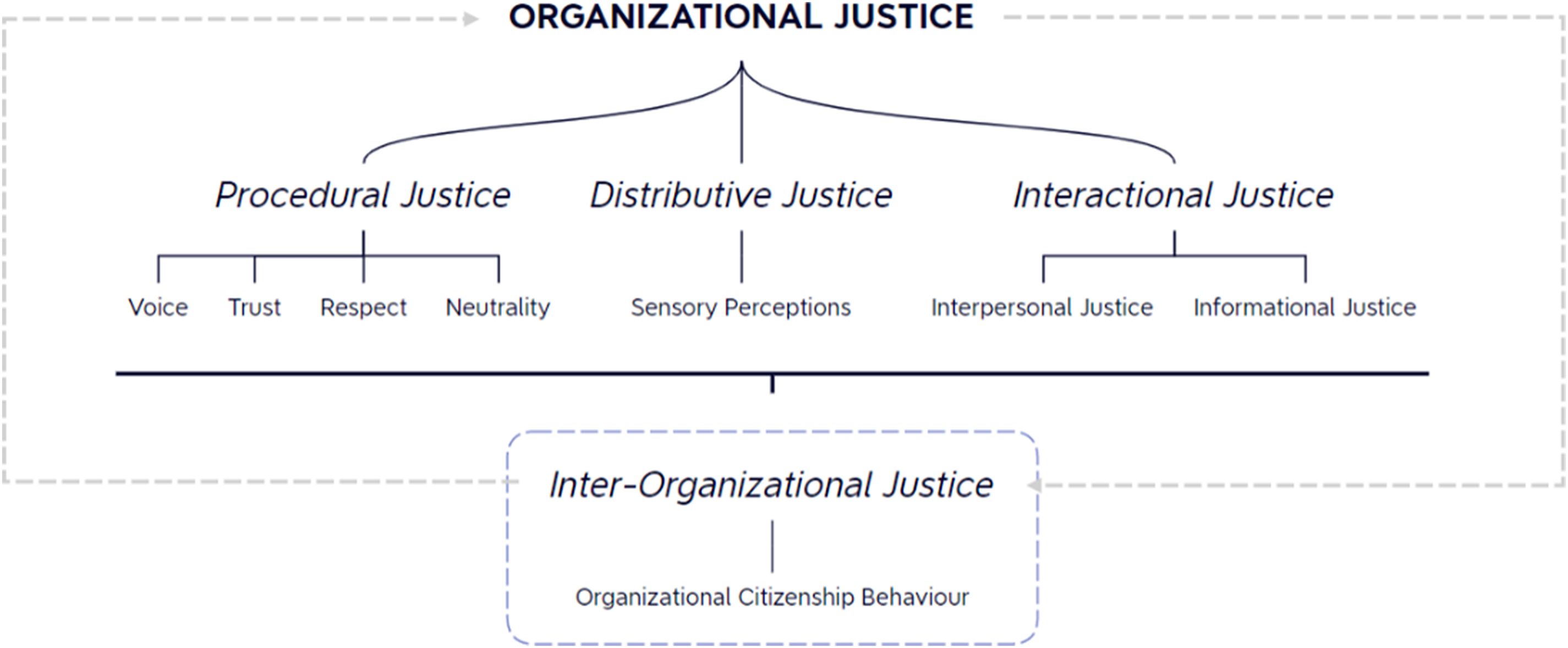
Diagram of organizational justice as a multi-construct concept relating to organizational citizenship behaviour.
The researchers operationalized distributive justice to mean ‘how fairly employees believe resources are distributed’, whereas procedural justice occurs when ‘employees feel a sense of control during the decision-making process’ (Wolfe and Lawson, 2020: 621). Therefore, distributive and procedural components of organizational justice are organized within parole workplaces (Cropanzano and Randall, 1993), and this has led to a burgeoning field of inquiry about voice, trust, respect and neutrality in supervisory procedures (Blasko and Taxman, 2018; Phillips, 2023). We posit that a distributive outcome of parole operations is how people think, feel and perceive criminal justice (Ricciardelli, 2018).
Finally, the ‘interactional’ component of organizational justice, as referenced by Wolfe and Lawson (2020) following Bies and Moag (1986), is a third consideration referring to employees’ interpersonal perceptions about how policies and procedures are implemented by an organization. In sum, parole officers believe they are treated in an organizationally just manner when they perceive fairness both as it relates to outcomes of decision making (i.e. distributive) as well as the extent to which they sense being included in those processes (i.e. procedural). Therefore, interactions among organizational members are meaningful not only for achieving organizational goals but also in affecting employees’ sensibilities about organizational justice.
Moreover, Greenberg (1993) posed that interactional justice was a construct consisting of two separate interpersonal and informational dimensions. Wolfe and Lawson (2020: 621) referenced the interpersonal dimension to mean the ‘level of respect and propriety supervisors afford their subordinates’. Thus, the manner knowledge is shared with parole officers is a reference to the informational dimension, including ‘the extent to which supervisors are candid, timely, and thorough in their communications with subordinates’ (Wolfe and Lawson, 2020: 621). An overarching conceptualization of organizational justice, then, pertains to a complex and not fully understood set of relationships among all other procedural, distributive and interactional constructs that mediate how justice is perceived. We centre on inter-organizational justice as a relatively novel and understudied addition to this field, recognizing the incorporation of asymmetry and multi-level dynamics (Bouazzaoui et al., 2020). By inter-organizational justice, we mean how public sector employees relate internally to one another (Zayed et al., 2020), which contains interpersonal information that shapes parole work.
Organizational citizenship behaviour
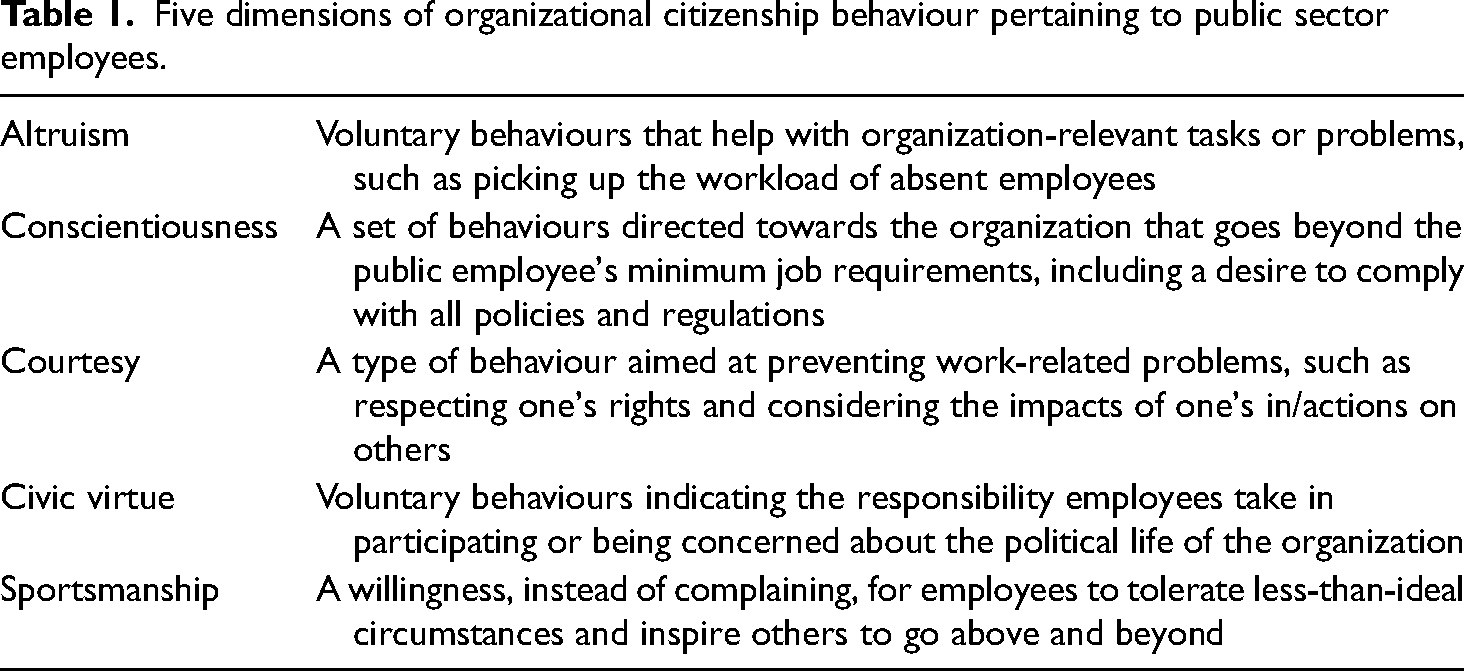
Relatedly, Organ (1977, 1997) theorized organizational citizenship behaviour mediates organizational justice (Cohen-Charash and Spector, 2001; Colquitt et al., 2001; Jafari and Bidarian, 2012; Knez et al., 2019; Wolfe and Lawson, 2020; Zayed et al., 2020). Following Zayed et al. (2020: 448), we recognize five dimensions of organizational citizenship behaviour. While these tend to be studied in private organizations, we operationalize them for the public sector as they relate to inter-organizational justice (see Table 1).
Five dimensions of organizational citizenship behaviour pertaining to public sector employees.
Zayed et al. (2020) found inter-organizational justice was a strong indicator for improving distributive outcomes (e.g. employee perceptions), suggesting a study of parole supervisory procedures is an effective way to explicate what officers believe about their work. As organizational citizenship behaviour affects how parole officers understand their relationships, it relates to their inter-organizational conduct as public service members. Hence, the extent to which parole officers believe they are treated in an organizationally just manner is mediated by the quality of inter-organizational relationships they appreciate in everyday interactions. In our current study, we focus on how interactional justice (and its interpersonal and informational dimensions) mediate higher levels of organizational citizenship behaviour as a function of justice. Furthermore, Skarlicki and Latham (1996) pose that interactions between parole officers and their direct supervisors will affect perceptions on an interpersonal level. Thus, through organizational citizenship behaviour, perceptions are believed to map ontologically onto the organization itself (Cohen-Charash and Spector, 2001; Colquitt et al., 2001; Knez et al., 2019).
Nonverbal communication theory and carceral culture
Organizational citizenship behaviour in parole, as a carceral subculture, is unique in its use of space, touch, time and artefact, which all represent ‘nonverbal codes’ (Giri, 2009). A nonverbal code refers to how meaning is created through transmission, perception and interpretation (Bonaccio et al., 2016; Burgoon et al., 2021; Giri, 2009). Nonverbal codes may be organized into typologies that are encoded or decoded (Bonaccio et al., 2016; Burgoon et al., 2021) and an estimated 93% of all human interactions are mediated by nonverbal codes (Birdwhistell, 1971). Yet, this field of study remains relatively under theorized in organizational management.
As Bonaccio et al. (2016) show, nonverbal codes may be grouped according to various communication modalities. For instance, ‘body codes’ refer to kinesics, including appearances about bodily movements such as gestures, posture and gait (Burgoon et al., 2021). ‘Spatiotemporal’ codes refer to proxemics (the use of personal space within an environment) and chronemics (how time is perceived and interpreted in that space). Finally, ‘contact codes’ refer to the sense of touch, which is a form of communication known as ‘haptic interaction’ (Andersen et al., 2013). In some workplace contexts, haptics is a job requirement (e.g. ‘functional-professional touch’), such as in nursing where ‘therapeutic touch’ is an established concept for healing practice (Bagci et al., 2020; Hanley et al., 2017; Shattell et al., 2007). Recently, this has emerged in penal scholarship (Stanley, 2021) but, as far as we are aware, remains unexplored in parole whereby haptic interactions tend to be limited to ‘social-polite touch’ (Andersen et al., 2013). For instance, a firm handshake with strong eye contact by a parole officer contains interpretive meaning, where nonverbal codes converge in an invocation of authenticity and consistency during social interaction (Bonaccio et al., 2016).
As Bonaccio et al. (2016) pose, all nonverbal codes convey interpretive meaning both in terms of acts and cues that mediate messaging. Acts refer to doing something and may also refer to inaction. Meanwhile, cues refer to all other sensory data for deciding how judgements are formed (see Cooksey, 1996 as cited in Bonaccio et al., 2016: 1047). Recognizing that perceptions are highly contextual and based on norms within a given culture, parole more closely resembles ‘noncontact culture’ (Bonaccio et al., 2016: 1061), where interactions involve limited touch (Andersen et al., 2013; Bonaccio et al., 2016; Bull and Doody, 2013; Giri, 2009; Hans and Hans, 2015; Mandal, 2014; Matsumoto and Hwang, 2016). This elucidates the phenomenon of ‘untouchability’ and informs one reason why relationships lack the capacity to invoke sensations of care and bonding (Giri, 2009; Sarukkai, 2009). In contrast, ‘contact culture’ is informed by interactions where personal distance is lessened, as with prison officers, where physical touch is normative (Bonaccio et al., 2016; Matsumoto and Hwang, 2016; Watson, 1970).
Within the context of this article, we suggest inter-organizational justice is mediated by parole's noncontact culture. In broader carceral contexts, we believe perceptions about nonverbal codes mediate organizational citizenship behaviour. Therefore, we aim to conceptualize the constellational nature of nonverbal codes within parole work as cultural phenomena. Specifically, we aim to explicate how nonverbal codes, interpreted by parole officers’ perceptions, complement and/or contradict correctional service organizational messaging. Furthermore, we explore public and interpersonal ‘territoriality’ with which human beings have an innate drive to defend space (Hans and Hans, 2015), especially in Canadian correctional work, which is governed by bureaucratic departments people occupy (Andersen et al., 2013; Giri, 2009). In turn, we elucidate how perceptions of nonverbal codes mediate governance within parole workplace environments (Hupe and Hill, 2007; Kuronen and Caillaud, 2015).
Methods
We qualitatively investigated facets of parole officers’ (n = 17) experiences employed by Correctional Service Canada in a study commissioned by the Union of Safety and Justice Employees (USJE, 2019). Recruitment was supported by both of these organizations, and ethics approval was granted by the Research Ethics Board at Memorial University of Newfoundland (#20201495). Originally, our study sought to understand how organizational culture and climate affected the well-being of Canada's national correctional service. In our current results, we unpack frustrations as expressed by parole officers in terms of bureaucracy.
We conducted telephone interviews due to resource limitations, COVID-19 public health measures and Canada's geographical size, where participants were employed across all but one province/territory. Information about our study was shared via email through internal listservs in English and French, and recruitment efforts were aided by an informal snowball sample where participants promoted the research on their own accord. Semi-structured interviews were designed around broad interview questions, enabling participants to discuss matters they felt most relevant, where interviewers guided conversations and probed for elaboration when necessary (Brinkmann, 2020). Informed consent was obtained in advance of interviews conducted in August and September 2020. All interviews lasted 75–120 minutes and were conducted in English. We found telephone interviews effective in establishing rapport despite face-to-face interviewing offering more visual cues for interpretation (Bonaccio et al., 2016; Giri, 2009). This finding aligns with evidence supporting telephone interviews enable participants to discuss sensitive topics more comfortably (Mealer and Jones, 2014; Novick, 2008).
We followed a semi-grounded constructed method of analysis where meaning was discovered through a deep appreciation for participants’ perspectives emerging from data (Charmaz, 2014; Glaser and Strauss, 2017; Ricciardelli et al., 2010, 2022b). Our findings in this article stem from a single theme termed ‘bureaucracy’, which the research team interpreted to mean how systems and organizational structures affected the parole officer's job. Transcripts were coded inductively, and emergent themes were identified with the assistance of NVivo software (Version 1.7.1 (1534)). Initially, three members of the research team coded five transcripts independently and sequentially to develop a codebook. Then the rest of the team followed suit while checking to ensure inter-rater reliability (Hemmler et al., 2022; Ricciardelli et al., 2022b).
Finally, our reflexive and auto/ethnographic experiences in different Canadian correctional contexts have informed our analysis (Ricciardelli, 2022; Taylor, 2023). These insights, we feel, are intellectual resources for ‘doing prison research differently’ (Jewkes, 2012). In particular, the study we present here is an analysis, at the granular level, investigating the macro context of a justice organization's communication strategy. It was not our intention to theorize nonverbal communication, nor were sensory perceptions a part of our interview guide. Rather, it arose by studying experiences with job satisfaction within the culture and climate of Canada's national correctional service. During the analysis, we noticed idioms and paralanguage, such as sarcasm, that participants invoked to communicate meaning (Bonaccio et al., 2016). Thus, we interpreted human experience through an interactionist approach and hermeneutic tradition (Hesse-Biber, 2017: 23), discovering nonverbal codes by studying phenomena participants described, resulting in our emergent theoretical orientation.
Participants
We offer a more fulsome demographic discussion of participants’ age, race, educational attainment, employment location by region and prior public safety experience elsewhere (Ricciardelli et al., 2022b), and we have documented our methods in various outputs resulting from our wider research project (Norman and Ricciardelli, 2022a; Norman et al., 2022; Ricciardelli et al., 2021). In total (n = 17), 14 participants self-identified as female and three as male. All participants were parole officers at some point in time, and 82% (n = 14) confirmed that role assignment when interviewed. However, other participants had moved into different organizational roles. For those who had moved on, we asked participants to reflect back to when they worked as parole officers. Participants were then subsequently counted based on their interviews as working predominantly in community or institutional settings (see Table 2).
Parole officer by identification number (ID), institution (I) or community (C) setting, age range and years of service employed by Correctional Service Canada.
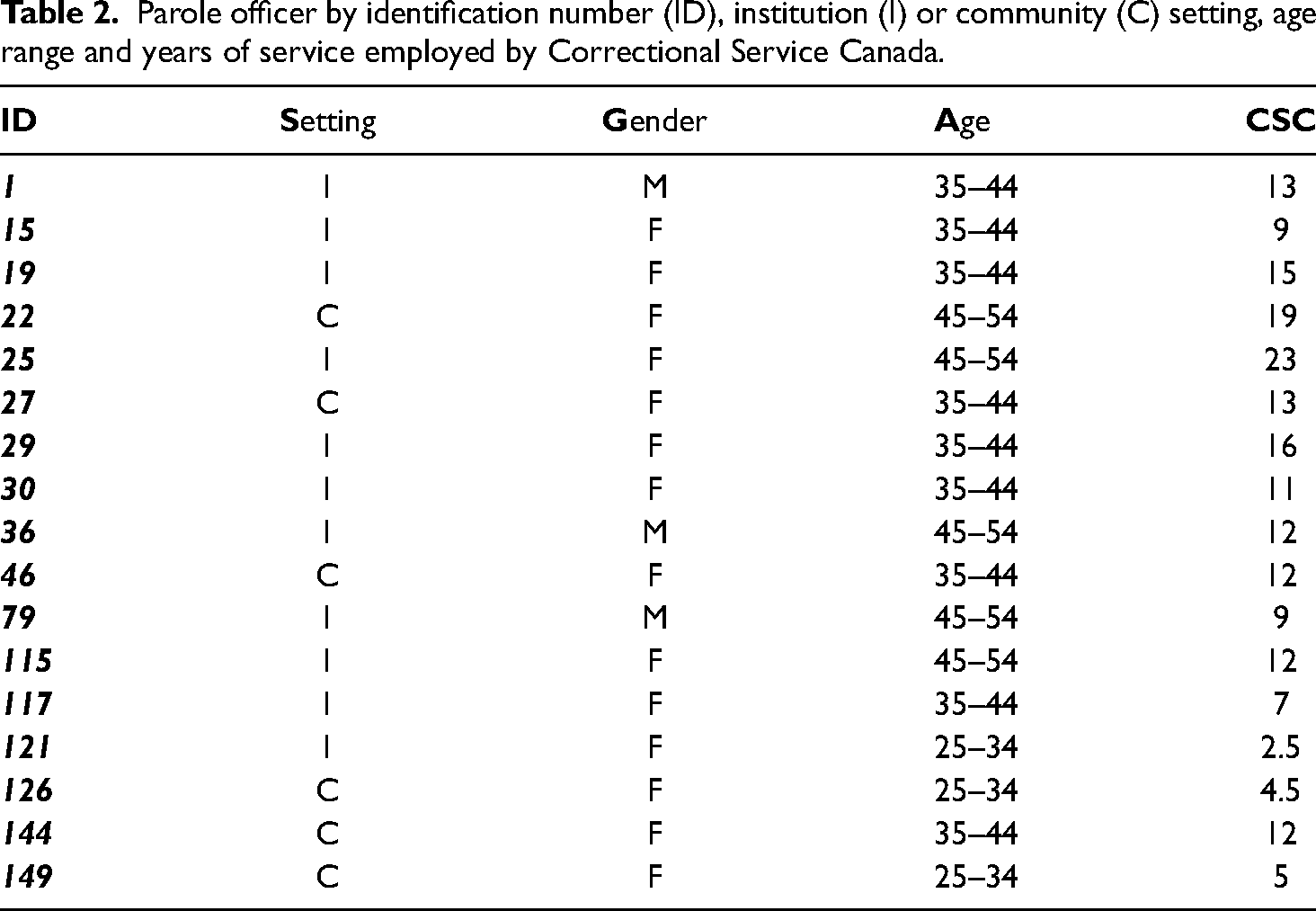
The most common age range of participants, when interviewed, was 35–44 years with a mode of n = 9. The parole officers presented in this article represented a collective 195 years of employment experience in Correctional Service Canada with an average career spanning ≥ 11 years. For confidentiality, we ensure no identifiable information is presented in the results and have edited quotes for readability, never impacting participant context, intention or vernacular.
Results: Saying versus doing
Collectively, parole officers described a stark gap between their employer's political statements and operations on the ground. This incongruency contributed to feeling unrecognized: ‘You asked earlier if we thought our position was respected by senior management, and … I don’t think a lot of them really understand what we do … I think there does need to be more recognition’ (P25). These words suggest a feeling of disrespect for a role believed to be underrecognized by organizational decision makers. Another participant further explained how provisions of mental health support collide with respect and dignity for parole officers: they tell us that our mental health is important. They’re really good at the talking but as [for] the actual providing … CSC comes up with this wonderful plan of like ‘oh, we need to better support our workers’ and then they put out like this video that comes to my laptop and I have to watch this thing about mental health in the workplace and then I have to do this online learning about mental health in the workplace and resiliency and all this other stuff. So I have a lot of online courses to do about my mental health (laughing).
(P117)
Despite audible laughter, this excerpt describes misrecognition where ‘mental health’ support is experienced superficially. The demonstrated gap between what the employer stated versus what was achieved in practice suggests contradictory communication. From the street-level perspective, participants saw: policies … being put in place before training is being done … policy … being pushed before the processes are tested … [my] frustration … oddly enough, it's never with my cases it's oftentimes with the … bureaucracy behind my job. (P15)
From afar, the wider organizational system appeared to be unaccountable: ‘I don’t know who makes the changes or who makes the decisions, but it's … hard to get anything done’ (P29). As stated, ‘getting things done’ on an organizational level was difficult because ‘decision makers’ who enact change are unknowable—a reality common to any large organization with disconnection between frontline and management. However, this perceived lack of accountability was supported by sentiments of territoriality according to one's position: I think that direct management listens to our opinions and our recommendations, we get a lot of encouragement from them, but when you go higher up the chain—well, our messages and our recommendations perhaps don’t go beyond middle managers.
(P149)
This demonstrates how perceptions of accountability were proximate for street-level bureaucrats on the ground. However, local operations evince that officers were unfamiliar with upper management. Thus, accountability appeared to disperse or dissolve ‘higher up the chain’. Affirming this, another participant stated, ‘I think once you get beyond that to the regional and national levels, it starts to get a little bit more diluted, and they don’t … appreciate or understand what a parole officer is going through’ (P1). Here, the officer says decision making was not appreciable on the ground level and that dilution occurred proportionally to the extent one was close to or ‘beyond’ operations.
For officers, accountability was experienced locally, while organizational decision making was seen as remote, distant and out of touch—creating discord: We know our job is hard, and we know that there's trauma and everything like that, but I think a lot of our stress also comes from the organization in itself, in the bureaucracy of CSC. … what is kind of a shock is how [the] bureaucracy is.
(P126)
This officer evinces an incongruency, from the frontline perspective, that is interpreted to mean the employer enacts something contradictory to what is desired on the ground level. Qualifying this, another exemplified wanting to be heard: My team … we had to try and get a message across … [and] to get concrete action … because this was an issue of accountability really if something ever happened … we would have been blamed and we would have felt the consequences … if we make demands I feel that they’re not often or they’re not always heard by senior management … we’d like to be more widely consulted because we’re there on the ground and we’re in the heart of things so sometimes I feel that even if I raise issues, the chances that that changes anything are pretty slim. (P144)
Unpacking this excerpt is the sense of blame felt by frontline staff from superiors, where accountability was perceived to be top–down and unidirectional. Being unheard, misrecognized and helpless, parole officers articulated a need for dialogical communication with operations on the ground. That desire to be ‘more widely consulted’ refers to a communication strategy where officers want to be organizational stakeholders. Achieving a more efficacious communication strategy, according to frontline parole officers, would benefit the organization as a whole: you would learn stuff about the areas where we might be breaching law that people are concerned [with] but aren’t able to [action] … you would learn those little bits and you’d be able to protect your organization better because you’d be able to ask more questions and ask the right questions from different people. (P27)
These words describe a communication strategy that effectively diversifies organizational knowledge flow bidirectionally by posing different lines of inquiry to frontline staff. Such a strategy, this officer posed, would help protect against organizational liability. Thus, for parole officers, a theory holds that accountability is perceived as ungraspable by those working on the ground. They rather felt pinned down by a didactic communication approach despite their proximity and appreciation for operations. Accordingly, this meant parole officers were ‘in touch’ with operations on the ground while other organizational members were ‘out of touch’ and perceptually distant and disconnected as characterized by bureaucracy.
Haptics: Sensitivity to being ‘in touch’
Parole officers described disconnection from decision making due to their low-level positionality within a hierarchical structure. For instance, organizational leaders would ‘ask … us to justify the decisions they already made’ (P19). Thus, disconnection was perceived as a lack of integrity. The officer continued, ‘they come up with these brilliant ideas … and then they expect us to just do it with very little consultation … from the frontlines … it's patronizing’ (P19). The officer references a preferred communication strategy that invokes meaningful consideration by consulting frontline staff, which may evoke caring sensations about organizational decision making. Regarding employment culture, the officer stated: its big, it's bureaucratic, people are stressed … I feel [sigh] isolated from beyond, like my direct manager. I don’t feel a lot of support coming from above … there's a huge disconnect between regional headquarters and national headquarters and the institution.
(P19)
These words indicate an organization characterized as disjointed, where frontline workers interpreted ‘headquarters’ as neither understanding nor caring to appreciate what happens on the ground. Thus, organizational members worked disconnectedly and at varying distances from the frontline. Reiterating this sense of disconnection, an officer stated: I wonder sometimes about the disconnect between us and the policy makers up in Ottawa. They’ve never stepped foot inside of a prison and how can they come up with this stuff … and I think there is a big disconnect there … in terms of what our roles really are, and the policies that come down the pipes. (P25)
These words describe unfamiliarity, with management ‘never stepping foot’ inside the workplace and disconnection between policy and the territory where frontline employees undertake daily operations. In other words, what the employing organization does versus what it says, according to parole officers, is discrepant. Another officer articulated concern about disconnection as an inability ‘to question the decision[s] … that are made by higher up[s]’ (P46), where remote departments functioned at a distance: I just find a lot of times that they either are so far removed from the frontline … Or they never had the experience with it to understand decisions that are being made and … the impacts. … We find departments don’t always like sharing everything or networking … which makes it difficult for us to do our job when we don’t know every little bit of the puzzle. (P46)
This excerpt describes a perception of the employer operating incongruently and suggests collaboration and connection (‘all pieces of the puzzle’ fitting together) may remedy organizational issues felt on the ground. Such a tactile approach to decision making for parole officers means each department within the complex organization needs to communicate effectively—in order to be ‘in touch’—and congruently fit pieces of the puzzle together. As another officer aptly stated, organizational members were ‘not in touch’ (P30). Collectively, frontline parole officers understood this sense of disconnection between operational realities on the ground and management prerogatives as fuelling mistrust.
Proxemics: Territoriality and the proverbial ladder
Territorially speaking, parole officers practised on the ground level, where distance was described in terms of being situated at the ‘bottom’ of the organizational hierarchy. The policy was perceived to exist atop a long and distant chain of command. Thus, officers most valued ‘just being straight up honest’ (P46) during workplace interactions. Yet, this tactic differed across the political territory in which organizational decision making occurred: one of my biggest stresses is more management and maybe not even direct management but the above management … it['s] always politically driven towards government so, the way decisions are often made is like the flavour of the year [or] the month … that's a struggle sometimes as well as communication … But it comes from the territory I find.
(P46)
The perceived policy-making tactic, as described by this officer, was based on populism or style rather than need. Thus, territoriality was invoked to describe a proverbial ladder that extended from the ground up to heads of government. Negotiating this space between supervisors and more distant senior management was challenging: we muddle through a lot of red tape, a lot of bureaucracy … the management we actually report to are at the bottom of … the ladder, [not] senior management. I know we’re not the ones making decisions. We’re on the ground. (P144)
‘On the ground’ meant an existence below the bottom rung of the proverbial ladder, where frontline officers were close in proximity to the action albeit disconnected from their superiors. Officers held a perception that decision making occurred elsewhere, at a distance—and not proximately. This perception of management-at-a-distance meant decision making and action were territorially different. Moreover, the tact for propelling oneself through the hierarchy, from action to decision making, was described as follows: if you wanna be a ladder climber, you basically just have to kiss the right person's ass … don’t piss off this person because ‘I wanna go here, here, and here.’ It's very [much] who you know, the relationships you’ve formed, a lot of it is very political that way. … And that's upper management and like CSC as a whole … On an institutional level, it's a little bit like that but a lot less. (P121)
These words describe favouritism underpinning movement on the proverbial ladder. While this issue appeared less pervasive in workplaces local to frontline staff, organizational politics were at other times vicious: I find it's become over the years less supportive and more political … people are trying to climb the ladder so they’re going to try and please whoever they need to please to do that … so, it's a matter of who do they have to throw under the bus or who do they have to make an example of to show that they’re doing a great job. So instead of reaching out and supporting people, they end up persecuting people … I’ve seen some of my colleagues treated horrifically, all in all, to try and show how great a manager they are. (P115)
This excerpt indicates a perception of suffering, as the officer held a belief that certain managers would act cruelly to subordinates for personal gain. Another participant suggested decision-making myopia among parole officers who were relegated to ‘individual’ case assignments: That kind of structure that's already in place. It kind of is what it is, and do I feel I have a voice in that? No, not at all. I don’t make policies. At all. That's just what it is. … we’re pretty autonomous on how we choose to manage an offender … But if you’re looking at the bigger picture thing, like policy, I have no say in policy or what laws are coming down or anything like that. (P36)
Parole officers maintained their role occupied a territory removed from the organizational structures, in which they felt unheard, invoking a sense of helplessness about policy making. This perception was that parole officers were fixed to a place that was below the bottom rung, which for some, led to a desire to climb the politicized proverbial ladder. Policies were therefore seen to dictate governance where some held status as organizational stakeholders and others, such as parole officers, were required to comply with downflow torrents of direction.
Kinesics: Organizational mobility and knowledge flow
Organizational mobility pertained to both how information flowed as well as human resource movement and allocation. For example, when asked about their ability to voice concerns and effect change, participants were definitive, responding: ‘not within CSC’ (P29), ‘no, being it's a huge organization’ (P22) and ‘in the grand scheme of things, no, not at all’ (P121). However, as previously mentioned, parole officers felt they did have some modicum of agency to either propel themselves up the proverbial ladder or exercise discretion in casework: on the sort of individual level … working with offenders, there is room to move. There is ability to provide my opinion … on how a guy should be managed or whatever. So I do feel … in that regard, that yeah, I do get heard.
(P36)
These words indicate a situation on the frontline that equates to being able to grasp nuances of parole work, including an interpretation of gestural cues and posturing. Parole officers opined judgements not only about casework but formed perceptions generally about the organization itself. Mobilizing those opinions to effect change on an organizational level was perceived to be fettered by liminality. That is, parole officers perceived decision making to be dispersed among distant upper management, atop a proverbial ladder, with which that feeling of helplessness meant parole officers tended to give up and ‘move on’: We get a lot of false promises, and then they [managers] just hope that we move on, and we do because we’re so beaten out and feel like we don’t actually have a voice … you just start to give up. (P1)
The voicelessness that parole officers describe, due to unmet expectations, left them believing that organizational leaders were sometimes deceptive. Hence, the interpretation was the parole officer position was undervalued within the organization, evoking a perception of hopelessness. As a participant explained, managerial expectations were often unrealistic, ‘they expect miracles … and [we] hardly ever see anyone from those buildings step foot [in] an institution’ (P19). Remarking here about how a manager ‘walks verses talks’—alluding to gait—illustrates how nonverbal communication is perceived by the frontline. The administration, vis-a-vis senior managers, were seen as unaccountable to officers on the ground: I mean we are the frontline. If you want to know what needs to be changed probably that's where you should be looking … then we have feedback and it rolled out exactly how it came across [originally] so to me … we regurgitate a lot … I feel like there's a lot better ways we could be doing our work but … when you got an organization this large … there would have to be some major upheaval to start actually getting more information from the bottom. (P22)
These words indicate a desire to mobilize decision making from the bottom up and foster an organizational communication strategy that is congruent and complementary. Mobilizing organizational knowledge in this manner was a reality elaborated upon by a participant who had prior private sector work experience: When I worked in a business you’d have people at higher levels coming and talking to you and just being like ‘how are you? How are things? Do you have any like suggestions?’ In a hierarchy you can’t do that and so you’ll never see the district director or the area director coming to your office and having a seat and asking you ‘how is your day?’ and ‘how are things going here? What is your opinion about what's going on?’, so everything is filtered and that's where you stop being heard. (P27)
These words evince organizational information flowed in a way that hindered knowledge about what is actually happening on the ground. The impact on employees is how they subsequently form attitudes, opinions and perceptions about being heard. When upper management efficaciously engages parole officers, it cues them to a valuing of their work. Consequently, frontline staff who feel they are not appropriately consulted perceive being undervalued. Thus, frontline engagement demonstrates how information may be channelled from the ground up—by ‘moving’ ideas and new perspectives through the hierarchy. As another parole officer put it: If CSC really wanted to put its money where its mouth [is], there would be a little bit more, you know … awareness of the workplace and identifying … new perspectives of new and younger employees … other people that have other experiences from outside; [but] we don’t hire a lot of external [employees] at our site most of our people are promoted from within … so the culture continues. I’m an external guy, I was hired off the street from provincial corrections, so I think I have a different way of thinking. (P79)
Participants reiterated that ‘awareness’ of the frontline situation may be mobilized by investing in what parole officers describe as concerning, and as an approach, this represents a means for inducing a more effective organizational knowledge flow. Failure, however, to heed this advice meant that parole officers ‘feel like you have to go outside [the organization] if you want anything done’ (P29). Hence, organizational knowledge flow meant that human resource allocation pertained to people's mobility. This occurred in a way that meant staff might seek to climb up, move beyond or leave their employment situation.
Discussion
Our investigation into parole officers’ experiences deals with the informational and interpersonal dimensions of interactional justice (Bies and Moag, 1986; Wolfe and Lawson, 2020; Zayed et al., 2020). Within this framework, interpretations of nonverbal codes appear to affect the well-being and resilience of parole officers where policy statements were juxtaposed to what was enacted in practice. Thus, divergence from what is said versus what is done exacerbates uncertainty in parole and may contribute to the compromised mental health of correctional workers (Norman and Ricciardelli, 2022b; Ricciardelli et al., 2020, 2022a).
Our findings support organizational justice as a multi-construct concept, and based on experiences reported by parole officers, their workplace interactions bring attention to the need for a responsive communication strategy, especially regarding how criminal justice is administered in the public sector. In carceral contexts, nonverbal codes signal how haptic interactions—and touch avoidance in parole noncontact culture—implicate a need to understand compassion in penal settings (Andersen et al., 2013; Bonaccio et al., 2016).
A distributive outcome of our analysis is that sensory experiences of punishment pertain to a dialogue through which criminal justice governance is mediated by penal communication theory (Christie, 2007; Duff, 2003). Thus, Correctional Service Canada and similar organizations may wish to consider how policies are perceived—and practices subsequently conceived—by their frontline members if they wish to promote legitimacy (Bottoms and Tankebe, 2012; Sparks and Bottoms, 1995). We have argued this means redressing the divergence between what an organization is perceived to do and its official policy statements by promoting awareness about nonverbal codes, thereby converging on authenticity and recognizing frontline proximity.
As a strategy centred on nonverbal communication, managerial training in emotional intelligence is prudent (Bonaccio et al., 2016) as this promotes awareness about the organizational ‘eco-system’, elucidating how silos and friction devolve into toxicity (Sharma and Bhattacharya, 2013). Nonverbal codes, as understood through organizational citizenship behaviour, suggest the need for awareness about how knowledge is managed, shared and flows within and beyond organizations (Leistner, 2015).
More specifically, we found that inter-organizational interactions among parole officers pertain to both the procedural and distributive factors underpinning perceptions about how decision making and self-governance occur within penal organizations (Phillips, 2023). We found parole officers felt generally voiceless about their concerns and mistrusted such issues would be meaningfully addressed. Therefore, organizational knowledge that is disseminated to the frontline, with no uptake from staff, left street-level bureaucratic officers feeling disrespected and holding a belief that policy making occurred elsewhere and was exclusive.
Theoretical contribution: Haptic interactions
Parole officers’ perceived distance between political decision making (i.e. policy) and the actioning of policy on the ground (i.e. practice) contributed to discord between upper management and frontline governance. Parole officers perceived their positionality as being situated at the bottom of a hierarchical chain of command. Their proximity to operations meant being ‘in touch’ with frontline realities, thus able to grasp nuances of parole work that policy makers were seemingly unable to appreciate. Policy, according to frontline officers situated at the bottom of their organizational hierarchy, was perceived to be ‘out of touch’. Thus, organizational members worked in vastly different territories that impacted organizational functionality. One interpretation of this observation is the spaces bureaucrats occupy are inherently territorial. We understand territoriality as characterized by rungs of a proverbial ladder that some parole officers aim to climb, touch and move up by becoming organizational stakeholders of perceived status. Recognizing the drive human beings have to defend their place, therefore, provides some explanation as to the politics of exclusion, and at times hostility, in parole workplace culture.
For instance, ‘throwing coworkers under the bus’ may be read as a gesture or haptic interaction that is perceived kinetically, which conveys a noncollegial demeanour. Meanwhile, ‘sucking up’ may be interpreted as posturing amenability to move up. As a haptic interaction, this shows one's affinity to climb the proverbial ladder and mobilize in favour of politics and managerialism. These findings suggest organizational mobility for parole officers was liminal, where decision-making capacity is confined narrowly to casework and removed from organizational matters concerning policy.
Hence, ‘misrecognition’ in parole work was perceived as oppressive in how it was organized, managed and administered (McNeill, 2019). That is, human resources occurred through cultural inculcation where ideas flowed, and mobility was favoured from within, consistent with observations about nepotism and unfair promotion practices in the public sector (Zayed et al., 2020). Mobility within Canada's national correctional service was, therefore, an allocation situation perceived to be inequitable and informed by moral judgements (Leventhal et al., 1980). Parole officers imbued, through their desire for recognition, procedural justice by way of voice, trust and respect (Cohen-Charash and Spector, 2001; Colquitt et al., 2001).
The distribution of human resources, as it relates to nonverbal codes, therefore mediates justice phenomena (Bonaccio et al., 2016; Zayed et al., 2020). Inasmuch as human experience is grounded by the sense of touch, it is also contextualized by the spaces where nonverbal codes exist. We argue that public perceptions are a distributive outcome of the criminal justice system, and further inquiry into parole's noncontact culture may elucidate ways of rethinking organizational knowledge flow. That is, if perceptions represent a distributive outcome of how parole operates, then who is most ‘in touch’ with how to realize desistance on the ground? We recognize that frontline praxis occurs through ad-hoc case-management decisions when officers engage in daily interactions (Hupe and Hill, 2007; Lykes and Hershberg, 2012). We believe that conceptualizing haptic interactions in this way may bring policy and practice closer together (Andersen et al., 2013; Leistner, 2015). These findings result in a diagram for scholars to continue explicating the dynamics of inter-organizational justice (see Figure 2).
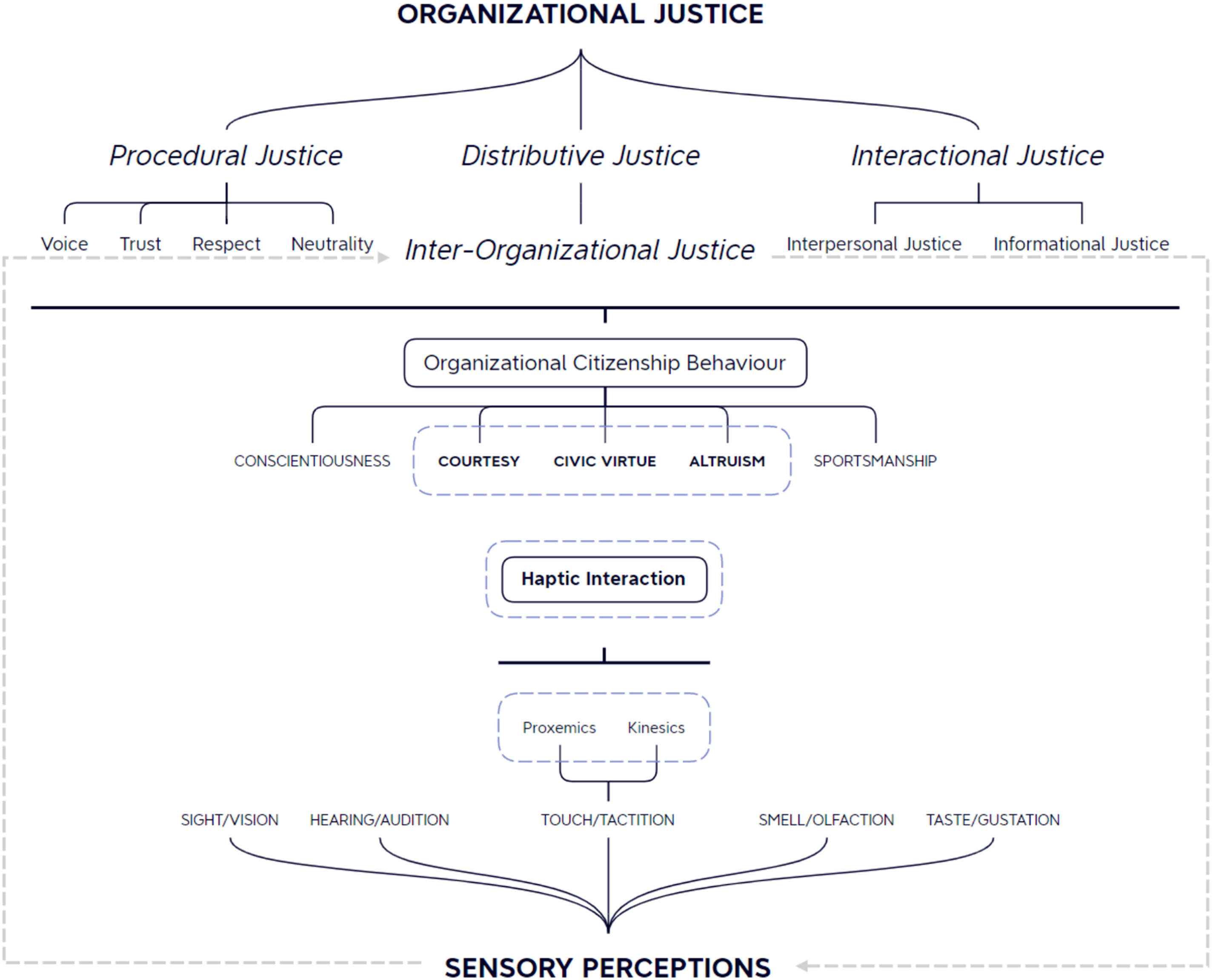
A diagram mapping sensory perceptions onto organizational phenomena.
Practical implications: Justice perceptions of organizational citizenship behaviour
We engaged sense making perceptually and contextually based on parole officers in terms of how close—or ‘in touch’—they felt to operations. Our data show that further empirical inquiry is needed to understand the complex and constellational nature of nonverbal communication as it relates to organizational phenomena. Administrators for public sector organizations, such as Correctional Service Canada, are advised to pay particular attention to organizational interactions and especially how information is communicated interpersonally. This may be measured in terms of convergence by aligning experiences of fairness with frontline sensory perceptions.
Following Bonaccio et al. (2016), we understand congruence in terms of authenticity related to emotional displays at work. Continued advancement with emotional labour in criminal justice is therefore useful as nonverbal codes may be perceived differently than intended within the social contexts of parole workplaces (Phillips et al., 2020, 2021; Waters et al., 2021). Management studies must therefore recognize minor subtle cues potentiate widespread repercussions. Moreover, inter-organizational justice not only impacts all employees, it also potentially impacts how the public perceives claims made by criminal justice administrators.
Appreciation for the dimensions of how judgement is mediated sensorily may be key to understanding the multi-construct concepts of justice. Thus, a practical outcome of our conceptual work is to foster congruency by mobilizing knowledge flow and promoting an accountable praxis of ad-hoc policy making for the field. We conclude with a few questions about organizational citizenship behaviour. Reflecting on the dimensions that were particularly salient in our data, we pose the following questions for future consideration. How do organizational members perceive political life as a function of their employment (civic virtue)? How do staff help one another resolve organization-relevant issues in the workplace (altruism)? To what extent do employees perceive colleagues care about their work, and how does the employing organization administer resolution processes for issues when they arise (courtesy)?
While conscientiousness and sportsmanship were less salient in the data presented in this article, we nevertheless urge consideration of these dimensions. In the case of conscientiousness, how amenable are staff to go above and beyond their role to promote the goals of the organization? And in the case of sportsmanship—which pertains to the identity of parole officers and their employing organization (Lovins et al., 2018, 2022)—how may endurance be perceived in terms of coachability and in the context of feedback?
Limitations and future research
One significant limitation of our work is that nonverbal codes tend to be ocular. Our analysis, premised on interview data, has offered some understanding of paralanguage and idioms but neglected interpretations about illustrators, eye contact and fidgeting. Future research may overcome this by engaging in ethnographic and observational methods while investigating nonverbal codes in organizational contexts. Moreover, the demographics of our participants were predominantly self-identified women. Despite the masculinities performed in carceral workplaces (Ricciardelli et al., 2015), a gendered dynamic exists in which women tend to prefer less physical distance and, thus, desire greater closeness in workplace settings (Bonaccio et al., 2016). Future research should unpack these dynamics with greater certainty, for instance, engendered differences in preferences, traits, taste and dispositional characteristics.
Consistent with our findings is the need to better understand hiring practices, including nepotism in the public sector, in order to learn how promotion occurs as well as what drives individuals to move into—and away from—correctional organizations. This may be undertaken from both staff or service user perspectives by exploring how interactions among organizational citizenship behaviour relate to penal operations as a function of desistance.
Our findings are highly conceptual in part because our analysis was limited by an approach that was not intended nor designed to study nonverbal codes. As with all qualitative research, generalizability is therefore cautioned. This exploratory work cannot determine the complex and constellational nature of nonverbal codes. We merely point to how nonverbals relate to justice and organizational phenomena, whereas quasi and full-experimental designs within laboratory settings might avail more explicit correlations. We urge quantitative and qualitative researchers alike to take up this line of inquiry by considering ways to better recognize and test the multi-construct concepts of justice. As discovered in our present research on parole officers, we believe one way of achieving this might be through carceral geography. For instance, how might cognitive-perceptual mapping methods, including cartography, aid in more precisely locating justice and detailing its constitutions? As a starting point, we believe exploration into organizational and communication phenomena is paramount.
Conclusions
In our exploratory research, we sought to bridge nonverbal communication with organizational theories to reveal how parole officers experience bureaucracy within Correctional Service Canada—a public sector organization that administers criminal justice nationally. We located accountability within patterns of behaviour and showed how authoritarian governance is necessary for complex organizations, albeit contradicting the agency required for parole officers to responsively address re-entry needs for ex/prisoners. We theorize that perceptions of frontline parole officers hold insights about the legitimacy of criminal justice administration. By operationalizing sensory perceptions, we show how procedural, distributive and interactional constructs relate to organizational justice. Thus, we offer some explanation as to why supervisory procedures sometimes appear unfair and converge on future research directions, including how organizations may augment their communication strategies.
Footnotes
Declaration of conflicting interests
The authors declared no potential conflicts of interest with respect to the research, authorship and/or publication of this article.
Funding
The authors disclosed receipt of the following financial support for the research, authorship and/or publication of this article: this work was supported by the Union of Safety and Justice Employees.

Author biographies
Micheal Taylor is a PhD student researching Safety, Security and Wellness with prior probation and parole practitioner experience (2016–2022). His research investigates how criminal desistance and technology mediate penological work in the context of organizational justice, citizenship and behaviour.
Rosemary Ricciardelli (PhD, Sociology) is a Professor in Maritime Studies and Research Chair in Safety, Security and Wellness. She was elected to the Royal Society of Canada (2019), and her scholarship is broadly recognized as evolving understandings of risk, gender and vulnerabilities, including experiences of criminal justice practitioners and other public safety professionals both on land and at sea.