




Abstract
What are we talking about when we talk about police discretion? The concept is ubiquitous yet ambiguous and amorphous. In analytical terms it is redundant, but its continued use remains (for some) convenient and politically expedient. References to police discretion, connote as much as they denote, and in so doing they reproduce politico-legal structures that legitimise, enable, and may even embolden, discriminatory policing practices. We conclude, therefore, that policing scholars ought to move beyond discretion, developing a new conceptual vocabulary for making sense of police power.
Introduction
This article began life as a simple question: ‘What are we talking about when we talk about police discretion?’. Our reading revealed a ubiquitous yet ambiguous and amorphous concept, both taken-for-granted and imprecise. Noting this, we resolved to examine the concept more closely, to clarify what is at stake when we talk of police discretion by identifying the work the concept is doing in various discursive contexts and probing its explanatory utility. In trying to hone our own conceptual vocabulary, we sought to understand whether and in what ways the term discretion aids our understanding of police, and to consider whether we might be better able to make progress on urgent and seemingly intractable issues including inequalities in the use of police power, by emphasising alternate concepts over ‘discretion’.
Our core argument is as follows. In Anglophone jurisdictions, the concept of discretion has become ubiquitous in discussions of police work but inhabits a liminal space between political and organisational rhetoric, legal theory, political philosophy and sociological explanation. The concept is used to refer to multiple practically interdependent but conceptually distinct modalities of policing such that it oversimplifies and obscures the reality of police action, incorporating a crucial disjuncture between the imagined legal agent (autonomous, individual, rational), and the reality observed in empirical research of officers as ‘co-agent[s] of common social actions’ (Ericson, 2007: 379). Thus, key unresolved tensions at the core of the legitimacy struggles of the modern police institution are contained within the concept. As a result, it can only describe rather than diagnose the causes of recurrent problems with police power and in analytical terms is redundant. Nonetheless its continued use remains (for some) convenient and politically expedient: it reproduces politico-legal structures that legitimise, enable, and may even embolden, discriminatory policing practices. We conclude, therefore, that policing scholars ought to move beyond discretion, and adopt new conceptual vocabularies for making sense of police power.
The article is structured as follows. First, we provide an overview of the origins of and definitional issues with the concept of police discretion. Second, we make the case for considering police discretion as a special case of discretion and offer a constitutive criminological lens through which to view this special case. Third, we examine the concept in more depth by identifying the five main reasons given in the policing literature for why discretion is inevitable and/or necessary, each of which places different types of demand on police officers, implying different meanings for the concept of discretion with correspondingly varied practical and political implications. Fourth, we turn to empirical literature on police work in which loose, compound definitions of discretion that accommodate power, autonomy, interpretation and choice can appear more germane yet result in a proliferation of different working usages of the term, which are sometimes tellingly incompatible. Finally, we conclude by proposing that developing a new conceptual vocabulary to replace police discretion is a crucial pragmatic move in gaining a much-needed fresh perspective on police power, authority and legitimacy.
Police discretion: The ‘discovery’ of what?
Decision-making by actors at different points in the criminal justice process is a well-worn topic in criminal justice research. But, because of the breadth and indeterminacy of the police role, and the crucial role played by the police before the formal criminal justice process is even activated, the concept of ‘police discretion’ has a unique significance. It is ubiquitous in discussions of policing, offering reassurance when police powers are expanded (e.g. during the Covid-19 pandemic; see Home Office, 2020), its value regularly proclaimed (College of Policing, 2014, 2017; Police Federation, 2018). But empirical researchers frequently discuss it in connection with discriminatory and/or inadequate policing (Bowling and Phillips, 2007; Ellis, 2010; McCara and McVie, 2005; Myhill and Johnson, 2016; Rowe, 2004), and it is in this vein that the concept first came to the fore in academic work.
Concerns about the conduct of police officers in mid-20th century America prompted fieldwork by the American Bar Foundation, which explored previously hidden aspects of criminal justice, observing that police officers, like other criminal justice actors, could shape the law ‘in action’. Some argue this research created a need for ‘a new way of talking about the police’ (Nickels, 2007: 571), with the term ‘police discretion’ being deployed to denote the gap between ‘the law in principle and the law in practice’ (Nickels, 2007: 571). Acknowledging this ‘discovery’ was a challenge for some police officers (Ericson, 2007; Goldstein, 1963) and some preferred to protect the ‘constitutional fiction’ (Waddington, 1999), that they impartially enforced all laws.
Others argue that the true ‘discovery’ was the realisation of the extent to which police officers operated in unjust and anti-democratic ways, engaging in ‘unregulated decision-making’ (Kleinig, 1996: 2) with ‘rampant lawlessness, racism, and casual unprofessional conduct’ (Walker, 1993: 9) seemingly beyond legal constraint or rebuke. Whether ‘discretion’ encompasses both officially authorised and unofficially enabled forms of police behaviour is an unresolved distinction discussed further below. But it is clearly the case that discussions of police discretion, especially in the U.S.-context, have long been coupled with concerns about police conduct.
Yet, what seemed a novel discovery in the US, has long been taken-for-granted in the English context. The first commissioners of the Metropolitan Police provided ‘General Instructions’ for new officers but cautioned that they were ‘not to be understood as containing rules of conduct applicable to every variety of circumstances that may occur in the performance of their duty; something must necessarily be left to the intelligence and discretion of individuals’ (quoted in Kleinig, 1996: 1). The ‘office of constable’, held by sworn police officers, enshrines in common law their position as ‘agents exercising an independent authority by virtue of the office’ (Grimshaw and Jefferson, 1987: 201). Thus, in England, discretion is ‘afforded to the constable in law’, part of the unwritten constitution (Grimshaw and Jefferson, 1987: 295).
An early article in the Police Journal (FTT, 1936: 235) affirms this understanding of discretion as part of the unwritten ‘English Constitution’, and explicitly associates discretion with good judgement, referring to it as a ‘virtue’ that ‘policemen, in all ranks’ must ‘exercise’. Here discretion is associated both with the constitution of power and authority in society and with the possession of the necessary good judgement to wield such power well, reproducing a common elision between notions of power and of good judgement (discussed further below) and demonstrating how the concept is often used in a rather loosely defined way. Conceptual ambiguity is not unusual in political and organisational rhetoric, but one might expect greater clarity and consistency in analytical research publications. Yet over six decades of empirical research on policing have not provided this.
Empirical studies of police work in Anglophone contexts tend not to define ‘discretion’ in detail (Fletcher, 1984; McGregor, 1996; Nickels, 2007; Pearson and Rowe, 2020). Theoretical perspectives developed by legal scholars (KC Davis, 1969, 1975, 1996; Dworkin, 1977; Fletcher, 1984; Galligan, 1986; McGregor, 1996) are rarely acknowledged and the word is often used in a rather ‘generic’ sense (Gelsthorpe and Padfield, 2003: 6) or its use lacks both clarity and consistency (Barlow and Walklate, 2020; Nickels, 2007; Pepinsky, 1984). Pearson and Rowe (2020: 9) note that this inconsistency is reproduced within police organisations as both police leaders and front-line officers use the word in varied ways, such that it encompasses multiple ‘meanings and behaviours’.
In contrast to the looseness described above, some researchers explicitly indicate that they use discretion to refer to those instances in which front-line police officers choose to pursue formal legal proceedings against some suspected offenders, or in relation to certain offence types, and not others. This is referred to variously as ‘invocation discretion’ (Goldstein, 1960), ‘legal discretion’ (Grimshaw and Jefferson, 1987), ‘discretionary enforcement’ (LaFave, 1962b), ‘discretionary non-enforcement’ (Monahan, 2023) and ‘selective enforcement’ (Davis, 1975; Fielding, 1991; Grimshaw and Jefferson, 1987). At other times, discretion is used to indicate decisions made in relation to a much broader and less-clearly defined set of issues, including the freedom more senior law enforcement officials have to decide how to distribute police resources across different areas and communities (Miller, 2015); whether individual officers ‘exercise authority in any encounter’ (Schinkel et al., 2018: 637); whether officers pay closer attention to certain people, places and incidents than others (Waddington, 1999); and, at times, almost any decision made by police officers at work (Brown, 1988; Phillips, 2016).
At this stage, it is important to acknowledge that the above observations are largely derived from literature focused on Anglophone jurisdictions, and we must be careful not to imply that the conceptual issues we describe are universal. Although the concept of discretion is familiar to literature on policing across Europe (see, e.g. Aston et al. 2024; Buvik, 2016; Gundhus et al., 2022) and beyond (Göpfert, 2017; Jardine, 2020; Martin, 2007; Varghese, 2022) the frequency and manner of use of the term that we identify and critique here cannot be said to characterise all policing research (Eiró and Lotta, 2024; Lotta et al., 2022). For example, Jauregui (2014, 2016) makes minimal references to discretion as she explores police power in India, instead adopting concepts of ‘provisional agency’ and ‘provisional authority’ to capture the multifaceted indeterminacy she observed. Meanwhile, Kyed (2017) and Waseem (2021) refer to ‘procedural informality’, with Waseem noting that discretion is but one element of the informal practices that are central to police ‘getting things done’ (p. 586). Perspectives such as these, focusing on policing in Global South contexts, offer inspiration when it comes to developing alternate conceptual frameworks for moving beyond ‘discretion’. We return to this matter in our conclusion, but for now we note that the primary analytical focus for this article has been on the significance of the concept of ‘discretion’ in the context of research in Anglophone policing settings.
Given the foregoing discussion, it is tempting to concur with Fletcher that the assortment of different senses in which the concept is applied renders the ‘discussion of discretionary processes virtually incomprehensible’ (Fletcher, 1984: 276). Yet variation and even imprecision in conceptual definitions is neither unique to the concept of discretion nor, with respect to discretion, is it a distinctive feature of the field of police studies. Nonetheless, as we argue next, there are good reasons to regard the issues with the concept of ‘police discretion’ as distinctive.
Police discretion as a distinctive case
Commenting on the multidisciplinary field of policy implementation studies, Hupe (2013: 426) notes that ‘discretion’ functions as ‘a more or less broadly defined label (or “umbrella”) under which aspects of bureaucratic practice at the street level get attention’ and that researchers should accept that the concept is ‘multifaceted’ and calibrate their analytical approach accordingly (Hupe, 2013). We find this relaxed prescription concerning when it comes to thinking about the specific case of policing and propose that police discretion ought to be considered a distinctive kind of public administrative discretion for (at least) three reasons. First, often the person towards whom discretion is to be directed has not initiated their encounter with the police by seeking some specific service or benefit from them (e.g. healthcare or employment benefits). Rather, they are the person to be dealt with (or not dealt with) by the police to provide a service to some other (specific or imagined) citizen(s). Second, police operate with a highly ambiguous remit, such that the ends towards which their ‘discretion’ is exercised often remain hazy and implicit, if not indefinable (Dubber, 2005). And third, because police power is highly consequential, expansive, controversial and politically charged, and to legitimise the power they possess, they themselves make use of the concept of discretion.
That police organisations themselves use the concept of discretion in official discourse as a legitimising device matters profoundly, because discretion therefore functions as both a ‘category of analysis’ and a ‘category of practice’ (Brubaker and Cooper, 2000: 4) in relation to policing. As a ‘category of practice’, the concept of ‘discretion’ can be used to encourage people to see police power and its application favourably. This is possible because discretion has long been used to refer to both the existence of a space within which an individual is free to decide how to act (power, authority) and the quality of using power well (good judgement, wisdom). Furthermore, the etymological origins of the word lie in the second sense of good judgement (Galligan, 1986) and it is this connotation of discretion as a ‘virtue’ (FTT, 1936) that lends a positive air to statements about the importance of police discretion.
Despite the dual functionality of the word ‘discretion’, it has become a commonplace feature of the way in which policing is represented and thus constituted in various discursive realms. When used repeatedly, ‘particular ways of talking … reflect, continuously constitute and reconstitute narratives that provide the continuity to reproduce social structures’ (Henry and Milanovic, 1994: 113). The concept's etymological origins in the notion of ‘good judgement’ enable it to persistently connote legitimacy, even as it is putatively deployed to denote a range of features of police work to analyse police power. Noting this, along with the distinctive characteristics of police work, it seems to us that, contra Hupe (2013), we should not be entirely relaxed about discretion's ‘multifaceted’ nature.
Indeed, given the expansive powers granted to the police, the potentially profound consequences of being subjected to such powers and the extensive evidence of entrenched inequalities in the way they are used, it is vital that the concept which is so frequently deployed in discussions of how police use their powers is, at the very least, more carefully defined (McGregor, 1996). As Brubaker and Cooper (2000: 2) observe, ‘[s]ocial analysis … requires relatively unambiguous analytical categories’. And so, we turn next to the possibility of conceptual disambiguation.
Towards disambiguation: Reflecting on the inevitability of police ‘discretion’
Despite the potentially confusing range of ways in which the term discretion is used in relation to policing, there are some noteworthy points of consistency and recurring themes. First, it is commonly accepted that police discretion is either inevitable or necessary (or both). Second, there is a recurrent emphasis on five reasons why this is so, namely: (a) the ambiguity of law (whether intended or not); (b) the finite nature of police resources; (c) the limitless variety of complex, volatile and risky scenarios police encounter at work; (d) the ‘low-visibility’ conditions under which police officers work; and (e) the need for police to maintain good relationships with the community. We now examine each of these claims in turn to identify how they contribute to constructing the multifaceted concept of discretion.
Ambiguity of the law
Classic texts on ‘police discretion’ emphasise that few (if any) laws have ever been written that did not require interpretation (Brown, 1988; Goldstein, 1960; LaFave, 1962a, 1962b; Waddington, 1999). This is said to make ‘discretion’ an inevitability in police work (Rowe, 2007; Sanders and Young, 2011). The more ambiguous the law, the greater the space for officers’ interpretations to shape the way it is applied (Jefferson and Grimshaw, 1984; Waddington, 1999). Attempts to regulate or shape the use of discretion (for example, through the provision of guidance or codes of conduct) simply enlarge the range of decisions they must make about how to act (Pepinsky, 1984).
On the face of it, the application of professional judgement to interpret the law seems to be the least controversial aspect of discretion, although it means police officers inevitably have ‘personal input’ (Fletcher, 1984) into the law-in-action. However, as the following sections make clear, the tidy bracketing of cognitive effort, severing interpretation from choice, is rarely plausible, not least because officers are subject to various constraints and influences that mean they must balance competing demands.
Resource limitations
That police can never deal with every criminal offence committed has long been a staple in the police studies field (see, e.g. Bittner, 1967; Brown, 1988; Davis, 1975; Goldstein, 1960; Hall, 1953; LaFave, 1962a, 1962b; Lipsky, 1980). Police leaders have long been aware that ‘full enforcement … is not a realistic expectation’ (Goldstein, 1960: 560–561) and that police must necessarily be ‘selective’ (Hall, 1953). The police's putative core aim of crime suppression will always be ‘incomplete’ (Jefferson and Grimshaw, 1984).
The need to manage limited resources arises most obviously for senior police leaders. Their decisions about policy, priorities and deployment affect which types of crime are dealt with: a form of selectivity before front-line discretion ever comes into play (Jefferson and Grimshaw, 1984; Stenning, 2007). Instructions or guidance issued to officers, and their deployment in certain teams or geographical areas or to focus on certain tasks, may result in a general policy of non-enforcement in relation to certain types of behaviour or people (Wilson, 1968).
Whether every instance of selection that police resource limitations entail should be called ‘police discretion’ is a matter for debate. The overall strategy and priorities senior officers set, as well as the overall managerial approach, clearly shape front-line activity (Gundhus et al., 2022; Monahan, 2023), but senior officers themselves are rarely exercising discretion in relation to specific people, in specific places, doing specific things (Sekhon, 2012). When people talk of ‘police discretion’ they have traditionally been referring to the types of decisions made by officers on the front line (Barlow and Walklate, 2020). But, like their more senior counterparts, individual front-line officers operate with an awareness of resource limitations.
When they stop and search someone, make an arrest, issue a fixed penalty notice or ignore a minor infraction, the individual officer (consciously or not) apportions the finite resource of time. In the context of limited resources, where officers may judge that the incident is not an appropriate (or rewarding) use of their time (Holdaway, 1983), they may choose to respond informally or not at all to some situations (Pearson and Rowe, 2020). The result is that some laws are rarely enforced, or are enforced only against certain people, or in certain circumstances (Davis, 1975; McCara and McVie, 2005). This selective enforcement can occur either because certain offences are simply not a priority or a focus for proactive work, or because where officers encounter offences during normal duties they deal with them informally or not at all. If resource limitations make ‘discretion’ inevitable and necessary, then this encompasses officers being authorised (or at least enabled) to make choices of this kind.
Limitless scenarios
The reality of police work brings front-line officers into a potentially limitless range of scenarios, where responses to police intervention cannot be predicted in advance. Thus, providing prescriptive or codified direction for officers on the course of action they should take is widely considered difficult and potentially counterproductive (Beckett, 2016; Bradford and Jackson, 2016; Buvik, 2016; Gundhus et al., 2022; Holdaway, 1983). This is perhaps particularly so in relation to the ‘peacekeeping’ aspects of police work, in which officers may be dealing with relatively low-level offences that are open to interpretation (e.g. drunk and disorderly behaviour). Supervisors may be highly reluctant to provide prescriptive direction, preferring to rely on officers exercising the skilled ‘craft’ of dealing with the people they encounter without invoking the criminal law for every minor infraction (Bittner, 1967; Wilson, 1968).
Attempts to shape or curtail the use of discretion in certain situations (e.g. in relation to domestic violence) through guidance, binding codes of practice, ‘decision support’ (Slowother, 2014) and mandatory procedures indicate the limits of policymaker and public trust in officers to make appropriate assessments and choices for every scenario. As we have already noted, such codes and guidance only enlarge the range of decisions officers face (Lipsky, 1980; Pepinsky, 1984).
Low visibility
The low visibility of police work appears to be unavoidable: front-line officers often work alone or in pairs and, except in cases of major failure or when they invoke formal powers or procedures, specific actions are unlikely to be fully visible to others, even their direct supervisors (Goldstein, 1960; Holdaway, 1983; Skolnick, 2011). Difficulties in achieving formal oversight are particularly acute when it comes to peacekeeping or order-maintenance work, which often does not involve the identification of specific crimes or formal invocation of police powers, and thus is often invisible to systems in which officers record their actions. On this basis, it has become accepted wisdom that the lowest ranking front-line police officers, dealing mainly with low-level offences and order-maintenance work have the ‘most’ discretion (Poyser, 2004).
In recent years, this understanding of the nature of police work has been increasingly challenged by innovations in police management, increasing bureaucratic complexity and technological enhancement, leading to changes in the visibility of police work and, some argue, a diminishing of officer autonomy as ‘discretion’ is moved upwards in the chain of command (Gundhus et al., 2022). The introduction of computerised systems for recording both crime and police activity, along with the introduction of managerialist approaches have created increased requirements for officers to account for their actions and apparently increased opportunities for their supervisors to ‘see’ what they have done (Gundhus et al., 2022; Rowe, 2007). Yet, even recent innovations in the technology of policing remain limited in their ability to render police actions visible. Police officers issued with body-worn video cameras are said to exercise ‘discretion’ over when to record (Bradford and Jackson, 2016) and little of the material recorded is used to make police work more visible outside the police organisation (Rowe et al., 2018). Citizen journalism, in the form of filming of incidents involving the police (Rowe et al., 2018), can make policing more visible, but it tends to be only particular aspects of policing that are filmed (Farmer and Sun, 2016).
The claim that the low visibility of front-line police work makes ‘discretion’ inevitable indicates what some regard as a ‘degenerate’ (Davis, 1996) sense of discretion as conduct made possible by the features of the officers’ working conditions. If all actions made possible by officers’ low visibility are manifestations of discretion, then discretion encompasses both ‘delegated’ and ‘unauthorised’ authority (Skolnick, 2011), expanding to include ‘mere opportunity’ (Davis, 1996), or what officers can get away with (McGregor, 1996). Most would say that officers pursuing their own goals are not using ‘discretion’, but where officers act in ways not formally authorised in law, regulation or policy, they may still believe they are authorised (and thus have discretion) to do so.
The nature of authorisation in relation to police work is more complicated than mere formal legality (Jauregui, 2014, 2016; Monahan, 2023; Waseem, 2021). Furthermore, opportunities for police officers to engage in deviant and harmful ways are always potentially tempered by the threat that their behaviour may become visible to supervisors and/or the wider public. As such, officers’ actions may be moulded by their awareness that they need to maintain the support of the community.
The need to maintain the support of the community
It is widely claimed that the police can only be effective where they operate with the ‘consent’ of the community (Tyler, 2004). Discretion is proposed as a means for police to achieve the consent required to operate effectively and maintain the support of community members by balancing the expectation that they enforce the law against the need to maintain order (Hawkins, 2003). This perspective echoes the conclusions of the Scarman Report (1981) on riots in London, and other urban areas of England in 1981. Scarman argued that in ‘a free society’ the first duty of the police was ‘to co-operate with others in maintaining ‘the normal state of society’’ while their second duty was ‘without endangering normality, to enforce the law’ (Scarman, 1981: 62, emphasis added). This suggests it is more important that the police retain ‘the support of the community as a whole’ (Scarman, 1981: 64) than that they take enforcement action whenever the law is breached.
Scarman was writing of the need for police to exercise restraint when proceeding against members of already marginalised and disadvantaged groups in society lest their frustration boil over into hostility and violence. Use of discretion in this sense is also referred to in more strategic terms, as something that officers working in specialist contexts can use to maintain useful relationships with certain individuals who may engage in offending behaviour but may also, if their trust is maintained, be able to support police in pursuing other objectives (e.g. see Hope et al., 2023 on policing crowds at football matches).
‘Discretion’ (in the sense of avoiding formal enforcement action) has also been proposed as a means for police to achieve overarching policy objectives; for example, avoiding criminalising children and young people. McCara and McVie (2005) refer to officers choosing to exercise ‘discretion’ to this end. But their research indicates the risks of relying on informality to achieve broader policy objectives, as they found that officers pursuing the broader policy objective of avoiding the criminalisation of children did so primarily by avoiding taking formal action against children from more affluent backgrounds. Thus, although an overarching policy objective of maintaining good relationships with the community or avoiding criminalising young people may be pragmatic, it is clear that it might encourage police to turn a blind eye to criminal behaviour by people from groups whose opinion of the police carries more weight (Bronitt and Stenning, 2011; Waddington, 1999; Wilson, 1968).
Clearly then, the claim that discretion is necessary for the police to maintain community support and cooperation, or to pursue broader policy goals, is highly ambiguous. There is an important distinction between seeking to build well-functioning and trusting relationships with all communities and seeking to retain the approval of more powerful groups in society. These two things can become confused if extant claims about the concept of police discretion are taken-for-granted, rather than problematised.
Underneath the conceptual ‘umbrella’
The five reasons given for the unavoidable/necessary existence of police discretion described above place varied demands on police officers, implying different meanings and practical and political implications for the concept. Table 1 summarises these.
Police Discretion: meanings and implications.
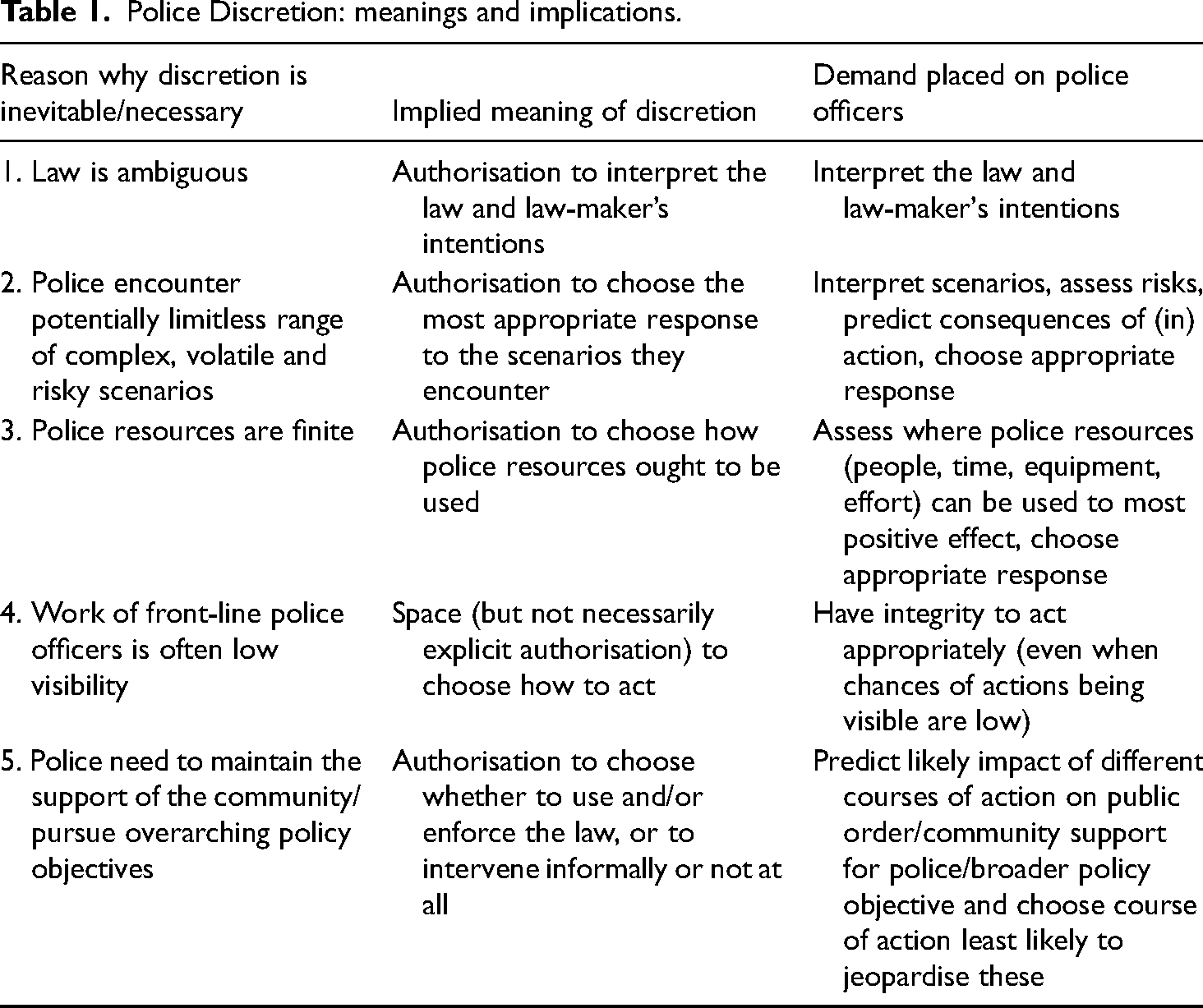
The word discretion is clearly being used to refer to multiple practically interdependent but conceptually distinct modalities of policing. It encompasses the hoped-for qualities of the individual officers (good judgement supported by professional competence and personal integrity) and the different types of (putatively) cognitive operations towards which we expect them to direct these qualities (interpretation and assessment of facts, choices informed by values) and their working conditions (broad authorisation, low visibility) and the consequence of all of these (that police organisations as well as individual officers have input into the way the laws made by elected officials are applied in practice). ‘Discretion’ is functioning as a very broad ‘umbrella concept’ (Hupe, 2013) indeed.
To grasp the full significance of attempting to operate with such a broad concept, it is useful to note that the implied cognitive demands involved in discretion have different practical and political implications. Consider the following processual reconstruction of discretion in action. 1 When police officers encounter a scenario, in theory they take on several conceptually distinct, and temporally ordered, cognitive tasks. First, they assess a scenario to determine whether action is required. Second, they interpret statutes to determine whether a law has been broken and/or what powers they have to intervene. Third, they predict the consequences of responding in different ways. Finally, they choose what (if any) action to take.
The above is obviously an unrealistically rationalistic and mechanical rendering of a much messier and more implicit occurrence (Hawkins, 1992), but it is useful for ‘unbundling’ (Brubaker and Cooper, 2000) what is obscured under the generic label discretion. The first, second and third stages in the process we outline here involve interpreting and assessing what we might call ‘facts’ (the law as written, the situation encountered, available data and/or knowledge on what happens when police take certain actions). The final stage involves bringing together the interpretation and assessment of the ‘facts’ with some set of ‘values’ to choose what is the ‘right’ or ‘best’ thing to do. Many have noted before that discretion involves both interpretation and choice (e.g. see Ericson, 1982; Hawkins, 1992; Poyser, 2004), and Monahan (2023) proposes that they be understood as two different but interdependent types of discretion: ‘interpretive’ and ‘priority’ discretion.
Yet, the distinction between interpretation and choice in the application of the law is clearly politically significant. Although it may be true that all laws and policing scenarios require the interpretation of facts, it is perhaps the element of value-based choice that makes discretion so potentially controversial. Choice introduces the possibility that the values informing police officers’ actions might be at odds with the intentions of elected law-makers, the values of the community at large (or some parts of the community), or the achievement of fair and beneficial outcomes. Furthermore, because discretion clearly involves police being engaged in choosing which laws to enforce and under what circumstances, their claim to be politically neutral and ultimately accountable to the law, is exposed as pure myth. 2 A wealth of research on police officers and their ways of working has also demonstrated that the artificial and idealised processual and conceptual account of discretion set out above oversimplifies and distorts the reality of police action in significant ways.
Discretion in action
Turning to the empirical evidence on police action, the artificial processual separation elaborated above clearly collapses. Interpretation and choice occur simultaneously and are impossible for the external observer to disentangle. The ‘fact’/‘value’ distinction is a false dichotomy. Here, loose, compound definitions of discretion accommodating power, interpretation and choice appear more germane. Thus Ericson's definition of discretion as ‘the power to decide which rules apply to a given situation and whether or not to apply them’ (Ericson, 1982: 11) is often implicit. Yet, as we engage with the empirically based literature, we find that sometimes different working definitions of discretion point towards quite different phenomena.
Pepinsky (1984) labels KC Davis's famous ‘freedom to choose’ definition of discretion ‘clear, simple and implausible’ (p. 250), arguing that officers’ responses to incidents are never only constrained and conditioned by law and policy. For example, what is understood as a ‘free’ choice may reflect an officer's conscious or unconscious absorption of the words chosen by the dispatcher who sent them to that incident. For Pepinsky this means that true discretion is rare indeed because when decisions are ‘patterned’ by external influences then they are not in fact instances of discretion (and indeed are antithetical to it).
Ericson (1982: 12), however, interprets KC Davis's definition of discretion differently, emphasising KC Davis's reference to ‘effective limits’ on the power of officials, and suggesting that such limits might include ‘expectations from other sources such as the occupational culture of police officers’. Ericson suggests these influences merely form part of the bounds within which discretion is exercised. Others suggest that discretion is ‘mediated’ by police culture (Barlow and Walklate, 2020), ‘circumscribed’ by the structure of institutional ‘risk communications’ (Ericson and Haggerty, 1997), patterned by interactions with ‘non-human actants’ (Dymond, 2020) or influenced by ‘working rules’ (McCara and McVie, 2005). A key difference here is in whether discretion is to be understood as referring to power used autonomously in the Kantian sense (as Pepinsky seemingly argues), or to authorisation to determine how to use power within certain limits and subject to certain external influences (as implied by Ericson (1982) and the other authors referenced above).
This is a crucial area of ambiguity in the conceptualisation of discretion and is closely linked to the ambiguity about the sources of authorisation or permission for police power. As noted above, Davis (1996) has argued that understanding the concept of discretion as including any behaviour that their low-visibility working context allows officers to get away with leads us towards a ‘degenerate’ concept of discretion as ‘mere opportunity’. Others are less precise on this point, with Rowe (2007: 279) indicating that discretion can ‘circumvent […] policies and procedures’, suggesting that it includes occasions when officers act in ways contrary to organisational instructions. For Reiman (1996: 74), this indicates that ‘police discretion begins where the rule of law ends: police discretion is precisely the subjection of law to a human decision beyond the law’. Alternatively, McBarnet (1979: 39 cited by Ericson, 2007: 374) proposes that ‘[d]eviation from legality is institutionalized in the law itself’. Even if we accept McGregor's assertion that ‘[t]he exercise of discretion must involve choices or courses of action that are permissible, not merely possible’ (1996: 52, emphasis in original), it is important to note that neither the nature nor the sources of permission for police power to be used in certain ways are straightforwardly apparent nor indeed static (Jauregui, 2014, 2016). It is a mistake to equate authorisation with explicit legal authority (Monahan, 2023).
In stating that police discretion is authorised, not just possible we must recognise that the nature and sources of authorisation require careful analysis, the boundaries of implicit authorisation are unavoidably blurred and elastic, and the sources of implicit authority are multiple and shifting, carrying different weights in different contexts. Actions that have become normal practice in teams or departments could be considered by individual officers to be within acceptable bounds and thus a matter of ‘discretion’. However, this assumption may be dislodged when an incident becomes more widely visible, and it becomes clear that the standards applied are not considered acceptable by senior officers or wider society.
It is well-established in policing research that the responses of individual officers to the situations they encounter reflect the routines, values and ‘customs’ of a distinctive ‘occupational culture’ (Westley, 1970) as much as the individual officer's autonomous ‘choice’. The significant body of literature on police culture – contested as it may be (see Rowe, 2023; Turner and Rowe, 2017) – indicates that police actions rarely flow entirely from the individual judgements of autonomous decision-makers and more frequently reflect the values and habits of distinctive organisational and/or occupational ‘cultures’ (Holdaway, 1983; Loftus, 2010) or tacit knowledge contained in stories containing ‘instructions for seeing the world and acting in it’ (Shearing and Ericson, 1991: 488).
Any conceptualisation of police discretion that projects an image of police officers as atomised, autonomous and individually professional is therefore at odds with the weight of empirical data on how police action is produced. Police decision-making is frequently a ‘collective enterprise’ (Hawkins, 1992) and conceptualising discretion as meaning that officers are ‘free to choose’ neglects the multiple cultural and structural pressures that have been found to bear down on and interrupt individual officer autonomy (Campbell, 1999). KC Davis's ‘free to choose’ conceptualisation of discretion is ‘more political than analytical’ (Campbell, 1999: 79), an ideological construct, rather than an empirical fact.
Goldstein (1963) famously contrasted the ideal image of the police as impartially upholding all laws with the reality of police leaders and officers making pragmatic decisions about how best to use their resources. We think the more telling ideal/real contrast is of a different kind. It is a contrast between the idealised politico-legal image of police ‘discretion’ as the use of sound individual, independent judgement by rational, autonomous professionals (the connotative shadow cast by the word's etymological origins), and the reality of police action as emerging from ‘a habitus of background, tacit, embodied knowledge that exists in [the individual police officer] not as an individual agent, but as the co-agent of common social actions’ (Ericson, 2007: 379). Upon acknowledging this contrast, the inadequacies of the concept of discretion qua ‘category of analysis’ are thrown into sharp relief. The question, we now turn to in our conclusion, (borrowing from Brubaker and Cooper, 2000: 8) is: ‘Do we really need this heavily burdened, deeply ambiguous term?’
Conclusion
As the foregoing discussion has highlighted, ‘police discretion’ is a very broad ‘umbrella concept’ (Hupe, 2013). Its etymological origins associate it with good judgement, but its usage has expanded over time to encompass matters of authorisation, freedom, autonomy, interpretation, choice, power – each of which denotes a different kind of thing and carries its own connotative baggage. Despite this diversity of use, and concomitant ambiguity of meaning, references to discretion are a staple feature of political and organisational rhetoric, legal and political theory, and sociological explanation. Ultimately, the concept inhabits a liminal space between these different discursive spheres.
The liminal character of the concept of discretion is reflected in the disjuncture between the politico-legal ideal of officers as individual agents (autonomous, unbiased, rational) and the observed reality of officers as ‘co-agent[s] of common social actions’ (Ericson, 2007: 379). The concept of discretion thus carries within it crucial unresolved tensions at the core of the ongoing legitimacy struggles of the modern police institution. Thus, returning to the simple question that first prompted us to write this article, ‘what we are talking about when we talk about police discretion?’ has never been concretely settled and never will be.
Does this matter? Many policing researchers seem content to use the word discretion in a relatively ‘generic’ (Gelsthorpe and Padfield, 2003) or implicit sense, perhaps feeling that it is clear enough. However, our exploration of the myriad senses in which the term discretion is deployed suggests that policing researchers ought to be more concerned about what the idea of discretion both denotes and connotes. In terms of what the concept denotes, its primary function in empirical studies of police is describing features of the police working context. It does not (in and of itself) diagnose the causes of different forms of police conduct. Assessed in terms of its analytical utility, the concept is therefore effectively redundant. 3 But the problems run deeper than this.
Repeated references to discretion are advantageous for the police institution in (at least) two ways. First, they associate police with the virtue of good judgement, signalling the trustworthiness of the institution. Second, they connote authorisation, and thus legitimacy, because discretion is widely hailed as a necessary feature of police work (Monahan, 2023) and increasingly institutionalised through the passage of laws that intentionally allow for it (Ericson, 2007). Thus, if certain actions are described as performed by police ‘exercising their discretion’ then, except in cases in which police conduct departs gratuitously from acceptable standards of justification according to the law (Sekhon, 2012), those actions become de facto legitimate, in line with a Weberian conception of bureaucratic authority (Rowe, 2025).
So, although legal theorists may observe that the law is not the primary source of legitimacy for police action, and that liberal precepts of policing are out of kilter with the reality revealed through historical and social analyses (Sekhon, 2019), and although critical policing scholars may highlight the inherently political nature of policing and the liberal myth of neutrality (Turner, 2014, 2016), the tenets of liberal legalism still cast a long political shadow and can be expediently deployed by police (and politicians) when circumstances require (Monahan, 2023). That instances of so-called discretionary actions which can be individually legally justified aggregate into the unequal deployment of police power against different societal groups, is therefore, in the final reckoning, rendered irrelevant.
Focusing on discretion as an individual phenomenon (as politico-legal accounts suggest we should), neglects the fact that discrimination is generally socially and institutionally enabled (Solanke, 2017), perhaps even designed in from the inception of modern policing (Fatsis and Lamb, 2022; Vitale, 2017). Obvious, pervasive and longstanding inequalities and injustices in the distribution of policing (Sekhon, 2012, 2019) remain, we contend, effectively impervious to challenge precisely because that persistent, ubiquitous yet analytically redundant concept ‘discretion’ connotes general authorisation for police to apply individual judgement in ways essentially (and inherently) beyond challenge. Through its repeated use, the concept of discretion therefore helps to reproduce politico-legal structures (cf. Henry and Milanovic, 1994) which legitimise, enable, perhaps even embolden, discriminatory policing practices.
Recent analyses of policing in the Global South suggest alternative conceptual frameworks that could support a move away from reliance on ‘discretion’. Some highlight the potential of ‘informality’ as a conceptual resource and contest the tendency to characterise informal police practices as unambiguously negative (see Jauregui, 2014, 2016; Waseem, 2021). They advocate paying closer attention to both formal and informal aspects of policing and the interactions between these in the production of police actions. Shifting focus in this way may enable researchers to side-step the problematic concept of discretion.
However, some definitions of informality still rely on the concept of ‘discretion’. For example, Waseem (2021: 594) argues that ‘[p]rocedural informality enabled officers to exercise greater discretion’. Here discretion is used to indicate the space afforded to officers by their working conditions, but, as we have discussed above, this is but one sense in which the word is used in the literature. Furthermore, Waseem does not acknowledge that this discretionary space engages police officers in both interpretation and choice, stating instead that discretion is ‘the freedom street-level bureaucrats including police officers have to interpret formal rules and procedures through ‘short-cuts’’ (Waseem, 2021: 586). By contrast, we have argued that although it may be fluid and difficult to disentangle in practice, the distinction between interpretation and choice is politically significant and thus should not be collapsed or elided in descriptions of police practice.
Jauregui's (2014, 2016) work is perhaps more helpful in moving beyond discretion because she points us towards using notions of agency and authority as conceptual tools for engaging with the production of police action, thus disentangling the means for doing (or the production of action) from the sources of authorisation to do, both of which frequently and unhelpfully (dis)appear under the broad conceptual umbrella of ‘discretion’.
However, attempts to satisfactorily pin-down a clear definition of discretion often lead to ‘experience-distant’ abstractions that contribute to analytical confusion (Rowe, 2025). This article indicates instead the need to develop alternative formulations altogether for making sense of and engaging critically with the authority we explicitly and implicitly grant the police to ‘get things done’. Ultimately, although it may be etymologically consistent to subsume authorisation, good judgement and the content of police officers’ choices under one conceptual umbrella, this article has highlighted many ways in which it is analytically unhelpful to do so. Perhaps foremost is that the positive associations and connotative echoes of the word ‘discretion’ mean that its use frequently implies action, which is always already authorised, when much police in/action is only ambiguously, contingently and provisionally so.
Urgent work is still needed to better hold police to account for their unequal and unjust societal impacts, and this work is too important for policing scholars to accept the conceptual inadequacy we have highlighted: ‘[o]ld descriptions must give way to newer more socially useful ones.’ (Wheeldon, 2015: 398). We should no longer tolerate the aggregation of individual qualities, working conditions, cognitive operations and the consequences of these into a single conceptual ‘bundle’ (Brubaker and Cooper, 2000). Instead, we should aim to move beyond discretion to build ‘replacement discourses’ (Henry and Milanovic, 1994) of police power, action and accountability.
Footnotes
Acknowledgements
Many people have provided feedback on the ideas developed within this article. We are particularly grateful to colleagues who engaged with these ideas during ‘Work in Progress’ sessions in the Department of Sociology, Social Policy and Criminology at the University of Liverpool and to Dr David Baker who gave feedback on an earlier draft. We are also grateful to the anonymous reviewers whose suggestions helped us to clarify and expand our argument.
Declaration of conflicting interests
The authors declared no potential conflicts of interest with respect to the research, authorship, and/or publication of this article.
Funding
The authors received no financial support for the research, authorship, and/or publication of this article.
