




Abstract
Punishment is commonly understood as a response to criminal behavior calibrated by offense severity or legal proportionality. This article advances a different account. It argues that punishment operates as a system of class governance structured through bureaucratic practices of knowing and not-knowing. Criminal-legal institutions do not simply sanction wrongdoing; they organize unequal exposure to punishment by differentially rendering populations administratively visible. Drawing on scholarship on punishment, bureaucracy, and social stratification, the article develops the concept of bureaucratic (un)knowing to theorize how administrative knowledge and institutionalized ignorance function as penal mechanisms. It introduces the Punishment Gradient as an inverse, class-structured relationship between social position, surveillance exposure, and penal severity. As surveillance exposure intensifies, punishment becomes more likely, more severe, and more durable; as access to insulation and professional mediation increases, penal escalation is constrained or deflected. By reframing punishment as an epistemic project of governance rather than a neutral legal response, the article explains the persistence of class-stratified punishment and shows how inequality is administratively produced through routine practices of documentation, classification, and surveillance.
Introduction: Punishment beyond crime
Punishment in contemporary societies remains profoundly class-stratified. Despite decades of reform—sentencing guidelines, decarceration initiatives, diversion programs, and risk-assessment tools—those who are poor continue to be disproportionately arrested, prosecuted, confined, and subjected to the cumulative harms of the criminal-legal system. These harms extend beyond incarceration to include debt extraction through fines and fees, housing instability, family separation, employment exclusion, and ongoing surveillance and compliance burdens. The persistence of such outcomes is often framed as a failure of reform or institutional resistance to change. Yet such explanations obscure a more basic reality: punishment is not simply imposed in response to crime, nor is it exhausted by sentencing outcomes. It is produced through administrative systems that sort, classify, monitor, and record populations in ways that structure differential exposure to state harm. Punishment endures because it is embedded in bureaucratic governance itself.
Punishment scholarship has long recognized that penal systems do more than sanction wrongdoing. Empirical research demonstrates that economically marginalized populations face heightened exposure at each stage of the criminal process, including arrest, pretrial detention, conviction, and incarceration (Pettit and Western, 2004; Wakefield and Uggen, 2010). Foundational work has shown that punishment organizes social order (Durkheim, 1893), manages marginality and poverty (Wacquant, 2009), governs through risk and actuarial logics (Feeley and Simon, 1992), and reflects broader political and economic transformations in the regulation of insecurity (Garland, 2001; Simon, 2007). Critical accounts have demonstrated how race structures criminalization and confinement (Alexander, 2010; Western, 2006), while sociolegal scholarship has illuminated the discretionary and uneven exercise of legal power (Ewick and Silbey, 1998). Yet within this literature, class stratification often appears as an outcome of punishment rather than as a principle organizing how punishment operates.
Dominant explanations for classed penal outcomes emphasize severity, bias, or policy failure. Each captures an important dimension of inequality, but none fully accounts for its durability. Severity alone cannot explain why similar offenses generate divergent trajectories across class lines. Bias-based accounts individualize what are institutionalized patterns. Policy-failure narratives assume malfunction rather than design.
What these approaches share is a focus on punishment after contact—on what happens once an arrest is made or a sentence imposed. They devote far less attention to how individuals become visible to the state in the first place. Class structures not only determine who is punished, but also who is watched, monitored, and administratively available for intervention. Poor individuals are more likely to live and work in institutional environments saturated with surveillance and compliance requirements—policing, welfare systems, public housing, schools, probation offices, and low-level courts—where minor deviations are routinely documented and escalated (Gustafson, 2011; Pettit and Western, 2004; Soss et al., 2011; Wakefield and Uggen, 2010). Affluent individuals, by contrast, more often move through environments characterized by privacy, professional mediation, and discretionary resolution, where harmful conduct is less likely to be formally recorded or routed toward criminalization.
This article advances a different theoretical account. I argue that punishment operates as a system of class governance through what I term bureaucratic (un)knowing: the structured production of knowledge and ignorance within administrative systems that determines who becomes punishable and with what consequences. Bureaucratic knowing refers to dense documentation, monitoring, and classification disproportionately imposed on poor and marginalized populations. Bureaucratic not-knowing refers to institutionalized forms of opacity and protection that shield affluent actors through legal representation, negotiated compliance, regulatory displacement, and discretionary insulation. Together, these processes organize punishment through unequal exposure to administrative scrutiny.
Building on this account, I introduce the Punishment Gradient as an inverse, class-structured relationship between social position, surveillance exposure, and penal severity. As surveillance exposure intensifies, punishment becomes more likely, more severe, and more durable. As access to insulation and mediation increases, penal escalation is constrained or deflected. Punishment thus unfolds not as a single event but as a trajectory shaped by differential visibility.
The article proceeds by situating this argument within punishment scholarship, developing bureaucratic (un)knowing as a penal mechanism, and formalizing the Punishment Gradient as a model of class-structured punishment. It then examines how classed visibility organizes state harm through regulatory displacement and cumulative exposure before turning to implications for punishment theory and reform.
Rethinking punishment as governance
Punishment scholarship has undergone a profound transformation over the past several decades. Once centered on moral sanction, legal proportionality, and individual culpability, the field now routinely treats penal institutions as instruments of governance and population management. Classical sociological accounts framed punishment as an expressive response to collective moral violations (Durkheim, 1893), while legal and philosophical traditions emphasized desert, deterrence, and retribution. These perspectives largely conceptualized punishment as episodic—a discrete response imposed after wrongdoing.
Critical, sociolegal, and political–economic scholarship unsettled this view by demonstrating that punishment is embedded in broader systems of power. Studies of policing, courts, prisons, and parole revealed punishment as discretionary, unevenly applied, and entangled with race, class, and political economy (Garland, 2001; Rusche and Kirchheimer, 1939; Simon, 2007). The “new penology” highlighted actuarial logics and population management (Feeley and Simon, 1992), while historical and ethnographic research showed how penal institutions regulate marginality and manage social surplus (Wacquant, 2009; Western, 2006). Collectively, this scholarship reframed punishment as governance rather than solely as a legal sanction.
Yet even governance-oriented accounts often concentrate on moments of intervention—arrest, prosecution, sentencing, incarceration—rather than on the administrative conditions that make such interventions routine for some populations and rare for others. The analytic emphasis remains on when the state acts, not on how differential exposure to monitoring and documentation is structured in advance.
This limitation is especially visible in analyses of stratification. There is extensive evidence that punishment is socially patterned: poor people are more likely to be stopped, searched, arrested, charged, detained, and incarcerated than their wealthier counterparts (Pager, 2007; Western, 2006). Explanations frequently emphasize harsher laws, biased decision-makers, or unequal legal representation. While important, these accounts focus on downstream decisions rather than upstream conditions of detectability and exposure. Punishment thus appears as the culmination of inequality rather than as one of the mechanisms through which inequality is organized.
Class, in this literature, is often treated as background context or correlational variable rather than as a structuring principle of penal governance. By contrast, race has rightly occupied a central place in punishment scholarship, particularly in analyses of racialized social control (Alexander, 2010; Muhammad, 2010). This article does not displace race. Instead, it argues that class governance operates through racialized institutions and administrative sorting processes that structure exposure to monitoring and sanction. Class shapes how deeply individuals are embedded within bureaucratic systems that generate penal authority. These dynamics intersect with race, gender, and citizenship, but they cannot be reduced to them.
A governance lens clarifies this point. Governance approaches conceptualize punishment as a dispersed set of practices that manage populations across sites and over time (Foucault, 1977; Garland, 2001). From this perspective, penal power extends beyond courts and prisons to include probation offices, welfare agencies, housing authorities, schools, and regulatory bodies. These institutions do not distribute scrutiny evenly. They concentrate documentation and oversight in some environments while permitting greater discretion and insulation in others (Lipsky, 1980; Soss et al., 2011).
Class governance remains difficult to perceive because it operates through administrative criteria that appear technical rather than punitive. Eligibility thresholds, risk classifications, and compliance requirements are framed as neutral tools of management. Yet such mechanisms convert material disadvantage into heightened exposure to intervention while allowing advantage to appear as normalcy or credibility (Bowker and Star, 2000; Porter, 1995). Administrative neutrality can thus obscure domination.
Understanding punishment as governance, therefore, requires shifting analytic attention from discrete sanctions to the infrastructures that structure exposure to scrutiny. It requires asking not only who is punished, but how administrative systems organize differential availability for punishment in the first place.
The sections that follow build on this perspective by specifying how punishment is structured through administrative knowledge. By theorizing bureaucratic (un)knowing as a penal mechanism, the article advances a framework for understanding punishment as an ongoing system of class governance organized through unequal visibility and institutional insulation.
Bureaucratic (un)knowing as a penal mechanism
Punishment does not operate solely through law, force, or moral judgment. It operates through administrative knowledge—specifically, through bureaucratic systems that determine who is known to the state, in what ways, and with what consequences (Garland, 2001; Simon, 2007). Long before formal sanctions are imposed, administrative institutions sort populations through documentation, classification, and record production, shaping whose conduct becomes visible, actionable, and punishable. This section develops the concept of bureaucratic (un)knowing to capture how institutionalized knowledge and institutionalized ignorance function together as a central mechanism of penal governance.
Building on scholarship that conceptualizes ignorance as actively produced and politically consequential (McGoey, 2012), bureaucratic (un)knowing specifies how institutionalized non-knowledge structures penal exposure. They actively determine what to document, whom to scrutinize, and which forms of conduct to render administratively opaque. Through this asymmetrical production of knowledge and ignorance, punishment is organized as a durable administrative system (Western, 2006).
The concept of bureaucratic (un)knowing was developed to theorize how institutions govern through the coordinated management of knowledge and ignorance, and it has been applied in prior work to examine classificatory and epistemic dimensions of state power (Author, under review). This article extends that framework by specifying bureaucratic (un)knowing as a penal mechanism—one that structures exposure to criminalization, sanction severity, and custodial risk through routine administrative practices. The analytic focus here is not on misrecognition or data omission as epistemic problems, but on how knowing and not-knowing function as techniques of punishability and protection.
Genealogical foundations of bureaucratic (un)knowing
Bureaucratic (un)knowing draws on several established bodies of scholarship while advancing a distinct analytic specification. Work on state legibility has long shown that modern governance depends on rendering populations visible through records, categories, and administrative simplification (Scott, 1998). Classification and infrastructure studies demonstrate how ostensibly technical systems—forms, databases, standards—organize institutional action while embedding inequality into everyday governance (Bowker and Star, 2000).
Research on street-level bureaucracy further reveals how discretion and documentation mediate access to state resources and sanctions, often intensifying control over marginalized populations while appearing procedurally neutral (Lipsky, 1980). In punishment scholarship, analyses of actuarial justice and risk governance show how administrative tools reorder penal priorities away from individualized culpability and toward population management, compliance, and control (Feeley and Simon, 1992; Simon, 2007). Together, these literatures establish that administrative systems are central to how governance operates.
This account also resonates with scholarship on moral panic and deviance amplification, which demonstrates how institutional processes render certain forms of conduct hyper-visible while others remain diffuse or unremarkable (Cohen, 1972). Amplification does not arise solely from media discourse; it is embedded in administrative routines that pre-classify actors and behaviors as risky, disorderly, or threatening. Knowledge of “the deviant” often arrives to enforcement agents already coded through institutional categories and prior documentation. In this sense, bureaucratic knowing operates as an amplification mechanism: it intensifies scrutiny for those already visible while leaving structurally insulated actors comparatively unexamined. The result is not simply uneven enforcement but patterned escalation rooted in prior classification.
At the same time, sociolegal and science and technology studies have emphasized that ignorance is institutionally produced and strategically maintained (McGoey, 2012; Proctor, 2008). States and organizations routinely choose not to document, not to pursue, or not to classify certain harms. These choices are not neutral. What institutions decline to know—or allow to remain ambiguous—can be as politically consequential as what they record extensively. Yet across these literatures, knowledge and ignorance are rarely theorized as penal mechanisms in their own right. Legibility is often treated descriptively, ignorance as administrative failure, and punishment as an outcome rather than as a process organized through governance (Ewick and Silbey, 1998). Bureaucratic (un)knowing synthesizes these insights by specifying how the uneven production of knowledge and ignorance itself structures penal exposure.
Bureaucratic knowing and not-knowing
Bureaucratic knowing refers to the dense production of records, classifications, and assessments through which individuals are rendered administratively legible. These include arrest reports, risk assessments, compliance logs, eligibility determinations, warrants, probation notes, surveillance data, and digital traces that accumulate across institutional sites (Feeley and Simon, 1992; Kohler-Hausmann, 2018). Such records do not merely document behavior; they actively structure governance by shaping credibility, risk attribution, and administrative availability for intervention. To be bureaucratically known is to be continuously exposed to evaluation, monitoring, and sanction.
Bureaucratic not-knowing, by contrast, refers to the structured absence of equivalent documentation, monitoring, or classification. It is not inattention or neglect. It is an institutional condition produced through regulatory design, professional mediation, and selective enforcement (Levi, 2012). Bureaucratic not-knowing functions as an institutional defense mechanism, actively shielding affluent actors and organizations through legal intermediation, negotiated compliance, civil reclassification, and discretionary forbearance. Conduct that might trigger criminalization elsewhere is rerouted into regulatory, contractual, or private domains where it generates minimal, durable records and limited penal consequences.
Crucially, bureaucratic knowing and not-knowing are co-constitutive. Penal systems rely on both. The intensive documentation of poor and marginalized populations is made possible by the relative opacity afforded to affluent ones. Exposure and insulation are not accidental byproducts of governance; they are mutually reinforcing outcomes of how administrative systems are designed and deployed.
Classification, discretion, and institutional ignorance
Punishment scholarship has long emphasized discretion as a source of inequality, focusing on the decisions of police officers, prosecutors, and judges (Beckett and Murakawa, 2012). While discretion remains empirically important, an exclusive focus on individual decision-making obscures the role of classification systems that structure discretion in advance. Bureaucratic (un)knowing shifts attention from isolated choices to the administrative infrastructures that make certain decisions routine, automatic, or invisible (Bowker and Star, 2000).
Classification systems—risk categories, eligibility thresholds, offense typologies, and supervision levels—operate as preconditions for punishment. These systems are embedded in bureaucratic routines and often framed as technical or neutral. Yet they encode assumptions about stability, compliance, and trustworthiness that are deeply classed. Requirements such as stable housing, formal employment, reliable transportation, documentation, or payment capacity routinely determine eligibility for diversion, probation, or alternatives to incarceration (Harris, 2016; Kohler-Hausmann, 2018). Individuals unable to meet these conditions—often because of poverty—are rendered administratively non-compliant and therefore more exposed to penal intervention.
Institutional ignorance operates in parallel. Certain harms and violations remain thinly documented or entirely unrecorded when they occur within privileged contexts. Affluent individuals and organizations are more likely to encounter regulatory regimes that emphasize audits, negotiations, settlements, and fines rather than criminal sanctions (Hagan and Parker, 1985; Shover and Hochstetler, 2006). These systems rely on self-reporting, professional intermediaries, and delayed enforcement, producing fewer records and fewer triggers for penal escalation. Ignorance here is not accidental; it is built into the architecture of governance (Levi, 2012).
Legibility as penal power
Legibility is a form of power. In penal contexts, the capacity to classify, record, and monitor individuals determines who becomes administratively available for sanction, supervision, and escalation (Scott, 1998). Bureaucratic (un)knowing operationalizes this insight by showing how legibility is differentially produced across classed institutional environments, establishing the structural conditions under which punishment becomes possible.
Poor individuals are more likely to be bureaucratically known because they are more likely to interact with institutions that require intensive documentation, including public assistance offices, public housing authorities, probation departments, family courts, and low-level criminal courts (Lipsky, 1980; Piven and Cloward, 1993). Each interaction generates records that circulate across systems, increasing exposure. Affluent individuals, by contrast, more often encounter the state through professionalized regulatory channels that manage information strategically, limit durable record production, and prevent minor violations from becoming penal events (Shover and Hochstetler, 2006).
Contemporary developments in algorithmic governance intensify these dynamics rather than displace them. Predictive policing tools, risk assessment instruments, and data integration systems expand the scale and speed at which administrative visibility operates. These technologies rely on historical records that disproportionately capture the activities of already surveilled populations, thereby reproducing and automating prior patterns of exposure. Far from neutralizing discretion, algorithmic systems formalize existing asymmetries of legibility, embedding classed and racialized visibility into ostensibly objective infrastructures of decision-making (Brayne, 2020; Eubanks, 2018; Lyon, 2003). Bureaucratic (un)knowing thus persists not only through traditional paperwork and institutional discretion but through technologically amplified classification regimes.
Beyond error, absence, or inefficiency
It is essential to distinguish bureaucratic (un)knowing from familiar critiques of administrative failure. This is not an argument about error, inefficiency, or lack of capacity. Error implies deviation from an intended standard; inefficiency implies failure to achieve stated goals. Bureaucratic (un)knowing instead highlights how inequality persists because administrative systems function as designed. Decisions about what to document, what to pursue, and what to ignore distribute protection and exposure unevenly across class lines (Bowker and Star, 2000). Calls for transparency or expanded data collection may therefore intensify penal exposure for already legible populations while leaving privileged opacity intact.
Understanding bureaucratic (un)knowing as a penal mechanism reframes punishment as an epistemic system—one that governs through the selective production and withholding of administrative knowledge. Punishment persists not simply because laws are harsh or actors are biased, but because bureaucratic systems continue to organize who is exposed to sanction and who is shielded from it through differential visibility and institutionalized ignorance (Garland, 2001; Simon, 2007).
Bureaucratic (un)knowing as the engine of the Punishment Gradient
Bureaucratic (un)knowing does not merely shape what happens after individuals come into contact with penal institutions. It structures who is likely to be contacted at all, how often, and under what conditions. In this sense, bureaucratic (un)knowing functions as the generative mechanism underlying the Punishment Gradient—an inverse, class-structured relationship between social position, surveillance exposure, and penal severity.
Bureaucratic knowing produces administrative visibility. Poor and marginalized populations are rendered continuously available for observation, detection, and intervention through dense administrative surveillance. Their lives are monitored across multiple institutional sites—policing, welfare, housing, schools, and family courts—creating numerous points at which conduct can be observed, recorded, and reclassified as noncompliance or violation. This saturation dramatically increases the likelihood that minor, ambiguous, or survival-based behavior will be detected and formalized as punishable conduct.
Bureaucratic not-knowing, by contrast, produces front-end insulation. Affluent individuals and organizations are shielded from comparable scrutiny through regulatory design, professional intermediation, and selective enforcement. Their conduct is less likely to be observed, less likely to be documented, and less likely to be rendered actionable in penal terms. This insulation operates before questions of guilt, severity, or sentencing arise. It limits detection itself, constraining entry into the penal system rather than merely mitigating outcomes within it.
The Punishment Gradient, therefore, does not emerge primarily from differential escalation after wrongdoing, but from asymmetrical conditions of surveillance exposure. Those subjected to bureaucratic knowing are more likely to enter the gradient, experiencing steeper trajectories of criminalization and sanction. Those protected by bureaucratic not-knowing encounter the gradient late, intermittently, or not at all, resulting in flattened or deflected penal exposure. In this way, bureaucratic (un)knowing supplies the epistemic infrastructure through which class position is translated into systematically unequal punishment.
The next section builds on this framework by formalizing the Punishment Gradient as the patterned outcome of bureaucratic (un)knowing, showing how front-end visibility and insulation are converted into class-differentiated trajectories of criminalization, sanction severity, and custodial risk.
The Punishment Gradient
This section reconceptualizes the Punishment Gradient as an inverse, class-structured relationship between social position, surveillance exposure, and penal severity. Rather than understanding punishment as a linear escalation driven primarily by offense severity or legal guilt, the Punishment Gradient specifies how class position reshapes both the likelihood of detection and the severity of sanction once detected. As economic resources, institutional credibility, and professional access increase, individuals are subjected to fewer points of observation and less punitive forms of state response. Conversely, as poverty deepens, administrative exposure intensifies, rendering punishment more likely, more severe, and more durable.
The Punishment Gradient captures a central and normatively unjust feature of contemporary punishment systems: those with the greatest capacity to produce widespread social harm are routinely insulated from the harshest penal consequences, while those with the fewest resources are subjected to the most intrusive and cumulative forms of state punishment. This pattern is not explained by differences in moral culpability or offense seriousness. It reflects how class power structures who is watched, how often, and through which institutions, shaping access to insulation, reclassification, and alternative sanctioning regimes within administrative governance (Garland, 2001; Rusche and Kirchheimer, 1939; Wacquant, 2009).
Defining the Punishment Gradient
Formally, the Punishment Gradient can be specified along two axes. On one axis lies class position, ranging from poor to affluent. On the other lies penal severity, ranging from non-custodial or regulatory responses to incarceration and prolonged confinement. Movement along the class axis systematically reshapes three interrelated processes: the likelihood that conduct will be observed, the probability that it will be criminalized once detected, and the severity of the sanctions imposed. The relationship is represented schematically in Figure 1.
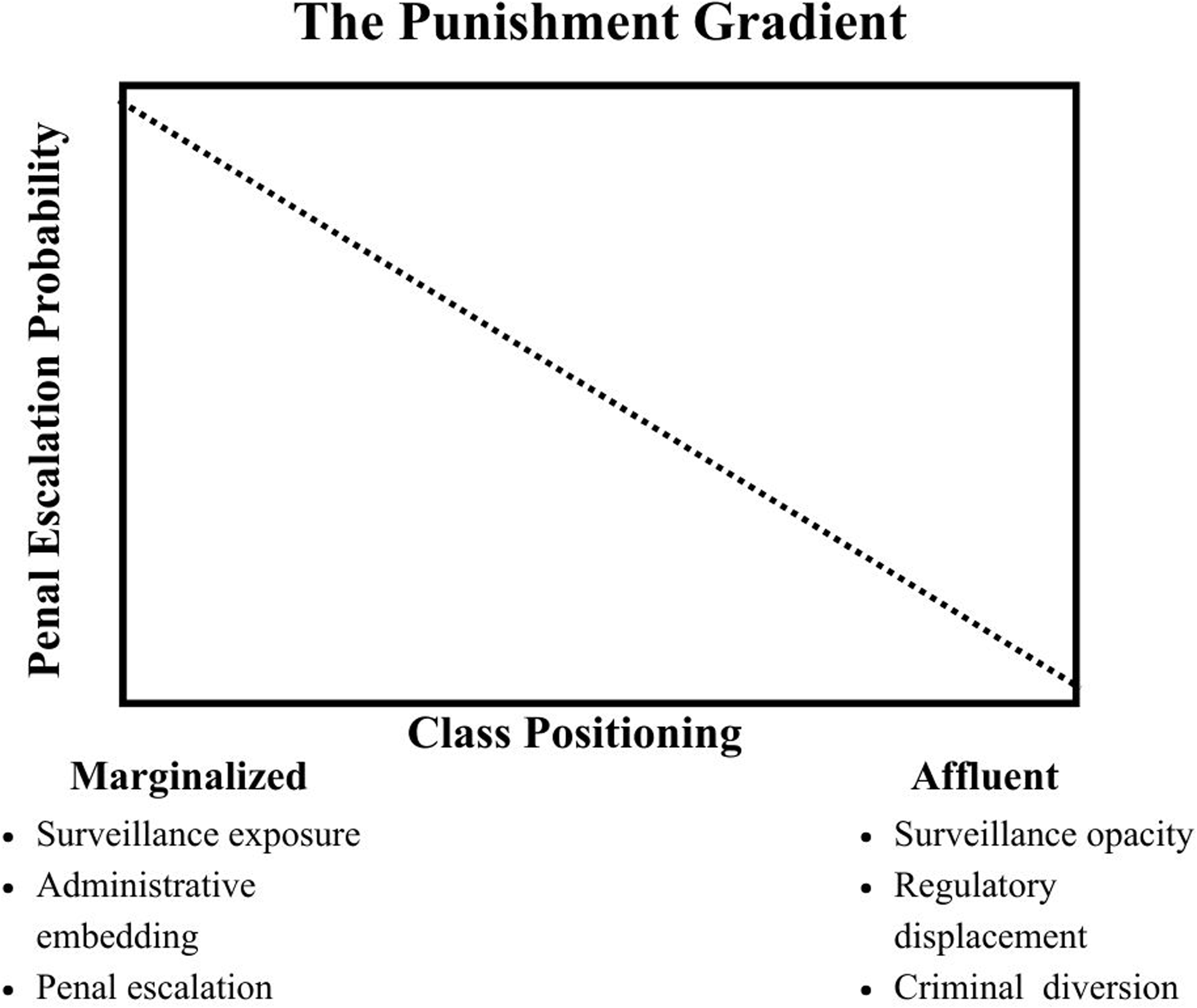
The Punishment Gradient illustrates the inverse, class-structured relationship between social position and penal escalation probability. As class position increases, surveillance exposure and custodial risk decline, while insulation, regulatory displacement, and non-custodial resolution become more likely. The gradient captures how administrative visibility, rather than offense severity alone, structures differential penal trajectories.
For individuals at the lower end of the class hierarchy, punishment is characterized by hyper-visibility, intensive monitoring, and custodial escalation. For individuals at the upper end, punishment—when it occurs at all—is more likely to take the form of regulatory enforcement, civil penalties, negotiated settlements, or other non-custodial sanctions. The gradient, therefore, captures not only differential sanctioning, but a class-stratified allocation of surveillance and scrutiny that determines who is likely to be caught in the first place. Punishment does not simply follow wrongdoing; it follows where the state is looking (Foucault, 1977; Scott, 1998).
Classed visibility as the mechanism of the gradient
At the steep end of the Punishment Gradient lies hyper-visibility. Poor individuals are embedded in dense institutional environments that subject them to continuous observation, assessment, and monitoring. Policing, probation, welfare offices, public housing authorities, family courts, child protective services, and low-level criminal courts impose overlapping regimes of surveillance that generate numerous points of detection and intervention (Lipsky, 1980; Piven and Cloward, 1993; Wacquant, 2009).
Within these environments, everyday life is rendered administratively observable. Missed appointments, unpaid fines, informal or survival-based work, housing instability, substance use, or conflicts with authority become detectable events rather than private struggles. Documentation follows scrutiny, but it is the saturation of observation—not record accumulation alone—that increases the likelihood that minor deviations will be interpreted as violations rather than misfortune or constraint (Beckett and Western, 2001; Kohler-Hausmann, 2018). Hyper-visibility thus functions as a capture mechanism. Poor individuals are more criminalized because they are watched more frequently, across more institutional sites, and with fewer buffers against escalation.
At the opposite end of the gradient, affluent individuals benefit from reduced scrutiny and administrative opacity. Their interactions with the state are less frequent, more discretionary, and often mediated by professionals—lawyers, accountants, compliance officers—who manage information strategically and resolve violations before they become objects of penal attention.
Harms associated with white-collar crime, environmental violations, wage theft, and financial misconduct are routinely addressed through audits, civil penalties, settlements, or internal compliance mechanisms rather than policing or prosecution (Hagan and Parker, 1985; Levi, 2012; Shover and Hochstetler, 2006). These governance regimes limit front-end visibility, preventing criminalization by constraining detection itself rather than merely softening punishment after the fact.
Escalation under saturation and insulation through opacity
Within hyper-visible environments, escalation is often rapid once scrutiny is established. Continuous monitoring narrows discretionary tolerance and transforms minor noncompliance into actionable violations. Missed court dates, inability to pay fines, transportation barriers, or paperwork errors trigger sanctions because they occur within systems designed to detect deviation rather than accommodate scarcity.
Custody frequently emerges as the endpoint of bureaucratic saturation, not as a response to violent or high-harm conduct. Technical violations, probation breaches, and accumulated administrative failures produce confinement that appears procedural or inevitable, even as it imposes severe social and economic harm (Beckett and Murakawa, 2012; Harris, 2016).
By contrast, administrative opacity interrupts escalation for the affluent at the level of detection. Violations are absorbed through regulatory displacement, negotiated compliance, or civil remedies, producing fewer points of penal contact and limited pathways to custody. Even when incarceration occurs, it is typically shorter, less restrictive, and institutionally segregated from the facilities that confine the poor.
Punishment as a class-structured regime of visibility
The Punishment Gradient shifts analytic attention from punishment as an event to punishment as a class-structured regime of visibility, detection, and sanction. It reveals how administrative governance converts poverty into punishability by saturating the poor with surveillance while shielding the affluent through opacity and professional insulation. Punishment does not merely reflect inequality; it institutionalizes it by structuring unequal exposure to surveillance and escalation. So long as class position shapes insulation from scrutiny and access to reclassification, penal power will continue to operate unevenly intensive and cumulative for the poor, buffered and negotiable for the affluent.
Class, visibility, and the organization of state harm
The Punishment Gradient foregrounds class as a central axis through which state harm is organized, distributed, and normalized. This emphasis neither denies the foundational role of race in criminalization nor advances a race-blind account of punishment. Rather, it specifies class as a distinct and analytically necessary dimension of penal governance—one that structures how racialized punishment is administered, intensified, or deflected through bureaucratic systems. Class matters not only because poor people are punished more often, but because it shapes the depth, duration, and cumulative weight of punishment as lived experience (Wacquant, 2009; Western, 2006).
Punishment scholarship has rightly centered race as indispensable to understanding policing, incarceration, and legal inequality (Alexander, 2010; Muhammad, 2010). Racial hierarchy shapes who is suspected, stopped, surveilled, and subjected to state violence. Yet even race-centered accounts, while indispensable, can leave less specified how punishment is differentially organized within and across racial groups through classed administrative exposure. As the Punishment Gradient demonstrates, class conditions the institutional pathways through which racialized populations encounter the state—shaping how often they are monitored, what forms of scrutiny they face, and whether their conduct is routed toward penal intervention or diverted into regulatory or informal resolution (Ewick and Silbey, 1998; Kohler-Hausmann, 2018).
Seen this way, class is not merely a background variable. It is a governing mechanism that determines who must live under continuous scrutiny and who is afforded insulation from the punitive reach of the state.
This framework does not position class as more fundamental than race, nor does it treat racialized institutions as secondary to class governance. Rather, it identifies distinct but interacting mechanisms through which exposure to punishment is structured. Class shapes insulation capacity—the material and relational resources that reduce the probability that conduct becomes institutionally visible and escalates into penal consequence. Race and other forms of minoritized status shape marked scrutiny—the interpretive conditions under which visibility converts into documentation, escalation, and sanction. Institutions may be racialized in their historical formation and contemporary operation, yet class conditions how deeply individuals are embedded within the bureaucratic circuits that generate penal authority. The Punishment Gradient, therefore, models punishment as emerging from the interaction between insulation and scrutiny: wealth lowers baseline exposure to detection and escalation, while minoritized status can attenuate the protective effects of that insulation once visibility occurs.
Classed visibility and administrative exposure
As shown by the Punishment Gradient, class governance operates fundamentally through differential visibility. Poor individuals—disproportionately racialized—are embedded in institutional environments saturated with state oversight, including means-tested welfare systems, public housing authorities, under-resourced schools, probation offices, child welfare agencies, and low-level criminal courts. These institutions impose dense documentation and compliance requirements that render everyday life administratively legible and perpetually sanctionable (Lipsky, 1980; Piven and Cloward, 1993).
The consequence is not simply increased contact with the state, but heightened vulnerability to capture. Missed appointments due to unstable transportation, informal work that violates program rules, overcrowded housing framed as neglect, or inability to pay fines interpreted as defiance rather than scarcity, become routine points of intervention. These encounters generate records that circulate across systems, narrowing discretion and accelerating exposure to sanction (Bowker and Star, 2000; Kohler-Hausmann, 2018).
By contrast, middle- and upper-class individuals are far less exposed to routine state scrutiny. Their interactions with the state are less frequent, more privatized, and more easily managed through professional intermediaries. These encounters emphasize discretion, confidentiality, and negotiated compliance rather than continuous monitoring. The result is not merely fewer sanctions, but fewer opportunities for detection and documentation in the first place.
Visibility functions as a governing technology through which class structures exposure to state harm (Scott, 1998). As the Punishment Gradient makes clear, differential surveillance exposure—not differential wrongdoing—produces divergent penal trajectories.
Regulatory displacement versus penal intervention
One of the clearest applications of the Punishment Gradient is the phenomenon of regulatory displacement: the systematic rerouting of harmful conduct away from criminal-legal systems and into civil, administrative, or professional regulatory frameworks. Regulatory displacement transforms the site and modality of state power. Instead of arrest, prosecution, or incarceration, misconduct is addressed through audits, fines, settlements, warnings, licensing actions, or internal compliance regimes (Hagan and Parker, 1985; Levi, 2012).
Access to regulatory displacement is classed. It depends on institutional position, professional credibility, and access to intermediaries who can negotiate outcomes before conduct becomes criminally visible. Affluent individuals and organizations are more likely to have lawyers, accountants, compliance officers, and reputational buffers that absorb violations and prevent escalation (Shover and Hochstetler, 2006). Even serious harms—environmental damage, wage theft, financial fraud, or sexual misconduct—are reframed as civil liability, regulatory error, or managerial failure rather than crime.
For poor individuals, by contrast, regulation and punishment are tightly coupled. Administrative noncompliance is quickly criminalized, and minor deviations trigger formal sanctions rather than negotiated resolution (Beckett and Murakawa, 2012). Penal intervention functions as the default mode of governance for marginalized populations, while regulatory displacement operates as a protective mechanism for those with economic and institutional capital.
As the Punishment Gradient illustrates, similar—or even greater—harms generate radically different trajectories depending on how administrative systems classify actors and route conduct toward or away from penal authority (Garland, 2001).
Alternatives, diversions, and classed accessibility
The Gradient also clarifies why alternatives and diversions frequently reproduce, rather than reduce, inequality. Probation, diversion courts, treatment mandates, and community-based supervision are framed as humane substitutes for incarceration. Yet access to these alternatives—and the capacity to survive them without escalation—is itself class-structured.
Eligibility often depends on stable housing, formal employment, reliable transportation, time flexibility, and the ability to pay fees or comply with intensive reporting requirements (Harris, 2016; Kohler-Hausmann, 2018). For poor individuals, these conditions transform alternatives into additional sites of surveillance and extraction. Missed appointments, conflicting work schedules, or inability to pay generate new violations that steepen movement along the Punishment Gradient (Beckett and Western, 2001).
What is framed as leniency thus becomes another mechanism of cumulative harm. By contrast, individuals with economic resources are better positioned to meet compliance demands, negotiate accommodations, or exit programs without escalation. Alternatives do not reduce punishment evenly; they reorganize it along classed lines of exposure and compliance.
This reveals a core contradiction of reformist punishment regimes. Alternatives are not inherently less punitive. When layered onto dense bureaucratic environments without addressing structural scarcity, they legitimate inequality under the language of care (Feeley and Simon, 1992).
Punishment as cumulative state harm
When applied through classed visibility and insulation, the Punishment Gradient reveals state harm as cumulative, relational, and enduring. Punishment is rarely experienced as a single event. It unfolds through repeated administrative encounters that impose obligations, generate records, and narrow future options. Each sanction reshapes the terrain on which individuals must navigate the state, increasing vulnerability to further intervention (Western, 2006).
Cumulative punishment includes incarceration, but also fines, fees, surveillance, supervision conditions, mobility restrictions, employment exclusion, housing instability, and family disruption. These harms reinforce one another: monetary sanctions heighten noncompliance risk; supervision intensifies scrutiny; administrative records foreclose access to basic resources (Harris, 2016). Over time, punishment becomes a chronic condition of life rather than a discrete legal outcome.
This accumulation is class-structured. Poor individuals experience punishment as continuous, exhausting, and inescapable, while affluent individuals encounter state intervention as episodic, negotiable, and containable. The Punishment Gradient thus reveals punishment as a system of class-differentiated state harm, organized through visibility, administrative design, and unequal access to insulation.
This analysis shifts attention from individual bias and statutory severity to the administrative infrastructures that differentially distribute exposure and protection. As long as classed visibility structures escalation and insulation, punishment will continue to reproduce hierarchy—even absent overtly punitive legal change (Simon, 2007).
Bureaucratic (un)knowing in practice: School discipline and differential escalation
To render the mechanism of bureaucratic (un)knowing concrete, consider how comparable adolescent misconduct is processed in differently resourced educational institutions. School discipline often operates as an early site of penal pathway production, particularly in low-income communities where schools function as dense nodes of administrative oversight. Scholarship on the “school-to-prison pipeline” has documented how zero-tolerance policies, mandatory reporting systems, and the routine presence of school resource officers convert behavioral infractions into criminalized events (Hirschfield, 2008; Kupchik, 2010). The comparison below synthesizes these established findings to isolate the mechanisms through which administrative visibility converts into penal exposure.
Consider two adolescents who engage in comparable misconduct—for example, bringing a prohibited substance to school or participating in a physical altercation. In a public school serving low-income communities, disciplinary governance is frequently formalized and surveillance-saturated. Incident reports are completed, behaviors are coded, and records are entered into administrative databases. If a school resource officer is present, the event may be referred directly to law enforcement. Even absent arrest, documentation circulates internally and may be shared across agencies. The student becomes administratively legible within systems that track behavioral risk, attendance, prior infractions, and compliance history.
At this stage, punishment has not yet escalated. What has escalated is visibility. The conduct is transformed into an institutional record. That record narrows discretion in subsequent encounters. Future incidents are evaluated not in isolation but against an accumulating file. As classification scholarship demonstrates, administrative categories do not merely describe behavior; they structure institutional response (Bowker and Star, 2000). Once codified, misconduct travels.
In many private schools, by contrast, comparable conduct is managed through internal processes that emphasize parental mediation, confidentiality, and discretionary resolution (Cookson and Persell, 1985; Gaztambide-Fernández, 2009). There are typically no on-site law enforcement officers, and reporting obligations are less tightly coupled to criminal systems. Parents—often equipped with professional capital and legal knowledge—intervene before behavior becomes criminally visible. Sanctions may include suspension, counseling, or negotiated withdrawal. What differs is not necessarily the gravity of the conduct but the density of documentation and the likelihood that it will be routed toward penal authority.
Divergence becomes sharper at the point of escalation. In surveillance-saturated public schools governed by standardized disciplinary codes, repeated documentation can trigger referral to juvenile court. A second altercation, a missed disciplinary meeting, or perceived defiance may be interpreted as evidence of escalating risk. The student enters probationary supervision, where compliance obligations multiply and monitoring intensifies. Each requirement—curfew adherence, school attendance verification, program participation—generates additional documentation. Administrative knowing deepens. Here, the Punishment Gradient becomes visible as a process: surveillance saturation increases the probability that minor misconduct is converted into cumulative penal exposure.
For the privately educated student, escalation is less likely to convert into criminalization. Family resources may secure private counseling or therapeutic intervention in lieu of court referral. Legal representation can intervene early. Even when law enforcement becomes involved, reputational buffering and negotiated discretion may redirect the case toward informal resolution. Insulation capacity operates before and during exposure.
This contrast illustrates the interaction between insulation and scrutiny identified earlier. Minoritized status may heighten suspicion in both contexts. But class conditions the density of surveillance and the durability of documentation once suspicion materializes. In surveillance-saturated institutions, visibility compounds. In insulated environments, visibility can be absorbed or contained.
Bureaucratic (un)knowing operates through this asymmetry. Structural scarcity—unstable housing, unmet mental health needs, neighborhood violence—often underlies misconduct in under-resourced schools. Yet administrative systems translate these conditions into behavioral risk categories rather than structural vulnerability. Institutional knowledge accumulates while structural causes are rendered irrelevant. By contrast, in insulated settings, deviance is more readily reframed as developmental error, stress response, or private family matter. Structural advantage is interpreted as redeemability.
Over time, the consequences diverge dramatically. For the public school student, early documentation may produce a juvenile record, probation supervision, and future court exposure. That record can shape employment prospects, educational access, housing eligibility, and subsequent policing encounters. Punishment becomes cumulative long before incarceration is imposed. For the private school student, comparable misconduct may leave no durable administrative trace. Opportunities remain intact. The event remains episodic rather than infrastructural.
The conduct in these two scenarios may be similar. The institutional processing is not. The difference lies in how administrative systems classify actors and route behavior. One pathway thickens the file; the other contains it. One amplifies visibility; the other buffers it. Through these routinized processes, class structures who becomes legible to penal authority and who remains shielded from it.
The penal state does not begin at conviction; it begins at classification. The Punishment Gradient becomes visible not at sentencing but at the moment conduct enters—or avoids—the bureaucratic record. School discipline represents only one domain in which bureaucratic (un)knowing organizes early penal trajectories. Similar dynamics operate across welfare compliance systems, housing oversight, workplace regulation, and probation supervision. In each domain, institutional density and insulation capacity interact to determine whether conduct is absorbed, negotiated, or converted into formal punishment.
The next section turns to these implications directly, examining why reforms centered on sentencing, proportionality, or decarceration routinely fail to disrupt the administrative organization of state harm, and what a politics of administrative restraint would require.
Implications for punishment theory and reform
The Punishment Gradient has direct implications for how punishment is theorized and how reform efforts are evaluated. If punishment operates primarily through administrative legibility, surveillance, and capture rather than episodic sanction, then reforms focused narrowly on sentencing severity, proportionality, or incarceration rates intervene only at the most visible endpoints of a much broader system of governance. Such reforms moderate punishment's endpoints while leaving intact—and often expanding—the surveillance infrastructures that generate class-stratified exposure. Contemporary reform thus misrecognizes where punishment occurs, treating it as a moment of sentencing rather than a process that begins with visibility and administrative capture.
Why sentencing reform alone fails
Sentencing reform has long been treated as the primary lever for correcting penal inequality. Mandatory minimums have been rolled back, guideline ranges adjusted, and judicial discretion expanded in the name of fairness and proportionality. Yet these reforms have repeatedly failed to produce sustained reductions in class-stratified punishment. The Punishment Gradient clarifies why: sentencing intervenes after the most consequential work of punishment has already been done.
By the time a sentence is imposed, individuals—particularly those who are poor—have often been subjected to extensive front-end surveillance and administrative capture through policing, pretrial supervision, probation, fines, fees, and compliance regimes. These processes generate durable records that shape perceptions of risk, credibility, and compliance, constraining judicial options regardless of formal sentencing rules (Kohler-Hausmann, 2018). Even formally lenient sentencing regimes, therefore, operate atop unchanged systems of surveillance that continue to sort defendants into steep and flat trajectories of punishment.
More fundamentally, sentencing reform assumes that punishment is primarily imposed through legal judgment. The Punishment Gradient shows instead that a substantial portion of penal harm is produced before sentencing—through pretrial detention, technical violations, surveillance conditions, and administrative sanctions that are only weakly governed by sentencing law (Beckett and Murakawa, 2012; Feeley, 1979). Reforming sentences without confronting the front-end conditions of visibility and capture leaves the administrative architecture of class governance intact.
Limits of proportionality and decarceration frameworks
Proportionality and decarceration frameworks have further shaped contemporary punishment reform. By emphasizing reduced incarceration, shorter sentences, and alternatives to confinement, these approaches seek to mitigate the most severe expressions of penal harm. While normatively important, the Punishment Gradient reveals their structural limits.
Decarceration does not necessarily reduce punishment; it often redistributes it. In many contexts, incarceration is replaced by intensified supervision, expanded alternatives, and prolonged compliance regimes that extend penal control into everyday life (McNeill, 2018). These arrangements frequently increase surveillance density for poor populations, steepening the Punishment Gradient even as incarceration rates decline.
Similarly, proportionality frameworks presume that punishment severity can be calibrated to offense seriousness. The Gradient demonstrates that severity is frequently shaped less by conduct than by surveillance saturation. Technical violations, inability to pay, or missed appointments trigger sanctions that are procedurally justified yet substantively disproportionate—not because proportionality has failed as a principle, but because administrative scrutiny has intensified exposure (Harris, 2016). Reforms that leave surveillance density intact often preserve extraction and control under more administratively benign forms.
Reframing punishment as epistemic governance
Taken together, these failures point toward the need to reframe punishment as a system of epistemic governance. Punishment is not exercised solely through force or confinement; it is exercised through the production, circulation, and accumulation of administrative knowledge. Surveillance data, records, classifications, and compliance metrics determine who becomes punishable, how early, and how persistently.
This reframing shifts analytic attention from punishment's outcomes to its conditions of possibility. It asks how individuals come to be rendered visible and administratively available for sanction. From this perspective, reform cannot be evaluated solely by changes in penalties or incarceration rates; it must interrogate the surveillance infrastructures that generate legibility, capture, and escalation in the first place (Garland, 2001; Simon, 2007).
Understanding punishment as epistemic governance clarifies why inequality persists even under ostensibly neutral or progressive policies. Administrative systems do not require punitive intent to produce stratified harm. They operate through routine practices—monitoring, documentation, eligibility criteria—that convert poverty into punishability. Reform that ignores these practices risks reproducing inequality while claiming success.
De-classification and administrative restraint
The Punishment Gradient, therefore, points toward a different analytic orientation centered on de-classification and administrative restraint. De-classification does not imply abolition or the rejection of accountability. It refers to limiting the scope, durability, and mobility of administrative legibility—reducing unnecessary surveillance, preventing minor deviations from cascading across systems, and constraining how records are reused over time.
Administrative restraint extends this logic beyond paperwork. It emphasizes restraint in monitoring, supervision, and compliance-based governance. Rather than expanding alternatives that intensify oversight, restraint calls attention to how excessive surveillance itself functions as punishment—producing extraction, instability, and failure under conditions of scarcity (Lipsky, 1980).
This perspective challenges reform paradigms that equate intervention with care. More monitoring does not necessarily produce more justice. In highly unequal administrative environments, it often produces more punishment.
Importantly, de-classification and restraint are not offered here as technical policy fixes. They are analytic implications of treating punishment as an epistemic system—one in which more knowledge can generate more harm, and where surveillance itself operates as a mechanism of class governance.
Rethinking reform through the gradient
Viewed through the Punishment Gradient, reform success cannot be assessed solely by sentence lengths, diversion rates, or incarceration counts. It must be evaluated by whether administrative systems continue to sort populations into steep and flat trajectories of surveillance, detection, and sanction. As long as class position determines who is watched, who is recorded, and who is captured early and often, punishment will continue to reproduce class hierarchy even under reformist regimes.
This perspective calls for a reorientation of punishment theory. It shifts attention from punishment as an event to punishment as a process, from sanction to surveillance, and from individual bias to administrative design. Addressing class-stratified punishment, therefore, requires not only changes in law, but sustained critical engagement with the epistemic infrastructures through which the state sees, tracks, and governs inequality.
Conclusion: Punishment as an epistemic project
This article has advanced a structural account of punishment as an epistemic project of class governance. Rather than treating punishment as a discrete response to crime or a function of sentencing severity, it has argued that punishment is produced through administrative systems that differentially render populations visible, knowable, and sanctionable. By theorizing bureaucratic (un)knowing as a penal mechanism and reconceptualizing the Punishment Gradient as an inverse, class-structured relationship between social position, surveillance exposure, and penal severity, the article reframes punishment as a cumulative process organized through knowledge, classification, and administrative design.
The central intervention is conceptual and critical. Punishment is shown to operate not only through force, confinement, or moral judgment, but through the routine production and withholding of administrative knowledge. Legibility functions as a mechanism of exposure: dense documentation, monitoring, and classification convert poverty into criminalization, escalating sanctions, and custodial risk. Opacity, by contrast, functions as insulation. For those with economic and institutional power, harmful conduct is reclassified, negotiated, or displaced into regulatory regimes that sharply limit penal severity. These dynamics are not accidental. They are features of governance systems designed to sort populations through differential bureaucratic saturation.
The Punishment Gradient captures this normatively unjust structure. As class position rises, punishment becomes less likely, less severe, and more negotiable—even when the underlying harms are substantial. As poverty deepens, punishment becomes more likely, more intrusive, and more durable, even in the absence of serious wrongdoing. Those with the fewest resources are subjected to the harshest forms of surveillance, criminalization, and confinement, while those with the greatest capacity to cause social harm are systematically protected from custodial punishment. Punishment, in this sense, does not simply respond to inequality; it is one of the administrative processes through which inequality is actively produced and stabilized over time.
This framework contributes to punishment scholarship in three ways. First, it extends governance-oriented accounts by specifying how administrative processes generate inequality, rather than treating stratification as a downstream effect of bias or severity (Garland, 2001; Simon, 2007). Second, it recenters class as an analytic dimension of punishment without displacing race, showing how class structures the administrative pathways through which racialized punishment is intensified or deflected (Wacquant, 2009; Western, 2006). Third, it offers a processual model that explains why reforms focused on sentencing, proportionality, or incarceration rates repeatedly fail: they leave intact the epistemic infrastructures that convert visibility into punishment and opacity into protection.
Reframing punishment as an epistemic project also clarifies the limits of dominant reform paradigms. Decarceration, alternatives, and proportionality matter, but they are insufficient when poor populations remain embedded in dense administrative systems that transform minor deviations into cascading sanctions. As long as bureaucratic legibility is unevenly distributed, punishment will continue to function as a mechanism of class governance—even under ostensibly progressive policy regimes. The persistence of inequality is not simply a failure of implementation or political will; it is an effect of administrative design.
Seen through the lens of bureaucratic (un)knowing and the Punishment Gradient, punishment emerges not merely as a response to crime, but as a knowledge-producing system that governs through documentation, visibility, and classification. Inequality is not only reflected in penal outcomes; it is manufactured through everyday administrative practices that expose some lives to relentless scrutiny while shielding others from meaningful sanction. By bringing these processes into view, this article invites punishment scholars to look beyond crime and sanction toward the epistemic foundations of penal power—and to confront the ways punishment continues to operate as a profoundly unfair system of class governance.
Footnotes
Acknowledgements
The author thanks family, friends, and academic peers for sustained conversations about punishment, incarceration, and governance that informed the development of this article.

Ethical approval
Not applicable. This article does not involve human participants, human data, or human tissue.
Consent to participate
Not applicable.
Consent to publication
Not applicable.
Funding
The author received no financial support for the research, authorship, and/or publication of this article.
Declaration of conflicting interests
The author declared no potential conflicts of interest with respect to the research, authorship, and/or publication of this article.
Data availability statement
No new datasets were generated or analyzed for this manuscript.