




Abstract
This article evaluates developments in the ecological analysis of crime, which have found their most recent expression in a Criminology of Place. We argue that theoretical and methodological deficiencies are evident in the Criminology of Place and associated literatures with respect to their underlying treatment of place, time and causation. Big Data holds promise for helping address these shortfalls, but dangers also. The successful advance of the Criminology of Place requires elevating the why question to equal status with those of where and what in the analysis of crime. Ultimately, the paper positions the progress towards and prospects for a multi-scalar and time sensitive theoretical and empirical model of the Criminology of Place.
Introduction
Recent years have seen the blossoming of a Criminology of Place. Of particular note in this regard has been the publication of several important works and edited volumes since 2012 (Taylor, 2015; Weisburd, 2015; Weisburd et al., 2012, 2016). Perceived failure of existing crime theory to account for offender behaviour (Weisburd et al., 2012) has provided much of the stimulus to this growth of interest in crime at place. At the same time, a range of fundamental policy drivers (the rise of new public management initiatives; austerity imperatives; concerns to validate criminal justice system legitimacy) and technological facilitators (ICT, Big Data) have also helped stimulate and inform this literature, affording it both urgency and relevance while spawning a range of distinctly place-based situational crime prevention policy interventions such as (most recently) hot spot policing (Braga and Weisburd, 2010; Sherman et al., 1989).
It has been claimed that Criminology of Place represents ‘a radical departure from current interests’ and a ‘turning point in the life course of criminology’ (Weisburd et al., 2016: xix). Are such claims merited? Moreover, if they are, if we are at a turning point in criminology, what do we need to do to advance theoretically, empirically and methodologically? Our purpose in this article is to offer some thoughts on these questions. 1 To anticipate our conclusions somewhat, we contend the jury to be still out on how radical or new the current emphasis on Criminology of Place is. Moreover, the extent to which such claims do turn out to be true depends on how a range of broader conceptual, methodological and empirical matters are dealt with.
In the next section, as context for our subsequent argument, we situate current Criminology of Place theorizing within the broader evolutionary sweep of criminological thinking, and highlight emerging interest (see Braga and Clarke, 2014; Weisburd et al., 2012, 2014) in the integration of environmental criminology and social disorganization perspectives on crime within an explicit Criminology of Place framework. While a welcome development, to succeed, such efforts at integration require appropriate conceptualizations of place and time. Section three critiques treatments of place within criminology, paying particular attention to the ideas of hot spots and neighbourhoods, their ontological justification and methodological treatment, and how the matter of causation is handled generally in the treatment of place. Section four considers the related question of the role of time in Criminology of Place. The penultimate section explores the possibilities and dangers for a Criminology of Place—and policy based upon it—that arise from Big Data, while a final section offers some conclusions.
Theoretical and policy contexts
Initial interest in the geography of crime in the work of early researchers such as Guerry (1833), Mayhew (1862) and Quetelet (1984), was followed by later contributions from Burt (1925), McKenzie (1923) and, most significantly, Shaw and McKay (1942). 2 The principal focus of attention of the Chicago School, and of debate concerning the ecology of crime, however, was the geographical distribution of the residences of offenders rather than the locations at which crime occurred (Weisburd et al., 2012). From the end of the Second World War to the 1970s, criminology privileged person over place; the key matter to be explained was why crime is committed, and analysis conducted over this period typically rested on an implicit assumption that opportunities for crime are ubiquitous in spatial terms. Like a gravitational field, the potential for crime was understood to be everywhere, with proclivity therefore the main point of interest: ‘[c]rime opportunities provided by places were assumed to be so numerous as to make focus on places of little utility’ (Weisburd et al., 2016: 6).
The potential for geography to gain greater prominence in crime analysis thereafter improved, with the emergence of economic perspectives on crime in the form of rational choice theory (Cornish and Clarke, 1986). Also significant was growing interest in how the regularized structures of everyday life—routine activities (Cohen and Felson, 1979)—condition the geography of crime potential and thereby give rise to patterns of crime within specific spatial environments (Brantingham and Brantingham, 1984), opening the door to situational crime analysis and prevention (Clarke, 1983). Collectively, these opportunity theories of crime ushered in a rich new set of ideas with which to explore criminal activity, but with the focus firmly on micro-social reasoning—how individuals interact in specific locational contexts. Using these analytical frameworks, researchers began to explore the geographic structure of criminal activity within cities, leading to a Criminology of Place (Sherman et al., 1989) invested in the concepts of hot spots, micro-geographies of crime, ‘tight coupling of crime at place’ (Weisburd et al., 2012: 9) and, ultimately, a proposed law of crime concentrations (Weisburd, 2015). This emergent form of Criminology of Place is defined by theoretical emphasis on spatial clustering at a micro-geographical scale, and a policy focus on crime targets and offenders. While there is also interest in guardianship within this literature, reflecting the earlier environmental perspectives from which it sprang, to date it has focused more on the role of formal state agents of control (place managers, security and policing personnel) than the significance of informal social controls.
It is from this foundation that some Criminology of Place researchers (see Braga and Clarke, 2014; Weisburd et al., 2012, 2014) have recently begun to explore the integration of social disorganization theories of crime (revivified in the work of Sampson and Groves, 1989; Sampson et al., 1997, and traditionally linked to the more macro-geographic notion of a neighbourhood) with opportunity theories articulated in specifically micro-geographic contexts. Social disorganization theory originally focused on the concentration of offenders in city zones of transition, where conditions of low social capital were thought to depress community capacity to impose informal social control over deviant behaviours (Shaw and McKay, 1942). The more recent concept of collective efficacy emphasizes social cohesion and shared expectations as drivers of informal social control (Hipp, 2016; Sampson, 2012). Regardless of this difference however, the work by Weisburd and his colleagues promoting integration (Weisburd et al., 2012) essentially seeks to improve understanding of the factors conditioning crime in place within a prior framework defined over micro-geographies of offenders, victims and formal social controls. To assess progress, we need to consider more generally how the relevant literatures approach the concepts of place, time and causation.
Treatments of place
The primary representations of place in the Criminology of Place literature, 3 and therefore of direct interest here, are those of street segment and neighbourhood. 4
The street segment, or street block, defined by Weisburd et al. (2012: 23) as ‘both sides of the street between two intersections’, has become a mainstay of Criminology of Place literature (Braga and Weisburd, 2010; Sherman and Weisburd, 1995; Weisburd et al., 2012, 2016). An important proposition within this literature is that hot spots exhibit remarkable stability in space and over time, supporting claims for a law of crime concentration at place (Weisburd, 2015) as well as for a reorientation of public resources towards hot spot policing strategies (Braga and Weisburd, 2010). Against this, Hope (2015) identifies errors of inference within the hot spot research paradigm, and contends that the law of concentration is simply a reification of the notion of crime concentration (see also Taylor, 2015: 127).
Neighbourhood lacks the sharp geographic dimensions of a street segment (Brunton-Smith et al., 2013). In consequence, considerable debate surrounds what a neighbourhood actually is. For Galster (2001: 2111), neighbourhood ‘is hard to define precisely, but everyone knows it when they see it’, but this is unsatisfactory. There is a tendency within empirical studies of neighbourhood simply to fall back on administrative boundary representations, but this is unsatisfactory also (Brunton-Smith et al., 2013; Bursik and Grasmick, 1993). Sampson (2012: 54–56) conceptualizes neighbourhoods as multi-scalar, imbricated and nested within larger community structures, and concludes the search for a single operational or statistical definition to be futile. He argues for neighbourhood as an analytic tool involving spatial and social (one can add functional) significance, that can be operationally defined in specific locational contexts via ecological differentiation over social (one can add economic) characteristics. Neighbourhood here attains salience as a cultural mechanism, requiring insiders and outsiders, and, by virtue of cultural identities, contains the seeds of its own perpetuation over time.
Sampson’s interpretation offers as both a necessary and sufficient condition for the definition of neighbourhood that it involve ontological content; something that makes its existence meaningful to those that make explicit choices on whether to interact with a place or avoid it. Indeed, acts of crime and incivility can in themselves constitute formative aspects in the emergence or maintenance of locations with identity, given public interpretation of crime and disorder informs ‘the wider symbolic construction of social space’ (Innes, 2004: 336); the existence of situated, 5 normative signals relating to specific locations (Bottoms, 2012: 481) therefore offers a potential route for demarcating ontologically meaningful geographies. 6
A suitable ontological framework incorporating ‘perceptions, culture, and norms’ (Bottoms, 2012: 485) is as relevant to the hot spot debate as it is to the identification of neighbourhoods. Thus, while Hope’s earlier noted criticisms are partially well founded, he fails to acknowledge that at least some of the relevant literature does attempt to justify hot spots as a sociologically meaningful geography, and a logical distinction must exist between the question of whether hot spots exist per se and that of the validity of particular approaches being employed to empirically analyse them. 7 Weisburd et al. (2016) for example accord street segments the status of a behaviour setting (Barker, 1968; Wicker, 1987)—that is a recognizable sociological entity—largely on the basis of arguments forwarded by Taylor (1997, 1998). 8 It is argued that within this type of setting (which need not necessarily be residential) people recognize each other and their habits of behaviour, evolve complementary roles and develop shared norms (Weisburd et al., 2012: 23–24).
Sampson’s point about neighbourhoods nesting within larger communities (themselves both forms of behaviour setting) also generalizes; examining the spatial (and temporal) distribution of crime at the neighbourhood level can be misleading as a neighbourhood may consist of multiple micro-locations with distinct social functions and crime profiles. Moreover, as there may be macro-, meso- and micro-causative factors (Schnell et al., 2016; Taylor, 2015) 9 and multi-level linkages to take into account, the manner in which spatial aggregation is undertaken in any analysis is also of significance. 10 In this context, recommendations that concentrations of crime should be allowed to emerge from data rather than as artefacts of existing administrative boundaries (Sherman et al., 1989), that multiple scales of analysis should be employed to identify the scale at which explanatory variables hold the most potent effect (Weisburd et al., 2009) and that ‘data should be collected at the most detailed level possible and aggregated upward to fit the requisites of theory’, taking account of the spatial scale at which explanatory variables are captured (Brantingham et al., 2009: 90), are understandable but incomplete.
If we allow in principle (as we should) the possibility of street segments and neighbourhoods as ontologically meaningful geographies for social analysis, a further issue arises concerning universality. Much of the Criminology of Place literature founded on street segments is based on North American cities. There is no a priori reason however to expect the culture of street segments elsewhere (if it exists at all) to be well represented by that found in North America. Some supporting evidence has been adduced for micro-geographic analysis using street segments in a European context (Steenbeek and Weisburd, 2016) but, in general, European micro-geographies of crime have received limited attention so far. Moreover, staying within the North American context, to assume (or demonstrate) that some street segments have developed an intrinsic identity or cultural integrity is not the same as saying they all have. At best, urban areas might be understood to be comprised of a system of street segments, some of which provide the basis for behavioural analysis of crime, and where the proportion so constituted varies from city to city, country to country and time period to time period. In this respect also, conducting an analysis that is based on all identifiable street segments within an urban area lacks validity, in that these areas are not homogeneous (in behaviour settings). A similar point can also be made with respect to neighbourhoods; methodologically preferable to assuming a priori that urban areas consist of comprehensive systems of neighbourhood defined on common (geographic) criteria would be to define the behaviour settings that characterize potential neighbourhoods of interest and then identify those subsets of urban space that correspond. 11
As we have conceived them, crime-relevant behaviour settings provide a context for understanding causal processes, while causal analysis (especially in a multi-level modelling context) offers a specific route via which to progress the integration agenda articulated by Weisburd et al. (2012, 2014). However, while search for causation has loomed large in the general neighbourhood effects literature (Galster and Sharkey, 2017; Manley et al., 2013; Van Ham et al., 2012, 2013), comparatively little attention has been given, at either neighbourhood or street segment level, to analysis of causal mechanisms specifically relating to crime outcomes (Bottoms, 2007; Wikström and Sampson, 2003). This reflects (continuing) prioritization of the what and where of crime outcome analysis over the why question.
Bottoms (2012: 460) considers the Moving to Opportunity housing experiment of the 1990s in the USA to be the most important recent research undertaken on neighbourhood effects and crime, arguing that it confirms (among other things) gendered neighbourhood effects on youth crime (Bottoms, 2012: 468). But what might have caused such an effect remains unknown; part of the ‘foggy picture’ this social experiment served to generate (Sampson, 2012: 261). More generally, for Sampson (2012: 286), much of the existing neighbourhood effects literature is misdirected, due to a long-standing concern with selection bias that fails to recognize that selection ‘is a social process that itself is implicated in creating the very structures that then constrain individual behaviour’.
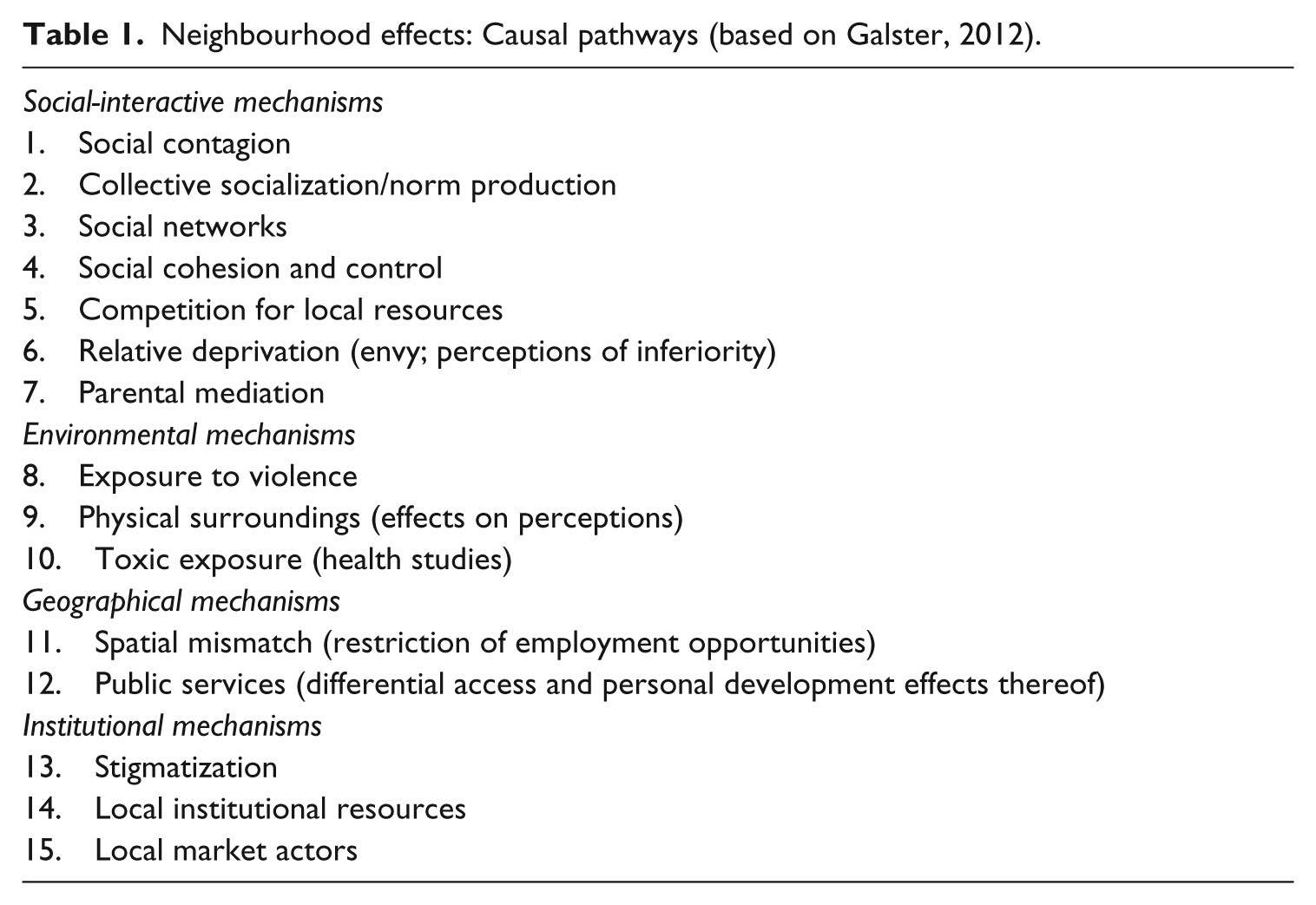
Galster (2012) identifies from within the general neighbourhood effects literature some 15 distinct place-based processes (Table 1) that appear to hold potential significance for criminology. Of these, social-interactive mechanisms are processes endogenous to specific behaviour settings and many of the putative mechanisms involved can be associated with the creation and maintenance of identifiable territory-based sub-cultures (Bannister et al., 2013). Environmental mechanisms also relate to within-setting phenomena and encompass aspects of the broken windows hypothesis (Wilson and Kelling, 1982). The remaining categories relate to how conditions, situations and perceptions external to a setting affect those based within it. Additionally, Galster (2012) proposes a pharmacological metaphor to aid the investigation of these mechanisms and of any policy interventions built around them (see Table 2).
Neighbourhood effects: Causal pathways (based on Galster, 2012).
Mechanisms of neighbourhood effects: Conceptual issues (based on Galster, 2012).
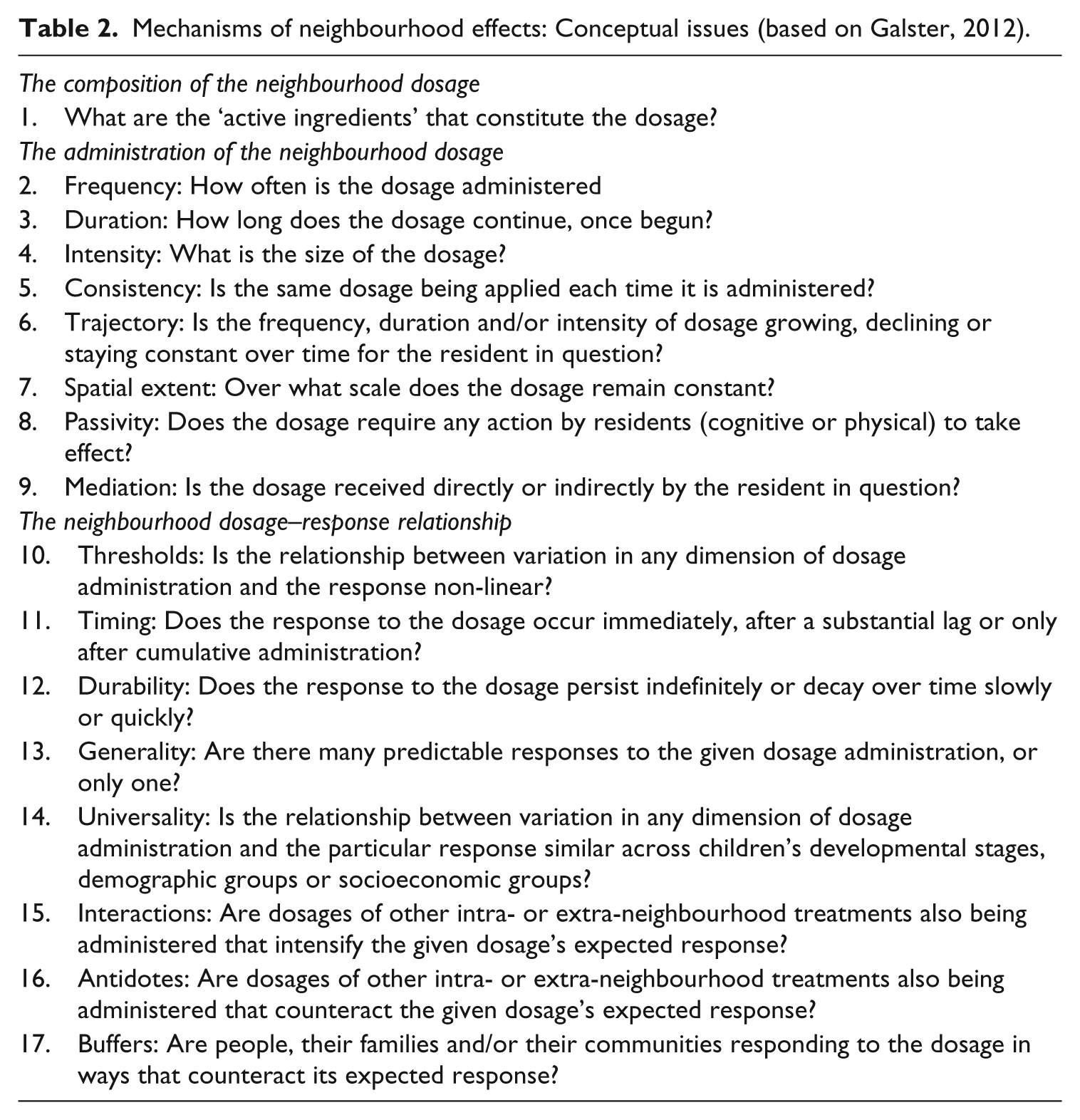
Both aspects of the Galster framework have potential value for the shaping of a more narrowly conceived Criminology of Place research agenda. The recent development of situational action theory (Wikström, 2006; Wikström et al., 2010), with its emphasis on person–environment interactions and the underlying causal processes that lead to offending behaviour in specific space–time contexts, presents as place theory as well as developmental theory, and offers interesting immediate possibilities for applying the Galster framework—especially as situational action theory also ‘implies a need for effective synthesis of neighbourhood and micro-locational traditions’ (Bottoms, 2012: 475). But a more general response is clearly merited from criminology, which has yet to engage substantively with the broader set of issues and possibilities that the neighbourhood effects literature delivers, and that Tables 1 and 2 embody. Rectifying this would add appreciable substance to recent claims of Criminology of Place as a turning point. 12
Treatments of time
Conceiving of places as behaviour settings that nest and interact introduces issues of cross-level dynamics, feedback loops and recursive process. Taylor (2015), develops the work of Boudon (1986) and Coleman (1990) 13 into a multi-level meta-model framework of inputs (I) and crime-related outcomes (O) (Figure 1), using it to illustrate the dangers of assuming homology across behaviour settings (Taylor, 2015: 90). He further speculates (Taylor, 2015: 155) that causal time frames lengthen as the size of the spatial unit of interest grows.
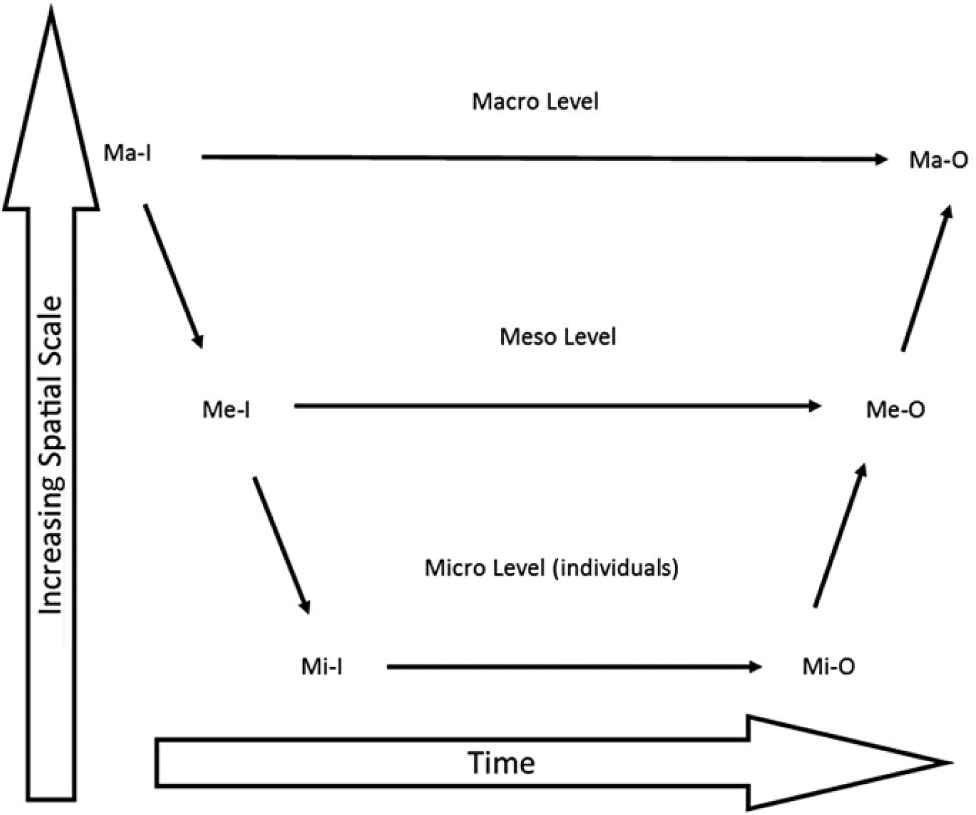
A multi-level meta-model of inputs and crime-related outcomes.
Within environmental criminology, configurations of offender/target presence and guardian absence necessarily imply some contextual time dimension, which is reinforced by the notion of crime patterning, although Eck (1995) notes that, as such theory is micro-level-based in both space and time, aggregated data in either dimension cannot be used for testing it. The Criminology of Place literature appeals to time additionally through analysis of hot spot trajectories (Weisburd et al., 2012), but without yet offering a convincing explanation for the statistical patterns uncovered.
The largely implicit treatment of time in social disorganization theories of crime also fails to convince. Promoting temporal resilience as a core feature of neighbourhoods, Sampson (2009a, 2009b) contends that neighbourhood self-replication is itself a neighbourhood effect but does not demonstrate the conditions under which time-based outcomes are stable or unstable (Wikström, 2009). Research has shown that housing system processes can determine and moderate the spatial distribution of offenders and offending levels (Bottoms, 2007; Bottoms and Wiles, 1986; Foster and Hope, 1993), a set of processes further mediated by criminal justice agency activities related to (differentiated) offender removal from/return to domestic environments (Taylor, 2015: 34 et seq.). Such processes support the possibility of temporally dynamic broader urban ecological outcomes, involving changing patterns of urban segmentation and the fundamental restructuring of cities. If this type of restructuring occurs, the narrow focus of hot spot analysis of crime will fail to capture key aspects of the aetiology of crime at place, but, absent a suitable broader theoretical space and time perspective, social disorganization theory remains deficient also (Bottoms and Wiles, 2002). Conceiving of a city as a set of neighbourhoods dynamically changing over time, Taylor (2015) moots city ecosystems, but notes that cross-sectional ecological analysis is unable to distinguish ecological continuity from recent ecological discontinuity, flags the possible existence of a modifiable temporal unit problem and cautions that applying the assumption of homology is as potentially misleading in temporal contexts as it is in spatial analysis.
In light of the foregoing, recent efforts to integrate environmental and social disorganization perspectives in a Criminology of Place must be adjudged welcome but premature. Separately, environmental criminology and social theory remain underpowered in terms of causal analysis that adequately accounts for spatial or temporal factors. Meshing the approaches without addressing these shortcomings is misguided, especially where doing so involves restricting attention to data immediately to hand. A robustly integrative Criminology of Place will be spatially multi-level, not simply spatially micro-founded but inclusive of street segment representations of social disorganization. And it will provide answers to a range of pressing questions: how are behaviour settings best qualified and quantified for criminological research? How much crime occurs within specific types of behaviour setting? How do they interact, both spatially and temporally? How do structural relationships change through time? Are there dosage effects and what is their nature? Is it possible to manipulate social norms in differing behaviour settings? What impact do urban transformations have on behaviour settings? Are intervention capacities universal across urban systems? Are intervention benefits (efficient, effective, equitable) sustainable?
Big Data for big issues?
Some might contend we are fretting over yesterday’s problems (Anderson, 2008; Mayer-Schönberger and Cukier, 2013). Big Data is changing the game; causation is dead, correlation is king, and the new challenges are simply of how to manage the volume, velocity and variety of the flexible, relational, fine-grained and indexical information increasingly becoming available (Kitchin, 2014a). There is even a nascent literature of algorithmic approaches to time- and place-specific crime hot spot prediction on which to build. Exploratory data-mining work by Corcoran et al. (2003) and Olligschlaeger (1998), involving artificial neural network modelling, has been followed by studies that seek to apply an increasingly wide range of machine learning techniques to a motley assortment of crime datasets (see Almanie et al., 2015; Kianmehr and Alhajj, 2008; Yu et al., 2014). This work typically privileges method over meaning by adopting a non-critical approach to the spatial and temporal features of the data under interrogation. Adepeju et al. (2016) suggest new metrics for interrogating the spatial patterns generated by the growing range of data-mining techniques, but fail to even consider whether the patterns being uncovered in the data they have 14 simply constitute parts of more general white noise situations.
Adding a dash of Big Data, Gerber (2014) seeks to augment kernel density-based predictions of hot spots across a broad range of crime types for Chicago, by means of linguistic analysis of spatio-temporally tagged tweets. Defining (for no clear reason) spatial neighbourhoods as one-kilometre square cells, Gerber claims the addition of Twitter-derived information improves prediction performance for 19 of 25 crime types, but notes the models developed do not properly account for temporal effects and that: ‘[i]n general, it is difficult to explain why crime types benefited more or less from the addition of Twitter topics. The topic modeling process is opaque and, similar to unsupervised clustering, it can be difficult to interpret the output’ (Gerber, 2014: 121). Similarly, Chen et al. (2015) seek to augment a kernel density approach to spatio-temporal hot spot prediction for theft crimes in Chicago using Twitter data, and for good measure add categorized weather data into the mix also. Here, textual content in Twitter data is subjected to sentiment analysis to determine (trends in) the positivity/negativity of tweets across neighbourhoods; once again completely arbitrary space and time units are employed, rendering findings difficult to interpret.
Efforts to exploit the crime-analytic potential of social media data on a broader canvass are also emerging. Wang et al. (2012) investigate a Twitter-based prediction model of hit-and-run incidents for Charlottesville, Virginia, albeit using a single news agency feed; Bendler et al. (2014) attempt to explain and predict criminal activity around Market Street, San Francisco using absolute tweet volumes as a proxy for public activity, with data differentiated by intervals of an hour and 200-metre square grids. In a somewhat more substantive contribution, Williams et al. (2017) construct a broken windows variable from Twitter activity in London. Combining this with police-recorded crime and Census data at borough level, they find the social media variable to increase the amount of variance explained in their crime estimation models. More significantly, Williams et al. (2017) consider at length the potential forms of bias to be found within social media data and how to minimize the potential for misclassification arising from subjecting such data to machine learning algorithms. Williams and Burnap (2016) provide a case study in computational criminology, using a dataset of around 427,000 tweets over a 15-day period to analyse the propagation of cyberhate in social media networks that followed the murder of Lee Rigby in a terrorist attack in London in 2013. Innes et al. (2016) examine the Rigby murder more substantively using a dataset of 35 million data points, experimental multi-channel social media data-mining software and both quantitative and qualitative analysis. In the process of delineating 10 distinct forms of social reaction to Rigby’s murder, Innes et al. (2016: 7) convincingly argue that the algorithms being used to process Big Data must be recognized as ‘profound new instruments of social perception’.
Empirically speaking, criminology to date has prioritized the qualities of place (residents and environments) over daily routine (population movement) in the analysis of crime. In this context, the potential social media data offer for illuminating the behaviour of mobile populations; for analysing population flows, densities and characteristics across space and time, is of particular interest. Criminologists have long acknowledged the inappropriateness of residential population as denominator in the calculation of crime rates for at least some types of criminal activity (Boggs, 1965), but alternatives have been rarely found (Andresen, 2011; Stults and Hasbrouck, 2015). Malleson and Andresen (2015a) explore the use of Twitter data for Leeds, UK for determining population-at-risk in the spatial analysis of street crimes to interesting effect; Malleson and Andresen (2015b) also consider violent crime in Leeds and present evidence that hot spots shift spatially where ambient population proxied by Twitter data replaces resident population based on Census data as the measure of population-at-risk. In a further investigation using London data these authors evaluate a range of potential ambient population measures for the investigation of theft-from-person crimes (Malleson and Andresen, 2016). These studies all have data limitations, as the authors acknowledge; not least that the representativeness of the social media data employed in the specific applications made is unverified, but more generally also limitations regarding the locational and time-specific content of the crime data employed. 15 Nonetheless, this body of work more than hints at the potential Big Data holds for advancing criminological science, especially where used in tandem with more traditional data.
Big Data may ultimately prove to be a fad, although we think this highly unlikely. Social science generally is frequently charged with faddishness, either in the topics chosen for investigation, or the methods used to investigate them (Economist, 2016), which when true can lead to inappropriate research effort and to conclusions that are misleading or just plain wrong (Deaton and Cartwright, 2016). But what presents as fad in the use of new techniques is often simply the highly desirable consequence of the besting of technological constraints; in data availability, computational power or of prior epistemological limitations, thereby permitting researchers to venture into areas already known, but previously unreachable (Innes et al., 2016; Mian and Rosenthal, 2016).
This being the case, while Big Data connotes—may even demand—new epistemological framings, we must not throw any babies out with the bathwater. In one sense, the discussion is hardly yet begun within criminology; in another, criminology may have already stolen a march on a fundamental pan-social scientific debate, given: ‘the most serious challenge to criminology has already happened 15 years ago with the birth of “crime science” which self-consciously and deliberately dissociates itself from the social and sociological aspects of criminology’ (Chan and Bennett Moses, 2016: 35). In this view, Big Data-related claims over the death of theory are simply the pronouncements in different guise of criminologists who argue that understanding the what (and where) of crime is more important than an understanding of why. But in our view such claims have always been specious. On a practical level, black box analysis and attendant policy positions always remain subject to suspicion and a failure to inspire political confidence that renders them intrinsically unstable. Epistemologically, it is mistaken to believe that data ‘exist independently of the ideas, techniques, technologies, people and contexts that conceive, produce, process, manage, analyze and store them’ (Kitchin, 2014b: 8). There is little as fallacious as the notion of objective facts, or the idea that they speak for themselves without a theoretical lens to impart meaning (Putnam, 2002).
If instead one starts from the presumption that Big Data does not obviate the need for theory, the picture is more promising, with extensive possibilities ‘for creating rich databases of neighborhood and other place-based contexts’ (Sampson, 2013: 9). The recent work on ambient populations noted above illustrates this well, promising to advance understandings of causation while providing opportunities to integrate consideration of space and time as a basis for exploring new policy options.
Ultimately, therefore, Big Data contains both opportunity and danger for criminology. These both arise from the fact that, in principle, Big Data allows us to slice, dice and splice time and space in an extremely large number of ways. The opportunity this provides is flexibility in the empirical investigation of properly contextualized and theorized lines of criminological inquiry. The danger is that it opens the door to an even more strident empiricism, where data are mercilessly tortured for patterns that have no intrinsic meaning. The ‘messy, biased and noisy’ nature of Big Data (Malleson and Andresen, 2015b: 118) is currently very evident, but this is not an insurmountable impediment to serious crime research. Like other technologies, Big Data is simply a tool; it remains up to the user to decide how to wield it.
Concluding comments
Criminology of Place does not yet represent the radical departure, or turning point that its adherents sometimes contend, but it does have the potential to fulfil such claims. At present, Criminology of Place has returned geography to the centre stage, cloaked in the micro-localities of environmental criminology. Efforts to expand this framework to incorporate social disorganization and collective efficacy approaches (and thereby improve understanding of the factors conditioning crime in place, the role of informal control and the range of options policy makers might consider) are extremely laudable but remain under-developed. To achieve a meaningful integration of these streams of thought, the current deficient treatments of space, time and causation that are evident in each should be simultaneously addressed.
These challenges should be embraced, and Big Data holds great promise for assisting in their achievement, but dangers also. Criminologists can at this juncture either choose to give the why of crime outcomes equal standing with what and where within an augmented Criminology of Place framework that incorporates meaningful multi-level analysis of place and multi-period dynamic causation, or alternatively to intensify the hunt for pattern with insufficient concern for meaning. The latter path promises incremental policy pay-offs, notably in the perceived efficacy of hot spot policing and situational crime prevention. But the former path offers a bigger prize; a stronger basis for policy combinations that simultaneously address cause and manifestation of crime, that can handle path dependency and contingency—and policy solutions that (like the science on which they are founded) reject silo mentalities in favour of a more holistic approach.
Footnotes
Funding
The author(s) disclosed receipt of the following financial support for the research, authorship and/ or publication of this article: Funding from the Economic and Social Research Council, Grant Reference Number ES/K006460/1 supported this research.