




Abstract
In the present study, we sought to examine whether face recognition problems impact the social anxiety experienced by autistic people. Many autistic people – perhaps between 15% and 30% – exhibit severe face recognition problems that closely resemble developmental prosopagnosia. At present, however, little is known about the psychosocial consequences of these difficulties. Autistic participants (N = 60) with varying degrees of face recognition ability completed two measures of face recognition (the original and Australian variants of the Cambridge Face Memory test), a measure of social anxiety (the Social Interaction Anxiety Scale) and a bespoke survey that enquired about individuals’ experiences of face recognition and social interaction. Relative to autistic individuals with average or above-average face recognition, autistic individuals with poor face recognition described significantly higher levels of social anxiety. Moreover, more than half our participants felt that poor face recognition hampered their social interaction, while more than a third thought that poor face recognition had undermined their efforts to make friends. These initial results suggest that poor face recognition may be an important determinant of social anxiety in autism.
Lay abstract
Research has shown that some autistic people have severe difficulties in recognising other people’s faces. However, little is understood about how these difficulties impact the daily life and the mental well-being of autistic people. In this study, we asked 60 autistic adults with varying degrees of face recognition ability to complete two tests of face recognition, a questionnaire about social anxiety and a bespoke survey which asked participants about their experiences of face recognition and social interaction. We found that participants who had poor face recognition reported experiencing higher levels of social anxiety compared to those with average or better face recognition skills. More than half felt that their face recognition difficulties affected their social interactions, and over a third believed it hindered their ability to make friends. These findings suggest that face recognition difficulties may contribute to social anxiety among autistic individuals.
Introduction
Mental health conditions occur with a greater incidence in the autistic population than in the nonautistic population (Lai, 2023; Lai et al., 2019). Research suggests that approximately 80% of autistic adults in the United Kingdom experience mental health challenges that have a significant impact on their daily lives. Among these challenges, anxiety disorders are among the most prevalent, affecting between 20% and 40% of autistic adults (Hollocks et al., 2019; Stark et al., 2021). The high prevalence of mental health conditions within the autistic population has been linked to an elevated risk of suicidal behaviours (Mournet et al., 2023; Newell et al., 2023; O’Halloran et al., 2022).
In the present study, we sought to examine to what extent face recognition problems impact the social anxiety of autistic people. Where observed, face recognition problems are known to influence psychosocial outcomes. For example, non-autistic adults with developmental prosopagnosia (DP) – an independent neurodevelopmental disorder characterised by lifelong face recognition difficulties (Behrmann & Avidan, 2005; Cook & Biotti, 2016; Duchaine & Nakayama, 2006b) – frequently cite high levels of social anxiety, social interaction difficulties, feelings of inadequacy and associated avoidance behaviours (e.g. choosing careers that minimise face-to-face interaction) arising from their face recognition problems (Dalrymple et al., 2014; Yardley et al., 2008).
Many autistic people exhibit severe face recognition problems (Gehdu et al., 2022; Hedley et al., 2011; Kamensek et al., 2023; Minio-Paluello et al., 2020; Stantić et al., 2022). Recent research suggests that 15% to 30% of autistic participants exhibit face recognition impairments comparable with those seen in DP (Kamensek et al., 2023; Minio-Paluello et al., 2020). At present, little is known about the psychosocial consequences of these difficulties. However, given that individuals with DP describe heightened levels of social anxiety (Dalrymple et al., 2014; Yardley et al., 2008), we reasoned that poor face recognition (where observed) might also increase autistic individuals’ experience of social anxiety.
Method
Participants
Sixty participants with a clinical diagnosis of autism (Mage = 36.6 years; SDage = 11.26 years) were recruited via www.ukautismresearch.org. All autistic participants had received an autism diagnosis (e.g. Autism Spectrum Disorder, Asperger’s Syndrome) from a clinical professional (General Practitioner, Neurologist, Psychiatrist or Clinical Psychologist) based in the United Kingdom. All participants in the autistic group also reached cut-off (a score of 32) on the Autism Spectrum Quotient (AQ; Baron-Cohen et al., 2001). All participants were required to be a current U.K. resident. To be eligible, participants also had to be aged between 18 and 60, speak English as a first language and have normal or corrected-to-normal visual acuity.
Of the 12 individuals who described their sex as male, 9 described their gender identity as male, 2 identified as non-binary and 1 identified as female. Of the 48 individuals who described their sex as female, 40 described their gender identity as female, 6 identified as non-binary and 2 preferred not to say. Fifty-nine of the 60 participants identified as White (56: White-British, 2: White Irish, 1: White-Other). The remaining participant did not specify their ethnicity. Fifty-three of the participants were right-handed, while 7 were left-handed.
Measures
To assess face recognition ability, all participants completed two versions of the Cambridge Face Memory Test (CFMT): the original (CFMT-O; Duchaine & Nakayama, 2006a) and the Australian variant (CFMT-A; McKone et al., 2011). The CFMT is a standardised objective test of face recognition ability that was developed to identify cases of DP (Duchaine & Nakayama, 2006a). On each trial (72 in total), participants are asked to identify recently learned target faces from a line-up of three options (a target and two foils). The addition of viewpoint changes and high-spatial frequency visual noise increases task difficulty in the later stages. All data were collected online via Gorilla Experiment Builder (Anwyl-Irvine et al., 2020).
To assess social interaction anxiety, participants completed the Social Interaction Anxiety Scale (SIAS; Mattick & Clarke, 1998). This scale consists of 20 self-report items designed to measure anxiety specifically in relation to social interaction. Participants rate how well each statement describes them on a 5-point scale. Total SIAS scores range from 0 to 80. Higher scores suggest higher levels of social anxiety. A score of 36 and above is thought to reflect clinically significant levels of social anxiety (Peters, 2000). Note, we updated the wording of item 14 (‘I have difficulty talking to attractive persons of the opposite sex’) to ‘I have difficulty talking to someone I find attractive’.
We also administered a bespoke three-item survey that enquired about participants’ experiences of face recognition and social interaction. The items were: (1) Poor face recognition makes social interaction difficult for me; (2) Face recognition problems have influenced my choice of job / career, or otherwise limited my employment opportunities; and (3) Face recognition problems have hindered my ability to make friends. Each item was scored on a five-point scale: Definitely disagree / disagree / neither agree nor disagree / agree / definitely agree. For each item, participants were also given a free-response text box in which they could elaborate on their response if they wished.
In addition to the foregoing measures of face recognition and social anxiety, we also assessed the presence of traits associated with alexithymia and attention-deficit hyperactivity disorder (ADHD) in our sample. Alexithymia and ADHD are known to co-occur with autism and are thought to be associated with higher levels of social anxiety (Bird & Cook, 2013; Koyuncu et al., 2015, 2019; Pickard et al., 2020). We therefore sought to establish whether face recognition difficulties influence social anxiety in autism, independently of co-occurring ADHD and alexithymia.
To assess the presence of alexithymia, participants completed the Twenty-item Toronto Alexithymia Scale (TAS-20; Bagby et al., 1994; Taylor et al., 2003). The TAS-20 comprises 20 statements that relate to one’s ability to describe and identify emotions and interoceptive sensations. Respondents indicate to what extent each statement applies to them on a 5-point scale. Scores can range from 20 to 100, with higher scores indicative of more alexithymic traits.
To assess the presence of traits associated with ADHD, participants completed the Adult ADHD Self-Report Scale (ASRS; Kessler et al., 2005). The ASRS consists of two parts: Part A is a six-item screener that has been shown to effectively discriminate clinical cases of adult ADHD from non-clinical cases (Kessler et al., 2007). Each response is scored as either 0 or 1, thus screener scores can range from 0 to 6. Part B consists of 12 follow-up items that can be used to probe symptomology. Part B was not employed here.
Community involvement
The present research was informed by numerous conversations between the research team and autistic individuals about their subjective experiences of face recognition and social interaction. By including a free-text component, we sought to give autistic participants the opportunity to present these experiences in their own words.
Results
Social Interaction Anxiety Scale (SIAS)
For the purposes of the analyses described below, we split the sample into those who scored less than 65% on both versions of the CFMT (N = 18, Mage = 36.72, SDage = 12.33) and those who achieved a score of 65% or more on one or both variants (N = 42, Mage = 36.55, SDage = 10.93). While meeting this criterion does not constitute a formal diagnosis of DP, it has been used previously to distinguish those whose face recognition ability is likely to fall within the impaired range, from those whose face recognition ability is average or above-average (e.g. Tsantani et al., 2021). Supporting data are provided as Supplementary Material.
Overall, the SIAS scores were relatively high (M = 55.70, SD = 12.95) and 55 of the 60 autistic participants met cut-off for clinically significant levels of social anxiety. Critically, however, the subgroup with poor face recognition reported higher levels of social anxiety (M = 61.78, SD = 9.27) than those with average or above-average face recognition (M = 53.10, SD = 13.51) (t(58) = 2.482, p = 0.016, d = .699; Figure 1).
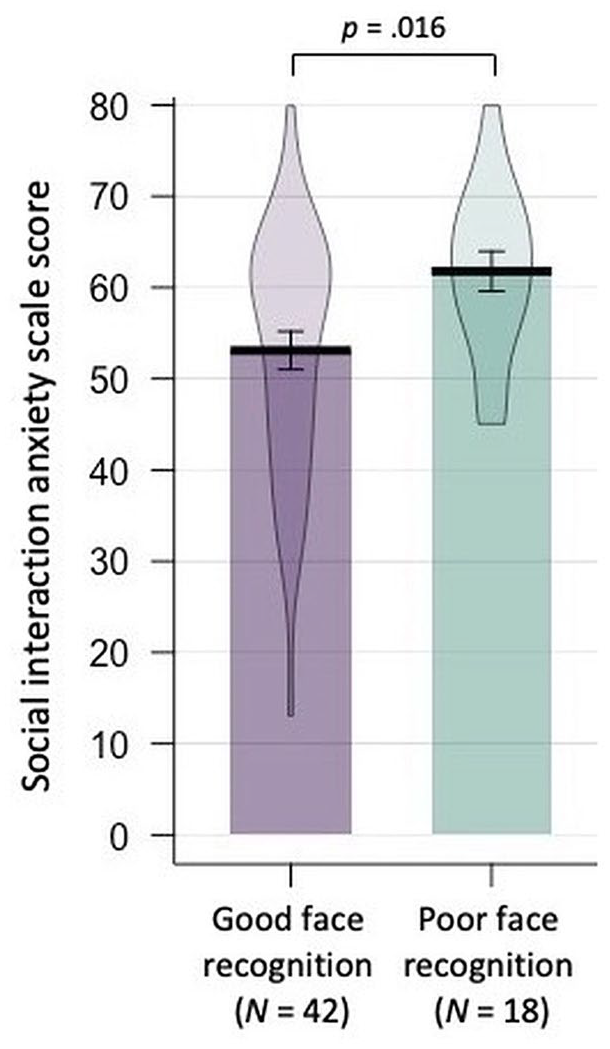
Participants’ scores on the social interaction anxiety scale illustrated as a function of face recognition subgroup.
Participants’ SIAS scores were also predicted by their scores on the AQ (M = 42.25, SD = 4.13, r = .300, p = 0.020), the TAS-20 (M = 67.77, SD = 12.98, r = .398, p < 0.001) and on the ASRS (M = 4.10, SD = 1.70, r = .386, p < 0.001). In other words, those who exhibited more traits associated with autism, alexithymia and ADHD, also tended to report greater social anxiety. However, when entered into a multiple-regression with these other predictors (F(4, 55) = 5.641, p < 0.001, R2 = .291), the presence of face recognition impairment remained a significant predictor of SIAS scores (β = .283, t = 2.373, p = 0.021; Table 1).
Summary of the multiple regression model of participants’ scores on the social interaction anxiety scale.
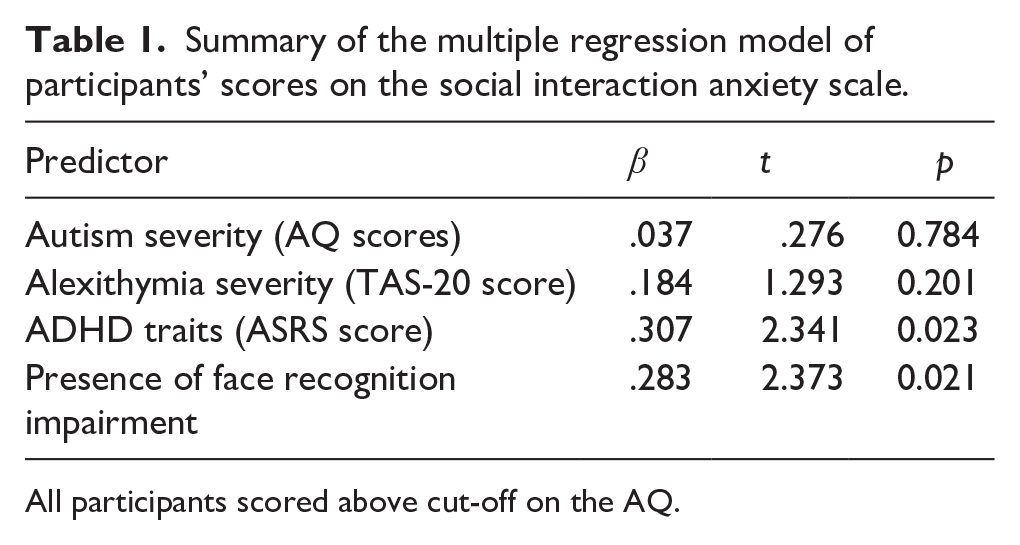
All participants scored above cut-off on the AQ.
Face recognition survey
Thirty-seven (61.7%) of the 60 participants expressed agreement (either ‘Agree’ or ‘Strongly agree’) with the first item of the survey (‘Poor face recognition makes social interaction difficult for me’), while 14 (23.3%) participants indicated disagreement (either ‘Disagree’ or ‘Strongly disagree’). Many of the free-text comments described hesitant or stressful social interaction stemming from face recognition difficulties. For all items, illustrative comments are provided in Table 2.
Illustrative quotes from the face recognition survey.
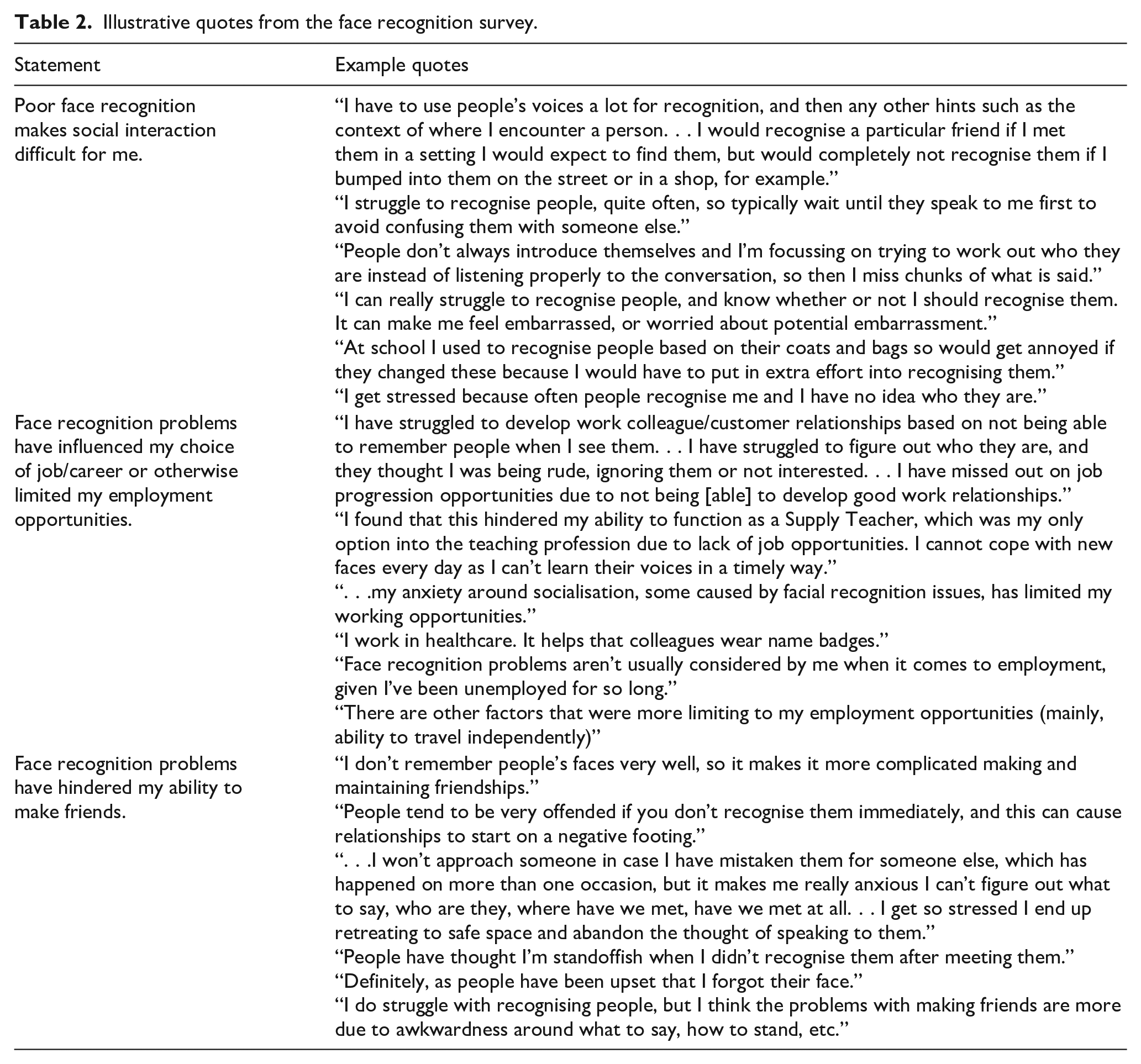
Only 9 of the 60 participants (15.0%) expressed agreement with the second survey item (‘Face recognition problems have influenced my choice of job / career, or otherwise limited my employment opportunities’). Thirty-eight (63.3%) participants expressed disagreement. One or two of the free-text comments described vocational difficulties caused by poor face recognition. However, many of the comments alluded to other factors (e.g. disabilities, issues with travel) that prevented individuals from pursuing employment / career opportunities.
Twenty-two (36.7%) of the 60 participants expressed agreement with the third survey item (‘Face recognition problems have hindered my ability to make friends’), while 23 participants (38.3%) expressed disagreement. Several respondents felt that poor face recognition meant they were viewed as rude or aloof. Others also described how uncertain face recognition and the potential for embarrassment made it harder to approach new acquaintances.
For each participant we computed their total questionnaire score. Scores could range from 3 to 15 (assuming: Strongly disagree = 1; Strongly agree = 5). The mean score of the poor face recognition group (M = 10.17, SD = 2.90) exceeded the mean score of the good face recognition group (M = 8.07, SD = 3.06) (t(58) = 2.467, p = 0.017, d = .695).
General discussion
It is now well-established that a subgroup within the autistic population exhibit severe lifelong face recognition problems (Gehdu et al., 2022; Hedley et al., 2011; Kamensek et al., 2023; Minio-Paluello et al., 2020; Stantić et al., 2022). However, there is less appreciation that these difficulties, where observed, have important psychosocial consequences. The present results suggest that autistic individuals with poor face recognition experience greater social anxiety than those with average or above-average face recognition. Strikingly, more than half our sample felt that poor face recognition hampered their social interaction, while over a third thought that poor face recognition had undermined their efforts to make friends.
The development of social anxiety in autism likely reflects the interplay of many factors (Spain et al., 2018) – poor face recognition may be just one part of this complex story. Where observed, face recognition problems may exacerbate or interact with underlying social anxiety caused by other factors. In this context, we note that the presence of co-occurring alexithymia and ADHD were also predictive of greater social anxiety, consistent with previous reports (e.g. Koyuncu et al., 2015, 2019; Pickard et al., 2020).
In keeping with previous research (Tsantani et al., 2021), we split our sample into those who scored less than 65% on both versions of the CFMT and those who did not. Eighteen participants met this criterion for poor face recognition. Interestingly, however, more than twice this number felt that poor face recognition hindered their social interaction. It is possible that CFMT scores sometimes over-estimate participants’ face recognition ability (see Burns et al., 2023). Alternatively, relatively mild face recognition problems may be sufficient to induce or exacerbate social interaction difficulties in some autistic individuals.
At the outset, we hypothesised that poor face recognition may cause heightened social anxiety in autistic individuals. We acknowledge that – while suggestive of association – the quantitative results described do not evidence causality. In this context the qualitative reports are noteworthy, however. Several of the quotes in Table 2 accord well with the hypothesised causal relationship.
Consistent with several recent studies that have sought to recruit autistic participants online, our sample included a large proportion of female participants (Rødgaard et al., 2022). Consequently, we acknowledge the need to replicate the preliminary findings described here in a sample more representative of the wider autistic population, the majority of whom identify as male.
Conclusion
It is now well-established that a subset of the autistic population experience face recognition difficulties. However, little is known about the psychosocial consequences of these problems. Our results suggest that autistic adults with poor face recognition may experience greater social anxiety than those with average or above-average face recognition.
Supplemental Material
sj-xlsx-1-aut-10.1177_13623613241272031 – Supplemental material for Poor face recognition predicts social anxiety in autism: A short report
sj-xlsx-1-aut-10.1177_13623613241272031 for Poor face recognition predicts social anxiety in autism: A short report by Bayparvah Kaur Gehdu, Katie LH Gray and Richard Cook in Autism
Footnotes
Declaration of conflicting interests
The author(s) declared no potential conflicts of interest with respect to the research, authorship and/or publication of this article.
Funding
The author(s) received no financial support for the research, authorship and/or publication of this article.

Supplemental material
Supplemental material for this article is available online.
References
Supplementary Material
Please find the following supplemental material available below.
For Open Access articles published under a Creative Commons License, all supplemental material carries the same license as the article it is associated with.
For non-Open Access articles published, all supplemental material carries a non-exclusive license, and permission requests for re-use of supplemental material or any part of supplemental material shall be sent directly to the copyright owner as specified in the copyright notice associated with the article.
