



Abstract
The integration of artificial intelligence (AI) into language education is transforming pedagogical practices. This transformation is influenced by two distinct yet interconnected domains: the cognitive domain, encompassing AI literacy, and the affective domain, involving AI-induced emotions. However, the dynamic interplay between cognition and emotion in this context is a critical yet underexplored area of research. This study presents a systematic review, compliant with PRISMA guidelines, synthesizing findings from the Web of Science, Scopus, and ProQuest databases. The review delineates the specific characteristics of AI literacy and catalogues the range of emotions arising from AI use. To bridge the identified theoretical gap, we introduce a conceptual framework based on Appraisal Theory, which provides a mechanism to link cognitive evaluations of AI with emotional responses. This leads to the proposal of a holistic strategy that addresses not only the literacy required for effective AI tool usage but also the emotional support necessary to mitigate the challenges and stresses of technological integration.
I Introduction
The integration of artificial intelligence (AI) into language education offers vast opportunities but also presents a complex set of challenges, particularly for educators who must adapt to this rapidly evolving technological landscape (Moorhouse & Kohnke, 2024; Shen & Guo, 2024). Moreover, AI in language education is not a singular tool but a broad spectrum of technologies, including natural language processing, data-driven learning, automated writing assessment, intelligent tutoring systems, computerized dynamic evaluation, automatic speech recognition, and chatbots, each contributing uniquely to language instruction and acquisition (Son et al., 2023). Therefore, the integration of AI into language education constitutes more than a simple technological upgrade; it signifies a paradigm shift that fundamentally redefines pedagogical processes, and has a profound impact on teachers’ cognitive (Bannister, 2024; Kohnke et al., 2023, 2025; Ma et al., 2024; Moorhouse et al., 2024, 2025; Özer-Altınkaya & Yetkin, 2025; Wang et al., 2025) and affective (Liu & Chang, 2024; Liu & Liu, 2025; Parviz & Arthur, 2025; Seyri & Ghiasvand, 2025) domains.
For the cognitive domain, AI literacy encompasses not only technical knowledge of AI applications but also an understanding of their pedagogical implications, ethical considerations, and the ability to critically evaluate and implement these technologies effectively in the classroom (M. Liu, Zhang, Zhang, 2025; M. Liu, Zhang, Neufeld, 2025; Moorhouse et al., 2024, 2025; Pan & Wang, 2025; Xue, 2025). The proliferation of AI in education is prompting a significant re-evaluation of the teacher’s role (Wu et al., 2025a, 2025b). Foundational activities such as lesson planning, resource creation, and student assessment, once central to the profession, now face the prospect of being streamlined or entirely assumed by intelligent technologies (Ng et al., 2021a). Without sufficient AI literacy, educators may struggle to maximize the benefits of AI tools, potentially leading to ineffective implementation or resistance to technological integration (Urazbayeva et al., 2024; Xu et al., 2025). Consequently, as Wang et al. (2025, p. 2) argue, ‘they need literacies for understanding, implementing, and evaluating different forms of technologies in line with the digitalized space that they work in to have a competitive advantage and be on a better footing.’
In the affective domain, the adoption of AI is complicated by the profound complexity and diversity of teacher emotions (Parviz & Arthur, 2025; Seyri & Ghiasvand, 2025; Zhou & Hou, 2024). These emotions are not merely personal feelings but can be comprehensively defined as ‘socially constructed, personally enacted ways of being that emerge from conscious and/or unconscious judgments regarding perceived successes at attaining goals or maintaining standards or beliefs during transactions as part of social-historical contexts’ (Schutz et al., 2006, p. 344). ‘Socially constructed’ nature of emotions signifies that understanding this intricate relationship between language teachers’ emotions and their pedagogical practice is crucial, as it can help them better manage the challenges of their profession and facilitate teaching improvement (Han et al., 2023; Hong et al., 2016). This understanding becomes particularly relevant when examining how the introduction of AI elicits a broad spectrum of emotional responses, ranging from enthusiasm and curiosity to anxiety and apprehension (Liu & Chang, 2024; Shen & Guo, 2024). These emotional responses constitute a pivotal factor, capable of either profoundly facilitating or critically hindering the incorporation of AI-driven innovations into pedagogical practice. As Yin et al. (2024) underscore: the experience of Challenge Emotions correlates positively with approach-oriented coping strategies, thereby promoting active engagement with AI tools; conversely, Loss Emotions and Deterrence Emotions predict avoidance-oriented mechanisms, leading language teachers to disengage from or actively resist AI integration. Consequently, a deep understanding of these affective experiences is vital for developing targeted support strategies (Kohnke et al., 2024; Seyri & Ghiasvand, 2025). The aim is to ensure teachers feel empowered, rather than overwhelmed, as they navigate the complexities of AI-mediated language instruction (Liu & Chang, 2024; Liu & Liu, 2025; Sun & Sun, 2025).
This paradigm shift necessitates a deeper investigation into both the cognitive and affective dimensions of AI integration in language education. A significant void exists in the existing scholarship concerning the intersection of educators’ AI literacy and emotional responses, a domain that has thus far remained largely unexplored. Appraisal Theory offers a valuable lens for this inquiry, positing that an individual’s cognitive evaluation of an event shapes their emotional reaction. In this context, an educator’s level of AI literacy can profoundly influence their appraisal of AI as either an opportunity or a threat (Ng et al., 2021b; Pan & Wang, 2025). Consequently, when educators perceive AI as an opportunity for professional growth, they experience more positive emotions and feel less obstructed; conversely, perceptions of AI as a threat correlate with negative emotions such as frustration and anxiety (Yin et al., 2024). While Xie et al. (2025, 2026) represent a pioneering effort to explore this interplay of AI literacy and AI-induced emotions among language teachers, their work underscores the fact that this critical nexus remains markedly underexplored, confirming the persistent gap in the literature.
We believe that a comprehensive review of existing research on language teachers’ AI literacy and AI-induced emotions is essential for advancing our understanding of this rapidly evolving field. Additionally, based on our findings of the systematic review, we propose a conceptual framework bridging language teachers’ AI literacy and AI-induced emotions that is intended to help guide scholars in designing studies that deepen our knowledge of AI integration in language education, while also offering practical recommendations to support language teachers in adapting to AI-mediated teaching environments.
II Previous review studies
A growing body of systematic reviews has investigated various dimensions of AI integration in language education, examining themes such as generative AI (GenAI), conversational AI chatbots, emotional AI, and broader AI applications. The seven systematic reviews we identified reveal diverse but interconnected emphases within the emerging field of AI in language education, as shown in Table 1. Collectively, these reviews chart a landscape dominated by the capabilities of the technology itself and its potential to reshape the language education.
Previous reviews related to AI in language education.

A comparative analysis of these reviews reveals distinct yet overlapping priorities. The work of Chandel and Lim (2025) and Law (2024) provides a broad overview of the generative AI landscape, emphasizing its disruptive potential for literacy development and identifying a pressing need for ethical frameworks and teacher professional development. These studies underline the importance of literacy and multiliteracies outcomes, indicating GenAI’s role in both linguistic development (e.g. writing and vocabulary acquisition) and multimodal literacies such as digital literacy. Key gaps identified in this area include the need for empirical research, targeted skill interventions, and careful consideration of ethical implications and stakeholder engagement (Law, 2024). In contrast, reviews focusing on chatbots delve deeper into the dynamics of human-AI interaction. Ji et al. (2023) identified a significant gap in genuine collaborative partnerships between teachers and AIs, proposing a future of classroom orchestration where AI amplifies human intelligence. Building on this, Y. Li et al. (2024) specifically addressed the neglected role of the teacher, using Self-Determination Theory to articulate how educators must fulfil student needs that chatbots inadvertently thwart. This focus on systematic outcomes was further refined by Y. Li et al. (2025), who employed Activity Theory to model how rules, tools, and division of labor must be configured to achieve specific learning outcomes in chatbot-assisted environments. These reviews advocate that integrating conversational AI can amplify teachers’ effectiveness, reduce workloads, and improve student learning outcomes, although they also caution against over-reliance on AI without adequate human cognitive and emotional support. Furthermore, recent studies on broader perspectives of AI in language education (AILEd) and emotional AI applications reveal a nuanced understanding of the intersection between technological, cognitive, and emotional factors in educational contexts. For example, Liang et al. (2023) and Y. Liu et al. (2024) extend the discussion by exploring the emotional affordances of AI, including its potential to reduce language anxiety, provide personalized feedback, and enhance student engagement. However, they also identify significant gaps in current research, particularly the lack of focus on developing higher-order thinking, critical problem-solving skills, and effective teacher-AI collaboration. In response, they call for comprehensive professional development initiatives to fully realize AI’s educational potential.
Despite their valuable contributions, a critical synthesis of these seven reviews reveals a persistent and significant gap: the lack of comprehensive investigation into language teachers’ internal experiences in the age of AI. Although Y. Li et al. (2024) commendably center their analysis on teacher roles, their focus remains primarily on how educators can support student motivation rather than examining teachers’ own professional competencies or emotional responses. Collectively, these reviews emphasize what teachers ought to achieve, such as orchestrating classrooms, integrating digital tools, and collaborating with AI systems, while systematically overlooking the fundamental enablers required for such integration. Crucially, the essential dimensions of language teachers’ AI literacy, including encompassing conceptual understanding, practical skills, critical evaluation capabilities, and ethical preparedness for AI implementation, have not been adequately addressed as a distinct research priority. Concurrently, the profound AI-induced emotional responses that teachers inevitably experience, ranging from anxiety and apprehension to senses of opportunity and accomplishment, remain largely unexamined. This creates a striking imbalance when contrasted with the detailed attention afforded to student anxiety (Y. Liu et al., 2024). Consequently, the prevailing research perspective emerging from these major reviews has largely neglected the complex interplay between cognitive competence and emotional response that fundamentally shapes teacher experience, leaving a critical void that must be addressed to ensure the sustainable and effective integration of AI in language education.
Building upon these foundations while addressing their limitations, this review conducts a systematic exploration of existing empirical research specifically focused on language teachers’ AI literacy and AI-related emotions. By synthesizing empirical findings, identifying prevalent patterns and challenges, and proposing future research directions, this review aims to advance both theoretical understanding and practical innovation. It specifically seeks to investigate the following research questions:
Research question 1: What are the defining characteristics of the various dimensions that constitute language teachers’ AI literacy?
Research question 2: How are the different AI-induced emotions experienced by language teachers manifested and understood within the educational context?
III Methodology
To address the research questions, we conducted a two-phase systematic review of the literature to investigate language teachers’ AI literacy and AI-induced emotions, respectively. The review followed the guidelines of the Preferred Reporting Items for Systematic Reviews and Meta-Analyses (PRISMA), as outlined by Liberati et al. (2009) and Moher et al. (2009), and was conducted in four stages: identification, screening, eligibility, and inclusion. The PRISMA framework was adopted to enhance the reliability of the research process and strengthen the credibility of the findings (Chong & Plonsky, 2024).
1 Literature search
A systematic literature search was conducted in September 2025 across three major research databases: the Web of Science Core Collection (WOSCC), Scopus, and ProQuest. The selection of these databases was based on their comprehensive coverage of evidence-based scientific information and influential educational research. Furthermore, their established reputation in the field is evidenced by their frequent use in previous systematic reviews on AI in language education (Law, 2024; Y. Li et al., 2024, 2025; Y. Liu et al., 2024). The literature search was conducted across three databases, with a specific focus on the disciplines of education, social science, psychology, and the arts and humanities. No restrictions were placed on the year of publication.
We established a set of eligibility criteria, detailed in Table 2, to ensure a focused, rigorous, and reproducible review process. The scope was limited to full-text articles published in English, the dominant language of international scholarly communication, to facilitate a thorough and accurate analysis by the research team; this acknowledges a potential for language bias but was necessary for practical feasibility. To uphold academic rigor, the review was confined to peer-reviewed journal articles and book chapters, as these publications undergo stringent quality control. Consequently, grey literature, dissertations, and conference proceedings were excluded to maintain a consistent standard of scholarly validation. Furthermore, a decision was taken to include only studies presenting primary empirical data, thereby grounding the synthesis in observable evidence and excluding non-empirical work such as theoretical papers or literature reviews, which, whilst valuable, address a different research objective. The population of interest was explicitly circumscribed to in-service and pre-service language teachers, leading to the exclusion of studies centerd solely on language learners to maintain a clear analytical focus on the professional, rather than the student, experience. Finally, the dual focus of the investigation was operationalized by segregating the review into two distinct phases: the first targeted research on AI literacy in language education, whilst the second concentrated on AI-induced emotions within the same context, ensuring each research question was addressed with precision.
Eligibility criteria for the two phases of systematic review.

In the first phase of our literature review, we examined the terms ‘AI literacy’ and ‘AI competency’, which are often used interchangeably. Chiu (2025) distinguishes between them, defining AI literacy as a foundational, conceptual understanding focusing on knowledge, critical thinking, and ethical awareness. In contrast, AI competency denotes practical proficiency in using or managing AI systems in real-world contexts. However, the prominent framework from Ng et al. (2021a, 2021b) conceptualizes AI literacy more broadly to include four dimensions – Knowing and Understanding AI, Applying AI, Evaluating AI, and AI Ethics – thereby encompassing the practical skills termed as AI competency by Chiu. To ensure a comprehensive search, we therefore included both terms in our literature search strategy.
During the identification stage, the search query [(‘language teacher’) AND (‘artificial intelligence’ OR ‘generative AI’ OR ‘large language model’ OR ‘chatbot’ OR ‘ChatGPT’) AND (‘literacy’ OR ‘competen*’)] was employed. Following the independent searches, the three reviewers compared their results and consolidated the findings. This process yielded a total of 1,434 articles from the three selected databases: 560 from WOSCC, 701 from Scopus, and 173 from ProQuest, as detailed in Table 3. The deduplication function in EndNote20 identified and removed 476 duplicate articles, resulting in 756 records for further screening.
Key search terms regarding language teachers’ AI literacy.

Note: Using an asterisk (*) at the end of a word root retrieves variant endings.
Throughout the selection process, the two primary reviewers worked independently. Any discrepancies regarding the inclusion or exclusion of specific studies were resolved through discussion until a consensus was reached. In the event a consensus could not be achieved, a third reviewer was consulted to arbitrate and make a final decision. The complete process, detailed in accordance with the PRISMA guidelines, is illustrated in Figure 1. The screening stage involved a thorough review of the 756 article abstracts against the pre-defined eligibility criteria. This process led to the exclusion of 612 articles that did not meet the criteria. The remaining 144 articles were then subjected to a full-text eligibility assessment, which was conducted independently by two researchers to ensure rigor. The more detailed, full-text evaluation led to the exclusion of a further 128 articles. The primary rationale was that, although these studies contained peripheral content related to AI in education (such as Tour et al., 2025), their core focus did not specifically center on the construct of language teachers’ AI literacy. Consequently, they were deemed to fall outside the precise scope of this review. Consequently, a total of 16 articles progressed to the inclusion stage. To enhance the comprehensiveness of the review and mitigate the risk of overlooking pertinent studies, an ancestral search was performed on the reference lists of these 16 articles. This supplementary search identified six additional relevant publications. Therefore, a final corpus of 22 articles was included for the systematic synthesis on language teachers’ AI literacy.

PRISMA flow diagram for the systematic review of AI literacy.
For the second phase of the literature review, the nature of language teacher emotion is conceptualized by Han et al. (2023) through three key aspects, drawing upon a corpus of 161 empirical studies on language teacher emotion published between 2005 and 2022. The first aspect is the measurement of language teacher emotion, which involves the development of valid scales to assess the diverse emotions educators experience. The second aspect is language teachers’ emotional capacity, denoting their ability to identify, regulate, and manage their own emotions and those of others. This encompasses concepts such as emotional intelligence, emotional labor, and emotional regulation. The third aspect is language teachers’ emotional experience, which constitutes a complex interplay of sensations, perceptions, and reflections. This includes feelings such as teaching enthusiasm, anxiety, and enjoyment.
During the identification stage, the search query [(‘language teacher’) AND (‘artificial intelligence’ OR ‘generative AI’ OR ‘large language model’ OR ‘chatbot’ OR ‘ChatGPT’) AND (‘emotion*’ OR ‘affect*’)] was employed. Following independent searches, the three reviewers compared and consolidated their findings. This process yielded a total of 1,272 articles from the three selected databases: 471 from WOSCC, 632 from Scopus, and 169 from ProQuest, as detailed in Table 4. The deduplication function in EndNote20 identified and removed 422 duplicate articles, resulting in 724 records for further screening.
Key search terms regarding language teachers’ AI-induced emotions.
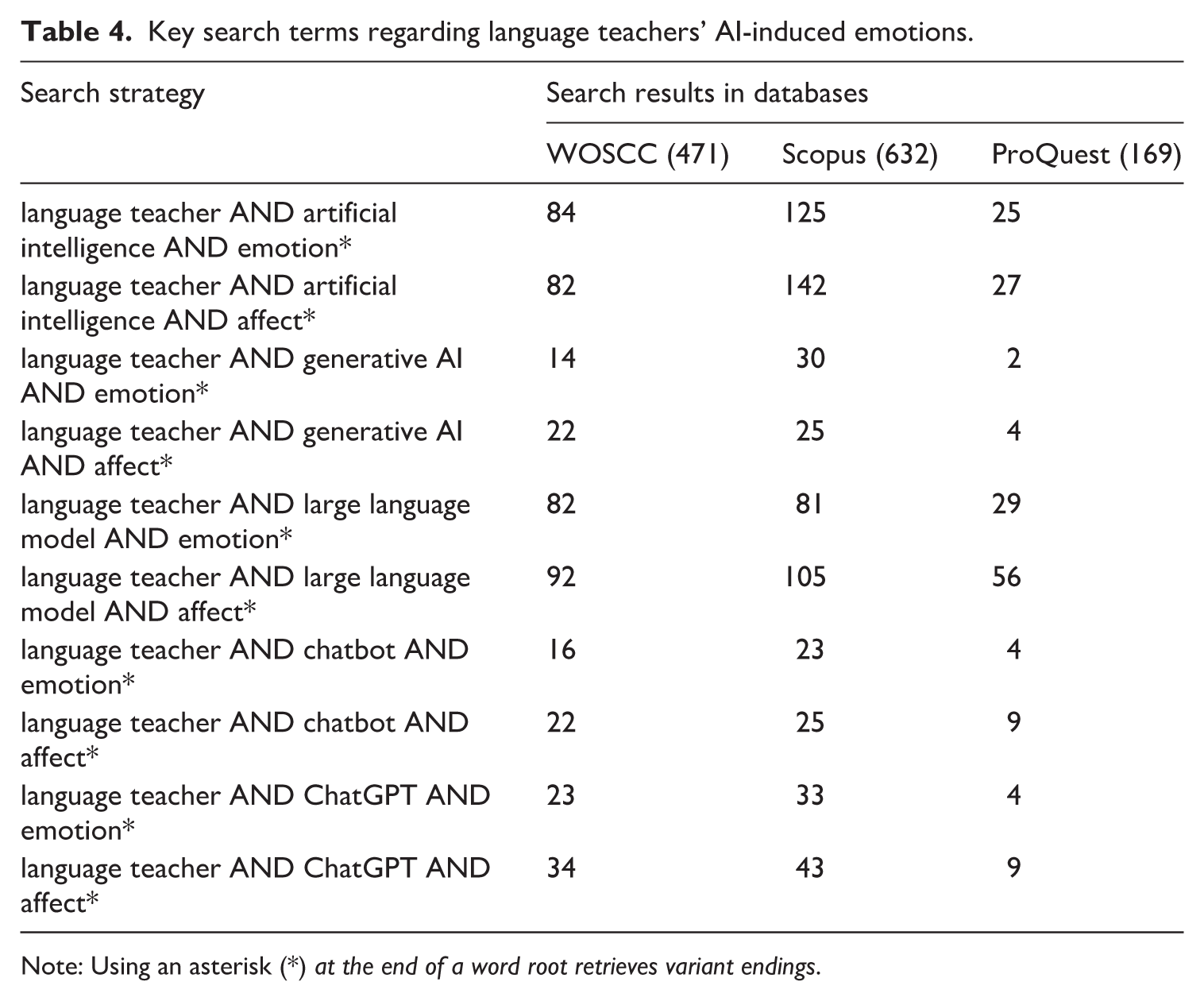
Note: Using an asterisk (*) at the end of a word root retrieves variant endings.
Throughout the selection process, the two primary reviewers worked independently. Any discrepancies regarding the inclusion or exclusion of specific studies were resolved through discussion until a consensus was reached. In the event a consensus could not be achieved, a third reviewer was consulted to arbitrate and make a final decision. The complete process, detailed in accordance with the PRISMA guidelines, is illustrated in Figure 2. The screening stage involved a thorough review of the 724 article abstracts against the pre-defined eligibility criteria. This process led to the exclusion of 592 articles that did not meet the criteria. The remaining 132 articles then underwent a full-text eligibility assessment, which was conducted independently by two researchers to ensure rigor. This more detailed evaluation resulted in the exclusion of a further 124 articles, as their core focus did not specifically center on the construct of language teachers’ AI-induced emotions, as exemplified by Fan and Zhang (2024). Consequently, these studies were deemed to fall outside the precise scope of this review, leaving eight articles to progress to the inclusion stage. To enhance the comprehensiveness of the review and mitigate the risk of overlooking pertinent studies, an ancestral search was performed on the reference lists of these eight articles. This supplementary search identified four additional relevant publications. Therefore, a final corpus of 12 articles was included for the systematic synthesis on language teachers’ AI-induced emotions.

PRISMA flow diagram for the systematic review of AI-induced emotions.
2 Data analysis
The data analysis incorporates both qualitative deductive and inductive coding techniques, employing a combination of a priori and grounded coding approaches (Gough et al., 2017). This methodological framework enables the creation of a comprehensive summary regarding language teachers’ AI literacy and AI-induced emotions. Furthermore, it allows for the generation of new theoretical framework derived from a collective review of existing studies.
To address the two research questions, a systematic and collaborative approach to data analysis was undertaken by three researchers. The process was designed to maximize consistency, transparency, and rigor, thereby strengthening the credibility and trustworthiness of the findings. Prior to the formal analysis, all three researchers participated in a structured calibration exercise. This involved independently coding a pilot sample of five articles focusing on AI literacy and five articles on AI-induced emotions. Following this initial coding, the researchers convened to compare their assigned codes. Through in-depth discussion, they examined areas of divergence, reconciled differing interpretations, and refined the codebook definitions. This iterative process ensured a shared understanding of the coding framework and enhanced inter-rater reliability before proceeding to the full analysis. For the primary analysis, two researchers independently coded the entire corpus of 22 articles on AI literacy and 12 articles on AI-induced emotions using a hybrid inductive-deductive approach. This dual-coding strategy allowed for a robust check on coding consistency. To quantify the level of agreement, inter-coder reliability was calculated using Cohen’s Kappa (κ). This yielded a score of 0.84 for the first phase of the literature review regarding AI literacy, and 0.81 for the second phase regarding AI-induced emotions, indicating a high degree of consensus. Any discrepancies or inconsistencies identified between the two sets of codes were meticulously documented. To resolve the documented disagreements, the three researchers held multiple face-to-face meetings. Each discrepancy was reviewed collaboratively, with reference to the source text and the agreed-upon codebook. Through this deliberative process, a consensus was reached on the final coding for all contested segments. In instances where a consensus could not be easily achieved, the third researcher acted as an adjudicator to make the final determination, thereby ensuring all coding decisions were conclusive. Moreover, the methodological rigor and potential for bias within the included studies were assessed through a formal quality appraisal. This process utilized the Mixed Methods Assessment Tool (MMAT) (Hong et al., 2016), which offers established criteria for evaluating qualitative, quantitative, and mixed-methods research. The insights derived from this appraisal subsequently informed the interpretation of the findings, facilitating a critical evaluation of the credibility and contribution of each empirical study.
This meticulous, multi-stage approach, encompassing calibration, independent coding, statistical reliability checks, and consensus-based adjudication, ensured a rigorous and reliable content synthesis. The process provides a structured and auditable foundation for understanding the constructs of AI literacy and its emotional impact on language teachers.
IV Findings
1 Characteristics of the various dimensions of AI literacy
To deductively code the manifestations of AI literacy among language teachers across the 22 identified studies, we employed the established framework developed by Ng et al. (2021a, 2021b). This framework was selected for its comprehensive and structured approach to conceptualizing AI literacy, which has established it as a seminal reference in the field. Its specific relevance to language education has been further demonstrated by its recent adoption in several key studies (Pan & Wang, 2025; Wang et al., 2025; Xie et al., 2025). For instance, Wang et al. (2025) developed and validated a scale for measuring language teachers’ AI literacy directly based upon Ng and colleagues’ framework. The application of this framework thus provided a consistent and rigorous analytical lens for our systematic synthesis. The deductive coding categories applied to the selected studies are summarized in Table 5, which also presents a synthesis of the publication years, participant demographics, and data analysis methods employed across the research corpus.
Deductive coding of 22 empirical articles into four dimensions of AI literacy.
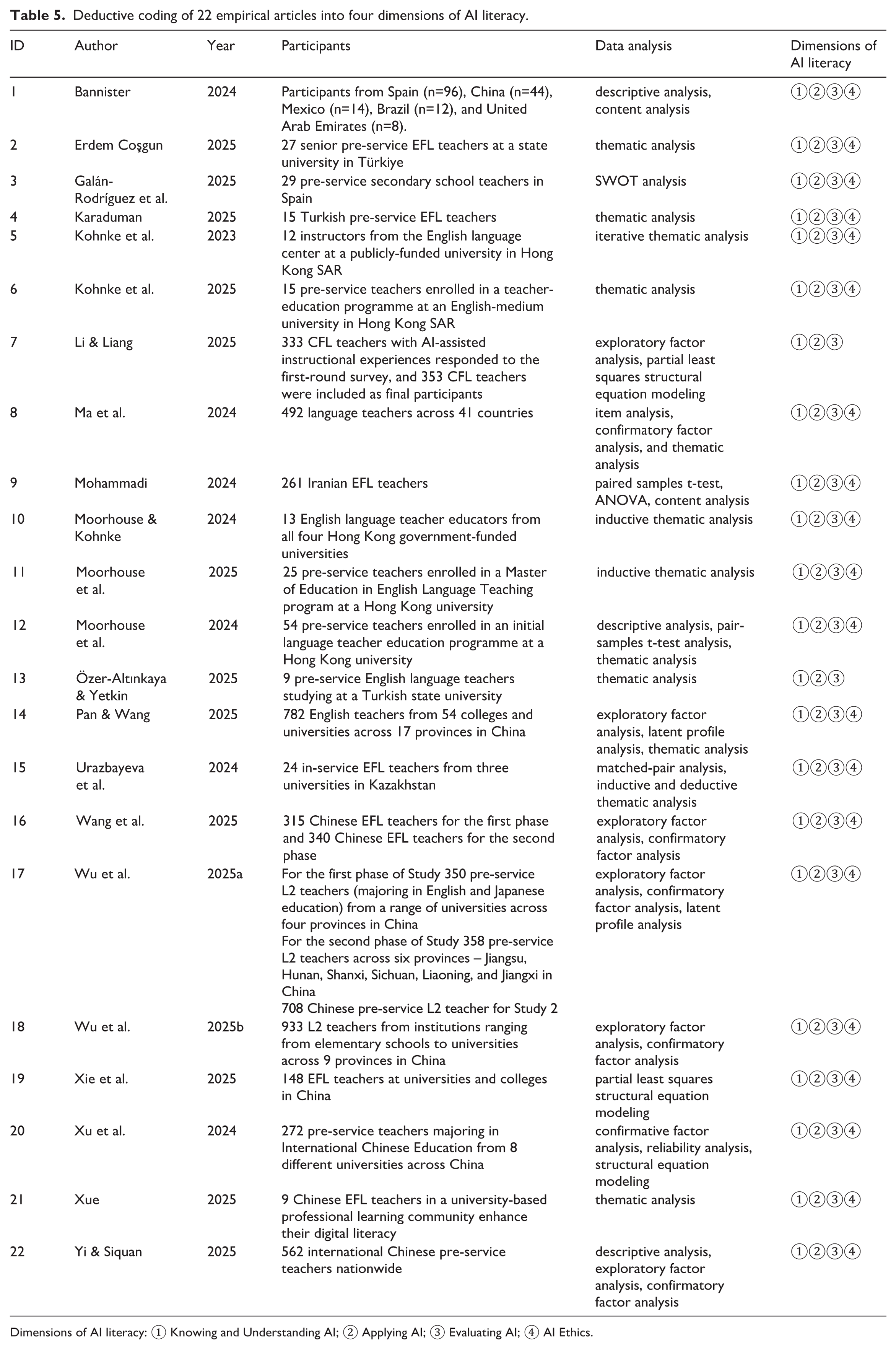
Dimensions of AI literacy: ① Knowing and Understanding AI; ② Applying AI; ③ Evaluating AI; ④ AI Ethics.
Ng et al. (2021a, 2021b) proposed four dimensions of AI literacy: Knowing and Understanding AI, Applying AI, Evaluating AI, and AI Ethics, drawing on the literature from 30 existing peer-reviewed articles. For the first dimension of AI literacy, Knowing and Understanding AI entails being familiar with the fundamental functions of AI and comprehending how to utilize AI applications in language teaching in an ethical manner. Second, Applying AI involves implementing AI knowledge, concepts, and applications in language teaching, effectively integrating them into pedagogical practices to enhance learning experiences. Third, Evaluating AI entails employing higher-order thinking skills, such as evaluation, appraisal, and prediction, when engaging with AI applications in language teaching, ensuring their effectiveness, ethical implications, and pedagogical value. Furthermore, AI Ethics encompasses human-centerd considerations in language teaching, including fairness, accountability, and transparency, ensuring that AI applications are used responsibly and equitably to support both educators and learners. Each of these dimensions constitutes a fundamental pillar in developing AI literacy, collectively offering a holistic approach to understanding and engaging with AI in educational contexts.
Based on the deductive coding of the 22 empirical studies according to Ng et al.’s (2021a, 2021b) four-dimensional framework of AI literacy, the findings reveal a comprehensive and multifaceted engagement with AI competencies among language teachers. The majority of the studies, including those by Bannister (2024), Galán-Rodríguez et al. (2025), Ma et al. (2024), and Pan and Wang (2025), encompass all four dimensions, indicating a holistic recognition of AI literacy that spans from foundational knowledge and practical application to critical evaluation and ethical considerations. A smaller subset of the studies (such as Li & Liang, 2025; Özer-Altınkaya & Yetkin, 2025) addresses three of the four dimensions, typically omitting the dimension of AI Ethics. This more focused scope, while still substantial, underscores a comparative lack of engagement with ethical considerations and highlights an area where further scholarly attention is warranted. The methodologies employed across these studies are diverse, ranging from thematic and content analyses to advanced statistical approaches like exploratory and confirmatory factor analysis. This underscores a rigorous, multi-method effort to map the landscape of language teachers’ AI literacy. Collectively, these studies highlight that AI literacy is not only being widely operationalized across varied educational and cultural contexts – from Hong Kong SAR and mainland China to Türkiye, Iran, and Spain – but is also being systematically investigated through robust analytical lenses to capture its complex, multi-dimensional nature.
While the deductive coding is guided by existing frameworks, particularly Ng et al.’s (2021a, 2021b) four-dimensional model of AI literacy, further insights are uncovered through an inductive approach. This enables the identification of themes that emerge organically from the data, offering a more nuanced understanding of language teachers’ engagement with AI technologies. The inductive coding captures the lived experiences, challenges, and evolving practices of language teachers as they navigate the integration of AI into their professional contexts. Appendix A provides a summary of the inductive coding results, illustrating the six key themes and their sub-themes that characterize language teachers’ AI literacy from a bottom-up analytical perspective.
The first theme, Understanding of AI, begins with a conceptual framing of AI literacy itself, which is recognized not as a singular skill but as a multidimensional professional competency integral to teacher education, with prompt literacy emerging as a critical component (Karaduman, 2025; Kohnke et al., 2023; Moorhouse et al., 2024). This conceptual knowledge is coupled with an awareness of AI’s features and potential, where it is perceived as a dualistic force, both transformative and disruptive, in its capacity to reshape language education (Ma et al., 2024; Özer-Altınkaya & Yetkin, 2025; Xie et al., 2025; Yi & Siquan, 2025). Consequently, teachers demonstrate a growing awareness of AI’s role, characterized by a recognition of its inevitable presence and a broad acknowledgement of its significant pedagogical potential and professional relevance (Kohnke et al., 2025; Wang et al., 2025; Wu et al., 2025a). However, this is increasingly tempered by an emerging critical awareness and attitudinal tensions, indicating a more nuanced evaluation of AI’s implications beyond its initial promise (Li & Liang, 2025; Xie et al., 2025; Xue, 2025).
The second theme, Application of AI in Pedagogical Practices, demonstrates how AI literacy is being operationally translated into teaching methodologies across four areas. In lesson planning, AI is predominantly framed as a cognitive partner that assists teachers in generating ideas, structuring unit sequences, and developing creative activities. This collaboration, however, is not passive; it requires the teacher to engage in a continuous, iterative dialogue with the AI, critically evaluating its suggestions and infusing them with pedagogical expertise and contextual knowledge (Kohnke et al., 2023; Ma et al., 2024; Moorhouse et al., 2025). Second, in the development of teaching resources such as textbooks, AI functions as a collaborative assistant. It significantly enhances efficiency in generating draft content, exercises, and supplementary materials, while also enabling a high degree of personalization for different learner levels and contexts (Kohnke et al., 2023; Urazbayeva et al., 2024; Wang et al., 2025; Xue, 2025). Third, in the domain of assessment, AI is being utilized to facilitate formative assessment and generate personalized feedback. This application demands a sophisticated level of prompt literacy from teachers and creates significant opportunities for critical reflection on the AI-generated outputs (Erdem Coşgun, 2025; Ma et al., 2024; Mohammadi, 2024). Finally, in the realm of teacher-student interaction, AI’s role, though nascent, demonstrates considerable promise for fostering richer student engagement. Realizing this potential is not automatic; it is fundamentally dependent on two key factors: the teacher’s own proficiency in AI literacy to guide the interaction effectively, and a supportive institutional framework that enables such innovation (Kohnke et al., 2023; Moorhouse & Kohnke, 2024; Urazbayeva et al., 2024).
The third theme, Prompt Literacy in Language Education, conceptualizes prompt literacy as a sophisticated pedagogical skill that is fundamental to the effective integration of AI, particularly generative AI. Research indicates that prompt literacy extends beyond simple command-giving to encompass task-specific prompting strategies, which require contextual adaptation and function as a form of reflective, critical practice (Erdem Coşgun, 2025; Ma et al., 2024; Özer-Altınkaya & Yetkin, 2025). Central to this literacy is an iterative prompting refinement process, where prompts are continuously honed based on pedagogical purpose and critical evaluation of the AI’s output. This iterative cycle is not only a practical method but also a collaborative, design-oriented process that fosters metacognition of AI literacy itself (Erdem Coşgun, 2025; Ma et al., 2024; Moorhouse et al., 2025; Xue, 2025). Ultimately, the effectiveness of this prompting practice is governed by the principle of pedagogical alignment, where the strategic purpose of the teaching activity determines the prompt’s design. A well-developed prompt literacy is thus shown to be crucial for achieving key educational goals such as personalization and differentiation in language learning (Ma et al., 2024; Moorhouse et al., 2025; Urazbayeva et al., 2024).
The fourth theme, AI Ethics Concerns, reveals that language teachers’ AI literacy is fundamentally intertwined with a complex array of ethical considerations. A prominent concern is the awareness of inherent bias in AI-generated content and its associated risks for assessment and learner interaction, necessitating a critical pedagogical approach to AI use (Bannister, 2024; Kohnke et al., 2023; Ma et al., 2024). Similarly, the risk of AI hallucination is widely recognized as undermining trust and pedagogical integrity, prompting calls for verification strategies and its treatment as a critical teaching moment (Erdem Coşgun, 2025; Moorhouse et al., 2025; Wu et al., 2025a). Furthermore, significant apprehensions regarding plagiarism shape teacher hesitancy, highlighting the need for an ethical AI pedagogy that addresses blurred lines of ownership (Galán-Rodríguez et al., 2025; Ma et al., 2024; Xue, 2025). Compounding these are concerns about over-reliance, which is perceived to erode teacher agency and learner autonomy, creating tension between efficiency and academic integrity (Kohnke et al., 2023; Moorhouse & Kohnke, 2024). Additionally, issues of data security and privacy regarding student information collected by AI platforms are emphasized, leading to a strong advocacy for protective practices (Urazbayeva et al., 2024; Wang et al., 2025). In response to these multifaceted challenges, the literature consistently frames responsible use as a core element of AI literacy. This entails employing professional judgment, ensuring pedagogical alignment, and equipping students to use AI critically, thereby positioning ethical practice as a direct and necessary response to emerging technological risks (Karaduman, 2025; Pan & Wang, 2025; Wu et al., 2025a, 2025b).
The fifth theme, Challenges and Barriers Faced by Language Teachers, identifies several interconnected obstacles to the effective integration of AI. A primary barrier is teachers’ limited digital competence, where educators acknowledge their own deficiencies with AI tools, a gap that is most pronounced in complex tasks and is exacerbated by a lack of training and uneven competence across experience levels (Karaduman, 2025; Li & Liang, 2025; Pan & Wang, 2025). This is compounded by significant institutional challenges, including a lack of AI-specific policy, curriculum guidance, and sufficient professional development infrastructure, highlighting a critical need for leadership and strategic planning (Kohnke et al., 2023; Özer-Altınkaya & Yetkin, 2025). Furthermore, a lack of ongoing technical support discourages pedagogical risk-taking and innovation, underscoring the necessity for institutional investment in technical infrastructure (Li & Liang, 2025; Özer-Altınkaya & Yetkin, 2025; Xue, 2025). Finally, a consistent lack of pedagogical support presents a major hurdle, as teachers struggle to align AI use with learning objectives and are often left without the classroom-focused models or use cases needed to build their confidence (Moorhouse & Kohnke, 2024; Pan & Wang, 2025). Collectively, these barriers reveal that supporting AI integration requires a holistic approach that addresses individual competence, institutional frameworks, and practical pedagogical guidance simultaneously.
The sixth theme, Professional Development and Training Needs, identifies crucial requirements for building language teachers’ AI literacy. There is a widespread recognition of significant training gaps, with teachers calling for sustained professional learning that moves beyond technical tool operations to integrate pedagogical principles and ethical considerations (Kohnke et al., 2023; Li & Liang, 2025; Wu et al., 2025a). Effective development should be continuous and practice-oriented, providing scaffolding, modeling, and opportunities for independent exploration and critical reflection (Bannister, 2024; Moorhouse et al., 2025; Wang et al., 2025). A pivotal mechanism for achieving this is the establishment of professional learning communities (PLCs), which foster situated learning, enable collective problem-solving, and help bridge institutional support gaps through peer dialogue and community-building (Kohnke et al., 2023; Xue, 2025). Concurrently, there is a compelling need for reformed teacher education programmes that systematically integrate AI literacy into the curriculum. Such programmes should aim to cultivate not only practical skills but also the necessary professional dispositions for responsible and pedagogically aligned AI use (Karaduman, 2025; Li & Liang, 2025; Wu et al., 2025a, 2025b). Collectively, these findings advocate for a multi-faceted developmental ecosystem that interweaves formal training, communal learning, and curricular reform.
In summary, these themes underscore the multidimensional nature of AI literacy in language education, advocating for an integrated approach combining conceptual understanding, pedagogical innovation, ethical reasoning, and systemic reform to prepare teachers for AI-mediated educational landscapes.
2 Manifestations of diverse AI-induced emotions
To deductively code the AI-induced emotions experienced by language teachers across the 12 identified studies, the analytical process was guided by the categorization framework developed by Beaudry and Pinsonneault (2005, 2010). Their model synthesizes four distinct emotional categories – Challenge Emotions, Deterrence Emotions, Loss Emotions, and Achievement Emotions – which provided a systematic structure for classifying emotional responses. This framework offered a robust theoretical lens for interpreting the affective dimensions of teachers’ interactions with AI technologies. Its applicability and relevance to the specific context of language education have been substantiated by its recent adoption in key studies focusing on language teachers’ AI-induced emotions, such as Xie et al. (2025) and Yin et al. (2024). A summary of the deductive coding categories applied across the selected studies is presented in Table 6, which also details the publication year, participant demographics, and data analysis method for each study.
Deductive coding of 12 empirical articles into four categories of AI-induced emotions.
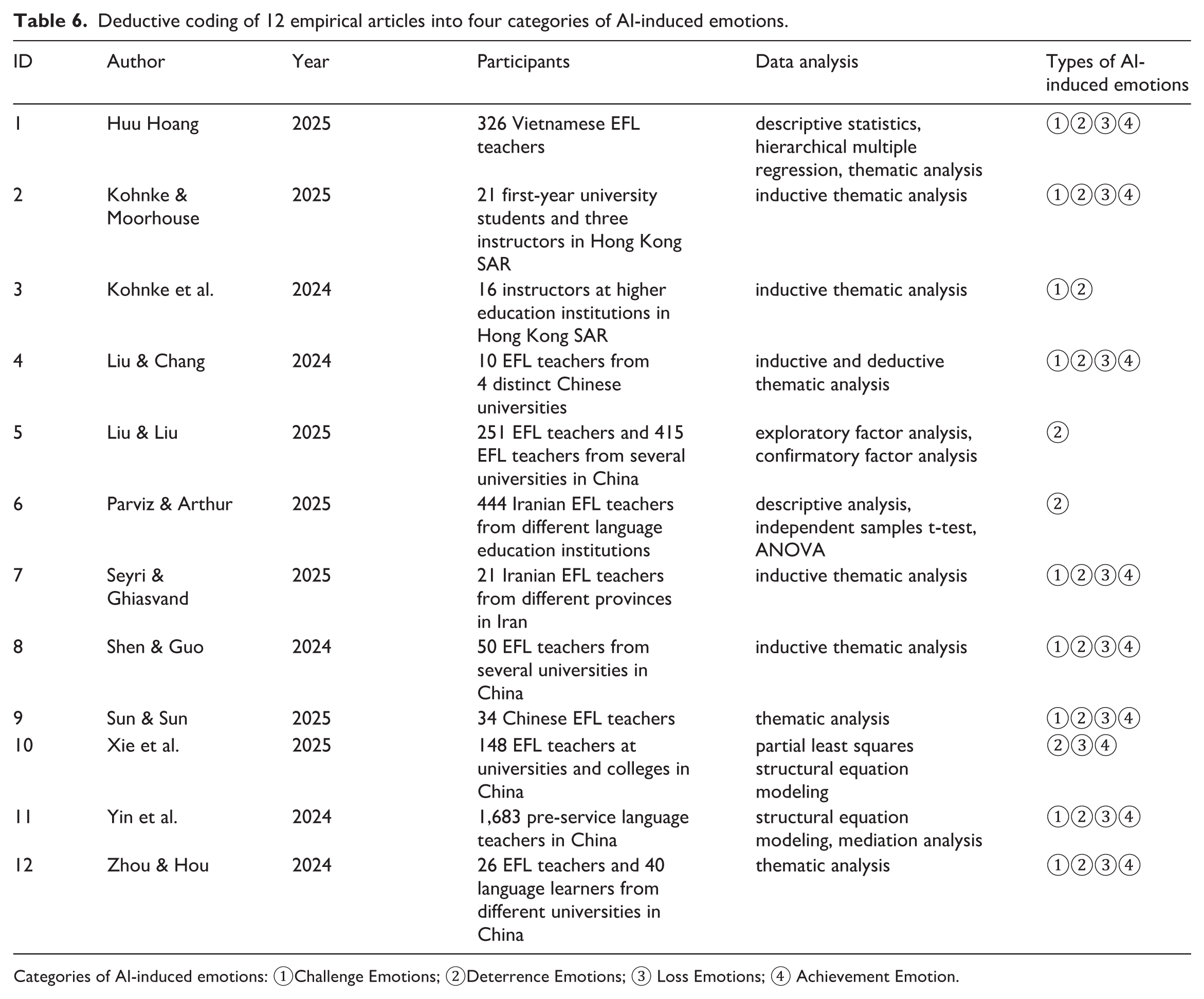
Categories of AI-induced emotions: ①Challenge Emotions; ②Deterrence Emotions; ③ Loss Emotions; ④ Achievement Emotion.
Beaudry and Pinsonneault (2005, 2010), grounded in Appraisal Theory (Bagozzi, 1992; Folkman & Lazarus, 1985; Lazarus, 1991), distinguished emotional responses based on individuals’ cognitive evaluations of technology-related events, particularly across the dimensions of perceived opportunity or threat and outcome uncertainty. For the first category of emotions, Challenge Emotions ‘‘are triggered by the appraisal of an event as being an opportunity likely to result in positive consequences and over which individuals feel they have some control’’ (Beaudry & Pinsonneault, 2010, p. 697), which might evoke excitement, eagerness, playfulness, arousal, and flow (Folkman & Lazarus, 1985). Second, Deterrence Emotions occur when an ‘‘event is perceived as a threat and the individual feels that he/she has some control over its consequences’’ (Beaudry & Pinsonneault, 2010, p. 696), which may elicit emotions such as anxiety, worry, fear and distress (Bagozzi, 1992; Folkman & Lazarus, 1985). Third, Loss Emotions reflect the perception of an event ‘‘as a threat and the perception of a lack of control over its consequences’’ (Beaudry & Pinsonneault, 2010, p. 694), eliciting anger, dissatisfaction, frustration, and disgust (Bagozzi, 1992; Lazarus, 1991). Lastly, Achievement Emotions result from ‘‘the appraisal of an upcoming event that will generate positive outcomes. In this situation, emotions such as happiness, satisfaction, joy, and pleasure will be experienced’’ (Beaudry & Pinsonneault, 2010, p. 698).
Based on the deductive coding of 12 empirical studies using Beaudry and Pinsonneault’s (2005, 2010) framework of emotion categories, the findings reveal that language teachers experience a complex spectrum of emotional responses. The majority of the studies, including those by Huu Hoang (2025), Liu and Chang (2024), and Yin et al. (2024), address all four emotional categories, demonstrating a comprehensive mapping of this multifaceted affective landscape. A smaller subset of studies exhibits a more concentrated focus; for instance, Kohnke et al. (2024) primarily examine Challenge and Deterrence Emotions, while the research by Liu and Liu (2025) and Parviz and Arthur (2025) centers specifically on Deterrence Emotions. The methodologies employed across this research are diverse, ranging from various forms of thematic analysis to advanced statistical techniques such as structural equation modeling and factor analysis. This underscores a rigorous, multi-method endeavor to understand the emotional dimensions of AI integration. Collectively, this corpus of work highlights that AI-induced emotions among language teachers are not a monolithic experience but are instead being systematically investigated as a complex interplay of challenge, deterrence, loss, and achievement across varied educational contexts.
While the deductive coding provides a theory-driven lens for categorizing language teachers’ emotional responses based on Beaudry and Pinsonneault’s (2005, 2010) framework, it is evident that certain affective experiences extend beyond the scope of the predefined categories. Specifically, the emotional complexities and contextual nuances surrounding AI integration in educational settings call for a more exploratory approach. In order to capture these emergent patterns and gain a deeper understanding of how teachers experience and interpret AI-related changes, an inductive thematic analysis was conducted. This data-driven method allows for the identification of recurrent themes grounded in the qualitative data itself, without being constrained by existing theoretical constructs. The results of this analysis reveal five overarching themes that encapsulate the multifaceted emotional landscape teachers experience in the context of AI integration, as shown in Appendix B.
The first theme, AI-Induced Positive Emotions, delineates how the integration of AI generates significant affirmative affect among language teachers, primarily through three interconnected pathways. First, teachers experience enjoyment and creative empowerment from using AI as a novel tool, which sparks curiosity and fuels adaptive expertise (Huu Hoang, 2025; Kohnke & Moorhouse, 2025; Xie et al., 2025). Second, positive emotions such as satisfaction and emotional relief are strongly linked to AI-driven workload reduction, where increased task efficiency and a lessened routine burden lead to feelings of fulfilment and lightness (Liu & Chang, 2024; Seyri & Ghiasvand, 2025; Yin et al., 2024). Third, AI-enabled personalized teaching induces feelings of professional empowerment and joy, stemming from the enhanced capacity to meet diverse learner needs and strengthen teacher-student relationships (Kohnke & Moorhouse, 2025; Shen & Guo, 2024; Zhou & Hou, 2024). Crucially, these positive emotions are most pronounced when teachers perceive a strong alignment between AI functionalities and their pedagogical goals, leading to satisfaction from a sense of co-agency and task relevance (Liu & Chang, 2024; Sun & Sun, 2025). Collectively, these positive affective responses are not merely outcomes but function as a reinforcing feedback loop, encouraging teachers’ continued engagement and exploration of AI technologies (Liu & Chang, 2024).
The second theme, AI-Induced Negative Emotions, reveals significant affective barriers to AI adoption stemming from three primary sources. Foremost is the anxiety and stress triggered by unfamiliarity with AI tools, characterized by cognitive overload, technological intimidation, and frustration from trial-and-error learning, which is often exacerbated by insufficient training and institutional support (Huu Hoang, 2025; Kohnke et al., 2024; Liu & Liu, 2025). Compounding this is a profound fear of professional replacement, where teachers experience stress related to potential redundancy and the erosion of their professional identity, feelings that are amplified by a lack of clear institutional guidance (Liu & Chang, 2024; Parviz & Arthur, 2025; Zhou & Hou, 2024). Furthermore, a consistent emotional unease regarding over-reliance on AI emerges, manifesting as anxiety about undermining learner autonomy and a fear of deskilling and losing professional agency (Kohnke & Moorhouse, 2025; Shen & Guo, 2024; Sun & Sun, 2025). Underpinning these specific concerns is a pervasive sense of unease stemming from a perceived lack of control or oversight in the AI integration process (Xie et al., 2025; Yin et al., 2024). Collectively, these negative emotional responses highlight how affective dimensions, when unaddressed, can significantly hinder the constructive adoption of AI in language teaching contexts.
The third theme, Ambivalence and Mixed Emotional Responses, captures the complex and often contradictory affective states that characterize teachers’ engagement with AI. A prominent dimension is the coexistence of optimism and concern regarding AI’s long-term potential and its implications for the teaching profession, reflecting a state of uncertainty that is common among educators (Kohnke et al., 2024; Zhou & Hou, 2024). This is closely linked to mixed emotions stemming from ethical uncertainty, where feelings of curiosity and interest are tempered by ethical discomfort and a sense of anxiety and responsibility in the absence of clear guidelines, creating a palpable tension between perceived pedagogical benefits and underlying moral dilemmas (Kohnke et al., 2024; Liu & Chang, 2024; Shen & Guo, 2024). Furthermore, ambivalence arises from changing student-teacher dynamics, manifesting as tension between empowering learners and maintaining instructional control, uncertainty about the future of emotional connections, and a simultaneous hopefulness about the potential for newly co-constructed learning roles (Kohnke & Moorhouse, 2025; Liu & Liu, 2025; Yin et al., 2024). Collectively, these findings illustrate that teachers’ emotional responses to AI are rarely uniformly positive or negative, but are instead characterized by a nuanced and ongoing negotiation of competing perceptions and values.
The fourth theme, Emotion Regulation and Coping Strategies, delineates how language teachers navigate the affective challenges of AI integration through two contrasting approaches. On one hand, teachers develop confidence and resilience by engaging in positive challenge appraisals, framing AI as a professional growth opportunity rather than a threat. This fosters adaptive engagement, with resilience being cultivated through iterative experimentation and reinforced by cycles of positive emotional feedback, ultimately contributing to professional identity reformation and a sense of empowerment (Kohnke & Moorhouse, 2025; Liu & Chang, 2024; Zhou & Hou, 2024). Conversely, when AI is perceived as a threat, it often triggers avoidance-oriented coping. This maladaptive strategy is driven by emotional fatigue, cognitive overload, and a fundamental mistrust in AI’s capabilities, frequently resulting in emotional suppression and passive compliance rather than constructive engagement (Shen & Guo, 2024; Sun & Sun, 2025; Yin et al., 2024). This dichotomy underscores that teachers’ affective responses are not predetermined but are significantly shaped by their cognitive appraisals (Xie et al., 2025), which in turn dictate whether their coping strategies will facilitate or hinder successful technological integration (Yin et al., 2024).
The fifth theme, Institutional and Pedagogical Implications, synthesizes key recommendations for supporting teachers’ affective adaptation to AI integration. A central finding is the pressing call for institutional emotional support systems, where structured support is recognized as crucial for developing emotional resilience. This includes fostering peer support and PLCs that function as vital emotional infrastructure, alongside advocating for emotionally intelligent leadership and policy frameworks (Kohnke & Moorhouse, 2025; Xie et al., 2025; Zhou & Hou, 2024). Concurrently, targeted professional development is emphasized as a primary mechanism for fostering positive emotional engagement and mitigating anxiety. Effective training not only alleviates AI-induced uncertainty and fear but also facilitates the emergence of positive emotions through guided practice and pedagogical scaffolding, ultimately creating a sustainable pathway towards long-term emotional resilience and professional growth (Liu & Chang, 2024; Sun & Sun, 2025; Yin et al., 2024). Collectively, these implications underscore that successful AI integration requires systematically addressing the affective dimensions of teacher development through both institutional support structures and pedagogically grounded training initiatives.
Collectively, these emotional responses underscore that language teachers’ engagement with AI is deeply emotional rather than solely cognitive or technical. Positive emotions can significantly drive professional growth and pedagogical innovation, whereas unresolved anxieties and ethical uncertainties necessitate targeted institutional interventions. These findings reinforce the critical importance of incorporating emotional awareness and robust support structures into AI-related teacher education and policy planning.
V Theoretical framework
This systematic review offers a critical synthesis of existing research on language teachers’ AI literacy and the spectrum of emotions elicited by AI in educational contexts. To deepen this investigation, we adopt Appraisal Theory (Bagozzi, 1992; Beaudry & Pinsonneault, 2010; Ellsworth, 2013; Lazarus, 1991; Moors et al., 2013) to conceptualize the dynamic interplay between AI literacy and emotional responses, culminating in the framework illustrated in Figure 3.

The expanded appraisal framework for AI literacy and AI-induced emotions.
Appraisal Theory has been extensively employed in cognitive psychology and general education to investigate emotion causation (Frenzel et al., 2016, 2021; Hong et al., 2016; Xie et al., 2025; Yin et al., 2024). Defined as ‘a process that detects and assesses the significance of the environment for well-being’ (Moors et al., 2013, p. 120), appraisal suggests that emotions arise from cognitive evaluations including novelty, goal relevance, and perceived control (Ellsworth, 2013). Consequently, emotions represent adaptive responses shaped by subjective interpretations of circumstances rather than by objective properties alone. When language teachers encounter AI technologies, they engage in cognitive evaluations involving dimensions such as the novelty of digital tools, the goal relevance of AI to their pedagogical objectives, and their perceived control over these new systems. Thus, the emotions that emerge, whether enthusiasm, anxiety, or resistance, function as adaptive responses driven by teachers’ subjective interpretation of AI’s role in their professional practice, rather than by the technology’s objective features alone.
Substantiating this view, substantial empirical evidence confirms that appraisals constitute the core mechanism in emotion activation, with specific appraisal patterns corresponding distinctly to discrete emotions (Scherer, 2001). Moreover, the role of social context is critical. As Hong et al. (2016, p. 83) emphasize, ‘key attributes of emotions that even if an individual experiences emotions, social matrix inherently influences the type and intensity of emotions, as well as why and how the individual experiences certain emotions’. This aligns with Ratner’s (2007, p. 89) assertion that emotions are ‘rooted in macro cultural factors, such as social institutions, artifacts, and cultural concepts. Emotions have cultural origins, characteristics, and functions.’ In language education settings, institutional support structures, prevailing pedagogical cultures, and collective beliefs about technological innovation all fundamentally shape how teachers appraise and emotionally respond to AI-driven tools.
On the left side of the framework, AI literacy is conceptualized as a multidimensional construct, building on the foundational work of Ng et al. (2021a, 2021b). The four dimensions are as follows: Knowing and Understanding AI, Applying AI, Evaluating AI, and AI Ethics. First, Knowing and Understanding AI, which reflects cognitive awareness of how AI operates and its limitations. This includes understanding what AI can and cannot do, as well as acquiring the basic skills and attitudes necessary to engage with AI, especially important for novices. Second, Applying AI, which captures the behavioural implementation of AI in pedagogical practice. This dimension refers to language teachers’ ability to meaningfully integrate AI tools into their instructional routines, for example, using AI for formative assessment, grammar checking, or oral language practice. It also involves aligning AI tools with pedagogical goals, modeling appropriate use for students, and scaffolding AI-supported learning activities that preserve academic integrity. Third, Evaluating AI, which encompasses critical and reflective engagement with AI technologies. Language teachers must assess the affordances and limitations of AI tools, including the presence of algorithmic bias in automated scoring, the reliability of AI-generated feedback, and the implications for student autonomy and learning outcomes. Last, AI Ethics, which focuses on values such as fairness, accountability, privacy, and transparency. This dimension involves recognizing and addressing ethical concerns, for instance, whether student data are handled securely, whether AI-generated content supports equitable learning, or whether over-reliance on AI compromises student agency. Teachers are also responsible for cultivating students’ awareness of these ethical issues as part of their AI literacy development. Together, these four dimensions, when applied to the context of language teaching, highlight the interplay between technical proficiency, pedagogical adaptation, critical reflection, and ethical awareness. They underscore the multifaceted competencies language teachers must develop to navigate the responsible integration of AI in linguistically and culturally diverse educational settings.
We posit that AI Ethics constitutes a distinct and indispensable dimension of AI literacy, one that transcends mere technical cognition to engage with the realm of values, moral reasoning, and professional accountability (Xie et al., 2026). While universal ethical frameworks, such as Floridi and Cowls’ (2019) five principles of beneficence, non-maleficence, autonomy, justice, and explicability, provide valuable guidance for AI development across sectors, they often remain abstract in relation to the situated realities of educational practice. In the specific context of language education, ethical considerations take on heightened significance, as articulated in Holmes et al.’s (2022) tripartite focus on the ethics of big data, algorithms, and pedagogy itself. These are further substantiated by Pack and Maloney (2024), who identify pressing issues such as ethical teaching practices with AI, intellectual ownership, writing skill development, output reliability, educational equity, and algorithmic bias. These concerns collectively illustrate that the ethical implications of generative AI extend far beyond technical operation, engaging fundamental questions of authorship, learning integrity, fairness, and social justice. It is precisely this pervasive and cross-cutting nature of ethics that justifies its central positioning within our framework, interconnecting with and underpinning the dimensions of Knowing and Understanding AI, Applying AI, and Evaluating AI. Rather than treating ethics as a peripheral or standalone component, we argue that it must serve as the moral core of AI literacy, infusing each dimension with critical ethical consciousness. It is this imperative that anchors AI Ethics at the heart of our framework, emphasizing that meaningful AI literacy demands not only cognitive competence but also moral discernment.
At the heart of the proposed framework lies the cognitive appraisal process, a cornerstone of Appraisal Theory which explains how individuals interpret and emotionally respond to events based on personal relevance and perceived control (Lazarus, 1991; Moors et al., 2013). Building on this foundation, Beaudry and Pinsonneault (2005, 2010) established that responses to technological innovations are shaped through dual appraisal mechanisms. In language education contexts, we argue that Primary Appraisal and Secondary Appraisal collectively determine teachers’ emotional responses to AI technologies.
Primary Appraisal involves the initial assessment of whether an external stimulus, such as AI implementation, represents an opportunity or a threat (Ellsworth, 2013; Lazarus, 1991). This dimension aligns with what emotion theorists term goal congruence, the extent to which an event supports or hinders personal goal achievement (Bagozzi, 1992; Beaudry & Pinsonneault, 2005). Such evaluations are inherently subjective, reflecting individuals’ values and professional priorities. For example, language teachers who perceive AI as enhancing instructional effectiveness or enabling pedagogical innovation typically view it as goal-congruent, resulting in positive emotional responses. Conversely, those who see AI as threatening professional autonomy, job security, or established teaching routines are likely to appraise it as goal-incongruent, triggering negative emotional reactions.
Complementing this process, Secondary Appraisal focuses on evaluating one’s ability to manage the situation, encompassing perceived control, coping capacity, and outcome predictability (Folkman & Lazarus, 1985; Moors et al., 2013). Beaudry and Pinsonneault (2005) identified three control dimensions particularly relevant to AI integration: control over work (professional autonomy in adapting to AI-related changes), control over self (capacity for personal adjustment), and control over technology (ability to influence AI tools’ functionality). For instance, even teachers who initially view AI as an opportunity may experience anxiety if they lack input into institutional integration policies. Conversely, those perceiving AI as a threat may develop greater confidence if they believe in their ability to adapt or customize these tools.
The emotional outcomes emerging from this dual appraisal process, whether enthusiasm, anxiety, or resistance, are therefore shaped by teachers’ subjective interpretations of AI’s professional significance and their perceived capacity to manage its integration. As Xie et al. (2026) emphasize, the emotions teachers undergo via Primary Appraisal and Secondary Appraisal are situated within their social surroundings, spanning both immediate and broader contexts, reflecting how institutional cultures, collegial relationships, and broader educational policies fundamentally shape these evaluative processes.
On the right side of the framework, AI-induced emotions are depicted as distinct categories, with an interplay of colours symbolizing their fluid and overlapping nature. This visual design reflects the underlying principle that emotion induction arises from the dynamic interaction between Primary Appraisal and Secondary Appraisal, each operating along its own fluid continuum. This means that appraisals can shift over time and with increased exposure to AI and are better understood as varying by degree rather than existing at two fixed extremes. For instance, perceptions of control may range across different levels, such as high control, moderate control, and low control. The dual-appraisal process emphasizes that emotional responses to technologies like AI are not static reactions, but dynamic psychological constructions shaped by individual interpretations. When combined, these appraisals give rise to four distinct categories of emotions: Challenge Emotions, Deterrence Emotions, Loss Emotions, and Achievement Emotions (Beaudry & Pinsonneault, 2010). As summarized in Table 7, each emotional category captures a unique configuration of perceived opportunity or threat and the degree of perceived control, offering valuable insight into how language teachers experience and navigate AI-related changes in their professional practice.
Emotion categories based on primary and secondary appraisal (Beaudry & Pinsonneault, 2010).

Challenge Emotions in the context of AI integration are characterized by a forward-looking, proactive stance towards technology, rooted in an optimistic assessment of its potential. These emotions arise when teachers appraise AI tools not as threats, but as opportunities for pedagogical enhancement, innovation, and professional growth. Crucially, this positive appraisal is accompanied by a perception of control, where teachers believe they can harness AI effectively within their own contexts. Drawing on Folkman and Lazarus (1985), these emotions may manifest as excitement, curiosity, eagerness, and playfulness, particularly when experimenting with new tools or instructional strategies. They often coincide with experiences of flow, wherein teachers become fully absorbed in creatively integrating AI into their practice. Such emotional states foster deep engagement and can fuel sustained motivation and exploration.
In contrast, Deterrence Emotions emerge when teachers perceive AI as a potential threat but believe they retain some control over its consequences. These emotions, including anxiety, worry, fear, and distress, reflect a state of alertness to potential disruption, yet not powerlessness (Bagozzi, 1992; Folkman & Lazarus, 1985). In practice, they are often triggered when AI tools are introduced without sufficient training, pedagogical guidance, or institutional support. Teachers may worry about their technical proficiency, the accuracy of AI outputs, ethical risks, or the impact on student learning. While they may still engage with the technology, their interaction is coloured by caution and emotional strain.
Furthermore, Loss Emotions emerge when teachers perceive AI as a threat to their professional identity, autonomy, or relational dynamics with students. These emotions are triggered by a perceived lack of control over the consequences of adoption, such as fears of being replaced, having a diminished role, or losing personal connection with learners (Frenzel et al., 2016, 2021). Consistent with Bagozzi (1992) and Lazarus (1991), Loss Emotions include anger, frustration, dissatisfaction, and disgust, signalling a strong emotional dissonance towards technological change. In language education, this may manifest as teachers feeling undermined by AI-driven instruction or resenting institutional pressures to adopt tools they perceive as lacking nuance in cultural competence or emotional intelligence.
Finally, Achievement Emotions refer to the positive affective responses that arise when teachers appraise AI tools as beneficial and capable of producing positive outcomes. Emotions such as happiness, satisfaction, and pleasure are typically experienced when teachers feel AI enhances their instruction, supports learners, or reduces workload in meaningful ways. According to Smith and Ellsworth (1985), happiness is often linked to perceiving a benefit without necessarily prompting further action. This suggests that while teachers may feel content with AI tools, they might not feel compelled to innovate further. Thus, Achievement Emotions may stabilize current usage patterns rather than drive transformative pedagogical change.
Taken together, this framework underscores that successful AI integration requires more than just improving AI literacy; it also necessitates ensuring teachers feel empowered, supported, and ethically grounded. By anticipating and addressing these emotional patterns, educational leaders can better facilitate sustainable and emotionally intelligent AI integration in language education.
VI Limitations and suggestions for future research
From a micro perspective, there are several notable limitations in the present systematic review that should be acknowledged. First, the literature search was limited to only three databases, which excluded grey literature and this could mean that we might have overlooked relevant studies published in other sources. Second, only English-language publications were considered, which potentially biased the selection towards studies focusing on English as a second or foreign language, thereby limiting the linguistic and cultural diversity of the findings. Moreover, it is important to note that different search strategies and keyword combinations may yield varying results; consequently, some pertinent studies might not have been captured in the final synthesis. Additionally, as the field of research on language teachers’ AI literacy and AI-induced emotions is still in its early stages, and given the sharp rise in publications over recent years, the current review may not fully reflect the most recent developments. Therefore, future systematic reviews are encouraged to broaden the scope of their database selection, include non-English studies, and consider diverse publication venues to ensure greater inclusivity and comprehensiveness.
From a macro perspective, the current research landscape on language teachers’ AI literacy and AI-induced emotions is characterized by a methodological dichotomy, predominantly employing either qualitative interview designs, frequently analyzed through thematic analysis, or quantitative surveys reliant on self-report mechanisms. To transcend the limitations of these approaches, future studies should champion mixed-method designs that can capture the multifaceted nature of teacher cognition and affect. A particularly promising avenue is the adoption of Q methodology, which combines qualitative depth with quantitative rigor by identifying and analyzing shared patterns of subjectivity. For instance, researchers could use Q-sorts to map the diverse perspectives teachers hold towards AI, followed by in-depth interviews to interpret the emergent factors. This would yield a more nuanced and holistic understanding of the subjective beliefs and emotional appraisals that underpin professional practice.
Furthermore, the constructs of AI literacy and AI-induced emotions are frequently treated in a generic, cross-disciplinary manner, inadvertently overlooking the distinctive pedagogical, relational, and linguistic dimensions inherent to language education. Future research must, therefore, strive to contextualize these constructs within the specific realities of the language classroom. This involves empirically validating and refining the proposed appraisal-based framework through in-depth, mixed-method studies across diverse educational settings, ranging from primary schools to university language centers. Such research should investigate, for example, how AI literacy specifically influences a teacher’s ability to design communicative tasks or provide personalized feedback on linguistic accuracy, and how these domain-specific applications trigger distinct emotional responses.
Moreover, to understand the temporal dynamics of this integration, longitudinal research is essential. Studies tracking a cohort of language teachers over an academic year or more could illuminate how their initial appraisals of AI tools and their corresponding emotional trajectories evolve with sustained use and increasing familiarity. This would reveal the critical inflection points in teachers’ technological adoption journeys.
Finally, a key limitation of this study concerns its reliance on the emotional categorization framework developed by Beaudry and Pinsonneault (2005, 2010). The applicability of this framework to teachers across different cultural contexts may be constrained, as profound cultural factors can significantly influence both the expression and subjective experience of emotions. Future research should therefore prioritize cross-cultural comparative studies to validate and potentially refine this framework. Such investigations could explore, for instance, whether certain emotional categories maintain universal salience or if distinct, culturally-specific emotional responses to AI integration emerge across diverse educational settings. It should also be noted that our proposed framework is grounded in Appraisal Theory to establish the connection between AI literacy and AI-induced emotions. This theoretical foundation posits that emotions are elicited through cognitive evaluations of events. Consequently, future research could focus on empirically validating this postulated causal relationship or, alternatively, challenging this causal inference with evidence drawn from other theoretical perspectives.
Based on the limitations identified, we propose the following questions for future research:
Future research question 1: How can targeted professional development interventions enhance language teachers’ ethical decision-making capabilities regarding AI use, and to what extent does this reduce anxiety associated with AI integration?
Future research question 2: To what extent do language teachers’ appraisals of AI literacy and its associated emotional impacts vary across different cultural and educational contexts?
Future research question 3: How does the integration of AI into specific language learning tasks, such as AI-assisted academic writing instruction, trigger distinct emotional responses among language teachers?
VII Implications
To ensure the successful and sustainable AI integration, language education institutions must move beyond a purely technical focus and adopt a holistic support strategy for their educators. We recommend that policymakers and institutional leaders take the following concrete actions: First, design and implement modular AI literacy training courses that are aligned with the specific needs of language educators. These courses should progress from foundational knowledge to advanced applications, ensuring all teaching staff can build competency at an appropriate pace. Second, establish dedicated teacher support networks, such as PLCs focused on AI, to provide a structured forum for educators to share experiences, discuss AI-induced emotions, and develop collective solutions to common challenges. This peer-support mechanism is vital for normalizing the emotional dimensions of technological change. Third, develop and mandate scenario-based ethical decision-making training that presents language teachers with realistic dilemmas they may encounter when using AI. This practice will equip them with the critical thinking frameworks needed to navigate issues of academic integrity, data privacy, and algorithmic bias confidently. By prioritizing these initiatives, institutions can empower language teachers with the technical proficiency, emotional resilience, and ethical discernment required to harness AI’s potential effectively. This comprehensive approach is fundamental to fostering an educational environment where AI integration is not only operationally efficient but also ethically sound and psychologically supportive.
For language teachers themselves, the developmental trajectory in adopting AI typically follows a discernible pattern of familiarization: exploration–reflection–refinement. To navigate this progression effectively, teachers should cultivate metacognitive awareness to critically assess their current proficiency with AI tools and identify specific areas for growth. It is imperative to recognize AI literacy not as an ancillary skill but as a core professional competency. This entails active engagement in structured professional development, including participating in workshops on prompt engineering for language tasks, completing certified courses on AI ethics in education, and attending seminars focused on practical AI applications in language pedagogy. Concurrently, teachers commonly undergo a parallel emotional journey, evolving from initial curiosity and enthusiasm, through a phase of apprehension and feeling overwhelmed, towards eventual equilibrium and purposeful integration. To support this emotional transition, teachers should proactively employ emotional regulation strategies. These may include establishing peer support circles for sharing AI-related teaching experiences, maintaining reflective journals to document and process emotional responses to AI integration, and engaging in scenario-based planning to anticipate and manage potential classroom challenges. By systematically developing both technical competence and emotional resilience, teachers can transform their stance from one of reactive anxiety to one of proactive adaptation, ultimately harnessing AI’s potential to drive meaningful curriculum innovation and enhance language learning outcomes.
VIII Conclusions
Although research on AI literacy and AI-induced emotions in language education remains at a nascent stage, there is an urgent need to transcend the reductive perspective that treats these two constructs as separate entities. More profound investigations are required to explore how AI literacy functions as a predictor for the spectrum of AI-induced emotions experienced by language teachers. Understanding this predictive relationship is crucial, as it significantly influences the success of teachers’ AI-related endeavors, shaping their confidence, adaptability, and overall engagement with AI-driven pedagogical tools.
This systematic review offers a comprehensive and critical account of studies pertaining to language teachers’ AI literacy and AI-induced emotions, while also pinpointing key directions for future research and practice in this evolving field. It also highlights a significant gap in the literature resulting from the absence of a unified theoretical framework. As a response to the void, we propose an expanded appraisal framework for AI literacy and AI-induced emotions, grounded in Appraisal Theory. The implications of this framework are manifold. It positions AI literacy not merely as a skill set but as a catalyst for shaping affective orientations toward technological change. Teachers’ perceptions of threat or opportunity and their sense of control can foster or hinder meaningful integration of AI tools. By recognizing the centrality of appraisal and emotion, educational stakeholders, such as policy-makers, curriculum developers, and school leaders can better support teachers’ emotional resilience and readiness in the face of AI-driven pedagogical transformation. Hence, this model serves as a robust scaffold for future empirical inquiry and practical interventions. It offers a nuanced lens for understanding teachers’ lived experiences with AI and provides a theoretically grounded approach to addressing the socio-emotional dimensions of AI integration in language education.
Supplemental Material
sj-docx-1-ltr-10.1177_13621688261421322 – Supplemental material for Bridging language teachers’ AI literacy and AI-induced emotions: A systematic review and a framework for future research
Supplemental material, sj-docx-1-ltr-10.1177_13621688261421322 for Bridging language teachers’ AI literacy and AI-induced emotions: A systematic review and a framework for future research by Xiao Xie, Lawrence Jun Zhang and Aaron J Wilson in Language Teaching Research
Footnotes

Funding
The author disclosed receipt of the following financial support for the research, authorship, and/or publication of this article: This research is supported by the Western Project of the National Social Science Foundation of China: Cognitive Conflicts and Optimization of Foreign Language Teachers in the Context of Smart Education (22XYY045).
Supplemental material
Supplemental material for this article is available online.
References
Supplementary Material
Please find the following supplemental material available below.
For Open Access articles published under a Creative Commons License, all supplemental material carries the same license as the article it is associated with.
For non-Open Access articles published, all supplemental material carries a non-exclusive license, and permission requests for re-use of supplemental material or any part of supplemental material shall be sent directly to the copyright owner as specified in the copyright notice associated with the article.
