



Abstract
Scholarship on literature in foreign language education has tended to see textbooks as an arch enemy that not only marginalize authentic literary texts in foreign language classrooms but also offer students inauthentic texts and an incoherent literary syllabus to learn from. Studies on literature in textbooks have found it challenging to operationalize definitions of ‘literature’ and have overlooked the role of textbook images in shaping students’ understanding of what literature is and can be. This study constructs a multimodal framework for analysing visual and written references to literary texts in textbooks, and applies the framework to two Finnish textbooks of English as a foreign language. The study shows that the proposed framework successfully builds a coherent understanding of literature as conceptualized in foreign language textbooks. Applying the framework to the textbooks, the article argues that the textbooks include mostly references to parts and kinds of literary texts, with some symbolic references. By emphasizing references to parts and kinds of literary texts, the textbooks equip students with the meta-skills and knowledge to read, produce and evaluate literary texts through both visual and textual references to literary texts. The numerous references to parts of literary texts support students’ multiliteracy skills, and while the references to kinds of literary texts do not form a coherent literary syllabus, neither is this the intent in light of the curricula the textbooks are founded on. For foreign language pedagogy, the key conclusion to draw is that the polar relationship of literary texts versus textbook texts is not as stark as one might presume: conceptions of literature are embedded in textbooks and their images, and the textbooks thus contribute to shaping learners’ conceptions of literature. The study provides a fresh perspective and means to consider conceptions of literature conveyed through other multimodal teaching materials, also.
I Introduction
Balancing literature and language study in foreign language education has been the object of much debate for decades (Kramsch & Kramsch, 2000). Many factors related to students, teachers and the curriculum affect balancing the subject areas (see for example Bland, 2013; E. Luukka, 2019). Though the value of literature in foreign language education seems commonly accepted, recent studies from Finland show that textbooks in foreign language education continue to dominate classrooms’ day-to-day materials and practices while, for example, fiction holds a much smaller role (see, for example, Mäkipää et al., 2024). Naturally, the degrees of freedom a teacher has in their choice and use of textbooks will vary by educational context and the country in question.
In shadow of the ideologically driven development of textbooks, scholars have raised concerns about the diminishing role of literary texts in contemporary curricula (Takahashi, 2015). Textbooks are ‘powerful ideological tools’ as Weninger (2021, p. 134) states, which Bland (2024) suggests could be read ‘against the grain’, like literary texts. Analysing Spanish as a foreign language textbooks used in the United States, Kramsch and Vinall (2015, p. 21) conclude, among other findings, that the textbooks analysed reflect a commodification of education. Saari et al. (2013) see this as part of a broader curricular development which emphasizes learning skills rather than holistically educating to understand complex phenomena. Language education as a pedagogical framework emphasizes holistic learning across languages and subjects in accordance with the values set in the national curriculum, such as the ability to entertain multiple perspectives, reflecting and constructing one’s own cultural identity, respecting cultural multiplicity, engaging in authentic communication and cultivating a sense of community (Mustaparta et al., 2015, p. 11). Literature caters to these very needs (Baumbach et al., 2009; Meretoja et al., 2015).
Regardless of whether literary texts reach students through materials chosen outside of textbooks or in the form of literary references embedded in textbooks, the inclusion of literature in foreign language teaching materials necessitates a commitment to a particular conception of literature (see, for example, Alvstad & Castro, 2009; Kramsch & Kramsch, 2000). The same challenge of committing to a particular conception of literature is seen in the scholarship analysing literature in foreign language textbooks: these analyses, too, must operationalize a particular conception of literature. However, these studies tend to overlook textbooks as multimodal material, which further entails ontological commitments. This is surprising, given the active discourse on multimodal literature in English language education (e.g. Bland, 2018). More common are studies which analyse culture in textbooks through multimodal means (Canale, 2016). With these challenges in mind, this study asks: How is literature understood in two Finnish textbooks of English as a foreign language (EFL)? To answer this question, I construct, describe and test a framework for analysing references to literature in multimodal textbooks.
II Background
1 Literature in textbook analysis scholarship
The available studies on literature in foreign language textbooks show that while literature has been the subject of a few textbook analyses, the underlying conceptions of literature have frequently been taken for granted. These conceptions are discussed in Section II.2. This section (Section II.1) examines scholarship on literature in foreign language textbooks and shows that the studies available cover multiple perspectives and approaches to a multifaceted subject of study. Studies might be broadly categorized into those primarily examining tasks and activities related to literary texts and those focusing on quantitative or qualitative aspects of literary texts in textbooks. Fjellestad’s (2011) work, for example, offers a comparative perspective into literary texts used in Norwegian EFL textbooks and the tasks connected to these texts, comparing how the four books differ from one another. Fjellestad (2011) argues that literary texts are used for varying purposes, commonly to illustrate other topics. Tasks encourage cultivating linguistic and cultural competence, forming and sharing opinions and interpretations about the texts. How the two EFL textbooks analysed in this study understand the function of literary texts is returned to in Section V.
Greene (2017) examined literary texts in a selection of eight general EFL coursebooks and two literature-focused coursebooks used in France. Of particular interest here is Greene’s (2017) finding that the three textbook series contain more comprehension and oral activities, whereas the activities in the literature textbook contain more inference tasks in addition to tasks related to literal comprehension. Authentic and inauthentic texts were investigated by Al-Saeed and Alenezi (2021) in terms of their communicativeness, and to what extent literary texts are used communicatively in Kuwaiti textbooks. The authors argue that authentic texts support communicative language use better than the inauthentic, as they encourage learner autonomy, provide an authentic learning context and direct learners to focus on fluency (Al-Saeed & Alenezi, 2021). Using authentic texts prompts learners to negotiate meanings, express opinions and relate to texts on a personal level, all of which encourage communicative interaction (Al-Saeed & Alenezi, 2021). In another study, Al-Saeed and Alenezi (2022) considered whether the literary texts are used to their full potential as literary texts in textbooks. Assessing tasks associated with literary texts, texts deemed inauthentic did not support higher levels of inquiry, in this case addressing authorial intention or focusing on autobiographical aspects of the text or narrative elements of horror stories. Authentic texts, on the other hand, supported addressing these aspects as well as focusing on word lists, modern versus archaic use of English and the plot (Al-Saeed & Alenezi, 2022). While these studies highlight the significance of including literature in EFL education, the division between authentic versus inauthentic texts also creates a distinct polarity referred to at the opening of this article.
The second broad category introduces quantifying and qualifying perspectives into the role of literature in foreign language textbooks, EFL in particular. Findings such as those described below are informative for this study, because they provide both methodological and ontological examples of what exactly other studies have looked for when analysing ‘literary texts’ in EFL textbooks. Al-Saeed and Alenezi (2020) found 45% of literary texts in the 44 contemporary Kuwaiti EFL textbooks were authentic, representing texts published more than a century ago, with the remaining texts either extracts, simplified texts or what they call simulated texts. Of the authentic literary texts, most were complete poems or short stories, with some extracts from novels, dramas and short stories. Yildirim (2012) examined elements of English culture in English language teaching (ELT) coursebook reading texts, the kinds of literary sources used, and how cultural and literary elements are represented differently in elementary versus upper-intermediate coursebooks. The findings showed that the textbooks contained few literary elements (Yildirim, 2012). Gümüsok (2013) considered the extent to which literary texts are used in ELT coursebooks, and whether ELT coursebooks use more or less references to literary texts now than 20 years ago. Coursebooks were found to contain a few references to literature, but the number of literary texts used seemed to have steadily decreased (Gümüsok, 2013). Analysing Slovenian EFL coursebooks covering seven decades, Skela (2014) considered how the role of literary texts has changed and which genre (novels, stories, poems, plays) is currently most commonly used. Modern coursebooks contained fewer texts and equally many, or in some cases more, references to literary works (Skela, 2014). Literature was generally treated as rather irrelevant, and the coursebooks did not contain ‘a coherent literary syllabus’ (Skela, 2014, pp. 131–132). The coursebooks contained mostly ‘extracts from novels and short stories’, and ‘more poems than extracts from plays’ (Skela, 2014, pp. 131–132). Takahashi (2015) addressed reasons for diminished use of literary materials in the context of Japanese ELT. Multiple reasons were found, the main ones being secondary school and university course reforms, where references to literature in syllabi have been omitted and a greater emphasis placed on communication skills.
Eid et al. (2023) focused on literary components in textbook series for grades 7 to 10. The authors argue that the literary components were found mostly in textbooks for more advanced students. The series, however, seemed to lack plays and poetry, while the genres included were novel, novella and short story extracts, (auto)biographies, quotations and diary entries or ship logs (Eid et al., 2023). Interestingly, (auto)biographical texts were the most common. Calafato and Gudim (2022) argue that the number of study units in the Russian ministry-approved FL textbooks did not always correlate with the amount of literary content in the textbooks. English and German textbooks contained 7.67 literary texts on average, whereas French textbooks averaged 11.67 literary texts. The literary texts included were mostly extracts of prose with a few poems included, while plays were ‘almost wholly absent’ (Calafato & Gudim, 2022, p. 833). The authors found that ‘English texts are slightly older, lengthier, and easier to read (grade 6), on average, than French (grade 8) and German (grade 7) texts’ (Calafato & Gudim, 2022, p. 834). English texts had been shortened from the originals, while French and German texts were used in their original form (Calafato & Gudim, 2022). These findings highlight that the quality and quantity of literary texts can vary notably among textbooks and languages taught. This requires examining each textbook individually in a given context. E. Luukka (2021) introduces textbook authors’ perspectives to the subject, and argues that the Finnish EFL textbook authors found literary texts to positively contribute to learners’ intercultural competence through multiple means. Textbook authors also considered teachers’ perspectives in their efforts to cultivate learners’ intercultural competence (E. Luukka, 2021).
2 Conceptions of literature operationalized in scholarship
Any study addressing literature in language textbooks is inevitably confronted with defining ‘literature’ in order to operationalize this definition in the analysis. Few studies address the conundrum explicitly. Instead, studies tend to review earlier definitions without problematizing them and rather look for preset, conceptual wholes like prose, poetry and drama (see Weninger & Kiss, 2015). How other studies operationalize their definitions of literature is central for constructing a framework to use in the analysis of literature in EFL textbooks and answering the research question. No studies seem to have recognized the role of textbook images in conveying particular conceptions of literature.
Calafato and Gudim (2022, p. 831) describe the definition of literature operationalized in their study as following Calafato and Paran (2019), which outlines ‘literary texts as significantly representational texts like short stories, novels, poems, and plays that engage readers’ cognitive, imaginative and emotional faculties. As for authentic texts, we define these as texts not originally written for learning a language’ (Takahashi, 2015). These definitions draw on genre labels, or conceptual wholes, described above, and the functions literary texts have. This approach, however, does not allow recognizing references to parts of literary texts, or the symbolic meanings associated with the texts.
Fjellestad (2011, p. 41) focuses her work on ‘literary texts that reoccur in English textbooks, namely the poem, the short story and the novel excerpts’. The author observes that because textbooks generally label texts using these terms, it is easy to identify items to include in data analysis using the textbook labels. Takahashi (2015, p. 33) similarly describes the literary material in Japanese English textbooks published since 2009 as ‘British and American novels, stories, poems and plays’. This definition not only relies on the problematic genre-labels but in focusing on British and American texts also overlooks New Literatures and texts written by authors outside of the ‘Inner Circle’ nations (Kachru, 1992).
Greene (2017, p. 41) defines literature as including poetry, short stories, novels and plays, and observes that while ‘this follows McRae’s (1991) view of literature with a large “l”, . . . I am not as concerned with focusing solely on canonical works as I am on identifying different texts that fall into these categories.’ Indeed, McRae’s (2022) definition is perhaps the broadest in range, encompassing essentially anything that can be read. Greene (2017, p. 41) also refers to textual qualities perceived as literary, ‘creative pieces largely consisting of descriptive language appealing to the senses, while also containing multiple registers and varieties of language’. While this definition is conceptually more eloquent, it is more difficult to operationalize in textbook analysis, and more so in the context of EFL classroom practice. Further into the analysis, however, Greene (2017) found it necessary to expand the definition to include literary non-fiction and songs. Songs Greene (2017, p. 265) justifies through a similarity with poetry, and literary non-fiction as ‘written stories about other people’, while ‘[p]ersonal essays, autobiographies, and memoirs were still considered non-literary’. The note on autobiographical texts as non-literary is particularly interesting, as the initially self-evident demarcation becomes blurred as we consider human lives recounted through narratives.
Eid et al. (2023, p. 1466) define literary components ‘according to the following literary genres: extracts from novels/novellas, extracts from short stories (tales, fable, legends, and/or myths), plays, poems, biographies/ autobiographies, quotations, and/or diaries (ship logs)’ (sic). The role of (auto)biographies is particularly interesting, as some studies (e.g. Greene, 2017) deem it as non-literature, while others such as Eid et al. (2023) include it.
Skela (2014) addresses the difficulty in pinning down a particular definition of literature which would be helpful in analysing textbooks. Drawing on Stern (1992) and Rivers (1981), Skela (2014, p. 122) outlines that: literature is taken in its broadest sense, and the textbook may include popular fiction, folklore, folk tales, ballads, nursery rhymes, children’s literature. widely read books which ‘constitute a common heritage of literacy’ (Stern, 1992, p. 230), or ‘anything else that can illuminate the thought and life experience in the culture’ (Rivers, 1981, p. 338).
While the broadness of their definition is a welcome expansion of earlier definitions in similar studies, it simultaneously renders the definition rather challenging to operationalize. Gümüsok (2013, p. 119) describes the definition of literature by stating that ‘coursebooks . . . were analyzed in terms of the number they include literary texts and literary references, namely, quotations by literary figures, references to literary works, characters and writers.’ The references to literary figures and characters are noteworthy here, because it is a step toward definitions which refer to parts of texts rather than to kinds of texts through genre-labels. This description, however, problematically assumes that the definition of ‘literature’ or what is meant by ‘literary’ is widely, if not universally, shared.
The three studies by Al-Saeed and Alenezi (2020, 2021, 2022) build on one another and similarly operationalize the same conception of literary texts. The authors recognize the foundational work of Carter (1996) and Brumfit and Carter (1986), which highlight the difficulty of explicitly defining literary texts. Al-Saeed and Alenezi (2020) point to the role of canonical texts and how these relate to different genres of texts. While the authors also recognize that literariness might be a matter of a spectrum rather than clear-cut lines, as indeed Brumfit and Carter (1986, p. 10) suggest, the authors outline their understanding of literature by stating that ‘texts are not constrained to literary canons, but do not include sub-literary forms such as songs and TV-dramas’ (2020, 90).
Although Yildirim (2012) focuses on literary elements as opposed to categorizable works of literature like Fjellestad (2011), the author similarly relies of genre categories: widely used genre categories (prose vs. verse), distinctions based on belonging to the universal literary canon (canonical vs. non-canonical) and the ways in which these elements are generally represented in ELT contexts (adapted vs. authentic) are considered as the main headings. (Yildirim, 2012, p. 142)
E. Luukka (2021, p. 59) defines literature as ‘socially constructed and contextually bound body of texts, to which individuals attach a variety of different kinds of values’. While this definition is similar to those presented above, the meaningful distinction lies in how it is operationalized through phenomenologically analysing for meaning – values associated by textbook authors. The authors interviewed by E. Luukka (2021, p. 65) defined literature ‘from the perspectives of content, formats, functions and questions of legitimacy’, which further contained 15 distinct sub-themes.
Overall, the above summary of different definitions of literature used in studies analysing literature in EFL textbooks highlights the difficulty and – simultaneously – great importance of explicating what exactly one looks for when analysing literature in foreign language textbooks. The central contribution this study offers is its framework for analysing the role of literature in foreign language textbooks in a way that goes deeper than genre labels and recognizes the role of images in constructing conceptions.
III Data, methods, and curricular context
1 Curricular context
Kramsch (2013, p. 64) observes that there are ‘roughly two different ways of looking at culture in language teaching, depending on one’s disciplinary and intellectual orientation: modernist and postmodernist. These two perspectives co-exist today in the theory and practice of language learning and teaching.’ Modernist approaches draw on the ‘history, the institutions, the literature and the arts’ of a particular country (big C culture), and the ‘native speakers’ ways of behaving, eating, talking, dwelling, their customs, their beliefs and values’, or little c culture (Kramsch, 2013, p. 66). Post-modernist views of culture have tended to see culture as discursive practices shared by a group ‘in a given space and time and over the historical life of the group’ (Kramsch, 2013, p. 69).
The two perspectives are also present in the Finnish National Curriculum for General Upper Secondary Education. Kaikkonen and Kohonen (2012) describe Finnish foreign language educators’ professional identity as entailing autonomy, authenticity and community agency and EFL education as subject pedagogy, which aims to educate the whole learner as opposed to focusing on language alone. Finnish comprehensive education prepares learners for secondary education. In Finland, comprehensive education is compulsory for all learners aged 7 to 18 years or up until the learners have completed the requirements of diplomas in secondary education. Comprehensive education comprises primary and lower secondary education, and supports learners’ holistic growth as individuals, developing their values, knowledge, skills, attitudes and the ability to be active citizens in their respective communities. (Finnish National Agency for Education [FNAE], 2015, p. 12) General upper secondary continues the well-rounded education established over the course of comprehensive education. The role of general upper secondary education in Finland is to provide learners with a broad, well-rounded education that prepares them for studies in higher education, either at a university or a university of applied sciences.
In Finland, teachers have pedagogical autonomy in terms of materials and methods of teaching and assessment. Teachers are free to use literary texts in their teaching if and how they see fit. While it is difficult to give any blanket description of how EFL is taught at different educational levels, studies (E. Luukka, 2019; M.-R. Luukka et al., 2008; Mäkipää et al., 2024) have shown the use of literary texts in Finnish EFL is not tremendously common. It is important that teachers are familiar with the learning objectives and the common cultural approach for schools described in the national, municipal and institutional curricula, which frame the teaching practice. The 2003 National Curriculum for General Upper Secondary Education of young adults references kulttuuri* (English ‘cultur*’) 557 times. The description for the general aim of the curriculum outlines that ‘general upper secondary education should provide students with the possibility of attaining a well-rounded education and a structured understanding of the world. Students should receive essential information on nature, humanity, society and cultures as produced by various scientific and artistic fields’ (FNAE, 2003, p. 24; translation by author). The communicative turn is visible in the way the curriculum highlights students’ ability to interact with others in different groups and networks, express themselves in multiple languages, acknowledge others, change their views and ways of working if necessary. (FNAE, 2003, p. 24)
The 2003 curriculum also outlines six thematic units which are common to all institutions of general upper secondary education. One such thematic unit is entitled Cultural identity and cultural knowledge. (FNAE, 2003, p. 27). This thematic unit aims to strengthen students’ positive cultural identities and knowledge of cultures, which are foundational to learning how to successfully cooperate internationally and interculturally.
Curriculum revisions in Finland are organized by a steering group of experts from multiple relevant organizations approximately every decade. The curriculum revision drafts are reviewed by municipality representatives, principals, teachers, parents and students. Municipalities prepare their own, more detailed curricula, and schools therein further detail their own curricula. This process of revision ensures that the way culture is understood in the national curricula for comprehensive education or upper secondary education, for example, does not reflect the world view of any single individual, or even a view which could be considered that of a small group of individuals. In Finland, textbooks have not needed to be approved by the Finnish National Agency for Education (FNAE) since 1992. Instead, textbook authors ensure that their books are grounded in the current curriculum.
The 2015 National Curriculum for General Upper Secondary Education (FNAE, 2015) includes 812 references to kulttuuri* (English ‘cultur*’) and is structured around the basic premise of culturally responsive pedagogy, which ‘holds that exemplary teaching builds on rather than ignores the rich reservoirs of knowledge, experiences, and beliefs that linguistically and culturally diverse learners bring to their schooling experiences from their homes and communities’ (Hall, 2008, p. 45). In outlining the educational values which the curriculum is established upon, the curriculum (FNAE, 2015, p. 12) states that ‘Humane and cultural plurality are seen as a source of richness and creativity. Cultural heritage is strengthened by mediating, evaluating and renewing the related skills and knowledge’ (translation by author). This curriculum places more emphasis on the post-modern approach to culture, and encourages guiding students toward learning to adopt different subject positions, for example by ‘appreciating one’s own cultural background and the plurality of languages and cultures in the world, encountering others without prejudice, and awakening an interest in the plurilingual and pluri-cultural community at school and beyond’ (FNAE, 2015, pp. 87, 107).
2 Textbooks
Finnish ELT coursebooks are most often written by teams of teachers and ELT professionals. The teams commonly include both native speakers and speakers of English as a foreign language. The books are published by publishing houses specializing in teaching materials, such as Otava or Sanoma Pro. The textbooks are peer-reviewed by other English teachers. The textbooks used in this study were obtained as copies from the publishers, Open Road 5 (Karapalo et al., 2009) from Otava and On Track 3 (Daffue-Karsten et al., 2019) from SanomaPro. Both are major publishers of teaching materials and media.
The two textbooks represent two consecutive revisions of the Finnish National Curriculum for General Upper Secondary Education, the 2003 and the 2014. Open Road 5 is intended for the mandatory course five of the 2003 curriculum for all students studying English as an A1-language, that is, a language they have begun studying from the third year of primary school. The course is entitled ‘Culture’ and it is described as follows (translation from Finnish by author): The course explores culture from a broad range of perspectives. The topics of ‘cultural identity’ and ‘cultural knowledge’ and ‘communications and media skills’ provide perspectives into dealing with the themes of the course. Students will prepare a moderately wide production on the subject and present it. (FNAE, 2003, p. 102)
Open Road 5 is divided into sections structured around four main themes (film, visual arts, literature, music) with separate sections for engaging with and producing texts as well as references to CEFR-levels and language portfolio work, a section for grammar and a section for pair-work and vocabulary revision with answers to questions included (Karapalo et al., 2009, pp. 4–5).
On Track 3 is founded on the third course of the 2015 curriculum. The course ‘Cultural phenomena’ is described as follows: The course broadens and brings depth to students’ multiliteracies. Students will produce different types of texts, with an emphasis on adhering to a level of specificity in expression that is customary for the given text type. Topics covered will include different cultural phenomena, the English-speaking media and creative activity. (FNAE, 2015, p. 111)
The book is divided into four major units, each with four key topics, with an additional section for Grammar. Unit 1 is entitled Express yourself, Unit 2 What’s the message?, Unit 3 Myth and reality, and Unit 4 I’ve seen the future. The themes include self-expression, music, poetry, graffiti, stand-up comedy, theater, archetypes of prose and popular culture, dystopias, film, architecture, and fashion. Each section ends with a ‘Read on’ section with a lengthier text to read, including an extract from the novel The Picture of Dorian Gray, short story ‘The perfect mark’, an extract from the novel Dead until Dark and three texts on fashion likely specifically written for the textbook.
3 Methods of analysis
The analysis was conducted in two phases. The first involved constructing a framework for analysis, the second applying the framework. To construct the framework I first examined scholarship on literature in foreign language textbooks, primarily textbooks of English as a Foreign language. My interest was on how studies of similar nature defined literature and operationalized the concept in their textbook analyses. These findings I have reported above.
Weninger and Kiss (2015, p. 61) observe that in analyses of culture in textbook, the underlying definition of culture is seldom problematized. I therefore first conducted a precursory qualitative content analysis of what I understood as references to literary texts in the two textbooks. I found that the written references to literature included not only conceptual wholes or groups classified as literature (genres, whole texts), but also properties of literary texts (authors, titles, literary features, text extracts or quotations, message or theme, language, details related to publication status or process of works) and metaphors or similes involving literature (e.g. ‘A poem is a picture painted with words’). I considered it meaningful to broaden my analytic scope of written references to include literary properties, similes and metaphors, because these, too, contribute to students’ and teachers’ conception of literature. These precursory findings I compared to the scholarship on literature in foreign language textbooks.
Textbooks, however, convey meanings through both written texts and images. Though semiotic and multimodal textbook analysis is a fairly recent area of research, it has become a lively field of research onto its own (Risager, 2021; Waallan Brown & Habegger-Conti, 2017; Wang & Hemchua, 2022; Weninger & Kiss, 2015; Xiong & Peng, 2021). Creating a framework for analysing conceptions of literature in textbooks needed therefore to account for meanings in both texts and images. This led me to draw on broader multimodal textbook research and Kress and van Leeuwen’s social semiotic theory of representation, influenced by the work of linguist Michael Halliday (see, for example, Halliday & Mathiessen, 2014). The social semiotic approach to image structures provided the tools to analyse how conceptions are conveyed visually through textbooks’ image structures.
To apply the framework, it was essential to understand that the visual and written references to literary texts should not be ‘described on various levels of abstraction and interpretation’, because this ‘threatens not only credibility and authenticity, but also overall trustworthiness’ of the analysis (Graneheim et al., 2017, p. 33). The analytic categories I used are therefore the same for both written and visual references. It also follows that the analysis of images focuses on conceptual image structures and on the ideational metafunction these images play (Kress & van Leeuwen, 2021, p. 16). My interest lies in the ‘generalized and more or less stable and timeless essences’ the images may communicate in relation to literature. Kress and van Leeuwen (2021, p. 76) classify the kinds of ontological statements that conceptual image structures make in the following way: Classification structures create hyponymical (‘kind of’) relations between participants, analytic structures create meronymical (‘part of’) relations between participants and symbolic structures ‘define’ participants visually in terms of who or what they are, or what they mean.
I proceeded to first identify all conceptual image structures where the subject of the image has to do with literature or are presented in the textual context of literature, and then asked:
What is this a conceptual image structure of?
What ontological statement is it making? (A kind of, part of, or symbolic representation?)
What function does this conceptual image structure serve here?
I analysed each written and visual reference to literature and categorized the references according to whether the references were meronymical (parts), hyponymical (kinds) or symbolic. Seppänen (2015, p. 79) recognizes that the linguistic cannot be reduced to the visual, which is to say that visuals cannot fully explicate the meanings of verbal language. Referring to the work of Kunelius (2003), Seppänen (2015, p. 79) notes that visual communication is much more ambiguous than the verbal. It is therefore important that both the images and the text be analysed to better understand literature in the EFL textbooks as a whole.
The qualitative content analysis of the texts was therefore reasonably complemented with the social-semiotic analysis of the textbook images, because: a semiotic approach enables the analyst to describe the cultural meaning potential that task, text, and image generate without insisting that such meanings will always be derived or proposing one preferred interpretation. It is a powerful analytic tool that can be used in a variety of EFL contexts as long as one accepts that texts and images are not isolated signs with an a priori identifiable meaning, but rather represent meaning potentials through their complex interrelations. (Weninger & Kiss, 2013, 699)
Text and images which did not contain references to literature as a concept were left outside of the data set. Reflecting on how literature is understood in the textbooks provides a fresh point of departure for pedagogical decision-making and complementing the ways in which literature is addressed in foreign language contexts.
IV Results
The results are presented in two halves: first the written references to literature and then the visual references. In both categories, I first describe references to parts, then kinds and finally symbols of literary texts.
References to parts of literary texts include instances where literature is referred to through meronymical relations of the parts and the whole. These I have considered to include authors of texts, format of texts (print media, e-books, audio books), publication status or the text’s path to publication, literary features (e.g. references to characters, juxtaposition, soliloquies, themes, etc.), language and text extracts or quotations from the text. From a pedagogical standpoint, meronymical references to literature provide students with the meta-language to work with literary texts, to read, produce and evaluate texts.
References to kinds of literature include whole pieces of literature like poems or short stories included in the course books or references to various genres under poetry, prose or drama. These serve to provide students with knowledge of literature, and thus serve learning goals that place weight primarily on literature education.
When literary texts are represented through symbolic means, attention is drawn to the meaning or significance of a particular text. In writing, this is accomplished through similes and metaphors, which draw attention to the functions of literature, show learners how they might appreciate or value literature, and provide statements about iconic or canonical figures or pieces of literature. In these instances, literature is likened or distinguished from something, or compared to something altogether different, like music, cross-words or beverages. In images, ‘what a participant means or is’ (Kress & van Leeuwen, 2021, p. 102) is conveyed through symbolic image structures that are either attributive or suggestive.
1 References to literature in text
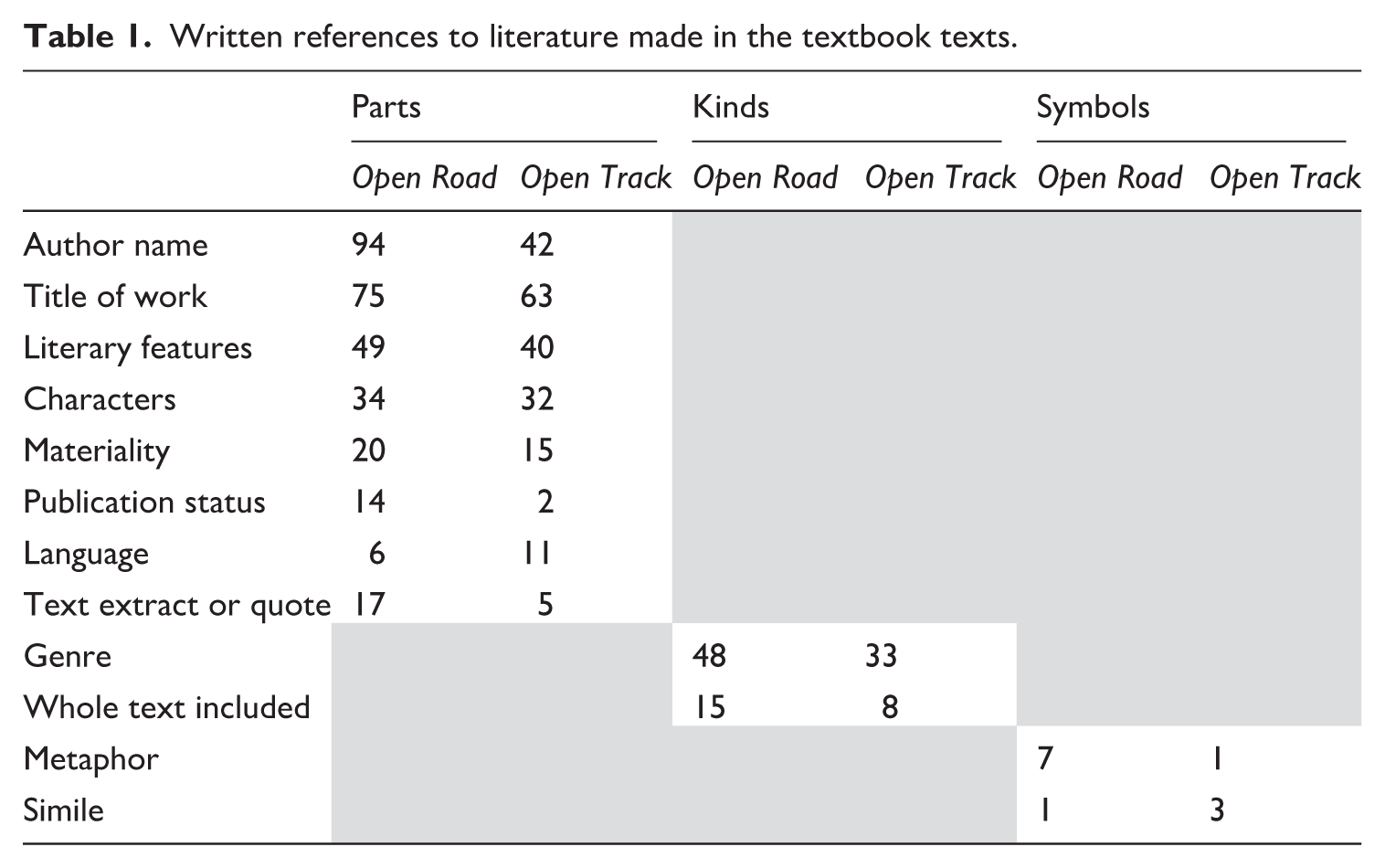
The written references to literature made in the textbook texts are summarized in Table 1.
Written references to literature made in the textbook texts.
a References to parts of literary texts
A representative example of the use of authors, titles and extracts from texts in Open Road 5 can be found on pp. 56–57, where students are instructed as follows: The following (1–12) are opening lines from famous books. Read through them with a partner and try to find the correct description of the book (A–L) and the title and the name of the author (a–l). (Open Road, pp. 56–57)
These extracts are from Harry Potter and the Philosopher’s Stone by J.K. Rowling, The Adventures of Huckleberry Finn by Mark Twain, The Mirror Crack’d (from Side to Side) by Agatha Christie, The Chronicles of Narnia: The Lion, the Witch and the Wardrobe by C.S. Lewis, Peter Pan by J.M. Barrie, The Egyptian by Mika Waltari, The Lord of the Rings by J.R.R. Tolkien, Pride and Prejudice by Jane Austen, The Hound of the Baskervilles by Sir Arthur Conan Doyle, The Unknown Soldier by Väinö Linna, Catcher in the Rye by J.D. Salinger and The Godfather by Mario Puzo.
Examples of references to characters can be found throughout On Track 3, but a representative example is found on pp. 91–93, which discusses hero archetypes: Here are three types of hero archetypes who are hundreds of years old and still going strong today. The warrior woman . . ., The lover . . . The mentor’ (p. 91–93). The background to the Lover archetype is described as follows: ‘The lover-hero appears in the Finnish epic Kalevala as the impulsive Lemminkäinen. In the legend of King Arthur he takes the form of the handsome Sir Lancelot. He appears again in eighteenth century Italy, this time as the famous seducer Casanova. (Open Track 3, p. 92).
Open Road 5 references the publication status of a text on p. 63, where students are tasked with summarizing a four-paragraph text into 50 words. The subject matter deals with the idea of self-publishing, which used to be considered ‘literary suicide’, but has worked out well for a few authors.
On Track 3 includes a few extracts from texts by Shakespeare. One example of an extract featuring a character is utilized in the book is Act 5, Scene 5 from Macbeth. The extract is used in context of sub-chapter 3.3. on Shakespeare. The chapter opens with a brief description of the play, and the extract is introduced with the words ‘When Macbeth hears the news, he feels that his own life is suddenly pointless. This is how he expresses that feeling.’ The exercise that follows is a multiple choice which directs students to choose the correct meanings of the extract tone, similes used, and the overall message in the extract.
The two coursebooks are surprisingly different in the number of references they make to various authors and titles.
b References to kinds of literary texts
Open Road 5 contains 15 whole texts, which include 10 poems or lyrics and five short stories:
‘Art School’ by Paul Weller (lyrics);
‘The Road Not Taken’ by Robert Frost (poem);
Sonnet 138 by William Shakespeare (sonnet);
‘You’ by Carol Ann Duffy (poem);
‘Love’s Philosophy’ by Percy Bushe Shelley (poem);
‘This Be the Verse’ by Philip Larkin (poem);
‘My Son, My Executioner’ by Donald Hall (poem);
‘Life is Fine’ by Langston Hughes (poem);
‘The Fly’ by William Blake (poem);
‘Ace of Spades’ by Edward Alan Clarke, Ian Kilmister and Philip John Taylor (lyrics and music);
‘Harrison Bergeron’ by Kurt Vonnegut (short story);
‘A Shocking Accident’ by Graham Greene (short story);
‘Full Stop’ by Alecia McKenzie (short story);
‘The Last Spin’ by Evan Hunter (short story); and
‘Why, Honey?’ by Raymond Carver (short story).
On Track 3 includes eight whole texts:
Exemplary haiku 1, no named author;
Exemplary haiku 2, no named author;
Exemplary haiku 3, no named author;
Exemplary haiku 4, no named author;
‘Cloths of Heaven’ by W.B. Yeats (poem);
‘The Orange’ by Wendy Cope (poem);
‘The Price of Art in Lutton’ by United Agents LLP, London, and John Hegley (poem);
‘The Perfect Mark’ by Melody Campbell (short story).
An example of how genres are referenced in Open Road 5 comes from a task on p. 62 which encourages students to: discuss books you have read. Try to come up with a list of books and authors you have both read and liked. Cover as many literary genres as you can (biographies, fairy tales, adventure novels, comic novels, crime fiction, fantasy, historical fiction, horror, poetry, romance, science fiction, thrillers, tragedies, short stories, etc.
On Track 3 frequently combines a definition of a genre or sub-genre with a task to produce a text of one’s own, such as on p. 52, which tasks students with writing a 10-word story before swapping with a pair. The introduction to the task relates that ‘Writers have played around with the idea of really short stories for decades. In America, National Public Radio has readings of Three Minute Fiction, for example’ (On Track 3, p. 52).
c References to symbols of literary texts
A symbolic reference to literature is made on p. 66 chapter seven of Open Road 5, which includes an extract from Stephen Fry’s book The Ode Less Travelled. Here, poetry is distinguished from a beverage that should not be consumed quickly: Poetry is not made to be sucked up like a child’s milkshake, it is much better sipped like a precious malt whiskey. Verse is one of our last stands against the instant and the infantile. Even when it is simple and childlike it is to be savored. (Open Road 5, 66)
On Track 3 texts also include symbolic representations of literature, though markedly less than representations of kinds of or parts of literature. An example of a symbolic representation of literature is made on p. 38 where poetry is likened to a painting using a simile: ‘A poem is a picture painted with words. – G.K. Chesterton, British writer’. Another example of a symbolic representation of literature is on p. 128 where the functions of dystopias are referred to in the following comparison: ‘These imagined worlds are more than escapism. They’re a wakeup call. They show us what might happen if these things get out of control.’
2 References to literature in images
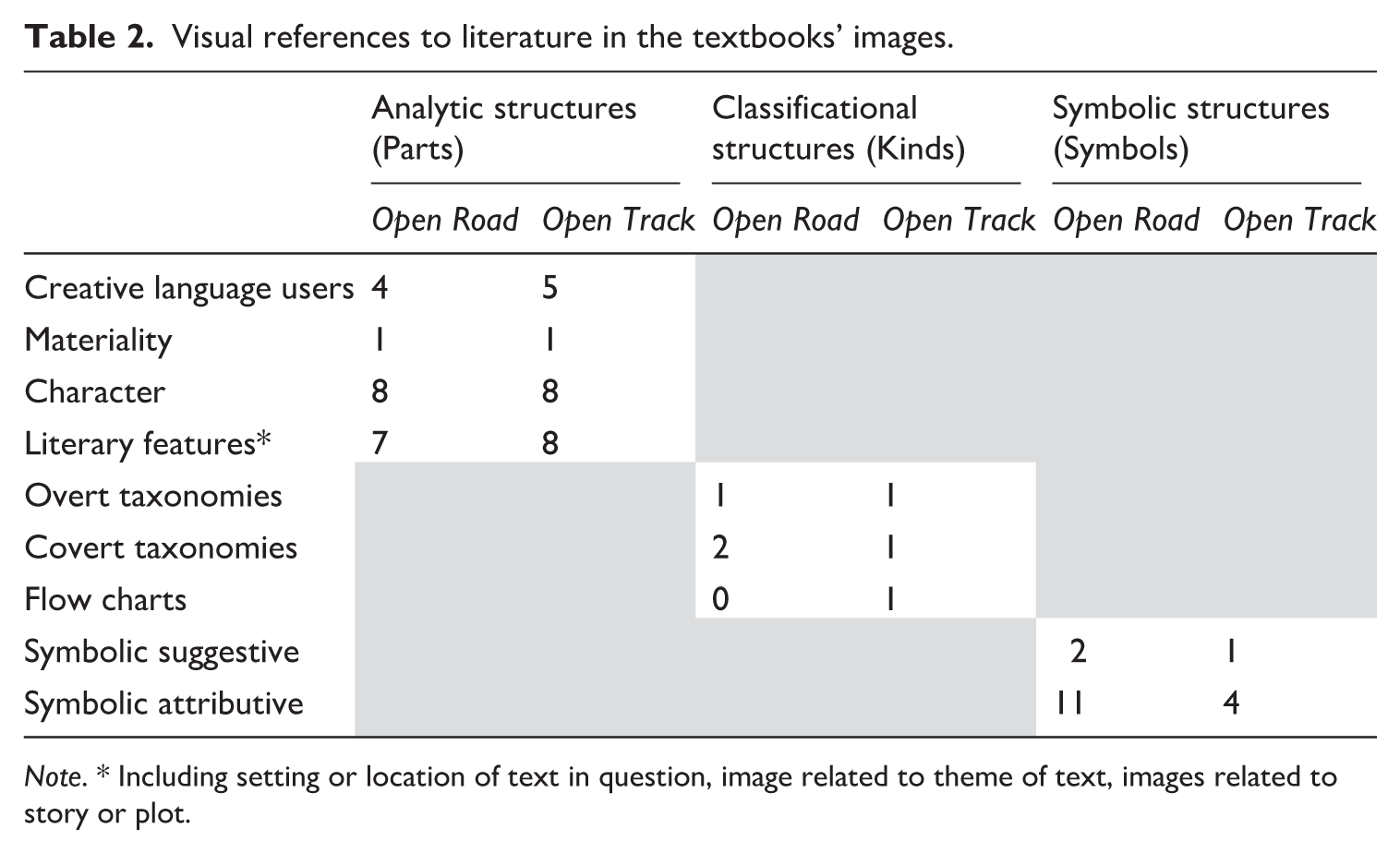
References to literature in the textbooks’ images are summarized in Table 2.
Visual references to literature in the textbooks’ images.
Note. * Including setting or location of text in question, image related to theme of text, images related to story or plot.
a References literary texts in analytic image structures
One of the most common themes of analytic image structures were creative language users and characters depicted in portraits. One example is a portrait of Shakespeare on p. 72 of Open Road 5. See Figure 1. Similarly, p. 66 of the same textbook contains an analytic image structure of Stephen Fry.
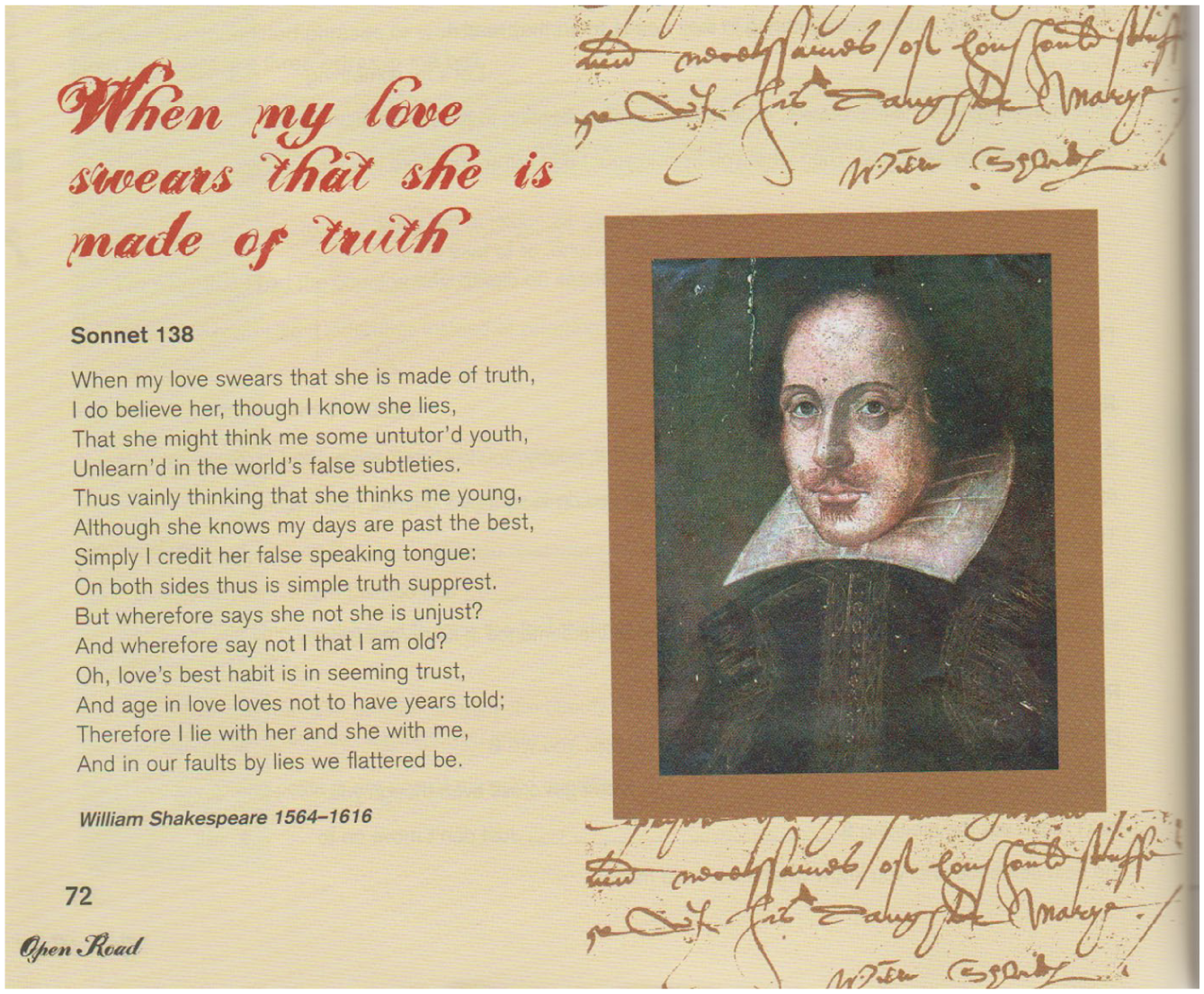
Open Road, p. 72.
Some analytic image structures serve to illustrate settings of texts, as does the use of an analytic image structure of a lighthouse on p. 32 of Open Road 5. The lighthouse is depicted with topographical accuracy on a seashore. The image is used in context of an extract from Ian Pearson’s novel The Portrait. See Figure 2.
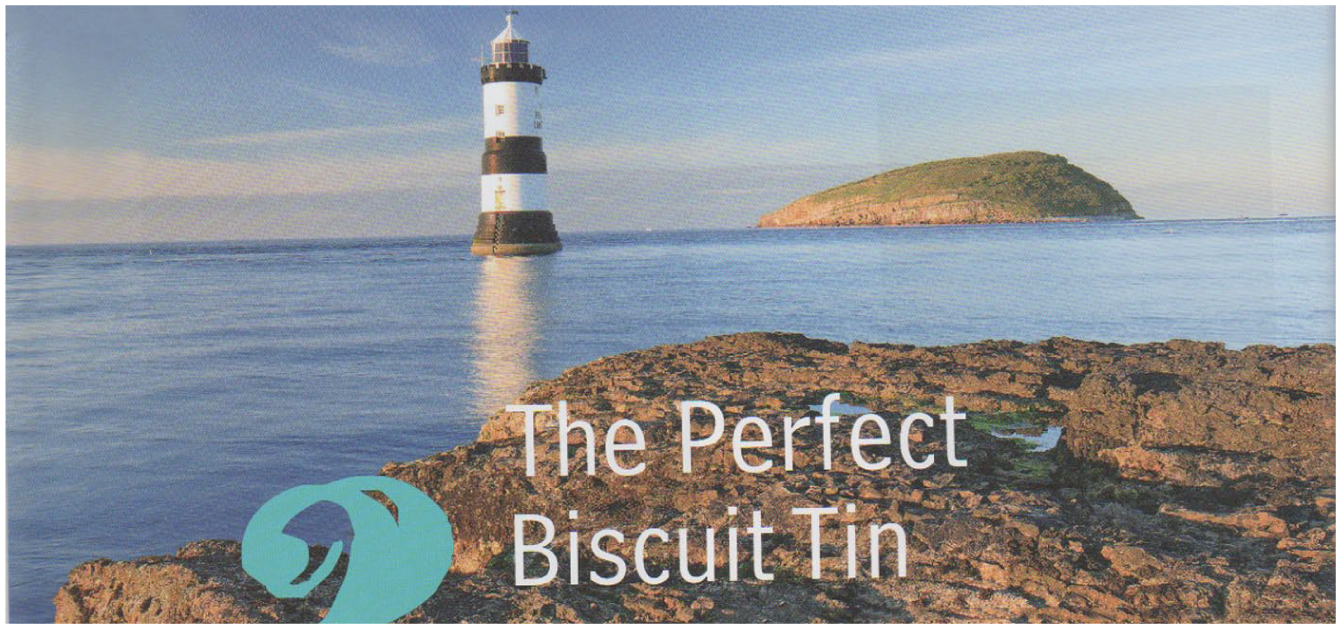
Open Road, p. 32.
Analytic image structures were also used to illustrate themes of particular texts, such as the inclusive analytic image structure of handgun parts (bullet, cylinder) in a hand-drawn line drawing colored in green and lilac. These are depicted on pp. 119–120 of Open Road 5. These are used in the context of the short story Evan Hunter’s short story, The Last Spin. Settings, like that of the Shire from The Hobbit on p. 94 of On Track 3, were also depicted through an inclusive analytic structure, showing parts of trees on hillsides, doors and chimneys to the hobbit homes. See Figure 3.
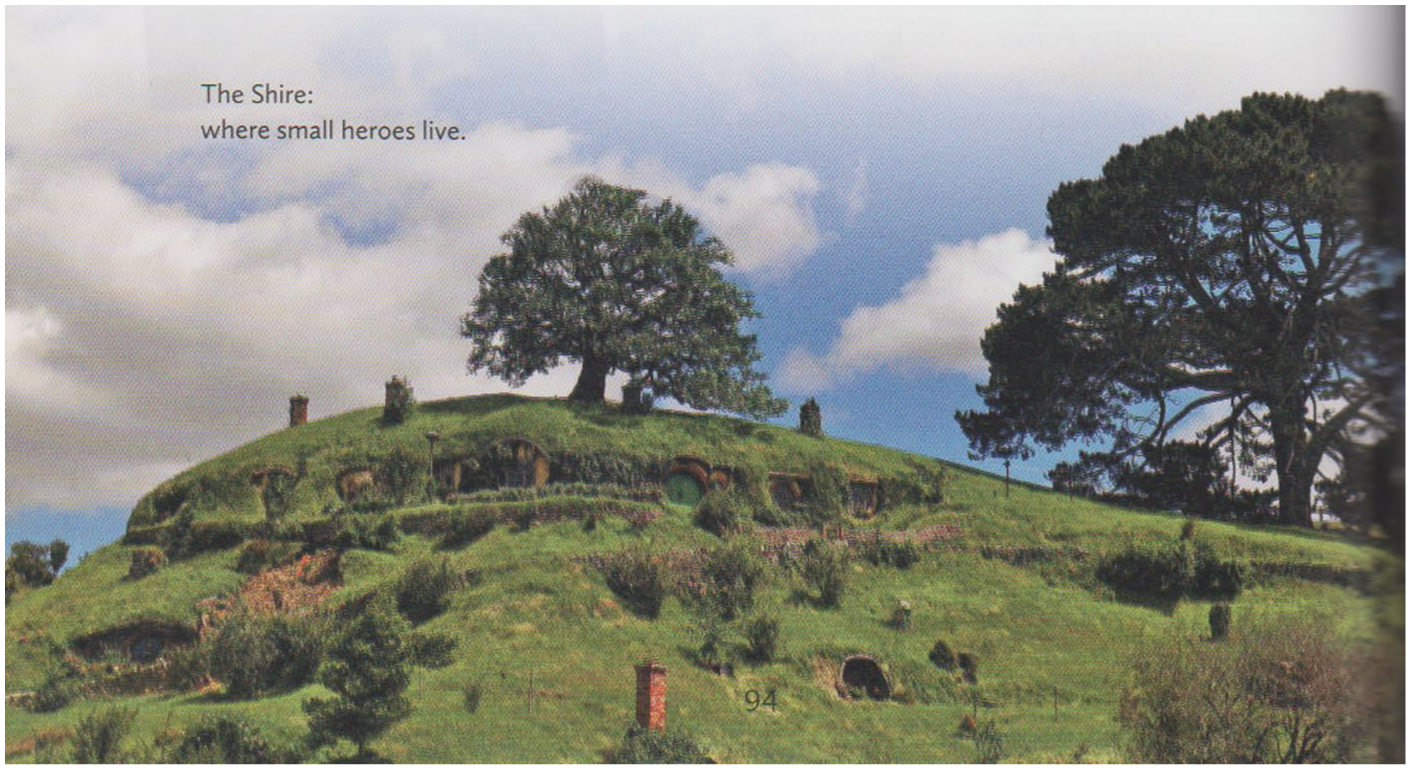
Open Track, p. 94.
Open Road 5 contains a centralized analytic image structure on p. 55, where hand-drawn line drawings of speech bubbles around a smiling young person’s head depict key elements of Harry Potter -series. The image structures convey the ideas of plot, setting, characters and theme of the book. In terms of the materiality of literary texts, Open Road 5 also included analytic image structures of book covers, such as the images of printed copies of 13 novels on pp. 56–57. See Figure 4.
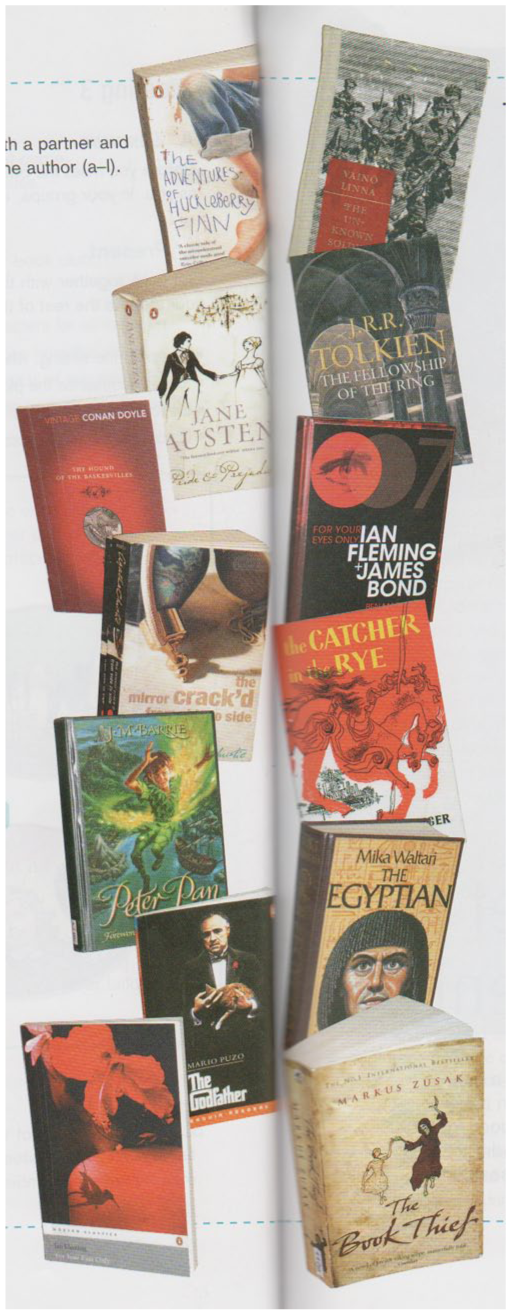
Open Road, pp. 56–57.
In On Track 3, settings are portrayed in two analytic image structures. One such instance is on p. 132 in the context of discussing dystopias and utopias, where the image empty, unfinished blocks of flats made of bricks, with a caption reading ‘Chicago, but not as we know it’ (On Track 3, p. 132). The other example is of a balcony, found on p. 10, with a caption identifying the balcony as ‘Juliet’s famous balcony’ in Verona, Italy. See Figure 5.
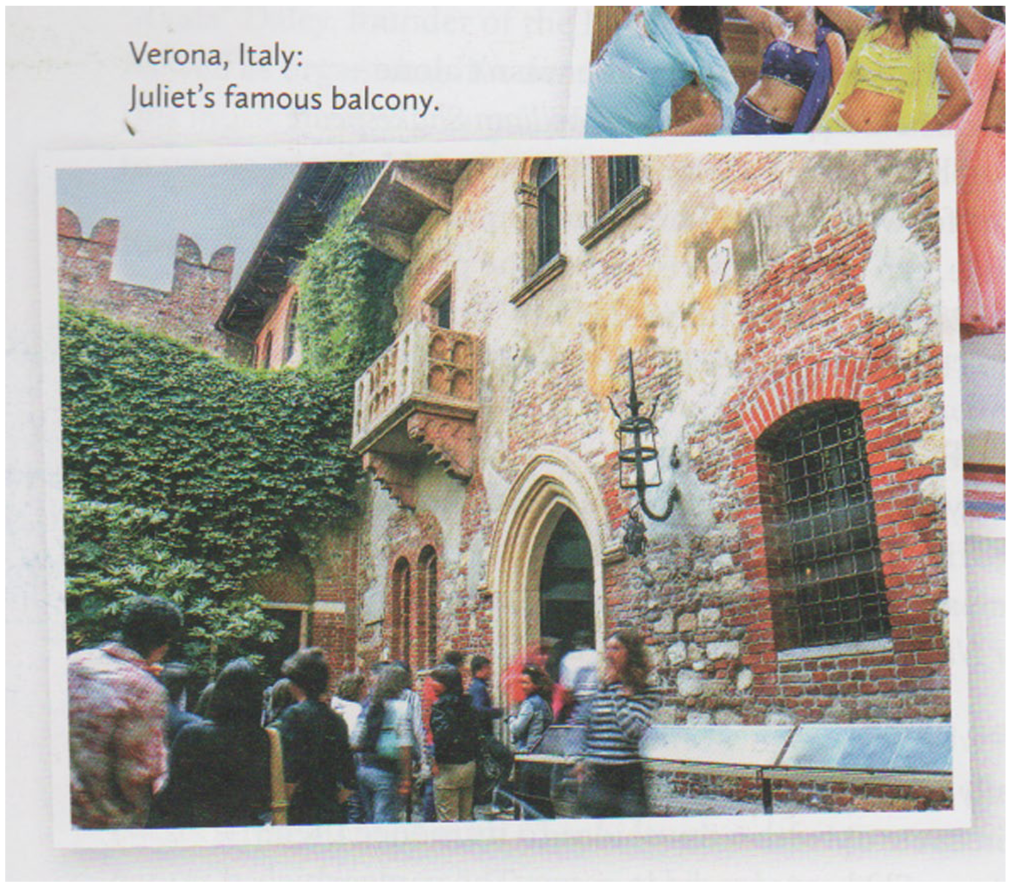
Open Track, p. 10.
Characters from literary works were also portrayed through analytic image structures in On Track 3. These included Dumbledore from the Harry Potter series on p. 93, James Bond on p. 92, taken from the film adaptations of novels, and an analytic exhaustive image structure of Jane Eyre, as suggested by the text box next to the image on p. 122. See Figure 6.
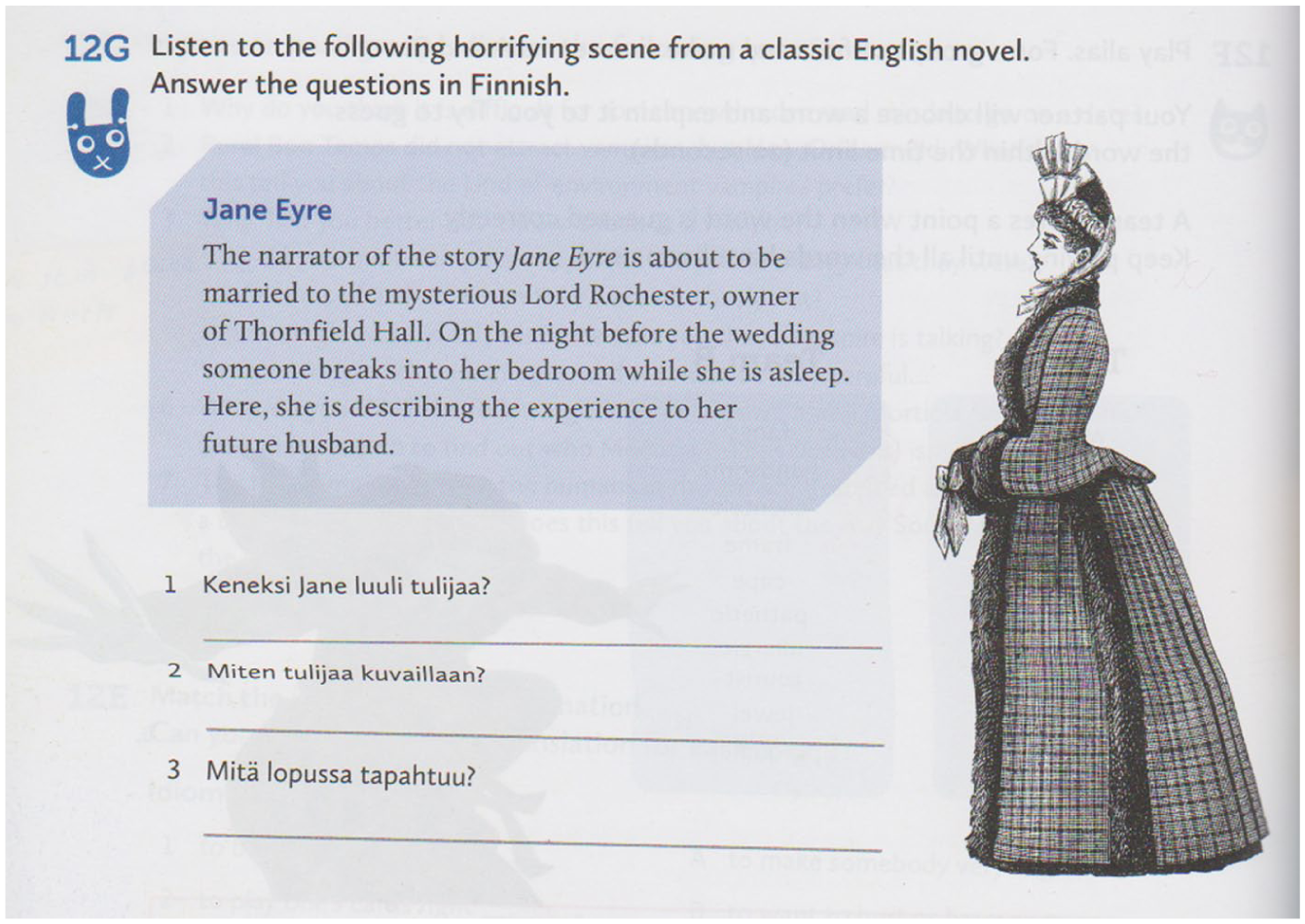
Open Track, p. 122.
In On Track 3, the materiality of literary texts is conveyed through a similar use of images containing a printed book, such as the image of Charlaine Harris’s book Dead until Dark on p. 115, or the photorealistic structured analytic image of a printed book on p. 84. Here, however, the viewer cannot discern any identifiable details of the book. The image is used in conjunction with an information box containing vocabulary distinguishing between novel, novella and short story; chapter and paragraph; title, heading and headline. Finnish translations for the terms are included.
b References to literary texts in classificational image structures
In terms of classificational image structures, On Track 3 was found to contain one overt taxonomy, one covert taxonomy and one flow chart. The one overt multi-leveled taxonomy depicts ‘the arts’. The taxonomy includes the main categories of Visual arts, Performing arts and Literature. The sub-categories listed under Literature include drama, novels, short stories, biographies and poetry. See Figure 7.
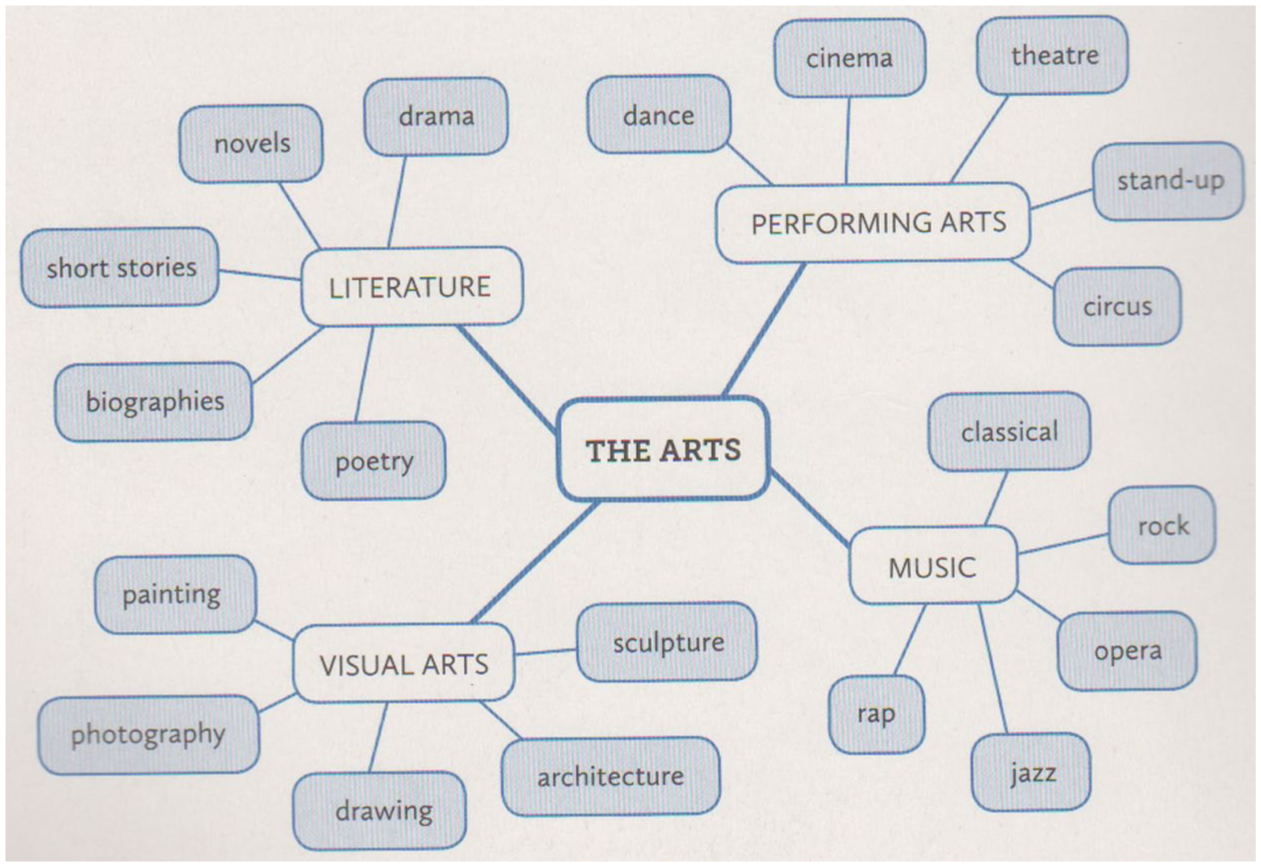
Open Track, inside cover.
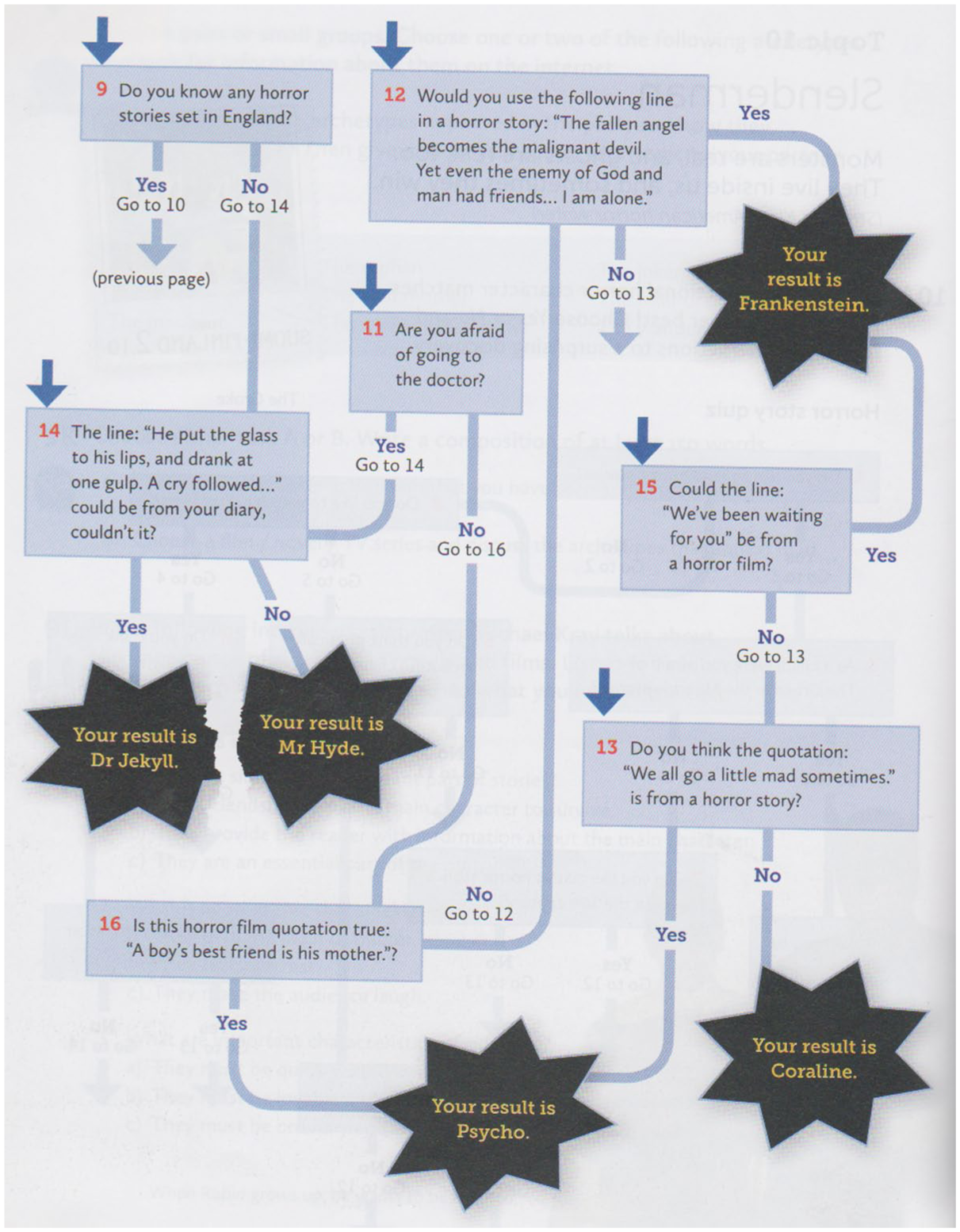
The covert taxonomy on the other hand depicts Shakespearean characters as re-imagined in the context of Bollywood on p. 10. Here, the image serves to illustrate the far-reaching influence of Shakespearean texts. For the Western reader, however, the only distinct clue to the fact that the image relates to Shakespeare is in the caption. On Track 3 also contains a flow chart on pp. 99–100 which directs the reader to choose a horror character they might be interested in. The end-results of the flow chart include Dr. Jekyll, Mr. Hyde, Psycho, Coraline or Frankenstein. The task implicitly encourages students to familiarize themselves further through reading or watching films related to the aforementioned results. See Figures 8 and 9.
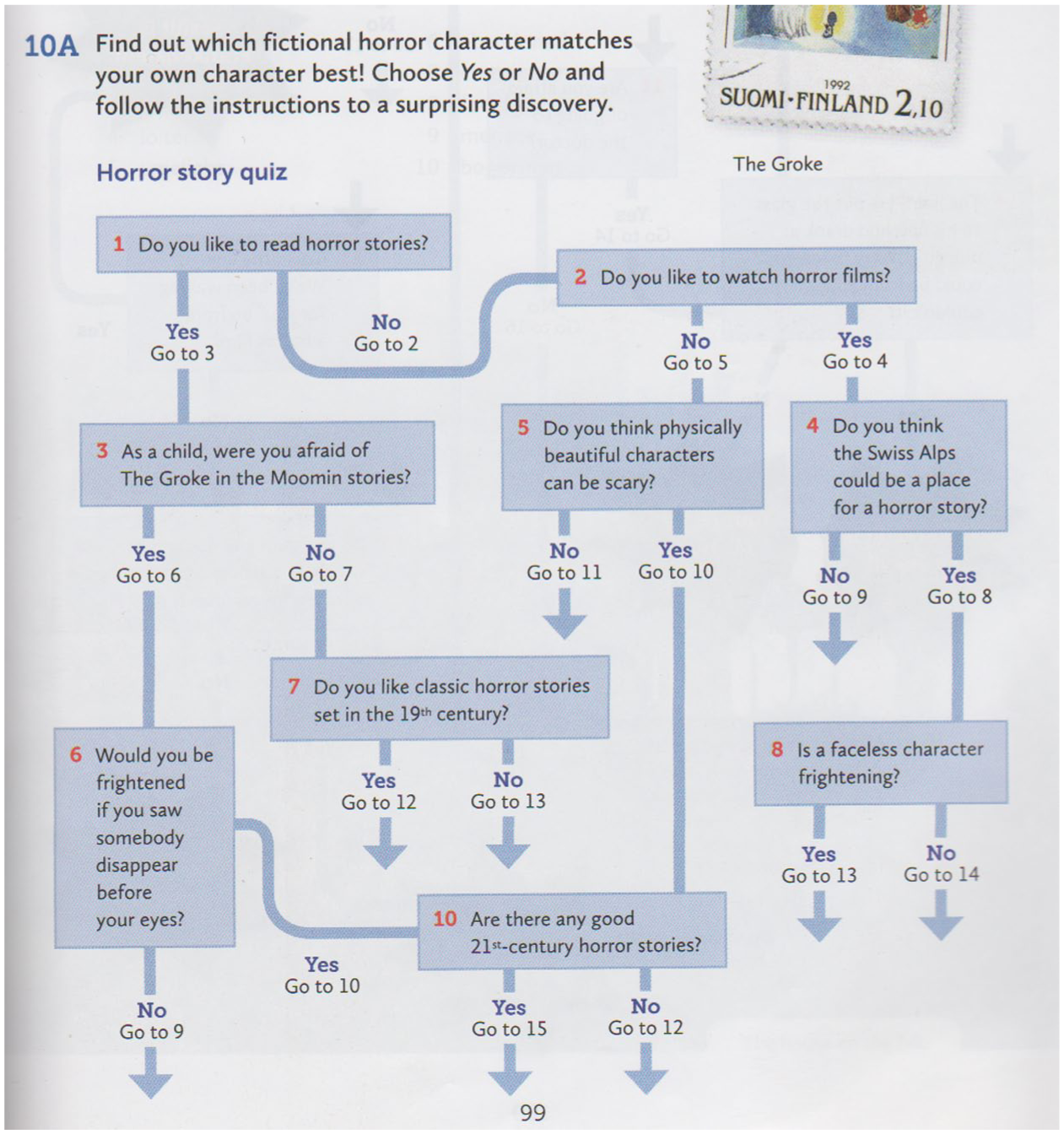
Open Track, pp. 99–100.
Open Track, pp. 99–100.
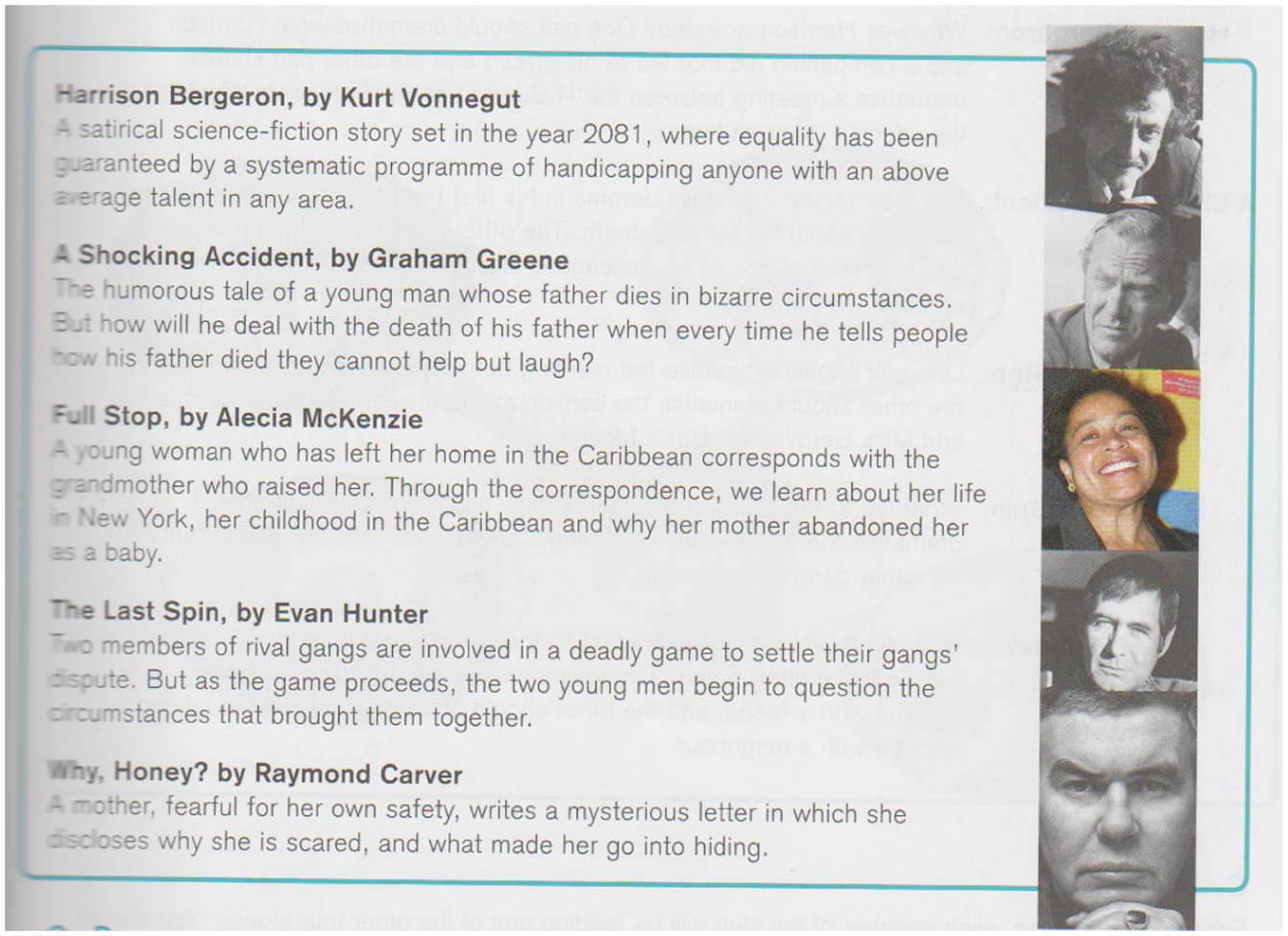
Similarly to On Track 3, Open Road 5 does not feature many classificational image structures either. The textbook contains two covert taxonomies, of which one depicts photorealistic images of the six Bond actors on p. 18 in a two by three grid. These are in context of discussing the books by Ian Fleming which the films are based on. The other covert taxonomy contains portraits of short story authors Kurt Vonnegut, Graham Greene, Alexia McKenzie, Evan Hunter and Raymond Carver on p. 53. These are presented in context of introducing literary circles and the series of reading activities based on reading the short stories included in the book. See Figure 10.
Open Road, p. 53.
The one overt taxonomy included in the book is that of ‘famous books’, as stated in the introduction of the warm-up exercise on the spread pp. 56–57 (see Figure 4). The book covers included include The Adventures of Huckleberry Finn, The Unknown Soldier, The Fellowship of the Rings, Pride and Prejudice, The Hound of Baskervilles, Mirror Crack’d from Side to Side, Peter Pan, For Your Eyes Only, The Godfather, The Egyptian, The Book Thief, and Catcher in the Rye.
c References to symbols of literary texts
Open Road 5 contained as many as 11 symbolic attributive image structures. These were most often used to convey meanings related to literary texts. Page 69 contains multiple examples of such as hand-drawn line drawings colored in shades of yellow featuring, for example, an image of a clock to suggest ‘poetry as time consuming’ reading material. This idea is explicitly described in the preceding extract from Stephen Fry’s novel The Ode Less Travelled in chapter 6 of the textbook. In the same context, an image of a milkshake to suggest ‘poetry not to be consumed like a child’s milkshake’. Open Road 5 also makes use of symbolic suggestive images, but these were markedly fewer with only two instances found. These included an image of two hearts on p. 73 and again on p. 74, one of which read ‘me’ and the other ‘you’. Another example of a symbolic suggestive image structure is on p. 106, where chalk lines on the ground are suggestive of death. This is used in context of a short story with a theme related to death.
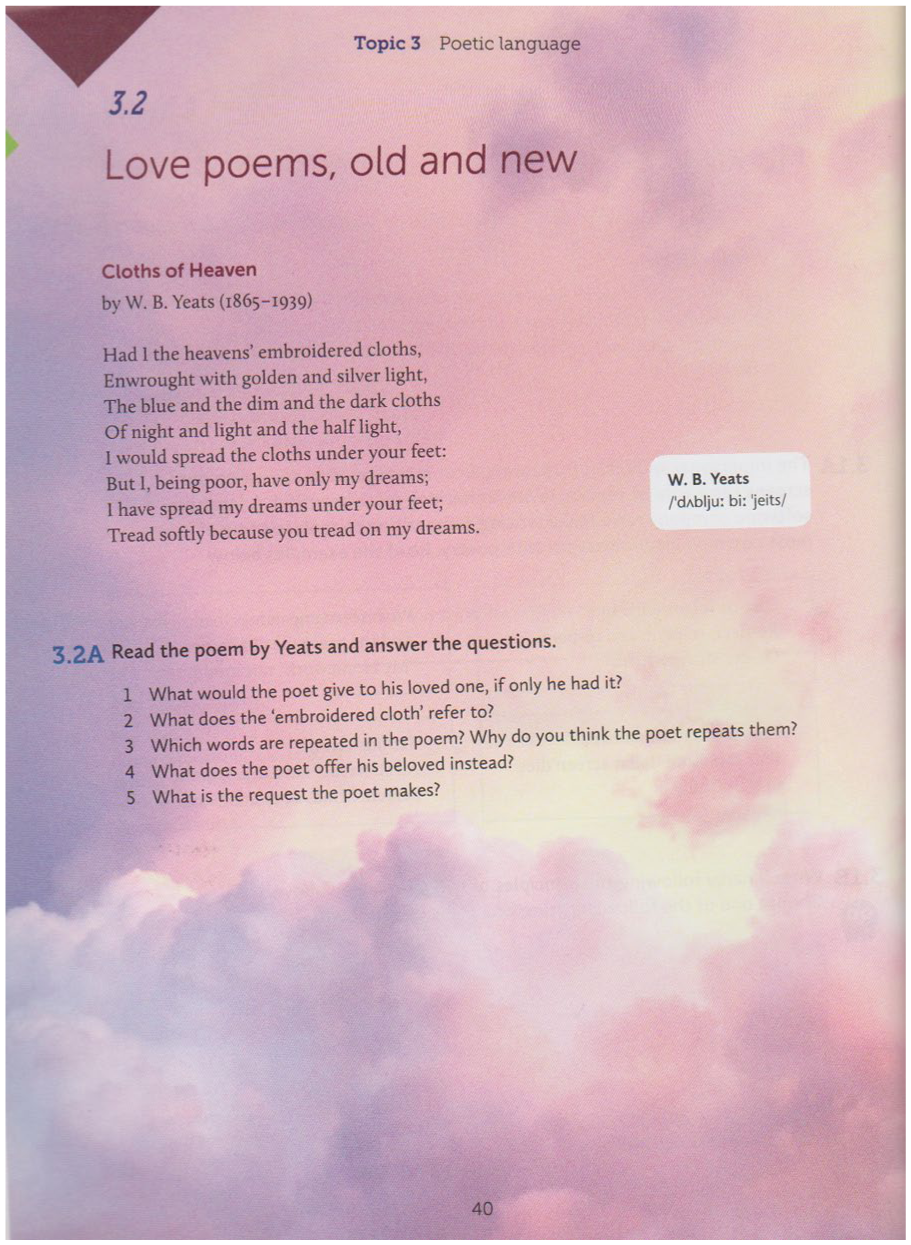
On Track 3 contained one symbolic suggestive image structure on p. 40, depicting clouds, in context of W.B. Yeats’s poem ‘Cloths of Heaven’. See Figure 11.
Open Track, p. 40.
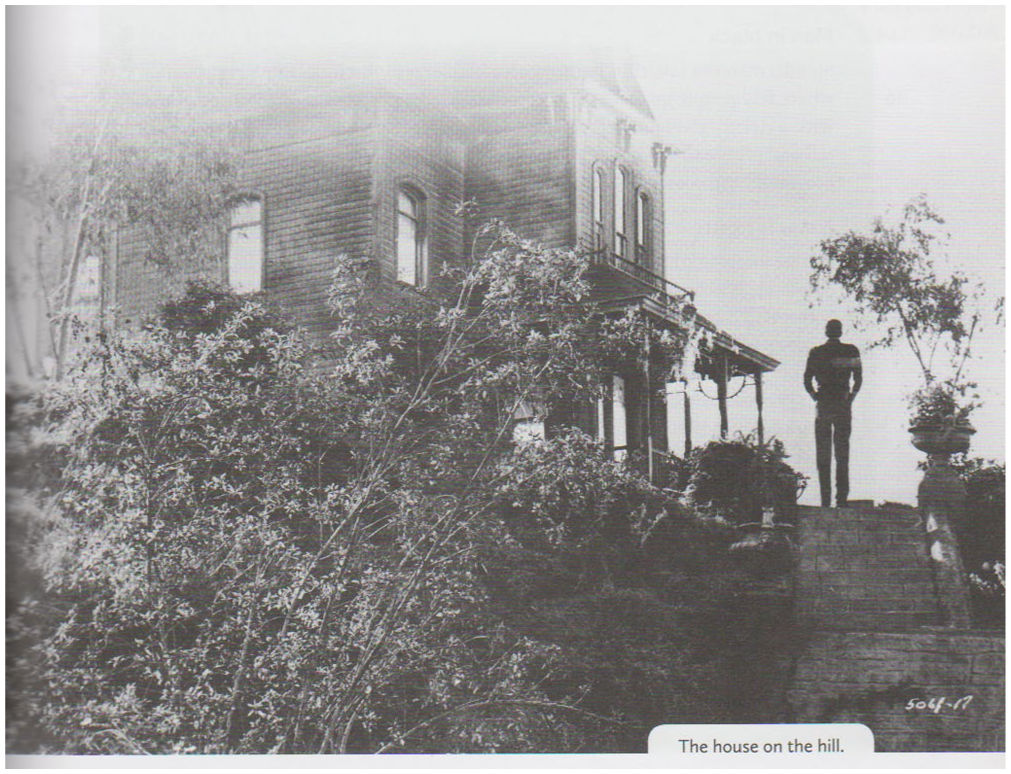
One of the four symbolic attributive image structures in On Track 3 is rather interesting. It is an image of a house on a hill, where the silhouette of Frankenstein establishes the meaning of captioned ‘The house on the hill’ as a house in which Frankenstein perhaps dwelled or was created, but without being familiar with either the novel or its film adaptations, this would be difficult for young readers to ascertain. See Figure 12.
Open Track, p. 101.
V Discussion
The study builds understanding of how conceptions of literature in coursebooks might be analysed, and asks how literature may be understood in the two Finnish EFL coursebooks at hand. The study offers an applicable framework for teachers and scholars to understand how literature is incorporated into particular textbooks. Answering the research question by using the hermeneutic research approach meant constructing an understanding of how particular aspects of literary texts manifest in textbooks in light of available scholarship on literature in foreign language textbooks and multimodal textbook research.
Through the data and examples presented, I show that the proposed framework builds a coherent understanding of literature as it is conceptualized in these foreign language textbooks. I argue that applying the framework to analyse the visual and textual references to literature shows that the textbooks’ emphasis on parts and kinds of literary texts aims to equip students with the meta-skills and knowledge to read, produce and evaluate literary texts.
Modernist approaches to culture, particularly if focusing on the ‘big C culture’ (Kramsch, 2013, p. 65), might place more emphasis on examples of kinds of literature, whereas post-modernist approaches might emphasize references to parts and symbols of literary texts and the ability to discuss, evaluate and analyse texts. From this perspective, one might conclude that the textbooks are more post-modernist than modernist in their view of culture, if the conception of literature is interpreted as suggesting as much, but this remains speculation as culture cannot be considered synonymous with literary texts only. There is, however, an interesting note in the foreword of Open Road 5, which states that ‘[The textbook will] be dealing with both popular culture and high-brow culture as we explore some of the possibilities for artistic expression’ (Open Road 5, 3). Nevertheless, both approaches can be identified here, also, as Kramsch (2013, p. 69) also argues.
From a strictly numerical perspective only, the conclusion to draw from the results is that the role of literary references is smaller in the newer coursebook. This finding is echoed by Gümüsok (2013) and Takahashi (2015), for example. However, because I only analysed two textbooks and did so with the intention of applying and testing the framework, no conclusions regarding any greater trends can reliably be drawn from the limited sample.
However, in light of the curricula the textbooks are founded on, there is another conclusion to draw. The newer (2015) curriculum emphasizes multiliteracy, which in the Finnish curriculum is understood as the ability to read, produce and evaluate a multiplicity of different texts (FNAE, 2015, p. 38; Kupiainen et al., 2015, p. 16). Here, multiliteracy is founded on the expanded notion of the text. The interesting conclusion is that the emphasis on conceptualizing literature through its parts, as seen in the use of both text and images, aligns with the goals related to multiliteracy and the expanded notion of the text. This emphasis aligns with more global trends seen in the use of literature in foreign language education (Bland, 2018).
While the findings support Skela’s (2014) observation that textbooks do not contain a coherent literary syllabus, the curricula the textbooks are founded on reveals that neither has this been the intent. However, Skela’s (2014) observation on the ratio of full texts versus references to literature is in agreement with the findings here. The proposed framework and the analysis demonstrate that, at least in the case of these textbooks, both contain more references to literature than full texts.
Reviewing the kinds of texts included in the textbooks, it is interesting that contrary to the findings of Calafato and Gudim (2022) and Eid et al. (2023), approximately a third of the full texts included Open Road 5 are poetry or lyrics, and only a third are short stories. The same is true in the eight whole texts included in On Track 3. If the references to literary texts are considered from the perspective of the all three categories (parts, kinds and symbols), the findings echo those of Al-Saeed and Alenezi (2020) who found that most of the authentic literary texts used in the textbooks they analysed were complete poems and short stories with some novel, drama and short story extracts.
A fair point of criticism for this study is that the tasks related to literature are not explicitly analysed, as they are in the work of Fjellestad (2011), for example. Given the breadth and depth of this study, the focus on tasks related to literature was regrettably bracketed for another study. Interestingly, however, Fjellestad’s (2011) findings align fully with the goals of multiliteracy, which is fully in agreement with the present findings.
The study contains some limitations to consider due to the methodological choices and commitments in the underlying theory of science. First, it is important to recognize that my position as a Finnish female scholar with an international education will influence the work presented in the study (see Appendix). However, I have endeavored to thoroughly review and present the scholarship the work is founded on, and to ensure the applicability of the framework by applying it to two sample textbooks and using examples from the data to establish the validity of the findings. To its merit, there is value in the critical reflection of how a particular definition of literature is operationalized. Furthermore, few other previous studies on literature in foreign language textbooks have addressed the possibility that the textbook images also contribute to readers’ conceptual understanding of what literature is or can be.
Many visual references to film adaptations of novels were not, in fact, conceptual image structures which would provide any statement on the ontology of literature. Rather, these were narrative image structures which are discerned from conceptual image structures by the inclusion of vectors, or directional movement, which create a narrative of what is happening in the image. These narrative image structures are therefore not included in the analysis. Future studies might therefore focus on narrative image structures and the kinds of narratives related to literary texts they convey.
VI Conclusions
For foreign language pedagogy, the key conclusion to draw here is that the polar relationship of literary texts versus textbook texts is not as stark as one might presume: conceptions of literature are embedded in textbooks and their images, and the textbooks thus contribute to shaping learners’ conceptions of literature. In order to see how this is accomplished, however, the framework constructed for this study is helpful. For EFL subject pedagogy, the study provides a fresh perspective and means to consider conceptions of literature conveyed beyond the textbook, also. In other words, the findings are helpful in reflecting on how visual and textual references to parts, kinds and symbols of literary texts are present elsewhere in the EFL lessons also. Relaying a list of different kinds of literary authors and texts to learners through carefully curated reading lists is regrettably not enough to propel learners toward holistic growth and for example well-rounded multiliteracy skills. Learners of all ages need to be able to explore meanings related to the texts from not only their unique perspectives but to also understand shared meanings associated with texts. Equally important is learning to read, produce and evaluate multimodal texts. The role of images in establishing conceptual understanding of abstract ideas should not be overlooked. If the conceptions of literature we transmit to students are built through limited means of associating particular authors (parts) or their specific works (kinds) as literature, we run the risk of instilling rigid conceptions of a subject which should be a playground for creative expression, exploring new meanings and learning to work with and pull apart texts in order to better understand the texts, their writers and ourselves.
Footnotes
Appendix
Acknowledgements
The author wishes to thank the publishers SanomaPro and Otava for the copies of the textbooks that have been used in this study.
Data availability
The datasets generated and analysed during the study are available from the corresponding author on reasonable request.
Funding
The author received no financial support for the research, authorship, and/or publication of this article.
Ethical considerations
The research described in the article has been conducted in accordance with the Finnish Code of Conduct for Research Integrity Finnish National Board on Research Integrity, which are in line with the European Code of Conduct for Research Integrity.
Consent to participate
This article does not contain any studies with human or animal participants.
Consent for publication
Not applicable.
