




Abstract
Studies examining culture representation in language textbooks have rarely adopted the semiotic approach, despite its potential for presenting and (re)creating cultural meanings at their various levels (i.e. cultural, intercultural, multicultural, and transcultural) in the co-instantiations of texts, tasks, and images. To address this issue, a qualitative analysis, embarking on the Peircean semiotic theory, was applied on the text-image-task semiotic relationship. It explored its potential for constructing and reconstructing cultural meanings relative to the Iranian national English as a foreign language (EFL) textbook, Vision 1, from the perspectives of Iranian EFL students, teachers, and teacher educators. Content and thematic analyses of the interview records revealed three themes: first, the co-instantiation of the image and text was indexical, cultural awareness and connotations were almost untouched; second, the textual and visual components driving intercultural meanings and interpretations were not in accordance with the tasks; and, third, some alternative more culturally engaging images were provided by the interviewees. On the whole, the findings confirmed the previous findings that the discourse of this brand-new Iranian localized EFL textbook leaves little space to raise cultural awareness for its users. Based on the findings, a dynamic model for evaluating cultural representations in textbooks is suggested, hoping to show how EFL textbooks can be developed, implemented, and received more effectively in instructional settings.
Keywords
I Introduction
The present-day era of internationalization, globalization, and multilingualism (Cenoz & Gorter, 2015; Matsuda, 2018) has prompted teachers, researchers, teacher educators, and materials developers to notice today’s cultural hybridity and complexity (Risager, 2011) for potential restructuring of the curricula. In this era, culture teaching has also changed radically as teacher educators are required to educate teachers, and teachers are expected to prepare students, who will develop critical cultural awareness at its various levels (i.e. cultural, intercultural, multicultural, and transcultural) (Huh & Suh, 2017; Kiss & Weninger, 2013; Risager, 2011). According to Guilherme (2012), there is ‘a complementary relationship between language/culture education, intercultural education, citizenship education and critical pedagogy’ (p. 360), confirming the close link of critical multicultural awareness in language instruction within the citizenship education (Guilherme, 2002). Such an awareness encourages students and teachers to negotiate hidden ideologies and values, documents, and events in the instructional context to better appreciate and understand their own cultural, political, social, and ideological stances as well as those of the other (Kramsch, 2013b). Teaching intercultural communication is encouraged through a dynamic, hybrid, and emergent understanding of language and culture (Baker, 2011) for becoming politically and culturally critical, conscious citizens of the globe (Kramsch, 2013a; Kumaravadivelu, 2008; Porto, et al., 2017).
Despite this desideratum for highlighting the global conceptualization of culture in language pedagogy (Baker, 2015), multicultural elements are not sufficiently instilled into ELT programs (Davidson & Liu, 2018; Fang & Baker, 2017), and in turn, many language teachers still evoke the monolithic view of culture in their instructional practices (Tseng, 2002). One venue for examining such arguments and the synergy of language and culture within the English as a foreign language (EFL) instructional context is textbooks, being still an indispensable constituent of the curriculum in many educational programs worldwide (Derakhshan, 2018). A viable approach for the examination of cultural representations in textbooks, enlightened by the semiotic theory of Charles Sanders Peirce (1980), is the semiotic approach, at the heart of which lies the triadic interrelation of a sign, its object (i.e. what it stands for), and an interpretant (i.e. meaning or mental image created by the sign in an interpreter’s mind). According to Kramsch (2013b), this approach rests on the postmodernist perspective and can potentially take a dynamic, interactive, relational, and multimodal perspective toward the analysis of cultural elements in learning materials as it considers culture a discourse or what is called a social semiotic construction. This approach inspects the creation of specific cultural meanings from the co-instantiation of texts, tasks, and images within the process of semiosis for realizing curriculum goals and bringing to the fore the cultural messages underlying the materials and facilitating students’ learning and putative reading of them (Chen, 2010).
Despite the fruitful implications of this semiotic approach for cultivating a global conceptualization of culture in English curricula and instructional materials design and development, few studies to date have capitalized on this approach to critically scrutinize the quality of current EFL textbooks and examine their cultural representations (e.g. Canale, 2016; Chen, 2010; Dimopoulos et al., 2003, 2005; Koulaidis & Dimopoulos, 2005; Stranger-Johannessen, 2014; Weninger & Kiss, 2013). To fill this research lacuna, the present study, theoretically inspired by the mentioned studies, analysed the Iranian national EFL textbook, Vision 1 (Alavimoghadam et al., 2016), for its cultural representations following the semiotic approach. The main impetus behind selecting this textbook lies in the fact that since 2016 it has been mandated by the Iranian Ministry of Education to be taught nation-wide to all senior high school students three hours a week. Another reason is that this textbook was written by Iranian materials developers, specifically for the Iranian EFL students, and it adopts a communicative language teaching (CLT) approach (Khodabandeh & Mombini, 2018). Moreover, the new localized textbooks of Vision series – and also those of Prospect series – taught at Iranian state-run schools, have been found to be replete with local and national discourse and cultural representations, failing to enhance Iranian EFL students awareness of international cultural representations and develop their intercultural competence (Aliakbari, 2004; Borjian, 2010; Haghighi & Norton, 2017; Razmjoo, 2007; Soodmand Afshar et al., 2018; Taki, 2008). In the present study, I endeavored to see whether this monolithic perspective toward culture reported for the Vision textbooks can be approved or rejected from the lens of the semiotic approach based on the accounts of teachers, students, and teacher educators in the Iranian EFL context.
The study, nevertheless, differs from previous studies using semiotic approach for textbook evaluation in different respects. First, this study differs from Weninger and Kiss’s (2013) study in that in their study, they manipulated some hypothetical scenarios about the meaning-making processes of images, but the present study has drawn on genuine scenarios by conducting in-depth semi-structured interviews with students, teachers, and teacher educators. Second, this study diverges from Canale’s (2016), Chen’s (2010), Koulaidis and Dimopoulos’ (2005), and Stranger-Johannessen’s (2014) investigations in that their studies embarked on the co-deployment of visual (image) and linguistic (text) resources, yet the present study has simultaneously considered the co-instantiation of the image-text-task triad from a qualitative semiotic approach.
As the main concern of this study was to examine cultural representations in an Iranian EFL textbook, in line with Chen (2005), I have sought not only to explore why a particular image is required pedagogically, and if it is possible to do without it, but also to find out whether the image has successfully accomplished one of its main missions, which is making students critically mature and culturally aware through exposing them to multicultural, global, multifaceted resources. Finally, it can be argued that although the two studies by Weninger and Kiss (2013) and Chen (2010) analysed the cultural representations in English as a second/foreign language textbooks through analysing textbook elements by implementing the semiotic approach, none of them probed into the image-text-task complementarity from the vantage point of students, teachers, and teacher educators, who are the key participants in the educational system, the main consumers of textbooks, and thus researchers should consider their perspectives as the main agents in the use of textbooks and the analysis of their contents.
In light of the aforementioned points, the current study tried to answer the following research question: How do Iranian EFL learners, teachers, and teacher educators view the cultural representations of the Iranian EFL national textbook, Vision 1, from the semiotic approach perspective?
II Review of the literature
1 Theoretical framework: The semiotic approach to textbook evaluation
A useful semiotic approach to textbook evaluation is the one inspired by Peirce’s (1980) Theory of Semiotics. A central idea within Peirce’s theory is the triadic interrelation of a sign, its object (i.e. what it stands for), and an interpretant (i.e. meaning or mental image created by the sign in an interpreter’s mind). The semiotic approach to textbook evaluation, being interactive, fragmented, and multimodal in nature, intends to examine multimodal resources deployed in textbooks for the purpose of meaning construction (Chen, 2010). The different modes in the textbook create a constellation, the elements of which are instantiated together to fulfill ideologies, curriculum goals, and hidden agendas (Chen, 2010). The semiotic approach emphasizes the functional importance of images as potential presenters of cultural knowledge in concomitant of texts and pedagogic tasks, but not as decorative elements used for filling spaces.
With its great potential for unveiling many covert aspects of textbooks, the semiotic approach can be utilized for understanding how much and in what forms textbooks contain cultural representations (Kiss & Weninger, 2013). This approach highlights how culture is dynamically created and recreated in instructional settings during learners’ interaction with instructional materials, and brings to the fore the processes learners go through for doing so. This is referred to as unguided semiosis as, within this approach, textbook is not conceived as the conveyor of fixed cultural meanings, rather, it is a venue for construction and reconstruction of cultural meanings through the interaction of textbooks, teachers, and students. In other words, through unguided semiosis, key participants in the instructional context are engaged in the dynamic and interactive process of multicultural meaning-construction (Weninger & Kiss, 2013). In contrast to it is the guided semiosis which tends to inhibit language learners to voice their spontaneous reactions and to explore the cultural meaning potential in the textbook. In this regard, potential cultural meanings are curtailed as the textbook images and texts are interpreted as a ‘denotational indexicality’, that is, the images and the reading comprehension texts in the textbook point to one another, aiming at facilitating lexical meaning, not as a symbol or icon to engage students in an unguided and natural meaning-making process via connotative links. But such a focus on the linguistic denotation at the expense of cultural connotation is limited if textbooks are to prepare learners for becoming interculturally competent citizens of the globe (Weninger & Kiss, 2013).
The semiotic approach also regards objects, language, and participants, being themselves the components of cultural practices, as signs which are imbued with cultural meanings (Weninger & Kiss, 2013). It can also represent the interplay of local, national, transnational, and global conceptions of language and culture, being ideally instantiated in EFL textbooks in the form of a focal shift from cultural to intercultural, multicultural, and transcultural forms of cultural competence and awareness development (Kiss & Weninger, 2013; Risager, 2012; Tseng, 2002), with the ultimate aim of realizing the socially transformative agenda of language education (Weninger & Kiss, 2013).
Despite the value of using semiotic approach for analysing textbooks as explained above, the majority of the past studies have resorted to monolithic, static approaches to textbook evaluation (e.g. Ke, 2012; Larrea-Espinar & Raigón-Rodríguez, 2019; Roohani & Heidari, 2012; Sándorová, 2016). They sufficed with quantitative research tools: tallying, frequency word counts, or visual representations and thus considering culture as an objectifiable element. In other cases, they have utilized qualitative content analysis methods like Critical Discourse Analysis (CDA) or even used a mix of techniques from both research paradigms (e.g. Shin et al., 2011; Soodmand Afshar & Sohrabi, 2020; Yuen, 2011). The use of content analysis and CDA for textbook evaluation, has been somewhat monolithic as they only focus on the textual analysis of the textbook contents, and mainly disregard the perspectives the key instructional participants have toward the content and implementation of the textbooks and neglecting how textbooks are actually implemented in the instructional context. Such a perspective stands in stark contrast to the multifaceted and dynamic nature of the semiotic approach which caters for the co-instantiation of text-task-image triad on the one hand, and the teacher-student-textbook interaction, on the other hand.
More particularly, CDA approach to textbook evaluation is a monolithic, monotone approach which enacts, legitimizes, and enforces the US-western hegemonic discourse, topics, values, models, cultures, tools, and worldviews as standards, at the expense of attending to other cultural perspectives in the world, in turn, hindering a multicultural and transcultural awareness of discourse (Shi-xu, 2009, 2015). This issue is raised and addressed by the new research paradigm instantiated in the culturally conscious approach of ‘cultural discourse analysis’. This approach was introduced around the turn of the 21st century, being primarily concerned with multicultural scholarship, human cultural diversity, and the divisive and diverse nature of human discourses in terms of culture and intellectuality (Shi-xu, 2009, 2015). In CDA-based analysis, there is no place for collaborative creation of specific cultural meanings, co-construction of cultural meanings through teacher-student-textbook interactions, and students, teachers, or teacher educators’ active and putative reading of materials. It also fails to take a non-fragmented, dynamic view of different modes of communication in presenting, constructing, delivering, and even promoting the reconstruction of various levels of cultural meaning as fits appropriately under the theoretical underpinnings of the semiotic approach (Chen, 2010; Kiss & Weninger, 2013). In CDA, textbooks are considered only conveyors of hidden agendas, ideologies, and fixed cultural meanings, being unable to indicate how teachers and students, as key partners in the instructional context, can interactively and dynamically engage with textbooks to arrive at new layers of cultural meaning. As CDA-oriented studies reveal (e.g. Bloor & Bloor, 2007; Park, 2005; van Dijk, 2015), CDA is mainly concerned with and restricted to substantiating the significant role that discourse plays in objectifying and legitimizing more powerful, hegemonic ideologies, cultures, and worldviews.
Similar monolithic approaches are mainly employed to examine cultural representations in Iranian national EFL textbooks from Vision and Prospect series (e.g. Khodabandeh & Mombini, 2018). In essence, although previous textbook evaluation studies present useful insights concerning how culture is manifested in the visual and textual content of textbooks, they normally provide an etic view of textbook evaluators, failing to take into account the perspectives of essential educational stakeholders, namely, learners, teachers, material developers, and teacher educators (Weninger & Kiss, 2013) and also how the textbook contents are actually implemented in the classroom. Another issue with such an approach is its consideration of learning materials as only the conveyors of cultural information. Rather, cultural meanings emerge in visual and textual elements of textbooks hand in hand with the construction of meaning through social interaction of students, materials, and teachers within a pedagogic task framework, as highlighted in the semiotic approach (Kiss & Weninger, 2013; Kramsch, 1987, 1993). Such a perspective is in line with Kumaravadivelu’s (2001) post-method pedagogy, resting on the three parameters of practicality, possibility, and particularity, with the third parameter specifically focusing on the significance of a context-sensitive and location-specific pedagogy accounting for local political, linguistic, and sociocultural particularities.
2 Semiotic approach and textbook evaluation
To gain from the potential advantages of the semiotic approach, researchers have utilized it for examining textbooks taught at various parts of the globe. To start with, Koulaidis and Dimopoulos (2005) examined the extent to which the combination and interaction of linguistic and visual resources as two types of semiotic modes could produce heightened school science-related meanings in Greek primary school textbooks. The analyses were done at two levels, namely the design level and the semantic level. Data analysis results uncovered that while the visual elements of the textbooks were subordinate to the linguistic ones for meaning construction, there was an interactive play between these two modes to create specific meanings.
Likewise, utilizing a qualitative synthesis research approach, Canale (2016) analysed second, heritage, and foreign language textbooks for their foreign culture representation. Here, two approaches were employed for data analysis; the qualitative coding and the analysis of semiotic choices, examining how foreign culture was instantiated in visual and lexico-grammatical choices of the textbooks. The results illuminated that foreign culture was represented statically in the textbooks in terms of the presence or non-presence of homogenous behaviors, facts, or artifacts. Similarly, Chen (2010) examined the extent to which the co-deployment of text and image in Chinese EFL textbooks could achieve attitudinal curriculum goals. The findings revealed that the co-instantiation of text and picture has been an indispensable contributor to increasing students’ cultural awareness.
Weninger and Kiss (2013), employing Peircean semiotic theory, also analysed the text-image-task constellation in two EFL textbooks in Hungary to investigate cultural representations in them. Rather than taking the perspectives of actual students toward the cultural meanings in these textbooks, through manipulating some hypothetical scenarios, the authors attempted to display how the co-instantiation of text, task, and image led to the formation of the semiosis process which in turn influenced students’ understanding of cultural representations. It was found that the process of meaning creation was guided in the textbooks, and mainly, an indexical relationship existed between images and texts in them, with focal attention to denotation. What the authors argued was that for critical understanding and intercultural citizenship to be developed through EFL textbooks, a reflexive engagement with culture rather than just attaining only linguistic competence through focusing on denotation is needed.
Finally, Stranger-Johannessen (2014) adopted Weninger and Kiss’s (2013) framework as the conceptual underpinning for evaluating the Ugandan EFL textbook in terms of its intercultural representations. Results indicated that the visual and textual elements of the textbook failed to provide foreign culture references and critical queries because the main goal of the textbook was to achieve nationalistic cultural goals.
Based on the aforesaid, by embarking on the Peircean semiotic theory, the present study sought to enrich this line of research by exploring the semiotic relationship between texts, images, and tasks in an Iranian national EFL textbook, Vision 1 (Alavimoghadam et al., 2016), from the Iranian EFL teachers, teacher educators, and students’ perspectives. The ultimate goal of this endeavor is to propose practical implications regarding the potential processes of semiosis for the key stakeholders in the Iranian EFL context. Moreover, relying on indexicality, this study sought to elucidate how image-text-task constellation – taken as a semiotic complex – impacts the process of interpretation, which can per se favor denotation or limit the potential chain of semiosis.
III Methodology
1 Context and participant sampling
The participants included senior EFL high school students, EFL teachers, and EFL teacher educators in Iran. The rationale for choosing participants from the three groups of EFL students, teachers, and teacher educators was that these three groups are amongst the main stakeholders in the educational system who can provide insiders’ accounts as they have direct contact with instructional materials and are the main consumers of textbooks. Another reason to gather data from these three groups of stakeholders was to increase the trustworthiness of our qualitative findings. As noted by Merriam and Tisdell (2016), one way to enhance the credibility of qualitative results is to gather data from various groups of purposefully chosen individuals, which results in triangulation through multiple sources of data. Nassaji (2020) also highlights that one way to achieve the principle of credibility is to utilize various perspectives, sources, data collection methods, and explanations as triangulation aids in reaching a more comprehensive and precise understanding of the problem under study, hence making study findings more valid and credible.
In Iran’s educational system, students formally commence receiving English lessons from the seventh grade of junior high school at around the age of 13. They receive English lessons for three years before they go to senior high school, which lasts for another three years. The focus of this study was on the 10th graders, who have already been instructed English for three consecutive years at school and are typically at around the age of 16. The reason for choosing student participants from the 10th graders in the present study was their assumed cognitive maturity compared to the seventh, eighth, and ninth graders who attend junior high schools. Their great cognitive maturity can help them better verbalize their opinions, critically analyse what they are exposed to, and provide more accurate and elaborate answers to the questions asked. On the other hand, the justification for which the 10th graders were targeted rather than the 11th and 12th graders was that the 10th graders are taught through Vision 1, which is the first textbook in the Vision Series and the one which was selected as the targeted book in this series in the current study (see Section 3.II).
It should also be mentioned that in Iran, for senior high school students, there are three types of schools, namely public, private (non-profit), and exceptionally talented. To document the range of unique differences and identify how these three groups of students and their teachers, and teacher educators perceive the cultural representation in the textbook, the study employed maximum variation sampling (Patton, 2015). Particularly, the selected textbook is analysed from three different angles of students, teachers, and teacher educators as each of these three groups takes a different position in relation to the textbook. Therefore, the three groups’ perceptions and views can complement each other and contribute to the comprehensiveness of the findings in this regard. Therefore, the maximum variation sampling was employed in order to cater for heterogeneity in the sample through adapting to diverse conditions and identifying ‘important shared patterns that cut across cases’ while deriving ‘their significance from having emerged out of heterogeneity’ (Palinkas et al., 2013, p. 535). To maximize variation among the student participants, the 30 students were chosen from both genders (i.e. male and female), all types of school in Iran (i.e. private, public, and exceptionally talented), and provinces from four main geographical directions (i.e. North, South, Center, and East) in Iran (i.e. Tehran, Golestan, North Khorasan, Fars, and Khorasan Razavi provinces). Furthermore, to maximize variation among teachers and teacher educators, 20 cases with variation in age, gender, years of teaching experience, academic degree, and province were chosen.
Pseudonyms were assigned to all the participants to ensure confidentiality. At the time of the interview, the students had recently graduated from Grade 10th. Since the book was developed in 2016, the teachers had taught using this book for two or three years.
2 Textbook sampling
Vision series, written by Persian speakers of English for EFL students, aged from 16 to 19 years old in senior high school, encompasses three textbooks (Vision 1, Vision 2, and Vision 3). In the present study, which is part of an ongoing larger-scale project in which all the three textbooks in this series are being analysed consecutively, only the analysis of the first book in this series (i.e. Vision 1) is under scrutiny. Vision 1 (Alavimoghadam et al., 2016) is addressed to the 10th graders and includes a Student Book, Workbook, and Class Audio CD (recordings by Persian speakers of English). This 125-page textbook consists of four lessons, covering such sections as Get ready, Conversation, New words and expressions, Reading, Grammar, Listening and speaking, Pronunciation, Writing, and What you learned. The workbook also contains different types of activities germane to each aforementioned section.
3 Selection of images for analysis
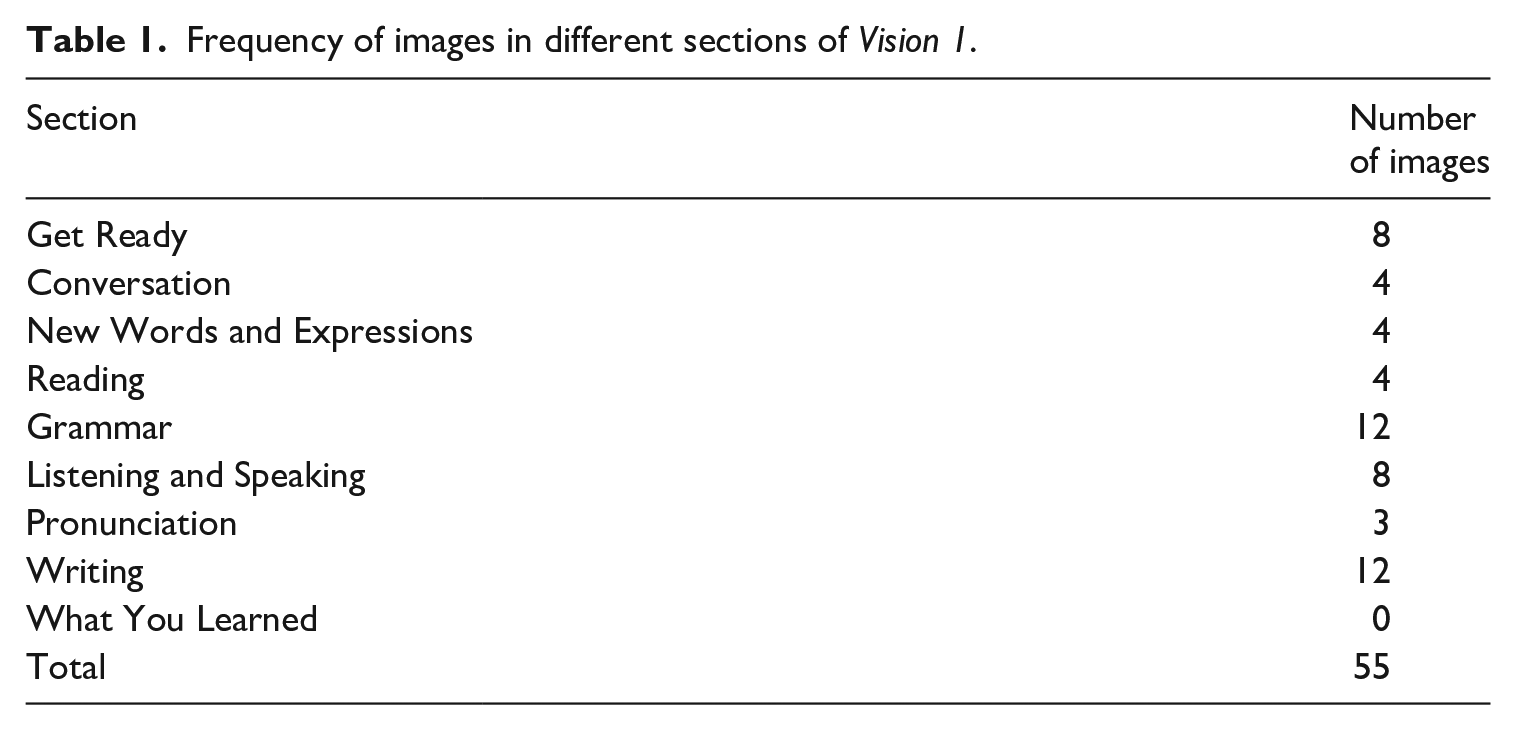
The criterion sampling technique was employed for the selection of images. The criteria for choosing the images were: 1) lacking text-task-image co-instantiation, or 2) indicating indexicality. On the whole, Vision 1 encompasses nine sections, each of which, except the ‘What you learned’ section, includes some images. The frequency of all the images is depicted in Table 1. All these images were scrutinized by the researcher and two other researchers in Applied Linguistics to find out whether these images violate text-task-image co-instantiation or they indicate indexicality. Of the 55 images in all the aforementioned sections, six images were found to lack text-task-image co-instantiation, and 19 images manifested the relationship between text and image as indexical. In the present study, only three images, two of which lack text-task-image co-instantiation and one that represents indexicality, were selected for analysis due to space constraints. Figure 1 presents the picture with an indexical association of text and image, while Figures 2 and 3 depict pictures lacking text-task-image co-instantiation.
Frequency of images in different sections of Vision 1.
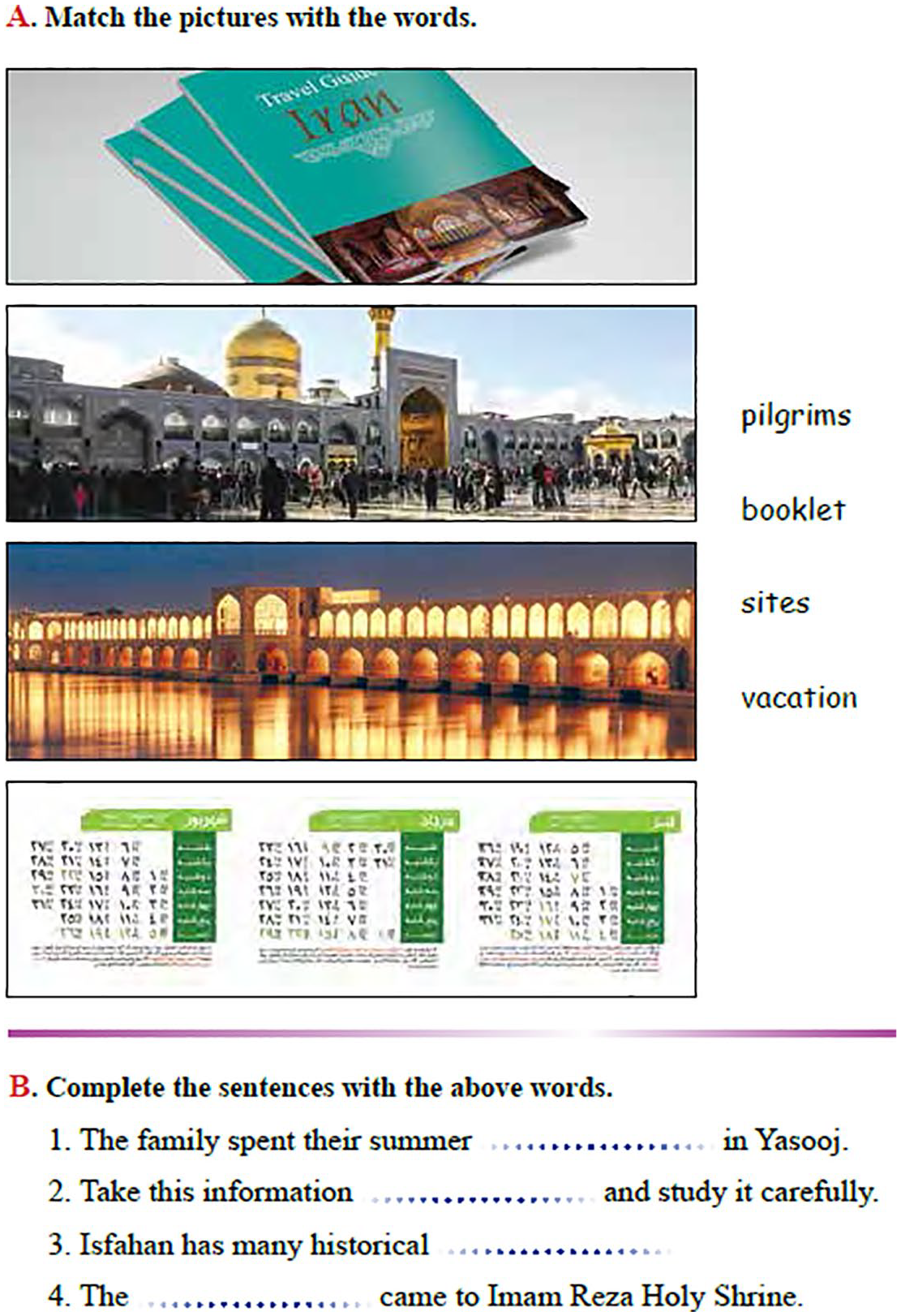
Example extracted from Vision 1, Part1 of Get Ready of Lesson 4, ‘Travelling the World!’ (p. 101).
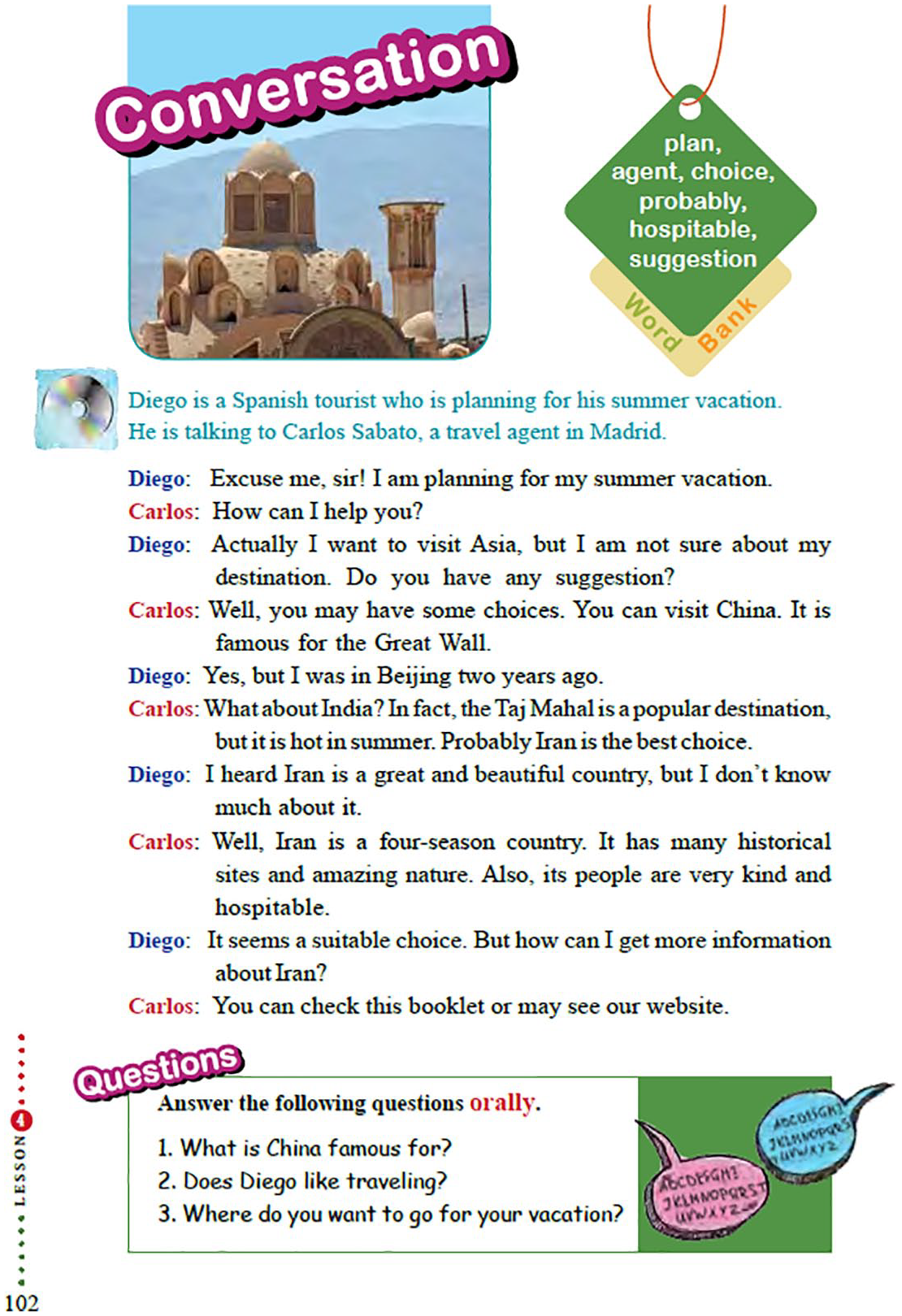
Example extracted from Vision 1, Part 2 of Get Ready of Lesson 4, ‘Travelling the World!’ (p. 102).
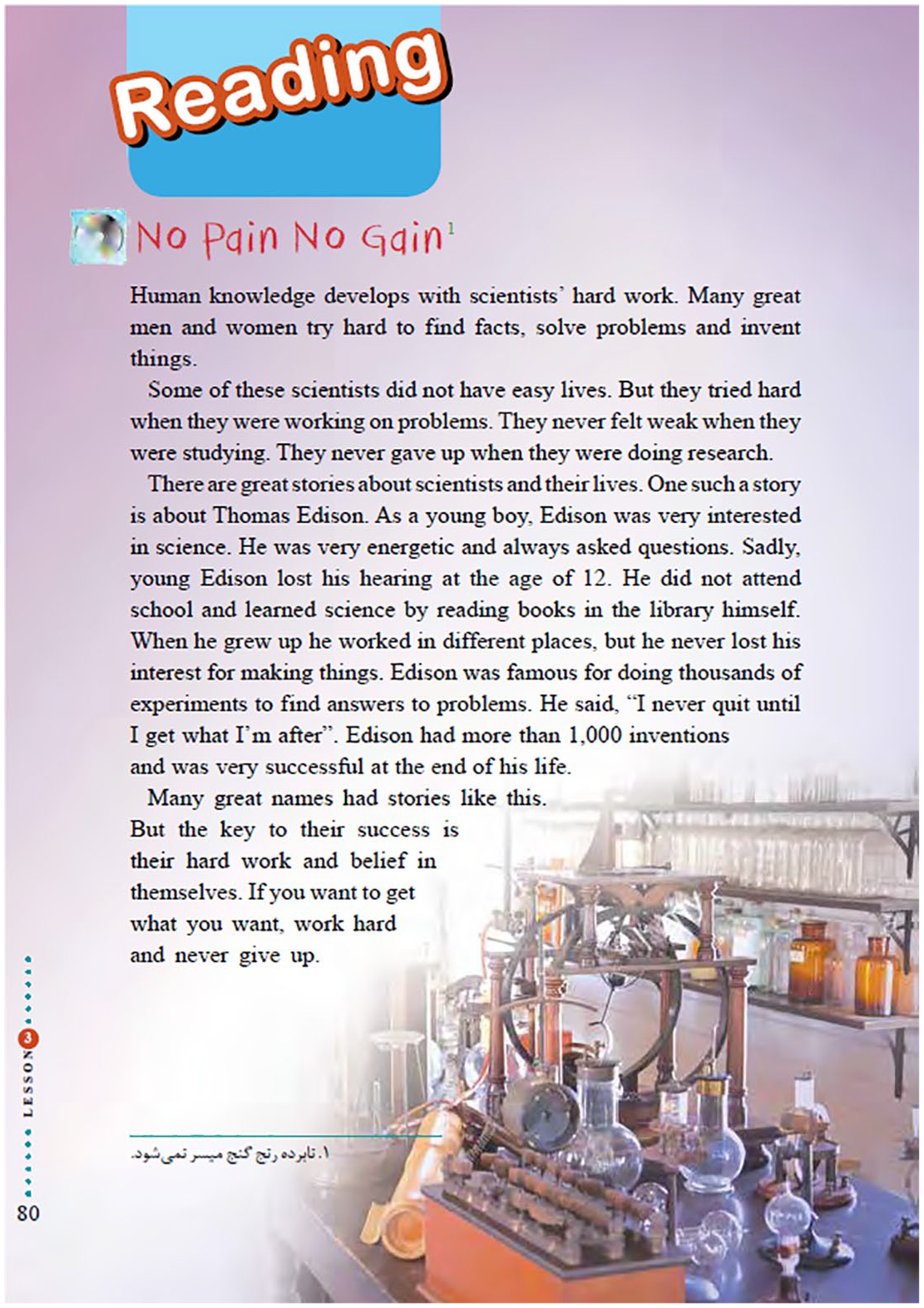
Example extracted from Vision 1, Lesson 3, ‘Value of knowledge’ (p. 80).
4 Semi-structured interviews
After signing the informed consent forms (British Educational Research Association, 2011) and assuring the participants of the ethics and confidentiality issues, the one-to-one semi-structured interviews, each lasting between 20 to 40 minutes, were conducted through an online platform, called Adobe Connect Software. Before the interview sessions, the researcher briefed the participants on the meaning of cultural, intercultural, cross-cultural, and transcultural issues. The interview sessions were conducted virtually between the researcher and each participant because of two main reasons; first, the participants were targeted from different provinces of Iran, and second, with the Covid-19 pandemic at the time of conducting the study, virtual interviews were conducted to follow the health protocols regarding the spread of Coronavirus.
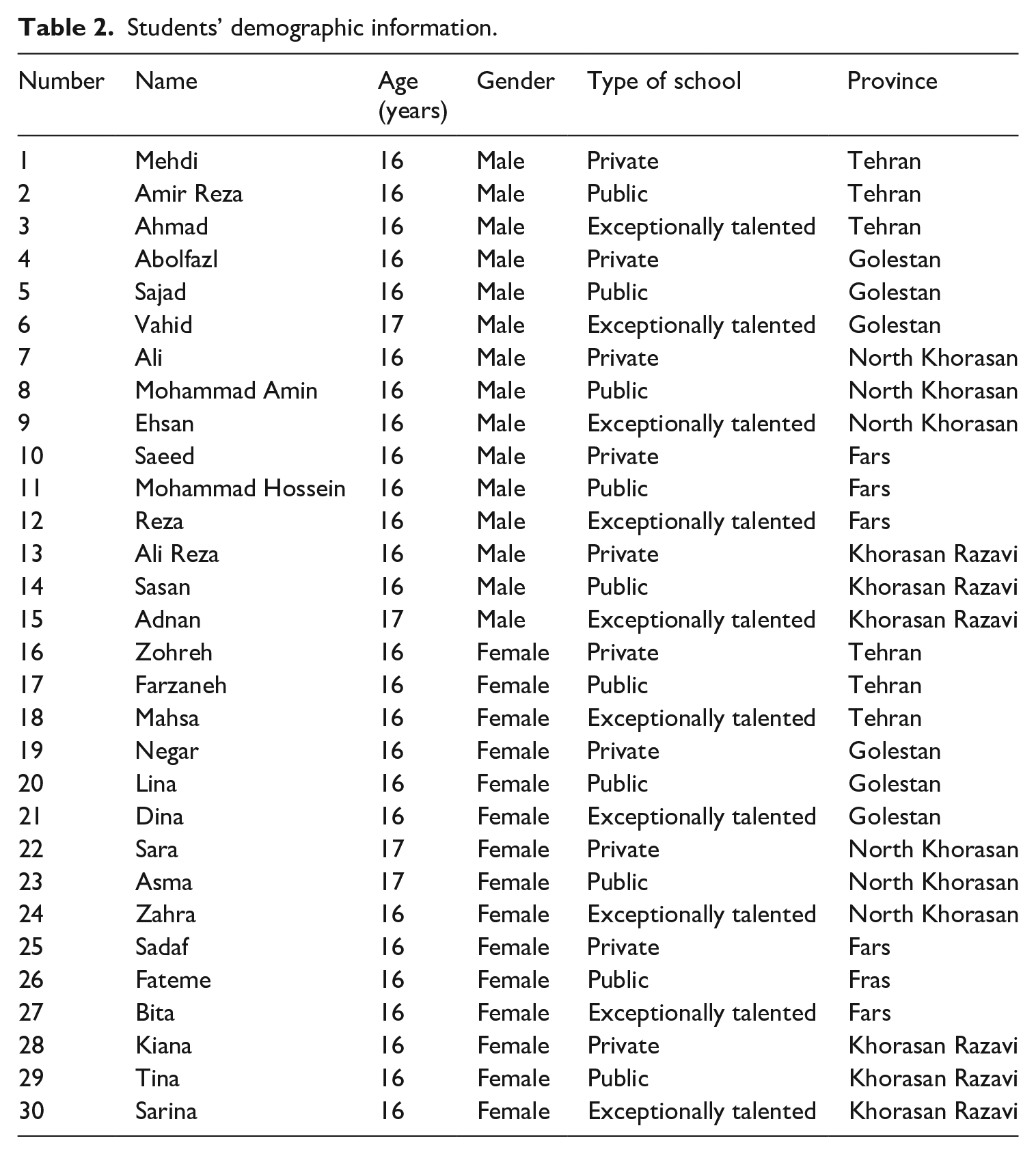
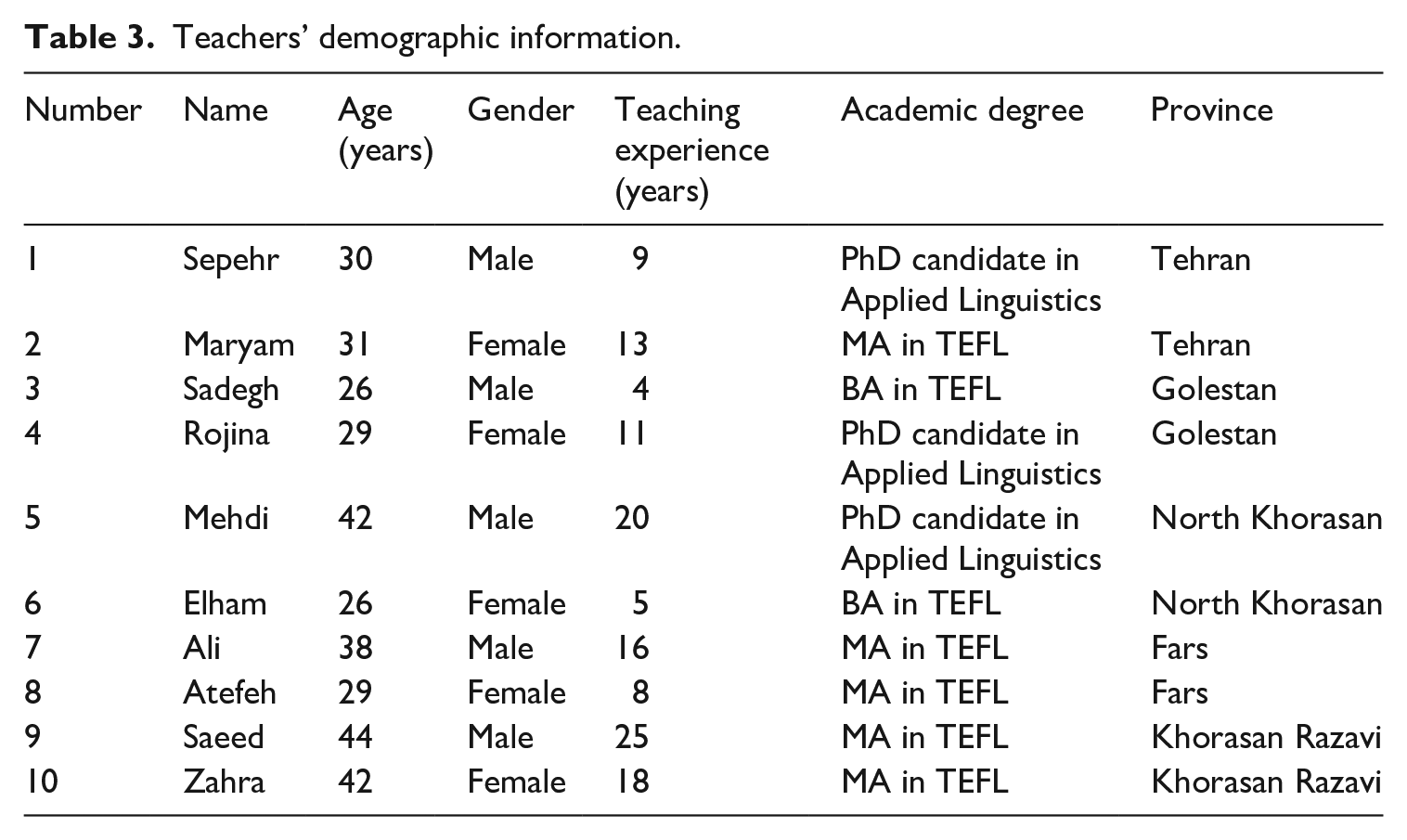
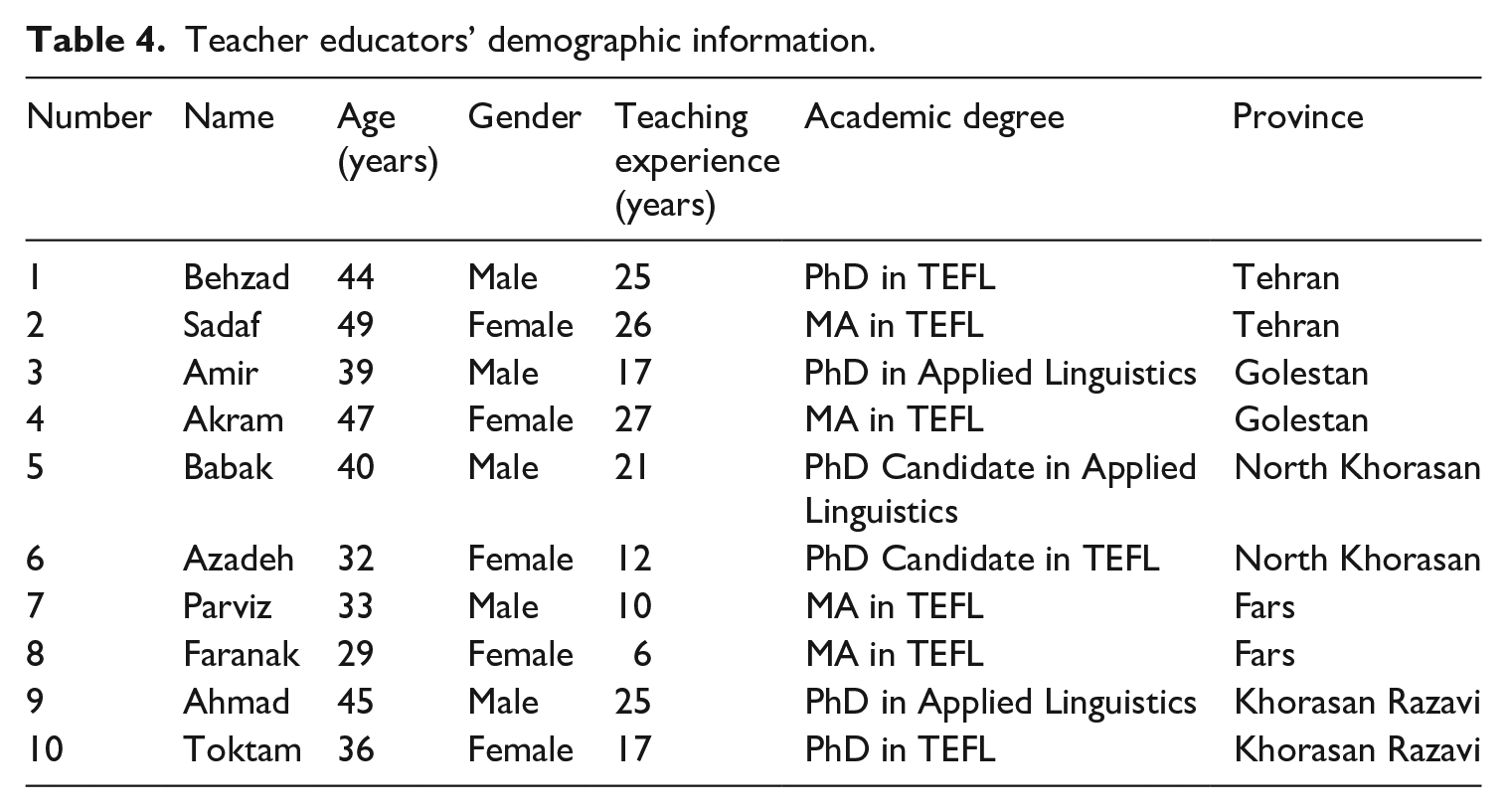
The semi-structured interviews were conducted with three groups of participants which were balanced in terms of the number of females and males. These were 30 students from each of the three types of schools from five provinces, 10 teachers, and 10 teacher educators. (See students, teachers, and teacher educators’ demographic information in Tables 2–4.)
Students’ demographic information.
Teachers’ demographic information.
Teacher educators’ demographic information.
Each teacher and teacher educator were interviewed individually. The interviews were semi-structured and the researcher used the prepared interviewed questions with some follow-up questions as needed (Appendix 1). Due to teachers and teacher educators’ sufficient level of English proficiency, the interview questions were written in English and the interview sessions were held in English. However, because many of the learner participants were not adequately proficient in verbalizing their perceptions in English, the interview sessions with learners were held in their mother tongue (i.e. Persian). The English back-translated versions of the Persian interview questions are presented in Appendix 2. The writing of the interview questions was informed by the literature on the semiotic approach for textbook evaluation. To ensure the content validity of the interview questions before running the interview sessions, the interview questions were given to two faculty members with expertise in applied linguistics. Based on their comments, some revisions were made to the content and the number of questions accordingly.
Each interview session was recorded, and the oral data provided by the participants were transcribed verbatim for further content and thematic analysis. It should be noted that, as the interviews with students were conducted in Persian to avoid any ambiguities, the students’ interview data, which were originally provided in Persian, were first transcribed in Persian and then back translated into English.
During the interview sessions, the participants were given three images and asked whether the image, text, and tasks were related. The researcher’s concern here was to explore not only the participants’ perspectives regarding why a particular image is required pedagogically, and if it is possible to do without it, but also to find out whether the image has successfully accomplished its mission and objective; that is, to what extent it contributes in making the students culturally aware. Moreover, the three groups of participants were asked to suggest some other images which would be more appropriate to understand the text better, perform the task more efficiently, and would lead to more cultural awareness. The students were also asked whether and to what extent their teachers spent time discussing cultural beliefs, facts, and artifacts. The teachers and teacher educators were also asked to what extent they prioritize culture learning and cultural awareness in their classes, and whether there is any room in the design and implementation of the book to facilitate students’ cultural and intercultural competence.
5 Content analysis of the textbook and interview analysis
According to Cole (1988), content analysis is a method of analysing visual, verbal, and textual communication messages. In other words, artifacts of social communication are investigated in content analysis (Berg, 2001). In the current study, content analysis was done on qualitative data obtained from different modes of communication (i.e. textual, verbal, and visual). As pointed out by Merriam and Tisdell (2016), using multiple sources of data in qualitative studies aid researchers to enhance the trustworthiness of their findings. The units of analysis encompassed image(s), text(s), and the accompanying pedagogic tasks. Deductive content analysis is employed when the structure of the analysis is operationalized on the basis of a theoretical perspective (Abrahamson, 1983). Deductive content analysis of the three images in this study was informed by the tenets of the semiotic approach in textbook evaluation so that the two tasks were analysed to see whether they reflected and could be coded based on the two criteria of the ‘text-task-image’ co-instantiation and the indexical relationship. To capture the complex nature of semiosis and to add to the findings obtained from image analysis, tasks accompanying the images and interview data were inductively analysed. Therefore, in line with what the semiotic approach advocates, the researcher performed the concomitant analysis of the text, image, and task.
No matter whether one employs inductive or deductive content analysis, the process involves three main phases of preparation, organization, and reporting. However, it should be noted that no systematic principle or procedure exists for analysing data. As announced by Weber (1990), the common point in all content analysis studies is that they categorize the many words of the text into reduced content categories. In analysing the interview data, only manifest content was considered for analysis, and the latent content was disregarded as it was assumed that only what the participants verbally articulated were significant to the study. The unit of analysis for interview transcripts was at the sentence level. As put by Berg (2001), content analysis is the most prevalent way of analysing interview data. In line with the suggestion of Creswell (2014), MAXQDA software (Version 12) was utilized to transcribe, analyse, verify/explore, and report the recurring patterns in the interview data. Content and thematic analysis of the interview data was emergent in nature as data analysis was not influenced by any theoretical framework. Such an inductive content analysis initiates with the observation of specific instances and moves, combining them into more general patterns or themes (Berg, 2001). Put it differently, in inductive content analysis, to explore the themes from the data, the researcher immerses him/herself in the documents or any type of communication message which is under investigation (Abrahamson, 1983). The analysis started with open coding, generating categories, and then moving to abstraction (Dey, 1993). In this regard, all teachers, students, and teacher educators’ interview transcripts were inductively coded. In doing so, the researcher tried his best to bring as many codes as possible, being near to the data to truly reflect the participants’ own perspectives. This type of coding is referred to as emic coding through which ‘researchers draw the meanings directly from the participants’ perspectives and the cultural scene. The coding is grounded in the data gathered’ (Peterson, 2017, p. 2). Subsequently, by grouping similar codes with each other, common patterns or categories were extracted from each group of codes. Finally, three overarching, broader, and salient themes, which were grounded in and drawn from the data, were extracted and discussed in relation to Image 1, Image 2, and Image 3, and their corresponding tasks. To ensure the trustworthiness and credibility of the obtained data, first of all, all the data gathered in this study was coded by the present study researcher. In this section, the researcher tried to explain in detail and rationalize all the decisions made and the steps taken with regard to data coding and data analysis as such detailed records help to ensure confirmability of data and findings by other researchers (Nassaji, 2020). Subsequently, two PhD holders in applied linguistics, who had expertise and experience in conducting and analysing qualitative data, independently checked 30 percent of the data. There was complete agreement in the coding of data between the coders. Triangulation by the presence of multiple researchers working to collect or analyse data increases the credibility of the obtained findings (Merriam & Tisdell, 2016). This strategy helps ensuring that the results are not simply an artifact of an individual investigator’s arbitrary choices or a single source (Patton, 2015).
On the whole, in this methodology section, the researcher attempted to offer a comprehensive explanation of the data collection and analysis process. When qualitative researchers detail the data collection and analysis process and explain the extracted categories and themes through sample evidence in the form of participants’ quotes, they make strides toward increasing the dependability and consistency of their results (Creswell, 2014). The principle of dependability, being a qualitative counterpart of reliability in quantitative research, displays that when detailed documentation of each stage of the study is presented, other researchers could reach a similar interpretation in case they review the study data (Nassaji, 2020). Another rationale behind providing a detailed explanation of research assumptions and activities of the present study was to ensure the transferability principle, being the qualitative counterpart of generalizability in quantitative research. According to Nassaji (2020), for the researchers’ conclusions and interpretations to be transferable to other similar contexts, researchers are advised to provide a thick description of their research activities and assumptions.
IV Findings
Results of analysis for Image 1
a Indexical relationship between the image and text and the lack of image-text-task co-instantiation
Figure 1 is extracted from Vision 1, Get Ready section of Lesson 4 (p. 101), ‘Travelling the World!’ Content analyses of Activity A in Part One indicated four images portraying traveling, and students are given instruction to match ‘the pictures with the words’. In Activity B, on the same page, students are instructed to complete ‘the sentences with the above words’. The interpretative anchoring of the images is instantiated when students are instructed to match linguistic terms (pilgrims, booklet, sites, and vacation) with their appropriate photos, indicating that the link between text and image is indexical. In this picture, the meaning of a linguistic form, for instance, pilgrims, is inferred with reference to the extra-linguistic context; in this case, the picture of Imam Reza’s Holy Shrine accompanies the word in close proximity. This finding indicates that the semiotic relationship between the image and text is oftentimes indexical: text and image are denotationally linked.
The testimony of the indexical relation between the co-deployment of linguistic and visual resources in Vision 1 is further entrenched, in Activity B, through the shared denotation and the creation or reinforcement of lexical meaning when students are asked to complete the sentences with the words they have practiced in the previous activity (see Figure 1). Activity B relates the four images to a more denotational meaning, where each picture aims to move toward a complete focus on form. The students, teachers, and teacher educators stated that some of the pictures in Figure 1 have not been appropriately selected, which can suppress the meaning-making process and even constrain the indexical relation between the words and images.
All teacher educators unanimously mentioned that the word calendar is poorly chosen to represent the indexical relation between the image and the word vacation. For example, Amir, a 39-year-old teacher educator, stated that: ‘The calendar may not that much help learners to think of the word vacation. As to ‘vacation’, the relevant picture could be coupled with a picture in the target language to convey the same message in the target language/culture.’ Maryam, a 31-year-old teacher, suggested that ‘For the word vacation, the picture introduces a calendar rather than vacation. If the vacations were zoomed in in some way, in my own opinion, it would be clearer.’
The interviewees also argued that the image for pilgrims is flawed on two grounds. It represents a holy shrine more than pilgrims. Students, teachers, and teacher educators suggested that a picture of Mecca could make learners more culturally aware. In Iran, there are different religious groups such as Shia and Sunni, and Shia people may prefer Imam Reza Holy Shrine, but the picture of Mecca shows no boundary across Muslim groups around the world (See Appendix 3 for more interviews related to Image 1.)
b Alternative, more culturally engaging images
With respect to Figure 1, another theme emerging from the interviews with the participants revealed some alternative images and words that can make students more culturally engaged and aware. These images can go beyond the guided semiosis and indexical denotation. The suggested alternative images include travel agency, tour guide, tourists, historical monuments, tourist attractions, airport, Mecca, Kaaba, and Church.
Results of analysis for Image 2
a Indexical relationship between the image and the text
Figure 2 was extracted from Part 2 of Get Ready section of Lesson 4 (p. 102), ‘Travelling the World!’ This example shows a dialog between the tourist and the travel agent. Diego, a Spanish tourist, is seeking some information about the Asian countries. Moving through the lines of the conversation, Carlos, the travel agent, suggests visiting ‘the Great Wall of China’. Moreover, Carlos recommends visiting ‘the Taj Mahal’. It seems that in this part of the textbook, some images could have been added about the Asian continent, such as the ‘Great Wall of China’ or ‘the Taj Mahal’ to enhance students’ transcultural awareness, negotiation, and interaction. In fact, no image is portrayed to make the link between the visual and textual elements of this conversation to augment students’ cultural and transcultural awareness and interpretations.
Moreover, with regard to the interview findings, for instance, one of the students, Abolfazl, asserted that ‘As far as I’m concerned, this image shows a historical place which bears no relation to the text.’ Another student, named Hadyeih, also voiced the same opinion ‘This picture depicts a castle or a house of worship which is not related to the text of this conversation which talks about the Taj Mahal, Great Wall of China, and Iran’s historical sites.’ Adnan was on the same page with the other students when he raised his skepticism about this place by saying that ‘It is an ancient place which probably belongs to Iran.’
It seems that the aforementioned lack of interrelationship between the image and text is supported by the results of semi-structured interviews. It was revealed from the interview findings that some of the students are not even familiar with their own national culture, so textbook developers are required to incorporate some more germane pictures to pair them with the texts and tasks. And it is the teachers’ responsibility to make students aware of their cultural and religious heritage by bringing some supplementary and authentic materials to the class. Moreover, interview results evinced that students are not genuinely engaged in the reciprocal world of sign relations because the teacher and textbook restrict and control many of their decisions and cultural awareness. It is understood that some of these images have either minimal textual references or such references oftentimes lack specificity and, hence, primarily function as decoration.
b Lack of image-text-task co-instantiation
Amin, a student, articulated that: This image has nothing to do with the conversation, and unfortunately there is no link between the image and these three questions because question 1 is about China, but this image is probably from Iran, and Question 2 is about Diego, yet no image is given here to help me answer this question as well. The third question is a general question about whether I like traveling or not. I wish there were more sample images about historical sites or tourist attractions so that I could talk about them.
Teachers and teacher educators mentioned that there is no link between the image and the follow-up questions. Toktam, a 36-year-old teacher educator, argued that: Unfortunately, the image seems to be just decorative. There is no link between the image and text, nor is there any link between the image and task, and even worse, the text cannot help you much to answer the questions because they are general questions.
For more interviews related to Image 2, see Appendix 4. As rightly expected by students, signs and sign complexes in EFL textbooks need to be specifically accompanied by explicit instructions as to how they could be construed. Figure 2 clearly elucidates that visual and textual elements are not in conjunction with tasks. This postulation is further substantiated by the interviewees’ perspectives.
c Alternative, more culturally engaging images
The interviewees suggested some other, more culturally engaging images such as the Great Wall of China, the Taj Mahal, a travel agency, a map of the Asian countries or other continents, Perspolis, Mount Bisotoun, the Hafiz or Sadi tombs, a four-season picture of Iran, happy and hospitable people, Si-O-Se-Pol Bridge, Ghabous Tower, Ali Qapu Palace, Golestan Palace, Pasargadae, and Arge-e-Bam.
Results of analysis for Image 3
a Indexical relationship between the image and the text
It is not clear how language students interact collaboratively with the texts and images to perform the pedagogic tasks to deepen their understanding of global cultural awareness. One such a tangible example is illustrated in Figure 3, extracted from Vision 1, Lesson 3, ‘Value of knowledge’ (p. 80). The image is irrelevant not only to the idiom, which is the title of this reading, but also to Edison’s biography. As can be seen, barely is there any link between the image and text, so the students can go through the reading comprehension questions without any reference to the image.
b Lack of image-text-task co-instantiation
Amir, a teacher educator, expressed that: I’m afraid the picture is irrelevant to the reading and follow-up questions. The lesson is about hard work, resilience, and perseverance for which Thomas Edison’s chronicle is exemplified. Yet, the picture is just a snapshot of a laboratory by which hardly can one infer the message articulated in the passage.
Zahra, a teacher, voiced her concern by saying that: The picture is minimally related to the reading and the follow-up questions. The passage is mainly about Edison and where he worked (laboratory), but you can find no trace of Edison or laboratory or his main invention, the electricity. As mentioned, only exercise 2 in section A could be said to be related to the picture.
It seems that in their involvement with the semiotic resources available in this close-ended activity, students are not allowed to voice their own ideas, experiences, and beliefs and react to others’ views to negotiate potential differences and create cultural and social repositories. Students, teachers, and teacher educators’ viewpoints confirm lack of co-instantiation across the image, text, and task.
My main concern with this image was how the image could help teachers to activate their students’ content schemata due to lack of relationship between the image and the students’ background knowledge and authentic activities. The reading activities can be completed under teacher control, and there is nothing unpredictable for students to reflect and negotiate. Had the task included, for instance, images of Edison, light bulb, his creations, etc., not only would students’ knowledge and vocabulary have been activated, but also students would have been more critically engaged in the reflective and interactive discussions to create potential cultural meanings.
Figure 3 represents an example of guided semiosis, which curtails potential cultural meanings (i.e. denotational indexicality), not prompting students to be actively and critically involved in meaning-making processes and cultural reflection inasmuch as the fact that the process of the three follow-up tasks on page 81 is linear. This linearity sounds to be far from the genuine reality of how learning, a dynamic and multifaceted phenomenon, takes place in a spontaneous context since students are simply asked to answer a set of close-ended comprehension activities. I argue that without the constraints of these multiple-choice, True or False, and matching questions, which steer students’ focal attention to the sole grammatical and lexical features to be mastered, teachers as facilitators of cultural explorations should encourage unpredictability and let the spontaneous meaning-making process emerge.
Sadegh, a teacher, asserted that: ‘In my opinion, the picture may help students answer only exercise 2 in section A which is related to experimentation. It seems that other exercises are not related to the picture.’ Sadaf, a teacher educator, mentioned that: ‘Given that the two elements, i.e. passage and picture, remain rather unrelated, one can refer to the text to answer the questions. There is also a potential risk of students being misled by the picture.’
Furthermore, in the following pages, no activity relates the text and the image to the cultural issues. In this regard, Figure 3 and Figure 4 illustrate that the didactic filter of the close-ended focus-on-form task of reading comprehension questions inhibits the process of unguided semiosis and does not allow language learners to voice their spontaneous reactions and to explore the cultural meaning potential of the activity. (For more interviews related to Image 3, see Appendix 5.)
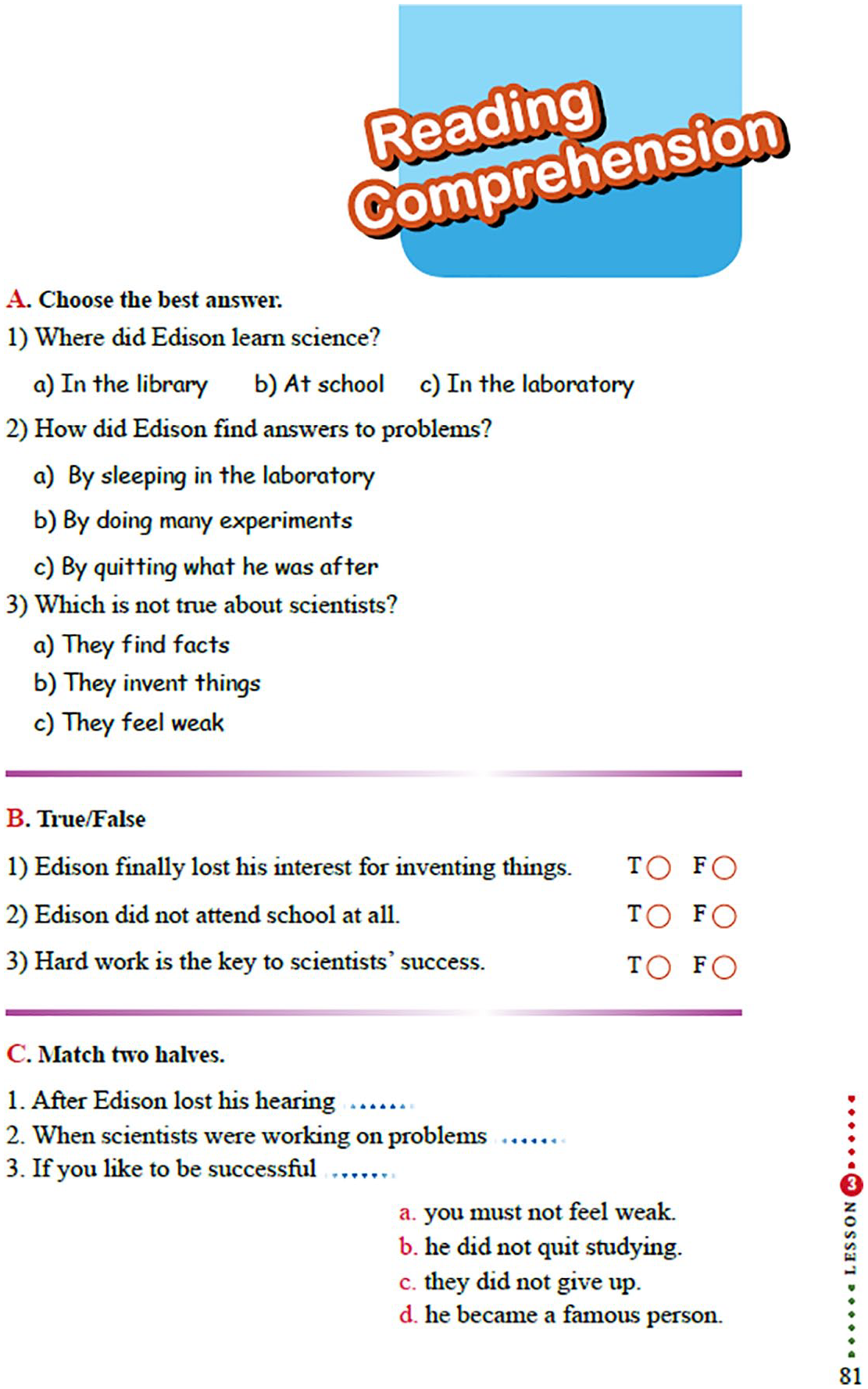
Example extracted from Vision 1, Lesson 3, ‘Value of knowledge’ (p. 81).
c Alternative, more culturally engaging images
The interviewees recommended that some images could make the image-text-task triad more interrelated. These images could be the portrait of Edison, electricity, a light bulb, a laboratory, and Edison’s inventions.
V Discussion
The primary goal of this article was to illuminate how image, text, and task concomitantly construct and reconstruct potential cultural meanings through the process of semiosis. Although Vision 1 contains some fragments of culture infusion, particularly the local culture, and passages from famous people such as Tahereh Saffarzadeh and Alexander Fleming, and tourist destinations from other countries, including, Brazil, Chile, China, France, Egypt, Italy, Japan, and Spain, they are not sufficient because, as the interview results documented, scarcely are such instances paired with tasks to trigger students to reflect and create multicultural awareness. This was in line with Kramsch (1987) and Canale’s (2016) supposition that, despite their potentials, textbooks mainly fail to result in an understanding of cultural diversities and at the same time appreciation of one’s own and other cultures. Unfortunately, in such contexts, cultural awareness and culture teaching are most likely to solely prompt and perpetuate stereotypes rather than challenge or reflect on them (Davidson & Liu, 2018; Weninger & Kiss, 2013). This is in sharp contrast with the recent advocacies for the ultimate responsibility of teachers and learning materials as developers of learners who are conscious, intercultural, critical, and global citizens of the world (Byram, 2011; Davidson & Liu, 2018; Fang & Baker, 2017; Huh & Suh, 2017). In such discussions, teachers function as facilitators aiding the students in the ‘recognition, exploration, and reflection’ process (Tseng, 2002, p. 16).
Drawing on the semiotic approach, the first theme extracted from the analyses was that the co-instantiation of the image and text is mainly denotationally indexical, where text and image are merely used as a linguistic resource, leaving cultural awareness and connotations almost untouched. This was in line with the findings of previous studies revealing that scant attention has been paid to cross-cultural understanding and intercultural skills in educational policy of Iran, in general, and in many EFL textbooks taught in this system, in particular (e.g. Ahmadi Safa et al., 2015; Hayati & Mashhadi, 2010; Razmjoo, 2007). In a similar vein, Borjian (2013) has declared that in Iran, the national English curriculum gives priority to syntactical, phonological, and morphological dimensions of the language while considering its sociocultural aspects as unsuitable to be taught. This notion was well reflected in Tajeddin and Teimournezhad’s (2014) findings that localized EFL textbooks in Iran are bereft of adequate reference to students’ source culture, target culture, and international culture elements.
The finding also gave credence to the previously held argument by Chen (2010), Kiss and Weninger (2016), Koulaidis and Dimopoulos (2005), Stranger-Johannessen (2014), and Tseng (2002) that the co-deployment of images and texts in the textbooks are usually denotationally indexical. This is also in line with findings of Weninger and Kiss (2013) regarding two EFL textbooks written by and for Hungarians which underscored that first, texts and images contained in textbooks typically enhance students’ linguistic competence, and second, in the classroom context, normally students’ meaning-making process is heavily guided. What Weninger and Kiss (2013) highlight is the essentiality of raising students’ global cultural consciousness and preparing them for intercultural citizenship as transformative goals which can only be maintained through designing a critically oriented pedagogy, fostering cultural understanding and reflection (Porto et al., 2017).
As referred to earlier, such a concern is attended to in the tenets of critical cultural awareness, influenced by post-method pedagogy and globalization issues (Matsuda, 2018) and emphasizing the essentiality of a critical understanding of intercultural competence for successful communication in English for learners as well as English teachers’ professional growth (Guilherme, 2012). In an empirical study examining teachers’ critical cultural awareness in the context of Iran, Soodmand Afshar and Yousefi (2019) reported that Iranian EFL teachers are not adequately critically culturally aware. The authors justified this finding by explaining some reasons; first, a lack of cultural exchanges and intercultural communication in the Iranian EFL context, second, the uncritical nature of the Iranian educational context, and third, the influential role of the geopolitical, religious, cultural, and socioeconomic background of the country in ‘the process and product of curriculum development and syllabus design, and the discourse of English textbooks and even language instructional activities across the country’ (p. 15). The last reason was in line with the findings of our study and Borjian’s (2013) assertion that the discourse of brand-new Iranian localized textbooks, namely Prospect series and Vision series, leaves little space for the raise of cultural awareness and development of intercultural competence.
The second theme was that the students could perform their tasks and follow-up questions even if the pictures were not present, and there was no interconnectedness across the image-text-task triad to derive intercultural meanings and interpretations. This finding unveiled that images were used mainly as decorative elements used for filling spaces in this textbook, which is in opposition to the functional importance of images in the semiotic approach as potential presenters of cultural knowledge in concomitant of texts and pedagogic tasks (Chen, 2010; Kiss & Weninger, 2013, 2016). Hill (2003) also found that the visual elements contained in many EFL textbooks are decorative space fillers, added based on non-educational considerations such as the space left or the number of pictures that can be afforded. The inability of texts, tasks, and images of Vision 1 to interact in order to raise Iranian EFL students and teachers’ critical, multicultural awareness was also in agreement with Taki’s (2008) results that EFL textbooks taught at Iranian state-run schools are bereft of cross-cultural and intercultural elements. Soodmand Afshar et al. (2018) also evinced that Vision 1 and Prospect series are unsuccessful in enhancing metacultural and intercultural communicative competence in learners as the content and discourse of these textbooks are heavily localized, and they primarily aim to develop L2 functional and grammatical competencies. Moreover, Razmjoo (2007) asserted that although EFL textbooks taught at private language institutes in Iran contain variety and multiplicity regarding their dialogues, perspectives, activities, and content, and foster communicative competence development, their counterparts taught at state-run schools mainly lack such diversity. Similarly, Aliakbari (2004) revealed that Iranian EFL textbooks are very naïve in that they are unable to expand learners’ cultural understanding and to familiarize learners with other worldviews.
The third theme was related to the interviewees’ recommendation of alternative textbook images as supposed to be more culturally engaging than the ones already present in the textbook. Although the three groups’ recommendations showed their concern with the possibilities of integrating cultural aspects into textbooks, it should be noted that the mere replacement of existing textbook images with supposedly more culturally engaging images will not raise students’ consciousness and awareness of cultural issues that much. For them to be effective, culturally engaging images should be accompanied by teacher-student-textbook interactions on cultural representations and content with the potential to reveal diversity of cultural and linguistic influences. In other words, it is not possible to expect that just adding an image of the ‘Great Wall of China’ would enhance students’ transcultural awareness, negotiation, and interaction that much. This is because, as stated by Weninger and Kiss (2013), in the semiotic approach, teachers and students are themselves considered as signs being imbued with cultural meanings, which can potentially enhance cultural awareness when they are actively engaged in exploring and interpreting textbook elements. This is echoed in Cortazzi and Jin’s (1999) words when they say that the expectations coming from a culture of learning can be strong predictors of what happens during classroom interaction, reflecting the notion that images do not have intrinsic cultural meanings to them. Rather their cultural meanings are constantly shaped and reshaped in a particular situation through interactions of students and the teacher with the textbook elements. In this regard, language teachers and learners are themselves regarded cultural informants who bring their linguistic, cultural, ethnic, social, and religious background to the class (Kumaravadivelu, 2006) to develop multicultural knowledge through engaging with the textbook. Furthermore, what can help the facilitation of multicultural awareness and understanding in the classroom is the employment of human resources present in the classroom along with the presentation of more culturally engaging textbook elements which are developed in light of local, national, and global conceptualizations of culture (Weninger & Kiss, 2013). Based on the aforesaid, it seems that what is needed is a methodology of cultural learning in which textbooks can be regarded as a dialogic process within which the teacher and students can vicariously negotiate identity and meaning with the cultural content and the author of the textbook (Canale, 2016; Cortazzi & Jin, 1999).
VI Conclusions and pedagogical implications
Based on the findings, it is concluded that despite the indispensable role of multicultural elements in ELT programs, the texts, tasks, and images of Vision 1 have failed to fully prepare Iranian EFL students for the cultural realities of the present-day world of internationalization, multilingualism, and multiculturalism (Cenoz & Gorter, 2015). Furthermore, neither were the texts, tasks, and images meaningfully associated to present cultural meanings, nor was there a quality interaction between the students, textbook, and teacher for constructing and reconstructing cultural meanings.
The results of this study corroborated those of the previous ones (e.g. Ahmadi Safa et al., 2015; Canale, 2016; Kramsch, 1987) that acknowledged the failure of textbooks in terms of culture teaching. In the light of these findings, I devise here a practical model for the evaluation of culture representation in textbooks, as presented in Figure 5. Although this model is not prescriptive in any sense, it is hoped that it will enlighten the practice of curriculum designers, materials developers, teacher educators, teachers, and students.
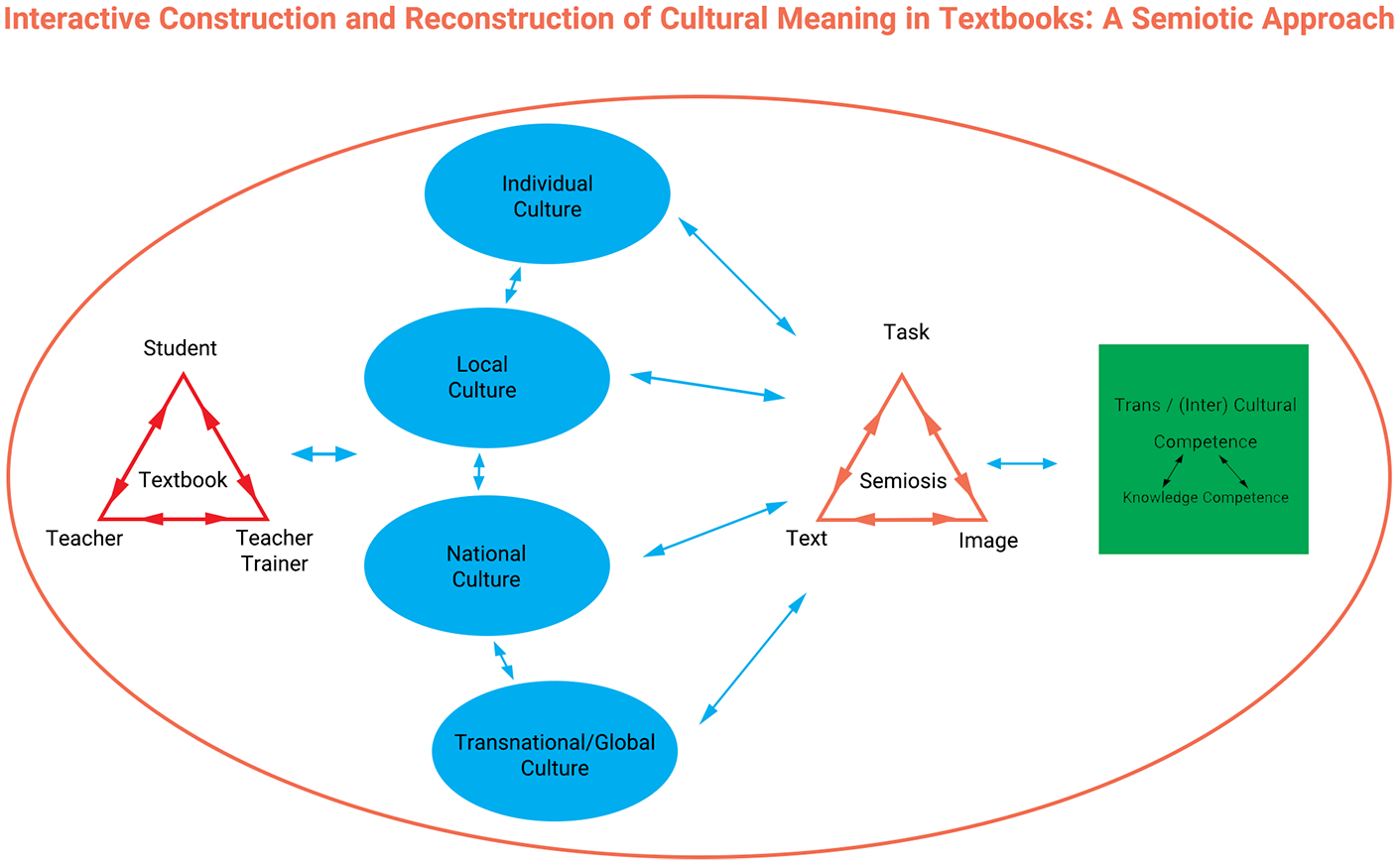
The unguided semiosis approach to culture representation evaluation in textbooks.
As depicted in Figure 5, transcultural/ inter(cultural) competence can be catered for in textbooks through attending to the interplay of individual, local, national, and transnational/global conceptualizations of culture, which can be represented in the instantiation of the text-task-image triad. Within this model, the textbook is not the conveyor of fixed cultural meanings, instead, it is a venue for the construction and reconstruction of cultural meanings through the interaction of textbooks, teachers, and students. This is what is referred to as unguided semiosis in the semiotic approach. What this model and the findings of this study document is that students, teachers, and teacher educators’ voices are fundamental to approach culture and culture learning in a dialogic, hybrid, non-essentialist, and dynamic atmosphere. These educational stakeholders can engage in emergent and negotiated interactions and discuss cultural meaning-making processes locally, nationally, and transnationally. Similarly, teacher educators and teachers can act as cultural facilitators and mediators by urging students to reflect on values, beliefs, behavior, and cultural practices and relate those reflections to other cultures. Enlightened by the semiotic approach, I, therefore, recommend that informing teacher educators and educating teachers on the evaluation of textbooks from the culture learning vantage point strengthens the quality of materials and curricula to make a solid co-instantiation of image, text, and task since they become more cognizant of their role as transformative intellectuals and critical textbook users. When gaps are identified, teachers should never be hesitant to supply extra materials to the textbooks (e.g. more expressive and relevant to texts and tasks images).
Our textbooks should be culturally responsive by developing manuals for teachers encompassing specific recommendations and extracurricular activities regarding how texts, images, and tasks can be interwoven to make our students not only linguistically proficient but interculturally competent as well. Teachers need to go beyond denotational indexicality or guided semiosis by letting their students cogitate on cultural connotations and meaning-making. Ministry of Education, language institutions, and academics need to realize that holding sustainable teacher training workshops and continuing professional development courses for pre-service and in-service teachers play indispensable roles in making them interculturally competent and aware and more importantly, able to guide their students to develop intercultural competence and awareness. This need is particularly required in the Iranian EFL context as Iranian EFL teachers are not well aware of the pluralistic conceptualization of culture and therefore do not hold high perceptions of multicultural dimensions of teaching.
One potential reason for this finding is the noticeable gap between theory and practice in teacher education programs in Iran, failing to reflect the recent research findings regarding the essentiality of integrating multicultural and transcultural awareness and knowledge into ELT programs. Another reason is the passive role of teachers as blind consumers of the knowledge and materials transmitted to them due to the presence of unbalanced power relations and outdated educational policies and practices as well as the top-down, non-collaborative, non-engaging, and non-critical nature of such preparation programs in Iran (Haghighi & Norton, 2017). In this respect, teachers are not expected to engage in research enterprise to update their knowledge-base, establish a more profound theoretical understanding of essential components of successful language teaching and learning, and finally, practice what they have theorized, which are among the main tenets of the post-method pedagogy (Kumaravadivelu, 1994). Therefore, Iranian teacher education and preparation programs and teacher training courses are advised to promote teachers’ attendance to their own professional development needs and engaging in continuing, lifelong professional growth for them to better realize their professional responsibilities, a crucial component of which is the awareness of and familiarity with recent conceptualizations of culture. In this regard, teachers can engage in various forms of research undertaking to identify cultural issues in their instructional context and become critically and actively engaged in enhancing cultural awareness and acquaintanceship of themselves and their students through maximally reflecting culture in the activities, materials, tasks, lessons, and methods they prepare and implement in their classroom.
In a nutshell, echoing Kramsch’s (1993) notion of ‘a sphere of interculturality’ (p. 205), where teachers and students are collaboratively involved in an ongoing reflection on cultural learning, I suggest that EFL curricula and textbooks need to provide a lens through which teachers and teacher educators are empowered and informed not only to provide their students with facts about local and global cultures for self-reflection and self-construction but also to enable them to critically scrutinize and construe cultural practices and meanings of local, national, and transnational cultural peculiarities.
Further areas for future research can be highlighted, in the light of the present study’s limitations. First of all, due to space and time constraints, only one textbook from the Vision series (i.e. Vision 1) was examined in this study. Future studies can focus on other textbooks (i.e. Vision 2 and Vision 3) from this series. In this study, only interview sessions were held for data collection. Future studies can add an observation scheme of how the textbook is employed in the classroom and compare the points of divergence and convergence between key educational participants’ perspectives and actual employment of the textbook in the class. Moreover, the findings of this study remained at the descriptive level of analysis due to the employed approach and focus of the study. Future studies may embark on more emancipatory discourse analysis approaches to examine the textbook. This study drew only on the Peircean semiotic theory. Future studies can focus on other frameworks for the investigation of cultural representations in textbooks. The data of the current research were collected from 30 students, six teachers, and six teacher educators. To see whether the obtained findings can be generalized to the whole population of the Iranian EFL teachers, teacher educators, and students or not, future studies are recommended to be conducted on other samples from these statistical populations.
