



Abstract
This article reports the findings of a multiple-case study on four teachers of German as a third language (GL3) at a Swedish lower secondary school (year 7). To gain a better understanding of third language (L3) teachers’ pedagogical perceptions and practices about grammar teaching to young beginners, teacher emotions are used as a theoretical frame. The data consist of individual interviews, lesson observations and immediate post-observational oral reflections that are analysed qualitatively using thematic content analysis with narrative features. The study points out the links between emotions and contextual factors inside and outside the classroom – such as time, workload, colleagues’ teaching practices as well as the motivation and attitudes of the students – and shows how these interrelatedly have an impact on teachers’ thinking, beliefs and instructional decision-making. Also, three narratives about teaching grammar are laid out, where the teachers themselves are passionate but at the same time display apprehensive emotions in the fear of their students not liking it as much. The findings indicate that teacher emotions about grammar – such as the tension between passion and apprehension – exert important influence on L3 teachers’ grammar teaching practices and beliefs. Based on this, it is suggested that bridges are needed between grammar teaching in first language (L1) and L3, since the pedagogical content knowledge and the positive teacher emotions about grammar in teachers of GL3 might be powerful assets that colleagues of other language subjects could also benefit from.
Keywords
I Introduction
In Sweden, the most commonly studied second foreign languages (or Modern Language as the subject is called) in compulsory schools are, in order of popularity, Spanish, German and French, which are introduced in year 6 (Eurydice, 2023; Skolverket, 2018). As the second most chosen, German is studied by approximately 18% of the students in every cohort (years 6–9), currently some 88,000 students in total, showing a stability in the numbers over the past five years (Skolverket, 2023). However, being considerably less popular than Spanish, both German and French are currently at risk of not being offered as a language choice at many schools and in entire municipalities, particularly in northern Sweden (Granfeldt et al., 2019, p. 42). This is one example of a contextual factor at the macro level (see Bahia et al., 2013; Nazari et al., 2023), that may have an affective and emotional influence on teachers of other foreign languages than English (except maybe for teachers of Spanish 1 FL). In addition, language teachers are in general already in an emotionally more vulnerable position than teachers of other school subjects, since physical, emotional and cultural aspects of the teachers’ performance play a more central role in language teaching (Pérez Cavana, 2019, p. 3). However, this situation is by no means exclusive to the Swedish context, since the decline of the popularity of German as a foreign language at schools is reported elsewhere in the world as well (e.g. Auswärtiges Amt, 2020; British Council, 2023; Eurostat, 2023), and often coincides with an increased popularity of Spanish as the preferred choice of foreign language. Consequently, it seems plausible to assume that working as a teacher of German as a foreign language (in Sweden, as well as in other countries) may in some cases lead to feelings of professional isolation, notions of working in a disadvantaged subject field, and anxiety about the future of the profession and one’s career.
Dissatisfaction with work, excessive workload, low salaries and an overall low status of their subject are other examples of potential sources for negative teacher emotions, as reported in survey studies with third language (L3) teachers in Sweden in the past years (Erickson et al., 2018; Lärarnas Riksförbund, 2016; see also Bardel et al., 2019). Furthermore, a recently published inspectorate report (Skolinspektionen, 2022) arrived at the conclusion that two thirds of the reviewed compulsory schools in Sweden displayed shortcomings in their L3 teaching conditions. Problematic areas pointed out are, for example, solitary working conditions, where L3 teachers do not have colleagues teaching the same language subject and insufficient access to subject-specific in-service professional education. The latter is considered by some to be related to the low status of second foreign languages as a school subject, in contrast to the strong position of English in school and society generally (see Bardel et al., 2023; Phillipson, 2008). The low status is also assumed to be one of several factors driving Swedish L3 students to drop out from the Modern Language subject (see Granfeldt et al., 2019). Interestingly, there are even accounts of language teachers encouraging students to abandon the L3 studies as a means of coping with unmotivated students in their language classes (Skolinspektionen, 2010, 2022; Tholin, 2019). In the specific case of German, another consequence of the low status is the low number of students at Swedish universities who study for a teacher’s degree today (Fredriksson & Rosén, 2020). This circumstance is not exclusive to the Swedish context, given the hardships to recruit and train future teachers of German reported in various countries, such as France and the UK (Education Committee, 2024; Noll, 2022). Based on these similarities, the research interest of the present study might therefore have relevance for German teaching and/or foreign language education in other countries as well.
In light of the above, this ethnographically inspired study, based on semi-structured teacher interviews, classroom observations and teachers’ post-observational reflections, is part of a research project 2 on grammar teaching to young beginners (age 13–14 years) of German as a foreign language at four Swedish lower-secondary schools. Because German is practically always introduced after English in Swedish schools, as in many other parts of the world, the term German as a third language (henceforward abbreviated GL3) will be used in this study. 3 With the overarching aim to understand what shapes Swedish GL3 teachers’ perceptions and practices when it comes to teaching grammar to young beginners, an analytical emphasis has in this study been placed on the role of teacher emotions (Barcelos & Aragão, 2018; Chen & Cheng, 2022; Golombek & Doran, 2014; Sutton & Wheatley, 2003; Zembylas, 2004). Given the theoretical viewpoint that emotions are rooted in the social, cultural and political environment and influence actions (Benesch, 2019; Chen, 2016; Her & De Costa, 2022; Jiang et al., 2021; Nias, 1996; Scherer & Moors, 2019; Song, 2016; Yin & Lee, 2012), teacher emotions are here seen through the lens of the contextual factors that frame the GL3 teaching practice. The present article suggests that such factors, occurring and operating on various levels, give rise to pedagogical emotions, i.e. emotions that might impact teachers’ pedagogical decision-making (Sheppard & Levy, 2019, p. 197), and that they ultimately have an impact on teachers’ cognition, pedagogical beliefs and practices (see Borg, 2006, 2011, 2019; Johnson, 1994; Pajares, 1992; Phipps & Borg, 2009).
Language teaching is an emotionally and situationally sensitive domain (Barcelos & Aragão, 2018), where a focus on the interplay of context and emotions can be a means to better understand language teachers’ professional life stories and pedagogical approaches, as well as the tensions that might exist between their stated beliefs and actual practices (see Phipps & Borg, 2009). As the results presented in this article show, there are affective and emotional elements related to GL3 teachers’ perceptions and beliefs about the instructional context and subject-matter specific content (e.g. grammar), suggesting such elements should be considered in research on language teachers’ pedagogical and professional knowledge (see Johnston & Goettsch, 2000; Shulman, 1986, 1987; Watzke, 2007). This accentuates the need for a closer inquiry into subject matter-specific emotional responses in teachers (see Sutton & Wheatley, 2003). Although based on a case study in Sweden, the implications of the findings can be relevant for foreign language teaching in other countries as well, where interest for studying other languages than English is generally low, and attracting and retaining language teachers, especially of German, in the profession often poses an educational challenge (Education Committee, 2024; Noll, 2022).
II Theoretical framework
In this article, emotions are defined as ‘multicomponent changes in an organism’s psychophysical system that occur in response to events or situations important to the organism [where the changes] can comprise affective, cognitive, physiological, motivational, and expressive-behavioral components’ (Pekrun et al., 2023, p. 146). The study departs from an ecological perspective (see Bronfenbrenner, 2005; van Lier, 2011), in which the interaction between the organism (i.e. the teacher) and the social environment (i.e. the teaching context) to which the organism responds (see Benesch, 2018, 2019; Scherer & Moors, 2019) is central for the conceptualization of teacher emotions as a powerful source of influence on pedagogical behavior (Borg, 2019), as well as for excitement, enthusiasm and enjoyment in and about teaching (Frenzel, 2014; Zembylas, 2004). In the data of the present study, teacher emotions (Chen & Cheng, 2022; Frenzel, 2014; Sutton & Wheatley, 2003) are identified and interpreted among those utterances that have an affective dimension, i.e. where the participants express subjective beliefs and opinions about aspects of the instructional context that have an emotional impact on their work as GL3 teachers. This is in line with the heuristic for identifying emotional content in teachers’ narratives by focusing on affectively charged lexis that indicates stance, epistemic adjectives and metaphors, as proposed by Golombek and Doran (2014, p. 106).
A central assumption in this article is that teachers’ emotional responses to contextual factors, as well as emotions related to a specific teaching area, have an important impact on their beliefs, instructional decision-making and pedagogical practices. Contextual factors are here conceptualized both as the classroom-external frame factors that give social actors in education space for agency (Lundgren, 1972, 1999; see also Persson, 2015), such as time, group sizes, school organization and the demands of the curricula, and classroom-internal factors, that is, the presence of students as social actors, with sets of beliefs, attitudes, motivations and actions that they bring to the teaching situation. Hence, it is suggested that the students’ attitudes towards the teaching content, e.g. grammar in GL3, is another central contextual factor that can lead to emotional responses in teachers, caused by the interaction with the social environment.
1 Teacher emotions and their interplay with context
Emotions are part of a complex web of teachers’ practical knowing (Golombek, 1998) and have, as such, a natural place in research on teachers and teaching. They are an integral part of classrooms, teaching practices and of teachers’ lives and worlds (Benesch, 2018, 2019; Her & De Costa, 2022; Sutton & Wheatley, 2003; Zembylas, 2004). As a psychological subsystem, teacher emotions influence and interact with teachers’ cognition, behavior, motivation and formation of identity (Borg, 2019; Dörnyei, 2009; Frenzel, 2014; Golombek & Doran, 2014; Oxford, 2021; Reio, 2005; Sheppard & Levy, 2019; Song, 2016; Sutton & Wheatley, 2003). Consequently, teaching and emotions are ‘deeply interrelated in complex ways, both epistemologically and constitutively’, as Zembylas (2004, p. 198) points out. However, due to the complexity of the concept and a lack of theoretical agreement across disciplines, teacher emotions have been difficult to define in the research literature (Barcelos & Aragão, 2018; Chen & Cheng, 2022; Uitto et al., 2015).
As an educational research field, teacher emotions gained attention in the 1990s, whereas a specific interest for the affective and emotional aspects of language teachers’ professional lives developed in the mid 2010s (Barcelos & Aragão, 2018; Barcelos & Ruohotie-Lyhty, 2018; Chen & Cheng, 2022; Cowie, 2011; Golombek & Doran, 2014). This development is in line with the ‘affective turn’ (Pavlenko, 2013) away from a merely rationalist viewpoint on teaching that excludes emotional aspects of labor (see Noddings, 2016; Rose, 1983). The turn reflects an increased research interest in emotional and motivational factors in foreign language teaching and learning in the past decades. A recent overview of studies on teacher emotions shows that two thirds of the published research come from 10 countries, where the list is headed by the USA, Australia and Germany (Chen & Cheng, 2022). The development of the field across subject areas and geographical contexts has shed light on the impacts of local cultures and social environments on teachers’ emotions (Chen, 2016; Jiang et al., 2021; Sheppard & Levy, 2019; Yin & Lee, 2012), not the least in the domains of language teaching in various parts of the world (Bahia et al., 2013; Barcelos & Aragão, 2018; Cowie, 2011; Nazari et al., 2023; Song, 2016).
Central to research on teacher emotions is the viewpoint on classrooms as emotional spaces and teaching as an emotional practice that, due to its relational nature, produces affective and emotional responses in teachers (Bress, 2006; Denzin, 1984; Hargreaves, 1998, 2000; Her & De Costa, 2022; Nias, 1996; Sheppard & Levy, 2019; Winograd, 2003; Yin & Lee, 2012; Zembylas, 2004) and requires the involvement and investment of the teacher’s full persona (Nias, 1999; Pérez Cavana, 2019). These responses are a result of the teachers’ interactions with students, colleagues, other stakeholders in and around the context, as well as with impersonal phenomena such as material conditions, policy and curriculum reforms and the context-specific instructional situations and demands posed upon them in the teaching of individual school subjects. Hence, research on teacher emotions report findings related to teachers’ well-being at work and (dis)satisfaction with the working conditions (e.g. Chen, 2016; Winograd, 2003), emotional strategies in dealing with curricular change (e.g. Her & De Costa, 2022), emotions in relation to the teaching of specific subjects, such as foreign languages (e.g. Pérez Cavana, 2019), emotions towards colleagues (e.g. Chen, 2016; Nias, 1999), and towards students and their performance (e.g. Cowie, 2011; Hargreaves, 2000; Nias, 1996; Zembylas, 2004). The latter is a salient feature found in Cowie’s (2011) results, where examples are provided of teachers expressing satisfaction in seeing their students make progress and becoming more confident and fluent in the language (p. 239).
Traditional explanatory frames of emotions would typically include a listing of discrete emotions with verbal category labels, often paired as dichotomies (Frenzel, 2014). More recent viewpoints instead regard emotions as dynamic processes occurring as responses to events in the social context and leading up to action, rather than as passive states within an individual (Barcelos & Ruohotie-Lyhty, 2018; Benesch, 2018, 2019; Frenzel, 2014; Jiang et al., 2021; Scherer & Moors, 2019; Sheppard & Levy, 2019; Sutton & Wheatley, 2003). From this perspective, emotions are embedded in sociocultural power-related phenomena that follow certain emotional rules and unspoken norms of the social context (Ahmed, 2014; Her & De Costa, 2022; Song, 2016; Winograd, 2003; Yin & Lee, 2012; Zembylas, 2004).
Furthermore, emotions could be analysed as operating on different levels within one and the same context, such as e.g. the micro, meso or macro ecologies of education (e.g. Bahia et al., 2013; Her & De Costa, 2022; Nazari et al., 2023). It is, for example, suggested that positive teacher emotions are mainly experienced in classrooms (i.e. the micro level), such as enjoyment with the teaching content and relations with the students, whereas negative teacher emotions typically stem from factors operating at the meso and macro levels, i.e. at the local school institutions or in the broader socio-political context of the educational system in question (Bahia et al., 2013; Cowie, 2011; Chen, 2016), such as heavy workload, perceptions of a low status of the subject and institutional and curricular demands. Other contextual factors affecting teachers’ work are their interactions with colleagues, school management and parents, to which teachers might have emotional responses that at the same type shape their professional and pedagogical perceptions and mediate their beliefs, values and discourses (see Chang, 2020; Hochschild, 1979; Zembylas, 2004). Consequently, this highlights the impact contextual factors from the local institutional context have on the shaping of teachers’ cognition, beliefs and instructional practices (Basturkmen, 2012; Borg, 1998, 2006, 2019; Johnson, 1994; Phipps & Borg, 2009; Richards et al., 2001; Sanchez & Borg, 2014).
2 Emotions and teacher cognition
Since previous research has clearly shown that ‘emotions hover like a shadow over the lives and work of teachers’ (Chen & Cheng, 2022, p. 418) due to the emotional demands (Chen, 2016; Yin & Lee, 2012) placed upon teachers from various stakeholders surrounding the school context, it is suggested that teacher emotions can exert a constraining effect on teachers’ pedagogical thinking, behavior and instructional decision-making (Sutton & Wheatley, 2003; Zembylas, 2004). It is, for example, shown that emotions have an influence on teachers’ instructional effectiveness and classroom management (Barcelos & Aragão, 2018; Frenzel, 2014), as well as on several cognitive functions, such as categorizing, problem-solving, goal setting, choice of teaching strategies, efficacy beliefs, and motivation in general (Sutton & Wheatley, 2003, pp. 337–340). This emphasizes the nature of classrooms as emotional spaces, in which teachers make instructional decisions guided not only by their cognition, but also by emotional considerations in their pursuit of professional fulfillment and a sense of satisfaction (Cowie, 2011; Sheppard & Levy, 2019).
The acknowledgement of the emotional aspects of teachers’ work and pedagogy, as well as the interplay of emotions and instructional actions (Barcelos & Aragão, 2018; Jiang et al., 2021; Zembylas, 2004), has also resulted in an updated view on the conceptualization of language teacher cognition as a research field and umbrella term for what language teachers ‘think, know and believe’ (Borg, 2006, p. 1), which in turn developed from the theoretical viewpoint of language teachers’ beliefs as a ‘unique filter through which second language teachers make instructional decisions, choose instructional materials, and select certain instructional practices over others’ (Johnson, 1994, p. 440). The greater role that affective components have gained in the field recently can be seen in the following passage, where one of the most influential names in the field now adopts a more holistic description of the research interest of language teacher cognition, namely: Inquiry which seeks, with reference to their personal, professional, social, cultural and historical contexts, to understand teachers’ minds and emotions [emphasis added] and the role these play in the process of becoming, being and developing as a teacher. (Borg, 2019, p. 1167)
This updated view and acknowledgement of the role of teacher emotions follows the call for an affective turn in the broader SLA field (Pavlenko, 2013), and is a central theoretical point of departure in the present article.
3 Emotions in L3 (grammar) teaching
Language teaching can be seen as having an ‘emotionally and situationally sensitive nature’ (Barcelos & Aragão, 2018, p. 507), where the teachers are in a particularly vulnerable position. This viewpoint suggests that the specific context in which language teaching is situated opens up for emotional responses in teachers that could be studied from a subject-matter perspective. One example of language teachers’ vulnerable position is the fact that they have to invest their whole persona to a larger extent than teachers of other school subjects, for example by feeling defensive when students question particular features of the target language or culture (Pérez Cavana, 2019). Another example of FL teacher-specific emotions is anxiety and doubt about non-native teachers’ own language skills when facing students with a high proficiency level of the target language obtained outside of school (Song, 2016). In the Scandinavian context, although no previous studies explicitly target teacher emotions, literature on L3 teaching and teachers contains emotional keywords which can help research uncover affective aspects of L3 teachers’ professional lives. For example, two studies by Erickson et al. (2018, 2022) on L3 teachers in Sweden mentioned ‘passion’ and ‘the joy of working with youths and passing on language’ (2018, p. 11; author’s translation), as well as ‘joy from “opening doors” and seeing people grow’ (2022, p. 180). Furthermore, an inspection report by the Swedish Schools Inspectorate targeting the teaching of modern languages echoed teachers who explicitly voiced feelings of relief when certain students dropped out of their FL classes (Skolinspektionen, 2010, p. 7).
Teacher emotions as an analytical lens can be applied to grammar teaching, where Phipps and Borg (2009) noted tensions between language teachers’ stated beliefs and actual practices (see Basturkmen, 2012). In a thesis on secondary level Spanish L3 teachers’ beliefs on grammar, Nylén (2014) implicitly touched upon teacher emotions as a factor shaping FL teachers’ perceptions of grammar teaching. In a similarly implicit vein, Haukås (2016) reported how L3 teachers in Norway wished that their students would know more grammar from previous language learning. In both studies, L3 teachers expressed uneasiness about having to start from scratch with new student groups, since these typically lack the basic elementary grammar knowledge that the teachers would expect them to have. Contextual factors like these could be seen as ‘causal antecedents of emotions’ (Jiang et al., 2021, p. 3) within the instructional frames of grammar teaching in FL and L3 contexts. In response to the constraints of factors such as group sizes, curricular demands and students’ aptitude, motivational levels and expectations, teachers might resort to certain instructional approaches to grammar teaching primarily as means of maintaining control and exercising classroom management (Borg, 1998, 1999, 2006; Sanchez & Borg, 2014; Uysal & Bardakci, 2014; Watzke, 2007).
Furthermore, it has been suggested by Borg (2006, p. 124) that teachers engage in grammar teaching ‘not because they feel it enhances language acquisition but because they feel it is something their students expect’. Previous research conducted on university courses reported discrepancies between students’ and teachers’ perceptions of grammar, suggesting that teachers tend to underestimate how much their students enjoy grammar work in class (Brown, 2009; Schulz, 1996). Literature in the field also provides accounts of teachers’ enjoyment of working with grammar instruction (Johnston & Goettsch, 2000), viewpoints that grammar work enables opportunities for more creativity in teaching (Liviero, 2017) and examples where teachers had ‘positive feelings about the role grammatical metalanguage played in L2 [second language] learning’ (Borg, 1998, p. 19). However, reluctant stances towards grammar as a teaching context are also found in the field (e.g. Watson, 2015). On this note, Askland’s (2018) study with teachers of L3 Spanish reported teachers calling for caution with grammar teaching, since one could ‘kill students with grammar’ (p. 69). This type of emotion related to grammar teaching in foreign languages can be regarded as pedagogical emotion (Sheppard & Levy, 2019), where subject matter is an ‘important context for considering teachers’ emotions’ (Sutton & Wheatley, 2003, p. 343). Just like teacher cognition in general, these emotional stances towards grammar are often retraceable to the teachers’ own previous experience as language learners (see Borg, 1999).
As seen in the literature overview, emotional and affective components can be identified in practically all work that reports teachers’ own voices about their professional life. However, few studies in the field of foreign language education explicitly set out to address teachers’ pedagogical emotions as a construct in its own right. This holds particularly true for research on grammar teaching as a teaching content and, more specifically, the teaching in L3 contexts (as opposed to the teaching of English as an L2). Hence, this constitutes a gap in the field which will be addressed in the present study.
III The research gap
A fundamental assumption guiding the present study is that there is an interplay between teacher emotions and the material and social circumstances framing the instructional context and that the interplay is important to take into consideration, given the nature of language teaching as an emotional enterprise (Barcelos & Aragão, 2018; Pérez Cavana, 2019). Hence, the following research question was formulated, with the aim of obtaining a more holistic understanding of how the mentioned interplay between contextual factors and teacher emotions shapes the participants’ perceptions and practices regarding GL3 grammar instruction:
• Research question: What role do emotions and context have in shaping German L3 teachers’ perceptions and practices when teaching grammar to young beginners in a Swedish school context?
Thus, the article specifically aims to describe the emotions experienced by teachers of GL3 in Sweden, explore how these emotions interact with their pedagogical beliefs about grammar teaching, and unravel the contextual factors that influence these emotions and beliefs.
In educational research, teachers have typically been viewed as mere providers of content and context and less attention has been given to teachers’ own affective experiences (Frenzel, 2014) about the teaching content and the contextual factors that shape the instructional context and practice. In order to better understand the instructional decision-making of L3 teachers when teaching grammar to young beginners, this article therefore addresses the beliefs and emotions about the subject and the contextual factors surrounding GL3 teaching in Sweden, where second foreign language education is a fairly underresearched area (Bardel et al., 2019, 2023; Granfeldt et al., 2019). Apart from making a contribution to the field of teacher emotions from a specific country, where there seem to be no published studies on in-service teachers (see overviews by Chen & Cheng, 2022; Uitto et al., 2015), the present study aims at showing, at a more general level, how the contextual factors and teacher emotions can interact in the shaping of teachers’ perceptions of a subject matter (see Sutton & Wheatley, 2003). As previous research has revealed, there is a clear gap in the field when it comes to the significance of the particular subject matter for teacher emotions (Uitto et al., 2015, p. 133), especially when it comes to grammar teaching in foreign languages. This will be addressed in the present article, which is based on the example of GL3 teaching and, more specifically, grammar teaching in the Swedish context.
IV Methods
In order to answer the research question, data were collected from four GL3 teachers in the middle of the academic year 2021/22. This number of participants is in line with methodological suggestions of not including too many subjects in this type of qualitative research (Trost, 2010). At the time, the participants were working at four separate public compulsory schools in urban middle-class areas in Stockholm. 4 All four schools offered German, French and Spanish as L3s and the total number of students ranged between 400 and 1,000. In order to render a rich description of GL3 teaching practices, three data types are used (see Table 2 below).
Before the start of the study, the researcher visited the schools to familiarize themselves with the local context and establish a sense of trust and collegiality with the teacher participants, as well as to inform the groups of students involved. Throughout the project, the positionality of the author/researcher was that of a colleague-insider, i.e. a language teacher who works at a similar-sized public lower secondary school and who thus understands the complexities that L3 teachers in this pedagogical context face. It was also made explicit to the participants that the researcher viewed them as the experts in the matter, given their seniority in terms of years of experience, and that their participation in the research project would, in the long run, help shed light on GL3 as a school subject in language education research in Sweden.
1 Participants
Since research in authentic classrooms often implies necessary choices based on feasibility rather than on purely methodological grounds (Borg, 2006, 2013), the four participants, henceforth referred to as Teachers A–D (see Table 1), were recruited through a purposive non-random convenience sampling (Mackey & Gass, 2016). An invitation to take part and recommend colleagues teaching GL3 was sent out to members of a local network for in-service L3 teachers, and the first four participants whose school managers granted them permission to participate were selected.
Overview of the participants.
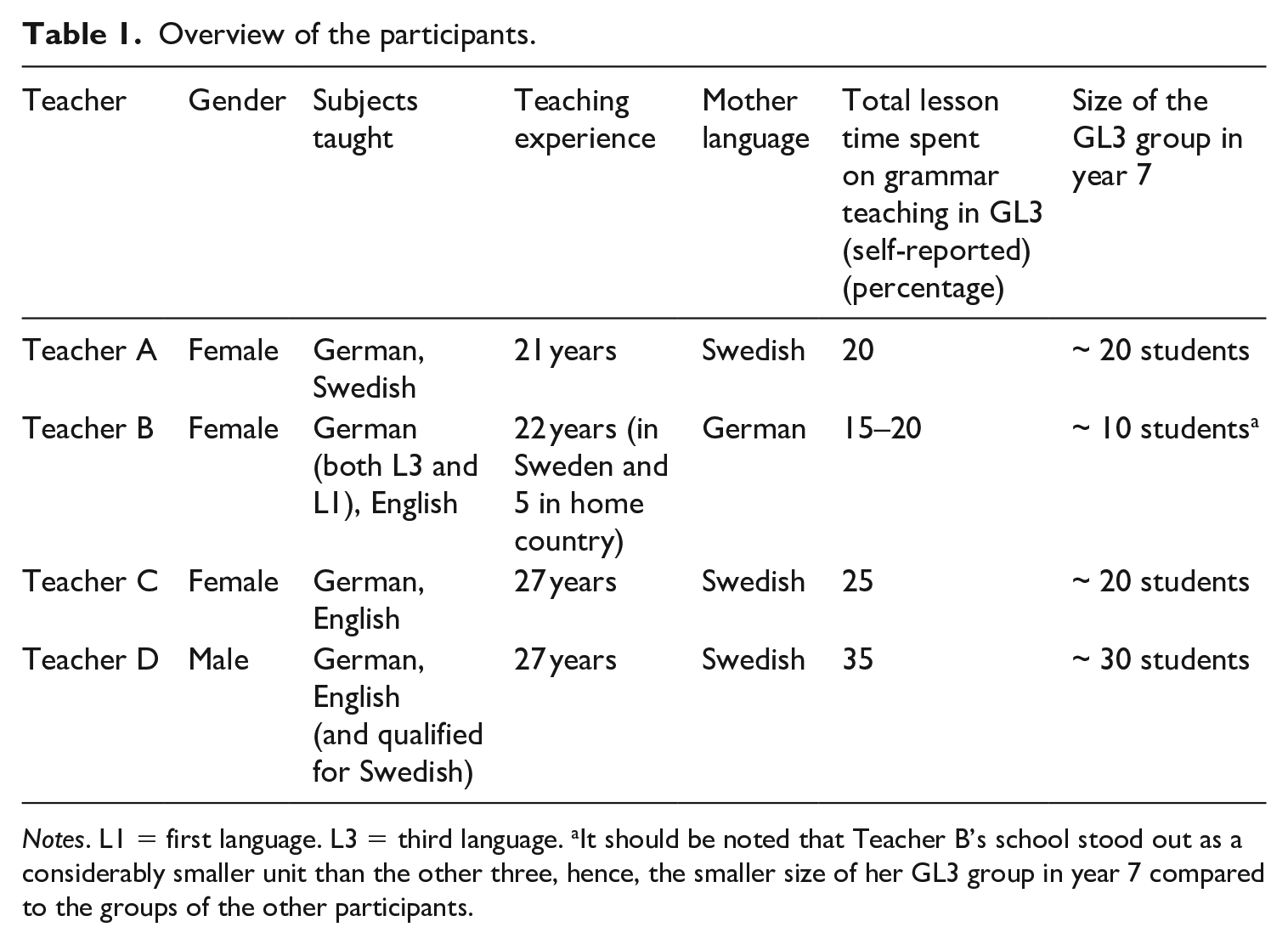
Notes. L1 = first language. L3 = third language. aIt should be noted that Teacher B’s school stood out as a considerably smaller unit than the other three, hence, the smaller size of her GL3 group in year 7 compared to the groups of the other participants.
The only inclusion criteria used were an official national teaching certificate and at least five years’ experience of teaching German at the lower secondary level, since it is considered that teaching experience shapes teaching practices to a greater extent than teacher education alone does (see Borg & Burns, 2008), and that subject teachers’ pedagogical knowledge develops with years of experience (Gudmundsdottir & Shulman, 1987). Furthermore, previous research has shown that experienced language teachers, in comparison to novices, are more familiar with the professional discourse and can more easily articulate their pedagogical beliefs, which also better correspond with their pedagogical actions (e.g. Basturkmen, 2012; Basturkmen et al., 2004; Feryok, 2005).
As can be observed from Table 1, the participants share many similarities when it comes to the most elementary background variables. What stands out and could have a possible impact on the results is that Teacher B is a native speaker of German and has some experience of teaching in a German-speaking country before moving to Sweden. All four participants are experienced GL3 teachers having in total more than 20 years in the profession. Also, none of the teachers has changed workplace in the last couple of years and are, consequently, well established in their current context. All four teachers also use the same GL3 textbook, namely Alles Deutsch (Karnland et al., 2014).
2 Instruments and procedures for data collection
A first approach to finding out what constitutes teachers’ perceptions of their practice is to simply ask them what they think. For research on teacher emotions, Barcelos and Aragão (2018) also suggest adding ethnographic elements (i.e. observations), ‘since emotions are contextual and embodied’ (p. 517). Therefore, the present study uses a mix of three data types (see Table 2) that triangulate the themes found in the analysis.
Overview of data collection.
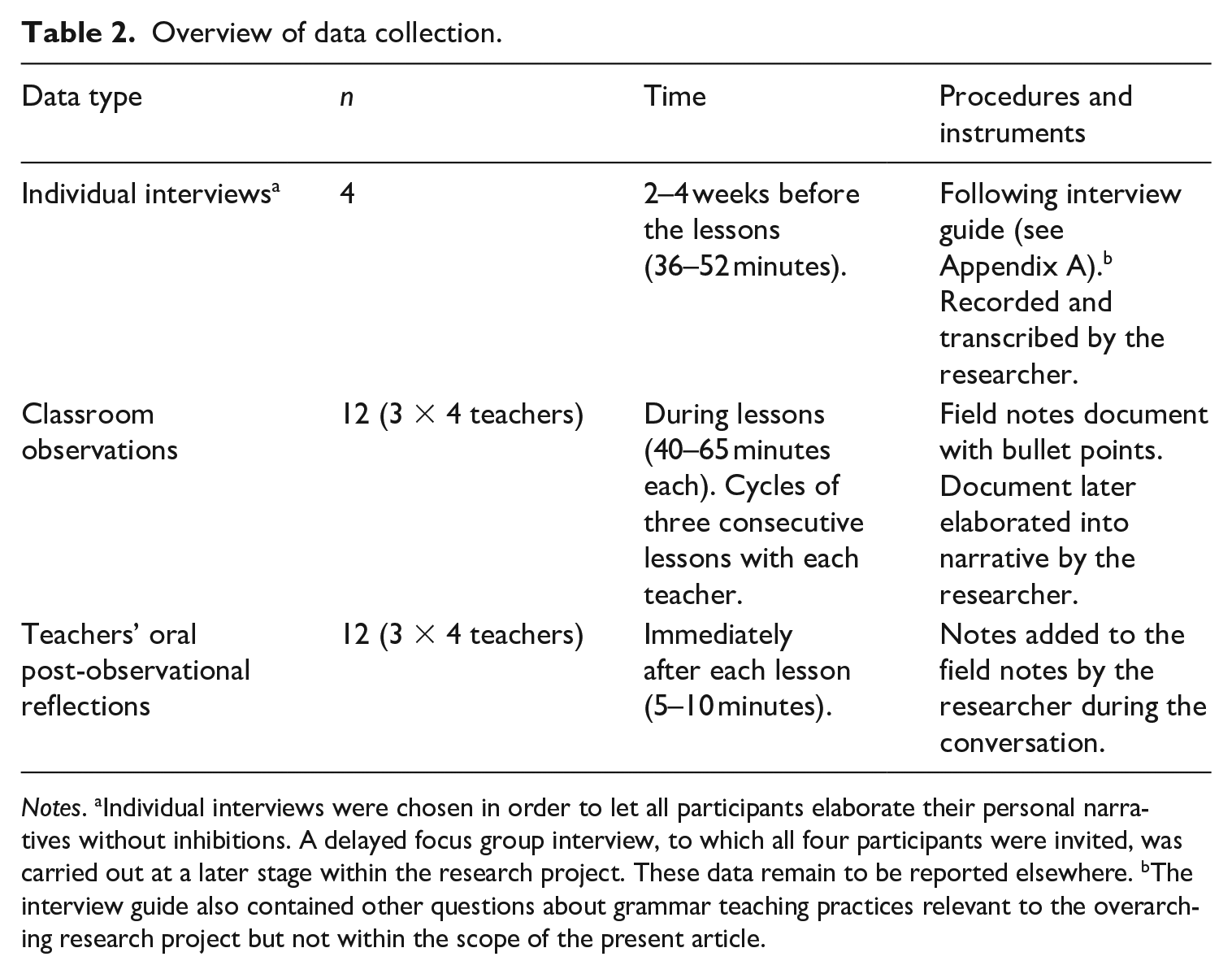
Notes. aIndividual interviews were chosen in order to let all participants elaborate their personal narratives without inhibitions. A delayed focus group interview, to which all four participants were invited, was carried out at a later stage within the research project. These data remain to be reported elsewhere. bThe interview guide also contained other questions about grammar teaching practices relevant to the overarching research project but not within the scope of the present article.
The first data type collected was individual semi-structured interviews. These took place 2–4 weeks before the classroom observations and were based on an interview guide with questions about the participants’ perceptions and experiences of various aspects of GL3 teaching, with a special emphasis on grammar (for a list of questions where the answers were found relevant for the findings of the present article, see Appendix A). Some of the questions in the interview guide were designed to elicit information about the instructional context and content, thereby implicitly targeting utterances that would also contain the participants’ emotional and affective responses to these. This was done using examples of emotional keywords contained in previous research (see Section II.3) that can be interpreted as implicit voicing of pedagogical emotions in mind. The interviews lasted 36–52 minutes and were recorded and transcribed verbatim, with pauses and hesitations included. Quoted passages reported in this article were translated from Swedish and are simplified for the sake of readability, which means that the initially indicated pauses and hesitations have been omitted in the examples given.
The second data type was classroom observations in a cycle of three consecutive lessons 5 with each participant targeting a specific grammatical item (verb-second placement). The teachers were all given the same textbook material as a point of departure and were asked to design their lessons in any preferred fashion and invited to add any other materials they believed would suit the pedagogical purpose of addressing the topic. Since the participants shared a short preliminary draft of their plan for the lesson cycle, the researcher had an idea of what would be covered in class. However, the teachers made on-the-spot modifications of these plans, which is normal and typical for authentic classroom settings (see Ulichny, 1996). From a position at the very back of the classroom, the researcher observed the lessons and simultaneously and systematically documented the unfolding events as ethnographic field notes (see Walford, 2009) in written form (for practical reasons, mainly as bullet-points). The main focus was to observe how the teachers explained the content to the students, especially the grammar concerned. Given the research interest and the conceptualization of students’ attitudes towards the subject as a contextual factor that might give rise to emotional responses (see Section II), the observer tried, to the best of their ability, to pay attention to instances of audible students’ and teachers’ reactions and interactions when grammar was discussed and dealt with during the lessons.
A third data set consists of oral post-observational reflections between the participant and researcher immediately after each lesson. In these short conversations (5–10 minutes), the participants were first asked to give their overall view on the lesson. After some of the observed lessons, depending on the time available the researcher also brought up some questions about observed actions and could ask the participant, for example, whether the action was planned or occurred spontaneously, whether the action is typical for the instructed group, and how the teacher perceived their students’ reactions to the teaching content (i.e. in case they had time to take notice of that), and whether they wish to adjust particular aspects of the cycle before the next lesson with the group. Some interesting answers were given, where several implicit references were made to the Hawthorne effect (see Brown, 1992), given that the two weeks with the research lessons constituted a break from the ordinary course and textbook, which might have influenced both teachers’ and students’ behavior in the observed situation. The answers were added to the field notes document, mainly as bullet points during the conversation while the participant was still present, and then elaborated on and clarified in running text by the researcher (without the teacher present) just before leaving the school facility for the day.
3 Procedures for data analysis
A qualitative approach with narrative features was used in the analysis, since teachers’ accounts of their work-related emotions can be regarded as life story materials (Lieblich et al., 1998) and ‘quality is represented through narratives of personal experience’ (Elliott, 2007, p. 230). Specifically, thematic analysis (Braun & Clarke, 2012) was applied as an accessible and flexible method for ‘systematically identifying, organizing, and offering insight into patterns of meaning’ (p. 57). All three data sets were analysed in the quest for both manifest and latent themes and content (Graneheim & Lundman, 2004) related to the research question.
The first phase of the analysis consisted of transcribing the interview recordings and the restructuring of the field notes from the observations and post-observational reflections into coherent narratives. In this process, some major categories appeared particularly meaningful, two of which are reported in this article: (1) contextual factors affecting the teaching, and (2) emotional and affective responses to the instructional context. The interview transcripts then underwent a meaning categorization by being broken down into smaller coding units, which were sorted into appropriate sub-categories. These were continuously re-evaluated during the coding process and ultimately rendered the analytical frame presented below.
In the final phase of the analytical process, themes on an interpretative level were determined. Following Graneheim and Lundman (2004), a theme is here understood as ‘a thread of an underlying meaning’ and ‘as an expression of the latent content of the text’ (p. 107). Hence, it appeared fruitful to depart from the codes stemming from the interview transcripts, define tentative themes and then look for content in the other two data sets in order to triangulate the suggested themes and provide them richer descriptions. Once the themes were defined, the data material was read once again in order to identify meaning units that might have been overlooked in the earlier phases of the analysis.
The analysis and interpretations were scrutinized and clarified in a deliberation with a colleague (who is both a researcher and a practicing teacher), to whom the analytical frame yielded was presented. Where there were potential inconsistencies and questions, the examples from the raw data were double-checked and some adjustments in the coding scheme were made. Furthermore, a member-check was performed, in which an early draft of this manuscript was sent out to the four participants. This drew the author’s attention to some misinterpretations and helped clarify the situated meaning of the interpreted utterances.
V Findings
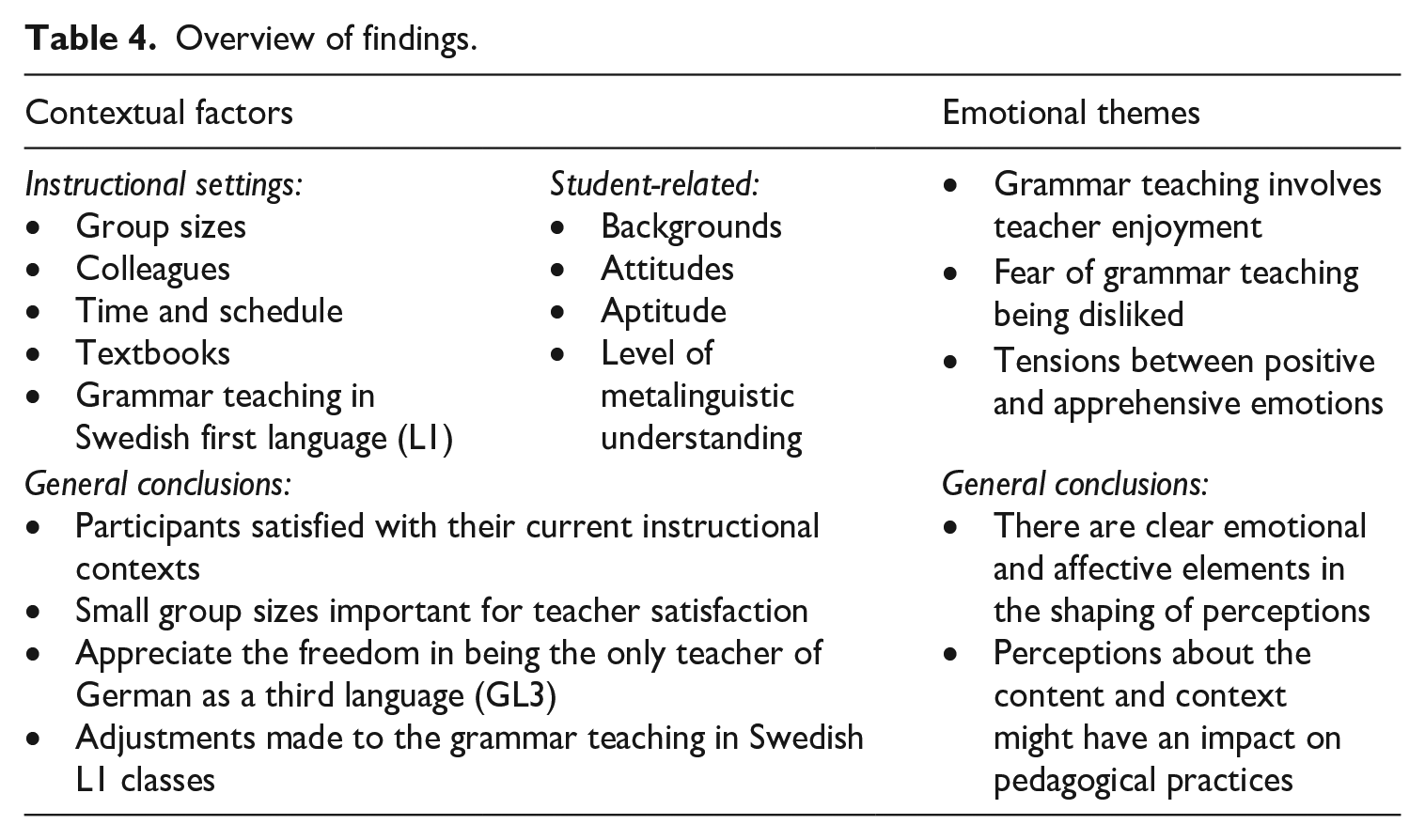
Based on the analytical frame described in Table 3, it is shown that the contextual factors (including students as a factor) are in many ways a source of emotional responses in the teacher towards the instructional situation and the subject matter as such. Taking both main categories into consideration, as well as their interplay, opens up for a better understanding of the research question about the role the context and emotions might have in shaping GL3 teachers’ perceptions and practices, especially on the example of grammar teaching to young beginners. The contextual factors and emotions that resulted from the analysis will be laid out in two sub-sections, as visualized in Table 4.
Categories and sub-categories with examples of coded meaning units.
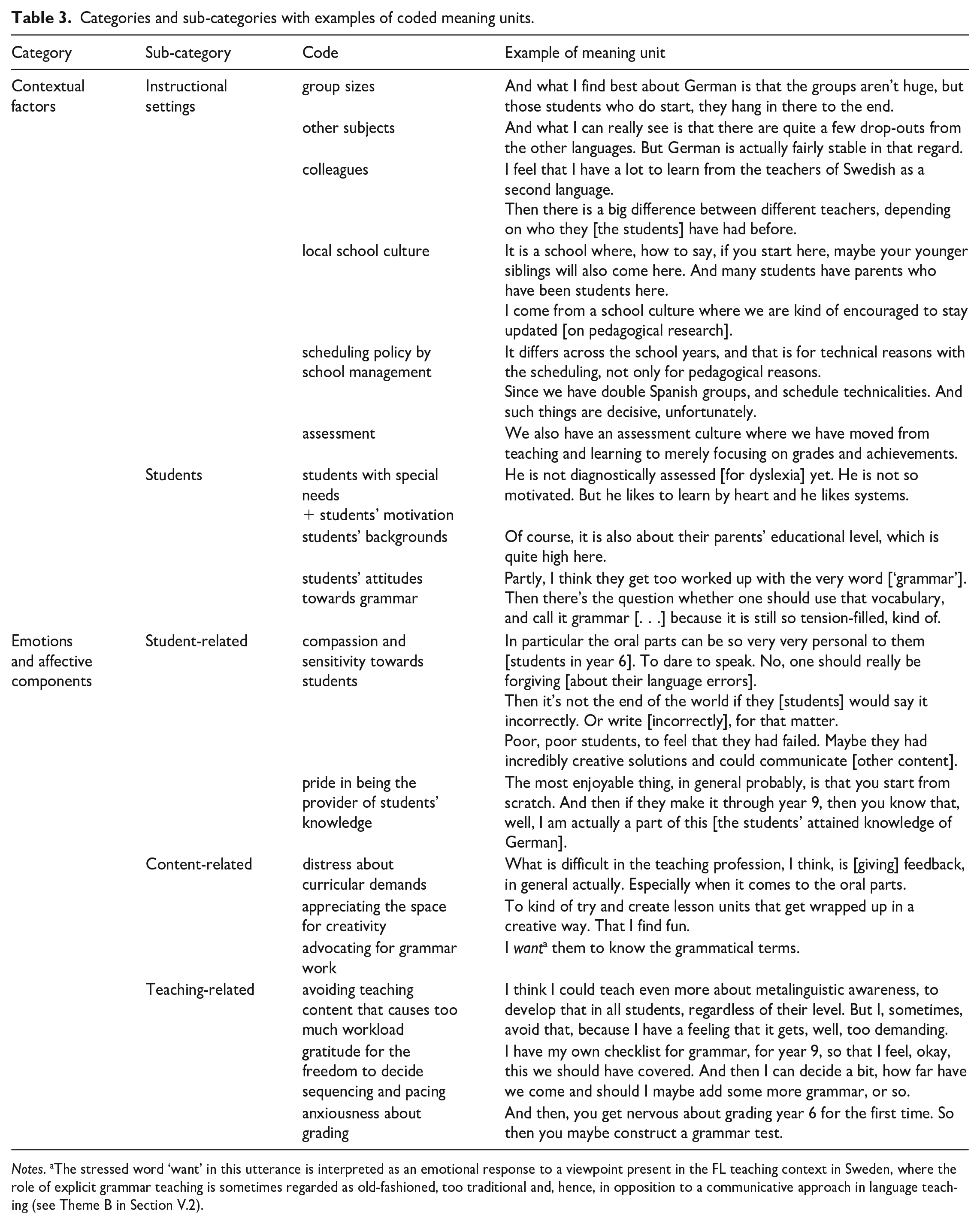
Notes. aThe stressed word ‘want’ in this utterance is interpreted as an emotional response to a viewpoint present in the FL teaching context in Sweden, where the role of explicit grammar teaching is sometimes regarded as old-fashioned, too traditional and, hence, in opposition to a communicative approach in language teaching (see Theme B in Section V.2).
Overview of findings.
1 The influence of contextual factors on pedagogical perceptions and practices
The contextual factors mentioned by the teachers in this study have been categorized as either instructional settings or related to the students. As for the first sub-category, the factors brought up refer mainly to group sizes, other teachers, time and scheduling, and GL3 textbooks. In contrast to the somber picture about the conditions for many L3 teachers in Sweden (see Section I), the individual participants in this case study report an overall satisfaction with the contextual factors framing the instructional contexts at their current workplaces (although many potential fields of tension and areas for improvement are clearly pointed out).
The very small group sizes of the GL3 groups (see Table 1) are an important contextual factor that the participants relate to their feelings of satisfaction with work. All but one teacher have groups fewer than 20 students, which is a considerably smaller number than the number of students found in groups of Spanish L3 and many typical Swedish school classes in general (where 30 students are very common). Teacher A, for example, mentions the fact that both the group sizes (none of her GL3 groups has more than 20 students) and the drop-out rates are smaller in GL3 than in the other L3s at her school, which she states as the single best thing about her current position as a teacher of German. A similar reference to group sizes and their relation to the sense of enjoyment in a GL3 teacher is found in Teacher B, whose school unit stands out a bit in the sample due to its atypically small size: So my smallest group counts only 6 students, and the biggest one has 16. And since I have worked here several years and I am the only German teacher, I can really work with the students all the way up. And it facilitates very much that I know, okay, this we have already covered, but this not so much, that I will have to review. So it is, very easy, easy yeah, that I know how much they [the students] know. Also, I have many highly motivated students, so, yeah. (Teacher B, interview)
6
As the teacher in the quoted passage above mentioned, presence of colleagues (or the lack of them) is also a central contextual factor important for GL3 teachers’ perceptions of their teaching conditions. This is found as a recurring theme in the analysed data. Since GL3 is a relatively small subject in Sweden (Skolverket, 2023) there is usually only one German teacher at a school. Being the single German teacher can, however, be seen as an advantageous factor that gives the teacher a sense of freedom to decide what to teach and how to organize and sequence lesson content without having to make compromises with subject colleagues when it comes to, for example, decisions regarding the introduction of a new textbook.
The impact of other subject teacher colleagues’ teaching as a contextual factor framing GL3 teaching becomes particularly evident when grammar as teaching content is considered. The interview data indicate overall that the GL3 teachers introduce syntax and the concept of the clause elements before their colleagues do it in the Swedish lessons. Teacher A also calls it a pity that relevant linguistic terminology is not introduced anymore by the Swedish first language (L1) teachers, who allegedly tend to simplify grammatical terminology when teaching. According to Teacher D, teachers of Swedish nowadays seem to teach less grammar than in the past and, as an L3 teacher, one has to invest time in ‘getting that job done’.
The fact that GL3 teachers generally teach more grammar and introduce it earlier than their colleagues of other language subjects is, however, generally not seen as a problem, the present data suggest. Teacher B, for example, reports adapting her grammar content and pacing in GL3 to the timing of the grammar taught by her Swedish L1 colleagues, framing it in positive words as a pedagogical strategy rather than a problematic limitation: Then I think, of course, that I have a great help from our competent teachers of Swedish. And I await them, until they have discussed the perfect tense, or the clause elements, and then, then I come in. (Teacher B, interview)
Furthermore, another observed theme on this topic is the participants’ highlighting of the position of the GL3 teacher as an exclusive provider of grammatical knowledge when other language teachers focus less on grammar. Teacher C, for example, expresses a sense of pride in the fact that her students of German can come to Swedish class with a decent amount of prior knowledge when it comes to the clause elements, since they have already been acquainted to that in the GL3 course. On a similar note, Teacher D states that he does not mind that the Swedish L1 teachers cover less grammar nowadays compared to some years. Since he enjoys teaching grammar, he has nothing against doing it himself.
Another important contextual factor mentioned by the participants in the interviews is the time factor and the way the school management decides to distribute the L3 classes in the weekly schedule. Two of the teachers explicitly mentioned that the schedule policy is not driven by pedagogical but rather financial concerns, resulting in solutions that the L3 teachers are not always happy about. A common concern here is whether the L3 lessons should be distributed over the week as three shorter sessions or two longer ones. In the interviews, one of the teachers reminisces about a previous school where the management placed GL3 students from three different school years into one and the same teaching group in order to cut down on teaching staff expenses. Comparing it to this experience, the participant stresses the word ‘happy’ when explaining her satisfaction with the conditions at the current workplace.
The time factor is also related to the participants’ experiences and accounts of other contextual factors, such as textbooks, and to their perceptions of a desired way to teach GL3. For example, one of the participants finds the German textbooks available on the Swedish market too grammar-focused and the time constraints limit her intentions to select and prepare teaching content that she would rather want to use more frequently: And then you don’t have time to develop the teaching, well then you just go. And if you have a group that is problematic, then you also get stricter and you regress. (Teacher C, interview)
Although it might demand a personal investment of time, thoughts and effort in coming up with and producing activities and materials, several of the participants refer to the freedom embedded in language teaching and the space for creativity and playfulness that the profession allows for. A clear example is found in the following quote: I’m grateful to be a language teacher, I believe, because one can do many different things that more have the character of play. It’s the creative part of our profession, which I actually like very much. (Teacher D, interview)
As the data suggest, the teachers are very concerned with providing teaching that will find its best way to the students. In terms of word choice, they for example refer to this idea as ‘a mission’ and a need to ‘stand up for the craft’ when designing lessons ‘so that students will find it meaningful’. This suggests that the awareness of the students’ individual learner characteristics, attitudes and backgrounds are an important contextual factor that shape the frames for GL3 teaching. For example, the lack of precision in the students’ L3 production makes it tiresome for the teachers to carry out some creative activities in class, since these would require a great deal of instant feedback and corrections from their side. Consequently, several teachers hesitate about planning for some activities that they hold strong positive beliefs about. They also report prioritizing working with students’ motivation, even if this sometimes requires the teachers to carry on with activities they are personally not very fond of and that might require an additional workload.
Both Teacher B and Teacher C describe how they find it hard to help the students develop and produce more elaborated and complex sentences in German before they have developed enough for this. The teachers also reflect the belief that metalinguistic awareness (see Bolitho et al., 2003; Falk et al., 2015; Nielsen, 2021) in students is a prerequisite for successful learning of foreign language grammar and they lament when students are lacking it: I think, there are still students who are a bit, a bit insecure [and] their metalanguage is not activated. They don’t have a feeling of where the verb is. What is the subject in a sentence? I mean, that you just must grasp. And not every student does. (Teacher C, interview)
Students’ inabilities to grasp the introduced concepts also mediate (and sometimes slow down) the intended grammar curricula of the GL3 teachers. In this respect, Teacher B reports on changes in her instructional practice compared to her first years of teaching in Sweden: Well. Uhm. In the beginning I was not so meticulous with the clause elements. Because, I did not fully understand how tricky that is [for the students]. Because as a German speaker, you just know all that [laughs]. (Teacher B, interview)
Similarly, she nowadays introduces the German accusative and dative prepositions much earlier than she did in her first teacher years in Sweden, because she has noticed how tricky these concepts are for Swedish students at the lower secondary level. The students’ lack of basic grammatical terminology is also the reason why Teacher C mentions spending a larger share of her total lesson time on grammar teaching today compared to 10–15 years ago.
2 The influence of emotions on the participants’ perceptions and teaching practices
As shown above, several contextual factors inside and outside the classroom have impacts on the teaching practices of the four teachers in this study. Another powerful source of influence on teachers’ perceptions and practices are the emotions they experience in relation to events that occur in the teaching context or to a specific teaching content. As a result of the thematic analysis in this study, three narratives about teacher emotions concerning grammar teaching in GL3 will be laid out in the following.
a The teachers find grammar teaching enjoyable and hold positive beliefs about it
A salient teacher emotion observed in the present study is that the teachers reflect an evident passion for teaching grammar and they personally perceive it as something pleasant and fun. In line with this, they regard working with grammar as an important teaching area, and the subjective stance is clearly demonstrated in a stressed utterance like ‘I want [the students] to know the grammatical terms’ (see Table 3). This is interpreted as an affective response to the debate among scholars and language teachers where the role of explicit grammar teaching in our language classrooms has at times been brought into question (see Ortega, 2013).
Teacher A, for example, unequivocally states her positive beliefs about grammar knowledge during the interview and underscores that it is not too early to start teaching it from year 6. After her first lesson in the cycle, the researcher shows her the following excerpt from the field notes where two students were seemingly engaged in discussing definitions of the clause elements she had just introduced:
What did you say that an object is?
Object is what gets affected by . . . and predicate is kind of a verb, like run. And so, you know.
When Teacher A hears the example, and realizes that it was said by a student that she did not really expect would grasp the explanations at first, the expression of her face changes. Her eyes light up and she exclaims her excitement clearly: There you see! That is a good sign that we for sure can start talking about clause elements earlier and provide them the [linguistic] building blocks and this vocabulary. Absolutely! (Teacher A, post-observational reflection after lesson 1)
The teachers’ passionate feelings about grammar teaching can be traced as a latent aspect in the analysis of their dedicated teaching styles, as well as their abilities to plan for and organize grammar lesson activities that motivate and fill their students with enthusiasm. One clear example is Teacher C’s introduction to the lesson cycle, where she discusses some basic concepts of grammar. She clearly succeeds in motivating her students, even those who otherwise give a rather passive impression during the lessons. Her lecturing is accompanied with narrations, drawings on the whiteboard and metaphors. For example, she borrows images from several conceptual domains and denominates the verb as ‘the boss’; she explains the V2 rule by saying that the verb ‘requires the silver place’, at the same time drawing a podium and a medal on the whiteboard. In the oral reflection after the lesson, she explains this use of metaphors and drawings. According to Teacher C, the ideas sprang to her mind spontaneously as she was standing in front of the class. She reports that she all of a sudden ‘got a feeling’ and felt inspired by some German Youtubers who publish videos on the same topic.
Another observation comes from a lesson where Teacher C talks about the clause element ‘object’. She draws the students’ attention to the word as such and names other lexemes that contain ‘object’. ‘Objectification’ and ‘sex object’ are mentioned, which causes giggling, follow-up questions and ‘aha’ reactions among the students. A very pleasant atmosphere reigns in the classroom, and the observer can clearly note that Teacher C manages to enthuse the students present with her style of giving a lesson by narrating a story.
A similar observation is noted with Teacher A, when she patiently and playfully walks around the classroom and takes her time to scaffold and give suggestions when she notices that some of the student pairs might need it. This observation seems well aligned with Teacher A’s accounts of her personal stance towards grammar from the individual interviews, where she clearly expresses her opinion that grammar is important and fun. Equally clear in the interview situation is her rejection of the hypothetical counterview that explicit grammar instruction would be something obsolete that should best be avoided in communication-oriented language teaching.
In effect, all four teachers underscore that grammatical knowledge is a mediating aid in foreign language learning. As such, it is essential for producing comprehensible utterances in the target language, whether in oral or written communication. When the teachers are asked in the interviews whether they share the opinion that communication is more important than grammar, they clearly stick up for the latter. Teacher D, for example, states that ‘the grammar must simply be there’. He would even categorize his own grammar teaching praxis as rather ‘traditional’, which he does not seem in any sense ashamed of admitting. Instead of downplaying the role of grammar, the teachers in the present study constantly advocate for it and bring it into prominence, as can be seen in the following example: No way, I don’t believe in that [the separation of grammar and communication] at all. It is not possible to, communicate without grammar [. . .] Both have to go hand in hand, and that is, precisely, why it is so important. I am thinking about modal auxiliary verbs. It is great fun to have, like a roleplay at IKEA. ‘Can’t we buy that rug?’, ‘no, you must not!’. I mean, when you kind of, bring the grammar, into real-life situations that make sense. (Teacher C, interview)
The rationale here, expressed by the other three teachers in the interviews as well, is that explicit grammar teaching can be communicative in its own right, and that the teacher must make an effort to come up with realistic situations in which grammatical constructions could be used and practiced in the classroom.
b The teachers fear students might dislike grammar and are therefore cautious
At the start of one of the observed lessons, the teacher switches from German to Swedish and comments on this language change explicitly with the explanation: ‘because there will be lots of grammar today’. In point of fact, details in the interview data suggest the presence of a somewhat apprehensive viewpoint where teaching grammar is regarded as something necessary rather than fun. One such instance is when Teacher B contrasts the fun parts of oral activities, representing something performed out of joy and creativity, with grammar as its counterpart, representing something that is taught out of mere necessity: The most enjoyable [in GL3 teaching] is to see how the oral part emerges [. . .] that they get used to talking to each other, to answer me, and that they maintain this habit, even if we have some: ‘okay, now we have to go do some grammar as well’. (Teacher B, interview)
Examples also occur of teachers’ internalized fear to go beyond a perceived upper limit for how much grammar could be included in the class work before the students find it boring. This is clearly noted in the answers to the interview question where the teachers are asked to appreciate the amount of lesson time they spend on teaching grammar. Teacher D, for example, starts cautiously by indicating 20%–30% before he, with some incertitude in his voice, revises it up to 30%–40%. It appears that Teacher C and Teacher D at times try to distance themselves from a potential assumption that their teaching would be too grammar-centered. Hence, they provide assertions that they are aware of the risk of grammar taking over too much of the lesson time (Teacher C) and give accounts of what is not part of their teaching practice as well (Teacher D). An example of the latter category is when Teacher D explains that he does not teach grammar every lesson and emphasizes that grammar work would never comprise the full scheduled time of a whole lesson.
Based on the observation data in this study, the teachers seem especially careful about not forgetting three factors when teaching grammar: connecting the content to the previous lesson’s grammar work, summarizing thoroughly what has been said in that day’s class, and clarifying and justifying the purposes of why grammar is important to deal with in first place. Teacher C’s introduction to the lesson cycle, for example, consists of a whole class discussion about the use of having grammar knowledge and knowing terms like word classes and clause elements. During this part of the lesson, she repeatedly addresses questions in order to motivate the students. In the oral reflection immediately after the lesson, she again stresses her belief that a pivotal factor of successful grammar teaching is to make the students understand the functions of the grammatical rules explained by discussing and confronting them with engaging questions (which to a large extent resembles the experienced teachers’ practice reported in Johnston & Goettsch, 2000).
Traditional grammar teaching, associated with teacher explanations and exercises to be filled out by the students, is a recurring theme across the interview data. Teacher D is an interesting example. Although he would label his grammar teaching as somewhat traditional, he reports making conscious efforts to teach in a creative and communicative rather than a traditionally rule-based way. When reflecting about his grammar teaching style he states: It has been developed, not because I have had such good students, but rather the contrary. Ehm, that the students think that, ‘well, this is so boring’, and it’s grammar, and you have to explain so much in order to, kind of, reach them. And then, I have had to, I feel, find other ways, to make it more interesting. And to make it more fun and varied. These [his current] students, you could teach them in a very traditional way, and they would still think it’s completely fine. (Teacher D, interview).
Another example of the phenomenon of being cautious about too much grammar teaching is shared by Teacher C, who expresses the potentially stressful situation of taking over a group that has been taught by another teacher in the previous year and realizing that the students have some gaps in their grammatical knowledge. In such situations the teacher has to try and fill the gaps by spending more lesson time on grammar than one would usually think is appropriate. As to that, Teacher C even uses the word ‘panicking’ to describe her reaction to a potential situation where a language teacher would feel that one’s teaching is at risk of becoming perceived as too traditional or even ‘old-fashioned’.
c There are tensions at the interface of positive and apprehensive emotions about grammar
An awareness of a bad reputation of grammar in language teaching contexts is a clear and present theme during the interviews with the four teachers. Teacher A, for example, asks herself whether we should even avoid the word ‘grammar’ and rather call it ‘learning to talk about how the language is built up, because it is still, quite triggering, kind of’. As for herself, she does not share the view that grammar is a particularly difficult part in language teaching: I think it’s just what many people say, ‘oh, it is so hard, German is so hard because the grammar is so difficult’, but that’s just because everybody is saying that. (Teacher A, interview)
She thinks of it as a self-fulfilling prophecy and that German grammar in itself is not hard, but rather fun. However, there is a tension between her personal beliefs and emotional experience, and what she reports being able to perform in the actual teaching situation. The tension is illustrated by the following quote: It’s pretty easy actually [. . .] and I personally find it quite amusing [giggles], but [keeps giggling] I don’t know if I manage to convey it. (Teacher A, interview)
Having to choose which items to include in the teaching plan appears as another source of tension between GL3 teachers’ personal beliefs (about what is easy and fun to teach) and perceptions of what must or ought to be covered in the limited amount of teaching time that is at their disposal. 7 In the interview, Teacher B mentions a couple of occasions where she hesitates about what grammar content to include and how much time to invest in teaching specific forms, without making the students lose their interest and give up. As an example, she asks herself whether it is reasonable to spend time on the preterite tense or if she should rather leave that for the upper secondary school teachers to deal with. Interestingly, Teacher B never mentions this verb form as particularly tricky for the students to grasp, but due to the abundance of possible items to cover in lower secondary school, she reports simply having to draw the line somewhere.
The attitudes towards grammar teaching reflected by the education system, the national curriculum (Skolverket, 2018) and the colleagues are other potential sources of tension for L3 teachers of German. Teacher A reports on general opinions at the Teacher Academy two decades ago, where the teacher students were taught that grammar was something ‘very nasty’. What she interpreted from the discourse of those years was that language teachers should not correct grammar or any other kind of language errors. She reports that she, in fact, subconsciously internalized that viewpoint at the onset of her teacher career. Therefore, she eventually had to, as she puts it, ‘almost start all over again, to kind of have it [grammar] as a separate teaching unit’. Nowadays, her opinion about grammar knowledge is rather clear. She finds it essential in language education and she states that her intention is not to deprive the students of this knowledge during their school years. Hence, she states that she does not share a hypothetical opinion that some language teacher colleagues might have, that too strong a focus on explicit grammar might inhibit the students from communicating. She rather sees grammar as a medium that might help them to build sentences and utterances, not the least in oral communication: ‘Yes, I do believe that, and it might even be easier also, if you feel that you have a grammatical structure to hook it up on, when you want to speak.’
Another source of tension with impacts on the grammar teaching practice, mentioned by several of the teachers, is the lack of metalinguistic knowledge and awareness in some students. The interview data suggest a clear discrepancy between what the teachers find important for fruitful grammar teaching – in line with their beliefs about effective and modern grammar pedagogy – and the classroom reality where many students struggle with understanding central concepts required for such a teaching to take place. Teacher C, for example, mentions that students who do not have a metalinguistic awareness find almost everything related to the L3 difficult and Teacher A has observed that those students tend to easily get stressed and bored in class when for example grammar is being taught. Consequently, she sometimes has to balance her own fascination about grammatical items, for example her personal will to introduce the clause elements in the early years, with the wish not to bore the students and make them lose their interest in her lessons.
VI Discussion
Grammar as a teaching subject is an element in the professional knowledge base of language teachers (Johnston & Goettsch, 2000; see also Shulman, 1986, 1987) that can have both cognitive and emotional/affective components. Since emotions are ‘world making’ (Ahmed, 2014, p. 12), this article suggests that teacher emotions about grammar teaching are helpful in unpacking L3 teachers’ perceptions of subject teaching and the pedagogical practices in which they engage. Based on the example of grammar teaching in German L3, the findings of the present study shed light on the significance of teacher emotions from a subject matter perspective, which has hitherto been a scarcely researched area (Sutton & Wheatley, 2003; Uitto et al., 2015).
A theme identified in the present article are the tensions found at the interface of the central elements in the European subject didactics tradition (Caillot, 2007; Chevallard, 2007; Hopmann, 2007; Hudson & Schneuwly, 2007; Vollmer, 2014), i.e. subject matter, teachers and students as social actors of the classrooms, and the contextual factors that frame the teaching of a subject. Aligning with a definition of instructional tensions (Golombek, 1998) as ‘competing demands’ within teaching and ‘divergences among different forces or elements in the teacher’s understanding of the school context, the subject matter, or the students’ (Freeman, 1993, p. 488), the results presented in this article point out the competing demands between GL3 teachers’ personal enjoyment of grammar and their concerns for the students’ perceptions of this teaching item as apprehensive tensions in grammar teaching.
As Sutton and Wheatley (2003) point out, emotions often tend to be discursively framed as something irrational, out of control and childish, which ‘researchers who pride themselves on their rationality and logic’ (p. 328) do not traditionally consider. A subject-matter based approach to teacher emotions can, however, help promote the role that pedagogical emotions (Sheppard & Levy, 2019) play for developing evaluations about teaching and learning (Zembylas, 2004), and hence frame them in the realm of the rational. As an example, the findings of the present study, which point out the apprehensive tensions that exist between the GL3 teachers’ personal passionate emotions and their internalized beliefs about their students more reluctant stances towards grammar, appear rather rational given the popular beliefs about German grammar as a particularly troublesome content area for foreign language learners (Diehl, 1999; Diehl & Boss, 2017; Eisenberg, 2004). This belief is also mentioned in a newspaper article (Pihl, 2022), where the journalist toys with the idea of the great dominance of Spanish as a school L3 in Sweden having to do with the deterrent effect of the German grammar (and the French pronunciation).
Furthermore, the apprehensive tensions suggested as an outcome of the thematic analysis in the present study are all but irrational if previous research on teacher cognition and beliefs are taken into consideration, where it is, for example, shown that teachers resort to grammar teaching and select instructional approaches based on what they think their students expect and enjoy (Borg, 1998, 1999, 2006; Brown, 2009; Phipps & Borg, 2009; Schulz, 1996). A related area in previous research are the beliefs held by language teachers about the role of grammar work in class as a technique for smoother classroom control (see Sanchez & Borg, 2014; Uysal & Bardakci, 2014; Watzke, 2007), regardless of the teachers’ personal preferences for instructional styles and approaches.
Although pedagogical beliefs about methods for grammar teaching might appear firm, they can, however, be challenged and changed if language teachers are provided with alternative options (van Rijt et al., 2022). A potential contribution of the present study is, therefore, to evoke discussions in the profession about the role of grammar instruction in (G)L3 teaching, even with very young learners. This discussion might open the doors for a reconceptualization of grammar as an undesired teaching area, and rather suggest notions of potential mutual enjoyment in both students and teachers, similar to the viewpoint voiced in the following quote: I think the students actually enjoy an intellectual spot in the lesson where they can reflect about language and consider language, and where they can actually talk about grammar . . . if there is an opportunity to do so and the majority of the people are included in the discussion, and nobody feels alienated by it in any way, I think I would take opportunities to do that. (Borg, 1998, p. 20)
What teachers feel and emotionally perceive about their teaching context, including the subject matter, has an impact on their cognition, beliefs and actual teaching practices, given the bidirectional and reciprocal relationship between instruction and emotions, claimed by Jiang et al. (2021), and the ‘intrinsic interconnection between emotion and cognition in teacher development of professional identity’ (Golombek & Doran, 2014, p. 103). To better understand these interconnections, ‘[c]ontextual factors need to be part of any analysis of the relationship between teachers’ beliefs and practices’ (Phipps & Borg, 2009, p. 381). Contextual factors mediate the thousands of decisions teachers make on a daily basis (Thorsten et al., 2021), and they ‘may have a more powerful impact on what teachers do than their beliefs about effective pedagogy’ (Borg, 2006, p. 132).
This article, therefore, suggests that it is reasonable to assume that factors such as heavy workload, poorly motivated students, solitary working conditions for GL3 teachers, the low status of the school subject. The non-existent opportunities for subject-specific in-service professional education (see Bardel et al., 2019; Erickson et al., 2018, 2022; Skolinspektionen, 2010, 2022) place affective demands on the teachers, adding thus to the notion of schools as complex emotional arenas (Chen, 2016; Chen & Cheng, 2022; Yin & Lee, 2012) where teacher emotions may have a direct impact on successful deployment of teaching programs and strategies (Sutton & Wheatley, 2003) and instructional actions in general (Barcelos & Aragão, 2018; Jiang et al., 2021; Zembylas, 2004).
As the findings reveal, contextual factors (e.g. the pressures from a perceived assessment culture) play an evident role in the participating GL3 teachers’ perceptions of the subject and grammar teaching practices. Another important aspect of the instructional context is the teachers’ perceptions of the students, their expressed desires to see the latter make progress in the new language (see Cowie, 2011; Erickson et al., 2018, 2022), and the efforts the teachers make to bring about enthusiastic teaching (see Frenzel, 2014) that would find its way to the students, in which they invest their personalities (see Pérez Cavana, 2019). Furthermore, the impact of language teacher colleagues (see Cowie, 2011; Nias, 1999) is another contextual factor shown to have an impact on the participants’ pedagogical practices.
The latter might be a particularly important contextual factor in school systems where GL3 is a fairly small subject and there is typically only one teacher of the language at an individual school, which is a common case in countries like Sweden and Norway (see Erickson et al., 2022; Granfeldt et al., 2019; Haukås, 2016). Such environments could be assumed to give rise to negative emotions in teachers. However, the present study shows that the participating teachers instead see the upsides of this situation, which permits them to harvest the fruits of their own hard labor once their students reach a proficiency level in their final years. Furthermore, they do not have to depend on colleagues’ teaching from previous years, especially when it comes to the grammar syllabus, and they are in full charge of topics, procedures, pace and choices when teaching each individual group over the years. This exclusivity in being the only provider of knowledge in a new foreign language gives the teachers a sense of satisfaction in the long run, this article suggests.
A clear theme identified in the data of the present study is that there is a space between the grammar teaching practices in the L1 and L3 subjects (see Nylén, 2014), where further bridges could be built between the language teachers. This theme is interpreted as partly coming from a deficit perspective of lacking bridges between the two subjects and teaching cultures, which reflects the impression of many L3 teachers in Sweden that there is hardly any teaching of explicit grammar rules in the Swedish L1 classes (Falk et al., 2015, p. 228). The implication of such an interpretation is twofold. First, it highlights the fact that other language subjects are an important contextual factor that exerts an influence on (G)L3 teachers’ practice, not least when it comes to grammar instruction. Second, it addresses the need for future research on how L1 and L3 teachers could establish successful crosslinguistic collaborations for grammar teaching across the language subjects in practice.
Previous research in the field has dealt with the tensions between teachers’ beliefs and practice in grammar teaching (e.g. Phipps & Borg, 2009) and various studies suggest a limited correspondence between teachers’ stated beliefs and observed practices (see Basturkmen, 2012, p. 291). The contribution of the present study is that it also involves an emotional component in the discussion of the pedagogical tensions found in the context of GL3 grammar teaching, since it is suggested that teachers’ emotions correspond with language teachers’ beliefs, actions and practices (Barcelos & Aragão, 2018). In line with the theoretical conceptualization of emotions as dynamic processes rather than passive states, and as responses to events and phenomena in the social context (Benesch, 2018, 2019; Pekrun et al., 2023; Scherer & Moors, 2019), this article suggests a viewpoint of teachers’ pedagogical emotions (e.g. the apprehensive tensions about grammar teaching) as a contextual factor in its own right, which might have an impact on language teachers’ cognition and abilities to enact FL teaching that is compatible with their own pedagogical beliefs (see Golombek, 1998; Johnson, 1994; Phipps & Borg, 2009). The suggested viewpoint sheds light on the ‘intrinsic interconnection between emotion and cognition in teacher development of professional identity’ (Golombek & Doran, 2014, p. 103) and is aligned with the broadened view of teacher cognition, which clearly acknowledges the role emotions play in ‘the process of becoming, being and developing as a teacher’ (Borg, 2019, p. 1167).
VII Conclusions
The reported findings make an empirical contribution to the field of language education, especially to the area of subject didactics of third languages, where available research in the Swedish context is scarce (see Bardel et al., 2019, 2023; Granfeldt et al., 2019). An analytical focus is set on the emotional and affective components that shape language teachers’ perceptions and pedagogical practices when it comes to grammar teaching, resulting in a thematic interpretation of the findings, summarized in the title of the article. This focus helps establish the links between teachers’ emotions, cognition and behavior (Borg, 2019), which provides a more holistic understanding of teachers’ professional lifeworlds.
The usefulness of teacher emotions in this interpretative process makes a case for the viewpoint that ‘emotions are not simply feelings per se’ (Her & De Costa, 2022, p. 1), but rather a reflection of teaching and classrooms as a social and cultural context, where the dynamic interaction with the environment gives rise to emotional responses in the teacher (Barcelos & Aragão, 2018; Reio, 2005; Song, 2016). These responses could be labeled as pedagogical emotions (Sheppard & Levy, 2019), and they have a function of shaping language teachers’ self-perceptions, professional identity and classroom practices (Barcelos & Aragão, 2018; Her & De Costa, 2022; Nias, 1999; Sutton & Wheatley, 2003; Zembylas, 2004). Consequently, teacher emotions become environmental variables (Jiang et al., 2021) that have an impact on teachers’ cognition and decision-making (Borg, 2019; Golombek & Doran, 2014), in a similar vein as other (more material) contextual factors in and around the classroom.
The benefits of theoretically departing from a perspective of teacher or pedagogical emotions is that this perspective shifts the focus from teachers as mere providers of learning content towards a view of teachers as professional humans with their own motives, goals and affective experiences (Frenzel, 2014). Acknowledging these experiences ‘enables teachers to better transform their relations to their students and to the subject-matter itself’ (Zembylas, 2004, p. 199). Hence, teacher emotions are an important element of language teaching, and both research and practice should allocate space to discussing both positive and negative emotions about the practice (Cowie, 2011). The present article makes a contribution to encourage professional discussions among (G)L3 teachers about the role of pedagogical emotions and, not the least, about the contextual factors in and around the classroom that give rise to emotional responses towards the language teaching practice. This is particularly important in countries like Sweden, where a majority of L3 teachers in a large survey study (Lärarnas Riksförbund, 2016) reported considerations of leaving the profession due to dissatisfaction with the working conditions and the low status of the subject. As was shown in Section I, this is not exclusive to Sweden, suggesting that more attention needs to be paid to the working conditions of GL3 teachers in other countries as well. An increased focus on the interplay of the context and the pedagogical emotions of GL3 teachers could thus be a fruitful way of addressing improvements in teaching conditions. Such a focus on teachers’ emotions and their socially situated nature might facilitate drawing the attention to the structural problems in language teachers’ working conditions (see Winograd, 2003) by shifting the focus ‘from isolated to situated conceptualizations of teachers’ minds’ (Borg, 2019, p. 1153). This is an important factor for strengthening the position of (G)L3 teachers and foreign language teaching in general, the present article suggests.
A clear implication of the study is that language teachers’ emotions in relation to teaching and the content of teaching are important for developing knowledge and evaluations of the pedagogical knowledge required for the teaching of a subject matter (e.g. German grammar). An example of such professional knowledge are the accounts the participants gave about how they select or avoid content or certain teaching strategies (see Sanchez & Borg, 2014; Uysal & Bardakci, 2014). Another contribution to the field by the study is the focus on tensions related to grammar teaching (both as perceptions and in practice), which is a valuable focus for both research and teacher development (Phipps & Borg, 2009, p. 381). Such knowledge can also have implications for the teacher education of future language teachers (see Uitto et al., 2015), who should be made aware of and mentally prepared for the emotional responses to various components of the contexts that might arise in their future work and classroom practices. Furthermore, the contribution of the present study might add to the notion of subject-specific pedagogical content knowledge (see Ball et al., 2008) as a teacher knowledge domain exclusive to teachers of a specific school subject. Relevant for language education (as well as for future research) is the notion of a grammar-related pedagogical content knowledge (GPCK) proposed by Sanchez and Borg (2014), which could be further elaborated upon in the light of the findings of the present study.
A limitation of the present study is the absence of students’ perspectives on teaching, which are important in the European tradition of subject didactics (see Meyer, 2007). Therefore, future research is called for regarding GL3 students’ viewpoints on grammar teaching and learning, as well as their perceptions of the interpreted themes suggested in this article, such as the tensions that language teachers may be experiencing when it comes to explicit grammar teaching. As previous research has shown, students are aware of teachers’ emotions (Sutton & Wheatley, 2003). Hence, their perceptions of language teachers’ emotions about instructional contexts and certain teaching content, such as grammar in GL3, could be a fruitful topic to be addressed by future research. Given that the present study suggests that the grammar teaching of colleagues in the L1 subject is a contextual factor that influences L3 teachers’ perceptions and practices, another area that merits more research scrutiny is how L1 and L3 teachers could establish successful crosslinguistic collaborations for grammar teaching across the language subjects. Again, students’ perceptions of the lack of bridges between the L1 and L3 subjects might also be worthwhile investigating. Furthermore, longitudinal inquiries into how language teachers’ emotions change over time (see Kubanyiova, 2012), for example in the case of change of workplaces and school contexts, would also advance our understanding of how context and emotions shape and modify teachers’ cognition, perceptions and instructional practices.
Footnotes
Appendix A
Acknowledgements
The author wishes to express his sincere gratitude to Camilla Bardel, Pernilla Rosell and Mara Haslam from Stockholm University, as well as to the three anonymous reviewers, for their insightful feedback and invaluable support. Appreciation is also extended to the four participants of the study for their time and valuable contributions.
Funding
The author received no financial support for the research, authorship, and/or publication of this article.
