



Abstract
This exploratory study investigated second language (L2) teachers’ perceptions and assessment of young learners’ (aged 8–10 years) engagement, particularly focusing on the definition of engagement, its indicators, the teachers’ assessment of engagement during live task performances in intact classes, and their use of engagement-promoting strategies. The participants included 12 experienced L2 teachers recruited from various primary schools in Vietnam. Their perceptions regarding young learner engagement, its indicators, live engagement assessments, and engagement-promoting strategies were elicited using multiple tools, including semi-structured interviews, classroom observations, field notes, stimulated recalls, and reflective frames. The results revealed that teachers perceived young learner engagement as demonstrated by active participation and focus during task performance. They emphasized the behavioural and emotional aspects of engagement as key dimensions in assessing young learners’ engagement levels during task performance and thus tending to design tasks that largely foster these dimensions. The teachers also shared a variety of engagement-promoting strategies that were tailored to the characteristics of young learners. The overall results suggest the need to raise teachers’ awareness of a more comprehensive view of young learner engagement as well as reconsider task designs that could promote various aspects of engagement, rather than primarily or solely focusing on the aspect of ‘fun’ or emotional engagement.
Keywords
I Introduction
The issue of learner engagement has long been of interest not only to teachers but also to researchers in the fields of educational psychology and general learning science (Appleton et al., 2008; Christenson et al., 2012; Reschly et al., 2020). Recently, in the field of second language (L2) learning and teaching, the ‘engagement’ concept has garnered a momentum regarding what it refers to, how it manifests in L2 classrooms, what factors affect its level, and how to promote it in intact classes (see Dao, 2021; Hiver et al., 2021; Lambert, 2017; Mercer & Dörnyei, 2020; Philp & Duchesne, 2016; Svalberg, 2009). Similar to the field of educational psychology, L2 research faces the challenge of putting into practice the concept of learner engagement, whether in traditional classroom (Lambert et al., 2017; Sang & Hiver, 2021; Zhou & Hiver, 2022) or online settings (Dao, Nguyen, Duong, & Tran-Thanh, 2021; Lyu & Lai, 2024). This issue, as highlighted by Christenson et al. (2012) in their discussion of the ‘jingle fallacy’ (using a single term for different phenomena), has arisen partly due to the diverse perspectives, underscoring the necessity of deepening our understanding of the L2 learner engagement concept (Dao, 2017; Sang & Hiver, 2021; Smith & Ziegler, 2023; Vo, 2024; Zhou & Hiver, 2022). It is arguable that delving into the understanding and perceptions of engagement from the viewpoints of key stakeholders, specifically teachers, is imperative because how teachers perceive and believe about aspects of practice (i.e. learner engagement) affect what they do and act in their daily teaching practice (i.e. assessing and fostering learner engagement in their classrooms) (Barcelos & Kalaja, 2011; Basturkmen, 2012; Dao, Nguyen, & Iwashita, 2021; Nguyen et al., 2023; Van Uden et al., 2013). In addition, young learners, referred to as ‘children from the first year of formal schooling to 11 or 12 years of age’ (Phillips, 2000, p. 3) or ‘primary school children, with ages ranging from approximately 5 to 12 years old’ (Oliveira & Jones, 2023, p. 1), remain a demographic that is underexplored in current L2 engagement research. Thus, it is crucial to understand how young learners engage in classrooms from the perspective of L2 teachers to enhance the effectiveness of L2 teaching in primary schools. Furthermore, English as a foreign language (EFL) contexts, such as primary schools in Vietnam, have received relatively limited research attention. Therefore, further research is needed to shed light on this underexplored educational setting. Against this backdrop, this study investigated teachers’ perceptions of primary school learners’ engagement (or young learner engagement), specifically focusing on the definition and/or description of learner engagement, its indicators, teachers’ live assessment of young learners’ engagement in intact classrooms, and strategies for fostering young learners’ engagement. To gain a comprehensive understanding of the complex issue of engagement, this study employed a multi-method approach, including semi-structured interviews, stimulated recalls, classroom observations, field notes, and reflective frames. These methods were used to provide data triangulation for a more nuanced and holistic understanding of the focal issue: young learner engagement in EFL classrooms in public primary schools.
1 Conceptualizing learner engagement in L2 classrooms
There has been a relatively significant development in L2 research concerning the conceptualization and operationalization of the engagement construct, influenced by various theoretical perspectives (Hiver et al., 2021; Mercer, 2019; Vo, 2024). Early L2 research focuses largely on one dimension of engagement, primarily assessing it through the amount of verbal language production (Dörnyei & Kormos, 2000). Taking a different approach, Storch (2008) assesses L2 engagement in terms of the quality of language production as reflected in learners’ elaboration during language-related discussions. In a similar vein, Toth et al. (2013) delve into the cognitive aspect of language discussions, exploring analytical language rule discussions as indicators of engagement. Placing an emphasis on task-based L2 learning, Bygate and Samuda (2009) view engagement as learners’ commitment and mental effort during discourse, encompassing elements such as negotiation for meaning, clarification, and attention to language features.
Subsequent L2 research has then shifted to view L2 learner engagement as a multidimensional construct, as pioneered by Svalberg’s (2009, 2018) model of engagement with language (EWL). From the language awareness perspective, Svalberg conceptualizes EWL as ‘a cognitive, and/or affective, and/or social state and a process in which the learner is the agent and the language is the object and may be the vehicle (means of communication)’ (Svalberg, 2009, p. 244). EWL is perceived as consisting of three components such as affective (e.g. positive attitude), cognitive (e.g. alertness, focused attention) and social (interactiveness, other-orientedness) aspects. Informed by educational psychology, Philp and Duchesne (2016) define task engagement as ‘a state of learners’ heightened attention and involvement’ which is manifested in four dimensions: cognitive, social, behavioural and emotional dimensions (Philp & Duchesne, 2016, p. 51). Together, these two early models suggest at least three or four components of engagement, including behavioural, cognitive, social, and emotional/affective.
The multiple-component frameworks of L2 learner engagement, as reviewed above, have been widely embraced by scholars in L2 research (Hiver et al., 2021; Mercer, 2019; Mercer et al., 2021; Oga-Baldwin & Nakata, 2020; Vo, 2024). In this extant body of L2 research, while all components of engagement are perceived as independent, interconnected, context-dependent, and socially situated (Hiver et al., 2021; Mercer, 2019; Philp & Duchesne, 2016), each dimension could be operationalized separately. For instance, behavioural engagement is often perceived as effort and initiative (Hiver et al., 2021; Lambert et al., 2017) whereas cognitive engagement is referred to as mental effort, focus, and attention (Dao, Nguyen, Duong, & Tran–Thanh, 2021; Philp & Duchesne, 2016; Svalberg, 2018). Social engagement relates particularly to the relationship among learners, especially in terms of reciprocity and mutuality (Storch, 2002) and interactiveness (Svalberg, 2009, 2018), and emotional/affective engagement is referred to as feelings, emotions or attitude toward the task, context, and peers that arise during the task performance (Philp & Duchesne, 2016; Skinner et al., 2009; Svalberg, 2009). It should be noted that another dimension of engagement (i.e. agentic engagement: perceived as learners’ actions and initiatives contributing to teaching and learning) has been also added to the current models of L2 engagement (see Reeve & Tseng, 2011). Despite some differences, the current multidimensional models of engagement, as exemplified by Svalberg’s (2009, 2018) and Philp and Duchesne’s (2016) frameworks (see also Hiver et al., 2021), have been influential in the field of L2 research, informing the design and the analytical framework for multiple subsequent empirical studies that documented a variety of factors affecting learner engagement in both face-to-face (Aubrey et al., 2020; Dao, 2021; Lambert & Zhang, 2019; Oga-Baldwin & Nakata, 2020; Zhou et al., 2023) and online settings (Aubrey, 2022; Baralt et al., 2016; Carver et al., 2021; Dao, Nguyen, Duong, & Tran–Thanh, 2021; Lyu & Lai, 2024; Smith & Ziegler, 2023).
Although providing insights into the role of task engagement and its link to language production, the body of the existing L2 engagement research has revealed issues. First, there are variations in L2 studies regarding how learner engagement is described and operationalized (Zhou et al., 2021). This variation issue is partly because what is defined as learner engagement has been mainly conceptualized by researchers who have different theoretical standpoints informed by different fields of research (Dao, Nguyen, & Iwashita, 2021). While researchers’ perspective and conceptualization of learner engagement are useful, it is possible that what teachers perceive as engagement might be different and, thus, what indicators they rely on to assess and foster learner engagement in live performances of tasks in the classroom might also vary (Dao, Nguyen, & Iwashita, 2021). Additionally, how teachers perceive engagement can influence the specific strategies used to promote learner engagement (see Mystkowska-Wiertelak, 2022; Sulis, 2022; Teravainen-Goff, 2022). Given these issues, it is necessary to understand teachers’ viewpoint of learner engagement, which can contribute to the current discussion of the conceptualization of learner engagement.
Moreover, while some recent L2 research has explored teachers’ perspectives of adult learner engagement (Dao, Nguyen, & Iwashita, 2021; Mystkowska-Wiertelak, 2022; Sulis, 2022; Teravainen-Goff, 2022), few focus on their perceptions of young learner engagement (for an exception, see Oga-Baldwin & Nakata, 2020). The prominent focus on adult learner engagement in existing L2 research has consequently left little understanding of how young learner engagement is perceived and manifested in the classroom. Previous research has suggested that young learners are characteristically distinct from adult learners (see Butler & Zeng, 2015; Oliver, 2009; Oliver & Azkarai, 2017; Pinter, 2006). Thus, it is possible that young learner engagement might differ from adult learner engagement, especially in terms of its manifestation in the classroom and how teachers view it, as opposed to engagement among adult learners. Furthermore, to date, little research has focused on classes in public schools to observe or assess learner engagement (except Aubrey et al., 2020; Oga-Baldwin & Nakata, 2020). It is therefore necessary to explore the issue of learner engagement from the perspective of L2 teachers by specifically focusing on an underrepresented participant group (i.e. young learners) in an underexplored context such as public primary schools in Vietnam.
2 Teachers’ view and strategies for promoting learner engagement in L2 classrooms
While the number of studies on L2 learner engagement has increased significantly, given the focus of this study on teachers’ perspectives, this section only discusses findings from L2 research that concern teachers’ perceptions of L2 learner engagement and engagement-promoting strategies in the instructed classroom settings. Among the first studies that investigated teachers’ perceptions and strategies to promote young learner engagement is Oga-Baldwin and Nakata’s (2020) study. Using a survey and classroom observations, they found that the engagement of young Japanese learners of English varied across classes and that teachers used various strategies or practices to engage these learners in classroom activities. These engagement-promoting strategies included, for example, teachers’ appropriate pacing, use of interactive routines and short activities, a balance of diverse classroom activities using multiple modalities, instructional clarity, teachers being warm but strict during the classroom activities, and the involvement of home-room teachers.
Although not focusing on young learners, other L2 classroom studies have also documented teachers’ views and strategies for promoting learner engagement. For example, Mystkowska-Wiertelak (2022) reported that teachers in Poland believed that adult learner engagement is affected by multiple sources, including internal factors (e.g. learners’ personality and characteristics) and external factors (e.g. teachers’ approach and characteristics, teaching style, parental encouragement and support, as well as immediate context-related elements such as tasks and pedagogical skills, or general-context elements such as school context and setting, and the educational system and policies). Thus, to deal with learner engagement, the teachers suggested using diverse engagement-promoting strategies. They included, for example:
manipulating task design, e.g. breaking activities into smaller, more manageable steps, devising tasks that require participation from all learners, and adapting tasks to accommodate learners’ proficiency levels;
adjusting task implementation, e.g. organizing learners into small groups, allowing adequate wait time and preparation; and
using social strategies such as establishing a positive classroom atmosphere to maintain attention and effort, demonstrating respect for learners, providing a sense of security, reducing tension, offering encouragement and praise, incentivizing active learners with bonus points, and displaying enthusiasm for teaching.
Similarly, Sulis and Philp (2021) investigated French learners in a British university and found that teachers used multiple strategies to promote learner engagement. These strategies included, for example, (1) designing tasks that require interaction, collaboration, and cognitive challenges and (2) providing support and guidance to address those task-built-in challenges. In addition, to recommend strategies to promote learner engagement, Teravainen-Goff (2022) interviewed teachers from England and Finland to identify factors preventing motivated learners from engaging in classroom activities so that engagement-promoting strategies built around those factors could be suggested. The study found and suggested that engagement-promoting strategies could address six major areas: task design (i.e. recognizing disengaging tasks and creating engaging tasks), the difficulty or challenge of language learning nature, lack of self-efficacy and confidence, conflicting priorities, peer and teacher influence, and teaching styles. Collectively, these studies of L2 teachers’ perspectives of learner engagement converge to suggest that multiple strategies could be used to promote engagement for both young and adult L2 learners.
Despite providing insights into documenting teachers’ engagement-promoting strategies, the studies reviewed above did not explicitly focus on how teachers perceived the construct of young learner engagement (Oga-Baldwin & Nakata, 2020). Even for teachers’ perceptions of adult learner engagement, previous research shows mixed views. For example, pre-service L2 teachers view adult learner engagement (i.e. at the level of task) as learners’ deep thinking, attention to peer’s ideas, language production, and amount of interaction and assistance (Dao, Nguyen, & Iwashita, 2021). However, other studies suggest that learner engagement needs to be understood as a dynamic and ongoing process over multiple time-scale (Sulis, 2022) that goes beyond the individual task level (i.e. micro-level) to include engagement at the level of the classroom, course, and language-learning (i.e. micro-level) (Aubrey et al., 2020; Sulis, 2022, 2023; see also Aubrey et al., 2020; Mercer, 2019; Teravainen-Goff, 2023). Given these mixed views, it remains unclear how L2 teachers perceive young learner engagement and whether teachers differ in their view of it as opposed to adult learner engagement. Also, the context under which the teachers are teaching might also have implications for how teachers perceive young learner engagement (see Sulis, 2023), which thus warrants more research into teachers’ perceptions of young learner engagement in under-research contexts (e.g. EFL public primary schools). To provide background information about the context of the present study, the next section describes the education context of public primary schools in Vietnam.
3 Teaching English in public primary schools in Vietnam
Vietnam introduced English to students in Grade 3 (aged 8 years) in primary schools as a compulsory subject in 2010 through a national project Foreign Language 2020 (Nguyen, 2011). This language policy reflects the government’s commitment to developing the English proficiency of Vietnamese learners from an early age and to assisting Vietnam in staying competitive with other countries (Decision No. 1400/QD-TTg, 2008). Following this, a pilot primary English language curriculum (MOET, 2010) was issued, and several regulations were enacted to support the curriculum implementation, such as increasing the number of teaching sessions from two to four (for schools which have enough resources such as qualified teachers and classrooms) and mandating a better calibre of teacher preparation (B2 level of Common European Framework of Reference or CEFR) (Nguyen & Nguyen, 2019). In addition, the curriculum specified communicative language teaching (CLT) as a designated pedagogy and placed more weight on developing oral proficiency amongst students (MOET, 2012).
Recently, task-based language teaching (TBLT) has gradually been introduced to the English teaching curriculum in Vietnam in which TBLT perceived as a reformulation of CLT can be adopted in public primary schools for teaching English. TBLT is seen as the development within the Communicative Language Teaching (CLT) movement (Littlewood, 2014). It is based on learning theories, which support the idea that students learn best when they actively engage in the process of generating their own knowledge via experience and problem-solving (Ellis, 2003; Long, 2015). It proposes that students will acquire language through the process of completing genuinely communicative and meaningful tasks: a central unit of organization for TBLT. To be qualified as a TBLT task, Ellis (2012) proposed four criteria, including (1) a primary focus on meaning, (2) a clearly defined communicative outcome, (3) a gap of some kind that engenders meaningful interaction, and (4) the opportunity for learners to rely on their own linguistic, non-linguistic, and other semiotic resources in attempting to meet that outcome (Ellis & Shintani, 2015). In L2 classrooms, such as those in Vietnam, tasks are considered the main means of providing students with opportunities to engage in language use (see Kim, 2015; Van den Branden, 2006). Learners’ language use and their active participation in tasks are deemed essential to learning, which is consistent with the cognitive-interactionist perspective that holds that language usage promotes language growth. Thus, learner engagement in tasks can be seen as one of the primary objectives of TBLT, with engagement being the result of task performance as well as indicators for measuring instructional efficacy and L2 learning possibilities through interaction. Given that TBLT has been introduced to public schools in Vietnam and that learner engagement is probably best investigated within the context it occurs (Anderman & Patrick, 2012), it is necessary to understand how teachers perceive and assess young learner engagement in their intact TBLT classrooms, and how they design and implement tasks to promote learner engagement.
II Research questions
The current study is guided by three research questions:
• Research question 1: How do primary school teachers perceive young learner engagement and its indicators in L2 classrooms?
• Research question 2: How do primary school teachers assess young learners’ engagement in L2 intact classrooms?
• Research question 3: What strategies do primary school teachers use to promote young learners’ engagement in L2 intact classrooms?
III Method
1 Participants
Participants were 12 volunteer Vietnamese teachers of English from 10 public primary schools. They represented different teaching grade levels, teaching experience, geographical regions, and genders (Table 1). All participants hold a bachelor’s degree in English language teaching, and their proficiency was reported to be at the B2 level (based on the CEFR). Six of the teachers (T1–T6) were willing to have their classes video-recorded. The other six teachers (T7–T12) chose to complete reflective frames in which they described their understanding of learner engagement, reflected on how they assessed learner engagement in their intact classroom(s) through describing a self-selected lesson activity that demonstrates children’s high level of engagement, and reported on the strategies they employed to promote their learners’ engagement during these class activities.
Teachers’ profiles.
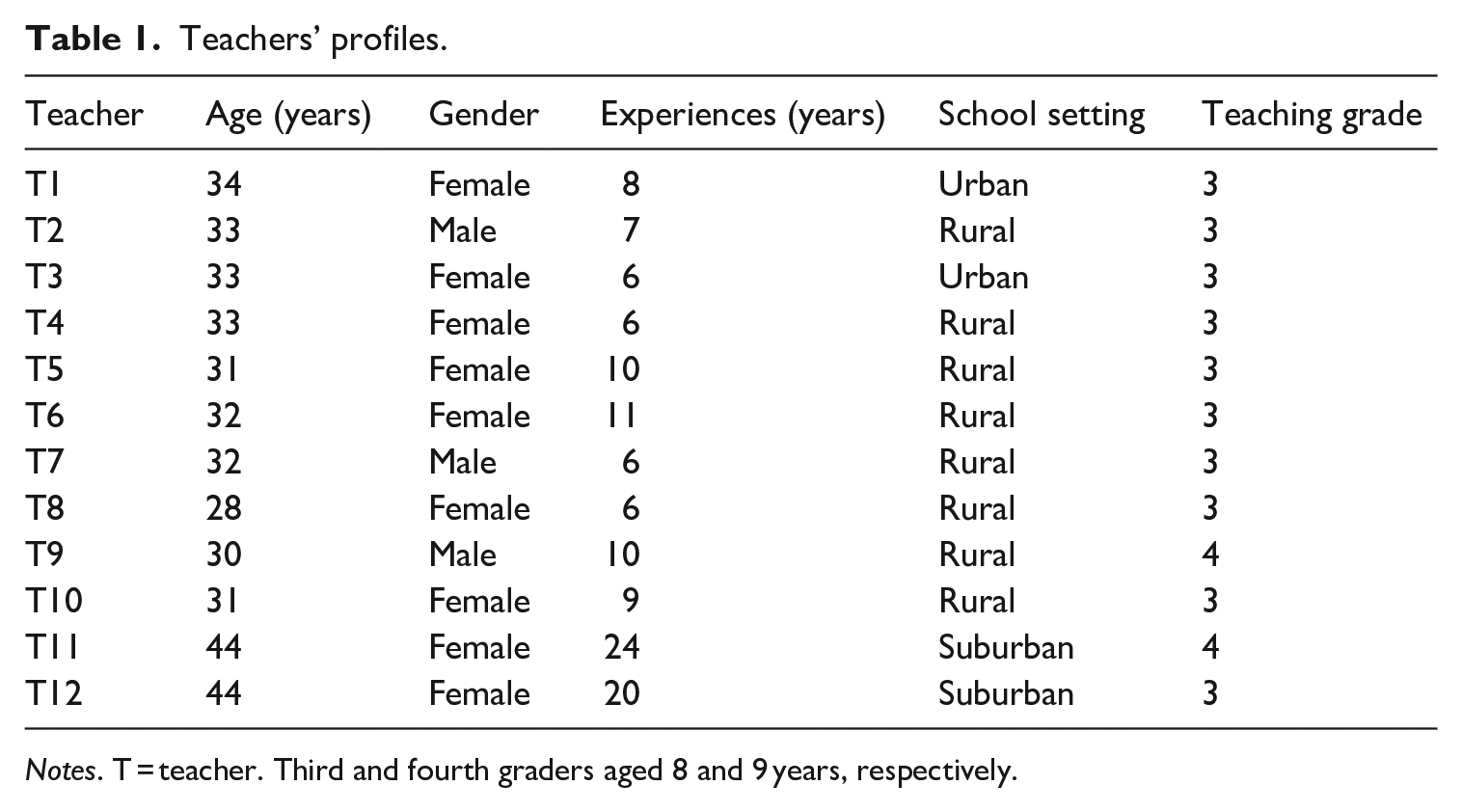
Notes. T = teacher. Third and fourth graders aged 8 and 9 years, respectively.
2 Instructional context
The study was conducted at 10 public primary schools in the South of Vietnam. These schools have implemented the new curriculum issued by the Ministry of Education and Training (MOET) since 2010. Under this curriculum, English becomes a compulsory subject for all school students starting in Grade 3. Two textbook series – Global Success and I-Learn Smart Start – were used in accordance with the new curriculum and under the permission of the MOET. Nine schools in the current study employed the Global Success series known as Tieng Anh 3–5 for Grade 3 to 5 (Hoang et al., 2022). The I-Learn Smart Start textbook series was used only at one school. Textbooks of Global Success for each grade (3–5) contain 20 units, each of which contains three lessons and six activities per lesson while textbooks of I-Learn Smart Start for each grade contain eight themes with each theme containing six lessons and five activities per lesson.
3 Study design
The study employed a qualitative multi-method approach to data collection (Denzin & Lincoln, 2002) and grounded analysis procedures (Charmaz, 2006) to facilitate the interpretation of the findings. Three data collection tools, including interviews, stimulated recalls, field notes, and reflective frames, were used to elicit teachers’ descriptions of learner engagement and their practices, particularly focusing on how primary school teachers perceive young learner engagement, and how they describe and assess their engagement in their intact L2 classes.
4 Instruments and procedure
a Semi-structured interviews
The semi-structured interviews focused on teachers’ descriptions and assessments of young learner engagement in intact classrooms. In this interview, each teacher was asked how they perceived learner engagement, how they described behaviours of engaged learners, what signs/indicators they looked for in an interaction to ensure that learners are engaged, and what strategies they used to promote young learner engagement (for interview prompts, see Appendix A).
b Classroom observation, field notes, and stimulated recalls
Classroom observations were conducted with six teachers who agreed for their lessons to be video recorded. The second author took unstructured field notes while visiting the teachers’ classes. A total of 6 lessons were recorded (one 35–40 minute lesson per teacher). The observed lessons varied in terms of the skills practised and language focus including speaking, listening, reading, writing, and pronunciation. After the lesson was recorded, a stimulated recall (SR) interview (Gass et al., 2005) was conducted. These SR interviews were conducted in Vietnamese and took place in a private teacher lounge at each teacher’s school. Each teacher watched a recording of their lesson(s) during the SR session at their own pace, and they were asked to recall their thoughts at the time. While viewing the recordings, the teachers were encouraged to pause the recording at the moments they thought their learners were most actively engaged in the classroom activities. When the video recording ceased, the teachers gave an account of what had been occurring, their thoughts, how they had evaluated learner engagement in the episode, and the indicators that had led them to that conclusion. The interviews were transcribed verbatim and sent back to the teachers for confirmation.
c Reflective frames
We designed three reflective frames to elicit teachers’ understanding of learner engagement, their account and assessment of their learners’ engagement in their recent practices, and the strategies they used to promote engagement. Similar to the narrative frame (Barkhuizen, 2015, p. 178), the reflective frame is ‘a written reflection template consisting of a series of incomplete sentences and blank spaces of varying lengths, structured as a reflection in skeletal form, aiming to produce a coherent reflection by filling in the spaces according to writers’ experiences and thoughts on these’. Although the reflective frames are a relatively new form of research inquiry, they were arguably considered to be the most efficient way to collect data from our study participants given their complex schedules and their reluctance to be recorded, affording them the opportunity to express their personal experiences through a structured, yet unlimited means as the frames can be easily expanded within a Word document (Farrell, 2022; see also Barkhuizen, 2014) (for the reflective frame template, see Appendix B). Each of the six participants completed two reflective frames. The first frame explored teachers’ perceptions of young learners’ engagement, while the second frame probed into teachers’ accounts and evaluations of young learner engagement. In these frames, the teachers were asked to reflect on a recent lesson, describe the events that took place during the lesson, identify the activities in which they found their learners to be most engaged, and provide justifications for their activity choices. The teachers had the freedom to fill out the reflective frames in either Vietnamese or English. All frames were sent to the six participants via email, and all were returned. The data from the reflective frames helped triangulate the themes identified in the interviews, field notes, and stimulated recalls.
5 Coding and analysis
Oral responses from the semi-structured and SR interviews, field notes, and written responses from the reflective frames were transcribed, typed up, and crossed-checked by the first and second authors (also the coders). The first coder used a thematic analysis approach to analyse the data, which focuses on finding recurring patterns in the data (Braun & Clarke, 2006). First, the data was examined to identify segments of each participant’s responses that were specifically relevant to the main study questions (i.e. learner engagement views and reasons for engagement assessment). Second, depending on the terms and phrases found in the segments, codes were assigned to the segments. These preliminary codes were then organized into various themes, and distinct names were made for each theme. For inter-reliability, the second coder followed the same procedure as the first coder did, as described above, for coding the dataset. The two coders then discussed the differences until both achieved agreement on all coding results.
IV Results
1 Primary school teachers’ perceptions of young learner engagement
Research question 1 explored how primary school teachers define young learner engagement and perceive its indicators in L2 classrooms. The analysis of qualitative data from the interviews (n = 6 teachers) and reflective frames (n = 6 teachers) revealed that all primary school teachers converged on defining young learner engagement as ‘active participation’ and ‘focus during the activities’ which was demonstrated through their observable behaviours (Excerpt 1).
Excerpt 1: Primary school teachers’ general definition of young learner engagement: Learner engagement is the extent to which learners show their active participation in class in response to the teacher’s questions or elicitation, as well as their level of focus in class activities.
When asked to elaborate further on their perceptions after giving a general definition/description of young learner engagement (as presented in Excerpt 1), 83.33% of the teachers (n = 10) added another theme to the general definition that ‘young learner engagement also means that learners show a high level of excitement and enthusiasm’. Overall, the analysis revealed that teachers’ perceptions of young learner engagement in primary schools concerned two major components: behavioural engagement (i.e. active participation in response to questions and elicitation, and level of focus), and emotional engagement (i.e. excitement and enthusiasm). Notably, all teachers emphasized in the interviews that these two aspects of engagement (i.e. behavioural and emotional) were the most salient and key dimensions of primary school learner engagement.
It should be noted that three teachers additionally stated that young learner engagement also included ‘self-control through focusing on completing tasks individually, and actively applying what they have learned’, and one teacher said that young learner engagement concerned ‘collaborating and exchanging ideas with friends’. However, these teachers emphasized that for young learners, self-control, application of what has been learned (i.e. cognitive engagement) and collaborating and exchanging ideas with friends (i.e. social engagement) were not the key indicators of engagement, given that ‘learners were still very young, so it was hard to expect them to self-control and exchange ideas well with friends as compared to adult learners’.
2 Indicators of young learner engagement
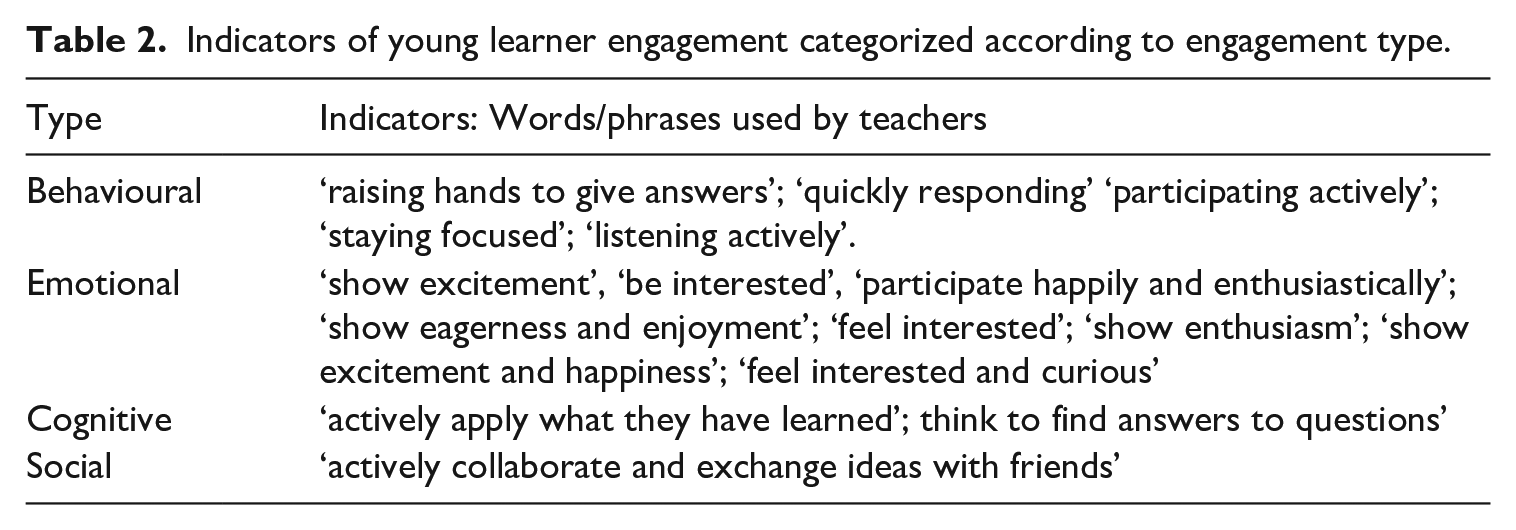
The analysis of responses from interviews and reflective frames shows multiple indicators of young learner engagement reported by teachers, with the majority of them indicating the behavioural and emotional aspects of engagement. This corresponds to their definition of young learner engagement, as reported earlier, where teachers focused more on behavioural and emotional aspects. Tables 2 and 3 summarize these indicators.
Indicators of young learner engagement categorized according to engagement type.
Individual teacher’s reports of indicators of young learner engagement.
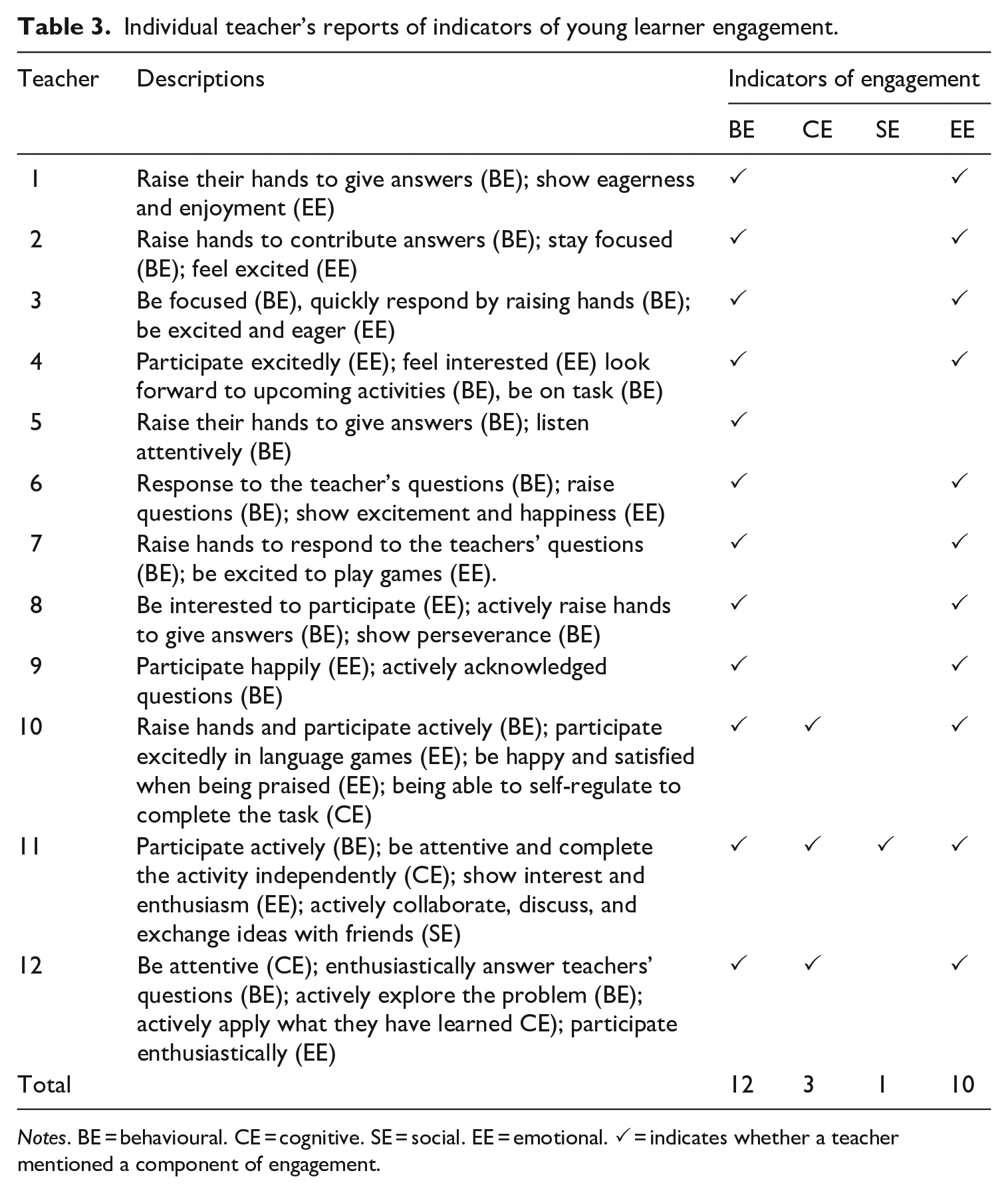
Notes. BE = behavioural. CE = cognitive. SE = social. EE = emotional. ✓ = indicates whether a teacher mentioned a component of engagement.
In Table 2, a large number of phrases describing indicators of young learners’ engagement concerned the behavioural and emotional dimensions of engagement. Meanwhile, only one or two phrases were used to describe indicators of cognitive and social engagement. A further detailed description of individual teachers’ reports of indicators of young learner engagement is provided in Table 3.
In Table 3, all 12 teachers mentioned indicators of behavioural engagement, and 10 mentioned indicators of emotional engagement. Notably, only three teachers stated cognitive engagement, and one considered social engagement.
3 Primary school teachers’ assessment of young learners’ engagement in L2 classes
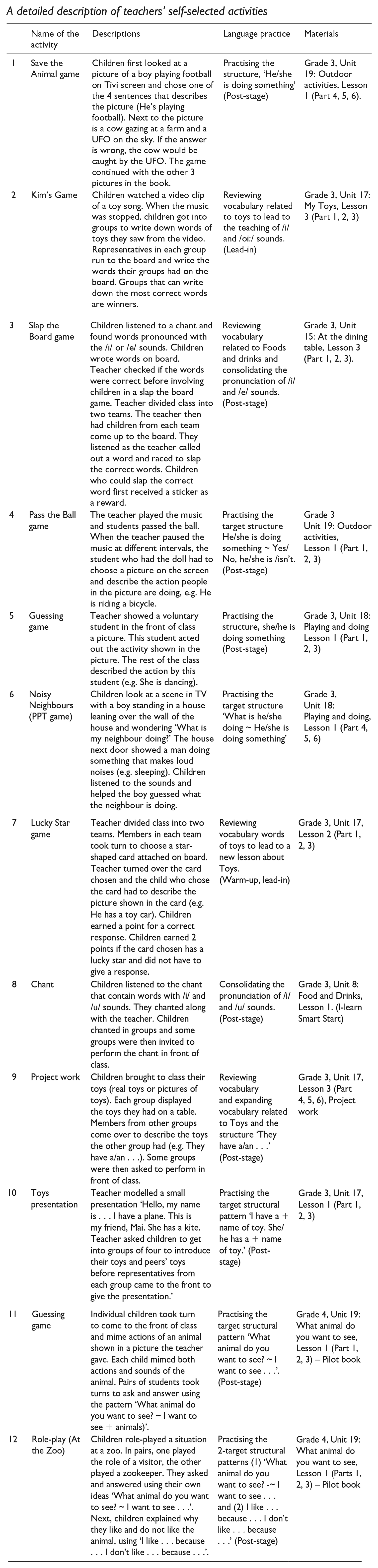
To examine how the teachers assessed young learners’ engagement in their classrooms when observing learners’ live performance of the activities, the teachers (n = 12) were asked to self-select one activity from their lesson and then justify how the activity demonstrates young learners’ high level of engagement. Table 4 provides a brief description of these 12 activities (for a detailed description, see Appendix C).
Descriptions of teachers’ self-selected intact classroom activities.
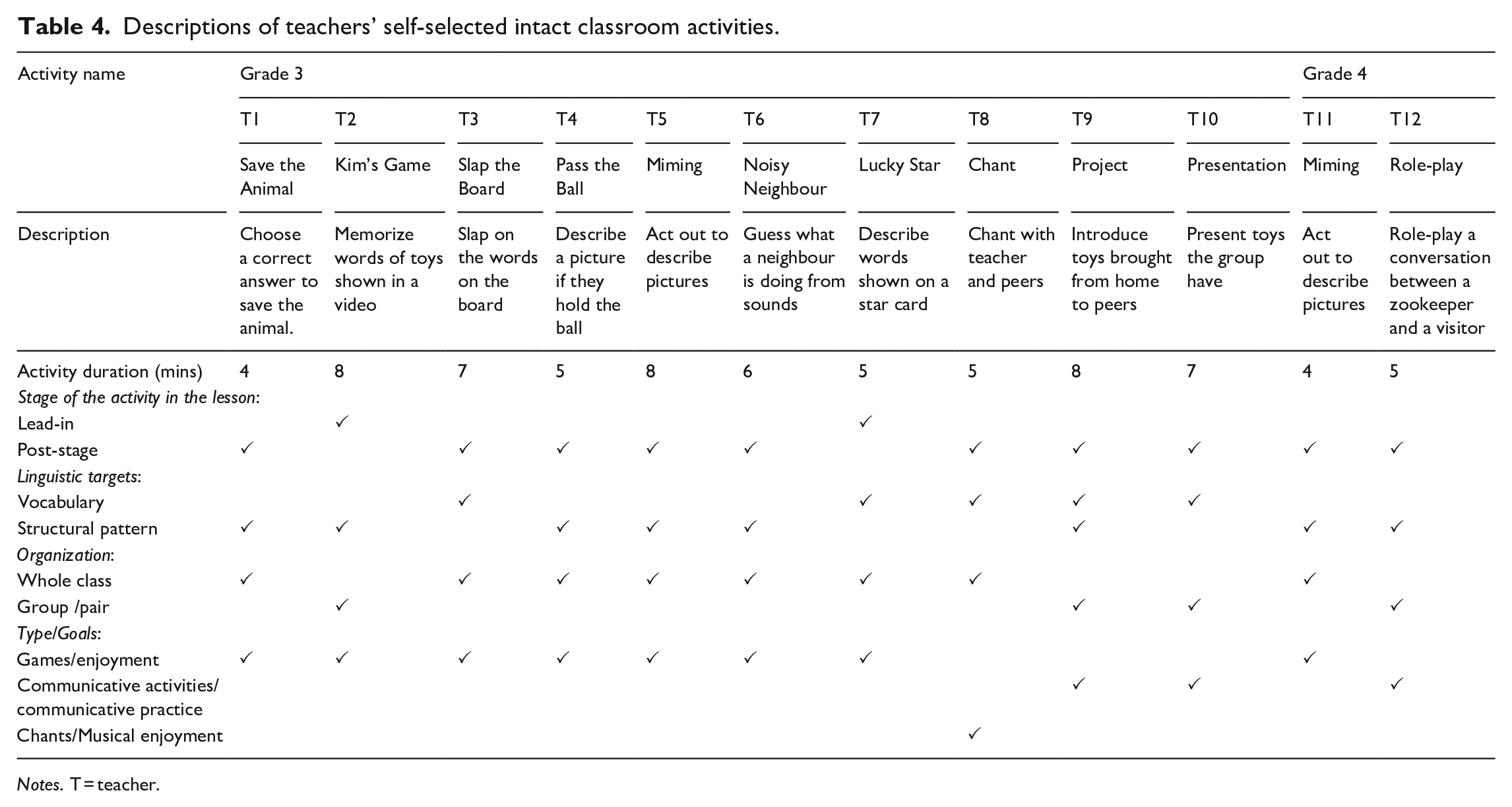
Notes. T = teacher.
In Table 4, the 12 selected activities (one activity per teacher), each lasting 4 to 8 minutes, occurred in two different stages during a 35–40-minute lesson. Two activities served as warm-up and lead-in activities, delivered at the start of the lesson, while the others took place in the post-stage of a lesson. These activities targeted two aspects, namely vocabulary and structure patterns. Most of them (n = 8) were conducted as whole class activities, as opposed to pair and group work (n = 4). When using TBLT task criteria (Ellis, 2003; Ellis & Shintani, 2015), the analysis of these activities revealed that seven out of the 12 activities did not incorporate any TBLT task criteria, while five activities partially applied TBLT task criteria but did not fully utilize all of them (Table 5).
Teachers’ self-selected activities via the lens of TBLT task criteria.
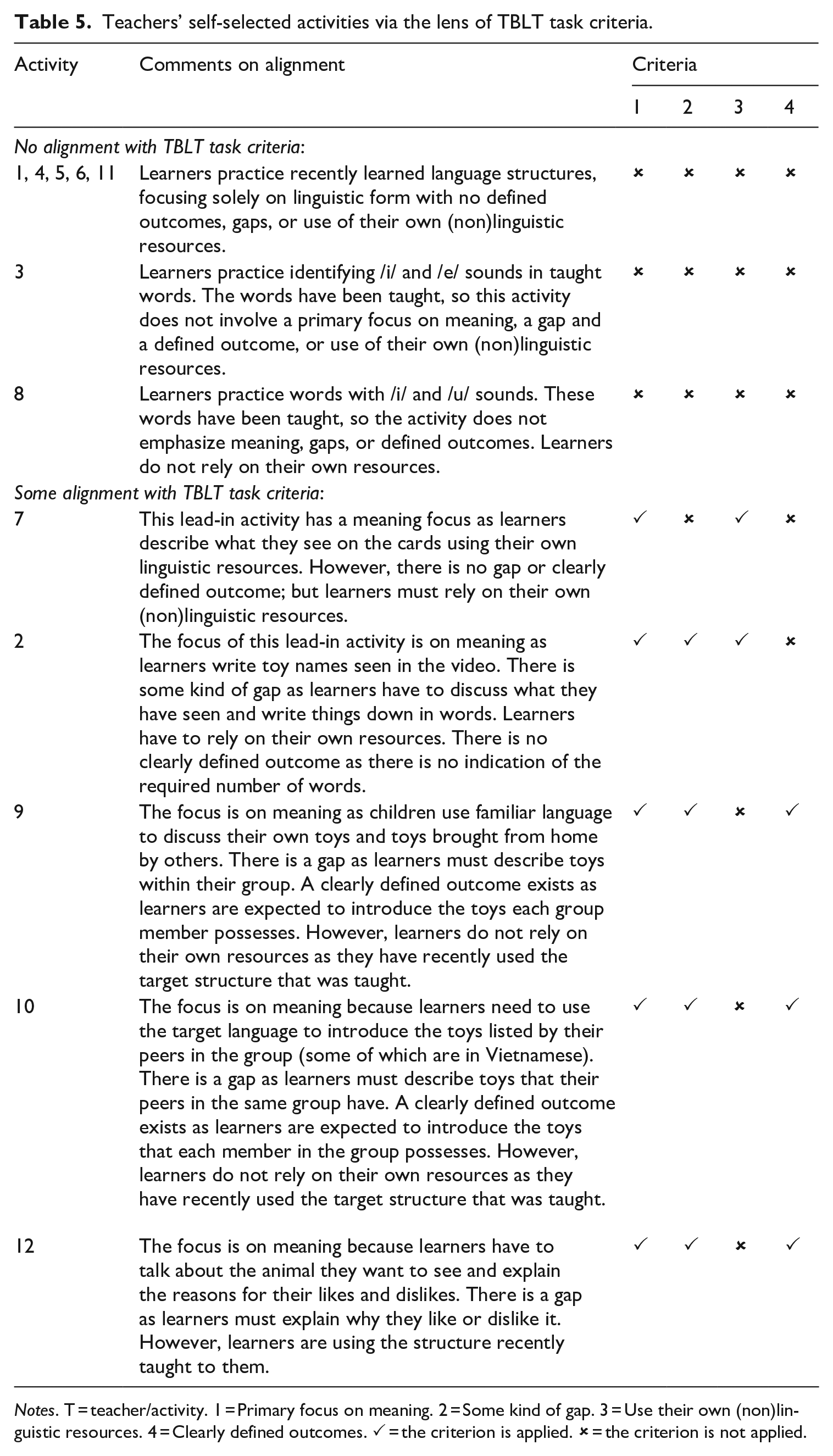
Notes. T = teacher/activity. 1 = Primary focus on meaning. 2 = Some kind of gap. 3 = Use their own (non)linguistic resources. 4 = Clearly defined outcomes. ✓ = the criterion is applied. ✘ = the criterion is not applied.
Regarding the teachers’ assessment of learner engagement during live performances of these activities, the analysis revealed that teachers attended to three aspects to assess learners’ high levels of engagement, as reflected in the Type and the Goals of the activities (Table 4). That is, most of the teachers (n = 8) chose ‘game-based’ activities that involve elements of ‘enjoyment and competition’ as most engaging activities for young learners. Three teachers selected communicative activities that required ‘a high level of interaction’ and involved ‘pair/group work’. One teacher chose a chant that involves ‘musical and enjoyment elements solely’. To further explore teachers’ justifications behind their activity selection as they observed children’s engagement in the activities, their explanations in the interviews and reflective frames were analysed (Table 6).
Teachers’ account of engaging activities.
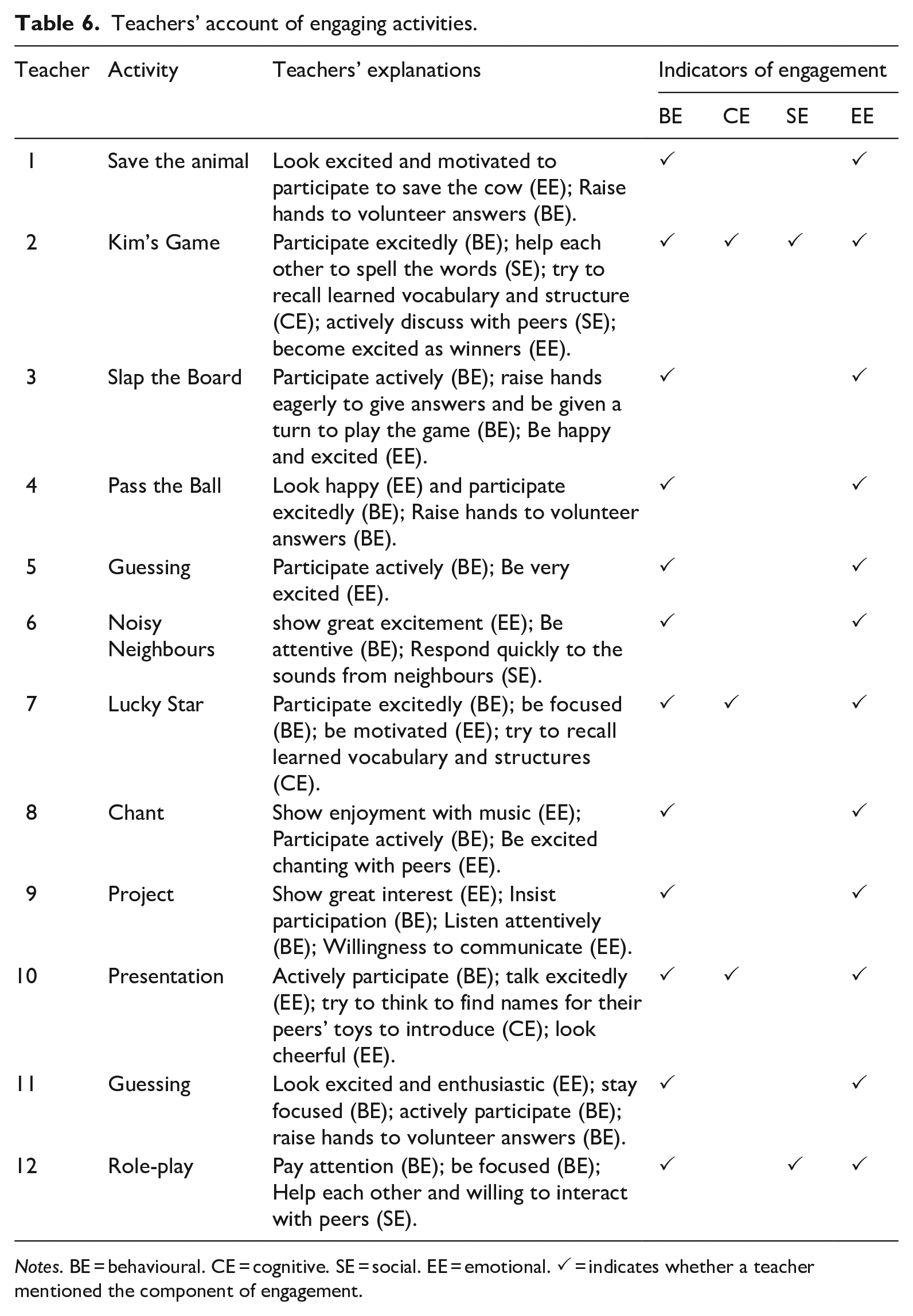
Notes. BE = behavioural. CE = cognitive. SE = social. EE = emotional. ✓ = indicates whether a teacher mentioned the component of engagement.
In Table 6, when justifying why these selected activities demonstrate learners’ high level of engagement, all teachers (T1–T12) referred to the behavioural and emotional features of the activities as the main reasons. Their comments centred on indicators of behavioural engagement (e.g. ‘participate actively’, ‘raise hands to volunteer an answer’, ‘stay focused’), and indicators of emotional engagement (e.g. ‘be excited and motivated’, ‘look happy and satisfied’ and ‘be willing to communicate’). However, indicators of cognitive and social engagement were mentioned by three teachers. The teachers reasoned that their children engaged cognitively as they ‘tried to recall’ or ‘tried to think’ to mobilize knowledge (vocabulary and structures) learned in the previous lessons to use in the activities. They also explained that their children engaged socially as they were willing to ‘help each other to spell words’, ‘respond quickly’ and ‘be willing to interact’. Notably, as compared to the behavioural and emotional aspects, the cognitive and social engagement dimensions received much less attention. In sum, the results showed that all teachers relied primarily on two indicators of behavioural and emotional engagement to assess children’s engagement during live classroom activities, with some paying additional attention to cognitive and social aspects of engagement.
4 Strategies to promote young learners’ engagement
To investigate strategies the teachers used to promote young learners’ engagement in their intact classes, data from classroom observations, interviews, and reflective frames were analysed thematically. Results indicated that a variety of strategies were used to keep children engaged throughout the entire lesson. The shared strategies included: (1) creating excitement for learning, (2) rewarding children often and immediately, and (3) giving them verbal praise. The teachers also reported their other unique attempts at engaging children in their regular practices.
a Creating excitement for learning
All teachers reported that they used various activities to create excitement for learning throughout the lessons. They considered creating an enjoyable classroom atmosphere a decisive factor as failing to do this successfully results in disengagement. Most teachers used language games at different intervals in a lesson to keep children engaged. Some stated that quick technology-based activities (e.g. powerpoint games or video-based games) such as Noisy Neighbours or Kim’s Game kept children excited throughout the lessons, thus facilitating their learning.
Excerpt 2: Creating excitement for learning: I usually do something fun at the beginning of the lesson if I want my children to engage in the lesson. Children can easily lose focus if they cannot find fun in the activities they do. In almost every class, I have them play games, chant or sing to keep them interested and focused throughout a lesson. (T2)
b Rewarding children often and immediately
Most teachers stated that rewarding was very effective in sustaining children’s attention and effort. Many teachers (T1, T3, T5, T10) used stickers as rewards in most classes. Children received stickers (small pieces of plastic with funny pictures of animals or cartoon heroes and encouraging words such as ‘Well done!’ or, ‘You are a hero!’) every time they volunteered a correct answer. Some rewarded their children immediately with a sweet, a small toy, or a bonus sticker if they attempted a difficult question. The teacher reasoned that these strategies were especially effective in encouraging active participation.
Excerpt 3: Rewarding children often and immediately: Children eagerly volunteer to answer to collect [stickers]. As they want to collect as many [stickers] as they can. They love to keep them and show their parents, siblings or friends the [stickers] they had with pride. (T1)
c Giving children verbal praise
Many teachers verbally praised children for any attempts they made to participate. This strategy, according to T6, was even more effective than rewarding them with a sweet.
Excerpt 4: Praising children for attempts or participation: Children feel especially proud when they are praised verbally in front of the class. They immediately become excited and motivated to learn. I think this is even more effective than rewarding them with a sweet. (T6)
Some other strategies used by individual teachers showed their additional attempt to keep children interested. For example, T8 ‘used humour to make children smile and keep them interested’. T11 usually ‘created chants from the melody that is familiar with children’ such as a chant using a melody of a popular song for kids ‘When I turn 3’ to make them feel fun chanting. Two teachers (T1 and T9) tried to ‘strengthen teacher–student relationships by talking to their children to learn about their strengths and weaknesses to tailor the classroom activities to their interests’ as a way to support engagement. Interestingly, T4 reported an effort to engage children cognitively by ‘creating tasks in such a way that they demand product outcomes – students create something to share at the end, such as a piece of drawing or a real object’. In sum, the results showed that most teachers tried to engage young learners throughout the lessons using a variety of activities, with most of the strategies intending to engage them emotionally and behaviourally, except T4 who used cognitive strategies.
V Discussion
1 Primary school teachers’ perceptions of young learner engagement and its indicators
The results show that all primary school teachers conceptualized L2 young learners’ engagement as ‘active participation’ and ‘degree of focus’, particularly emphasizing the behavioural aspect (i.e. active participation in response to questions and elicitation, and level of focus) and emotional aspect (i.e. excitement and enthusiasm) as the salient dimensions of young learners’ engagement. A small number of teachers mentioned the cognitive (three out of 12) and social (one out of 12) aspects of engagement, which were notably perceived as not key indicators of engagement. These results supported the findings of previous studies that acknowledged the multidimensional nature of engagement (Aubrey & Philpott, 2023; Dao, Nguyen, Duong, & Tran–Thanh, 2021; Philp & Duchesne, 2016; Lambert & Zhang, 2019; Svalberg, 2009; see also Hiver et al., 2021). However, the results point out that behavioural and emotional dimensions of young learner engagement were more emphasized and considered as key indicators by the primary school teachers in this study. One possible explanation for the greater focus on behavioural engagement (i.e. active participation) is that teachers often rely on observable behaviours to judge learner engagement in the live performance of the activities and thus behaviours (e.g. raising hands, participating actively, and responding to the teachers’ answers quickly) were considered as key signs of learner engagement. Additionally, the teachers’ greater focus on the emotional engagement (i.e. excitement and enthusiasm) is arguably specific to the characteristics of young learners who always requires more ‘fun’ elements in their learning, which are often generated by games, playful competitions, and entertaining chanting (Pinter, 2006; Wingate, 2018).
The lesser focus on social and cognitive aspects of young learner engagement documented in this study is partly due to the teachers’ perceptions, as reflected in the quote presented in the results section: ‘learners were still very young, so it was hard to expect them to self-control and exchange ideas well with friends as compared to adult learners’. These results suggest two notable points. First, it seems that the teachers have a lay understanding of the construct of engagement (i.e. placing more emphasis on two aspects: emotional and behavioural), which differs from its scholarly operationalization that often has a balanced view of all aspects of engagement (behavioural, cognitive, emotional, and social). Second, it seems plausible that the teachers prioritize the ‘fun’ or emotional aspect of engagement over other aspects, such as social or cognitive engagement, due to the characteristics of young learners. This points to the slight difference between young learner engagement and adult learner engagement, suggesting that characteristics of young learners have probably led teachers to attend more to some aspects of engagement (e.g. emotional and behavioural dimensions) than compared to other aspects (e.g. social and cognitive dimensions). It should be noted that while the fun or emotional aspect is crucial for young learners’ engagement, previous research noted that ‘lots of games with little [cognitive, intellectual, and linguistic] challenges functioned as a disguise for form-focused exercises’ might be a potential issue for L2 learning’ because these ‘fun’ activities, organized in a teacher-led and controlled fashion, might not necessarily promote L2 development (Wingate, 2018, p. 442). This suggests that it might be necessary to increase some degree of learners’ cognitive engagement, and collaborative and meaningful interactions (e.g. social engagement) (Bygate & Samuda, 2009; Storch, 2008) while still maintaining the fun (i.e. emotional engagement) in activities for young learners. An increase in cognitive and social engagement for young learners is possible because previous research has shown that primary school or young learners are able to perform a learner-led and communicative task successfully (Pinter, 2006).
Another key finding in this study was that teachers reported multiple indicators to assess young learners’ engagement levels. Previous research suggests that engagement manifests itself in different dimensions (Dao, Nguyen, & Iwashita, 2021; Lambert & Zhang, 2019; Nguyen et al., 2023, see also Philp & Duchesne, 2016), so it is important to look for different indicators to gauge the engagement of learners more accurately. Supporting this argument, the current study posits that attending to diverse indicators of engagement is one of the potentially effective ways to determine learners’ engagement levels. In this study, the teachers appeared to emphasize the importance of indicators for behavioural and emotional engagement more than social and cognitive engagement, resulting in a higher number of reported indicators for cognitive and emotional engagement (Tables 2 and 3). Previous research suggests that all dimensions of engagement (e.g. cognitive, social, emotional, and behavioural) are sometimes inseparable and intertwined (Platt & Brooks, 2002; Storch, 2008), so it is plausibly necessary to balance the use of indicators related to different aspects of engagement to achieve an accurate assessment of learner engagement.
2 Primary school teachers’ assessment of young learner engagement
The analysis of the 12 selected activities and the teachers’ justification for their selection revealed a congruence between teachers’ conceptions of engagement and their practices. Most teachers selected games as the activities that they believed to provoke children’s high level of engagement. Also, the teachers greatly focused on achieving enjoyment as ‘goals’ of the activities. As reflected in Tables 4 and 5, most of the activities were relatively short, organized in a controlled, whole-class and teacher-fronted manner. Also, all the activities served as ‘lead in’ or ‘post-stage mechanic’ practices of the structural patterns explicitly taught in the main stage of the lesson, and/or checking the memorization of previously taught vocabulary. These results indicate that while joyful play and reviewing previously taught grammatical points and vocabulary are essential for engaging learners on a behavioural and cognitive level, opportunities for L2 meaningful language use in these 12 activities could be enhanced to foster genuine language production, communicative L2 abilities, and engagement at all levels: behavioural, cognitive and social (Oliveira & Jones, 2023; Pinter, 2006; Wingate, 2018).
In addition, the analysis of the 12 activities shows that the teachers placed a great focus on the observable behaviours (e.g. raising hands, quickly responding to teachers’ questions, and participating actively) when assessing young learner engagement. From the cognitive-interactionist perspective, these observable interactional behaviours are essential for generating productive classroom interaction (see Gass & Mackey, 2020). However, little empirical research has established whether behavioural and emotional engagement (rather than cognitive processes – cognitive engagement) is directly linked to subsequent L2 learning. It is possible that ‘superficial’ behavioural engagement does not reflect ‘deep’ engagement, and thus does not necessarily result in subsequent L2 learning. However, this interpretation is tentative and should be treated cautiously, given that limited empirical research has established which aspects of engagement (cognitive, behavioural, social, and emotional) are directly or indirectly linked, predictive of, or conducive to subsequent L2 learning.
Furthermore, the results revealed the shared design of all 12 activities, all of which served as ‘lead-in’ and brief ‘post-stage’ activities (rather than the main activities of the lesson), were mostly structured in whole-class settings instead of meaning-based pair/group work, and targeted mechanic practices of previously taught structures and vocabulary. Specifically, analysis of all of the self-selected activities shows that more than half of them did not incorporate any TBLT task criteria, suggesting that they do not seem to provide learners with opportunities for (1) using their own linguistic and non-linguistic resources, (2) focusing on achieving meaningful and communicative outcomes, (3) resolving some gaps in the tasks, and/or (4) engaging in communicatively meaning-based performance (Ellis, 2003; Ellis & Shintani, 2015; Ellis et al., 2019). The remaining activities partially embraced TBLT task criteria, and none fully incorporated all of these criteria. These results suggest that while some tasks in Table 4 are appropriate for young learners, a more careful examination of the task design and implementation is necessary, especially for those tasks being purely imitative, mechanic, and decontextualized (e.g. chanting or chorus) which can lead to ‘superficial’ behavioural engagement rather than ‘actual’ engagement (for fake engagement, see Mercer et al., 2021). It should be noted that TBLT task criteria are proposed for adult learners and thus might not always be fully applicable to young learners, especially for the 12 activities analysed in Table 4. Also, while it is plausible not to expect young learners to freely engage in discussion and meaning-making, it is necessary to ensure some degree of communicativeness and less teacher-centredness during task interactions as reflected through TBLT criteria (for designing tasks for young learners using TBLT criteria, see Shintani, 2016).
3 Strategies for fostering young learners’ engagement
The results show that the strategies that most teachers used to keep their students engaged in the activities reflect a strong focus on the emotional aspect of engagement. They included creating enjoyment for learning via games, rewarding children often and immediately with physical objects such as toys, sweets, and stickers, and/or verbally praising them for their effort or attempts in front of their class. Besides, using humour to make children laugh and chanting to make classes enjoyable were also considered effective in keeping children engaged in the classroom activities. In line with the findings of previous research that documented various strategies to promote young learner engagement (Oga-Baldwin & Nakata, 2020) and adult learner engagement (Mystkowska-Wiertelak, 2022; Sulis, 2022), these results suggest that strategies to promote young learners’ engagement can be diverse, but they need to be tailored to the characteristics of young learners, as even motivated learners might not always be engaged due to different contextual factors (see Teravainen-Goff, 2022).
Finally, while most teachers did not mention them, some teachers used specific strategies, including (1) strengthening teacher–student relationships by talking to their children to understand their strengths and weaknesses, and (2) creating tasks that demand tangible outcomes, such as children producing a drawing or physical object to share. Arguably, these strategies, which emphasize building the relationship between the teacher and the learner (i.e. social engagement) and requiring non-linguistic outcomes of task performance throughout collaboration (i.e. cognitive and social engagement), are in line with the principles of TBLT task design that could potentially generate L2 learning opportunities and thus subsequent L2 learning. However, it is worth noting that only a few teachers mentioned these strategies. This suggests the need for a stronger focus on them, in addition to the strategies that target emotional engagement.
VI Conclusions
This study investigated teachers’ perceptions of young learner engagement. The results revealed that teachers perceived engagement as learners’ active participation and focus during the activities, emphasizing the behavioural and emotional aspects (as opposed to social and cognitive aspects) as key dimensions of the construct of engagement. The teachers also reported multiple indicators, mostly focusing on the behavioural and emotional aspects of engagement. Given this specific conceptualization of young learner engagement, their practices (i.e. design of engaging tasks or activities) were primarily focused on promoting behavioural and emotional engagement. Thus, activities that engaged learners behaviourally and emotionally were perceived as engaging. The results also show that teachers used a variety of strategies to promote engagement, all of which appeared to be specific to the characteristics of young learners and focused largely on behavioural and emotional aspects of engagement.
Inevitably, there are limitations to the study that necessitate caution in interpreting these findings. First, the study relied solely on qualitative measures that may not capture the full spectrum of learner engagement, especially from a large group of participants. Second, the study primarily focused on teachers’ perspectives of engagement, lacking the insights that learners could provide. Incorporating the viewpoints of the learners could have offered a more holistic understanding of engagement as opposed to the teachers’ perspectives. Third, while the study shed light on engagement from an observational and qualitative standpoint, it did not directly address the link between young learner engagement and subsequent L2 learning outcomes. This calls for further research to establish any direct causal relationship between young learner engagement and L2 learning.
Despite the limitations, this study offers some pedagogical implications. First, the results suggest that raising awareness among teachers regarding their perceptions of young learner engagement is essential, particularly in promoting a more balanced view of engagement across multiple dimensions, including cognitive, social, emotional, and agentic aspects, rather than prioritizing only behavioural and emotional dimensions of engagement. Second, the design of tasks and activities can be revisited. While maintaining behavioural and emotional engagement is crucial, there is a need to promote more cognitive and social aspects of engagement such as genuine opportunities for language production and language use. These elements are crucial for subsequent learning processes. Finally, the strategies employed by the teachers in this study were diverse, and thus other teachers may find them beneficial when applied in their own classrooms.
Footnotes
Appendix A
Appendix B
Appendix C
A detailed description of teachers’ self-selected activities
| Name of the activity | Descriptions | Language practice | Materials | |
|---|---|---|---|---|
| 1 | Save the Animal game | Children first looked at a picture of a boy playing football on Tivi screen and chose one of the 4 sentences that describes the picture (He’s playing football). Next to the picture is a cow gazing at a farm and a UFO on the sky. If the answer is wrong, the cow would be caught by the UFO. The game continued with the other 3 pictures in the book. | Practising the structure, ‘He/she is doing something’ (Post-stage) |
Grade 3, Unit 19: Outdoor activities, Lesson 1 (Part 4, 5, 6). |
| 2 | Kim’s Game | Children watched a video clip of a toy song. When the music was stopped, children got into groups to write down words of toys they saw from the video. Representatives in each group run to the board and write the words their groups had on the board. Groups that can write down the most correct words are winners. | Reviewing vocabulary related to toys to lead to the teaching of /i/ and /oi:/ sounds. (Lead-in) |
Grade 3, Unit 17: My Toys, Lesson 3 (Part 1, 2, 3) |
| 3 | Slap the Board game | Children listened to a chant and found words pronounced with the /i/ or /e/ sounds. Children wrote words on board. Teacher checked if the words were correct before involving children in a slap the board game. Teacher divided class into two teams. The teacher then had children from each team come up to the board. They listened as the teacher called out a word and raced to slap the correct words. Children who could slap the correct word first received a sticker as a reward. | Reviewing vocabulary related to Foods and drinks and consolidating the pronunciation of /i/ and /e/ sounds. (Post-stage) |
Grade 3, Unit 15: At the dining table, Lesson 3 (Part 1, 2, 3). |
| 4 | Pass the Ball game | The teacher played the music and students passed the ball. When the teacher paused the music at different intervals, the student who had the doll had to choose a picture on the screen and describe the action people in the picture are doing, e.g. He is riding a bicycle. | Practising the target structure He/she is doing something ~ Yes/No, he/she is /isn’t. (Post-stage) | Grade 3 Unit 19: Outdoor activities, Lesson 1 (Part 1, 2, 3) |
| 5 | Guessing game | Teacher showed a voluntary student in the front of class a picture. This student acted out the activity shown in the picture. The rest of the class described the action by this student (e.g. She is dancing). | Practising the structure, she/he is doing something (Post-stage) |
Grade 3, Unit 18: Playing and doing Lesson 1 (Part 1, 2, 3) |
| 6 | Noisy Neighbours (PPT game) | Children look at a scene in TV with a boy standing in a house leaning over the wall of the house and wondering ‘What is my neighbour doing?’ The house next door showed a man doing something that makes loud noises (e.g. sleeping). Children listened to the sounds and helped the boy guessed what the neighbour is doing. | Practising the target structure ‘What is he/she doing ~ He/she is doing something’ |
Grade 3, Unit 18: Playing and doing, Lesson 1 (Part 4, 5, 6) |
| 7 | Lucky Star game | Teacher divided class into two teams. Members in each team took turn to choose a star-shaped card attached on board. Teacher turned over the card chosen and the child who chose the card had to describe the picture shown in the card (e.g. He has a toy car). Children earned a point for a correct response. Children earned 2 points if the card chosen has a lucky star and did not have to give a response. | Reviewing vocabulary words of toys to lead to a new lesson about Toys. (Warm-up, lead-in) |
Grade 3, Unit 17, Lesson 2 (Part 1, 2, 3) |
| 8 | Chant | Children listened to the chant that contain words with /i/ and /u/ sounds. They chanted along with the teacher. Children chanted in groups and some groups were then invited to perform the chant in front of class. | Consolidating the pronunciation of /i/ and /u/ sounds. (Post-stage) |
Grade 3, Unit 8: Food and Drinks, Lesson 1. (I-learn Smart Start) |
| 9 | Project work | Children brought to class their toys (real toys or pictures of toys). Each group displayed the toys they had on a table. Members from other groups come over to describe the toys the other group had (e.g. They have a/an . . .). Some groups were then asked to perform in front of class. | Reviewing vocabulary and expanding vocabulary related to Toys and the structure ‘They have a/an . . .’ (Post-stage) | Grade 3, Unit 17, Lesson 3 (Part 4, 5, 6), Project work |
| 10 | Toys presentation | Teacher modelled a small presentation ‘Hello, my name is . . . I have a plane. This is my friend, Mai. She has a kite. Teacher asked children to get into groups of four to introduce their toys and peers’ toys before representatives from each group came to the front to give the presentation.’ | Practising the target structural pattern ‘I have a + name of toy. She/he has a + name of toy.’ (Post-stage) | Grade 3, Unit 17, Lesson 1 (Part 1, 2, 3) |
| 11 | Guessing game | Individual children took turn to come to the front of class and mime actions of an animal shown in a picture the teacher gave. Each child mimed both actions and sounds of the animal. Pairs of students took turns to ask and answer using the pattern ‘What animal do you want to see? ~ I want to see + animals)’. | Practising the target structural pattern ‘What animal do you want to see? ~ I want to see . . .’. (Post-stage) | Grade 4, Unit 19: What animal do you want to see, Lesson 1 (Part 1, 2, 3) – Pilot book |
| 12 | Role-play (At the Zoo) | Children role-played a situation at a zoo. In pairs, one played the role of a visitor, the other played a zookeeper. They asked and answered using their own ideas ‘What animal do you want to see? ~ I want to see . . .’. Next, children explained why they like and do not like the animal, using ‘I like . . . because . . . I don’t like . . . because . . .’. | Practising the 2-target structural patterns (1) ‘What animal do you want to see? -~ I want to see . . . and (2) I like . . . because . . . I don’t like . . . because . . .’ (Post-stage) | Grade 4, Unit 19: What animal do you want to see, Lesson 1 (Parts 1, 2, 3) – Pilot book |
Funding
The author(s) disclosed receipt of the following financial support for the research, authorship, and/or publication of this article: This research is funded by Vietnam National University HoChiMinh City (VNU-HCM) under grant number C2024-16-01, awarded to the second author.
