



Abstract
Transformative practitioner research enables teachers to create or contribute to their own knowledge base. Recently, this research field has flourished, with numerous studies exploring how practitioner researchers develop knowledge, agency and identities, particularly through action research (AR) and exploratory practice (EP). Despite important work on the content or outcomes of language practitioner researcher development (LPRD), there is less conceptualization of how LPRD is manifested in relation to environments where language practitioners work. In this contribution to the special issue on inclusive practitioner research, we draw on sociocultural and ecological systems theories to present a framework for understanding what enables LPRD to flourish in terms of sustainability and inclusivity. Our framework considers how sustainability through inclusion can be achieved within micro, meso and macro ecological systems, and how these systems interrelate. We exemplify our framework using illustrations of individual teachers and their interactions with a specific AR program and their institutions. While we focus on AR, this framework may apply to EP and other forms of practitioner research which strive for inclusive LPRD. We conclude with practical implications for teacher educators and professional development coordinators about fostering inclusive LPRD within institutional environments.
Keywords
I Introduction
For two decades English language teaching (ELT) has witnessed the expansion of practitioner research as a form of teacher education and continuing professional development (CPD). Practitioner research, whether Action Research (AR), Exploratory Action Research (EAR), Exploratory Practice (EP) or Reflective Practice (RP), denotes self-agency by protagonists and aligns with transformative views of language teacher education that strengthen teachers’ knowledge base and identities (Freeman, 2020; Johnson & Golombek, 2020). Despite important work on the content or outcomes of language practitioner researcher development (LPRD), particularly through AR (e.g. Dikilitaş & Yayli, 2018; Edwards, 2021) and EP (Hanks, 2019; Slimani-Rolls & Kiely, 2019), less is known about how such development is mediated by particular environments and contexts. Better understanding is needed of how teacher-researcher identities and a research ‘reflective mindset’ (Allwright, 1997) arise, along with insights into how ‘ripple effects’ eventuate and are harnessed across groups or institutions (Burns, Edwards & Ellis, 2022). In particular, if practitioner research is to contribute to sustainable, inclusive development of teachers, learners, their institutions and curricula, the nature of relevant environmental contexts and individual processes mediating development requires investigation.
Our article aims to contribute to furthering the notion of inclusive practitioner research within the theoretical lenses outlined below. We conceptualize inclusive practitioner research as operating at the level of institutional and broader educational systems. Institutionally inclusive practitioner research is conducted by an individual or group that includes and/or influences other people and artefacts within the institution (i.e. classroom, school, college, university) and beyond (i.e. other institutions and educational sectors in the region/country). The initial research may aim for institutional inclusivity, or it may be an unanticipated consequence. Other people included and/or influenced could encompass learners, teaching colleagues and managers, and artefacts influenced by the research may comprise materials, curricula, programs and policies. When it is institutionally inclusive, there is, we argue, greater likelihood of the research and/or an emerging research culture being sustained. By probing how LPRD is thus manifested, we aim to equip professional development educators with theoretical concepts and practical strategies for expanding institutional inclusivity and sustainability of practitioner research.
Here, we draw on sociocultural and ecological systems theories, and our own extensive research and AR involvement in Australia. We build on existing research on mediation of language teacher development (e.g. Johnson & Golombek, 2020), language teacher identity (e.g. Darvin & Norton, 2015), agency (e.g. Miller et al., 2018) and emotions (e.g. Gkonou et al., 2020), and unite several concepts into one framework specific to language practitioner research. Our framework distinguishes between LPRD environments, dimensions and outcomes, and emphasizes inclusivity within institutional contexts. We exemplify the framework using two contrasting LPRD illustrations. We aspire to present a holistic conceptualization of LPRD development and its sustainability specifically for AR, but with possible application to other practitioner research such as EP. This conceptualization contributes to advances in inclusive practitioner research, and to this special issue, by proposing a holistic way of understanding LPRD in terms of sustainability and institutional inclusivity.
II A sociocultural ecological perspective on LPRD
Sociocultural theory offers a ‘powerful theoretical stance’ for analysing teacher development and the impact of language teacher education activities (Johnson, 2015, p. 525). From this perspective, teacher development can be defined as ‘new self-awareness and reorganisation of psychological formations that inform their implementation of work practices’ (Grimmett, 2014, p. 10). Self-awareness is simultaneously a conceptualization of identity and a cognitive construct: that is, understanding of ourselves, of our place within a particular environment, combined with continuous processes of (re-)aligning self-perceptions from different sources (our own and our perceptions of how others see us) (van Lier, 2008). Thus, cognition and identity (often explored with constructs such as agency and emotions) work in combination. Recent studies adopt sociocultural theory to fruitfully analyse teacher development (e.g. Bugra & Wyatt, 2021; Nguyen & Ngo, 2023); however, what can be missing is detail on how individual development interacts with aspects of teachers’ work environment. The additional perspective afforded by ecological systems theory illuminates such interaction, thereby complementing sociocultural theory.
Ecological systems theory is ‘the study of the relationships and interactions between and among organisms and their environment’ (Goodnough, 2010, p. 170) and posits that human development results from complex interactions within different sets of social contexts or systems: the micro (individual), meso (institutional) and macro (wider social system) (Bronfenbrenner, 1979; van Lier, 2004). The microsystem refers to individuals (e.g. teachers) and their immediate environment (e.g. the classroom). More broadly, there are also mesosystems (e.g. the school) and the interactions of individuals within them. The macro system encompasses cultural, social, political, educational environments surrounding the other two (e.g. whole regional or national educational sectors and policies). This perspective has been particularly useful in research on teacher agency and identity. For instance, in a rare study exploring agency and AR, Emam et al. (2023) conclude that their Egyptian primary school participants had constricted agency for AR within their meso and macro contexts. These contexts were characterized by lack of both resources for teacher research and collective agency, and little willingness to defy cultural norms of conflict avoidance. More such studies are needed for LPRD.
Here, we combine sociocultural theory and ecological systems theory in what we call sociocultural ecological (SE) theory. SE theory illuminates how ecological contextual layers act as environments for development and shows how individuals interact with these environments. Central to this understanding is the concept of ‘mediation’. Mediation explains the connection between human development and the sociocultural environment, which is considered the stimulus or the ‘starting point’ for human development (Veresov, 2015, p. 5). Elements of each layer of the environment (other people, activities, resources) can act as stimuli (or constraints); we provide more detail in Section IV. One area benefitting from sociocultural perspectives on mediation is language teacher education pedagogy (Johnson & Golombek, 2020), particularly in how teacher educators can facilitate ‘mediational spaces’ (p. 123) that respond to individual teachers’ goals and needs. However, there is less research on LPRD mediation; investigating practitioner research is particularly important because of its potential as a transformative form of PD (Kennedy, 2014). Commonly, individual LPRD lies within institutional settings; consequently, insights into institutional ‘affordances within the mesosystem’ (Edwards, 2021, p. 409) are essential to understand any ‘ripple effects’ within and beyond the individual within their specific system. While some research exists on LPRD affordance conditions within institutional ecologies (e.g. Borg, 2013), we contend, drawing on sociocultural theory, that it is not environmental conditions per se that ensure LPRD. Rather, it is the interactions between the individual and their environmental conditions and how these interactions are filtered that serve to facilitate LPRD (or not).
It is argued that sociocultural theory powerfully combines elements of language teacher development (cognition, identity, emotion, agency) previously explored in a dispersed rather than unified fashion (Burri et al., 2017; Nguyen & Ngo, 2023). Promisingly, teacher development is increasingly viewed as multidimensional, drawing on multiple constructs. For instance, Nguyen and Ngo (2023), employing cultural historical activity theory (CHAT), present a useful model of the professional becoming of teachers of English as a foreign language (EFL) where emotion, agency and identity exist in unity in a triadic relationship. The framework we present also details contexts of development, including how different aspects of the environment are in relationship with individuals.
Central concepts of SE theory and its potential to illuminate LPRD are outlined only briefly to this point. To explain our framework more thoroughly, we expand on theoretical aspects in Section IV.
III Research design
1 Context of research
The research we draw upon occurred in the Australian ELICOS (English Language Intensive Courses for Overseas Students) sector. This sector has a major role in offering English language courses (e.g. General English, English for Academic Purposes, IELTS Preparation) which support international students’ higher education entry and study. These courses are offered in university language centres and private colleges, some subsidiaries of major multinational chains with others locally owned and operated. The peak body providing sector-wide analysis, advocacy, and professional development nationally is English Australia (see https://www.englishaustralia.com.au). Since 2010, one of its major professional development offerings has been the Action Research in ELICOS Program, sponsored annually by Cambridge English (see https://www.cambridgeenglish.org). Annually, ELICOS teachers can apply to join a small group of volunteers (up to 12 with some from the same institution working in pairs) wishing to conduct AR. Current teacher participants and an ELICOS/Cambridge reference group identify sector priority research themes for the succeeding year. Within these overarching themes teachers investigate their own topics and research angles (e.g. during the Covid-19 epidemic, the 2020 theme became online teaching to accommodate rapid changes in instruction; see Burns et al., 2023). During the program, teacher-researchers meet online or face-to-face for three workshops, held in March, June and October to span the Australian academic year. In these workshops, facilitated by the second author, teachers are progressively introduced to AR theories and processes, discuss and refine their projects and share updates and data analyses. Although teachers come from different locations across Australia, the group constitutes a community of research practice, where dialogic engagement and reflection become particularly significant for development of research and pedagogical knowledge. Between workshops, teachers pursue AR at their institutions, with regular online or email contact with the facilitator and each other; to conclude, they present at the annual national English Australia Conference to other educators. They also prepare written reports published the following year in Cambridge English’s online journal, Research Notes (for numerous examples, see https://www.cambridgeenglish.org/research-and-validation/published-research/research-notes).
The AR model used, which has been found to be clear and explanatory in guiding the teachers’ research, is Kemmis and McTaggart (1988; see also Burns, 2010). This model consists of four phases: plan (identifying and focusing a research issue/topic and posing initial questions); act (putting the plan into action with the focal participants); observe (gathering evidence through various data tools); and reflect (analysing and interpreting findings and outcomes to continue or plan new research directions). This model is dynamic and cyclical, introducing teachers to developmental, agentive processes where research unfolds relative to, and adapted by, local conditions, constraints and affordances (van Lier, 2004). Since educational AR focuses on teachers and learners and issues relevant to them, it is self-directed, aimed at finding innovative, creative responses. Thus, it is not simply a research approach but also a means for deeper professional reflection and growth, central to which is participant ownership within ecological systems of classroom, institution and wider educational context.
2 Methodology
Data to support our framework draw from research conducted over several years that involved 21 teachers participating in one iteration of the annual Action Research in ELICOS Program. It involved two main phases (see Table 1). Here, we answer the following question: ‘How is LPRD influenced by different aspects of the environment when teachers take part in AR?’ In the original study, interviews with nine managers of ELICOS centres were also undertaken and are documented in Edwards (2019b). However, since the managers were not necessarily from the same centres as the teachers whose development is the focus of this article, we report only briefly on the findings from these interviews, in Section V. Qualitative case study was adopted to paint a rich, holistic picture (Casanave, 2015; Duff, 2008) of teachers’ development unfolding as they conducted research in their own institutions.
Summary of the two main research phases, participants and methods.
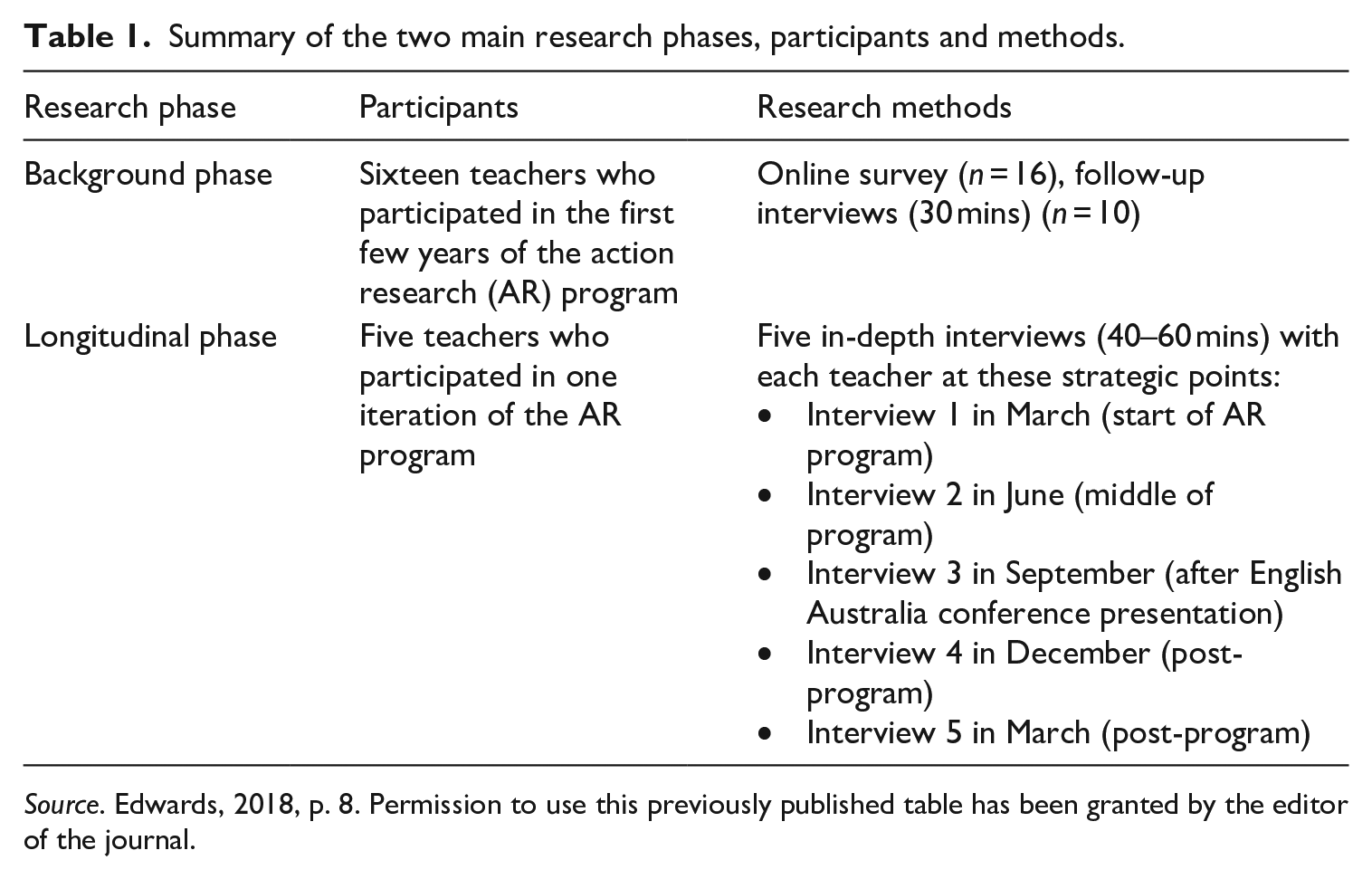
Source. Edwards, 2018, p. 8. Permission to use this previously published table has been granted by the editor of the journal.
The background phase online survey posed multiple-choice and open-ended questions on how AR experiences impacted on professional development. Teachers were also asked about institutional support after the program, as well as challenges faced. The follow-up interviews expanded on survey responses. The 18-month longitudinal phase followed five teachers through five in-depth interviews during and after the program. Each interview asked about experiences, how the program impacted professional development, and how institutional context facilitated or hindered it. These interviews were loosely structured, and teachers were encouraged to share their stories in detail.
Analysis involved organizing, coding, interpreting and validating data (Saldaña, 2013). Saldaña’s codes-to-theory model was used to create categories and then themes; in the longitudinal phase interview themes were validated (or not) and expanded on in each subsequent teacher interview. To conclude the longitudinal phase, we created written profiles detailing each teacher’s development, and asked for feedback. Most responded with edits to represent intended meaning more accurately. These profiles provided key data for developing our framework, supplemented by insights from the background phase. Following the analysis, we employed SE theoretical lenses (see Section II) to understand how and why LPRD unfolded within specific AR program contexts, each teacher’s institution, and the broader Australian ELICOS sector. The data presented derive primarily from the longitudinal phase.
IV A sociocultural ecological framework for understanding LPRD
Based on this research, we propose a framework (see Figure 1) for understanding how LPRD is manifested through interrelated micro, meso and macro systems in an educational context, as well as through individual dimensions. The framework distinguishes between the environments, dimensions and outcomes and presents a holistic conceptualization related to the AR program. Following Figure 1, components of the framework are described. Although described separately, they should be seen as intersecting in a multidirectional framework, with the illustrations section (Section V) explicating how the various aspects interrelate. Our focus in this framework is on how LPRD is mediated ecologically, rather than on the forms of development experienced by teachers.
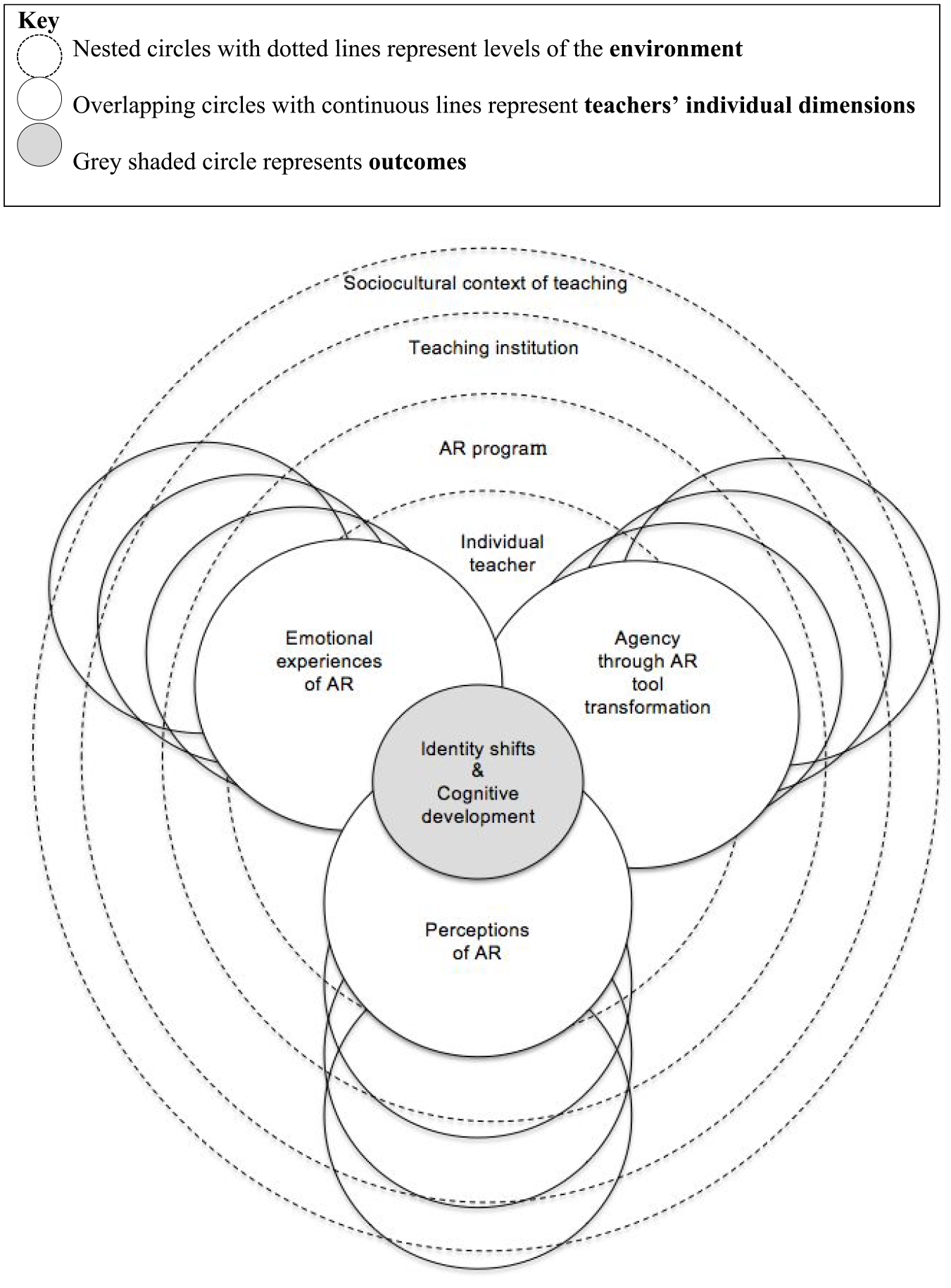
A sociocultural ecological framework for understanding language practitioner researcher development (LPRD).
1 Environment for development
The environment for development includes mutually inclusive systems: the sociocultural teaching context, the teaching institution, the AR program, and the individual teacher. Drawing on ecological perspectives of nested systems (van Lier, 2004), the circles are layers of context, all equally important in mediating LPRD. From a sociocultural perspective, the three outer systems are all social sources of development, which act as stimuli (Veresov, 2015). Within the innermost system, the individual teacher, their history and professional goals also act as stimuli for development (Chen et al., 2022). Each system contains mediating agents or affordances, as well as constraints. These potential sources are important both during AR participation and afterwards, as development (ideally) extends far beyond the research experience itself. However, Vygotsky (1994) emphasized that it is not the features of the contextual layers that are important in determining development; rather, it is the relationship between the individual and their environment. Therefore, in understanding LPRD, it is important to comprehend the particular affordances and constraints of the various interacting environmental systems that individual teachers consider particularly meaningful.
a Sociocultural context of teaching
The broadest system is the sociocultural teaching context, encompassing prevailing educational ideologies, policies, and economic and political conditions. These act either as affordances or constraints depending on the relationship between teacher and context. Important aspects of the sociocultural context identified here are likely relevant to ELT world-wide: specifically, competitive, market-oriented sectors relying on casual teachers; uncertain, even negative, views of research; cultural phenomena affecting how teachers engage in research (see also Edwards & Ellis, 2020; Ellis, 2014). These aspects are detailed in Section V.
b Teaching institution
The second nested system is the environment of the teaching institution employing the teacher during or after their AR involvement. Teacher development can be mediated by professional relationships with others (managers, mentors, peers) (Bugra & Wyatt, 2021), institutional activities engaged in (Eun, 2008), and prevailing institutional cultures. In particular, relationships with manager or principal, and the level of this individual’s support, is crucial in facilitating development. Potential mediating events include staffroom dialogues, workshop interactions, materials creation, or other formal or informal development activities. The institutional culture may or not embrace research, which to some extent reflects the broader sociocultural context, sector attitudes and ideologies. Indeed, Borg (2010) suggests that school cultures of enquiry and openness to change are important teacher research facilitators, while non-collaborative cultures can be a significant barrier. However, the contribution of these facilitators depends on the individual teacher’s interaction with their environment and the specific mediational means perceived as important by each teacher. We expand on our findings about ELICOS institutions in Section V.
c AR program
As the new engagement activity, the AR program is the driving force for teacher development within this framework, providing mediating agents in several forms. First, the participants and the organized AR learning activity, including workshops, discussions and presentations, create a ‘collective scaffold’ (Eun, 2008, p. 143) and ‘mediational spaces’ (Johnson & Golombek, 2020, p. 123). EP promotes similar scaffolded collaboration and partnership (Hanks et al., 2022; Slimani-Rolls & Kiely, 2019). To lead to development, inquiry-based teacher education mediates the dialogic relationship between everyday concepts grounded in practical experience, and scientific, abstract concepts such as teaching theories (Johnson, 2009). Experiencing cyclical AR processes provides a means of evaluating and reflecting on daily practice, as well as conceptual and practical tools that teachers appropriate (Edwards, 2019a). Conceptual tools include new personal theories about practice, and practical tools include AR findings and materials, as well as the AR framework itself. These tools may be appropriated and then transformed through teacher agency, depending on mediating conditions and alignment with teachers’ goals. Further aspects offering facilitating research conditions include projects being relevant to teachers’ working context, activities being structured and supported by expert mentor(s), as well as being voluntary, democratic, collaborative and integrated into teachers’ work, with shared dissemination of findings (Borg, 2010). Section V details how the teachers were influenced by the specific AR program.
d Individual teacher
The innermost system is that of the individual teacher, including their history, professional goals and, in particular, their identity in terms of their perception of present ‘conceptual self’ and vision of ‘future-oriented self’ (van Lier, 2004, 2008). From ecological perspectives, self and identity are separate but closely linked. Van Lier explains that identity constitutes a continuous process of (re-)aligning self-perceptions from different sources (yourself and how others see you). Conceptual self refers to how people perceive themselves, their roles and status and how they think others perceive them: ‘the self is . . . an ongoing project of establishing one’s place in the world’ (van Lier, 2004, p. 115). Coupled with present versions of self, it also connects to past versions. The future-oriented self constitutes a prospective vision: who one wishes to become. Similarly, Kubanyiova’s (2012) ‘ideal language teacher self’ is the aspirational self, who may also be driven to avoid a ‘feared self’ or align with an ‘ought-to self’. LPRD derives from the interaction between a present conceptual self, and ideal future-oriented self (Vygotsky, 1994), and, sometimes, avoidance of a feared self.
2 Teachers’ individual dimensions
We define ‘dimensions’ as fluid strands or processes individual to specific teachers and both caused and influenced by teachers’ AR encounters. Through these dimensions, experiences of AR are interpreted or framed. Our framework includes three dimensions – perceptions of AR, emotional experiences of AR, and agency through AR tool transformation – which are closely interconnected, dialogic and relational. The dimensions span micro, meso and macro systems, connecting individuals with their environment in multiple ways, and are endlessly fluid and continuously changing. Their inclusion offers a new way of understanding complex, interacting processes of LPRD.
a Perceptions of AR
A key developmental dimension emerging from this study is perceptions of AR – both teachers’ perceptions of the program and of their profession and their position within it. Van Lier (2008) describes ‘perception’, the process of perceiving an event or situation within an environment, and then ‘acting’ on it, as central to cognitive and identity development. Perception facilitates or mediates action, which in turn mediates perception. Teacher-researchers might all experience the same program, and even be working within the same research-conducive institution but may still interact with AR differently because of personal perceptions – derived from and mediating the experience.
b Emotional experiences of AR
Another key dimension, emotions or affective processes, are defined here as feelings about experiencing AR. Our framework shows how emotions, closely interacting with teachers’ individual cognitions, initial identities and professional goals, enable outcomes of cognitive development and identity shifts. Teachers’ emotions are shaped by, and significantly shape, their AR experience, and derive from environmental interactions and mediation (or lack of it). Conducting AR can be emotionally charged, as it incurs disruption to normal practices and encourages reflection on issues often previously unconsidered. Teachers may experience emotional turmoil, frequently shifting emotions or emotional ‘disharmony’ (Golombek, 2015, p. 471) – an imbalance between emotions experienced in a given situation and what would be ‘normative’ or expected. What might be considered ‘negative’ emotions can actually lead to ‘positive’ development (Hiver, 2013), as described in Section V.
c Agency through AR tool transformation
The third dimension is teacher agency through AR tool transformation. Agency is defined as both the ‘sociocultural mediated awareness’ of opportunities to transform one’s current situation, and the ‘mediated capacity to act, by using cultural resources, in order to actually transcend’ one’s present position and abilities (Grimmett, 2014, p. 17). Agency is sourced from both individual teachers and their social environment (Vähäsantanen, 2015). In an AR program, the mediating agents initially facilitate teachers’ appropriation or internalization of tools, the key tools being ‘conceptual’ – new ideas, theories generated for practice or research – or ‘practical’, including the AR spiral itself, data collection skills, materials creation, and other pedagogical insights. Eun (2008) highlights the importance of mediating tools in continuing growth following professional development – thus, these opportunities depend on the institutional environment. Then, once internalized, the teacher is in control of regulating their own activities through using these tools (Johnson, 2009). Agency within the proposed framework is thus defined as purposeful use and re-use of internalized conceptual and practical tools for continued development. For instance, a teacher may appropriate the conceptual tool of new (to them) theories about a certain aspect of teaching, and then transform this tool by developing a new research project, through reading and/or engagement at professional events. Alternatively, a teacher may appropriate the practical tool of data collection, and then transform it by conducting more student focus groups to uncover new teaching ideas.
3 Outcomes of development: Identity shifts and cognitive development
LPRD is conceptualized as a dynamic, on-going process without fixed start or end points. Thus, the outcomes described here refer to accumulating development before, during and after the AR program. They are not predetermined, but rather one set of positions in the continuum of development. Our framework conceptualizes development as encompassing both identity and cognitive shifts, interlinked and co-developed over time. Engaging in an AR program can lead to heightened awareness and reflectivity about and in teaching practice. For example, it helps teachers make decisions with a more critical lens and reflect more carefully on different dimensions of practice (Banegas et al., 2013; Burns & Kurtoğlu-Hooton, 2016). This awareness or reflectivity can lead to a ‘transformed professional self’, more aware of missing knowledge yet more confident and collaborative in professional roles, a teacher who views research as integral to practice and who has a strong, (re-)negotiated teacher-researcher identity (Edwards & Burns, 2016; Dikilitaş & Yayli, 2018).
However, emergence of a transformed professional self is only possible under certain conditions. The first set of conditions relates to the environment and the individual’s history and future goals within that environment: it requires alignment between ‘future self’, the AR program, and affordances for mediation within institutional and broader sociocultural environments. The second set of conditions relates to dimensions of development: perceptions of AR, emotional experiences of AR, and whether the teacher can transform tools acquired to enact agency in line with future self-goals.
V Illustrations of the framework
To explicate our framework further, we apply it to one specific context: the ELICOS AR program. The first three parts of this section illustrate the broader sociocultural ecological context of ELICOS, the teaching institutions, and the AR program. Next, two narratives capture the experiences of two teachers within this context. These illustrations aim to highlight concepts of institutional inclusivity and sustainability, and show how our framework is multidirectional: resources, support systems and other system enablers (micro, meso, macro) can enhance activity within the other systems.
1 Sociocultural context of teaching in ELICOS
An important feature of the macro sociocultural teaching context is its market-oriented operation. As a major educational sector that international students typically encounter on arrival in Australia, ELICOS is highly sensitive to changing economic conditions (such as value of the dollar), government student visa policies, and international perceptions of Australian education. Consequently, ELICOS centres are necessarily business-oriented to attract students competitively, resulting in commercial-pedagogical tensions and unstable working conditions with high levels of casualization, and relatively poor salaries compared with primary and high school sectors (Stanley, 2016). A further effect is curriculum standardization to provide the same ‘product’ to students despite high teacher transience. In response, competition can exist around professional development, whereby teachers may perceive AR participation as a strategy to increase retention and promotion (Edwards & Ellis, 2020). While these conditions motivated some teachers to volunteer, perceiving AR as a competition became a constraint in some cases, and overly-standardized curricula meant that sometimes teachers could not effect changes in desired ways (as we expand on in individual narratives).
Ideologies around the status of research within ELICOS are also a key feature of this broader system. ELICOS teacher research has developed quite significantly in participation and popularity over the last decade, largely because of the AR program, which has in turn sparked satellite programs in some institutions. However, a broader research culture is still ‘emergent’, reflective of ‘a recently developed awareness of the positive contribution to teacher and school improvement that research can make, but . . . also [with] a range of constraints which limit the extent of productive teacher research engagement’ (Borg, 2013, p. 152). Consequently, teachers experienced differences in institutional inclusivity around practitioner research. Some acquired opportunities to lead innovation in their research area, but others encountered low interest in their AR from colleagues and peers. Some experienced ambivalent (or negative) attitudes, sometimes coupled with the cultural phenomenon of ‘tall poppy syndrome’ (Edwards & Burns, 2016) – the reported tendency within Australian culture, which cherishes egalitarianism, for high achievers to be ‘cut down to size’ (Feather, 1989, p. 239). Therefore, it can be difficult for teacher-researchers, particularly in egalitarian societies like Australia, to promote their work and be celebrated.
2 Teaching institutions
As mentioned, we conducted some interviews with ELICOS managers. They were asked about professional development environments in their centres, as well as how teachers participating in the program had affected their institution. Environments varied widely, ranging from practitioner research becoming a common activity to where it was still unusual (also reported in Edwards, 2019b). All institutions had regular professional development schedules including workshops, full-day events, and integrated activities, such as mentoring, discussion groups, and peer observation. Some had conference attendance funding, an important motivator for practitioner researchers, but it was mainly available in university-affiliated rather than private centres. Other key forms of institutional inclusivity that facilitated development and sustainability (Edwards, 2018, 2019b) were managers and colleagues recognizing and celebrating AR, other teachers showing interest in research, the use of AR findings in curriculum development, and flexibility to assist teachers, such as providing teaching relief during key AR stages. We provide more specific descriptions of the teaching institutions of the focal teachers in this study in the ‘individual teacher’ sections below.
3 AR program
The teachers identified several program features that were particularly important to them, especially relationships with others. Some teachers benefited considerably from having a colleague with whom they co-constructed the research process as partners. However, a partner lacking commitment for whatever reason could become a constraint limiting their project’s potential. Attending and presenting at the English Australia conference also proved a mediating environment for development, offering inspiration from others and a strong sense of achievement during their own presentation. In Section III, we already described the collective scaffold provided by the program’s structure, whereby the facilitators promoted discussion and reflection that mediated teacher development as researchers. Burns (2022) has also written about the importance of collaboration in this AR program, through joint refinement of researchable topics, collegial processes for learning about and carrying out AR, and cooperative sharing of research outcomes. However, there is scope for further examination of what the teacher educators did and said to construct mediational spaces; that would be a fruitful line of enquiry for future studies.
Having illustrated general conditions of the broader ecological systems, we now turn to the individual experiences of two teachers, Alex and Katie, who participated in one iteration of the program. We created these illustrations based on interviews conducted for the longitudinal phase (see Table 1). To ensure the teachers’ voices are present, we include direct quotes from the interviews, and the teachers also provided feedback on earlier drafts of the illustrations. Written as narratives aiming to capture key elements of each teacher’s journey, the illustrations are structured specifically to help readers connect to our framework. Each describes the individual teacher, their initial identities and goals and their teaching institution. Next, we focus on the individual teachers’ dimensions (perceptions, emotional experiences, agency) and describe how they interact with each teacher’s environment at different stages of participation. The outcomes (identity shifts, cognitive development) are interwoven throughout, since they are a dynamic part of accumulative development. The use of only two narratives is limited by the scope of the article; we chose to explicate the framework in depth, then focus on these examples to illustrate the importance of institutional inclusivity and sustainability.
4 Individual teacher 1: Alex
Alex, a female teacher in her 40s, had arrived in Australia one year before AR participation. Alex was bilingual in the two major languages of her home country, one being English, and had taught high school languages – but not English as a second language (ESL) – for about 15 years. Just before migrating, Alex completed an honours degree, which included an introduction to ESL teaching and conducting a small-scale AR project. She had effected some changes in her school and developed a positive perception of AR and its potential. On arrival in Australia, Alex struggled to find high school work, so she completed the Certificate in Teaching English to Speakers of Other Languages (CELTA) course at a university-affiliated ELICOS college and afterwards was offered a casual contract there teaching general and academic English. Starting the program, Alex described herself as ‘brAAAnd new to this whole ELICOS teaching thing’ (Interview 1), which she perceived as very different to high school teaching. Job security was very important to support her family, and by our final interview, she was preparing her Australian permanent residency application. Alex was motivated to participate for several reasons, including previous positive experiences, enthusiasm and support of a senior teacher at her college, and her underlying philosophies about teaching and professional development. She was strongly driven by belief in being a ‘lifelong learner’, which she considered essential to avoid becoming what she envisaged as a resentful, inflexible teacher.
Alex experienced an environment of institutional inclusivity in terms of practitioner research, with several especially meaningful features for her as a teacher with an AR background and motivation to continually develop. Her institution had a strong ‘culture [of AR], that it works, people understand the benefit of it’ (Interview 1), nurtured by several previous program participants who were in positions of influence as senior teacher and teacher trainer. Also, the institution had just commenced a year-long AR program that all staff were required to undertake, so despite participating individually, Alex already had ‘a little bit of my own [research] network’ (Interview 1) institutionally. Towards the end of the program, Alex gained a fixed-term one-year contract as Learner Training Teacher, providing greater job security than before, and she attributed this promotion to her AR involvement. As well as aligning with her professional goals, the position allowed her to integrate her project materials into the broader curriculum – evidence that Alex appropriated and transformed the tool of AR materials early on.
Alex’s initial perception was that the program provided an open-ended development opportunity, which, together with her emotional excitement at being part of it and the research culture within her institution, provided a strong foundation. Over the first few months, she also felt overwhelmed and likened AR to ‘Opening Pandora’s Box’ – the Greek myth where Pandora opens a box containing the evils of the world and cannot put them back. Nevertheless, she successfully navigated these feelings of chaos, thanks largely to the supportive institutional research environment, and her promotion. Her experience of Opening Pandora’s Box indicates that Alex was developing greater cognitive awareness of her own missing knowledge: ‘it’s that whole Socrates thing, the more I know the more, I become aware of things I don’t know (laughing)’ (Interview 2).
After the program, Alex seemed to develop the role of ‘go-to’ person in her institution, with colleagues consulting her for advice, which she found both bemusing and humbling. Her professional identity had shifted and continued to shift: ‘In a sense I have gone from being the newbie . . . to the one who actually gets the questions. It’s also a bit scary, because I’m not the guru at all, not even close’ (Interview 3). She felt proud, accomplished and excited, especially when she presented at the English Australia conference. Her perception at the end was of belonging to a wider professional community, feeling included and supported both in her institution and more broadly at the conference. She felt that her position within the professional community had been validated, with a sense of legitimacy or authenticity also noted in McLaughlin and Ayubayeva’s (2015) study. The institutional and broader level of inclusivity that Alex experienced assisted the sustainability of both her initial AR project and her reflective mindset.
In the months after the program, Alex experienced a higher degree of challenge and frustration. The only constraints experienced in her environment occurred at this point; she was allocated an intensive Academic English course which was a steep ‘learning curve’ that restricted reflection time as well as opportunities to integrate her AR, since the curriculum was already set and curtailed by time. She ‘felt that I lost a lot of the good things that I learnt from the action research . . . I felt so frustrated’, even describing AR as ‘almost like a curse, because from here on you can never just do something and not reflect on it (laughing)’ (Interview 4). While driven to do more research, with ideas for new projects, she lacked the time or support, and felt a sense of loss that the program and its supportive community had concluded. However, awareness of the AR ‘curse’ indicates a reflective mindset (a cognitive outcome), and a few months later she finally started benefitting: she taught a less demanding course and had started a new project with a colleague, with plans to present at professional development events, and she perceived progress in her career. Successfully transforming the tool of the AR framework, she now used it in a new context. She described traversing a challenging process and gaining a strong feeling of satisfaction: ‘it’s like a little ladder . . . it’s climbing, it’s going up in your own profession, in your maturity as a teacher . . . So all that hardship and energy got you up there, but now you can relax into it, you can just breathe now’ (Alex Interview 5).
Alex’s case is a good example of how LPRD can be sustained within multiple systems: despite constraints and tensions from her institutional environment and her emotional experience of the overwhelming nature of research, Alex sustained AR development in her classroom microsystem, creating a more mature, established professional identity and a reflective mindset. She effected change and sustained her AR materials within the mesosystem of her institution thanks to institutional support and inclusion. Moreover, her new position facilitated agency through AR tool transformation and allowed her AR to contribute to the institution’s research culture, while in the macrosystem, Alex’s institution continued contributing to ELICOS research. This illustration demonstrates how the framework is multidirectional: for Alex, resources and support systems were in place at all levels, micro, meso and macro. Alex was able to develop greater self-confidence, professional agency, and view AR as an integral dimension of pedagogy, while at the same time, her insights and AR outcomes enhanced institutional cultures and structures, and even offered broader implications for educational policy through continued presentations and publications.
5 Individual teacher 2: Katie
Katie, a female teacher in her early 30s, had recently immigrated to Australia and spoke English fluently as her second language. Katie had always been a language teacher, having completed two undergraduate degrees, in Linguistics, English and Literature, and Education respectively, as well as a Masters in Applied Linguistics. She attributed her research interests to the quality of degree programs in her country, where teachers are encouraged to consider themselves as researchers. She started teaching EFL while studying and taught for 15 years before migrating. Katie arrived with her husband one year before commencing the program, hoping for better quality of life, and more balance between work and study: she planned to start a second Master’s and then a PhD in Applied Linguistics. Before the AR program, she taught General English and International English Language Testing System (IELTS) classes for a year on casual contracts in two private ELICOS colleges in two different cities, moving for visa reasons. Despite feeling positive about her move and new lifestyle, Katie’s professional identity was already in flux. She felt undervalued in salary and position, and occasionally unappreciated due to non-native speaker status; nevertheless, she maintained a positive self-image as a committed teaching professional dedicated to on-going development. Katie was already experiencing a clash between her values (prizing research and professional development) and her perceptions of ELICOS values (underrating research and professional development) before starting the program. Her perception, developed through studies in her home county, was that ‘we’re all teachers and we’re all researchers so there isn’t a difference . . . I don’t see it, at least I was taught not to see it’ (Interview 1). Katie’s struggle to identify herself as an ELICOS teacher continued throughout her data collection.
Katie’s institutional research environment was less inclusive than Alex’s, which had a strong effect on Katie since she prized research as integral to teaching. She felt little connection to colleagues and managers, whom she believed were unenthusiastic about the program or her topic; instead, her manager seemed more focused on the business side of ELICOS than teacher development. Early on, Katie explained, ‘I still feel a bit disappointed that I’m 100% alone apart from my new friends here [on the AR program]’ (Interview 1), and later expressed frustration: ‘it’s a lot of hard work and nobody [at my institution] cares, nobody was paying attention, it was as if nothing has happened’ (Interview 3). Her experience is perhaps evidence of the tall poppy syndrome, or basket of crabs effect, described earlier: normative behaviour of colleagues who resent a high achiever. However, Katie benefited greatly from the program’s environment, experiencing a sense of belonging and goal alignment. She described her participation as ‘a dream coming true’ (Interview 2), which ‘opened doors’ (Interview 2), believing it helped her gain a Master’s scholarship. While her institutional environment isolated her from the ELICOS sector, the program environment spurred her desire to belong to the academic research community.
Throughout, Katie expressed strong positive emotions about participation, including euphoria, excitement, pride and accomplishment. She initially perceived it as a stepping-stone to further research, and soon accomplished this goal through successful Master’s scholarship application, indicating transformation of the conceptual tool of theoretical ideas and gap in the literature from her AR. Katie was already a highly agentic teacher, and she quickly perceived how AR tools could be transformed for her own development. Program participation validated her existing professional identity and spurred a shift from ELICOS teacher to academic researcher identity: ‘by doing the action research right now, I’m absolutely sure that I was born to be a researcher’ (Interview 2). However, Katie also strove towards ‘the possibility of replication’ (Interview 3), showing awareness of the importance of AR being taken up and extended by other teacher-researchers. While there seemed no possibility of replication in her institution, she received encouragement and interest from other ELICOS teachers during her presentation at the annual conference.
After the program, Katie experienced increasing isolation from ELICOS. She moved to a new city and job in a university-affiliated teaching institution, hoping that she would meet colleagues more interested in research, which was not the case. She felt ‘like an extra-terrestrial person, because they [her colleagues] say “oh wow, how can you do all these things?” but I’m looking for “oh that’s interesting, tell me more? . . . I just want your interest!” ’ (Interview 4). Katie’s disconnection was only strengthened by frustration at inability to transform the tool of AR materials to implement project activities within her institutional curriculum, which she attributed to relative lack of power as a casual teacher in a new context. She experienced a sense of disillusionment with her teaching institutions and the wider ELICOS sector.
This illustration exhibits lost opportunity for sustaining LPRD within the meso and macrosystems of Katie’s context, largely due to a lack of institutional inclusivity around practitioner research. Despite experiencing enormous enjoyment of the program and enthusiasm for research, sustaining and transforming her AR within her classroom microsystem and doing research aligned with her professional goals, Katie struggled to maintain any aspect of AR in her mesosystems due to barriers within her institutional environments (lack of interest or support) and ELICOS more broadly (tall poppy syndrome, basket of crabs effect). From personal communication, we know that she traversed several more ELICOS institutions before finally finding one far more conducive to academic research; however, the ‘possibility of replication’ anywhere was lost, as was opportunity to influence others with her passion for teacher-research. Katie’s story demonstrates the importance of institutional inclusivity in achieving LPRD sustainability beyond the individual teacher’s own development. It highlights the multidirectional quality of the framework: within the meso system Katie experienced lack of institutional inclusivity and simultaneously a strong sense of inclusion in the AR program, which combined, in her case, to distance her from the broader ELICOS system where her research could not have the effect she desired.
VI Conclusions and implications: Towards institutional inclusivity
The framework presented contributes to the field of language practitioner research by demonstrating how LPRD is manifested when individual teachers interact with different ecological systems in the context of an AR program. It highlights the importance of institutional inclusivity and sustainability and emphasizes the relationship between an individual and their environment, conceptualized through the three dimensions of perceptions, emotions and agency. These interactions shed light on how practitioners can achieve (or not) the desired outcomes of LPRD. However, in focusing on individual dimensions we do not intend to put the onus on practitioners to develop themselves in isolation; quite the contrary. It is clear from our study and framework that the mediational processes within institutional environments can be enhanced to ensure LPRD is enabled, and it is also clear that institutional inclusivity is vital. Scaffolded collaboration and partnership with colleagues, mentors and university researchers – that is, built into AR programs but also present within institutions – serve to create a form of collective scaffold. EP promotes a similar form of scaffolded collaboration and partnership (Hanks, 2019; Slimani-Rolls & Kiely, 2014). Such scaffolding through a whole-of-school community, in turn, ‘fosters shared or distributed leadership, which is a key element in guaranteeing the sustainability of the change’ (Sales et al., 2011, p. 918). When practitioner researchers navigate tensions or experience struggles during their research, sufficient support of this nature helps to facilitate development. Within such an interrelated micro, meso and macro ecology, practitioner research becomes a ‘tool’ for experimentation and reflection and fosters teachers’ agency over their practices.
Here, we have focused on AR but our framework could be applied to other forms of practitioner research, such as EP and RP, as well as broader programs and practices (e.g. mentoring) where the goal is transformative rather than transmissive teacher education. It is likely that practitioners working with EP or RP will experience similar outcomes to those in our framework and will be influenced by the environment and dimensions in similar ways. We hope that our framework is trialled by researchers and teacher educators across these broader fields to test its applicability. We also propose, below, a series of questions that could form a practical research agenda furthering the institutional inclusivity and sustainability of language practitioner research. Most could be explored by practitioner researchers themselves in the context of their own institutions:
• How is practitioner research influenced by different aspects of the environment in our context? Is the sociocultural ecological framework for understanding LPRD useful in our context? (How) could it be adapted?
• Are institutional inclusivity and sustainability of practitioner research important in our context? Why (not)?
• How do we understand institutionally inclusive practitioner research? What are the goals of institutionally inclusive practitioner research in our context?
• When practitioner research is institutionally inclusive, how do teachers, learners, managers (and others involved) respond or develop?
• What can we do to make our institution more inclusive in terms of practitioner research? What are the enablers of institutionally inclusive practitioner research in our context?
• How does institutionally inclusive practitioner research facilitate sustainability of that research in our context?
• How can inclusivity be encouraged within macro systems across broader educational sectors in which we work?
In terms of practical implications for language teacher educators and PD coordinators, it is important to work towards a goal of inclusive practitioner research at the institutional level. The national AR program which the teachers in this study experienced could be replicated on a smaller scale in an institution or across a group of institutions. Burns et al. (2022) is a useful resource for possible institutional approaches and, as described in this book, a good starting point would be to conduct a needs analysis and set up an institutional strategy for practitioner research that responds to these needs. The aim is to foster a culture of practitioner research where it is valued, discussed, practised and shared (but never forced): this could occur through establishing research activities or projects, discussion groups or forums, and/or events to celebrate research activities.
While these institutional ‘affordances’ are essential, it is equally important to foster interaction between such affordances and individual practitioners. Practitioner researchers can be encouraged to reflect on their goals, perceptions of and emotions about their research at various points, and have conversations about these aspects with their teacher educators. Such conversations could also cover how tools gained from research could be used in alignment with their own professional goals, and what support the institution can provide. Institutions could create avenues for practitioner research to be applied to practice in order to impact resources, curricula, programs and policies (if possible), for example by instituting new materials development or coordination positions for those involved in the research. Finally, research collaboration and interaction can be encouraged across the broader language teaching community, for example by creating a network of institutions in the same area/sector or country.
