



Abstract
This study introduced action research to a group of 25 teachers in a K-12 school in Pakistan. The objective was to understand how teachers viewed their identity as teachers and how they perceived action research as a possible professional development tool. Data were obtained through three focused group interviews with 12 volunteers from the initial group which was later analyzed through discourse analysis. Findings from data are shared about action research as a viable tool in effective learning and instruction. The teachers shared their apprehensions about action research. Implications for equitable education and research in international contexts have been discussed.
Introduction
Teacher education in Pakistan has been ignored for decades. An urgent need to develop effective teacher education programs for both pre-service and in-service teachers in K-12 schools has, therefore, been recognized (Ministry of education (Moe) 2008). Many educational problems that surface in K-12 and higher education point to an enormous gap that exists in preparing effective teachers and instructors (MoE, 2008). The literature on teacher education and professional development in Pakistan suggests that teachers need opportunities to expand their capabilities and learn innovative strategies that stimulates high order thinking (Faize et al., 2018). Rizvi and Elliot (2005) argue that teachers are likely to consider reforms that result in improved teaching, learning, and professionalism. They argue that teacher learning can only occur when teachers are given opportunities to study, experiment, and receive useful feedback on innovations.
As a post-colonial nation, Pakistan struggles with issues of power that dominate all spheres of public and private life. In the context of education, power relations between administrators and teachers, and between teachers and their students, are an enormous challenge for professional development efforts. For instance, teachers are handed prescribed syllabi and strategies that they must follow verbatim. Teachers are also required to participate in school-mandated activities including professional development and research studies without a choice. In the absence of well-structured teacher education programs, teachers are left to face the challenges of teaching alone. They may draw upon personal experience, trial, and error, or by approaching teaching situations as an apprenticeship of observation model, which consists of teaching students the way teachers have been taught themselves with little focus on critical and reflective thinking (Faize & Akhtar, 2020). Likewise, teachers demonstrate banking education, where knowledge is deposited into students that echoes positivist epistemology, as opposed to promoting liberating education based on a constructivist epistemology (Freire, 1970). These practices leave teachers powerless with little agency to bring about the change they may consider vital for their own learning and development and that of their students’.
Action research, like teacher inquiry, teacher research, or practitioner research is “… a spiral of cycles of planning, execution, fact-finding, and reflection leading to social action and social change” (Borko et al., 2008, p.1029). Action research allows classroom teachers to become knowledge generators when they reflect upon situations and take appropriate action to find solutions to problems they identify when they engage in the design, data collection, and data analysis stages of research. Investigating questions developed by these teachers, based on needs identified by them in the context of their own teaching can be truly empowering. Action research positions the teacher-as-a-researcher, a concept first suggested by Stenhouse in the UK (Elliot, 2015; Stenhouse, 1975). It challenges traditional roles teachers are expected to play in the school system, such as technicians that follow prescribed ways of educating students. Instead, it provides a space for innovation, experimentation, and research initiated by the teachers themselves to enhance their professional growth, learning, and inform their practice (Elliot, 2015; Stenhouse, 1975; Webster-Wright, 2009). Action research is a collaborative, self-reflective study that allows individuals or groups of individuals, such as teachers, students, colleagues, activists, and community members, to critically examine issues of rationality and justice in social and/or educational contexts (Elliot, 2015; Stenhouse, 1975).
The current structure of education in Pakistan reflects a positivist theoretical stance. Positivists regard knowledge as a ‘thing’ that can be acquired or mastered by an expert (the teacher or researcher) after which they must impart it to their students. For the Positivist, knowledge is verifiable information that has its roots in scientific investigation and assumes that there are specific facts, truths, and relationships in the world, that can be explored methodologically (Hinchey, 1998). Positivist epistemology is based on the “process-product” (p.40) approach where information and knowledge may be used interchangeably. The knowledge is generated by scholars through research and is implemented by school administrators. Both are unaware of the specific context and challenges the teacher faces in her unique classroom. Hence, in line with the positivist approach, the power to take ownership of teaching and learning is taken away both from teachers and students, in the typical Pakistani education system, when they are required to use prescribed ways of teaching and learning and are managed by the school administration.
Constructionism, however, provides an alternate perspective to positivism. For the constructionist, there is no factual knowledge waiting to be found, rather the knowledge is based on human examination of data and the meaning they assign to it (Hinchey, 1998). Constructivist epistemology provides the space where teachers can create individual and collective meaning that can inform their practice and understanding (Crotty, 1998). Both constructionism and action research are qualitative in nature and provide the necessary support for teachers so they can take ownership of their teaching and learning.
In this paper, we present a study conducted to understand how the participants viewed their identity as teachers who could use an innovative method, such as, action research to address their professional development needs. We do this by introducing it to a group of 25 teachers at a private K-12, English medium school in Pakistan. Our study is important because it allows us to examine how teachers view an opportunity that could provide them with agency and the chance to use innovative teaching methods generated within their classrooms, through research initiated by them to find answers to problems they encounter. We believe, such a process might provide an opportunity to participants to take ownership of their teaching and learning. Accordingly, the purpose of this paper is to share the participants’ perceptions of their identities as teachers and about action research as a possible professional development tool. Formally stated, the following research question drives our study: How do participants perceive their identities as teachers who could use action research as a possible tool for their professional development at a private, K-12 English medium school in Pakistan? To study this phenomenon and answer our research question, we rely on prior literature on action research and draw on social constructionism and critical theory (Crotty, 1998). Furthermore, we analyze the data collected through focus group interviews by applying Gee’s (2005) method of discourse analysis.
One of the main contributions of this study was to understand teachers’ perceptions of action research as a professional development tool in a post-colonial context. We found that teachers were reluctant to consider innovative ways that could allow them academic freedom to make decisions related to their teaching and learning. Another contribution of this research is that we investigated the teachers’ perceptions of action research from a Social Constructionist and Critical Theory perspective. Our critical lens allowed us to see that participants identified themselves as powerless teachers who are answerable to school administrators and parents alike rather than as empowered agents who could respond to their own experiences and judgment. These findings were not common to the literature reviewed for this study.
Literature Review
Action Research
Action research emerged from the works of John Dewey and Kurt Lewin. Dewey (1938) defined the importance of intentional reflective thought and saw the scientific techniques imbedded in the process of inquiry, a naturalistic logic that provided the basic methods and their relationship to the subject matter (Lortie, 1975; Stenhouse, 1975). An inquiry was thus identified as “… a powerful instrument of progressive self-criticism and development” (Gruen, 1938, p. 427). In the 1960s and 70s, action research gained momentum as a counter movement against traditional positivist research traditions that ignored human subjectivities as a major and vital element in educational research setting. This movement had its underpinnings in the theoretical tradition of humanism and focused on the individual as a whole as its research concern. As a result, the scope of educational research broadened to include Action Research, Ethnography, Critical Theory, and Postmodernist research traditions (West, 2011). The movement also led to the elevation of schoolteachers as research authorities as opposed to mere followers of university generated research, eventually popularizing the use of Action Research in educational settings (West, 2011).
Further, action research offers a social justice perspective as it empowers teachers to take ownership of their own learning and professional development by creating knowledge grounded in research initiated from
Prior research presents three images of teacher learning: (1) knowledge-for-practice, which refers to the unquestioned formal knowledge and theory developed at universities for teachers to implement in their classrooms and improve practice; (2) Knowledge-in-practice, which is the practical knowledge and reflection on practice that enables teachers to make wise decisions and develop rich learning experiences in their classrooms; and finally, (3) knowledge-of-practice, which refers to the knowledge teachers generate when they look at their schools and classrooms as “sites for intentional investigation at the same time that they treat the knowledge and theory produced by others as generative material for interrogation and interpretation,” (Cochran-Smith & Lytle, 1999, p. 250; Lortie, 1975; Stenhouse, 1975). While knowledge-for-practice is based on traditional ways of teaching that position teachers as technicians transferring knowledge to their students, both knowledge-in-practice and knowledge-of-practice present enormous potential that may be utilized through action research as professional development where teachers take charge of their learning by integrating theory in the field with their practices for further learning.
Additionally, when action research is adopted as a stance it empowers teachers who can contribute to policy decisions that are usually imposed top-down with little input from practitioners (Dana & Yendol-Hoppy, 2009). Moreover, studies reveal that action research instills criticality and confidence in teachers when it is perceived as a means to grow both professionally and personally. This confidence and critical awareness allow teachers to perceive action research as an effective tool for empowering them to be leaders, influencing, and inspiring other teachers to reflect critically upon their own practices as they bring about changes in their teaching methods and curriculums (Goodnough, 2011).
Similarly, long-term engagements with action research can have a profound impact on the professional identities and practices of teachers. Ongoing engagements in action research can enable them to develop new understandings of what it means to be a teacher and thus help them in altering their practices, beliefs, and identities as teachers. This ongoing engagement allows teachers to compare their existing views and perspectives about teaching and learning with the insights that they gather from researching their pedagogical environments. This process of self-discovery can make them more attentive and sensitive to the learning needs of their students and of their own roles in their classrooms and institutions (Goodnough, 2011).
Engaging in action research can give teachers a voice in important decisions about teaching practices. This voice and perspective however cannot only come from formal action research courses where pre-service and in-service teachers are taught philosophy and methods of action research. The full potential of action research and its reformative aspects can only be gauged through collaborative mentoring of novice teachers by experienced ones, and by training and institutional support (Stenhouse, 1975). Research also shows that action research has been used with success in a wide range of contexts including, with English for Speakers of Other Languages (ESOL) teachers, and with students in a Master of Education program (Warren et al., 2008).
Professional Development in Pakistan
One research monumental to issues in teacher education in Pakistan highlights that, the few professional development programs that exist in Pakistan are based on short two to three-day traditional workshops that aim to provide teachers with a quick fix approach to solving problems in education or “…a handful of recipes for good teaching” (Siddiqui, 2007, p. 50). This presents a model that fails to view teachers as knowledge generators but only views them as users of knowledge. Teachers rarely have opportunities for reflection or critical thinking to make decisions specific to their context (Faize & Nawaz, 2020). As a result, teacher education programs fail to blend teaching and research and seldom address how teachers can bolster a given curriculum (Siddiqui, 2007).
Traditional teacher training programs in Pakistan operate on the knowledge transmission model and their contribution to the professional development and growth of English language teachers in Pakistan is dubious at best (Ali, 2000; Warsi, 2004). There are however alternatives that seem better suited to the Pakistani context. One such alternative are collaborative action research programs. Collaborative action research is an enterprise where novice and experienced teachers, teacher trainers, and researchers can come together to seek answers jointly and actively to the most pressing pedagogical issues whilst also providing an opportunity for teachers to grow professionally (Atay, 2008). Pakistan is a country where traditionally there has been little to no collaboration between teachers, teacher educators, and researchers, but collaborative action research is a means through which Pakistani English teachers, with the help and support of researchers and teacher trainers, can learn to make their own context-specific theories, methodologies, and pedagogies that are appropriate to their local needs and environments (Kasi, 2010).
There are also institutional and attitudinal challenges in Pakistan that may impede the full potential of the application of action research. Halai’s (2011) meta-synthesis based on data gathered from the theses of 20 Master of Education (M.Ed.) students revealed that Pakistani teachers who employ action research find it complex and difficult. The study reveals that teachers find it hard to strike a balance between their roles as teachers and researchers. Moreover, many teachers found that bringing about change and creating authentic contextual knowledge were constantly hindered by institutional predilection towards syllabus completion and passing examinations.
There is also a constant decline in English Language teaching (ELT) in Pakistan, where English is used as an academic language in private schools and taught as a compulsory subject in both private and public schools. Teachers who are involved in ELT have had little or no training on how to teach English to speakers of other languages and rely mostly on the traditional grammar translation method which their teachers had used to teach them (Lortie, 1975). They focus mainly on translations and rote memorization (Faize, 2015). A valuable solution to this problem would be to introduce effective teacher education that would enable teachers to work more efficiently, and that would enrich and enhance the existing curriculum and textbooks, and improve classroom interaction (Siddiqui, 2007).
One example of teachers using action research to bring about innovations in large English as a Second Language (ESL) classrooms, in a public college in Pakistan, is provided by (Sarwar, 2001). The researchers successfully developed and tested an out-of-class collaborative, project-based English language teaching program to explore its effectiveness in a Pakistani public college for women. They found that project-based collaborative learning had a positive impact on students’ learning, motivation, and self-esteem. This was done by bringing the outside world into the classroom. Sarwar’s, (2001) study highlights how action research can provide the tools and useful insights to teachers to address their most pressing pedagogical questions and problems.
Another research on site-based professional development involved preparing exemplary Pakistani professional development teachers to be agents of change and bring necessary improvement in the context of Pakistan (Khamis & Sammons, 2004). The authors contend that traditional professional development programs are based on theory that is far too removed from practice to be effective. Instead, action research should provide teachers the opportunity to engage in site-based professional development that builds on collaborative work geared toward common goals and objectives (Kasi, 2010). Furthermore, action research is cyclic so that one research study generates fresh questions thereby providing ongoing professional development.
In another attempt at improving teacher education and action research initiatives in Pakistan, the researcher reviewed a teacher development and capacity building program that aimed at developing teachers as educational leaders. 20 teachers from elementary schools in rural areas of Sindh and Baluchistan were selected to participate in a one-year training program that had a strong focus on field-based learning and development. A major component of the training program was introduction to action research. The teachers were not only given theoretical knowledge of action research but were also trained on how to identify problems in actual classrooms, collect data, interpret results, reflect upon their own teaching practices, and solve their pedagogical problems through action research (Ali, 2014). Findings showed that engagement in action research enabled the teachers to critically scrutinize their own environments and develop strategies and methods to overcome their school-based and class-based problems (Kasi, 2010). The teachers were able to enhance their research skills and become more aware of innovative teaching strategies, choices, and how to bring about change in the classroom. They were able to identify the most pressing problems faced by them and actively engaged with their communities, influential persons, and donor agencies to improve their schools and classrooms. This indicates that action research has the potential to enable teachers to act as leaders (Ali, 2014) otherwise most academic leaders in Pakistan become leaders by chance (Khwaja et al., 2022).
An often-overlooked aspect in research especially in an English as a Foreign Language (EFL) and ESL contexts are its political motifs. The proliferation and demand of English language teaching has put new challenges on research conducted in language education in non-native, especially Asian, contexts. Globalization has placed increasing pressures on educators and researchers in Asian contexts to produce research that is in line with internationally acceptable research traditions. These traditions mostly represent Western forms of thinking and inquiry that may not be well-suited to local, non-native contexts. In this situation, teaching of research methodologies to non-native researchers runs the risk of blindly pursuing Western modes of thought and research, which constructs researchers as clerks in the global research producing machinery (Xuan & Cadman, 2017). However, action research being invested and occurring in local contexts can provide resistance to the totalizing effects of globalization. A noteworthy concept within the ESL context is that of glocalization that has been defined as, “the refraction of globalization through the local” (Roudometof, 2016, p. 65). Thus, globalization and its adverse effects can be countered by not only blindly following global trends but also contextualizing and grounding research in local and in case of ESL, non-native research contexts.
The literature reviewed above indicates that action research has the merit and potential to not only enable teachers to learn and develop professionally but also equips them with the tools to critically analyze their environments and practices and take steps to change or alter them for the better. Thus, action research provides new challenges but also opportunities for countries like Pakistan where there has traditionally been a continuation of colonial pedagogic policies and techniques. Action research can enable Pakistani teachers to not only understand their own teaching practices better but can also enable them to become active participants and leaders in bringing about change in the traditional and outdated pedagogic traditions that have prevailed since the inception of the country in 1947.
Methodology
This study was informed by social constructionism, and further guided by critical theory. The social constructionist has the dual task of unraveling previously associated, culturally embedded meanings of objects before assigning “new frames of meaning” (Creswell, 2008; Crotty, 1998, p. 56) in association with the object. Social constructionism is based on the premise that our “knowledge of the natural world is as socially constructed as our knowledge of the social world” (Crotty, 1998, p.56), where the two worlds do not co-exist separately, but form one world that is already interpreted for us both in the natural and social sense. Hence, social constructionism focuses on how meaning is constructed in society and merges the boundaries between the natural and social worlds (Crotty, 1998). Social Constructionism was used in this study to understand how teachers constructed meaning during the focus group interviews related to action research as a professional development tool for their teaching and learning in the context in which they teach.
Additionally, Critical theory was also used to guide this research. Critical theory is based on the premise that “[t]he apprehended world makes [the] material difference in terms of race, gender and class” (Hatch, 2002, p. 13). Hence, critical theorists attempt to disrupt assumed normative discourses that maintain the status quo, to expose inequities that marginalize certain individuals and groups while assigning positions of power to individuals and groups who are in dominant positions. The purpose of critical theorists therefore is to “… produce a socio-political critique [and to] address inequities … to promote change in the communities” (Koro-Ljungberg et al., 2009). We found that using both social constructionism and critical theory provided the lens necessary to explore the how teachers co-constructed meaning related to action research by in the post-colonial context of Pakistan where perceptions of marginalization, powerlessness and lack of agency to bring about positive change is common among certain groups and individuals.
Data Collection
As mentioned above, focus group interviews were selected as the primary data source to complement the theoretical perspective and epistemology for this study (Koro-Ljungberg et al., 2009). Field notes and documents, such as, teaching materials, and other artifacts, such as, photographs, served as the secondary data source. Participants were recruited through snowball sampling at an English medium school in Islamabad, Pakistan. An English medium school in Pakistan is a school where English is used as a medium of instruction for teaching all subjects except languages and Islamic studies.
The data were collected in two phases. In the first phase, the researcher introduced action research to about 25 teachers through a 60-minute PowerPoint presentation that focused on explaining the history, definitions, and examples of action research. The researcher also shared case studies of action research and answered questions posed by the participants. This was followed by the second stage of data collection which included a group activity requiring participants to read, How to do Action Research in Your Classroom: Lessons from the Teachers Network Leadership Institute by Rust and Clark (2007). The participants were then assigned to small groups to discuss the action research process and prepare short presentations, for subsequent whole group presentations and discussions.
From the initial group of 25 teachers, 12 volunteers were recruited, after obtaining their consent, to participate in focus group interviews the following day. All 12 participants were Pakistani females, between 20 to 60 years of age, and taught either English or science subjects and used English as the medium of instruction, in PK-12 grades. All participants were fluent in both English and Urdu (the national language of Pakistan) and had diverse experiences in receiving teacher education, that ranged from successfully completing a bachelor’s degree in Education (B.Ed.), and/or receiving some short term (two–three day) professional development, to no teacher education or professional development.
The interviews were structured using open-ended questions from an interview guide that were used as probes to generate meaningful discussions (Appendix I). Each of the three focus group interviews lasted for about 40–50 minutes. The purpose of these focus group interviews was to understand participants’ perceptions of action research for professional development of teachers in Pakistan. Additional data collection included field notes, documents such as teaching materials and artifacts, such as photographs, that were collected after obtaining participants’ consent. Pseudonyms were used for the participants to maintain confidentiality.
Data Analysis
Discourse analysis was used to analyze the focus group interviews (Gee, 2005). Discourse analysis is used in sociology, linguistics, education, psychology, communication, and management to explore data and uncover new knowledge related to the research question (Berdychevsky et al., 2016). Both Discourse analysis and critical discourse analysis are widely used to support critical theory and social constructivism. According to Rogers (2002), “Discourse is a question of representation. This involves how texts are represented through production, consumption, and distribution of texts, as well as what perspective (s) they represent” (p. 221).
Language is used “to support the performance of social activities and social identities and to support human affiliation within cultures, social groups, and institutions” (Gee, 2005, p.1). As such, language is employed to participate in social activities and enact certain identities, which are different ways of participating in various social groups, cultures, institutions (e.g., a student, parent, and teacher … uses different discourses to construct identities for each of these roles). In most situations, language used is political, whereby social goods or sources of power, such as, status, money, good looks, and knowledge are negotiated in society (Gee, 2005). Additionally, the way language or grammar is applied in society reflects a particular perspective that co-constructs what is considered normal versus not normal.
According to Gee (2005) “a discourse analysis involves asking questions about how language, at a given time and place, is used to construe the aspects of the situation network as realized at the time and place and how the aspects of the situation network simultaneously give meaning to that language” (p. 110). In other words, the magical power of language is that it creates reflexivity or reciprocity, meaning language creates and reflects the context in which it is used. Language reflects reality and simultaneously constructs it to be a certain way (Gee, 2005).
Discourse models are unconscious theories that we hold to help us make sense of the text in which they are written, and through it the world of that time. They are simplified, usually unconscious, taken for granted theories about how the world works. We, thus, infer what is normal and not normal. They mediate between the micro level of interaction and macro level of institutions and influence the seven building tasks and Discourses to create complex patterns of institutions, cultures, and histories. Discourse with a capital D refers to “ways of combining and integrating language, actions, interactions, ways of thinking, believing, valuing, and using various symbols, tools, and objects to enact a particular sort of social identity” (Gee, 2005, p. 21). The data for this study were analyzed by applying macro level analysis and using building identities identified by Gee (2000, 2005).
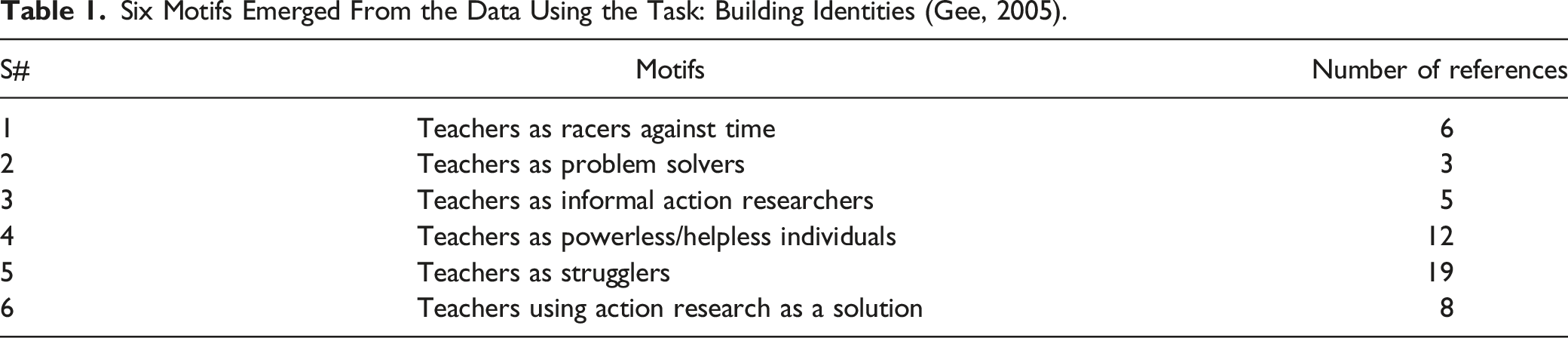
After an initial analysis was completed, it appeared that participants constructed different identities through their discourses while responding to the interview questions. Therefore, building identities was recognized as a focus for a macro level discourse analysis, as it related to the research question: How do teachers perceive action research for professional development at a private, English medium school in Pakistan? The following six motifs emerged across the three focus group interviews with the 12 teachers:
Building Identities
Six Motifs Emerged From the Data Using the Task: Building Identities (Gee, 2005).
Racers Against Time
It appeared that teachers identified themselves as racers running against time, constructing their identities as workers, who never seem to have enough time for innovation or to teach all linguistically and culturally diverse students, who work and learn at a different pace. For instance, three teachers constructed their identities as Pakistani teachers in comparison to American teachers, who (they assumed), did not face problems in teaching: Seema: In Pakistan, we have a totally different system as compared to America; they work till 5 o’ clock and have more time … Sara, Fareeha, and others: Some of the students are … very different and there is a lot of difference between the context (in Pakistan and the US) … some of the students are very hyper and we have to manage them …
Here, Seema constructs her own identity as a Pakistani teacher racing against time with the assumption that
Teachers as Strugglers
The maximum number of references found in the data were related to teachers constructing their identities as strugglers. They described themselves as struggling for academic support from administrators, students, and parents to address the needs of learners, especially concerning behavioral issues, which were hard for them to manage and control. Through their discourse they also positioned themselves as struggling language teachers, unable to meet the linguistic and cultural needs of their students, who communicated in their regional languages, and were neither fluent speakers of English nor Urdu. The teachers also constructed their identities as struggling to find solutions, expressing that even if they had solutions, they were unable to apply them because of the system. For instance, all teachers echoed Mahvish: Mahvish: This is the problem I was discussing. I may want to find a solution for this problem, and I may have a solution…but I Fareeha: We want to apply… but we SAM/others: [we Fareeha: Because of time management, because of curriculum re-write …we have got … or we have to do this, this is the first term, and you have to do this …and finish these chapters. Fareeha: If you
The reasons listed for I can’t apply it appear to link back to the belief that suggests a lack of agency and power to change things. Throughout their discourse teachers consistently identify the problem to be a mandated curriculum, and the lack of freedom to change the course syllabus, which is required to be taught a certain way and over a specific period of time. Teachers also portrayed themselves as struggling for self-improvement, struggling to learn, and wanting to enhance their abilities as teachers.
Teachers constructed their identities as powerless and helpless accounting for 12 references in the data, for instance: Seema: I think it [action research] is very helpful, but it should be implemented [willfully] not forced. Fareeha: Of course, action research is very helpful as a teaching technique or whatever you call it (Ghazal: but at the same time, you need a lot of help from the parents as well). Yes, exactly, from parents and from management. Ghazal: Because it’s like a cycle, a wheel, the parent, the teachers, the student, unless they are with us, we are helpless, we are helpless…
Teachers construct their identities as helpless and powerless, representing the will to bring about change conditional to the support from others, such as administrators, students, and their parents. The use of the words implemented and forced in Seema’s opening remark about action research is interesting. It appears from her discourse that if action research is implemented, it is applied as a necessary tool, and the word forced seems to suggest, that despite resistance from teachers, there is a likelihood that teachers may be pressurized to engage in action research against their will. This also gives an impression of the top-down, hierarchical environment, suggesting the possibility of other activities that are currently forced upon the teachers or were forced upon them in the past. Hence, a tone of resentment seems to accompany her discourse.
Teachers also co-constructed their identities as informal action researchers and problem solvers, using action research to solve their struggles in teaching. Throughout the discourse teachers constructed images of teaching as a problem they must address or were expected to address by the administrators and/or parents, indicating their disbelief that student learning was their responsibility alone, and not a shared endeavor shouldered with parents and administrators (Webster-Wright, 2009). Ghazal: We get together and discuss behavior problems, the plusses and minuses, and we do discuss when we have a behavior problem. Researcher: Yes, but action research is a whole process. Ghazal: I know, it can be done as you said in small groups … even 10 minutes would be fine if you get together after break, you can get together and discuss … that would also help … you don’t have to have a formal class, formal lecture or formal gathering of an hour or so … Mahvish: … the main problem is that the whole time I am trying to complete the syllabus, in whatever period whatever class, I am trying to cover my syllabus. I have to check my copies, I have to make students complete their work, I want them to learn and … to make them learn I have to make them … I like to do these activities, but the syllabus doesn’t let me, and I get very frustrated … that I have to complete my work … but my students are not learning, and I don’t like that …
Mahvish echoes other teachers at the school who feel they are helpless to address the academic needs of their students. She provides useful insight into her personal struggle as well as the shared struggles of her co-teachers. She begins by accepting that there is a problem and continues to provide a list of the things she must accomplish as a teacher, suggesting that she struggles with her role as a teacher. She confides that how what she is teaching is ineffective, since the students are not learning the way she would like them to. Through her discourse she creates an identity of a struggling teacher who, is trying to do her job, but needs help.
Throughout the discourse the image of time as a valuable resource is constructed along with the identities of the teachers as helpless individuals or workers who must follow orders from their superiors without any agency of their own. Even the syllabus is personified to have the power to prevent activity-based learning. The participants also co-constructed their students’ identities as lazy, uninterested, and unmotivated, who have changed their minds not owing to the teaching in the classrooms but due to media, cable television, and other distractions.
Findings
The interpretation of the data analysis showed that most of the discourse constructed in the focus group interviews related to building identities. The three identities: racers running against time (Pakistani teachers vs. American teachers); teachers as helpless and powerless; and teachers as strugglers appeared to be connected to the larger Discourse in the Pakistani culture that positions teachers as powerless vis-a-vis the administration. The same finding is supported by Vazir and Retallick (2007) that teachers have less authority and power in the Pakistani society. This also echoes the hierarchical structure of colonialism, where the colonizer is accepted to have the upper hand and the colonized remain powerless without agency to make any change (Said, 1979). It is interesting to note that while the teachers do nothing to disrupt this hierarchical structure, they extended it further by positioning their students as powerless. Faize and Husain (2021) also reported students’ helplessness and their inability to cope with changes and academic problems. In this way they perpetuate the binary positioning applied to them by the administration and institutional policies that support an unequal power distribution (Freire & Macedo, 1998).
When a discourse alludes to other written or oral texts and/or Discourses it is known as intertextuality (Gee, 2005). The three focus groups provided ample evidence of intertextuality where positivist frames of reference position people with knowledge such as teachers, parents, and elders with unquestionable authority. The same holds true for people in authority such as senior workers in an institution. Hence, the teachers’ discourse was one of powerlessness, helplessness, and struggle when they spoke of the challenges, they face in teaching with reference to the school policies. However, when they spoke of their students, they positioned them as powerless, constructing their identities as individuals who should be managed, controlled and disciplined, thereby continuing the post-colonial Discourse of colonized/colonizer.
The data interpretation also points to several characteristics of banking education and highlights the unequal status between the teacher and the students (Freire & Macedo, 1998). It was conveyed that the teacher teaches, has knowledge, possesses the ability to think, talk, discipline, choose, and is identified as the subject in the process of learning. On the other hand, students were like objects to be taught, and to learn as passive followers, who listen, and are to be disciplined (Freire & Macedo, 1998). Hence, this binary reinforces the inequity existing in the teacher–student relationship which becomes a relationship of oppressor and oppressed.
In terms of the research question, the findings show that participants perceive themselves to be powerless in taking ownership of their professional development and view action research as a viable form of teacher professional development only if the required support was provided to them by the administration, parents, and school leaders. Support, for them, included providing extra time for participation in action research activities and flexibility in completing the school-mandated syllabus and related duties.
Discussion
From the findings of this study, it appears that action research may be used to address the need for effective teacher professional development in Pakistan. Clarke and Fournillier (2012) suggest that teacher educators need to be more open to sharing, questioning, modeling, examining, implementing, and reflecting on their own teaching. However, support in terms of time and guidance to complete action research projects may be provided.
Professional development experts may work with teachers and teacher educators to focus on deconstructing traditional positivist epistemologies to create space for constructivist frames of reference that acknowledge the funds of knowledge teachers and students bring with them and provide space for equity in the Pakistani education system for teachers, students and administrators. It is suggested that future research and professional development aims to explore how assumptions related to power may be deconstructed in post-colonial contexts to pave the way for teacher learning and development.
Teachers can learn to effectively use action research provided they are given due institutional support. A step in this regard would be to include action research as a subject in teacher education programs and educate teacher educators who can then provide pre-service and in-service teachers with the guidance and support needed to practically undertake action research projects within their classrooms and educational institutions (Halai, 2011). Future researchers may also study other post-colonial contexts to understand how teachers perceive the opportunity to incorporate action research in their practice.
One of the limitations of our study was the brief time in which teachers were exposed to the concept of action research in the classroom or to the role of the teacher-as-a-researcher. Future researchers may include a course on how to conduct action research in the classroom for teachers as they engage in guided action research initially. Another limitation of this study was related to exploring teachers’ perception of themselves and of action research over time. It would have been enlightening to reconnect with the participants to gauge whether they re-considered their initial response to action research as a tool that is appropriate for teachers working in Western contexts and later decided to give it a try. This was made difficult for us due to Covid-19 restrictions and extended lockdowns in schools. Future researchers may initiate longitudinal studies that provide data that spans overtime.
Footnotes
Acknowledgments
We offer special thanks to Sana Zafar and Katherine C. Alexander for their helpful comments during the review process.
Declaration of Conflicting Interests
The author(s) declared no potential conflicts of interest with respect to the research, authorship, and/or publication of this article.
Funding
The author(s) received no financial support for the research, authorship, and/or publication of this article.

Appendix
Focus group interview guide for Participants to explore:
How teachers perceive action research for professional development at a private, K-12 English medium school in Pakistan
Background questions: 1. How long have you been teaching? 2. How would you describe your experiences learning to teach? 3. How prepared do you feel you were, when you started teaching? 4. Do you feel that professional development (PD); in the form of pre-service training or in-service training, might have helped ease you into the job requirements of the teaching profession? 5. How effective was the teacher education/PD that you received (if so)? 6. What kind of PD do you think would have helped? Questions related to AR: 7. What do you think of action research for professional development? 8. What were some of the things that stood out to you during the presentation on action research (in this study)? 9. What do you see as potential advantages of AR for teacher professional development? 10. What do you see as potential disadvantages of AR for teacher professional development? 11. How effective do you think AR could be if you were to try it out in your classroom? 12. What support do you think you might need to successfully integrate AR in your practice? 13. What are the challenges you anticipate in integrating AR in your own practice? 14. In your context how might AR help to improve student-teacher learning opportunities when teaching English to students from diverse linguistic/cultural backgrounds?